Although there are numerous studies dealing with a wide array of animal welfare issues, less is known about practical aspects such as the voluntary movements of farmed animals, which are related to different farming aspects including livestock handling, stockmanship and human-animal interaction, design of the farm and facilities. Voluntary movements of cattle have been studied in different situations. Several studies have shown that a consistent order of entry into the milking parlour is a prominent feature of the social system of dairy cattle (Rathore, Reference Rathore1982; Grasso et al. Reference Grasso, De Rosa, Napolitano, Di Francia and Bordi2007; Berry & McCarthy, Reference Berry and McCarthy2012). Milking order can be influenced by several factors, for example: social rank (Reinhardt, Reference Reinhardt1973; Melin et al. Reference Melin, Hermans, Petterson and Wiktorsson2006), health (Rathore, Reference Rathore1982; Flower et al. Reference Flower, Sanderson and Weary2006; Polikarpus et al. Reference Polikarpus, Kaart, Kokin, Veermäe and Poikalainen2011) and productivity (Gadbury, Reference Gadbury1975; Gόreckio & Wόjtowski, Reference Gόrecki and Wόjtowski2004). In addition, it has been demonstrated that some cows are consistent in their choice of one particular side of the milking parlour, showing a clear side preference (Hopster et al. Reference Hopster, van der Werf and Blokhuis1998; Paranhos da Costa & Broom, Reference Paranhos da Costa and Broom2001; Grasso et al. Reference Grasso, De Rosa, Napolitano, Di Francia and Bordi2007). Some factors such as dominance and social structure of the herd, but also individual characteristics such as anxiety, fear, stress, sensitivity, can influence side preference (Hopster et al. Reference Hopster, van der Werf and Blokhuis1998; Prelle et al. Reference Prelle, Phillips, Paranhos da Costa, Vandenberghe and Broom2004). In addition, behavioural lateralisation may bias the choice of individual animals towards a particular side of milking parlour. Behavioural lateralisation has been demonstrated in a wide array of farm animals such as horses (Komárková & Bartošová, Reference Komárková and Bartošová2013), sheep (Versace et al. Reference Versace, Morgante, Pulina and Vallortigara2007) and cattle (Phillips et al. Reference Phillips, Llewellyn and Claudia2003; Robins & Phillips, Reference Robins and Phillips2010).
There has been intense debate about the meaning of animal behavioural needs (Dawkins, Reference Dawkins1983; Hughes & Duncan, Reference Hughes and Duncan1988; Jensen & Toates, Reference Jensen and Toates1993; De Rosa et al. Reference De Rosa, Grasso, Pacelli, Napolitano and Winckler2009). Currently a consensus has been reached that, when animals are prevented from performing specific behavioural patterns, a negative psychological state may arise and animal welfare may be impaired (Jensen & Toates, Reference Jensen and Toates1993). Negative emotional states such as fear and frustration may render it less likely that animals do what a stockperson wants (Dawkins, Reference Dawkins1990). Conversely, a certain degree of environmental control, which is achieved when animals are able to predict changes in the surrounding environment and access to specific resources when needed, may induce a positive state of wellbeing (Napolitano et al. Reference Napolitano, Knierim, Grasso and De Rosa2009). Milking routine can affect cows’ welfare, and some authors have suggested that drift from preferred behaviour may cause stress during milking (Hopster et al. Reference Hopster, van der Werf and Blokhuis1998; Munksgaard et al. Reference Munksgaard, De Passillé, Rushen, Herskin and Kristensen2001; Rushen et al. Reference Rushen, Munksgaard, Marnet and De Passillé2001). Machine milking involves several physical and psychological factors which can lead to difficulties in milk letdown, for example poor maintenance of milking equipment or negative behaviour of the stockman (Saltalamacchia et al. Reference Saltalamacchia, Tripaldi, Castellano, Napolitano, Musto and De Rosa2007). During milking buffaloes are more sensitive to stress stimuli than cattle (Thomas, Reference Thomas2004). If animals are stressed adrenaline is secreted, and this may reduce the supply of oxytocin necessary for milk letdown. This is exacerbated in buffaloes, since about 95% of the milk stored in the udder is constituted of the alveolar fraction, which needs oxytocin to be ejected (Thomas et al. Reference Thomas, Svennersten-Sjaunja, Bhosrekar and Bruckmaier2004; Neglia et al. Reference Neglia, Saltalamacchia, Thomas and Rasmussen2008). Owing to this particular udder anatomy and milk ejection physiology, even small changes in the milking routine may render the animal uncomfortable and impair milk letdown. This may explain why in buffaloes stock-people use exogenous oxytocin in order to allow a complete evacuation of milk from the udder more commonly than in other dairy animals (Saltalamacchia et al. Reference Saltalamacchia, Tripaldi, Castellano, Napolitano, Musto and De Rosa2007; Neglia et al. Reference Neglia, Saltalamacchia, Thomas and Rasmussen2008).
When this procedure becomes routine, several detrimental effects are likely to occur: milking time, labour costs and drug administration costs increase, while animal welfare (in terms of frustration of behavioural needs and possible formation of abscesses consequent to frequent injections) and stockpersons safety (restlessness may be induced by undesirable position and entrance order, as well as by painful injections) decrease (De Rosa et al. Reference De Rosa, Napolitano, Grasso, Pacelli and Brodi2005).
Therefore, in buffaloes complete milk ejection may be easily impaired, and even small changes in the management routine can influence the milking process and buffalo behaviour during milking.
Studies on the behaviour at milking of dairy animals have mainly focused on cattle. While some research on milking order has been done on small ruminants (Wasilewski, Reference Wasilewski1999; Villagria et al. Reference Villagra, Balasch, Peris, Torres and Fernandez2007) little is known about dairy buffaloes. Therefore, the aim of this study was to assess the consistency of the entrance order into the milking parlour and side preference of dairy buffaloes.
Materials and methods
Farms and milkings
The study was carried on two commercial dairy buffalo farms located in the Campania Region, Southern Italy. The first farm (Farm 1) was situated in the Sele Plain (40°17′N, 15°13′E), and the second (Farm 2) was positioned in the Volturno Plain (41°18′N, 14°15′E). Animals were group-housed in a loose open-sided barn with a concrete floor in the lying area, covered with dried manure solids as bedding. They had free access to an outdoor loafing area. After morning milking animals were offered a complete mixed diet for ad-libitum consumption. Drinking facilities consisted of ample troughs.
On Farm 1 all buffalo cows were primiparous and had been brought from several farms in the surrounding area as pregnant heifers. A total of 130 consecutive milkings per cow (from the mid-July to the end of November 2011) of a group of 57 primiparous cows were used in this study. Buffaloes were milked in the morning once a day with a 2×5 auto-tandem milking parlour. The age at calving was 37·2±1·1 months. The mean days in milk (DIM), and milk yield per milking session, at the beginning of the experiment were 135±22 d (median=132 d, range=102–166 d) and 5·9±1·5 kg (median=5·8 kg, range=3–10·5 kg) respectively. On this farm the bulls were kept together with females throughout the year.
On Farm 2, two milking groups were used. In the first group 120 consecutive milkings per cow (from mid-March to mid-May 2012) of 55 buffalo cows (3 primiparous, 16 secondiparous and 36 multiparous; range=1–8) were collected, while in the second group 92 consecutive milkings per cow (from the end of March to mid-May 2012) of 36 buffalo cows (12 primiparous, 10 secondiparous and 14 multiparous; range=1–10) were considered. Buffaloes were milked twice a day with a 2×6 auto-tandem milking parlour. Mean DIM at the beginning of the experiment was 59±27 d (median=60·5 d, range=3–103 d) and 136±88 d (median=114 d, range=57–290 d) for groups 1 and 2, respectively. Milk yields per milking session at the beginning of the experiment were 6·2±2·1 kg (median=5·5 kg, range=1·9–11·3 kg) and 3·4±1·1 kg (median=3·3 kg, range=1–6·7 kg) for groups 1 and 2, respectively. This farm practised the out-of-breeding-season-mating technique, consisting of keeping the bulls with females from March to September, calving between the end of January and the beginning of August when the demand for mozzarella cheese is highest.
The differences in milk yields per milking session are due to the fact that animals from Farm 1 were all primiparous in the late stage of lactation (standard lactation of a buffalo cow is 270 d); whereas animals from Farm 2 group 1 were mainly multiparous in an early stage of lactation.
The milking routine of the two farms was similar. Before milking, whole groups entered the waiting area (approximately 100 and 120 m2 for Farm 1 and Farm 2, respectively) and, within the social constraints of the group, the animals were free to choose their position in relation to the side and entrance order into the milking parlour (i.e. there was no intervention by the stockman). The two sides of the parlour were identical and access to both sides was allowed through pneumatically operated gates. In the parlour, cows stood nose to tail in individual stalls, with entry and exit through side passages. In each stall, the identity of the cow was automatically recorded by a pedometer fitted at the metatarsus. The milking equipment on Farm 1 was the AFIMILK® system (S.A.E. AFIKIM, Israel), whereas on Farm 2 the ALPRO® system (De Laval, Sweden) was used. These systems allow the collection of all data from the milking parlour, including the time of milking, number of milking stall, milk yield and duration of milking. The auto-tandem milking system allows cows to enter the parlour as soon as a stall becomes available. The entrance order was determined on the basis of time of milking. Thus, the earlier a cow was milked the lower was its entrance order. For each milking session, the entrance order in the milking parlour ranged from 1 to 57 for Farm 1, from 1 to 55 for group 1 of Farm 2 and from 1 to 36 for group 2 of Farm 2. During the collection of data no animals were added or removed from the three groups.
Statistical analysis
The data were analysed using nonparametric statistical tests. For each milking group, the consistency of the entrance order was computed using the Kendall concordance coefficient. This statistical test allows measurement of the extent of association among several milking sessions of several cows (Siegel, Reference Siegel1956). In addition, in order to test whether the consistency of entrance order was influenced by the temporal proximity of milking sessions, a reduced data set was used. For each milking group, we used the first 15% and the last 15% milking sessions. Thus, 40 (20+20), 36 (18+18) and 28 (14+14) milking sessions were used for Farm 1, group 1 Farm 2 and group 2 Farm 2, respectively. The correlations between mean entrance order vs. mean milk yield, mean DIM and mean duration of milking were calculated using the Spearman correlation coefficient. The same test was used to calculate the correlation between mean entrance order and parity within group 1 Farm 2 and group 2 Farm 2. For each cow, side preference in the milking parlour was assessed using the χ2 one-sample test, with 50% as the expected frequency. However, it was considered a side preference only if an animal chose a particular side on more than 80% of the milking sessions. For the animals showing side preference, the preference for one stall out of the 5 (Farm 1) or 6 (Farm 2) available on each side was assessed using the χ2 one-sample test, with 20% (Farm 1) or 16·7% (Farm 2) as expected frequencies. It was considered a stall preference only if an animal chose a particular stall on more than 40% (Farm 1) or 34% (Farm 2) of the milkings occurring on the preferred side.
Results
Farm 1
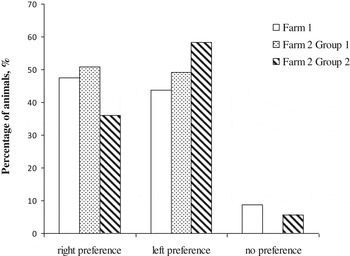
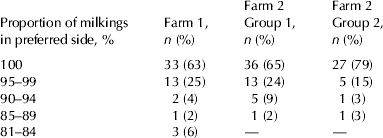
A consistency of entrance order into the milking parlour was found either for the complete data set (W=0·658; χ2=4792·81; P<0·001) or the reduced data set (W=0·651; χ2=1457·251; P<0·001). More productive cows tended to enter the milking parlour first (r s =−0·221; P<0·10). Twenty-seven cows (47·4%) preferred the right side of the milking parlour, 25 the left side (43·8%) and the remaining five (8·8%) showed no preference (Fig. 1). Thirty-three out of 52 animals (63%) showing preference were milked on 100% of occasions on the preferred side, whereas for the remaining 19 this occurred on 81–99% occasions (Table 1). Nine of the animals showing a side preference also exhibited a stall preference (χ2 ranged from 42·89 to 361·15; P<0·001) with 42–91% of visits to the same stall.
Percentage of buffalo cows from the three milking groups expressing side preference in the milking parlour. A preference was considered as such only when animals chose a particular side on more than 80% of occasions.

Distribution of animals according to different levels of a side preference

Farm 2 group 1
A strong consistency of entrance order into the milking parlour was found either for the complete data set (W=0·779; χ2=5046·81; P<0·001) or the reduced data set (W=0·718; χ2=1395·24; P<0·001). Animals with a higher DIM tended to enter the milking parlour latterly (r s =0·243; P<0·10). More productive cows tended to enter the milking parlour first (r s =−0·215; P<0·10). Negative correlations were found between mean entrance order into the milking parlour vs. duration of milking and (r s =−0·265; P<0·05) and vs. parity (r s =−0·319; P<0·05).
All the animals showed a side preference. Twenty-eight cows (50·9%) preferred the right side of the milking parlour and the remaining 27 (49·1%) the left side (Fig. 1). Thirty-six out of 55 animals (65%) were milked on 100% of occasions on the preferred side and the remaining 19 on 87–99% occasions (Table 1). Seven of the animals showing a side preference also exhibited a stall preference (χ 2 ranged from 56·38 to 163·88; P<0·001) with 37–52% of visits to the same stall.
Farm 2 group 2
As for the other milking groups, a strong consistency of the entrance order into milking parlour was found either for the complete data set (W=0·624; χ2=2030·48; P<0·001) or the reduced data set (W=0·657; χ2=643·66; P<0·001). Animals with higher DIM entered the milking parlour latterly (r s =0·334; P<0·05). A negative correlation was found between mean entrance order into and parity (r s =−0·325; P<0·05). No significant correlations were found among the other variables collected.
Thirteen cows (36·1%) preferred the right side of the milking parlour, 21 the left side (58·3%) and the remaining two cows (5·6%) showed no preference (Fig. 1). Twenty-seven out of 34 animals (79%) showing a preference were milked 100% of times on the preferred side, and for the remaining seven animals this occurred 85–99% of times (Table 1). Five of the animals showing a side preference also exhibited a stall preference (χ2 ranged from 38·95 to 107·58; P<0·001) with 39–53% of visits to the same stall.
Discussion
This study widens the array of dairy species showing consistent milking order and location preferences into the milking parlour, which may be regarded as a behaviour common to all animals subjected to machine milking. Strong consistency of the order of entry into the milking parlour in all the groups shows that buffaloes do not enter the milking parlour randomly. This is similar to results reported for cattle (Grasso et al. Reference Grasso, De Rosa, Napolitano, Di Francia and Bordi2007; Polikarpus et al. Reference Polikarpus, Kaart, Kokin, Veermäe and Poikalainen2011), sheep (Wasilewski, Reference Wasilewski1999; Villagria et al. Reference Villagra, Balasch, Peris, Torres and Fernandez2007), and goats (Gόreckio & Wόjtowski, Reference Gόrecki and Wόjtowski2004). Furthermore, if the absolute value of the Kendall coefficient (W) of concordance is taken into account, it was found that buffalo cows yielded a higher value (W ranges 0·620·78) than either cattle (W=0·36, Grasso et al. Reference Grasso, De Rosa, Napolitano, Di Francia and Bordi2007) or sheep (W=0·23, Wasilewski, Reference Wasilewski1999). This strong consistency was also found for the reduced data set, where the temporal distance among milking sessions was high (90, 42 and 32 d for Farm 1, group 1 Farm 2 and group 2 Farm 2, respectively). Therefore, as buffaloes have a more consistent entrance order than other ruminants, it can be hypothesised that for buffaloes there is a higher motivation to maintain entrance order, and consequently higher behavioural disturbance if it is forcefully changed (e.g. by stockpeople).
Some authors have reported that higher-yielding dairy cows (Rathore, Reference Rathore1982; Grasso et al. Reference Grasso, De Rosa, Napolitano, Di Francia and Bordi2007; Berry & McCarthy, Reference Berry and McCarthy2012) and goats (Gόreckio & Wόjtowski, Reference Gόrecki and Wόjtowski2004) enter the milking parlour earlier. In this study, there was only a tendency for more productive cows in two of the milking groups to enter the milking parlour first. In addition, in the other milking group, a significant negative correlation between duration of milking and order of entry in the milking parlour was found, which could also be explained by the higher-yielding animals entering the parlour earlier. These results only partly support the hypothesis that, like other ruminants, high producing buffaloes may be more motivated to enter the milking parlour first. Therefore, also owing to the low value of correlation coefficients, further studies are needed before reaching any final conclusion.
Previous works on goats (Margetínová et al. Reference Margetínová, Brouček, Apolen and Mihina2003) and cattle (Willems & Lampo, Reference Willems and Lampo1964) reported that older animals entered the milking parlour earlier, whereas other studies on cattle (Gadbury, Reference Gadbury1975; Berry & McCarthy, Reference Berry and McCarthy2012) showed different results (i.e. older cows entered the milking parlour later). In this study, negative correlations were found between mean entrance order and parity for both groups of Farm 2. These results may be related to the higher production and/or to the higher social rank, both possibly associated with a higher parity. However, further investigations are needed into the possible effects of dominance and affiliative relationships on entrance order.
Side preference was very high in all groups. Previous work on dairy cows reported similar results in terms of general trends, although frequencies of side preference were much lower than those reported in this study on dairy buffaloes (Hopster et al. Reference Hopster, van der Werf and Blokhuis1998; Paranhos da Costa & Broom, Reference Paranhos da Costa and Broom2001; Grasso et al. Reference Grasso, De Rosa, Napolitano, Di Francia and Bordi2007). Factors that could affect side choice include milking technique, social behaviour, laterality, neurological development and daily routine, including interaction with humans (Hopster et al. Reference Hopster, van der Werf and Blokhuis1998; Paranhos da Costa & Broom, Reference Paranhos da Costa and Broom2001; Phillips et al. Reference Phillips, Llewellyn and Claudia2003; Grasso et al. Reference Grasso, De Rosa, Napolitano, Di Francia and Bordi2007). Dairy cows tend to select the most attractive side or avoid the unattractive side (Hopster et al. Reference Hopster, van der Werf and Blokhuis1998); therefore, each animal should be able to choose its favourite side of the milking parlour in order to feel comfortable during milking (Grasso et al. Reference Grasso, De Rosa, Napolitano, Di Francia and Bordi2007). Entering the milking parlour from the non-preferred side might result in the stress response during milking (Hopster et al. Reference Hopster, van der Werf and Blokhuis1998), which would reduce the animal's milk yield (Wasilewski, Reference Wasilewski1999). Buffaloes seem even more sensitive to changes in the milking environment than other dairy animals and when they are uncomfortable they may withhold milk (Borghese et al. Reference Borghese, Rasmussen and Thomas2007).
Although both farms were equipped with auto-tandem milking parlours, which makes a precise choice of the stall by the animals difficult, in this study some buffalo cows were nevertheless able to express stall preference. Even if this finding seems difficult to interpret, the high entrance order consistency and side preference expressed by buffaloes along with other factors, such as affiliative relationships, may have determined for some of them also a stall preference.
This result further indicates that buffaloes are very consistent in their milking routine, order of entry and location choices. Therefore, these animals should be, as far as possible, free to choose location and time of entry based on their preferences.
Conclusions
It is concluded that dairy buffaloes express strong consistency in their order of entry into the milking parlour. The majority of the animals expressed a side preference and most animals showing preference were milked on 100% of occasions on the preferred side, which along with other factors, may have determined in 21 animals also a stall preference. Such a strong consistency is likely to be related to an equally strong motivation to satisfy their behavioural needs. Therefore, handling practices disturbing behaviour at milking (e.g. forced modification of entrance order, unavailability of the preferred side or stall) should be avoided to minimise animal stress and maximise farming profits, particularly in dairy buffaloes, which seem more sensitive than other dairy animals to changes in the milking routine.
Thanks are due to the farms ‘Leone Alberto’ (Capaccio, SA, Italy) and ‘Casearia Artigiana’ (Baia e Latina, CE, Italy) for providing their milking data and to Giovanni Migliori for expert technical assistance. We also thank David Arney and two anonymous referees for improving the draft of the manuscript. This research was supported by European Social Fund's Doctoral Studies and Internationalisation Programme DoRa, of the Archimedes Foundation (Estonia) which provided a scholarship for A.P.