Introduction
In the tropics the genera Herpothallon and Cryptothecia are common and widely distributed crustose genera of lichenized fungi. Both are closely related, forming conspicuous cottony-byssoid crusts with trentepohlioid photobionts and asci not developing inside true ascomata. Species of Herpothallon were, until recently, included within Cryptothecia, but have been segregated by Aptroot et al. (Reference Aptroot, Thor, Lücking, Elix and Chaves2009): almost all species of Herpothallon are sterile, only one species, H. fertile, is known to produce isolated asci within pseudisidia and ascospores with straight, not curved septa (as is characteristic for Cryptothecia). All species typically have abundant pseudisidia, i.e., isidioid outgrowths that, despite their similarity to true isidia, lack internal differentiation and have no distinct cortex. In many species pycnidia develop inside these pseudisidia. The medulla of all but one species does not react with iodine; only H. philippinum has a patchy I+ blue medulla. Cryptothecia can generally be distinguished because species in that genus generally do not form pseudisidia (although granules may be present on the thallus surface); instead their thalli are typically fertile with asci loosely dispersed or closely aggregated within ascigerous areas. Frequently these areas develop into pustulate outgrowths, and the specimens have a medulla that, at least in parts, reacts blue with iodine.
In the Galapagos, species of both genera are common and abundant in the humid forests of the highlands, some venture into the transition zone, and only few occur in the dry zone. With its bright carmine red pigmentation the ‘Christmas Lichen’ Herpothallon rubrocinctum is among the most conspicuous common lichens of the humid Galapagos highlands. Equally abundant and almost as conspicuous are the large white patches of Cryptothecia striata.
Despite being characteristic elements of the Galapagos lichen vegetation, not many species have been reported until recently. Weber's classical checklists (Weber Reference Weber1986, Weber Reference Weber1993, Weber & Beck Reference Weber, Beck, Robinson and Pino1985, Weber & Gradstein Reference Weber, Gradstein and Perry1984, Weber et al. Reference Weber, Gradstein, Lanier and Sipman1977) mention only two: Herpothallon rubrocinctum (as H. sanguineum) and Chiodecton effusum Fée (a record based on misidentifications of Sclerophyton murex and Cryptothecia darwiniana). This may not be surprising because at first glance the thalli of both genera have few diagnostic characters and analysis of their secondary chemistry is often necessary to distinguish the species.
As a result of the Galapagos Lichen Inventory (Bungartz et al. Reference Bungartz, Ziemmeck, Aptroot, Nugra, Bungartz, Herrera, Jaramillo, Tirado, Jímenez-Uzcategui, Ruiz, Guézou and Ziemmeck2010b) a total of ten species is reported here. These are included in our regularly updated online checklist (Bungartz et al. Reference Bungartz, Herrera, Jaramillo, Tirado, Jímenez-Uzcategui, Ruiz, Guézou and Ziemmeck2010a) as part of a large scale biodiversity inventory by the Charles Darwin Foundation with the long-term goal to establish a comprehensive Census of Life for the Galapagos Islands (Yánez et al. Reference Yánez, Dal-Forno, Bungartz, Lücking and Lawrey2011).
During the revision of historic specimens and recently collected material, it soon became evident that specimens of Cryptothecia darwiniana in particular, but to some extent also C. galapagona, both newly described, are characterized by an unusual anatomy and morphology. The specimens share some characteristics with the enigmatic Helminthocarpon leprevostii, a lichen of uncertain taxonomic position. Because of its lirellate ascomata this species is still often listed as a member of the Graphidaceae (Kirk Reference Kirk2011, Kirk et al. Reference Kirk, Cannon, Minter and Stalpers2011). Nevertheless, it was not included in our treatment of Galapagos Graphidaceae (Bungartz et al. Reference Bungartz, Lücking and Aptroot2010c ), because we agree with Staiger (Reference Staiger2002) and Aptroot (Reference Aptroot and Eriksson1999) that the genus belongs in the Arthoniales, not Ostropales. Aptroot (Reference Aptroot and Eriksson1999) suggested including Helminthocarpon within the Arthoniaceae, but the family concept within the Arthoniales was changed considerably in the most up-to-date revision by Ertz & Tehler (Reference Ertz and Tehler2011) and they did not include Helminthocarpon in their analysis. Its taxonomic position thus remains unclear.
Here we present short descriptions of all Galapagos species of Cryptothecia and Herpothallon with an identification key and we discuss how Helminthocarpon leprevostii shows similarities to these genera and other Arthoniales, evidence that strongly suggest that it belongs either in the Arthoniaceae or the Opegraphaceae sensu Ertz & Tehler (Reference Ertz and Tehler2011).
Methods
The Galapagos Archipelago comprises more than 123 oceanic islands, islets and large rocks that emerged from the sea as a result of volcanic hot spot activity; fourteen islands are somewhat arbitrarily recognized because of their size as the principal islands (Snell et al. Reference Snell, Stone and Snell1996). The Galapagos climate is unusually dry, with a hot and cool season and prevailing winds from the south and south-east (Trueman & d'Ozouville Reference Trueman and d'Ozouville2010). Five principal vegetation zones can be distinguished: coastal, dry, transition, humid, and high altitude dry zone (Bungartz et al. Reference Bungartz, Lücking and Aptroot2010c , Tye et al. Reference Tye, Snell, Peck, Adersen and Bensted-Smith2002).
As part of the Galapagos Lichen Inventory the following islands have been visited; all vegetation zones were surveyed: Isabela (Volcán Sierra Negra, Volcán Alcedo, Volcán Darwin), Santiago (incl. Rabida, Bartolomé), Santa Cruz (incl. Santa Fé, Plaza Sur, Plaza Norte, Roca Gordon, Pinzón), Pinta, Española, Floreana, and San Cristóbal.
Herbarium collections of the inventory are deposited at CDS; specimens from historic collections have also been examined (COLO, CAS, FH, H, S, B). All specimens were examined with a Zeiss Stemi DV4 dissecting microscope and a Zeiss Imager A1 compound microscope equipped with differential interference contrast. Macrophotographs were taken with a Nikon D300, 62 mm Nikkor Micro Lens and R1C1 macro flash directly in the field, or using a Novoflex macro-table to take images of herbarium specimens; for photographic magnifications higher than 1:1 an extension tube or Novoflex bellows was used. For microphotographs the compound microscope is equipped with a phototube for the Nikon D300. Photographs in the laboratory were taken with Nikon Camera Control Pro 2; all photographs were databased with the program IDimager 5 using the Darwin Core XML schema to embed collection and identification information as XMP metadata (http://owl.phy.queensu.ca/~phil/exiftool/TagNames/DarwinCore.html). Photos were processed with Photoshop CS4.
Secondary metabolites were examined from a selection of specimens using standardized thin-layer chromatography (Orange et al. Reference Orange, James and White2001, Reference Orange, James and White2010); instead of the conventional upright TLC tanks a horizontal HPTLC developmental chamber was used (Arup et al. Reference Arup, Ekman, Lindblom and Mattsson1993). TLC plates were documented with a Nikon D300 digital camera. Photographs were taken immediately after running the solvent, in long wave (366 nm) and short wave (254 nm) UV light, before applying 10% H2SO4. After H2SO4 treatment and charring in a laboratory oven for approx. 8 min at 110°C a second set of photographs in visible light and short wave UV (254 nm) were taken.
Due to the large number of specimens examined, collection data for only few representative examples are included here. Where available, at least one specimen per surveyed island (and, in the case of Isabela, the island's different main volcanoes) has been listed. Detailed collection information for all Galapagos specimens used in this study can be downloaded from the CDF Collections Database online at http://www.darwinfoundation.org/datazone/collections/.
Key to the species of Herpothallon and Cryptothecia from the Galapagos
-
1 Thallus ecorticate ... 2
Thallus corticate, with a dull to ±shiny, beige surface and beige to white, short and broad, ±lirellate ascomata, lacking isidia or soredia; medulla ILugol's− throughout ... Helminthocarpon leprevostii
-
2(1) Thallus ecorticate, of loosely interwoven hyphae, typically with a cottony surface; the thallus centre densely covered by pseudisidia (i.e., ecorticate isidia-like outgrowth that in a few species may be inhabited by a single pycnidium or a single ascus); medulla ILugol's− throughout, very rarely reacting ILugol's+ blue in parts* [Herpothallon] ... 3
*records of Galapagos specimens reported as Herpothallon philippinum by Aptroot et al. (Reference Aptroot, Thor, Lücking, Elix and Chaves2009) cannot be confirmed here, but the medulla of the newly described H. hypostictium also reacts in parts weakly I+ blue.
Thallus ecorticate, of loosely or densely interwoven hyphae, frequently with large quantities of crystals and then with a shiny, shimmery surface that almost appears corticate; rarely with scarce, loose granules or soredia, but all species generally lacking pseudisidia; thallus with irregular pustules or cushion-shaped outgrowths that contain few, scattered asci (ascigerous areas); medulla, or at least in parts, distinctly reacting ILugol's+ blue* [Cryptothecia] ... 9
-
3(2) Thallus and prothallus with a bright to rust red, K+ purple pigment; pigment occasionally scarce, but always present ... 4
Thallus and prothallus lacking reddish pigment, K not reacting purple ... 5
-
4(3) Thallus pale greenish grey, surrounded by a wide, bright carmine red prothallus, bearing bright carmine red pseudisidia in its centre; pseudisidia not known to contain pycnidia ... Herpothallon rubrocinctum
Thallus pale greyish to greenish white, prothallus concolorous or, at least in parts, distinctly rust red, pseudisidia concolorous with the thallus, but always with few, conspicuous, scattered rust red, needle-shaped pigment crystals; pseudisidia occasionally containing a single pycnidium ... Herpothallon rubroechinatum
-
5(3) Thallus forming fibrous strands of ±loosely interwoven hyphae on a whitish arachnoid prothallus bearing coarse, granular pseudisidia ... 6
Thallus thick, dense, cottony or thin and arachnoid, but then not forming distinct, fibrous hyphal strands; pseudisidia fine, powdery to distinctly cylindrical ... 7
-
6(5) Thallus K−, P− (perlatolic acid); on bark ... Herpothallon granulare
Thallus K+ yellow, P+ yellow (brialmontin 1 & 2, confuentic acid); on rock ... Herpothallon saxorum
-
7(5) Thallus P+ bright golden yellow (psoromic acid); with distinct, elongate cylindrical pseudisidia (occasionally containing a single pycnidium) ... Herpothallon echinatum
Thallus P− (lacking psoromic acid); pseudisidia granular to elongate cylindrical (not containing pycnidia) ... 8
-
8(7) Thallus thin, loosely arachnoid to dense and compact; prothallus white; with hypostictic and hyposalazinic acid; medulla in parts ILugol's+ weakly blue ... Herpothallon hyposticticum
Thallus thin, loosely arachnoid; prothallus conspicuously brown; with confluentic acid only; medulla ILugol's− thoughout ... Herpothallon aff. confluenticum
-
9(2) Thallus UV+ bright orange (always with xanthones), lime yellow to pale whitish yellow; surface smooth, compact, ±shiny ... Cryptothecia darwiniana
Thallus UV− (lacking xanthones), white to pale grey or beige with storage, when fresh sometimes with a ±greenish tinge, never yellowish; surface cottony or densely granular, not shiny; ... 10
-
10(9) Thallus C+ bright red, P−; surface with byssoid pustules or byssoid dots, but always lacking ‘soredia’ (pseudoisidiate granules) ... Cryptothecia striata *
Ascigerous areas confined to conspicuous, discrete, broad, cushion-shaped pustules, not arranged in distinct striae ... pustulate morphotype
Ascigerous areas in byssoid dots, when well developed typically arranged in distinct radial lines (striae) ... striate morphotype
Thallus C−, P+ yellow; surface densely covered by coarse ‘soredia’ (pseudisidiate granules) ... Cryptothecia galapagoana
Species Descriptions
Cryptothecia Stirt.
Proc. Roy. Philos. Soc. Glasgow 10: 164 (1876)
Cryptothecia darwiniana Bungartz & Elix sp. nov.
MycoBank no. 804737
Similar to Cryptothecia assimilis and C. lichexanthonica but with confluentic acid in addition to lichexanthone; ascospores much larger than those of C. lichexanthonica and only slightly larger than those of C. assimilis; of the 8 ascospores several often abortive.
Type: Ecuador, Galapagos Islands, Isla Floreana, Ladera N del Cerro Ventanas, 1°16′12″S, 90°25′49″W, alt. 400 m, zona húmeda, sobre corteza de tallo de Bursera graveolens, 27 iii 2006, Simbaña 556 (CDS 32392—holotype).
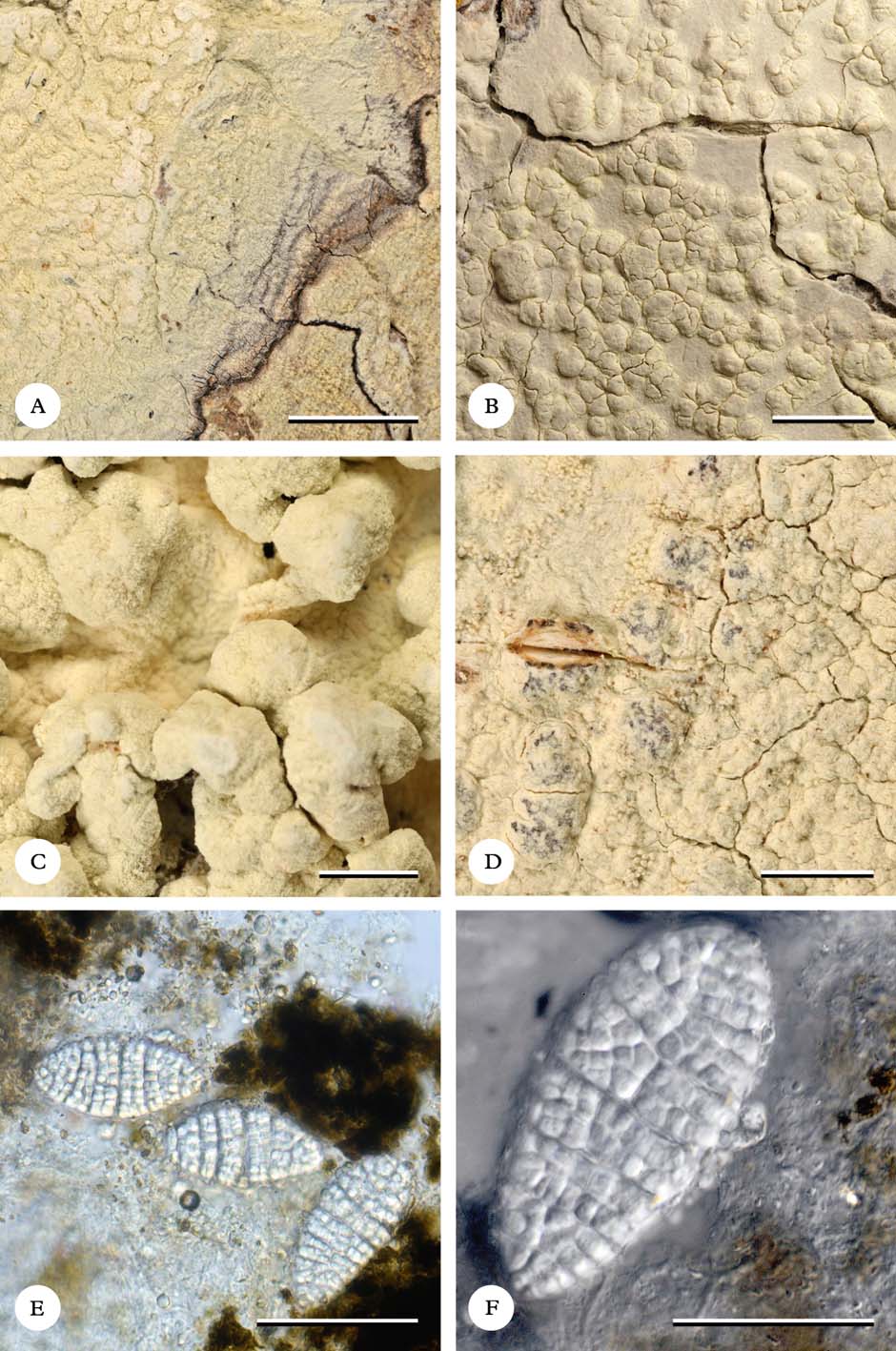
(Fig. 1)
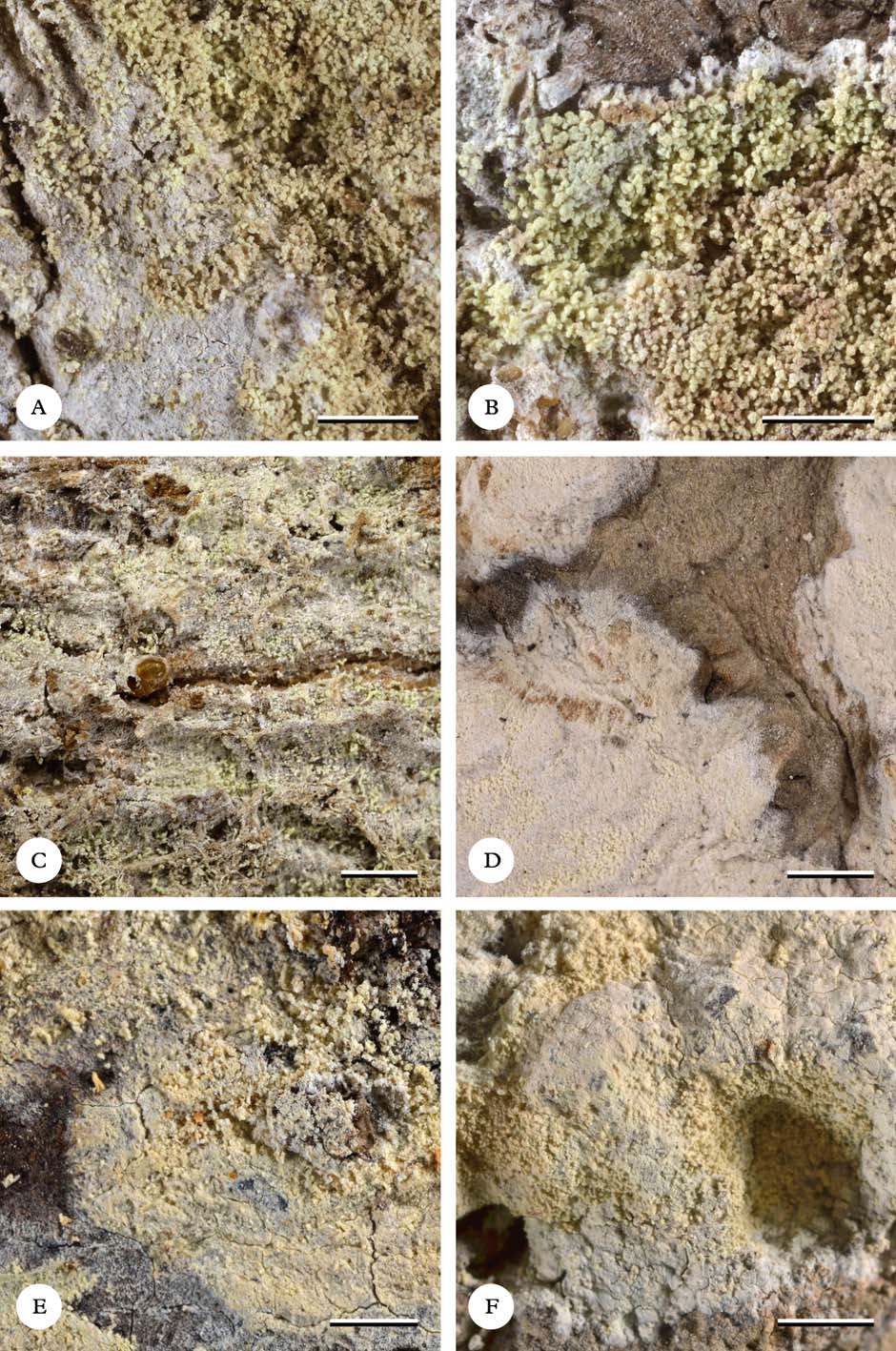
Cryptothecia darwiniana. A, general thallus aspect with brownish prothallus delimiting two thalli (holotype); B, flattened ascigerous pustules (Bungartz 5033); C, strongly swollen ascigerous pustules (Bungartz 5973); D section of ascigerous pustule with carbonized locules inside, locules often in irregular ramified lines (Aptroot 65296); E, ovoid, muriform ascospores, principal septa curved (holotype,); F, close-up of ovoid ascospore (holotype). Scales: A & B=5 mm; C & D=2 mm; E=70 µm; F=35 µm.
Thallus corticolous or lignicolous, delimited by a distinct byssoid prothallus of white to brownish, radiating hyphae; thallus surface smooth, shiny, ecorticate, yellowish white, with storage intensifying lemon yellow, occasionally with sparse granular ‘soredia’ (pseudisidiate granules); medulla white, densely filled with minute colourless crystals (soluble in KOH, not forming colourless, needle-shaped crystals in 25% H2SO4).
Ascigerous areas developing within roundish, broad, lemon yellow, pruinose, irregular pustules with a ±roughened surface which at maturity breaks open; asci bitunicate-fissitunicate, broadly pyriform to globose, with a short stalk, a thick wall (c. 21 µm) and thick tholus with small ocular chamber; occurring isolated within thalline pustules, entangled by strongly ramified and anatomizing, KI+ violet-blue paraphysoids; one to few asci with age encapsulated by a brownish pigmentation, eventually becoming carbonized forming ‘locules’ that are irregularly arranged or develop into striae, when eroded at their surface these ascigerous pustules thus appearing similar to ramified, carbonized lirellae; ascospores hyaline, K+ pale olivaceous, ovoid, muriform, with curved septa, (50–)60–85(–95)×(22–)32–40(–48) µm, typically 8 per ascus, but frequently 1–2(–3) spores aborted, these asci thus remaining (5–)6–7-spored.
Conidiomata not observed.
Spot tests and chemistry
P−, K−, C−, KC−; UV+ bright orange; medulla ILugol's+ deep blue; confluentic acid, lichexanthone.
Distribution and ecology
Currently known only from the Galapagos and possibly endemic; common throughout the dry zone and lower transition zone, currently known only from bark of native and endemic tree species, most commonly Bursera graveolens and Erythrina velutina, in sunny, wind- and rain-exposed habitats.
Notes
Two other Cryptothecia species with a UV+ bright yellow to orange fluorescence are currently known: Cryptothecia assimilis Makhija & Patw. described from India, and C. lichexanthonica E. L. Lima et al. described from Brazil. For C. assimilis Makhija & Patwardhan (Reference Makhija, Patwardhan, Sarma, Saini, Trivedi and Sharma1994 p. 63) mention a lichen substance that, when analyzed with TLC, gives a “UV+ bright yellow fluorescence; unknown yellow spot at atranorin (UV+ orange pink fluo.)”. Lima et al. (Reference Lima, Mendonça, Aptroot and Cácares2013) state that both C. lichexanthonica and C. assimilis contain lichexanthone, a substance also present in C. darwiniana.
The three species are very similar: according to Lima et al. (Reference Lima, Mendonça, Aptroot and Cácares2013) C. lichexanthonica has asci that are globose and not pedicellate, and its ascigerous areas are generally much smaller than those of C. assimilis. The ascospores of C. lichexanthonica (55–75×22–28 µm) are also smaller than those of C. assimilis (66–83×25–33 µm). Both species generally have 8 spores per ascus. The Galapagos specimens of C. darwiniana have distinctly pedicellate asci, their ascigerous areas vary considerably in size, but are generally larger than those of both of the other species, and, when very well developed, form distinct pustules. With ascospores 60–85×32–40 µm, C. darwiniana has the largest ascospores of the three, though only slightly broader than those of C. assimilis. Cryptothecia darwiniana is the only species to contain confluentic acid in addition to lichexanthone.
During our studies, the identity of C. darwiniana remained unresolved for a considerable time. Weber (Reference Weber1986) first reported Chiodecton effusum Fée for the Galapagos, a species cited as Syncesia effusa (Fée) Tehler by Elix & McCarthy (Reference Elix and McCarthy1998). The thalli are indeed superficially similar to those of Syncesia effusa, especially when the surface of the ascigerous pustules becomes abraded. Ascospores of Syncesia, however, are slender, fusiform, 3-septate, whereas those of Cryptothecia are broad, oblong to ovoid and muriform.
The record by Weber (Reference Weber1986) of Chiodecton effusum is even more confusing and a revision of the COLO specimens confirmed that this material was not Cryptothecia darwiniana. Instead most specimens of C. effusum in COLO are misidentifications of Sclerophyton murex Egea & Torrente ex Sparrius, and one specimen is Syncesia graphica (Fries) Tehler.
Reports of Syncesia effusa from Galapagos are thus erroneous, no material of that species was found in COLO and it has not been collected during our recent inventory.
Selected specimens examined. Ecuador: Galapagos: Isla Española, trail from Bahía Manzanillo on the N-coast of the island to the highest point, 1°21′41″S, 89°41′57″W, alt. 48 m, dry zone, on bark, 2010, Bungartz 9086 (CDS 45904); Bungartz 9125 (CDS 45943). Isla Floreana, along trail going to Post Office Bay off the dirt road between highlands and Puerto Velasco Ibarra, at Laguna Seca, 1°15′31″S, 90°26′27″W, alt. 206 m, dry zone, on bark, 2011, Bungartz 9530 (CDS 46813); inside the crater of Cerro Laguna at E-side of island, on W-exposed slope, 1°16′12″S, 90°23′17″W, alt. 245 m, transition zone, on bark, 2011, Bungartz 9941 (CDS 47310). Isla Pinta, along the trail up to the summit from the S-coast, 0°34′3″N, 90°44′56″W, alt. 233 m, transition zone, on bark, 2007, Bungartz 5973 (CDS 33651). Isla Pinzón, along the trail going up from Playa Escondida, 0°36′10″S, 90°40′1″W, alt. 254 m, dry zone, on bark, 2006, Bungartz 3639 (CDS 27457), Aptroot 64116 (CDS 30677). Isla San Cristóbal, north-western foothills of Media Luna, inland from the NW-coast, 0°43′41″S, 89°18′44″W, alt. 75 m, dry zone, on bark, 2007, Bungartz 6177 (CDS 34389). Isla Santa Cruz, above Mina Granillo Rojo, on the N-side of the island, 0°37′4″S, 90°21′57″W, alt. 600 m, transition zone, 2008, Clerc 08-27 (CDS 39881); along the road from Bellavista to El Garrapatero, c. 4 km W from the campsite of the National Park, 0°40′38″S, 90°14′54″W, alt. 159 m, dry zone, on bark, 2006, Bungartz 3569 (CDS 27368); along the road from Bellavista to El Garrapatero, c. 4 km W from the campsite of the National Park, 0°40′38″S, 90°14′54″W, alt. 159 m, dry zone, on bark, 2006, Aptroot 63979 (CDS 30539). Isla Santiago, c. 5 km inland from the E-coast, ± at the same latitude as Bahía Sullivan, 0°16′52″S, 90°37′17″W, alt. 175 m, dry zone, on bark, 2006, Bungartz 5033 (CDS 29246, ), c. 7 km inland from the E-coast, ± at the same latitude as Bahía Sullivan, 0°17′4″S, 90°38′21″W, alt. 190 m, dry zone, on bark, 2006, Bungartz 5088 (CDS 29301); en el parte sureste de la isla, 0°17′5″S, 90°38′35″W, alt. 160 m, zona seca, sobre corteza, 2006, Nugra 114 (CDS 32768). Isla Isabela, Volcán Alcedo, along the trail going up the E-slope, basalt rubble field to the SE-side of the trail and the barranco, 0°24′6″S, 91°2′53″W, alt. 530 m, dry zone, on bark, 2006, Aptroot 64914 (CDS 31493); alt. 434 m, on bark, 2006, Aptroot 64981 (CDS 31561); plain at the base of the outer E-exposed slope, along the trail going up to the rim, 0°24′47″S, 91°4′12″W, alt. 768 m, transition zone, on bark, 2006, Aptroot 65184 (CDS 31768); Volcán Sierra Negra, area around the Muro de las Lagrimas, ca. 5 km W of Puerto Villamil, 0°57′54″S, 91°0′49″W, alt. 81 m, dry zone, on bark, 2008, Bungartz 8399 (CDS 41045); Cerro Orchilla, ca. 4 km W of Puerto Villamil, 0°57′47″S, 91°0′27″W, alt. 56 m, dry zone, on bark, 2008, Bungartz 8473 (CDS 41119).
Cryptothecia galapagoana Bungartz & Elix sp. nov.
MycoBank no. 804738
Cryptothecia with pustulate ascigerous areas, typically covered by coarse pruina and granular soredia, reacting P+ yellow, K+ yellow, containing confluentic, 2'-O-methylperlatolic, and 2'-O-methylmicrophyllinic acids.
Type: Ecuador, Galapagos Islands, Isla Pinzón, along the trail going up from Playa Escondida, SW-slope of the top, 0°36′36″S, 90°40′11″W, alt. 310 m, transition zone, dry transition zone with Prosopis juliflora, Opuntia galapageia ssp. macrocarpa, Croton scouleri, Cordia lutea, Scalesia baurii ssp. baurii, on Opuntia, 16 ii 2006, Aptroot 64075 (CDS 30636—holotype).
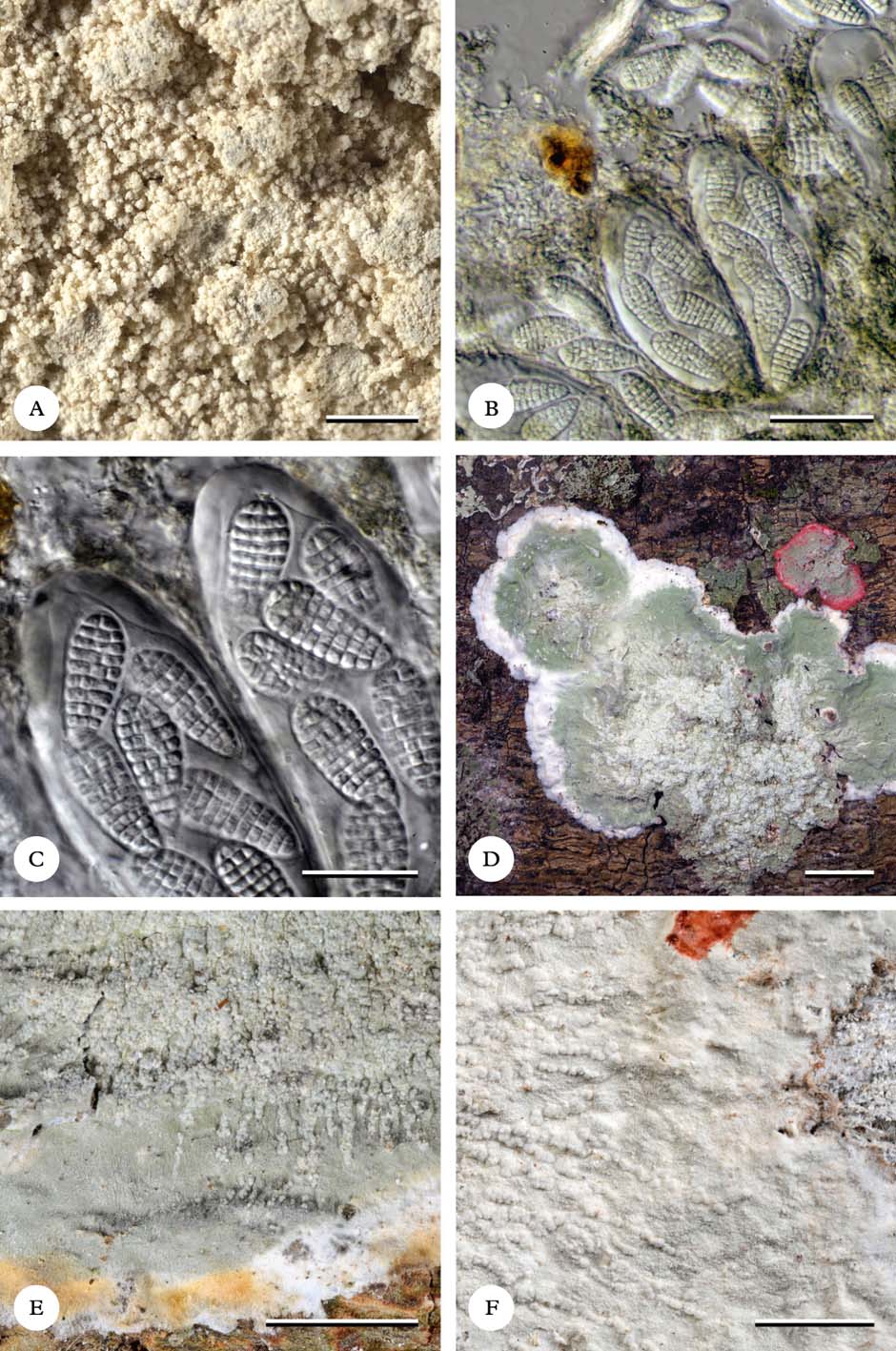
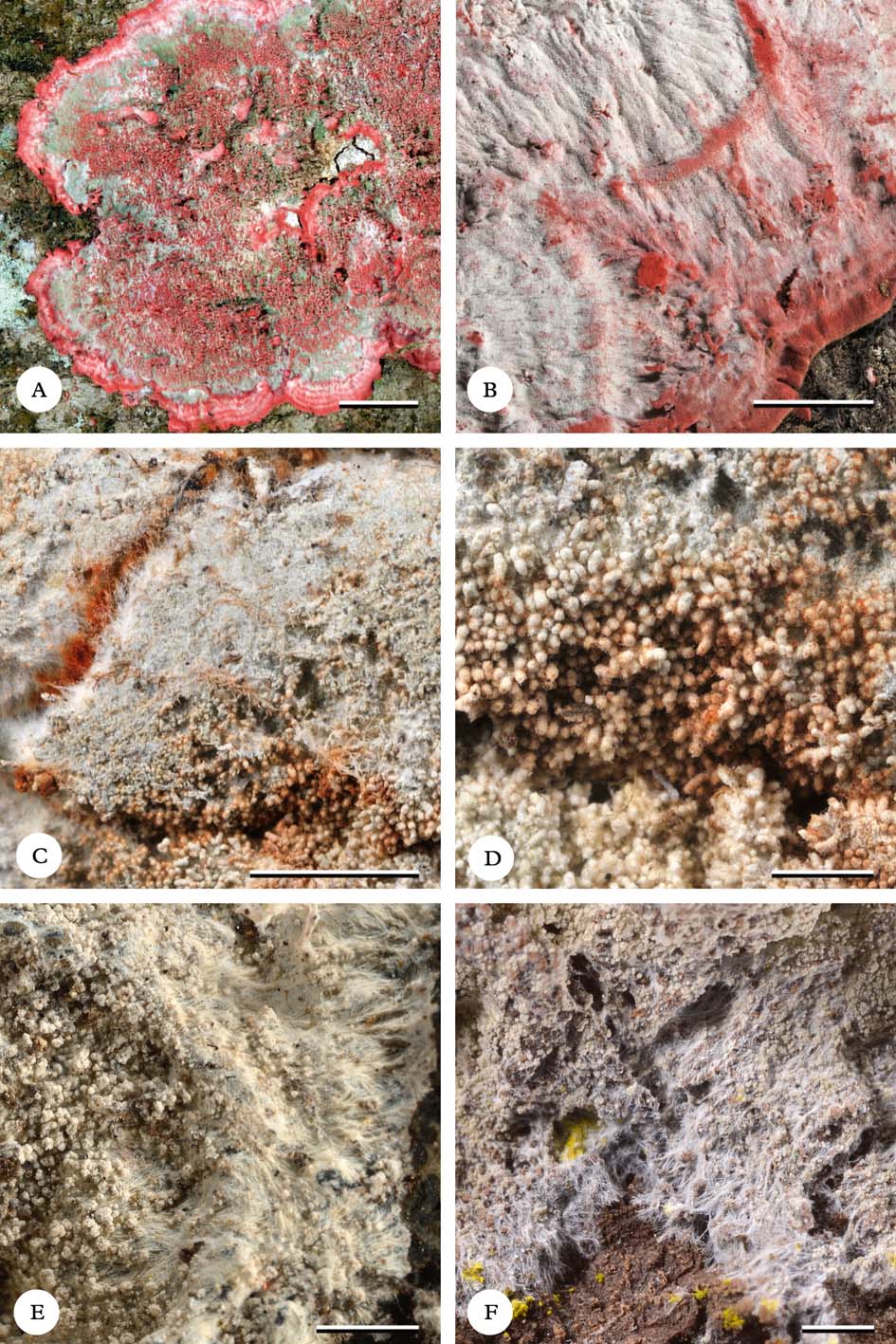
A–C, Cryptothecia galapagoana; A, general thallus aspect with ascigerous pustules covered by granules (holotype); B, broadly pyriform asci with ovoid, muriform ascospores (Aptroot 64081); C, apices of two asci with thick bitunicate-fissitunicate tholus with small ocular chamber, spores ovoid, muriform with faintly curved septa (Aptroot 64081). D–F, Cryptothecia striata; D, general growth aspect of several merged thalli (Bungartz 4314); E, thallus close-up, white prothallus with pale yellowish discoloration, ascigerous areas punctiform, radiating in distinct striae towards the margin, merging in the centre (Nugra 887); F, close-up of thallus surface with radiating striae of small pustulate ascigerous areas and a discoloration patch from C+ red spot testing (Aptroot 64322). Scales: A=1 mm; B=25 µm; C=15 µm; D=5 mm; E & F=3 mm.

Thallus corticolous, delimited by a white to brownish, compact prothallus of densely interwoven hyphae; thallus surface cottony, ecorticate, with a dull ±roughened surface, pale beige to yellowish or greyish white, typically abundantly covered with granular ‘soredia’ (pseudisidiate granules); medulla white, densely filled with minute colourless granules and sparse calcium oxalate crystals (insoluble in KOH, forming colourless, needle-shaped crystals in 25% H2SO4).
Ascigerous areas developing within yellowish pale, irregular to subglobose coarsely pruinose pustules, which at maturity break open and are generally densely covered in sorediate granules; asci bitunicate-fissitunicate, pyriform to broadly pyriform, with a short stalk, a thick wall (c. 20 µm) and thick tholus with small ocular chamber, forming isolated to loosely grouped within the thalline pustule, very loosely entangled by few, IK+ violet-blue paraphysoids; one to several asci with age encapsulated by a brownish pigmentation, eventually becoming carbonized within ‘locules’, visible as black dots with erosion of the pustule surface, dots aggregated within the pustules, but not ‘lirellate’; ascospores hyaline, K+ pale olivaceous, ovoid, muriform, with curved septa, (13–)14–17·5(–19)×(6·5–)7·5–9·5(–10) µm, 8 per ascus.
Conidiomata not observed.
Spot tests and chemistry
P+ yellow, K+ yellow, C−, KC−; UV−; medulla ILugol's+ deep blue; confluentic, 2'-O-methylperlatolic, and 2'-O-methylmicrophyllinic acids; occasionally possibly also with traces of gyrophoric acid (but all specimens C−).
Distribution and ecology
Currently known only from Galapagos and very likely endemic; a rare species, known only from the bark of the native tree Bursera graveolens and cactus pads (Opuntia galapageia ssp. macrocarpa); in sunny, wind- and rain-exposed habitats.
Notes
Cryptothecia galapagoana is a very rare species of which only three specimens have so far been collected. A minute piece of the species was first identified by R. Lücking as C. evergladensis Seavey based on similar ascospores and the P+ yellow reaction of the thallus fragment. Even when TLC did not confirm psoromic acid, it was assumed that the wrong material must have been accidentally analyzed. Repeating the TLC would have destroyed what was left of the specimen and only when a much larger specimen was subsequently discovered and analyzed was it possible to confirm that the material indeed lacked psoromic acid. This much larger specimen, selected here as the type, clearly shows that the species is not only chemically distinct, but that it also differs morphologically from C. evergladenis.
The thallus of C. galapagoana is quite unusual, because it is abundantly covered in sorediate granules that have a ±coarse pruinose appearance due to an abundance of colourless granules (?crystals) throughout the thallus. These granules not only appear on the thallus surface itself, but typically cover the ascigerous pustules.
Additional specimens examined. Ecuador: Galapagos: Isla Santa Cruz, on the North side of the island, along the dirt road to the ash quarry Mina Granillo Rojo, 0°36′ 56″S, 90°22′3″W, alt. 570 m, lower transition zone, on bark of Bursera, 2006, Aptroot 64600 (CDS 31173). Isla Pinzón, along the trail going up from Playa Escondida, SW-slope of the top, 0°36′36″S, 90°40′11″W, alt. 310, transition zone, on Opuntia, 2006, Aptroot 64081 (CDS 30642).
Cryptothecia striata G. Thor
Bryologist 31: 278 (1991)
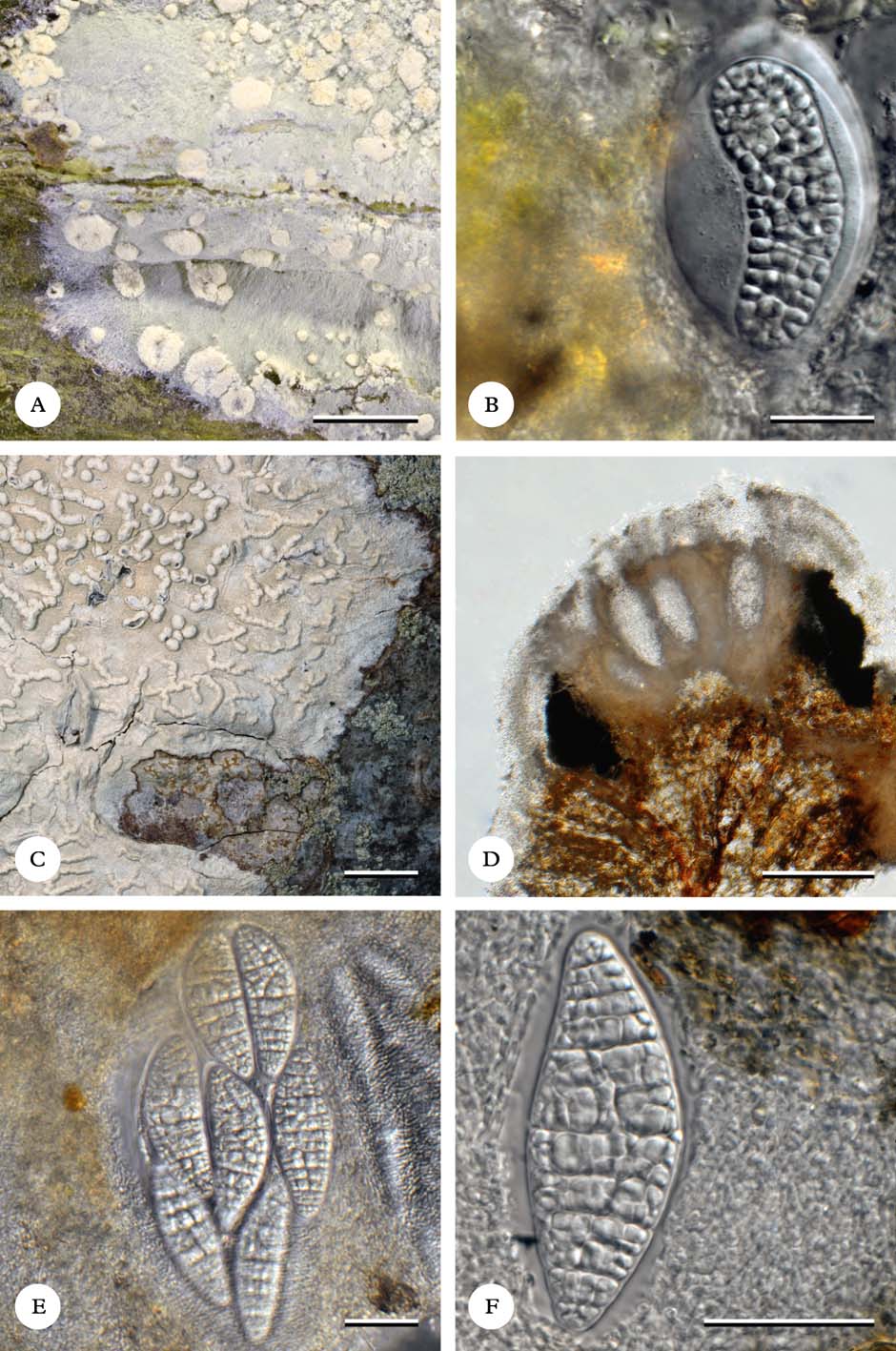
(Figs. 2D–F, 3A–C)
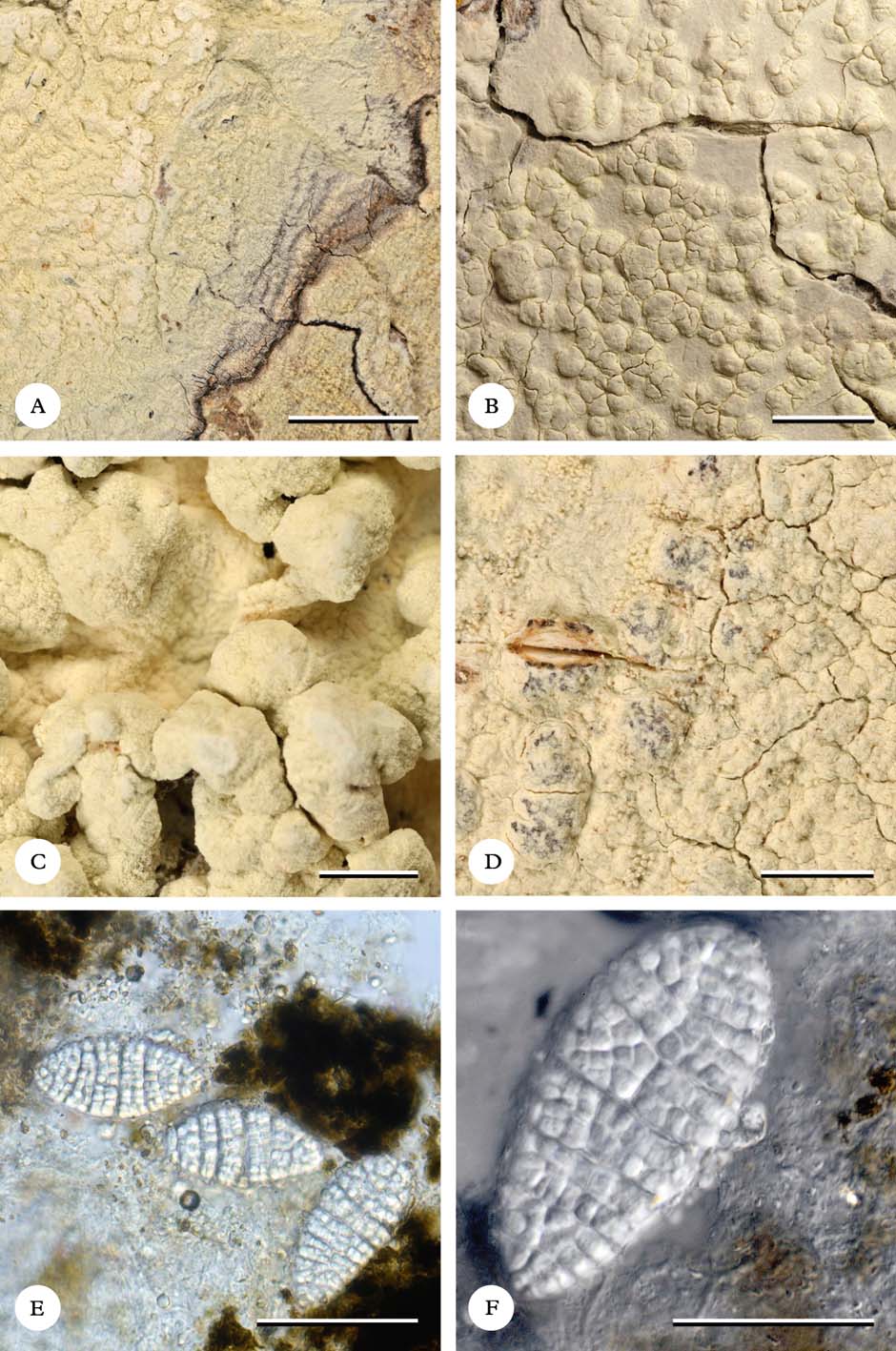
A–B, Cryptothecia striata; A, morphotype with ascigerous areas forming broad pustules, not arranged in striae (Bungartz 3710); B, pyriform to subglobose ascus with a single, oblong, slightly bent, muriform ascospore (Rivaz-Plata 4046). C–F, Helminthocarpon leprevostii, C, thallus aspect with short, broad, swollen lirellate ascomata (Bungartz 4390); D, cross-section of a lirella, outside covered by a thick thallus layer, hamathecium of strongly ramified and anastomosing paraphysoids, flanked by carbonized exciple (Aptroot 64570); E, two asci, the one on the left with muriform ascospores, the one on the right closely entwined by strongly ramified and anastomosing paraphysoids (Aptroot 64570); F, single ascospore (Aptroot 64570). Scales: A=3 mm; B=25 µm; C=10 mm; D=0·2 µm; E & F=30 µm.
Thallus corticolous, rarely saxicolous, delimited by a distinct byssoid prothallus of white, radiating hyphae; thallus surface cottony, ecorticate, greenish grey to greyish white, with storage beige, lacking soredia; medulla white, densely filled with minute colourless granules and sparse calcium oxalate crystals (insoluble in KOH, forming colourless, needle-shaped crystals in 25% H2SO4).
Ascigerous areas developing in the thallus centre as small, byssoid dots that soon merge into distinctly radiating striae, rarely not forming striae, but merging into large pustular outgrowths (not true soredia); asci bitunicate-fissitunicate, broadly pyriform to globose, with a short stalk, a moderately thickened wall (c. 4–6 µm) and thick tholus with small ocular chamber, individual asci irregularly dispersed, isolated to loosely grouped, not closely aggregating, entangled by few, IK+ violet-blue paraphysoids, occasionally surrounded by diffuse brownish pigment, not carbonized; ascospores hyaline, K−, ovoid to oblong, occasionally slightly bent, muriform, with curved septa, (46–)55–70(–80)×(19–)23–29(–37) µm, 1(–2) per ascus.
Conidiomata not observed.
Spot tests and chemistry
P−, K−, C+ bright red, KC+ bright red; UV− (pale yellowish green); medulla ILugol's+ deep blue; gyrophoric and/or lecanoric acid, ±traces of atranorin.
Distribution and ecology
Cosmopolitan, new to Galapagos and Ecuador; the most common Cryptothecia species in Galapagos, often very abundant, especially in the humid and upper transition zone, rarely also in the dry zone, on a wide range of mostly native, but also introduced tree species, typically in ±shaded and sheltered habitats.
Notes
Aptroot et al. (Reference Aptroot, Thor, Lücking, Elix and Chaves2009) report two specimens collected in Galapagos as Herpothallon philippinum. We were unable to locate specimen Aptroot 54328 in CDS and were thus unable to examine the specimen and confirm its identification. The second specimen cited as Aptroot 64330 (CDS accession no. 30895) contains psoromic acid and thus belongs to Herpothallon echinatum. Reports of H. philippinum therefore cannot be confirmed for Galapagos.
Morphotypes of thalli that do not form very distinct striae, but are instead abundantly covered in pustular outgrowths within which the asci develop have previously erroneously been reported as C. punctosorediata (Bungartz et al. Reference Bungartz, Ziemmeck, Aptroot, Nugra, Bungartz, Herrera, Jaramillo, Tirado, Jímenez-Uzcategui, Ruiz, Guézou and Ziemmeck2010b ). Sparrius & Saipunkaew (Reference Sparrius and Saipunkaew2005) emphasize that in C. punctosorediata the thallus does not react with C, but that only the soredia contain gyrophoric acid and thus react C+ bright red. For C. punctosorediata they also report asci with six to eight ascospores.
The pustules of the Galapagos material previously identified as C. punctosorediata are not true soredia, but they clearly represent the ascigerous regions in which asci with one, rarely two, never eight ascospores develop. Thalli and pustules contain lecanoric acid and both react distinctly C+ bright red; this reaction is clearly not confined to the pustules only. Finally, unlike as reported for C. punctosorediata by Sparrius & Saipunkaew (Reference Sparrius and Saipunkaew2005) the material does not fluoresce conspicuously white under UV light.
Selected specimens examined. Ecuador: Galapagos: Isla Floreana, Asilo de la Paz, Cerro Wittmer, road to Post Office Bay, 1°18′41″S, 90°27′4″W, humid zone, on bark, 2010, Hillmann GAL-82 (CDS 44908); c. 1 km S of Cerro Verde, 1°18′34″S, 90°25′19″W, alt. 299 m, transition zone, on bark, 2011, Yánez 1954 (CDS 48306); c. 200 m from the northern limit of the Primavera Farm in the highlands of the island, 1°18′48″S, 90°26′7″W, alt. 339 m, humid zone, on bark, 2011, Bungartz 10051 (CDS 47446); caldera of Cerro Pajas, old trail in the caldera, 1°17′48″S, 90°27′21″W, humid zone, on bark 2010, Hillmann GAL-13, 28, 33, 38, 40, 46, 49, 51, 53, 57 (CDS 44776, 44853, 44796, 44801, 44803, 44793, 44852, 44816, 44818, 44827). Isla Pinta, along the trail up to the summit from the S-coast, 0°34′31″N, 90°45′6″W, alt. 388 m, humid zone, on bark, 2007, Bungartz 5844 (CDS 33519); 0°34′57″N, 90°45′11″W, alt. 579 m, humid zone, on bark, 2007, Bungartz 5766 (CDS 33438); 0°34′39″N, 90°45′7″W, alt. 436 m, humid zone, on bark, 2007, Bungartz 5806 (CDS 33479). Isla Pinzón, E-facing side of a valley on the W-slope of the highest mountain, 0°36′49″S, 90°40′14″W, alt. 294 m, transition zone, on bark, 2006, Bungartz 3650 (CDS 27468). Isla San Cristóbal, W of the cemetery of El Progresso at the border of the National Park, 0°54′45″S, 89°34′34″W, alt. 170 m, transition zone, on bark, 2008, Bungartz 8559 (CDS 41205); El Chino in the southern higher part of the island, 0°54′42″S, 89°27′15″W, alt. 220 m, humid zone, agricultural area, on bark, 2007, Bungartz 6771 (CDS 35022). Isla Santa Cruz, abandoned farm along the northern part of the loop road from Bellavista to Garrapatero, 0°40′58″S, 90°18′31″W, alt. 255 m, humid zone, on bark of Cedrela, 2006, Aptroot 64322 B (CDS 44663), Aptroot 64329 (CDS 30894), Aptroot 64322 A (CDS 30887); above the quarry Mina Granillo Rojo, off the main road to the channel, on the N-side of the island, 0°37′6″S, 90°21′59″W, alt. 617 m, transition zone, on bark, 2007, Ertz, D. 11601 (CDS 36927). Isla Isabela, Volcán Alcedo, outer SE-exposed slope, c. 2·5 km below the crater rim, 0°26′13″S, 91°4′33″W, alt. 785 m, transition zone, on bark, 2006, Bungartz 4254 (CDS 28324), Bungartz 4239 (CDS 28309); Bungartz 4255 (CDS 28325); plain at the base of the outer E-exposed slope, along the trail going up to the rim, 0°24′47″S, 91°4′12″W, alt. 768 m, transition zone, on bark, 2006, Bungartz 4314 (CDS 28388), Aptroot 64866 (CDS 31443); Volcán Cerro Azul, along the trail from Caleta Iguana to the first Caseta del Parque, 0°59′14″S, 91°25′39″W, alt. 300 m, transition zone, on bark, 2012, Bungartz 10307 (CDS 52280), Bungartz 10309 (CDS 52282); lower half of path from the Caseta del Parque to Caleta Iguana, 0°58′52″S, 91°26′41″W, alt. 74 m, dry zone, on wood, 2012, Bungartz 10478 (CDS 52440); path from the fist Caseta del Parque to Caleta Iguana, approx. a third of the way, 0°59′10″S, 91°26′5″W, alt. 224 m, transition zone, on bark, 2012, Spielmann 10641 (CDS 52008).
Helminthocarpon Fée
Essai Crypt. Exot., Suppl. (Paris): 156 (1837)
Helminthocarpon leprevostii Fée
Essai Crypt. Exot., Suppl. (Paris): 156 (1837)
Thallus corticolous, rarely lignicolous, not delimited by a distinct prothallus, in contact with other thalli often forming a thin brown line; thallus surface pale beige, corticate, smooth and shiny; medulla white, densely packed with minute crystals that dissolve completely in KOH, lacking calcium oxalate crystals (not forming colourless, needle-shaped crystals in 25% H2SO4).
Ascomata developing as short, broad, swollen lirellae with a thick outer thalline layer that at maturity breaks open along a wide, irregular central slit; exciple flanks strongly carbonized, but buried below thick thalline layer; subhymenium and hypothecium hyaline to pale brown; hamathecium of strongly ramified and anastomosing paraphysoids that closely envelop the asci, KI+ blue; asci bitunicate-fissitunicate, cylindrical to narrowly clavate, basally tapering into a stalk, immature ascus wall strongly thickened, with maturity differentiating into two distinct layers (c. 20–25 µm wide, basally thinner, thickened towards the apex), KI+ pale blue throughout, at the apex occasionally with a minute, KI+ deep blue ring, ocular chamber indistinct or absent; ascospores hyaline, K−, elongate fusiform, muriform with curved septa, (89–)120–150(–165)×(22–)26–44(–62) µm, 8 per ascus;.
Conidiomata not observed.
Spot tests and chemistry
P−, K−, C+ red, KC+ red; UV− (pale yellowish green); medulla ILugol's−; lecanoric acid.
Distribution and ecology
Pantropical; new to Galapagos, moderately common throughout the dry and lower transition zone on bark of native and endemic trees, especially Bursera graveolens, Pisonia floribunda and Cordia lutea; mostly in semi-shaded to shaded and ±sheltered habitats, rarely also in moderately sunny and ±exposed sites.
Specimens examined: Ecuador: Galapagos: Isla Española, along S-coast of the island, SE of Punta Suárez, c. 500 m inland from coast, 1°22′57″S, 89°43′8″W, alt. 133 m, dry zone, on bark, 2010, Bungartz 8972 (CDS 45790); trail from Bahía Manzanillo on the N-coast of the island to the highest point, 1°22′19″S, 89°42′7″W, alt. 125 m, dry zone, on bark, 2010, Yánez 1686 (CDS 45569). Isla Floreana, Cerro Pajas, inside the crater, 1°17′49″S, 90°27′23″W, alt. 379 m, humid zone, on bark, 2011, Bungartz 9285 (CDS 46511); trail from Black Beach to highlands, on bark, 25 iv 1976, Weber s. n. (COLO 294611, L-62910); trail going to Post Office Bay off the dirt road between highlands and Puerto Velasco Ibarra, cliff at NE-side of trail (mirador), 1°17′4″S, 90°26′37″W, alt. 365 m, on bark, 2011, Yánez 2113 (CDS 46578). Isla Pinta, along the trail up to the summit from the S-coast, 0°34′9″N, 90°44′59″W, alt. 252 m, transition zone, on bark, 2007, Bungartz 5712 (CDS 33350); 0°34′5″N, 90°44′57″W, alt. 237 m, transition zone, on bark, 2007, Bungartz 5905 (CDS 33582); Bungartz 5922 (CDS 33599). Isla San Cristóbal, SW foothills of Media Luna, inland from the NW-coast of the island along the trail from Galapagera to Media Luna; bottom of small crater to the NW of Media Luna, 0°43′53″S, 89°18′57″W, alt. 124 m, dry zone, on bark, 2007, Bungartz 6239 (CDS 34451). Isla Santa Cruz, Bellavista, along road, 0°41′35″S, 90°19′27″W, alt. 200 m, humid zone, on bark, 2005, Aptroot 63307 (CDS 30047); farm of Don Cabrera between Bellavista and Cascajo, c. 1 km W of Cascajo, 0°40′39″S, 90°17′21″W, alt. 249 m, humid zone, agricultural area, on wood, 2010, Yánez 1491 (CDS 44921); on the North side of the island, along the dirt road to the ash quarry Mina Granillo Rojo, 0°36′56″S, 90°22′3″W, alt. 570 m, transition zone, on bark, 2006, Aptroot 64570 (CDS 31142), Aptroot 64556 (CDS 31128). Isla Santiago, along the trail from Bucanero to Jaboncillos, c. 1 km below the summit, Cerro Gavilan, 0°11′45″S, 90°47′20″W, alt. 680 m, transition zone, on bark, 2006, Aptroot 65449 (CDS 32037), Bungartz 4676 (CDS 28763); c. 7 km inland from the E-coast, ± at the same latitude as Bahía Sullivan, 0°17′4″S, 90°38′18″W, alt. 192 m, dry zone, on bark, 2006, Bungartz 5185 (CDS 29398). Isla Isabela, Volcán Alcedo, along the trail going up the E-slope, at the NW-side of the trail, 0°24′2″S, 91°2′36″W, alt. 410 m, dry zone, on bark, 2006, Bungartz 4390 (CDS 28475); 0°24′3″S, 91°2′35″W, alt. 434 m, dry zone, on bark, 2006, Bungartz 4405 (CDS 28490), Aptroot 64953 (CDS 31532); 0°24′7″S, 91°2′55″W, alt. 493 m, dry zone, on bark, 2006, Bungartz 4448 (CDS 28534); 2006, Aptroot 64965 (CDS 31545). Volcán Sierra Negra, Las Merceditas, 0°51′58″S, 91°0′50″W, alt. 208 m, humid zone, agricultural area, on bark, 2008, Bungartz 8294 (CDS 40940).
Herpothallon Tobler
Flora, Jena 131: 446 (1937)
Herpothallon aff. confluenticum Aptroot & Lücking
In Aptroot, Thor, Lücking, Elix & Chaves, Biblioth. Lichenol. 99: 35 (Reference Aptroot, Thor, Lücking, Elix and Chaves2009)
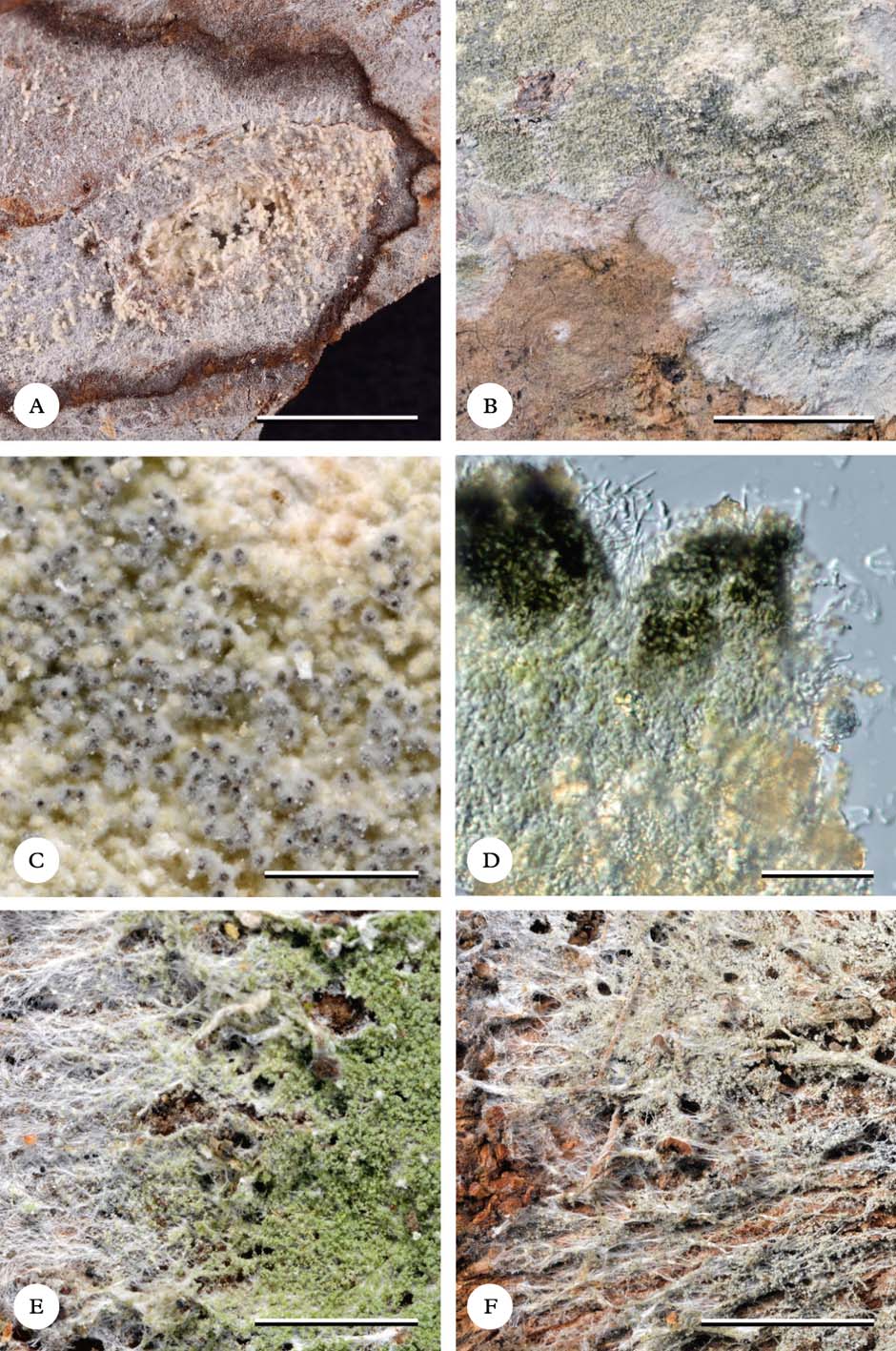
(Fig. 4A)
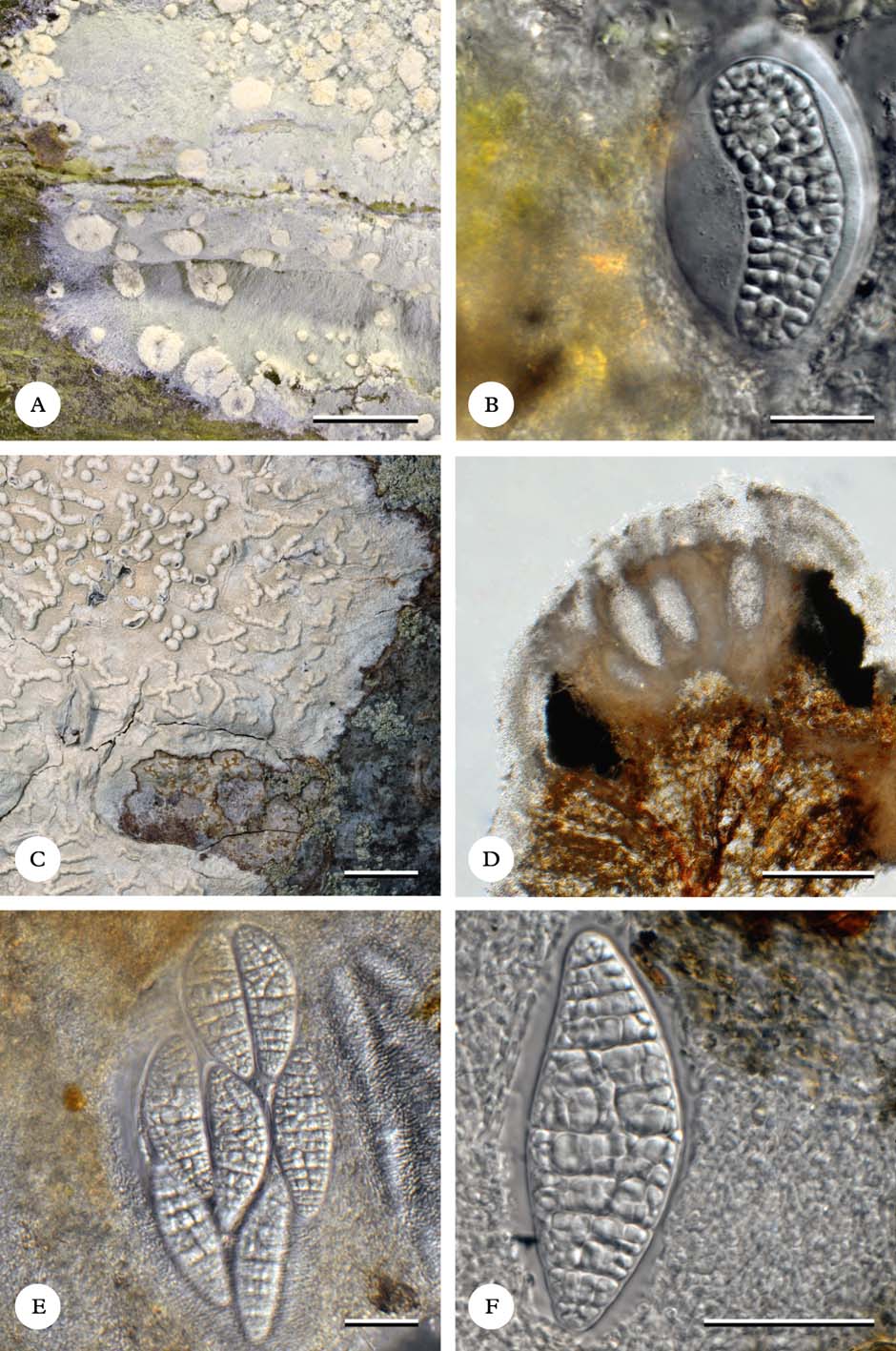
A, Herpothallon aff. confluenticum, small, thin, arachnoid thallus with few pseudisidia and a distinct brown prothallus (Nugra 137). B–D, Herpothallon echinatum (Bungartz 5616); B, general thallus aspect of two merged thalli delimited by a white, arachnoid prothallus; C, central thallus part with pycnidiate pseudisidia; D, close-up of pycnidiate pseudisidia; D, squash preparation of pycnidiate pseudisidium with aeruginose ostiole and bacilliform conidia. E–F, Herpothallon granulare; E, radiating white fibrous prothallus strands along the thallus margin and granular pseudisidia in the centre (Nugra 889); F, radiating fibrous thallus strands loosely covered in granular pseudisidia (Bungartz 4997). Scales: A & C=1 mm; B=2 mm; D=15 µm; E & F=5 mm.

Thallus corticolous, delimited by a compact brown prothallus; thallus surface greyish to greenish white, ecorticate, arachnoid to cottony, in the centre densely covered by pale beige to greyish white, loose, ‘fluffy’, ±cylindrical to sparsely branched pseudisidia, (20–)30–40(–60) µm diam.; medulla white, lacking calcium oxalate crystals.
Asci and pycnidia not observed.
Spot tests and chemistry
P−, K−, C−, KC−; UV− (pale), ILugol's−; confluentic and/or hyperconfluentic acid.
Distribution and ecology
Pantropical, new to Galapagos and Ecuador; all specimens collected in the humid zone, both on native and introduced trees, rarely on rock, in shaded and sheltered habitats.
Notes
How well the Galapagos material corresponds to C. confluenticum s. str. remains uncertain. Unlike the description in the protologue (Aptroot et al. Reference Aptroot, Thor, Lücking, Elix and Chaves2009), the few Galapagos specimens collected so far are all small, very thin and have poorly developed thalli. With storage in the herbarium their pseudisidia develop a ±pale pinkish hue similar to fresh pseudisidia of Syncesia leprobola, a species for which these specimens were originally mistaken. Thalli of S. leprobola, however, do not contain confluentic acid; instead they are characterized by protocetraric acid and thus react distinctly P+ red. The Galapagos specimens have a conspicuous, relatively compact brown prothallus that clearly delimits individual thalli. The description of this species in Aptroot et al. (Reference Aptroot, Thor, Lücking, Elix and Chaves2009) mentions a dirty whitish prothallus and a whitish to brownish hypothallus, but the photograph therein (fig. 3D) shows a much better developed specimen, which also appears to be delimited by a fine brown line.
Specimens examined. Ecuador: Galapagos: Isla Floreana, Asilo de la Paz, Cerro Wittmer, road to Post Office Bay, 1°18′41·29″S, 90°27′4·29″W, humid zone, on bark, 2010, Hillmann GAL-81 (CDS 44907); Isla Isabela, Volcán Alcedo, outer E-exposed slope just below the crater rim, 0°25′17″S, 91°5′8″W, alt. 1077 m, humid zone, on rock, 2006, Aptroot, A. 65176 (CDS 31760); Isla Santa Cruz, línea del Parque Nacional Galápagos, sector el Camote a lindero de la finca de Don René Valle, 0°38′21·10″S, 90°17′57·20″W, alt. 487 m, zona húmeda, sobre corteza, 2006, Nugra 135 (CDS 32789); Nugra 137 (CDS 32791); along trail from Media Luna to El Puntudo, 0°39′9·80″S, 90°19′59·29″W, alt. 724 m, humid zone, on bark, 2008, Clerc 08-114 (CDS 39968); Steve Divine Farm, near Tortoise Road, off the main road to Baltra, at the entrance to lava tunnel, Tortoise Territory, 0°39′51″S, 90°24′16″W, alt. 364 m, humid zone, agricultural area, on rock, 2006, Bungartz 3966 (CDS 27848).
Herpothallon echinatum Aptroot et al.
In Aptroot, Thor, Lücking, Elix & Chaves, Biblioth. Lichenol. 99: 38 (Reference Aptroot, Thor, Lücking, Elix and Chaves2009)
Thallus corticolous, delimited by a distinct byssoid prothallus of white, radiating hyphae; thallus surface greyish to greenish white, ecorticate, cottony, in parts almost granular, in the centre densely covered by slightly darker, compact globular to ±cylindrical pseudisidia containing a central pycnidium; medulla white, filled with colourless to pale brownish granules and sparse calcium oxalate crystals (insoluble in KOH, forming colourless, needle-shaped crystals in 25% H2SO4).
Asci not observed.
Pycnidia embedded within pseudisidia, opening with an aeruginose ostiole, pigmentation occasionally ±extending along the pycnidial wall, conidiophores simple, with oblong to bacilliform conidia, 3–4×1–1·5 µm.
Spot tests and chemistry
P+ deep golden yellow, K−, C−, KC−, UV− (dull), ILugol's−; psoromic acid.
Distribution and ecology
Pantropical, new to Galapagos and Ecuador; the few known specimens were collected in the agricultural areas of the humid zone of Santa Cruz, all growing on introduced trees and shrubs (Cedrela odorata, Cestrum auriculatum), in shaded and sheltered habitats.
Specimens examined. Ecuador: Galapagos: Isla Santa Cruz, abandoned farm along the northern part of the loop road from Bellavista to Garrapatero, 0°40′58″S, 90°18′31″W, alt. 255 m, humid zone, agricultural area, on bark, 2006, Aptroot 64328 (CDS 30893); 2006, Aptroot 64330 (CDS 30895); along the trail down into the crater at Camote, 0°38′17″S, 90°17′42″W, alt. 418 m, humid zone, on bark, 2007, Bungartz 5616 (CDS 33241).
Herpothallon granulare (Sipman) Aptroot & Lücking
In Aptroot, Thor, Lücking, Elix & Chaves, Biblioth. Lichenol. 99: 43 (Reference Aptroot, Thor, Lücking, Elix and Chaves2009)
Thallus corticolous, rarely foliicolous, delimited by a broad prothallus of loosely radiating fibrous strands of white hyphae; thallus surface greenish grey to dull green, with storage becoming paler, ecorticate, entire thallus of thick fibrous strands of loosely interwoven hyphae, abundantly covered in coarsely granular pseudisisdia; medulla poorly differentiated, indistinct, with hyphae covered by colourless to pale brownish granules, lacking calcium oxalate crystals (not forming colourless, needle-shaped crystals in 25% H2SO4).
Asci and pycnidia not observed.
Spot tests and chemistry
P−, K−, C−, KC−; UV−, ILugol's−; perlatolic acid.
Distribution and ecology
Pantropical, new to Galapagos and Ecuador; one of the most common species from the upper transition zone through the humid zone into high-altitude transition zone; on a wide variety of both native and introduced trees; typically in semi-shaded to shaded and ±sheltered habitats.
Selected specimens examined. Ecuador: Galapagos: Isla Floreana, Asilo de la Paz, Cerro Wittmer, road to Post Office Bay, 1°18′41·29″S, 90°27′4·29″W, alt. 0 m, humid zone, on bark, 2010, Hillmann GAL-83 (CDS 44909); Cerro Pajas, inside the crater, 1°17′49·29″S, 90°27′23″W, alt. 379 m, humid zone, on bark, 2011, Bungartz 9260 (CDS 46486); on W-slope of Cerro Alieri, permanent plot 2, 1°17′24·10″S, 90°27′8·90″W, alt. 347 m, transition zone, on bark, 2011, Bungartz 9312 (CDS 46538); on W-slope of Cerro Alieri, 1°17′24·10″S, 90°27′8·94″W, alt. 347 m, transition zone, on bark, 2011, Bungartz 9333 (CDS 46620). Isla Santa Cruz, on farm N of Bellavista, 0°41′4″S, 90°19′29″W, alt. 250 m, humid zone, agricultural area, on bark, 2005, Aptroot 63314 (CDS 30054); temporary Cinchona weather station, along the trail to El Puntudo, 0°39′6·59″S, 90°19′57·39″W, alt. 698 m, humid zone, on bark, 2005, Bungartz 3283 (CDS 26925); above the Finca of Galo Torres, inside the Park boundary, 0°37′45″S, 90°24′1″W, alt. 536 m, humid zone, on bark, 2006, Bungartz 4997 (CDS 29210). Isla Isabela, Volcán Alcedo, outer SE-exposed slope, ca. 2·5 km below the crater rim, 0°26′13″S, 91°4′33″W, alt. 785 m, transition zone, on bark, 2006, Bungartz 4238 (CDS 28308).
Herpothallon hyposticticum Bungartz & Elix sp. nov.
MycoBank no. 804739
Herpothallon with thin to moderately thickened dense, contiguous to rimose thallus, granular to cylindrical, sparsely branched pseudisidia, containing hypostictic and hyposalazinic acid.
Type: Ecuador, Galapagos Islands, Isla Santa Cruz, near the CDRS field-weather station below the summit of Cerro Crocker, 0°38′35″S, 90°19′42″W, humid zone, much overgrown with dead Cinchona pubescens trees (killed by invasive species programme), N-exposed slope, on trunks and twigs of dead Cinchona pubescens, 28 xii 2005, Bungartz 3306 (CDS 26961—holotype).
A–E, Herpothallon hyposticticum (corticolous specimens); A–B, thin arachnoid thallus with dense, abundant and well-developed pseudisidia (Bungartz 3489); A, thallus centre; B, thallus margin; C, thin arachnoid thallus with few, scattered, well-developed pseudisidia (Nugra 13 A); D, well-developed compact thallus with few, immature, granular pseudisidia (Bungartz 4972 A); E, well-developed, compact to rimose thallus with scattered, well-developed pseudisidia (holotype,); F, Herpothallon hyposticticum (saxicolous specimen), well developed, compact to rimose thallus with immature, granular pseudisidia (Aptroot 65713). Scales: A & D=2 mm; B, E & F=1·5 mm; C=1 mm.
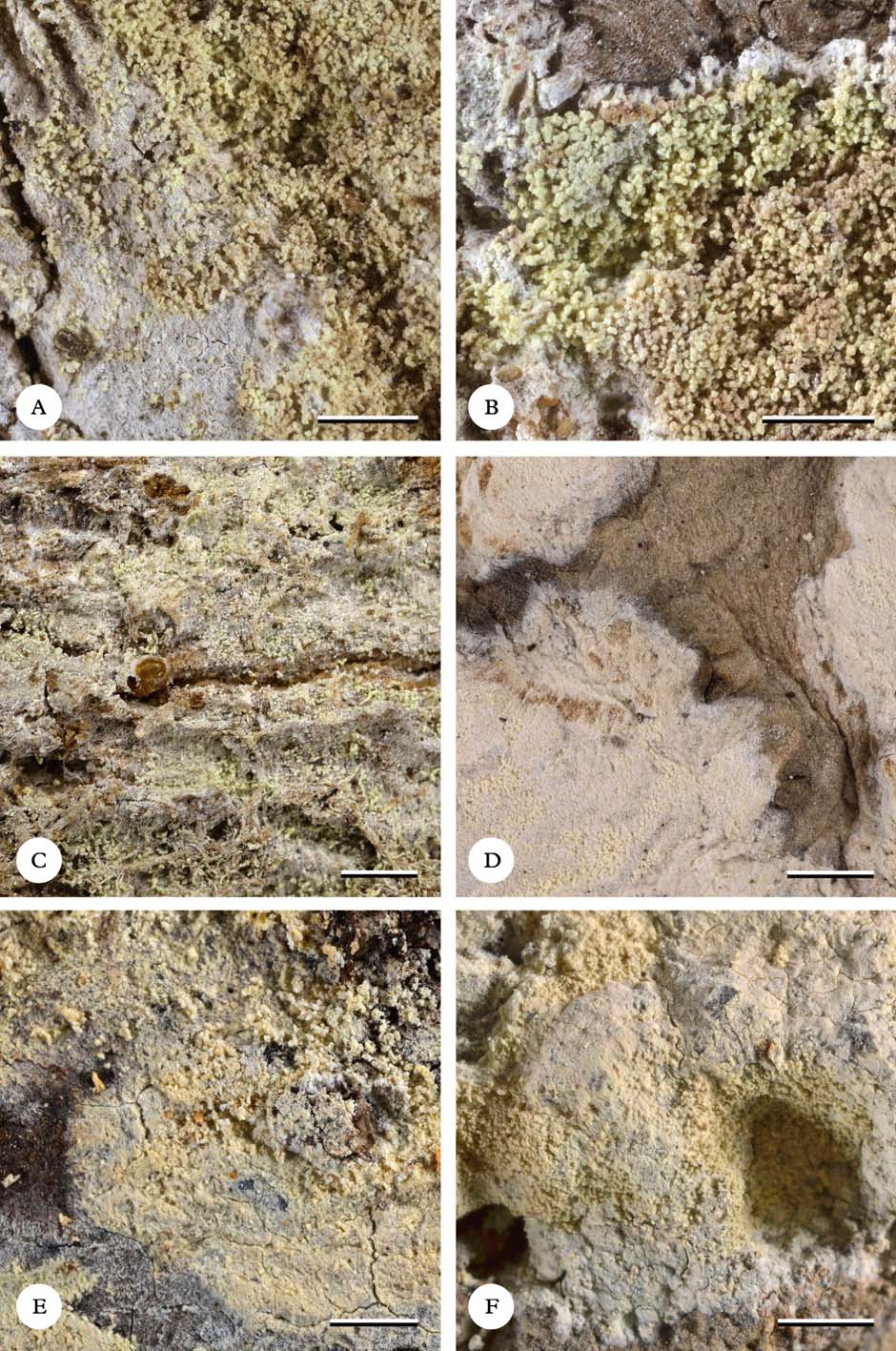
Thallus corticolous, rarely saxicolous, delimited by an inconspicuous, dense prothallus of white hyphae; thallus surface greyish white, with storage ±beige to pale yellowish, ecorticate, thin and arachnoid to moderately thickened and then developing a dense, compact, contiguous to sparsely fissured or even distinctly rimose surface, sparsely to abundantly covered by minutely granular, powdery to distinctly cylindrical pseudisidia, 50–80 µm diam., fairly uniform in size; medulla white, filled with few, sparse calcium oxalate crystals (insoluble in KOH, forming colourless, needle-shaped crystals in 25% H2SO4).
Asci and pycnidia not observed.
Spot tests and chemistry
P−, K+ yellow, KC−, C−; UV+ bright yellow; medulla ILugol's+ weakly blue in parts; hypostictic and hyposalazinic acid.
Distribution and ecology
Currently known only from Galapagos; occurring from the upper transition to the humid zone, on native or endemic (Pisonia floribunda, Zanthoxylon fagara, Scalesia pedunculata) and introduced tree species (Cinchona pubescens, Persea americana), in semi-shaded to shaded, ±sheltered habitats; one specimen from a shaded rock overhang.
Notes
Herpothallon hyposticticum is unusual in several aspects. Specimens consistently contain hypostictic and hyposalazinic acid, substances that are usually accessories of stictic acid and norstictic acid, yet these principal metabolites are absent from the thalli. The species is morphologically unusually variable. Some thalli are abundantly covered in well-developed pseudisidia, whereas the thallus itself is poorly developed, essentially present only as a thin layer of arachnoid hyphae. In other specimens the thallus is better developed, cottony to dense, ±compacted and then sparsely fissured. These specimens generally have pseudisidia that are much less developed, in some parts of the thallus they remain in fact granular and thus look like granular soredia. In other parts of the same thallus these granules nevertheless become cylindrical and even sparsely branched, indicating that they are all precursors of true pseudisidia. Finally some specimens have an unusually well-developed, sometimes almost rimose thallus and generally only develop granular pseudisidia. All specimens have a weakly I+ blue medulla, at least in part. Specimens with well-developed thalli and poorly developed pseudisidia are superficially similar to species of Cryptothecia, but when elevated regions of the thallus, thought to perhaps correspond to ascigerous areas, were sectioned, no asci or acospores could be found.
Specimens examined: Ecuador: Galapagos: Isla Isabela, Volcán Alcedo, on top of the crater rim, 0°27′33″S, 91°6′49″W, alt. 1051 m, humid zone, on bark, 2006, Bungartz 4105 (CDS 28073); Isla Santa Cruz, off the dirt road to Mina Granillo Rojo, on the N-side of the island, 0°37′2″S, 90°22′6″W, alt. 294 m, transition zone, on bark, 2006, Bungartz 4972 A (CDS 44662); along the road from Bellavista to Los Gemelos, 0°38′10″S, 90°23′45″W, alt. 579 m, humid zone, on bark, 2006, Bungartz 3489 (CDS 27245); línea del Parque Nacional Galápagos, cerca de la finca de Galo Torres, 0°37′45·77″S, 90°24′0″W, alt. 570 m, zona húmeda, sobre corteza, 2006, Nugra 13 A (CDS 38749), Nugra 20 B (CDS 54431); Isla Santiago, summit of Cerro Gavilan, inner N- and NE-exposed crater rim, 0°12′20″S, 90°47′3″W, alt. 840 m, humid zone, on rock, 2006, Aptroot 65713 (CDS 32305).
Herpothallon rubrocinctum (Ehrenb.) Aptroot et al.
In Aptroot, Thor, Lücking, Elix & Chaves, Biblioth Lichenol. 99: 61 (Reference Aptroot, Thor, Lücking, Elix and Chaves2009)
A & B, Herpothallon rubrocinctum; A, close-up of thallus with striped carmine red prothallus, greenish thallus and carmine red pseudisidia (Ertz 11551); B, close up of dense, compact carmine red prothallus (Aptroot 63132). C & D, Herpothallon rubroechinatum (Bungartz 3488); C, thallus with central pseudisidia, delimited by rust red prothallus; D, cylindrical pseudisidia with rust red pigment crystals. E & F, Herpothallon saxorum; E, dense, compacted fibrous prothallus strands covered with coarse granular pseudisidia (Bungartz 4874); F, loose, arachnoid prothallus strands along the thallus margin covered towards the centre in coarse granular pseudisidia (Bungartz 7793). Scales: A=10 mm; B=5 mm; C=4 mm; D=1 mm; E & F=2 mm.

Thallus corticolous, rarely saxicolous or foliicolous, delimited by a distinct byssoid prothallus of carmine red, radiating hyphae; thallus surface greyish to greenish white, ecorticate, dense, cottony, felt-like, in the centre covered by carmine red, granular pseudisidia; medulla white, in parts filled with carmine red granules and sparse calcium oxalate crystals (insoluble in KOH, forming colourless, needle-shaped crystals in 25% H2SO4).
Asci and pycnidia not observed.
Spot tests and chemistry
P−, K− (green thallus areas), K+ purple (carmine red prothallus & pseudoisidia), C−, KC−; UV− (dull), ILugol's−; confluentic, chiodectonic, 2'-O-methylmicrophyllinic acids.
Distribution and ecology
Cosmopolitan; by far the most common Herpothallon species in Galapagos, often very abundant and sometimes forming thalli of several decimeters across; common in the humid and upper transition zone, rarely also in the dry zone, on a wide variety of both native and introduced tree species, rarely also on rock; both in sunny, exposed and ±shaded and sheltered habitats.
Selected specimens examined. Ecuador: Galapagos: Isla Fernandina, W-side, alt. 335 m, transition zone, Cavagnaro, D. s. n. (COLO 193387, L-40446). Isla Floreana, c. 1 km S of Cerro Verde, 1°18′34″S, 90°25′19″W, alt. 299 m, transition zone, on bark, 2011, Yánez 1945 (CDS 48297); trail going to Post Office Bay off the dirt road between highlands and Puerto Velasco Ibarra, 1°17′17″S, 90°26′35″W, alt. 360 m, transition zone, on bark, 2011, Yánez 1921 (CDS 48275). Isla Pinta, along the trail up to the summit from the S-coast, 0°34′39″N, 90°45′7″W, alt. 436 m, humid zone, on bark, 2007, Bungartz 5828 (CDS 33501); 0°34′34″N, 90°45′8″W, alt. 414 m, transition zone, on bark, 2007, Bungartz 5735 (CDS 33378); northern part of the western cliff above Las Pampas, 0°35′11″N, 90°46′34″W, alt. 356 m, dry zone, on bark, 2008, Nugra 606 (CDS 38984). Isla Pinzón, summit, transition zone, on bark, Cavagnaro, D. s. n. (COLO 192819, L-40489). Isla San Cristóbal, Bailey s. n. (COLO 151174, S-27084); along trail between entrance to Cerro Pelado and Cerro Partido, trail to El Ripioso, 0°51′40″S, 89°27′38″W, alt. 383 m, transition zone, on bark, 2007, Bungartz 6678 (CDS 34914); along trail to Ochoa, along the northern border of the National Park, 0°53′39″S, 89°33′19″W, alt. 315 m, humid zone, on bark, 2008, Herrera-Campos 477 (CDS 43368). Isla Santa Cruz, above the Finca of Galo Torres, inside the Park boundary, 0°37′45″S, 90°24′1″W, alt. 536 m, humid zone, on bark, 2006, Bungartz 4993 (CDS 29206); along the dirt road from Bellavista to Media Luna, farmland on the W-side of the road, 0°40′54″S, 90°19′26″W, alt. 285 m, humid zone, agricultural area, on bark, 2006, Bungartz 3989 (CDS 27919); along the road from Bellavista to Los Gemelos, 0°38′10″S, 90°23′45″W, alt. 579 m, humid zone, on bark, 2006, Bungartz 3476 (CDS 27232), Bungartz 3493 (CDS 27249), Aptroot 63866 (CDS 30424). Isla Santiago, E of salt lake at Santiago Bay, 0°14′25″S, 90°48′50″W, alt. 170 m, dry zone, on bark, 1971, Pike 2707 (COLO 263253, L-56175), Pike 2707 (OSC 54834); summit of Cerro Gavilan, inner N- and NE-exposed crater rim, 0°12′20″S, 90°47′3″W, alt. 840 m, humid zone, on rock, 2006, Aptroot 65753 (CDS 32345); on bark, 03-Jan-1906, Stewart 3446 (FH 197182). Isla Isabela, Volcán Alcedo, outer SE-exposed slope and crater rim, 0°27′29″S, 91°7′19″W, alt. 1089 m, humid zone, on bark, 2006, Bungartz 4041 (CDS 27971), Bungartz 4241 (CDS 44660); lower crater slopes above the first Caseta del Parque; below the cloud layer, 0°58′37″S, 91°25′26″W, alt. 456 m, humid zone, on bark, 2012, Nugra 1036 (CDS 52200); Volcán Sierra Negra, along dirt road from Puerto Villamil to crater of Sierra Negra, farmland, 0°50′38″S, 91°3′52″W, alt. 564 m, humid zone, on bark, 2007, Bungartz 6891 (CDS 36379); Cueva del Sucre, at the entrance (parking), SE side of the island, 0°50′33″S, 91°1′37″W, alt. 369 m, humid zone, on bark, 2008, Herrera-Campos 10644 (CDS 40381).
Herpothallon rubroechinatum Frisch & G. Thor
In A. Frisch, G. Thor and J. A. Elix, Bryologist 113: 145 (2010)
Thallus corticolous, delimited by a distinct byssoid prothallus of white, radiating hyphae typically at least in part with a rust-red pigment; thallus surface greyish white, with storage becoming ±beige, ecorticate, cottony, in parts almost granular, in the centre densely covered by slightly darker, compact pseudisidia that appear as if sprinkled with rust-red crystals; pseudisidia dimorphic, either swollen, globular containing one central pycnidium or, with age, elongate cylindrical to ±vermiform; medulla white, filled with brownish granules and sparse calcium oxalate crystals (insoluble in KOH, forming colourless, needle-shaped crystals in 25% H2SO4).
Asci not observed
Pycnidia embedded within pseudisidia, opening with an aeruginose ostiole, pigmentation occasionally extending along the pycnidial wall, conidiophores simple, with oblong to bacilliform conidia, 3–4×1–1·5 µm.
Spot tests and chemistry
P+ bright yellow; K− (greenish white thallus areas), K+ purple (bright red crystal of the pseudoisidia and rust reddish prothalline hyphae), C−, KC−, UV− (dull), ILugol's−; psoromic acid.
Distribution and ecology
Neotropical, new to Galapagos and Ecuador; the few known specimens were collected in the humid zone of Santa Cruz, growing on both the endemic tree Scalesia pedunculata and the introduced trees Cinchona pubescens and Cedrela odorata, in semi-shaded to shaded and ±sheltered habitats.
Selected specimens examined: Ecuador: Galapagos: Isla Santa Cruz, along the road from Bellavista to Los Gemelos, 0°38′10″S, 90°23′45″W, alt. 579 m, humid zone, on bark, 2006, Bungartz 3488 (CDS 27244), Aptroot 63826 (CDS 30384); along the road to Baltra, S of Los Gemelos, 0°38′44″S, 90°20′5″W, alt. 741 m, humid zone, on bark, 2006, Bungartz 5511 (CDS 36156); línea del Parque Nacional Galapagos, cerca de la finca de Galo Torres, 0°37′46″S, 90°24′0″W, alt. 570 m, zona húmeda, sobre corteza, 2006, Nugra 17 (CDS 32670), Nugra 19 (CDS 32672); off the dirt road to Mina Granillo Rojo, on the N-side of the island, 0°37′2″S, 90°22′6″W, alt. 294 m, transition zone, on bark, 2006, Bungartz 4972 B (CDS 29185).
Herpothallon saxorum Bungartz & Elix sp. nov.
MycoBank no. 804740
Similar to Herpothallon granulare, but containing confluentic acid, brialmontin 1 and brialmontin 2 instead of perlatolic acid; saxicolous.
Type: Ecuador, Galapagos Islands, Isla Santiago, along the trail from the caseta in La Central to La Bomba (at the coast), cliff c. 2·5 km NE of the caseta, 0°13′41″S, 90°44′10″W, alt. 533 m, transition zone, SW-exposed basalt cliff with some ferns (Adiantum concinnum, Pityrograma calomelanos var. calomelanos, and Blechnum polypodioides) growing in crevices, on horizontal ledges of SW-exposed front of basalt cliff; semi-shaded, wind- and rain-exposed, 25 iii 2008, Bungartz 4874 (CDS 29073—holotype).
Thallus saxicolous, delimited by a broad prothallus of white arachnoid hyphae that soon aggregate into loosely radiating fibrous strands; thallus surface dull greenish to beige, with storage becoming ±white, ecorticate, entire thallus initially of loosely interwoven hyphae that soon form distinct fibrous strand and with age rarely become more densely interwoven and almost cottony, typically not developing into a distinctly differentiated thallus, but instead covered with abundant, coarsely granular pseudisidia; medulla poorly differentiated, indistinct, with hyphae covered by colourless to pale brownish granules, lacking calcium oxalate crystals (not forming colourless, needle-shaped crystals in 25% H2SO4).
Asci and pycnidia not observed.
Spot tests and chemistry
P+ yellow, K+ yellow, C−, KC−; UV+ (dull), medulla ILugol's−; brialmontin 1, brialmontin 2, confluentic acid.
Distribution and ecology
Currently known only from Galapagos and very likely endemic; moderately common throughout the dry and lower transition zone, rarely extending into the humid zone; on sheltered, shaded rock faces and overhangs.
Notes
Morphologically this new species closely resembles H. granulare, but it is chemically distinct and is not corticolous, instead growing on sheltered rock surfaces. When the material was first analyzed in solvent C, specimens were believed to represent a K+ yellow chemotype of H. granulare that contained atranorin in addition to perlatolic acid. However, in solvent A, the specimens were shown to contain confluentic acid and brialmontin 1 and brialmontin 2 (the latter two substances have almost identical Rf to atranorin in solvent C).
The only other species of Herpothallon known to contain related substances (brialmontic acid, methylbrialmontic acid, and dimethylbrialmontic acid) is H. brialmonticum Aptroot & Elix. This corticolous species is morphologically dissimilar from H. granulare, forming a much more compact, thick, cottony thallus with smoother, globose pseudisidia. In contrast, H. saxorum is composed of fibrous hyphal strands with rather coarse, distinctly granular pseudisidia.
Specimens examined. Ecuador: Galapagos: Isla Santa Cruz, along the road from Bellavista to Los Gemelos, 0°38′10″S, 90°23′45″W, alt. 579 m, humid zone, open Scalesia pedunculata forest with Rubus niveus, Psychotria rufipes, Zanthoxylum fagara, and scattered lava boulders, on rock of top and slope of basalt boulders; semi-shaded, wind- and rain-sheltered, 2006, Bungartz 3470 B (CDS 27226); above Mina Granillo Rojo on the N-side of the island, 0°37′9″S, 90°21′57·73″W, alt. 619 m, transition zone, upper transition zone; open forest of Scalesia pedunculata, Psidium galapageium, Zanthoxylum fagara and few Pisonia floribunda with basaltic rock outcrops, on rock of N-exposed overhang of basalt boulder; semi-shaded, wind- and rain-sheltered, 2008, Bungartz 8111 (CDS 40757); Isla Isabela, Volcán Darwin, Isabela, south-western slope, above Tagus Cove, 0°13′28·19″S, 91°19′17·89″W, alt. 872 m, transition zone, top of lava flow in open scrubland of Croton scouleri and Dodonaea viscosa with Cordia revoluta and some Opuntia insularis, on rock of S-exposed overhang of basalt boulder; shaded, wind- and rain-sheltered, 2007, Bungartz 7740 (CDS 38246); south-western slope, above Tagus Cove, 0°13′59″S, 91°20′8″W, alt. 597 m, dry zone, open Bursera graveolens forest with Croton scouleri and Macraea laricifolia shrubs, few Chiococca alba and Scalesia microcephala, among lava boulders and outcrops, on rock of SW-exposed overhang of basalt boulder; shaded, wind- and rain-shaded, 2007, Bungartz 7803 (CDS 38312); Bungartz 7793 (CDS 38302); Volcán Sierra Negra, Muro de las Lagrimas W of Puerto Villamil, along the stairs going up behind the wall, 0°57′52·73″S, 91°0′46·79″W, alt. 78 m, dry zone, dry zone vegetation with Bursera graveolens and Opuntia echios, slope 45° N, on rock of basaltic rocks at the side of the stairs, 2008, Herrera-Campos, M.A. 10745, (CDS 40483).
Discussion
With nine different species of Herpothallon and Cryptothecia now reported from the Galapagos, four of them new to science, this group of species at first appears more diverse than anticipated, yet the number of species found in the archipelago is comparable to other genera with similar ecology and distribution mode. Herpothallon for example generally inhabits humid, sheltered habitats and reproduces almost exclusively by vegetative propagules rather than ascospores. This ecology and means of reproduction is little different from Lepraria and the numbers of species in both genera are almost the same: six species of Herpothallon are now reported from Galapagos and a recent treatment of Lepraria (submitted for publication) lists five species.
It is difficult to assess whether the new species described here are endemic to the archipelago. The Galapagos are of course famous as a ‘laboratory of evolution’ characterized by their high degree of endemism, a result of their geographic isolation in combination with climatic and geomorphological variation and thus habitat diversity. Due to the relatively late arrival of humans much of the original biodiversity is considered to still be present in the islands (Snell et al. Reference Snell, Tye, Causton, Bensted-Smith and Bensted-Smith2002).
Isolation and thus effectiveness of dispersal units are clearly the limiting factors for any species to reach the archipelago and lichens, characterized by microscopic propagules clearly have an advantage in crossing the 1,000 km distance from the mainland compared with many other organisms with much heavier propagules. Lichen species that reproduce and disperse mainly by ascospores may be hindered in establishing a successful symbiosis if they fail to encounter suitable photobionts, but propagules like soredia, granules, isidia, and thallus fragments in general, will almost always be larger and heavier. Thus it is not clear which species, those that reproduce sexually or those that mainly reproduce asexually, have an evolutionary advantage in reaching the islands and evolving into new, endemic species.
Studies which try to compare rates of endemism across different species groups are challenging when species groups being assessed are generally not well studied. It is quite possible that the species newly described here are endemic to the Galapagos, but since this group of species is very poorly known, it is difficult to assess whether or not these species may also be present on the South American continent.
Two of the three genera studied here are unusual insofar that their asci do not develop in distinct ascomata, but instead within ascigerous areas (Cryptothecia) or solitary inside pseudisidia (Herpothallon fertile, not observed in Galapagos, see Aptroot et al. Reference Aptroot, Thor, Lücking, Elix and Chaves2009). Among lichenized fungi this ascus ontogeny, the non-aggregation of hamathecial filaments within supporting ascomatal structures, is only known from one other genus, Stirtonia, which differs in having transversely septate, rather than muriform spores. In Cryptothecia the ascigerous areas may barely differ from the surrounding thallus and these species almost appear as one smooth, ‘sterile’ crust. More typically, however, the ascigerous areas are somewhat confined and delimited as warts or pustules, sometimes resembling irregular patches of ascomata in Arthonia or Arthothelium, both genera of the Arthoniaceae with distinct interascal filaments aggregating into a well-developed hamathecium (Wolseley & Aptroot Reference Wolseley and Aptroot2009).
Both Cryptothecia and Herpothallon have a cottony-byssoid thallus. As they lack a cortex the hyphae are usually not very dense or compacted and in some species, like Herpothallon granulare, they are in fact very loosely bundled into fibrous strands bearing granular packets of pseudisidia. This growth form could be called leprose (sensu Lendemer Reference Lendemer2011), because the main thallus of the species is actually formed by the granules and a thallus with a distinct photobiont layer and medulla does not develop. Only one other species of Herpothallon, the newly described H. saxorum, has a similarly leprose growth form, even though the hyphae of this species tend to become more densely interwoven and then quite similar to the cottony-byssoid thallus typically observed in Herpothallon or Cryptothecia.
Clearly the cottony-byssoid growth form of sterile thalli alone is not a good indication of how these species are related. Frisch & Thor (Reference Frisch and Thor2010) recently described the genus Crypthonia to accommodate species with byssoid thalli like those of Herpothallon and Cryptothecia, but with 1–3 septate ascospores similar to those of Arthonia. Ascomata of Crypthonia are less distinct than those of Arthonia, and some species of Cryptothecia show at least a tendency of their asci to be closely aggregated, almost forming inside structures similar to ascomata (see the descriptions of C. darwiniana and C. galapagoana).
When fertile specimens are absent it can be difficult not only to assign a species to a particular genus, but even the placement within Arthoniales or Arthoniomycetes may be in doubt. Nelsen et al. (Reference Nelsen, Lücking, Andrew, Rivas Plata, Chaves, Cáceres and Ventura2012) “dismantling Herpothallon” demonstrated that at least one species previously included was in fact a Diorygma lacking apothecia. Nelsen et al. (Reference Nelsen, Lücking, Rivaz Plata and Mbatchou2010) described the new genus Heiomasia, with a species that forms thalli analogous to those of Herpothallon, but like Diorygma is a member of the Graphidaceae and thus part of Lecanoromycetes rather than Arthoniomycetes.
Among the species treated here, the newly described H. hyposticticum forms thalli that appear superficially very similar to those of Heiomasia (Fig. 5C shows a thallus similar to that of H. sipmanii, though it lacks the discoid pseudisidia). As for all other species of Herpothallon, accurate phylogenetic placement will ultimately have to wait until fertile material is found and/or material is examined with molecular tools.
With the medulla of H. hyposticticum reacting I+ blue at least in part, at first we believed it could be described as Cryptothecia, but no asci or ascospores were found and the presence of well-developed pseudisidia, at least in some material (Fig. 5A & C), suggests the species is currently best included in Herpothallon. The distinction between Cryptothecia and Herpothallon no longer appears to be as clear cut as outlined by Aptroot et al. (Reference Aptroot, Thor, Lücking, Elix and Chaves2009). Nelsen et al. (Reference Nelsen, Lücking, Grube, Mbatchou, Muggia, Rivas Plata and Lumbsch2009, Reference Nelsen, Lücking, Andrew, Rivas Plata, Chaves, Cáceres and Ventura2012) demonstrated that H. rubrocinctum appears to be nested within Cryptothecia and Ertz & Tehler (Reference Ertz and Tehler2011) stated in their revision of Arthoniales that the genus Cryptothecia remains paraphyletic.
The morphological studies presented here also suggest that the distinction between the genera requires further study. Cryptothecia galapagoana is abundantly fertile with well defined ascigerous pustules, but its thalli are also densely covered in granules that are morphologically similar, if not identical, to the granular pseudisidia of H. granulare or H. saxorum, and H. hyposticticum shows a transition from granular to cylindrical pseudisidia. Thus, some species of Cryptothecia do not reproduce exclusively from ascospores, but also form pseudoisidiate granules.
Most thalli of the species studied here are thick and cottony-byssoid, but a few have an unusually compact surface. It is possible that the loose, cottony surface is an adaptation to the high humidity of habitats where these lichens typically grow. Their thalli are water repellent and in humid habitats gas exchange will be much enhanced, if lichen hyphae are not closely compacted. Cryptothecia darwiniana on the other hand, though also ecorticate, always forms very dense thalli and is regularly found in exposed habitats, on trees of the dry Galapagos lowlands. Its pale yellowish crust contains high concentrations of xanthones, possibly an adaptation to high solar radiation present in these habitats.
This species is also unusual in other respects. Its ascigerous areas are initially broad, flattened, irregular and only slightly elevated, and when young barely distinguished from the surrounding surface. With age they become more distinctly pustulate and sometimes even strongly convex. These pustules may erode and may then even appear somewhat blackened due to increasing carbonization within. Although no distinct interascal filaments can be differentiated from surrounding thalline hyphae, the asci within these ascigerous pustules seem to aggregate loosely within ‘locules’ around which the carbonization develops. These ‘locules’ may even merge and become aggregated in ramified lines and, when eroded, then have some similarity to ascomata of a Syncesia. A second species occasionally shows similar carbonization, though not as strong. Cryptothecia galapagoana has asci located in ascigerous areas that contain a brownish pigment, which with age accumulates and forms ‘locules’, though, unlike in C. darwiniana, these ‘locules’ do not aggregate in lines and they never resemble ramified lirellae.
Overall the ascigerous warts of both Cryptothecia darwiniana and C. galapagoana display tendencies towards some kind of ascomata formation and develop structures that are surprisingly similar to the broad, bean-shaped, short lirellae of Helminthocarpon leprevostii, a species that is occasionally found in the same habitats as Cryptothecia darwiniana. Asci of H. leprevostii develop within a distinct hamathecium of very strongly ramified and repeatedly anastomized paraphysoids. These paraphysoids form a dense layer of hyphae enveloping individual asci, a phenomenon also similar to the paraphysoids of Cryptothecia, where these hyphae are less dense, but also closely surrounding each ascus.
In Helminthocarpon the carbonized flanks of the exciple are buried deep below a thick thalline layer. This resembles the carbonized ‘locules’ of Cryptothecia darwiniana and C. galapagoana, buried deeply within their ascigerous warts. Further, the large, thin-walled muriform spores with curved septa are also similar and both genera have ascospores that react KI−.
Despite these similarities, Helminthocarpon differs not only because of its better developed ascomata forming a true hamathecium embraced by a distinct exciple, but also because it has a corticate thallus with an I− medulla.
Staiger (Reference Staiger2002) in her monograph of Graphidaceae excluded Helminthocarpon referring to Aptroot (Reference Aptroot and Eriksson1999, in Eriksson, Outline of Ascomycota, note 2603), who suggested including this enigmatic lichen within Arthoniaceae and cites Awasthi & Joshi (Reference Awasthi and Joshi1979) as the first to discuss its close similarity to some Cryptothecia species. Aptroot (Reference Aptroot and Eriksson1999) suggested that ascigerous areas of Cryptothecia might ultimately develop structures quite similar to those of Helminthocarpon (Aptroot Reference Aptroot and Eriksson1999): “In fact, Helminthocarpon may represent the most developed Cryptothecia-like ascomata.” Interestingly, the most recent Outline of Ascomycetes (Lumbsch & Hunhdorf Reference Lumbsch and Huhndorf2010) no longer lists Helminthocarpon.
The lirellae of Helminthocarpon, though superficially similar to those of some species of Graphis, anatomically resemble more closely those of Opegrapha and related genera where the exciple carbonization is typically coarser and the asci often more loosely embraced within a less well developed hamathecium. The asci of Helminthocarpon are very similar if not identical to those of Opegrapha: they are two-layered, very thick-walled, with an outer layer not staining in KI and an inner layer KI+ pale blue, with no conspicuous ocular chamber or tholus, though apically thickening and typically tipped with a minute, KI+ deep blue apical ring. Like Cryptothecia and Opegrapha, asci of Helminthocarpon open by bitunicate-fissitunicate dehiscence. Asci of Cryptothecia have a similarly thickened bitunicate wall, but they are KI− throughout, are generally much broader and typically have a distinctly thickened tholus with a small ocular chamber.
Although species of Opegrapha s. str. do not have muriform spores, those of the closely related Dictyographa do; this genus was originally reduced to synonymy (Ertz & Diederich Reference Ertz and Diederich2007), but recently resurrected (Ertz & Tehler Reference Ertz and Tehler2011). Most other genera with muriform spores are now, however, included in Arthoniaceae (Ertz & Tehler Reference Ertz and Tehler2011) and, as discussed above, with their curved septa the spores of Helminthocarpon closely resemble those of Cryptothecia.
The phylogeny and consequent taxonomy of Arthoniomycetes has changed considerably in recent years (Nelsen et al. Reference Nelsen, Lücking, Grube, Mbatchou, Muggia, Rivas Plata and Lumbsch2009, Ertz & Tehler Reference Ertz and Tehler2011). Classical characters are currently insufficient to come to a definite conclusion at to whether the enigmatic Helminthocarpon be better placed in the Opegraphaceae or in the Arthoniaceae. Molecular studies will also be necessary to re-assess the significance of classical morphological and anatomical characters in Cryptothecia and Herpothallon.
We thank Frauke Ziemmeck for managing the cryptogam collection at CDS, helping with collecting, data entry and curation of specimens. Successive Directors of Science at the Charles Darwin Foundation have supported this project: Alan Tye, Mark Gardener, and Rodolfo Martinez. We are further indebted to the Galapagos National Park, especially its technical director Washington Tapia for support and specimen export permits. The Census of Galapagos Biodiversity and the CDF Checklist of Galapagos Species is supported by several grants to the Charles Darwin Foundation (donors cited at http://www.darwinfoundation.org/datazone/checklists/). A checklist of Galapagos lichens is regularly updated and available at http://www.darwinfoundation.org/datazone/checklists/lichens, where contributing scientists are acknowledged. The lichen inventory continues to receive funds from The Paul and Bay Foundations and the Erwin Warth Stiftung. In 2010 an international lichen workshop was held in Galapagos, supported by two National Science Foundation (NSF) projects (DEB 0715660 to The Field Museum; PI Robert Lücking; and DEB 0841405 to George Mason University; PI James Lawrey, subcontract to the Charles Darwin Foundation, local coordinator F. Bungartz). During this workshop R. Lücking reviewed many specimens, also drawing attention to misidentifications of Cryptothecia striata as Herpothallon philippinum. HPTLC was largely carried out by the authors, but several people also contributed much to some of these chemical analyses, in particular Andrea Cahuana, Harald Jonitz, Georg Hillmann and Alba Yánez. This publication is contribution number 2070 of the Charles Darwin Foundation for the Galapagos Islands.