1. Network growth by edge hooking
Constructing graphs by adding vertices and edges is in numerous classical studies. In the vogue these days is an area of research investigating networks grown by hooking more complex components (Bhutani et al., Reference Bhamidi, Fan, Fraiman and Nobel2021; Chen & Mahmoud, Reference Chen and Mahmoud2016; Desmarais & Holmgren, Reference Desmarais and Holmgren2018; Desmarais & Mahmoud, Reference Desmarais and Mahmoud2021; Drmota et al., Reference Drmota, Gittenberger and Panholzer2008; Gopaladesikan et al., Reference Gopaladesikan, Mahmoud and Ward2014; Mahmoud, Reference Mahmoud2019) via vertices.
In this article, we consider networks grown by adding complex components by fusing edges. We have a seed graph from which we build a dynamic network (a sequence of graphs
 $G_n$
, for
 $n\ge 0$
). The first graph in the network,
 $G_0$
, is the seed itself. A particular edge in the seed is designated as the hooking edge (or simply the hook). We call that hooking edge
 $e= \{u, v\}$
, where
 $u$
and
 $v$
are two distinct vertices in the seed.
At step
 $n-1$
, we have grown the network
 $G_{n-1}$
. The next graph in the sequence is obtained by choosing uniformly at random an edge,
 $e^{\prime}= \{u', v'\}$
, where
 $u'$
and
 $v'$
are two distinct vertices in the network
 $G_{n-1}$
, to which a copy of the seed is attached by fusing the edges
 $e$
and
 $e'$
. This fusing can be made in two different ways—we can identify
 $u$
and
 $u'$
together and identify
 $v$
and
 $v'$
together, or we can do the opposite, that is, we identify
 $u$
and
 $v'$
together and identify
 $v$
and
 $u'$
together. We call the edge chosen in the network for fusing the latching edge (or simply the latch), and the two possible hookings correspond to two orientations. We take the two orientations to be equally likely. The fused edges merge into one. Different orientations can give rise to nonisomorphic graphs.
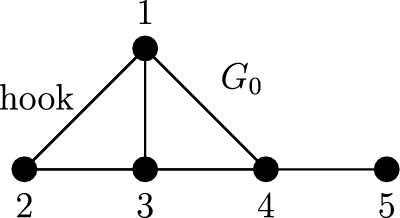
Figure 1 illustrates a seed with a hooking edge. The seed nodes carry numbers according to a canonical labeling that will be explained in Subsection 3.1.
A seed labeled canonically.

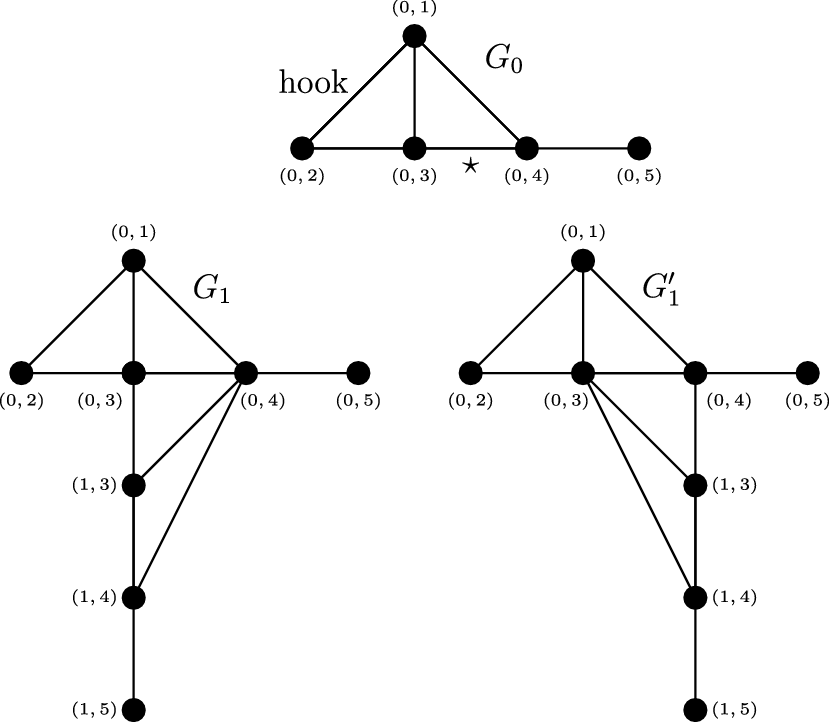
Figure 2 shows networks grown from the seed by the two different orientations, while fusing the hook and the latch. The graphs in the growing network carry labels derived from the canonical numbering of the seed nodes and additional timestamps indicating the entry point in time of a seed copy (more on this in Section 3.1).
A dynamically labeled seed (top) and two dynamically labeled networks grown from it (second row), each corresponding to one hooking orientation. The edge chosen for hooking is marked with a star.

The graph
 $G_1$
is constructed by obtaining a new copy of the seed and hooking vertex 1 in the new seed to vertex 4 in the graph
 $G_0$
and vertex 2 in the new seed to vertex 3 in
 $G_0$
. The graph
 $G^{\prime}_1$
corresponds to the alternative orientation, in which vertex 1 in the new seed is hooked to vertex 3 in the graph
 $G_0$
and vertex 2 in the new seed is hooked to vertex 4 in
 $G_0$
. Each of the two graphs
 $G_1$
and
 $G^{\prime}_1$
occurs with probability
 $\frac 1 6 \times \frac 1 2 = \frac 1{12}$
. The nodes in the graphs of Figure 2 carry labels that will be explained later. Note that the two orientations give rise to the two nonisomorphic graphs
 $G_1$
and
 $G^{\prime}_1$
.
In the context of edge-fused networks, a seed is a connected graph
 $S= (V,{\mathcal{E}})$
with a set of vertices
 $V$
and a set of edges
 ${\mathcal{E}}$
containing at least one edge. A particular edge in
 ${\mathcal{E}}$
is distinguished as the hook, the edge designated for fusing into larger graphs. The seed is used as a building block in a bigger network in discrete time steps. We use
 $n$
for discrete time. Consequently, we can think of the graph
 $G_n$
as the network at age
 $n$
. Technically speaking, we generate a sequence of seeds
 $S_0, S_1, S_2, \ldots$
that are identical to one prototype seed
 $S$
. Each copy then has its own hook. At time 0, the network starts as
 $S_0$
. At time
 $n\ge 1$
, the copy
 $S_n$
is adjoined to the network and its hook is used for edge hooking.
In the sequel, when we speak of a property of a seed without specifying its timestamp, we refer to the prototype seed
 $S$
. We call the class of graphs so built edge-hooking networks.
The study is motivated by the recent interest in graphs with “community structure,” see van der Hofstad et al. (Reference van der Hofstad, van Leeuwaarden and Stegehuis2018), for example. Graphs with community structure have been suggested as models for epidemiology (Bhamidi et al., Reference Bhamidi, Fan, Fraiman and Nobel2021; Trapman, Reference Trapman2007). The proposed edge-hooking network has a tree as a backbone, where a tree edge may develop into a “local community,” that is, blown out to be an entire graph (copy of the seed).
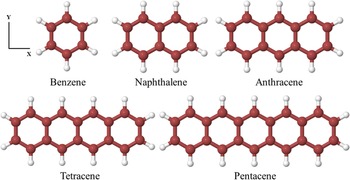
As an application of the edge-hooking mechanism, we present an example from organic chemistry. Acenes or polyacenes are polycyclic aromatic hydrocarbons that consist of linearly fused benzene rings. This threadlike network of benzene ring fusion is shown in Figure 3.Footnote 1
The topology of benzene ring fusion in polyacenes.

Polyacenes follow the molecular formula
 $C_{4k+2}H_{2k+4}$
, where
 $k \ge 1$
. As a particular example of edge-hooking networks,
 $G_0$
will be benzene having a molecular formula with
 $k = 1$
. One can think of
 $G_1$
as naphthalene having a molecular formula with
 $k = 2$
. Then,
 $G_2$
will be anthracene having a molecular formula with
 $k = 3$
and so on. Our edge fusing network model exhibits the structure and geometry that happens in these organic compounds.
Acenes are an important and unique class of organic compounds (Tönshoff & Bettinger, Reference Tönshoff and Bettinger2021). The smaller acenes like benzene, naphthalene, and anthracene are among the well-studied organic compounds that can be produced from coal or petroleum products. The larger acenes and their derivatives form organic semiconductor materials. They possess unique and versatile electronic properties, and scientists find them to be attractive candidates for use in organic electronic devices. They are currently the subject of great interest in materials science and engineering (Akter et al., Reference Akter, Yamamoto, Zope and Baruah2021; Anthony, Reference Anthony2008; Zamoshchik et al., Reference Zamoshchik, Zade and Bendikov2013).
2. Scope
A paramount property of graphs is the distribution of node degrees within. For example, the degree of a node in a social network, namely the number of followers, may be taken as a measure of the influence of a person in the network.
We study the local degree profile of a network, which tracks the evolution of a specific vertex in the network over time. We also study the size of the core, which is the number of edges that experience fusing. Via fusing, edges in the core are more anchored in the graph and can be “thicker” than other edges. The notion of edge fusing is studied in a different context in Bhutani & Khan (Reference Bhutani and Khan2003), where the authors looked at the multiplicity of an edge with respect to a given set of paths. Multiplicity there is defined as the number of times an edge is used to construct the named set of paths. The concept in (Bhutani & Khan, Reference Bhutani and Khan2003) is introduced to define a distance between two graphs.
At the end of the study, we look into an alternative model of preferential edge hooking. To see the contrast to the uniform model, we develop a result for the size of the core under preferential attachment.
3. Notation
We denote the cardinality of a set
 $B$
by
 $|B|$
. The prototype seed
 $S=(V,{\mathcal{E}})$
has structural properties, such as the degrees of its nodes. It is expected that network characteristics (such as a degree profile) will depend on these properties. For instance, distributions associated with the network may be parameterized by some counts in
 $S$
. The size of the seed
 $\epsilon _0 \,:\!=\,|{\mathcal{E}}|$
appears in the results. In the case
 $\epsilon _0 = 1$
, the seed is the
 $K_2$
,Footnote 2 the complete graph on two vertices. Such a case is degenerate, as fusing copies of the seed produces
 $K_2$
. The network does not progress beyond the initial
 $K_2$
, and there is nothing to study. In what follows we assume
 $\epsilon _0 \ge 2$
.
Let
 $\epsilon _n$
be the size (the number of edges) of the network at age
 $n$
. As we add a copy of the seed at each step, and the hook is subsumed in the graph, i.e., does not add to the edges of the network, we have
 \begin{equation*}\epsilon _n = (\epsilon _0-1) n + \epsilon _0.\end{equation*}
Some exact results will be represented in terms of Pochhammer’s symbol for the rising factorial. The
 $m$
-times rising factorial of a real number
 $x$
is
 \begin{equation*}\langle x \rangle _m = x(x+1) \ldots (x+m-1),\end{equation*}
with the interpretation that
 $\langle x \rangle _0=1$
.
We also have occasion to use
 $ \left\{{m \atop i} \right\}$
, the
 $i$
th Stirling number of order
 $m$
of the second kind, which is the number of ways to divide a nonempty set of size
 $m$
into
 $i$
nonempty subsets. For properties of Stirling numbers, we refer the reader to David & Barton (Reference David and Barton1962) and Graham et al. (Reference Graham, Knuth and Patashnik1994).
3.1 Canonical labeling
Assume the nodes of the seed are numbered
 $1, \ldots, |V|$
, a numbering in which the two nodes of the hook are numbered 1 and 2, the rest are arbitrarily labeled distinctly with the numbers
 $3, 4, \ldots, |V|$
. We take this numbering as canonical to be preserved in every copy of
 $S$
. Since the canonical labels in the seed repeat in the network, a tiebreaking mechanism is needed for unique identification of network nodes. The tiebreaker is the timestamp—the point in time at which a node joins the graph. In such a “dynamic labeling,” a node’s tag carries two components: the canonical labeling and the timestamp.
Figure 2 shows one such canonical numbering. A node appearing in the network is thus adequately specified by a pair
 $(j,r)$
, if it appears for the first time at stage
 $j$
and is the
 $r$
th in the canonical numbering of
 $S_j$
.
Let
 $d_r$
be the degree of node
 $r$
in the seed, for
 $1 \le r \le |V|$
. According to the canonical labeling, in the seed, the two ends of the hook
 $\{1,2\}$
have degrees
 $d_1$
and
 $d_2$
. We use
 $\Delta _{j,n}^{(r)}$
to denote the degree of node
 $(j,r)$
in a network of age
 $n\ge j$
. For instance, in the running example of Figure 2, we have
 $\Delta _{0,0}^{(3)} = 3$
, and if the stochastic path follows
 $G_1$
we would have
 $\Delta _{0,1}^{(3)} = 4$
, but if the stochastic path follows
 $G^{\prime}_1$
, we would have
 $\Delta _{0,1}^{(3)} = 5$
.
Note that, for
 $r=3,4, \ldots, |V|$
, the node
 $(j,r)$
appears at time
 $j\ge 0$
, whereas the nodes
 $(j,1)$
and
 $(j,2)$
appear only when
 $j=0$
; this is because the fusing of edges subsumes the seed edge
 $\{1,2\}$
of the seed in older edges, and the end nodes of these receiving edges have already been labeled at earlier stages.
In the sequel, we use the symbol
 $\buildrel a.s. \over \longrightarrow$
to denote almost sure convergence and the symbol
 $\buildrel{\mathcal{D}} \over \longrightarrow$
to denote convergence in distribution. The notation
 ${\mathcal{N}}(0, \sigma ^2)$
stands for a centered normal random variable with variance
 $\sigma ^2$
.
4. Pólya urns
An instrument we use in this investigation is Pólya urn (Mahmoud, Reference Mahmoud2008). A
 $c$
-color Pólya urn scheme is comprised of an initial nonempty urn containing balls of up to
 $c$
-colors and rules to operate on the urn at discrete time steps. The colors are numbered
 $1, 2, \ldots, c$
. At each time step, a ball is drawn at random from the urn and its color is observed. If the color of the ball withdrawn is
 $i$
, we put it back in the urn and add
 $a_{i,j}$
(possibly negative or even random) balls of color
 $j$
, for
 $j=1, \ldots, c$
, and the drawing is continued. These dynamics are captured in a
 $c \times c$
replacement matrix:
 \begin{equation*}\begin {pmatrix} a_{1,1} & \quad a_{1,2} & \quad \ldots & \quad a_{1,c}\\ a_{2,1} & \quad a_{2,2} & \quad \ldots & \quad a_{2,c}\\ \vdots & \quad \vdots & \quad \ddots & \quad \vdots \\ a_{c,1} & \quad a_{c,2} & \quad \ldots & \quad a_{c,c} \end {pmatrix}.\end{equation*}
When some entries of the replacement matrix are negative, a tenability issue (of indefinite drawing) may arise. These cases do not appear in our study—all the replacement matrices in this article contain only nonnegative elements.
5. Modeling the local profile by a Pólya urn
The strategy to track the degree
 $\Delta _{j,n}^{(r)}$
is to map the edges of the network onto balls in a Pólya urn. The edges incident with the vertex we are tracking correspond to the white balls in the urn and all the other edges in the network correspond to the blue balls in the urn. Thus, the count of the white balls at any stage is the degree of the vertex under tracking at that stage.
We wait till the node
 $y = (j,r)$
appears in the network to start a Pólya urn with
 $d_r$
white balls and
 $\epsilon _j - d_r = (\epsilon _0-1) j + \epsilon _0 - d_r$
blue balls. We use the terms “edges” and “balls” interchangeably, so we can think directly of an urn of white and blue edges.
When we pick a white edge at step
 $n$
(one of the
 $\Delta _{j, n-1}^{(r)}$
edges incident with
 $y$
), node
 $y$
and one of its neighbors are involved in the edge hooking. Upon hooking a copy of the seed, we fuse the seed edge joining the vertices with labels 1 and 2 in the canonical numbering. We increase the degree of
 $y$
either by
 $d_1-1$
or
 $d_2-1$
, (with equal probability) depending on the orientation of the hooking; the
 $-1$
accounts for the loss of the seed fused edge upon hooking. The orientation chosen is determined as in the outcome of flipping a fair coin. Let
 ${\mathbb{I}}_{{\mathcal{H}}}$
be the indicator of the event that the coin toss yields Heads. The number of white edges increases by a variable distributed like
 \begin{equation*} d_1{\mathbb {I}}_ {{\mathcal{H}}} + d_2(1-{\mathbb {I}}_{{\mathcal{H}}}) -1.\end{equation*}
Except for the edges incident with
 $y$
in
 $G_{n-1}$
, hooking at any other edge does not alter the degree of
 $y$
, we add
 $\epsilon _0 -1$
blue edges.
Letting
 ${\mathbb{F}}_n$
be the sigma field generated by the first
 $n$
steps, the conditional distribution of the degree of node
 $(j,r)$
is
 \begin{equation*}\Delta _{j,n}^{(r)} \, \vert \, {\mathbb {F}}_{n-1} = \begin {cases} \Delta _{j,n-1}^{(r)} + d_1{\mathbb {I}}_ {{\mathcal{H}}} + d_2(1-{\mathbb {I}}_{{\mathcal{H}}}) -1, \ \ \mbox {with probability} \frac {\Delta _{j,n-1} ^{(r)}} {\epsilon _{n-1}}; \\[6pt] \Delta _{j,n-1}^{(r)}, \qquad \mbox {with probability} 1- \frac {\Delta _{j,n-1} ^{(r)}} {\epsilon _{n-1}}. \end {cases}\end{equation*}
These dynamics are captured by the Pólya replacement matrix
 \begin{equation*}\begin {pmatrix} d_1{\mathbb {I}}_ {{\mathcal{H}}} + d_2(1-{\mathbb {I}}_{{\mathcal{H}}})-1 & \quad \epsilon _0 - d_1{\mathbb {I}}_ {{\mathcal{H}}} - d_2(1-{\mathbb {I}}_{{\mathcal{H}}})\\ 0 & \quad \epsilon _0-1 \end {pmatrix}.\end{equation*}
Traditionally, a two-color urn scheme with a replacement matrix with one off-diagonal element being 0 and the other off-diagonal element being positive is called triangular.
We analyze the average behavior of balanced urns of this type; the balance means the row sum is constant. Take an integer
 $\delta \ge 1$
and construct a triangular Pólya urn scheme on white and blue balls with the replacement matrix
 \begin{equation} \begin{pmatrix} X && \quad \delta -X\\ 0 && \quad \delta \end{pmatrix}, \end{equation}
with
 $X$
having a distribution on the integers
 $0, 1, \ldots, \delta -1$
, with mean
 $\mu$
.
Let
 $W_m$
be the number of white balls after
 $m$
draws from the urn, and let
 $Q_m$
be the total number of balls in the urn at time
 $m$
. Thus,
 $Q_0$
is the initial number of balls in the urn and we have
 \begin{equation*}Q_m = \delta m + Q_0.\end{equation*}
More precisely, at the
 $m$
th drawing,
 $X_m$
is the
 $m$
th realization of
 $X$
. So,
 $X_1, X_2, \ldots$
is a sequence of independent identically distributed random variables, and in the
 $m$
th drawing we use the replacement matrix
 \begin{equation*}\begin {pmatrix} X_m && \delta -X_m\\ 0 && \delta \end {pmatrix}.\end{equation*}
After
 $m$
draws, the number of white balls satisfies the stochastic recurrence
 \begin{equation*}W_m = W_{m-1} + X_m\, {\mathbb {I}}_m^{(W)}, \end{equation*}
where
 ${\mathbb{I}}_m^{(W)}$
is the indicator of the event of picking a white ball in the
 $m$
th drawing. Conditioning on
 ${\mathbb{F}}_{m-1}$
(the sigma field generated by the first
 $m-1$
draws), we have the expectation
 \begin{equation*}{\mathbb {E}}[W_m\, \vert \, {\mathbb {F}}_{m-1}] = W_{m-1} + {\mathbb {E}}[X_m] \, {\mathbb {E}}\!\left[ {\mathbb {I}}_m^{(W)} \, \vert \, {\mathbb {F}}_{m-1}\right],\end{equation*}
following from the independence of
 $X_m$
of the history. We then have
 \begin{equation}{\mathbb{E}}[W_m\, \vert \,{\mathbb{F}}_{m-1}] = W_{m-1} + \mu \,\frac{W_{m-1}}{Q_{m-1}}. \end{equation}
An iterated expectation gives us the unconditional expectation
 \begin{equation*}{\mathbb {E}}[W_m] = \Big (1 + \frac {\mu } {Q_{m-1}}\Big ) \, {\mathbb {E}}[W_{m-1}].\end{equation*}
Unwinding this recurrence, we obtain
 \begin{align}{\mathbb{E}}[W_m] &= \left(1 + \frac{\mu }{Q_{m-1}} \right)\ldots \, \left(1 + \frac{\mu }{Q_0} \right)W_0, \nonumber \\[3pt] &= \left( \frac{\left(m-1\right)\!\delta + Q_0+\mu }{\left(m-1\right)\!\delta + Q_0} \right)\ldots \, \left( \frac{Q_0 + \mu }{Q_0} \right)W_0\nonumber \\[3pt] &= \left( \frac{m-1 + \frac{Q_0+\mu }{\delta }}{m-1 + \frac{Q_0}{\delta }} \right)\ldots \, \left( \frac{\frac{Q_0+\mu } \delta }{\frac{Q_0}\delta } \right)W_0\nonumber \\[3pt] &= \frac{\Gamma \!\left(m+ \frac{Q_0+\mu }{\delta }\right)\, \Gamma\!\left( \frac{Q_0}{\delta }\right)}{\Gamma \!\left(m+ \frac{Q_0}{\delta }\right) \, \Gamma \!\left(\frac{Q_0+\mu }{\delta }\right)}\, W_0. \end{align}
This derivation furnishes a proof for the average degree of a node in the network. The proof concerns a node
 $(j,r)$
, and we keep in mind that
 $j$
may be a function of
 $n$
. For example, we may specify some large
 $n$
and decide to look at the degree of a node that appeared at time
 $j = j(n) = \lceil \sqrt n \,\rceil$
.
In the context of exact probability calculation, we just use
 $j$
and
 $n$
, as they are both fixed numbers. In the context of asymptotics, it is preferable to use the notion
 $j_n$
to capture any dependence therein between the index
 $j$
and the age
 $n$
.
Theorem 5.1.
Let
 $y=(j,r) = (j_n,r)$
be the
 $r$
th node in the canonical representation of the
 $j_n$
th seed copy in the network. Suppose the two ends of the hook
 $\{1,2\}$
have degrees
 $d_1$
and
 $d_2$
. At time
 $n$
, the average degree of
 $y$
is
 \begin{equation*}{\mathbb {E}}\!\left[\Delta _{j,n}^{(r)}\right] = \frac { \Gamma \!\left(j+\frac {\epsilon _0} {{\epsilon _0}-1}\right)\, \Gamma \!\left(n + \frac {d_1+ d_2 + 2 {\epsilon _0} -2}{2({\epsilon _0}-1)}\right)} { \Gamma \!\left(j+\frac {d_1 + d_2 +2{\epsilon _0} -2}{2({\epsilon _0}-1)}\right)\, \Gamma \!\left(n+\frac {\epsilon _0} {{\epsilon _0}-1}\right) }\, d_r.\end{equation*}
Asymptotically, as
 $n\to \infty$
, we have
 \begin{equation*}{\mathbb {E}}\!\left[\Delta _{j,n}^{(r)}\right] = \begin {cases}d_r\, \frac { \Gamma \!\left(j+\frac {\epsilon _0} {{\epsilon _0}-1}\right)} { \Gamma \!\left(j+\frac {d_1 + d_2 +2{\epsilon _0} - 2}{2({\epsilon _0}-1)}\right) }\, n^{\frac {d_1+ d_2 -2}{2\!\left({\epsilon _0}-1\right) }}, & {if \ } j_n = O(1) ;\\ \\ d_r\! \left(\frac n j\right)^{\frac {d_1+ d_2-2 }{2\!\left({\epsilon _0}-1\right) }}, \qquad & {if \ } j_n \to \infty .\end {cases}\end{equation*}
Proof. The replacement matrix of the urn scheme associated with the local degree profile of the node
 $(j,r)$
is triangular of the type (1), with
 \begin{equation*}X= d_1{\mathbb {I}}_ {{\mathcal{H}}} + d_2(1-{\mathbb {I}}_{{\mathcal{H}}}) -1, \qquad \mu = \frac {d_1+d_2} 2 - 1,\qquad \qquad \delta = \epsilon _0-1;\end{equation*}
The scheme has the initial conditions
 \begin{equation*}W_0 = d_r, \qquad Q_0 = \epsilon _j = ( \epsilon _0-1) j + \epsilon _0.\end{equation*}
The exact average of
 $\Delta _{j,n}^{(r)}$
follows upon plugging these values in (3), and evaluating at time
 $m = n- j$
.
The asymptotic equivalent follows from Stirling approximation of the ratio of gamma function (see article 6.1.47 in Abramowitz & Stegun (Reference Abramowitz and Stegun1972)):
 \begin{equation*}\frac {\Gamma (x+a)}{\Gamma (x+b)} \sim x^{a-b}, \qquad \mbox {as} x \to \infty .\end{equation*}
Remark 5.1. Reference (Janson, Reference Janson2006) deals only with urn schemes with fixed entries. Edge fusing calls for urn schemes with random entries.
Remark 5.2. From the affine transformation of
 $W_m$
in (2), we can quickly show that
 \begin{equation*}S_m = \left(\prod _{i=0}^{m-1}\frac {Q_i} {Q_i + \mu }\right) W_m\end{equation*}
is a martingale. The top line in the chain of derivations (3) can be obtained from
 ${\mathbb{E}}[S_m] ={\mathbb{E}}[S_0]$
. The gamma asymptotics used in the proof of Theorem 5.1 also tell us (via the martingale convergence theorem) that
 $W_m/ m^{\mu/\delta }$
converges (as
 $m\to \infty$
) almost surely and in
 $L^1$
to “some” limit.
Remark 5.3. Reference (Aguech, Reference Aguech2009) gives strong laws for a broader class of triangular urns, but in less explicit terms. The entries of the replacement matrix in Aguech (Reference Aguech2009) are bounded in
 $L^2$
, and the author gets convergence almost surely. The strong convergences in Aguech (Reference Aguech2009) are to unknown limits that come out of the martingale convergence theorem, which is only an existential statement that does not specify the limits. To guarantee tenability, the entries of the triangular urn we are considering are uniformly bounded by
 $\delta$
. So, they are bounded in
 $L^2$
and in the almost-sure sense, as well. Results in Aguech (Reference Aguech2009) apply.
5.1 Interpreting the phases in the local degree profile
Note that in Theorem 5.1 the power of
 $n$
is less than 1—this can be seen from the fact that
 \begin{equation*}d_1 + d_2 -2 \lt \sum _{r=1}^ {|V|} d_r - 2 = 2\epsilon _0 - 2,\end{equation*}
with
 $K_1$
and
 $K_2$
forbidden as seeds, the inequality is strict.
Theorem 5.1 portrays a spectrum covering all the nodes by time
 $n$
. We can think of
 $j$
as
 $ j_n= a n + h(n)$
, with
 $h(n) = o(n)$
. In the very early sublinear phase in which
 $j= j_n = O(1)$
, such as the cases
 $j=5$
or
 $j = 13 +({-}1)^n$
, the average degree of the node
 $ (j, r)$
is of the form
 ${\mathbb{E}}\!\left[\Delta _{j,n}^{(r)}\right] \sim c_j n ^{\frac{d_1+ d_2-2 }{2(\epsilon _0-1)}}$
, for a
 $O(1)$
coefficient
 $c_j$
that depends on
 $j$
and the seed parameters. Note that in the instance
 $j_n = 13 +({-}1)^n$
, the coefficient
 $c_j$
oscillates.
In the later sublinear phase, we still have
 $a=0$
, and
 $j_n\to \infty$
, such that
 $j_n = 0 + h(n) = o(n)$
. For instance
 $j_n$
may be
 $\lfloor 6\ln n + \pi \rfloor$
, or
 $\left\lceil 4\, \frac n{\ln n} + \frac 7 6 + \frac 1 n \right\rceil$
. In this phase, we have
 ${\mathbb{E}}\!\left[\Delta _{j_n,n}^{(r)}\right] \sim d_r ( n/ h(n))^{\frac{d_1+ d_2-2 }{2(\epsilon _0-1) }}$
.
Next comes the linear phase, with
 $a \in (0,1)$
. In this phase, we have
 \begin{equation}{\mathbb{E}}\!\left[\Delta _{j_n,n}^{(r)}\right] \sim d_r \Big ( \frac 1 a\Big )^{\frac{d_1+ d_2-2 }{2(\epsilon _0-1) }}. \end{equation}
Finally, we reach the very late linear phase, with
 $a=1$
, such as the case
 $j_n=\lceil n - \ln n\rceil$
or
 $j_n = n-7$
. In this phase, we have
 ${\mathbb{E}}\!\left[\Delta _{j_n,n}^{(r)}\right]\sim d_r$
. This is to be anticipated, since the edges incident with these very late nodes compete with an overwhelming number of edges in the graph to be the latch, and by time
 $n$
they have not had enough time to succeed. So, they retain the degree with which they joined the network.
The index
 $j_n$
may have a complex dependence on
 $n$
. For instance, one could conceive of the choice
 $j_n= a_n n + h(n)$
, where the coefficient
 $a_n$
is a function of
 $n$
. This may lead to multiple asymptotic subsequences of asymptotic equivalents, as for example the case
 $a_n = \frac 1 3$
for even
 $n$
, and
 $a_n = \frac 2 3$
for odd
 $n$
. In such an instance, formula (4) is applicable with
 $a$
alternating appropriately with the parity of
 $n$
.
5.2 The subclass with both ends of the hook having the same degree
With
 $d_1 \not = d_2$
, the underlying urn is unbalanced. As mentioned, an appeal to the known theory of urns can only produce nonconstructive almost-sure convergence (to an unspecified limit variable). In the case of
 $d_1=d_2$
, we can go further and develop a distributional result eliciting the limit.
If both ends of the hook
 $\{1,2\}$
are of the same degree
 $d_1$
, the Pólya urn scheme is simplified to a balanced scheme with a triangular deterministic replacement matrix, which is namely
 \begin{equation*} \begin {pmatrix} \alpha & \quad \delta - \alpha \\ 0 & \quad \delta \end {pmatrix}.\end{equation*}
This is a well-studied urn and we can say much more beyond the average degree of a node. This scheme has been analyzed in Flajolet et al. (Reference Flajolet, Dumas and Puyhaubert2006), Janson (Reference Janson2006), and Zhang et al. (Reference Zhang, Chen and Mahmoud2015). The exact moments have been characterized in Zhang et al. (Reference Zhang, Chen and Mahmoud2015). In this case, the moments of the number of white balls after
 $m$
draws are given by
 \begin{equation*}{\mathbb {E}}\!\left[W_m^k\right] = \frac {\alpha ^k } {\left\langle \frac {Q_0}\delta \right\rangle _m} \sum _{i=1}^k ({-}1)^{k-i} \left\{{k \atop i }\right\} \, \left\langle \frac {W_0} \alpha \right\rangle _i \, \left\langle \frac {Q_0 + i\alpha } \delta \right\rangle _m.\end{equation*}
For an edge-hooking network, where the two ends of the hooking edge have the same degree
 $d_1$
, we have a correspondence with an urn with
 \begin{equation*}\alpha = d_1 -1, \qquad \delta = \epsilon _0-1.\end{equation*}
The scheme has the initial conditions
 \begin{equation*}W_0 = d_r, \qquad Q_0 = \epsilon _j = (\epsilon _0 -1) j +\epsilon _0,\end{equation*}
and the degree of node
 $(j,r)$
by time
 $n$
is the number of white balls in the urn at time
 $m={n-j}$
. The moments equation in Zhang et al. (Reference Zhang, Chen and Mahmoud2015) readily yields
 \begin{align*}{\mathbb{E}} \!\left[ \left(\Delta _{j,n}^{(r)} \right)^k \right] &= \frac{(d_1-1)^k }{\left\langle \frac{ ({\epsilon _0} -1) j +{\epsilon _0}}{{\epsilon _0}-1} \right\rangle _{n-j}} \sum _{i=1}^k ({-}1)^{k-i} \left\{{k \atop i } \right\} \, \left\langle \frac{d_r}{d_1-1} \right\rangle _i \\[3pt]& \qquad\qquad\qquad\qquad\qquad \times \left\langle \frac{ ({\epsilon _0} -1) j +{\epsilon _0}+ i (d_1-1)}{{\epsilon _0}-1} \right\rangle _{n-j}. \end{align*}
The asymptotic moments are given in Flajolet et al. (Reference Flajolet, Dumas and Puyhaubert2006) and Janson (Reference Janson2006), see also Zhang et al. (Reference Zhang, Chen and Mahmoud2015). Translated to the urn associated with node degrees, as
 $j_n\to \infty$
, such that
 $j_n = o(n)$
, we have
 \begin{equation*}{\mathbb {E}}\!\left[\left(\frac {\Delta _{j_n,n}^{(r)}} {{(n/j_n)}^{\frac {d_1-1}{{\epsilon _0} -1}}} \right)^k\right] \to \big (d_1-1\big )^k \frac {\Gamma \!\left(k+ \frac {d_r} {d_1-1}\right)} {\Gamma \!\left(\frac {d_r}{d_1-1}\right)}.\end{equation*}
In this convergence relation, the right-hand side is the
 $k$
th moment of the so-called gamma-type distribution (Janson, Reference Janson2010), which is uniquely determined by its moments. Hence,
 ${\Delta _{j_n,n}^{(r)}}/{{(n/j_n)}^{\frac{d_1-1}{{\epsilon _0} -1}}}$
converges to the so-characterized gamma-type distribution.
The special case in which both ends of the hooking edge have the same degree covers, for example, hooking regular graphs. As an instantiation, consider the graph obtained from triangles by fusing edges. Here, we have
 ${\epsilon _0} =3$
and
 $d_1-1 = 1$
, and we have the convergence
 \begin{equation*}{\mathbb {E}}\!\left[\left(\frac {\Delta _{j_n,n}^{(r)}} {{(n/j_n)}^{\frac 1 2}} \right)^k\right] \to \Gamma (k+ 2),\end{equation*}
as
 $j_n\to \infty$
, with
 $j_n = o(n)$
. Note that the right-hand side of the above convergence relation is the
 $k$
th moment of a gamma
 $(2, 1)$
random variable.
6. The core
Edges of the network fall in two categories. There are edges that are used as hooks and there are other edges that are yet to be used in hooking. We call the edges fused in hooking operations the core as they are “soldered” with other edges and their position is thicker and sturdier in the network.
Let
 $C_n$
be the size of the core (i.e., the number of edges in it) at age
 $n$
. For example, the starred edge in Figure 2 in
 $G_0$
is not in the core of the network at time 0, but becomes in the core of
 $G_1$
. We always have
 $C_0=0$
,
 $C_1=1$
, and randomness appears at age 2 and beyond. Note that when an edge is selected as a latch and the seed is hooked, both orientations of the hooking give the same number of edges in the core. If the edge
 $(0,1)$
and
 $(0,3)$
in
 $G_1$
is the latch to produce
 $G_2$
, both hooking orientations give
 $C_2 =2$
.
We compute the exact mean and ultimately an asymptotic Gaussian distribution via Pólya urns.
6.1 Exact mean
Let
 ${{\mathcal{C}}}_{n-1}$
be the event of picking a latch from the core of the graph
 $G_{n-1}$
for hooking, and let
 ${\mathbb{I}}_{{{\mathcal{C}}}_{n-1}}$
be its indicator. The size of the core increases (by 1) only if the latch chosen is not in the core. We have a stochastic recurrence:
 \begin{equation} C_n = C_{n-1} + 1 -{\mathbb{I}}_{{{\mathcal{C}}}_{n-1}}. \end{equation}
From this relation, we can get the exact mean.
Theorem 6.1.
Let
 $C_n$
be the size of the core in an edge-hooking network of age
 $n$
. We have
 \begin{equation*}{\mathbb {E}}[C_n] = 1 + \sum _{i=1}^{n-1} \frac {\langle i+1 \rangle _{n-i}} {\left\langle i +\frac {\epsilon _0} {{\epsilon _0} -1}\right\rangle _{n-i}}.\end{equation*}
Proof. Let
 ${\mathbb{F}}_n$
be the sigma field generated by the first
 $n$
hookings. The conditional expectation (on
 ${\mathbb{F}}_{n-1}$
) arising from the stochastic recurrence (5) is
 \begin{equation}{\mathbb{E}}[C_n\, \vert \,{\mathbb{F}}_{n-1}] = C_{n-1} + 1 -{\mathbb{E}}[{\mathbb{I}}_{{{\mathcal{C}}}_{n-1}} \, \vert \,{\mathbb{F}}_{n-1}] = C_{n-1} + 1 - \frac{C_{n-1}}{\epsilon _{n-1}}. \end{equation}
Collecting similar terms and taking an iterated expectation, we get the unconditional expectation
 \begin{equation*}{\mathbb {E}}[C_n] = \left(1-\frac 1 {\epsilon _{n-1}}\right)\, {\mathbb {E}}[C_{n-1}] + 1 .\end{equation*}
This recurrence equation is of the standard linear form
 \begin{equation*}y_n = g_n y_{n-1} + h_n,\end{equation*}
with solution
 \begin{equation*}y_n = \sum _{i=1}^n h_i\prod _{j=i+1}^n g_j + y_0 \prod _{j=1}^n g_j.\end{equation*}
In view of the initial condition
 $C_0 = 0$
, the solution for the average core size (for
 $n\ge 1$
) is
 \begin{equation*}{\mathbb {E}}[C_n] = \sum _{i=1}^n \prod _{j=i+1}^n \frac {\epsilon _{j-1}-1} {\epsilon _{j-1}}, \end{equation*}
with the interpretation of an empty product as 1. So, we have
 \begin{align*}{\mathbb{E}}[C_n] &= 1 + \sum _{i=1}^{n-1} \prod _{j=i+1}^n \frac{({\epsilon _0}-1)(j-1)+{\epsilon _0}-1}{({\epsilon _0}-1)(j-1)+{\epsilon _0}} \\ &= 1 + \sum _{i=1}^{n-1} \prod _{j=i+1}^n \frac{j}{j-1 +\frac{\epsilon _0}{{\epsilon _0}-1}}\\ &= 1 + \sum _{i=1}^{n-1} \frac{\langle i+1 \rangle _{n-i}}{\left\langle i +\frac{\epsilon _0}{{\epsilon _0} -1}\right\rangle _{n-i}}. \end{align*}
6.2 Core asymptotics
We derive a strong law and an asymptotic Gaussian law for
 $C_n$
via a connection to Bagchi–Pal urn (Bagchi & Pal, Reference Bagchi and Pal1985).
Theorem 6.2.
Let
 $C_n$
be the size of the core in an edge-hooking network of age
 $n$
. We have
 \begin{equation*}\frac {C_n} n\buildrel a.s. \over \longrightarrow \frac {{\epsilon _0}-1} {\epsilon _0},\end{equation*}
and
 \begin{equation*}\frac {C_n - \frac {{\epsilon _0} -1}{\epsilon _0} \, n} {{\sqrt n}} {\buildrel {\mathcal{D}} \over \longrightarrow } \ {\mathcal {N}}\left(0, \frac {({\epsilon _0}-1)^2} {{\epsilon _0}^2 ({\epsilon _0} +1)}\right). \end{equation*}
Proof. Think of the edges in the graph as colored balls in an urn—edges in the core are white and edges not in the core are blue. For the next graph, we choose an edge at random (pick an edge (ball) at random from the urn). The chosen edge is the latch. If the latch is white, this edge has already participated in hooking and is in the core. If we hook a copy of the seed at this latch, the status of the latch does not change, and it remains in the core; however, we add
 ${\epsilon _0}-1$
fresh edges that have not yet participated in any recruiting. Consequently, we leave the number of white balls unchanged and add
 ${\epsilon _0}-1$
blue balls to the urn.
Alternatively, the latch is a blue edge that has not participated in hooking before. After hooking the seed to the latch, the fused edge has now moved into the core, a new white edge at the expense of an exiting blue edge, and
 ${\epsilon _0}-1$
blue edges come with the new seed, a net gain of
 ${\epsilon _0}-2$
blue edges. The corresponding replacement matrix is
 \begin{equation*}\begin {pmatrix} 0 & \quad {\epsilon _0}-1\\ 1 & \quad {\epsilon _0}-2 \end {pmatrix}.\end{equation*}
This is an instance of Bagchi–Pal urn, and the stated result follows from a well-developed theory. The strong law has long been known (Athreya & Karlin, Reference Athreya and Karlin1968), and a central limit theorem appears in Bagchi & Pal (Reference Bagchi and Pal1985), see also Section of Mahmoud (Reference Mahmoud2008).
Remark 6.1. The standard urn theory specifies an asymptotic average but does not give an exact value. We thought it is worth it to develop the exact average (cf. Theorem 6.1) as it can give us sharper asymptotic approximation. For instance, if
 $\epsilon _0 = 3$
, the exact average formula in Theorem 6.1 reduces to
 \begin{equation*}{\mathbb {E}}[C_n] = \frac 2 3 \, n + 1 - \frac {\sqrt {\pi } \, \Gamma (n+1)} {2\, \Gamma \big (n + \frac 3 2\big )},\end{equation*}
and
 $n\to \infty$
, we have the approximation
 \begin{equation*}{\mathbb {E}}[C_n] = \frac 2 3 \, n + 1 - \frac 1 2 \sqrt {\frac \pi n} + \frac 3 {16} \sqrt {\frac \pi {n^3}} - \frac {25} {256} \sqrt {\frac \pi {n^5}} + O\!\left(\sqrt {\frac 1 {n^7}} \, \right),\end{equation*}
following from well-known approximations of the ratio of gamma function (see article 6.1.47 in Abramowitz & Stegun (Reference Abramowitz and Stegun1972)).
7. Preferential hooking as an alternative model of randomness
So far, we have considered only a uniform model of randomness, in which all the edges of the network
 $G_{n-1}$
are equally likely candidates to be the latch to progress into
 $G_n$
. This model stems from the notion of fairness and equal opportunity.
Under a uniform model, each of the two graphs
 $G_1$
and
 $G^{\prime}_1$
occurs with probability
 $\frac 1 6 \times \frac 1 2 = \frac 1{12}$
(see Figure 2), continuing the stochastic path started from
 $G_1$
, the edge
 $\{3,4\}$
has probability
 $1/11$
, like any other edge in
 $G_1$
.
In the preferential attachment (hooking) model of randomness, priority is given to edges that are used as latches. The more an edge latches, the higher the probability is that it latches again. This model reflects experience. In an economics setting, preferential hooking represents the Matthew principle, according to which “the rich get richer,” also characterized as “success breeds success.”
To precisely describe this model, we introduce the notion of “thickness” of an edge. If the network edges are physical objects such as electrical wires or pipes, fusing edges increases the thickness of the resultant edge. We define the thickness of an edge as 1 plus the number of edges fused with it (the number of times the edge is used for latching). Any edge starts out in
 $G_0$
with thickness 1, and its thickness may grow over time. Each fusing into the edge adds 1 to the thickness. Let
 $T_{n-1}(e)$
be the thickness of an edge
 $e$
in the graph
 $G_{n-1}$
. In the preferential hooking model, the probability that
 $e$
is the latch for the next graph
 $G_n$
is proportional to its thickness. So, if
 ${\mathcal{E}}_n$
is the set of edges of
 $G_{n-1}$
, the probability that
 $e$
is the latch to build
 $G_n$
is
 \begin{equation*}\frac {T_{n-1}(e)} {\sum _{e' \in {\mathcal{E}}_{n-1}}T_{n-1} (e')}.\end{equation*}
Note that the total thickness in the entire graph
 $G_n$
is
 ${\sum _{e' \in{\mathcal{E}}_{n}}T_{n} (e')} = \epsilon _0(n+1)$
.
Under preferential hooking, all the edges of
 $G_0$
have thickness 1; the graphs
 $G_1$
and
 $G^{\prime}_1$
still occur with probability
 $ \frac 1{12}$
(see Figure 2). The edge connecting
 $(0,3)$
and
 $(0,4)$
in
 $G_1$
has twice as much probability as any other edge in
 $G_1$
to be the latch to build
 $G_2$
. Continuing the stochastic path from
 $G_1$
, the edge joining
 $(0,3)$
to
 $(0,4)$
has probability
 $2/12$
, whereas any other edge in
 $G_1$
has probability
 $1/12$
to be the latch to build
 $G_2$
.
7.1 The core under preferential hooking
Represent an edge with thickness
 $t\ge 2$
inside the core with
 $t$
white balls in an urn, and represent an edge outside the core (of thickness 1) with one blue ball in the urn.
After
 $n$
draws, let
 $W_n$
be the number of white balls in the urn to be the latch to build
 $G_n$
(i.e., the sum of thickness of all edges in the core) and
 $B_n$
be the number of blue balls in the urn. In the starting graph, all edges are not in the core—the starting urn has
 $\epsilon _0$
blue balls (edges) and none white. If a white edge in
 $G_{n-1}$
is used as a latch, we increase its thickness by 1 (we add a white ball, upgrading the edge thickness) and add
 ${\epsilon _0} -1$
noncore new edges coming from the added seed copy (we add
 ${\epsilon _0} -1$
blue edges). Alternatively, if a blue edge in
 $G_{n-1}$
is used as a latch, we increase its thickness by 1 (we add two white balls; the edge joins the core with thickness 2) and add
 ${\epsilon _0} -2$
noncore new edges (we add
 ${\epsilon _0} -1$
blue edges coming from the seed, but we lose the latch as noncore edge, accounting for an extra
 $-1$
). The ball addition matrix is
 \begin{equation*}\begin {pmatrix} 1 & \quad {\epsilon _0}-1\\ 2 & \quad {\epsilon _0}-2 \end {pmatrix}.\end{equation*}
This again is a Bagchi–Pal urn scheme (Bagchi & Pal, Reference Bagchi and Pal1985). Note that the total number of balls in the urn after
 $n$
draws represents the sum of the thickness of all the edges in the graph
 $G_n$
.
In the limit, we have
 \begin{equation*} \frac {W_n - \frac {2{\epsilon _0}}{{\epsilon _0}+1} \, n} {{\sqrt n}} \ {\buildrel {\mathcal{D}} \over \longrightarrow } \ {\mathcal {N}}\!\left(0, \frac {2{\epsilon _0}({\epsilon _0}-1)} {({\epsilon _0} +1)^2 ({\epsilon _0} + 2)}\right).\end{equation*}
Let
 $\tilde C_n$
be the size of the core at age
 $n$
. The number of blue balls is the number of edges outside the core. So, the size of the core is
 \begin{equation*}\tilde C_n= \epsilon _n -B_n = ({\epsilon _0} -1) n + {\epsilon _0} - \left(\sum _{e\in {\mathcal{E}}_n} T_n(e) - W_n\right).\end{equation*}
Hence, we have
 $\tilde C_n= W_n - n$
, satisfying the following central limit theorem.
Theorem 7.1.
In an edge-hooking network grown under preferential hooking, let
 $\tilde C_n$
be the size of the core at age
 $n$
. We have
 \begin{equation*}\frac {\tilde C_n} n\buildrel a.s. \over \longrightarrow \frac {{\epsilon _0}(\epsilon _0 -1)} {{\epsilon _0} +1},\end{equation*}
and
 \begin{equation*}\frac {\tilde C_n - \frac {{\epsilon _0}(\epsilon _0 -1)} {{\epsilon _0} +1} \, n} {{\sqrt n}} {\buildrel {\mathcal{D}} \over \longrightarrow } \ {\mathcal {N}}\!\left(0, \frac {{\epsilon _0}-1} {{\epsilon _0}^2 ({\epsilon _0} +1)}\right). \end{equation*}
Acknowledgment
We thank the anonymous reviewers for their insightful comments that improved the presentation of the paper.
Competing interests
None.
Funding statement
This research received no specific grant from any funding agency, commercial, or not-for-profit sectors.
Data availability statement
Our findings do not rely on any data or code.


 edges.