In late 2010, as President Obama was bracing himself for the electoral backlash that loomed like a gathering storm among Americans unhappy with the passage of health-care reform and otherwise discomfited by the state of national affairs, one source of consolation could be found in the thoughts of Tom Daschle, former Senate Majority Leader from South Dakota. In his book detailing the events leading up to the Democrats’ legislative breakthrough, Daschle recounted that as Lyndon Johnson signed the Civil Rights Act of 1964, he reportedly stated: “We have lost the South for a generation.”Footnote 1 With a little historical perspective, then, the Obama administration’s current plight seemed neither unique nor necessarily calamitous over the long term.
Daschle’s observation was not only perspicacious but also extremely apt in that a sense of historical awareness had suffused the administration’s health-reform effort from the outset. Throughout the months when the Obama team had developed an overhaul proposal and then fought for its adoption, avoiding damaging mistakes of the past approached the level of obsession. The push for health-care reform at times resembled nothing so much as an advanced policy seminar in which a bevy of experts, reform advocates, and other political commentators—from inside and outside government—all weighed in with their advice (and personal reminiscences) about the missteps of 1993–94. In all, the lessons put forward were complex and multidimensional, encompassing policy design as well as political strategy, including the challenges of communication with an American public whose reactions could be crucial to the administration’s prospects for success.
Almost before the dust had settled once the Patient Protection and Affordable Care Act became law, a flurry of retrospectives attributed the success of President Obama and his political allies to their skillful reading of the historical record and heeding the guidance it provided.Footnote 2 This is “a story about political learning,” argued political scientist Jonathan Oberlander. “The Obama administration’s effort to pass reform in 2009–10 is best understood as a reaction to the Clinton administration’s health-care debacle during 1993–94. The Obama administration’s strategy was evidently to do the opposite of what the Clinton administration tried; the Clinton plan became a blueprint for what not to do in health reform.”Footnote 3
There are three problems with this emerging body of literature and the conventional wisdom it threatens to establish. First, the contributors to this congratulatory commentary are, in many cases, the same individuals who earlier had shaped the political narrative about essential “lessons” of the Clinton Health Security Act. This group—prominent among them leading health policy academics—advanced its views not merely as scholars and analysts communicating about a field of study, but also as enthusiasts for comprehensive health reform who sought to use their writing to influence the policy process. David Blumenthal and James Morone stated in the preface to their ambitious and engaging work, The Heart of Power: Health and Politics in the Oval Office: “Our fondest wish is that the lessons of this book will guide a new administration, however slightly, toward winning social justice and the people’s health.”Footnote 4 When authors who have proffered historical advice later turn attention to assessing the impacts of action consistent with that advice, they are, in part, evaluating the wisdom of their own judgment and counsel.
Second, the subject of historical lesson drawing deserves more than a tallying of good and bad pieces of advice, however that appraisal might be done. Indeed, the process by which the “lessons of history” entered the warp and woof of health-reform discussion in 2009–10 is a striking development noteworthy in its own right, particularly for anyone curious about the transmutation of “policy history” into a distinctive political discourse having observable potency. The question of who participated in this lesson-drawing exercise about health reform and how key messages gained currency across various traditional and new media is neglected by recent authors focused on President Obama’s effective learning from past failure. This is unsurprising, given the largely self-referential nature of such a topic for this group. However, it highlights the need for a broader approach to lesson drawing that treats its forms and its methods of dissemination as significant objects of inquiry.
Third, conclusions about the Obama administration’s adept use of historical lessons seem unduly influenced by the passage of health reform. That is, because the president implemented certain historical lessons in his line of attack regarding this political issue and later emerged from the legislative ordeal with a victory, the former is credited with producing the latter. Perhaps, but there is also the danger of a fallacy logicians call “affirming the consequent,” or “if A, then B; B, therefore A.” So it is that if one begins with the assumption that sound use of historical lessons was a prerequisite for the success of health reform in 2009–10, the ultimate success of health reform then demonstrates that historical lessons were soundly used. At the least, we hope to raise doubts about the beneficial impact of several of the most ubiquitous lessons derived from defeat of the Clinton health plan, lessons to which the Obama administration subscribed assiduously in its struggle to revamp the U.S. health-care system.
The potential contributions of historical insight to official decision making have been addressed by a number of historians and public policy specialists over the past four decades. A brief review of this concept of history as policy utility provides the necessary analytical backdrop for our consideration of contemporary health reform as a case study in historical lesson drawing and its pitfalls.
ON HISTORICAL LESSONS AND PUBLIC POLICYMAKING
In a book dedicated to the uses of “historical thinking to imagine the future,” historian David Staley presents three broad views of the passage of time.Footnote 5 A cyclical view conceives of the future “as fixed and determined, and very similar to events that have occurred before.”Footnote 6 A linear view maintains that constant overarching forces produce a steady direction of change so that “events will not necessarily repeat themselves.”Footnote 7 Under the strongest versions of these cyclical and linear views, the movement of history can only be discerned; it cannot be changed. By contrast, a nondeterministic view holds that the future is “not so predetermined that humans could not exert some sort of influence on the course of events, and in fact could construct for themselves their own future.”Footnote 8 With its emphasis on human agency, this approach treats historical insight as of more than merely intellectual interest, for it opens the door to leadership in carving out a path ahead. The future starts now with current plans and choices.
“Scenario thinking” is a principal method of analysis among those who believe in the feasibility of human beings shaping their own destiny and who are committed to consulting the historical record in order to forecast and create alternative futures. Through the adoption of systematic techniques of assessment combined with comprehensive consideration of factors from different realms, the outlining of plausible scenarios is, in the words of defense theorist Herman Kahn, a means of “disciplining the imagination.”Footnote 9 Although no one scenario may itself represent a confident prediction, this method promises to identify “a contingent future of many possibilities.”Footnote 10 And it is these contingencies that present the opportunity for strategy and manipulation. Staley summarizes: “The scenario method is based on evidence, is sensitive to context and contingency, is based on counterfactual thinking, sees the future as deterministic but not predictable, and is conveyed through narrative and stories.”Footnote 11
Although scenario writing can serve diverse ends—from abstract futuristic speculation, to war gaming, to practical business decision making—a specially prominent adaptation of the practice has emerged among those who would call upon the “lessons of history” to inform the public policy process. Straddling the spheres of scholarship and worldly engagement, these analysts belong firmly in the camp of those who hold faith in the past as at once an intelligible and usable resource, particularly when examined through the proper lens. Cast in this light, public policy becomes a potentially powerful form of historical action, one presumably under the control of public officials and their advisers as they seek to steer the field of events toward certain desired results and away from other outcomes either feared or rejected.
A concern with the lessons of history can be traced in the writing of great scholars and thinkers throughout the years, among them notables no less than Thucydides, Santayana, and Durant. In the contemporary period, the work credited with helping to establish the field of “applied history” while cultivating its relevance for the policy-making process is Ernest May’s classic, “Lessons” of the Past.Footnote 12 To be sure, May expressed misgivings about simplistic analogies driven by superficial understanding of the historical process. Hence the quotation marks around the word “lessons” in his title. Published in the early 1970s, May’s book may be seen in part as a reaction against America’s woeful Vietnam experience; he devoted an entire chapter to critiquing what he viewed as the misguided and counterproductive decision to bomb North Vietnam (even as he supported the logic of a threat of bombing). More broadly, however, May assembled a series of case studies to illustrate the kind of sophisticated analytical approach by which officials could “use history more discriminatingly. They can seek alternative analogies and parallels and in doing so reflect on whether a moral seen in one case is a principle exemplified in many.”Footnote 13
May criticized fellow members of his profession for failing to help “people who govern” make proper use of the “enormously rich resource” of history. His position on the faculty of Harvard University’s Kennedy School of Government gave him an influential platform from which to advance this cause. Working with graduate students of public policy and management, May and his colleague Richard Neustadt, the eminent presidential historian, contributed to and oversaw the preparation of dozens of “teaching cases” designed to derive historical insights from an intensive review of concrete policy decisions ranging from issues of war and peace to bureaucratic management. Historians elsewhere soon picked up this same challenge. By 1981, the New York Times heralded the emergence of a modest but thriving field “that has grown up on the dual assertions that the lessons of history are relevant to the making of present-day social policy and that, as a result, historians ought to have a role in shaping policy.”Footnote 14
Neustadt and May’s Thinking in Time,Footnote 15 published in 1986, went well beyond May’s opening salvo on this topic in regard to the scope of contemporary examples selected for examination. As well, the book was much more explicit in its advice about the techniques policymakers could apply to mine the record of the past for present purposes. While eschewing any “capital-M methodology,” the authors nonetheless specified “What to Do and How” when drawing on historical precedent, developing a series of action steps that may be summarized as follows:Footnote 16
• Identify the nature of the problem to be solved.
• Categorize factual elements concerning the current problem as Known, Unclear, and Presumed.
• List any past situations considered to be potentially analogous to the current situation, with careful attention to both their likenesses and dissimilarities.
• Define the objective of current policy action based on a detailed “issue history” to clarify “the desired future.”
• Select options for action that are in line with objectives and reflect awareness of what may have succeeded and what may have failed in the past, being mindful of the hazards of simplistic analogies.
• Place into context the people and organizations whose support is crucial for successful implementation, paying special heed to relevant historical facts and details bearing on the capacity and/or disposition of these presumptive program elements.
No less pragmatic than the content of this well-honed set of instructions was its target audience: “We put our recommended steps in terms of staff work, but our eyes are on the choices. If decision-makers are their own staff, or if staffers make the choices, fine. The steps apply regardless.”Footnote 17
The history discipline’s concern with public policy formulation has been identified in recent years as a prime force contributing to the “reconvergence of history and political science.”Footnote 18 Indeed, a focus on historical lessons fits quite comfortably into policy analysis models based on exhaustive information gathering as a requirement for rational policymaking.Footnote 19 However, the most direct discussion within political science of the subject of historical lessons has come under the theoretical rubric of “policy learning,” the landmark contribution here belonging to British policy studies expert Richard Rose.Footnote 20 For Rose, lesson drawing is the predominant vehicle by which policymakers gain from experience across space and time. In both cases, the focus is much the same—to search for examples of what ought and ought not to be done in the future based on “understanding under what circumstances and to what extent programs effective elsewhere will work here.”Footnote 21 No matter whether the object of scrutiny is found abroad or within one’s own institutions earlier in time, Rose asserts that “a lesson is . . . a political moral drawn from analysing the actions of other governments.”Footnote 22
In the spirit of Neustadt and May, to whom he is intellectually indebted, Rose aims to separate lessons from full-blown analogies, since “lessons must identify circumstances that are different as well as those that are the same, whereas an analogy between the present and past assumes that the similarities justifying the analogy are sufficiently powerful to offset all differences.”Footnote 23 His goal is a perspective linking different types of policy change to the nature of continuities/discontinuities within a policy field.Footnote 24 An extensive, if informal, network of knowledge specialists from universities, government, and the private sector puts forward the ideas that attract consideration in lesson drawing. These actors constitute what Rose terms “epistemic communities.”Footnote 25 Finally, although Rose is chiefly interested in the performance of operating programs as the “unit of analysis,” his framework necessarily embraces politics as a salient dimension in calculations of “political feasibility” that can distinguish “practicality from desirability” in the evaluation of new programs. This search for a rigorous social science approach to historical understanding may be seen as a precursor to the current “historical turn in the policy sciences,”Footnote 26 including the work of Pierson with its interest in unpacking sophisticated temporal concepts such as path dependence, threshold models, and critical junctures.Footnote 27
None of this is to say that historians, even those most engaged in public affairs, do not retain ambivalence about turning their scholarly craft to applied uses. In one of his final works, the late Arthur Schlesinger Jr., who was a speechwriter and special assistant for John F. Kennedy, referred to the “inscrutability of history” while warning that “far from offering a short-cut to clairvoyance, history teaches us that the future is full of surprises and outwits all our certitudes.”Footnote 28 Yet, to the extent that “historical consciousness” is intrinsic to individuals and to cultures,Footnote 29 government officials have always been influenced by past events, however unreflectively at times. Indeed, no advocate of lesson drawing would claim to be suggesting an enterprise not already widely in practice. As Otis Graham has put it, “Thus it is much too late to debate whether history should serve power. Power answered that question a long time ago.”Footnote 30 Rather, the intellectual movement surveyed here has simply added impetus to a basic instinct while encouraging its expression as a more explicit and systematic part of the policy-making endeavor. At a later point in this article, important assumptions and claims of this perspective will need to be revisited. Next, however, we examine the phenomenon of historical lesson drawing in the great health-care-reform debate of 2009–10.
DRAWING LESSONS FROM THE CLINTON HEALTH REFORM
The Kennedy School’s model of staff advisory seems a tame affair when set alongside the highly visible and vigorous discourse marking attempts to school the Obama administration on lessons of the Clinton health plan. The many venues in which this conversation played out included academic and professional circles, official and unofficial briefings, public affairs magazines, newspaper columns, cable television, the world wide web, and the blogosphere. Scholars, former and current public policymakers, elected officials, journalists, and pundits all were involved, with some individuals playing more than a single role from the list. Perhaps never before has such a diverse and, at times, impassioned group—a kind of “epistemic community” on steroids—taken form to supply historical perspective on a public policy issue.
Small wonder that so much attention was paid to the Clinton debacle. Despite a long line of presidents who had tried and failed to achieve health-care reform, no previous effort was as dramatic or politically momentous as the rise and demise of President Clinton’s proposal. The episode began when Bill Clinton was elected in 1992, in part on the promise of fixing a “broken” health-care system. Eight months after entering office, the president delivered a well-received speech before Congress in which he famously promised to deliver “health security . . . that can never be taken away.”Footnote 31 He also appointed his wife Hillary to the Task Force on National Health Reform, a bold move signaling that this issue was of the highest personal, as well as political, importance. This commitment, combined with Democratic dominance of both legislative houses, led many political observers to predict that Clinton would finally do the impossible—overhaul the nation’s health-care system.
It soon became clear, however, that the task of drafting comprehensive health-care legislation was going to be far more time consuming than estimated. A protracted and secretive process of policy development, combined with the issue’s sheer complexity, invited harsh and seemingly relentless attacks from opponents once the Clinton proposal was announced. Public opinion, initially supportive of the president, turned negative, and the air of inevitability dissolved. Within less than a year, Clinton’s much-heralded crusade for health reform died without his plan ever making it to the floor of the U.S. Congress for a vote.
What went wrong with the Clinton health plan? Early postmortems by students of health policy and American politics predated Barack Obama’s arrival on the Washington scene as senator, much less president, by many years. Nonetheless, they formed the bedrock of lessons that would continue to echo when the nation resumed the unfinished business of health reform.
Perhaps the most common thread running through this post-defeat analysis was that the Clinton administration had focused so intently on fashioning an ideal policy that it overlooked a strategy for selling the product. Jacob Hacker, who wrote a detailed account of the intellectual genesis of the Clinton plan, made this point explicitly, arguing that “the White House did not just bungle the politics—it failed to take any real action to speak of.”Footnote 32 According to Hacker, failure to recognize the political dimension of health-care reform was not just a minor oversight. Rather, the “fundamental problem with the White House effort” was the very “conception of politics on which their reform strategy was based.”Footnote 33 Instead of taking into account what was doable, the administration had employed a purely “policy-analytic methodology” preventing “full realization of the political, institutional, and cultural context in which policy ideas must be justified, debated, enacted, and implemented.”Footnote 34
The administration’s hypertechnical approach drew another criticism as well. Haynes Johnson and David Broder, two well-respected newspaper reporters who combined efforts on a scholarly examination of the Clinton reform, noted that such terms as “alliances,” “managed competition,” “mandates,” and “cooperatives” had proved incomprehensible as well as alienating. Such jargon “sounded heavy, bureaucratic, authoritarian” and was “neither simple nor reassuring” to an increasingly skeptical American public.Footnote 35 As a result, opponents found it easy to portray the Clinton proposal as overwrought with operational layering and complexity, a kind of Frankenstein’s monster of big government. Thus, a key lesson taken from the Clinton experience was that deliberate and effective use of language is essential when it comes to selling health reform and defending it against detractors.
Harvard political scientist Theda Skocpol contended that the 1994 “Republican Revolution,” which swept away Democratic majorities in the House and Senate, was at least partly due to the president’s inability to fulfill promises on health care. Writing in 1995, Skocpol observed that the “collapse of the 1993–1994 campaign for health-care reform lurked in the electoral upheavals of November 1994.”Footnote 36 This analysis offered a distinct lesson learned and an implicit warning about the high political price for future failure on this issue.
Paul Starr is a distinguished sociologist and historian of American medical care who served as a senior health policy adviser under Clinton. Writing close on the heels of reform’s untimely end in 1994, Starr pointed to poor strategic judgment as a primary reason why the administration’s health proposal never gained traction. Recognizing that many important groups had thought twice about supporting Clinton’s proposal, he explained: “Because we had failed to edit the plan down to its essentials and find familiar ways to convey it, many people couldn’t understand what we were proposing. There were too many parts, too many new ideas, even for many policy experts to keep straight.” Going further, Starr offered the following metaphor: “The administration had gone to the trouble of writing a bill and then left it like a foundling on the doorstep of Congress.”Footnote 37 This rather sad image of health-reform legislation as a bereft child adds weight to the lesson conveyed by Hacker and others that the administration failed to match the energy it poured into policy formulation with a similar political exertion. Starr also underscored that the nation needed a more expeditious and incremental tack on health-care reform: “The lesson for next time in health reform is faster, smaller. We made the error of trying to do too much at once, took too long, and ended up achieving nothing.”Footnote 38
Fast forward to 2007 and Jonathan Oberlander, prominent member of a younger generation of health policy scholars, was even more interested in looking ahead than licking past wounds. He published an article in the New England Journal of Medicine, the nation’s premiere professional medical journal, accusing the Clinton administration of “excessive ambition.” Specifically, the administration’s “plan attempted simultaneously to secure universal coverage, regulate the private insurance market, change health-care financing through an employer mandate, control costs to levels enforced by a national health board, and transform the delivery system through managed care.”Footnote 39 Given that any one of these goals represented a major political challenge, the attempt to do all in one shot “galvanized opposition.” For Oberlander, the Clinton “misadventure” provided invaluable political lessons: first, no matter how much momentum health reform may possess, the political system will be deeply resistant to change; second, many Americans are content with their health-care arrangements and will be prone to view change as a threat; third, no universal health-care plan can avoid a divisive ideological debate; fourth, finding a viable method of paying for health-care reform remains a riddle; fifth, the power of the president to force policy change will always be limited by the institutional framework of American government; and finally, since the window of opportunity for enacting comprehensive reform never stays open for long, failure carries the penalty of pushing needed change well into the future.Footnote 40 Oberlander’s enumeration approach to conveying lessons from the Clinton failure was not uncommon in literature on this subject. Its effect was to give the impression of an established catalogue of strategic insights in which any serious health policy scholar or reformer should be well versed.
Published in the influential journal Health Affairs around the time Barack Obama locked up the Democratic nomination, Joseph Antos’s article, “Lessons from the Clinton Plan,” presumed to offer the next president “a few suggestions.”Footnote 41 The first was to avoid making the assumption that simply winning the presidential election would constitute a policy mandate. Antos recalled that Clinton had entered office with “strong public credibility on health care and a Democratically controlled Congress,” and still failed to garner adequate political support for reform. Second, Antos cautioned the next president to “be wary of insurance mandates” and overregulation, in general, in addressing gaps in insurance coverage and spending growth. For, despite what the Clinton team had surmised, such policies are “unlikely to work as they are intended to.”Footnote 42 Antos favored a distinctly “American solution” incorporating what could be learned not only from the Clinton failure but also from the wide range of health policy changes implemented by states during subsequent years.
In 2009, David Blumenthal, a physician and former Clinton adviser, and James Morone, a political scientist, published the book The Heart of Power,Footnote 43 which chronicled how the White House since FDR has dealt with health policy challenges and political conflicts. In addition to providing a behind-the-scenes look at how a series of eleven chief executives worked at enacting signature health-care reforms, including an examination of the influence of presidential illnesses and health orientations, Blumenthal and Morone drew lessons from this record of successes and failures. Their list of “eight rules” is largely consistent with scholarship focusing on the Clinton administration, including the need to act quickly, effectively manage Congress, and actively create popular support. For Blumenthal and Morone, presidential passion is perhaps the most important ingredient in the formula for success. Guarding against overoptimism on the verge of Obama’s turn at the helm, they also stressed that a president should have the ability to frame a loss in terms helpful for future reform efforts. Former Secretary of Labor Robert Reich reviewed The Heart of Power for the Sunday New York Times Book Review. Finding it “timely and insightful,” Reich wrote approvingly that “the lesson that one will probably take away . . . is that a president must set broad health-reform goals and allow legislators to fill in the details, but be ready to knock heads together to forge a consensus.”Footnote 44
This cumulating scholarly didactic served two broad functions. First, it established a compendium of analysis and guidelines helping politicians, political commentators, and advocates to appreciate the intricate pathways of health-care reform. Second, this body of work reinforced the commonsense perception that a resounding legislative defeat such as Clinton had suffered must hold a wealth of practical knowledge pertinent for achieving future success. During the heated 2008 presidential primaries, which were often dominated by the topic of health care, Ezra Klein, a staff reporter and blogger for the Washington Post as well as a Newsweek columnist, asserted that “today’s reformers have one thing that yesterday’s didn’t: The lessons of 1994.”Footnote 45 Drawing on the likes of Jacob Hacker and David Broder, Klein laid out three reasons why “the Clinton administration’s health-care reform effort failed, and how the next Democratic president can get it right.” First, Clinton failed to harness the benefits of his postinauguration honeymoon, allowing political gridlock to set in; second, because the reform process took place behind closed doors and outside the halls of Congress, the plan was not politically viable; and third, the administration neglected to build a coalition supportive of its proposal, even among traditional Democratic allies. Once Obama won the general election and another health-reform effort became imminent, Klein’s lessons and others very similar dotted the mainstream media, taking on the aura of established political lore. Klein became a regular guest on such liberal cable shows as “Countdown with Keith Olbermann,” “The Rachel Maddow Show,” “Hardball with Chris Matthews,” and “The Daily Show,” which amplified the reach of his ideas.
Of course, not all political pundits were interested in facilitating the passage of health-reform legislation. It should be noted that conservatives used Clinton’s defeat to inform their opposition to Obama. William Kristol, a well-known conservative commentator, gave Republicans the following advice when it looked like they were gaining the upper hand against the administration in the fall of 2009: “With Obamacare on the ropes, there will be a temptation for opponents to let up on their criticism, and to try to appear constructive, or at least responsible. . . . My advice, for what it’s worth: Resist the temptation. This is no time to pull punches. Go for the kill.”Footnote 46 These words recalled an infamous 1993 political memo to the Republican leadership in which Kristol had warned: “Any Republican urge to negotiate a ‘least bad’ compromise with the Democrats, and thereby gain momentary public credit for helping the president ‘do something’ about health care, should . . . be resisted.”Footnote 47 In the eyes of reform opponents, then, the Clinton episode offered a serviceable set of lessons in how to obstruct. Even the term “Obamacare” was a re-creation of “Hillarycare,” chosen for calculated effect in disparaging the president’s plan while linking it to Clinton’s failure.
Central to the dynamic process by which lessons of the Clinton episode attained the status of conventional political wisdom was the blurring of lines between scholarship and political punditry. Not only did scholarly literature underpin the views of Klein and others, academics themselves played political pundit on this topic. Jacob Hacker, noted earlier for his learned analysis of the demise of the Clinton plan, found the blog space of The New Republic an apt place to disseminate “four big recommendations” for how the Obama administration should proceed politically.Footnote 48 Hacker’s recommendations, repetitive of his own previous statements and the ideas of others, underscored the extent to which elite and more mainstream commentary blended together.
Similarly, back in the fray as co-editor of The American Prospect, Paul Starr wrote pieces giving strategic advice to contemporary advocates of reform. In an item titled “Sacrificing the Public Option,” Starr urged progressives to “chill out” and allow the public option to be jettisoned if political backing failed to materialize. Starr’s underlying logic betrayed his own painful experience in the Clinton administration. He argued that if Democratic lawmakers failed to vote for reform simply because it lacked a public option, “they will help to ruin the best chance in years to put health care on a path toward reform. And they will do severe damage to the presidency of Barack Obama.”Footnote 49
Stanley Greenberg, a political pollster who had worked for President Clinton, collected fresh polling results to assess the prospects for health reform in 2009. His reaction was foreboding: “Oh no. It can’t be. Nothing’s changed.”Footnote 50 In a widely referenced article, Greenberg warned contemporary reformers that although “the country proclaimed its readiness for bold reform,” there are “eerily parallel numbers” to 1993–94 capable of undercutting momentum toward reform, including three-quarters of Americans who “are satisfied with their own health insurance.” The underlying message? “Obama might want to pay attention to how closely his situation echoes Clinton’s.”Footnote 51 National Public Radio took interest in Greenberg’s analysis, following up with an interview in which the pollster articulated this major lesson based on experience: The president must be a “teacher,” who explains to the public both the “macro” questions of health reform on the system level and the “micro” questions of how the details will affect them as individuals.Footnote 52
Tom Daschle, former Senate Majority Leader, was another veteran of the melee of 1993–94, who authored a book titled Critical that amounted to a “virtual road map . . . to avoid the pitfalls that doomed Clinton’s effort.”Footnote 53 A chief lesson for Daschle was that “the [Clinton] White House should have engaged congressional leaders in a more meaningful way at the very beginning, on both the substance of the bill and the strategy for passing it.”Footnote 54 Daschle urged future reformers to go “on the offensive,” citing the danger of letting the next “Harry and Louise” ad define the terms of the debate. And he stressed the need to “educate the people on the emptiness of antireform rhetoric.”Footnote 55 President Obama liked Daschle’s views well enough to nominate him to head both the Department of Health and Human Services (DHS) and a new White House Office of Health Reform, although Daschle later had to withdraw due to a tax snafu.
Yet no political veteran of the early 1990s could speak more directly or more intimately of the lessons of the Clinton administration than Bill Clinton himself, who gave an interview with Esquire magazine in early 2009. Clinton claimed provocatively, “Almost everything anyone today writes about this stuff is wrong.”Footnote 56 The former president stated that it was congressional Democrats who required his administration to take charge of health reform, and he offered a simple reason for his failure to secure legislation: “We just couldn’t do it as long as Bob Dole was running for president.” As Clinton explained, the Senate Minority Leader would not cooperate due to his fear that a Clinton victory on health care would thwart his presidential aspirations. Whatever one makes of this narrow partisan account of events, Clinton did line up with others in directing attention to lessons of the past: “What I’m more worried about is our people getting careless, forgetting the experience of ’94, and that it is imperative that they produce a health-care bill for the president and make it the best one they can; if it’s not perfect we’ll go back and fix it. . . . The people hire you to deliver.” It is not known the extent to which the current and ex-president consulted privately on the matter of health-care reform, although White House Chief of Staff Rahm Emanuel did coordinate a visit by Bill Clinton with Senate Democrats at their weekly conference lunch on November 10, 2009. After discussing similarities and differences between 1993 and 2009 in the closed-door meeting, “Clinton told reporters he urged Democrats to compromise when necessary, but to move a bill quickly.”Footnote 57
HOW THE OBAMA ADMINISTRATION APPLIED ITS LESSONS
The chorus of lessons vocalized by this far-flung epistemic community did not fall on deaf ears. To the contrary, the health-reform approach adopted by the Obama administration sought to avoid mistakes of the Clinton era in ways both specific and obvious. It is useful to organize this analysis according to three broad categories: political tactics, policy design, and rhetorical message.
Just six weeks into his presidency, on March 5, Barack Obama launched his reform initiative with a highly publicized “health-care summit.” Invited were representatives of the insurance industry, hospital executives, doctors, nurses, patients, business and labor leaders, and other key stakeholders. According to the president, the purpose of the summit was to begin discussion about how best to “lower costs for everyone, improve quality for everyone, and expand coverage to all Americans.” Setting the tenor of the event, the president also told his audience: “Each of us must accept that none of us will get everything we want, and that no proposal for reform will be perfect.” Furthermore, “While everyone has a right to take part in this discussion, no one has the right to take it over and dominate.”Footnote 58 One in attendance was Bill Gradison, former head of the Health Insurance Association of America, the group that had funded the “Harry and Louise” ads against the Clinton plan. Commented Gradison: “My impression is that there’s been a real openness to reach out to diverse interests, not leaving anyone out—which is how a lot of people felt back in the 1990s. . . . They seem to have learned the lessons of what not to do this time.”Footnote 59 Chip Kahn, president of the American Federation of Hospitals, which also had fought President Clinton’s plan, said: “This is a different day . . . I think among most of the stakeholders, everyone wants to see this work. There is a tremendous feeling that it’s time.”Footnote 60 All things considered, Chief of Staff Emanuel may be forgiven a certain boastfulness in his upbeat take on the administration’s strategy as “the manifestation of a series of learned examples, learned lessons.”Footnote 61
Bipartisanship figured centrally in administration plans for achieving reform. According to reporters from the Washington Post, the president and Emanuel “understood that most Republicans would oppose them. But in the upbeat early days of the administration, they thought some amount of bipartisanship was possible. (At the time, it was also a necessity; Democrats did not have 60 reliable votes in the Senate to overcome filibusters.)”Footnote 62 The list of invited guests at the March summit included roughly one hundred members of Congress, most of them Democrats. Yet a number of Republican leaders were also there, including David Camp, top Republican on the House Ways and Means Committee, Charles Grassley, senior Republican member of the Senate Finance Committee, and Senator Judd Gregg, who was briefly President Obama’s choice for Commerce Secretary. One breakout session put Democrats and Republicans together to confer on the possibility of a bipartisan bill.Footnote 63 Just one month after the health-care summit, the president invited GOP leaders to the White House for a face-to-face discussion on health care. There was also hope that Democrats and Republicans would close ranks, at least to some extent, within the congressional committee process. In January 2010, Obama acknowledged the “sour climate on Capitol Hill” and tried to push for cooperation between the parties by attending a House Republican health-care retreat. He offered an olive branch and, in conciliatory fashion, admitted some personal culpability: “What I can do maybe to help is to try to bring Republican and Democratic leadership together on a more regular basis with me. That’s I think a failure on my part.”Footnote 64 One month later, almost exactly one year after the initial health-reform summit, Obama convened yet another “bipartisan health-care summit” at Blair House, the official presidential guesthouse. During this unprecedented event, the president moderated an exchange of ideas from both sides of the aisle over a period lasting nearly seven hours.
The president had set an ambitious August deadline for Congress to send a completed bill to his desk. Here was a sign that Obama accepted another prevailing lesson from the Clinton years, namely, that the previous administration did not capitalize on its postelection window of opportunity. Resolving to avoid this same mistake, President Obama and his advisers conveyed a palpable sense of urgency on health reform beginning in early 2009, this despite the nation’s still-floundering economy. Meeting with Senate Democrats in early June, the president communicated an almost anxious impatience to make haste: “So we can’t afford to put this off, and the dedicated public servants who are gathered here today understand that and they are ready to get going, and this window between now and the August recess I think is going to be the make-or-break period. This is the time where we’ve got to get this running.”Footnote 65
At the outset, President Obama decided that, as Daschle and others had advised, Congress should take the lead in writing health-reform legislation. Employing a strategy sharply different from the Clinton administration, which had sidelined lawmakers in policy development, Obama encouraged Congress to follow a “set of eight principles” offering only basic guidance on the nitty-gritty issues pivotal to reform. Obama’s guiding principles were: (1) guarantee choice, (2) make health coverage affordable, (3) protect families’ financial health, (4) invest in prevention and wellness, (5) provide portability of coverage, (6) aim for universality, (7) improve patient safety and quality care, and (8) maintain long-term fiscal sustainability.Footnote 66 Nancy Pelosi, Speaker of the House, acknowledged the president’s broad guidance, as well as his hands-off style of leadership, during a rally in the fall of 2009, in which she thanked the president for his “intellectual contributions” to the bill being crafted by her and her colleagues.Footnote 67 So yielding and distant was the president during this period that he attracted criticism from certain Democrats in Congress—notably, the single-payer advocates—who desired his help in pushing for stronger legislation.
Yet the president remained steadfast in resisting any temptation for the executive branch to micromanage health-care reform this time around, all of which stands in stark contrast with President Clinton’s strong-arm treatment of Congress in 1993–94. Ultimately, President Obama did release his own blueprint for reform, but it was not until late February 2010 when the legislative process tottered on the brink of collapse. Observed the New York Times: “The release of the bill is an extraordinary reversal for a president who has long said he would leave legislating to the legislators.”Footnote 68 In fact, however, the administration hewed closely to the measure already passed by the Senate.
Both in terms of early principles and later specifics, the administration formulated a policy whose design reflected other lessons taken from previous failure. As noted, the Clinton plan, while built on existing institutional structures, had called for dramatic all-in-one change of American health care. Obama’s approach to health reform was, by comparison, much more incremental and limited. The president never insisted on universal coverage, as Clinton had done. Nor did he choose to pursue tough cost-containment measures. Under his plan, Medicare and Medicaid would continue, for the most part, in current form. And although the president spoke on behalf of including a “Public Coverage Option” as part of his new Health Insurance Exchanges, this was never made a drop-dead condition for reform.
Soon after he entered the White House, President Obama was also advocating for an “individual mandate.” According to this provision, individuals not receiving coverage from another source would have to purchase health insurance directly or pay a penalty through the tax code. During the 2008 primary campaign, Obama had routinely attacked Hillary Clinton for putting forward just this idea. Yet Mrs. Clinton had deep political scars from her own foray into the politics of heath care during the early 1990s, and she needed to promise voters something other than the “big government” solutions with which she became identified as First Lady. President Obama’s acceptance of an individual mandate showed that he had come to believe, with Hillary, in the political pragmatism of accenting a measure of individual responsibility within health reform. Moreover, an individual mandate had been central to the bipartisan universal health-care package adopted in Massachusetts in 2006, under Republican governor Mitt Romney.
Still another reason argued on behalf of an individual mandate. Rather than confront health insurers head-on, as Bill Clinton had done, President Obama sought to co-opt them by cutting a deal with the powerful industry group, America’s Health Insurance Plans (AHIP). In return for Obama’s acceptance of an individual mandate, which promised to deliver millions of new paying customers to the insurance companies, AHIP would consent to a ban on the practice of excluding subscribers due to preexisting conditions. AHIP’s fondness for this deal was no surprise. As early as November 2008, the group called publicly for a reform plan that would include “guarantee-issue coverage with no pre-existing condition exclusions” in combination with “an individual coverage requirement.”Footnote 69 Wary of revitalizing destructive political conflicts of the past, the Obama administration gave the industry what it wanted.
With regard to the rhetoric of reform, this gentleman’s agreement led the Obama team to refrain from portraying the health insurance industry in a negative light, at least for a while. The goal was to avoid the war of words—and ad spots—with insurers and other well-financed interests that had buried the Clinton plan. Although this strategy was never made explicit by the Obama administration, when asked during a town-hall meeting in Montana why it was that he “decided to vilify health insurance companies,” Obama’s response was revealing:
First of all, you are absolutely right that the insurance companies, in some cases, have been constructive. So I’ll give you a particular example. Aetna has been trying to work with us in dealing with some of this preexisting conditions stuff. . . . And there are other companies who have done the same. . . . So my intent is not to vilify insurance companies. If I was vilifying them, what we would be doing would be to say that private insurance has no place in the health-care market, and some people believe that. I don’t believe that. What I’ve said is let’s work with the existing system.Footnote 70
This reluctance by the president to single out health insurers as adversaries held firm until late in the reform campaign.
Yet President Obama and his advisers did understand the price paid by the Clinton administration for failing to respond quickly to opposition attacks. The decision was made to launch a web page, “Health Insurance Reform: Reality Check,” linked to www.whitehouse.gov, for the purpose of refuting criticisms of the president’s initiative.Footnote 71 David Axelrod, senior adviser to the president, showed a particularly keen appreciation for the importance of “messaging.” Immediately following a presentation to House Republicans by consultant Frank Luntz, in which the conservative wordsmith outlined effective lines of attack against the Democratic health plan, Axelrod visited Capitol Hill to “help hone talking points” with congressional Democrats.Footnote 72 Later, Senator Evan Bayh explained why this event was necessary: “I think there was some unease that we didn’t have a strategy. [Axelrod] was coming up to reassure the Senate that they do have a strategy.” Senate Majority Whip Richard Durbin added: “This is an effort to coordinate our message so we present a health-care reform effort the American people trust.”Footnote 73
Defining the beneficiaries of reform was another area of public rhetoric in which President Obama was determined to improve on 1993–94. Whereas Clinton had tended to focus on the uninsured, Obama spoke insistently about reducing and lowering costs for those already with insurance.Footnote 74 Obama also tried to calm gnawing apprehensions about unwanted change among those satisfied with their health coverage, a bloc identified by Greenberg and others as crucial to winning the hearts and minds of the general citizenry. Consider the following sales pitch delivered by the president before the annual meeting of the American Medical Association in June:
I know that there are millions of Americans who are content with their health care coverage—they like their plan and, most importantly, they value their relationship with their doctor. They trust you. And that means that no matter how we reform health care, we will keep this promise to the American people: If you like your doctor, you will be able to keep your doctor, period. If you like your health care plan, you’ll be able to keep your health care plan, period. No one will take it away, no matter what. My view is that health care reform should be guided by a simple principle: Fix what’s broken and build on what works. And that’s what we intend to do.Footnote 75
For the Obama administration, one logical way of persuading those with coverage about the need for reform was to highlight America’s “underinsured.” “Underinsurance” is a term used to describe those who have health insurance, but with gaps that lead to high out-of-pocket health-care costs. Obama frequently recounted personal stories about those caught in this unenviable situation. An emphasis on this group and others already in the insurance market was also evident during the president’s September 2009 address to Congress, during which he said: “The problem that plagues the health-care system is not just a problem of the uninsured. Those who do have insurance have never had less security and stability than they do today.” Obama pledged a strong and principled course of action: “We will place a limit on how much you can be charged for out-of-pocket expenses, because in the United States of America, no one should go broke because they get sick.”Footnote 76
A last way in which Obama deviated from Clinton’s use of the “bully pulpit” was the sheer amount of talking he did on health reform. Intent on keeping the issue at the top of the political agenda and communicating directly with the American people, the president gave no fewer than four prime-time news conferences in six months, two of which featured health-care reform. So common were these appearances that by July 2009 the networks balked at the inconvenient scheduling of another broadcast on the subject, and Fox refused outright.Footnote 77 Just weeks later, however, after lawmakers returned from summer break, the president again commanded a national audience when addressing a joint session of Congress on the issue of health care. Add to these major speaking events a miscellany of other television interviews, local “town hall” appearances, and public rallies, and the extensiveness of President Obama’s service on the rhetorical front lines becomes plain.
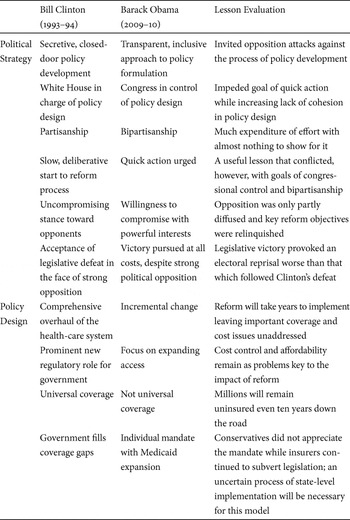
Ezra Klein captured the larger pattern of events succinctly enough: “Barack Obama’s strategy to pass health-care reform seems to be based on a simple principle: Whatever Bill Clinton did, do the opposite.”Footnote 78 To summarize, Table 1 catalogues the manifold ways in which the Obama administration sought to apply lessons learned from defeat of the Clinton health plan.
Applying the Lessons of History

AND THE RESULTS: “LEARNING HISTORY IS EASY; LEARNING ITS LESSONS SEEMS ALMOST IMPOSSIBLY DIFFICULT” (NICOLAS BENTLEY, BRITISH AUTHOR AND ILLUSTRATOR)
When the House of Representatives gave final approval to the Senate health-reform bill late in the evening of March 21, 2010, the president was watching from the Roosevelt Room in the White House.Footnote 79 Once the Democratic tally reached the pivotal 216th vote, Obama gave his Chief of Staff a jubilant high five. In days following there came more celebrations and expressions of exuberance. At the signing ceremony for the Patient Protection and Affordable Care Act, the president orated grandly: “Today we are affirming that essential truth, a truth every generation is called to rediscover for itself, that we are not a nation that scales back its aspirations.”Footnote 80 Yet the president’s great victory was an extremely precarious one. In fact, the margin of victory was so tight, and the level of opposition so vehement, that passage of the bill immediately gave birth to a counter-movement to “Repeal and Replace.” If it is true that the Obama presidency was reinvigorated by this success with health reform, the administration would need as much fortification as possible to hold on to what it had achieved.
In this epic struggle, how well was the administration served by lessons it took from failure of the Clinton health plan? Unquestionably, the broadest insights were relevant and predictive: Expect a bloody battle. Half a loaf may be better than none. Look for allies. Complexity is a disadvantage. Health care sparks deeply rooted concerns about the role of government. But was the Clinton defeat necessary to instill this macro lens appreciation for the forces and stakes involved in health reform? Certainly those who advocate the use of history in public policy-making promise something more practical and nuanced as a payoff than bromides of this caliber. As we have seen, the Obama administration resorted to historical analysis as a principal tool for mapping its route to reform, big picture and small steps, vision, strategy, and tactics all included. Where did this choice get the Democrats? The answers provide occasion for a sobering meditation on history’s elusiveness as handmaid to political power.
A false lesson may be said to describe situations in which a mistaken conclusion has been drawn about changing outcomes on one side of the equation by altering inputs on the other. Or, to put it more simply, it is the perception of an opportunity for achieving a different set of results in the future where none exists. Surely one such false lesson was seen in the administration’s attempt to mute criticism of its policy-making process on health reform by committing to transparency. Loath to repeat Clinton’s secretive process of policy development, the Obama administration allowed congressional backdoor dealing—a common but rarely spotlighted feature of the legislative process—to play out in front of a national audience, providing Republicans with prime fodder for opposition attacks. In two particularly poignant examples, Senator Ben Nelson, a centrist Democrat from Nebraska, secured federal funding for 100 percent of his state’s Medicaid expansion in return, allegedly, for his support of the health-reform law, while another holdout, Democrat Senator Mary Landrieu from Louisiana, apparently gained roughly $100–300 million in additional Medicaid funding for her state in return for a “yes” vote.Footnote 81
Reform opponents seized on these deals, known pejoratively as the “Cornhusker Kickback” and “Louisiana Purchase,” to label crafting of the health law as corrupt “politics as usual,” stirring outrage among Tea Party activists and others who feared the federal government was not serving their best interests in this process. Even Republican Governor Dave Heineman of Nebraska, whose state would have gained considerably from the Nelson “kickback,” denounced it as a “special deal, rather than a fair deal.”Footnote 82 In response to a groundswell of critical media attention, Senate Majority Leader Harry Reid said matter-of-factly: “You’ll find a number of states that are treated differently than other states. That’s what legislating is all about. It’s compromise.”Footnote 83 True enough, but drawing public attention to such unequal treatment did little to cultivate public support for reform. This is certainly not to suggest that a repeat of Clinton’s highly closed process of policy formulation would have been wise political strategy either, only that President Obama gained little by swinging to the opposite extreme based on his interpretation of policy history. The president’s commitment to the bright glare of legislative sunshine opened up both the politics and policy substance of health reform to harsh criticism, even ridicule. None other than John McCain attempted to embarrass the president at the Blair House summit by complaining: “What we got was a process that you and I both said we would change in Washington.” To which the president could only reply tiredly: “We’re not campaigning any more. The election is over.”Footnote 84
Even when historical lessons are not false, they may conflict. Reviewing the crash and burn of Clinton’s health reform, a score of health policy experts and pundits had stressed the necessity of moving quickly and involving Congress in policy formulation. The Obama administration accepted both insights as well founded and wise, but it was not really possible to do both things. The inevitability of this trade-off between quick action and congressional control of the policy-making process is not adequately addressed in the postreform scholarly literature. In his June 2010 article published in Health Affairs, James Morone writes approvingly that Obama “urged speed at every opportunity” and “repeatedly set deadlines for Congress.”Footnote 85 Yet, as Morone also notes, no matter how much the president urged Congress to move, the lawmaking branch adhered to its own sluggish pace toward reform. Simply stated, Congress is designed to move slowly. Not only must there be agreement between House and Senate—representative bodies with very different legislative priorities and electoral pressures—but ever lurking at the end of the work of committees and subcommittees in 2010 was a filibuster possibility in the Senate. In a way markedly worse than the period of the Clinton health plan, the U.S. Congress of 2009–10 found its legislating hampered constantly by filibuster or a threat of filibuster, both of which had become easier due to changes in institutional rules and procedures over the years.Footnote 86 Nor did Democrat leaders in Congress appear overly moved by the president’s urging for prompt deliverance of a bill. When asked in November whether the Senate would meet the president’s end-of-year deadline for passing health-care reform, Senator Reid struck a pose of independence, informing reporters that “we’re not going to be bound by any timelines.”Footnote 87 Thus, although the process of health reform may have benefited from an early kickoff in March 2009, Congress was unable (or unwilling) to meet the president’s rapid legislative timetable, and it was often hard to gauge how much Obama’s attempts to impose deadlines really mattered.
One main legislative holdup was the Senate Finance Committee, where months of wrangling over issues like the public option and cost and financing kept the bill bottled up until mid-October. In this instance, it was the president’s goal of bipartisan compromise that came into conflict with his effort to move reform quickly through Congress. Former Senator Tom Daschle published a glowing appraisal of Obama’s political strategy in the wake of passage of the health-care law: “All of the White House strategies for health care reform were smart ones, with plenty of good reasoning to back them up.”Footnote 88 He added, however, that “these plans also created their own problems.” Among them, the decision to allow the Senate Finance Committee time to forge a bipartisan consensus, though a “worthy goal that had a brief chance of success . . . went on too long and allowed opponents to mobilize, just as they did with the Clinton health care plan.”Footnote 89 Admitting that the administration did not have the benefit of hindsight, as we now have, Daschle argued all the same that “a timely change in strategy might have headed off some of the later events that nearly killed health care reform.”
The most significant of these “later events” arose directly from the prolonged legislative dance, as Daschle rightly observed. Reform opponents used time as a resource to strengthen the movement against health-care reform. The fruits of this effort surfaced in dramatic fashion in the summer of 2009 as members of the House and Senate returned home to their districts only to find themselves in the center of raucous town-hall meetings. National news networks were not slow to broadcast legislators’ wide-eyed response to crowds of outraged citizens. On August 3, Katie Couric adopted an ominous tone in describing the building momentum of negation: “Voices are being heard all over the country, voices of protest and they’re growing louder.”Footnote 90 This narrative, which played out for several weeks, continued until the reconvening of Congress in September, and it allowed opponents to portray lawmakers who remained committed to reform as dismissive of the concerns of their constituents. As this pressure intensified into the winter months, some Democrat lawmakers lashed out, imploring the president to intervene. In just one example, Florida Senator Bill Nelson, during a meeting between David Axelrod and congressional Democrats, delivered a vehement message to the administration: “There’s a great deal of frustration that the president isn’t getting the feelings that a lot of us are feeling. The president needs to be more hands-on with the health-care bill.”Footnote 91 Eventually, the president did assume more leadership in finalizing legislation, and his strategy of allowing Congress to work out the details of reform did help to shore up buy-in among Democrats, an advantage that Clinton lacked. Still, Obama’s long reluctance to play a dominant role had incurred a steep political cost.
Another downside of this same strategy lies in the design of the health-care law. Reflecting an unrestrained and highly contentious legislative process, the reform became a messy culmination of compromises, concessions, and last-minute alterations. Moreover, the final law, which lacks both a public insurance option and a centralized purchasing hub, relies on each state to create its own “exchange” devices, while affording a great deal of autonomy to subnational actors in regard to final policy design and operationalization. Such lack of cohesion could present important unforeseen consequences, not least the addition of another costly and inequitable layer to the complex “patchwork” of American health care. Could not this risk have been better managed with more forceful policy direction from the White House? How telling it seems that the following critical assessments, first from Tea Party activist Dick Armey and second from Ralph Nader, two figures whose political philosophies are as different as different can be, so closely echo each other:
The real winners are insurance companies and big pharma. Americans want health care reform that improves access to health care through reforms that hold down costs. Instead they got a trillion dollar bill that was more politics than good policy.
The health insurance legislation is a major political symbol wrapped around a shredded substance. It does not provide coverage that is universal, comprehensive or affordable. It is a remnant even of its own initially compromised self—bereft of any public option, any safeguard for states desiring a single payer approach, any adequate antitrust protections, any shift of power toward consumers to defend themselves, any regulation of insurance prices, any authority for Uncle Sam to bargain with drug companies, and any reimportation of lower-priced drugs.Footnote 92
To a great extent, the Obama administration’s broadly defined “principles” left the substance of reform in the hands not only of Congress but also implementing officials, a chancy bet in this period of political backlash against the bill. It does not equate to aimless hankering after the Canadian plan, or some other foreign version of national health insurance, to point out the limitations of a reform that will leave five to ten million Americans without coverage even after full implementation ten years down the road; the numbers rise even higher if one counts those moving into and out of this precarious position over a defined interval of time.
In a different take, Morone has argued that those who claim Obama “overlearned” this Clintonian lesson of deference to legislative prerogative suffer from “naiveté” about the congressional process.Footnote 93 However, Morone does agree that a president can potentially fall victim to two mistakes: “Too hard a line and a president cannot round up the needed votes; too soft and the legislation becomes so attenuated that it fails to serve its purpose.”Footnote 94 So, did Obama make the right choice when faced with this dilemma? Concedes Morone: “Here there is room for disagreement,” and “We’ll discover, in the years ahead, whether President Obama made the second mistake.”
As noted, the Obama administration also sought to bridge the deep political divides that had plagued Clinton’s reform effort. Application of this historical lesson took the form of a two-pronged strategy: a commitment to working across party lines to gain Republican support, and an outreach to industry stakeholders. On the first score, the Obama administration failed miserably at gaining Republican support for the process of health reform. Five committees were involved in producing health legislation: Education, Energy and Commerce, and Ways and Means in the House; Health, Education, Labor and Pensions, and Finance in the Senate. Considering the actions of all five committees, only a single Republican voted with the Democrats, Finance Committee member Olympia Snowe of Maine. What Snowe contributed to the cause of health reform, she gave grudgingly. “Is this bill all that I would want? Far from it,” she explained. “But when history calls, history calls. And I happen to think that the consequences of inaction dictate the urgency of Congress to take every opportunity to demonstrate its capacity to solve the monumental issues of our time. . . . My vote today is my vote today. It doesn’t forecast what my vote will be tomorrow.”Footnote 95 When the House passed its composite bill in November, again only one Republican, Louisiana freshman Anh Cao, supported it.Footnote 96 Neither a subsequent vote by the full Senate in December nor the final House vote in March counted any Republicans among the ayes.
Events at Blair House in March 2010 punctuated forcefully the Republican stance of noncooperation during this long year of health-reform politics. In an interview on CBS prior to broadcast of the Superbowl, the president stated: “I want to come back and have a large meeting, Republicans and Democrats, to go through systematically all the best ideas that are out there and move it forward.”Footnote 97 At best, Obama hoped to find some concrete area of compromise to attract a few votes across party lines. At worst, the president expected Republicans might demonstrate their contrariness before a national television audience. The president got the latter, as one Republican after another at the gathering repeated the mantra: Scrap the bill! We need to start over!Footnote 98
As political theater, the performances were pretty good, but it suffered from a dismal lack of originality. Here was a stale script merely being acted out with new characters and staging. Describing Newt Gingrich’s reaction when President Clinton had launched his health-reform plan before Congress in 1993, Johnson and Broder revealed that the House Minority Whip was lying in wait: “[For nearly two and a half years], Gingrich prepared to defeat the very kind of plan now being proposed. No support would come from Gingrich and the restive Republicans he led, especially support for a President of Gingrich’s own post–World War II generation who possessed, Gingrich believed, formidable political gifts with potential for becoming another FDR. . . . House Democrats knew they could not expect a single Republican vote. They would have to win this by themselves.”Footnote 99 Similarly, in 2009–10, the Republicans saw no political gain in helping the president. Conservative commentator David Frum explained: “At the beginning of this process we made a strategic decision: unlike, say, Democrats in 2001 when President Bush proposed his first tax cut, we would make no deal with the administration. No negotiations, no compromise, nothing. We were going for all the marbles. This would be Obama’s Waterloo—just as healthcare was Clinton’s in 1994.”Footnote 100
Was it arrogance or naiveté for the Obama administration to imagine that this stark pattern of partisanship could be reversed once health reform returned to the national agenda? No matter. It amounted to a wishful misreading of the historical record and present circumstances, one costly in time and resources, to judge that a modified approach by Democrats could secure a bipartisan path to health reform. Even if Democrats had been willing to do the unthinkable and reach across the aisle to embrace a Republican plan for health reform, it could not have worked. There was no proposal from the Republican leadership before November 2009.Footnote 101 When it finally appeared, the GOP plan seemed but an empty political gesture, offering neither substantial expansion of coverage nor protections for those already having insurance, sine qua nons of reform for most Democratic rank and file.
In the search for common ground with opponents, the president and Democrats in Congress gave up a lot on policy design. Judged by the standard of nations around the world having comprehensive health care that marries universality with spending controls, the best one could label this nascent American program was “health-reform lite.” Even compared to the Clinton plan, Obama set his sights low. Opting to build on the existing system—in fact, a strengthened private insurance market without insistent competitive pressures—the president settled for less than universal coverage while skirting the establishment of strong cost-containment mechanisms. The individual mandate, an idea with strong conservative bona fides going back to the 1990s,Footnote 102 was identified with Mitt Romney’s breakthrough health-care legislation in Massachusetts. But Mitt Romney would have none of it now, claiming a mandate was sound public policy on the state level but unacceptable as federal law. All told, as Newsweek editor Jon Meacham said on Meet the Press, the Democratic health bill came out “somewhat to the right” of where Richard Nixon stood on health reform in the early 1970s.Footnote 103 Ezra Klein has described it as “a dead-ringer for the bill Republicans rallied around as a conservative alternative to the big-government overreach of ClintonCare.”Footnote 104
Still, the Republicans pilloried the Democrats’ approach in 2010 as a “government takeover” of the private health system. During the final House debate, Republican Marsha Blackburn of Tennessee mourned the “death of freedom” under health reform, while Republican John Shadegg of Arizona warned: “Tragically, this bill will . . . do incredible damage to the very fabric of our society.” More extreme comments by Republican Devin Nunes of California are worth quoting at length: “For most of the twentieth century, people fled the ghosts of Communist dictators. Now, you are bringing the ghosts back into this chamber. With passage of this bill, they will haunt Americans for generations. . . .Today, Democrats in this House will finally lay the cornerstone of their socialist utopia on the backs of the American people.”Footnote 105
Had President Obama bused a group of Canadian bureaucrats to the United States to perform a transplant operation installing a full-blown single-payer system, denouncements from the right could hardly have been more excessive. Significantly, after passage of the health-reform law, the New York Times speculated whether it represented a “grand achievement, or a lost opportunity” for creating a stronger government presence within the insurance system.Footnote 106
Somehow the insurance industry also convinced the Obama administration that it was a leopard that had changed its spots. The AHIP’s stated willingness to support reform this time around was a main reason why the president adopted the individual mandate and also why Obama did not push harder for a public insurance option, despite his own preference for this provision. In a preliminary appraisal of the Obama health-reform law, Lawrence Jacobs and Theda Skocpol have argued that getting into bed with the insurers and other powerful interests was a necessary step, central to the administration’s success because it prevented “the full force of all-out, unified business opposition” such as the kind that derailed the Clinton plan.Footnote 107 But insurers had undergone no political conversion since the early 1990s; they had only gotten craftier. Even while speaking publicly in favor of reform, they maneuvered behind the scenes to help kill or dramatically reshape legislation. According to a report on health-reform lobbying activities by the National Journal, AHIP funneled between $10 million and $20 million from a group of the nation’s largest insurers to the U.S. Chamber of Commerce to finance attack ads against bills moving through Congress during the summer of 2009.Footnote 108 The experience of 1993–94 had taught that the insurance industry was a formidable foe in the quest for health reform. But was the right lesson to placate the enemy or to take heed and gird for war? It’s the kind of dilemma that historical awareness can do much to illuminate but little to answer. The Obama team opted for the former approach only to be sorely disappointed.
Historical analysis can be most frustrating when the lessons it provides are sound and even obvious, yet there is no effective means of capitalizing on them. Understanding how the American public had withdrawn support from health reform in the early 1990s, the Obama team knew it would be detrimental to let voters become confused or alienated again. The White House website was used in creative ways to advance the president’s agenda on this issue by making available speeches and policy briefings, posting videos of “average Americans” dealing with health insurance problems, and more. It also linked to the site “HealthReform.Gov,” which presented a wealth of constantly updated information, web chats, and interactive Q&A features. Nothing comparable was, or could have been, done by the Clinton administration in the early 1990s simply because technology for such a mass communication project did not exist. As we have seen, President Obama himself also made public outreach a top priority. His team sent him out frequently to explain the need for and objectives of reform, as well as the administration’s recommended remedies. If Americans did not comprehend the concept of health reform, it was not for the administration’s lack of trying. Yet misunderstand it they did. Newsweek conducted a national poll in mid-February 2010 that was revealing.Footnote 109 It found that while most Americans said they were against “Obama’s health care reform plan,” a majority backed specific provisions of the Democratic proposal when these were outlined to them. This paradox was consistent with turbulent Town Hall meetings during late summer of 2009 in which one witnessed such oddities as elderly citizens protesting: “Keep government hands off my Medicare!”Footnote 110 In the end, Democrats had to move legislation forward without benefit of strong public support. Passage did not mean the challenge of winning over the public had ended, only that it now shifted to the troubled implementation stage for this new law.
So it was that the Obama team tried to learn from health-reform history and did so thoroughly and self-consciously. Almost in the manner of diligent students from May and Neustadt’s Harvard classroom, the policymakers moved forward on the basis of clear problem definition and policy objectives, exhaustive fact gathering, broad-based input, and well-informed recognition of key stakeholders and actors. The advice received came from some of the top students of health policymaking in America. And, as a result of this methodical process, key lessons were drawn, many of which led nowhere, backfired, or proved tangential. Nonetheless, when all is said and done, the Obama administration did walk away victory in hand. How did it happen?
The nadir of the conflict over health reform came for Democrats in January 2010, when Republican Scott Brown snatched Ted Kennedy’s Senate seat in a special election.Footnote 111 Brown had campaigned against the legislation moving through Congress. Aside from embarrassing the Democrats while raising the specter of massive losses in the forthcoming midterm elections, his victory meant the majority party had lost its filibuster-proof margin in the Senate. At the same time, the administration was contending with revolts by pro-life advocates, who feared expanded public financing for abortion, and liberals, who insisted on a government-run plan as part of the framework of insurance market changes. (Independent Senator Joseph Lieberman had just succeeded in pressuring the Democratic leadership to drop a provision allowing Americans fifty-five and older to buy into Medicare.)Footnote 112 The president retreated, weighing the possibilities for a much weaker, more bipartisan, legislative package. At his State of the Union address, Obama provoked laughter when he said that “by now it should be fairly obvious that I didn’t take on health care because it was good politics.”Footnote 113
Announcement of the Blair House summit signaled a last-gasp effort at working with Republicans on health care. For the administration, however, the meeting’s failure would not mean an abandonment of reform. Instead, it set the stage for a dramatic end game in which the cautious political approach of the past year would be set aside. By now, Democrats had already stopped coddling insurers, and they lashed out when Anthem Blue Cross in California requested skyrocketing premium increases. Accusing the industry of pursuing “big profits” at the expense of consumer hardship, the president adopted a tough new rhetorical approach.Footnote 114 He also called attention repeatedly to the heartbreaking story of one Ohio woman who was a cancer survivor and no longer able to afford her health coverage.Footnote 115 Hardball had finally begun. This dramatic change in strategy represents an outright rejection of a key lesson of history. The administration’s cautious use of rhetoric, steadfastly adhered to for over a year, was replaced by fiery language, partisan attacks, emotional stories, and a demonizing of the insurance industry. It was this strategic conversion that injected much-needed momentum into the final push toward reform.
Among the many lessons of 1993–94, there was evidently one more that President Obama took to heart: Failure is not an option. Here was a meta insight that became controlling. Following Blair House, the Democrats moved into high gear. House Speaker Nancy Pelosi marshaled support for the Senate health bill, combining upbeat encouragement of her colleagues with an ability to be “scary tough.”Footnote 116 Meanwhile, President Obama did what he could to shore up political vulnerabilities. He cut a deal with leaders of the pro-life forces in Congress, agreeing to a special Executive Order confirming that taxpayer money would not pay for abortions.Footnote 117 He also mollified single-payer critics, transporting Representative Dennis Kucinich via Air Force One to a rally in his home district in Ohio.Footnote 118
Last, the president and Democratic lawmakers decided to use the budgetary procedure known as “reconciliation” to force their health bill through Congress with a simple majority. Republicans cried “Foul!” and it was unknown how the American public would view this legislative maneuvering. But there was no turning back at this point. Interestingly, the administration laid the groundwork for this unusual step in April, and it also grew out of a lesson learned from the Clinton experience.Footnote 119 Chief of Staff Emanuel convinced members of the Senate Budget Committee to insert a provision in the budget document allowing reconciliation procedures for health and education measures reducing the deficit. Emanuel had been part of the Clinton team that tried and failed to take advantage of a similar tactic in 1993–94. Yet, as so often seems the case with lesson drawing, events unfolded in a way different from expected. Although the administration anticipated the reconciliation process might be needed to overcome a filibuster in the Senate, it was in the House where reconciliation proved crucial in giving Democrats the means to pass changes to the Senate-approved health measure by majority vote on a separate bill.
The president’s victory almost instantly inspired its own new round of lesson drawing. New York Times reporter Sheryl Gay Stolberg offered these observations: “Among the many lessons Democrats have learned from President Obama’s 14-month slog through the nation’s vitriolic health care debate is that there are two ways for a president to do business in hyperpartisan Washington. One is to go small, and partner across the aisle. The other is to go big, and go it alone. Mr. Obama chose the second path on health care—and came out on top.”Footnote 120 The irony was inescapable. For “going it alone” and “going big” were nothing if not antithetical to the most basic historical lessons drawn from defeat of the Clinton health plan.
All of which brings us to the 2010 midterm elections, in which Democrats took a “shellacking,” as the president himself described it.Footnote 121 Obama’s party lost more than sixty seats in the House, along with control of the chamber, and six seats in the Senate, an electoral rout even worse than the “Republican Revolution” of 1994. In the wake of this dramatic reversal of fortune, was the victory-at-all-cost approach to health reform a valuable learned-lesson? Skocpol had written about 1994 that “many voters were punishing Democrats for having been in charge during a time when Washington was ‘a mess’ and not delivering desired results.”Footnote 122 If true, there could be no doubt about what Democrats needed to accomplish if ever given the chance for a do-over. However, far from insulating the Democrats from electoral fallout, the passage of health legislation in 2010 actually provoked reprisal from voters.
A public opinion study by Robert Blendon and John Benson in the lead-up to the midterm elections found that, in fact, the health-reform law sat heavily enough on the minds of voters to make a difference. More than four in ten Americans said that health care or health-care reform would be an “extremely important” voting issue for them, second only to the economy. Further, more than seven in ten respondents said that “a candidate’s position on the health care law [would] play a role in their congressional vote.”Footnote 123 Most Democrats (67 percent) said they were more likely to vote for a congressional candidate who supported the new health-care law, but 72 percent of Republicans said they were less likely. Perhaps most important, 37 percent of Independents were less likely to vote for a candidate who supported the health-care law and only 29 percent were more likely to vote for such a candidate.Footnote 124
A Kaiser Family Foundation Poll conducted shortly after the election confirmed the role of health reform in voter decision making. When asked about the top factors that had influenced their vote, 17 percent of respondents named health care/health-care reform as the most important. This ranked fourth behind those who identified jobs and the economy (29 percent), party preference (25 percent), and views of the candidates themselves (21 percent) as the most influential factors. Among the 17 percent of “health-care voters,” however, nearly six in ten (59 percent) backed a Republican candidate for Congress, and 56 percent had a “very unfavorable view” of the new health-care law. Nearly half of these voters (49 percent) reported being angry about the law, 45 percent wanted repeal of the entire law, and another 26 percent called for parts of the law to be repealed.Footnote 125
Even President Obama, in a postelection press conference, hinted that the health-reform “process” contributed to his party’s major losses. Responding to a reporter who asked about the deal-making, the president admitted: “But you are absolutely right that when you are navigating through a House and a Senate in this kind of pretty partisan environment that it’s an ugly mess when it comes to process. And I think that is something that really affected how people viewed the outcome. That is something that I regret—that we couldn’t have made the process more—healthier than it ended up being.”Footnote 126
In a way that lesson drawing about the Clinton years could not anticipate, the 2010 midterm elections also complicated the future of health reform as policy reality. On Election Day, an unquestionably concerned Obama implored supporters to head to the polls by suggesting that his agenda was “all at risk if people don’t turn out and vote today.”Footnote 127 This dire statement raises the question: Just how much of the president’s accomplishment is now in jeopardy? Reveling in victory, Republican House Speaker-elect John Boehner offered a glimpse of things to come when he announced in no uncertain terms that “the healthcare bill that was enacted by the current Congress will kill jobs in America, ruin the best healthcare system in the world, and bankrupt our country. That means we have to do everything we can to try to repeal this bill and replace it with common sense reforms to bring down the cost of health care.”Footnote 128 Although it will be impossible to repeal the law while Obama occupies the Oval Office, Boehner’s statement is by no means an empty threat. Just days after the election, the New York Times reported that Republicans “hoped to use the power of the purse to challenge main elements of the law, forcing Democrats—especially those in the Senate who will be up for re-election in 2012—into a series of votes to defend it.”Footnote 129 Among other tactics, Republicans plan to limit money for the Internal Revenue Service so that the agency will be hard pressed to enforce the health-care mandate, and to use spending bills to block federal insurance regulations to which they are opposed.Footnote 130 The courts will provide another institutional battleground for those intent on challenging the legality of the health law, with outcomes of these cases hard to foresee. And, as a result of the 2010 election, Republicans gained the majority of governorships across the country. Many prominent conservative officeholders vowed to do everything within their power to block implementation of the law,Footnote 131 while figures such as Tim Pawlenty of Minnesota and Rick Perry of Texas made the issue a cornerstone in their bid for the 2012 Republican presidential nomination.
CONCLUSION
Whatever might come next, the American health-care system stands forever changed by adoption of the Patient Protection and Affordable Care Act of 2010. President Obama deserves credit for achieving a legislative feat that consistently eluded his predecessors and doing so under treacherous political conditions. Expansions of coverage have already begun to benefit millions of Americans. Yet, for all the reasons noted here, the role and impact of historical lessons in this legislative episode are intricate matters to discern. It is far from clear to what extent such lesson drawing was responsible for the administration’s success in moving its health proposal into law. Moreover, tough questions need to be asked about the character of health-policy reform that those lessons helped to inspire.
On the issue of health care, Barack Obama entered the White House aiming to prove that history need not repeat itself. Striving to avoid the kind of costly defeat suffered by Bill Clinton, the president and his advisers put faith in learning from the past. The outcomes were mixed at best and demonstrated the perverse difficulty of putting into practice the advice of those who counsel historical awareness as a guide within the policy-making process. While providing a sense of direction and initial confidence among the reformers, the lessons of 1993–94 did not always pay dividends and sometimes even blinded the administration to traps and opportunities within present circumstances. And when push finally came to shove, the Obama team needed to look beyond historical lessons in reviving their moribund cause. For the president and his allies, it was probably inevitable that the challenge of leadership would take them to a juncture where the established playbook gave way to the dangerous political adventure of inventing what could be. Because this, too, is written in the pages of history.