1. Geological setting
The Deseado Massif is a 60 000 km2 geological province in southern Argentinean Patagonia (Fig. 1a). Widespread (> 30 000 km2) bimodal volcanism (Bahía Laura Group) occurred during middle to late Jurassic times (177.8 to 150.6 Ma; Pankhurst et al. Reference Pankhurst, Riley, Fanning and Kelley2000), producing calc-alkaline rhyolites and minor andesites, with rare dacites. The Massif is part of the Chon Aike Large Igneous Province (Pankhurst et al. Reference Pankhurst, Leat, Sruoga, Rapela, Márquez, Storey and Riley1998), formed by a combination of slow subduction rates at the Pacific margin of Gondwana and a mantle plume. The steep thermal gradient that developed in association with significant extension and volcanic activity together demarcate the beginning of Gondwana break-up in the region (Riley et al. Reference Riley, Leat, Pankhurst and Harris2001). The late stages of Bahía Laura Group volcanism (late Jurassic) were accompanied by extensive hydrothermal activity, manifest in economic gold- and silver-bearing epithermal deposits, and surface hot-spring sinters and travertines mainly in western areas (Fig. 1a; Guido & Schalamuk, Reference Guido, Schalamuk and Eliopoulos2003).
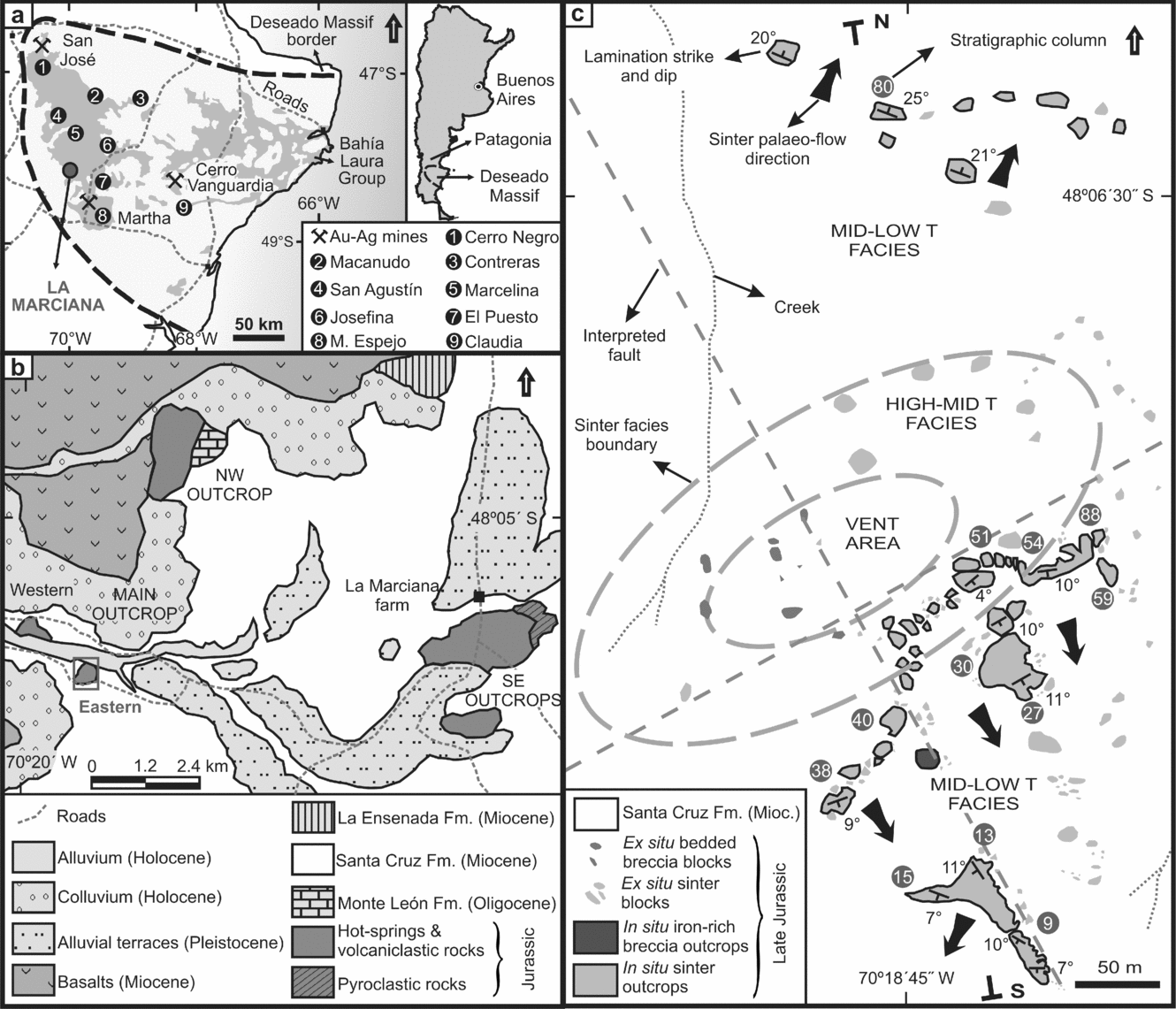
Geological context of La Marciana sinter. (a) Regional map of Jurassic volcanic deposits, Deseado Massif, Patagonia, Argentina, with location of active mines and hot-spring deposits. (b) La Marciana area geological map (modified from Guido, de Barrio & Schalamuk, Reference Guido, de Barrio and Schalumuk2002). (c) La Marciana Eastern Main Outcrop map, marking locations of selected stratigraphic columns, and N-S cross-section line of Figure 2. Also shown are inferred faults and broad palaeoenvironmental divisions of the sinter apron. For a colour version of this figure see online Appendix at http://journals.cambridge.org/geo.

The Jurassic deposits were buried on a passive continental margin during Cretaceous and Cenozoic times that later was eroded to fortuitously expose windows to the older land surfaces. The late Jurassic Deseado Massif hot-spring deposits partly fill a gap in the geological record between well-known Cenozoic (e.g. Sillitoe, Reference Sillitoe, Kirkham, Sinclair, Thorpe and Duke1993) and scattered Palaeozoic (e.g. White, Wood & Lee, Reference White, Wood and Lee1989; Sillitoe, Reference Sillitoe, Kirkham, Sinclair, Thorpe and Duke1993; Rice et al. Reference Rice, Ashcroft, Batten, Boyce, Caulfield, Fallick, Hole, Jones, Pearson, Rogers, Saxton, Stuart, Trewin and Turner1995; Walter et al. Reference Walter, Des Marais, Farmer and Hinman1996) examples.
2. Stratigraphy and structure of the La Marciana sinter
La Marciana is one of the larger, late Jurassic (~ 150 Ma), siliceous hot-spring deposits (sinter) of the Deseado Massif. It constitutes three dispersed groups of outcrops (Main, NW and SE), hosted in Jurassic, volcanic-reworked lacustrine and fluvial sediments, over a 72 km2 area (Fig. 1b). The geothermal system heat source is interpreted to be a rhyolitic dome complex located 5 km NW of the western outcrops (Guido, de Barrio & Schalamuk, Reference Guido, de Barrio and Schalumuk2002). The trace metal signature (Au, Ag, Sb, As, Hg and Tl) of the La Marciana deposit is similar to most known fossil sinters, and its oxygen isotopes (7.3 to 16‰ δ18OSMOW) also are compatible with a sinter origin (Guido, de Barrio & Schalamuk, Reference Guido, de Barrio and Schalumuk2002).
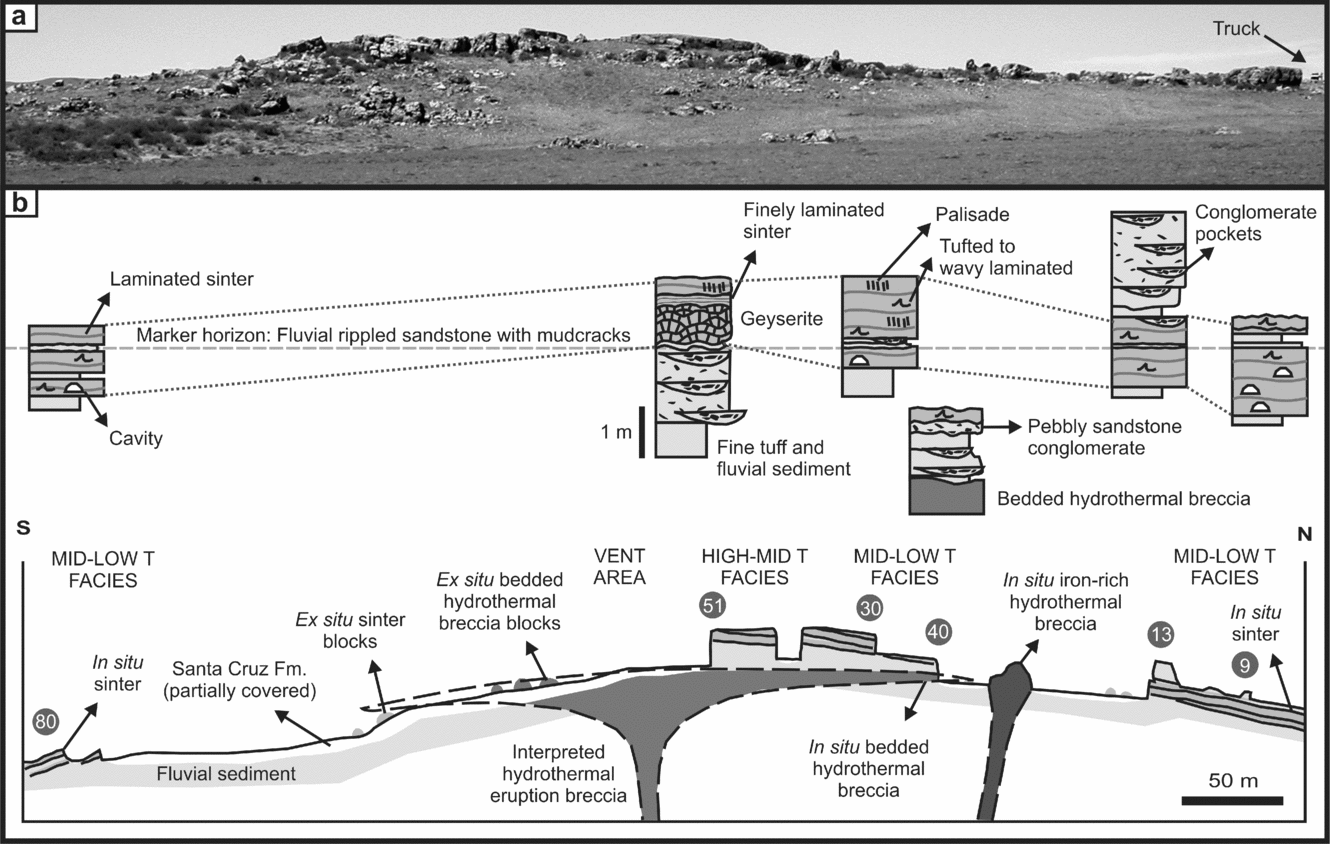
Based on initial field assessment, the eastern portion of the Main Outcrop (0.3 km2) was found to be particularly well exposed in a broad, shield-like sinter apron (Figs 1c, 2). We mapped the apron to evaluate potential structural relations to thermal fluid flow, and to determine its extent and facies distributions with respect to the fluvial host setting. The inferred vent coincides with the intersection of two major faults, one parallel to the ENE–WSW elongated vent, and one aligned NW–SE (Fig. 1c). A bedded hydrothermal breccia and the thickest geyserite deposits occupy the vent area (e.g. stratigraphic columns (SC) 40 and 51, respectively; Fig. 2), suggesting a hydrothermal eruption at the fault intersection, which may have created a pathway for rising thermal fluids. Strikes and dips of sinter bedding planes (Fig. 1c) also agree with the interpreted locus of the palaeo-vent, where the dip is nearly horizontal (4° SE). The southern sinter apron yields an average 10° dipping palaeo-flow direction to the SE away from the vent, whereas the northern apron dips an average of 23° to the NE. The dip directions may represent Jurassic palaeotopography, or could result from a 5° northward tilting of the entire outcrop.
La Marciana Eastern Main Outcrop N–S cross-section. (a) Sinter apron, E view, showing typical outcrop exposure. (b) Schematic N–S cross-section with selected stratigraphical columns (numbered circles) positioned above their locations in the cross-section, partly correlated by a fluvial rippled sandstone marker horizon. For a colour version of this figure see online Appendix at http://journals.cambridge.org/geo.

Two different hydrothermal breccias are evident at La Marciana. The bedded breccia of the central vent area is positioned stratigraphically beneath the sinter (Fig. 2, SC 40). It is iron-stained, with matrix-supported, heterolithic, volcaniclastic blocks (< 10 cm diameter), and is interpreted as the product of a hydrothermal eruption that possibly facilitated initiation of thermal fluid up-flow. The iron-rich hydrothermal breccia is situated 150 m SE of the vent on the NW–SE fracture (Figs 1c, 2). It is typified by a dark red, iron-rich, chert matrix with partially disrupted white sinter blocks. This breccia may be a late-stage, lesser hydrothermal eruption, which locally disturbed sinter over a small area.
The laminated and commonly porous sinter ranges from a few decimetres to 2 m thick, and is erosionally truncated to the north and west by the present fluvial system (Fig. 1b). The sinter typically overlies a silicified, tuffaceous, laminated siltstone and fine sandstone, with local channel conglomerates sandwiched, in places, above or beneath the sinter (Fig. 2b). A distinctive, thin (~ 20 mm), ripple-laminated, fine tuffaceous sandstone bed within many sinter outcrops constitutes a local marker horizon (Fig. 2b). It is a fluvially reworked ash-fall from an eruption that disturbed sinter deposition. During this time, hot-spring activity apparently ceased and the sinter apron dried out, as mudcracks and sinter fragments litter the surface of the marker bed. Similar features have been reported in Pleistocene and Holocene sinters from New Zealand (Campbell et al. Reference Campbell, Sannazzaro, Rodgers, Herdianita and Browne2001; Campbell, Buddle & Browne, Reference Campbell, Buddle and Browne2004) and Iceland (Jones et al. Reference Jones, Renaut, Torfason and Owen2007).
3. La Marciana hot-spring palaeoenvironments
Figures 1c and 2 illustrate an inferred distribution of broad, spring-outflow palaeoenvironmental settings based on field stratigraphical and textural analysis of the La Marciana sinter. Fabrics of these outcrops bear striking similarities (Fig. 3) to Quaternary sinters of the Taupo Volcanic Zone, New Zealand (e.g. Jones, Renaut & Rosen, Reference Jones, Renaut and Rosen1998; Campbell et al. Reference Campbell, Sannazzaro, Rodgers, Herdianita and Browne2001; Lynne & Campbell, Reference Lynne and Campbell2004), and Yellowstone National Park, USA (e.g. Walter, Reference Walter and Walter1976; Cady & Farmer, Reference Cady, Farmer, Bock and Goode1996; Lowe, Anderson & Braunstein, Reference Lowe, Anderson, Braunstein, Reyensbach, Voytech and Mancinelli2001). In these localities, nearly neutral pH, alkali chloride thermal fluids discharge at the surface (~ 100 °C) and cool rapidly to encase environmentally diagnostic biotic and abiotic components in opaline silica (cf. Fournier, Reference Fournier1985). A temperature- and pH-dependent zonation of prokaryotes and eukaryotes, from high-temperature vent to cool distal discharge apron, produces characteristic sedimentary textures during hot-spring mineralization (cf. Brock & Brock, Reference Brock and Brock1971; Walter, Reference Walter and Walter1976; Walter, Bauld & Brock, Reference Walter, Bauld, Brock and Walter1976; Cady & Farmer, Reference Cady, Farmer, Bock and Goode1996; Jones, Renaut & Rosen, Reference Jones, Renaut and Rosen1998; Farmer, Reference Farmer2000; Schinteie, Campbell & Browne, Reference Schinteie, Campbell and Browne2007).
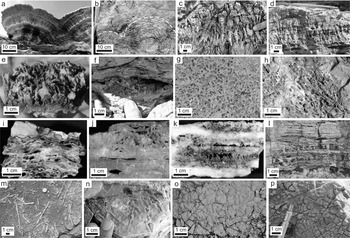
Comparison of palaeoenvironmentally significant sinter fabrics, Holocene (Taupo Volcanic Zone (TVZ), New Zealand) and Jurassic (La Marciana). (a–d) Inferred high-temperature vent geyserite rim fabrics, in cross-section. (a) Laterally linked hemispheroidal fabric, rim margin, Ohaaki Pool (drained), TVZ. b. Two laterally linked hemispheroidal geyserite rim features (white dashed line), overlain by very finely laminated sinter; SC 55, La Marciana. (c) Detail of upwardly radiating geyserite textures; Northern Waiotapu, TVZ. (d) Detail of upwardly radiating geyserite textures; SC 88, La Marciana. (e–j) Interpreted mid-temperature fabrics. (e) Conical tufted texture, oblique plan view, Kuirau Park, TVZ. (f) Conical tufted overlain by wavy laminated fabrics, oblique bedding plane view, SC 9, La Marciana. (g) Tuft network, Atiamuri pool margin, plan view, TVZ. (h) Tufted network texture, bedding plane view, SC 80, La Marciana. (i) Wavy laminated fabric with curved lenticular voids (flattened ‘bubble mats’), cross-section view, 4694 ± 40 ka Umukuri sinter, TVZ. (j) Wavy laminated fabric with flattened, almond-shaped vugs, some filled with late-stage microquartz; cross-section view, SC 40, La Marciana. (k–p) Inferrred low-temperature textures. (k) Palisade fabric in cross-section, partly recrystallized to massive, mottled, diffusely layered (white) textures, Umukuri sinter, TVZ. (l) Palisade fabric in cross-section, within a primary porosity ‘window’, SC 30, La Marciana. (m) Poorly preserved, silicified plant reeds, plan view, Golden Fleece Terrace (dry), Orakei Korako, TVZ. (n) Possible silicified and recrystallized plant stems, bedding plane view, SC 9, La Marciana. (o) Desiccation cracks, plan view, Golden Fleece Terrace (dry), Orakei Korako, TVZ. (p) Preserved desiccation cracks, bedding plane view, SC 9, La Marciana. For a colour version of this figure see online Appendix at http://journals.cambridge.org/geo.

Summarized in Figure 3 are sinter fabrics that incorporated distinctive microbial and other depositional signatures during primary silicification at La Marciana, with some comparative textures shown for Holocene sinters in New Zealand. Very high (> 75 °C) to high (~ 60–74 °C) temperature facies from vent areas are represented by radiating columnar, spicular geyserite (Fig. 3a–d) and dense, very thinly laminated sinter, respectively (e.g. SC 51, Fig. 2b). Mid-temperature (~ 35–59 °C) microbial fabrics of finely filamentous bacteria on central sinter aprons are varied, depending on whether mats developed in spring pools or discharge channels, with morphology controlled by water depth and velocity (cf. Walter, Reference Walter and Walter1976; Cady & Farmer, Reference Cady, Farmer, Bock and Goode1996; Jones, Renaut & Rosen, Reference Jones, Renaut and Rosen1998; Farmer, Reference Farmer2000; Campbell et al. Reference Campbell, Sannazzaro, Rodgers, Herdianita and Browne2001). Some examples (Fig. 3e–j) include conical tufts (deep or still water), network (drying tufts, often near pool margins), and wavy laminated fabrics with lenticular voids (stacked ‘bubble mats’ in outflow channels forming fenestrae from photosynthetic outgassing). By contrast, in channels and pools on distal sinter aprons, low-temperature (< 35 °C) microbial mats form layered palisade structures (Fig. 3k, l) which, in modern hot springs, are constructed of densely packed, vertical, coarsely filamentous cyanobacteria (cf. Walter, Reference Walter and Walter1976; Cady & Farmer, Reference Cady, Farmer, Bock and Goode1996). Poorly preserved plant-stems (Fig. 3m, n) are associated with polygonally cracked, fragmental sinter (Fig. 3o, p), and indicate desiccation and weathering of the sinter apron at times of low to no spring outflow.
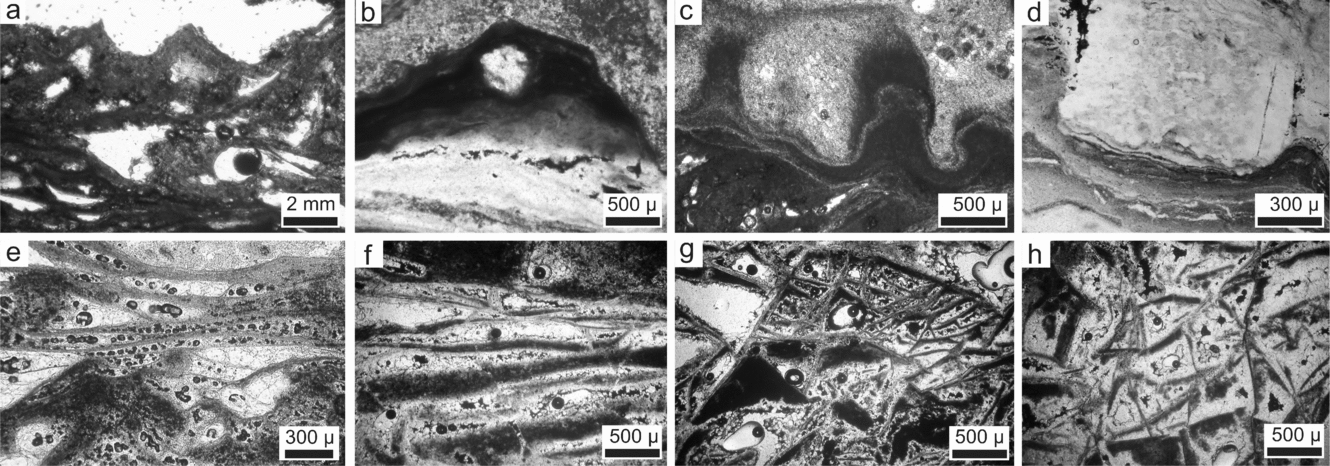
Several microtextures inferred as microbial in origin (Fig. 4) are preserved in the fine-grained quartz of the La Marciana sinter, which recrystallized from the original opaline precipitate. Primary porosity in the deposit was largely created by microbial activity and some is still preserved. For example, conical tufts and bubbles trapped within mats during mineralization are known from mid-temperature discharge areas on modern hot-spring sinter aprons, and are inferred for some Quaternary hot-spring deposits, such as the Tahunaatara sinter (~ 15 ka; Fig. 4a; cf. Campbell, Buddle & Browne, Reference Campbell, Buddle and Browne2004). Comparable conical structures with microtufts and fossilized bubbles also are evident at La Marciana (Fig. 4b). Moreover, digitate microstromatolites from the Tahunaatara sinter (e.g. Fig. 4c) have counterparts in the La Marciana sinter (Fig. 4d). Finally, La Marciana network fabrics (e.g. Figs 3h, 4f–h) have modern analogues in Yellowstone and Taupo Volcanic Zone hot-springs (e.g. Figs 3g, 4e), where they develop from microbial mats that dehydrate to form fibrillar textures (cf. Handley et al. Reference Handley, Turner, Campbell and Mountain2008) along warm pool margins. The La Marciana network fabrics record several stages, from initial, undisturbed wavy laminae with lenticular voids (flattened bubbles; e.g. Fig. 4f), to partially disconnected mats (Fig. 4g), to ‘criss-cross’ textures inferred as mat desiccation features (Fig. 4h).
Petrography of probable microbial textures at La Marciana, with some morphological comparisons made to Pleistocene–Recent hot-spring sinters. (a) Small conical tufts and lenticular voids (white pore spaces; flattened ‘bubble mats’) from a domal stromatolite (~ 15 ka sinter at Tahunaatara, Taupo Volcanic Zone (TVZ); cf. Campbell, Buddle & Browne, Reference Campbell, Buddle and Browne2004, their fig. 11D, p. 496). (b) Conical structure (dark brown) from La Marciana with trapped bubble (circular white feature) and microtufts. (c) Three digitate microstructures (dark brown) from a Tahunaatara domal stromatolite, with spaces between digits filled by filamentous/fibrous microbial fabric (light green). (d) Two digitate microstructures (brown) from La Marciana, with spaces between digits preserving a clotted microfabric inferred as microbial in origin. (e) Modern bubble mat laminae with fibrous exopolymeric substance (EPS) in voids from HB2 spring, Tokaanu, TVZ. Dark grains are polishing grit. (f–h) Transition from wavy laminated to network fabric in La Marciana sinter. (f) Wavy laminae with lenticular voids. (g) Same fabric but broken and partly disconnected. (h) ‘Criss-cross’ network fabric, inferred as dessicated, fibrillar microbial fabrics similar to those forming at modern hot-springs around drying, mid-temperature pool margins. For a colour version of this figure see online Appendix at http://journals.cambridge.org/geo.

4. Local and regional controls on preservation of hot-spring deposits in Patagonia
The style and extent of sinter preservation at La Marciana appears to have been mediated by a particular combination of local depositional and diagenetic conditions, as well as by regional geological factors. The interbedded sinter, siliciclastic and volcaniclastic deposits all were intensely overprinted by an extensive late Jurassic silicification event (Guido, de Barrio & Schalamuk, Reference Guido, de Barrio and Schalumuk2002). While original microbial macrostructures are pristine in places (Fig. 3), microtextures potentially were destroyed by this late-stage silicification and associated quartz recrystallization (cf. Walter et al. Reference Walter, Des Marais, Farmer and Hinman1996; Farmer, Reference Farmer1999; Jones, Renaut & Rosen, Reference Jones, Renaut and Rosen2001). However, less-altered, high primary porosity textural areas (patches) also exist in the La Marciana sinter, and are good targets for biosignal characterization at the microscale. For example, spatially patchy palisade fabrics at La Marciana (Fig. 3l) are similar to those reported from the ~ 4.7 ka Umukuri sinter (Fig. 3k), Taupo Volcanic Zone, now undergoing transformation from opal-CT to quartz (Campbell et al. Reference Campbell, Sannazzaro, Rodgers, Herdianita and Browne2001; Campbell, unpub. data).
Plants are rare and poorly fossilized at La Marciana (Fig. 3n), which can be attributed to at least two factors. La Marciana's fluvial setting favoured oxidation of organics, mechanical destruction of plants, and intermittent drying on an extensive sinter apron that may have been largely devoid of vegetation, similar in size and character to aprons in the Lower and Midway Geyser basins (~ 0.34 km2 each) at Yellowstone today. Low-temperature and apron-margin facies also are uncommon at La Marciana, and no marsh or lacustrine habitats are known. These settings might otherwise have been conducive to plant preservation, as is seen in the San Agustín sinter ~ 50 km to the north (Guido and others, unpub. data).
The La Marciana and other western Deseado Massif hot-spring deposits appear to have formed in quiescent times at the end of major volcanism in the region. This 240 × 120 km band of sinters and travertines (Fig. 1a) is well preserved and must have developed after voluminous ignimbrite and caldera-forming events, which destructively changed earlier Jurassic landscapes. Deseado hot-spring deposits are commonly associated with localized rhyolite and dacite domes and lava flows, reworked volcaniclastic rocks and hydrothermal events, including precious- and base-metal emplacement and widespread silicification. Similar geological scenarios (waning or intermittent felsic volcanism, tectonic extension, concurrent basin subsidence and sedimentation) have favoured regional hot-spring development, and enhanced its subsequent preservation potential, in early Devonian cherts of Rhynie, Scotland (e.g. Rice et al. Reference Rice, Ashcroft, Batten, Boyce, Caulfield, Fallick, Hole, Jones, Pearson, Rogers, Saxton, Stuart, Trewin and Turner1995), late Devonian Drummond Basin sinters of north Queensland, Australia (e.g. White, Wood & Lee, Reference White, Wood and Lee1989; Walter et al. Reference Walter, Des Marais, Farmer and Hinman1996), and Quaternary sinters of El Tatio, Chile (e.g. Fernandez-Turiel et al. Reference Fernandez-Turiel, Garcia-Valles, Gimeno-Torrente, Saavedrap-Alonso and Martinez-Manent2005), Yellowstone (e.g. Christiansen, Reference Christiansen2001) and New Zealand (Bibby et al. Reference Bibby, Caldwell, Davey and Webb1995; Rowland & Sibson, Reference Rowland and Sibson2004).
Acknowledgements
The project was supported by INREMI, UNLP and CONICET in Argentina, SGGES at the University of Auckland, the National Geographic Society, and the Marsden Fund Council for government funding, administered by the Royal Society of New Zealand. Thanks also to Nancy Hinman for Yellowstone areal data and comments on an earlier draft of the manuscript.