

What are the choices that corporations have in the context of public policies that are designed for corporate social responsibility (CSR)? The CSR literature can seem confusing on this question. On one hand, there is a long-standing belief that CSR reflects voluntarism and thus wide corporate discretion, particularly discretion free from the constraints of public policy: the dichotomous perspective of CSR and government (Moon & Vogel, Reference Moon, Vogel, Crane, McWilliams, Matten, Moon and Siegel2008). Conversely, several authors have pointed to the interactions of government policy and CSR, from Bowen (Reference Bowen1953) to recent accounts of government and business: the related perspective (Knudsen & Moon, Reference Knudsen and Moon2017). This apparent contradiction has been described as a “paradox between the principle of voluntarism and the role of governments in B&S [business and society]” (Dentchev, Haezendonck, & van Balen, Reference Dentchev, Haezendonck and van Balen2017: 527). So, the first task of this article is to explain these two different perspectives and, in so doing, unravel the paradox. Having established conceptually that corporate discretion and engagement with public policy for CSR can be related, the article proceeds by identifying the types of choices that corporations enjoy in the context of recent, as well as long-standing, public policy for CSR.
The article is motivated, first, to explain the reasons for the dichotomous perspective, as it seems at odds with the literature on the relationships between CSR and government (e.g., Moon & Vogel, Reference Moon, Vogel, Crane, McWilliams, Matten, Moon and Siegel2008; Preston & Post, Reference Preston and Post1975). Our first research question is, therefore, Why do some authors assume or conclude that CSR and government are dichotomous? We address this question with reference to four distinct views within the dichotomous perspective on CSR and government. There is, first, the definitional view, whereby scholars exclude legal influences on CSR because their inclusion would undermine the distinctive motivation for CSR (e.g., Davis, Reference Davis1973). Second, some scholars have adopted a normative view, assuming that it is a bad thing for society and for government if, through CSR, corporations seek governmental roles (e.g., Levitt, Reference Levitt1958; Reich, Reference Reich2007) and that CSR works best when justified for economic reasons rather than to conform with government policies (e.g., Levitt, Reference Levitt1958; Porter & Kramer, Reference Porter and Kramer2011). Third, other scholars have adopted an empirical view on the dichotomous perspective such that CSR is understood as filling in governmental voids (e.g., Scherer & Palazzo, Reference Scherer and Palazzo2011). Fourth, perhaps reflecting the fact that CSR has been principally a subject for management scholars whose focus is the corporation itself, the dichotomy between CSR and government is often simply implied rather than stated (e.g., Margolis & Walsh, Reference Margolis and Walsh2003).
Conversely, given that the CSR concept is so strongly infused with assumptions about voluntarism reflecting these four different views on the dichotomous perspective on CSR and government, we also need to understand why authors have contributed to the related perspective on CSR and government policy. This informs our second research question: Why do some authors assume or conclude that CSR and public policy are related? It could be argued that this may simply be a temporal effect reflecting change in CSR and government relationships over time (Matten & Moon, Reference Matten and Moon2020). However, we also identify three underlying explanations for the related perspective. First, there is the normative view, contending that, contrary to the normative dichotomous view, CSR engagement with government is good for public policy and, indeed, for CSR (e.g., Moon, Reference Moon2002; Preston & Post, Reference Preston and Post1975). Second, in the broad tradition of historical institutionalism, it has been observed that corporations—much as markets—reflect the long-term shaping effects of government policy (e.g., Avi-Yonah, Reference Avi-Yonah2005) and, more specifically, that different national approaches to CSR reflect inherited government policies and institutions (Campbell, Reference Campbell2007; Matten & Moon, Reference Matten and Moon2008). We refer to this as the embedded view on CSR and government (Knudsen & Moon, Reference Knudsen and Moon2017). Third, there has been a growth of analysis of public policies for CSR introduced by contemporary governments that have not necessarily achieved the institutional status of those embedded policies in the aforementioned view (e.g., Albareda, Lozano, Tencati, Midttun, & Perrini, Reference Albareda, Lozano, Tencati, Midttun and Perrini2008; Knudsen, Moon, & Slager, Reference Knudsen, Moon and Slager2015; Steurer, Reference Steurer2010). This we call the agential view on CSR and government (Knudsen & Moon, Reference Knudsen and Moon2017), in which the governmental impact on CSR reflects government agency rather than the inheritance of public policy (Rose, Reference Rose1990).
Having understood why the dichotomous and related perspectives coexist, the article continues by addressing our third question: What are the relationships between corporate discretion and public policy for CSR? It investigates the regulatory strength of public policies for CSR and the corporate discretion that they afford, the types of discretion available for corporations in relation to such public policy for CSR, and the interactions of such policies and such discretion. It deploys a corporate discretion and public policy for CSR framework for exploratory analysis of four key CSR issue areas: corporate philanthropy in the United States, ethical trade in the United Kingdom, CSR reporting in Denmark, and corporate taxation internationally following the release of the Panama Papers.
The article offers four main contributions. The first is to explain the dichotomous and the related perspectives on the relationship between CSR and government with reference to the different assumptions and types of analysis that inform these views. This is important because the assumed paradox of CSR and government can be unraveled. The second is to demonstrate and illustrate the coexistence and interaction of public policy for CSR and corporate discretion. This is important because we provide an empirical basis for these relationships grounded in institutional theory and public policy analysis. The third contribution is to demonstrate that, rather than obviating it, public policy for CSR can inform and stimulate corporate discretion. This is important for those who might fear that public policy for CSR will necessarily quash voluntarism. The fourth is to demonstrate that corporate discretion in relation to public policy for CSR is not binary (i.e., comply with CSR requirements or not) but rather that corporations can have discretion even in relation to mandated public policy for CSR, particularly as to how corporations choose to engage with such policy. This is important as it substantiates the choices that corporations face in engaging with public policy for CSR. We conclude by offering a typology of six forms of corporate discretion in relation to public policy for CSR.
PERSPECTIVES ON CSR–GOVERNMENT RELATIONSHIPS
Here we explain the dichotomous and related perspectives on CSR and government to unravel the paradox between voluntarism and the role of governments and thus prepare for the analysis of corporate discretion and public policy for CSR. We locate this discussion in the context of an established definition of CSR:
policies and practices of corporations that reflect business responsibility for some wider societal good. Yet the precise manifestation and direction of the responsibility lie at the discretion of the corporation (Matten & Moon, Reference Matten and Moon2008: 405, emphasis added).
This definition is justified by Matten and Moon (Reference Matten and Moon2020) with respect to its capaciousness and its ability to accommodate CSR policies, strategies, and practices across different contexts of time and place. The Matten and Moon definition is particularly significant for this article as the concept of corporate discretion is core but does not preclude discretion to engage with public policy.
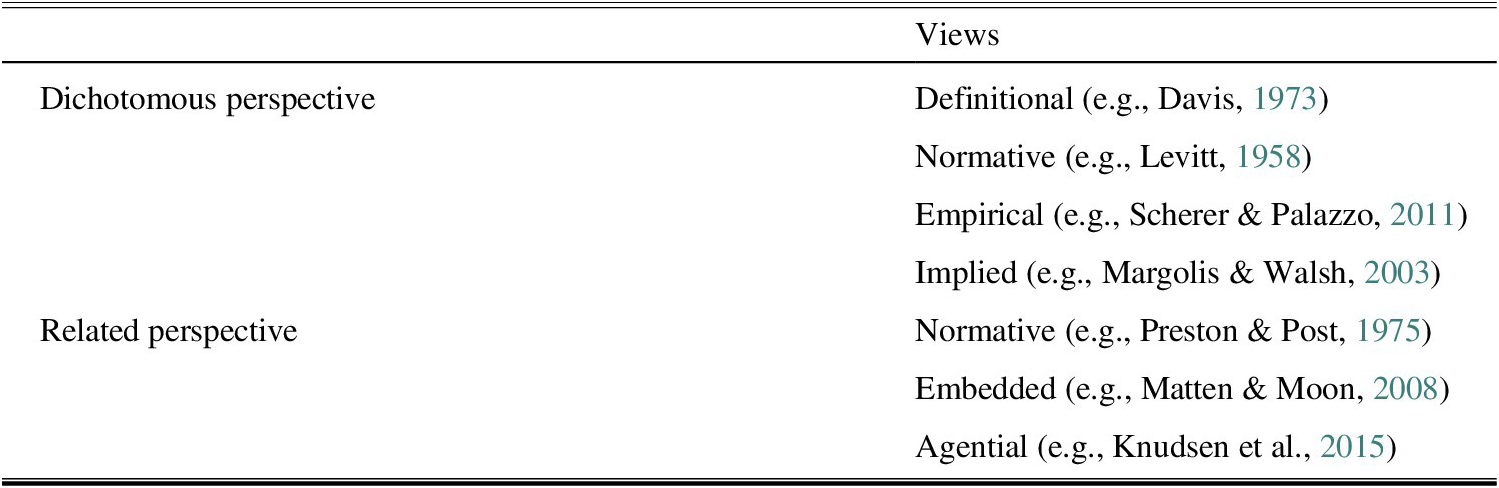
Our analysis contrasts the dichotomous and related perspectives on CSR and government, building on the analysis of Moon and Vogel (Reference Moon, Vogel, Crane, McWilliams, Matten, Moon and Siegel2008) and Knudsen and Moon (Reference Knudsen and Moon2017). We do so by investigating constituent views within each perspective. These perspectives and views are summarized in Table 1.
Perspectives on CSR and Government
Note. Derived from Knudsen and Moon (Reference Knudsen and Moon2017: 20).
The Dichotomous Perspective on CSR and Government
We suggest that the assumption of voluntarism has been central to CSR and that this informs the dichotomous perspective of CSR and government. We explain the dichotomous perspective with reference to four views: definitional, normative, empirical, and implied. While these may overlap in particular studies, they betray distinct conceptual and evaluative assumptions.
The definitional view is adopted by authors who distinguish CSR from what is required by the law and by governmental mandate in highlighting the voluntary character of CSR. McGuire (Reference McGuire1963) distinguished a business’s social responsibilities from its legal (and economic) ones. He suggested that
the idea of social responsibilities supposes that the corporation has not only economic and legal obligations but also certain responsibilities to society which extend beyond these obligations (144).
Davis (Reference Davis1973: 313) defined CSR as “the firm’s consideration of, and response to, issues beyond the narrow economic, technical, and legal requirements of the firm.” Jones (Reference Jones1980: 59) stressed that “behaviour coerced by forces of the law … is not voluntary,” and, for his purposes, these behaviors were excluded from CSR. This theme was reiterated by Frynas (Reference Frynas2012: 2):
The voluntary aspect forms the key distinguishing characteristic between CSR and mandatory regulation in that CSR establishes certain standards and rules of behaviour that are followed by companies voluntarily, even though there is no mandatory requirement to do so.
For other analysts, the definitional approach arises from their need to stipulate boundary conditions to conduct some evaluation of CSR (e.g., of a statistical nature; see Flammer, Hong, & Minor, Reference Flammer, Hong and Minor2019; Flammer & Luo, Reference Flammer and Luo2016). Equally, the need for boundary conditions can also arise for authors adopting a more theoretical approach to modeling CSR. McWilliams and Siegel’s (Reference McWilliams and Siegel2001: 117) theory of the firm analysis defined CSR as “actions that appear to further some social good beyond the interests of the firm and that which is required by law.” What unites these views is that the legal and other governmental mandates are ipso facto incompatible with corporate discretion, the essence of CSR.
Arguments for the dichotomous perspective have also reflected the normative view. Levitt (Reference Levitt1958) argued that as general welfare is the responsibility of government, corporations should stay out, because he feared that CSR would inappropriately empower corporations and that this would risk CSR becoming a vehicle for a business take-over of government. He therefore preferred that CSR be confined to welfare activities that “make economic sense” (48) and even posited a “natural division between economic and social functions” (48). A number of scholars have identified a motivation for CSR as being able to ward off government (e.g., Carroll & Shabana, Reference Carroll and Shabana2010), suggesting that regulation is unwelcome for the performance of CSR. So in this view, and in contrast to Levitt (Reference Levitt1958), the threat is to corporations from government. This view is shared in Porter and Kramer’s (Reference Porter and Kramer2011: 65) advocacy of “creating shared value,” in which corporations should assume roles in social problem solving that had been “ceded to governments and NGOs.” They contend that
government and civil society have often exacerbated the problem by attempting to address social weaknesses at the expense of business…. Companies must take the lead in bringing business and society back together (64).
Third, there are empirical arguments for the dichotomous perspective on CSR and government when it is observed that corporations take on roles that, in the twentieth-century democratic capitalist world at least, had been seen as state responsibilities. This occurs in accounts of pre–welfare state CSR (e.g., Djelic & Etchanchu, Reference Djelic and Etchanchu2017; Etchanchu & Djelic, Reference Etchanchu and Djelic2019; Husted, Reference Husted2015) and in governmental vacuums in the context of remote extractive industries (e.g., Muthuri, Chapple, & Moon, Reference Muthuri, Chapple and Moon2008). However, the empirical arguments have also emerged in the context of globalization, whereby corporations, often with civil society actors (Matten & Crane, Reference Matten and Crane2005; Scherer & Palazzo, Reference Scherer and Palazzo2007, Reference Scherer, Palazzo, Crane, McWilliams, Matten, Moon and Siegel2008), take on governmental roles in the absence of accompanying state capacity (e.g., Locke, Reference Locke2013; Spar & La Mure, Reference Spar and La Mure2003; Yaziji & Doh, Reference Yaziji and Doh2009). This empirical view has featured in the political CSR literature (Scherer & Palazzo, Reference Scherer and Palazzo2011), in which it is argued that companies (and civil society) actors have undertaken new roles in global governance in the name of CSR because “on the global level, neither nation-states nor international institutions alone are able to sufficiently regulate the global economy and to provide global public good” (Scherer & Palazzo, Reference Scherer and Palazzo2011: 900). While in a later rendition of political CSR (labeled “2.0”), possible roles for government in CSR were recognized, it was also contended that governmental inactivity creates space for CSR turning
corporations into political actors, by engaging in public deliberations, collective decisions, and the provision of public goods or the restriction of public bads in cases where public authorities are unable or unwilling to fulfil this role (Scherer, Rasche, Palazzo, & Spicer, Reference Scherer, Rasche, Palazzo and Spicer2016: 277).
The fourth view in the dichotomous perspective of CSR and government is the implied one, in which conceptualizations of CSR simply omit government, the law, or public policy. In their seminal article, Margolis and Walsh’s (Reference Margolis and Walsh2003) concern with CSR and the public interest appears to bypass government as a source of regulation for CSR or as an outgrowth of CSR, other than noting that all three branches of the US government have encouraged business social responsibility. It could be reasonably concluded that for Margolis and Walsh (Reference Margolis and Walsh2003), and for the hundreds of other papers on CSR that make no mention of government, government simply appeared unrelated to their analysis. Significantly, such studies have been prominent in the emergence of the CSR management subfield, as noted in analyses of the literature (e.g., Lockett, Moon, & Visser, Reference Lockett, Moon and Visser2006; Surroca, Aguilera, Desender, & Tribó, Reference Surroca, Aguilera, Desender and Tribó2020). One, presumably unintended, effect is that it has compounded the impression of CSR and government being of little relevance to one another, thereby marginalizing the question of how corporate discretion engages with public policy for CSR.
Thus, for four rather different reasons (definitional, normative, empirical, and implied), the dichotomous perspective on CSR and government has had a powerful effect on the literature, much of which is presented as if CSR operates in isolation of government.
The Related Perspective on CSR and Government
As noted, there is a smaller but growing literature reflecting an interest in CSR and government ranging from the inclusion of a governmental role in political CSR 2.0 (Scherer et al., Reference Scherer, Rasche, Palazzo and Spicer2016) to research on the revival of regulatory approaches by government to business conduct (Kourula, Moon, Salles-Djelic, & Wickert, Reference Kourula, Moon, Salles-Djelic and Wickert2019).
We suggest that three views underlie the related perspective on CSR and government: normative, embedded, and agential. Preston and Post (Reference Preston and Post1975) offered normative support for business involvement in, and accountability for, public policy. They saw the significance of CSR’s relationship to government for the respective societies and thus coined the term public responsibility to distinguish this from “ad hoc managerial policies and practices” (9). Thus, if CSR seriously addresses societal challenges, it would, necessarily, be related to government policies. Normative arguments also informed research on the relationship between CSR and new governance on the grounds that the forms of engagement of this more participatory approach to governing served both governments and CSR (Moon, Reference Moon2002; Moon & Sochacki, Reference Moon and Sochacki1998). Other normative justifications for the related perspective of CSR and government include Marens (Reference Marens2008) and Vogel (Reference Vogel1996) in general terms and analyses of corporate citizenship (e.g., Crane, Matten, & Moon, Reference Crane, Matten and Moon2008; Moon, Reference Moon1995; Moon, Crane, & Matten, Reference Moon, Crane and Matten2005) that see corporate engagement with government positively, notwithstanding caveats on power and accountability.
The embedded view of the related perspective on CSR and government (Moon & Vogel, Reference Moon, Vogel, Crane, McWilliams, Matten, Moon and Siegel2008) is that CSR is structured by public policies, and institutions more broadly, which governments have created, legitimated, and inherited (Rose, Reference Rose1990). This reflects the tradition of historical institutionalism (e.g., Thelen, Reference Thelen2014), in which focal policy commitments and actor behaviors are explained in terms of structures of the economy that are shaped by decades and centuries of government (e.g., Boyer, Reference Boyer2004; Hall & Soskice, Reference Hall and Soskice2001; Whitley, Reference Whitley1999). This has proved to be crucial for understanding the formation and shaping of corporations themselves (Avi-Yonah, Reference Avi-Yonah2005). In the CSR literature, Matten and Moon’s (Reference Matten and Moon2008) concept of implicit CSR assumes that the accumulative effect of government policies, along with social norms, shapes understandings of how companies should behave, without an explicit assumption of responsibility at a company level (e.g., in the United States, see Carroll, Lipartito, Post, Werhane, & Goodpastor, Reference Carroll, Lipartito, Post, Werhane and Goodpastor2012; Pasquero, Reference Pasquero and Igalens2004). Crane, Matten, and Moon (Reference Crane, Matten and Moon2004) argue that governments provide a legal background for the corporation, its citizenship, and the rights of its respective stakeholders. It is axiomatic in the CSR literature, reflecting long-standing business ethics scholarship, that corporations have a legal responsibility to obey the law (e.g., Carroll, Reference Carroll1979). Kang and Moon (Reference Kang and Moon2011) demonstrate the institutional complementarity between CSR and corporate governance systems in three capitalisms. Schrempf-Stirling (Reference Schrempf-Stirling2018) contends that the state acts as an enabling condition for CSR (e.g., through the Foreign Corrupt Practices Act, trade agreements), specifically in providing a legal structure for access to remedy for alleged corporate social irresponsibility (Schrempf-Stirling & Wettstein, Reference Schrempf-Stirling and Wettstein2017). For these analysts, the relationship of CSR to government is in the nature of the policy context for the creation and operationalization of corporations and the performance of their responsibilities.
A third view in the related perspective of government and CSR is that of agency, which focuses on the way governments purposively regulate the deployment of CSR for their own agendas. Gerde and Wokutch (Reference Gerde and Wokutch1998) note that various companies in the 1970s adopted CSR due to perceived government pressure, and they define the years 1978–86 as a “CSR and public policy” period. In the United Kingdom, the revival of CSR in the 1980s was precisely in the context of extensive government policies ranging from encouragement to direct pressure, and organizational and financial support for CSR in the context of mass unemployment and structural change during the Thatcher era (Kinderman, Reference Kinderman2012; Moon & Richardson, Reference Moon and Richardson1984; Moore, Richardson, & Moon, Reference Moore, Richardson and Moon1989). CSR revivals in the context of government policies to address mass unemployment also occurred in Australia (Moon & Sochacki, Reference Moon and Sochacki1996) and Denmark in the 1990s (Vallentin, Reference Vallentin2015). The volume of research into agential relationships between government and CSR has increased since the turn of the twenty-first century. This includes research on government–CSR partnerships (Selsky & Parker, Reference Selsky and Parker2005), interactions between private authority and public policy (Bernstein & Cashore, Reference Bernstein and Cashore2007; Cashore, Reference Cashore2002; Cashore, Knudsen, Moon, & van der Venn, Reference Cashore, Knudsen, Moon and van der Ven2021), aggregate studies on European government policies for CSR (Albareda et al., Reference Albareda, Lozano, Tencati, Midttun and Perrini2008; Knudsen et al., Reference Knudsen, Moon and Slager2015; Steurer, Reference Steurer2010), the choice of governmental instruments for encouraging CSR (Giamporcaro, Gond, & O’Sullivan, Reference Giamporcaro, Gond and O’Sullivan2020), and national governments developing policies for international CSR (Knudsen, Reference Knudsen2018; Midttun, Gjølberg, Kourula, Sweet, & Vallentin, Reference Midttun, Gjølberg, Kourula, Sweet and Vallentin2015; Reinecke & Ansari, Reference Reinecke and Ansari2015).
The normative, embedded, and agential views thus betray different approaches to the CSR–government relationship. The first focuses on corporate and governmental choices for good governance. The second reflects historical institutionalism, in which corporate discretion is shaped by institutional inheritance. The third reflects studies of government agency to purposefully deploy public policy for CSR.
What are we to conclude about the dichotomous perspective on CSR and government in the light of this evidence of attention to the related perspective? Reflecting the definitional view of the dichotomous perspective, for certain sorts of argument and analysis, it is clearly desirable to distinguish governmental and corporate variables; but heuristics should not obscure realities of CSR–government engagements that we have illustrated. Regarding the normative view, there may be circumstances where CSR involvement with government is to the detriment of the CSR itself or of good governance more widely, but equally, it may be to the betterment of either. There are also circumstances where the empirical view is valid such that CSR operates with little or no public policy context, but while significant, these circumstances are not representative of wider contexts for CSR. The implied view is understandable given the conventional focus and training of management scholars, but we suggest a broadening of management research ambition.
The rest of the article examines the varying nature of the relationship between corporate discretion and public policy for CSR, mainly reflecting the related perspective.
PUBLIC POLICY FOR CSR
Here we introduce public policy, the core output of government, illustrating its different regulatory strengths. We focus on the range of regulatory strengths of public policies for CSR. This is will inform our subsequent analysis of the different relationships between corporate discretion and public policy for CSR.
Public policy can be defined as “the substance of what government does” (Dearlove, Reference Dearlove1973: 2). It reflects authoritative actions taken by governments ostensibly to steer someone or something toward public ends (Ruggie, Reference Ruggie2004). It can entail the creation of laws and rules but also softer forms of regulation, such as information provision and capacity building (Andonova, Betsill, & Bulkeley, Reference Andonova, Betsill and Bulkeley2009). So, notwithstanding the common denominator of government’s authority predicated upon their possession of the monopoly of legitimate force within national boundaries (Weber, Reference Weber1949), public policy can come in many shapes and sizes (Hood, Reference Hood1986). With reference to the definitional view within the dichotomous perspective, this, of course, means that government can regulate without the recourse to mandate, as illustrated in the new governance literature (Pierre, Reference Pierre and Pierre2000; Rhodes, Reference Rhodes1996).
Government policies for CSR bring different forms of discretion to corporations. Albareda et al. (Reference Albareda, Lozano, Tencati, Midttun and Perrini2008: 349) report on the evolution of soft government policies to “shape the voluntary behaviour of companies,” including policies to promote formalization and transparency and to encourage scrutiny. Steurer (Reference Steurer2010) also reveals a variety of regulatory strengths of European governments beyond the use of legal resources for CSR, such as economic, informational, and partnering policies. Kourula et al. (Reference Kourula, Moon, Salles-Djelic and Wickert2019) point to government as facilitator and partner as well as reregulator of business conduct. We continue by outlining how public policies for CSR bring different regulatory strengths and thus varying choices for the exercise of corporate discretion with reference to Knudsen et al.’s (Reference Knudsen, Moon and Slager2015)—building on Fox, Ward, and Howard (Reference Fox, Ward and Howard2002)—presentation of four types of public policy for CSR distinguished by the resources deployed and their relative regulatory strength. First, they identify policies that endorse CSR with reference to official encouragement and the provision of the governmental imprimatur; information campaigns; and websites, awards, and labeling schemes. This is a relatively weak form of regulation predicated on signals of government approval of CSR. Second, they distinguish policies that facilitate CSR with reference to the provision of such tangible resources as subsidies (e.g., to stimulate employment) and tax expenditures (e.g., for charitable donations, environmental investments) or public procurement policies (e.g., for sustainable or ethical products). These policies bring a medium level of regulatory strength to CSR. They do not coerce corporations, though they might be considered more constraining by companies whose main customers are governments and whose business models are directly impacted.
Partnership policies for CSR (Knudsen et al., Reference Knudsen, Moon and Slager2015) reflect government’s ability to create and formally join partnerships for CSR. These usually consist of multiple business and civil society organizations as well as governmental organizations and are used to disseminate knowledge about CSR and sustainability issues, often extending to guidelines, standards, or codes. These also have medium regulatory strength. While corporations—and other actors—undertake obligations on joining such partnerships, they neither need join nor remain in them.
The public policies for CSR based on endorsement, facilitation, and partnership constitute the overwhelming majority of CSR policies (Albareda et al., Reference Albareda, Lozano, Tencati, Midttun and Perrini2008; Knudsen et al., Reference Knudsen, Moon and Slager2015; Steurer, Reference Steurer2010). Soft law can bring various advantages over hard law, such as lower implementation and audit costs, adaptability, learning opportunities, compromise, and cooperation (Abbott & Snidal, Reference Abbott and Snidal2000). However, they bring no requirements for compliance: corporate discretion remains as to whether and how to engage.
Mandatory policies for CSR (Knudsen et al., Reference Knudsen, Moon and Slager2015) might be expected to compromise corporate discretion and prompt disquiet among those adhering to the normative view on the dichotomous perspective of CSR and government. However, we argue that although mandated CSR policies are clearly of high regulatory strength, they do not necessarily undermine corporate discretion in absolute terms, though they may change it. A common form of government mandate for CSR is nonfinancial reporting legislation, which usually brings few clear legally binding obligations, precision, or clear delegation for interpretation and implementation (Abbott & Snidal, Reference Abbott and Snidal2000: 421; see also Jackson, Bartosch, Avetisyan, Kinderman, & Knudsen, Reference Jackson, Bartosch, Avetisyan, Kinderman and Knudsen2020). Similarly, governments have mandated CSR environmental public policies whose specific obligations are modest. These can range from a simple reporting requirement for emissions to sector-specific emissions reductions agreements, targets, and trading schemes. So it appears that governments are willing and able to use their powers to mandate behavior for companies. But they may choose to do so in ways that offer either a flexible framework enabling choice (including the use of markets) or a regulated framework for conformance with some relatively broad criteria that are flexible and open to interpretation. This sort of mandate allows some corporate discretion, both whether to comply (e.g., regulations often entail comply or explain requirements) and how to comply.
In a forthcoming section, we investigate more closely public policies for CSR and the related corporate discretion in four vignettes in the light of our exploratory framework of corporate discretion and public policy for CSR. But first, we turn to examining the concept of corporate discretion in relation to public policy.
CORPORATE DISCRETION AND PUBLIC POLICY FOR CSR
In this section we define corporate discretion and present a typology on CSR and the law that we use in the following section to build our own framework for corporate discretion for engagement with public policy for CSR. This is because we need a clear understanding of different types of corporate discretion available to corporations.
A long-standing definition of discretion is “liberty or power of deciding, or of acting according to one’s own judgement; uncontrolled power of disposal” (Onions, Reference Onions1973). In the management literature, the concept famously arises in the context of managerial discretion in relation to the preferences of shareholders. Perspectives range from agency theory, in which managers act “solely for the rateable benefit of all the shareholders” (Berle, Reference Berle1931: 1049; see also Jensen & Meckling, Reference Jensen and Meckling1976), to assumptions of wider managerial discretion, including for social welfare (e.g., Berle, Reference Berle1932; Clark, Reference Clark1916; Dodd, Reference Dodd1932; Stout, Reference Stout2012).
We are unaware of any literature on corporate discretion in relation to public policy for CSR. However, we are inspired by McBarnet’s (Reference McBarnet, McBarnet, Voiculescu and Campbell2007) sociolegal approach to CSR and her concept of the “new accountability,” which distinguishes three sorts of “commitment” that corporations can make in relation to public policy for CSR. Thus corporations can use their discretion in enacting their responsibility “beyond law, through law, [or] for law” (McBarnet, Reference McBarnet, McBarnet, Voiculescu and Campbell2007: 13). While McBarnet’s focus is broad, including private regulation and civil society and market pressures for CSR, our adaptation of her typology only highlights corporate discretion for engagement with public policy for CSR.
McBarnet’s (Reference McBarnet, McBarnet, Voiculescu and Campbell2007: 12) first category, CSR beyond law, is the most familiar one to adherents of the dichotomous perspective on CSR and government. It is that companies develop CSR activities outside what the law requires. She illustrates this with respect to corporations’ environmental and human rights activities and the use of Fairtrade products. She notes that such corporate policies can be used to forestall further public policy but also to achieve a higher social performance than regulation could achieve (akin to the normative dichotomous view).
McBarnet’s second and third categories are consistent with the related perspective on CSR and government. CSR through the law (McBarnet, Reference McBarnet, McBarnet, Voiculescu and Campbell2007: 31) refers to various forms of corporate discretion, including to comply with regulation of corporations (e.g., the duties on directors under the UK Company Act Amendments, 2006; the duties for disclosure under the US Sarbanes–Oxley Act, 2002), to comply with legal accountability arising from voluntary agreements (McBarnet, Reference McBarnet, McBarnet, Voiculescu and Campbell2007: 40), or to respond to incentives created by public policy (e.g., environmental standards in public procurement requirements) (McBarnet, Reference McBarnet, McBarnet, Voiculescu and Campbell2007: 43). CSR for the law (McBarnet, Reference McBarnet, McBarnet, Voiculescu and Campbell2007: 13, 54) refers to CSR that recognizes and reflects the limits of the letter of the law but that informs action in the spirit of the law. We take the spirit of the law to refer to the underlying intention of the law and as featured in a wide range of contexts from Jewish and Christian theology to US constitutional debates. McBarnet notes that the term is used increasingly by regulators to encourage good ethical practices and a culture of compliance. She quotes former US Securities and Exchange Commission chair William Donaldson’s comment that “companies are living up to their obligations and embracing the spirit underpinning all securities laws … beyond just conforming to the letter” (52–53). McBarnet submits that adherence to the spirit of the law includes refraining from creative compliance to avoid the intention of the law or to thereby exploit competing regulatory standards, compensating for weak policy implementation resources, and engaging in constructive policy advocacy (44–56). So while she recognizes the corporate choices that inform the dichotomous perspective on CSR and government in her concept of CSR commitments beyond the law, nevertheless McBarnet also supports claims for the related perspective in terms of the normative, embedded, and agential views. In the following section, we will adapt insights from McBarnet’s typology to inform our own framework of corporate discretion and public policy for CSR.
CORPORATE DISCRETION FOR ENGAGEMENT WITH PUBLIC POLICY FOR CSR
This section builds on the typologies of public policy strength (Knudsen & Moon, Reference Knudsen and Moon2017) and of CSR and the law (McBarnet, Reference McBarnet, McBarnet, Voiculescu and Campbell2007) to develop a framework for analyzing corporate discretion for engagement with public policy for CSR. This enables us to systematically compare and assess different CSR and government relationships across a range of different issues in their respective contexts.
While the terms typology and framework are used in different ways, and often interchangeably, in the management and wider social science literatures, we use the term typologies to refer to the distinctions and classifications within a single kind of phenomenon, respectively, the regulatory strength of public policy for CSR (Knudsen & Moon, Reference Knudsen and Moon2017) and corporate discretion in respect of regulation (McBarnet, Reference McBarnet, McBarnet, Voiculescu and Campbell2007). We describe our framework thus because it enables us to illustrate a number of relationships between different types of phenomena, specifically corporate discretion and public policy for CSR. Figure 1 presents the framework.
A Framework of Corporate Discretion and Public Policy for CSR
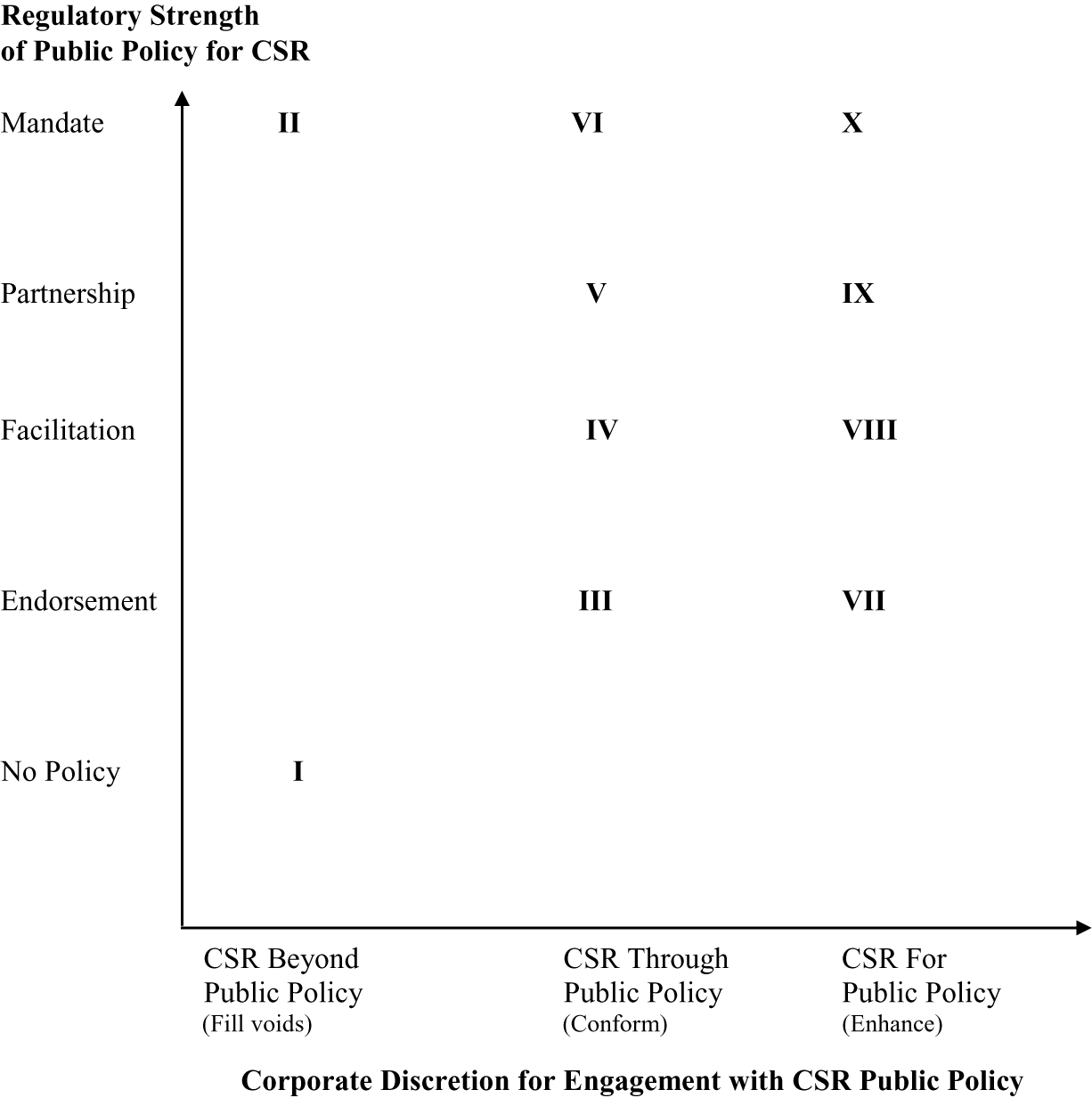
The points on the two axes are nominal ones. However, there is a gradation of regulatory strength (y-axis) from strong regulation in the form of mandate through partnership, facilitation, and endorsement to no policy. These forms of regulation present corporations with the opportunity to use their discretion in how to relate their CSR to public policy. Likewise, there is a gradation on the dimension of corporate discretion (x-axis) from beyond public policy akin to the dichotomous perspective on CSR and government to through and for public policy, which denote choices consistent with the related perspective on CSR and government. We use the framework to illustrate comparative and changing relationships between public policy for CSR and corporate discretion in four vignettes of CSR. These different relationships are marked by the positions of the Roman numerals on Figure 1.
As relationships between public policy for CSR and corporate discretion for CSR are shaped by context (Matten & Moon, Reference Matten and Moon2008, Reference Matten and Moon2020), we note the vignettes’ specific contexts. They are corporate philanthropy in the United States, ethical trade in the United Kingdom, corporate nonfinancial reporting in Denmark, and corporate taxation internationally following the release of the Panama Papers in 2016. This selection reflects CSR issues that have been fairly salient, albeit in specific temporal and societal contexts. The purpose of the comparison is to illustrate how corporate discretion for engagement with public policy for CSR, and the strength of the public policy itself, can evolve across different CSR cases. For three of the four cases (philanthropy, ethical trade, and reporting), the literature has often understated the significance of government for CSR. In the fourth case (tax), the literature has often understated the significance of corporate discretion for CSR.
Corporate Philanthropy in the United States
Corporate philanthropy is probably the most common mode of CSR, particularly in the United States (Carroll et al., Reference Carroll, Lipartito, Post, Werhane and Goodpastor2012; Maignan & Ralston, Reference Maignan and Ralston2002). In 2017, US corporations made more than $20 billion in donations to charitable causes (Reisman, Reference Reisman2019). Notwithstanding various motivations that might underlie corporate philanthropy, it is assumed to be quintessentially voluntary (position I in Figure 1).
However, US governments have long deployed tax incentives for corporate charitable donations reflecting the inheritance of tax policy for charitable donations in what were the American colonies derived from the 1601 English Charitable Uses Act. As Bremner (Reference Bremner1988) demonstrates, patterns of giving in the United States are shaped by tax laws. Yet the role of tax expenditures for corporate philanthropy is largely unrecognized in the CSR literature. In view of the effect of this embedded public policy, much US corporate philanthropy reflects corporate discretion to adopt the tax subsidies for their philanthropy (IV) or even integrate the logic of the policy and go beyond its minimal requirements (VIII). So this is not to say that the philanthropic CSR in the United States is any more or less socially responsible but simply that the discretion is related to public policy for CSR (Reich, Reference Reich2018).
This logic also extends to the provision of health insurance and other corporate benefits to US employees that corporations often include in their CSR policy (e.g., Google [Meyer, Reference Meyer2017], Starbucks [Matten & Moon, Reference Matten and Moon2008]). However, health insurance provided by corporations can also reflect subsidies in the form of tax expenditures (i.e., revenue foregone) provided by the US government, thus constituting the “welfare economy” (Rein, Reference Rein1982) and thereby conforming to the related perspective. While we do not contend that corporations are motivated by financial gain derived from the tax relief, we suggest that this is a powerful case of CSR being embedded in a highly significant public policy framework, estimated to be valued to exceed $146 billion in fiscal year 2018 (excluding the value of employee tax reductions; Tax Policy Center, 2021). No law directly required employers to provide health care coverage to their employees until the Affordable Care Act (2010), which imposes penalties on larger employers that fail to provide health insurance. So as with tax relief for philanthropy, so here, too, corporations have long used their discretion regarding how to respond to the tax incentives (IV) or even to integrate the principle of health insurance beyond the minimum level (VIII).
CSR-oriented tax incentives are deployed by governments throughout the world, most commonly for general corporate charitable donations, but also to stimulate employment opportunities or encourage environmental investments. Corporations make choices about if and how to avail themselves of these incentives, thereby reflecting the related perspective. They can ignore such policies, adopt the logic of the policies in their respective CSR, or integrate the logic of such policies more deeply or more widely.
Ethical Trade in the United Kingdom
Ethical trade refers to the sourcing of products and services under conditions that confer workers’ labor and human rights and that are otherwise responsible (Blowfield, Reference Blowfield1999: 753–54). The issue has been a long-standing one, evidenced in business opposition to slavery in the nineteenth century (e.g., the Wedgwood company, United Kingdom) and to South African apartheid in the twentieth century (e.g., business signatories of the Sullivan Principles). In the last twenty years, often in response to nongovernmental organization (NGO) pressure, corporations have adopted private standards for working conditions and living wages (often known as fair trade). Examples include Nike’s auditable standards for labor conditions (Nike, n.d.) and Sainsbury’s (2017) ethical trade code of conduct. Companies have also adopted private standards generated by business associations, partnerships, or multistakeholder initiatives (e.g., Fair Labor Association, Better Cotton Initiative, Fair Wear Foundation, Forest Stewardship Council, Marine Stewardship Council). These examples of corporate discretion for CSR reflect definitional, normative, and empirical assumptions of the dichotomous perspective (position I in Figure 1).
However, governments have also played a role in developing ethical trade policies. The UK Ethical Trading Initiative (ETI) was instigated by the UK government in 1998. It is a CSR multistakeholder institution of eighty-plus companies, NGOs, and trade union bodies, claiming coverage of 10 million workers. Subsequently, UK governments facilitated the ETI (e.g., in the form of finance, secondments, and network access; Knudsen & Moon, Reference Knudsen and Moon2017) such that the ETI member companies’ CSR is thus partly engaged with the UK government and thus reflective of the related perspective (IV). Some aspects of the ETI’s collaboration with the UK government reflect a partnership-type relationship. In its formative stages, the government was represented on the ETI Board. The Labour government minister, Clare Short, described government support for the ETI as part of its “applied international development policy,” and her Conservative successor, Alan Duncan, described the ETI as a partner of government (Knudsen & Moon, Reference Knudsen and Moon2017: 117, 115). These aspects of the relationship reflect the related perspective in the corporate discretion of multiple companies (and civil society organizations). Corporations can ignore such policies or adopt the facilitation resources (IV) or the requirements of the partnership (V) and even integrate the principles and objectives of the facilitation (VIII) or partnership more deeply or widely (IX).
The Modern Slavery Act (2015) (on which the ETI collaborated with government) includes Transparency in Supply Chain Provisions, which require large businesses to publish a statement of the steps they have taken to ensure that there is no slavery and human trafficking in their supply chains. Yet even in this mandated public policy for CSR, corporations retain some discretion because if they prefer not to publish the statement, they can declare that no such steps have been taken. They can also choose how to conduct and publish their due diligence, whether through compliance (VI) or through embracing the logic of the policy in their wider operations (X).
The UK cases are not isolated. There are numerous public policies for more responsible international supply chains, often through endorsement and facilitation of CSR organizations (e.g., the US government supported the North American retail brand initiative Alliance for Bangladesh Worker Safety). There is also a growth of mandates for due diligence regarding abuses in multinational corporations’ (MNCs’) international supply chains (e.g., in French and Dutch labor rights regulations).
Nonfinancial Reporting in Denmark
CSR reporting (also known as nonfinancial or environmental, social, and governance reporting) has become pervasive among corporations (Ioannou & Serafeim, Reference Ioannou and Serafeim2011). It brings expectations of accountability both to company stakeholders and to society and an opportunity for CSR communication. This partly reflects societal demands for greater “transparency of corporate social and environmental impact, together with delivering enhanced levels of accountability to organizational stakeholders” (Owen & O’Dwyer, Reference Owen, O’Dwyer, Crane, McWilliams, Matten, Moon and Siegel2008: 385). Certainly this form of corporate reporting usually emerged voluntarily (position I in Figure 1). However, numerous countries and the European Union have introduced CSR reporting policies, suggesting the applicability of the related perspective. We focus on Denmark, known as a CSR leader country (Vallentin, Reference Vallentin2015), a front-runner in government support for CSR (Knudsen & Brown, Reference Knudsen and Brown2015), and one of the countries that reflects “systemic institutionalization” of its CSR policies (Knudsen et al., Reference Knudsen, Moon and Slager2015).
Danish companies began CSR reporting voluntarily in the 1990s (I). However, the government supported this practice by endorsing and facilitating CSR reporting, which followed United Nations (UN) Global Compact recommendations. The Danish Foreign Ministry collaborated with the United Nations Development Programme Nordic Office to form a task force to organize outreach activities and advise companies about the UN Global Compact. Companies engaging with the recommendations of the task force could thus use their discretion to echo (III) or champion (VII) the endorsement policies and adopt (IV) or integrate (VIII) the facilitation policies.
The nonfinancial reporting (Section 99a of the Danish Financial Reporting Act, 2008) and its subsequent amendments certainly constituted a mandate that narrowed the scope for corporate discretion. Crucially, though, companies retain considerable discretion on how to report (Knudsen & Moon, Reference Knudsen and Moon2017). The government claimed it was motivated to create “greater openness about the CSR initiatives undertaken by Danish corporations … [to make] Danish companies and Denmark well-known for responsible growth which will benefit Danish business more generally” (quoted in Knudsen & Moon, Reference Knudsen and Moon2017: 95–96). The Act required publicly traded or publicly owned companies and large private companies to report on their social responsibility policies, how these are translated into action, and their evaluation of these initiatives and prospects for future initiatives. Beyond these requirements, complying companies had considerable discretion over what issues they reported on, how they presented their reports, and even whether to report at all, with the proviso that an explanation for no report was provided.
The Act was extended in 2012 to require reporting of initiatives to reduce the impact of climate change, human rights protection measures, and actions to prevent irresponsibility (Danish Government, 2012). It was extended in 2015 to reflect the European Union Directive on Non-Financial Reporting (Directive 2014/95/EU), adding requirements for disclosure on corporate policies, risks, and outcomes concerning environmental, human rights, employee issues, anticorruption and bribery, and gender diversity on boards of directors. The Act required a fuller account of CSR activities, including of the company’s business model; specific policies (e.g., due diligence, policy outcomes, operational risks); and performance indicators. However, corporations retained discretion over how the report is presented, the use of guidelines, and reporting further issues. This reflected the government’s stated preference for firms to choose how to report “in order to provide the reporting information that best suited the individual company” (Ministry of Economics and Business Affairs, 2008, authors’ translation). However, whereas the corporation’s decision as to whether to report was initially voluntary (report or explain), now failure to report can result in fines (CSR DK, 2014; though we are unaware of fines having been imposed).
A study of CSR reporting of Danish companies (Pedersen, Neergaard, Pedersen, & Gwozdz, Reference Pedersen, Neergaard, Pedersen and Gwozdz2013) concluded that “companies are reflexive and selective in their use of existing CSR resources. They do not just passively conform to new CSR guidelines” (Pedersen et al., Reference Pedersen, Neergaard, Pedersen and Gwozdz2013: 366). So while corporations had the choice simply to comply with the mandate (VI), many of them embraced the regulation and reported much more fully than the legal minimum (X).
Corporate Taxation Internationally
Corporate tax barely featured in accounts of CSR historically, on the assumption that responsibility was confirmed by compliance with mandated corporate taxation requirements (Carroll, Reference Carroll1979). Thus the payment of taxes would be located at position VI in Figure 1. Following critiques of extractives corporations’ lack of transparency about their tax and other payments to host governments in the late 1990s, and evidence of corporate tax avoidance following the 2008 financial crisis, responsible tax payments emerged as a more explicit CSR issue. The release of the Panama Papers (Guardian, 2016) further politicized the issue of legal tax avoidance with the revelation that corporations had exercised great (and, by implication, malign) discretion over how they complied with corporate tax law (Muller & Kolk, Reference Muller and Kolk2015; SustainAbility, 2006). Not only was it revealed that Starbucks had legally avoided UK corporate taxation for many years but when this became public knowledge, the corporation chose to speedily revise the basis of its UK tax obligations and thus the amount of tax paid (BBC, 2013).
In this light, tax authorities now expressly relate taxation policies to corporate discretion by providing advice to MNCs regarding their choices between multiple tax authorities, transparency, and anti-avoidance in general. They invite tax negotiation and encourage corporations to relate this to their CSR by adopting the fairness principle in their tax strategies (Hilling & Ostas, Reference Hilling and Ostas2017). Accordingly, business associations are developing responsible tax principles to inform the exercise of that discretion. The B Team (a global nonprofit initiative cofounded by Sir Richard Branson of the Virgin Group and Jochen Zeitz of Harley-Davidson) has developed an approach reflecting corporations’ discretion to enhance tax law through their tax management, tax relationships, and tax reporting (B Team, 2018; see also CSR Europe, n.d.). Individual corporations have also developed their own tax principles and practices (e.g., Mærsk, 2019; Starbucks, 2017). Rather than simply complying, including through legal loopholes, the approach is to embrace the spirit of the law, reflecting CSR engagement with public policy (X) (McBarnet, Reference McBarnet, McBarnet, Voiculescu and Campbell2007; Moon & Vallentin, Reference Moon and Vallentin2020).
Together our vignettes give vivid insights into the operation and dynamics of the dichotomous and related perspectives on CSR and government. Certainly the dichotomous perspective seems apposite, as in the first three vignettes, there is evidence of CSR beyond public policy (I). Yet, in all three cases, CSR has become more reflective of the related perspective as various government regulations encouraged, scaled up, and institutionalized these private initiatives. In the case of philanthropy, the institutionalization appears so effective that CSR accounts often misrepresent this as unrelated to public policy, reflecting the dichotomous perspective.
But it would be a mistake to conclude that this is a simple sequencing story from private initiatives fitting the dichotomous perspective being followed by public policy fitting the related perspective. In ethical trade and CSR reporting, we have seen corporations not only using their discretion through and for public policy (the related perspective) but also further innovating and raising the quality of their CSR initiatives beyond public policy (II). Regarding philanthropy, ethical trade, and nonfinancial reporting, the literature has often understated the significance of government policy for company CSR initiatives. In the case of taxation, there is some interplay between the related and dichotomous perspectives. Public policy now includes overtures to corporations to exercise their discretion and to do so responsibly and in the spirit of the law. Private initiatives set out responsible business approaches to taxation, entailing ethical principles, tax management practices, and reference to the framing for responsible taxation provided by national and international regulators. In this case, the literature has often understated the significance of corporate discretion for responding to corporate tax policy in any way beyond compliance (VI).
DISCUSSION AND CONCLUSIONS
Here we draw together the findings and associated contributions to the CSR literature and briefly discuss two limitations concerning corporate influence on public policy and nondemocratic contexts for corporate discretion and public policy for CSR.
Looking at our contributions, the first two questions that motivated our article concerned the coexistence of the dichotomous and related perspectives on CSR and government. Why, given the evidence of public policy for CSR, do so many important contributions to the CSR literature adopt the dichotomous perspective and assume that CSR and government are unrelated? Why, given that the CSR concept is so strongly infused with assumptions about voluntarism, do numerous authors write about how CSR and public policy are related? Our first contribution has been to explain the dichotomous and the related perspectives on the relationship between CSR and government with reference to the different assumptions and analytical approaches that inform their constituent views. Hitherto the coexistence of these views had been either overlooked or understood in such terms as an absence of agreement, paradox, or confusion.
We identify four different views that support the dichotomous perspective. First, in the definitional view, corporate choices constrained by public regulation would negate the sine qua non of CSR, corporate discretion. Research into distinguishing the effects of CSR would be undermined if it were not possible to stipulate a definition of CSR that delimited such variables as the law or government. The normative view simply goes that it would be bad for government and for corporations’ CSR activities if the former regulated the latter. The empirical view arises from the apparent “absence” of government (e.g., as a result of globalization), prompting the conclusion that CSR is independent of public policy. There is also the implied view in which there is no account of any CSR–government relationship. We suggest that this reflects both the combined impact of the first three dichotomous views and the corporate focus of much management research.
We explain the related perspective on CSR and government as grounded in three views. First, there is the normative view within the related perspective by which some authors contend that CSR and public policy can be mutually beneficial. Second, the embedded view of CSR and government presents the underlying role of public policy in shaping CSR. Third, the agential view reveals how governments choose to make policy for CSR (rather than inherit it) and encourage corporations to engage with it. From this standpoint, we contend that defenders of the dichotomous perspective should reconsider the role of government as did the authors of the political CSR concept, Scherer and Palazzo (Reference Scherer and Palazzo2007, Reference Scherer and Palazzo2011), who subsequently noted that the literature on political CSR “may have been too sceptical with regard to governmental regulation” (Scherer et al., Reference Scherer, Rasche, Palazzo and Spicer2016: 284).
Our second contribution is to demonstrate the coexistence and interaction of public policy for CSR and corporate discretion, and this contribution informs two more specific contributions (discussed later). This is important, as it confirms the related perspective. We drew on two CSR typologies: CSR public policy and its varying regulatory strength (Fox et al., Reference Fox, Ward and Howard2002; Knudsen et al., Reference Knudsen, Moon and Slager2015) and corporate discretion in relation to public policy, whether beyond, through, or for public policy (McBarnet, Reference McBarnet, McBarnet, Voiculescu and Campbell2007). We integrated these typologies into a framework for analyzing corporate discretion for engagement with CSR public policy (Figure 1). This enabled us to depict and explain different relationships between corporate discretion and public policy through four vignettes of key CSR issues. Although no sign of a positive relationship emerges from our analysis (and given its qualitative nature, any such interpretations could only be tentative), we nevertheless found diverse interactions between corporate discretion and public policy strength. This lends support to Djelic and Etchanchu’s (Reference Djelic and Etchanchu2017: 654) observation that “business and state responsibilities are tightly interconnected and always being negotiated.”
Our third contribution is that, rather than obviating it, public policy for CSR can inform and stimulate corporate discretion. This is important, as it confirms that public policy for CSR need not coerce corporate discretion. We showed how, although societal expectations and embedding of values are clearly core to CSR, government provides the medium by which societal preferences are institutionalized. Moreover, CSR public policy creates opportunities for corporate discretion, not only in whether, but also in how, to comply. Relatedly, our fourth contribution is to demonstrate that corporate discretion in relation to public policy for CSR is not binary (i.e., comply or not); rather, corporations can have discretion even in relation to mandated public policy for CSR, particularly as to how corporations engage with such policy. This is important, because we demonstrate that even in cases where public policy for CSR entails mandatory requirements, in nonfinancial reporting and corporate taxation, some elements of corporate discretion are preserved. These insights bring different conclusions into CSR and government relations than those of the dichotomous view, which assumes that corporations would or should resist the long arm (Schuler, Reference Schuler2012) of government or might regard CSR simply as a means of averting further regulation (Carroll & Shabana, Reference Carroll and Shabana2010; Kaplan, Reference Kaplan2015). Instead, we contend that corporations can make choices about how to respond to CSR public policy, whether by conforming to or enhancing such policy. CSR therefore reflects different types of discretion in relation to public policy rather than being strictly and wholly voluntary. The nature of discretion will vary by the form, particularly regulatory strength, of the public policy itself and by corporate values and interests.
We conclude by rejecting the idea of CSR as strictly and wholly dichotomous from public policy and instead propose a theory of CSR–government relationships in which CSR reflects different types of corporate discretion for engagement with public policy, which offers different opportunities for discretion, notably how to engage. We submit that our overall conclusions about the coexistence and interaction of corporate discretion and public policy for CSR are entirely in keeping with the spirit of CSR as adumbrated by Bowen, often regarded as the academic father of modern CSR. He defined CSR as “the obligations of businessmen to pursue those policies, to make those decisions, or to follow those lines of action, which are desirable in terms of the objectives and values of our society” (Bowen, Reference Bowen1953: 6). This implies that social responsibility is not confined to activities outwith the purview of public policy. While Bowen described these responsibilities as “voluntary” (6), he also assumed that responsible business would extend to “participation by officials and employees in community activities pertaining to government” (63) and “seek[] public policies which will make the economic system work better from the point of view of all classes” (64), both of which anticipate the related notions of public policy for CSR and CSR for public policy (see Mäkinen & Kourula, Reference Mäkinen and Kourula2012).
On this basis, we offer a more generalized typology of corporate discretion for engagement with public policy for CSR than the relationships between corporate discretion and public policy for CSR provided in Figure 1.Footnote 1 Table 2 presents our typology.
Six Forms of Corporate Discretion in Relation to Public Policy for CSR

A corporation can conform to a public policy that endorses CSR by echoing its message. For example, it can produce a CSR report focusing on positive stories in response to government endorsement of nonfinancial reporting. Alternatively, the corporation can choose to enhance the endorsement policy and champion it by extending the endorsement to report to its own suppliers and other business partners. It can conform to a CSR policy of facilitation and adopt it narrowly. For example, it can meet the requirements of a public purchasing specification of sustainable timber, or it can choose to enhance the policy and integrate the principles underlying the public purchasing specifications with greater ambition. For example, it can apply the sustainable timber public purchasing standard to all its product markets. Likewise, a corporation can adopt the principles and expected practices of a government-initiated or -supported partnership. For example, it can abide by the base code of an ethical trade partnership to its first tier suppliers. However, it can choose to enhance the partnership policy and integrate the principles of the base code by applying them throughout its value chain. It can conform to a CSR policy mandate and comply with the letter of the law. For example, it can legally adhere with the corporate tax law of a country in which it operates and makes profits, but legally not pay tax in that jurisdiction. However, the corporation can choose to enhance the law by embracing its spirit by ensuring that taxes are paid in proportion to its business activity, particularly its profit making, in the country in question rather than follow a legal strategy for tax avoidance.
Limitations and Opportunities
We now turn to two issues arising from our article, reflecting limitations and opportunities for further research. First, while the article has addressed and identified positive instances of corporate discretion and CSR public policy interaction, it has not focused on corporations intervening in regulatory processes (Hillman, Keim, & Schuler, Reference Hillman, Keim and Schuler2004)—the reverse direction of influence to that of the impact of public policy on discretion for CSR. This relates to one aspect of the normative dichotomous view of CSR: the fear of the corporatization of government (Flinders, Reference Flinders2005; Levitt, Reference Levitt1958; Richter, Reference Richter2004).
A number of reverse direction of influence relationships can be distinguished. Corporations are well known for using whatever means are at their disposal to advance their interests, particularly lobbying (Anastasiadis, Reference Anastasiadis2013) and campaigning (Nyberg, Spicer, & Wright, Reference Nyberg, Spicer and Wright2013) against ostensibly socially beneficial regulation. Thus, in the context of our vignettes, we would expect that corporations lobby to influence the design and application of regulation pertaining to charitable giving, ethical trade, CSR reporting, and corporate taxation. Nonetheless, our point remains that public policy can embed or incentivize CSR choices.
Second, the public policy for CSR might be construed not as embedded or reflecting the agential power of government but as reflecting the power of business in averting more stringent regulation (Hanlon, Reference Hanlon, Crane, McWilliams, Matten, Moon and Siegel2008), in shaping not only policies but also agendas and public preferences (Gilens & Page, Reference Gilens and Page2014). More specifically, as Kaplan (Reference Kaplan2015) argues, the very investment in CSR reflects a strategy for offsetting greater business regulation by employment of the definitional and normative dichotomous views. Likewise, it could be countered that CSR reporting and due diligence–based public regulation represent weak alternatives to stronger regulation of corporate behavior.
We also note that other motivations for the reverse direction of influence may pertain, building on the idea of “constructive policy advocacy” (Anastasiadis, Humphreys, & Moon, Reference Anastasiadis, Humphreys and Moon2018; McBarnet, Reference McBarnet, McBarnet, Voiculescu and Campbell2007) whereby corporations lobby for public policy in an ethical fashion to raise social and environmental standards. Certainly this may be motivated by competitive considerations, such as raising competitors costs (e.g., when a car manufacturer advocates raising a climate emission standard because it has developed a new technology that would meet the new requirements); gaining access to new labor resources (e.g., when a manufacturer supports the rights of immigrants and refugees because they need access to cheap labor), appealing to their employee or consumer stakeholders (e.g., in supporting the rights of LGBTQ communities because these rights have come to be seen as critically important), and creating new markets (e.g., pharmaceutical companies advocating expansion of a public health service as a way to generate demand for their products). Presumably the legitimacy or value of such policies is not invalidated simply by being supported by, and in the interests of, particular corporations.
Certainly the relationship between corporate influence and public policy for CSR is a subject for further research. Rasche (Reference Rasche2015) has observed that corporations may not only be keen to pursue their economic interest through corporate political activity but increasingly recognize that CSR may be attractive in terms of establishing political legitimacy (Moon, Reference Moon2002; Scherer & Palazzo, Reference Scherer and Palazzo2011; Scherer et al., Reference Scherer, Rasche, Palazzo and Spicer2016). Accordingly, multinational corporations have become critical for addressing various cross-border regulatory challenges, such as protection of labor rights and preventing corruption, which invariably also intersect with national regulatory regimes in which corporations also lobby for their economic interests. Moreover, while conceptually, political legitimacy and economic interest are clearly distinct, they also interact and may be mutually reinforcing. The circumstances for such interactions vary with implications not only for corporate reputations but also for the efficacy with which corporations engage with public policy (den Hond, Rehbein, de Bakker, & Kooijmans-van Lankveld, Reference den Hond, Rehbein, de Bakker and Kooijmans-van Lankveld2014; Cashore et al., Reference Cashore, Knudsen, Moon and van der Ven2021).
A second limitation of the article is its concentration on corporate discretion and public policy in the world of democratic welfare capitalism. It bears stressing that the corporate discretion to engage with public policy for CSR is contextual. This point cautions against an overeagerness to generalize from our findings and conclusions. Governments in Asia, Africa, and South America bring an even greater variety of government–business–society relationships. While there is now quite a strong literature on CSR in non-Western systems, there has been less on public policy for CSR therein, and we are unaware of any on-corporate discretion in relation to such regulation. The absence of stable and functioning democratic governments departs from some of the underlying assumptions about CSR and government in the contexts we have addressed. Our discussion has been mainly located in systems in which societies are capable of regulating corporations (Boswell, Reference Boswell1983) and in which public policy is enacted by governments that are subject to judicial and electoral judgment. It would be valuable to investigate more closely both directions of influence between corporate discretion and public policy for CSR in systems with more limited mechanisms for regulation both of corporations and of governments.
Notwithstanding these and, doubtless, other limitations, we conclude that while private initiatives might bring CSR innovation, public policy for CSR is crucial in shaping, encouraging, scaling, and institutionalizing CSR behavior more widely. Such public policy tends not to obviate corporate discretion; rather, public policy for CSR focuses corporate discretion on how to engage rather than just on whether to engage with public policy.
Acknowledgments
We would like to thank Jean-Pascal Gond and Andreas Rasche for their extensive feedback on an earlier draft of the article. We also had some wonderful responses and insights following a presentation of a recent draft of the article to the Sustainability Governance Group Workshop, Copenhagen Business School, Centre for Sustainability, December 2020, and at a Social Issues in Management paper development session of the Academy of Management, 2019. We are grateful for advice from Tom Donaldson on the main theme of the article. The three reviewers have been extremely challenging on the big questions, diligent in the detail, and patient as our work unfolded in response to their advice and encouragement. The BEQ editor has been exemplary in his bridging the perspectives of the reviewers and assisting us to improve our article. We are grateful to all.
Jette Steen Knudsen is a professor at the Fletcher School of Law and Diplomacy at Tufts University and a visiting professor at Copenhagen Business School. Her research centers on the interface between government regulation and business actions with a focus on CSR. She has published in journals such as British Journal of Industrial Relations, Comparative Political Studies, and Regulation and Governance. From 2003 to 2007, Knudsen headed a government-sponsored think tank, the Copenhagen Centre for CSR. She also served as project leader of a CSR task force for the CEO at Maersk and consulted with the Asian Development Bank, PricewaterhouseCoopers, and Deloitte.
Jeremy Moon (jm.msc@cbs.dk, corresponding author) is professor of sustainability governance in the Department of Management, Society and Communication, Copenhagen Business School. Previous appointments include professor and director, International Centre for Corporate Social Responsibility, University of Nottingham, and visiting positions at the universities of Melbourne, Cambridge, and Manchester and at the European University Institute. Recent publications include “Reflections on the 2018 Award: The Meaning and Dynamics of Corporate Social Responsibility,” Academy of Management Review (with Dirk Matten), and “Private Authority and Public Policy Interactions in Global Context: Governance Spheres for Problem Solving,” Regulation and Governance (with Benjamin Cashore, Jette Steen Knudsen, and Hamish van der Ven).



