The profound changes in current societies are, among others, marked by two intertwined trends: the intensification of citizens’ participation in politics and the increasing digitization of everyday life. Political apathy today is counteracted by intensified political participation in social movements, citizens initiatives, and unconventional forms of engagement such as flash mobs and occupations (della Porta and Rucht Reference della Porta and Rucht2013). Simultaneously, governments are developing new participatory formats such as citizens’ assemblies, referenda, and participatory budgets (Smith Reference Smith2009). The digitization of everyday life affecting the dynamics of work, love, family, and politics amplifies this trend. Social media that accompany our every step through the smart devices in our pockets increase participatory possibilities and extend communicative networks (Castells Reference Castells2012). The #MeToo debate, in which a social media hashtag connected a global bottom up campaign challenging patriarchal structures, is a recent example.
Both trends of increased participation and digitization are situated in a context of power asymmetries along social identity markers of gender, class, race, sexuality, able-bodiedness, etc. Such inequalities, perceptible by hard indicators such as income and soft indicators such as respect, result in the exclusion of marginalized groups from and within democratic participation. Thus, democratic theory with its ideal of equality faces the challenge of conceptualizing inclusion in digitized participatory societies marked by structural power asymmetries.
Contemporary feminist theory has extensive expertise regarding the exclusion of marginalized groups. However, feminism and democracy are two concepts mostly discussed in isolation from each other. Although the core ideas of equal rights and social status of the sexes and equal rights and influence of all citizens in political decision making share a lot of common ground, democratic theory has been reluctant to acknowledge feminist thought. This neglect is regrettable because feminist debates offer crucial insights, particularly when taking the emancipation of the sexes as a starting point and understanding feminism as a broad movement against identity-based discrimination. In the groundbreaking essay “Feminism and Democracy,” the leading democratic theorist Carole Pateman (Reference Pateman1989) was the first to articulate a vision of democracy that “extends beyond the state to the organization of society… Democratic ideals and politics have to be put into practice in the kitchen, the nursery, and the bedroom” (220, 222).
The great potential of combining feminist and democratic theory was explored for a short period of time in the 1990s by so-called “difference democrats” (e.g., Mansbridge Reference Mansbridge, Chapman and Shapiro1993; Phillips Reference Phillips1993; Young Reference Sanders1997b). Their rich discussions promoted inclusion in democracy through a performative politics of presence. Mirror or special representation through quotas were advanced to include marginalized groups into the public sphere. Difference democrats themselves, however, extensively discussed a dilemma inevitably accompanying this strategy. The organic body of the individual democratic subject became not only the intended site of resistance to domination but also a site of confinement. Claiming identity through physical presence entails essentialist tendencies, reinforces stereotypical thinking, and traps the individual in the body, impeding the possibility of identity change.
Difference democrats’ discussions in the 1990s did not take notice of the parallel emerging discourse about novel identity configurations on the Internet. Cyberfeminist thought in media, communication, and science and technology studies (STS) developed a different understanding of democratic subjectivity (e.g., Haraway [1985] Reference Haraway1991; Turkle Reference Turkle1984). In contrast with the physically embodied subject with its stable identity markers, the reconfigurations of the organic body through technology allowed for novel cyborgian corporealities. While sharing the idea of inclusion through embodied presence with difference democrats, cyberfeminists redefine presence through new modes of digital embodiment, anonymity, and identity play.
This essay deepens difference democratic thought by incorporating cyberfeminist insight. It augments the politics of presence with a notion of digital presence to answer the question: How can inclusion be advanced in societies marked by identity-based power asymmetries? Both difference democratic and cyberfeminist thought contributes to inclusion in democracy, but their focus on one type of identity performance only limits their respective scope. Moreover, they both neglect to differentiate between participatory sites and their respective functions in democracy. In contrast, I propose that the essentializing tendencies in difference democracy can be tackled by expanding the array of identity performances. This can be achieved through a pluralization of participatory sites and their respective democratic functions. Social movement activists, for example, fulfil different democratic functions than parliamentary legislators and thus best contribute to inclusion through different identity performances. The solution to the essentializing dilemma of the politics of presence can be found in difference democracy itself. Its core value of pluralism leads the way out.
To achieve this differentiation, I further develop the debates on difference democracy and cyberfeminism with the concept of participatory spaces generated in feminist development studies (Brock, Cornwall, and Gaventa Reference Brock, Cornwall and Gaventa2001) and deliberative democratic theory (Dryzek Reference Dryzek2009), distinguishing empowered spaces such as parliaments, invited spaces such as citizens’ assemblies, and claimed spaces such as social movement organizations. I propose a typology that outlines which digital identity performance (identity continuation, identity negation, identity exploration) in which participatory space (empowered, invited, claimed) best contributes to which democratic function (accountability, equality, freedom). This typology might encourage democracy scholars, activists, and state agents to think more adequately about the variability of identity performances and democratic functions of different participatory spaces.
The main purpose of this article is to investigate the positive contributions new means of performing identity through online media can make to participatory democracy. When raising this question, the negative effects of digital communication must not be overlooked, however. Extensive empirical literature illustrates how online communication is frequently marked by group polarization, fraud, cyberbullying, and hate speech (e.g., Sunstein Reference Sunstein2017). The digital divide and digital inequalities, moreover, exclude large numbers of citizens from participating altogether (Campos-Castillo Reference Campos-Castillo2015). For a critical feminist inquiry, it is imperative to ask, how these challenges interact with new participatory spaces on the Internet. Do digital participatory spaces exacerbate or mitigate the discrimination, exclusion, and deception as widely observed in everyday online communication?
To move toward a new feminist democratic theory in the digital age, I first revisit difference democracy and the notion of inclusion through physically embodied presence. Then I move on to cyberfeminist thought on digital reconfigurations of democratic subjectivity. Drawing on the concept of participatory spaces, in the third section, I develop a typology showing how different modes of identity performance in different participatory spaces fulfil different democratic functions. This typology is illustrated by a review of empirical studies of online participation.
DIFFERENCE DEMOCRACY: A FEMINIST CHALLENGE TO DEMOCRATIC THEORY
Rather than a coherent model of democracy, what came to be termed “difference democracy” (Dryzek Reference Dryzek2000, 57) is a diverse feminist discourse in democratic theory promoting inclusion in participatory processes in the context of structural inequalities. Jane Mansbridge's Beyond Adversary Democracy (Reference Mansbridge1983) played a crucial role in setting the agenda. Her empirical investigation evidenced participatory inequalities along the lines of gender, race, and class in a New England Town Hall meeting and in a case of workplace democracy, illustrating how members of marginalized groups spoke less and felt less influential.
The agenda set forth by Mansbridge critically resonated with conceptions of deliberative democracy emerging at this time. While sharing the goal of inclusion with deliberative democrats, difference democrats charged the original conceptions of deliberation with androcentrism and Eurocentrism. Generated by white, male academics, the universalizing conception of rational knowledge is deeply rooted in Western Enlightenment thinking. The focus on dispassionate, fact-oriented discussion with the force of the better argument contributing to consensus-finding tends to silence marginalized social groups. This results in internal exclusion, the devaluation of content uttered by those with low identity-related social status (Young Reference Young2000). In her seminal essay “Against Deliberation,” Lynn Sanders argues:
[T]aking deliberation as a signal of democratic practice paradoxically works undemocratically, discrediting on seemingly democratic grounds the views of those who are less likely to present their arguments in ways that we recognize as characteristically deliberative. In our political culture, these citizens are likely to be those who are already underrepresented in formal political institutions and who are systematically materially disadvantaged, namely women; racial minorities, especially Blacks; and poorer people. (Sanders Reference Sanders1997, 384)Footnote 1
The problem of internal exclusion has been evidenced in a wide array of empirical work since Mansbridge's (Reference Mansbridge1983) study. The extensive experimental work of Christopher Karpowitz and Tali Mendelberg (Reference Karpowitz and Mendelberg2014) documented in The Silent Sex finds that, overall, women speak less in deliberative settings. Edana Beauvais (Reference Beauvais2017) finds not only that women and ethnic minorities speak less but also that audience members are more easily swayed by comments made by men. The gender gap in classical forms of political participation such as voting has closed recently in Western societies (Burns et al. Reference Burns, Schlozman, Jardina, Shames, Verba, McCammon and Banaszak2018). Upon closer examination, however, inequality persists. A recent study of 18 Western countries finds that while women vote and petition at higher rates than men, they are less likely to participate in civil society initiatives and collective action. These patterns point to internal exclusion: women participate less in face-to-face deliberative settings because they feel unwanted or intimidated (Coffé and Bolzendahl Reference Coffé and Bolzendahl2010). This tendency is also mirrored in a dramatic gender gap in political ambition to engage in politics among youth (Fox and Lawless Reference Fox and Lawless2014).
To tackle the problem of internal exclusion, difference democrats promote diversity as a resource for deliberation. Iris Marion Young, for example, observes the emergence of a heterogeneous public in contrast to Habermas’ universal public sphere. Here, Red and Black Power, LGBTIQ, and women's movements articulate diversity: “In this vision the good society does not eliminate or transcend group difference. Rather, there is equality among socially and culturally differentiated groups, who mutually respect one another and affirm one another in their differences” (Young Reference Young1990, 163). Difference is not perceived as obstacle but as resource for deliberation enabling mutual growth (Young Reference Young, Bohman and Rehg1997b). In the same vein, Nancy Fraser (Reference Fraser1990) observes the formation of subaltern counterpublics by marginalized social groups as safe spaces to develop counter discourses that challenge hegemonic narratives.
Beyond diversifying politics through social movements, many difference democrats call for extending the scope of participatory democracy. According to Carole Gould (Reference Gould and Benhabib1996), the best way of facilitating presence for marginalized groups is by creating self-managed participatory assemblies in the workplace and in education. Others focus on inclusion in parliamentary institutions. Anne Phillips (Reference Phillips1995), for example, argues that the notion of diversity has always been a core concept in the liberal, pluralist tradition. However, pluralism was only applied to ideas and not to identities. While liberalism declares individuals equal in value and rights, it overlooks structural inequalities along identity cleavages. According to Phillips, the composition of parliamentary bodies needs to reflect not only a pluralism of ideas but also a pluralism of identities.
Physically Embodied Presence as Political Claim
In difference democratic debates, the corporeal identity of marginalized subjects functions as visible claim for inclusion. Phillips (Reference Phillips1995) argues that the liberal politics of ideas, which only pays attention to content and neglects identities, is now challenged by a politics of presence. Giving preference to Hanna Pitkin's concept of “standing for” rather than “acting for,” Phillips contends that only by claiming presence in public assemblies such as parliaments and activist meetings can marginalized groups draw attention to their particular experiences. Similarly, Mansbridge argues: “Even when the descriptive legislator is silent, his or her mere physical presence reminds the other legislators of the perspectives and interests of the group of which he or she is a descriptive member” (Reference Mansbridge2005, 626). Thus, the visibility of the physical body articulates a political claim.
According to many difference democrats, political claims-making through embodied presence is valid because different bodies represent different social positionalities. Since men and women, heterosexual and LGBTIQ, black and white people are forced into different social positions, they also bring different qualities to the public. The presence of women in political decision-making processes is often advocated by pointing to specific womanly qualities stemming from particular socialization. According to this argument, women's experience of mothering contributes to a caring and nurturing orientation. Mansbridge (Reference Mansbridge, Chapman and Shapiro1993, 345) argues that empathy, sensitivity, and intuition as female characteristics are constitutive for democratically organized communities, which rely on social connections of trust, love, and duty. Some difference feminists interpret this as a superior culture of women who excel at persuading, listening, asking questions, moderating, and integrating (Mansbridge Reference Mansbridge and Murchland1991, 126–128). And Gould draws parallels between female nurturing and the redistributive functions of the state: “I also believe that the typical concern for providing for the specific needs of others associated with mothering or parenting … can usefully be imported into the larger democratic community” (Reference Gould, Chapman and Shapiro1993, 405).
To facilitate access of marginalized groups to political institutions, many difference democrats advocate quotas along different conceptions of representation. While Mansbridge (Reference Mansbridge1999; Reference Mansbridge2005) and Phillips (Reference Phillips1991; Reference Phillips1995) favor descriptive or mirror representation, Young (Reference Young1990; Reference Young, Shapiro and Kymlicka1997a; Reference Young2000) calls for special representation of groups who suffer from the long-term effects of historic oppression. According to Young, the current system of party representation needs to be supplemented by a structure of self-organized associations of marginalized groups wielding veto power in decisions of their direct concern. These measures need to be accompanied by affirmative action in education and employment.
The Dilemma of Difference
Difference democrats’ discussions about identity, inequality, and inclusion provide an invaluable contribution to democratic theory, but their argument is also haunted by an inherent conundrum. Difference democrats themselves have repeatedly pointed out a paradox: The politics of presence furthers inclusion through visibility of marginalized groups; however, it simultaneously reinforces dominant modes of identity construction (Mansbridge Reference Mansbridge, Chapman and Shapiro1993, 371; Reference Mansbridge1999, 637; Reference Mansbridge2005; Phillips Reference Phillips1991, 72; Young Reference Young1990, 172; Reference Young1994; Reference Young, Shapiro and Kymlicka1997a, 350; Reference Young, Bohman and Rehg1997b, 386). Young calls this the dilemma of difference. If black people are supposed to speak for black people by virtue of their corporeal attributes, the identity of the individual is fixed in accordance with the associated group identity, personal preferences are undermined, and stereotypes are activated. According to Young: “The unifying process required by group representation inappropriately freezes fluid relational identities into a unity, and can recreate oppressive segregation” (Young Reference Young, Shapiro and Kymlicka1997a, 350). Similarly, Mansbridge elaborates: “Essentialist beliefs reinforce stereotypes, trap the individuals in the group in the images traditionally held of the group, make it hard for those individuals to treat their identities flexibly and performatively, de-emphasize lines of division within groups to the advantage of dominant groups within the group, and harden lines of division between groups” (Mansbridge Reference Mansbridge2005, 623).
Social movements promoting the affirmation of group difference might be successful in reinterpreting their identities in positive terms, but in doing so they also affirm identity confinements. Labels such as “woman,” “gay,” “lesbian,” “black,” “Asian,” or “Jew” always demarcate definitions, which limit individual self-expression and identity exploration. These confinements become even more problematic considering intersectionality and uneven power relations in the process of identity construction. The notion “woman,” for example, is mostly created by white, heterosexual, able-bodied women with higher incomes and thus rarely reflects the experience of LBTIQ, black, disabled, or poor women (Fraser Reference Fraser and Trend1996, 200). Young's criticism of “cultural imperialism” imprisoning members of marginalized groups in their bodies marked as deviant Other (Young Reference Young1990, 123) thus partly also applies for positive reinterpretations of these identities. The new prison might benefit from an improved image, but it is a prison nevertheless.
CYBERFEMINISM: MATERIALIZING DIFFERENCE THROUGH THE DIGITAL
Difference democrats’ discussions in the 1990s did not take notice of the parallel emerging discourse about novel identity configurations on the Internet, which promises to shed new light on the dilemma of difference. In the 1980s, feminist scholars started exploring new modes of digital communication (e.g., Haraway [1985] Reference Haraway1991; Turkle Reference Turkle1984). These discussions came to be identified with the term “cyberfeminism.” Cyberfeminist discourses, on the one hand, promoted diversity through the digital performance of marginalized identities in digital counterpublics—very much in line with the ideals of difference democracy. On the other hand, they explored the liberating effects of anonymity (Asenbaum 2018). What emerges in cyberfeminist thought are conceptions of digital presence, which allow for a re-reading of difference democracy.
Cyberfeminism as a movement extends beyond academia and fuses discussions from three sources: feminist scholarship, digital art projects such as the Old Boys Network (www.obn.org) and SubRosa (cyberfeminism.net), and online women's empowerment projects including peer-support groups (Fernandez and Wilding Reference Fernandez, Wilding, Fernandez, Wilding and Wright2002). The equal importance of feminist scholarship and empowered practice for cyberfeminism as a movement, is also exhibited in the fact that the term “cyberfeminism” was simultaneously coined in 1991 by the British cultural theorist Sadie Plant and the Australian art collective VNS Matrix (Volkart Reference Volkart, Reiche and Kuni2004, 97). The roots of cyberfeminist discourse go further back than the emergence of the term, however.
Rise of the Cyborg
Before the term cyberfeminism was coined, scholars such as Donna Haraway and Sherry Turkle laid the ground for cyberfeminist debates. In “A Cyborg Manifesto,” Haraway ([1985] Reference Haraway1991) starts from the same point of critique as Young (Reference Young1990) and other difference democrats: “Gender, race, or class consciousness is an achievement forced on us by the terrible historical experience of the contradictory social realities of patriarchy, colonialism, and capitalism” (155). Like Young (Reference Young1990), Haraway points to the construction of binary categories such as male/female, civilized/primitive, and mind/body defining one element as inferior to the other. However, unlike Young's difference as resource for deliberation aiming at equalizing the value of both elements, Haraway proposes the metaphor of the cyborg as monstrous hybrid breaking out of this dichotomous thinking altogether. By reconfiguring human/machine, animal/human, and physical/nonphysical, the cyborg does not merge these binaries into a new unity, a dialectical synthesis, but rather leaves the riddle unsolved. The irony of the cyborg is constituted by its plurality dissolving unity into contradiction. Haraway encourages giving up the struggle for clearly demarcated identities and indulging in the pleasures of the cyborg—the pleasures of disorientation. Binary gender codes are reconfigured into “partial, contradictory, permanently unclosed constructions of personal and collective selves” (Haraway [1985] Reference Haraway1991, 157).
Haraway's cyborg dream leaves the figure of the cyborg itself mainly obscure. What cyborgs could be in current societies is made comprehensible in Sherry Turkle's Second Self (Reference Turkle1984)—albeit without using the term “cyborg.” In her psychological ethnography of user interaction with computers, Turkle explores human/machine hybridity: “We search for a link between who we are and what we have made, between who we are and what we might create, between who we are and what, through our intimacy with our own creations, we might become” (2). Computers simultaneously appear as objects – as tools used by human subjects – and as thinking subjects that call upon their users. Humans can employ computers as tools to create their own individual worlds. As soon as humans enter these worlds, however, they are affected by them. Humans are subjected as “computers enter into the development of personality, of identity, and even of sexuality” (ibid., 6). The hybridization of human/machine emerges in a move of reciprocal affectivity. On the one hand, users humanize computers as “friends” that “are stupid” at times or need to “rest for a while.” On the other, users reimagine themselves in technological terms: They explain their errors caused by fatigue as “not functioning well” and frame forgetfulness as “information being erased from the hard drive” (ibid., 7).
According to Turkle, computers function as mirrors for the individual self. The metaphor of Narcissus, which has been misinterpreted in the past, helps to understand this mirror function. Narcissus did not fall in love with himself out of vanity, but seeing his reflection in the water he perceived himself as someone else, thus falling in love with the self as other. Computers provide mirrors to see the self as reconfigured other. It objectifies the self, resulting in a representational object vis-à-vis the self. This objectified other/self does not serve vain self-love, but the anxious search for the self, as reassurance of our own existence, stability, and unity. Turkle aptly captures Haraway's complex notion of the disorientation of the cyborg: “Where we once were rational animals, now we are feeling computers, emotional machines. But we have no way to really put these terms together. The hard-to-live-with, self-contradictory notion of the emotional machine captures the fact that what we live now is a new and deeply felt tension” (ibid., 326).
Identity Play in a World beyond Zeros and Ones
These theories of the cyborg as a subject formation that disrupts modern identity categories is put into relation with online communication in Sadie Plant's book Zeros + Ones (Reference Plant1997). Plant attests the disorder of binary identity codes rooted in Western thinking that was also criticized by Haraway and Young. This identity disruption is amplified by new possibilities of anonymous communication and identity play online. Plant illustrates this reconfiguration of gender identities along the computational logic of zeros and ones. In traditional Western thought, the phallic 1 is associated with presence, power, and masculinity, whereas femininity is associated with the 0 as absence, passivity, powerlessness, a nothing, a gap, a hole. In this metaphor, men are everything and women nothing, an image corroborated by the division of global wealth and political power. The computer disrupts this binary logic, however, and turns the established binary upside down. In original computer punch cards, the 0 constitutes the something and the 1 the nothing: “No longer a world of ones and not-ones, or something and nothing, thing and gap, but rather not-holes and holes, not-nothing and nothing, gap and not-gap” (ibid., 57).
Plant's narrative of the history of computing relocates the focus to the forgotten contributions of women such as Ada Lovelace whose work in the 1840s foresaw the potentials of computing beyond mere calculation (also cf. Evans Reference Evans2018). Women mostly, however, executed repetitive work to fulfil plans developed by men. When weaving was automated through punch cards as an early form of computational automation, women moved to the industrial assembly lines and functioned as gearwheels along with industrial machines. Today, women in the Global South, mainly in Asia, assemble computers for use in the West. Plant describes an intimate relationship between women and machines, both abused as tools of men. She invokes the many popular fictional narratives of robots, often designed as women and thus connoted with the idea of sexual objectification, who rebel against their human, male creators.
Plant's Zeros + Ones has been highly influential in early cyberfeminist writing. Both Danet (Reference Danet and Jones1998) and Sick (Reference Sick, Reiche and Kuni2004), for example, explain online avatars as masquerade disrupting traditional gender identities. Volkart (Reference Volkart, Reiche and Kuni2004) describes the cyberfeminist subject as unruly cyborg, revolting against male domination. Plant's book has, however, rightfully been criticized for its techno-determinism and its essentialist reproduction of stereotypical gender roles, although reinterpreting them in positive terms (Wajcman Reference Wajcman2004, 73) much like some difference democrats.
Recent cyberfeminist work turns to the corporeal configurations of the cyborg. The collected volume Cyberfeminism 2.0 (Gajjala and Oh Reference Gajjala and Oh2012), for example, examines digital space as marked by patriarchal and capitalist inequalities that are contested by feminist presence. In “Developing a Corporeal Cyberfeminism” Brophy (Reference Brophy2010) attempts to “rehabilitate” cyberfeminism through the concept of liminality. Drawing on Elizabeth Grosz's (Reference Grosz2001) “in-betweenness,” she explains new subject constitutions through the digital as a change in the perception of reality both online and offline. In a similar vein, Jessie Daniels’ “Rethinking Cyberfeminism(s)” (Reference Daniels2009) draws attention to re-embodiment on the Internet. Through examples such as websites that facilitate peer advice on transsexual body transformation, she illustrates how the participatory possibilities of online engagement are used in subaltern counterpublics to construct alternative body images. This can be read as an emancipatory move of marginalized groups to take control of the construction of their own body and challenge hegemonic body images. In a circular process, images of the physical body are replicated online and, in turn, affect the perception of the body offline and can even entail physical body transformation.
While early cyberfeminist writings of Haraway, Turkle, and Plant focus on ephemerality and identity play, current cyberfeminists situate themselves much closer to difference democrats’ politics of presence by focusing on analog/digital identity continuities, thus paying closer attention to the limits of identity play and its stereotyping effects (Nakamura Reference Nakamura2002), while still attesting possibilities for transformation. Moreover, they take the notion of the cyborg further by applying it not only to online identities like Plant but also by grasping the offline reconfigurations of embodiment through a digitally altered perspective on the self.
TOWARD A FEMINIST DEMOCRATIC THEORY IN THE DIGITAL AGE
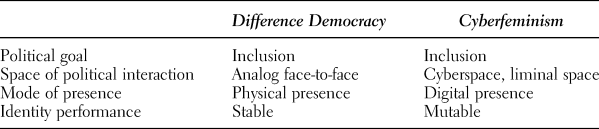
Although some agreement exists regarding the importance of identity and the inclusion of marginalized groups between difference democrats and cyberfeminists, their conceptions of identity differ quite significantly. Table 1 summarizes these similarities and differences.
Comparison between Difference Democracy and Cyberfeminism

Both difference democrats and cyberfeminists contest gendered power asymmetries by focusing on particular modes of identity performances. Cyberfeminist perspectives allow for the conceptualization of a politics of presence online. The difference democratic notion of physical presence can thus be supplemented with a cyberfeminist notion of digital presence. This sheds new light on the dilemma of difference. The essentializing tendencies in difference democratic thought can be countered by opening up possibilities of exploring multiple identity configurations in the liminal spaces between and beyond online and offline. Cyberfeminists draw attention to the value of anonymity. This does not merely entail hiding identity, which has rightfully been criticized as contributing to the invisibility and further marginalization of disadvantaged groups (Kolko Reference Kolko, Kolko, Nakamura and Rodman2000). Rather, anonymity consists as much of identity creation as of identity negation and thus constitutes a specific type of identity performance (Asenbaum 2018). As the rest of the article demonstrates, promoting diversity is possible through digital corporealities that continue as well as discontinue physically embodied identities. Thus, a cyberfeminist notion of digital presence can supplement difference democrats’ politics of presence and can contribute to the overarching goal of inclusion.
Difference democrats developed their accounts of inclusion in relation to three types of political institutions in society: representative state institutions, citizens’ participatory institutions, and social movement organizations. However, they did not differentiate the mode of identity performance for these three types, proposing continuous identity performances for all of them instead. In contrast, I argue that different institutions fulfil different democratic functions that are best facilitated by different modes of identity performance. To generate this differentiation, I draw on the concept of participatory spaces emerging in feminist development studies (Brock, Cornwall, and Gaventa Reference Brock, Cornwall and Gaventa2001; Cornwall Reference Cornwall2002; Reference Cornwall2004; Cornwall and Coelho Reference Cornwall and Coelho2007; Gaventa Reference Gaventa2006) and deliberative democratic theory (Dryzek Reference Dryzek2009).Footnote 2
Discussions about participatory spaces distinguish empowered spaces such as parliaments, invited spaces such as citizens’ assemblies, and claimed spaces such as social movement organizations. This differentiation enables us to grasp political participation in three different academic fields: First, the study of parliamentary deliberation gives insight into legislative decision-making processes (Bächtiger et al. Reference Bächtiger, Sörndli, Steenbergen and Steiner2005). Second, the study of democratic innovations is rich in empirical findings on participatory designs such as mini-publics, town meetings, participatory budgets, petitions, referendums, and consultations (Smith Reference Smith2009). Third, the study of social movements and collective action has recently employed democratic theory to understand internal decision making where “forms of power intervene in the communicative arenas that social movements build and inhabit” (della Porta and Rucht Reference della Porta and Rucht2013, 4; also cf. Polletta Reference Polletta2002). The concept of empowered, invited, and claimed spaces allows these three types of participatory arrangements to be considered together. The crucial differentiation between these spaces is informed by the social positionality of the creators of the respective space and the actors within them. In short, it is determined by the question: Who created the space for whom? Empowered spaces are created by the state and facilitate the interaction of state actors; invited spaces are created by the state for citizens; and claimed spaces are created by citizens for their own interaction.
The metaphor of the space serves to translate the notion of physical relationality into social relationality: “Thinking about participation as a spatial practice highlights the relations of power and constructions of citizenship that permeate any site for public engagement” (Cornwall Reference Cornwall2004, 1). Furthermore, space as a relational concept makes imagining a discursive power architecture possible. Participatory interfaces are to be carefully constructed to challenge asymmetrical power relations inscribed in societies. In line with difference democrats’ pursuit of inclusion, Andrea Cornwall (Reference Cornwall2002) argues: “Some participatory approaches explicitly seek to disrupt the order of hierarchical institutions, creating new and different spaces in which different rules of the game offer otherwise silenced actors a chance to speak and be heard” (7). At the same time, however, participatory design can function as a tool of political elites to coopt participants (Font et al. Reference Font, Smith, Galais and Alarcon2017).
The differentiation between types of spaces contributes to finding new answers to the question of inclusion in unequal digitized societies. Looking at political engagement on the Internet, each type of participatory space with its different actors contributes to a different democratic function through different modes of identity performance (as illustrated in Table 2). All of these identity performances and their respective democratic functions serve the overarching goal of inclusion.
Typology of Identity Performances in Participatory Spaces on the Internet

Empowered spaces such as parliaments need to fulfil the democratic function of accountability to create a strong link between citizens and their representatives (Dryzek Reference Dryzek2009, 1386). The dialogical process of giving and holding to account includes various ideas of various constituencies into the democratic system. Accountability is facilitated by identity continuation—the performative enactment of physically embodied identity as advocated by difference democrats. As a communicator in empowered spaces, the democratic subject acts as a representative of the social group with which it is associated by virtue of the identity markers inscribed in its body and performed through sociocultural codes of clothing, body language, etc. With regard to online communication, such continuous identity performances are possible through the digital replication of analog identity performances.
Invited spaces are designed to facilitate inclusive dialogue and are oriented toward the ideal of freedom from domination (Smith Reference Smith2009, 22). In contrast with both empowered and claimed spaces, invited spaces generate short-lived encounters between citizens and between citizens and state agents. They call for short-term solutions to problems of internal exclusion (Young Reference Young2000). Digitally enabled identity negation corresponds to this logic. It reduces stable identity markers to a minimum, such as individual pseudonyms, the collective moniker “anonymous,” or no identifiers at all. This does not do away with identity; rather, it facilitates identity expression. Diversity is claimed discursively rather than visually. Identity boundaries are, however, destabilized (Asenbaum Reference Asenbaum2018a).
Claimed spaces, finally, flourish on identity exploration to facilitate expressive freedom, as suggested by cyberfeminists. Claimed spaces on the Internet allow for the visual enactment of identity through avatars, pictures, videos, emoticons, and other digital reifications of corporeality. This identity exploration of the individual serves the freedom to rediscover and playfully express the multifaceted self. It thus contributes to the inclusion of various aspects of identity into the democratic system. Identity exploration corresponds with social movements’ need to communicate with the public. To be heard in a competitive media environment, they need to form colorful and innovative collective identities and engage in carnivalesque forms of protest.
The typology presented in Table 2 is not rigid. Although the mode of identity performance and the respective function are indeed closely linked, the type of participatory space in which they might occur needs to be treated more flexibly. Accountability through identity continuation, for example, can be important in invited spaces as well, just as identity negation and equality might be vital in claimed spaces. The following review of empirical work on the subject, however, demonstrates that the respective identity performances and their functions mostly occur in the participatory spaces indicated in Table 2. It shows how these democratic functions come into play and what designers of participatory spaces need to take into account to best facilitate them.
Empowered Spaces on the Internet: Accountability through Identity Continuation
Empowered spaces such as democratic forums legitimized by the citizenry to make political decisions on their behalf are expanding online (Stanyer Reference Stanyer2008). New digital modes of identity construction are used by governmental actors to fulfil their function as representatives of their respective constituencies. In practical terms, representatives carefully select and curate images and text including biographies and information on current activities. These visual and textual self-portraits replicate representatives’ analog identities. In a study on US Members of Congress, Gulati (Reference Gulati2004) explains: “The images and symbols that members of Congress include on their Web sites are meant, at the very least, to be consistent with the impression of themselves that they are trying make with a constituent during a face-to-face meeting” (25). This assertion is corroborated by Stanyer (Reference Stanyer2008) in a study on US and UK legislators, who “will seek to project the same identity (they will not appear as someone else) and emphasize the same qualities” (419).
These continuous identity performances serve the democratic function of accountability, connecting representatives to their constituencies. Only through identity continuation can representatives be held accountable. Thus, one of the prime goals of digital government policies is to increase transparency. Not only does this enhance public scrutiny of governmental activities, it also strengthens the bond of constituents with their representatives: “While transparency of parliamentary procedures including committee deliberations, parliamentary debates, MP [Member of Parliament] voting records and MP absenteeism is clearly important for public accountability, transparency of actual MP characteristics (that is, personal and contact information) can likewise enhance the quality of governance by increasing public awareness, legitimacy, and trust in both Parliament and individual MPs” (Joshi and Rosenfield Reference Joshi and Rosenfield2013, 528).
Setälä and Grönlund (Reference Setälä and Grönlund2006) go beyond the notion of transparency and claim that legislators’ digitized identity performances facilitate publicity. Unlike transparency, which describes the mere possibility of public scrutiny, publicity facilitated by representatives’ websites strengthens interactivity. The act of holding representatives accountable is a two-way conversation that also comprises civic feedback. This input function of accountability allows the inclusion of public opinion in governmental decision making. Even though the possibilities for public feedback to legislators’ have been significantly increased through new media, several studies show that most of representatives’ websites grossly neglect the opportunity for interactivity (e.g., Jackson and Lilleker Reference Jackson and Lilleker2009).
Representatives’ websites are rather used for one-way communication and identity construction contributing to difference democrats’ ideal of embodied diversity. A recent study finds that 61% of parliamentary websites worldwide display photos of legislators, 67% indicate their sex, and 44% reveal their age (Joshi and Rosenfield Reference Joshi and Rosenfield2013). These numbers are higher in wealthier nations such as the United States, where 100% of the websites of members of Congress contain information on education and experience, 78% on local roots, and 90% on family relations. Representatives’ official governmental websites are complemented by their social media presence. The compilation of several identity performances on various web domains has been theorized as “networked self” in the work of feminist media scholars (Cohen Reference Cohen2012; Papacharissi Reference Papacharissi2011). Empirically, 21% of legislators worldwide use social media (Joshi and Rosenfield Reference Joshi and Rosenfield2013). Legislators’ social media presence also has a gendered aspect. Although only 19.4% of UK MPs are women, 29.4% of MPs who actively engage on Twitter are women (Jackson and Lilleker Reference Jackson and Lilleker2011), which gives some credibility to the cyberfeminist thesis of women's empowerment through online engagement.
Invited Spaces on the Internet: Equality through Identity Negation
Invited spaces such as citizens’ assemblies and participatory budgets are increasingly replicated online or make use of hybrid online/offline engagement (Smith Reference Smith2009, 142–160). Whereas in empowered spaces only state agents interact and the democratic function of accountability links them to the citizenry, invited spaces serve as an interface between citizens and state representatives, either directly through the digital interaction of citizens with state agents or indirectly through governmental engagement with the discursive output of these spaces (Peixoto and Fox Reference Peixoto and Fox2016).
Invited spaces online are carefully designed to afford inclusive processes of citizens’ participation, with the literature focusing on design features such as facilitation, co-temporality (a-/synchronicity), and identifiability (Davies and Chandler Reference Davies, Chandler, Nabatchi, Gastil, Leighninger and Weiksner2012). The latter feature proves especially significant. Unlike their analog counterparts, online spaces provide the opportunity for the temporal negation of physically embodied identity. This potentially counters prejudice and discrimination that are prevalent in face-to-face encounters. It levels the playing field and promotes meritocracy.
In 2000, for example, the UK parliament in cooperation with the Hansard Society organized an online consultation process entitled Womenspeak. The online forum invited both MPs and victims of domestic violence to discuss their personal experiences under self-selected pseudonyms. The crucial role of avoiding identification is pointed out by Margarete Morgan, an MP taking part in the process: “The anonymity offered by the technology enabled women to tell their stories, often for the first time, without fear of identification and to receive support and advice without fear of reprisal” (cited in Smith Reference Smith2009, 154). Coleman (Reference Coleman2004) finds that 85% of participants in Womenspeak reported to perceive the online forum as a safe space: “Had the participants been invited to attend Parliament to tell their stories and express their views, few would have gone. Parliament is an intimidating place and most women would not want their names recorded as witnesses” (6). This case illustrates difference democrats’ counterpublics as enclave deliberation of disadvantaged groups (Fraser Reference Fraser1990). At the same time, it exemplifies a cyberfeminist practice of peer support. At the end of the process, several participants posted enthusiastic comments such as: “It was brilliant; I felt really close to the participants during the consultation as if I were part of a giant support network” (cited in Coleman Reference Coleman2004, 8).
Even though this example aptly illustrates the inclusive function of identity negation in invited spaces online, this may be due to the particularly vulnerable position of participants. Other examples show that temporal identity negation can contribute to equality in other contexts as well. In an experiment on a political discussion forum to debate the upcoming South Korean national election in 2004, participants who had to reveal their gender, age, and region engaged less frequently than those who remained anonymous. The authors of the study explain: “Physical appearance or social status (perceived) in face-to-face interactions often function as ‘gates’ that control human interaction. Anonymity in computer-mediated communication frees interaction participants from potentially feeling socially inferior to their counterparts and, thus, facilitates expression for everyone” (Rhee and Kim Reference Rhee, Kim, Davies and Gangadharan2009, 225).
This feeling of inferiority can further be explained by the “chilling effect.” The feeling of being observed and judged by others leads to inhibition and stifles free expression. This chilling effect observed on social media where users self-censor due to government surveillance (Stoycheff Reference Stoycheff2016) also comes to bear in invited spaces on the Internet, where participants potentially feel judged by their gender, race, or other identity markers. Anonymity can thus work against the chilling effect and alleviate peer pressure and concerns about surveillance. In a study comparing anonymous and identified online petitioning, the willingness to sign petitions dropped by 8.5% when identification was required (La Raja Reference La Raja2011). Other studies show that when given the choice, large shares of online petition signers opt for anonymity (Berg Reference Berg2017; Schmidt and Johnsen Reference Schmidt and Johnsen2014). Similarly, participation numbers dropped drastically in the online participatory budgeting process in the German city of Gütersloh when mandatory identification was introduced. In 2011, with the option of anonymity, 1.7% of the population took part; this number decreased to 0.4% in the consecutive year where identification was required (Ruesch and Märker Reference Ruesch, Märker, Parycek and Edelmann2012).
The effect of diminished participation through enforced identification comes along with significant gender differences: In the study on online petitions, men were hardly affected by required identification, but the engagement of female participants dropped significantly. The author reasons that women are more heavily affected by peer pressure: “While women now vote at equal rates to men, their participation remains unequal with respect to… other forms of participation. Disclosure policies appear to depress this participation even more” (La Raja Reference La Raja2011, 21).
Claimed Spaces on the Internet: Freedom through Identity Exploration
Claimed spaces on the Internet are either created as alternative media or occupy commercial space on corporate social media such as Facebook or Instagram. They make use of opportunities for digital identity change, which is not a serious endeavor but a playful undertaking. The carnivalesque act of masking constitutes a transformative practice of challenging the stability of identity (Bakhtin Reference Bakhtin1968). Today, carnivalesque protest with its roots in European medieval Mardi Gras, which often entailed the mockery of ruling authorities and the playful inversion of social hierarchies, meets the possibilities of online identity play described by cyberfeminists.
Both cyberfeminist practice and carnivalesque protest are aptly illustrated by the New York art collective Guerilla Girls. Their public interventions in the disguise of gorillas dating back to 1985 have made use of digital media in recent years. Digital identity performances extend the analog possibilities of roleplay through digital images and videos of gorilla performances enacting aggressiveness and masculinity. Particularly, the breakaway group Guerilla Girls Broadband have created a subversive online presence. On their website, users can join by virtually dressing up as gorillas. Core members of Guerilla Girls Broadband themselves take on the identities of female artists who have not gained the deserved appreciation in the male dominated art business. A “cartography of choice” maps abortion clinics and emails can be sent to “bad bosses” anonymously to address sexual harassment, unequal pay or other work-related grievances (Stein Reference Stein2011).
Digital identity play has also become an important part of the annual 16 Days of Activism Against Gender-Based Violence. Established in 1991, this campaign spread to Second Life, a virtual online environment for social roleplaying. Feminist activists set up virtual discussion events, meetings, and exhibitions around the topic of gendered violence. Participants design female avatars with black eyes, bruises, and bleeding wounds to create awareness (Motter Reference Motter2011). Protest avatars were also used in the Euro Mayday Netparades in 2004 and 2005. The annual Euro Mayday Parade draws attention to the current precariousness of work, which especially affects women. On the website of the Mayday Netparade, users created their individual protest avatars as part of a diverse collective. According to a study by Mattoni and Doerr (Reference Mattoni and Doerr2007), women, who are often underrepresented in the imagery of traditional Labor Day parades, took center stage online as “the parade's visual icons of protests positively underlined diversity and differences as an asset of the collective struggle” (132).
Other examples illustrate the relevance of racial and queer identity performances in claimed spaces on the Internet. In 2004, a queer community established itself in the virtual roleplay fantasy game World of Warcraft. The fact that the 5,000 users of the community created 15,000 characters, including the practice of gender swapping, indicates playful identity exploration. Due to its global scope, this community also included participants from countries where homosexual practices are banned. Apart from political discussions on LGBTIQ issues, the community organized virtual Pride parades. Unlike in the Mayday Netparade and the other cases discussed so far, in which activists first organized offline and then reenacted their protest through digital means, in the case of the LGBTIQ movement on World of Warcraft, participants organized offline activities after their online encounter through their digital embodiments (McKenna, Gardner, and Myers Reference McKenna, Gardner and Myers2011). The digital enactment of difference is also evident in the so-called Habbo raids. In 2006 users of the imageboard 4chan charged moderators of Habbo Hotel—an online roleplay platform mostly used by white, US American teenagers—with discriminating against black avatars. The 4chan users coordinated an online swarm of black, male avatars in black suits with black sunglasses and big afros, which blocked entrances to facilities in the virtual hotel setting. When other users attempted to enter the virtual pool, the raiders exclaimed: “Pool's closed due to AIDS!” mocking racial prejudice (Asenbaum Reference Asenbaum2018b).
Identity exploration in claimed spaces on the Internet does not require an entire virtual world with fully animated avatars. Rather, social media provide tools for the everyday practice of identity play as part of political engagement. Gerbaudo (Reference Gerbaudo2015) demonstrates how users change their social media profile pictures to flags, logos, or portraits of others or they decorate their own pictures with ribbons or color filters. In the “Arab Spring,” for example, thousands of social media users changed their profile picture for the image of Khaled Said, a 28-year-old blogger killed by police in Alexandria. Online identity exploration thus also allows for the performance of solidarity. At the same time, however, the carnivalesque construction of digital identities can also be employed for discrimination and hate speech. In the so-called “Gamergate affair,” Twitter trolls using images of anime girls as profile pictures attacked feminists criticizing misogynist depiction of women in computer games, including death and rape threats (Mortensen Reference Mortensen2018). Another example is the online presence of the Ku Klux Klan, who uses their websites to visually construct a masculinist, heteronormative, and “racially pure” self-image (Schmitz Reference Schmitz2016).
CONCLUSION
This essay set out to find new ways of advancing inclusion in democratic societies marked by identity-related power asymmetries. It contributes to the ideal of inclusion promoted by difference democrats while counteracting the essentializing tendencies inherent in their politics of presence. Although the essentializing effects of the politics of presence themselves cannot be eliminated, they can be alleviated by a pluralization of alternative modes of identity performances. The multiplicity of identities that contributes to diversity as core value of democracy calls for the pluralization of institutional arrangements, which facilitates such diverse identity expression.
The typology presented here to account for such plural identity performances might appear rigid. Although the link between identity performances and their respective democratic function is strong, the link with the respective space appears weaker. Examples illustrate that these identity performances with their respective function can work in other types of spaces as well. Koop and Marland (Reference Koop and Marland2012), for example, find that at least to a certain extent, identity exploration is possible for representatives as they emphasize different aspects of themselves in different media. Some of my own work explores modes of identity negation in claimed spaces created by the hacktivist collective Anonymous (Asenbaum Reference Asenbaum2018b).
The purpose of this article is not to regulate identity performances and confine them to particular spaces. Rather than closing doors, I aim to open them to allow for new thinking. My goal is to draw attention to the diversity of modes of identity performances that are not mutually exclusive but can and must function alongside each other to fulfil a variety of democratic functions. This essay is a call for diversifying the types of participatory spaces and modes of identity performances as part of a pluralist democratic society. Thus, diversity—the core value of difference democracy—leads the way out of the dilemma of difference. The essentializing tendencies of difference democracy are best countered by pluralizing participatory spaces and the variety of identity performances within them.
However, this argument needs to be evaluated against the background of the perils of online communication such as group polarization, discrimination, and digital inequalities. Exclusion from online participation along gender, race, class, age, and geographic divides leaves these new possibilities of engagement out of reach for many. The factual increase in participatory possibilities also widens gaps in political engagement. Importantly, these gaps are narrowing and are even overcome in the case of gender in the United States (Campos-Castillo Reference Campos-Castillo2015). All of these challenges often pose new threats to democracy. The wide spread of online communication is, however, an emerging reality that needs to be faced. This reality brings both opportunities, which are the subject of this article, and challenges. Both are unavoidable and need to be approached with the greatest possible awareness; this article contributes to this awareness.
The important question at this point is whether and to which extent participatory spaces on the Internet exhibit negative effects observed in everyday communication online. Group polarization described by Sunstein (Reference Sunstein2017) as a process in which communication among like-minded participants leads to more extreme positions has not been reported in any of the cases discussed above. The same applies for lying and fraud. It appears that design features of participatory spaces such as moderation and the awareness of their participants mitigates negative behavior exhibited elsewhere. This observation, however, does not apply to discrimination. As the examples of the Gamergate and the KKK online illustrate, some claimed spaces are created to pursue exclusionary purposes. This is a trade-off of freedom of expression. In short, antidemocratic tendencies exhibited in everyday online communication are rather less pronounces in participatory spaces, which through their design and participants’ awareness, appear to discourage such behavior.
Discussions of difference democracy have diminished, but marginalized identities still account for modes of exclusion, as recent studies show (e.g., Beauvais Reference Beauvais2017; Karpowitz and Mendelberg Reference Karpowitz and Mendelberg2014). They are even more evident in the face of new media's challenges such as cyberbullying and opportunities such as #MeToo. Let Carole Pateman's words be an inspiration: “The lesson to be learned from the past is that a ‘democratic’ theory and practice that is not at the same time feminist merely serves to maintain a fundamental form of domination and so makes a mockery of the ideals and values that democracy is held to embody” (Pateman Reference Pateman1989, 223).