Use of extracorporeal membrane oxygenation for children undergoing surgery for CHD or for those with acquired heart disease has increased over the past 30 years. However, the overall survival rate to hospital discharge has remained largely unchanged during that same period, averaging approximately 40%.Reference Punn, Axelrod and Sherman-Levine 1 – Reference Bairdain, Betit and Craig 4 Certain factors have been associated with mortality in the setting of extracorporeal membrane oxygenation use in children with cardiac disease, including age, history of cardiac arrest, single-ventricle physiology, and evidence of end-organ damage while on extracorporeal membrane oxygenation.Reference Mehta, Turner and Walsh 5 , Reference Delmo Walter and Alexi-Meskishvili 6
In an attempt to determine whether outcomes have changed over time, we sought to review our use of extracorporeal membrane oxygenation for cardiac indications over a period spanning more than a decade. We aimed to identify factors associated with hospital mortality in patients supported with veno-arterial extracorporeal membrane oxygenation for cardiac indications. In addition, we sought to broadly compare mortality in the present cohort with that from an earlier era in our institution in which the patient population and indications for extracorporeal membrane oxygenation were comparable.Reference Morris, Ittenbach and Godinez 7
Finally, since extracorporeal membrane oxygenation support may be used as a bridge to recovery, ventricular assist device, or heart transplantation, this report includes an analysis of short-term outcomes for these indications as well.
Materials and methods
Patients supported with extracorporeal membrane oxygenation in the cardiac ICU at The Children’s Hospital of Philadelphia, Philadelphia, PA, United States of America, between July 2001 and December 2012 were identified. This study resulted from a secondary analysis of an existing data set focussing on long-term outcomes and quality of life indicators in survivors of extracorporeal membrane oxygenation.Reference Elias, Achuff and Ittenbach 8 The Institutional Review Board at The Children’s Hospital of Philadelphia gave approval for this study with waiver of informed consent. Patients who did not survive cannulation or who died before admission to the ICU were excluded from the study.
Data collection
Medical records were reviewed and patient information were extracted, including demographics and clinical factors, at the initiation and duration of extracorporeal membrane oxygenation. Patients who underwent cardiac surgery before initiation of extracorporeal membrane oxygenation – surgical group – were evaluated separately from those who did not have a surgical procedure before initiation of extracorporeal membrane oxygenation during the same admission – non-surgical group.
Variables evaluated
Clinical variables evaluated are provided in Table 1. End-organ dysfunction while on extracorporeal membrane oxygenation was defined as a doubling or more of serum creatinine compared with creatinine values before the initiation of extracorporeal membrane oxygenation, and/or serum transaminases >500 IU/L after initiation of extracorporeal membrane oxygenation. Weekends were defined as Saturday and Sunday, and weekday nights were defined as 11 pm to 7 am on Mondays, Tuesdays, Wednesdays, Thursdays, and Fridays.
Demographics.

CPB=cardiopulmonary bypass; IQR=interquartile range; LCOS=low cardiac output syndrome; 2 V=biventricular CHD; 1 V=single-ventricle CHD
Patient classification
Patients were further classified as follows: cardiac anatomy at birth, cardiac physiology at the time of extracorporeal membrane oxygenation cannulation, and indication for extracorporeal membrane oxygenation. The Clancy classification for cardiac anatomy was used.Reference Clancy, McGaurn and Wernovsky 9 This system consists of four categories as outlined in Table 1 with an additional fifth category added for those without CHD, for example patients with cardiomyopathy. Cardiac physiology at the initiation of extracorporeal membrane oxygenation was classified and described in Table 1. The indications for extracorporeal membrane oxygenation were defined as cardiopulmonary arrest – patient undergoing extracorporeal cardiopulmonary resuscitation; failure to separate from cardiopulmonary bypass; low cardiac output; and others, for example respiratory failure and hypoxaemia.
Extracorporeal membrane oxygenation techniques
A standardised extracorporeal membrane oxygenation circuit was used with minimal variation in treatment strategy and management. The site for initiation of extracorporeal membrane oxygenation and use of left atrial decompression were at the surgeon’s discretion. Patients with cervical cannulation were evaluated with chest radiograph and echocardiography for adequacy of left atrial decompression and underwent trans-catheter atrial septal defect creation as needed. Slow continuous ultrafiltration was used for volume overload. Strategies for anticoagulation titration with heparin were individualised to patient’s clinical scenario and were based on activated clotting times. Of note, the extracorporeal cardiopulmonary resuscitation protocol within the time period of the study included a clear primed circuit “at the ready” and an extracorporeal membrane oxygenation activation system. The extracorporeal membrane oxygenation pager system was activated at the discretion of the cardiac ICU attending and/or surgeon that included the surgical team, anaesthetist, and perfusionists, and all them travelled from home after regular dayshift hours.
Statistical analysis
Descriptive statistics were first computed for all variables in the data set, including parametric and non-parametric measures of central tendency, variability, and association, with an emphasis on extracorporeal membrane oxygenation-related factors. Frequency counts were used to evaluate all dichotomous and/or polytomous variables. Mortality rates at hospital discharge were computed for the two groups, surgical and non-surgical. In addition, the mortality rate for the study cohort was compared with the mortality rate of the earlier cohort (1995–2001)Reference Morris, Ittenbach and Godinez 7 using a two-sample test of proportions.
To analyse the hypothesis that hospital mortality could be predicted from a series of patient- and extracorporeal membrane oxygenation-related factors, computations using a series of simple and multiple covariate logistic regression models were performed, with mortality serving as the outcome of interest. A series of single-covariate logistic regression models was specified and tested with covariates for each group. In the case of non-surgical patients where bypass was not used, that variable was also not used.
In cases with two or more extracorporeal membrane oxygenation episodes, only the first was used for data analysis. Model selection was conducted sequentially; statistically significant single-covariate predictors were first identified from those predictors reported previously in the literature.Reference Bairdain, Betit and Craig 4 , Reference Mehta, Turner and Walsh 5 Covariates with p-values <0.20 were included in a comprehensive multiple covariate model, with a final, best-fitting multivariable model identified using the best subset approach for the surgical group only. No best-fitting multivariable model was identified for the non-surgical group due in part to a lack of statistically significant, single-covariate models with p-values <0.05. In the case of additional, follow-up analyses to the aforementioned hypothesised models, either Spearman-rho correlations for associations, Wilcoxon rank-sum tests for differences, or logistic regression for associations or differences were used. For analyses using either subgroup, the study was powered to detect odds ratios of 2.5 and greater. To identify modest indicators of survival, all models were tested at an unadjusted α=0.05 level. All analyses were conducted using SAS v9.3 software; 100 SAS Campus Drive, Cary, NC 27513-2414, United States of America.
Results
There were 9932 admissions to the cardiac ICU during the study period, with 253 patients (2.5%) supported with extracorporeal membrane oxygenation. Among them, 63% of the cohort were males. The median age at extracorporeal membrane oxygenation initiation was 2.5 years, with interquartile range from 0.0 to 1.3 years; median weight was 4.0 kg, with interquartile range from 3.0 to 9.0 kg. Moreover, 40% of the total cohort had single-ventricle physiology. The indication for extracorporeal membrane oxygenation was cardiac arrest for 56% of the cohort, with the median duration of active cardiopulmonary resuscitation of 48 minutes with interquartile range from 28 to 63 minutes. Cervical cannulation was used in 185 patients (73.1%) and transthoracic cannulation in 68 patients (26.9%). CHD was present in 65 (95.6%) of those patients who underwent transthoracic cannulation. Left atrial decompression, either by means of a surgically placed vent or balloon atrial septostomy, was performed in 65 (25.7%) patients. In 95.4% of those patients who underwent left atrial decompression, they either had CHD with a biventricular circulation or no CHD.
Abnormal indicators of renal function and liver function such as serum creatinine and serum transaminases, respectively, during extracorporeal membrane oxygenation were found in 40% of the cohort. The median duration of extracorporeal membrane oxygenation support was 100 hours, with interquartile range from 59 to 181 hours, and the median length of stay was 34 days with interquartile range from 20 to 78 days. The longest duration of extracorporeal membrane oxygenation support in the cohort was 739 hours (31 days), and the longest survivor had an extracorporeal membrane oxygenation duration of 552 hours (23 days). Slow continuous ultrafiltration was used in 7% of patients. Of the entire cohort, 13 patients (5%) were placed on extracorporeal membrane oxygenation again after a period of decannulation, but during the same admission. Of these 13 patients, 12 had cardiac surgery before the initial extracorporeal membrane oxygenation run, and seven had single ventricle, with 76% mortality (10/13).
Overall mortality
Our findings suggest a significant improvement in survival to discharge of 48%, as compared with that observed in an earlier report from our institution,Reference Morris, Ittenbach and Godinez 7 in which survival to hospital discharge was 39% (p=0.01). Overall, 182 (72%) of the patients in the current cohort survived >24 hours after extracorporeal membrane oxygenation, while 122 patients (48%) survived to hospital discharge.
Mortality in cardiac surgical patients
During the study period, 187 patients (74%) underwent cardiac surgery, including heart transplantation, during the same hospitalisation before extracorporeal membrane oxygenation initiation. These patients comprised the surgical group. Of the patients in the surgical group, 101 died during the hospitalisation, with mortality of 54%.
Causes of death in the surgical group included multi-system organ failure (47%), cardiac failure (24%), neurologic failure or cerebral haemorrhage (18%), sepsis (4%), and respiratory failure (4%). Unspecified haemorrhage (3%) and primary graft failure (1%) were also listed as causes of death in surgical patients. The indication for extracorporeal membrane oxygenation in 96 of the 187 surgical patients was cardiac arrest (51%). The median duration of cardiopulmonary resuscitation for surgical survivors versus non-survivors was 48 minutes, with interquartile range from 30 to 61 minutes, and 42 minutes of interquartile range from 27 to 60 minutes, respectively (p=0.27).
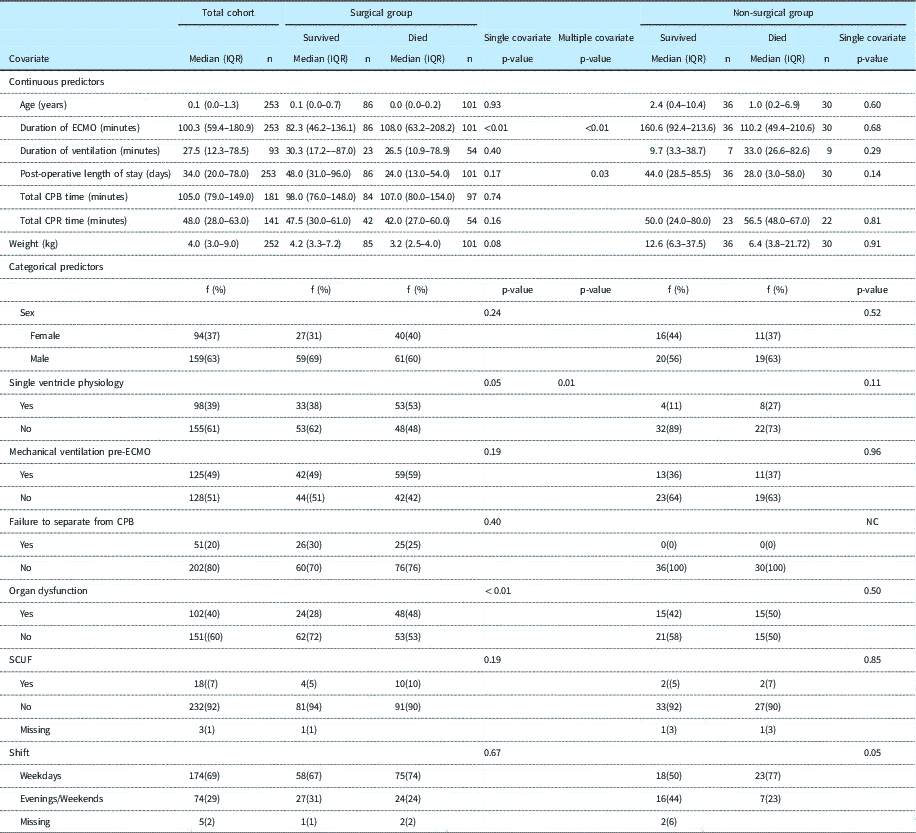
When timing of the extracorporeal membrane oxygenation was analysed for patients in the surgical group, weeknight and weekend cardiopulmonary resuscitation duration was longer compared with cardiopulmonary resuscitation duration on weekdays; median of 60 minutes, with interquartile range from 47 to 72 minutes, versus 32 minutes, interquartile range from 23 to 45 minutes (p<0.001) with no association between night/weekend cannulation and mortality (p=0.26). The median duration of extracorporeal membrane oxygenation was 82 hours, with interquartile range from 46 to 136 hours for surviving surgical patients, and 108 hours, with interquartile range from 63 to 208 hours for those who died (p=0.02).
The clinical characteristics of the surgical patients are outlined in Table 2. Although the surgical non-survivors were younger and weighed less than the survivors, neither age nor weight was significantly associated with hospital mortality. The use of mechanical ventilation before extracorporeal membrane oxygenation for the post-surgical group was not significantly different for survivors versus non-survivors, nor was mechanical ventilation found to be associated with mortality.
Clinical characteristics of surgical and non-surgical cohorts by survival status.

CPB=cardiopulmonary bypass; CPR=cardiopulmonary resuscitation; ECMO=extracorporeal membrane oxygenation; IQR=interquartile range; SCUF=slow continuous ultrafiltration; SD=standard deviation
Overall time to extracorporeal membrane oxygenation after surgery for the surgical group was 1.1 days, with median interquartile range as 0.7–1.9 days. There was no difference in time between surgery and extracorporeal membrane oxygenation initiation between survivors and non-survivors: 1.1 days, median interquartile range of 0.7–1.9 and 1.0 days, median interquartile range of 0.7–2.4, respectively (p=0.55).
Factors associated with mortality in the surgical group are single-ventricle physiology (p=0.05), duration of extracorporeal membrane oxygenation (p<0.01), and the presence of end-organ dysfunction (p<0.01). In multiple covariate modelling, extracorporeal membrane oxygenation duration (p<0.01), single-ventricle physiology (p=0.01), and length of stay (p=0.03) were predictors of mortality.
Mortality in non-surgical patients
Of the total cohort, 66 (26%) did not have cardiac surgery performed before cannulation to extracorporeal membrane oxygenation; these patients comprised the non-surgical group. In this group, 30 of 66 (45%) died during the same hospitalisation. Causes of death in the surgical group included neurologic failure (36%), cardiac failure (25%), multi-system organ failure (21%), sepsis (4%), respiratory failure (7%), and primary graft failure (7%).
The most common indication for extracorporeal membrane oxygenation in the non-surgical group was cardiac arrest with 45 patients (68%) undergoing extracorporeal cardiopulmonary resuscitation. The median duration of cardiopulmonary resuscitation for survivors was 56 minutes, with interquartile range of 48–67 minutes; for non-survivors, it was 50 (interquartile range of 24–80) minutes and did not show a relationship with mortality (p=0.78). However, patients in the non-surgical group who required extracorporeal cardiopulmonary resuscitation during the night/weekend hours had significantly longer duration of cardiopulmonary resuscitation, median of 69 minutes – interquartile range 58–88 minutes – versus 49 minutes – interquartile range of 30–62 minutes – for those during day shift (p=0.02). The relationship between timing of cannulation and mortality in non-surgical patients demonstrated increased risk of mortality in those patients cannulated on nights/weekends, with odds ratio 2.9, 95% confidence interval 0.99–8.62, p=0.05.
The median duration of extracorporeal membrane oxygenation for surviving non-surgical patients was 161 hours, 6.7 days, interquartile range 92–214 hours; and for non-survivors, 110 hours, 4.6 days, interquartile range 49–211 hours. Duration of extracorporeal membrane oxygenation was not associated with mortality, p=0.68. The non-surgical survivors were similar in age, weight, and gender to the non-survivors and these variables were not associated with hospital mortality. Although non-survivors had longer mechanical ventilation than survivors, it was not associated with mortality (p=0.29) nor was single-ventricle physiology (18% of non-surgical patients, p=0.11). It should be noted that 74% of the non-surgical patients had no surgical intervention on or after extracorporeal membrane oxygenation, but 9% had interventional catheterisation during extracorporeal membrane oxygenation and 6% had cardiac surgery after extracorporeal membrane oxygenation including ventricular assist device placement or heart transplantation after decannulation.
Ventricular assist devices and transplant
Of the 253 patients in the entire cohort, 13 (5%) were supported on ventricular assist device after extracorporeal membrane oxygenation support, most of whom had been converted to ventricular assist device directly from extracorporeal membrane oxygenation. Of these patients, four died before transplantation, and nine ventricular assist device patients (70%) eventually underwent heart transplantation during the same admission, of which three died after transplant. Among the patients in the cohort, 30 patients underwent transplantation during the same admission and extracorporeal membrane oxygenation was used. When patients were supported with extracorporeal membrane oxygenation in the same admission before heart transplantation, or as bridge to transplant, mortality was 24%; two out of 11 patients died. When extracorporeal membrane oxygenation was used in the same admission after heart transplantation, mortality was 58%; 11 of 19 patients died.
Discussion
Extracorporeal membrane oxygenation provides mechanical circulatory support for paediatric patients with life-threatening cardiac disease. However, mortality rates remain high despite this study suggesting an improvement as compared with a previous report. Although there has been little change in extracorporeal membrane oxygenation management between the two eras, improvements in mortality between eras may be related to refinement of candidate selection for extracorporeal membrane oxygenation support in view of a better understanding previously reported risk factors for extracorporeal membrane oxygenation-related mortality. Also, there may be an effect through the adoption of extracorporeal cardiopulmonary resuscitation as a conscious strategy in resuscitating patients with cardiac arrest. There are still certain risk factors contributing significantly to mortality in both eras that highlight ongoing opportunities for improvement in short-term outcomes.
Single-ventricle physiology
Like other reported studies, patients with single-ventricle physiology while on extracorporeal membrane oxygenation are at increased risk of hospital mortality, regardless of whether they underwent cardiac surgery during the same admission as extracorporeal membrane oxygenation.Reference Chauhan, Malik and Malik 10 Newborns after the Norwood procedure have the highest rate of mechanical circulatory support as reported in the Society of Thoracic Surgeons database,Reference Mascio, Austin and Jacobs 11 although extracorporeal membrane oxygenation may be life-saving in a third of them, particularly in cases of reversible conditions including acute shunt thrombosis or transient ventricular dysfunction.Reference Ravishankar, Dominguez and Kreutzer 12 , Reference Tabbutt, Ghanayem and Ravishankar 13 The excess mortality after extracorporeal membrane oxygenation associated with single-ventricle physiology in our study is likely due to a multitude of factors, and highlights the ongoing high-risk nature of those patients.
Extracorporeal membrane oxygenation duration
Consistent with previous reports, including the Extracorporeal Life Support Organization registry, extracorporeal membrane oxygenation duration was a significant determinant of mortality.Reference Brogan, Zabrocki and Thiagarajan 14 Longer duration of extracorporeal bypass of any type has a deleterious influence, including on the immune system.Reference Ricci, Haiberger and Pezzella 15 Most of the surgical patients in this study who died after extracorporeal membrane oxygenation died of multi-organ dysfunction, which is a defining limitation of extracorporeal membrane oxygenation as a means of medium- to long-term support. Gupta et al found that duration of extracorporeal membrane oxygenation could be shortened if the interval between index cardiac surgery and initiation of support is shorter.Reference Gupta, Robertson and Rettiganti 16
The majority of non-surgical patients had a neurologic cause of death reported. Omar et al revealed that duration of extracorporeal membrane oxygenation is an independent predictor of intracranial haemorrhage during extracorporeal membrane oxygenation support and may lead to mortality or decision to withdrawal of mechanical circulatory support.Reference Omar, Mirsaeidi and Mangar 17 The results of our study demonstrate the ongoing need to improve outcomes in patients who may be anticipated to have long extracorporeal membrane oxygenation duration, such as infants in whom durable mechanical circulatory support options are often limited.
Repeat extracorporeal membrane oxygenation runs
Although repeat extracorporeal membrane oxygenation runs during the same admission were not accounted for in the data analysis, brief mention of this unique patient population is warranted. Considering these poor outcomes, careful consideration should be given to offering repeat extracorporeal membrane oxygenation therapy in postoperative patients who have already undergone a run of extracorporeal membrane oxygenation with decannulation.
End-organ dysfunction
End-organ dysfunction on extracorporeal membrane oxygenation was common within the surgical group and was associated with higher mortality. In fact, a high percentage of the cause of death listed for this group was multi-system organ failure. Acute kidney injury or failure has been previously associated with a decrease in the odds of survival after extracorporeal membrane oxygenation in paediatric cardiac patients.Reference Smith, Hardison and Worden 18 , Reference Harris, Lewington and Harrison 19 In this cohort, an abnormal creatinine level was associated with mortality. Although current acute kidney injury definitions may include the measurement of urine outputReference Harris, Lewington and Harrison 19 or other measures of renal function, serum creatinine value was the most reliable measure available throughout the time course of this study and therefore was used as predictor of acute kidney injury. The rise in creatinine likely reflects renal ischemic insult sustained during the pre-extracorporeal membrane oxygenation period, or continued organ perfusion abnormalities despite extracorporeal support. Some groups have demonstrated that organ ischemia followed by re-perfusion may disrupt the organ at the cellular level.Reference Granger and Kvietys 20 Although blood flow is restored by institution of extracorporeal membrane oxygenation, difficulty in oxygen delivery and extraction may continue.Reference Graulich, Walzog and Marcinkowski 21 Liver injury during extracorporeal membrane oxygenation is reflected in the elevation in transaminases, as well as alkaline phosphatase and bilirubin.Reference Roth, Schrutka and Binder 22 In this series, elevation of creatinine and transaminases reflecting end-organ dysfunction was not significantly associated with mortality in the non-surgical cohort, perhaps because of lack of pre-extracorporeal membrane oxygenation end-organ insults related to cardiopulmonary bypass and/or perioperative factors.
Indication
The most common indication for extracorporeal membrane oxygenation cannulation in both subgroups was cardiac arrest. Many reports of extracorporeal cardiopulmonary resuscitation have shown that children with CHD can survive despite sudden deterioration and arrest. Extracorporeal membrane oxygenation has evolved and improved over the last two decades, allowing for expanded application of this life-saving support.Reference Patroniti, Sangalli and Avalli 23 Lasa et al studied this practice and reported that for children with in-hospital cardiopulmonary resuscitation ⩾10 minutes, extracorporeal cardiopulmonary resuscitation was associated with improved survival to hospital discharge with favourable neurologic outcome when compared to conventional cardiopulmonary resuscitation.Reference Lasa, Rogers and Localio 24 Boston Children’s Hospital also reported that extracorporeal cardiopulmonary resuscitation promotes survival in children with cardiac disease experiencing arrest unresponsive to conventional cardiopulmonary resuscitation, with favourable early neurological outcomes.Reference Kane, Thiagarajan and Wypij 25 When we evaluated cardiopulmonary resuscitation duration before extracorporeal membrane oxygenation, it was not associated with mortality for either the surgical or the non-surgical group. However, when we evaluated the timing of extracorporeal membrane oxygenation cannulation, weekend/night shift cannulation was associated with mortality in the non-surgical group. Only few studies exist on the outcomes of patients with cardiac arrest with extracorporeal cardiopulmonary resuscitation on the weekday versus the weekend; however, study in adults suggests extracorporeal cardiopulmonary resuscitation on the weekend was associated with a lower survival and higher complications.Reference Lee, Chung and Jeon 26
The most common indication for extracorporeal membrane oxygenation support in this cohort was cardiac arrest, and immediate availability of necessary personnel for rescue cannulation may be highest during the workweek. Thus weekend/night availability may play a role in the association with mortality. Cardiopulmonary resuscitation duration was significantly longer when extracorporeal cardiopulmonary resuscitation was used during weekday nights and on weekends. We speculate this observation was noted in the non-surgical group and not in the surgical because clinical deterioration may not have been anticipated as acutely in the non-surgical patients when compared to post-operative patients and the threshold for extracorporeal membrane oxygenation cannulation may be lower in post-operative patients. Although activation of extracorporeal membrane oxygenation is becoming more efficient, a full understanding of its availability, timing, and impact on survival is lacking.
It has been reported that failure to separate from bypass after cardiac surgery is a predictor of mortality;Reference Duncan, Hraska and Jonas 27 however, our data do not confirm this finding. Lack of association between the indication of failure to separate from bypass and mortality may be related to the small number of patients reported with that indication (0.5%). There may be other confounders not noted with those patients that also limits analysis. Cardiac anatomy has been shown to be predictive of mortality following neonatal heart surgery;Reference Clark, Pauliks and Myers 28 however, it has not been validated in older children undergoing cardiac surgery, and we did not evaluate a correlation between classification of cardiac anatomy and likelihood of survival following extracorporeal membrane oxygenation in this series.
Ventricular assist device and transplant
Use of ventricular assist device post extracorporeal membrane oxygenation was not the focus of this study; however, conversion to ventricular assist device may affect hospital mortality. We found extracorporeal membrane oxygenation to ventricular assist device was more frequently used for non-surgical patients compared with surgical patients (15 versus 1.6% respectively). This likely reflects fundamental differences with respect to underlying diagnosis and indications. The non-surgical patients in this cohort were larger and older as compared with the surgical group (see Table 2), a population in whom durable mechanical circulatory support options are much more feasible. The indications for ventricular assist device following short-term mechanical circulatory support such as extracorporeal membrane oxygenation are evolving, and likely to play a role in outcomes as ventricular assist device becomes more well established for cardiac failure in children.
A retrospective review such as this study has inherent limitations. The comparison between patients in the present study and an earlier time period (1995–2001) also has intrinsic limitations; however, overall institutional practice did not change significantly between studies and both populations included heterogenous physiologies at extracorporeal membrane oxygenation initiation. This study did not examine complications related to extracorporeal membrane oxygenation in depth, so the influence of specific complications cannot be assessed from our results. It should also be noted that adult congenital patients older than 20 years were included in this cohort (maximum age 33.3 years). Those patients may have affected the variables of age and weight which have been included as mortality factors for extracorporeal membrane oxygenation patients.Reference Duncan, Hraska and Jonas 27 , Reference Clark, Pauliks and Myers 28 This older population of patients is growing in number as CHD patients are advancing in age. Future analysis of age subgroups may be required and could delineate specific factors for that population. Although this report categorises patients into cohorts based on pre-extracorporeal membrane oxygenation surgical status, patients may have had intervention either surgically or via catheterisation while on extracorporeal membrane oxygenation support that was not captured. This report also details patient outcomes from a single institution and centres may have varying surgical approaches and extracorporeal membrane oxygenation management protocols; therefore, our findings may not be broadly generalised across all centres and practice models.
In paediatric cardiac surgical and patients receiving extracorporeal membrane oxygenation, hospital mortality is associated with both patient and extracorporeal membrane oxygenation-related factors using a best-fitting, multiple covariate model. In this model, single-ventricle physiology, evidence of organ dysfunction, and the duration of extracorporeal membrane oxygenation continue to be associated with hospital mortality. Patient mortality was associated with weekend/night shift cannulation in a subgroup of patients.
Acknowledgements
None.
Financial Support
This research received no specific grant from any funding agency, or from commercial or not-for-profit sectors.
Ethical Standards
The authors assert that all procedures contributing to this work comply with the ethical standards of the relevant United States of America guidelines on human experimentation (Final Rule to the Federal Policy for the Protection of Human Subjects 45 CFR 46) and with the Helsinki Declaration of 1975, as revised in 2008, and has been approved by the Institutional Review Board at The Children’s Hospital of Philadelphia, Philadelphia, PA, United States of America.
Conflicts of Interest
None.