Introduction
Standing in the pulpit of St Stephens Full Gospel Baptist Church, the New Orleans-based mother church of the Full Gospel Baptist Church Fellowship, Bishop Paul S. Morton offered the following exhortation:
it's so important, people of God, to get into the very presence of God. Nothing else matters now. In fact, I want you to find yourself right in the holy of holies. [I] see his presence. I'm in his presence. While I'm there thanking him, I know that I have a right. Whatever I need, he will supply. I believe tonight somebody just wants him to open the windows of heaven for you, let it rain. Send down your blessing, Lord. I just need you to move in this place on tonight. I just need you to move in this place on tonight. He's doing it right now. Hallelujah.Footnote 1
Speaking at a November 2002 live recording, Bishop Morton prefaced Full Gospel's version of Michael Farren's ‘Let It Rain’ by telling of blessings flowing down through the windows of heaven and of believers finding residence in the ‘holy of holies’. As this neo-Pentecostal reformation's musical and spiritual leader spoke, a team of instrumentalists began to gently iterate the basic material of the forthcoming ballad, a harmonic progression that moved between I–V–vi–IV in C major. While the audienceFootnote 2 members might not have known much about the song they were about to hear, Bishop Morton's words offered important clues, inviting the assembly to incline their ears, minds, and bodies towards eternity, expecting to inhabit a world they could not see. Although the bishop's words articulated an altogether familiar desire to take his audience on a transcendent journey into the presence of the God, this musical voyage included an unexpected stop in 1980s Minneapolis, Minnesota, on the stage of First Avenue, the nightclub where Prince Rogers Nelson recorded his famed ‘Purple Rain’.
In the middle of the Full Gospel Baptist Church Fellowship's version of ‘Let It Rain’, the distance between Morton's New Orleans Sanctuary and Prince's Minneapolis club collapses under the weight of pyrotechnic guitar solos and virtuosic displays of ecstatic vocality. Near the end of ‘Purple Rain’, the title track of Prince's eponymous movie soundtrack, this multi-instrumentalist leaps two full octaves into the far reaches of his voice, there to enunciate an iconic falsetto passage.Footnote 3
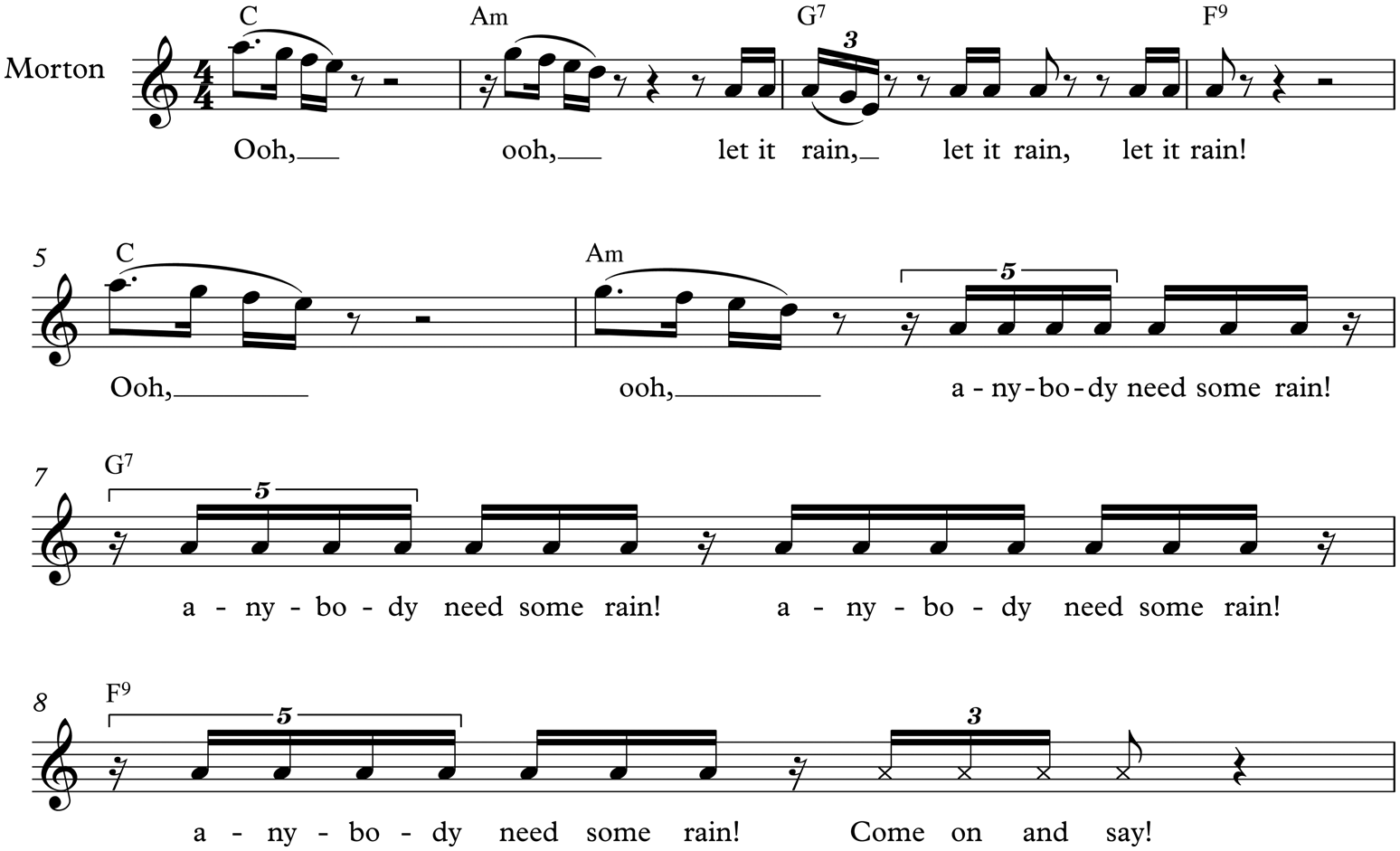
In this context, the ecstatic utterance depicted in Example 1 punctuates the song, which, though diegetically dedicated to his character's father, is sung to an unnamed lover. As such, this kinetic vocalization functions as a synecdoche for Prince's virtuosic performances of ambiguity, for his manifold sonic enactments of gendered, sexual, and religious plurality. While the radical openness signalled by the aforementioned moment in Prince's ‘Purple Rain’ might seem rather incongruous with the explicitly confessional manner in which Bishop Morton introduces the title track of his 2002 live recording, these two performances have much in common: in the middle of Full Gospel's recording of ‘Let It Rain’, Morton reaches above Prince's still-resounding exclamation to pull down the utterance depicted in Example 2.
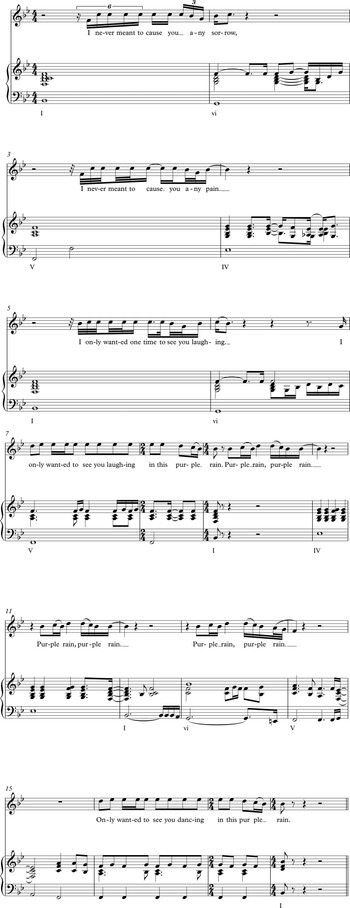
Falsetto passage from Prince, ‘Purple Rain’.

Falsetto passage from Bishop Paul Morton and the FGBCF, ‘Let It Rain’.

By the end of this ballad, Bishop Morton, the choir, the congregation, and the band find that the sanctuary of St Stephens comes to resemble a heterotopia, both the site of contemporary performance and a realm of communion with the Lord – a transcendent conjunction produced by the collective's sonic passage through First Avenue in Minneapolis. What does Prince's scream add to Morton's musical sermon? What does this performance's promiscuous admixture of musical elements reveal about Morton's theory of Black ecstasy?
This article grapples with ‘Let It Rain’, the title track of Bishop Paul S. Morton's 2003 release, a revision of Michael Farren's contemporary Christian ballad, which braids Farren's song together with Prince's ‘Purple Rain’ and the formal logic of Black gospel tradition. I argue that the gospel power ballad that Morton, the choir, and the band assemble from seemingly discordant musical components proffers a theory of religious ecstasy. As this song brings rain near, building from Farren's musical foundation and articulating a Pentecostal theology not unrelated to Prince's eschatology, it invites a rethinking of musical performances of Blackness, ecstasy, and, most especially, of the links between the two. The article begins with an analysis of Michael W. Smith's ‘original’ recording of Michael Farren's song, attending to the features of this contemporary Christian composition that enable its liturgical function as a prayer for divine presence. I then turn to Prince's ‘Purple Rain’, attending to its overall form, while paying special attention to the guitar solo that marks its apotheosis. Having outlined the two principal musical sources that precede Morton's Full Gospel version, I offer a close reading of that performance, arguing that it builds from these received materials a ballad that performs the Black gospel tradition's characteristic inflection – what has been termed ‘tuning up’.Footnote 4 As Morton, the choir, and the band pull apart the threads of the song, they enrol the song in its own undoing, breaking open the song's structure to satisfy its preoccupation with what lies beyond it. Finally, the article shows that this ecstatic approach to music making is a synecdoche of Morton's religious imagination, as evidenced by his career as an ecclesial institution builder, a leader in the neo-Pentecostal movement, whose emphatic embrace of religious ecstasy motivates the kind of provocative recombination from which emerges Full Gospel's version of ‘Let It Rain’.
‘Let It Rain’
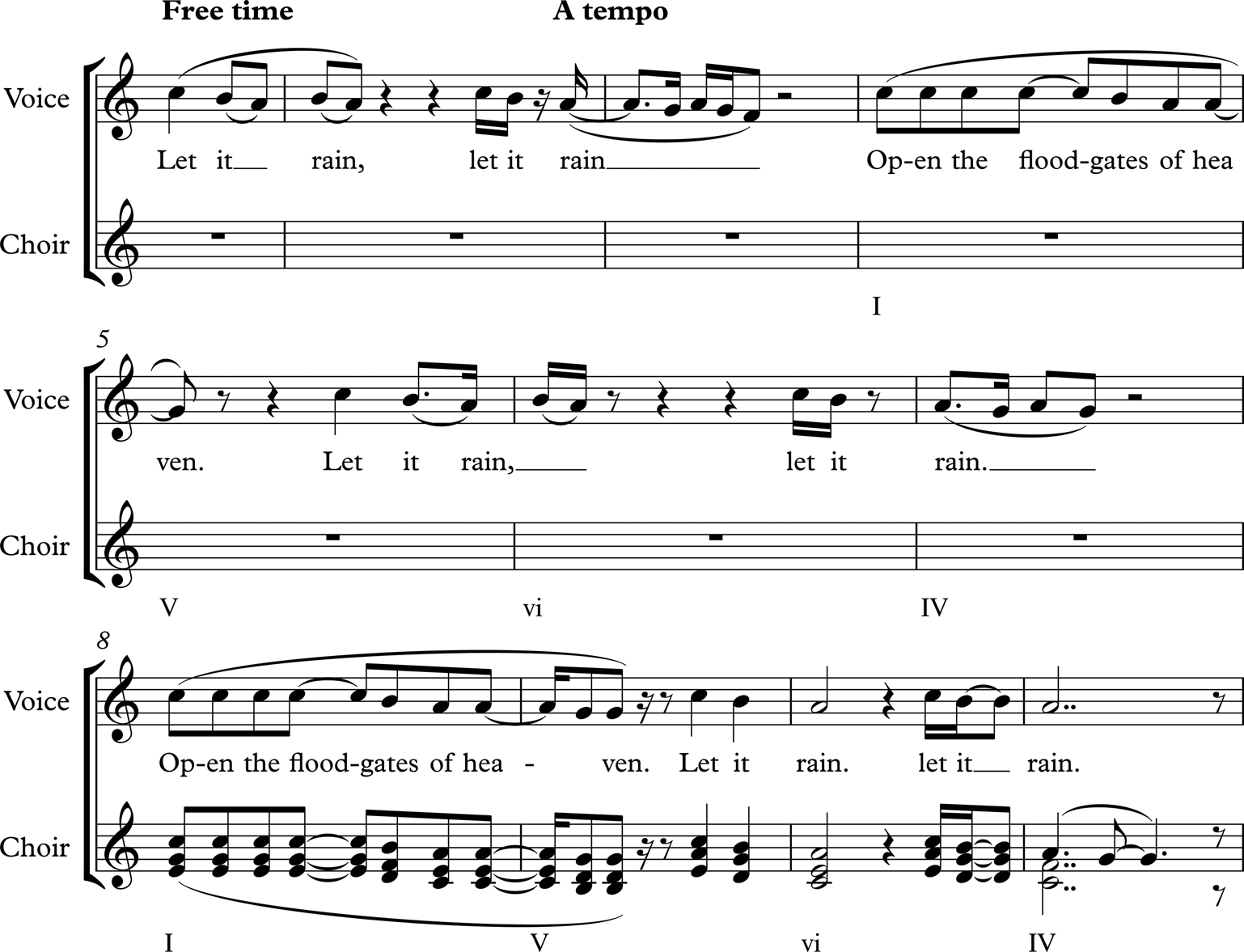
Released in 2001, Michael W. Smith's recording of Michael Farren's contemporary Christian song ‘Let It Rain’ presents a pious request for divine blessing, a petition that sounds in C major and unfolds at a deliberate 68 bpm.Footnote 5 As the track begins, Smith sings softly, ‘Open the floodgates of heaven. Let it rain. Let it rain.’ Example 3 depicts Smith's syllabic presentation of the ballad's crux, a melody that sonifies the falling of rain through its recursively descending line.
Michael W. Smith, ‘Let It Rain’, refrain, solo and chorus.

As Smith's voice tumbles a perfect fourth from middle C to G, his melody performs its request for rain; musical syntax endows the lyrics with an experiential efficacy, the capacity to mediate the presence of God. The rain for which the singer petitions is a spiritual metaphor for a host of divine blessings, for any number of miraculous interventions in human circumstances. Such a metaphor derives its power from biblical depictions of drought, deadly ecological disturbances that could only be overturned by an act of God.
Although the rain motif first emerges in Michael Smith's baritone register, this scalar passage is soon intensified; it becomes the sopranos’ part in a higher octave. Smith's ensemble gradually enters the texture, adding their homophonic version of this sung prayer. Throughout ‘Let It Rain’, the sung pattern of descent is buttressed by a conventional rock progression, harmonic movement of I–V–vi–IV, affirming Monique Ingalls proposal that ‘pop-rock conventions are [often] used to construct authentic worship’.Footnote 6 For more than five minutes, this musical request, recorded at a live event entitled Worship, is iterated with relatively little formal change, using invariant repetition to turn these lyrics from prayer to supplication. As they iterate this musical cell, the listener detects a subtle accretion of energy, an affective arc that seems to lead to the interruptive exhortation Smith offers beginning at 2′33″. The sole exception to the song's incessant reiteration comes through Smith's emphatic recitation of the first seven verses of Psalm 97:
The Lord reigns, let the earth be glad; let the distant shores rejoice. Clouds and thick darkness surround him; righteousness and justice are the foundation of his throne. Fire goes before him and consumes his foes on every side. His lightning lights up the world; the earth sees and trembles. The mountains melt like wax before the Lord, before the Lord of all the earth. The heavens proclaim his righteousness, and all peoples see his glory.
Smith turns back to his song by personalizing the last phrase of verse 7, ‘we want to see your glory’. This declaration frames the live recording at which the song was captured as a worship event, which, to quote Ingalls, is ‘a mass collective performance of contemporary worship music, generally led by a well-known celebrity performer and attended by a large audience’.Footnote 7 After Smith's recitation defines Psalm 97 as a scriptural basis for the song's message, Smith, the ensemble, and the band return to the song's material. While this interruption creates an experience of departure and return that might be likened to an ABA form, the song's concision is quite striking. Although it lasts for more than five minutes, it only has one musical cell, the single line of prayer spoken. Even against the other songs on that CD and the many songs that populate Smith's canon, the song's formal austerity is noteworthy. What does this relative dearth of material have to do with the song's humble request? I contend that the unfussiness of the song's structure yields an ascetic performance of devotion. The unremitting utterance of this meek strain voices a deep reverence, a sense of human unworthiness as a vital element of veneration – Ingalls calls this ‘the quest for authentic worship’.Footnote 8
‘Purple Rain’
Between Smith's ‘Let It Rain’ and the version made famous by Bishop Morton and the Full Gospel Baptist Church Fellowship lies ‘Purple Rain’, one of the best-known compositions of Prince Rogers Nelson. When I say between, I mean to suggest that ‘Purple Rain’ is a key condition of musical possibility for the Full Gospel performance, the song at issue in this article. What conditions does it set? First, as it relates to speed, ‘Purple Rain’ is quite literally between Morton and Smith's enactments of ‘Let It Rain’, unfolding at 58 bpm instead of Smith's 68 bpm and Morton's 48 bpm. Its slower tempo encourages the Full Gospel version's relaxed pace, making more room for the kind of nuances that produce a strong sense of groove. Second, in harmonic terms, all three musical entities discussed in these pages share the same chordal vocabulary. While Morton's and Smith's versions contain an identical progression, the movement of ‘Purple Rain’ has a different order.
As Example 4 depicts, the two harmonic modules that underpin ‘Purple Rain’ differ, but both privilege the subdominant, the chord that is also paramount in ‘Let It Rain’. While the verse reaches IV near the end of each module, the chorus accents IV as the place of arrival from which the first two statements of the title lyrics are made. The thinning of the instrumental texture at the end of the verse adds to this moment's emphatic quality. Here, as in Morton's ‘Let It Rain’, IV is often prolonged by a second-inversion ♭VII, a double plagal movement that adds to the sense that the chord in question (IV) is a sound with which to tarry.
Prince, ‘Purple Rain’, sections A and B.

The third, and perhaps most important, condition set by Prince is the song's intense focus on a strikingly ambiguous subject: rain, purple rain. Unlike the relatively discrete parameters of tempo and harmony, the lyrical content expands the possible range of meanings that can be attached to the song. What is purple rain? This decades-old question is key to the song's affect. While, in the movie, Prince dedicates the song to his father, the lyric's more overtly romantic moments problematize audiences’ understandings of the song's addressee:
As the song's three verses unfold, punctuated, of course, by three intervening choruses, the lyric gets more specific in its concerns with a kind of lover's dispute. As this growing sense of the song's interpretive multiplicity loosens the connection to any singular narrative, it materializes the ‘beautiful complexities’ that Traci Lewis-Giggets describes as vital ‘parts of Prince's spiritual and artistic evolution’.Footnote 9 This unwillingness to be pinned down, in performance and in life, is what prompts Robert Walser to describe Prince as a ‘queer poststructuralist’.Footnote 10 Slackening audiences’ certainty of this song's meanings facilitates its appropriation in later, and explicitly, Christian contexts.
This is not to say that Prince's oeuvre lacks religious concern. On the contrary, the very notion of ‘purple rain’ points to an eschatological preoccupation that suffuses Prince's canon, a religiomusical fascination that can quite easily be traced to his upbringing in the Seventh Day Adventist Church, a Christian denomination whose name emphasizes their fixation on the second coming of Christ. From 1999 to Purple Rain, and from ‘Sign O’ the Times’ to ‘Let's Go Crazy’, references to the end times appear as an expressive resource for Prince. In this way, Prince's oeuvre reveals the strength of Teresa Reed's claim that ‘black secular music conveys the evolving religious consciousness of African Americans in the twentieth century’.Footnote 11 However, there is more: as theologian Jonathan Downing contends, ‘Prince's back catalogue is punctuated by weighty themes that we might term ‘“religious” … concepts underpinning the relationship between the human and the divine, spirituality, creation, human sexuality, and eschatology’.Footnote 12 Downing is right to emphasize the idea of ‘relationship’ as a central force in Prince's use of religious ideas. The musician's fixation with ecstatic experience, whether of a sexual or religious nature, or some messy mixture thereof, shows his desire to find meaning in between. How better to do it than to sing to a lover about an eschatological rain? This conviction that the most salient musical expressions arise from movement beyond the self shows up in specific performative decisions: the famous falsetto passage mentioned earlier in the introduction is one instructive example. The location of these ethereal descending tetrachords at the end of a pyrotechnic guitar solo, and at the culmination of a song replete with the desire for purple rain, seems rather Adventist – it sonifies the coming of some other. Prince's scream is a transcendent gesture that produces the ecstasy the song describes. Prince's catalogue is full of moments like these, far too many to detail here.Footnote 13 What might Prince's pursuit of musical ecstasy teach about the relationship between ‘Purple Rain’ and the full gospel version of ‘Let It Rain’?
When asked about the composition of ‘Purple Rain’, keyboardist Lisa Coleman recalled:
At first, he wasn't sure Purple Rain was actually a Prince song. It was kind of a country number and he gave it to Stevie Nicks, but she felt intimidated by it. So, one day he decided to fool around with it at rehearsal. Wendy started hitting these big chords and that rejigged his idea of the song. He was excited to hear it voiced differently. It took it out of that country feeling. Then we all started playing it a bit harder and taking it more seriously.Footnote 14
What Coleman describes in this moment is vital. It points both to Prince's openness to movement between genres even at the point of conception and to their sense of what each genre entailed. Like the falsetto screams, the guitarist's ‘big chords’ and the band's decision to play ‘harder’ extended the song beyond its original country locale. This collaborative scene of music making sheds light on the sense that genre did not define ‘Purple Rain’, even at its beginning, suggesting that there was something else already inside the song, a creative potential waiting to be brought out of its container. How might its performance reveal this plurality? What motivates its reinvention? When Bishop Paul Morton and the Full Gospel Baptist Church musicians went to cover Michael W. Smith's ‘Let It Rain’, the most ecstatic dimensions of the lyric and arrangement of ‘Purple Rain’ proved too tempting to refuse.
‘Let It Rain’: The Full Gospel Version
The version of ‘Let It Rain’ performed by Bishop Paul Morton with the Full Gospel Baptist Church Fellowship Mass Choir, like Smith's before it, rests on a preoccupation with rain, a concern that mirrors the vulnerability to drought experienced in the places where the Hebrew Bible was written. For this reason, songs about rain pervade the gospel repertory; in these selections, rain functions as a valuable and malleable metaphor for divine solutions to human problems. Rain materializes the transcendent through the alchemy of musical sound. The Full Gospel version takes its time – it is considerably slower, somewhere around 48 bpm, instead of 68. Like Smith's recording, the Full Gospel version of ‘Let It Rain’ is built from twenty-one enactments of a single formal unit in C major, a prototypical progression of I–V–vi–IV. Morton and the choir's articulation of this pattern is intensified by the emphatic walkdown from vi to V to IV. Yet its harmonic austerity remains striking given the plenitude of chromatic harmonies that are so fundamental to gospel keyboard styles. While these relatively simple chord changes betray the song's basis in Christian Contemporary Music, Morton, the choir, and the band use this ascetic foundation to craft a compelling and characteristically gospel affective arc.
As the musical introduction discussed at the beginning of this article gives way to the song proper, Bishop Morton twice sings the refrain alone. Example 5 illustrates this.
Bishop Paul Morton and the FGBCF, ‘Let It Rain’, refrain, solo and chorus.

Both times, Morton's punctuated utterances make the opening sentence feel like a paragraph. Through the stark pause that follows its utterance, ‘Open’, the song's first word, comes to feels like its own sentence. Emphatically separated from the rest of this ballad's first line, this opening word offers a revealing window into the irruptive predilection that animates the Full Gospel version. As Bishop Morton takes his time with every word, luxuriating in the transcendent significance of his words, the sense that they might be engaged in the opening of a celestial realm is communicated. Although the tune's metrical framework had already taken hold, the bishop's first two statements claimed the kind of freedom often found outside such a temporal fabric. In contrast to Smith's version, at the Full Gospel recording, Morton lifted his melody from the tenor's forthcoming part. That Morton begins singing on scale degree three instead of scale degree one is significant because this musical decision causes his melody to start on a pitch that wants to descend, unlike Smith's decision to begin on the tonic, the note that exemplifies musical stability. While both versions agree that scalar descent is key to this lyric's delivery, Morton's melody more effectively marshals tonal tendencies to amplify the song's message. The effect of this substitution is not limited to the opening iterations: once we hear this tenor line sung in Morton's solo, it is hard to unhear it in the choir's subsequent statements. Even though it is not the highest voice in the ensemble, its prominence results from its primacy.
After Morton's two statements, the choir and the band make their presence known. Singing the refrain three times, these vocalists use choral homophony to formalize the bishop's previous statements. Their entrance also frees the bishop to ad-lib, that is, to flow in the improvisation afforded by these musical constraints. While the choir part is unchanged from Smith's 2001 recording, the Full Gospel version's slower tempo allows the singers to ‘stretch out’. The vocalists use this extra room to obdurately iterate the refrain's first four words, accruing energy for the emphatic delivery of the lyric's closing lines, ‘let it rain! Let it rain!’ If these moments seem to constitute the crux of the song, they will not for very long. After the third statement of this tutti presentation, things change: as soon as the full musical texture is constructed, then, Morton breaks it open, saying, ‘I want you to sing it without the music’. Following this musical instruction, the vocalists – Morton, the choir, and the audience – then sing three refrains, with the band only punctuating the space between their declarations. (The drums are the exception to this: through each of these refrains, the percussionist plays semiquavers on the hi-hats and the bass drum on the two backbeats of each bar.) Unsupported by any of the stage's other instruments – two guitars, electric bass, multiple keyboards, and Hammond organ – the sky seems to open as the sheer volume of Morton, the front-line singers, the choir, and the congregation fills the space the band used to occupy. Such a sonic rupture would have been gripping even if it occurred only once. However, the pursuit of rain seemed to resist singularity. Three times the band returns to repeat this rending of the song's texture, emancipating the voices, while building anticipation for their inevitable return. In so doing, these musical irruptions elevate the status of the band's phantom accompaniment to something like what Fred Moten has called ‘rapturous sounds [that] stay even in the declaration of their inevitable disappearance’.Footnote 15 In this middle frame of the recording, the repeated instrumental breaks that Morton commands reveal a prevailing approach to music making. After the instruments evacuate the texture for the three statements of the formative module, the bishop turns the texture in a different direction saying to the singers, ‘I want you to be quiet for a minute, let the music play’. As he marches from the first to fifth degree of the C major scale, giving each syllable its own pitch, Morton hints at, and indeed performs, an ecstatic instrumentalization of his voice: his voice escapes his body, finding its way into the band, affirming the attention Emily Wilbourne pays to ‘the unique location of the voice both inside and outside our bodies’.Footnote 16
Just where the bishop's voice leaves off the two lead guitars pick up; Jonathon Dubose and Courtney Robertson offer an emotive and emphatic guitar interlude, three declarations of the song's basic harmonic material that emerge from these guitarists’ antiphonal solos. These antiphonal solos call into question the category of solos itself. Even though no person is singing here, it is obvious that they are playing against an implicitly resounding melody, developing motives from the refrain that the choir and Morton had been repeating. However, more than playing against a melody, Bishop Morton suggests that they are playing up a storm. Morton expresses this when he interrupts their collective solo to sing ‘play the rain down, play the rain down!’
As this article's title suggests, I am interested in the phrase, ‘play the rain down’, both for its assertion about the spiritual potency of specific musical actions and for how these words offer a pre-emptive caption for Morton's own vocal ad libs. These two dimensions of the phrase's meaning come into view soon after their statement. After uttering this key phrase, Morton leaps into a piercing falsetto scream, singing two descending tetrachords from the soprano A5–E5 and G5–D5 (see Example 2).
He does this twice. Crucially, Bishop Morton conjoins his even-more-syncopated quotation of Prince's ecstatic utterance to a reiteration of the song's lyrics, ‘let it rain’. As Morton's voice becomes a vessel, Prince's utterance becomes yet another instrumental thread in this interlude's collective improvisation. In so doing, Morton reincarnates a gesture that, in the words of journalist Touré, ‘soars farther and farther over the highest point previously reached in the song, giving us a succession of superhuman wailing screams … outside the structure of the song’.Footnote 17 He makes this falsetto exclamation and then cries ‘let it rain’ with equal intensity. What are we to make of this conjunction? What is the meaning of this combination? I want to suggest that this heteroglossic enjambment uses one utterance to interpret and translate the other, calling into question what James Q. Davies calls the voice's ‘mysterious and magnificent belonging’.Footnote 18 The concurrence of these exclamations, the interpenetration of these two voices might then be an argument that Prince's scream always did mean ‘let it rain’. By reaching into this as-yet-unexplored tessitura, Morton turned his voice into another kind of instrument, a rainmaker, like the aforementioned guitars, whose otherworldly solos also engraft a Princely presence into this neo-Pentecostal performance. I should also note that falsetto phonations show up in other parts of Morton's practice, in both songs and sermons. However, this utterance was different because of its specific reference to Prince's ‘Purple Rain’. If there is thought embedded in aesthetic practices, surely this is one such moment, a sonic contention, a refusal of categorizations that divide the sacred and secular, an emancipation of expressive resources.
While I will return to this relationship between Morton's and Prince's displays of pyrotechnic vocality, the understanding I wish to develop depends on attending to the other vital musical changes that emerge after this arresting sound. After Morton's scream, the soloist, the choir, and the band return to the opening refrain for two iterations, a reanimation that integrates all the preceding material into the song's head. However, this recapitulation turns out to be a pretext for further transformation. After singing the formative refrain twice, there is a rhetorical and musical shift to an altogether different performative frame.
As Example 6 depicts, Morton sings a new lyric ‘I feel the rain’ and then the choir joins him. Yet before the choir can repeat their line a second time, Morton instructs them to tell somebody ‘it's raining’. Just as these lyrics change, the primary instruments, the guitars, turn to prickly arpeggiations whose percussive insistence make rain sonically available. Each struck string sounds a drop of the requested rain. While Courtney Robertson's broken chords sound drops of rain, Jonathan Dubose lends this musical precipitation a bit more resonance by playing wah-pedal-doused lead guitar lines that mirror Morton's vocal ad libs.Footnote 19
Bishop Paul Morton and the FGBCF, ‘Let It Rain’, vamp.

On a broader formal level, this moment in the performance is marked by a kind of hypermetric concatenation. From the beginning of the song, the prevailing duration of the basic musical idea had been three refrains long. Recall that the tutti presentation of the refrain, the instrumental break, and the instrumental solos lasted for three iterations of the harmonic progression. However, Morton's falsetto utterances marked a new moment in which the prevailing duration was shorted to the length of two refrains. The falsetto exclamation took two refrains. The ‘I feel the rain’ took two refrains. The ‘it's raining’ took two refrains. The final return to the original material also took two refrains. This hypermetric retraction is mirrored on a lyrical level. While the original refrain unfolds over the entire chord progression, in this new space of activity, which functions as a vamp, the lyric is repeated four times within each refrain. Taken together, these musical modifications make for a forceful turn towards a logic of iteration. Students of this performance must not fail to note that this new material and these new lyrics are not found in Michael W. Smith's original recording of Michael Farren's ‘Let It Rain’. Although these bits of musical material come from the outside, paradoxically, they become essential elements of the Full Gospel form.
How might surplus become fundamental to this performance? In my view, the crux of this performance, the key to the Full Gospel version of ‘Let It Rain’, lies in this aforementioned shift. More than just musical transformations, these musical conversions occur at the exact moment when the congregation and musicians adjust their posture to the divine. Refusing to simply pray for rain, they succeed at playing and singing rain down, such that they can now sing, ‘I feel the rain’ and ‘it's raining’. This inversion moves away from pure supplication towards immanence, towards an audacious assertion about the role music plays in mediating the experience of God. This shift – musical, rhetorical, and experiential – is how this version enacts a theory of Black musical ecstasy. The kind of shift at work here is the fundamental engine of gospel performance, which has elsewhere been described as ‘tuning up’, a song-based form of homiletic inflection.Footnote 20 Guthrie Ramsey, following Walter Pitts and Morton Marks, describes the moment as a shift into the ‘second frame of a song's metaphorical ritual syntax’.Footnote 21 What is so remarkable about this performance is that this arresting movement is accomplished within a song that has only one basic musical unit. The transformation comes from within. The song is enrolled in its own undoing. Just as the declaration of divine presence is the logical outgrowth of Morton's request for rain, the syntactic manipulations at work seem to have been invited by the song's structure. Full Gospel's management of this musical material is what enmeshes it in the Black gospel tradition, creating an instant of escalation that serves as an intersection, a portal through which rain begins to fall.
While the shift, the elevation, the turn to ecstasy is conventional in gospel, the interpolation of the Princely quotation would not seem to be, notwithstanding the ecstatic and religious themes that populate Prince's catalogue. Yet, upon further reflection, it becomes clear that Morton's engagement with Prince, his practice of what Justin Williams calls ‘an unconcealed intertextuality’ participates in a long genealogy of generative interactions through which gospel performers have moved back and forth across alleged boundaries between sacred and secular traditions.Footnote 22 Guthrie Ramsey calls this ‘a hybrid cultural logic’ that has inspired eclecticisms ranging from ‘Thomas Dorsey's mix of blues and gospel in the 1920s and 1930s; Rosetta Tharpe's blend of jazz and gospel during the 1940s; Edwin Hawkins's and Andre Crouch's pop-gospel of the late 1960s; the Winanses’ smooth-soul gospel of the 1980s; and Kirk Franklin's urban gospel of the 1990s’.Footnote 23 I contend that Full Gospel's ‘Let It Rain’ suggests that gospel's many hybridities are fuelled by a conviction, a belief that there is more in aesthetic forms than the generic names by which they are classified. This is to propose that these boundary crossings are really antiphonal performances of what Ashon Crawley calls ‘Blackpentecostal Breath’, movements towards radical forms of sociality.Footnote 24 The fact that the rain for which Morton, the band, the choir, and the congregation petition only appears after they reach outside the gospel canon is telling; the song's syntactical preoccupation with what lies beyond it – that its musical drama centres on a hyperlegible musical quotation – paves an uncanny passage between the material world and another, producing the kind of radical sociality that might be called ecstasy.
It is through this bringing-near of the rain, through this playing-down of rain, through this assertion of immanence and transformation that Full Gospel's cover becomes something more. Yet what is the more, I suggest that the Full Gospel version is both cover and critique. If we link all the formal observations together, running from the beginning of the song through the breaks and the guitar solos, through the ecstatic utterance, and the shift into the song's second phase, one finds that the performers spend remarkably little of the song's eight-and-a-half minutes singing what could properly be called the song. Only seven of the twenty-one iterations of this harmonic refrain seem to be of ‘the song’. The rest of the performance is spent tugging at the threads of the musical texture, undoing and then redoing the form, opening it up to be more than what it was. While this song might have been transformed ‘through a series of musical performances followed by critical listening and mixing’, the Full Gospel version of ‘Let It Rain’ invites audiences to witness the song's remaking, marshalling this transfiguration as evidence of and fuel for spiritual experience.Footnote 25 Listening to this song's undoing and outdoing allows congregants to pursue gospel's ‘telos’, Alisha Lola Jones's term for believers’ ‘expectations to have a tangible encounter with God during the worship experience’.Footnote 26 The Full Gospel version, then, is a cover preoccupied with unsettling the song's essence – a cover that is obsessed with creating a musical outside, an otherwise location where religious ecstasy can be experienced.
What does Morton's instantiation of ‘Let It Rain’ reveal about the intercalation of music, ecstasy, and Blackness in his religious imagination? What, for Bishop Morton, is ecstasy? I contend that the re-placed Princely utterances – in voice and guitar – and the song's irruptive form point towards a theory of ecstasy that is at work in Morton's aesthetic practice. My argument builds from Fred Moten's widely discussed view that Frederick Douglass's witnessing of (or entextualization of) ‘Aunt Hester's scream is diffused in but not diluted by Black music in particular and black art in general’.Footnote 27 Moten's claim that Hester's scream constitutes ‘an irruption of phonic substance that cuts and augments meaning with a phonographic, dematerializing inscriptions’ extends to an aesthetic theory that locates the essence of Black performance ‘in this break, this cut, this rupture. Song cutting speech. Scream cutting song. Frenzy cutting scream with silence, movement, gesture.’Footnote 28 Such a focus on expressive rupture calls attention to the most important features of the Full Gospel performance: the textural manipulations, the Princely interpolation, and the inflected assertion of immanence, each of which entails the dramatic production of sonic distance. What emerges from these breaks? What does this cutting bind together? In the Full Gospel performance of ‘Let It Rain’, I hear an affirmation of Fred Moten's contention ‘that something held within these forms also exceeds them, that there is a remainder that is not reducible to the technical apparatus that produces them or the technicity that grounds them’.Footnote 29 The song's preoccupation with getting beyond itself occasions the experience of religious ecstasy. As the cracks made in the song's structure become the objects of the audience's experience, these musical fissures amplify ‘an invitation, a call to a then-and-there, a not-yet-here’.Footnote 30 What Jose Muñoz calls ‘taking ecstasy together’ has much to do with the communal assertion of the phrase, ‘I feel the rain’.Footnote 31 To linger, as this performance does, somewhere between a New Orleans sanctuary, a Minneapolis stage, and the Holy of Holies is to heed what Muñoz describes as a call towards communal ecstasy. The plurality of this ontology is key. The brand of musical ecstasy exemplified by Full Gospel's ‘Let It Rain’ is best understood through Lindsay V. Reckson's notion of ‘being beside’.Footnote 32 Reckson argues that, ‘rather than a narrative of transcendence – of moving “beyond” the self or the disciplinary logic of the subject – being beside marks the self as fundamentally (not incidentally) social, necessarily constituted by what lies outside or side it’.Footnote 33 What does it mean to be constituted by what lies outside oneself? What procedures sustain this intersubjective existence? Whatever it means to be shaped in this way would seem to be on display in the Full Gospel version of ‘Let It Rain’. This performance's irruptive form and hunger for what exceeds it makes it uncommonly permeable by divine rain, this most potent symbol of the beyond.
While the textural breaks and the instantiation of ‘tuning up’ facilitate the emergence of this paradoxically external centre, the same must also be said about the falsetto utterance. There is a sense in which the ecstatic utterance that interrupts the Full Gospel version of ‘Let It Rain’ retrospectively defines it as having always been about ‘Purple Rain’. The same utterance also suggests that this moment in ‘Purple Rain’ always had the capacity to contain such a gospel song. This coalescence affirms Ashon Crawley's claim that ‘blackpentecostals are sounding out a way, rehearsing a mode of sonic production that refuses origin and purity, utilizing melismatic, melodic irruption, irreducible noise’.Footnote 34 While the intertext is clear, aspects of this performance do resist origin. The falsetto utterance so vital to this performance is joined to a host of ecstatic moments in Morton's preaching throughout his career. In the final frame of his sermons, Morton, like many other preachers with similar vocal ability, typically produces a few arresting screams, dramatic leaps into the highest reaches of his voice, utterances delivered in a marked phonation. That this way of preaching was an aesthetic possibility for Morton complicates the line of influence at work between ‘Purple Rain’ and the Full Gospel ‘Let It Rain’. If Prince's gestures bear some relation to ecstatic iterations of Black homiletical musicality, a tradition Morton has spent his life participating in, the trail of reference grows knottier still. What matters here is the shared preoccupation with accessing an essential exterior through the sonic force of disruptive musical gestures. While this charismatic bishop's reanimation of Prince on the stage of his own church might be said to mark a transgressive turn towards a specific creator, I argue that this refusal of purity and distinction is an integral part of Morton's theory of ecstasy. The forceful presence of a musical other eases the performance's path towards an interworldly religious experience; the heterodox character of the utterance makes it an even more affective instrument with which to play down the rain.
Having examined this compound utterance from the perspective of the performers, one should also consider the congregation's experience. Watching the video of the Full Gospel performance, one witnesses members of the front-line ensemble, the singers whose handheld mics suggest that they are tasked with primary vocal responsibility, react in pronounced ways to Morton's Princely incantation. While it is not clear if the moment of the recording was their first-time hearing this, their possibly inoculated response to the declaration is suggestive of its effect on other auditors. For members of this large audience, Morton's statement, coming from a soloist who was also the founder and leader of their reformation, must have been provocative. Holding together this performance and its intermusical partner called on a dialogic kind of listening. As such, this aspect of the Full Gospel ‘Let It Rain’ affirms George Lipsitz's contention that ‘popular music is nothing if not dialogic, the product of an ongoing historical conversation in which no one has the first or the last word … a long history [mediated by] the collective memory of the audience’.Footnote 35 This single quotation modified what Bakhtin called ‘the authentic environment of [this] utterance, the environment in which it lives and takes shape’.Footnote 36 If these stratospheric descending tetrachords carry with this traces of another environment, then their iteration in this new context was key to the production of ecstasy. The Full Gospel recording bears this out. Not long after Morton's reanimation of Prince's scream, the bishop moved towards another linguistic register, speaking in tongues in between sung utterances. That Morton's invocation of glossolalia came so close to the performance's most explicitly heteroglossic moment clarifies that we might think of the Princely invocation as a similarly ecstatic utterance, akin to glossolalia, another tongue with which to presence otherworldly power, a vocalization that was no less potent than the conventional mode of Pentecostal speech.
Morton's braiding-together of these two heightened utterances, an implicit statement of a kind of equivalence, highlights the central role that evocative musical gestures play in providing access to another realm. As for Morton, the screams which populate Prince's catalogue do theological and theoretical work; they betray the musician's eschatological concerns – not simply a fascination with the end of the world, but rather a creative preoccupation with irruptive experience, an alertness to the striking arrival of an external force. Such utterances are efficacious because their alterity conveys the sense that they come from another place; at the same time, their sonic materiality rends the musical fabric to let this other place take residence in a performance. Indeed, Morton's use of Prince might be termed doubly ecstatic because of its form and deep intertextuality. The structural resonances between Prince and Morton's musical theorizing reveal a commitment to a radical sociality that is not limited to the tangible world. ‘Purple Rain’ and the Full Gospel version of ‘Let It Rain’ share a particular fellowship because of the radical openness, porosity, and permeability that they lend to audiences.
My argument here is not merely speculative – it is grounded in the story of Bishop Morton's own ministry. In 1993, he founded the Full Gospel Baptist Church Fellowship. Morton, though raised in the Holiness-Pentecostal denomination of the Church of God in Christ, had been pastor of New Orleans, Louisiana's St Stephens Baptist Church since the mid-1970s. When the Full Gospel Baptist Church Fellowship was founded, he described the new fellowship as a movement to ‘give Baptists the right to choose’.Footnote 37 After its emergence, the leaders and members of the Full Gospel Baptist Church Fellowship spent several years struggling with the leaders and members of the National Baptist Convention USA, the large denomination of which Morton – and many of his new converts – had long been participants. Founded a century before Full Gospel, by the turn of the twentieth century, the NBC ‘comprised hundreds of congregations from coast to coast and could boast of missionary stations in Africa, the Caribbean, and South America’.Footnote 38 An organization whose emergence resulted from the union of the Foreign Mission Baptist Convention, the American National Baptist Convention, and the Baptist National Education Convention, the National Baptist Convention (NBC), USA, Inc. has been one of the most powerful forces in African American religious history, playing an important role in a range of cultural unfoldings, including the codification of gospel song in the 1920s and 1930s. Notwithstanding its enduring strength, the NBC has endured numerous fissures, including the formation of the Progressive National Baptist Convention in the 1960s, an exodus movement whose members sought to organize a more socially active assembly. In contrast to these earlier clashes, the Baptist quarrels of the 1990s had an aesthetic foundation. As Aldon D. Morris and Shayne Lee write, Morton's fellowship consisted of congregations who were ‘sympathetic to a neo-Pentecostal style of worship, as opposed to the traditional mode that existed at the NBC annual meetings’.Footnote 39 One of Morris and Lee's informants confessed that there had ‘always existed in the Baptist communion those with an appetite for a more spiritual, demonstrative type of worship style’. The new fellowship, then, ‘tapped into a kind of sleeping giant’.Footnote 40
Besides divergent views on the role various expressions of religious ecstasy should play in services of worship, there were two additional lines of distinction between Full Gospel and the NBC. While the NBC stood firm on patriarchal opposition to women in ministerial leadership, Full Gospel affirmed their participation. At the time of Full Gospel's founding, Bishop Morton's wife, Deborah, was the co-pastor of his New Orleans-based congregation. Furthermore, there was the question of bishops, a title that indexes ecclesial structures that had heretofore been anathema to Baptists. In opposition to the local autonomy that is fundamental to the Baptist polity and theology, the Full Gospel Baptist Fellowship has a form of ecclesial government with Bishops and elders. These organizational differences reflect the politics of Full Gospel's emergence. As Jonathan Walton notes, in the mid-1990s ‘Morton became increasingly disillusioned with the way emerging congregations with burgeoning membership rolls, thriving media ministries, and innovative styles of worship were being locked out of National Baptist leadership. He was also aware of how many Black Baptist ministers were foregoing the National Baptist Convention annual meeting in September to attend Carlton Pearson's AZUSA Conference in April’.Footnote 41 Full Gospel's ecclesial hierarchy capitalized on these circumstances, making space for prominent younger ministers to assume leadership positions from which they oversaw the relationship between local congregations and the international fellowship. Yet the questions of denominational structure at issue in the 1990s were not wholly original: religious historian Quinton Hosford Dixie recounts that ‘the tension between congregational autonomy and centralized authority was present from the outset of the NBC’.Footnote 42 Still the threat posed by the Full Gospel Fellowship crystallized the inter- and non-denominational alternatives facing the NBC, prompting a fervent backlash. In the early days of the Full Gospel Baptist Fellowship a principal antagonist, Henry Lyons, who was then president of the NBC, observed ‘[the National Baptist] convention has to take a stand and let our members know without a shadow of a doubt you're either with them or with [us]. It's either this or that. Not this and that’.Footnote 43 If Morton understood the Full Gospel Fellowship as a ‘movement to give Baptists a choice’, Lyons felt similarly about the NBC. However, the choices they offered were directly opposed. ‘This and that’, as Lyons put it, was exactly what Morton – and his many followers – deemed appropriate. This tendency is evident even in the kind and number of singers used in Morton's performance. Although this song is firmly located in gospel's praise and worship style, its use of ensembles is hybrid. While, as Birgittia Johnson notes, ‘in church settings, a praise (or worship) team, a vocal ensemble of six to twelve singers (two per vocal part), usually leads praise and worship music’,Footnote 44 the Full Gospel recording uses both a praise and worship ensemble and a choir with hundreds of singers, refusing to choose between ‘this or that’, even on the level of pragmatic musical decision making. Lyons's ‘this or that’ jeremiad joined a lineage of injunctions against ecstatic characteristics of Black worship, cessationist views that define ecstatic experience as profane. Morton argued that Full Gospel was a contemporary enactment of the renewal movements that have cyclically reanimated Black Christian practices. As those performances evince the continuationist pneumatology – the theory of ecstasy – which characterizes the Full Gospel Fellowship, it points to the diversity of Black church movements that are often collected under the label neo-Pentecostal. While a full exploration of these ecclesial topography is beyond the scope of this article, I favour Jonathan Walton's trichotomy – neo-Pentecostal, charismatic mainline, and Word of Faith – as a way to characterize the religious practices of millions of Black Americans. These three streams of Black Christian practice ‘provide a broad classificatory schema’, which ‘should be viewed as partially overlapping circles … [because] all three groups are in theological and ecclesial conversation’.Footnote 45
Stronger than the theological, denominational, or social issues that distinguish these three groups is the thread that unites them, an aesthetic that is helpfully summarized in Morton's aforementioned defence of the Full Gospel fellowship. Morton's institutional embrace of the ecstatic flowed from beliefs he described in an interview, namely his concern for: ‘too many saved people who are afraid of spiritual things … Whether it's speaking in tongues, laying on of hands, casting out demons, these things are available to us. We ought to use all our spiritual weapons.’Footnote 46 I am interested in Morton's phrase ‘these things are available to us’. While it reflects broad confessional dynamics, I am convinced that it also helps us understand the relationships between the three musical entities under examination in this article. Like the Full Gospel version of ‘Let It Rain’, this statement posits a theory of ecstasy in its Black, religious, and musical manifestations. In its ‘new’ context, the underdetermined ecstasy of Prince's scream is another thing available to Morton, an utterance capable of functioning as a spiritual weapon, which, like glossolalia, impartation, or exorcism, can be used to play down the rain. While it once might have been deemed off limits, like a host of other charismatic practices and modes of ecclesial governance, Morton's enunciation contends that this unlikely sound has a place in the Full Gospel version of ‘Let It Rain’, precisely because it connects this performance to what lies beyond it. Like Prince's scream, Farren's musical foundation is another such tool; transformed in myriad ways, it is unfurled and rewoven in order to realize its request, bringing rain near. The performance of ‘Let It Rain’ is an argument. Morton's imaginative and omnivorous relationship towards these musical materials – like his devoted embrace of various Pentecostal practices – reveals a theory of ecstasy, a view that these practices are devices, tools, technologies through which to connect an assembled congregation to its constitutive outside, a realm of interworldly possibility that is the assembly's raison d’être.
Like the austere harmonic palette and power ballad feel, the thread of rain connects all three of these songs. As a theme, it functions as a pivot, a fulcrum that occasions movement across versions, genres, and audiences. Whether rain signifies a reconciled relationship or physical intimacy, for Prince, or any host of divine blessings, for Smith and Morton, its capaciousness is key to its effect. What I find so interesting is not simply its polyvalence but also the intensity that the notion of rain elicits – in multiple directions. The function of rain in these interconnected performances affirms Michael Gallope's contention that while ‘music has the appearance of immediacy … this appearance can be confusing. Indecision and ambiguity are endemic to the immersive experience of its sensuous particularity’.Footnote 47 While it is common for gospel singers and preachers to use iterative musical structures to ‘call the roll’, materializing the transcendent by wedding the promise of divine intervention to particular human circumstances, Morton does not do that in ‘Let It Rain’. While it would be easy to imagine a gospel singer exclaiming, ‘Rain on my health. Rain on my finances. Rain on my relationships’, nothing of the kind appears here. In ‘Let It Rain’, Morton pursues intensity through the simple declaration of the title lyric. The lyrical technology ‘let it rain’ seems more affective when it is allowed to stand alone. In its generative ambiguity, rain has much in common with musical sound itself. As Gallope writes, ‘music is a slippery art form; the medium wears its mediations in unpredictable ways. It is not made up of words, or of representational pictures, which can make it clearer that artworks are copies of other things.’Footnote 48 Although all three songs have lyrics, the musical materials they share – the harmonic resources, the balladic tempo, and falsetto incantation – suggest that their resonances precede the linguistic. Whatever these resonances are they seem to be lodged inside the material, such that musical ecstasy is found by rending the song's foundation. This is the intervention that Morton's Full Gospel version makes, enabling it to play the rain down.
Conclusion
This article has used the relationship between the versions of ‘Let It Rain’ recorded by Michael W. Smith and Bishop Paul Morton and Prince's ‘Purple Rain’ to explore the form and function of Black musical ecstasy. Close readings of each composition have revealed the musical materials used to achieve different expressive ends. While Smith's recording of Farren's sung prayer uses a pious insistence to pursue what some call ‘authentic worship’, Morton's Full Gospel version offers another vision of spiritual intimacy. Morton and Full Gospel's version of the song braids it together with the most evocative moments of Prince's ‘Purple Rain’, assembling an unlikely sonic collective whose arresting power fosters communion with the divine. Along the way, this recombinant performance's jagged edges incorporate the intensive logic of the Black gospel tradition. Critiquing its own form, the Full Gospel version of ‘Let It Rain’ demonstrates a preoccupation with opening, irrupting, and unleashing, such that one might ask: what does the rending of this musical fabric reveal? As this article has shown, the breaking and remaking of this song's form effects an essential conversion; moving from a sonic petition to a vehicle of transformation, the song becomes an instrument, a device that compels the falling of an interworldly rain.