Rising healthcare costs and emphasis on pay for performance measures have led to a shift in health care, with a push to transfer patients to long-term care facilities (LTCFs) earlier to meet quality benchmarks and reduce mortality rates and length of stay. Exceedingly frail and debilitated patients are being transferred from acute care to the long-term care setting without any corresponding changes or infrastructure development to support the increased workload imposed on LTCFs. With these changes, we have seen a rise in infection and colonization with multidrug-resistant organisms (MDROs) in residents in LTCFsReference Carayon
1
; this is likely due to a multiple-array and complex set of underlying factors given the complex, demanding, and typically underresourced nature of LTCFs. For example, high MDRO rates in these facilities are driven not only by inadequate infection control practices but also by poor antibiotic prescribing practices. Up to 75% of antibiotic prescriptions ordered in the long-term care setting are considered unnecessary or inappropriate,Reference Lim, Kong and Stuart
2
,
Reference Nicolle, Bentley and Garibaldi
3
and antibiotic stewardship programs are only just being developed in most LTCFs. Ambiguity regarding healthcare professionals’ roles, infection control procedures, and appropriate antibiotic prescribing practices in long-term care is pervasive, and we do not yet understand how to address this from a patient safety perspective.
In this article, we posit that human factors engineering (HFE) approaches and methods can be effective in improving infection control and antibiotic prescription practices in LTCFs. The International Ergonomics Association defines HFE as “the scientific discipline concerned with the understanding of interactions among humans and other elements of a system, and the profession that applies theory, principles, data and methods to design in order to optimize human well-being and overall system performance.”
4
Furthermore, HFE can be an important innovation in developing and implementing safety improvement strategies in LTCFs.Reference Zimmerman, Antonova and Carayon
5
This discipline allows us to better understand how the characteristics of the individual work system elements (eg, cluttered supply closet) and their interactions with each other (eg, insufficient time to obtain materials) contribute to the safety and quality of processes (eg, patient care completed without proper sterile materials) and outcomes of the system as a whole. This process, in turn, can help us to develop effective solutions to reduce or mitigate the effects of safety risks, while considering the realities of the ‘work’ and simultaneously aiming to minimize the unintended consequences of proposed interventions.
Infection Prevention Challenges in Long-Term Care
Although acute-care hospitals have relatively well-established infection prevention protocols delineating appropriate hand hygiene, personal protective equipment (PPE), and isolation and cohorting procedures, these interventions are more of a challenge in LTCFs. In LTCFs, enhancing socialization and quality of life for residents is a priority, access to diagnostic tests is often limited, there is little or no antibiotic stewardship, and the patient population is more complex and fragile due to advanced age and prolonged healthcare exposure.Reference Zimmerman, Antonova and Carayon
5
Minimal evidence has emerged to address MDRO transmission in nursing homes, and clear guidelines regarding infection prevention in this setting are lacking.Reference Crnich and Drinka
7
–
Reference Smith, Bennett and Bradley
10
Interventions targeting MDROs in LTCFs with universal screening and decolonization for MRSA or staff training have been largely unsuccessful.Reference Uchida, Pogorzelska-Maziarz, Smith and Larson
11
–
Reference Schora, Boehm and Das
14
This has been attributed mainly to poor compliance by the nursing staff, as well as limited buy-in and support from management, both of which support a role for HFE-based analysis of contributing work-system factors and redesign of the work system.Reference Gurses, Marsteller, Ozok, Xiao, Owens and Pronovost
15
Intervention appropriateness and implementation issues may be major factors as well. LTCFs often do not have active surveillance programs, infection control and infectious diseases personnel resources are often limited, and communication during care transitions between facilities is poor. Therefore, MDRO colonization status in LTCFs is largely unknown.Reference Kahvecioglu, Ramiah and McMaughan
6
Applying Human Factors Engineering to Infection Prevention Practices
Using an HFE approach to improve infection prevention practices and antibiotic stewardship in LTCFs allows us to better understand the individual work system elements, their interactions, and their dynamic input on system processes and outcomes, and to develop more effective, sustainable solutions. Several recognized factors make compliance with infection prevention challenging from an HFE perspective.Reference Zimmerman, Antonova and Carayon
5
For example, in general, there is a cognitive disconnect and time lag between the impact of infection control tasks and safety of patient care.Reference Trudel, Cobb, Momtahan, Brintnell and Mitchell
16
Tasks associated with infection prevention, unlike many other healthcare-related tasks, such as inserting an IV line or suctioning a tracheostomy, do not have a direct or immediate observable result. If a healthcare worker (HCW) does not perform hand hygiene and then provides patient care, which consequently leads to transmission of infection, the infection is not observed until a later time, with no clear connection with the initial breach in technique. By the time the infection is recognized, days later, the personal identification with the outcome is either lost or impossible to make due to many other infection control breaches that may have occurred. The delayed nature of this feedback, even if it may be clearly linked to the source, makes it difficult to motivate the HCW in the face of other (presumably more pressing) tasks. Concordantly, it is challenging to connect infection prevention practices with a tangible positive result. The desired outcome in infection prevention is, in fact, the lack of an undesirable outcome (ie, transmission of infection), making positive feedback challenging.
Time pressure and task complexity are also common problems, particularly with the recent shift to an increasingly ill patient population in LTCFs. Thus, HCWs are assuming more complicated tasks, including central-line maintenance and ventilator maintenance, which were rarely required in this setting previously. Furthermore, staff in LTCFs are notoriously overworked, with a high resident-to-HCW ratio and multiple responsibilities.Reference Castle and Sonon
17
In the face of a growing list of tasks, infection prevention procedures are often overlooked due to time constraints and the risk of interrupting the care process. For example, hand hygiene can be viewed by the HCW as a distraction or interruption from what they may perceive as their actual duty, such as administering a medication, and their focus on completing that task may lead them to forgo infection prevention precautions. Due to the delay in or lack of feedback or a clear output, infection prevention may be considered an interruption to the real task; leading the HCW to abandon infection prevention precautions. HFE can help us to better understand why HCWs behave or choose to do a task in a certain way given the system design, and thereby identify how to redesign the LTCF work system to better facilitate infection prevention and control.
Applying the SEIPS Model to Infection Control in Long-Term Care
The Systems Engineering Initiative for Patient Safety (SEIPS) is a human factors model that uses an engineering approach to patient safety to delineate ways to improve the system as a whole.Reference Carayon, Schoofs Hundt and Karsh
18
Human factors engineers assess complex work systems, such as LTCF settings, applying their knowledge of human limitations and abilities to reduce safety risks to patients and care providers. This approach can be used systematically to identify specific barriers that may inhibit proper functioning of the work system and to design appropriate interventions based on the barriers identified. The SEIPS model proposes that the following 5 work system components continuously interact and influence one another: tools and technologies, tasks, organizational conditions, person(s), and the physical environment. Changes to any or multiple aspects of these components may either positively or negatively affect the resulting processes, and therefore patient, professional, or organizational outcomes.Reference Carayon, Schoofs Hundt and Karsh
18
This approach can be applied to infection prevention processes in an LTCF to understand the key barriers and facilitators that may be affecting practice and resulting in transmission of resistant organisms (Fig. 1).Reference Carayon, Schoofs Hundt and Karsh
18
Fig. 1The Systems Engineering Initiative for Patient Safety (SEIPS) model,Reference Carayon, Schoofs Hundt and Karsh
18
showing how the 5 work-system components influence infection prevention processes and outcomes in the long-term care setting.
Consider the process of effectively instituting the use of contact precautions in an LTCF. Communication from the acute-care hospital transferring the resident to the LTCF may be inadequate, resulting in the resident being transferred without a designated MDRO colonization flag (external environment). The signage used to show that a resident should be on contact precautions may be confusing or unavailable (tools and technology). The facility itself may not endorse contact precautions due to the risk of resident stigma (organization). The nurse taking care of the patient may have limited training in appropriate infection prevention practices (person). The act of putting on the gowns and gloves prior to every room entry may be too arduous due to limited time and staffing (task). According to the SEIPS model, all these components and their interactions with each other must be considered to determine feasible and appropriate interventions while preventing introduction of unintended risks to the system. By analyzing each of these contributing components, human factors engineering approach takes in to account both macro-level factors (ie, the underlying culture of the facility) and micro-level factors (eg, design characteristics of contact precautions signage) in a work system, which may be contributing to the care processes and outcomes.
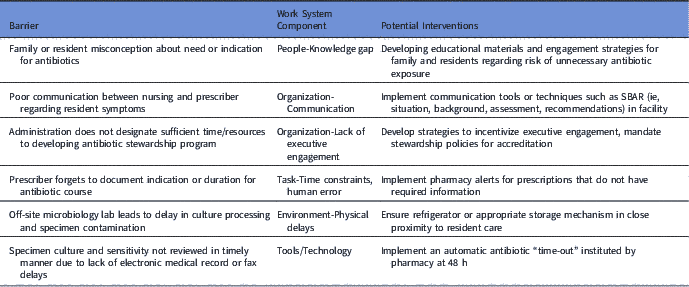
This same conceptual approach can also be applied to the pressing issue of improving antibiotic stewardship practices in an LTCF (Table 1). Consider the common LTCF practice of collection of a urine culture (process). The nurse may prompt the order for a urine culture due to requests from the family for evaluation of a change in urine consistency or smell (people). While guidelines do not indicate the need for testing for foul-smelling urine or changes in consistency without associated symptoms, the HCW may feel inclined to obtain the urine culture due to family pressure or due to a lack of his or her own knowledge of the guidelines. Both of these reasons may fall under the “persons” work factor component, and interventions can be explored based on the underlying social motivation. For example, if the nurse was prompted by family pressure, an appropriate intervention may include education and engagement of residents and family members regarding the risks of antibiotic use and the need for judicious use of antibiotics. If a lack of knowledge or training of the HCW was the reason for obtaining the culture, an appropriate intervention may include circulating a pocket card outlining appropriate indications for urine culture collection, or in-service training for nurses providing up to date guidance to this effect. However, if the reason for HCW not complying with the guideline is related to the pressure he/she gets from management regarding keeping residents and their families happy, then the underlying problem is probably due to wrongly incentivizing HCWs to collect the urine culture (organizational design).
Defects may also occur later in the process. The urine itself may be contaminated at the time of collection, resulting in a positive culture when in fact the resident was not harboring an infection. This could have been due to the HCW choosing not to wear sterile gloves (tools/technologies) at the time of collection because they were located in an inconvenient location (environment) and the HCW had a high workload (task, organization) or because he or she was distracted after collection by a phone call (task-nature of task/ job) and forgot (people-humans have limited short-term memory) to transport the specimen to the refrigerator in a timely manner (task). Potential interventions here may include reorganization of the physical location where gloves are stored or workflow adaptations to minimize distraction. Approaching these issues in a systematic manner, while also considering the larger work system and interactions between its components, enables human factors engineers to focus on the underlying reasons for these breaches to formulate appropriate and effective interventions.
Using Human Factors Methods to Reveal Work as Imagined versus Work as Done
Efforts to formulate interventions in healthcare will not be successful without understanding the gap between “work as imagined” (WIA), something that leadership believes happens or should happen, versus “work as done” (WAD), or what actually occurs during patient care.Reference Hollnagel
19
Healthcare workers in this largely resource-limited setting may establish “work-arounds” to complete their various duties throughout a work day, and these workarounds may have negative consequences on patient safety. These may include forgoing contact precautions due to time limitations, documenting wound dimensions/appearance at the completion of all rounds, or using shared equipment for multiple residents.
Although no previously published studies have applied HFE approaches and methods to infection control in LTC settings, recent HFE-based studies in acute-care settings have demonstrated several key barriers that may prevent HCWs from complying with infection prevention protocols.Reference Berenholtz, Pronovost and Lipsett
21
–
Reference Yanke, Carayon and Safdar
24
An overarching theme that seems to influence and promote HCW workarounds (and thus affect compliance with work as imagined) in infection prevention procedures is that of high workload, especially due to the high quantity of repetitive tasks. One study that observed hand hygiene procedures in a neonatal intensive care unit (NICU) revealed that nurses “share a strong sense of needing to complete a task, with some staff members commenting that breaches are most likely to occur when ‘you’re in the middle of something’ or ‘you have everything set up and you just need that one thing.’”Reference Trudel, Cobb, Momtahan, Brintnell and Mitchell
16
Another project focusing on operating room care revealed a similar theme, with infection prevention procedures seen as a ‘nuisance’ leading to inefficiency in completing a task.Reference Blanton
25
One surgical nurse commented: “Infection control slows down all movement. Hands must be washed before and after every contact with a patient, and fresh gown and gloves donned every time one enters a patient room, to be discarded when exiting. A thermometer or any other piece of equipment moved from one room to another must be cleaned too.”Reference Blanton
25
Workarounds may also apply to antibiotic stewardship practices in an LTCF. For example, “off hours” or on-call physicians are consistently cited as being more likely to prescribe antibiotics than providers who are on site and familiar with the patients. A practitioner responsible for off-hours coverage in a LTCF commented: “… you are called as an out of hours doctor you often times have little option but to prescribe an antibiotic because you don’t know the patient, you don’t know the staff, you often don’t know the background and you may not have complete notes in the history.”Reference Fleming, Bradley and Cullinan
26
Antibiotics are often prescribed after hours without an adequate history or evaluation to address vague problems such as change in mental status or urine consistency, even if this may conflict with facility policies (work as imagined).
These observations uncover core values that remain pervasive in the healthcare field, and without taking the time and using a systematic approach based on the science of human factors engineering to comprehensively understand the underlying factors that lead to the work as done, as opposed to work as imagined, the addition of another checklist, another didactic educational material, or other similar interventions will be neither effective nor sustainable. HFE uses both formative (exploratory) and summative (confirmatory) evaluation methods.
4
For example, if our goal is to identify why a urine culture is being ordered unnecessarily, we would conduct an exploratory study that may include both qualitative (eg, interviews with HCWs, family, etc) and quantitative (eg, a questionnaire surveying HCWs across the nation) data collection methods. If the study goal is to test whether an intervention package based on a SEIPS-based work system process analysis is effective, then an experimental study (eg, an RCT, a cluster-randomized or stepped-wedge trial, or a quasi-experimental design) would be conducted.
Promoting a Culture of Patient Safety
Redesigning work systems and promoting the culture of safety are core tenets of HFE and are key to improving infection prevention and patient safety. Without an understanding and an organization which supports the culture that infection prevention precautions can protect the patient, procedures will likely be ignored. A 2012 analysis exploring the attitudes of student nurses and their mentors described a conversation between a ward nurse and her consultant: “I can either practice infection control or I can treat the patients, you choose.”Reference Ward
27
These attitudes are likely even more pervasive in the LTCF setting, where the culture is further confounded by a need to respect the resident’s privacy and create a “home-like” environment. A 2006 survey on patient safety culture showed that nursing homes were below hospital benchmarks on almost all patient safety subscales, with the most dramatic difference in scores focused on organization learning and teamwork, with nursing homes reporting scores 47% below hospital benchmarks.Reference Handler, Castle and Studenski
28
These results are daunting, as organizational culture influences virtually all processes in the healthcare setting. Without support from leadership and value attributed to the importance of infection prevention, HCWs will be much less likely to devote time and energy to infection prevention tasks that often do not have directly observable outcomes and may hinder immediate resident satisfaction.
Although some evidence indicates that applying human factors engineering approaches to improve patient safety has led to reductions in healthcare-associated infections,Reference Pronovost, Needham and Berenholtz
29
–
Reference Pronovost, Berenholtz and Dorman
33
healthcare in general has been slow to incorporate HFE principles. Just as we need to understand the mechanisms of how the human body works to be able to develop effective interventions (medications) by conducting research in basic science, we also need to understand the mechanisms that lead to how work is done (as opposed to work is imagined) to be able to develop effective and sustainable interventions. This is the essence of what HFE does.
Integrating HFE approaches and methods in the long-term care arena will require a bolstering of research collaborations between clinicians and HFE experts with dedicated time for in-depth, rich, and systematic analyses of work systems and their underlying culture.Reference Gurses, Marsteller, Ozok, Xiao, Owens and Pronovost
15
,
Reference Castle and Sonon
17
Although workshops and short courses are available to learn basics of human factors, it should be recognized that for an individual to be a human factors expert, they must complete a master’s or PhD degree, typically in the fields of industrial and systems engineering or psychology. Hence, we recommend that LTCF clinical and quality improvement leaders should develop collaborations with human factors experts who work as researchers in academia or who work as practitioners increasingly in large academic healthcare centers or in private industry. Cultivation of this collaboration will allow for interventions specifically defined for the complex LTCF setting, an area that is poorly understood, with significant and urgent need for systematic redesign.






 You have
Access
Rising healthcare costs and emphasis on pay for performance measures have led to a shift in health care, with a push to transfer patients to long-term care facilities (LTCFs) earlier to meet quality benchmarks and reduce mortality rates and length of stay. Exceedingly frail and debilitated patients are being transferred from acute care to the long-term care setting without any corresponding changes or infrastructure development to support the increased workload imposed on LTCFs. With these changes, we have seen a rise in infection and colonization with multidrug-resistant organisms (MDROs) in residents in LTCFsReference Carayon 1 ; this is likely due to a multiple-array and complex set of underlying factors given the complex, demanding, and typically underresourced nature of LTCFs. For example, high MDRO rates in these facilities are driven not only by inadequate infection control practices but also by poor antibiotic prescribing practices. Up to 75% of antibiotic prescriptions ordered in the long-term care setting are considered unnecessary or inappropriate,Reference Lim, Kong and Stuart 2 , Reference Nicolle, Bentley and Garibaldi 3 and antibiotic stewardship programs are only just being developed in most LTCFs. Ambiguity regarding healthcare professionals’ roles, infection control procedures, and appropriate antibiotic prescribing practices in long-term care is pervasive, and we do not yet understand how to address this from a patient safety perspective.
In this article, we posit that human factors engineering (HFE) approaches and methods can be effective in improving infection control and antibiotic prescription practices in LTCFs. The International Ergonomics Association defines HFE as “the scientific discipline concerned with the understanding of interactions among humans and other elements of a system, and the profession that applies theory, principles, data and methods to design in order to optimize human well-being and overall system performance.” 4 Furthermore, HFE can be an important innovation in developing and implementing safety improvement strategies in LTCFs.Reference Zimmerman, Antonova and Carayon 5 This discipline allows us to better understand how the characteristics of the individual work system elements (eg, cluttered supply closet) and their interactions with each other (eg, insufficient time to obtain materials) contribute to the safety and quality of processes (eg, patient care completed without proper sterile materials) and outcomes of the system as a whole. This process, in turn, can help us to develop effective solutions to reduce or mitigate the effects of safety risks, while considering the realities of the ‘work’ and simultaneously aiming to minimize the unintended consequences of proposed interventions.
Infection Prevention Challenges in Long-Term Care
Although acute-care hospitals have relatively well-established infection prevention protocols delineating appropriate hand hygiene, personal protective equipment (PPE), and isolation and cohorting procedures, these interventions are more of a challenge in LTCFs. In LTCFs, enhancing socialization and quality of life for residents is a priority, access to diagnostic tests is often limited, there is little or no antibiotic stewardship, and the patient population is more complex and fragile due to advanced age and prolonged healthcare exposure.Reference Zimmerman, Antonova and Carayon 5 Minimal evidence has emerged to address MDRO transmission in nursing homes, and clear guidelines regarding infection prevention in this setting are lacking.Reference Crnich and Drinka 7 – Reference Smith, Bennett and Bradley 10 Interventions targeting MDROs in LTCFs with universal screening and decolonization for MRSA or staff training have been largely unsuccessful.Reference Uchida, Pogorzelska-Maziarz, Smith and Larson 11 – Reference Schora, Boehm and Das 14 This has been attributed mainly to poor compliance by the nursing staff, as well as limited buy-in and support from management, both of which support a role for HFE-based analysis of contributing work-system factors and redesign of the work system.Reference Gurses, Marsteller, Ozok, Xiao, Owens and Pronovost 15 Intervention appropriateness and implementation issues may be major factors as well. LTCFs often do not have active surveillance programs, infection control and infectious diseases personnel resources are often limited, and communication during care transitions between facilities is poor. Therefore, MDRO colonization status in LTCFs is largely unknown.Reference Kahvecioglu, Ramiah and McMaughan 6
Applying Human Factors Engineering to Infection Prevention Practices
Using an HFE approach to improve infection prevention practices and antibiotic stewardship in LTCFs allows us to better understand the individual work system elements, their interactions, and their dynamic input on system processes and outcomes, and to develop more effective, sustainable solutions. Several recognized factors make compliance with infection prevention challenging from an HFE perspective.Reference Zimmerman, Antonova and Carayon 5 For example, in general, there is a cognitive disconnect and time lag between the impact of infection control tasks and safety of patient care.Reference Trudel, Cobb, Momtahan, Brintnell and Mitchell 16 Tasks associated with infection prevention, unlike many other healthcare-related tasks, such as inserting an IV line or suctioning a tracheostomy, do not have a direct or immediate observable result. If a healthcare worker (HCW) does not perform hand hygiene and then provides patient care, which consequently leads to transmission of infection, the infection is not observed until a later time, with no clear connection with the initial breach in technique. By the time the infection is recognized, days later, the personal identification with the outcome is either lost or impossible to make due to many other infection control breaches that may have occurred. The delayed nature of this feedback, even if it may be clearly linked to the source, makes it difficult to motivate the HCW in the face of other (presumably more pressing) tasks. Concordantly, it is challenging to connect infection prevention practices with a tangible positive result. The desired outcome in infection prevention is, in fact, the lack of an undesirable outcome (ie, transmission of infection), making positive feedback challenging.
Time pressure and task complexity are also common problems, particularly with the recent shift to an increasingly ill patient population in LTCFs. Thus, HCWs are assuming more complicated tasks, including central-line maintenance and ventilator maintenance, which were rarely required in this setting previously. Furthermore, staff in LTCFs are notoriously overworked, with a high resident-to-HCW ratio and multiple responsibilities.Reference Castle and Sonon 17 In the face of a growing list of tasks, infection prevention procedures are often overlooked due to time constraints and the risk of interrupting the care process. For example, hand hygiene can be viewed by the HCW as a distraction or interruption from what they may perceive as their actual duty, such as administering a medication, and their focus on completing that task may lead them to forgo infection prevention precautions. Due to the delay in or lack of feedback or a clear output, infection prevention may be considered an interruption to the real task; leading the HCW to abandon infection prevention precautions. HFE can help us to better understand why HCWs behave or choose to do a task in a certain way given the system design, and thereby identify how to redesign the LTCF work system to better facilitate infection prevention and control.
Applying the SEIPS Model to Infection Control in Long-Term Care
The Systems Engineering Initiative for Patient Safety (SEIPS) is a human factors model that uses an engineering approach to patient safety to delineate ways to improve the system as a whole.Reference Carayon, Schoofs Hundt and Karsh 18 Human factors engineers assess complex work systems, such as LTCF settings, applying their knowledge of human limitations and abilities to reduce safety risks to patients and care providers. This approach can be used systematically to identify specific barriers that may inhibit proper functioning of the work system and to design appropriate interventions based on the barriers identified. The SEIPS model proposes that the following 5 work system components continuously interact and influence one another: tools and technologies, tasks, organizational conditions, person(s), and the physical environment. Changes to any or multiple aspects of these components may either positively or negatively affect the resulting processes, and therefore patient, professional, or organizational outcomes.Reference Carayon, Schoofs Hundt and Karsh 18 This approach can be applied to infection prevention processes in an LTCF to understand the key barriers and facilitators that may be affecting practice and resulting in transmission of resistant organisms (Fig. 1).Reference Carayon, Schoofs Hundt and Karsh 18
The Systems Engineering Initiative for Patient Safety (SEIPS) model,Reference Carayon, Schoofs Hundt and Karsh 18 showing how the 5 work-system components influence infection prevention processes and outcomes in the long-term care setting.
Consider the process of effectively instituting the use of contact precautions in an LTCF. Communication from the acute-care hospital transferring the resident to the LTCF may be inadequate, resulting in the resident being transferred without a designated MDRO colonization flag (external environment). The signage used to show that a resident should be on contact precautions may be confusing or unavailable (tools and technology). The facility itself may not endorse contact precautions due to the risk of resident stigma (organization). The nurse taking care of the patient may have limited training in appropriate infection prevention practices (person). The act of putting on the gowns and gloves prior to every room entry may be too arduous due to limited time and staffing (task). According to the SEIPS model, all these components and their interactions with each other must be considered to determine feasible and appropriate interventions while preventing introduction of unintended risks to the system. By analyzing each of these contributing components, human factors engineering approach takes in to account both macro-level factors (ie, the underlying culture of the facility) and micro-level factors (eg, design characteristics of contact precautions signage) in a work system, which may be contributing to the care processes and outcomes.
This same conceptual approach can also be applied to the pressing issue of improving antibiotic stewardship practices in an LTCF (Table 1). Consider the common LTCF practice of collection of a urine culture (process). The nurse may prompt the order for a urine culture due to requests from the family for evaluation of a change in urine consistency or smell (people). While guidelines do not indicate the need for testing for foul-smelling urine or changes in consistency without associated symptoms, the HCW may feel inclined to obtain the urine culture due to family pressure or due to a lack of his or her own knowledge of the guidelines. Both of these reasons may fall under the “persons” work factor component, and interventions can be explored based on the underlying social motivation. For example, if the nurse was prompted by family pressure, an appropriate intervention may include education and engagement of residents and family members regarding the risks of antibiotic use and the need for judicious use of antibiotics. If a lack of knowledge or training of the HCW was the reason for obtaining the culture, an appropriate intervention may include circulating a pocket card outlining appropriate indications for urine culture collection, or in-service training for nurses providing up to date guidance to this effect. However, if the reason for HCW not complying with the guideline is related to the pressure he/she gets from management regarding keeping residents and their families happy, then the underlying problem is probably due to wrongly incentivizing HCWs to collect the urine culture (organizational design).
Applying the Systems Engineering Initiative for Patient Safety ModelReference Carayon, Schoofs Hundt and Karsh 18 to Forming Antibiotic Stewardship Interventions in Long-Term Care
Defects may also occur later in the process. The urine itself may be contaminated at the time of collection, resulting in a positive culture when in fact the resident was not harboring an infection. This could have been due to the HCW choosing not to wear sterile gloves (tools/technologies) at the time of collection because they were located in an inconvenient location (environment) and the HCW had a high workload (task, organization) or because he or she was distracted after collection by a phone call (task-nature of task/ job) and forgot (people-humans have limited short-term memory) to transport the specimen to the refrigerator in a timely manner (task). Potential interventions here may include reorganization of the physical location where gloves are stored or workflow adaptations to minimize distraction. Approaching these issues in a systematic manner, while also considering the larger work system and interactions between its components, enables human factors engineers to focus on the underlying reasons for these breaches to formulate appropriate and effective interventions.
Using Human Factors Methods to Reveal Work as Imagined versus Work as Done
Efforts to formulate interventions in healthcare will not be successful without understanding the gap between “work as imagined” (WIA), something that leadership believes happens or should happen, versus “work as done” (WAD), or what actually occurs during patient care.Reference Hollnagel 19 Healthcare workers in this largely resource-limited setting may establish “work-arounds” to complete their various duties throughout a work day, and these workarounds may have negative consequences on patient safety. These may include forgoing contact precautions due to time limitations, documenting wound dimensions/appearance at the completion of all rounds, or using shared equipment for multiple residents.
Although no previously published studies have applied HFE approaches and methods to infection control in LTC settings, recent HFE-based studies in acute-care settings have demonstrated several key barriers that may prevent HCWs from complying with infection prevention protocols.Reference Berenholtz, Pronovost and Lipsett 21 – Reference Yanke, Carayon and Safdar 24 An overarching theme that seems to influence and promote HCW workarounds (and thus affect compliance with work as imagined) in infection prevention procedures is that of high workload, especially due to the high quantity of repetitive tasks. One study that observed hand hygiene procedures in a neonatal intensive care unit (NICU) revealed that nurses “share a strong sense of needing to complete a task, with some staff members commenting that breaches are most likely to occur when ‘you’re in the middle of something’ or ‘you have everything set up and you just need that one thing.’”Reference Trudel, Cobb, Momtahan, Brintnell and Mitchell 16 Another project focusing on operating room care revealed a similar theme, with infection prevention procedures seen as a ‘nuisance’ leading to inefficiency in completing a task.Reference Blanton 25 One surgical nurse commented: “Infection control slows down all movement. Hands must be washed before and after every contact with a patient, and fresh gown and gloves donned every time one enters a patient room, to be discarded when exiting. A thermometer or any other piece of equipment moved from one room to another must be cleaned too.”Reference Blanton 25
Workarounds may also apply to antibiotic stewardship practices in an LTCF. For example, “off hours” or on-call physicians are consistently cited as being more likely to prescribe antibiotics than providers who are on site and familiar with the patients. A practitioner responsible for off-hours coverage in a LTCF commented: “… you are called as an out of hours doctor you often times have little option but to prescribe an antibiotic because you don’t know the patient, you don’t know the staff, you often don’t know the background and you may not have complete notes in the history.”Reference Fleming, Bradley and Cullinan 26 Antibiotics are often prescribed after hours without an adequate history or evaluation to address vague problems such as change in mental status or urine consistency, even if this may conflict with facility policies (work as imagined).
These observations uncover core values that remain pervasive in the healthcare field, and without taking the time and using a systematic approach based on the science of human factors engineering to comprehensively understand the underlying factors that lead to the work as done, as opposed to work as imagined, the addition of another checklist, another didactic educational material, or other similar interventions will be neither effective nor sustainable. HFE uses both formative (exploratory) and summative (confirmatory) evaluation methods. 4 For example, if our goal is to identify why a urine culture is being ordered unnecessarily, we would conduct an exploratory study that may include both qualitative (eg, interviews with HCWs, family, etc) and quantitative (eg, a questionnaire surveying HCWs across the nation) data collection methods. If the study goal is to test whether an intervention package based on a SEIPS-based work system process analysis is effective, then an experimental study (eg, an RCT, a cluster-randomized or stepped-wedge trial, or a quasi-experimental design) would be conducted.
Promoting a Culture of Patient Safety
Redesigning work systems and promoting the culture of safety are core tenets of HFE and are key to improving infection prevention and patient safety. Without an understanding and an organization which supports the culture that infection prevention precautions can protect the patient, procedures will likely be ignored. A 2012 analysis exploring the attitudes of student nurses and their mentors described a conversation between a ward nurse and her consultant: “I can either practice infection control or I can treat the patients, you choose.”Reference Ward 27 These attitudes are likely even more pervasive in the LTCF setting, where the culture is further confounded by a need to respect the resident’s privacy and create a “home-like” environment. A 2006 survey on patient safety culture showed that nursing homes were below hospital benchmarks on almost all patient safety subscales, with the most dramatic difference in scores focused on organization learning and teamwork, with nursing homes reporting scores 47% below hospital benchmarks.Reference Handler, Castle and Studenski 28 These results are daunting, as organizational culture influences virtually all processes in the healthcare setting. Without support from leadership and value attributed to the importance of infection prevention, HCWs will be much less likely to devote time and energy to infection prevention tasks that often do not have directly observable outcomes and may hinder immediate resident satisfaction.
Although some evidence indicates that applying human factors engineering approaches to improve patient safety has led to reductions in healthcare-associated infections,Reference Pronovost, Needham and Berenholtz 29 – Reference Pronovost, Berenholtz and Dorman 33 healthcare in general has been slow to incorporate HFE principles. Just as we need to understand the mechanisms of how the human body works to be able to develop effective interventions (medications) by conducting research in basic science, we also need to understand the mechanisms that lead to how work is done (as opposed to work is imagined) to be able to develop effective and sustainable interventions. This is the essence of what HFE does.
Integrating HFE approaches and methods in the long-term care arena will require a bolstering of research collaborations between clinicians and HFE experts with dedicated time for in-depth, rich, and systematic analyses of work systems and their underlying culture.Reference Gurses, Marsteller, Ozok, Xiao, Owens and Pronovost 15 , Reference Castle and Sonon 17 Although workshops and short courses are available to learn basics of human factors, it should be recognized that for an individual to be a human factors expert, they must complete a master’s or PhD degree, typically in the fields of industrial and systems engineering or psychology. Hence, we recommend that LTCF clinical and quality improvement leaders should develop collaborations with human factors experts who work as researchers in academia or who work as practitioners increasingly in large academic healthcare centers or in private industry. Cultivation of this collaboration will allow for interventions specifically defined for the complex LTCF setting, an area that is poorly understood, with significant and urgent need for systematic redesign.
Acknowledgments
We thank Nimalie Stone, Shannon Novosad, Kara Jacobs Slifka, and Elizabeth Wilkins at the CDC for their guidance and support of this work.
Financial support
M.K. received salary support from the CDC (grant no. 200-2018-96313) and from the AHRQ (grant no. HHSP2332015000201). A.G. received salary support from the CDC (grant no. 200-2018-96313), and from the AHRQ, the NICHD, and the PCORI. She has speaking arrangements with the Brazilian Patient Safety Foundation and the Center for Healthcare Design.
Conflicts of interest
Both authors report no conflicts of interest relevant to this article.