Much research has examined how parents’ language input relates to their children's language development (Hart & Risley, Reference Hart and Risley1992; Huttenlocher, Vasilyeva, Cymerman, & Levine, Reference Huttenlocher, Vasilyeva, Cymerman and Levine2002; Perez-Bazan, Reference Perez-Bazan2002; Snow & Ferguson, Reference Snow and Ferguson1977). Bilingual parents use a variety of strategies to socialize children's use of two languages. These strategies have been examined in dyadic conversation (Kasuya, Reference Kasuya1998; Lanza, Reference Lanza, Cenoz and Genesee2001); however, little is known regarding how bilingual parents demonstrate appropriate pragmatic language skills in multiparty interactions. Parents may use implicit strategies such as modeling pragmatic differentiation, or they may explicitly talk with children about when to use a particular language. Examining parents’ language use can illuminate what types of input are available to young children. Thus, the primary goal of this research is to determine the extent to which parents demonstrate pragmatic language use in the presence of a third party. A secondary goal of the present research is to examine the metalinguistic strategies bilingual parents use with their children to highlight language differences. Finally, a tertiary goal is to examine the extent to which children demonstrate pragmatic language use in this context, as well as how children respond to parental metalinguistic strategies.
Bilingual children are surprisingly skilled at adapting their language use to their interlocutors (De Houwer, Reference De Houwer2009). They show an early capacity to use their two languages appropriately (also known as “pragmatic differentiation”) with their parents, by using more of a parent's preferred language with them (De Houwer, Reference De Houwer1990; Deuchar & Quay, Reference Deuchar and Quay1999; Koppe & Meisel, Reference Koppe, Meisel, Milroy and Muysken1995; Montanari, Reference Montanari2009; Nicoladis & Genesee, Reference Nicoladis and Genesee1996; Quay, Reference Quay2008). Bilingual children (M = 2 years, 2 months [2;2]) also show language accommodation when speaking directly with strangers, using relatively more of the stranger's language during a free-play session than they would normally (Genesee, Boivin, & Nicoladis, Reference Genesee, Boivin and Nicoladis1996). However, many factors affect bilingual children's and adults’ language choices (Kasuya, Reference Kasuya, Blum-Kulka and Snow2002). Tare and Gelman (Reference Tare and Gelman2010) found that although bilingual preschoolers produced the appropriate language a majority of the time during a free-play conversation with an unfamiliar interlocutor, they had difficulty producing specific labels in the appropriate language when given minimal conversational cues. Further, older preschoolers showed more pragmatic sensitivity in this object-naming task than younger children, suggesting that pragmatic differentiation skills have a protracted development and that success in one context does not predict success in another context. Thus, although bilingual children can show early pragmatic differentiation of their languages when speaking directly with a monolingual interlocutor, it is unclear whether children would be able to accommodate in a more difficult situation, such as to a third party's language preference. A multiparty context is of particular interest, in that it allows one to disentangle knowledge of a speaker's language background from ongoing feedback that a speaker provides during conversation. For example, a child who successfully switches from English to French when in conversation with a French-speaking individual may be doing so either because they have noted that the individual knows French or because they receive ongoing feedback that the individual seems not to understand or react when she tries to use English. By including a third-party individual who just listens in on the conversation but does not participate in it, one can discern which information children are using.
Bilingual children may learn to navigate complex linguistic situations by following an adult's lead in the conversation (Comeau, Genesee, & Lapaquette, Reference Comeau, Genesee and Lapaquette2003). Several analyses have focused on how parents use socialization strategies to influence or adjust children's language use, particularly in one-parent/one-language households where parents want to maintain the child's use of the home language. Lanza (Reference Lanza, Cenoz and Genesee2001) employed a language socialization framework in her analysis of parents’ strategies for dealing with children's language mixing. This framework contends that, “the processing of linguistic knowledge occurs simultaneously with the processing of social knowledge, with language socialization beginning as soon as the infant has social contact” (p. 202). The analysis revealed several strategies that aim to socialize children linguistically, depending on their parents’ personal or community attitudes regarding language mixing. Lanza found that parents’ reactions to children using a nonpreferred language can range on a continuum of maintaining a monolingual context (by indicating incomprehension and using clarification requests) to engaging in a bilingual context (by switching languages themselves).
Kasuya (Reference Kasuya1998) examined parents’ use of these and other strategies in the context of English–Japanese bilingual acquisition in the United States, where parents wanted to encourage children to use Japanese, the minority language. In this study, parents were found to use techniques such as restating a child's utterance from the majority language to the preferred (minority) language. Although this technique implicitly conveys the parent's preference, explicit instruction to use the preferred language or translate an utterance also occurred. Kasuya's (Reference Kasuya1998) analysis of the effectiveness of these strategies in getting the child to use Japanese in his next utterance showed that the explicit strategies, such as instructing the child to use Japanese or correcting the child's utterances, were associated with higher rates of success than the implicit strategies.
Beyond dyadic interactions, bilingual adults also follow complex, often unspoken rules, when navigating conversations with multiple people, assessing factors such as others’ fluency or social status when deciding which language to use (Kasuya, Reference Kasuya, Blum-Kulka and Snow2002). Thus, it is important to look beyond the parent–child dyad and examine a variety of conversational contexts (Lanza, Reference Lanza, Auer and Wei2007), as has been done in word learning research (Akhtar, Reference Akhtar2005). Lanza (Reference Lanza, Cenoz and Genesee2001) examined triadic interactions of a Norwegian/English bilingual child who was living in a primarily one-parent/one-language home. These situations were examined through a “participation framework,” in which participants could have the role of primary addressee or the role of “auditor,” someone who was part of the interaction in a particular conversational exchange but not spoken to directly (p. 222). One example of this situation was that the child's mother used her less dominant language to encourage the daughter to tell the father about her day in his language. Lanza proposed that these various strategies, which she characterizes as “negotiations,” socialize children to understand how languages are used in their household.
Language socialization occurs not only in the home but also in the broader social context of the community; this may also affect children's language use and how well they adhere to their parents’ modeling of pragmatics. Sociolinguistic factors, such as majority/minority language differences, may have a strong influence on children's language choice. Work on bilingual acquisition shows that in their interactions, parents often prefer to use the minority home language and children prefer to use the majority societal language (Muysken, Kook, & Vedder, Reference Muysken, Kook and Vedder1996; Pan, Reference Pan1995; Vedder, Kook, & Muysken, Reference Vedder, Kook and Muysken1996). Although research looking at bilingual children's ability to translate has found that 3- and 5-year-olds are capable of repairing communication breakdowns by translating (Comeau & Genesee, Reference Comeau, Genesee, Cenoz and Genesee2001; Comeau, Genesee, & Mendelson, Reference Comeau, Genesee and Mendelson2007), it does not mean that they will always be willing to do so. Thus, it is important to consider sociolinguistic factors when examining children's language use.
Finally, parents may use metalinguistic strategies to highlight and bring attention to language differences, in addition to using them to encourage children to use one language over the other. Metalinguistic skills encompass the knowledge, ability, and awareness that allow one to link the abstract nature of language to actual language use (Bialystok, Reference Bialystok2001). These skills, such as comments on other people's language use and requests for translations, develop as children learn to use language in different ways (Koppe & Meisel, Reference Koppe, Meisel, Milroy and Muysken1995; Malakoff & Hakuta, Reference Malakoff, Hakuta and Bialystok1991). Many researchers have examined how the bilingual experience of switching between languages might enhance children's metacognitive abilities compared to monolingual children (Cummins, Reference Cummins1978; Ianco-Worral, Reference Ianco-Worrall1972; Rosenblum & Pinker, Reference Rosenblum and Pinker1983). Bilingual children have shown enhanced metalinguistic skills on many different tasks, including making grammatical judgments (Bialystok, Reference Bialystok1988; Galambos & Goldin-Meadow, Reference Galambos and Goldin-Meadow1990) and measures that require awareness of the arbitrary nature of words, such as Piaget's sun–moon task (Bialystok, Reference Bialystok1988). Relatedly, bilingual children have recently shown a greater capacity than monolingual children for other executive function and pragmatic understanding skills, such as managing conflicting attentional demands, taking into account a speaker's language knowledge when learning novel labels, and showing sensitivity to violations of conversational maxims (Carlson & Meltzoff, Reference Carlson and Meltzoff2008; Diesendruck Reference Diesendruck2005; Siegal, Iozzi, & Surian, Reference Siegal, Iozzi and Surian2009). Metalinguistic talk with parents may also contribute to these skills.
PRESENT STUDY
In the present study, we examine the ways in which bilingual parents and children navigate a multiparty interaction. We specifically study the extent to which parents model language use through pragmatic differentiation and metalinguistic talk and how children respond. The present sample is ideally suited for examining this issue because it represents a very common familial profile, consisting of bilingual parents who regularly use both languages with their children and in everyday life (in contrast to one-parent/one-language families; Hakuta & D'Andrea, Reference Hakuta and D'Andrea1992; Pearson, Reference Pearson2007). We examine families in the United States where both parents and their children speak English and Marathi, which is an Indo-Aryan language primarily spoken in the Maharasthra state of India by nearly 96 million people (Wali, Reference Wali2005).
Our picture-book task examines parents’ and children's pragmatic differentiation through a subtle manipulation, in which they speak with each other, but in the presence of a third person who speaks only one of the two languages, and who does not actively participate in the conversation. The two researchers were a Caucasian female who spoke only English and an Indian female who spoke only Marathi during the entire research session. The context is considered to be subtle for children for two reasons: first, their primary addressee, their parent, is bilingual and therefore can respond to either language, and second, the third person does not provide any feedback of their language knowledge and preference during the conversation. Children's successful performance depends on their attention to one of two cues: (a) knowledge of the bystander's language ability, despite the lack of feedback, and/or (b) variation in their parent's language choice (e.g., the child may note that the parent tends to use one language in a context, even though the parent is known to readily speak both languages). For this study, we hypothesized that parents would differentiate in their language use, thereby showing a mature form of this subtle pragmatic differentiation, as well as providing a language model for their children. However, we predicted, based on the subtle nature of this manipulation as well as previous research showing that children have more difficulty differentiating in a context with fewer conversational cues, that children would not differentiate their languages in this context.
To examine the possibility that bilingual parents may provide metalinguistic feedback to their children, we also examined the extent to which parents and children engaged in metalinguistic conversation during picture book reading. Given prior research (Kasuya, Reference Kasuya1998), we predicted that parents would request and provide translations as well as explicitly refer to the names of the languages of the labels being discussed.
METHOD
Participants
The participants for this study were young bilingual children who spoke English and Marathi. The younger age group included 14 children (9 female) who ranged in age from 2;7 to 3;10 (M = 3;2). The older age group included 14 children (4 female) who ranged in age from 4;1 to 4;11 (M = 4;6). The reported average English/Marathi ratio of vocabulary knowledge, as measured by the MacArthur Communicative Development Inventory (CDI), for the younger age group was 1.19:1 words. The reported average English/Marathi ratio of vocabulary knowledge for the older age group was 1.37:1 words. Three additional children were contacted but not included in the study: two children (both younger) did not meet the criterion for bilingual ability (see below); one child (older) refused to participate. Twenty-six of the children were tested in a Marathi household; two were tested in a research lab.
The children's mothers’ average age was 33.37 years, and 92% had at least a college education. Their fathers’ average age was 37.08 years, and 92% had at least a college education. The parents immigrated to the United States an average of 6.86 years before participating in the study. Seventy-one percent of children in the older age group and 43% of children in the younger age group attended some amount of English-speaking daycare during the week. One bilingual parent of each child participated in the task with the child. For 27 dyads, the mother participated; for one dyad, the father participated. All of the parents who participated in the study reported knowledge of both English and Marathi; 39% of these parents also reported knowledge of at least one other Indian language, most often Hindi. All of the parent participants endorsed that it was very important to them for their children to know Marathi.
Design
The task was designed to be a quasinaturalistic situation where the parent looks at a picture book with the child. The research session was divided into three sessions: (a) parent and child alone, (b) parent and child with the Caucasian researcher who spoke exclusively in English to them, and (c) parent and child with the Indian researcher who spoke exclusively in Marathi to them. The between-subjects variables were speaker (parent or child) and child's age group (older or younger). The within-subject variable was session (parent–child, parent–child–English speaker, parent–child–Marathi speaker) and the dependent variable was language used (English or Marathi).
Materials and supplementary measures
Materials for the task included three binders that contained pages of brightly colored photographs of everyday objects and no written text. Each binder depicted 16 objects (different across the three binders), intended to be fairly familiar to the children (e.g., car, bucket, spoon). One binder was used for each session, with the order of the binders counterbalanced between subjects, such that all three binders occurred roughly equally in the three different language sessions, across participants.
MacArthur CDI. The MacArthur CDI for preschoolers (Fenson et al., Reference Fenson, Dale, Reznick, Bates, Thal and Pethick1994) was originally developed in English. This measure was translated into Marathi for use in this study, with the help of a native Marathi speaker who was raised in India and educated in Marathi. We calculated how many items children knew in each language using just the items that had translation equivalents on the measure (442 items). Using this measure of children's productive vocabulary in the two languages, we established a criterion that children had to meet in order to be included in the study. Specifically, we required that the ratio of one language to the other (in terms of number of words on the MacArthur CDI) could not be greater than 3:1; that is, at least one-quarter of their total vocabulary was required to be in their less known language. Two children were not included in the final sample because they did not meet these criteria.
Language background questionnaire. A questionnaire for parents was created to assess each child's language environment at home and at child care. Parent background variables such as age, education, and language use were assessed. Attitudes toward raising a child bilingually were also assessed.
Procedure
Parents observed earlier tasks in the research session where children had engaged directly with the experimenters, and therefore knew what the language abilities of the two experimenters were. The English-speaking experimenter was a female monolingual English speaker. The Marathi-speaking experimenter was a female bilingual Marathi/English speaker but only spoke Marathi throughout the research session (i.e., she acted as a monolingual Marathi speaker).
The first session always included the parent and child alone. The order of the English and Marathi sessions was counterbalanced between subjects. At the start of the first session, parents were given the following instructions: “We're interested in how you ordinarily talk in this situation. Take as much time as you need. You can use both languages as you normally would. A helper will come in with the next book when you're finished.” When they were finished with the first binder, the first experimenter entered and provided them with a second binder, saying in her respective language, “Hi, remember me? Do you remember my name? I'm [experimenter's name]. Here's another book. I'm going to sit here with you and your mom/dad and look at the pictures with you.” Following the completion of this binder, the first experimenter left and the second experimenter entered, provided the parent with the third binder, and introduced herself in the same way in her respective language. Generally, the researchers sat on the other side of the child than the parent; they were instructed to look engaged in the discussion about the picture book, but not to converse unless spoken to.
Coding
The entire research session was videotaped and then transcribed for analysis in the CLAN program, used by the CHILDES database (MacWhinney & Snow, Reference MacWhinney and Snow1990). The utterances in the transcripts were operationalized as continuous units of speech or thought without long pauses or interruptions; utterances consisted of words, phrases, sentences, or multiple sentences. Several coding schemes were used in the analysis, in order to examine different aspects of the parent–child conversation. Reliability was calculated by two bilingual coders using 20% of the data across both age groups. See Appendix A for the coding of an excerpt of the parent–child conversation.
Language use coding. The goal of this coding scheme was to capture the language used by parents and children during the picture book task. This coding scheme is based in part on Muysken's (Reference Muysken2000) coding of bilingual code mixing. Utterances were coded as Complete English (fully in English, with no Marathi, although proper names can be in either language), Complete Marathi (fully in Marathi, with no English, although English proper names or borrowed words with no Marathi translation could be included), English with Marathi Insertion (insertion of Marathi lexical items into English structure, i.e., word order), Marathi with English Insertion (insertion of English lexical items into Marathi structure, including quoted English words), and Neutral (not identifiable as belonging to either language, e.g., “hmm,” “umm,” or proper nouns; κ = 0.93, 96% agreement).
Because much of the conversation involved parents asking for labels for the pictures, we also coded the language that children used to label a picture for the first time and how that related to whether parents followed up with a metalinguistic strategy (κ = 0.95; 96% agreement).
Metalinguistic talk coding. The goal of this coding was to examine ways in which parents encouraged children to focus on the two language systems. We primarily examined how parents and children discussed translation equivalents, that is, lexical items in English and Marathi that refer to the same object (e.g., key, killi). The codes were not mutually exclusive. Reliability was calculated for each code individually. For each example below, the coded utterance is in bold and a translation is provided for any utterance containing Marathi (italicized).
(1) Requests Translation: speaker requests a translation for a label that has already been provided in one language (κ = 0.90; 99% agreement).

(2) Provides Translation: speaker provides a translation for an item that has already been labeled in one language (κ = 0.86; 99% agreement).
(3) Suggests Translation: parent suggests possible translations for an item already labeled in one language (κ = 0.79; 99% agreement).
(4) Requests Repetition of Translation: parent requests that the child repeat the translation that was provided (100% agreement).
(5) Repeats Translation Equivalent: speaker repeats a translation that was provided in a previous utterance (coded for each repetition; κ = 0.81; 99% agreement).
(6) Uses Name of Language: speaker uses the name of a language (English, Marathi; κ = 0.80; 99% agreement).

RESULTS
Preliminary analyses were conducted with gender and order of language sessions (English ➔ Marathi, Marathi ➔ English) as variables; however, because they were not found to be significant factors, they were excluded from further analyses.
Background language measures
Based on parental report on the MacArthur CDI (analyses reported in Tare and Gelman, Reference Tare and Gelman2010), older children (M = 419.29, SD = 24.00) knew significantly more English vocabulary items overall than younger children (M = 310.64, SD = 105.06). There was no significant age difference in older (M = 307.00, SD = 48.67) and younger children's (M = 261.93, SD = 95.74) reported knowledge of Marathi vocabulary. However, older children (M = 284.14, SD = 53.30) knew more sets of translation equivalents in English and Marathi than younger children (M = 203.21, SD = 97.89).
Pragmatic differentiation across sessions
Overall, in support of our primary hypothesis, parents demonstrated sensitivity in their language use in the presence of a monolingual third party, whereas children did not adjust their language use. To address this research question, we examined their language use across sessions, that is, whether they used relatively more of each researcher's language (English or Marathi) when she was present. For the language-used variable, we report the results using the Marathi-Plus coding category, which included complete Marathi utterances as well as those utterances that were coded as Marathi with English insertions. This is because many of both the adults’ and children's utterances were primarily Marathi except for one word (over 20%). In order to provide a more conservative test, we also conducted the following analysis with complete Marathi utterances (not Marathi-Plus), and with just one exception (noted below), the results were comparable.
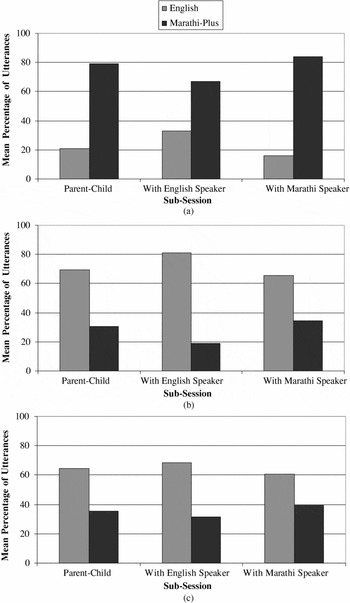
We conducted a repeated-measures analysis of variance with the number of utterances produced in each language (Marathi-Plus, English) as the dependent variable and the following factors: 3 (Session: parent–child alone; parent–child–Marathi Speaker; parent–child–English speaker) × 2 (Children's Age Category: older, younger) × 2 (Speaker: parent, child). There was a significant Session × Language interaction, F (2, 51) = 19.15, p < .01, which was subsumed under a significant Session × Language × Speaker interaction, F (2, 51) = 7.15, p < .01 (see Figure 1). Pairwise comparisons revealed that there were no significant differences in children's use of English or Marathi-Plus across the three sessions; however, there were significant differences across sessions in parents’ language use. Parents used significantly more English in the parent–child alone session than when the Marathi speaker was present (p < .05), and they also used significantly more English when the English speaker was present than when the Marathi speaker was present (p < .01). Parents used significantly more Marathi in the parent–child alone session than when the English speaker was present (p < .01), and they also used significantly more Marathi when the Marathi speaker was present than when the English speaker was present (p < .01). These results support our primary hypothesis that parents would model pragmatic differentiation, but that children would not show this sensitivity.
The mean percentage of (a) parents’, (b) older children's (M age = 4;6), and (c) younger children's (M age = 3;2) utterances in English and Marathi-Plus for each subsession.

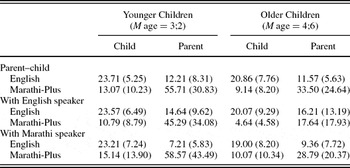
Overall, more utterances were spoken in Marathi-Plus than in English (see Table 1), as revealed by the main effect of language, F (1, 52) = 8.06, p < .01. (This was the only effect that was not significant when the analysis of variance was run with only complete Marathi utterances, rather than Marathi-Plus.) This main effect must be interpreted within the significant Language × Speaker interaction, F (1, 52) = 44.22, p < .01, with children producing significantly more English utterances than Marathi Plus and parents producing significantly more Marathi-Plus than English. Thus, as other researchers have found (Pan, Reference Pan1995; Vedder et al., Reference Vedder, Kook and Muysken1996), parents tend to use the minority language (i.e., their native language), whereas children tend to use the majority language (which many of them are also hearing in preschool). However, there was also a Language × Age Category × Speaker interaction, F (1, 52) = 4.85, p < .05, which generally showed the same pattern as the Language × Speaker interaction, except that parents of the older children used significantly less Marathi-Plus than parents of the younger children, suggesting that these parents may be accommodating to the older children's greater exposure to English.
Mean (standard deviation) number of utterances by age category, subsession, language used, and speaker

Note: Ages are in years;months.
Finally, there were several main effects, including session, F (2, 51) = 5.95, p < .01, such that there was significantly less talk overall with the English speaker present than in the parent–child alone session, probably reflecting parents’ overall tendency to produce fewer English utterances. There was a main effect of age category, F (1, 52) = 8.92, p < .01, with more utterances spoken in the younger children's sessions than in the older children's sessions, and there was a main effect of speaker, F (1, 52) = 11.75, p < .01, with parents talking more than children.
Metalinguistic strategies
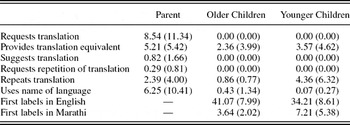
In support of our hypothesis regarding strategy use, parents used a variety of metalinguistic strategies, such as requesting and providing translations (see Table 2). The majority of parents (79%, or 22/28) used at least one strategy, and nearly half (43%, or 12/28) used such strategies on 10% or more of their utterances. The most frequently used metalinguistic strategy was the parent requesting a translation equivalent from the child. As predicted, parents often used the names of the two languages and provided translations. They also repeated translations themselves, and parents rarely requested that the child repeat a translation. Finally, a few parents occasionally suggested translations when the child was trying to remember one, as a hint. Children provided translations and repeated translations, but did not request translations from their parents. Sixty-five percent of parents’ translations were given in Marathi (as opposed to English). Eighty-four percent of children's translations were given in Marathi.
Mean (standard deviation) number of linguistic strategies used by parents, older children (M age = 4;6), and younger children (M age = 3;2)

Note: Ages are in years;months.
To examine developmental changes, we conducted t tests comparing the use of the individual metalinguistic strategies by age group. Younger children repeated translation equivalents more often than older children, t (26) = −2.06, p = .05. However, this may be the result of a nonsignificant tendency for parents of younger children (M = 7.14, SD = 6.44) to provide more translation equivalents than parents of older children (M = 3.29, SD = 3.38), t (26) = −1.98, p = .058. Parents’ use of metalinguistic strategies did not differ significantly by session. Further, there was no relation between parents’ use of metalinguistic strategies and their children's ability to show sensitivity to the bystander's language knowledge.
Parents’ marking of translations in conversation. In order to determine how explicit parents’ use of translations was in conversation, we analyzed whether parents “marked” the translations that they provided. This was done by examining whether parents made an explicit comment regarding the translation prior to providing it (i.e., requesting a translation or using the name of a language) or if they stated it without making any comment, so that children would have to realize themselves that it was a translation equivalent. The analysis showed that 60% of parents’ translations were marked, with 41% of translations to older children and 68% of translations provided to younger children explicitly marked. These results indicate that, similar to parents of monolingual children who explain when they provide multiple English labels for an item (Callanan & Sabbagh, Reference Callanan and Sabbagh2004), bilingual parents also tend to clarify the relationship between the labels in the two languages in this context.
Strategies that elicited children's translations. We also looked at the content of parents’ utterances prior to children's production of translations in order to determine the circumstances under which children are likely to translate. Twenty percent of children's translations were provided spontaneously, without prompting. Eighty percent of children's translations were given in response to parents’ translation requests, as coded above. Of these translation requests made by parents, 67% explicitly used the name of the language they wanted the child to translate a label into, whereas the rest were more subtle in nature. Thus, the majority of children's translations were provided after an explicit prompt from their parent. Parents’ more subtle prompts to translate came in different forms, including questions such as “what else is it called?” or “what do we call it?” when reminding the child of the Marathi label that is used at home.
Parents’ differential use of strategies. Children provided more “first labels” for the pictures in English (M = 37.64, SD = 8.87) than in Marathi (M = 5.43, SD = 4.38), t (27) = 14.43, p < .01. Older children provided significantly more first labels in English than younger children, t (26) = 2.18, p < .05, and younger children provided significantly more first labels in Marathi than older children, t (26) = −2.33, p < .05 (see Table 2). In terms of raw frequencies, parents used a metalinguistic strategy more often after the child first provided an English label for a picture (M = 4.78, SD = 6.41) than after the child first provided a Marathi label (M = 1.25, SD = 1.69), t (27) = 3.01, p < .01, which is not surprising given that most of children's first labels were in English. However, we predicted that the percentage of trials on which parents used a translation strategy would be higher for Marathi first labels than English first labels, as parents would have a bias toward ensuring that children knew the English label for an object (given the status of English as the majority language). Thus, we predicted that parents would be particularly likely to use one of the metalinguistic strategies to elicit or provide the English label if the child gave the Marathi label first. As predicted, the percentage of Marathi first labels provided by children that was followed by a translation strategy (M = 21.43, SD = 26.16) was higher than the percentage of English first labels that was followed by a translation strategy (M = 11.89, SD = 14.23), t (27) = −1.83, p < .05 (one tailed).
DISCUSSION
When learning language, bilingual children must learn to accommodate their conversational partners, ranging from direct addressees to third-person auditors who are not directly spoken to but are nonetheless part of the interaction (Bell, Reference Bell1984). Overall, our findings support our hypotheses that parents model pragmatic language use with their preschool children in the presence of a third party and also engage in metalinguistic conversations that highlight language differences. We will discuss these two research findings in turn.
Pragmatic differentiation
In examining conversations between bilingual parents and children that included a monolingual third person, we found that children did not differentiate in their use of either language across the sessions, despite their parents’ sensitivity to the language capabilities of the bystander. Thus, this difficulty was specifically a developmental problem: the parents made an attempt to ensure that the researchers could follow the conversation, even though neither experimenter participated directly in the conversation. This was not done explicitly; that is, none of the parents said, “Let's use English because [experimenter's name] is in the room,” but rather they used relatively more of her language than they did in the session where they were alone or with the other speaker present. It is possible that parents considered the researchers to be sanctioned participants in the interactions, whereas children did not; this may relate to developments in understanding of social situations more generally, not specifically related to bilingual development. Nonetheless, parents were not overly concerned with the presence of the researcher, or they would have switched their language use completely. Rather, they seem to have been demonstrating a mature pragmatic response to the situation (either deliberately or perhaps even unconsciously), by trying to grant the researcher more access to the conversation than she would have otherwise. Consider, for example, a parent of a younger female participant adjusting her language use by requesting a label for the picture in the bystander's language.
Children could have responded to parents’ accommodation as a form of scaffolding, but they did not match their parents’ language use in this respect. Although children have shown early pragmatic differentiation when speaking directly with a monolingual interlocutor, in this study, they showed no sensitivity to the presence of the researchers. This occurred despite having the researchers’ language use and even physical appearance as cues to their linguistic ability. Further, the children who participated in this study had already completed a task that same day in which they interacted with the researchers directly during free play. During the free-play context, they adjusted their language use according to the researchers’ language preferences (Tare & Gelman, Reference Tare and Gelman2010). This result suggests that the children had particular difficulty accommodating their language use to a third-person auditor. We suspect that children's lack of sensitivity may reflect the lack of direct linguistic feedback from the conversational partner, leading children to be either unaware of the language needs of the third party, or unable to accommodate continually in the situation. Bilingual children's responsiveness to pragmatic cues is positively related to developments in theory of mind (Tare & Gelman, Reference Tare and Gelman2010). Thus, it is possible that children would become more sensitive to a third person's linguistic needs as their general social–cognitive understanding increases. Future research could also examine nonverbal behaviors, such as gaze, to determine the extent to which children ratified the researcher as a participant in the interaction.
Metalinguistic strategies
In this study, we also found that bilingual parents use a variety of metalinguistic strategies to highlight translations for object labels during an everyday task. Parents were not asked to discuss translations or provide multiple labels; nonetheless, the majority of parents (79%) used at least one of the metalinguistic strategies that we analyzed. Further, parents did not use more strategies when a researcher was present than when they were alone with the child, suggesting that metalinguistic talk occurs naturally and not in response to an expectation from a researcher. The primary strategies, which we expected to find, were that parents asked children to provide translations, provided translations themselves, and used the names of the two languages. However, these naturalistic data also provided the opportunity to examine other strategies that parents used, which we coded once we found more than one parent spontaneously using them. These include parents requesting that children repeat the translations that were provided, repeating translations themselves, and even suggesting translations to their children (which were sometimes intentionally wrong so that children would recognize the right one when parents said it). These strategies often focused on translating into the minority language of Marathi but were not necessarily intended to shift children's language use away from the majority language of English, in contrast to parental strategies examined in other studies (Kasuya, Reference Kasuya1998; Lanza, Reference Lanza, Cenoz and Genesee2001). Ultimately, the strategies brought metalinguistic topics to the forefront of the picture book conversation.
We further analyzed the nuances of parents’ and children's talk about translations. When providing translations, parents often explicitly mark that they are providing a label in the other language, suggesting that they may be trying to help children organize their language knowledge. A potential consequence of this explicit talk may be that bilingual children develop language learning biases, such as mutual exclusivity, differently compared to monolingual children (Au & Glusman, Reference Au and Glusman1990).
Another way in which this talk varies is the explicitness of parents’ translation requests. Some parents’ questions were explicit, such as “what is it called in Marathi?”, whereas other questions were more subtle or ambiguous, such as “what do we call it?” or “what else is it called?” We found that children's translations were most often given in response to requests that used the name of the language. This finding is consistent with other analyses of bilingual parent–child conversation showing that children used the parents’ preferred language more after parents used explicit strategies (Kasuya, Reference Kasuya1998). Thus, children may find it easier to successfully translate or switch languages when an explicit cue is provided.
Sociolinguistic factors
In considering sociolinguistic factors that affected the conversations, we found that although the majority of parents’ translation efforts followed children's English labels (because most of children's first labels were in English), the percentage of Marathi first labels that were followed by translation strategies was higher than the percentage of English first labels that were followed by translation strategies. This finding suggests that parents were particularly likely to ensure that children knew the English label for an object. This bias might result from the value that parents place on their children becoming skilled in the majority language of English, which is the language of instruction at school. This result is consistent with the findings of Vedder et al. (Reference Vedder, Kook and Muysken1996), who argued that bilingual families often have a functional differentiation, or “language use connected with particular socialization settings (e.g., the school),” and that parents use the two languages differently according to their perception of what is associated with academic knowledge (p. 464). In their study, lexical categories such as numerals were often spoken in the majority language of Dutch, suggesting that parents may deem it more important or appropriate for the child to learn a particular concept in one of the languages, most likely the majority language (Muysken et al., Reference Muysken, Kook and Vedder1996).
Consistent with what other researchers have found (Kasuya, Reference Kasuya1998; Lanza, Reference Lanza, Cenoz and Genesee2001; Pan, Reference Pan1995; Vedder et al., Reference Vedder, Kook and Muysken1996), parents primarily used the minority language of Marathi (i.e., their native language) in our study whereas children primarily used the majority language, English. The pull of the majority language of English can be seen throughout the study, despite parents’ high rates of Marathi use with their children. Parents showed some bias toward English in that they did not expect children to label pictures in Marathi and even seemed to prefer that children know the labels in English. Parents allowed a bilingual context (Lanza, Reference Lanza, Cenoz and Genesee2001) and children exhibited some tendencies of “passive” bilinguals who understand both languages but mainly speak one of them (Kasuya, Reference Kasuya1998). Thus, children's lack of pragmatic sensitivity may also have resulted from their engaging in a typical conversational pattern of responding to their parents’ Marathi questions in English.
There were also some developmental differences, possibly arising from the influence of children's increasing experience with English-speaking preschools; a greater number of older children attended preschool than younger children. Older children also provided more first labels in English than younger children. Although parents of older and younger children did not differ in how many translations they requested from their children, there was a trend for parents of older children to provide fewer translations and explicitly mark fewer translations, suggesting that both older children and their parents may be accepting more English into their conversational patterns.
These findings support the perspective that sociolinguistic factors affect bilingual parents’ and children's language use, with parents generally preferring to use their native language and children preferring the majority language, particularly as they get older (Fishman, Reference Fishman1991). Nonetheless, parents of both age groups modeled pragmatically appropriate language use and chose to elicit and explicitly discuss translations with their children. This type of conversation may be an important source of information for bilingual children's developing pragmatic understanding and language awareness. Discussion about the nature of the two languages they speak may enhance preschoolers’ understanding that the label for an item is not inextricably tied to the referent, which many researchers have examined in school-aged bilingual children (Bialystok, Reference Bialystok1988; Rosenblum & Pinker, Reference Rosenblum and Pinker1983).
CONCLUSIONS
In the present study, bilingual parents demonstrated pragmatic sensitivity in the presence of a third party, whereas their preschool-aged children did not. This capacity is of particular significance because it reflects knowledge and awareness of the linguistic limitations of the third party, and cannot be due to ongoing linguistic cues or feedback (as the third-party bystander did not continually speak in the interaction). Thus, bystanders provide a particularly valuable method to examine the mechanisms by which bilingual children can (or cannot) demonstrate pragmatic sensitivity. In future research, it would be useful to examine when in development this sensitivity to a third-party speaker emerges.
Of further interest, many of the parents in our sample discussed language differences with their children. It would be very interesting to examine whether preschool-aged children whose parents engaged in more explicit metalinguistic conversation perform better on metalinguistic tasks when they are older. Similarly, parents who adjusted their language use more markedly may have children who show greater pragmatic differentiation later on in development. These findings may provide a technique and first step in investigating how individual differences in bilingual children's experience may affect their pragmatic language use and metalinguistic skills.
APPENDIX A
Example of coding of parent–child conversation excerpt (mother with older male child)
ACKNOWLEDGMENTS
This research was supported by dissertation research grants from the University of Michigan and the journal Language Learning (to M.T.) and NICHD Grant HD36043 (to S.G.). We thank our parent and child participants and Michelle Housey, Ashwini Joshi, and Manasi Khadilkar for research assistance. Portions of this research were presented at the 2008 Triennial Conference of the International Association for the Study of Child Language in Edinburgh, Scotland, and the 2009 Biennial Conference of the Society for Research in Child Development in Denver, CO.