Introduction
Hospital-acquired pneumonia (HAP) is defined as pulmonary parenchymal inflammation caused by pathogens after 48 hours from admission.Reference Modi and Kovacs1,Reference Kalil, Metersky and Klompas2 In this study, HAP is used as an umbrella term that includes both ventilator-associated pneumonia (VAP) in patients with invasive mechanical ventilation and non-ventilator hospital-acquired pneumonia (NVHAP) in non-ventilated patients.Reference Martin-Loeches, Rodriguez and Torres3 While medical technology has continuously improved, various interventional operations and the use of antibiotics, although effective in diagnosing and treating patients, have also brought new challenges.Reference Leone, Bouadma and Bouhemad4 HAP ranks second among nosocomial infections in the United States, with an increased incidence in mechanically ventilated patients, accounting for 25% of all hospital-acquired infections in the ICU.Reference Luyt, Hékimian, Koulenti and Chastre5 Additionally, it accounts for more than 50% of antibiotic use in ICU patients and has a mortality rate of 33% to 50%.Reference Papazian, Klompas and Luyt6 The high proportion of multidrug-resistant bacterial infections in HAP patients complicates antibiotic treatment.Reference Ferrer and Torres7 HAP extends the average hospital stay by 7–9 days and increases medical expenses by approximately 50,000 US dollars per patient.Reference Zaragoza, Vidal-Cortés and Aguilar8,Reference Warren, Medei, Wood and Schutte9 In Chinese hospitals, HAP ranks first among nosocomial infections, with an incidence rate of 1.3%–3.4%, accounting for 29.5%–45.2% of all nosocomial infections, and demonstrates a significantly higher mortality rate than community-acquired pneumonia.Reference Zaura and Twetman10
The oral cavity represents a complex ecosystem where temperature, humidity, and food residues provide favorable conditions for microorganism growth and reproduction.Reference Lyons and Kollef11 Its unique physiological structure makes the oral cavity a potential gateway for pathogenic microorganisms to enter the body, leading to various diseases. Oral care is a crucial measure for maintaining oral hygiene, with cotton swabbing being a commonly used method.Reference Mitchell, Russo, Cheng, Stewardson, Rosebrock, Curtis and Robinson12 Oral care is particularly important for ICU patients, as research has shown that inadequate oral care effectiveness can directly contribute to HAP development.Reference Munro, Haile-Mariam, Greenwell, Demirci, Farooqi and Vasudeva13
While multiple studies have demonstrated the effectiveness of oral care in reducing VAP, particularly in mechanically ventilated patients,Reference Hua, Xie, Worthington, Furness, Zhang and Li14,Reference Shi, Xie and Wang15 fewer studies have examined the relationship between the quality of oral care implementation and HAP outcomes in broader ICU populations. The recently updated Society for Healthcare Epidemiology of America (SHEA) guidelines for preventing HAP and VAP emphasize the importance of oral care protocols,Reference Klompas, Branson and Cawcutt16 but questions remain about optimal implementation strategies and their impact on patient outcomes. This study aims to address this gap by examining how variations in oral care practice compliance affect HAP incidence in ICU patients, providing evidence to support the development of more effective implementation strategies.
Methods
Study design and setting
We conducted a prospective mixed-methods observational study following STROBE guidelines. The research was performed across seven ICUs at the First Affiliated Hospital of Chongqing Medical University, a tertiary care center with 3,000 beds and approximately 130,000 annual discharges, from May 1, 2021, to May 31, 2021.Reference Chick and Wynne17
Research process
Oral care practice assessment
The study participants included nursing staff working in the ICUs. Inclusion criteria were: (1) nursing staff on duty during observation days and (2) willingness to participate in the survey. Nurses were informed that their oral care practices were being observed as part of a quality improvement initiative, which may have influenced their behavior (Hawthorne effect). Observations were conducted by trained quality control specialists from the nursing department who were not directly involved in patient care. The standardized oral care operation procedure is presented in Figure 1. Observations were conducted at standardized time points: 7 am–9 am, 2 pm–4 pm, and 7 pm–9 pm.Reference Quinn, Baker, Cohen, Stewart, Lima and Parise18
The oral care operation procedure.

The standardized oral care protocol included the following components
-
1. Preparation: hand hygiene, patient identification, explanation of procedure to conscious patients, assembly of necessary equipment including oral care packs (containing toothbrushes, 0.12% chlorhexidine mouthwash, suction devices, and moisturizers), large cotton swabs, sponges with suction function, or small cotton swabs depending on the patient’s condition.
-
2. Procedure: positioning the patient (head elevated 30–45 degrees when not contraindicated), moistening the oral cavity, cleaning teeth and gums with appropriate tools, applying chlorhexidine, suctioning as needed, and moisturizing lips and oral mucosa.
-
3. Documentation: recording the procedure, patient’s response, and any abnormal findings.
The observation tools included recording devices and standardized hospital oral care operation evaluation criteria. The evaluation standards comprised three dimensions (before operation, during operation, and after operation), consisting of 17 items in total. Items were scored as either “qualified” or “unqualified,” with higher pass rates indicating more standardized operations.Reference Dale, Angus, Sinuff and Mykhalovskiy19
-A “qualified” care episode was defined as one where all 17 items were performed correctly according to the standard protocol. -“Oral care completion rate” was calculated as the percentage of ordered care episodes that were actually performed. -“Oral care qualification rate” was calculated as the percentage of completed care episodes that were performed according to all standard procedures. -“Item qualification rate” was calculated as the percentage of all evaluated items (across all care episodes) that were performed correctly.
HAP outcome assessment
Patient follow-up began at inclusion and continued for one month. Each patient was included only once in the study. HAP was defined according to standardized criteria: new and persistent alveolar infiltration on chest X-ray after 48 hours of admission, excluding other pulmonary diseases; presence of local infection symptoms or signs (fever, increased white blood cell count, increased pulmonary rales, changes in airway secretions); and positive bacterial findings in respiratory specimens.Reference Torres, Niederman and Chastre20,Reference Klompas, Branson and Eichenwald21 Two independent clinicians (a respiratory specialist and an ICU physician) reviewed each case, and only patients confirmed by both physicians were classified as having HAP. Ventilator-associated pneumonia (VAP) was defined as HAP occurring in patients with invasive mechanical ventilation, while non-ventilator hospital-acquired pneumonia (NVHAP) was defined as HAP in patients without mechanical ventilation.
Data collection and analysis
We collected patient characteristics including age, sex, smoking status, invasive mechanical ventilation status, tracheotomy, invasive operations, consciousness level, APACHE II score, and comorbidities (COPD, hypertension, diabetes). We also collected data on other HAP prevention measures, including head-of-bed elevation, swallowing function assessment, aspiration risk evaluation, and use of acid-suppressing medications. For oral care assessment, we calculated:
-
Oral care order rate = (patients with oral care orders/total screened patients) × 100%
-
Oral care completion rate = (completed care episodes/total ordered care episodes) × 100%
-
Oral care qualification rate = (qualified care episodes/total completed care episodes) × 100%.
Statistical analysis
Statistical analysis was performed using SPSS version 25.0 and R version 4.0.5. Continuous variables were expressed as mean ± standard deviation or median (range) as appropriate. Group comparisons used χ 2 or Fisher’s exact test for categorical variables and Student’s t-test or Mann-Whitney test for continuous variables. The association between oral care practices and HAP incidence was analyzed using univariate and multivariate logistic regression. Variables significant in univariate analysis were included in the multivariate model. We also conducted stratified analyses to examine the relationship between oral care practices and pneumonia outcomes separately in patients with and without mechanical ventilation. Statistical significance was set at P < 0.05.Reference Tablan, Anderson and Besser22
Results
Baseline characteristics of study participants
A total of 58 nurses participated in this study. The nurses’ ages ranged from 23 to 42 years, with a mean age of 31.60 ± 3.25 years. Their working experience ranged from 2 to 17 years, with an average of 8.48 ± 4.08 years. The study included 142 hospitalized patients, of whom 63 received oral care orders. Among these patients, there were 36 (57.14%) males and 27 (42.86%) females, with ages ranging from 61 to 94 years (mean age 75.25 ± 7.78 years). Patients had an average of 7.37 ± 3.85 comorbidities, ranging from 3 to 16 conditions. Table 1 presents the baseline characteristics of patients with and without oral care orders.
Baseline characteristics of patients

Data are presented as mean ± SD or n (%) COPD, chronic obstructive pulmonary disease; HAP, hospital-acquired pneumonia.
Oral care practice assessment
During the observation period, of 142 admitted patients, 63 received oral care orders, yielding an oral care order rate of 44.37%. According to the orders, nurses were scheduled to perform oral care 176 times and completed 109 instances, resulting in a completion rate of 61.93%. The completion rates varied across different ICUs, ranging from 37.50% to 100%, with lower rates generally observed in units with higher patient-to-nurse ratios (Supplementary Table I).
Among the 109 completed oral care instances, the methods used were: oral care packs (54.13%), large cotton swabs (22.02%), sponges with negative pressure suction function (21.10%), and small cotton swabs (2.75%). Of the 67 (38.07%) uncompleted care instances, 19 (28.36%) were scheduled for noon and 48 (71.64%) for night shifts.
Of the 109 completed oral care instances, 59 followed the standard protocol, yielding a qualification rate of 54.13%, while the total item qualification rate was 47.66% (Supplementary Table II). Among the 50 nonstandard care instances, 24 used large cotton swabs, 23 used sponges with negative pressure suction function, and 3 used small cotton swabs, with incorrect order and method.
Nursing staff survey results
We conducted a survey to understand nurses’ perspectives on oral care implementation challenges. Among the surveyed nurses (n = 58), 79.3% acknowledged the importance of oral care for HAP prevention, but 63.8% reported finding the task unpleasant. When asked about barriers to implementation, the most commonly cited reasons were: insufficient time (72.4%), inadequate staffing during night shifts (65.5%), concern about disturbing patient sleep (55.2%), and lack of standardized assessment tools for oral care needs (48.3%). Additionally, 41.4% of nurses reported receiving inadequate training on oral care techniques, and 37.9% expressed uncertainty about appropriate oral care frequency for different patient conditions.
When observed during practice, nurses frequently omitted steps in the oral care protocol. The most commonly omitted steps were: explaining the procedure to the patient (omitted in 43.1% of episodes), checking for adverse effects during care (omitted in 38.5% of episodes), and proper post-procedure documentation (omitted in 35.8% of episodes). Notably, implementation was particularly problematic during the 2am–4am period, with 71.64% of missed care episodes occurring during night shifts.
Association between oral care practice and HAP incidence
Overall, HAP occurred in 37/142 (26.06%) patients. Breaking down by specific groups, HAP developed in 7/25 (28.00%) patients with oral care and mechanical ventilation, 8/38 (21.05%) patients with oral care without mechanical ventilation, and 22/79 (27.85%) patients without oral care.
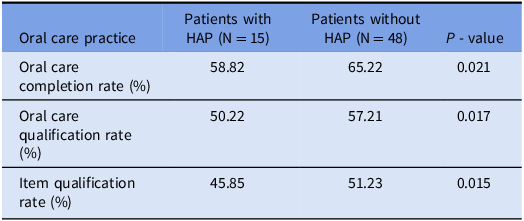
Among the 63 patients receiving oral care, 15 developed HAP while 48 did not. Patients without HAP showed significantly higher rates of oral care completion (65.22% vs 58.82%, P = 0.021), qualification (57.21% vs 50.22%, P = 0.017), and item qualification (51.23% vs 45.85%, P = 0.015) (Table 2).
Comparison of oral care practice in patients with and without HAP

HAP, hospital-acquired pneumonia.
Univariate analysis identified several factors associated with increased HAP risk, including age >75 years, mechanical ventilation, tracheotomy, altered consciousness, COPD, higher APACHE II scores, incomplete oral care, non-qualified care techniques, and inadequate item qualification (Supplementary Table III).
Multivariate logistic regression analysis revealed that incomplete oral care (adjusted OR 2.47, 95% [CI, 1.15–4.45], P = 0.009), non-qualified care techniques (adjusted OR 3.17, [95% CI, 1.45–6.35], P = 0.002), and inadequate item qualification (adjusted OR 3.33, [95% CI, 1.47–6.55], P = 0.001) were independently associated with increased HAP risk, after adjusting for age, sex, smoking status, mechanical ventilation, and comorbidities (Table 3).
Multivariate analysis for the incidence of HAP

In model 1, no confounding variables were adjusted; In model 2, age, sex and smoking were adjusted; In model 3, age, sex, smoking, mechanical ventilation and also morbidities including COPD, hypertension and diabetes were adjusted. OR, odds ratio; CI, confidence interval; HAP, hospital-acquired pneumonia.
Stratified analysis by ventilation status
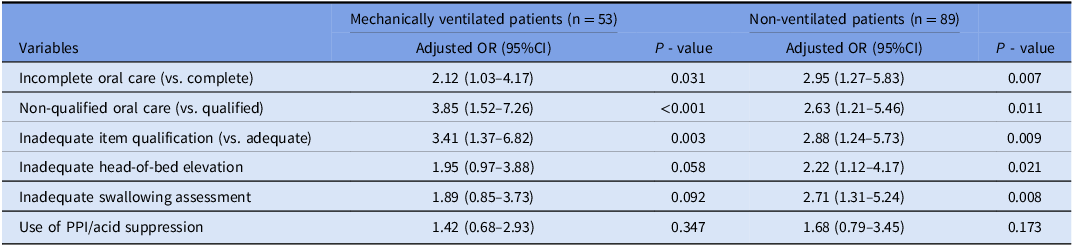
When analyzing VAP (n = 22) and NVHAP (n = 15) separately, similar associations were observed between oral care practice and pneumonia outcomes. In mechanically ventilated patients, non-qualified care techniques showed the strongest association with VAP development (adjusted OR 3.85, [95% CI, 1.52–7.26], P < 0.001). In non-ventilated patients, incomplete oral care was most strongly associated with NVHAP (adjusted OR 2.95, [95% CI, 1.27–5.83], P = 0.007) (Table 4).
Stratified analysis of oral care practice and pneumonia by ventilation status

OR: odds ratio; CI: confidence interval; PPI: proton pump inhibitor.
Additional analysis of other HAP prevention measures showed that failure to maintain head-of-bed elevation (adjusted OR 2.11, [95% CI, 1.08–3.96], P = 0.029) and inadequate swallowing assessment in patients with altered mental status (adjusted OR 2.38, [95% CI, 1.14–4.23], P = 0.018) were also independently associated with increased HAP risk.
Discussion
Our study results demonstrate that the oral care order rate was 44.37%, the completion rate was 61.93%, and the qualification rate was 54.13%. Several factors contribute to the low oral care order rate, including medical staff prioritizing disease treatment over oral care and nurses’ perception of oral care as an unpleasant task as revealed in our nursing survey. Notably, only 54.13% of completed oral care procedures followed standard protocols, with nurse unwillingness accounting for a significant portion of noncompliance.
The period between 2 am–4 am was identified as problematic for oral care delivery, primarily due to patient sleep patterns and insufficient nursing staff. Our survey results indicate that nurses often lack systematic evaluation of patient conditions and oral care needs, instead performing care according to routine habits. This highlights the current absence of comprehensive oral care assessment guidelines in many ICU settings.
“Previous research has demonstrated that while many nurses prefer using toothbrushes for oral care, there is often a lack of standardized brushing techniques.Reference Cutler and Sluman23 This deficiency in standardized protocols, both domestically and internationally, results in inconsistent clinical practices. Although our institution has a standard protocol (as shown in Figure 1), our findings indicate that adherence remains suboptimal, highlighting implementation challenges rather than absence of protocols. Effective oral care, particularly in patients with orotracheal intubation, can significantly improve oral hygiene and reduce HAP incidence by removing dental plaque and debris.Reference Liao, Tsai and Chou24,Reference Feider, Mitchell and Bridges25
Our study revealed important associations between oral care practices and HAP outcomes. The multivariate analysis demonstrated that incomplete oral care, non-qualified care techniques, and inadequate item qualification were independently associated with increased HAP risk. Furthermore, our stratified analysis showed similar associations in both VAP and NVHAP subgroups, suggesting that high-quality oral care is important for all ICU patients regardless of ventilation status. These findings align with previous studies showing that standardized oral care protocols can reduce HAP incidenceReference Garcia, Jendresky and Colbert26,Reference Oliveira, Zagalo and Cavaco-Silva27 and with recent SHEA guidelines emphasizing the importance of oral hygiene in infection prevention.Reference Klompas, Branson and Cawcutt16
Our finding of a relatively high HAP rate (26.06% overall) compared to some published literature may be attributed to several factors. First, our institution is a regional referral center treating more complex patients with multiple comorbidities. Second, we employed clinical diagnostic criteria with evaluation by two independent physicians, which may be more sensitive than surveillance definitions used in some studies. Third, our patient population had a high proportion of elderly individuals (mean age 75.25 years) with multiple risk factors for pneumonia development.
Several limitations of our study should be noted. First, the sample size was relatively small and drawn from a single center. Second, nurses’ awareness of being observed may have positively influenced their practice (Hawthorne effect), potentially resulting in better oral care than typical practice. Third, the definition of complete oral care and qualification metrics may vary with updates in oral care guidelines, necessitating validation in future studies. Fourth, our use of clinical diagnostic criteria for HAP, while evaluated by two independent physicians, may have different sensitivity compared to surveillance definitions used in other studies, affecting comparability of incidence rates.
Our findings have important implications for clinical practice. While most ICU protocols include oral care, our results suggest that simply having protocols is insufficient - the quality of implementation is crucial. The development of evidence-based oral care guidelines, particularly for patients with orotracheal intubation, is crucial. Furthermore, standardization of oral care procedures and regular assessment of compliance may help improve care quality and patient outcomes. Special attention should be paid to patients with altered mental status and neurological diseases that affect swallowing function, as our additional analysis identified these as significant risk factors for HAP development.Reference Grap, Munro and Hamilton28–Reference Ames, Sulima and Yates33
Conclusion
Our investigation demonstrated that oral care practice significantly influences HAP incidence in ICU patients. The current rates of oral care completion and qualification remain suboptimal, highlighting the need for standardized protocols and improved implementation strategies. Future multi-center studies with larger sample sizes are needed to validate these findings and develop more effective oral care protocols.
Supplementary material
The supplementary material for this article can be found at https://doi.org/10.1017/ice.2025.91.
Data availability statement
The data used to support this study are available from the corresponding author upon request.
Acknowledgments
Thanks to all those who helped with the study but were not listed as co-authors due to insufficient contributions.
Author contributions
Fu Ding designed the study. Xiaoqiang Lv wrote the original draft. Jun Yang, Li Wang collected raw data. Li Tong performed statistical and bioinformatics analyses. Fu Ding supervised the study.
All authors have given consent to publish.
Financial support
This work was supported by the Intelligent Medicine Project of Chongqing Medical University (Grant No. ZHYX2019003).
Competing interests
The authors declare that they have no conflicts of interest.
Informed consent
Informed consent was obtained from all patients.
Ethical standards
This study protocol was approved by the Ethics Committee of the First Affiliated Hospital of Chongqing Medical University (no. 2018085cmu), and in accordance with the Declaration of Helsinki.
Informed consent
All patients obtained written informed consent.