1. INTRODUCTION
During the industrial revolution long-established notions and ideas about time were swept away. Factory workers, miners and other blue-collar labourers were forced into a pioneering, incrementally defined, and continuous work schedule enforced by factory horns, timecards and fines for tardiness. Moreover, there emerged within daily life a new rhythm, established by the growing availability of pendulum clocks and pocket watches in the lower tiers of society. Novel horological notions were also spurred on by efficient steamboat and railway connections that eroded age-old assumptions about time and space. Local administrations and national governments eventually joined in such developments, introducing a deluge of time-based provisions, regulations, and laws to order public life. Textbook wisdom holds that this modern, industrial time awareness gained momentum during the late-eighteenth and early-nineteenth centuries with the waning of the sluggish, erratic and sporadic work pace that had characterised the Ancien Régime. Leisure and work became demarcated more distinctively, while festivals and holidays were curbed.Footnote 1
Clearly, this schism between pre-industrial and modern time awareness stems from the work of Edward Thompson. Inspired by classical anthropology, he branded early modern working rhythms and schedules as ‘task-oriented’.Footnote 2 Labourers, farmers, mercers and artisans were not ruled by the clock; rather, they planned their days according to the (piece-) work to be done. Working hours were frequently interspersed with breaks, during which the worker could chat with passers-by and neighbours, run errands, or have a drink in a favourite haunt. Long-case clocks and pocket watches were of minor importance for timekeeping, since lower- and middle-class burghers depended on natural phenomena (dusk, midday and dawn), social events (such as the opening of the city gates, the closing of the market, and the curfew) and religious life (high mass, holy days) to regulate their time.Footnote 3 In recent years, however, these ideas have been called into question by various scholars. Jan de Vries and Hans-Joachim Voth, for example, have suggested that although eighteenth-century people did indeed radically reduce their leisure time and accelerate their working pace, they did so deliberately, in an effort to improve their (market-based) family incomes. Clearly, this hypothesis of the ‘industrious revolution’ begins with the assumption that overall time awareness became more keenly developed as the concept of time evolved, namely, from something vague and intangible into a measurable component of daily life.Footnote 4
Mantel clocks, pocket watches, alarms and other personal timepieces are commonly identified as having triggered the abrupt upsurge in time-related pressures and the intensified pursuit of faster and more effective transportation. Most often, scholars have simply equated this ‘horological’ revolution with heightened perceptions of time in everyday affairs.Footnote 5 Yet, research that can substantiate these basic premises remains sparse. Academic literature has delved into questions concerning cutting-edge inventions, including pendulums and balancewheels, and has discovered then-novel regulations and laws such as the abrupt reduction, in the late eighteenth-century, of superfluous holidays relating to lesser saints' days. Such research, however, has rarely investigated the everyday practice of timekeeping. Few if any attempts have been made to link empirically the slow but marked accumulation of clocks in early modern households to evolutions in time awareness.Footnote 6 Were people in early modern Europe gradually enthralled by the irrevocable fleeting of the hours, minutes and seconds? How did the rapid profusion of mantel clocks, pocket watches and alarms relate to this? Was a finely honed time awareness – brought about by connection with a personal timepiece – an upper-class privilege, or did these advances in time perception bridge the social rifts between rich and poor, men and women, townspeople and peasantry, the lettered and the illiterate?
In seeking to answer these questions, historians have set their hopes upon a miscellany of sources. Memoirs, diaries, intimate letters and other ego-documents can yield highly detailed portraits of individual timekeeping and diurnal chores, yet they suffer from severe social bias. The much-cited writings of Samuel Pepys, for example, provide an overwhelming amount of information about his discernment of time, especially in the author's renderings of his professional work as a senior civil servant, a position that entailed frequent hurrying from one appointment to another. The issue of the representativeness of such works, however, remains open to question.Footnote 7 Other scholars have turned to serial sources such as newspaper advertisements, marriage acts and even birth statistics to describe broader trends and evolutions in early modern time management.Footnote 8 Files of criminal prosecutions have also proven to be reliable sources for unearthing wide-ranging facts and figures about early modern time management, as evidenced in the extensive research of Voth into the minutes of London's Old Bailey court. Delving into myriad testimonies allowed Voth to document some accelerations in late eighteenth-century working rhythms.Footnote 9
In a similar vein, we will endeavour to detail early modern time awareness by using the dossiers of the Hoogere Vierschaer – the administration of criminal justice in Antwerp – to introduce specific evidence to buttress, hone or refute the previously noted dominant hypothesis about the horological revolution.Footnote 10 Dossiers of the customs office, archives of the local clockmakers' guild and probate inventories are helpful for assessing the spread of pocket watches and grandfather clocks in early modern Antwerp.Footnote 11 Until now, most time-based research has centred on England, where the booming economy in the late eighteenth century is generally thought to have sparked a new sense of time and a corresponding craze for mantel clocks, pocket watches and similar devices. Eighteenth-century Antwerp, however, was a city in relative economic decline. Local trades and industries rallied slightly during the Austrian reign, but poverty, unemployment and social inequality rocketed.Footnote 12 Hence, Antwerp was among the least obvious places for a major transformation in time awareness to occur.
Yet, research on local transport services has argued that Antwerp may have indeed witnessed sweeping evolutions in time awareness, despite the unfavourable socio-economic climate of the city. A dense grid of paved, stone-slab roads was laid around Antwerp in the first decades of the eighteenth century, leading to a local enthusiasm for speed and haste unknown to previous generations. New, technologically superior roads allowed reductions in travelling time and increasingly precise departure and arrival times, while also diminishing the impact of seasonal variations on inter-urban transport. Punctual timetables were introduced and observed, and efforts were made to streamline the time spent loading and unloading coaches. Foreign and native travellers, unsurprisingly, preferred these regular, fast and comfortable stagecoaches to old-fashioned tow-boats and carts.Footnote 13 Was it a sign of the times that heavy fines were now regularly imposed upon coachmen who failed to leave on time, squandered precious minutes en route, or arrived late? Were such trends in fact only the most obvious manifestations of a much larger development? Was the obsession with regular and expeditious transportation part of an overall revolution in time awareness, a revolution spurred by a deluge of pocket watches and timepieces?Footnote 14 Such questions invite us to discuss two different research tracks simultaneously. However, it is first necessary to consider the potential advantages and disadvantages of our source material.
2. TIME ON TRIAL: THE PROCEEDINGS OF THE VIERSCHAER AND THE NOTARIS
In the middle of winter 1774, the Antwerp hatter Cornelius Van der Planken retired to the Wildeman, a common alehouse in the Kaasstraat (Cheese Street), to drink some pints of ale with his workmates. During the course of the evening, he fell into a blazing row with a certain individual named Londeneers, whose insults and pestering eventually compelled Cornelius to flee the scene. However, Cornelius and a friend, seeking revenge, later waylaid Londeneers in the dim passageway leading to the inn. Unfortunately for them, Londeneers easily warded off the blows and then stabbed his assailants with a knife. Bleeding profusely, Cornelius fled back into the Wildeman.Footnote 15 Some days later the injured hatter was summoned to the bench. The interrogation was a routine job, as the aldermen and administrative personnel of the Vierschaer handled myriad cases of wounding, manslaughter, burglary, slander, theft, rape and other felonies every year.Footnote 16 Cornelius was first compelled to provide his complete biographical information – his birthplace, age, address, profession and marital status – and was then assailed with countless questions about the crime scene. When had he entered the Wildeman? How many beers had he imbibed before ambushing Londeneers? Precisely what insults had been uttered? How long had he and his comrade waited in the alley? Finally, the testimony was read aloud and Cornelius added his mark. Yet the case was not yet closed, for the judges of the Vierschaer proceeded to call upon a motley crew of witnesses, including various habitués of the Wildeman, the innkeeper, and the barber-surgeon who had stitched Cornelius's wounds.Footnote 17
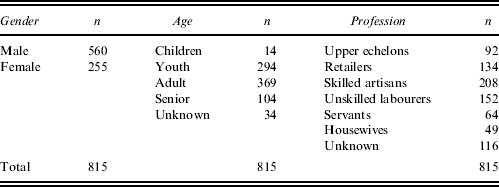
Between 1585 and 1789, the Antwerp Vierschaer summoned thousands of similar witnesses to the bench. Their archived testimonies yield the evidence used in this article to map shifting boundaries of time awareness. In order to do so, three periods were selected (1600–1635, 1700–1735 and 1750–1775), thus drawing evidence from 815 testimonies. All dossiers preserved in the local city archives were scrutinised in detail, save for a small number of cases, barely 5 to 15 per cent in total, in which the timing of the crime was not an issue. Typical cases in this respect involved counterfeiting, fraudulent bankruptcy and illegal printing; in such matters the administrative personnel and judges of the Vierschaer did not focus on issues of timing. For matters concerning manslaughter, burglary, rape, fornication and other serious transgressions, however, they usually urged witnesses to determine, more or less precisely, the time of the event in question.Footnote 18 Taken together, these hundreds of statements made before the Hoogere Vierschaer would seem to offer a clear understanding of early modern time awareness, particularly because the interrogators were keen to detail the timing and duration of the crime. However, prudence remains necessary, for though criminal records enjoy a reputation for stark objectivity and uncommon precision, they nonetheless have serious drawbacks.Footnote 19 For example, there is an element of social bias; the offenders sentenced by the Vierschaer were by no means a representative sample of the Antwerp population, being generally young, male and penniless.Footnote 20 Witnesses, however, were more randomly selected. Magistrates clearly preferred male observers to female, rich above poor, and old versus young, not least because wealth, age and being male enhanced the credibility of a witness.Footnote 21 Of course, such factors did not preclude all sorts of people from being summoned when necessary (Table 1).Footnote 22
Witnesses appearing before the Vierschaer, Antwerp, 1600–1775, by gender, age and profession

Source: Database on time awareness in early modern Antwerp, designed by Gerrit Verhoeven and based upon the dossiers of the Vierschaer in the City Archives of Antwerp (Felixarchief Antwerpen, V 85–123).
Uncouth fishmongers shared the witness box with elegant businesswomen, the elderly with the young, domestic servants with their masters, housewives with employees; moreover, a wide assortment of various relatives, neighbours, colleagues, passers-by and other witnesses could testify.Footnote 23 Unfortunately – and this is a second limitation – the early modern administration of criminal justice operated at a snail's pace. Days, weeks and even months could pass before every witness was heard, the evidence gathered, the suspect interrogated – and, if deemed necessary, tortured on the rack or subjected to similar enhanced interrogation techniques – and the case finally brought to court, during which time witness recollections about the exact timing, sequence and duration of the crime or other relevant events diminished and became less reliable.Footnote 24 For example, while bearing witness about a pub brawl in 1775 the memory of witness Maria Karnou failed, leading the Vierschaer secretary to note peevishly: ‘it (took place) late in the evening, without any remembrance of the exact hour’.Footnote 25 For this reason, certain ‘cold’ cases, in which the questioning of the accused and the hearing of the witnesses occurred over three months after the actual offence, were not considered in this research.
Moreover, it is a cause for concern that we have to assess early modern time awareness by using the proceedings of local aldermen and clerks, whose administration seldom proved meticulous or complete. It was not until the late eighteenth century that an efficient bureaucratic procedure was developed to cross-examine eyewitnesses; this procedure gave short shrift to the informal, slipshod modus operandi used in the seventeenth century. Caution is thus in order when the dossiers appear to provide evidence of linear growth in time awareness. Was there indeed an evolving sense of time, or simply an adjustment in administrative procedures?Footnote 26 It is clear enough that in the early seventeenth century particulars about timing and duration were already considered crucial information in legal proceedings. For instance, during a case in the spring of 1614, the young Antwerp baker Joris de Hout failed to produce an exact timing for his whereabouts, yet the judges and registrars ofthe Vierschaer pressed the point: ‘Could he truthfully state that he had been to a tavern the previous night, specifically between (the hours of) eight and ten?’Footnote 27
This question leads to a final methodological issue. It remains a moot question whether we assess the time awareness of the victims, witnesses and villains brought before the Vierschaer or rather that of the judges and registrars. However, part of the answer lies hidden in the myriad of corrections recorded. Witnesses frequently objected to suggestions as to the timing of events. An illustrative example was Anne Maria Segers, a poor lace worker, who took the stand in 1772 in a case of indecent assault and wounding. When the clerk queried whether she had been present at the crime scene at ‘around eight p.m.’ Anne Maria strongly rebuked him, asserting that it had in fact been ‘rather around half past seven’.Footnote 28 While the questioners of the Vierschaer often settled for imprecise phrasing and favoured hazy modifiers such as omtrent (‘around’) and circa (‘approximately’), eyewitnesses usually offered a (more-or-less) precise timing. Moreover, additional questions were uncommon in this part of the interview, evidence for this being provided by the fact that scrawled notes in the margins, commonly used to register further enquiries and elaborations, were usually missing. Save for certain exceptional cases, time was not considered a crucial onus of proof by the judges of the Vierschaer and such details were thus not particularly investigated. Thus, in these criminal proceedings the issue of timing appears to mirror the perspective of the person being questioned rather than the point of view of the interrogator.
However, the testimony of Anne Maria Segers leads to new questions. What was the basis for the precision and accuracy of her response? Had she been carrying a watch in her pocket? How widespread were these fashionable items in Antwerp? Post-mortem inventories, drawn up by a notaris (notary) and his clerks, can offer a glance behind the front doors of Antwerp. These sources not only reveal the lavish material culture of the city's elite citizens, many of whom dwelled in mansions on the Keizerstraat (Emperor Street), the Sint-Jacobsmarkt, the Meir and other similarly up-market addresses, but also shed light on the much more modestly furnished rooms of townspeople, even those who lived in particularly cramped conditions in cellars and garrets.Footnote 29 Clerks meticulously noted the belongings of men andwomen, literate and illiterate, newlyweds, spinsters and widowers. As a rule, the notary had to be paid to list the goods and chattels of the deceased, but the heirs could spare themselves the cost if the inherited goods proved not especially valuable. As such, the range of these sources is more socially skewed towards the upper classes than are the Vierschaer proceedings.Footnote 30
Besides miscellaneous household goods, some Antwerp inventories also list horloges, that is, timepieces or watches, although it is not always clear which type of object is meant. Virtually all horloges mentioned in the early seventeenth century would have been clocks, yet from 1650 onwards the term can also refer to numerous types of mantel clocks, pocket watches, alarms and other time-keeping devices. Occasionally, a notary exerted a degree of specificity, such as by cataloguing an object as a zakhorloge (a pocket watch), as was first recorded in 1680. For example, it was registered that Elisabeth Moretus, scion of a settled Antwerp family, owned a wekker (alarm clock), as did the priest Marcus Wynants.Footnote 31 Anna Vivien, widow of a bookseller, left a hangende horloge (wall clock).Footnote 32 In general, however, the clerks settled for the more generic label of horloge. In all likelihood the gold and silver horloges recorded in the parlour of the late Elisabeth Cluckers, widow of a chocolate maker, were actually pocket watches. In the sample for 1730, most pocket watches were classified as such, and this holds true for 1780, when the first pendule (mantel clock) also appears. Probate inventories occasionally reveal details about the actual design of the timepieces, such as a zilveren horloge (a silver watch) with schildpadleren cas (a case of turtle leather) found in the estate of Johannes Ludovicus De Carvajal, a prosperous canon in the church of Our Lady.Footnote 33 More often than not, however, the records confront us with hazy entries about indistinct horloges. Hence, to avoid problems of definition, our research has aggregated references to grandfather clocks, alarms, pocket watches and other time devices catalogued in the Antwerp inventories.
In the next section we will bring these two sources – inventories and criminal records – together in an attempt to endorse or refute the hypothetical link between, on the one hand, the spread of pocket watches, mantel and long-case clocks and, on the other, the emergence of a novel time awareness. We first delve into the late eighteenth century; we then endeavour to develop a long-term perspective; and finally we scrutinise certain social variations in clock ownership and time awareness.
3. MEASURING MOMENTS: TIME AWARENESS AND CLOCKS IN LATE EIGHTEENTH-CENTURY ANTWERP
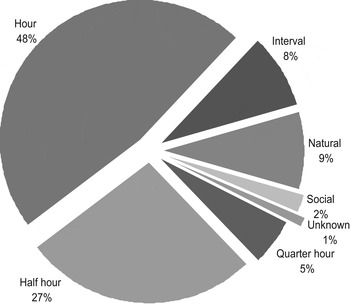
Anne Maria Segers, Cornelius van der Planken and other previously mentioned personages were among the hundreds of witnesses summoned before the Antwerp Hoogere Vierschaer in the late eighteenth century. Not all witnesses were equally accurate or precise in their recollections of the events in question. Some failed even to pinpoint the time of a street brawl, a robbery or a rape, but such people proved rare, barely one per cent of all the witnesses. For example, Elisabeth van Eensbroeck recounted how a certain Quade Griet (‘Bitchy Tart’) had been given a sound thrashing by her neighbours in the summer of 1759. However, she could only stammer hazy answers when asked about the specific time of the event.Footnote 34 More witnesses, about nine per cent, referred to natural phenomena – day break, morning, noon, dusk, evening or nightfall – to situate events in time, and some two per cent of observers used social events – such as the opening or closing of the town gates, morning mass, the market, the post, or the curfew – to situate their testimony. For ages, the humdrum flow of urban life, the stations of the sun, and the weather had aided early modern people in determining their bearings in time,Footnote 35 yet statements based on these and similar notions were now the exception rather than the rule in eighteenth-century legal testimony in Antwerp. As Figure 1 shows, nearly all witnesses called to the bench mentioned a precise point in time.
In 1773 the judges of the Vierschaer inquired into an obscure case of burglary. The matter offers an illustrative example of the remarkably keen time awareness that had developed in Antwerp. In the incident in question, the master tailor Philippus Jacob Gevaerts and his wife had departed, between half past eight and nine o'clock, for their favourite inn to drink beer and – om vrolijck te sijn – to be merry. However, their joy was abruptly tempered after an hour or so, when they learned that someone had broken into their house.Footnote 36 The next day, the bailiff and his men made two arrests. Johannes de Graef, an apprentice, appeared to have an alibi: according to his statement, he had arrived home shortly after nine, eaten some bread and plaice, and then rushed to an acquaintance in the Jan van Lier Street. Witnesses were called to the bench to confirm his story. Petronnela Bessels, a hostess, swore that Jan had ordered a tankard of ale at her inn around half past nine, and Anna Cools claimed to have seen him talking with some neighbours at a quarter past nine sharp – salvo justo. Various other witnesses offered similar time-specific testimonies, helping the registrar and judges to draw a fairly detailed time-line that appeared to acquit de Graef and to implicate the other suspect, the frame-maker Joannes Josephus Kindermans. Kindermans eventually admitted that he had indeed been in the house of the Gevaerts around half past nine, though he claimed that he had merely been searching for some mustard.Footnote 37
Dossiers providing references to exact hours, half hours or quarter hours are abundant in the late eighteenth-century administration of the Vierschaer (Figure 1). Together they provide solid evidence that overall time awareness in Antwerp was far from hazy or blurred, and was in fact clear-cut and precise, even long before the Industrial Revolution had enhanced economic growth in the port city.Footnote 38 Further proof of a highly defined sense of time is found in instances where eyewitnesses were pressed to elaborate on the exact duration of events. Kindermans, for example, provided a rare example of time measurement when he testified that he had stayed barely onderhalven vader (one and a half Paternosters) in the house of the Gevaerts.Footnote 39 Common prayers had long been a popular means by which to measure small amounts of time, but in the eighteenth century most Antwerp townspeople appeared to prefer more specific indications. Vague notions of ‘a while’ were converted into references to the half hour, quarter hour and even smaller units.Footnote 40 For example, on a winter's day in 1750, Adrianus van Camp, a miller, incurred the wrath of the son of his boss. As he testified later, he was flogged with a broomstick and bled profusely for wel ses minute, or no less than six minutes. In 1788, Joannes Laucka, a child abuser from Antwerp, specified an incident of ‘half a minute’ in his statements.Footnote 41
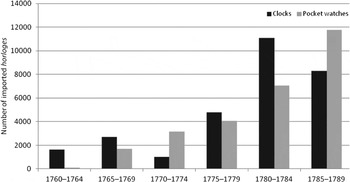
Textbook wisdom holds that these advancements in time awareness were offshoots of a horological revolution that was in full swing in the late eighteenth century.Footnote 42 Ledgers of the custom office of the Austrian Netherlands appear to bolster this hypothesis. In the late eighteenth century, French and Englishpocket watches, mantel clocks, alarm clocks, and a multitude of other timepieces had flooded the Flemish and Brabantine markets, reaching a high point in the 1780s (Figure 2).Footnote 43 The Antwerp clockmakers' guild thrived during this period. According to a population census in 1755, barely 13 households made a living by designing horloges or by repairing and setting them. By 1796 this number had doubled, though the total population had grown only modestly. During the interim clockmakers had been hiring more personnel: 4 servants were employed at mid-century, but their number had risen to 12 (most of whom were female) in 1796. Apparently, the craft afforded ample opportunity to raise one's living standards.Footnote 44
However, the overall impression that clocks and watches abounded in late eighteenth-century Antwerp is belied by household inventories. Although by 1780, the number of Antwerp's citizens who owned a personal timepiece had grown significantly, even at that date only 30.7 per cent of households in the city held such an instrument.Footnote 45 These figures were far from unique. The craze for mantel clocks and pocket watches also swept through London, Paris and Amsterdam in the late eighteenth century, yet actual ownership was not widespread in these places either.Footnote 46
Clearly, most Antwerp townsfolk could easily forego a pocket watch or grandfather clock to keep track of the time, relying instead on public horloges. Indeed, most people were alert to the playing of the carillon of the steeples of Our Lady, Saint Jacob and other churches, the public watch at the Stock Exchange, the tolling of the bells of the city gates, and the profusion of long-case clocks in inns, boutiques à la mode and workplaces. Some public clocks were established in the late Middle Ages, but most dated from the sixteenth century. Carolus, the largest bell of the cathedral of Our Lady, rang hourly, while the smaller bells chimed at the quarter and half hours, thus providing local townspeople with audible time references.Footnote 47 Files of the Vierschaer appear to bolster this hypothesis, as the majority of witnesses referred to public clocks rather than to private horloges when identifying the basis for their clear-cut sense of time. Called to testify in a case of manslaughter, the Antwerp weaver Jasper de Meulder averred that he had left the crime scene in an inn at quart voor tien uren (a quarter to ten) seggende dat het clocxken nogh niet en luijdende (when the curfew had not yet sounded).Footnote 48 In this respect, Antwerp proved no exception to the general rule, namely, that time awareness in early modern Europe remained deeply embedded within the urban soundscape.Footnote 49
4. FROM TIME TO TIME: ABRUPT REVOLUTIONS OR SLOW-BURN EVOLUTIONS (1585–1789)?
Long before the Industrial Revolution Antwerp townspeople were thus blessed with a markedly grounded and reliable sense of time. Nonetheless, the question of how this originated remains open. Were the seeds of this pioneering time awareness sown in the Age of Enlightenment? Should we give the credit to Antwerp's Golden Age (the period between 1490 and 1585 especially), when the city on the Scheldt became the commercial hub of western economies? Opinions on this matter differ greatly throughout the Anglo-Saxon world, where time-based research has been most profuse. David Landes, Edward Thompson and other experts have argued that the late eighteenth century saw revolutionary innovations in time management and time awareness, triggered by a flood of personal clocks, while other scholars such as Paul Glennie and Nigel Thrift point to a series of ‘slow-burn’ evolutions that originated in the late Middle Ages.Footnote 50 Files of the Vierschaer can again provide valuable clues to answer these questions, particularly as they bridge more than three centuries of criminal jurisdiction. First, we will use these sources to establish an overview. In examining evidence from the early seventeenth century, we aim to outline the long-term evolution of time awareness. This evolution will – in the second part of this section – be compared with evidence from the notarial post-mortem inventories (see above) to investigate whether evolutions in time awareness were keeping pace with fundamental changes in clock ownership.
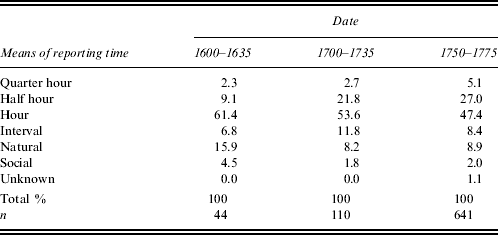
Looking to the early seventeenth century, it seems clear that time awareness – though slightly less precise and clearly defined than it would be a century later – was far from hazy or blurred (Table 2). A higher number of witnesses – around 20 per cent – employed natural or social phenomena to orient themselves in time, yet most people who testified already preferred to cite exact hours or time intervals. The testimony of François Peters, a member of the archers' guild, offers an illustrative example. In 1614, he swore that he had been assaulted while on guard duty ‘ten acht uren oft daer omtrent’, or around eight o'clock in the evening.Footnote 51 Clearly, such finely honed time awareness in Antwerp was not an offshoot of the late eighteenth-century Enlightenment, but had already been developed in the early seventeenth century. The inexactness of time awareness in Antwerp became slowly but surely more refined. In the early eighteenth century, only a handful of townspeople, barely 10 per cent, still referred to social happenings, religious events or natural phenomena to establish their bearings in time. As Table 2 shows, most witnesses mentioned a precise moment, noting an exact hour, half hour or – less commonly – quarter hour. Smaller units of time were also being used more frequently to indicate the duration of events.Footnote 52
Long-term evolution of time awareness amongst Vierschaer witnesses in Antwerp given as a percentage, seventeenth and eighteenth centuriesa

a The growth in the use of quarters of an hour and half hours between the early seventeenth century and late eighteenth century is statistically significant (χ2=10.04), though with a small Cramér's V=0.089 (p=0.02, one-sided).
Source: Database on time awareness in early modern Antwerp, designed by Gerrit Verhoeven and based upon the dossiers of the Vierschaer in the City Archives of Antwerp (Felixarchief Antwerpen, V 85–123).
Bernardus Rottiers, an Antwerp broker, attested that fierce fighting had occurred in his office during the course of an evening in the winter of 1733 – ‘s'avons tusschen seven ende acht ueren’ – sometime between seven and eight o'clock. One of his clients, the respectable notary Leonard Gerardi, had initiated a row with a wealthy merchant, Ignatius Boets, over an unpaid bill. According to Rottiers, when words failed to settle the argument, Gerardi grabbed Boets by the scarf and delivered the merchant a good shaking for ‘een half quartier uers’, half of a quarter hour.Footnote 53 Age awareness evolved in a similar way. Files from the early seventeenth-century Vierschaer provide evidence that most Antwerp townspeople could assess their own age more or less precisely. Few witnesses were inclined to round off their age by favouring decimals, multiples of five, sacred numbers, or even numbers. By the early eighteenth century, even this small tendency towards age-heaping had nearly disappeared.Footnote 54
Even though it remains a moot question whether the waning use of natural and social phenomena to measure time was indeed significant, it is clear that the townspeople of Antwerp had gradually mastered a more sophisticated mode of time awareness.Footnote 55 Hence, dossiers of the late eighteenth-century Vierschaer differ starkly from earlier files. References to quarter and half hours were seldom used in the early seventeenth century, being seen in barely 11 per cent of cases in total; instead, vague concepts such as even (for a moment) and een corte wijle (for a short while) were used to assess brief periods of time. In the first years of the Austrian reign, the use of half hours grew modestly, yet significantly, and quarter hours gained prominence at the close of the Ancien Régime (see Table 2). In short, Antwerp witnessed a series of ‘slow-burn’ evolutions in time awareness rather than any sudden revolution in attitudes to time. Not surprisingly, this tentative conclusion opens a series of new questions. What was the origin or catalyst for this development? Was the evolution of time awareness correlated with the advent of long-case clocks, alarms, pocket watches and other personal timepieces, as is often suggested, or were other devices relevant?
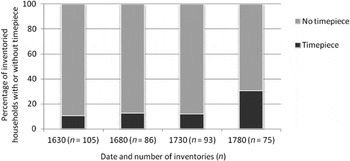
Antwerp notarial deeds and post-mortem inventories date to the late sixteenth century, and thus offer effective material from which to draw long-term evolutions. Clocks, as soon becomes apparent, were scarce in early seventeenth-century Antwerp. Barely 1 in 10 households (10.5 per cent) recorded in the notary files had any sort of personal timepiece at their disposal. However, we must consider the social bias of the sources. Most likely, clock ownership was much more restricted within the overall population than post-mortem inventories seem to suggest. Moreover, these numbers did not appear to rise significantly in the late seventeenth and early eighteenth centuries (Figure 3), even as common ideas and perceptions of time were gradually evolving (Table 2). Quarters, half hours and other such notions gained in importance, though actual possession of personal clocks remained uncommon. It was not until the end of the Ancien Régime that ownership of personal (zak)horloges and pendules rose, from barely 11 per cent to 30 per cent of households, a rise that, not surprisingly, corresponds to an increased number of watchmakers in town.
Nevertheless, it seems unlikely that this evolution – noticeable in France, England and the Dutch Republic as wellFootnote 56 – was, by itself, a decisive factor in finely honing the overall sense of time. Church bells and public clocks, once again, would seem to be more plausible suspects. During the early eighteenth century, Antwerp's local clockmaker was ordered by the aldermen of the city to install a new hand on the horloge of Our Lady to track the minutes and a special bell to mark half hours and quarters. Bills, missives, letters and innumerable other documents are evidence that public timekeeping was a constant concern for the town government.Footnote 57
Mantel clocks, pocket watches and other personal timepieces may not have exerted significant influence on time awareness in any straightforward way, yet it is plausible that they boosted a novel sense of time in a more indirect fashion. As with powdered wigs, snuffboxes, chocolates and a myriad of other new luxuries, horological items, such as expensive mantel clocks, ingeniously constructed alarm clocks and gold-rimmed pocket watches, may well have been little more than fashionable indulgences. Even so, these precious devices, owned almost exclusively by a few fortunate (and wealthy) enthusiasts, would surely have piqued the interest and imaginations of many, at all levels of society.Footnote 58 Personal timepieces were, in this respect, an epitome of deep-seated social desires. People hardly needed to own expensive chinaware in order to drink tea, or hand-painted snuffboxes to enjoy tobacco, silver stationery to sign papers, or a personal clock to keep track of time, yet these and other sorts of exclusive objects nonetheless embodied and provoked social aspirations.
5. THERE IS A TIME FOR EVERYONE: SOCIAL VARIATIONS IN TIMEKEEPING
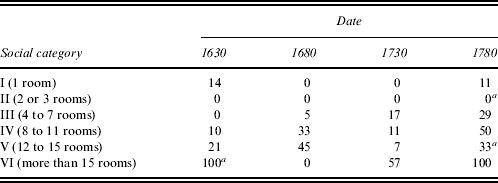
How did a pioneering sense of time – and the ownership of clocks and similar timepieces – reflect wealth, profession, gender, age, domicile and literacy? What were the social dynamics behind the possession of clocks and evolutions in time awareness? Unfortunately, in investigating the Antwerp notary dossiers it proves difficult to assess the wealth of the deceased parties, since taxation rolls, censuses and other financial sources are missing. Hence, we used the number of rooms noted in these household inventories as a rough proxy for the social status of probate inventory testators. This methodology is problematic for several reasons. It was not uncommon for foreign military officers stationed in Antwerp, top-ranking civil servants on secondment and itinerant tradesmen to opt for a one-room apartment, even when they were wealthy enough to rent more luxurious abodes. Save for these anticipated exceptions, the number of rooms in a house was positively linked to wealth.Footnote 59 In Antwerp, mantel clocks, trendy pocket watches and other timepieces were inextricably bound to social rank. During the late eighteenth century, ownership of fashionable horloges gradually filtered down from the higher to the lower rungs of society; however, social differences were not easily neutralised.Footnote 60 On the eve of the French Revolution, clocks were prevalent only in the material culture of the better sorts, whereas people of the lower classes rarely owned a personal timepiece (Table 3).Footnote 61
Percentage of eyewitnesses using different means of reporting time before the Vierschaer, Antwerp, 1750–1775. Note: there were a total of 641 references to time by witnesses.
Key: Hour, half hour, quarter hour: witness mentions exact hour, half an hour, or a quarter of an hour to pinpoint an event in time, e.g. ‘9 o'clock’, ‘quarter past 9’ or ‘half past 9’
Interval: witness mentions a period of time, e.g. ‘between 8 and 9 o'clock’
Natural: witness mentions a natural phenomenon to pinpoint an event in time, e.g. dusk, dawn, noon
Social: witness mentions a social phenomenon to pinpoint an event in time, e.g. opening of the city gates, markets, curfew

Number of horloges imported into the Austrian Netherlands between 1760 and 1789, by five-year periods. Note: over the 30 years a total of 57335 horloges were imported. (Source: Calculations based on National Archives Brussels, Belgium, Court of Finances 5748–5804, Rélévé general des marchandises (1760–1789.)

Percentage of Antwerp probate inventories in selected years, 1630–1780, which indicate that the deceased owned a clock and/or watch (number of inventories=359).

Percentage of households in each social category with horloges, Antwerp, 1630, 1680, 1730 and 1780, where social category is defined by the number of rooms occupied by the household

a Percentage is based on fewer than five cases.
Source: Probate inventory database Bruno Blondé, based upon Municipal Archives Antwerp, Notarial records.
Looking at the values of these precious objects, it is hardly surprising that clocks were anything but widespread in early modern Antwerp. Customs office papers, for instance, indicate that the common price for een gouden zakhorlogie (a pocket watch with a gold case) could easily amount to more than 150 guilders; a silver horloge was worth 30 guilders, and various pendules, wekkers & uerwercken (mantel clocks, alarms and other timepieces) were valued at 12 guilders apiece on average, a considerable price.Footnote 62
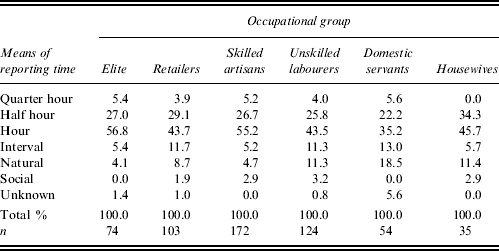
Wealth, however, was not a conditio sine qua non for sophisticated time awareness. Many of the poorest lace workers and cotton spinners, cocklers, costermongers, and fishwives, broom sellers and a great many other people living at the fringes of late eighteenth-century Antwerp society appear to have had a more or less precise sense of time. An especially illuminating example is that of Guillaume Wouters, who in the spring of 1752 was apprehended while attempting to chop down a tree near the city wall. Wouters, a poverty-stricken matchstick seller, was unable to buy firewood to bake bread for his wife and children, and had resorted to stealing it. At trial, he proved illiterate, yet seemed absolutely certain about his own age (36 years old) and about the timing of the theft, which he claimed had been carried out ‘s noenens omtrent één uere, around one o'clock in the afternoon.Footnote 63 The example of Wouters introduces doubt about the assumption that clock-time remained an upper-crust privilege in the early modern period. Those who purchased expensive pocket watches and grandfather clocks, such as moneyed civil servants, merchants, manufacturers and the nobility, might be expected to have enjoyed a more exact sense of time. Moreover, they would have achieved this long before the middling and lower sorts had developed any novel time awareness via the experiences of factory horns, strict timetables and fines for poor timekeeping in the nineteenth century.Footnote 64 However, this hypothesis proves false, for the sense of time was in fact remarkably precise at both ends of the social ladder (Table 4).Footnote 65
Time intervals described by social groups amongst Vierschaer witnesses, Antwerp, 1750–1775, as a percentage of the total responses of each groupa

a When quarter and half hours are grouped as a proxy for time accuracy and all other time measures merged as a residual category, a cross-tabulation with social groups yields insignificant differences only (χ2=8.29; p=0.687).
Source: Database on time awareness in early modern Antwerp, designed by Gerrit Verhoeven and based upon the dossiers of the Vierschaer in the City Archives of Antwerp (Felixarchief Antwerpen, V 85–123).
Coopers, bricklayers, bakers, cobblers, shopkeepers, wigmakers and other members of the middling sorts, though they appear to have been slightly less familiar with quarter and half hours and somewhat more reliant on natural and social phenomena to frame moments in time, nonetheless maintained an overall time awareness that was not remarkably different from the time awareness of the upper classes.Footnote 66 Likewise, the daily lives of domestic servants, housewives, unskilled labourers and pedlars were marked by the passing of minutes, quarter hours, half hours and hours, and the testimonies concerning matters of time of such people proved only a shade less precise than the accounts of the upper class (Table 4). Clearly, deep social rifts – especially those separating upper-class owners of (zak)horloges and pendules from lower-class people who effectively never owned personal timepieces – were virtually absent from everyday time awareness.
A case in point is the extensive file of Anna Maria Sas, who owned an upscale boutique in the Meistraat (May Street). In 1783, she and various other parties were summoned to court to testify about a theft that had occurred in her shop. Anna claimed that she had entered her boutique ‘omtrent tien uere voor noen’ (at ten o'clock in the morning, although the clerk suggested it was nine-thirty), whereupon she discovered that someone had purloined a significant number of handkerchiefs, multiple lengths of cotton and a piece of brocade. Luckily, the labourer working for a nearby tobacco merchant had witnessed the theft while on his break, around half past nine. He had observed, while looking through a window, an unknown woman break into the boutique, while two other women (her sisters, in fact) kept a lookout. Roelans testified that the unidentified woman remained inside for wynighe minuten, only a few minutes. The final witness to testify in the case was a dishevelled lodging-house proprietor, Marie Joseph Brassar, who affirmed that she had rented a room to three foreign girls – spreeckende gebrocken Vlaems op zijn Waels – who spoke with a broad Walloon accent. Around eight o'clock in the morning they had left the boarding house, yet returned after een quartier uers, a quarter hour.Footnote 67 Such testimony clearly suggests that lower-class townsfolk had mastered a clear-cut awareness of time, underpinned not by reliance on expensive pocket watches or mantel clocks, but on their own temporal acuity, such as by simply listening to the carillon of Our Lady, the bells of Mud Gate (Slijkpoort) and the chiming of long-case clocks in boutiques, inns and workshops.Footnote 68
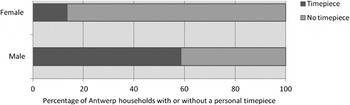
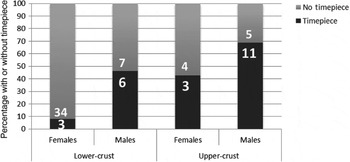
Clock ownership was not only bound to social constraints, but, according to textbook wisdom, was also biased by gender.Footnote 69 Our sample of Antwerp inventories can be subdivided into those households headed by married couples, bachelors and widowers, where a man can be assumed to have been in charge, and those headed by spinsters or widows. Overall, a clear distinction runs through this division,Footnote 70 as significantly more male-headed dwellings owned a mantel clock, pocket watch or alarm, whereas these timepieces were found more rarely in female-headed households (Figure 4).Footnote 71 In order to control for the social composition of our sample, social rank was built in as a control layer. Gendered distinctions continue to appear, even when dividing the households into social categories.Footnote 72 Female households – whether upper or lower class – could more easily forego any personal timepiece, while in both social groups men desired these luxurious items (Figure 5). Clearly, these gendered variations add a new layer of evidence to our main hypothesis that personal timepieces were in fact more often considered sophisticated toys or precious gadgets than much-needed tools for keeping track of time.Footnote 73 Let us, for now, consider the first of these alternatives. Local newspapers certainly appear to indicate that horloges were considered, first and foremost, to be chic and sophisticated gadgets.
Antwerp clock ownership in male- and female-led households (1780). A total of 29 male-headed households and 44 female-headed households were identified, making 73 in all. (Source: Probate inventory database Bruno Blondé, based upon Municipal Archives Antwerp, Notarial records.)

Breakdown of clock ownership in Antwerp, 1780, by gender and social category. Note: the numbers on the columns indicate the number of individuals in each category (73 in total). ‘Lower-crust’ individuals lived in one to seven rooms (social categories I to III in Table 3). ‘Upper-crust’ individuals lived in eight or more rooms (social categories IV to VI in Table 3). (Source: Probate inventory database Bruno Blondé, based upon Municipal Archives Antwerp, Notarial records.)

For example, on 17 February 1730, the Gazette van Antwerpen announced the public sale of an een schoon staende horlogie, a beautiful long-case clock, crafted by Jacques Willmore. According to the advertisement this piece of cutting-edge technology could indicate not only the hour, weekday and month, but also the phases of the moon, solar eclipses, and a great variety of other astronomical details. Moreover, the timepiece was equipped with various chimes indicating the quarter, half and full hours.Footnote 74 When another sophisticated clock by Willmore was sold at auction in the summer of 1730, the advertisement paid tribute to the famous watchmaker and his singular ingenuity.Footnote 75 Clearly, these extraordinary pieces of clockwork – fit for newspaper exposure and public auctioneering – were exceptions rather than the rule. Most horological devices advertised in the Gazette van Antwerpen were praised not for their technological ingenuity, scientific traits or accuracy, but rather for their fine design (een schoon werck) or beautiful appearance. However, these two examples remind us that burgeoning scientific motivations – and life in an increasingly measurable world – would probably have spurred people to buy and display horloges.Footnote 76
Unfortunately, it is difficult to bolster or counter this hypothesis with little more than probate inventories at hand. However, identifying thermometers, compasses and barometers – measurement devices that would seem to embody the novel scientific vogue for studying natural phenomena more accurately – in the inventories can provide further insight into the motivations behind early modern people purchased clocks. In 1730, 93 individuals in Antwerp left a legacy, but only 3 of them, all men, left a barometer, and only 2 bequeathed a clock. François Peter Persijn, a bachelor living in a relatively modest five-room flat, had owned a barometer, an unspecified horloge, and a silver watch.Footnote 77 Jan Baptist Bervoets, an unmarried notary, left a long-case clock and two silver zakhorlogies (one reported as broken).Footnote 78 Fransiscus Ludovicus Vrijlinckx, master in the medical sciences, who had owned a barometer, appeared to have lived without a grandfather clock, alarm or pocket watch.Footnote 79 Several decades later, in 1780, barometers remained exclusive items. Maria Beaufils, an extremely wealthy widow, possessed no fewer than three of these precious instruments, though it is unclear whether she or her late husband had purchased them.Footnote 80 Like Beaufils, the nobleman Joannes Antonius Dubois frequently mingled with the Antwerp elite. Not only had he enjoyed a gold pocket watch, but also scattered throughout the parlours of his mansion were several mantel pieces (pendules), and a barometer was displayed in the best room on the first floor.Footnote 81 Judocus de Ruddere and Carolus Henricus Vallee, bachelors who shared a house in the best quarters of the town, had both a timepiece and a barometer at their disposal. Clearly, some Antwerp individuals were eager to measure all sorts of phenomena, including atmospheric pressure, temperature and time, in a more precise manner. By acquiring various recently introduced instruments for doing so, they followed a more general interest for more accurately assessing, computing and registering measurements. These instruments generally appealed to a small group of single, upper-crust men. As such, it would be unwise to attribute the slow but marked accumulation of mantel clocks and pocket watches amongst this and other social classes exclusively to these limited scientific claims.
In searching for an alternative hypothesis, it is clear that, whereas een zakhorlogie may have been, for some people, a specific albeit rare epitome of a more rational, scientific – not to say modern – worldview, most people are likely to have regarded such items primarily as precious jewellery.Footnote 82 Nearly all pocket watches recorded in Antwerp inventories from the late eighteenth century were made of silver or gold. Only two cases noted other material, probably brass or copper.Footnote 83 Most of these horloges were finished with a silver watch-chain or other costly accessories. For example, the possessions of Catharina Guyot, a noble spinster, included a silver watch, as well as a gold zakhorlogie, decorated with red rubies.Footnote 84 Moreover, the notary and his clerks usually catalogued pocket watches together with other jewels, trinkets and gems found among the goods and chattels of the deceased. In the Gazette van Antwerpen pocket watches were rarely if ever described as curieus (curious), yet advertisements underscored silver or golden materials or highlighted an item's schoon (beautiful) design. Finally, it seems telling that most mantel clocks, alarms and (zak)horloges were displayed in parlours, best rooms and other domestic ‘front-stage’ areas, whereas kitchens and sleeping rooms – places where such timepieces could not only serve as fashionable possessions but also function as highly practical and useful devices – remained empty of such items. Clearly, clocks and watches were considered first and foremost to be items of conspicuous consumption, as possessions that could elegantly embellish the (most often male) owner's attire or the furnishings of a luxurious abode. This was enhancement via the aesthetic rather than the necessary; one's timepiece, though offering a degree of potential utility, was far more a pleasing item of science and refinement rather than a much used, everyday tool.Footnote 85
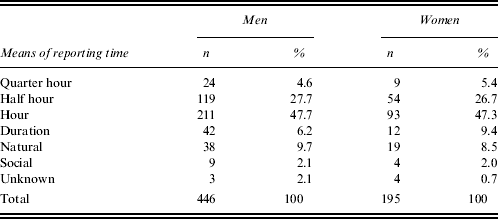
However, in contrast to this gendered and ‘sophisticated’ pattern of timepiece ownership, the above-mentioned case of Anna Maria Sas appears to suggest that in late eighteenth-century Antwerp men and women shared the same finely honed awareness of time; an idea that is substantiated by profuse evidence from the Vierschaer administration (Table 5). Gender was hardly a determining factor,Footnote 86 as most women, young, old, married and unmarried alike, seemed perfectly able to discern what time it was to the last quarter hour. Flemish housewives, like other West European women, were not debarred from public life; they were free to wander the streets, visit places such as the market and the post office, and socialise at the homes of neighbours and in cafés, inns and the like.Footnote 87 Women also took the lead in the booming retail trade, managing beer houses and gin stalls, boutiques à la mode, haberdasheries, greengroceries, dairy shops and fish stalls. Female members figured prominently in the Antwerp mercers' guild.Footnote 88
Time awareness of Vierschaer witnesses, Antwerp, 1750–1775, by gender
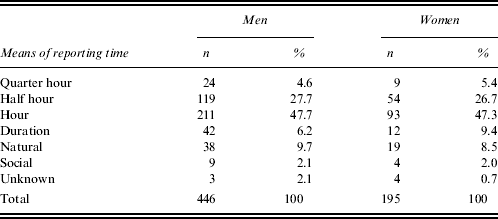
Source: Database on time awareness in early modern Antwerp, designed by Gerrit Verhoeven and based upon the dossiers of the Vierschaer in the City Archives of Antwerp (Felixarchief Antwerpen, V 85–123).
Women were thus trained in everyday timekeeping via the hustle and bustle of urban life. This included doing errands before closing time, catching the stagecoach to Brussels, or simply waiting for the city gates to open. During a criminal proceeding in 1780, the registrar of the Vierschaer recorded testimony about an incident during which an unnamed woman visiting a shop had exclaimed: ‘siet het is by half vijf ende wij moeten noodsaekelijk ten half vijf ievers sijn’ (‘look, it's almost half past five and we need to be somewhere at half past five!’). With a glance at the long-case clock, the woman had then fled the shop, a lace store in Key Street, exclaiming loudly that she had an appointment. Moments later, of course, it was discovered that she had stolen several pieces of expensive lacework.Footnote 89 As this incident illustrates, there were few gender differences when it came to well-developed time awareness.Footnote 90
6. CONCLUSION
It has long been held that over the course of the late eighteenth century, a horological revolution swept Europe. Fashionable pocket watches, mantel clocks, alarms and other time-keeping devices swamped the market and were the catalyst for a pioneering and truly ‘modern’ time awareness. This hypothesis has been reiterated in numerous textbooks, but the current article has endeavoured to present a fresh perspective. By delving into the proceedings of the Antwerp Vierschaer and the notarial records we have tried to refine, and even belie, the heavy-handed technological determinism which holds that the novel time awareness of the period was inextricably bound to the spread of pocket watches, grandfather clocks and other personal time devices. Three revisions to this common perspective can be listed.
First, there was never an actual horological revolution. Time awareness did indeed change in the early modern period but these changes – no matter how important they were – developed as ‘slow-burn’ evolutions rather than as a sudden late eighteenth-century revolution. By the early seventeenth century, Sinjoren (local citizens) measured time predominantly in terms of the hour; they had mastered a time-based mentality which, it is likely, had first emerged during Antwerp's Golden Age or even in the Middle Ages. Files of the Vierschaer contradict the notion of an abrupt deus ex machina modernity, and support the hypothesis of a protracted maturing process of time awareness. As Jacques Le Goff has asserted, this process originally emerged in medieval towns and gradually, over time, time awareness gained in precision, as evinced by increasingly more common references to half hours and quarter hours in the seventeenth and eighteenth centuries.
Mantel clocks, pocket watches and other time devices remained uncommon among the general populace, however, and the chronology of their introduction and eventual broader acceptance into general society did not parallel the recorded changes in time awareness. In examining the meagre and static figures, it seems very unlikely indeed that these scarce (zak)horloges were a decisive factor in the emergence of a novel time awareness. Far more important were the public signals of time: the carillon, the bells at the town gates and at the Stock Exchange, and the many long-case clocks displayed in inns, boutiques and workshops. Clearly, this urban soundscape remained vital even into the late eighteenth century.
Finally, the idea that growing time awareness resulted from a horological revolution is similarly falsified by closer scrutiny of social and gender variations. Mantel clocks, alarms and pocket watches were amassed in the households of the ‘better sorts’ as we defined them above and were predominantly found amongst the belongings of men, yet keen awareness of time did not discriminate between male and female, literate and illiterate, and upper- and lower-class townsfolk. Indeed, the ability of people to converse in terms of half hours, quarter hours and even minutes was rarely, if ever, affected by these differences in material culture. These findings would seem to underscore the lasting impact of public clocks and bells. However, it would be imprudent to close our eyes entirely to more indirect effects stemming from the use of pocket watches, grandfather clocks and other personal timepieces. As has been seen, gold and silver horloges were certainly not prerequisites for someone to effectively mark time, and thus such items probably functioned predominantly as precious ornaments, curious gadgets or miniature toys for an exclusive circle of well-to-do, often unmarried, male city dwellers. While the allure of such horloges may have reached further afield, more research and the use of different sources and approaches will be needed in order to unravel the cultural values that surrounded both evolving time measurement technologies and time awareness.
ACKNOWLEDGEMENTS
We wish to thank our colleagues at the Centre for Urban History (University of Antwerp) for their stimulating comments and suggestions on earlier versions of this text.