INTRODUCTION
This article investigates linguistic diversity, migration, and labour in one particular historical case. The background setting is Finnmark County in northern Norway in the nineteenth century. Situated north of the Arctic Circle, in the northernmost periphery of Europe, and only sparsely populated, the region has been multilingual for centuries. As in other parts of Europe, the nineteenth century was an era of major social, cultural, and political changes, such as the emergence of nation-states, industrialisation, and rapidly increasing geographical and occupational mobility. Rising nationalism and modernism put diversity and multilingual traditions under pressure.
The article examines the language policies and linguistic and discursive practices surrounding the region's first large industrial enterprise, a copper mine by a remote fjord near today's town of Alta. The British directors of the Alten Copper Works (ACW) recruited a diverse workforce that consisted almost exclusively of migrants: miners and expert workers from southern Scandinavia and Cornwall and, not least, a large number of Kven from northern Finland and Sweden.
For several reasons, the ACW and its mining population are an exciting case for investigating language policies and practices in a historical workplace setting. First, the mine was situated in the multilingual periphery of Scandinavia during a transition period from prenationalist to nationalist politics. Several ethnolinguistic groups had been living multilingually side-by-side. Now, the Norwegian state introduced systematic assimilation policies.
Second, the ACW displays many of the same relationships between capital, workers, state, and community as many mining enterprises today. Because many natural resources are found in peripheral regions, mining requires the mobility of workers, often profiting from social and economic problems in other regions (e.g. Godoy Reference Godoy1985; Bell Reference Bell, Barber and Lem2012; Heller, Bell, Daveluy, McLaughlin, & Noël Reference Heller, Bell, Daveluy, McLaughlin and Noël2016). Typically, the capital is situated somewhere else in the global economy, outside the legislation of the territory where the resources are extracted (Hechter Reference Hechter1975; Ballard & Banks Reference Ballard and Banks2003). As in our case, mining in peripheral regions often involves minorities or indigenous groups (Godoy Reference Godoy1985; Ballard & Banks Reference Ballard and Banks2003). These relationships correlate with centre–periphery relationships and sociolinguistic relations, and they are organised and mobilised in discourse.
Third, in an era of political, cultural, economic, and technological changes, the ACW directors became active policy makers and brokers between national politics, migrant workers, and the surrounding communities. Against the agenda of national politics, they protected their employees from assimilation policies and supported linguistic diversity. With economic success as the primary rationale, their engagement in diversity issues displays manifold ways of positioning. The company knew how to exploit the linguistically diverse situation to their advantage: Maintaining ethnolinguistic diversity among the workers (contrary to national policies) helped them to keep wages down and secure a flexible supply of labourers.
Finally, there is a growing number of studies on workplace multilingualism under the shifting conditions and neoliberal regimes of the late twentieth and early twenty-first century as well as a long tradition of research into linguistic minorities. Work and economy have been acknowledged as important domains here (e.g. Fishman Reference Fishman1991), but we know little about the impact of economic activities and labour in such sociolinguistic contexts. Since a major part of the historical correspondence and other documents have been preserved, the case of the ACW offers a great opportunity to extend the view on historical workplace multilingualism and to investigate the role of labour in the face of greater language political shifts.
In my approach, I focus on three central aspects of the relationship between multilingualism and society: language practices, the management of language and diversity, and attitudes and stances vis-à-vis these. I relate these to the relationships between capital, state, and community, which seem pivotal in mining contexts (Ballard & Banks Reference Ballard and Banks2003).
Language was a central means of social organisation and articulation in the there-and-then historical settings; but it is also the channel through which we as researchers engage with historical conditions (Fabian Reference Fabian1971). I build my argument first and foremost on original letters from the ACW's directors and administrators. Accessing these historical texts requires a critical awareness of the processes of genesis (Nevalainen & Raumolin-Brunberg Reference Nevalainen, Raumolin-Brunberg, Hernández-Campoy and Conde-Silvestre2012). This includes both the wider contexts as ‘meaningful conditions for the emergence, production, and exchange’ of discourses (Blommaert Reference Blommaert2005:125–26) and the development of and relations between individual voices, positions, and stances (Fabian Reference Fabian1971; Meeuwis Reference Meeuwis and Blommaert1999).
The article therefore begins with the wider context and gradually narrows down towards such situated, individual stances. It starts with an overview of the historical, geographical, and sociolinguistic contexts necessary for understanding the developments in and around the mine. Next, the case of the ACW is introduced and related to research on language, labour, and resource extraction. The relationships between language and labour, capital, state, and community are then analysed on three levels: (a) multilingual work practices and local organisation; (b) the management of diversity and human resources; and (c) the discursive positioning of company, community, and nation-state within particular intersubjective relations and contextual conditions. I give special attention to the role of the Kven workers as both migrants and a constitutive part of the mining community. The final section draws together the findings of all three levels.
HISTORICAL, GEOGRAPHICAL, AND SOCIOLINGUISTIC CONTEXTS
Finnmark in the nineteenth century has been described as a frontier (Brox Reference Brox1984; Aas Reference Aas1998; Niemi Reference Niemi, Niemi and Smith-Simonsen2009): a borderland region seen as a dynamic territory open to colonisation and new settlements. The region was inhabited by three ethnolinguistic groups: Sámi (about 50% of the population), Kven, and Norwegians (about 25% each) (Niemi Reference Niemi, Niemi and Smith-Simonsen2009). Sámi and Kven are Finno-Ugric languages (and thus significantly different from the Scandinavian national languages). Today, both are endangered. The Sámi are the indigenous population of northern Scandinavia, Finland, and the Russian Kola Peninsula. Though many Sámi were living in the area, only a few became employed by the ACW.
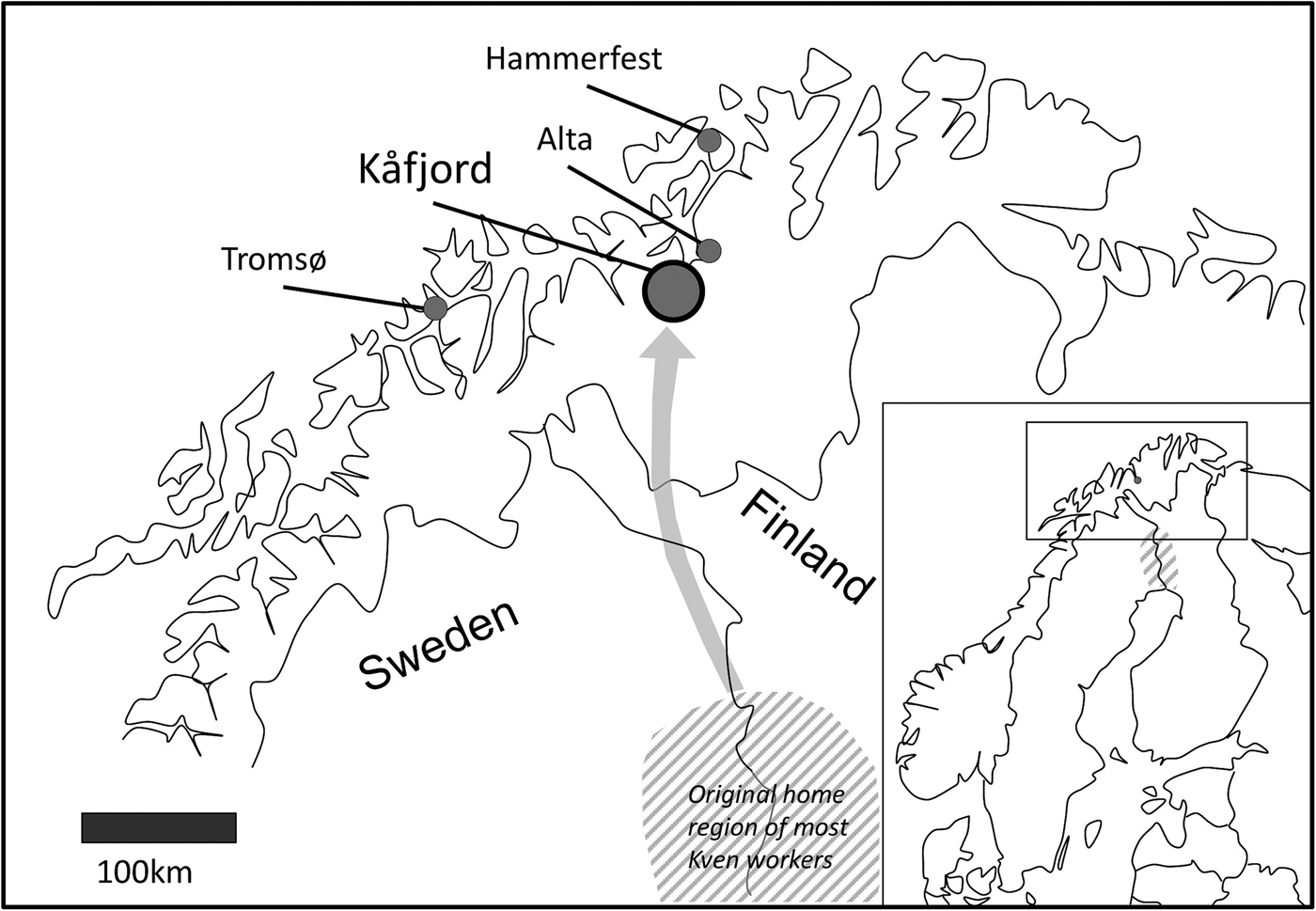
The Kven have their historical roots in present-day northern Sweden and Finland (see map in Figure 1). Kven people had been migrating along traditional tracks to and from the Finnmark coast for centuries. Particularly in the eighteenth and nineteenth centuries, many settled down in the coastal areas (e.g. Niemi Reference Niemi, Niemi, Myhre and Kjeldstadli2003). Norway recognised Kven as a national minority language in 2005. Kven is related to northern Finnish dialects, but has developed independently over time with little contact with the southern centres in Finland. Historical definitions of the Kven differ from today's conceptions of a national minority. The ACW directors described the Kven as “Swedish and Russian Subjects who speak the Finnish language; of which both nations, according to our laws, are similarly foreigners” (see example (8); Finland was part of the Russian Empire).
Northern Norway.

Multilingual development in northern Scandinavia has been described in three main historical stages (Niemi Reference Niemi and Fagertun2008; Huss & Lindgren Reference Huss, Lindgren, Fishman and García2010:261–62): (i) an era of varying traditional multilingualism, (ii) an assimilation period, (iii) and ethnic renaissance. The transition between the first two periods goes hand-in-hand with other political developments: the consolidation of the Norwegian nation-state, which was founded in 1814; the perceived need to protect national borders in the northern periphery (Eriksen & Niemi Reference Eriksen and Niemi1981; Niemi Reference Niemi, Niemi and Smith-Simonsen2009); and the shift from common land ownership through traditional use to internal colonisation and state ownership (Pedersen Reference Pedersen and Eidheim1999). Sociolinguistically, culturally, and politically, these developments were central to the creation of northern Norway as a periphery (Niemi Reference Niemi, Niemi and Smith-Simonsen2009; Pietikäinen & Kelly-Holmes Reference Pietikäinen, Huss, Laihiala-Kankainen, Aikio-Puoskari, Lane, Kelly-Holmes, Pietikäinen and Kelly-Holmes2013); they show many of the economic, political, and social mechanisms of internal colonisation (Hechter Reference Hechter1975). Minorisation and linguistic discrimination of the regional population were part of this process.
In the years before 1860, Norwegian minority politics expressed monolithic and pluralistic perceptions of cultural diversity (Eriksen & Niemi Reference Eriksen and Niemi1981:22–23). Most families pursued traditional livelihoods such as farming, fishing, and reindeer herding. Multilingualism was mainly regulated by practical needs, mobility, and actual contacts. National assimilation policies became effective from the 1860s onwards. Because of their connection to Russian (Finnish) territories, the Kven were considered a threat to the security of the Norwegian nation (Eriksen & Niemi Reference Eriksen and Niemi1981). The school system and, more generally, social and economic pressure were among the most effective tools of Norwegianisation. Norwegian dominated the domains of official life, including workplaces, which gained importance in the people's everyday lives. Under the direct or indirect pressure of the assimilation policies, many speakers of Sámi and Kven gave up their languages (e.g. Huss Reference Huss, King, Fogh and Schilling-Estes2008; Lane Reference Lane2010; Pietikäinen, Huss, Laihiala-Kankainen, Aikio-Puoskari, & Lane Reference Pietikäinen, Huss, Laihiala-Kankainen, Aikio-Puoskari and Lane2010). These macro-social processes, their effects, and instantiations are visible in the immediate surroundings of the ACW.
THE ACW AND ITS ECONOMIC AND SOCIAL CONTEXTS
John R. Crowe and Henry D. Woodfall, both British, founded the ACW in 1826. They had run a trading company in Hammerfest before and were familiar with the local conditions. A major part of the capital was subscribed by investors in London, powerful global players, who also owned mining enterprises in North and Central America (Nielsen Reference Nielsen1990:354). This financial power gave the company a great advantage over local competitors and a strong position vis-à-vis the Norwegian authorities. That the ACW acquired the permission to extract ore in Kåfjord, an ‘entirely deserted area of land consisting of mountains and rocks' (Crowe, quoted in Nielsen Reference Nielsen1990:357, my translation) from the Norwegian government, disregarding local uses and traditions, reveals the typical centre–periphery relationships of internal colonisation (Hechter Reference Hechter1975:33; Pedersen Reference Pedersen and Eidheim1999). The ACW mined copper ore and melted it into copper in Kåfjord until 1878. The mine was reopened by a Swedish industrialist in 1896 and finally closed in 1909. Here I concentrate on the ‘English’ period.
The ore in Kåfjord had a good quality, the surroundings offered plenty of waterpower, and the deposit was close to the fjord—good conditions for profitable exploitation. A major part of the copper was transported to British harbours, and coal for the melting house was shipped from Wales. Recruiting workers was a much bigger challenge. This is typical of many mining enterprises: Mining was labour-intensive and required the procurement of an ample and reliable supply of inexpensive workers (e.g. Godoy Reference Godoy1985), often in remote sites distant from the populated centres (e.g. Ballard & Banks Reference Ballard and Banks2003:288). Recruiting labourers to remote places depends on economic or social problems in other, typically also peripheral, places (Bell Reference Bell, Barber and Lem2012; Heller et al. Reference Heller, Bell, Daveluy, McLaughlin and Noël2016).
Few of the Sámi, Norwegians, and Kven in the area were interested in giving up their traditional livelihood to work in the dark and narrow mine. In the first years, the ACW recruited almost their complete workforce from southern Scandinavia and Cornwall (Drivenes Reference Drivenes1985; Nielsen Reference Nielsen1995, Reference Nielsen1996). To attract miners to the North, they offered higher wages than their competitors. Many worked in Kåfjord for a while, just to return home as soon as they had earned enough money. In January 1833, the directors conceded that these conditions would lead to “absolute ruin to the concern”. Therefore, the arrival of Kven immigrants, escaping from a famine and diseases in their home villages and willing to work for much lower wages, meant an important turning point for the human-resource management and economic wellbeing of the company—which also explains the company's great interest in the Kven. Example (1) shows how the directors evaluated this situation in a report to one of the investors.
-
(1) Our snow is now rapidly disappearing, and we are preparing with some energy to make the most of the summer so that our returns and extended operations may not be probaded, for this purpose, I have engaged and shall continue to engage as many Quans as we can advantageously employ, the difficulty we have hitherto laboured under, and which is inseparably connected with any Enterprise of magnitude in Districts so scantily populated as this but more particulary in an undertaking foreign to the habits of the inhabitants is now fast weaving away, and the probability of our succeeding in creating a mining population in a great measure from among our Quans is placed beyond a doubt—Several families have now settled themselves and more are inclined to do so, and that they take to mining with alacrity, their competing with the Norwegians in the Tut Bargains is a proof—in the settings for this Month there are no less than 22 Quans that have taken, a greater feeling of cordiality likewise exists among them and the Norwegians. (ACW to A.F. Nellen, London, 21 April 1834)
The example expresses the directors' optimism and positive view of the Kven newcomers. It also gives an analysis of the company's situation and the district, as well as the integration of the Kven into the workforce. The new diversity is presented positively, combining competition with a mutual “feeling of cordiality”.
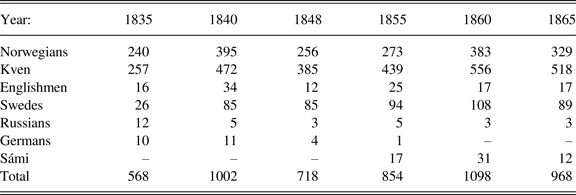
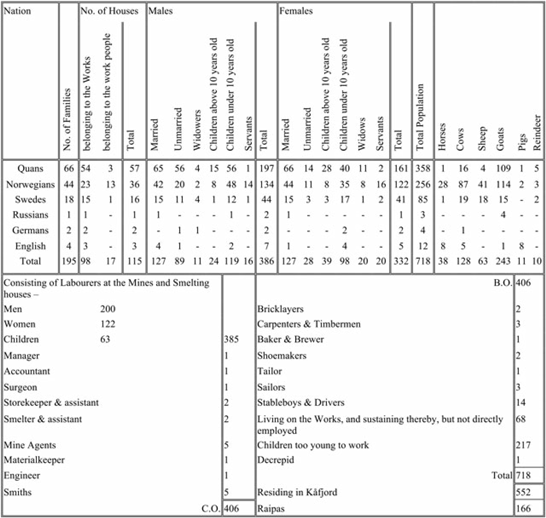
From the early 1830s onwards, Kven workers constituted a major part of the workforce (see Table 1) and made Kåfjord the largest settlement in Finnmark.
The mining population according to the ACW's original reports.

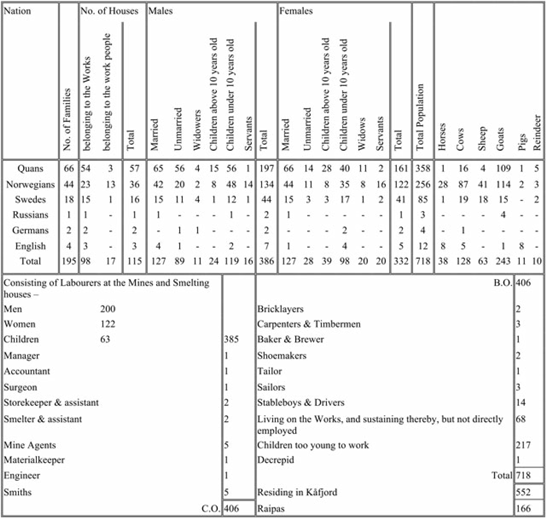
As we see in Tables 1 and 2, the ACW directors categorised their workers according to nations. Nation was typically used for ethnic groups; with rising nationalism, it acquired the connotation of belonging to a nation-state (Niemi Reference Niemi and Fagertun2008:172–73). The category nation is presented prior to the distribution of professions; it even includes the animals kept by the families. In several cases, nation does not coincide with the country of origin. The Kven workers had arrived from Sweden and Finland (which was an autonomous grand duchy under the Russian Empire), but they were not listed as Swedes, Finns, or Russians. The most visible marker of ethnic difference is language. Language is also a central identifier in other contemporary definitions, for example, ‘By Kven, we mean here the same who are called Finns in Sweden, that is, all those who speak the Finlandian or—as it is also called—Karelian language’ (Stockfleth Reference Stockfleth1860:242, my translation). Thus, language was likely an important marker of group distinction in the mining community.
The mining population in 1848 (reproduction from annual report).
Here, the question arises whether the ACW used linguistic differentiation for strategic purposes. Heller et al. (Reference Heller, Bell, Daveluy, McLaughlin and Noël2016) argue that cultural differentiation (rather than treating groups of workers in economic categories) is a strategic tool for companies to break up diverse workforces; in other words, it enhances intra-group relations (making it risky for individuals to abandon group structures) and weakens their bargaining position vis-à-vis their employer.
That the Kven newcomers pushed down the salary level was not appreciated by the other miners (Nielsen Reference Nielsen1996:19–20), which adds economic aspects to the differentiation of groups. The ACW erected a separate Kven settlement on the opposite side of a bay. Nielsen (Reference Nielsen1996:27–28) interprets this as an attempt to prevent conflicts between Kven and Norwegians. However, the original documents do not give a clear explanation. Niemi (Reference Niemi, Niemi, Myhre and Kjeldstadli2003) argues that the foundation of the Kven village was an attempt to offer the (economically valuable) Kven workers ideal living conditions and make them stay in Kåfjord. School education in Kven offered benefits for the Kven families—and it made Kven women available as cheap workers in the mine.
The Kven were treated as an inherent part of the mining population and, simultaneously, as foreigners. The ACW needed a stable workforce, but was also interested in keeping some Kven mobile, as surplus labourers in the busts and boosts of seasonal and economic cycles (Godoy Reference Godoy1985; Heller et al. Reference Heller, Bell, Daveluy, McLaughlin and Noël2016). Being peripheral in the nation-state and in the investors' global networks, the ACW developed into a regional industrial centre. As such, it entered into new centre–periphery relationships with the surrounding communities, especially in the Kvens' home areas, which ensured the supply of workers and competition among them (cf. Hechter Reference Hechter1975:33).
MULTILINGUALISM IN THE MINE
The core material for this study consists of the company's correspondence from fifty-two years of mining operation, archived in the regional state archive in Tromsø. Usually, one of the directors stands as the author, but the handwritings vary. Some documents were likely written by other administrative staff. The files contain fifty to 400 letters in English and Norwegian per year, with an increasing number of Norwegian texts, covering various genres and topics, such as financial transactions, political and legal concerns, and economic and geological reports. I searched the material for texts dealing with language and diversity. Three types of texts attract attention here:
-
(a) Reports to the investors in London. These routine communications typically cover a broad range of issues, including the economic situation, mining operations, and a brief section about the workforce.
-
(b) Letters to authorities and clergymen in the home communities of the Kven workers. Issues of diversity arise here in connection with social welfare issues.
-
(c) Letters to Norwegian authorities and clergymen concerning diversity politics, education, and religion.
The major distinction between these texts is the way they construe the relation between sender and recipient—and how they position (particularly) the Kven workers within this relationship. The texts analysed later in this article are representative of these.
Multilingual practices
The original documents are instances of multilingual written-language practices; and they contain statements about the diversity among the employees. These provide rather indirect insights into multilingual practices. Direct comments about language use at work are rare—because work in the mine was first and foremost physical or because multilingualism was normal in the given geographic and historical context.
The directors used their own multilingual skills to great advantage. Most letters are written in Norwegian or English, depending on the recipients. In either language, they employed elaborate techniques of persuasion and positioning appropriate to the social relations and communicational ends. The use of Norwegian and English side-by-side was key to their management work. Paulaharju (Reference Paulaharju1928:99) mentions that Director Thomas (a successor of Crowe and Woodfall) had learned some Kven. A letter from 1857, in which he orders a Finnish grammar book, might confirm this. Beyond using English and Norwegian, Thomas may have seen a certain value in addressing his employees in their own ethnic language.
The workers in the mine were organised in small groups of four led by one experienced worker. Original documents show that members of all ethnic groups were assigned tasks as group leaders. It would be a likely explanation that the group leaders also functioned as language brokers (e.g. DuBord Reference DuBord2014). Example (2) suggests that during the first years, Kven and Norwegian workers were specialised in different tasks, but in later years Kven workers also specialised in technical mining and became foremen. The distribution of work tasks to different ethnicities likely helped to avoid language problems at the worksite, but it would also have reinforced differences between the groups (cf. van den Born & Peltokorpi Reference van den Born and Peltokorpi2010:103–104 on ethnocentric recruitment and language policies in modern workplaces). Later, workers were also organised in mixed teams (Nielsen Reference Nielsen1995:26).
-
(2) The want of a sufficient number of able & suitable hands is the greatest difficulty we now have to contend with, and it is one owing to our peculiar situation we can only expect to get over progressively. Of late years the Quens or Finlanders come down in considerable numbers, but a small portion of them only become actual miners, they are however far superior workmen to the Norwegians as far as Gross work and common Labour in the Mine goes, but not for actual Boring & Shooting; the some few who have been longer here and in a measure become settled take to Tutwork, on the other hand the Norwegians coming from a Mining District prefer the boring to casual work and are hard working Miners, tho’ generally deficient in judgement and that experience which constitutes a good Miner, we have drawn them from the neighbourhood of Røraas & Foldal and contemplate next spring calling for an additional number, which of course must be limited by the supply that come down from Finland and other circumstances which will always set bounds to the number we employ. (ACW's five-year report, 20 November 1835)
The case of an English miner in example (3), who was dispatched to a business partner in Trondheim, shows that the directors were aware of the communicational skills (and in this case, their pragmatic behaviour) of employees in certain key positions.
-
(3) Mr Netto leaves us by this Steamer, and will of course wait on you—as I have mentioned before, he is a good practical, as well as technical miner, and any report he may hand you, you may fully rely on; he is far, from sanguine, if any thing, for a miner, he is too cautious. How far he would suit you as manager at any of your works is problematical, as he has one very great fault, which I cannot disguise from you, and that is “an unfortunate temper” which little suits the Norwegian character—on all associations of this kind a spirit of harmony and goodwill must exist and be kept up, if a zealous cooperation in the service of the company is to be secured. Having said this much it remains for yourselves to judge of the propriety of engaging him. (ACW to H. Hoe & Co., 4 August 1841)
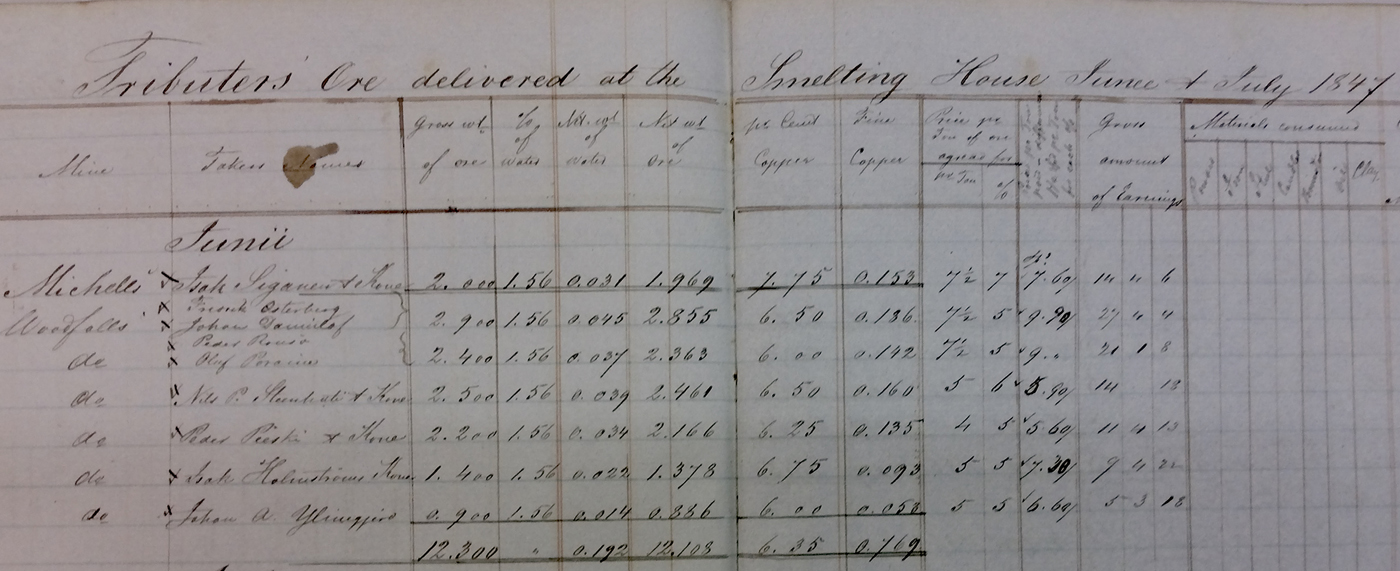
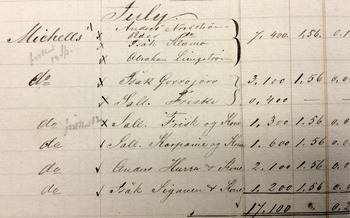
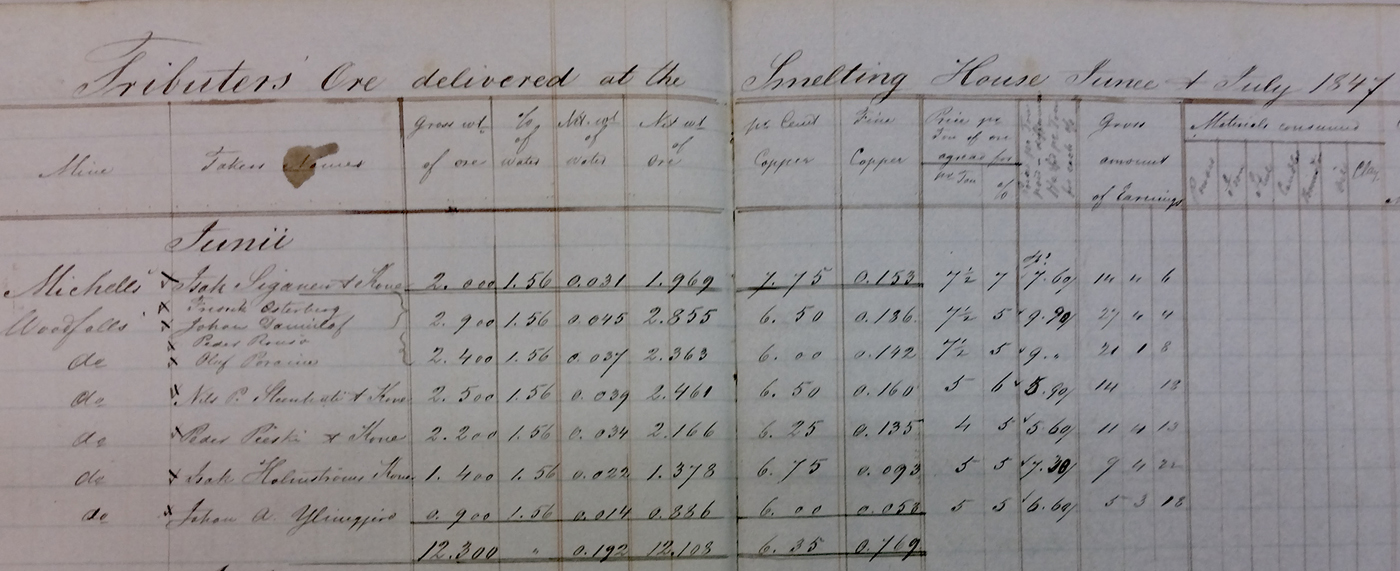
Recommending Mr. Netto for the position of a manager depended not only on his professional expertise but also on his communicational behaviour in the linguistically and culturally diverse workplace. Multilingual skills are not mentioned explicitly, but it is obvious that Mr. Netto communicated with Norwegian-speaking colleagues. Some report lists reveal such a use of English and Norwegian (see Figures 2 and 3).
Ore delivery (heading).
Ore delivery (content).

The overall linguistic frame of these documents is English. While the heading is in English (Figure 2), the name column contains entries in Norwegian such as Sall. Karpaine og Kone ‘Sall. Karpaine and wife’ (Figure 3). Such variation seems to have been a usual practice. Since Karpiaine is a Kven name, we may assume that Sallomon Karpiaine and his wife spoke Kven. A person using Norwegian registered their delivery of ore in an administrative system, the main language of which was English. Similar practices can be observed in the archived correspondence: Headings and administrative notes are written in English; the language of the letters varies according to the addressees. This resembles practices in modern industrial companies—with English as the main administrative language and lingua franca, local languages as means of everyday communication, and blue-collar workers using a variety of other linguistic resources (e.g. Gunnarsson Reference Gunnarsson2014). Often, such practices contribute to the maintenance of hierarchies and competition among the employees (e.g. Angouri Reference Angouri2013; Angouri & Miglbauer Reference Angouri and Miglbauer2014).
Paulaharju (Reference Paulaharju1928:99–101), who interviewed some remaining miners in the 1920s, reports isolated Kven loanwords such as tiikeri (‘steiger, foreman’, from Norw. stiger) and pankkihuone (‘hammering house/room’, from Norw. banke ‘hammer’ and Kven huone ‘house/room’), where especially Kven women separated malmisteini (‘orestone’, from Norw. malmstein) from kroosteini (‘greystone’, from Norw. Gråstein). These are likely outcomes of regular language contact among the workers.
Despite limited information on language use in the mine, the historical documents present a picture of varied multilingual practices. The material does not mention any company policies aiming at language use in work situations.
Managing diversity in the mining community
The question of how and with what purpose the ACW regulated multilingualism and diversity points us to the confrontation of the company's interests with national policies. While Norwegian authorities introduced assimilation policies, the ACW actively supported the linguistic diversity among their workers. These efforts were not aimed at the workplace itself but at the miners' public and private lives.
The directors were in frequent contact with authorities and clergymen about issues concerning education and church services (see also Nielsen Reference Nielsen1995, Reference Nielsen1996; Niemi Reference Niemi, Niemi, Myhre and Kjeldstadli2003). Clergymen, such as Nils Vibe Stockfleth, held a pluralistic conception of culture and wanted to offer Christian education and church services to all parts of the population in their respective ethnic languages. They recruited a Kven-speaking teacher for the workers' children, who was paid by the company. As a consequence, many workers were literate in Kven. This collaboration was not grounded in pure idealism on the part of the company. In a letter to Stockfleth, Crowe was quite explicit about his motives: His argument against assimilation builds upon the view that “the Kven are an eager, effective, industrial and thrifty people” as well as “their advantage in a national economic respect” (quoted in Stockfleth Reference Stockfleth1860:246, my translation).
Crowe maintained that the Kven showed a strong commitment to their own language and traditions (see also example (9)) and that it would be wrong to force them to adopt a foreign language, customs, and traditions. He withheld that the Kvens' rootedness to their home villages was an advantage for the company. As example (4) shows, moving back and forth, the Kven could serve as surplus labourers in the seasonal boost and stagnation cycles. Example (2) mentions also “other circumstances” with an impact on the need for workers. These include geological conditions and the market price for the extracted copper.
-
(4) There is another advantage resulting from the back and forth migration of these Kven that one has not honoured enough till now. The roughness of the climate combined with the shortness of the days reduces the need of workforce during the four winter months. There would arise a difficulty to provide subsistence to a population of workers without work, but the Kven solve this problem themselves, as most of those who have not settled down, visit their home during winter time and return in spring, thereby releasing the district from providing subsistence to an amount of people during a season where the opportunity for gainful employment is difficult. The journey home costs the Works about 1½ Spd. (Stockfleth Reference Stockfleth1860:245, my translation)
The ACW's strategy was twofold. On the one hand, to have them available as workers, they tried to make Kåfjord attractive for the Kven. Protecting them against the pressure of linguistic assimilation, erecting a separate Kven settlement, and offering school education were part of this strategy. On the other hand, it was in the company's interest that the Kven maintained strong connections to their home villages (and returned there when not needed in the works). Norwegianisation was not desirable, because it aimed at cutting the Kvens' roots to their country of origin. In addition, as examples (1) and (9) show, the directors held the view that maintaining diversity ensured an open competition among labourers and a safe supply of affordable workers. Despite such competition, the material does not provide explicit evidence that the company exploited (and therefore supported) linguistic differences to destroy solidarity between the workers (Heller et al. Reference Heller, Bell, Daveluy, McLaughlin and Noël2016). On the contrary, we find descriptions of strategies to “fraternise the different tribes”; example (1) stresses “a greater feeling of cordiality” among the Kven and Norwegian workers. Competition between ethnolinguistic groups of workers was an advantage for the company; but they were aware of negative effects and tried to maintain a balance to ensure an effective production: “I am afraid under any circumstances the competition that would arise between English and Norwegians would be far from having the usual beneficial effect that under other circumstances might be expected” (ACW to W. and H.B. Ward, 23 March 1833). In any case, we see close interrelations between the company's commitment to language policy-making and their management of human capital. The company knew how to use the linguistically diverse situation to their advantage.
A few contemporary reports reveal the impact of the ACW's policies on language diversity in Kåfjord. Friis (Reference Friis1861) noted in his ethnographic map that the mining population in Kåfjord included approximately a hundred Kven families, where few individuals spoke Norwegian, and about thirty Norwegian families where all were capable of speaking Kven. According to Stockfleth (Reference Stockfleth1860), the Kven in Kåfjord had not learned much Norwegian. When school inspector Killengreen documented the progress of Norwegianisation in 1886, he was satisfied with the learning and use of Norwegian in Kåfjord school (Killengreen Reference Killengreen1887:26). The number of Kven pupils at that time was eight (of a total number of twenty-seven). Thus, the closing of the mine in 1878 had a major impact on the linguistic situation in Kåfjord. Besides the national assimilation policies, the emigration of many Kven workers was the main reason for the rapid language shift among the remaining inhabitants. The decline of the mining activities caused a new wave of Kven migration (Nielsen Reference Nielsen1995:346; Niemi Reference Niemi, Niemi, Myhre and Kjeldstadli2003). Many Kven miners found work in Michigan's Copper Country in the US (e.g. Alanen Reference Alanen and Kostiainen2014:59–62).
Discursive positioning and social relations
The ACW managers were also managers of diversity, not only by supporting multilingual school and church services. Diversity management includes who talks about diversity to whom in which way, and to what communicational ends. Let us therefore move from general policy-making to situated stances and diversity management in correspondence between the ACW and representatives of capital, state, and the workers' home communities. With regards to the investors, the ACW had to account for the work progress in the mine; the ACW and representatives of the Kvens' home communities held each other financially responsibe for social welfare payments; and Norwegian authorities pursued the national project while the ACW tried to give direction to state policies and avert negative effects for the Kven workers and the company. The company's relationships towards these differ in terms of roles, power, and accountability. In all examples, the Kven (as a group or as individuals) are part of the letter content. They are positioned in a triangular relation regarding the mutual alignment of writer and addressee, such as sketched in Du Bois's (Reference Du Bois and Englebretson2007) stance triangle (subject 1 – subject 2 – evaluated object) or Östman's (e.g. Reference Östman, Halmari and Virtanen2005) principle of implicit anchoring towards self, interactional relationships, and culture. The discursive positioning of the Kven is thus part of the writer's positioning vis-à-vis the addressee, which involves the given (macro-social) relationships between the ACW and the addressees (including financial and political power and centre–periphery relationships) as well as specific communicational ends, such as accounting and persuasion. The picture of the Kven drawn in these letters must therefore be understood as positioned according to these conditions, stances, and intersubjective relations (cf. Fabian Reference Fabian1971; Meeuwis Reference Meeuwis and Blommaert1999).
Examples (1) and (2), and examples (5) through (7), are extracts from the ACW's reports to the investors in London. All reflect hierarchical relationships of economic power. The directors in Kåfjord were accountable to the investors for the economic situation in the mine. In these reports, the Kven are presented almost exclusively in economic terms, as human capital. We find collocations with economic terms such as supply (example (2)), advantageously, profitably (example (5)), advantage, afforded, selection (example (6)), and materially increased (example (7)).
-
(5) We have further engaged about a dozen Quains, as we may think we may be able to employ them advantageously now in Cobbing & Spalling and I was unwilling to give too great a check to their finding work here, a considerable number have come down, but many have found employment in the Fishery which promises to be exceedingly productive, these Men can also be discharged should I find we cannot profitably employ them. (ACW to W. and H.B. Ward, 23 March 1833)
The dozen Kven mentioned in example (5) are the first of a wave of immigrants who became employed by the mine. While the directors seem still unsure about their economic value and account for their employment in careful tones, examples (1) and (6) are very explicit about their advantages. This is most visible in the writer's stance-taking: “the difficulties… are fast weaving away” (example (1)) and “I do not despair” (example (6)).
-
(6) We have had a greater number of Quans already come down than we are capable at this moment of employing to advantage. it has however afforded us an opportunity of making a selection, and as soon as the Snow leaves, and we can commence our gross work, we shall progressively engage others, at present there is certainly no appearance of there being any scarcity of hands but rather the reverse, and I do not despair, particularly as many have come down this year with their families, that ultimately we shall be able to form a permanent mining population. (ACW to A.F. Nellen, 22 March 1834)
That the Kven workers emerged as a valuable currency for the directors when aligning their position vis-à-vis the investors, becomes visible in their accounts of undesired developments. In example (7), the writer has to explain a delay in work progress (caused by bad weather, an epidemic, and the death of two workers). Expressions of affective and evaluative stance (including valuable, harassed, fortunately, great hopes) address economic responsibilities, rather than the miserable situation of the workers (and there is no mention of the fate of women or children). In practice, the workers are presented as material resources. The Kven are presented as part of the solution, which is important for the writer's position because it mitigates his responsibility.
-
(7) Altho’ I say we are in full summer activity, we have not yet been able to turn our attention to Raipas or the discoveries beyond Mancurs. these lodes are situated so much higher than the scene of our main operations, that it is some weeks later before we can begin there, but this is not the sole cause, we have of late had so many of our men sick, no less than 30 or 40 at a time, and having so much preparatory work on hand, we really could not spare men for either objects altho’ our number have been so materially increased by the Quans that have of late been engaged—my attention however will be given to these valuable points as early as possible, so many of our men being laid up has harassed me not a little, fortunately we have as yet only lost two of our male labourers, and as more settled weather may soon be expected, I am now in great hopes we shall return to our usual healthy state. (ACW to A.F. Nellen, 2 June 1834)
Examples (8) and (9) represent communications between the ACW and representatives of the home communities of the Kven (example (8)) and state authorities (example (9)). The ACW was not economically dependent on any of these. Thus, in both examples, its own economic power becomes a central argument. The reports to the investors follow a routine scheme, building on established relationships. Examples (8) and (9) use explicit metalanguage to position writer and addressee in relation to each other and the particular topic of the letter. In example (8), the company refuses its responsibility for covering social-welfare expenses for Kven labourers and urges the addressee, a parish priest in Sweden, to reimburse these expenses. While the reports to the investors present the Kven workers as a valuable acquisition and a constitutive part of the mining population, example (8) highlights the distance between the company and the Kven. Negative properties of a single Kven person are ascribed to the whole group (lines 19, 24–26). The Kven are also explicitly identified as foreigners (line 6).
-
(8)


The writer shows his negative attitude vis-à-vis the addressee openly (lines 13, 20) and contrasts the ACW's responsible work with the irresponsible behaviour of the community representatives (lines 17–20). The Norwegian miners and local farmers receive a key role in the writer's persuasion strategy (lines 24–26): While lowered wages meant a great advantage for the company, the writer now foregrounds the negative effects for the Norwegian workers—and holds the Kven responsible.
Example (9) is part of the ACW's political engagement with the state authorities. We saw earlier how the directors protected their workers against the impact of state policies (in particular linguistic assimilation). This letter argues against the restriction of the freedom of religion, but the message is the same: “In case of any change in their current freedoms and privileges one must fear [the Kven] would leave the country” (line 14). In his construction of a writer-addressee relationship, the writer plays out economic vs. political power. The Kven are neatly embedded in this relationship.
-
(9)

The writer addresses the state representative in a formally polite way, but with a number of hidden threats (lines 7–9, 19–21). On the surface, he takes an inferior position vis-à-vis the bailiff, but indirectly, he signals that the whole district (including the state authorities) profits from the success of the ACW. The Kven are indispensable for this success (lines 14–18). In comparison to example (8), it is striking how the Kven workers and the ‘locals' are positioned in relation to each other: The Kven are strongly desired and crucially important, while there is little value in the local population (as human capital).
Comparing these texts, we receive a complex and heteroglossic picture of the relations between the company, capital, state, and community. The contrasts between the stances and positioning of social relationships in each text underline the importance of looking into the intersubjective spaces within the greater, historical setting. Each text presents the relevant relations in a multi-voiced manner, positioned according to particular communicational ends. Together, these examples reveal a flexible and strategically adaptable attitude towards diversity and, in particular, the Kven.
DISCUSSION AND CONCLUSION
Briefly summarised, we cannot see that the ACW implemented systematic language policies inside the mine. In the mining community and vis-à-vis the state authorities, the company supported diversity, often with great effort. In discursive practice, the directors show a flexible and strategic attitude towards their linguistically and culturally diverse workforce and the Kven immigrants. They could be positioned flexibly according to the social, political, economic, and intersubjective relations and strategic goals of particular communications.
The case of the ACW reveals close interconnections between the economic interests and policy-making of an industrial enterprise and the political and sociolinguistic development of a multilingual region. The ACW directors were brokers of this development vis-à-vis the community and the nation-state, with their own economic agenda. We can draw a multifaceted picture of the ways economic interests and ethnolinguistic diversity were managed within the relations between capital, nation-state, and community.
In the wider field, the findings can contribute to a more multifaceted picture of workplace multilingualism. The policy practices of the ACW clearly differ from the nationalist monolingual policies historically implemented by, for example, the Ford Company (Hewitt Reference Hewitt, Martin-Jones, Blackledge and Creese2012) as well as the ‘new centrality of language in late capitalism’ (Duchêne & Heller Reference Duchêne, Heller, Duchêne and Heller2012:19), viewing multicultural employees as ‘global business' untapped resource’ (Fitzsimmons, Miska, & Stahl Reference Fitzsimmons, Miska; and Stahl2011).
The flexible management of language and diversity was central to the ACW's management of their workforce. While contemporaries such as Stockfleth (Reference Stockfleth1860; cf. also Nielsen Reference Nielsen1995, Reference Nielsen1996) described the ACW's treatment of their employees as philanthropic, the directors' correspondence with the investors, in particular, assigns to the workers a merely material value in the overall process of production (as analysed and criticised by Marx Reference Marx1867). The overall strategy, it seems, was to ensure as much room for manoeuvre, flexibility, and access to human resources as possible—for best economic profit. Avoiding strict language policies is a means to ensure flexibility in modern workplaces as well (Angouri Reference Angouri2014).
Two interrelated aspects of the relationships between company, community, and nation-state are important: the (potentially conflicting) interests of the nation-state and capital and the dynamics of centre–periphery relationships. Duchêne & Heller (Reference Duchêne, Heller, Duchêne and Heller2012) sketch a shift from national pride to economic profit in late capitalism. Our historical case reveals conflicts of interest between rising nationalism and early capitalism. Centre–periphery dynamics existed between the northern periphery and the Norwegian nation-state, between the ACW and the financial centre in London, and between the mine as an industrial centre and the wider region. The peripheral position of the mine made the recruitment of nonlocals necessary for economic success, which created new centre–periphery relationships. The ACW's diversity policies were a strategy for securing a solid and cheap supply of labourers. These policies were in conflict with Norwegianisation, which was mainly a policy of linguistic assimilation and an attempt to secure the nation in the northern periphery. The ACW's connection to the global financial centre changed the balance of the relationship between company and nation-state. These centre–periphery relations are not only part of the wider context; they are linked to sociolinguistic relations, discursively constructed, mobilised, and repositioned in the company's correspondence.
A perspective that takes into account the flexibility and situatedness of practices, policies, and stances within these relations is necessary, because competition, diverging interests, and collaboration occur simultaneously. Discursive positioning and persuasion were important parts of the company's creative engagement in these complex relationships which, in turn, were mobilised in discourse in the pursuit of particular strategic goals.
A prospect for future research is to investigate the reception and recontextualisation of historical cases such as the ACW within the multilingual settings of modern economy. There is no explicit marketisation of the ACW as authentic history (see, for example, Coupland & Coupland Reference Coupland and Coupland2014), but Kven immigration and traditional diversity have become part of a new narrative that seeks to build coherence between modern economic development, mobility, regional tradition, authenticity, and, not least, economic success.