Cardiac anomalies are among the most frequent causes of premature death in patients with congenital malformations. The basic underlying causes of most congenital defects involving the heart remain undetermined, although there are recognized association with some specific genetic defects, such as 22q11 deletion and interruption of the aortic arch,Reference Gelb1 and genetic mutations associated with the Noonan syndrome.Reference Tartaglia, Kalidas and Shaw2
In 1967, Lev and associatesReference Lev, Okada, Kerstein, Paiva and Rimoldi3 reported a higher incidence of blood group B in a small number of African-American children with congenital cardiac disease, primarily those with septal defects and tetralogy of Fallot. As far as we can establish, no subsequent association between ABO phenotype and congenital cardiac disease has been reported. In the current era, particularly given the significant improvements in diagnosis and outcomes for patients with complex cardiac defects who previously died prior to palliation or repair, and were therefore not included in the population studied by Lev and associates,Reference Lev, Okada, Kerstein, Paiva and Rimoldi3 we sought to re-evaluate this purported association.
Methods
After obtaining approval from our Institutional Review Board, we collected data concerning blood groups from patients undergoing cardiac surgery at Children’s Hospital Boston from July, 2000, through December, 2004. Demographic criterions for inclusion in our study included permanent residency in the United States of America, or United States citizenship. We excluded foreign-born patients so as to prevent bias when making comparisons with the normal distribution in the population of the United States of America. The normal pool representing the normal population was taken from the retrovirus epidemiology donor study, which reviewed a population of 3.1 million.Reference Garratty, Glynn and McEntire4
Since there is variability among race and ABO phenotypes, we divided our patients into the same racial and ethnic classification as did those conducting the retrovirus epidemiology donor study.Reference Garratty, Glynn and McEntire4 In addition to examining the relationship of ABO phenotypes and congenital cardiac disease in general, we also examined possible associations with specific lesions, dividing our patients into six anatomic subgroups. These were obstruction of the left ventricular outflow tract, including hypoplastic left heart syndrome, hypoplastic aortic arch, aortic coarctation, interrupted aortic arch, and any left ventricular outflow obstruction involving aortic or mitral valvar abnormalities; variants of tetralogy of Fallot, abnormal arrangement of the organs, including heterotaxy and totally anomalous pulmonary venous return; the group of atrial, atrioventricular, and ventricular septal defects; right ventricular lesions including pulmonary atresia with intact ventricular septum, tricuspid atresia, and other forms of right ventricular hypoplasia; and discordant ventriculo-arterial connections. All patients underwent a cardiac surgical procedure, but we excluded patients who underwent ligation of persistent patency of the arterial duct, those who had intracardiac tumours, and those with congenitally complete heart block or arrhythmias requiring placement of a pacemaker.
Statistical analysis
Prevalence of ABO phenotypes among the general population, the overall population of those with congenitally malformed hearts, and the subgroups were compared using Pearson chi-squared analysis. Two-tailed values of p less than 0.05 were considered statistically significant. Analysis of the data was performed with the use of the SPSS software package (version 15, SPSS Inc. Chicago, IL).
Results
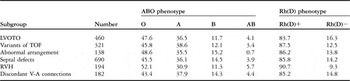
We enrolled a total of 1985 patients, of whom 55% were males. Each patient was included only once, thus avoiding duplication of those undergoing more than one cardiac surgery over the period of our study. We failed to find any significant association for ABO phenotype in the patients with congenital cardiac disease when compared to the general population (p = 0.52, Table 1). Similarly, there were no differences identified by subgroup analyses (Table 2). There was a trend towards higher prevalence of phenotype B in patients with abnormal arrangement of the organs, in those with septal defects, and in those with discordant ventriculo-arterial connections, but these differences did not attain statistical significance.
Distribution (%) of ABO and Rhesus (D) phenotypes in the population of the United States of America (US) and patients with congenital cardiac disease (CCD).

*Garratty G, et al. Transfusion 2004; 44: 703–706.Reference Garratty, Glynn and McEntire4
Distribution (%) of ABO and Rhesus (D) phenotypes according to subgroups of patients with congenital cardiac disease.

Abbreviations: LVOTO: left heart obstructive lesions; TOF: tetralogy of Fallot; RVH: right heart lesions; V-A: ventriculo-arterial.
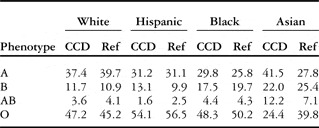
We were able to obtain complete data relating to ethnicity in 1783 (89.8%) of our patients. Some patients had declined to answer the information (listed as “other” in Table 3). Compared to our reference population, there was a higher percentage of whites (76.4% vs. 71.8%) and a lower percentage of Hispanics (6.9% vs. 8.4%), blacks (6.4% vs. 7.6%), and Asians (2.3% vs. 4.1%). The distribution of ABO phenotypes by race is shown in Table 3. The percentages of blacks and Asians with phenotype B were slightly higher in the reference group (19.7% versus 17.5% and 25.4% versus 22.0%, respectively). No differences were detected in rhesus phenotype between those having congenitally malformed hearts and the general population.
Distribution (%) of ABO phenotype for patients with congenital cardiac disease (CCD) and reference group (Ref) according to race.

Discussion
We have failed to find any significant relationship in the distribution of ABO phenotypes in patients with congenitally malformed hearts when compared to a general population within the United States of America. In 1967, Lev and colleaguesReference Lev, Okada, Kerstein, Paiva and Rimoldi3 had reported a higher incidence of blood type B in African-American children with congenital cardiac disease, although the number of patients studied was very small, comprising only 63 patients, race and age were not specified, and the diagnoses were limited to ventricular septal defects and tetralogy of Fallot.Reference Lev, Okada, Kerstein, Paiva and Rimoldi3 As far as we can establish, no subsequent studies have endorsed this purported association. Many of the cardiac lesions included in our study, however, were either not treated, or else the patients died in early infancy, when compared to the lesions included by Lev and his colleagues.Reference Lev, Okada, Kerstein, Paiva and Rimoldi3
As noted, the basic underlying cause of most of congenital cardiac disease remains to be determined. It would be of value, therefore, to demonstrate whether relationships with common phenotypes existed as potential markers for further genetic studies. Since the recognition of the ABO gene, with the subsequent identification of the structure of the alleles and the molecular basis underlying certain polymorphisms, different histo-blood groups have been associated with a variety of infections, diseases, and different types of cancers.Reference Skripal5–Reference Yaghoobi, Rakhshani and Sadr7 Associations have also been noted between ABO phenotype and risk of ischaemic cardiac disease and peripheral vascular disease.Reference Medalie, Levene and Papier8, Reference Meade, Cooper, Stirling, Howarth, Ruddock and Miller9 Further, a relationship between specific coagulation factors and the ABO phenotype has been reported.Reference Gill, Endres-Brooks, Bauer, Marks and Montgomery10 The ABO alleles control three-tenths of the variance in von Willebrand factor levels, those with blood group O have the lowest levels of von Willebrand factor, while those with blood groups B and AB have the highest. The ABO phenotype is also known to affect the levels of factor VIII, which are higher in patients of all groups but O. This correlates with the finding that several thrombotic diseases occur more frequently in patients with elevated levels of factor VIII, and with blood groups other than type O.Reference Meade, Cooper, Stirling, Howarth, Ruddock and Miller9 Patients with congenital cardiac disease are also at increased risk for developing a thromboemolic event especially patients with functionally univentricular physiology and the Fontan circulation. We have earlier reported that such patients with functionally univentricular hearts have an increased level of factor VIII, and therefore may be at an increased risk for developing thromboembolic events.Reference Odegard, McGowan and Zurakowski11 We are currently evaluating whether there is a significant relationship between elevated levels of factor VIII in patients who have undergone the Fontan procedure and have blood groups other than type O.
Our study is limited by the disparity in the size of our sample, and possibly by the population of patients referred to, and treated at, our institution. ABO and Rhesus phenotypes vary with ethnicity and race. Oft quoted frequencies for ABO and Rhesus D phenotypes from organizations such as the American Association of Blood Banks are based on data from pooled populations, and usually do not include details regarding ethnicity, nor citations to verify the source or raw numbers. Another important factor is the changing population of the United States of America due to immigration, causing the proportions of those with different ABO groups to change over time. With this in mind, we chose the retrovirus epidemiology donor studyReference Garratty, Glynn and McEntire4 as our reference population, since it provided a large contemporary data base, with raw numbers of frequencies of ABO and Rhesus phenotypes for donor groups in the United States of America, and included details regarding ethnicity and race. There were slight differences in ethnic distributions in our patients compared to this database, and the numbers in our subgroups were small. There also may be a bias in our population of patients, since we included only those who had serious enough disease to require surgery. We acknowledge there were patients over this time frame who had lesions that did not require surgery, but we did not include this group because our database only included patients in whom the ABO phenotype was known, and who were undergoing cardiac surgery.
Thus, we have shown that the distribution of ABO phenotype does not differ significantly between patients with congenital cardiac disease and the general population of the United States of America, albeit that our study showed a trend towards higher prevalence of phenotype B in those with septal defects, discordant ventriculo-arterial connections, and abnormal arrangement of the bodily organs. It is possible that, with larger samples, and assuming the same percentage of ABO phenotypes, significance could be reached.