Introduction
The years 2013-14 are considered to be the worst for power blackouts in Pakistan, with 16 to 18 hour electricity supply interruptions and the news that the government expects the same trend for coming years (Shahbaz, Reference SHAHBAZ2013). Power producers have occasional electric shut-downs due to capacity constraints or maintenance issues that resulted in a supply and demand gap of up to 4500-5500 MW of the current generation capacity. Inefficient power transmission and distribution systems that cause 23-25% losses contribute to an acute electricity shortage in Pakistan. Moreover, electricity provided by government is very expensive (Rs.12/ unit) due to increased dependence on expensive thermal fuel sources (Private Power and Infrastructure Board 2013). Expensive electricity, poor transmission systems and government subsidies result into a circular debt, thereby worsening the situation.
The power generation projected by the National Electric Power Regulatory Authority (NEPRA) for the financial year 2013-14 revealed that the share of hydel (hydroelectric) was 34%, furnace 35% and gas 23% of total production. The unit energy cost without capacity charges is Rs0.08/KWh, Rs18.25 and Rs5.58/KWh, respectively. This comparison shows that, in the wake of less generation capacity from hydel, reliance is on furnace oil, which causes a significant increase in cost of supply (Khawar Ghumman, 2014). The chronic condition of electricity supplies has severely affected the poultry production industry of Pakistan. The majority of broiler production farms are in rural areas, so they have maximum exposure to electricity load shedding. Pakistani broiler farmers are facing double challenges, firstly, inconsistent supply of electricity from government grids and secondly, higher cost of electricity generation through private diesel generators to meet the shortfall.
Most of the Asian economies are energy deficient and rely on imported energy resources. It is possible for cash-rich economies like China and Singapore to rely heavily on imported energy, but not for Pakistan, which is constantly trying to manage its balance of payment and foreign reserves. Pakistan needs to enhance its power generation capacity by changing its energy mix and mainstreaming renewable energy such as solar power and wind energy. Renewable energy will not only diversify Pakistan's energy mix, but will also reduce dependence on imported fossil fuels, consequently reducing supply interruptions and price fluctuations. Renewable energy is an indigenous, clean and sustainable energy source and can provide electricity in rural areas where conventional transmission becomes expensive. Before 2003, there was no concept of renewable energy in Pakistan; however, the government has now set a target of 5% share of power generations through renewable energies by the year 2030 (Khan et al., Reference KHAN, IRFAN and KHALIL2014).
The poultry production sector of Pakistan has gone through rapid proliferation after the advent of tunnel ventilated, environmentally controlled poultry houses. In a very short time, these houses have replaced conventional broiler farms because of improved health, lower mortality, better feed conversion rate and lower overall production cycle periods. Nevertheless, a continuous supply of electricity is required to operate their automatic feeding, drinking and ventilation systems. Currently, broiler farmers are using private diesel generators to meet electricity needs, but rising global fossil fuel prices and the depreciating local currency are continuously increasing costs. To make broiler meat prices more competitive in local and international markets, broiler farmers need to reduce their electricity costs.
In the literature, one of the first studies was conducted on the potential of solar electric applications for Delaware's poultry farms regarding the feasibility of photovoltaic (PV) systems used in poultry farms (Byrne et al., Reference BYRNE, GLOVER, HEGEDUS and VAN WICKLEN2005). These researchers carried out a feasibility study using a simulation model and testing alternative scenarios and cost conditions. Their study showed that 1.5kW PV solar system for typical Delaware poultry house was economical for the states producers under certain policy scenarios. Bazen and Brown (Reference BAZEN and BROWN2009) analysed broiler production in five different regions in Tennessee, which accounted for about 46% of total production in the state. They investigated not only the economic feasibility of solar PV energy integration, but also the impact of alternative energy programs and other factors in several solar regions within Tennessee's poultry industry.
The utilisation of PV–wind–diesel hybrid energy sources can significantly reduce fuel costs and has positive effects on the system reliability (Karki and Billinton, Reference KARKI and BILLINTON2001). Several authors (Keoleian and Lewis, Reference KEOLEIAN and LEWIS1997; Alsema, Reference ALSEMA1998; Alsema et al., Reference ALSEMA, FRANKL and KATO1998) have discussed the energy requirements of PV solar energy conversion systems and their energy pay-back-time. Wichert et al. (Reference WICHERT, DYMOND, LAWRANCE and FRIESE2001) published an evaluation of technical and economic characteristics of hybrid power systems, and outlined the expected future directions for the development of hybrids. They showed that hybrid systems are in a more favourable position when the cost of diesel fuel transportation is incorporated in the analysis. Studying cost and environmental impacts of such hybrid PV–diesel–battery generator systems compared to other systems is important to diminish global warming problems. Bajpai and Dash (Reference BAJPAI and DASH2012) outlined the foundations for analysis and design of standalone hybrid power systems for poultry production.
Similarly, energy efficiency is another area which requires a combination of technological and organisational efficiency. This paper discusses the technological aspects needed to bring energy efficiency into broiler farming in Pakistan. The following paper firstly analyses solar energy potential, then the poultry production industry's energy needs and lastly the use of solar PV-diesel hybrid solutions for broiler farms to reduce their electricity costs. Such analyses are relevant to other countries facing the same problems in terms of power interruption and spiralling costs for energy.
Solar energy and photovoltaic (PV) prospects for Pakistan
Solar power is one of the most promising renewables. It is more predictable than wind energy and less vulnerable to changes in seasonal weather patterns than hydropower. Whereas generation of power from hydel, wind and geothermal sources is limited to sites where these resources exist in sufficient quantities and can be harnessed, solar energy can produce power at the point of demand in both rural and urban areas (Muneer et al., Reference MUNEER, ASIF and MUNAWWAR2005). Solar energy is comprised of the both thermal energy and photovoltaic (PV). Solar PV is a technology which has been improved over decades-long development, in terms of reduced manufacturing costs and improved performance, under the benefit of sustained policy support, and, as such, it is seen as a prime example (along with wind generating) of a renewable energy technology learning curve (Junginger et al., Reference JUNGINGER, VAN SARK and FAAIJ2010).
Geographic location, long sunshine hours and high insolation levels in Pakistan makes solar power a strong candidate for harnessing energy. The mean global irradiation falling on horizontal surfaces is about 200-250 watt per m2 per day, amounting to 1500-3000 sunshine hours and 1.9 - 2.3 MWh per m2 per year. Daily global radiation up to 23MJ/m2 is available in this region, hence these conditions are ideal for PV and other solar energy applications (Khan et al., Reference KHAN, IRFAN and KHALIL2014) .
Pakistan poultry production and its growing energy needs
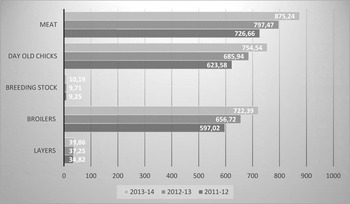
The poultry sector is one of the important and active segments of agriculture in Pakistan. This sector contributed 1.3% in Gross Domestic Product (GDP) during 2013-14 while its contribution in value-added agriculture and livestock stood at 6.1% and 10.8% respectively. Poultry meat contributes 28.0% of the total meat production in the country. The current investment in the industry is more than PKR.200.00 billion. The sector has shown robust growth of 8 to 10% annually, which reflects its inherent potential. Poultry output value has increased from PKR.121.7 billion (2012-13) to 130.7 billion (2013-14) showing an increase of 7.4% as compared to previous years. Commercial poultry production for the last three years is given in Figure 1 (Farooq, Reference FAROOQ2014).
Commercial poultry statistics in Pakistan.
Source: Economic Survey of Pakistan (2013-14), Birds in million, meat in 000's

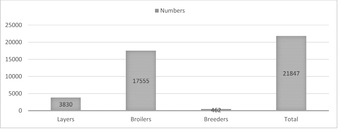
There are about 25000 poultry farms in Pakistan out of which 87% are operating in the most populous and mainly agricultural province of Punjab. As shown in Figure 2, there are 17,555 broilers farms in Punjab alone, the rest are in other areas of country (Livestock, 2014).
Number of poultry farms in the Punjab (2012-2013).
Source: Poultry research institute Rawalpindi, Livestock and Dairy Development Department.

Energy estimation for an environmentally controlled broiler house
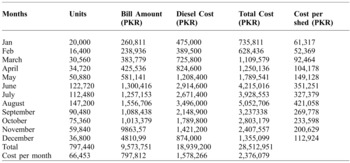
In hotter climates such as Pakistan, where diurnal temperatures can fluctuate widely from day and night, controlling the environment within the poultry house is important to maintaining performance and welfare. Increasing electricity shortage, rising fossil fuel prices and declining solar PV panel prices make it practicable to find PV solutions for broiler farmers in Pakistan. Furthermore, a hybrid solar PV solution is most feasible for broiler farmers as every environmentally controlled poultry house already have more than one generator which could be used at night. Consequently, this can save the cost of purchasing and maintaining deep cycle batteries. The site of Hi-Tech Poultry farms near Lahore was used as an example of an energy audit. There were twelve, double story farms on one location, and data was collected monthly regarding electricity expenditure, including diesel and electricity for one year that is shown in Table 1.
Total cost of electricity for one year.

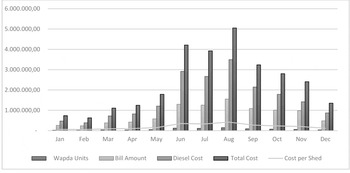
It can be observed from Figure 3 that electricity consumption trend is not linear. In summer, total expenditure on electricity increased to maintain the desired temperature inside poultry house. Consequently, diesel costs also increased due to the increase in load shedding during hot weather. If cost is analysed for one year; 66% of total electricity cost are from diesel whereas 34% cost is from grid electricity, thus, if solar PV electricity replaced diesel generated electricity, the total costs on farm can be reduced.
Electricity expense over a one year period in Pakistan

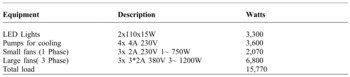
As shown in Table 2, the calculated minimum electricity load for a one double storey shed is 15 KW which needs to be converted to solar. Since farms are not using deep cycle batteries for back up, the hybrid solar solution can provide electricity during daylight when there is maximum load shedding. The dimensions of each shed is 520 feet long and 40 feet wide, and 20 feet in height. A hybrid solar PV solution containing 80 panel mono crystalline modules on stators 30° south including cables, connectors and inverter will cost $ 32,200 or PKR 3,220,000.
Consumption of one double storey poultry house.

In order to calculate payback period, 18% efficient solar panels, i.e. one 30 x 30 cm panel, will produce 16.8 watts, consequently the 15 KW proposed solar PV system requires 900 square feet of solar panels. As shown in Table 3, these panels will produce 2700 KWh (15 KW multiplied by six effective hours of sunlight multiplied by 30 days in a month) every month. If using 10 effective months to calculate payback period, considering cloudy weather and clean out period between flocks, in one year, a solar PV system will produce 27000 KWh from solar energy. Grid electricity tariff for a commercial consumer is PKR 14KWh and, with the addition of 17 percent general sales tax (GST) and 3.5 percent excise duty, this becomes PKR 16.95KWh, which is the highest in the region (Staff Report, 2014). Diesel generators can cost as much as PKR 32 per KWh (Farhan Zaheer, 2012). The average KWh grid tariff and diesel generator costs (PKR.24.50 multiplied by 27000) was used, and resulted in a calculated 4.86 years payback period. Hence, a broiler farmer can recover his investment on solar PV technology in less than five years with the benefits of minimal maintenance during the same period, with the average life of a solar panel being around twenty five years. In recent years, there has been a sharp decline in the cost of solar panels in the international market. The cost of importing one watt of photovoltaic power generation capacity is now just US$1, compared to US$2 just over a year ago, and down from US$4 in 2008 (Farhan Zaheer, 2012). If the same trend continues, a further decrease in cost of solar PV technology system for broiler farmers can be expected.
Savings and amortisation.

*To calculate KWh per year, we used 10 effective months considering cloudy weather and rest period between flocks.
Challenges being faced by poultry producers
Lack of adequate financing facilities is the key barrier in implementing solar PV technology in Pakistan. Financing for solar PV projects is considered risky by financial institutions due to the lack of previous successful business models. Moreover, high capital cost and lack of awareness about the potential of solar PV also makes it difficult to find finance facilities.
In order to make solar PV technology more feasible, there is a need for Government initiatives to encourage consumers to opt for renewable energy. Feed in Tarrif (FIT) is the best-known policy initiative encouraging the growth of renewable energy technologies by guaranteeing payment for the energy produced from renewable sources. Until now, more than 50 countries have adopted FIT Tariff over the last 10 years (Deutsche Gesellschaft Mr Internationale and Renewable Energy and Energy Efficiency (REEE) 2012).
Similarly, ‘net metering’ is another way to encourage electricity consumers to invest in solar PV technology. Under net metering, whenever the PV generation of a consumer exceeds its electricity consumption, the consumer pays for the net amount of PV-generated electricity at a set price and vice versa. However, in the associated net purchase and sale system, only surplus PV-generated electricity - the PV-generated electricity actually fed into the grid at times when generation exceeds consumption - is purchased at a set price (Yamamoto, Reference YAMAMOTO2012). These three systems are widely implemented in the majority of solar PV adopted European and Asian countries.
Conclusions
It appears that solar PV-diesel Hybrid power systems can bring a substantial decrease in electricity cost of broilers farmers in Pakistan, as it can for other farmers in regions of unreliable electricity supply. Compared with diesel generators, solar PV technology is not only cheap, but is environmentally friendly. By adopting solar power, broiler farmers can reduce fuel costs and vulnerability to price fluctuations, giving a more predictable cost of production. However, it is essential to run a successful awareness campaign among broiler farmers explaining to them the benefits of solar PV technology. Government initiatives are required in implementing solar PV technology to get optimum results.