


Introduction
In this paper, we argue for a new approach to the structure and interpretation of wh-questions with coordinated wh-pronouns, illustrated in (1a) with a Russian example. We refer to such questions as coordinated wh-questions (henceforth CWHs) to distinguish them from ordinary multiple wh-questions (henceforth MWHs), illustrated in (1b).Footnote 2 The two differ not only with respect to the presence vs. absence of the conjunction, but also with respect to interpretation; unlike MWHs, CWHs strongly favor single-pair readings.
- (1)
(a) Čto i kogda oni podarili? Russian what and when they gave ‘What and when did they give?’
(b) Čtokogda oni podarili?what when they gave (Gribanova Reference Gribanova2009: 134)
CWHs differ from other instances of phrasal coordination in that the two (or more) coordinated wh-phrases can differ in syntactic category, allowing for the conjunction of, for example, an NP and an AdvP, as in (1a). This is a violation of the Law of Coordination of Likes, proposed by Williams (Reference Williams1981), and is normally not allowed, as Croatian (2) shows.
(2) *Petar je vidio Marka i u srijedu. Croatian Petar aux.3.sg seen Marko.acc and in Wednesday Intended: ‘Petar saw Marko on Wednesday.’
Moreover, in a number of languages, a CWH can contain two coordinated wh-arguments which bear different theta roles, as shown in (3a). This, too, is disallowed in non-CWH constructions, as (3b) illustrates.
- (3)
(a) Kto ikogo udaril? Russian who and whom hit ‘Who and whom hit?’ (Kazenin Reference Kazenin2002: 1)
(b) *Udaril Vasja i Petju. hit Vasja.nom and Petja.acc Intended: ‘Vasja hit Petja.’ (Kazenin Reference Kazenin2002: 2)
These considerations indicate that the fronted wh-phrases in a CWH are not coordinated in their base position. The derivation thus does not proceed as in (4), where &P stands for Coordination Phrase, which we assume has asymmetric structure, as argued for by Johannessen (Reference Johannessen1998), among others.
(4)


As a consequence, alternative ways of analyzing CWHs have been developed in the literature. Existing accounts of CWHs can be divided into two groups; those that propose a mono-clausal structure, like the one in (5a) (Zoerner Reference Zoerner1995, Kazenin Reference Kazenin2002, Skrabalova Reference Skrabalova, Isabelle and Rebuschi2006, Zhang Reference Zhang2007, Gribanova Reference Gribanova2009, among others) and those that propose a bi-clausal structure of the kind given in (5b) (Browne Reference Browne1972, Bánréti Reference Bánréti and Kiefer1992, Whitman Reference Whitman2002, among others).
- (5)
(a) [CP [&P whi and whj] [TP ti…. tj]]
(b) [&P [CP whi [TP ti … ]] and [CP whj [TP … tj ]]]
In this paper, we argue against claims that CWHs are always mono-clausal or always bi-clausal. Our proposal draws on accounts advanced by Gračanin-Yuksek (Reference Gračanin-Yuksek2007) and Citko (in press). Gračanin-Yuksek (Reference Gračanin-Yuksek2007) examines CWHs in English and Croatian and argues that CWHs in English are always bi-clausal, while Croatian allows both mono-clausal and bi-clausal CWHs. Citko (in press) argues for two bi-clausal types for Polish CWHs. The proposal here combines the insights of both of these accounts, as it motivates the existence of three types of CWHs, one mono-clausal and two bi-clausal. This allows us to capture a wider range of cross-linguistic variation. We propose that there is no unique universal structure for CWHs and that their structure can vary not only cross-linguistically, but also within a single language. The idea that there are three types of CWHs allows us to capture the cross-linguistic distribution of CWHs, as well as the similarities (or the lack thereof) between CWHs and MWHs across languages. In the process, we argue against Gribanova's (Reference Gribanova2009) strictly mono-clausal account, which relates the existence of CWHs to the availability of multiple wh-fronting. We point out problems with this correlation, as well as with Gribanova's account of the differences in interpretation between CWHs and MWHs.
Proposal: Three types of CWHs
We argue that there exist three distinct types of CWHs, given in (6a–c) below, each yielding a different set of syntactic properties. We couch our proposal in minimalist terms; specifically, in the so-called ‘phase theory’ of Chomsky (Reference Chomsky2000, Reference Chomsky and Kenstowicz2001, Reference Chomsky and Belletti2004, Reference Chomsky, Sauerland and Gärtner2007). We start with the final representations, and defer the discussion of the derivational details till later in this section.
- (6)
(a) Mono-clausal CWHs
(b) Bi-clausal CWHs with bulk sharing
(c) Bi-clausal CWHs with non-bulk sharing
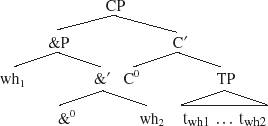
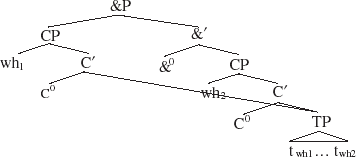
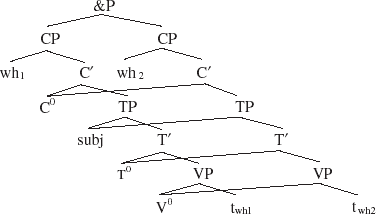
Each of the three structures has been proposed independently. We depart from previous accounts in that we argue that in order to achieve descriptive adequacy, Universal Grammar has to allow all three types. The availability of a given structure in a language depends on independent factors, such as the availability of multiple wh-fronting. We link this property to the ability of C and v heads (the two heads involved in wh-extraction) to host multiple specifiers. We further argue that this is what limits the structures in (6a) and (6b) to multiple wh-fronting languages.
The structure in (6a) is the mono-clausal structure argued for most recently by Gribanova (Reference Gribanova2009). Gribanova does not provide details of the derivation that results in (6a). A possible analysis might involve sidewards movement (see Nunes Reference Nunes2001, Reference Nunes2004), as proposed in Zhang (Reference Zhang2007, Reference Zhang2009). Sidewards movement is the kind of movement that takes place across two distinct tree structures before they are combined to form a single structure (as opposed to the upwards movement, which takes place within a single rooted structure). On such an analysis, each wh-phrase in a CWH question moves sidewards first, to become part of the coordinate phrase, which is subsequently merged with the original structure. In Section 2.2, we provide such a derivation in a step-by-step manner.Footnote 3
The remaining two structures, namely (6b) and (6c), are bi-clausal but, crucially, do not involve backwards ellipsis of the kind argued for by Giannakidou & Merchant (Reference Giannakidou and Merchant1998), for example. On a backwards ellipsis analysis, which Giannakidou & Merchant call ‘reverse sluicing’, the string in (3a) is derived as in (7), where the constituent following the wh-phrase in the first conjunct is deleted under identity with the relevant constituent in the second conjunct.Footnote 4
(7) [[Ktoiudaril proj] i [kogojpro i udaril tj]] Russian who hit and whom hit
This analysis has been criticized by Kazenin (Reference Kazenin2002) and Gribanova (Reference Gribanova2009) because it involves a cataphoric dependency between the wh-phrase (kogo) and a null pronominal in the first conjunct, which is not licensed in a structure like (7).
In our proposal, the bi-clausal structures in (6b) and (6c) rely on the existence of multidominant structures, characterized by a single element being shared between two mother nodes. Our aim here is not to defend multidominance (henceforth MD), but to merely point out one advantage of a grammar that allows it, thus adding to the growing body of empirical evidence in favor of such grammars. Furthermore, even though we develop our proposal in minimalist terms, the issue of MD in the grammar is independent from the specifics of minimalism for two reasons. First, MD predates minimalism and second, MD is not limited to minimalism.Footnote 5
While many existing MD proposals (especially the early ones) focus on coordinate structures, such as gapping or Right-Node Raising (RNR) (McCawley Reference McCawley1982; Goodall Reference Goodall1983, Reference Goodall1987; Levine Reference Levine1985; Muadz Reference Muadz1991; Moltmann Reference Moltmann1992; Wilder Reference Wilder1999, Reference Wilder and Johnson2008; among others), Across-the-Board (henceforth ATB) Questions (Williams Reference Williams1978; Goodall Reference Goodall1983, Reference Goodall1987; Moltmann Reference Moltmann1992; Citko Reference Citko2000, Reference Citko2003, Reference Citko2005; among others), determiner sharing (Citko Reference Citko and Pica2006, Kasai Reference Kasai2007), MD also figures in accounts of non-coordinate constructions, such as free relatives (Citko Reference Citko1998, Reference Citko2000; Huddelston, Pullum & Peterson Reference Huddleston, Pullum and Peterson2002; Van Riemsdijk Reference van Riemsdijk2006; Payne, Huddleston & Pullum Reference Payne, Huddleston and Pullum2007), parasitic gaps (Kasai Reference Kasai2007), serial verb constructions (Hiraiwa & Bodomo Reference Hiraiwa and Bodomo2008), amalgams and parentheticals (McCawley Reference McCawley1982, De Vries Reference de Vries2009, Heringa Reference Heringa2012).Footnote 6, Footnote 7 MD also features in other (not necessarily derivational) frameworks; Chen-Main (Reference Chen-Main2006) argues for MD structures in Tree Adjoining Grammar, and Ojeda (Reference Ojeda, Huck and Ojeda1987) motivates their existence in Generalized Phrase Structure Grammar.
In some of the models of the phrase structure that admit MD, it is conceived of as a general property of coordinate structures, which can also be represented as three-dimensional (Goodall Reference Goodall1983, Reference Goodall1987; Muadz Reference Muadz1991; Moltmann Reference Moltmann1992; among others), although in principle three-dimensionality is independent of MD, as discussed by Carnie (Reference Carnie2008). The three-dimensionality is assumed in the work of De Vries (Reference de Vries2003) and Heringa (2009), among others, at least for the treatment of coordination and parenthesis, if not for movement configurations. This brings us to a host of proposals that invoke MD to capture movement dependencies.Footnote 8 This is the main insight behind the Phrase-linking Grammar of Peters & Ritchie (Reference Peters and Ritchie1981) (see also Engdahl Reference Endgahl1986; Blevins Reference Blevins1990, Reference Blevins1994; Gärtner Reference Gärtner1999, Reference Gärtner2002), where movement configurations are represented through a node being shared between at least two parents (a Tree Parent and a Link Parent, such that the former dominates the latter), without assuming either that structures are three-dimensional, or that (this version of) MD is restricted to coordination.
Finally, Wescoat (Reference Wescoat2002), Payne & Huddleston (Reference Payne and Huddleston2002), and Payne et al. (Reference Payne, Huddleston and Pullum2007) employ MD to capture the fact that a single element may realize (or instantiate) several nodes/functions that are normally kept distinct. Wescoat proposes an MD account of words that seem to be associated with more than one mother node in the tree, as is the case of pronominal determiners such as those in the example below, which instantiates both a determiner and a noun.
(8) I've looked at those. (Wescoat Reference Wescoat2002: 65)
However, Wescoat (Reference Wescoat2002: 13) explicitly denies the possibility of sharing above the level of the word. Payne & Huddleston (Reference Payne and Huddleston2002) and Payne et al. (Reference Payne, Huddleston and Pullum2007) propose that two functions (which they differentiate from syntactic categories) may undergo fusion so that a single category may realize both of them, and as such may have two mothers. On this view, for example, in items such as someone or everybody, which are referred to as compound determinatives, the function of the determiner and the function of the head are fused. The exponent of the fused functions is the compound determinative, dominated simultaneously by the mothers of each function it realizes. Similarly, once, twice, and thrice are argued by these authors to be ‘compounds of a determinative base (numerical on, twi, thri) and a noun base ce (meaning “time”)’ (Payne et al. Reference Payne, Huddleston and Pullum2007: 588). This version of MD, although it abandons the Single Mother Condition, still prohibits crossing branches, so the functions realized by a single (multiply dominated) category must be adjacent.
In our view, a multiply dominated item is not an instantiation of distinct categories/functions. Rather, it retains the category/function that it would have in a non-MD representation, but is associated with two simultaneous derivations.
All these approaches, including ours, share the belief that any syntactic structure has to be uniquely rooted, i.e. even though at some stage in the derivation a structure might have more than one root, the final representation must satisfy the Single Root Condition.Footnote 9, Footnote 10
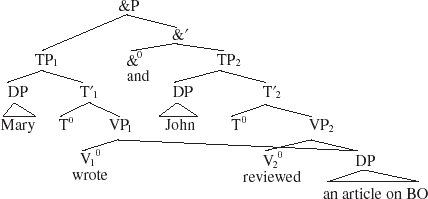
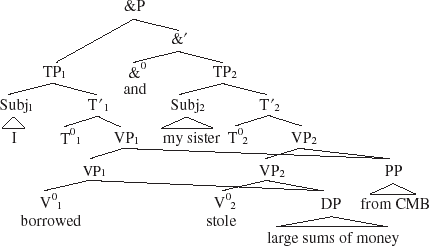
In this paper, we assume that MD is not limited to coordinate structures, although nothing crucial hinges on this assumption (since the CWHs we analyze as multidominant do involve coordinate structures). We further assume, for concreteness, that a node comes to be multiply dominated by having undergone a process akin to Parallel Merge of Citko (Reference Citko2005); two separate, but perhaps simultaneous, instances of Merge, each resulting in a different mother. Each of the root nodes created by Parallel Merge participates in a separate derivation (subject to standardly assumed conditions that hold for these, such as theta-role assignment, case-checking, locality considerations, etc.). Thus, in the absence of the evidence to the contrary, we assume that separate derivations which share one or more nodes proceed in exactly the same way they would if none of their constituents underwent Parallel Merge. At some point, the two roots must be united in order for the representation to satisfy the single root condition. In our case, the two derivations make up the conjuncts that end up united in a coordinate structure.Footnote 11 Related to our view of how the structure-building proceeds is the assumption that each conjunct is also interpreted separately before the meaning of the two is combined. This commits us to the view advanced by Goodall (Reference Goodall1987) and explored in some detail in Gračanin-Yuksek (Reference Gračanin-Yuksek2007) that each conjunct in a coordinate structure must be well-formed in order for the conjunction to be well-formed. Finally, we distinguish between two kinds of MD or sharing. When the shared string forms a single constituent, we assume that Parallel Merge targets the minimal node that dominates the entire string. When, on the other hand, the shared string does not form a constituent, the structure contains more than one constituent that underwent Parallel Merge. Following Gračanin-Yuksek (Reference Gračanin-Yuksek2007), we refer to the former as bulk sharing and to the latter as non-bulk sharing. As long as the shared string does not form a single constituent, i.e. when nodes are shared in a non-bulk manner, we assume that any number of nodes may be shared between the conjuncts (in a non-bulk manner). Bulk and non-bulk sharing are illustrated in (9) and (10), respectively.
(9) Bulk sharing
(a) Mary wrote and John reviewed an article on Barack Obama.
(b)
(example from Gračanin-Yuksek in press)
(10) Non-bulk sharing
(a) I borrowed and my sister stole large sums of money from the Chase Manhattan Bank.
(b)
(example from Abbott Reference Abbott1976)
One of the major questions in the literature on MD concerns linearization; how are MD structures, in which a single element simultaneously occupies two distinct positions, mapped onto linear strings? Although this is not our primary concern here, we follow Wilder (Reference Wilder1999, Reference Wilder and Johnson2008) and Gračanin-Yuksek (in press), who propose an algorithm based on Kayne's (Reference Kayne1994) Linear Correspondence Axiom (LCA), which linearizes all the shared material (that has not undergone movement) to the right of the unshared material. It accomplishes this by making LCA sensitive to complete dominance, to distinguish multiply dominated nodes from non-multiply dominates ones.Footnote 12
In our proposal, the crucial difference between the two types of MD representations lies in whether the wh-phrases are shared between the two CPs. In (6c) above, which features non-bulk sharing, wh-words are never shared between the two CPs (while everything else in the structure is). In (6b), on the other hand, the two CPs bulk-share the entire TP, which means there is a point in the derivation when the two wh-phrases belong to both CPs, even though in the final representation each wh-phrase occupies a specifier of a different CP.
In what follows, we support each of these structures.Footnote 13 To establish what structure CWHs have in a given language, we use the following diagnostics: (i) the relationship between the availability of MWHs and CWHs in a language, (ii) the behavior of CWHs with respect to superiority effects, (iii) the grammaticality of CWHs with two argument wh-phrases (such as a subject and an object wh-phrase), and (iv) the possibility of obligatorily transitive verbs such as buy to appear in mixed CWHs, i.e. CWHs in which one of the wh-phrases is a direct object and the other an adjunct. We will show that there is no correlation between the availability of MWHs and CWHs in a language, as there are languages without multiple wh-fronting that allow CWHs (English, Spanish, Greek, to name just a few). This is problematic for accounts that rely solely on a mono-clausal structure. We will also show that CWHs and MWHs within a single language can differ with respect to whether they obey superiority. For example, Romanian shows superiority effects in MWHs, but not in CWHs. Next, we will explain why in languages like English, mixed CWHs are possible only with optionally transitive verbs like eat, whereas in Slavic languages they are also fine with obligatorily transitive verbs like devour. Finally, we will explain why only some languages allow two coordinated argument wh-phrases. In the next three subsections, we discuss the three structures in detail, starting with the one in (6c).
Bi-clausal CWHs with non-bulk sharing
The structure in (6c), proposed originally in Gračanin-Yuksek (Reference Gračanin-Yuksek2007), contains two interrogative CPs, which share everything except the two wh-phrases. The two CPs are built in parallel, and they share a (number of) node(s). Finally, the two are conjoined under a single root. Given that wh-phrases are not shared, i.e. have not undergone Parallel Merge, a CWH with the structure in (6c) is derived by a single instance of wh-movement per clause, thus making CWHs possible in languages without multiple wh-movement. We propose that this structure is the only one available for English CWHs. This captures the fact that CWHs are more restricted in English than in multiply fronting languages. First, two arguments (with different theta roles and different grammatical functions) cannot be conjoined in English, as shown in (11a). This is expected based on the structure in (6c), since a CWH consists of two CPs, each containing only one wh-phrase. Thus, the ungrammatical (11a) has as its source the equally ungrammatical (11b), in which there is a missing argument in each clause.
- (11)
(a) *What and (to) whom did John give?
(b) *What did John give and (to) whom did John give?
The same reason, as argued by Gračanin-Yuksek (Reference Gračanin-Yuksek2007), underlies the fact, pointed out by Whitman (Reference Whitman2002), that for many speakers of English, mixed CWHs are possible with optionally transitive verbs (e.g. eat or sing), but become ungrammatical with obligatorily transitive verbs (e.g. devour or buy). This is shown by the contrast between the (a) and (b) examples in (12) and (13).Footnote 14
- (12)
(a) What and why did you eat?
(b) *What and why did you devour?
- (13)
(a) What and where did you sing?
(b) *What and where did you buy?
The ungrammaticality of the (b) examples is due to the same factors that exclude (11a) above, namely the fact that the wh-object what is only part of one conjunct, as shown in (14a–b), but is required by the verb in both conjuncts.Footnote 15
- (14)
(a) *What did you devour and why did you devour?
(b) *What did you buy and where did you buy?
Moreover, since there is only one wh-phrase moving within each conjunct CP, no superiority-like effects are predicted to arise in CWHs of this type. And indeed, this is what we find; Whitman (Reference Whitman2002) reports that with optional NP gaps, both orders of wh-phrases are grammatical, as shown in (15a–b).
- (15)
(a) When and what can I eat?
(b) What and when can I eat? (Whitman Reference Whitman2002: 87)
In sum, the bi-clausal non-bulk sharing structure in (6c) can explain the existence of CWHs in English, a language that does not allow multiple wh-movement, as well as account for the properties that CWHs demonstrate in such a language.Footnote 16 In the next section, we turn to the arguments for the mono-clausal structure in (6a).
Mono-clausal CWH questions
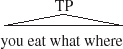
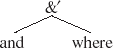
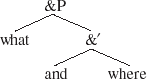
According to the structure in (6a), the derivation of a CWH parallels the derivation of a MWH in that the movement of both wh-phrases is triggered by a single C head (see Merchant Reference Merchant2007, Gribanova Reference Gribanova2009 and Haida & Repp Reference Haida and Repp2011 for different implementations of this idea). For concreteness, we follow Zhang (Reference Zhang2007) and Haida & Repp (Reference Haida and Repp2011) and assume that (6a) is derived by sidewards movement. The crucial steps in the derivation of the CWH in (16a) are given in (16b–e). After the TP you eat what where is constructed (as in (16b)), the wh-phrase where is re-merged with the conjunction and, as shown in (16c). Next, the wh-phrase what does the same (as in (16d)). Finally, the entire conjunction phrase merges as the specifier of the CP, as shown in (16e).Footnote 17
- (16)
(a) What and where did you eat?
(b)
(c)
(d)
(e)
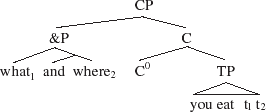
However, irrespective of the derivational details, the fact that in (6a) there is a single C head triggering movement in both CWH and MWH questions predicts that the two should be subject to the same restrictions.Footnote 18, Footnote 19 Here we test this prediction with respect to superiority effects. As first pointed out by Rudin (Reference Rudin1988) and discussed subsequently by Richards (Reference Richards2001) and Bošković (Reference Bošković2002), among many others, some multiple wh-fronting languages respect superiority while others do not. Bulgarian and Romanian belong to the former group, and Croatian/Serbian, Polish, Russian, and Czech to the latter. The structures in (17a–b) show that MWHs and CWHs violating superiority involve the same nested dependencies. If superiority is a result of nested (as opposed to crossing) paths, we predict that MWHs and CWHs should behave alike with respect to superiority.Footnote 20
- (17)
(a) superiority violation in CWH
(b) superiority violation in MWH
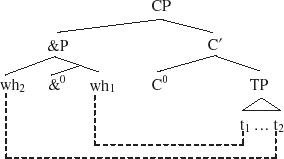
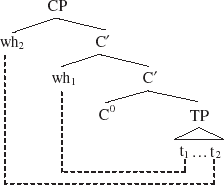
Indeed, there are languages that behave as expected. Bulgarian is such a language. It shows superiority effects in both MWHs and CWHs:Footnote 21
- (18)
(a) Kojkoga ste si hodi v Bulgaria? Bulgarian who when will refl go in Bulgaria ‘Who is going to Bulgaria when?’
(b) *Kogakoj ste si hodi v Bulgaria ?when who will refl go in Bulgaria
- (19)
(a) Kojikoga ste si hodi v Bulgaria? Bulgarian who and when will refl go in Bulgaria ‘Who is going to Bulgaria and when?’
(b) *Kogaikoj ste si hodi v Bulgaria ?when and who will refl go in Bulgaria
However, in some circumstances, both orders are allowed as shown in (20)–(23).
- (20)
(a) Kakvokoga jade Ivan? Bulgarian what when ate Ivan ‘What did Ivan eat when?
(b) Kogakakvo jade Ivan?when what ate Ivan ‘When did Ivan eat what?’
- (21)
(a) Kakvo i koga jade Ivan? Bulgarian what and when ate Ivan
(b) Koga i kakvo jade Ivan? when and what ate Ivan
- (22)
(a) ?Kakvokogo e spoletjalo? Bulgarian what whom aux stricken ‘What struck whom?’
(b) Kogokakvo e spoletjalo? whom what aux stricken (Billings & Rudin Reference Billings, Rudin and Toman1996: 38)
- (23)
(a) ?Kakvo i kogo e spoletjalo? Bulgarian what and whom aux stricken ‘What and whom struck?’
(b) Kogo i kakvo e spoletjalo? whom and what aux stricken
The issue of when we find superiority effects in Bulgarian (and when we do not), while interesting in itself, is not directly relevant for our purposes here. Relevant is the fact that we find the same ordering restrictions in both MWHs and CWHs.
This parallelism provides strong evidence that CWHs in Bulgarian are derived by a strategy that is at work in MWHs, namely, multiple wh-movement. Further evidence in favor of a mono-clausal structure for Bulgarian CWHs comes from the grammaticality of mixed CWHs with obligatorily transitive verbs, as well as CWHs with two argument wh-phrases, as shown in (24a–b), respectively.
- (24)
(a) Kakvo i kak kupil Ivan? Bulgarian what and how bought Ivan ‘What and how did Ivan buy?’
(b) Koj i kakvo e kupil? who and what aux bought ‘Who and what bought?’ (Kliashchuk Reference Kliashchuk and Radišić2007: 6)
So far, we have looked at three kinds of diagnostics to determine whether a CWH has a mono- or a bi-clausal structure: the parallelism in superiority effects between CWHs and MWHs, the grammaticality of mixed CWHs with obligatorily transitive verbs, and the possibility of conjoining two arguments. We have seen a language in which CWHs show bi-clausal properties (English) and a language in which they show mono-clausal properties (Bulgarian). However, there are also languages, such as Romanian, in which CWHs show properties of the mono-clausal structure with respect to the possibility of conjoining two arguments and the use of an obligatorily transitive verb in a mixed CWH, but the superiority effects observed in MWHs do not obtain in CWHs. This is only compatible with the bi-clausal bulk sharing structure in (6b), which we discuss in the next section.
Bi-clausal CWHs with bulk sharing
We start by observing that Romanian allows mixed CWHs with an obligatorily transitive verb, as in (25a), and moreover, that both wh-phrases in a CWH can be arguments, as shown in (25b).Footnote 22
- (25)
(a) Cuce şi pecine a supărat Ion? Romanian with what and PE who has upset Ion ‘With what and whom did Ion upset?’
(b) Cuii şi cej ii-ai dat ej ei ?to.whom and what to.him-you.have given ‘What did you give and to whom?’ (Comorovski Reference Comorovski1996: 135)
This rules out the bi-clausal non-bulk sharing structure in (6c) as a possible source of the CWHs in (25) and points instead to a structure in which the two wh-phrases are clausemates. This leaves us with two options: the mono-clausal structure in (6a) and the bi-clausal bulk sharing structure in (6b). To decide between the two, we turn to superiority. Romanian MWHs and CWHs differ in this respect; the contrast between (26a) and (26b) shows that MWHs show superiority effects, and the lack of a corresponding contrast between (27a) and (27b) shows that CWHs do not.
- (26)
(a) Cineicej (crezi că) ei a văzut ej? Romanian who what you.think that has seen ‘Who (do you think) saw what?’
(b) *Ceicinej ej a văzut ei? what who has seen (Comorovski Reference Comorovski1996: 2–3)
- (27)
(a) Cinei şi cej ei ti-a spus ej? Romanian who and what to-you-has told ‘Who told you something and what was it?’
(b) Cej şi cinei ei ti-a spus tj? what and who to-you-has told (Comorovski Reference Comorovski1996: 135)
The puzzling behavior of Romanian CWHs is explained if we adopt the bi-clausal bulk sharing structure in (6b) of the kind proposed by Raţiu (Reference Raţiu and Herschensohn2011) .Footnote 23 In (6b), a CWH contains two CPs, which share the entire TP in bulk. Since in this structure, both CPs contain (traces of) both wh-phrases, it is not surprising that both wh-phrases in a CWH can be arguments of the same verb. On the other hand, there is only one instance of wh-movement per CP. Consequently, superiority effects are predicted not to arise.
At this point a question arises as to what excludes the structure in (6b) in languages like English. We argue that it is the fact that English is not a multiple wh-movement language. The crucial difference between languages that do and do not exhibit multiple wh-fronting is whether their C can attract multiple wh-phrases (Attract-one versus Attract-all parameter proposed by Bošković Reference Bošković1997, Reference Bošković1998). In terms we adopt here, an Attract-one C may project only a single specifier per clause, while an Attract-all C may project multiple specifiers per clause (see Footnote footnote 19). In Chomsky's (Reference Chomsky2000, Reference Chomsky and Kenstowicz2001, Reference Chomsky and Belletti2004, Reference Chomsky, Sauerland and Gärtner2007) phase theory, which we assume here, it is not unreasonable to propose that the difference applies also to v. If in a language that does not have multiple wh-movement, an Attract-one v is embedded under two C′s (as in our (6b)), the uninterpretable wh-feature on one C is bound to remain unchecked (and undeleted), since the wh-phrase not attracted to v remains inaccessible to C, given the Phase Impenetrability Condition. A related question is what rules out the structure in (6b) in Bulgarian. If Bulgarian allowed it, it would allow violations of superiority, contrary to fact. At present we cannot account for this fact, and can only speculate that some form of economy might rule out CWHs involving bi-clausal structures of any sort in languages like Bulgarian. This might be a language-specific requirement that prefers minimal structure, thus precluding clausal coordination if a derivation containing phrasal coordination is available.Footnote 24
Independent evidence, due to Raţiu (Reference Raţiu and Herschensohn2011), in favor of such a bi-clausal structure for Romanian CWHs comes from the distribution of the interrogative particle oare. MWHs allow only a single occurrence of this particle, as shown in (28a), which suggests that only one oare is allowed per clause. CWHs, on the other hand, allow two occurrences of oare (as shown in (28b)), which follows straightforwardly from a bi-clausal structure.Footnote 25
- (28)
(a) Oare cine (*oare) ce va spune? Romanian OARE who OARE what aux say ‘Who will say what?’
(b) Oare cine şi oare ce va spune? OARE who and OARE what aux say ‘Who will say something and what will he say?’ (Raţiu Reference Raţiu and Herschensohn2011)
At this point we might ask whether the structure in (6b) is the only structure available for Romanian CWHs. We argue that it is not. Rather, while superiority-violating CWHs are necessarily derived as in (6b), superiority-obeying ones are ambiguous between the structure in (6b) and the one in (6a). Support for this claim comes from Romanian CWHs with collective predicates. Interestingly, in such CWHs, superiority effects re-emerge, as shown in (29).Footnote 26, Footnote 27
- (29)
(a) Cine şi cucine s-a intilnit? Romanian who and prep who refl-aux met ‘Who met whom?’
(b) *Cucine şi cine s-a intilnit? prep who and who refl-aux met
The contrast between (27b) and (29b) indicates that the two do not have the same structure: the former involves a bi-clausal bulk sharing structure in (6b), and the latter a mono-clausal structure in (6a).Footnote 28 Example (29a) cannot be derived from a bi-clausal structure in (6b) because it contains a collective predicate, which seems to require the presence of all arguments that participate in the event to be contained in the same clause throughout the derivation. Given that the sentence is grammatical (and that it shows superiority), an alternative structure, namely the mono-clausal one in (6a), must also be available. Thus, Romanian seems to be a language with at least two structures for CWHs: a mono-clausal one in (6a) and a bi-clausal with bulk sharing in (6b).Footnote 29
A natural question to ask at this point is whether there are any languages in which all three structures in (6a–c) are available. We believe that this is the case in languages like Russian, Polish, or Croatian, which allow not only the coordination of two arguments in a CWH, but also mixed CWHs with obligatorily transitive verbs, and superiority violations in both CWHs and MWHs. With respect to superiority, these languages represent, in a sense, a mirror image of Bulgarian; both CWHs and MWHs allow superiority violations, as shown below for Russian.
- (30)
(a) Ktočto zaxvatil? Russian who what grabbed ‘Who grabbed what?’
(b) Čtokto zaxvatil? what who grabbed (Gribanova Reference Gribanova2009: 135)
- (31)
(a) Kto i čto zaxvatil? Russian who and what grabbed ‘Who and what grabbed?’
(b) Čto i kto zaxvatil? who and what grabbed (Gribanova Reference Gribanova2009: 136)
It is important to note that in (31a) and (31b) both coordinated wh-phrases are arguments, which, as we saw in (11) above, is not possible in English. This is consistent with both the mono-clausal analysis in (6a) and the bi-clausal bulk-sharing one in (6b). In both structures, coordination of two argument wh-phrases is predicted to be possible, and CWHs are predicted to show no superiority effects. This is indeed what we find. However, since in these languages MWHs do not show superiority effects either, it is not possible to tell whether the examples in (31) are derived from the structure in (6a) or the one in (6b).Footnote 30 Evidence that these languages, in addition to (6a) or (6b), also allow the bi-clausal structure in (6c) comes from the distribution of second position clitics in Croatian. As shown below, a CWH in Croatian may contain one or two (sets of) clitics. The presence of two auxiliary and interrogative clitics in (32a) indicates that the structure is bi-clausal, and that in each clause, the clitics follow the first constituent. The fact that the clitics are pronounced twice shows that they are not shared – if they were, we would expect the clitics to be pronounced only once, following all the unshared material, i.e. after both wh-phrases. This is not the case in (32a). Instead, the two CPs share only the verb jeo ‘eaten’, which is pronounced following everything else in the sentence. Furthermore, under the assumption that auxiliary clitics originate in T0 and subsequently move to a higher (second) position, the fact that (32a) contains two instances of si indicates that the structure contains two T0 heads. This is only consistent with the bi-clausal structure in (6c).Footnote 31
- (32)
(a) Što lisi i gdje lisi jeo? Croatian what LI aux.2sg and where LI aux.2sg eaten‘What (on earth) and where (on earth) did you eat?’
(b) Što lisi i gdje jeo?what LI aux.2sg and where eaten ‘What (on earth) and where did you eat?’
The bi-clausal analysis of CWHs with repeated clitics is supported by the fact that, like in English, such CWHs are ill-formed with two argument wh-phrases, as shown in (33a). Also, a mixed CWH with repeated clitics cannot contain an obligatorily transitive verb, as in (33b):
- (33)
(a) *Što je i kome je dao? Croatianwhat aux.3sg and whom aux.3sg givenLiterally: ‘What and to whom did he give?’
(b) *Što si i gdje si vidio? what aux.2sg and where aux.2sg seen Literally: ‘What and where did you see?’
We can also show that some form of a bi-clausal structure must also be available for Polish CWHs. The evidence, due to Tomaszewicz (Reference Tomaszewicz2011), involves high speaker-oriented adverbs. The contrast between (34a) and (34b) shows that such adverbs cannot intervene between two wh-phrases in a MWH but can in a CWH.
- (34)
(a) Kto a najważniejszeco mówił o tobie? Polish who and most.importantly what said about you ‘Who and most importantly what said about you?’ (Tomaszewicz Reference Tomaszewicz2011: 189)
(b) *Kto najważniejszeco powiedział? who most.importantly what said ‘Who most importantly said what?’
Interim summary
In the previous section we looked at three kinds of diagnostics to determine the structure of a CWH: the possibility of conjoining two arguments, the grammaticality of a mixed CWH with an obligatorily transitive verb, and superiority effects. Based on these, we saw evidence that the structure of CWHs can vary not only across languages but also within a single language. More specifically, we saw that English has only bi-clausal CWHs with non-bulk sharing, whereas Bulgarian has only mono-clausal CWHs. We also saw that Romanian forms CWHs by at least two strategies: the mono-clausal one in (6a) and the bi-clausal one with bulk sharing in (6b). Finally, we saw that languages like Russian, Polish or Croatian may in principle have all three structures.
In the following sections, we discuss the consequences of the arguments presented so far for the (mono-clausal) analysis of CWHs developed recently by Gribanova (Reference Gribanova2009). Gribanova argues that CWHs are always mono-clausal, and consequently, that their formation piggy backs on the formation of MWHs. We also present data not discussed in previous sections, which lead us to conclude that mono-clausal CWHs are only a subset of possible CHWs across languages.
Challenges to Gribanova's (Reference Gribanova2009) account
Correlation between CWHs and multiple wh-fronting
Gribanova (Reference Gribanova2009) proposes two structures for CWHs, which mirror two independently motivated structures for MWHs (CP- versus IP-absorption structures of Richards (Reference Richards2001), who builds on Rudin's (Reference Rudin1988) insights about two types of multiple fronting languages).Footnote 32
- (35)
(a)
(b)
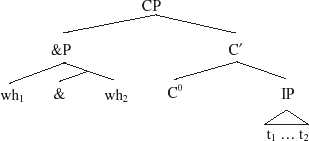
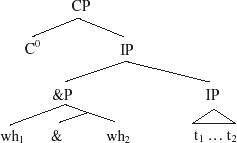
Such an analysis predicts that CWHs should only exist in multiply wh-fronting languages (Gribanova Reference Gribanova2009: 138). In Section 2.1 above we already saw data from English that argue against this claim. Corpus search also yields multiple examples of CWHs in English, a small sample of which is given below:
- (36)
(a) What and where is the Microsoft Office Button? (http://office.microsoft.com/en-us/help/HA101828951033.aspx, last accessed 23 May 2012)
(b) What and when was The Surrender of the Appomattox Court House Battle? (http://uk.ask.com/beauty/Appomattox-Court-House-Surrender, last accessed 23 May 2012)
(c) Study hints at what and how dinosaurs ate. (http://www.livescience.com/animals/090629-dino-teeth.html, last accessed 23 May 2012)
Other non-multiple wh-fronting languages with CWHs reported in the literature are Spanish and Greek (discussed by Anagnostopoulou Reference Anagnostopoulou2003, Whitman Reference Whitman2006, Sinopoulou Reference Sinopoulou2009, and Haida & Repp Reference Haida and Repp2011).
- (37)
(a) Quién y dónde vió a María? Spanish who and where see.pret Maria.acc ‘Who and where saw Maria?’ (Whitman Reference Whitman2006: 8)
(b) Ti ke pou tha spoudasi o Jiannis? Greek what.acc and where will study.3sg the Jannis.nom ‘What and where will John study? (Sinopoulou Reference Sinopoulou2009: 4)
While Gribanova has no natural way to accommodate the data from English, Spanish, and Greek, according to our account, all these languages have at their disposal at least the structure in (6c), involving two CPs that share everything except the wh-phrases themselves. While we do not deny that there is a correlation between multiple wh-fronting and the availability of certain types of CWHs, we conclude that the claim put forth in Gribanova (Reference Gribanova2009), that CWHs are impossible without multiple wh-fronting, is empirically untenable.
Superiority effects and co-occurrence restrictions
Gribanova's analysis predicts that the same restrictions (like the presence or absence of superiority effects) should apply to both MWHs and CWHs. We have already seen that this is not always the case. There exist languages like Romanian, which show superiority effects only in MWHs. If CWHs are derived by essentially the same mechanism as MWHs, this is unexpected. Our analysis, on the other hand, captures this discrepancy in the behavior of MWH and CWHs with respect to superiority effects by positing the availability of the bi-clausal bulk sharing structure in (6b) for Romanian CWHs.
A different challenge for Gribanova's account is observed in Croatian CWHs. However, the issue involves not ordering – since in Croatian superiority effects are observed neither in MWHs nor in CWHs – but co-occurrence restrictions. In Croatian, sequences of wh-phrases that are possible in CWHs are different from those that are possible in MWHs. For example, as noted by Bošković (Reference Bošković1998), two adjuncts cannot both be fronted in MWHs but are perfectly fine in a CWH, as shown in (38).Footnote 33 Again, on Gribanova's account, the contrast between (38a) and (38b) is unexpected: if the well-formedness of (38b) depends on the well-formedness of (38a), then (38b) should not be derivable, contrary to fact.
- (38)
(a) *Gdjekada Ivan nastupa? Croatian where when Ivan performs ‘Where does Ivan perform when?’
(b) Gdje i kada Ivan nastupa? where and when Ivan performs ‘Where and when does Ivan perform?’
As we noted in Section 2.3 above, CWHs in Croatian can have any of the three structures that we propose in (6a–c). Consequently, the derivation of (38b) is not necessarily related to that of (38a). Thus, although the ungrammaticality of (38a) remains mysterious, the well-formedness of (38b) is not – it is derived either as in (6b) or as in (6c), neither of which involves multiple wh-movement.Footnote 34
On the whole then, our account is able to capture a wider range of data than previous accounts. In particular, it can account for the data that are not amenable to purely mono-clausal analyses. Furthermore, our account does not run into the problems that previous bi-clausal analyses have. As Kazenin (Reference Kazenin2002) and Gribanova (Reference Gribanova2009), among others, point out, if (39a) is derived from (39b) via reverse sluicing (as proposed by Browne Reference Browne1972, Bánréti Reference Bánréti and Kiefer1992, and Giannakidou & Merchant Reference Giannakidou and Merchant1998), the contrast between the CWH in (39a) and sluicing in (39c) is hard to account for. On our account, (39a) is a result either of the mono-clausal structure in (6a) or the bi-clausal structure with bulk sharing in (6b). On the other hand, the ungrammatical (39c) cannot be derived as in (6a) given that on this analysis, there is no position inside the &P for the verb zaxvatil ‘conquered’, nor can it be derived as in (6b), again because of the intervening verb, which being shared should be linearized to the right of all the unshared material. Finally, (39c) cannot be the result of sluicing, given the constraints on backwards anaphora, as suggested by Kazenin (Reference Kazenin2002) and Gribanova (Reference Gribanova2009).
- (39)
(a) Kto i kakojgorod zaxvatil? Russianwho and which city conquered
(b) Kto zaxvatil i kakojgorod zaxvatil? who conquered and which city conquered
(c) *Kto zaxvatil i kakojgorod? who conquered and which city (Kazenin Reference Kazenin2002: 9)
Facts of this sort led both Kazenin and Gribanova to reject a bi-clausal structure. This conclusion, however, is too rash as it relies on the assumption that reverse sluicing is the only conceivable bi-clausal analysis for CWHs. Since our analysis involves no deletion whatsoever, the two types of bi-clausal sharing we have argued for here allow us to capture the bi-clausal properties of CWHs in some languages without having to consider the problems that reverse sluicing might raise.
Now that we have seen how our proposal compares to purely mono-clausal analyses, exemplified by Gribanova (Reference Gribanova2009), let us briefly discuss the interpretation of CWHs. This is the topic of the next and final section.
Interpretation of CWH Questions: Single Pair Readings
Most researchers working on CWHs agree that they differ in interpretation from MWHs (see Kazenin Reference Kazenin2002; Lipták Reference Lipták, Boeckx and Grohmann2003; Whitman Reference Whitman2004, Reference Whitman2006; Gračanin-Yuksek Reference Gračanin-Yuksek2007; Scott Reference Scott2010; Citko in press, among others). Whitman (Reference Whitman2004), for example, attributes this preference to a Q-implicature that something is being asked that could not be asked using the multiple wh-form, and that a likely candidate is the allowance of a singleton pair-list answer (Whitman Reference Whitman2004: 418). While MWHs typically allow only pair-list (PL) readings, CWHs strongly favor single pair (SP) readings, as shown by the following contrast:Footnote 35
- (40)
(a) Kto i kakojgorod zaxvatil? SP/??PL Russian who.nom and which.acc city.acc conquered. 3sg ‘Who conquered which city?’
(b) Ktokakojgorod zaxvatil? ??SP/PL who.nom which.acc city.acc conquered.3sg ‘Who conquered which city?’ (Gribanova Reference Gribanova2009: 141)
This contrast holds in non-multiply wh-fronting languages as well, and becomes even more pronounced if the context strongly favors an SP interpretation, as in the following examples, due to Whitman (Reference Whitman2006):
- (41)
(a) When and where were you born?
(b) #When were you born where?
Gribanova (Reference Gribanova2009) follows Higginbotham & May (Reference Higginbotham and May1981) and Barss (Reference Barss2000) in assuming that PL readings are generated by the mechanism of Quantifier Absorption (QA), which at LF turns one or more structurally adjacent quantifiers into one binary (or n-ary) quantifier. Furthermore, she proposes that QA is only possible if the two quantifiers are structurally adjacent at LF (in the sense of (42)). In CWHs, the conjunction is the head that intervenes between the two wh-elements, thus blocking QA.
(42) Structural Adjacency
α and β are structurally adjacent if and only if α c-commands β, and α c-commands no head that c-commands β.
(Gribanova Reference Gribanova2009: 146)
There are both conceptual and empirical problems with Gribanova's adjacency condition on QA. On the conceptual side, we note that the structural adjacency condition relies on the notion of intervention, reminiscent of a Relativized Minimality (RM) condition of Rizzi (Reference Rizzi1990). However, in a typical RM configuration, the intervener is of the same type as the elements between which it intervenes, both in terms of the featural content and in terms of its phrase theoretical status. This is not what we see in CWHs; the intervening conjunction does not have a wh-feature. It is also a head blocking the relationship between two phrasal elements. Typically, heads do not act as interveners with respect to dependencies involving phrasal constituents (and vice versa).
On the empirical side, the adjacency condition predicts that any head should block PL readings. Gribanova considers conjunctions and clitics as potential blockers, but the predictions of the adjacency condition go beyond the intervention effects induced by these two elements. To illustrate, Slavic languages do not always require both wh-phrases to move to the clause initial position. For example, in the Polish example in (43) below, the indirect object undergoes ‘short’ wh-movement to some position below the subject. As a result, both the subject and the T head intervene between the two wh-phrases, so Gribanova's analysis predicts that a PL reading should be unavailable. This is not what we find; questions of this sort readily allow PL readings.Footnote 36
(43) Co Jankomu dał? Polish what Jan whom gave ‘What did Jan give to whom?’
As independent support for the structural adjacency condition on QA, Gribanova discusses the Serbo-Croatian data involving the clitic li, which she analyzes as a complementizer which blocks PL readings, following Bošković (Reference Bošković2001, Reference Bošković2002).
(44) Ko likoga tuče? SP/*PL Serbo-Croatian who C whom beats ‘Who (on earth) is beating whom?’ (Grebenyova Reference Grebenyova2004: 181)
Interestingly, not all clitics have this effect. Auxiliary clitics do not, as shown in (45). Following Bošković (Reference Bošković2001), Gribanova takes the string in (45) to involve the pronunciation of the lower copy of šta ‘what’, forced by the PF requirement that the auxiliary clitic je appear second in the clause. Thus, (45a) has the LF representation in (45b). For syntactic purposes, the wh-phrases are adjacent. Thus, the clitic does not block QA and does not cause the loss of a PL reading.
- (45)
(a) Ko ješta kupio? SP/PL Serbo-Croatian who aux what bought ‘Who bought what?’ (Bošković Reference Bošković2001: 9)
(b) Ko šta je košta kupio?
However, even li does not always block PL readings. This is especially clear in questions in which neither wh-phrase is the subject, as is the case in (46) below, most naturally uttered in a scenario where Dad is coming back from a trip, and the speaker is wondering what present he brought to which of the children. If Dad is holding only one present, a CWH is required instead of (46).
(46) Što lijekome tata donio? PL/*SP Croatianwhat LI aux whom.dat daddy brought ‘What (on earth) did daddy bring to whom?’
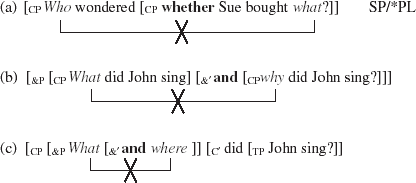
We agree with Gribanova that in order for the PL reading to be possible, the lower wh-phrase has to be absorbed by the higher one. If QA is blocked, PL reading is lost. However, we attribute the blocking effect not to an intervening head, but to the intervening island boundary, as first suggested by Kazenin (Reference Kazenin2002) (see also Citko in press). In all three CWH structures we argued for, the two wh-phrases are either in two distinct conjuncts or constitute conjuncts themselves, which suggests the island in question is the coordinate structure. This makes the loss of PL readings in CWHs part of a more general phenomenon, which is the loss of PL readings across island boundaries, discussed by Hagstrom (Reference Hagstrom1998) and Dayal (Reference Dayal2002, Reference Dayal2006), among others.Footnote 37 This follows from a natural assumption that QA, since it can only apply after the movement of wh-phrases, is subject to locality. In (47a), QA is blocked because the two wh-phrases are separated by a wh-island. Consequently, PL reading is not available. We propose an analogous explanation for the lack of PL readings in CWHs; in (47b), which is a representation of our two bi-clausal structures for CWHs, for QA to obtain, one or both of the wh-phrases would have to move out of its conjunct, and in (47c), the mono-clausal structure, QA could obtain only after the movement of (an) entire conjunct(s). Both movements, however, violate the Coordinate Structure Constraint.Footnote 38
(47)
Conclusion
In this paper, we developed a new typology of CWHs. We argued that Universal Grammar allows for three different structures for such questions: (i) a mono-clausal structure in which both wh-phrases belong to the same clause in both their base and their derived positions, (ii) a bi-clausal structure with bulk sharing of the TP, where the wh-phrases belong to the same TP in their base position, but subsequently move to specifiers of different C heads, and (iii) a bi-clausal structure with non-bulk sharing of everything but the wh-phrases, where the wh-phrases never belong to the same clause. We used four kinds of diagnostics to determine which of the three structures is available in a particular language: the availability of both MWHs and CWHs in a language, the possibility of conjoining two arguments in a CWH, the grammaticality of a mixed CWH with an obligatorily transitive verb, and the parallelism in superiority effects between MWHs and CWHs. Based on these, we concluded that English only allows the bi-clausal non-bulk sharing structure in (6c), Bulgarian only the mono-clausal structure in (6a), while in Romanian at least both (6a) and (6b) must be available. Slavic languages such as Polish, Russian, and Croatian, which allow the conjunction of arguments in a CWH, and in which a mixed CWH is well-formed with an obligatorily transitive verb, but which do not show superiority effects either in MWH or in CWHs, might in principle allow all three structures. This typology is consistent with the multiple wh-movement parameter setting in the languages we discuss. English does not allow multiple wh-movement, which excludes the structures in (6a) and (6b) as possible sources of CWHs in this language. Bulgarian, on the other hand, is a multiply-wh-fronting language, so proposing that the mono-clausal (6a) is the only structure it has for CWHs is consistent with this parametric setting. Finally, we showed that in deriving CWHs, Romanian has both (6a) and (6b) at its disposal. This is again consistent with the fact that Romanian allows multiple wh-movement.


