In contemporary studies, three texts dating from the second half of the sixteenth century continue to be treated as essential primary literature concerning pre-Hispanic and early colonial medicine. These are the herbal Libellus de medicinalibus indorum herbis (1552), composed by the Nahuas Martín de la Cruz and Juan Badiano in the Imperial College of Santa Cruz of Tlatelolco; the Historia natural de Nueva España, written by Philip II's protomédico (royal physician) Francisco Hernández, a “scientific envoy” in New Spain in the 1570s; and the Florentine Codex, the only extant manuscript of the 12-book encyclopedia on the world of the Nahuas, Historia universal de las cosas de Nueva España (ca. 1577), which was directed by Fray Bernardino de Sahagún.Footnote 1
Sahagún's interest in indigenous medicine is attested to by the information that he incorporated into chapters XXVII and XVIII of Book X, on anatomy, illnesses, and remedies, and in several passages of Book XI on flora, fauna, and mineralogy.Footnote 2 The production of the Florentine Codex, in particular of Book XI, shares several traits with the herbal of De la Cruz and Badiano. Sahagún, then at the College of Tlatelolco, supervised most of it sometime between 1561 and 1565, consulting with several Nahua healers whose answers were recorded in the Nahuatl language by a group of Nahua assistants who had themselves trained at the college. To some of them, Sahagún had taught, among other subjects, Latin and moral and natural philosophy. Later, in 1575, he received an official commission from Juan de Ovando, president of the Council of the Indies, to translate the 12 books of Historia universal de las cosas de Nueva España into Spanish.Footnote 3
Chapter VII of Book XI, on herbs, features a remarkable section on medicinal ones, designated paragraph V, which Mexican scholar Alfredo López Austin conceives as “una obra independiente, simple incrustación al libro.” Footnote 4 After a cursory comparison of paragraph V with other paragraphs in the same chapter and with other chapters of Book XI, López Austin notes several points that sustain his argument: “[Paragraph V] es la única parte de este libro en que se mencionan los nombres de los informantes; hay mucha mayor libertad en extensión de contestaciones; no hay petición de vocabulario relacionado con el tema, que sí es abundante en el resto de la obra.” Footnote 5 Despite López Austin's finding, paragraph V has been left “untouched,” in the sense that it has been studied only as an integral part of chapter VII in scholarly works that range from volumes on pre-Hispanic and colonial health practices to articles on pharmacology.Footnote 6 The intention of this study is to elaborate on López Austin's reasons for claiming that paragraph V stands on its own, and to throw light on the primary purposes for which it was initially produced. To do so, this article is divided into two sections.
The first section sets out to demonstrate the validity of López Austin's statement, that is to say, it pursues further inquiry into the peculiarities of paragraph V. Specifically, it examines features that demonstrate that it is an autonomous herbal attached to the Florentine Codex, namely, its lack of lexicographical-doctrinal notes, its style of visual presentation, and its naming of the Nahua healers who supplied data. In addition, parallelisms in content structure between paragraph V and other paragraphs of Book XI will be explored, in an attempt to prove that although paragraph V was completed as a separate text, it is the result of the same method of data collection that Sahagún applied to those other paragraphs. Following on the establishment of paragraph V as an independent herbal, the second section contextualizes it in the sociocultural milieu of the College of Tlatelolco, and makes the argument that the herbal is a product of the college and of Sahagún's concerns in times of particular duress: a period during which the cocoliztli pestilences were causing havoc among the Nahuas.
Section 1: Paragraph V as an Autonomous Herbal
At the end of his prologue to Book I of the Florentine Codex Sahagún recounts that his fellow missionaries, accustomed to expressing an interest in the writing process of Historia universal de las cosas de Nueva España, usually inquired about his “Calepin.”Footnote 7 To their eyes, Sahagún was composing a monolingual dictionary of the Nahuatl language that paralleled the Augustinian Ambrogio Calepino's overarching Latin dictionary Cornucopiae, which, aside from definitions, furnished etymologies, synonyms, and examples of use.Footnote 8 In his answer to his brethren, Sahagún partially surrenders to the impossibility of creating such a Nahuatl Calepin, arguing that he had not availed himself of written sources such as those Calepino had. Sahagún, nonetheless, avows that he is laying the foundations for the composition of a future Nahuatl dictionary by compiling what he calls a “a red barredera” (trawl); that is to say, an amalgam of heterogeneous texts codifying and framing the spoken language within the array of semantic fields that an encyclopedia-like work was expected to cover.Footnote 9
Sahagún was creating a “history,” understood by the custom of the time as an account of the world of the Nahuas, and paid heed to the sources with which he was familiar: not only Calepino's dictionary but also classical and medieval-Christian textual archetypes, such as Pliny's Historia naturalis (ca. 77 AD) and the Franciscan Bartholomaeus Anglicus's De proprietatibus rerum (ca. 1240–1260), which churchmen used to consult for the composition of sermons.Footnote 10 In fact, he intended his text as a doctrinal reference work that would ease the conversion of the indigenous people for his Spanish-speaking fellow friars. With these missionary readers in mind, Sahagún originally aspired to accommodate collected material in a reader-friendly fashion. He devised a three-column page consisting of the Spanish translation on the left, the Nahuatl source text centrally positioned, and on the right a column containing linguistic glosses, in which Nahuatl terms and grammatical issues pertaining to the Nahuatl text were to be explained.Footnote 11
The Doctrinal and Lexicographical Purposes of Book XI
Sahagún makes allusion to this twofold doctrinal-lexicographical objective of Historia universal de las cosas de Nueva España in titles, prologues, and passages of the final manuscript.Footnote 12 Thus, in Book XI, the text considered in this study, he qualifies the potential evangelical application of its linguistic and cultural knowledge on fauna, flora, and mineralogy by entitling it “bosque, jardin, y vergel de lengua Mexicana”; by describing it as a “noble joia de la recamara de la predicacion euangelica”; and by claiming that the book furnishes churchmen with: “exemplos, i comparationes, [que] quanto mas famjliares fuer[en] a los oientes, i por palabras, i lenguaje mas vsadas, entre ellos, dichas: tanto ser[an] mas efficazes: i prouechosas.” Footnote 13 The importance that Sahagún bestows on the use of daily, metaphorical language resonates with the expertise he obtained while training and acting as a preacher. From an early age, as a Franciscan novice in the friary of Salamanca where he took his vows, Sahagún was used to reading and hearing metaphors, similes, and fixed phrases related to the natural world in sermons written by prestigious members of his order like St Anthony of Padova, Fray Roger Bacon, Fray Nicolaus de Hacqueville, and Fray Olivier Maillard, whose florilegia or compilations of sermons were generally held in Franciscan libraries.Footnote 14 Animals were represented as human exemplars with behavior to be praised or reprehended: cunning foxes; faithful doves; vindictive snakes; hardworking bees; and humble ants. Likewise, minerals and plants, whether in their growing stages and forms, fragrance, or gamut of colors, assisted in the recreation of a given ambience in religious texts.Footnote 15 Subsequently, as a writer of sermons himself, Sahagún consulted these doctrinal texts as well as the encyclopedias that were considered preaching auxiliary works, including not only Pliny and Anglicus's works, but also Isidore's Etymologiae and the Franciscan Juan Gil de Zamora's Historia naturalis, all of which were filled with similes, metaphors, and exempla associated with the natural world.Footnote 16 Once in New Spain, Sahagún lacked the same material in the Nahuatl language and, instead of translating his known sources, he decided to compile his work in the Nahuas' own words so as to better facilitate their understanding of the Christian message.Footnote 17 In other words, Sahagún ensured that Book XI abounded in lexicographical data for the writing of a future “Nahuatl Calepin” and, at the same time, supplied liturgical tropes with which he hoped missionaries would capture their Nahua audience's attention more effectively.
Throughout the chapters of Book XI, on mammals, birds, insects, trees, and plants, the reader finds numerous characterizations of these as human exemplars, together with etymologies, fixed phrases, sayings, and collocations. For example, we are informed of the habits of the protective tlaquatl (opossum), which carries its young in a pouch and then on its back, and if caught “cries . . . squeals; true tears come forth”; of the annoying cujcujtzcatl (barn swallow), which is “a warbler, a crier, a constant warbler, an awakener of the sleeping”; and of the small and disappointing tlaolcapuli (cherry shrub), a thin-fleshed tree, bitter to the taste that “offends one. It is not regarded by anyone; it is not respected.”Footnote 18 Regarding etymologies, Sahagún notes that the tzicatana (ant) receives the name of tepehuani (conqueror) because “when [these ants] follow their path, they go in a wide stream. So it is said they draw up for battle.” He notes also that one of the names of the American bittern is ateponaztli because, like the teponaztli (slit drum), “it sounds from a distance like a two-toned drum, so loud is it.”Footnote 19
As for the codification of other fixed phrases, sayings, and similes that associated human traits with the natural world, a copious list of examples throughout Book XI includes the epithets quimichin (mouse), a “busybody,” one that likes eavesdropping, from which the saying “niqujmjchti” (“I mouse him” or “I eavesdrop on one”) derives; and avevetl (cypress), which is used, because of its shade, to refer to protective parents.Footnote 20 It is to be noted that the description of this cypress resumes with several collocations and specific terminology on a tree's stages of growth. Thus, it is said that this cypress “thickens, extends its branches, extends branches everywhere, forms foliage. It sheds foliage, it sheds butterfly-like leaves. It towers above, it excels.”Footnote 21 In other cases, the collocations are even separated from the main body of the text, appearing in a final line, and written in the first-person singular. For example, the description of the izcauitl (edible earthworm), which was sold in markets, finishes with: “I gather izcauitl; I take izcauitl; I roast, I cook, I sell izcauitl.”Footnote 22
Like previous and subsequent chapters of Book XI, the 12 paragraphs of chapter VII, on different herbs, offer a wide range of etymologies, fixed phrases of comparative nature between herbs and human beings, and collocations. As pointed out by López Austin, the exception to the rule is paragraph V. A cursory glance allows the reader to notice that the paragraphs flanking it, that is, paragraph IV on edible herbs and paragraph VI on “all the different herbs,” stand out for their lexicographical data.Footnote 23 For instance, in paragraph IV, under the entry of maxten (onion with numerous roots), we read: “It is said of him who engenders many, whose many children live [that he] ‘has offspring like the maxten.’”Footnote 24 Likewise, the texoxoli (chili-red plant), which is described as beautiful but with a disappointing odor, is believed to typify someone living off appearances; someone “who covers himself well, who wraps himself.”Footnote 25
As for etymologies, in paragraph IV we find that the name quauitzquilitl (drooping edible herb) originates from the sentence “[i]t eats me [as] I eat it,” because “it first pricks one as it is eaten.”Footnote 26 Finally, regarding collocations, some of the herbs of paragraph IV that are described by inserting verbs and adjectives with which they tend to combine are the acaxilotl (edible root), with the verbal form in the first person singular “I grub up, I chew the acaxilotl,” and the xaltomatl (sandy tomato), depicted with this string of adjectives: “Some are white, some black. They are sweet, very sweet; juicy, very juicy; round, round like a stone, very round.”Footnote 27 Similarly, in paragraph VI several entries portraying herbs illustrate how the data recorded was tailored to suit the lexicographical aim. Thus, the bitterness of the iztauhyatl (Mexican wormwood) is alluded to by adding a sentence with comparative forms: “[I]t is bitter, very bitter, surpassingly bitter”; the azpan xiuitl, a medicine for rubbing the face, is accompanied by an example of use referring to this action: “I wash my face with azpan”; and the brief description of the epaçotl (Mexican tea) concludes with a verb with which it usually collocates: “I put epaçotl in the sauce.”Footnote 28
Distinctive Characteristics of Paragraph V
In contrast, the dearth of lexicographical information in the herbal of paragraph V implies that its original manuscript would have been conceived for purposes other than linguistic and doctrinal, and that, eventually, Sahagún inserted it in Book XI because it suited his purpose of creating a “historia” and a “red barredera” of the Nahuatl language.Footnote 29 The incorporation of this manuscript to occupy paragraph V of chapter VII also meant that its initial format had to conform to that of the Florentine Codex. In other words, the scribes working under Sahagún's direction adapted the original contents of the herbal to a two-column bilingual arrangement, in which the Spanish text was given prominence. In this respect, further glances at paragraph V and those flanking it reveal other striking differences.
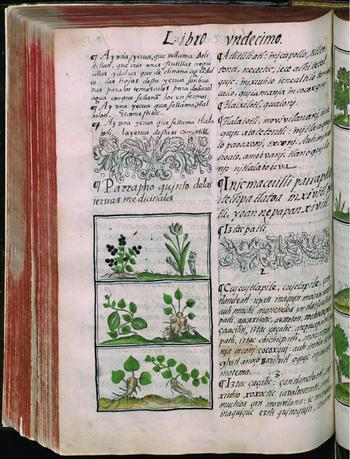
Visually speaking, paragraph V captures immediate attention for two main reasons. First, every entry is numbered, with the figure appearing on top of the name in both columns (see Figures 1 and 2). This pattern of presentation does not feature anywhere else in the 12 books of the Florentine Codex. Interestingly, a scribe added the numbers once the text had been inserted, and, as López Austin notes, the numbers are omitted at times, for example, when the scribe jumps from entry 79 to 90, from 101 to 103, and from 121 to 123.Footnote 30 Since the herbal reaches up to number 150, it is possible that the scribe who jotted down the numbers set himself the task of finishing paragraph V with this round figure. In other words, he numbered each entry by comparing both the original and the copy, a task during which, upon realizing that some entries had been left behind, he still maintained the original final number of 150.
Beginning, Folio 291v

Beginning, Folio 292r

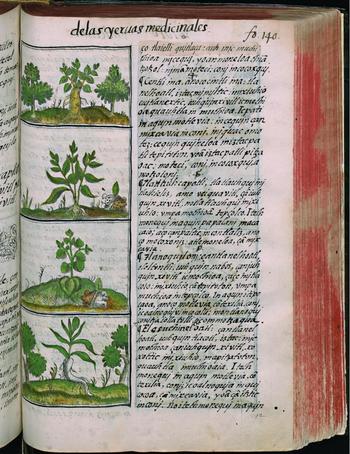
The second visual characteristic that singles out paragraph V as an autonomous herbal has to do with the language in which entries are written, and with the nature and size of their accompanying illustrations. For the first 31 herbs mentioned, the manuscript only contains the Nahuatl text, in the right-hand column, written by one scribe; the Spanish translation elsewhere found on the left is missing (see Figures 1 and 2).Footnote 31 This space is occupied instead by a drawing related to each herb: it may show the growing process or the mature state of the herb, or portray several types of the same herb and the manner in which it was prepared as a remedy for an illness. For example, the fourth herb, the centli ina, which is said to cure fever, is represented by three different shrubs with distinctive shapes; and the eighteenth herb, the necutic, a thick root used as eye medicine and for genitals, is being prepared by a woman who rubs it to extract its substance.Footnote 32
As for the Spanish translation, it is in handwriting dissimilar to that of the Nahuatl text. It begins at the thirty-second entry with the çoçoiatic (Indian poke), which is equated to a xonacatontli (little onion), and described in the Spanish translation as resembling a “cabeça de ajos.”Footnote 33 From then on, the manuscript maintains the Spanish-Nahuatl columns that characterize the codex, and each illustration of an herb is minimized within a box that tends to be situated in the Spanish column, right before the herb is described. What this modification in the presentation of contents is telling us, perhaps, is that the original herbal consisted only of the illustrations and the Nahuatl text—had it resembled the Libellus de medicinalibus indorum herbis, the drawings would have been centered and the descriptions would have appeared below them.Footnote 34
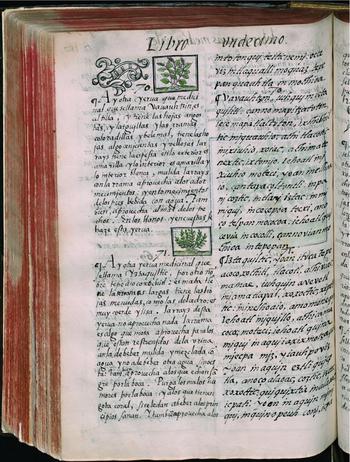
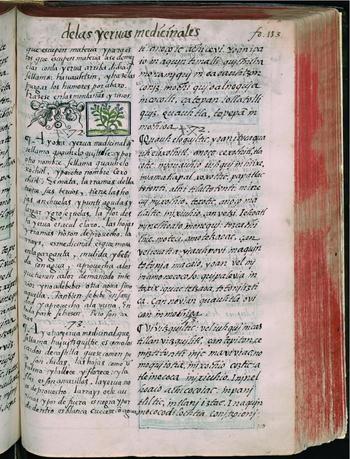
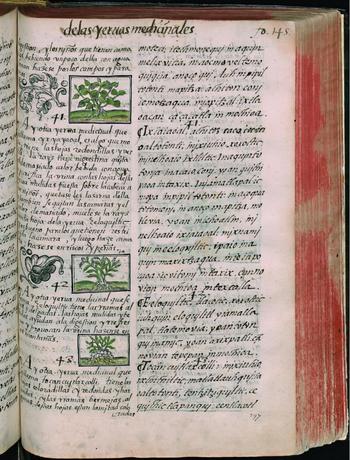
There may have been an initial attempt to transfer the pictorial and written information in the original herbal to the two columns of paragraph V, as the entries up to 31 suggest. From that point on, Sahagún must have factored in the importance of translating the information of these New World herbs and remedies for the Spanish officials of the Council of the Indies, and thus must have decided to translate the Nahuatl text. Adding the translation would mean that the illustrations, very likely more relevant in the original manuscript, lost their original status in the copy, which privileged the written text in Spanish. In addition, the insertion of the translation, or of some explanatory notes in Spanish in the left column, contributed to keeping the symmetry of contents aligned with the Nahuatl text of the right column (see Figures 3 and 4). Had the illustrations continued to occupy the full length of the left column, the reader would have found that when the Nahuatl text of the right column expanded along two folios, as it does for herb 71 and some others, the left column could have allowed blank spaces or given prominence to the illustrated herb, either by stretching it along the column length or by drawing it in its different stages.Footnote 35 With either option, the briefer Nahuatl passages, like those describing herbs in entries 42 and 43, would have looked discordant with their small-scale illustrations (see Figure 5).
Description of Herb 71, Folio 304v

Description of Herb 71, Folio 305r

Short Description of Herb, Folio 297r

Similarities between Paragraph V and Other Paragraphs of Chapter VII
Since the original manuscript of paragraph V preceded the creation of the codex and had to be adapted to its overarching structure, we are left to wonder about its genesis and whether it was born out of a dissimilar context, unconnected to Sahagún's. Thus, the following pages step back to consider the breakdown of the content of chapter VII and the manner in which information was collected, in order to argue that the original text of paragraph V must have belonged to Sahagún. To begin with, the full description of two herbs, one of which belongs to paragraph V, are provided here for comparison. The xoxocoyolcuecuepoc (oxalis), included in the fourth paragraph, on edible herbs, is depicted this way: “The stem is cylindrical, long. It has blossoms, it is a blossomer, so it is called xoxocoyolcuecuepoc. It is very tasty; it is like the tomato. It grows only when the rains set in anew.”Footnote 36 In turn, the tlalchichic (a root that is made into a drink) of paragraph V is depicted as “just a cylindrical root. It is just like an herb, not tall. Its foliage is ashen. He whose stomach is swollen or who has diarrhea is to drink it. First it is boiled; thereupon it cures. It grows in Teuhtlalpan.”Footnote 37 As observed in these two entries, the coinciding elements are the physical description of the herbs and their use: the xoxocoyolcuecuepoc (oxalis) is edible; the tlalchichic (the root made into a drink) is a remedy for stomach ailments, and these are followed by the season or location in which the herb is found.
In contrast to the content of the chapters of Book XI, and to other paragraphs of chapter VII, paragraph V does not manifest a lexicographical interest. However, it does deal with identifying features, properties, and location, like other entries of paragraphs on herbs. Thus, the reader learns from paragraph V whether the root and the trunk of the herb have a noticeable shape; whether the herb is characterized by a certain color and fragrance; whether it can relieve a given pain or cure a disease; whether, in order to prepare a remedy, the herb is crushed, boiled, dried, or mixed with other herbs and anointments; and whether it is found on mountains, in valleys, or in a specific area, such as the aforementioned town of Teuhtlalpan. This reference to the name of an exact location—other entries cite Xochimilco, Coyotepec, Tezcatepec, Chillocan, and Xaltenco—also differentiates paragraph V from the other paragraphs of chapter VII, and is suggestive of the distances that herbs must have traveled in the hands of expeditionary merchants.
To account for the almost systematic appearance of similar items of information in the portrayal of herbs throughout the paragraphs of chapter VII, López Austin suggests the existence of a fixed questionnaire for data collection. Sahagún seems to have obtained specific data on New Spain's fauna and flora for the first time in Tlatelolco between 1561 and 1565; this material was entered into an early draft of the codex, known as the Códices matritenses of the Academia de la Historia. López Austin has reviewed the sections on herbs of that manuscript (Book V) against the corresponding text in the Florentine Codex (chapter VII of Book XI). To examine the evolution that the information underwent between the two works, he names the list of herbs in the Códices matritenses the “Breve relación,” and their expanded version, in the Florentine Codex, the “Relación extensa.”Footnote 38 López Austin's argument is that Sahagún, dissatisfied with his initial gathering of data, requested the presence of several titicih (physicians) from the Tlatelolco area, so that they could amend and enrich what he had collected. Thus, the “Breve relación” of the Códices matritenses served as a guide to compose the “Relación extensa.” For the writing of this more detailed version Sahagún designed a questionnaire, which López Austin reconstructs, after deducing its content by careful analysis of entries in chapter VII: “1. What is it? (In the case of plants, what part of the plant is it?) 2. What does it look like? 3. What does it cure? 4. How is the medicine prepared? 5. How is it administered? 6. Where is it found?”Footnote 39
In the attempt to clarify the manner in which this questionnaire links all the paragraphs of chapter VII and, therefore, proves that the herbal of paragraph V is connected to Sahagún's work, it is worthwhile to focus on a potential source for the questionnaire and the identity of the informants involved. One of the most likely sources deployed by Sahagún to define questions to ask about herbs is Pliny's Historia naturalis, which was perused for the teaching of natural philosophy in the College of Tlatelolco. It is thought to have influenced both the Libellus and Book XI of Historia universal de las cosas de Nueva España, and it shows a striking association of contents with the questionnaire that, as López Austin maintains, Sahagún devised.Footnote 40 In Books XIX to XXXII of Historia naturalis, Pliny deals with remedies deriving from garden plants, such as flowers, fruits, and vegetables; those deriving from wild plants and forest trees; and those that come from other living creatures, such as aquatic animals. He structures this information into a two-category format; he either refers to the diseases that the remedies are supposed to cure, or as in the majority of books, he depicts the plants and the animals and then describes their healing properties. For example, in chapter II of Book XXVII, the reader comes across Pliny's portrayal of aconite, from which is extracted a poisonous but useful ingredient in compositions for the eyes:
[It] has leaves like those of cyclaminos or of the cucumber, never more than four in number, slightly hairy, and rising from near the root. . . . The root is slightly curved, like a scorpion's tail, for which reason some persons have given it the name of “scorpio.” . . . This plant is found growing upon the naked rocks known as “aeonæ;” and hence, it is according to some authorities that it is called “aconitum,” there being not so much as even dust about it to conduce to its nutriment. Such is the reason given for its name by some: but according to others, it receives this appellation from the fact that it fatally exercises the same effects upon the body that the whetstone does upon the edge of iron, being no sooner employed than its effects are felt.Footnote 41
The breakdown of content that builds up this passage, which tends to coincide with other chapters or entries of Pliny's books on herbal remedies, consists of a physical depiction of the herb, referring, for ease of identification, to its leaves and roots; to etymologies that provide reasons for the names aconite and scorpio; to the location where it is to be found; and to the effects that the herb produces on the human body.
Similarly, in Book XI of the Florentine Codex, in the first paragraph of chapter VII, on “herbs which perturb one,” we read this about the nanacatl (hallucinogenic mushroom):
[It] grows on the plains, in the grass. The head is small and round, the stem long and slender. . . . It is a remedy for fever, for gout. Only two [or] three can be eaten. It saddens, depresses, troubles one. . . . One eats it in honey. I eat mushrooms; I take mushrooms. Of one who is haughty, presumptuous, vain, of him it is said: “He mushrooms himself.”Footnote 42
A comparison between Pliny's and Sahagún's texts reveals a similar and parallel presentation of data. The portraits of not only the aconite and the nanacatl but also of the aforementioned tlalchichic, which is included in the paragraph V of the Florentine Codex, coincide in offering information on physical characteristics, location, effects produced by an herb's consumption, and, in the case of the aconite and the nanacatl, the etymology and fixed phrases, respectively, that are related to the word. This high incidence of recurring items is indicative of a textual analysis exercise, of which Sahagún, as a teacher of natural philosophy and Latin at Tlatelolco, had considerable experience.Footnote 43 One of the tasks he would have requested of his students was the imitatio or paraphrasing of a given text, as suggested by Quintilian in his seminal teaching guide Institutio oratoria, another book catalogued in the library of the college.Footnote 44 According to Quintilian, the requisites for paraphrasing or textual appropriation include a word-for-word scrutiny and the translation of every sentence, which, in turn, unfolds the textual organization of ideas.Footnote 45 On his search for a pattern of questions that would encapsulate the characteristics of the herbs, Sahagún would have recalled this exercise. He would have examined the structure of Pliny's books on herbs and deduced the most recurrent building blocks used to describe them. In other words, Sahagún would have figured out and jotted down questions requesting information on identifying features; effects caused by consumption; whether an herb was harmful or curative; and posology, location, and linguistic issues. The replies to these questions would correlate, overall, to López Austin's suggested questionnaire for chapter VII, on herbs, of Book XI. Before meeting with his informants, Sahagún would have selected the most pertinent questions to be asked, a choice that depended on the purpose behind his gathering of data. For example, during the process of obtaining material for what eventually constituted paragraph V, Sahagún excluded his question on linguistic issues because he did not intend to collect information for lexicographical-doctrinal purposes.
Sahagún's Informants for Data Collection
Regarding the identity of the Nahuas who answered these questions, two noteworthy pieces of evidence are available. First, there are the concluding lines of paragraph V, which report that data had been supplied by “los medicos del Tlatelulco Sãtiago viejos y muy esperimentados en las cosas de la medicina, y que todo ellos curan publicamente.” Footnote 46 Sahagún then lists the names of these indigenous physicians, coupled with the neighborhood or area where they performed their healing duties: “Gaspar Mathias, vecino de La Concecion / Pedro de Sãtiago, veci[no] de San[ta] Ines / Francisco Symon, veci[no] de Santo Toribio / Miguel Damjan, ve[cino] de S[anto] Toribio / Felipe Hernandez, v[ecino] de Sancta Ana / . . . Miguel Garcia, v[ecino] de Santo Toribio / Miguel Motolinja, v[ecino] de Sa[n]cta Ines.”Footnote 47 For López Austin, the identification of these informants, nowhere else to be found in the Florentine Codex, stands out as remarkable, an important factor that leads to his classifying paragraph V as an autonomous herbal. His suggestion is buttressed by the fact that their names appear at the end of the document, as if to close down an independent text only concerning this matter.
The second evidence that provides clues on Sahagún's informants is not from the Florentine Codex, but from the Códices matritenses. A note in folio 172r/v, which was not transferred to the Florentine Codex, discloses that by the early 1560s, Sahagún was already planning to collect material related to illnesses and remedies for what he called a “libro de medicina.” The note's reference to this objective of gathering such material and putting it into a book is of the outmost importance, as it highlights Sahagún's attempts to create a book on indigenous treatment of diseases, an undertaking that ran parallel to the gathering of material for what eventually became Historia universal de las cosas de Nueva España. Thus, there exists the possibility that the manuscript later transferred to paragraph V was first elaborated around this period, as part of Sahagún's efforts toward a libro de medicina. Those intensively involved in its composition, that is, “[l]os que fueron viendo paso a paso este Libro de Medicina, todos mexicanos,” were listed in the same manner as those at the end of paragraph V, that is to say, by name and then neighborhood: “Juan Pérez, de San Pablo; Pedro Pérez, de San Juan; Pedro Hernández, de San Juan; Joseph Hernández, de San Juan; Miguel García, de San Sebastián; Francisco de la Cruz, de Xihuitonco; Baltazar Juárez, de San Sebastián; Antonio Martínez, de San Juan.”Footnote 48
Impossible as it is to determine whether the omission of the latter list from the Florentine Codex was intended by Sahagún or the act of the assistants he had commissioned, these two passages—at the end of paragraph V and in the Códices matritenses—nonetheless tell us that a minimum of 14 or 15 men, experts on Nahua medicine, including herbal remedies, were consulted. This number of informants speaks volumes of the significance Sahagún attached to research on indigenous medicine and ties in with his method of data collection; that is, the more experts he had to question the better, since they enabled him to extend his material and validate the effectiveness of healing.Footnote 49 That Sahagún opts to name them is also revealing of his acquaintance with all these knowledgeable men. By supplying their identification, he certifies the accurateness of his writings—deriving from no less than the practitioners themselves—and brings to the fore their significance within the Nahua community: the fact that they were recognized healers in the neighborhood in which they practiced.
A Contextualization of the Herbal of Paragraph V
The first section established the status of paragraph V as an independent herbal, bereft of doctrinal and lexicographical purposes, and yet possibly linked to Sahagún's endeavors to compose a libro de medicina, covering data on illnesses and indigenous remedies. This section looks at the context in which information was extracted, and attempts to account for why the herbal was written in the first place. When Sahagún began gathering material on Nahua medicine in the early 1560s, he was residing in the Imperial College of Santa Cruz of Tlatelolco.Footnote 50 Officially opened in 1536, the college reached its peak in the first decades of the second half of the century, when, according to the archival manuscripts of the Fondo Franciscano, the Franciscans schooled about 100 colegiales (collegiate teenagers). These were children of caciques and nobles who entered the school between ages 8 and 10 and stayed for a minimum of three years as interns taking superior studies. Also at the college were about 400 parvulitos—younger indigenous boys who attended school only to learn prayers, basic literacy fundamentals, and music.Footnote 51
The circulation of illnesses in the communities in which the parvulitos lived meant that the college was ripe for the spread of disease and, at a time when licensed medical practitioners were in short supply, it comes as no surprise that the friars relied on a regular cohort of native healers to cater to the ill, whether pupils or themselves.Footnote 52 In fact, religious institutions like Tlatelolco are known, not only in New Spain but also elsewhere in the colonies, to have provided such services for the adult population. As in Europe, the mendicant orders built infirmaries and hospitals annexed to their friaries, where indigenous patients were tended by healers of their own race, as these were thought to be more suitable in dealing with their nature and temperament.Footnote 53
The Nahuas' spectrum of healers varied from shamans to specialist practitioners, such as phlebotomists, bonesetters, and midwives, who had received training within their families in anatomy and medicinal plants.Footnote 54 In the case of Tlatelolco, some of the healers the Franciscans must have commissioned were those Sahagún consulted, in his own words, indigenous men “muy esperimentados en las cosas de la medicina, y que . . . curan publicamente.” These healers must have belonged to distinct groups; the panamacac (apothecaries) and the titicih. Sahagún describes the former in chapter XXIV of Book X of the Florentine Codex as men who cultivated their own herbs and sold them in the market. In lieu of costly and often unavailable European medicines, the Franciscans would have relied on the familiarity of the panamacac with the curative virtues of the local plants, which were unknown to the Spaniards. Just as in the European friaries where the mendicant orders availed themselves of their own gardens, the friars of Tlatelolco must have continued the practice of growing vegetables, flowers, and medicinal herbs for their own use—and perhaps for the supply of drugs to private practitioners—this too with the indispensable help of expert panamacac.Footnote 55
The second group of Nahua healers who assisted the infirm in the college, the titicih, created a niche of colonial medical staff in institutions founded for the indigenous peoples, whether hospitals or schools.Footnote 56 Sahagún describes them in chapter VIII of Book X as knowers of remedies in the form of herbs, stones, and trees, and acknowledges they used these to heal people, such as when purging them and setting bones.Footnote 57 In addition, they would have treated diseases ordinarily found in the New World, such as gastrointestinal infections, dysentery, influenza, pneumonia, arthritis, viral fevers, Chaga's disease, and tuberculosis.Footnote 58
The most celebrated ticitl (physician) associated with the College of Tlatelolco was Martín de la Cruz. His name appears in a sixteenth-century document directed to the second viceroy, Luis de Velasco, where he and another healer from Tlatelolco, Antón Hernández, are described in the following manner: “Han hecho y hacen muchas y buenas curas, especialmente en los colegiales que están en el colegio de Santiago de esta ciudad.” Footnote 59 Aside from assisting the students and Franciscan brethren of Tlatelolco, De la Cruz acted as physician to distinguished figures like the first viceroy, Antonio de Mendoza. Of special interest is that De la Cruz's reputation gained strength under Velasco, who in 1553 awarded him a license to form, together with two other Nahuas, Antón Martín and Graviel Mariano, the first examining tribunal of indigenous physicians, which, as customary in European universities, consisted of three members.Footnote 60 De la Cruz must have been selected on merit, and also on his connections to the administration of an officially recognized and religious institution like Tlatelolco. In fact, De la Cruz's appointment to this tribunal happened only one year after he became involved in the codification of the first indigenous herbal of the New World, the Libellus.
With its beautiful calligraphy, lavish illustration, its binding of golden thread, and its red velvet cover, the Libellus was an expensive gift prepared at the College of Tlatelolco for Emperor Charles V. The prologue and the epilogue of the herbal explains that De la Cruz supplied data on illnesses and indigenous remedies in the form of herbs, roots, and compound medicines to Juan Badiano, a former Nahua student, and eventually a tutor at Tlatelolco, who translated the information into Latin.Footnote 61 The aim of the herbal was twofold; it was meant to promote continuing financial support for the intellectual and social activities carried out at Tlatelolco—an end that it met, as funds were subsequently allocated by Philip II and Viceroy Mendoza, in 1553—and it was also expected to lay the foundations for a lucrative European market of New Spain's herbs in Europe, to be run by the Mendoza family. However, this market failed to flourish.Footnote 62 The writing of the Libellus in the college in which De la Cruz practiced as a physician, with its aim of garnering financial support for the institution, is logical. There exists, nevertheless, another possible reason behind its composition. The Libellus and paragraph V of the Florentine Codex would have supported the role the college played as a center of knowledge on indigenous medicine.
The Libellus and Paragraph V in the College of Tlatelolco
In some passages of his translation into Spanish of Books X and XI of the Florentine Codex, Sahagún digresses on a contemporary topic very immediate to his work: how the epidemics of the sixteenth century, popularly known as cocoliztli (pestilence or illness), had shattered the life of the college to its core. He expresses his dismay at the outbreak of “tres pestilencias muy vnjuersales: y grandes,” namely, the smallpox plague of the 1520s (“morio casi infinita gente”); another plague that took place in 1545, during which “en toda esta nueua españa murio la mayor parte de la gente que en ella [vi]via”; and the deadly outbreak that was taking place even as Sahagún was dictating this passage to one of his scribes on November 8, 1576: he worriedly recounts that the death toll “siempre ha ydo creciendo . . . desde veynte, de tre[yn]ta, a quarenta, de cincuenta, a ses[en]ta, y a ochenta y de aquj adelante no se lo que sera.” Footnote 63 Sahagún relates his personal experiences in these harrowing circumstances. The second epidemic, he says, “dio un gran bacque al collegio,” and in the Tlatelolco area he claims to have buried “mas de diez mjll cuerpos”—until he himself was infected to the point of dying.Footnote 64 Now, in 1576, the same catastrophe threatened to repeat itself, and he laments that “casi no esta ya nadie en el collegio muertos, y enfermos, casi todos son salidos.” Footnote 65 In establishing comparisons between the two plagues, Sahagún notices that the death toll keeps increasing owing to lack of food and, to be noted, healers and physicians. Although in the late summer of 1576, “anduujeron . . . sãgradores sangrandolos, y medicos curandolos, y religiosos . . . para cõfesarlos y consolarlos,” help came to an end once these also fell worn and ill.Footnote 66
In the middle of this human tragedy Sahagún despairs, praying for divine and imperial intervention “porque a durar mucho todo se acaba.” Footnote 67 Pointing in particular to how the College of Tlatelolco could prove vital in times of illness and depopulation, Sahagún addresses Emperor Philip II, claiming that “el Rey, nuestro Señor, tuujera mas vasallos en [esta república Indiana]” if “los indios vujeran sido instruydos en . . . la philosophia natural, y medicina . . . porque en esta ciudad de Mexico, vemos por nuestros propios ojos, que aquellos que acuden a sangrarlos, y purgarlos, como conviene, y con tiempo sanan.” Footnote 68 Here, Sahagún confirms the productivity of instructing indigenous peoples in medicine and also appears to echo his experience as a tutor at Tlatelolco.
As a consequence of the second plague of the mid 1540s, which devastated the basin of Mexico and took a huge toll on the pupils of Tlatelolco, the college had introduced in its curriculum the study of indigenous medicine. Badiano and De la Cruz, authors of the Libellus, are believed to have delivered the courses.Footnote 69 As for Sahagún, the Franciscan chronicler Gerónimo de Mendieta corroborates his didactical and pastoral duties in the college in chapter XLI of Book IV of Historia eclesiástica indiana, reporting that: “[Sahagún] trabajó hasta la muerte en la instrucción y doctrina de los niños de principales indios que allí concurren de toda la tierra a enseñarse más perfectamente a leer y escribir, y a saber latinidad y medicina, según su menester.” Footnote 70 The last few words confirm that Sahagún taught Nahua young men indigenous medicine, a subject that entailed the learning of what Mendieta clarifies in chapter XV of his book as “medicina que ellos usan en conocimiento de yerbas y raíces, y otras cosas que aplican en sus enfermedades.” Footnote 71 The length of time and the degree of Sahagún's involvement in this type of instruction is unknown; Mendieta states only that it happened for “un poco de tiempo.” If one goes by Mendieta's assertion and Sahagún's own relation of his close encounter with death during the second plague of 1545, it is likely that his wish to learn Nahua medicine started soon afterward, and that he taught a course on it intermittently, perhaps for less than one decade, during which time he was in and out of the college, devoted to other pastoral and proselytizing duties. It is also during this period that Sahagún must have worked on the libro de medicina to which he refers in the Códices matritenses. For his own personal instruction, and for the writing of such work, Sahagún would have relied on physicians and tutors of the college, like De la Cruz and Badiano, as well as on the other titicih and panamacac whose names he quotes in the Códices matritenses and in the concluding lines of paragraph V.
Also to be noted is that Sahagún's interaction with these Nahua experts shows a continuity in the gathering of data on Nahua medicine; De la Cruz's commission to contribute to the production of the Libellus in 1552 was not an isolated case in the college. In fact, the production of both a libro de medicina and the herbal of paragraph V connects to and reflects the healing and pedagogical activities of the institution. Friars like Sahagún needed herbals, not only because of their practical interest in growing vegetables and medicinal herbs, but also because the college, having decided to offer courses on Nahua medicine, needed manuals on indigenous theory and practice for both tutors and their indigenous students, who were being accustomed to studying from written sources like Pliny's Historia naturalis. The codification of medical knowledge in what Sahagún calls the libro de medicina, in the well-structured description of herbal remedies in paragraph V, and perhaps in other herbals that have not survived---like De la Cruz and Badiano's original manuscript in Nahuatl—manifests what is most likely a real-life application. Their creation could have corresponded to an attempt to supply pre-Hispanic materia medica for friars and students of the college, so that they could learn how to heal the sick both inside and outside its premises.
Conclusion
The herbal of paragraph V may have belonged to the corpus of texts that Sahagún and other tutors used in their delivery of courses on Nahua medicine at Tlatelolco. As this article has attempted to demonstrate, the argument for Sahagún's authorship—or, rather, his direction and supervision of its writing—rests on the fact that the herbal and the other paragraphs of chapter VII, into which it was eventually inserted, bear similarities in content and approach. Just as he decided to collect and codify the metaphorical language the Nahuas used to describe the natural world, because he thought it more effective for their indoctrination than translations of his known European sources (these would include similes, metaphors, and exempla found in Pliny, Anglicus, Isidore, and Zamora), Sahagún collected data on local medicine rather than translating European sources, for example, herbals like the Hortus sanitatis. He was conscious of the latter's inapplicability.
To gather this material, Sahagún would have created a questionnaire, covering items such as physical description, effects, posology, and location of herbs, and recorded the answers provided by the Nahua healers whom he names. It remains to be explored whether the college could be put forward as an institution that during the mid sixteenth century prepared the Nahuas to become “recognized” practitioners of indigenous medicine by instructing them on anatomy, illnesses, and remedies. All of these topics appear in Books X and XI of the Florentine Codex, and perhaps the Nahua colegiales learnt them and received training so as to take their exams in front of an official tribunal of three members, including De la Cruz, who had been a physician and tutor at the college.
On another note, the autonomous nature of the herbal highlights the complexity of Historia universal de las cosas de Nueva España, to which Sahagún added other Nahuatl texts that had been completed before the 1560s, among them the Libro de la rethorica and the book on the conquest; Books VI and XII, respectively, of the Florentine Codex. The existence of the herbal in Book XI demonstrates that the impetus for the composition of Sahagún's encyclopedic work extended beyond the doctrinal and lexicographical purposes that this very study presented in its first section. What paragraph V and other chapters on medicine in the Florentine Codex, and in earlier drafts like the Códices matritenses, might be telling us is that Sahagún's work mirrors his concern not only with cura animae, the healing of the soul, but also with the healing of the body. Sahagún sought to compose an encyclopedic referential text in Nahuatl that aided the transmission of the Christian faith to the Nahuas because, as he declares in his famous opening lines of Historia universal de las cosas de Nueva España, he was a physician of the soul. Nevertheless, as this study has conveyed by placing the herbal in its sociocultural milieu, Sahagún was equally concerned with the Nahuas' physical health. The herbal of paragraph V is one text with which he contributed to the work performed by “a physician of the body.”