During the early stages of economic reform (the 1980s and early 1990s) China followed a path of decentralization and market development. The central state became less involved in the village economy after it promoted the household responsibility system. The household became the unit of both accounting and production, thereby ending state micromanagement of agricultural production. The state rapidly retreated from many aspects of the rural economy during this period and let the market take over production and distribution decisions.Footnote 1
The central state decentralized control over revenues to local state entities in an attempt to jump-start economic growth by providing fiscal incentives for development. Local officials, especially those at the village and township levels, used their information, connections and efforts to mobilize resources for the rapid development of rural industry. These fiscal incentives led to the rise of township and village enterprises (TVEs) that allowed villages and townships an unprecedented level of autonomy.Footnote 2
While the state continued to allow individual producers and communities to take control of their own economic activities within China's growing rural markets, in 1994 the central authorities changed their attitude towards their agents at the local levels and recentralized fiscal control. The 1980s revenue sharing system had spurred localities to spearhead economic developmentFootnote 3 but also left them with a large share of the increased revenues from rural China's economic take-off that the central government was not able to claim.Footnote 4 The 1994 reforms re-assigned rights to various categories of taxes, thus allowing the central authorities to gain access to the ballooning extra-budgetary revenues that previously had been left entirely to the localities.Footnote 5 In the early 2000s, the centre took additional revenues away from the localities with the tax-for-fee reforms, which abolished the fees and surcharges that village and townships had previously been allowed to levy on households. In 2006, the only remaining tax that fed township and village coffers, the reformed agricultural tax, was finally abolished. To make up for the lost revenues, the central state established a system of fiscal transfers, which sent funds down through the administrative bureaucracy to fund the townships and villages.
Although much has been written about the centre's policies to regain control over revenues, there is surprisingly little work on the state's efforts to limit the autonomy of township and village cadres. Measures designed to tighten administrative and fiscal oversight began to be implemented during approximately the same period in the mid-1990s. These measures are distinct from the requirement to post village accounts that O'Brien and LiFootnote 6 have described, and from the various cadre evaluation systems described by Whiting or Edin.Footnote 7 Most of those earlier measures were attempts to improve transparency and hold cadres accountable in their control of village resources. The measures to which we here refer are policies that directly limit or remove power from village cadres over collective resources or management of village affairs.
Oi and Zhao, based on fieldwork in the mid-2000s, shed some light on the “village accounts managed by the township” policy, whereby village cadres no longer have the right to keep their own books.Footnote 8 In places where the double proxy management (shuang daiguan 双代管) policy is in effect, village funds are actually turned over to township economic stations and the villages must submit a request before they can access their funds. If these policies are widely implemented, they represent a dramatic shift from the control village cadres formerly enjoyed in the management of collective resources. There are similar reports about township officials who have had their fiscal powers taken away from them. Some have complained that they sit atop a “fake” government because they control no resources and therefore have no power.Footnote 9
Unfortunately, we lack information about when such policies targeting village and township cadres began to be implemented and how widely they have been implemented. We also have no basis to assess how successful this effort has been because existing studies have been limited to anecdotal evidence and case studies. Such an assessment would have direct implications for better understanding the nature of rural governance, including local village elections. We have a wealth of studies on village elections, including recent studies that assess the implementation of elections and the length of tenure of those elected.Footnote 10 What we lack are measures of whether those who are elected have power, in other words whether they have the right to control village resources directly and to make decisions about village matters.
The overall goal of this study is to begin filling in some of these gaps in our understanding of what has been happening in China's countryside as the centre has recentralized control over tax revenues. We use a new set of survey data designed specifically to examine issues of centralization, and we document the centralization of administrative and fiscal control of villages. Evidence on investments in local infrastructure, administrative regulation and fiscal oversight is used to document centralization at the township level (towards county authorities and higher). This reflects a decisive turn towards more centralized administrative control of townships and villages beginning in the mid-1990s, after the failure to stem farmer discontent, rural protests, and the perception of cadre corruption. We see increased administration and oversight of village and township-level fiscal revenues, expenditures and public-goods investments. The state has adopted a bifurcated approach towards households and cadres: it has allowed markets to boom while it has remained out of the decision-making calculus of farm households; at the same time, however, it has tightened its grip over township and village cadres, and it has limited their authority by moving fiscal and administrative controls up the bureaucracy. We show that this development has evolved over time with the increasing fiscal capacity of the central state, in a broad shift in the central state's agenda to recentralize both fiscal and administrative control. Our survey data allow us to assess how widely these control policies have been implemented and to show that in the aggregate this broad shift has been surprisingly successful.
The survey data also allow a more empirical assessment of the consequences of China's fiscal reforms as they have affected townships and villages. Earlier studies provide empirical estimates of the degree to which the centre succeeded in regaining control over revenues after the 1994 reforms. We have less understanding of the empirical consequences of the tax-for-fee reform, the elimination of the agricultural tax, and the local evolution of the institutions that control fiscal transfers between counties and townships. Is the centre taking on fiscal burdens that were earlier shouldered by townships and villages? Is the provision of public goods improving with the centrally funded fiscal transfer system? While case studies do exist, there are conflicting accounts about investment and success rates in areas of service provision, such as rural health insurance and education.Footnote 11 What is the trend of change in this and other spending over time? Although many studies have questioned the effectiveness of transfers, we lack solid measures of the degree to which the central government has actually stepped up and made investments in the countryside as the various policies would suggest. This article draws on a nationally representative dataset to provide evidence on these issues.
We move beyond the fiscal numbers to examine the second order effects in the localities of the state's efforts to recentralize control over fiscal revenues. We know that the fiscal transfer system sends funds down from the higher levels, but we do not know the extent of the power of village and township cadres after the transfer system was institutionalized. Using our survey data we assess the spread of the policies designed to increase administrative and fiscal control over village and township cadres, including the shuang daiguan policy and the county-controlling-the-townships policy described above.
We begin with a re-examination of the relatively well-known fiscal policies to begin to understand why the state took more direct measures to control cadres at the township and village levels. We offer some thoughts on why higher levels of the state embarked on state-building policies that had not been implemented since much earlier abortive efforts during the Republican period.Footnote 12
The Need to Extend the Reach of the State
The underlying struggle over revenues in the 1990s was reflective of the age-old dilemma faced by all rulers of China: how to control agents at the local levels, or what Vivienne Shue has termed the “reach of the state.”Footnote 13 When Beijing set in motion the 1994 tax reforms, more was at stake than merely controlling revenues. The consequences of the 1980s reforms shifted the balance of power between the centre and the localities, some argued, to a dangerous degree.Footnote 14 It was not only that the centre did not control enough of the taxes to redistribute them as it saw fit; there were also issues of whether it controlled sufficient resources to command obedience from the localities. Existing studies show that at the macro level the centre has regained control over increasing amounts of revenue and the financial system more generally.Footnote 15
Recentralizing control over revenue gave the centre more resources but it failed to prevent township and village cadres from increasing farmer burdens by illegally levying more surcharges and fees. In fact, the more revenues the centre attempted to take, the more the cadres at the local levels sought to evade regulations to squeeze the farmers for more fees and surcharges. The fallout from the 1994 tax reforms is the backdrop that helps explain the state's decision to tighten control over cadres at the township and village levels. We argue that the two types of centralization are intimately linked.
The 1994 reforms were designed to reset the balance of power between the centre and the localities by giving the centre control over more fiscal resources. The centre succeeded in taking more revenues from the localities with the 1994 fiscal reforms, leaving the localities in a precarious fiscal situation that set the stage for increased farmer burdens, creating much farmer discontent and threatening rural stability.
The root cause of the farmers' burdens can be traced to the decollectivization of agriculture, which shifted the rights to income from the sale of the harvest from the collective to the household, leaving the localities with little collective income. In areas that were primarily agricultural and had no other sources of collective revenue, illegal fees and levies were essential for the basic operation of local administration.Footnote 16 The 1994 reforms made matters worse by taking more revenue out of the localities and by allowing the provinces to decide how revenues and expenditures should be shared with their lower levels. This opened the door for saddling the lower levels of the administrative bureaucracy with responsibility for covering increased expenditures. Wong and others have documented the growing problem of unfunded mandates that left the localities in debt.Footnote 17
Throughout the 1990s the countryside was plagued with problems. These came to be summed up by the phrase “three agricultural problems” (san nong wenti 三农问题): the general malaise in agriculture, stagnant rural development along with increasing debt from failed TVEs, and lack of development for farmers. Statements by China's top leaders that these problems could threaten the core of the regime suggest that the state recognized the need to become more proactive, as fear increased over the consequences of the unresolved problems emerging during the course of reform.Footnote 18 These fears were stoked by the increasing number of farmer protests over farmers' burdens and cadre corruption.Footnote 19 As the literature on village protests documents, villagers became increasingly bold in openly articulating their discontent about these problems.Footnote 20 In some instances, they made official complaints to higher levels. In others, they took to the roads to protest, sometimes resorting to violence.
The centre had long known of the farmers' burdens and rising discontent, and had issued many “red-letter directives” (hongtou wenjian 红头文件) ordering that local officials reduce the farmers' burdens. But these edicts largely fell on deaf ears.Footnote 21 If the 1994 tax reform was driven by a desire to gain control over more revenues, the recentralization over cadres was driven by a fear of increasing farmer discontent and charges of cadre corruption, after earlier, indirect control mechanisms had failed. In the troubled context of the 1990s the central state started to consider more direct action, both by making further changes to the fiscal system and by tightening controls over grass roots cadres.
On the fiscal front, the state implemented the tax-for-fee reforms (feigai shui 费改税) in 2000–01,Footnote 22 which abolished all fees and reformed the agricultural tax. Although the state's intentions were good, in practice, the reform aggravated the fiscal problems facing townships and villages. Eliminating fees and surcharges (tiliu 提留and tongchou 统筹) benefited rural households, but it created fiscal shortfalls for localities, especially villages and townships that had relied heavily on the fees. This was especially true in poorer areas. Localities even had trouble meeting their basic administrative budgets to pay their cadres.Footnote 23 Their ability to provide public goods was minimal, if not non-existent. The problems of local development were yet to be solved.
In this troubled context, as Hu Jintao and Wen Jiabao took over in the early 2000s, they faced a critical policy choice: either grant local governments power to implement taxation on their own, or further centralize and systematically make fiscal transfers from higher to lower levels to fund the previously unfunded mandates. The fact that China took the second option – eliminating the agricultural tax and instituting fiscal transfers – was an unexpected move.Footnote 24 Centralization was sealed with the decision to rely more heavily on the fiscal transfer system to replace the localities' lost tax revenues.Footnote 25
Premier Zhu Rongji is best known for his efforts to rein in the financial system in the 1990s, but, as shown below, it also was during his watch that a parallel effort, starting in the mid- to late 1990s, began to rein in the power of township and village cadres. We examine whether there is a relationship between the spread of these policies and the state's broader fiscal concerns and its capabilities.
Data
To examine the evolution of the administrative and fiscal relationship at the township and village levels, we collected a set of primary data. The data were collected by a research team at the Center for Chinese Agricultural Policy in collaboration with Stanford University. In 2005 a survey was administered to households and village leaders of 100 villages in 25 counties across five provinces. Each sample province was randomly selected from China's major agro-ecological zones. Five sample counties were then selected from each province in a two-step procedure. The enumeration team first listed all the counties in each province in descending order of per capita gross value of industrial output (GVIO), which as a predictor of standard of living and development potential is often more reliable than net per capita income.Footnote 26 Five counties per province were then randomly selected from the resulting list.
In each selected county, the team chose sample townships and villages. Two townships were chosen from each county, one from each of two groups per county (a “well-off” group and a “poorer” group). Following the same procedure, two villages per township were chosen. This methodology in selecting the samples was employed so that the resulting data would be nationally representative. A survey was then administered both to village cadres and to eight randomly selected households in each village (selected from the village rosters).
The village accountant survey was used primarily for information about total investment in the village's infrastructure. Using the village accounting records, we were able to document the amount of investment in the village's roads, irrigation, drinking water, schools, clinics and other public projects in 1997 and 2004. The sources of the investments were also collected, including what share came from higher government entities and what share was raised inside the village (either from village-generated revenues such as enterprise profits or from households as household assessments). Importantly, for a limited number of our variables in this part of the survey we also have data available for 2007, since we asked the village and township accountants to update the investment data during a supplemental round of the survey that was conducted in early 2008.
A survey of the village committee head and the Party secretary was conducted to collect detailed information about which policies might best represent the nature of state–local relations. In particular, we asked village cadres questions designed to ascertain the timing when certain fiscal policies and other administrative rules and regulations were implemented (described in detail below). We asked a series of questions such as: “Is [such and such] policy implemented in your village today? If so, in what year was it first implemented? If not, was the policy ever implemented in the past and then discontinued? In that case, in what year was it started and in what year was it discontinued?”Footnote 27
Because it is possible that the primary respondents (such as the village accountant or the Party secretary) might not always provide accurate information, we also conducted a large number of supplementary surveys for the purpose of verification. This time-consuming task required asking similar questions to a variety of actors in order to ensure a high degree of accuracy. These actors included so-called “small-group” leaders, key informants, such as a retired village committee head or a former Party secretary, other influential individuals in the village, and common villagers, both men and women.
In total, we asked the respondents in the village about the six administrative regulations and fiscal policies described below. These are our administrative regulation and fiscal policy variables. Three of the policies were designed to build capacity that would allow for more effective implementation of state policy. The others were designed to manage fiscal transactions and accounting practices in China's villages. We use the findings on these six policies, together with investment data, to measure the reach of the state to control cadres at the township and village levels.
Administrative regulations
The first policy is the township “cadre-in-residence” (zhu cun ganbu 住村干部) programme. According to this policy, township leaders are supposed to assign a township official (or a civil servant from the township) to each village. The policy is designed both to give villages more direct help in interpreting and implementing upper-level policies, and also to ensure that township/county government officials have more information about what goes on inside the villages. According to our data, in places where a cadre-in-residence programme has been formally implemented, a township official spends between two and five days per week (an average of 3.5 days) in the village throughout the year.Footnote 28
In contrast to the policies of the 1980s and early 1990s, the second policy, the “salaries-from-above” programme, stipulates that the salaries of village cadres should no longer be paid out of the village's fiscal accounts (which typically were funded by revenues collected through the assessment of fees and informal taxes). Instead, the policy mandates that certain cadres receive their salaries directly from county-level fiscal accounts funded (at least in most provinces) by transfers from the central government. In 2004, of the villages that were designated to take part in this policy, the county-level fiscal bureau paid the salaries of between three and seven cadres per village, with the average being four. In many cases, salaries were paid at the end of the year. In some cases, village cadres complained that township officials often used the threat of withholding payment of their salaries to spur them to execute some policy or directive.
The third policy concerns restrictions on corvée labour. Throughout the socialist period (before 1980) and the early reform era (1980–95), village cadres were allowed – and often encouraged – to mobilize the farmers in their villages to contribute a certain number of working days to the completion of centrally designated projects. During the socialist period, farmers frequently had to work on county or commune projects outside their village's immediate area. After the 1990s, such corvée labour was rarely used for township or county projects, but was still used for infrastructure projects within the village. During the late reform era, the central government made further efforts to place limits on the ability of village cadres to mobilize corvée labour because of concerns that this practice was a burden that reduced farm income, as well as because of complaints that farmers were being asked to work on projects that were not productive.
Fiscal oversight policies
According to the first fiscal oversight policy, village accounts managed by the township (cunzhang xiang guan 村帐乡管), the village is no longer allowed to have its own bank account.Footnote 29 Instead, village funds are deposited in a bank account that is controlled by the township (often the township's economic management office – jingji guanli zhan 经济管理站 or jingguanzhan 经管站 for short). Under this system, villages must apply to the township to use their own funds. In some places, petty cash is left in the village for miscellaneous expenses; in others, village leaders pay for all village expenses out of their own pockets and then are reimbursed. A township official, typically the head of the economic management committee (jingguanzhan zhanzhang 经管站 站长) has to sign off on all financial transactions.
The second fiscal oversight policy concerns transparency of village fiscal accounts. Where this policy has been implemented, the village accountant is required to post copies of all accounts (including income and expenditure statements, debts and asset balance sheets, and cash flow statements). Typically, it is required that the village accounts be posted either monthly or quarterly in a conspicuous place, often on the village blackboard, on a wall outside a village office, or at the home of a village cadre.
The third policy, accounting training programmes, includes mandatory training for village accountants, generally ordered by the central government and run by county financial bureau personnel. The training is usually held about once a quarter, or, in some cases, semi-annually. Each training programme is followed by an exam, and in some villages accountants will not be paid if they cannot pass the exam. Accountants are also formally (and personally) responsible for implementing the administrative and fiscal oversight regulations that they are introduced to in their training programmes.
Extending the Reach of the State: Findings from our Survey Data
We first report our findings regarding the degree to which the central state has extended its reach into villages through increased investments. We then examine the accompanying side of this reach: control over cadres at the village and township levels.
Upper-level investments in China's villages
One of the big questions in existing studies is whether the fiscal transfer system has resulted in more investments by upper levels. This concern is all the more relevant given the regime's goal of creating a “harmonious society” and a new socialist countryside that is intended to bring more public goods to those in the countryside.
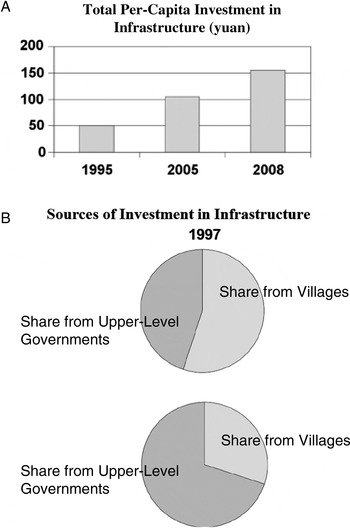
Overall, our findings show that the flow of investments from above into China's villages has increased. In 1997, according to our data, villages received an average of 350 yuan (US$50) per capita in public-goods investments (mostly for roads, irrigation and drinking water). Of this, however, less than half came from above, that is, from county fiscal transfers or directly from the accounts of other county-level bureaus, and in some cases funded by central government transfers. Village cadres were either required or allowed to use their own funds for about 55 per cent of the investment amounts. By 2005, the situation had changed. The level of investment had risen steeply to over 700 yuan (US$100) per capita, more than double the previous amount. In addition, in 2005 more than 65 per cent of the investment amounts were from above.
According to our supplemental survey in 2008, the trends in the early 2000s continued between 2005 and 2008. By 2008 the flow of investments had accelerated and the share coming from above had grown dramatically, especially in poorer villages. In 2008 per capita investments in the average village rose to nearly 1,000 yuan (US$150) per capita (see Figure 1, panel A). As described in Liu et al.Footnote 30 these investments reached the villages through a number of different channels, including funds originating from the Ministry of Agriculture, the Ministry of Water Resources, the provincial transportation authorities and the Leading Group for Poverty Alleviation. Nearly three-quarters of the funds came from upper-level governments, not from local villages (Figure 1, panel B). In the case of the poorest 20 villages in the sample, more than 95 per cent of the investment flows came from upper-level government sources.
Increased Investments in Public Infrastructure in China's Villages, 1995–2008

The change in the level of upper-level support is especially noticeable in the areas of education and health. In the 1990s villages were still in charge of building and maintaining their own school facilities. In 1997 more than 80 per cent of our sample villages reported that they were in part responsible for local schools. The fact that many teachers were being paid, in total or at least in part, directly by the villages was the source of considerable local debt. All elementary and junior high students paid both tuition and other fees. By 2005, however, policy had changed. Tuition fees for all nine years of compulsory education were eliminated. According to our data, in 2003 or 2004 none of the sample villages funded any investments in schools .
While our findings show that responsibility for school funding has clearly shifted away from student fees and village governments towards county and central government agencies, the net effects on total education spending and educational outcomes remain unclear and subject to local variation. Some case studies find that while county governments have assumed responsibility for schools, they have not sufficiently replaced the funding that was previously, collected from fees and taxes, leading to reduced per-student income and lower facility investment, particularly in poor areas.Footnote 31 However, other studies have found that the centralization of responsibility for educational funding has generated positive outcomes, such as increased central government education subsidies in recent years,Footnote 32 reductions in both rural–urban and male–female education inequalities,Footnote 33 and teacher salary stabilization.Footnote 34
Health care funding has also been evolving. In the mid-1990s less than 5 per cent of the farmers in our sample were covered by village- and township-funded health insurance. This is in line with several studies that have found that in the early and mid-2000s, government investment in rural health infrastructure was insufficient, or even non-existent.Footnote 35 However, our findings, along with recent studiesFootnote 36 and policy statements, indicate that this may have changed. By 2004, just after the introduction of China's New Cooperative Medical System – an initiative heavily funded by the central government – the government share of funding had increased to 24 per cent. According to the supplemental survey of our villages in 2008, by the end of 2007 the New Cooperative Medical System had reached 100 per cent of the sample villages and had greatly altered the everyday activities of village and township health care providers.
Even though our findings demonstrate that the central government had clearly intervened in the rural health system through the subsidized provision of health insurance to 800 million rural residents, we did not find a similar centralization of funding for facility operating costs or maintenance. However, recent policy statements suggest that the central government may have increased national health care spending by as much as 1.5 per cent of GDP in very recent years, targeting in particular rural health care facilities.Footnote 37
Apart from the increased funding of public goods at the village level, various other centrally funded programmes are intended to help rural households directly. There is a large-scale grain subsidy scheme that (in theory) gives more than 83 per cent of farmers in our sample cash payments in return for planting grain.Footnote 38 However, cadres at higher levels or those within the village assigned to allocate the funds can easily divert the money, and such problems are well known to the central authorities. According to survey data from the Chinese Academy of Sciences, to prevent such diversion of funds, payments from the Ministry of Finance go directly into the bank accounts of each farm household.Footnote 39 Interviews from recent fieldwork confirm that this is happening throughout China. Although payments are fairly low on a per-household basis (less than 300 yuan, on average), the payment constitutes between 7.6 and 10.4 per cent of the annual income of the households living at the poverty line.
In addition, in more than 80 per cent of villages there is a new low-income support programme for rural areas (nongcun dibao 农村低保). Like many of these programmes, however, not all who are poor will necessarily receive these funds. There are limits on funding and quotas for how many people can receive such aid. Anecdotal evidence reports that funds are sometimes given to those with connections regardless of whether they are the most in need. However, in many villages respondents told us that the low-income support payments were indeed going to the poor and the elderly who did not have children to support them. According to our 2008 supplemental survey data between 3 and 7 per cent of households in non-coastal provinces receive such payments.
To summarize this portion of the findings, we can say that while there is still much that needs to be done in terms of filling the many gaps in funding, in the aggregate the reach of the state into village communities is providing additional financial inputs. And these resources are reaching farmer households and rural schools. Others have noted that in some villages local governments alter the numbers, keeping large numbers of people off the rolls and engaging in creative accounting of various sorts. While this may have happened in the past and may still be happening for programmes in some areas,Footnote 40 the amounts reported above are those that, according to our primary data collection inside the villages, actually made it to villages, schools, rural clinics and rural households. One can easily see the results of the new flow of investments throughout rural China, even to remote villages in poor provinces. However, as we show in the following section, along with paying for more at the local level, central control is also being extended and strengthened.
Administrative regulation of China's villages
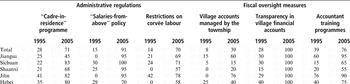
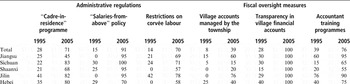
Along with increased fiscal support for various types of public goods, the central state has increasingly tightened control of cadres at the village level. In 1995 the typical village in China was still relatively decentralized and subject to loose administrative control and financial oversight (Table 1). According to our data, in 1995 only 28 per cent of China's villages were part of the cadre-in-residence programme (row 1, column 1); 72 per cent of the villages had no assigned official who regularly visited and was recognized as a township member of the village leadership. In other words, most of the villages were being run as they had been in the past: by village cadres from the village itself. The township did maintain a relationship with each village, but it was usually on an ad hoc basis.
Share of Sample Villages with Administrative Regulations and Fiscal Oversight Policies in China, 1995 and 2005 (% of total sample villages)
Source:
Authors' survey.
Even fewer villages in 1995 were subject to other administrative oversight measures (Table 1, row 1). For example, village cadres in only 15 per cent of villages were paid directly from the county budget (column 3). In the other 85 per cent, cadre salaries were supported by local fees and taxes raised by the villagers themselves; as part of the reform, these fees were abolished. There were similarly low levels of control regarding corvée labour. Our findings show that upper-level governments only attempted to limit the way that village cadres could draft and use corvée labour in 14 per cent of villages (column 5). In the other 86 per cent, a decision to use corvée labour and any limits on the number of days per year that it could be used was a village-level decision.
By 2005, however, our data show that the government's efforts to extend the reach of the state had increased significantly (Table 1, row 1). In 2005 there was a permanent township official posted in 71 per cent of China's villages (column 2). In other words, in more than 500,000 villages across China, township authority was physically present in the villages every other day or on a nearly daily basis. In even more villages (91 per cent), the salaries of village cadres were no longer paid from the village's own funds but rather from the coffers of the upper-level government; in many of these places village cadres were viewed by both township officials and farmers as being “on the payroll of the government” (column 4). According to our data, by 2005 70 per cent of China's villages had explicit rules about the maximum number of corvée labour days per year, and the form of compensation required (column 6). Our follow-up interviews indicate that a significant share of the villages that did not have such rules, or reported in the survey that there were no rules, had actually had no corvée labour requisitions in the recent past so there was no need for such rules. Clearly by the mid-2000s, upper-level governments had extended their reach through direct payments to cadres and limits on the corvée labour that they could demand from village households.
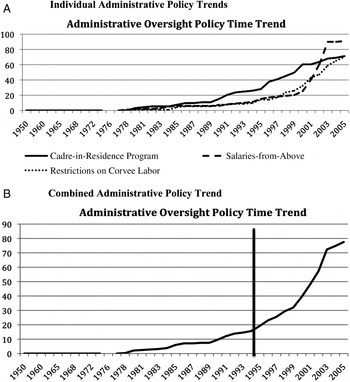
Graphical representations showing the implementation of these policies on an annual basis clearly demonstrate that the takeoff point for greater oversight was somewhere in the mid-1990s (Figure 2, panel A). When examining the trend lines of all three administrative regulations, there is a sharp rise in the share of villages covered by these policies in the mid-1990s. When the three administrative regulations are combined (given one-third weight each), the most obvious kink in the slope occurs in the year 1995 (Figure 2, panel B).
Administrative Regulation Policy Phase-In Trend

Fiscal oversight measures in villages
Fiscal oversight policies covered relatively few villages in 1995 (Table 1, row 1, columns 7, 9 and 11). The jingguanzhan, for example, directly managed the village's fiscal accounts in only 8 per cent of China's villages. In the other 92 per cent, villages had their own bank accounts and were responsible for all deposits and expenditures. In 1995, only 28 per cent of villages were required by the township to post their account balances and to report income and expenditure statements. In addition, only 39 per cent of village accountants received any training in formal accounting methods. This is confirmed by visits to villages during the 1980s and early 1990s. Accounting practices differed dramatically from village to village and in some villages accountants did not have any experience even in basic accounting.
The rise in fiscal oversight policies between 1995 and 2005 was equally dramatic (Table 1, row 1, columns 8, 10 and 12). By 2005, townships were directly managing the fiscal accounts (both keeping the books and managing the money) of 39 per cent of the villages. In our 2008 supplemental survey, the data show that well over half of China's villages lacked direct control over their own funds in 2007. By 2005, requirements for transparency in village accounts were universal. The accountant in every village in China was required to post detailed records of the village's income and expenditure as well as records of its debt and assets on a monthly or quarterly basis. Finally, by 2005 76 per cent of village accountants were required to attend annual (or more frequent) training. These fiscal oversight measures, like the administrative regulations, have greatly increased the capacity of the state to reach the villages and have made it more likely that upper-level government will influence national policy implementation and village governance.
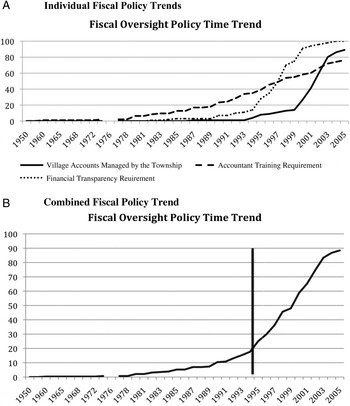
Figure 3 (panel A) shows the trend graphically over time. Similar to the case of administrative regulation, there was little fiscal oversight before 1995. Starting in the late 1990s, however, upper-level governments began to exert more fiscal oversight. Also, as in the case of administrative regulation, when the three fiscal oversight measures are combined (given one-third weight each), the most obvious upward kink in the slope occurs precisely in 1995 (Figure 3, panel B). Indeed, between 1995 and 2000, an average of nearly 30 per cent of China's villages were subject to the three new administrative regulatory policies and three new fiscal oversight measures.
Fiscal Oversight Policy Phase-In Trend

Reach of the state into China's townships
While the empirical findings in the previous section focus on state–local relations at the village level, there is also evidence that the same set of dynamics was occurring at the township level. In the 1980s, according to Oi's work on the local corporate state,Footnote 41 the fiscal reforms gave strong incentives to township leaders to start enterprises, invest in infrastructure and generally foster a strong local economy. Townships had the right to keep profits and much of the tax revenue that they generated locally. They could also spend what they earned.Footnote 42 This demonstrates that townships operated with a great deal of fiscal (and, indirectly, administrative) independence. The central state intentionally granted the localities autonomy over surplus revenue as an incentive to promote growth. Moreover, because of the weak institutional ties between upper-level governments and township officials/village cadres, when it did try to regulate the fiscal affairs of localities and increase its share of local revenue, the reach of the state was weak.Footnote 43
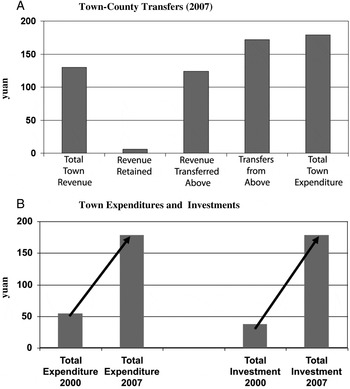
Using data on fiscal revenues, expenditures and transfers (from township to county and from county to township) that were collected during our original 2005 survey and the supplemental 2008 survey of township officials and township accountants in the 50 townships in our sample, we discovered that the reach of the state, specifically that of the county, to township finances in recent years has been much stronger than during the 1980s and 1990s (Figure 4). According to our data, township fiscal revenues in 2007 were about 130 yuan per capita (panel A, bar 1). However, unlike in the past,Footnote 44 only a small fraction (6 yuan per capita) accrued to the township's own fiscal account (bar 2). The rest (124 yuan per capita) was transferred from the township up to the county (bar 3). In short, townships got to keep little of what they earned.
Township Revenue Transfers

Having little access to their own fiscal revenue, however, did not mean that townships were unable to spend. In fact, on average, counties transferred more down to townships than they took up from towns. Despite transferring up an average of 124 yuan per capita, the typical township received 172 yuan per capita back from the central authorities in 2007 (bar 4). When used with their own revenue, townships were able to spend 179 yuan per capita (bar 5). Moreover, when compared to expenditure levels earlier (in 2000, the earliest year for which township-level accounting data are available in our dataset), it is clear that fiscal expenditures have risen sharply in recent years in real terms. Figure 4, panel B (bars 1 and 2) shows that from 2000 to 2007, fiscal expenditures rose from 55 yuan to 179 yuan per capita. Townships also received higher levels of investments from above. Investments for public goods and other infrastructure projects rose from 38 yuan per capita in 2000 to 179 yuan per capita (coincidentally the same as expenditures per capita from current accounts) in 2007. Therefore, it seems clear that by the mid-2000s many more fiscal resources, both in current/general fund accounts and in investment accounts, were flowing into China's townships.
The patterns of the flows (from Figure 4, panel A) and the nature of the institutional environment, however, constitute an important shift. While the total amount of resources is rising, most of the resources are filtered through upper-level government accounts, allowing upper-level authorities to have far more say on the nature of expenditures and the direction of investments. During the early reform period less than 30 per cent of expenditures were funded as targeted subsidies,Footnote 45 whereas by 2007 over 75 per cent were funded in this way.
The Fiscal Basis of Administrative Reach
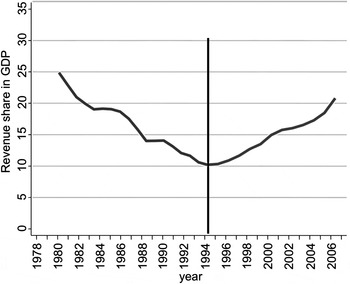
Putting the above findings together, we can see that the three trend lines show that there is a high correlation between increased administrative regulation and fiscal oversight and command over fiscal resources by the central government. The first two trend lines can be seen in Figure 2, panel B and Figure 3, panel B. The sharp rise in administrative regulation and fiscal oversight occured in 1995, or at least the mid-1990s. The third trend line is from Yingyi Qian's work on fiscal governanceFootnote 46 and is reproduced in Figure 5, which shows the share of total fiscal revenue that is remitted to the central government. Between the late 1970s and 1994, this share clearly fell. Indeed, in the mid-1990s policy officials and researchers commented on the fact that China's central share of budget resources was so low as to endanger the nation's growth and development.Footnote 47 The trend, however, changed direction in the mid-1990s. The central government began to collect higher revenue shares at the same time that it began to demand greater administrative regulation and fiscal control.
Fiscal Transfers to the Central Government

Our findings suggest that Shue may have made the right prediction about the outcome of increased state reach with reform, but it is not clear that it was because of the development of markets. Our findings suggest that the penetration of the state into China's townships and villages has been fiscally led and state determined. With a command over fiscal resources, the state has increased investments and increased expenditures from current accounts. It has used these fiscal resources to build an institutional capacity to implement policy at the lowest levels of administration. At the same time, to ensure that these funds would be used as intended, it also increased constraints on village and township cadres, moving authority over financial matters up the administrative hierarchy. Fiscal matters that village cadres used to control have now been moved to the township. Likewise, funds that used to reside with the township are now controlled by the county.
Although we cannot definitively show it with empirical evidence, our findings suggest that the ability of the central state to build its capacity to extend its reach may have been enabled by the power it gained from its command over fiscal resources. Fiscal capacity and state capacity are very difficult to disentangle in terms of cause and effect, since the latter often requires augmentation of the former, and the former can easily become a proxy or stand in for the latter. What is clear from our findings is that a set of political decisions made to augment fiscal capacity has been consistently manoeuvred into increased administrative oversight over more local state agents and the provision of more state services in terms of both quality and quantity.
The link between fiscal and political capacity to reach into villages and townships may also explain why the state did not earlier try to institute these types of controls to prevent cadre corruption and abuse. The answer may be a matter of feasibility rather than choice. Before the large infusion of monies through the fiscal transfer system documented above, central authorities allowed the levels of investment, public services and the power of local authorities to be completely tied to the ability of the village and its leaders to generate economic resources or to squeeze fees and corvée labour from the farmers.Footnote 48
Empirical studies show that during the 1990s, if corvée labour was thought of in monetary terms, villages contributed more than 70 per cent of all investments in key public goods – roads, irrigation and drinking water – in their villages.Footnote 49 Health clinics were either supported by local funds or were privatized. If a household in the village did not have enough to eat or wear, or had no place to live, it was the village's responsibility to support it. In other words, as long as the village's tax and grain quota responsibilities were satisfied and there were no out-of-plan births, the village leadership was allowed to run the village as it saw fit.Footnote 50 The reach of the state into the villages during this period was minimal, and we would argue that this was by design, both to stimulate growth and because the central state did not have or did not want to use its fiscal resources to intervene directly.
Instead of providing the needed fiscal resources during the earlier years of reform, the state opted to experiment with institutions to improve local governance and prevent abuses, namely, by allowing village elections, which began on a trial basis in 1988.Footnote 51 The idea was that if villages elected their own leaders, the villagers might actually listen to them. Some have argued that village elections were attractive for the central state because they served as a political safety valve for the villages and a check on cadre corruption after the end of the Maoist era campaigns.Footnote 52 If there were governance problems, the centre could shift the blame back to the villages and the farmers themselves.
Given our findings, the question is whether the two sets of strategies can work together. Are village elections and self-governance being undermined by the administrative and fiscal controls that have taken away considerable power from village cadres? Without control of economic resources do village cadres, elected or not, have effective power to lead and govern? Increasingly tight control and less autonomy for village leaders suggest that the central state has opted to go with regulation rather than to rely on the more unpredictable election system.
There is also the broader question of whether increasing fiscal and administrative centralization, including increased investments and provision of public goods, will improve the quality of village governance and increase regime legitimacy. Extending the central state's reach down into townships and villages through control over fiscal resources provides institutional controls and limits the opportunity for local cadres to misuse local revenues. Farmers should feel more protected and grateful to the upper levels of the state for the abolition of fees and taxes, as well as for the direct transfers that have brought them more public goods and services, but what about the local cadres who are charged with local governance? Recent empirical work has identified some of the positive effects of China's improved village governance on economic development.Footnote 53 Others, focusing on social welfare, rural health reform and other reforms, are decidedly mixed.Footnote 54 Being a village cadre may now be easier, but is that necessarily what is needed, especially in the still poor, underdeveloped villages? The experience of the 1980s suggests that local cadres can be entrepreneurial when they are given the right incentives. But do village or township leaders still have incentives to be entrepreneurial if they lack control over their own finances? Will localities be able to draw on their understanding of the nature of community problems in searching for solutions? Will the lack of control over fiscal resources along with the decrease in autonomy associated with the cadre-in-residence programme diminish the power and prestige of village leaders to the point that they feel that they are only charged with implementing routine administrative edicts?Footnote 55
These are difficult questions to answer and more suited to in-depth fieldwork that can explore in detail the degree to which the power of township and village cadres is limited in practice. This study has documented the degree to which the various cadre control policies have been implemented in townships and villages. But, as we well know, cadres, especially those at the lowest levels of the administration, can circumvent upper-level restrictions through various evasive strategies. This was the case even during the much more restrictive Mao period.Footnote 56 Our point is not that the centre now effectively controls all the finances of all villages and townships. Villages and townships still have “ownership” of these resources but they must receive permission to use these resources or be directed in how they use them. The question is at what point will such restrictions affect decisions to be entrepreneurial. Although we cannot answer that question definitively, we already know from our findings that between 2005 and 2008 the incentives for township leaders to generate more fiscal revenues fell sharply from between “moderate” and “strong” to “weak” (in the case of tax revenue-sharing incentives); and from between “weak” and “moderate” to between “none” and “weak” in the case of expenditure incentives (that is, allowing greater expenditures, if tax revenues rise).Footnote 57
But such outcomes may be a cost that the central authorities are willing to bear. Perhaps the developmental role of local authorities is no longer necessary. The decision to turn to a fiscal transfer system and to limit the power of township and village cadres suggests that the central state, even as it allows markets to boom, believes that the state can and should be involved in the plan and be willing to pay the extra costs and accept the inefficiencies in return for increased control. This strategy may be judged to be a more efficient and less risky route that can mitigate the inequality and other problems that were the products of the earlier periods of decentralized growth and local autonomy. Even if entrepreneurship is no longer needed, there remains the question of whether this new, increased reach of the state will actually promote stability or whether the new state–local relations will generate more conflict and alienation between rural residents and their local leaders. Will the hollowed out local state be filled with second-rate bureaucrats who are only doing their job with no sense of initiative and with no ability to exercise their knowledge of their locality's strengths and weaknesses?
Although this article cannot answer many of these questions, it does make one thing clear. The state's capacity to reach down to control local officials through the control of fiscal resources may be as strong as ever. The state has restructured fiscal and administrative control in rural townships and villages in response to problems of decentralization and cadre corruption. It is using its growing fiscal base to increase its administrative reach so as to ensure stability and more equitable distribution of public goods across villages and townships in China. Even though its intentions may be good, it remains to be seen what the long-term consequences will be on local governance and citizen satisfaction with regard to their local leaders and the regime more broadly. Just as the Maoist period dampened incentives by controlling how money could be made, these recent centralization policies may similarly dampen enthusiasm for local entrepreneurship by controlling how revenues can be spent.