INTRODUCTION
In the 1970s and 1980s, Muslim-majority states and Muslim groups responded with caution to Christian overtures for interfaith dialogue. When they participated, they were guests — but rarely hosts (Siddiqui Reference Siddiqui1997; Pratt Reference Pratt2010; Goddard Reference Goddard2000). However, in the 1990s, growing numbers of Muslim states, groups, and leaders embraced interfaith dialogue. In the past decade, Muslims have increasingly led major interfaith dialogue initiatives. The governments of Iran, Qatar, Jordan, Saudi Arabia, Kazakhstan, Indonesia, Libya, Malaysia, Morocco, and Turkey have all initiated interfaith meetings and established interfaith organizations. Muslim transnational civil-society groups have integrated interfaith dialogue and collaboration into their socio-political and religious activities. Notable examples of this strong interfaith activity include the Gülen Movement, present in 160 countries; the Asian Muslim Action Network, present in 18 Asian countries; and Muhammadiyah of Indonesia, whose 30 million members are found throughout South East Asia.
Some scholars see interfaith dialogue from the perspective of faith-based diplomacy. These scholars argue that interfaith dialogue seeks peace-making through the healing of religious animosities (Nimer, Khoury, and Welty Reference Abu-Nimer, Khoury and Welty2007; Goplin 2009; Haynes Reference Haynes2009). Other scholars claim that Muslims’ interfaith efforts are driven by their desire to invite non-Muslim individuals and communities to Islam (Duries Reference Duries2008; Sookhdeo Reference Sookhdeo2010). Still other scholars see interfaith dialogue as a public relations activity on the part of Muslim actors (Hendrick Reference Hendrick2013; Gutkowski Reference Gutkowski2015).
While valuable, these explanations discount the role of the broader political context motivating Muslim groups and states who engage in interfaith dialogue. I argue that Muslim actors initiate interfaith dialogue in response to clearly identifiable political concerns. First, Muslim actors use interfaith dialogue to dissuade powerful international and domestic actors from perceiving the Muslim actors as radical and, thus, dangerous. These interfaith initiatives signal the Muslim groups’ commitment to a specific — moderate — understanding of Islam. In particular, in the post-September 11, 2001 (9/11) world of the War on Terror, Islamic actors embraced, initiated, and endorsed interfaith dialogue with a sense of urgency (Pratt Reference Pratt2010a). Second, these actors also use interfaith dialogue as part of a strategy to speak on behalf of “true Islam,” thereby delegitimizing their radical and political rivals.
Although many Muslim actors engage in interfaith dialogue, they follow very different strategies. Toft, Philpott, and Shah (Reference Toft, Philpott and Shah2011) argue that two factors explain the varied trajectories of the religious actors’ political engagement. The first factor is political theology: the religious actors’ ideas about political legitimacy and justice (ibid, 27). Neither fixed nor epiphenomenal, religious actors’ interpretations of their key foundational texts shape their political engagement (ibid, 29). The second factor is institutional relationship: the level and quality of independence that religious actors have from political authorities. These actors and authorities can be constitutionally or financially independent or integrated. Moreover, this relationship can be consensual, one in which both religious actors and the state regard cooperation as legitimate, or conflictual, wherein at least one party wants to change the status quo (Toft, Philpott, and Shah Reference Toft, Philpott and Shah2011, 39; and also Baskan Reference Baskan2009). Using these two factors — religious actors’ political theology and the institutional relationship between religious actors and political authorities — Toft, Philpott, and Shah (Reference Toft, Philpott and Shah2011) analyze the influence of religious actors on democratization, terrorism, civil wars, and peace-building.
I extend their analysis to the interfaith dialogue strategies of Muslim actors. I argue that groups with a Sufi orientation will have the most accommodationist theology, while groups with a Salafi orientation will have the least. In terms of institutional relationship, in secular settings, interfaith dialogue will be carried out by non-state actors; in places where religious and political authorities are integrated, the state will control interfaith dialogue.
My analysis builds on Toft, Philpott, and Shah (Reference Toft, Philpott and Shah2011) but also amends their framework in three significant ways. First, following Sandal (Reference Sandal2012), I use the term “public theology.” Specifically, I use the phrase “public interfaith theology” to refer to religious actors’ perceptions of and theological arguments about the legitimacy of the religious other. In other words, I examine religiously based ideas not about the legitimacy of political authorities, but about the legitimacy of other faiths. Second, I argue that the “religious actor” category they have proposed needs further refinement. Toft, Philpott, and Shah's definition of a religious actor as “any individual, group, or organization that espouses religious beliefs and that articulates a reasonably consistent and coherent message about the relationship of religion to politics” (Toft, Philpott, and Shah Reference Toft, Philpott and Shah2011, 22) is inadequate because the international system provides different rights, responsibilities, and opportunities to state and non-state actors. While state-affiliated religious actors have access to diplomacy and intergovernmental institutions, non-state actors have only limited access to these means. Thus, non-state actors focus on grassroots efforts. Third, Toft, Philpott, and Shah (Reference Toft, Philpott and Shah2011) discount the role of regional and global resources and threats while overemphasizing domestic factors. I situate religious actors not only in their domestic political framework but also in the transnational system, which is particularly important in understanding religious actors’ strategies in an increasingly globalized world.
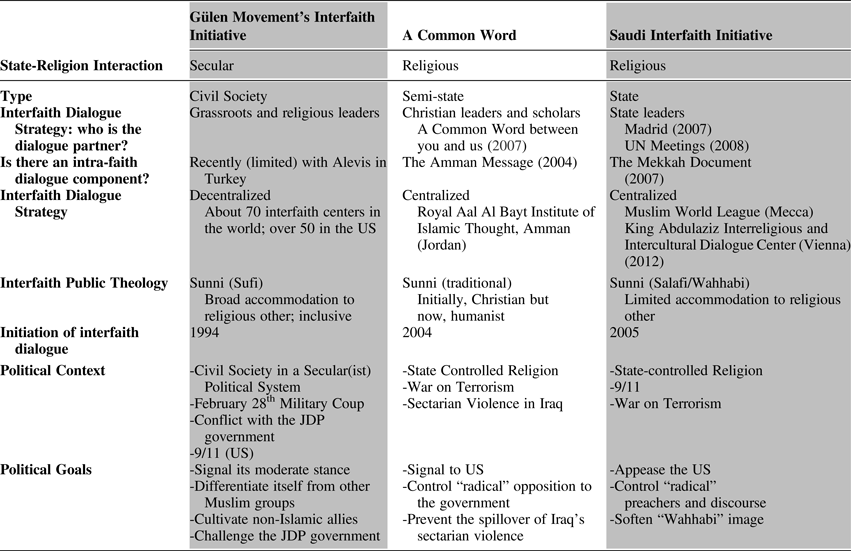
In the rest of this article, I examine three Muslim interfaith initiatives with varied interfaith theologies and religion-state relations in order to illustrate the impact of these factors (interfaith theology; state-religion interaction; religious actors’ state affiliation or lack thereof; and religious actors’ political, including global, concerns) on these groups’ interfaith dialogue initiatives. In particular, this article examines the Gülen Movement, Jordan's A Common Word initiative, and Saudi Arabia's interfaith efforts. These cases exhibit variation in the types of actors involved — state, semi-state, non-state — public interfaith theology — Sunni-Sufi, Sunni, and Sunni-Wahhabi. Last, while there are other actors in the Muslim world engaging in interfaith dialogue, these are some of the most sustained interfaith initiatives. These three prominent cases have attracted much publicity and are likely to influence future interfaith dialogue efforts in the Muslim world.
I aim to show that these interfaith initiatives are driven by political more than theological concerns. Theology, however, matters in making it easier for Muslim actors to initiate interfaith dialogue and it also shapes which non-Muslim groups will be adopted as dialogue partners and how the Muslim actors will engage with other faith communities. As I detail below that the main motivation is political, but the group type (state-affiliated versus non-state), similar to public interfaith theology, informs Muslim actors’ interfaith dialogue strategies: a state actor such as Saudi Arabia is likely to pursue interfaith diplomacy while a civil society actor such as the Gülen Movement is likely to pursue grassroots interfaith activism. Non-state actors will engage in civil society activities while state-affiliated actors will prefer to engage with other states or in inter-governmental organizations in order to advance an interfaith agenda. Moreover, since states with claims to religious representation and legitimacy attempt to control religion, they will likely attempt to control the interfaith dialogue, rather than leaving it to civil society actors.
FETHULLAH GÜLEN, THE GÜLEN MOVEMENT, AND INTERFAITH DIALOGUE
The Gülen Movement has shown remarkable creativity through grassroots interfaith activism, establishing over 50 dialogue centers in the United States alone. The movement's religious perspective, an orthodox Sunni (Hanafi) approach with a strong Sufi influence, and its experience in Turkey, a secular Muslim-majority country, has shaped its interfaith activism. The movement has used interfaith dialogue to distance itself from “political” and “radical” Islamist movements and to signal its “moderate” stance.
Pubic Interfaith Theology
Fethullah Gülen, the leader of the group, offers a very accommodating interfaith theology grounded in orthodox Sunni (Hanafi) thought and informed by his Sufi teachings. Gülen has written extensively on interfaith dialogue. For Gülen, “the very nature of religion demands [interfaith] dialogue” (Gülen Reference Gülen2000, 242). Gülen offers a public interfaith theology that goes beyond the traditional “the People of Book.” This accommodationist approach is built around three principles: (1) the commonalities among faiths, (2) a history of revelation and prophecy, and (3) the Qur'an's explicit sanction of interfaith dialogue (Kayaoglu 2010).
Gülen, like other traditional Sunni scholars, understands the Quran as calling for universal dialogue primarily — but not exclusively — with Christians and Jews. For Gülen, the Quran (such as 3:64) provides scriptural support for a Muslim dialogue with the People of the Book (Jews and Christians). Gülen stresses the verses in which Muslims are asked to believe “… in what is sent to you [Muhammad] and what was sent before you …” (Quran, 2:3–4) and “[d]o not argue with the People of the Book unless in a fair way” Quran (29:46).
However, Gülen expands this accommodation to non-Abrahamic religions. He holds that Judaism, Christianity, Islam, and even Hinduism and other world religions all accept the same divine source for themselves. These religions, along with the non-theistic religions, like Buddhism, are all in pursuit of the same goals: love, compassion, tolerance, and forgiveness (ibid. 253). This accommodating approach to other faiths is rooted in Gülen's understanding of the spiral history of religion. Embedded in an Islamic understanding of religion and history, assuming oneness and the basic unity of religions, this spiral view of history suggests that God sends prophets and revelations to establish and re-establish the universal principle of God's existence.
This inclusive interfaith theology constructed from the elements of mainstream Sunni and Sufi tradition is further buttressed by the Ottoman-Turkish tradition. Gülen refers to the teachings of Rumi (1207–1273), the famous Sufi poet, on universal values; Gülen indicates how religious tolerance encouraged Muslims and non-Muslims to embrace these universal values. Gülen invokes the Ottoman Empire's millet system and tradition of religious tolerance to show how Ottomans dealt with non-Muslims in a manner that was both practical and compatible with this Sunni-Sufi tradition. He favorably recounts the writings of the twentieth century Sunni-Sufi revivalist Said Nursi (1878–1960) on the importance of the mobilization of all faith communities to strengthen faith in an age of materialism and atheism.
Interfaith Dialogue Strategy
The Gülen Movement's theological interpretation is highly receptive to interfaith dialogue. This is one reason why Gülen and his followers have made interfaith dialogue a core area of their activism since the early 1990s, much earlier than other Muslim interfaith initiatives. Gülen has had bilateral meetings with key religious leaders, including the Chief Rabbi of the Jewish community in Turkey, the Greek Orthodox Patriarch, and the Pope. The Journalists and Writers Foundation was established on Gülen's initiative in 1994. It has launched a series of elite-level meetings between policy-makers, journalists, academics, and religious leaders on a variety of topics, including multi-culturalism, interfaith dialogue, and secularism (Esposito and Yılmaz Reference Esposito and Yılmaz2010). The movement has largely avoided intrafaith dialogue and only recently reached out to Alevis in Turkey (Today's Zaman Reference Zaman2013). Studies among the Gülen Movement's interfaith volunteers suggest that they have internalized an understanding of Islam that accommodates religious others and advocates for interfaith collaboration (Sahin Reference Sahin2009).
With the globalization of the Gülen Movement, interfaith activities have expanded. In addition to educational institutions and the media, the movement shares the ideas of Gülen with the wider public through a network of interfaith organizations in the United Kingdom (Dialogue Society), Australia (the Australian Intercultural Society), the Netherlands (Dialoog Academie), and Indonesia (Pacific Countries Social and Economic Solidarity Association), to name a select few locations. In the United States alone, the movement has over 50 loosely connected interfaith dialogue organizations (Kayaoglu Reference Kayaoglu2012).
Engaging in grassroots activism, these organizations typically seek to cooperate with religious and community leaders: they organize interfaith meetings, public lectures, and conferences on interfaith initiatives and Gülen's ideas. In their communities, they carry out activities under the banner of Abraham (e.g., Abrahamic interfaith dinners) or Noah (Noah's pudding celebrations), making these Hebrew Bible prophets central to their interaction with non-Muslims. They also organize travel to Turkey in order to introduce what they term Turkish/Anatolian Islam to American religious, political, and educational leaders (Hendrick Reference Hendrick2013).
Political Context
The movement's interfaith theology alone cannot explain the timing of its interfaith initiatives nor its distinctive features such as grassroots engagement and the avoidance of intra-faith dialogue. Political factors account for these.
From its formation in the 1960s until the early 1980s, the Gülen Movement operated as a “tight-knit underground community” and transformed itself following the 1980 military coup (Turam Reference Kayaoglu2007, 46). The coup changed Turkey's political and ideological landscape by targeting leftist, ultra-nationalist, and Kurdish activists. The military and the state promoted a “Turkish-Islamic synthesis.” The liberal policies of Prime Minister Turgut Özal (1983–1991) expanded the freedom of speech, association, and assembly. Benefiting from new circumstances, from 1983 to 1997, Islamic groups gained public visibility and popularity. Political Islamists used their power to confront Kemalism, the official state ideology. They also called, indirectly, for an Islamic state via their support for a “just system” (adil düzen). During this period, the Gülen Movement also flourished. It started to establish the movement's signature private schools, entered into broadcast and print media, and established cultural foundations and businesses (Yavuz and Esposito Reference Yavuz and Esposito2003).
The Islamic groups’ greater public visibility and the Islamist Welfare Party's electoral strength amplified the secularists’ scrutiny, fear, and attacks on Islamists. Increasing military pressures, which culminated in the 1997 “soft” military coup, removed the party from the government. The Turkish Constitutional Court closed the party in 1998 and its reincarnation (the Virtue Party) in 2001. Buoyed by the military's backing, secularist groups purged the bureaucrats suspected of having Islamist leanings and closed down Islamic charities (Yavuz and Esposito Reference Yavuz and Esposito2003).
The Gülen Movement professes a moderate Islamic stand and openly supports civil society, democracy, and Turkey's European Union membership. Yet, secularists, who often lumped all Islamic groups together, started to target the movement. In 1999, the State Security Court started a case against Gülen, alleging that he was undermining secularism (Yavuz and Esposito Reference Yavuz and Esposito2003; Kuru Reference Kuru2009). The retreat to a pre-1980s underground model was not an option. What the movement needed was to convey its differences from other Islamic groups, publicly commit itself to diversity and democracy, and find non-Islamic allies against state repression and secularist attacks.
Interfaith dialogue allowed the group to achieve these aims. Branding its version of Islam as Turkish (Anatolian) Islam, created an implicit contrast with Iranian, Saudi, and reactionary or political Islam. Additionally, the movement emphasized its local roots and its compatibility with Turkish nationalism. It avoided any public collaboration with other Islamic groups in order to keep its brand from being contaminated by the other groups’, arguably, anti-state and anti-establishment discourse and actions. With Davos-like meetings held in Abant, a lakeside town three hours away from Istanbul, the group reached out to liberals, leftists, and non-Muslims (Ugur Reference Ugur, Barton, Weller and Yilmaz2013; Yavuz Reference Yavuz2013). The group's inclusive Ramadan dinners were contrasted with Erbakan's (the leader of the Islamic Welfare Party) dinner invitations offered only to Islamic community leaders (Gülen declined the invitation). The movement used Ramadan dinners to differentiate itself from other Islamic groups, to burnish its commitment to diversity and democracy, and to cultivate allies from non-Islamic circles. As the tension between the Islamic Welfare Party and the secularists mounted, Gülen publicly asked the Welfare Party government to resign, further distancing the movement from political Islamic actors. All these attempts of “appeasement” (Yavuz Reference Yavuz2013), arguably, contributed to Gülen's acquittal in criminal charges in 2006 and prevented state repression of the movement.
Both the Gülen Movement's ambivalent relationship with the Turkish state and the secularist attempts of the 1990s that aimed to eliminate the movement are central to the movement's motivation for and methods of interfaith engagement. The movement embraced interfaith activities in Turkey in response to the intense efforts by groups within the state to exclude religion from the political and public sphere. The movement's interfaith activism sought to show how religious groups and faith-based actions serve the common good and advance Turkish state goals. Following a strategy of non-confrontation with the state and non-competition with political parties, the Gülen movement espoused the view that societal and economic power was more important to the movement's future than state support or political power (Gürbüz and Bernstein Reference Gürbüz and Bernstein2012).
To this end, Gülen Movement activists have traditionally engaged with the community through education, media, and economic ventures. Interfaith dialogue allowed the movement to build bridges with communities — secular leftist, Alevis, and Turkey's dwindling non-Muslim minorities — that it could not reach with its traditional methods. This non-confrontational attitude, the avoidance of party-politics, and the embrace of interfaith dialogue allowed the movement to cultivate allies on both sides of the political aisle and throughout diverse segments of Turkish society. These relationships were not only important for the movement's image, but they also provided a strategic benefit. Namely, speaking in favor of the movement in public and media, these allies strengthened the movement against parts of the state, such as the Turkish military, that until recently, perceived the movement as an ideological and political threat.
Although the Turkish state had long doubts about the Gülen Movement, parts of the state bureaucracy cooperated with the movement on several issues, including facilitating the expansion of the Gülen Movement into Central Asia (Turam Reference Kayaoglu2007; Park Reference Park2008). Interfaith dialogue is another area of state-movement cooperation. Even when Gülen and his movement were seen as suspect by parts of the state establishment, Turkish politicians and officials often participated in Gülen's interfaith meetings and supported the movement's interfaith initiatives. In a telling example, when Gülen was in Rome in February 1998 to meet with the Pope John Paul II, he also met with the Turkish Ambassador — a meeting widely criticized by secularists as offering state support to and recognition of the movement. It was later revealed that the Ambassador had acted on the request of Prime Minister Bülent Ecevit, the leader of Democratic Leftist Party, a party with a strong secularist orientation (Sabah 1998).
In addition to reflecting the Gülen Movement's potential voting power, an electoral force that seems largely exaggerated if the recent row with the Justice and Development Party (JDP) government is any indication, this political support is indicative of the Turkish state's support for interfaith dialogue. The dialogue agenda has been compatible with the Turkish state's self-image of religious tolerance and bridging Islam and the West. In the early 1990s, Huntington's clash of civilizations argument labeled Turkey as a “torn country.” This characterization triggered intense debate in Turkey, but also provided an opportunity for Turkey to present itself as an antidote to the clash of civilizations — a state with the potential to reconcile Islam and the West. Since the Turkish state's secular orientation made it unfit to lead interfaith dialogue, Turkey, along with Spain, led the United Nations' Alliance of Civilizations initiative, a secular alternative to interfaith dialogue. Turkey has used this image in its bid for membership in the European Union and in its relations with the United States. The Gülen Movement's interfaith activities and the Turkish state's Alliance of Civilizations initiatives have a symbiotic relationship.
Gülen's interest in interfaith and cross-cultural dialogue on a global stage can be traced back to his rejection of the clash of civilizations argument (Kayaoglu Reference Kayaoglu2012). With the movement's increased presence in the West, the events of 9/11 and the ensuing political environment led the movement to increase its interfaith activism. In the post-9/11 world, Muslims in the West experienced what Islamic groups in Turkey experienced from 1997 to 2002: security agencies started to monitor Muslims, Islam and Muslims were linked with terrorism and violence in the public sphere, and Islamophobic groups gained strength. In such an environment, the Gülen Movement aimed to produce and promote a socially acceptable understanding of what it meant to be a Muslim. Similar to its experience in Turkey during the 1990s, the movement now needed to convey its differences from other Islamic groups, especially those associate with violence, show its commitment to civil society and moderate Islam, and cultivate allies among policy-makers and non-Muslims.
Just after the 9/11 attacks, Gülen issued an explicit condemnation: “No terrorist can be a Muslim, and no real Muslim can be a terrorist” (Gülen Reference Gülen2004, 261). On a grassroots level, in the United States the movement's interfaith activism aimed to show the United States “that ‘Turkish Islam’ is peaceful and pro-democratic” (Turam Reference Kayaoglu2007, 35; also Paul and Becker Reference Paul and Becker2015). These efforts helped the movement to “establish legitimacy” and “generate social capital” as well as dispel any suspicions about the group's “radical agenda” in the West (Hendrick Reference Hendrick2013, 216).
In sum, Gülen and his followers embraced interfaith dialogue in Turkey in the 1990s. Their subsequent transnational growth made them a global movement in which interfaith dialogue continues to play an important role in their social and spiritual activism. The movement's interfaith theology transcends Abrahamic traditions and includes Buddhism, Hinduism, and Confucianism. This inclusive approach reflects the traditional Sunni-Sufi accommodation of the religious other and fits well with the Gülen Movement's global character. Born in a secular political environment, the movement internalized a decentralized and grassroots activism. Supported by local financial and personal resources, decision-making and interfaith outreach remains largely local. This is also compatible with the Gülen Movement's primary role as a civil society movement, building on practical, human-to-human interaction and influence while avoiding politics and abstract theological debates.
Although it is probably too early to assess the effects of the current row between the Gülen movement and the JDP government in Turkey, my analysis offers some insights about the future direction of the Gülen Movement's interfaith strategy. I predict that, owing to pressure from the Turkish government domestically and abroad, the movement is likely to ratchet-up its interfaith activism, especially in the West. It will continue to distinguish its moderate, democratic, human rights-friendly Islam from what it has described as the JDP government's misguided and instrumental use of Islam to justify the party's authoritarianism, populism, and corruption. The movement is also likely to use its interfaith connections and activism to lobby in the West to counter the Turkish government's propaganda and oppression and to claim the higher ground in the international public sphere, thereby attempting to compensate for the lost influence and legitimacy in Turkey.
JORDANIAN INTERFAITH INITIATIVE: A COMMON WORD BETWEEN US AND YOU
A Common Word is an intellectual, elite interfaith dialogue project, which follows an earlier intrafaith dialogue initiative known as the Amman Message. Both of these initiatives are products of the semi-official Amman-based Royal Aal al-Bayt Institute of Islamic Thought (hereafter RABIIT) and thus carry a strong imprint of Jordanian government influence. Jordanian officials and supporters of these initiatives refer to them as “ijma,” the universal Muslim consensus, suggesting that these documents represent the “true” Islam for Jordanians and the ummah, the worldwide Muslim community.
Public Theology on Interfaith Dialogue
The Amman Message first appeared in November 2004 in a sermon by the Royal Court Imam Izzaeddine Taimimi at Amman's al-Hashimiyeen Mosque on Laylat al-Qadr (the 27th night of Ramadan, considered to be the holiest night in the Islamic calendar). The sermon emphasized King Abdullah's determination to uplift Muslims from their marginalization and save Islam from radicals, declaring that “the ultimate goal [of the Amman Message] is to take back our religion from the vocal, violent and ignorant extremists who have tried to hijack Islam over the last 100 years.” To this end, the sermon urged Muslims to (1) reject groups that engage in takfir (charging a Muslim with apostasy), (2) recognize the legitimacy of various schools of Islamic thought, and (3) affirm that only qualified people in each one of these recognized schools have the right to issue fatwa (legal ruling) (Browers Reference Browers2011).
The legitimacy of the sermon's message was strengthened at a RABIIT-organized international conference of 24 senior Islamic scholars in Amman in July 2005. Prominent Islamic scholars and leaders such as Shaykh al-Azhar Mohammad Tantawi, Ayatollah Sistani, and Yusuf al-Qaradawi participated in the meeting. The King asked three questions: Who is a Muslim? Is it permissible to declare someone a kafir (apostate)? Who has the right to issue fatwa? The responses extended, justified, and formalized the Amman Message. Embracing a limited pluralism within Islam, the conference identified eight schools of Islamic jurisprudence as legitimate and their followers as Muslims: four main Sunni Branches (Hanafi, Maliki, Sahfi'i, and Hanbali), two Shi'a schools (Ja'afari and Zaydi), Ibadi, and Thairi (a literalist school of theology). The message also declared it illegitimate to label any person who follows these schools, as well as anyone practicing Sufism or “true” Salafism, as kafir.
Unlike the Gülen Movement whose interfaith initiative preceded its limited intrafaith activism (with the Alevi communities in Turkey), RABIIT has built its interfaith activism on the heels of its intrafaith dialogue agenda espoused in the Amman Message. The catalyst for this move was Pope Benedict XVI's Regensburg Lecture in September 2006, in which the Pope, citing a 15th-century Byzantine Emperor, arguably linked Islam to violence. A month later, in October 2006, 38 Muslim scholars, representing all eight branches of Islam that the Amman Message had designated as legitimate schools of Islamic jurisprudence, published an “Open letter to His Holiness” (Open letter 2006). This letter responded to the Pope's remarks with an effort to shift the focus from religious, ethical, and political disagreements to the commonalities of the two faiths. The Vatican largely ignored the letter (Ghazi Reference Muhammad, Volf, Muhammad and Yarrington2010). Undeterred, a year later, in October 2007, 138 Muslim scholars and leaders worldwide signed a document entitled “A Common Word between us and you” (Common Word 2007).
Although the Pope was the primary recipient of this document, the document was also addressed to the heads of many different Christian communities, including Eastern Orthodox patriarchs, leaders of a number of Protestant denominations (Ghazi Reference Muhammad, Volf, Muhammad and Yarrington2010, 12; El-Ansary and Linnan Reference El-Ansary and Linnan2010). Essentially, this public letter affirmed that, while differences exist between Christianity and Islam, there is also a strong basis for religious understanding and practical cooperation.
The authors of the document took the theme from the Qur'an (3.64): “Say, O People of the Book [Christians and Jews]! Come to a common word between us and you.” The text of the document explains its purpose clearly. In essence, without peace and justice between Muslims and Christians, there can be no meaningful peace in the world. The signatories of the document sound hopeful for such a peace: “The basis for this peace and understanding already exists. It is part of the very foundational principles of both faiths: love of One God, and love of neighbor. These principles are found over and over again in the sacred texts of Islam and Christianity.”
In terms of content, the document does not chart a new theological path. Scholars located in Western universities have made similar claims, including Islamic intellectuals such as Isma'il Raji al-Faruqi, Mahmoud Ayoub, Khursid Ahmad, and Sayyed Hossein Nasr (Siddiqui Reference Siddiqui1997). The document's uniqueness lies in the broad-based support it generated from major Muslim opinion leaders of diverse sectarian credentials. This support gives the document an authoritative voice to reinterpret the tradition in an inclusive manner. It is the first major effort by Muslim leaders to publicly appeal to their Christian counterparts — it is all the more notable that this overture affirms commonalities and stresses dialogue. Although the inter-sectarian character of A Common Word brings a strong legitimacy to its limited inclusiveness (between Muslims and Christians), the intersectarian consensus also narrows the commonalities between Islam and Christianity to two common phrases on which the diverse Muslim voices could agree: love of God and love of neighbor. The Gülen Movement's uniform interfaith theology lacks a broad legitimization, but it is able to offer more extensive understandings of the commonalities between Islam and Christianity, embracing concepts such as charity, forgiveness, and compassion.
Interfaith Dialogue Strategy
Since its publication, the document has become a central piece in international elite-level interfaith dialogue activism, rather than a guiding presence at the grassroots. RABIIT was able to gain support from several Christian organizations and leaders to co-organize numerous conferences and workshops to promote the initiative (Common word 2009). For example, in 2008, RABIIT collaborated with the Yale Center for Faith and Culture, RABIIT to author “Loving God and Neighbour in Word and Deed” and collaborated with the Archbishop of Canterbury and the University of Cambridge to organized a conference, ‘“A Common Word’ and future Muslim–Christian engagement” (Common word 2008).
The Jordanian government has also used diplomacy, introducing the document into the United Nations. As it entered into a post-secular public sphere, the initiative's interfaith theology, which initially focused on Muslim-Christian accommodation, expanded to include all faith traditions, eventually including even secular humanists. The United Nations General Assembly adopted the resolution (A/Res/65/5), which specified the first week of February of every year as “World Interfaith Harmony Week.” The resolution calls on states to organize weeklong activities based on “Love of God and Love of the Neighbor or Love of Good and Love of Neighbor.” With the inclusion of “love of good” as a potential commonality, the initiative's supporters broadened A Common Word's appeal and responded to critics who had challenged the approach as insufficiently inclusive of Jews and followers of non-Abrahamic faiths.
The supporters of the Amman Message call it a “historical, universal, and unanimous religious and political consensus (ijma’) of the ummah (nation) of Islam in our day, and a consolidation of traditional orthodox Islam” (The Amman Message 2007). The tendency to speak on the behalf of all Muslims and to delineate what does and does not constitute true Islam also appears in the A Common Word initiative. The Grand Muftis of Egypt, Jordan, Syria, Oman, Bosnia, Istanbul, and Russia, among others, all signed A Common Word. Thus, Prince Ghazi of Jordan believes that the document represents a Muslim universal consensus, ijma, because of the sectarian and geographical diversity and the eminence of the signatories (Muhammad and Nayed Reference Muhammad, Nayed, Volf, Muhammad and Yarrington2010, 172). In calling it ijma, its supporters elevate the document to the level of Islamic law (Kalin Reference Kalın2007).
Political Context
Jordan is a religious state. The King, via appointments, such as the Grand Mufti, Ministers of Awqaf and Education, and the Mufti of the Armed Forces, controls the religious institutions. The Ministry of Awqaf is responsible for the selection and appointment of all imams. This enables the government to select individuals who broadly support its vision and objectives. High-ranking religious figures and officials are also given roles with other key institutions, to further coordinate the promulgation of the King's religious message. The system allows the government to control religious discourse in the country.
The organization behind the A Common Word initiative, RABIIT, is an Islamic research institution founded in 1981 by Prince El Hassan bin Talal. The prince, a 42nd-generation direct descendant of the Prophet Muhammad, wants to have a prominent role in the ummah (Haddad and Smith Reference Haddad and Smith2010, 370). The Institute's director, Prince Ghazi, explains his own motivation for the initiative by invoking post-Cold War debates: he launched the initiative to counter the rise of terrorism and mutual prejudices among Muslims and Christians which led both groups to “routinely mistrust, disrespect, and dislike each other, if not popularly and actively trash, dehumanize, demise and despise, and attack each other” (Ghazi Reference Muhammad, Volf, Muhammad and Yarrington2010, 7).
Prince Ghazi's altruism-tinged account does not explain the initiative's timing and immediate political context. A Common Word as well as the Amman Message should both be understood within the broader context of Jordan's domestic, regional, and international political and security needs, especially in the post-9/11 era. The War on Terror defined Muslims as either radicals or moderates, thereby making the radicals potential targets. This new global landscape posed immediate challenges for the Jordanian government, whose authority rests on a claim of religious legitimacy. The government acted in earnest to assert its control over religious institutions and religious discourse in the state, delegitimize “radicals,” prevent the spillover of sectarian violence from Iraq, and signal its willingness to participate in the War on Terror (Gutkowski Reference Gutkowski2015).
First, the Jordanian government used its interfaith dialogue stance against domestic Islamic opposition. Although the royal regime had maintained largely cooperative and mutually supportive relations with Islamist groups until the 1990s, the emergence of an Islamist political bloc brought challenges. With controlled political liberalization and democratization, Islamists and the regime increasingly diverged on issues such as the Palestinian situation, International Monetary Fund-mandated economic policies, and relations with the United States (Mandaville Reference Mandaville2007, 130–141). After the almost half-century rule of King Hussein, King Abdullah II came to power in 1999. The new King faced demonstrations fueled by economic hardships in 2001 and violent clashes between government forces and Islamist groups in the city of Maan in 2002. Parliament was suspended from 2001 to 2003, and the government started to crack down on the Islamist opposition. What Michaelle Browers argues about the Amman Message can be extended to A Common Word initiative: “the Jordanian regime has also managed to construct a discourse based … on a Jordanian-sponsored Islamic orthodoxy, which can be marshaled to justify state policies and criminalize opposition to those policies” (Browers Reference Browers2011, 949).
Second, the government used its interfaith dialogue initiatives in response to the sectarian tension in the Middle East. The Amman message, in particular, aims to curb Iraq's sectarian violence or at least to prevent it from spilling over into Jordan as the violence is often preceded with takfir (Browers Reference Browers2011).
Third, the government used interfaith dialogue to promote its “moderate” image in international society. The Jordanian government signaled to Western governments, in particular to the United States, its commitment to fight what the United States considered to be radical Islamic groups and discourse. Michaelle Browers argues that “Like so many I interview, the head of [RABIIT] clarified that the Amman Message was a political, not a religious document, one aimed at putting forth an image of a tolerant Islam as ‘a prescription for Western leaders’” (Browers Reference Browers2011, 953).
The Jordanian effort was a response to American President George W. Bush's assertion that “the terrorists practice a fringe form of Islamic extremism that has been rejected by Muslim scholars and the vast majority of Muslim clerics — a fringe movement that perverts the peaceful teachings of Islam.” The Jordanian interfaith initiative is “intended to identify the real, official, moderate and peaceful Islam, and to distinguish this Islam from the hijacked, traitorous extremist, and violent Islam against which war was rightly being waged” (Browers Reference Browers2011, 954). This strategy has produced some positive result for Jordanian foreign policy: in 2009, a United States House of Representatives Resolution referred to the Kingdom as an “instrumental partner in the fight against Al Qaeda” and King Abdullah II the “leading Arab voice” in promoting the “True Islam” of tolerance and non-violence, citing the Jordanian interfaith initiatives (H Res 833, 2009).
The Jordanian government provides a significant portion of RABIIT's budget and appoints high ranking religious figures as its trustees or board members. Although A Common Word is not a Jordanian government initiative, it “would not have been possible without [the King's] help” (Muhammad and Nayed Reference Muhammad, Nayed, Volf, Muhammad and Yarrington2010, 173). Jordanian governmental support was also important in advancing the initiative in the international arena, such as at the United Nations.
Supporters of A Common Word claim to speak on behalf of all Muslims and argue that A Common Word represents a universal Muslim consensus. Unlike the Gülen Movement's preference for grassroots interfaith activism, the intended audience for A Common Word was elite Christian leaders, scholars, and policy-makers. RABIIT's connection with the Jordanian government and Jordanian diplomatic support allowed proponents of A Common Word to reach out to these elites.
SAUDI ARABIA'S INTERFAITH INITIATIVE
Saudi Arabia is a latecomer to interfaith dialogue. The King Abdullah bin Abdulaziz International Centre for Interreligious and Intercultural Dialogue (KAICIID) in Vienna was established in 2012. Saudi Arabia's interfaith effort is surprising in light of the government's official adherence to Wahhabi Islam, continued religious discrimination against non-Muslims and Shia Islam, and past reluctance to engage in interfaith dialogue. These factors can explain the kingdom's late embrace of interfaith dialogue as compared to the Gülen Movement and A Common Word.
Public Theology on Interfaith Dialogue
Traditionally, Saudi religious authorities, such as the Board of Senior Ulama and the Permanent Committee for Scientific Research and Legal Opinion, issued fatwas against interfaith dialogue, characterizing such activity as un-Islamic and dangerous. These religious authorities argued that interfaith meetings with Jews and Christians were unacceptable because these meetings validate the religious beliefs of the other. This validation conflicts with the notion that Islam, as the last revealed religion, abrogated previous religions. Furthermore, the religious authorities suggested that Jews and Christians could use these meetings to corrupt Islam (Al-Atawneh Reference Al-Atawneh2011, 257). According to the Saudi religious establishment, Muslims could meet with Jews and Christians only for the purpose of inviting them to embrace Islam.
Following the 9/11 attacks and the subsequent criticism of Saudi religious policies, some Saudi political and religious leaders embraced interfaith dialogue. Like Jordan's Amman Message, Saudi interest in interfaith dialogue was preceded by intrafaith outreach efforts on the part of Saudi authorities who sought to improve their government's relations with Sufi and Shia groups in the country. Shortly after 9/11, Saudi officials met with religious and legal scholars and regional leaders and urged them to work towards religious moderation and tolerance. To this end, in 2003, the Saudi Government initiated a national dialogue among segments of Saudi society, including Sufi and Shia Muslims (Al-Atawneh Reference Al-Atawneh2011, 259–261; Thomson Reference Thompson2011).
King Abdullah signaled a Saudi willingness to engage in interfaith dialogue with a highly publicized visit to Pope Benedict XVI in November 2007. In the following year, under the King's directives, the Saudi-controlled Muslim World League (MWL) convened a meeting of Islamic scholars. Like the intersectarian conference that resulted in the Amman Message, the International Islamic Conference for Dialogue included high-ranking Sunni leaders like Grand Shaikh of Al-Azhar, Tantawi, and the former Iranian president Rafsanjani. Rafsanjani sat next to King Abdullah in a symbolic gesture of Sunni-Shia unity on interfaith dialogue.
Addressing 500 high-ranking Muslim leaders from over 50 countries, King Abdullah declared, “You gathered today to say the world … [that we] are the voice of justice and human moral values, that we are the voice of rational and just coexistence and dialogue” (Saudi Embassy 2011, 809). In the words of Abdulla Al-Turki, secretary-general of the MWL, the conference discussed “the basis of dialogue with other faiths in the context of the teachings of the Holy Quran and Sunnah.” The final document, Makkah Appeal for Interfaith Dialogue, justified dialogue simply on the basis that “Islam advocates dialogue.” It argued that the diversity of faiths is God's will and that dialogue is the prophetic approach to deal with people. Key objectives listed in the document include: introducing Islam to non-Muslims, correcting the distorted image of Islam, helping to solve common problems, rejecting the clash of civilizations, familiarizing Muslims with other faith traditions, and contributing to Muslim unity. Unlike A Common Word's or the Gülen Movement's interfaith dialogue initiatives, the Makkah Appeal neither specifies any common values between Islam and other faiths nor identifies any factors that unite diverse faith traditions.
Although the Makkah Appeal blessed the idea of interfaith dialogue, some participants raised concerns. A major concern was Saudi-specific: the invitation of non-Muslims to Saudi Arabia for religious purposes is illegal in Saudi Arabia. The Kingdom forbids non-Muslim houses of worship and bars non-Muslim clergy from entering the country to conduct religious services. Moreover, the Kingdom's ban on apostasy and blasphemy, punishable by death, makes the country an unlikely destination for practitioners of interfaith dialogue. These factors discouraged Saudi Arabia from internalizing interfaith initiatives and contributed to the Saudi desire to internationalize its efforts.
In terms of interfaith theology, the Saudi government has departed from Wahhabi exclusivism. Establishing a clear break from the earlier Wahhabi stance, the Makkah Appeal accommodates Christianity and Judaism. In a meeting with then Senator John Kerry in Jeddah in July 2008, King Abdullah framed interfaith dialogue as a means to advance tolerance and combat religious extremism. In particular, King Abdullah stated “that the Torah, Koran, and the Gospel all preach the same message from the same God” (Wikileaks 2008c). Yet, this interfaith public theology falls short of considering non-Abrahamic traditions as “religion.” Abdullah al-Turki, Secretary General of MWL, the institutional backbone of the Saudi interfaith initiative, refers to “dialogue with followers of divine messages and eastern ideologies,” latter presumably referring to Hinduism and Buddhism.
Interfaith Dialogue Strategy
Like in Jordan where a state-affiliated actor initiated interfaith dialogue, Saudi Arabia relied on interfaith diplomacy. As a first step, Saudi Arabia collaborated with Spain to host the World Conference on Dialogue in Madrid in July 2008. The conference brought together Muslim, Jewish, Christian, Hindu, Buddhist, Shinto, and Confucian leaders. The Madrid Declaration issued by the World Conference on Dialogue urged faith communities to collaborate in the fight against extremism, to preserve family and the environment, and to advance human rights (Saudi Embassy 2011, 32–35). Consonant with the Saudi approach to other religions, the declaration also uses the language of “religions” and “cultures,” with the latter arguably referring to non-Abrahamic religions (Wikileaks 2008a).
In November 2008, Saudi Arabia led a two-day United Nations conference on interfaith dialogue. The United Nations conference drew about 25 world leaders, including United States President George W. Bush, Israeli President Shimon Peres, Pakistani President Asif Ali Zerdari, British Prime Minister Gordon Brown, and Jordan's King Abdullah II (UN Doc 2008). The resulting declaration praised the Saudi initiative and linked its purpose to similar United Nations-supported initiatives for the dialogue of civilizations (Saudi Embassy 2011, 44–46). Finally, to further institutionalize its interfaith efforts, the Saudi government established the KAICIID in Vienna in 2012.
As Saudi interfaith efforts grew, so did the criticism. Some argued that Saudi Arabia's repressive attitude toward other faiths within its borders (forbidding non-Muslim places of worship, banning non-Muslim clergy in the Kingdom, punishing blasphemy and apostasy by death) meant that the state lacked the proper perspective for promoting interfaith efforts internationally. Moreover, there are concerns that the KAICIID will exclude some Muslim and non-Muslim voices from the table and thus stifle debate. Owing to these concerns, some groups — both Muslim and non-Muslim — are critical of Saudi efforts. For example, a representative of Shia civil and political rights NGO said, in regards to the Saudi-led United Nations meeting for interfaith dialogue, “it's like apartheid South Africa having a conference at the UN on racial harmony” (NY Times 2008).
Political Context
Three factors are behind the Saudi interfaith initiative: First, attempts in the international sphere to stake a claim defining the Islamic position on interfaith dialogue are in line with Saudi Arabia's longstanding foreign policy. Saudi Arabia has asserted its role as the religious and political leader of the Muslim world as part of its foreign policy since the 1960s (Al-Yahya and Fustier 2011). As a result of this policy, Saudis have worked extensively to unify the Muslim world under Saudi leadership. They have built several pan-Islamic organizations: MWL (1962), the Organization of Islamic Cooperation (1969), and the World Assembly of Muslim Youth (1972) (Kayaoglu Reference Kayaoglu2015).
In this age of dialogue and globalization, Saudis want to engage in interfaith dialogue. The purpose is two-fold: to substantiate Saudi leadership claims among Muslims, and to engage with non-Muslim political and religious leaders as the mouthpiece of the Muslim world. As intra-Muslim competition intensified for the role of spokesperson of Islam, both to the West and within the Muslim world, the interfaith initiative aimed to assert Saudi Arabia's leadership (Rosen Reference Rosen2008). This role is explicitly identified in the Makkah Appeal, as Muslim leaders are asked to “coordinate among various Islamic delegations and unify the Islamic position via the international organization for dialogue in the Muslim World League” (Saudi Embassy 2011).
A second reason for Saudi interfaith activism is to improve the Kingdom's image in the West regarding its record of human rights and religious freedom. Saudi Arabia, with its Wahhabi interpretation of Islam, is often perceived as intolerant and contributing to religious hatred. Moreover, Saudi Arabia's discrimination of non-Muslims and Shia Muslims has been criticized by human rights organizations. Saudi authorities have attempted to change this image. To this end, Saudi officials cite the interfaith initiative as evidence of the Kingdom's attempt to advance tolerance, protect human rights, and promote peace (Royal Embassy of Saudi Arabia 2011). For the Saudi government, the United States was a key — possibly the key — audience in its interfaith dialogue efforts. Saudi officials asked Americans to include its interfaith initiative in the State Department's annual international religious freedom report (Wikileaks 2008a). Disappointed by the lack of high-level American public endorsement for the interfaith dialogue initiative, one Saudi diplomat complained to an American diplomat that the initiative was intended to “advance the agenda the US has always been advocating” and “promote your values” (Wikileaks 2008b).
As the Saudis had hoped, the interfaith initiative has already produced some positive outcomes. A year after the aforementioned complaint, United States Secretary of State Hilary Clinton praised the Saudi King for “championing interfaith dialogue” (Saudi Arabia Ministry of Foreign Affairs 2009). The United States Department of States Report on International Religious Freedom for 2011 cites the Saudi interfaith activities and the proposed King Abdullah Centre as some bright spots for religious tolerance and respect in Saudi Arabia's otherwise dismal record (Religious Freedom Report 2011).
Third, 9/11 led to an urgent need to initiate interfaith dialogue. Fifteen of the 19 hijackers were Saudi. Although the 9/11 Commission Report “found no evidence that the Saudi Government as an institution or senior Saudi individuals funded [Al Qaeda],” the report did not exclude the possibility of Saudi-controlled charities having provided funds to Al Qaeda (9/11 Commission 2004, 171). More than a decade after 9/11, the debate about a formal connection between the Saudi state and Al Qaeda continues (Lichtblau Reference Eric2012). Moreover, the Report also called on Saudi Arabia to join the United States in working toward “greater tolerance and cultural respect, translating into a commitment to fight the violent extremists who foment hatred” (9/11 Commission 2004, 374).
The events of 9/11 and these terse words from its most important political and military ally further pushed Saudi Arabia to create new policies. A major impetus for these new policies was the desire to convince America that Saudi Arabia was doing its share in the fight against terrorism. Saudi Arabia developed “Initiatives and Actions to Combat Terrorism” and named the interfaith dialogue initiative as one of these policies. A Saudi Ministry of Foreign Affairs publication presents the interfaith initiative as part of a “war of ideas” to promote “moderation and tolerance” (Royal Embassy of Saudi Arabia n.d.). The document contextualizes the interfaith initiative with other Saudi initiatives, such as the Public Awareness Campaign, which attempts to “reinforce the true values of the Islamic Faith and to educate Saudi citizens about the dangers of extremism and terrorism.” The document also refers to the Public and Religious Education initiative, which aims to “educate imams and monitor mosques and religious education to purge extremism and intolerance.” In this sense, the interfaith initiative works in tandem with Saudi Arabia's Counter-Radicalization and Rehabilitation programs to “combat the spread and appeal of extremist ideologies” and “reintegrate deviants/extremists back into society” (Royal Embassy of Saudi Arabia n.d.).
The Saudi initiative divided the ruling elite. Some within the royal family, such as Crown Prince Sultan and Prince Salman, have opposed it. Some high ranking religious leaders, such as the Imam of The Grand Mosque in Mecca, Salah bin Humaid, supported the initiative. On November 14, 2008, in a Friday Sermon, the imam justified the interfaith dialogue efforts on Islamic grounds (Wikileaks 2008d). Yet, some religious leaders see the initiative as appeasing the United States and compromising the teachings of Islam (Wikileaks 2008A). A United States Embassy report from Riyadh stated that “The Ministry of Islamic Affairs removed many Imams from their positions and some leading Sheikhs, like Sheik Abdul Rahman al-Sudais, lost their prominence because they refused to support [interfaith dialogue]” (Wikileaks 2008d). Al-Qaeda called for the King's death over the interfaith initiative (Wikileaks 2008e). A document from the United States Embassy in Riyadh notes that “These reactions demonstrate that while the King has expended significant political capital to promote [the interfaith dialogue initiative] at home and abroad, he has not yet achieved a full domestic consensus in support of his efforts” (Wikileaks 2008d).
The Saudi interfaith initiative started as a state project and remains under Saudi control. The King has invested his political capital in promoting the initiative and resistance to the initiative is seen as resistance to state authority. As in A Common Word, wide-ranging Saudi government agencies, government-controlled civil society organizations, and Saudi-influenced intergovernmental organizations work together to provide diplomatic and international legitimacy to the Saudi initiative. More so than in the Gülen Movement and in A Common Word, there are overt political motives associated with the Saudi interfaith initiative. The 9/11 attacks and the subsequent criticism of Saudi religious policies are probably the most important factor in Saudi willingness to engage in interfaith dialogue. This political motivation also explains the Saudi interfaith strategy of reaching out to political leaders with high-level meetings. Finally, like the A Common Word initiative, the Saudi initiative presents itself as the united “Islamic” position, with the Saudis claiming Muslim leadership on the issue.
CONCLUSION
The interfaith dialogue agenda is now well-established in contemporary Muslim thought and practice. The framework introduced by Toft, Philpott, and Shah (Reference Toft, Philpott and Shah2011) suggests that religious actors’ political theology (in this article, “public interfaith theology”) and institutional state-religion relationships are key factors in explaining the varied trajectories of religious actors’ political engagement. This political engagement has considerable power in explaining Muslim actors’ interfaith engagement. My analysis built on this foundation, expanding analysis to address some of the limitations of the initial model. In particular, whether a religious actor is a state or non-state actor shapes the type of religious engagement these actors will pursue. Furthermore, while domestic factors are important in understanding religious actors’ political engagement, regional and global politics significantly influence religious actors’ political engagement.
While Islamic interfaith projects are grounded in Islamic political and ethical thought, the strategies employed by these actors and the level of accommodation provided to the religious other varies considerably. These differences are shaped by each actor's public interfaith theology and the structure of state-religion interaction in the countries in which these actors operate. Muslim actors’ initiation of interfaith dialogue can be linked clearly identifiable political reason. Specifically, Muslim actors that initiate interfaith dialogue do so in order to differentiate themselves from those groups and discourses that are considered radical by powerful domestic and international actors. By offering a “moderate” and “tolerant” religious interpretation and publicly committing to it through interfaith dialogue, these actors signal their willingness to cooperate with these powerful actors against “radical” Muslim groups and discourses.
The Gülen Movement offers an example of interfaith dialogue through the prism of civil society. Fethullah Gülen's inclusive view of religious traditions, grounded in a Sunni-Sufi orientation, has allowed him to construct a broad interfaith theology. The interfaith dialogue has allowed the movement to signal its moderate stance and cultivate allies within political parties, the state establishment, liberals, and non-Muslims against secularist attempts to eliminate the movement and recently against the JDP government. A Common Word was grounded in a traditional Sunni approach, began by reaching out to Christian leaders and scholars on the basis that love of God and love of neighbor are two central tenets in both Christianity and Islam. With this initiative, Jordan seeks to construct an official moderate Islam for Jordanians and the ummah, control the radical elements within Jordanian society, and promote its moderate image in the West in the post-9/11 world. Finally, the Saudi interfaith initiative is government-led and has been shaped by the integration of religious and political authority in Saudi Arabia. Reflecting the Wahhabi view, the initiative's promoters present it as a means of introducing Islam to non-Muslims and combatting extremism. Using this initiative, Saudi Arabia aims to control religious institutions and discourse, delegitimize “radicals,” and signal Saudi commitment to the Global War on Terror.
Three interfaith initiatives in the Muslim World