Introduction
Funding and conflicts of interest: This work was supported by the CDC and the CDC's Epidemic Intelligence Service Program. The authors have no conflicts of interest to declare.
On April 20, 2010, the Mobile Offshore Drilling Unit Deepwater Horizon exploded 40 miles south of the coast of Louisiana. This event resulted in 11 deaths, 17 injuries, and the largest marine petroleum release in history.Reference Labson, Clark and Swazye1 Over the following three months, more than 4.9 million barrels of oil were released into the Gulf of Mexico. Although the oil well was capped on July 15, 2010, thus stopping the flow of oil into the ocean, the released crude oil has had prolonged negative effects on marine biota. The proximity of the well to the fishing industry of the Gulf States, coastal tourist attractions, and estuarine, marsh, and protected ecosystems placed these resources in jeopardy of contamination and destruction.Reference Antonio, Mendes and Thomaz2 The released oil has had and continues to have consequences for the industries along the Gulf Coast, and posed potential health hazards for those exposed to or affected by the oil spill.Reference Goldstein, Osofsky and Lichtveld3
Research from a previous oil spill and other man-made disasters suggests that mental health and community effects of the disaster persist long after the actual event.Reference Arata, Picou, Johnson and McNally4 Anecdotal reports from local services have noted increased and continued requests for assistance and behavioral problems, including substance abuse and domestic violence. Public health surveillance for adverse exposure-related outcomes was ongoing in coastal area emergency departments, urgent care facilities, and community health centers in Alabama, Florida, Louisiana, and Mississippi immediately following the oil spill, and lasted a few months.5 A Community Assessment for Public Health Emergency Response (CASPER) was conducted August 27 and 28, 2010 in Mobile and Baldwin counties in Alabama because public health officials were concerned that some health effects, particularly mental health outcomes, were not adequately captured by the surveillance systems.Reference Buttke, Vagi, Bayleyegn, Sircar, Strine, Morrison, Allen and Wolkin6 The CASPERs included questions from the Centers for Disease Control and Prevention's (CDC's) Behavioral Risk Factor Surveillance System (BRFSS) to allow comparison with previous statewide mental health measures. Overall, reports of poor mental health were higher in coastal communities compared to statewide and available nationwide BRFSS reports.
Results from these CASPERs were shared with the Alabama and Mississippi Departments of Public Health, and this information was used to obtain grant money for public health response. Responses differed by state but included increased mental health services and outreach. Increased mental health outreach has been ongoing since late 2010. To better understand health effects a year after the event, evaluate effectiveness of the increased mental health services, and plan future mental health services outreach, the Alabama Department of Public Health (ADPH) and Mississippi Departments of Mental and Public Health requested the assistance of the CDC in conducting an assessment of needs in Mobile and Baldwin counties on August 26 and 27, 2011 and coastal counties of Mississippi on October 12 and 13, 2011.
The goal of the CASPERs was to determine the general and mental health needs of the community one year following the Deepwater Horizon oil spill to aid health officials in resource planning and allocation.
Methods and Materials
Assessment Area
The Gulf Coast counties of Alabama and Mississippi were divided into three sampling frames for the purpose of this assessment—Baldwin County, Alabama; Mobile County, Alabama; and coastal Mississippi. Divisions were based upon public and mental health service districts (see supplemental material S1).
The first two assessment areas consisted of the coastal portions of Alabama's two Gulf Coast counties, Mobile and Baldwin. These counties are served by different health and mental health departments. In Mobile County, the assessment area included the coastal zip codes of 36523, 36509, and 36528, representing the cities of Bayou La Batre, Coden, and Dauphin Island. The assessment area of Baldwin County included the area south of state highway 98 and the community of Point Clear.
The assessment area in coastal Mississippi included all three Gulf Coast counties—Hancock, Harrison, and Jackson. These three counties are served by the same health and mental health departments (referred to as Mississippi throughout this report).
Assessment Design
The CDC, along with the states involved, used its CASPER methodology to conduct the mental health needs assessments.7 CASPER is an epidemiologic method designed to provide household-based information about an affected community's needs following a disaster, and to do so quickly and at low cost. CASPER used a two-stage probability sampling method to select a sample of 210 households to be interviewed. In the first stage, 30 census blocks from the 2000 US Census were selected from each assessment area. A CASPER tool developed within ESRI ArcGIS software (ESRI, Redwood, California, USA) made the selection. The probability of a census block being selected was proportional to the number of households in the census block. In the second stage, interview teams randomly selected seven households from each of the 30 clusters. The interviewers were provided with detailed maps of each selected cluster, and the teams were instructed to select the housing units for the seven interviews by use of a standardized method for randomization. This information gained from the interviews was then shared in a simple format with decision makers.
The two-person interview teams in each sampling frame were provided with a three-hour training session on interview techniques, safety issues, household selection, and referrals. In Alabama, teams consisted primarily of state and local public health and mental health workers. In Mississippi, teams consisted primarily of state mental health staff and doctoral students from the University of Mississippi, with assistance provided by CDC staff in all three sampling frames. Each team attempted to conduct seven interviews in each of the 30 census blocks selected for the sample, with a goal of 210 total interviews. Selected houses where no one was at home or the door was not answered were re-approached three times before an alternate house was selected. Residents were considered eligible respondents if they were 18 years of age or older, were residents of the selected household, and had lived within the community sampled for at least 30 days. Additionally, the interviewers completed confidential referral forms whenever they encountered urgent physical or mental health needs, and they distributed information on mental and physical health resources. Interviews were conducted on August 26 and 27, 2011 in Baldwin and Mobile Counties, Alabama, and October 12 and 13, 2011 in Mississippi. This study was approved by the CDC internal review board.
Analysis
Data analysis was conducted using SAS Version 9.3 software (SAS Corporation, Cary, North Carolina USA). Weighted cluster analysis was conducted to report the estimated percent of households affected in the assessment area. Two weighting variables were calculated—one to account for the probability that the responding household was selected, and one to account for the probability of selecting the individual respondent within the household. The results of each interview question were weighted based on whether the question referred to the individual or to the household. All percentages presented in this report were calculated by use of one of the two sampling weights.
Several of the questions regarding mental health were taken from the CDC's BRFSS (questions 15 through 23, supplemental material S2) and administered to the responding individual in each household. Data from the survey were compared to both Alabama and Mississippi statewide and national data from the most recent BRFSS in which these questions were asked. Responses to the quality-of-life questions (questions 15 through 17) were compared to data collected by use of the identical questions in the 2009 BRFSS in the statewide Alabama and Mississippi BRFSS and in the BRFSS in all 50 states. The depressive symptom questions (questions 18 and 19) were taken from the Patient Health Questionnaire-2 (PHQ-2) module in BRFSS and the anxiety questions (questions 20 and 21) from the Generalized Anxiety Disorder-2 (GAD-2) module in a hospital-based Patient Health Questionnaire study. Responses for both the PHQ-2 and GAD-2 were scored from zero (not at all) to 3 (nearly every day), and a combined score was calculated by use of the two questions within each module. PHQ-2 scores of ≥3 have a sensitivity of 83% and a specificity of 92% for major depression;Reference Kroenke, Spitzer and Williams8 GAD-2 scores of ≥3 have a sensitivity of 92% and a specificity of 76% for generalized anxiety disorder, and a sensitivity of 65% and a specificity of 88% for any anxiety disorder.Reference Kroenke, Spitzer and Williams9 The depressive symptom questions were compared to the PHQ-2 data from the 2009 BRFSS in Alabama and to the BRFSS data in 16 other states or territories nationwide; the PHQ-2 is part of an optional module in BRFSS, and therefore was not included in the survey in all states. The GAD-2 is not currently available in the BRFSS questionnaire; therefore, it has no population-based data available for comparison. Responses to the social context questions (questions 22 and 23) were compared to data from the 2009 BRFSS conducted in Alabama and eight other states nationwide, as these questions were not recently asked in Mississippi. Results of the 2011 CASPERs were also compared with the 2010 CASPER results.
Results from BRFSS questions used in the CASPER were also stratified based on self-reported income change following the oil spill. The question “How did the oil spill affect your household income?” was asked, and answers were recorded as increased, decreased, no change, other, or don't know. Very few individuals reported increased, other, or don't know; thus, this variable was categorized as “decreased” or “increased/no change” for the stratified analysis.
Results
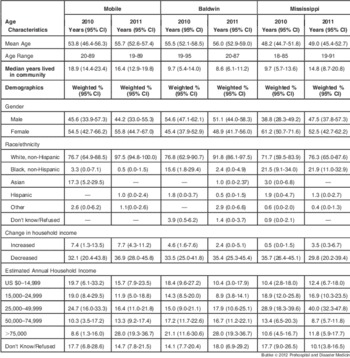
Interview teams completed 208 out of a goal of 210 interviews in Mobile County, Alabama (99%), 188 out of 210 interviews in Baldwin County, Alabama (90%), and 200 out of 210 interviews in Mississippi (95%). Of the houses approached, interviews were completed in 74% of houses where someone was at home in Mobile County, 65% of houses in Baldwin County, and 72% of houses in Mississippi. Reasons for interviews not being completed included the respondent being ineligible based on time lived in community or being under 18 years of age, and refusal to participate. Table 1 compares data from the 2010 CASPERs with the 2011 CASPER results. In 2011, the mean age of respondents ranged from 49.0 years in Mississippi to 56.0 years in Baldwin County, Alabama. Age ranged from 19 to 91 years, and the average respondent had lived in the community for a high of 16.4 years in Mobile County to a low of 8.6 years in Baldwin County. The majority of respondents in each assessment area were white, non-Hispanic, with a range of 76.3% in Mississippi to 97.5% in Baldwin County. The greatest proportion of respondents in Mobile and Baldwin Counties reported an estimated annual household income of >US $75,000 (28% of respondents in each county). This compares to 40% of Mississippi respondents reporting an estimated annual income of $25,000-$50,000. The proportion of respondents reporting decreased income following the oil spill ranged from 29.8% in Mississippi to 36.9% in Mobile County.
Demographics of Respondents, 2010 and 2011, Mobile and Baldwin Counties, Alabama and Mississippi

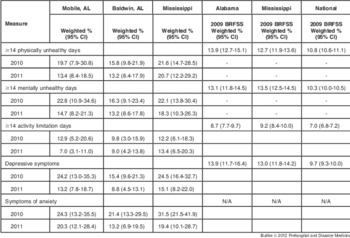
The proportion of respondents with two weeks or more of physically unhealthy days ranged from 13.2% in Baldwin County to 20.7% in Mississippi (Table 2). This compares to a range of 15.8% in Baldwin County to 21.6% in Mississippi in 2010. The proportion of respondents with two weeks or more of mentally unhealthy days ranged from 13.2% in Baldwin County to 18.3% in Mississippi. This compares to 16.3% in Baldwin County to 22.8% in Mobile County in 2010. A similar trend was seen in days of activity limitation. The proportion of respondents reporting symptoms consistent with depression ranged from 8.8% in Baldwin County to 15.1% in Mississippi. This compares with 15.4% in Baldwin County to 24.5% in Mississippi in 2010. Finally, the proportion of respondents reporting symptoms consistent with a generalized anxiety disorder ranged from 13.2% in Baldwin County to 20.3% in Mobile County. This compares to 21.4% in Baldwin County to 31.5% in Mississippi in 2010.
Individual-Level Weighted Percents of Respondents Reporting General Quality of Life, Mobile and Baldwin Counties, Alabama, and Mississippi, 2010 and 2011

Abbreviation: BRFSS, Behavioral Risk Factor Surveillance System
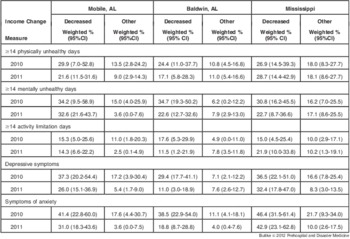
When responses were stratified by self-reported change in income following the oil spill, respondents reporting decreased income following the oil spill were more likely to report symptoms of poor mental health compared to respondents reporting no change or an increase in income following the oil spill (Table 3). In the 2011 Mobile County assessment, the difference in mentally healthy days, activity limitation days, depressive symptoms, and symptoms of anxiety between those reporting decreased income following the oil spill and those with no change or an increase in income following the oil spill was statistically significant. In the 2011 Mississippi assessment, the difference in depressive symptoms was statistically significant between respondents reporting decreased income and those with no change or an increase in income. Differences in symptoms of anxiety were statistically significant between those reporting decreased income and those reporting no change or an increase in income in all three assessment areas in 2011. In the 2010 assessments, statistically significant differences were seen in mentally unhealthy days, depressive symptoms, and symptoms of anxiety between those reporting decreased income and those with no change or increased income following the oil spill in Baldwin County only. Although not statistically significantly different, reports of poor mental health were generally lower in 2011 compared to 2010 in both self-reported income change groups for all three assessment areas.
Individual-Level Weighted Percents of Respondents Reporting General Quality of Life and Self-Reported Income Change Following the Gulf Coast Oil Spill, Mobile, AL, Baldwin, AL, and Mississippi, 2010 and 2011

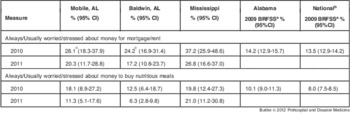
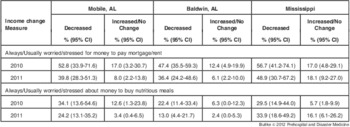
There was a small but non-significant decrease in the proportion of respondents reporting always or usually worried or stressed about money to pay the mortgage or rent from 2010 to 2011 in all three assessment areas (Table 4). The proportion of respondents always or usually worried about money to pay the rent or mortgage in Mobile and Baldwin counties was no longer statistically significantly higher than Alabama statewide BRFSS reports. No significant changes were seen in the proportion of residents reporting always or usually being worried or stressed about money to buy nutritious meals in any assessment area. When stratified by self-reported change in income following the oil spill, there was a statistically significant difference in the proportion of respondents always or usually stressed about money to pay the mortgage or rent between those reporting decreased income and those reporting no change or increased income following the oil spill in both 2010 and 2011 (Table 5).
Individual-Level Weighted Percents of Respondents Reporting Frequency of Worry or Stress, Mobile, AL, Baldwin, AL, and Mississippi, 2010 and 2011, According to BRFSS Social Context Categories

Abbreviation: BRFSS, Behavioral Risk Factor Surveillance System
aBRFSS asked question “in the past 12 months” CASPER asked question “in the past 4 months”
b8 states
cstatistically significant difference from state BRFSS
Individual-Level Weighted Percents of Respondents Reporting Frequency of Worry or Stress by Self-Reported Income Change Following the Oil Spill, According to BRFSS Social Context Categories, Mobile and Baldwin Counties, Alabama and Mississippi, 2010 and 2011

Abbreviation: BRFSS, Behavioral Risk Factor Surveillance System
Discussion
The data presented here suggest that mental health symptoms in the Gulf Coast counties of Alabama and Mississippi were lower in 2011 than in the months immediately following the oil spill. While these data suggest that mental health concerns may have decreased in 2011 compared to 2010, the proportion of individuals with mental health symptoms is still higher in the 2011 assessments than in the 2009 Alabama, Mississippi, and nationwide BRFSS estimates. In addition, when comparing individuals who self-reported decreased income following the oil spill to those whose income either increased or was not affected, large differences in mental health parameters were found to exist. This suggests that mental health services are still needed in the area, particularly in households who have experienced decreased income as a result of the oil spill.
The Gulf Coast oil spill negatively affected several industries in Alabama and Mississippi, including fishing, tourism, and real estate industries directly, and associated service industries indirectly.10 Financial concerns can adversely affect both mental and physical health.Reference Bisgaier and Rhodes11 Financial concerns do not directly reflect current or relative financial status or security; rather, any change or perceived change from an individual's norm can trigger both financial concerns and adverse mental health outcomes. Therefore, any perceived income change can produce adverse mental health outcomes. Similarly, unemployment is associated with poor mental health, regardless of financial security.Reference Scutella and Wooden12 In support of this, no difference in mental health outcomes was seen between those reporting higher annual household incomes and those reporting lower household incomes when both groups reported decreased household income following the oil spill (data not shown).
On a larger scale, even macroeconomic downturns can negatively affect individuals’ mental status.Reference Davalos and French13 Changes in the tourism and associated real estate, restaurant, and entertainment industries of the Gulf Coast following the oil spill affected income levels for many employed in these areas, and raised financial concerns for those whose income may be indirectly influenced by the overall community business climate.Reference Buttke, Vagi, Bayleyegn, Sircar, Strine, Morrison, Allen and Wolkin6 These effects may have been further exacerbated by the global economic recession. A situation therefore existed that may have triggered financial concerns in a broader range of individuals than those directly economically affected by the oil spill, and may have further increased mental health needs in the community.
While conducting these surveys, interview teams encountered several individuals requiring emergency mental health services in 2011, whereas no mental health services referrals were made during the 2010 interviews. Several factors may have influenced this, including differences in population, interviewee differences not addressed by the standardized training, or mental health symptoms acuity. Alternately, the increase in referrals may represent an increased awareness or acceptance of mental health issues compared to the 2010 surveys. Extensive community outreach and messaging was conducted by local mental health services following the oil spill. The active mental health outreach in these communities by services may have influenced this change in acceptance.
Limitations
This study is subject to certain limitations. Although not statistically significant, demographic differences were noted within assessment areas between 2010 and 2011 assessments. These differences were most notable in Mobile and Baldwin counties. In Mobile County, the Asian population in 2010 was over 17%; this compares to no reports of Asian race in 2011. Empirically, this may reflect the loss of migrant or “boat people” populations that had been employed in the seafood industry prior to the oil spill and left the area once the industry slowed following the oil spill. Immigrant status is associated with lower likelihood of seeking mental health services, and may therefore result in more reports of poor mental health in these populations.Reference Chen and Vargas-Bustamante14 The lack of this potentially vulnerable population in 2011 may have impacted overall mental health parameters in Mobile County.
Conversely, in Baldwin County, this study and empirical data suggest that the seasonal population of retirees and long-term vacationers who typically reside on the coast was absent immediately following the oil spill, and returned in 2011. Retired persons are more likely to be on a fixed income that may not have been affected by the oil spill, and therefore, financial impacts on mental health may not have occurred in this population and may have affected overall mental health parameters in Baldwin County, AL. These two potential population shifts in coastal Alabama counties cannot be proven, but would reflect two different populations that may have contributed to the overall lower reports for poor mental health seen in 2011 compared to 2010. Alternately, the increased mental health outreach and services following the oil spill may have resulted in a decrease in poor mental health prevalence in the community. Based on this study, it is not possible to determine whether one or some combination of these factors is responsible for the change in mental health parameters from 2010 to 2011.
Finally, these surveys reflect self-reports at a single point in time, and individuals within each household were not randomly selected. Time since the oil spill, as well as differences in the demographics of the populations currently living on the coast compared to populations living on the coast immediately following the oil spill, along with differences in current events, might have influenced the differences seen between the 2010 and 2011 CASPER data. These limitations may have resulted in systematic bias that would not be accounted for in the study design.
Conclusions
Although this report suggests that general and mental health symptoms have decreased compared to 2010, the authors cannot determine the cause of this decrease. Changes in demographics of the area may have influenced observed changes in mental health parameters. Both survey years saw a difference in mental health outcomes in those reporting decreased income following the oil spill, with those reporting decreased income having significantly worse mental health parameters. Public health response efforts and community outreach should continue to ensure remaining mental health needs are addressed, specifically in those experiencing negative financial impacts following the oil spill. The surveys conducted in 2010 led to increases in mental health services in the affected communities. The 2011 follow-up survey provided an opportunity to assess the current mental health status of the communities and evaluate the effectiveness of the mental health services provided in these communities. Future needs assessments should consider the benefits of conducting follow-up surveys.
Acknowledgment
The findings and conclusions in this report are those of the author(s) and do not necessarily represent the views of the Centers for Disease Control and Prevention (CDC).
Abbreviations
- BRFSS:
Behavioral Risk Factor Surveillance System
- CASPER:
Community Assessment for Public Health Emergency Response
- CDC:
Centers for Disease Control and Prevention
- GAD-2:
Generalized Anxiety Disorder 2
- PHQ-2:
Patient Health Questionnaire 2