INTRODUCTION
The velvet dogfish, Zameus squamulosus, was first described by Günther (Reference Günther1877) as Centrophorus squamulosus from a female specimen measuring 670 mm total length (TL) that was captured off Inosima (35°11′N 139°28′E), Japan, at a bottom depth of 631 m. The species was later reassigned to the genus Scymnodon Barbosa du Bocage & de Brito Capello, Reference Barbosa du Bocage and de Brito Capello1864, but was subsequently designated as the type species for the newly described genus Zameus by Jordan & Fowler (Reference Jordan and Fowler1903). Bigelow & Schroeder (Reference Bigelow and Schroeder1957) re-examined the issue and concluded that Zameus was a junior synonym of Scymnodon. The generic placement of this species was considered by most subsequent authors (Compagno, Reference Compagno1984; Yano & Tanaka, Reference Yano and Tanaka1984; Wetherbee & Crow, Reference Wetherbee and Crow1996) to be in Scymnodon, until a detailed study by Taniuchi & Garrick (Reference Taniuchi and Garrick1986) concluded that it was morphologically distinct from Scymnodon, and redefined Scymnodon as a monotypical genus from the North Atlantic. These authors resurrected the genus Zameus and reassigned the species to it (Taniuchi & Garrick, Reference Taniuchi and Garrick1986). Recent molecular studies have confirmed the distinctiveness of the genus Zameus from Scymnodon, and in fact, place it closer to the genus Centroselachus (Naylor et al., Reference Naylor, Caira, Jensen, Rosana, White and Last2012).
The velvet dogfish is one of only two species in the genus Zameus. The other species, the Japanese velvet dogfish, Z. ichiharai, is distinguished from Z. squamulosus by the following characteristics: a shorter snout; first dorsal fin broadly rounded at its apex, posterior margin steep; pectoral fins leaf-shaped; asymmetrical median tooth; dermal denticles without transverse ridges. Coloration is uniformly black, without conspicuous markings. Zameus ichiharai is currently only known from Japan and Taiwan (Ebert et al., Reference Ebert, White, Ho, Last, Nakaya, Séret, Straube, Naylor and de Carvalho2013), compared to the scattered worldwide distribution of Z. squamulosus. The taxonomic status of Z. ichiharai and its generic placement is currently under investigation (W.T. White, personal communication).
Zameus squamulosus is a poorly known somniosid shark species reported from scattered records from throughout the Atlantic, Indian, western, central and south-eastern Pacific Oceans, but to date has not been reported from the eastern North Pacific (Compagno et al., Reference Compagno, Dando and Fowler2005; Akhilesh et al., Reference Akhilesh, Bineesh, Ganga and Pillai2013). In the Pacific, Z. squamulosus is known from off Japan, including the Kyushu-Palau Ridge, Taiwan, eastern Australia and New Zealand in the western Pacific (Last & Stevens, Reference Last and Stevens2009; Ebert et al., Reference Ebert, White, Ho, Last, Nakaya, Séret, Straube, Naylor and de Carvalho2013), the Hawaiian Islands in the central Pacific (Wetherbee & Crow, Reference Wetherbee and Crow1996) and off Chile in the south-eastern Pacific (Meléndez, Reference Meléndez1991). The species is an epipelagic and oceanic deep water shark usually found off continental and insular slopes, on or near the bottom at depths of 550 to 1,450 m, but also found well off the bottom at depths between 0 and 580 m in water 2,000 to 6,000 m deep.
During a fishery survey conducted off southern California an unusual small, dark shark was caught and saved for identification. It was later determined that this species was a velvet dogfish, Z. squamulosus, a new record for this region. Here, we report on the first record of Z. squamulosus from the eastern North Pacific.
MATERIALS AND METHODS
Morphometric measurements modified after Ebert & Stehmann (Reference Ebert and Stehmann2013) were taken to the nearest 0.1 mm prior to preservation and are presented as a percentage of the TL. The specimen was fixed in 10% formalin, and subsequently preserved in 70% ethanol. The specimen has been deposited into the Ichthyology collection at the California Academy of Sciences (CAS) under the accession number CAS 235449. Tissue samples were taken, sent to the College of Charleston for sequencing, and accessioned (GN-12563).
RESULTS
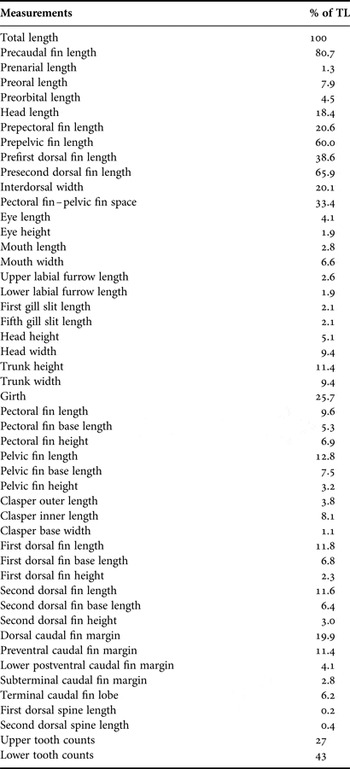
On 17 July 2011, during the US National Oceanic and Atmospheric Administration Fisheries annual Groundfish Slope and Shelf Combination Survey, a small, black mature male shark (Figure 1) measuring 533 mm TL was caught off Long Beach, California (33°43′15″N 118°32′14″W), USA, at a depth of 770.7 m. The specimen was photographed, frozen and sent to Moss Landing Marine Laboratories where it was later identified as a Zameus squamulosus (Chondrichthyes: Squaliformes: Somniosidae) based on a combination of characteristics, including: a small slender body, with a low flat head; fairly long snout; short narrow, nearly transverse mouth, with postoral grooves much longer than the short upper labial furrows; teeth small and lanceolate, without cusplets in the upper jaw and large high, knife-cusped cutting teeth in the lower jaw; median tooth symmetrical; tooth counts on this specimen were 27 in the upper jaw, 43 in the lower jaw; first dorsal fin apex angular, posterior margin angled; a small fin spine preceding each dorsal fin; anal fin not present; dermal denticles with transverse ridges; and caudal fin with strong subterminal notch and short lower lobe. Coloration prior to preservation was uniformly black, with no conspicuous markings, except for the presence of whitish tips on the claspers. Morphometric measurements and meristic counts are presented in Table 1.
Zameus squamulosus lateral view, CAS 235449, 533 mm total length, mature male.

Morphometric and meristic data for the specimen of Zameus squamulosus (CAS 235449, 533 mm total length); measurements are expressed as a percentage of total length (% TL).

DISCUSSION
This is the first confirmed extant record of Z. squamulosus in the eastern North Pacific Ocean and is a new modern record for California waters. The species is known from the fossil record in California, having been reported by Long (Reference Long1993) based on a tooth from the late Pleistocene (Rancholabrean Age) Palos Verde Sand Formation (about 123000 to 130000 years before present), from Newport Beach, California, but no extant records of it have been reported before now. Prior to this record, this species was thought to be the only contemporary extinction of a Pleistocene shark species from the recent California fauna. However, the discovery of extant Z. squamulosus in California waters confirms the survival of all shark taxa from the California Pleistocene period to modern time (D. Long, Oakland Museum, personal communication).
The occurrence of Z. squamulosus brings the number of shark species now confirmed to occur in California waters to 42 (Ebert, Reference Ebert2003).
ACKNOWLEDGEMENTS
The authors thank the West Coast Groundfish Bottom Trawl Survey Program (NOAA Fisheries, 2725 Montlake Boulevard, Seattle, WA, 98112) and the crew of the ‘Noah's Ark’ for collecting the specimen, and Douglas Long (Oakland Museum) for discussion and comments on the elasmobranch fossil record from California. The Packard Foundation provided funding support to the Pacific Shark Research Center for this study. Additional support was provided by a National Science Foundation grant (Jaws and Backbone: Chondrichthyan Phylogeny and a Spine for the Vertebrate Tree of Life, DEB 1132229) to Gavin Naylor, College of Charleston.