Introduction
With the advent of intensity-modulated radiation therapy (IMRT) and image-guided radiation therapy (IGRT), the accuracy of radiotherapy has improved dramatically, and these methods have been used in many cancer treatments. Volumetric-modulated arc therapy (VMAT) is a relatively new rotational radiation therapy technique that delivers IMRT. Its short treatment time (approximately 10 min, even with IGRT and irradiation) is advantageous for patients and offers fewer time constraints than static IMRT. VMAT for locally advanced prostate cancer has been reported to be an effective treatment, resulting in a reduction of adverse effects and dose escalation.Reference Wolff, Stieler and Welzel 1 – Reference Palma, Vollans and James 4 While late adverse effects in IMRT for prostate cancer have been reduced, side effects such as rectal bleeding (with some reporting severe cases), bladder bleeding and dysuria remain problematic.Reference Takemoto, Shibamoto and Ayakawa 5 , Reference Budaus, Bolla and Bossi 6 In this study, we report late adverse effects due to VMAT for localised prostate cancer, particularly rectal bleeding.
Purpose
We initiated VMAT for localised prostate cancer in the Juntendo University Nerima Hospital in July 2009. Late adverse effects post-radiation therapy for prostate cancer involve the urinary and lower gastrointestinal tracts, with the most severe issue being continuous rectal bleeding. We studied late adverse effects, particularly rectal bleeding post-radiotherapy, using VMAT for prostate cancer.
Materials and Methods
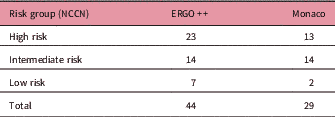
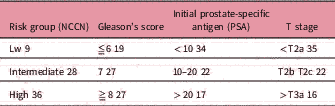
Seventy-three patients with localised prostate cancer were treated with radiation therapy using VMAT. Patient ages at the start of irradiation ranged from 54 to 81 years (median, 71 years). The follow-up period was from 23 to 87 months (median, 57 months). Risk groups, classified using the National Comprehensive Cancer Network (NCCN) classification for patients with localised prostatic cancer, are shown in Table 1. Gleason’s score, initial prostate-specific antigen (PSA) value obtained during the first hospital visit, and T stage are shown in Table 2.
Risk classification by National Comprehensive Cancer Network (NCCN) of localised prostate cancer

Notes: NCCN risk classification of localised prostate cancer treated by volumetric-modulated arc therapy (VMAT).
Radiation treatment planning systems (RTPS) was used ERGO++ in 44 cases and Monaco ver.2 in 29 cases.
Patient and tumor characteristics of prostate cancer treated with volumetric-modulated arc therapy (VMAT)

Note: Risk groups of localised prostate cancer were classified by National Comprehensive Cancer Network (NCCN).
Neoadjuvant hormone therapy was started at least 3 months prior to radiation therapy for the intermediate- and high-risk groups. Hormonal therapy was not administered to the low-risk group. VMAT was performed using an Elekta Synergy linear accelerator (Elekta, Stockholm, Sweden) equipped with a cone beam computed tomography (CT) imager. All patients were positioned and immobilised using a BlueBAG (Elekta) body pillow and treated with an IGRT system. Rectal bleeding grades and other morbidities were classified according to the Common Terminology Criteria for Adverse Events version 4.0 (CTCAE v.4.0). A small amount of temporary bleeding, which is difficult to distinguish from hemorrhoid disease, is classified as grade 1. The reason is that many individuals have hemorrhoid disease in Japan, and steroid ointments and suppositories are often prescribed even with slight symptoms. Furthermore, patients experiencing transient bleeding within 6 months after irradiation were excluded because we only evaluated late adverse events.
Radiation Planning
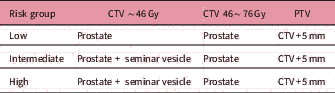
The ERGO++ and Monaco v.2.3 (Elekta, Stockholm, Sweden) radiation treatment planning systems (RTPS) were utilised. ERGO++ was used on 44 patients and Monaco on the remaining 29 patients. The clinical and planning target volumes are shown in Table 2. The prescribed total irradiation dose was 76 Gy in 38 fractions. Energy of Linear accelerator was used 6 MV photon beam. High- and intermediate-risk patients classified using NCCN were irradiated up to 46 Gy including seminal vesicles for clinical target volume (CTV). The CTVs of low-risk patients treated only prostate (Table 3). Dose constraints were determined according to the randomised prostate cancer trial, RTOG 0126.Reference Michalski 7
Clinical target volume and planning target volume for localised prostatic cancer treated by volumetric-modulated arc therapy (VMAT)

Abbreviations: CTV, Clinical target volume; PTV, Planning target volume.
Results
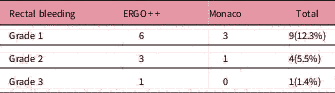
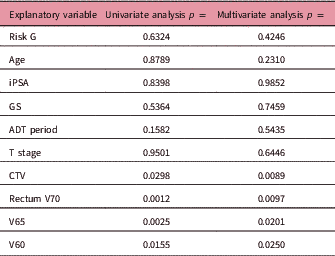
Late rectal bleeding was observed in 14 (19%) patients, with 9 (12.3%), 4 (5.5%) and 1 (1.4%) being classified as grades 1, 2 and 3, respectively. Grades 2 and 3 were defined as follows: grade 2, minor bleeding without anemia (a patient who needs medical treatment such as suppositories); grade 3, bleeding with anemia (a patient requiring cauterisation). Twelve patients with rectal bleeding were confirmed as having rectal inflammation using colonoscopy, except for two grade 1 patient. Table 4 shows the number of rectal bleeding cases in patients treated with ERGO-VMAT and Monaco-VMAT. Rectal bleeding was frequent in ERGO–VMAT patients. However, the chi-square test indicated no statistically significant difference between ERGO–VMAT and Monaco patients (p = 0.3427). The results of univariate and multivariate analysis are shown in Table 5. In both analyses, CTV (prostate volume) and rectal dose volumes (V70, V65, V60) were significant, but risk group, age, initial PSA value, Gleason’s score, T stage and duration of neoadjuvant hormonal therapy were not. One grade 3 patient with rectal bleeding had severe diabetes and was given warfarin for cardiomyopathy.
Late rectal bleeding cases in ERGO and Monaco volumetric-modulated arc therapy (VMAT)

Note: Rectal bleeding grades were classified by the RTOG/EORTC criteria.
Result of univariate and multivariate analysis

Abbreviations: Risk G, risk group by NCCN guideline; iPSA, initial number of PSA; GS, Gleason’s score; ADT, period of neoadjuvant hormonal therapy; CTV, clinical target volume.
Overall Survival and PSA Failure
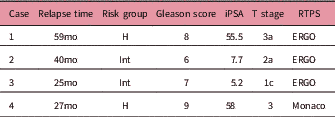
The overall 5-year survival rate was 97.3%. PSA failure was observed in four patients (two in the intermediate-risk group and two in the high-risk group) (Table 6). Two patients developed bone metastases following PSA relapse. Two patients died: one from urothelial cancer and another from stomach cancer. There were no cause-specific deaths during the follow-up period.
Prostate-specific antigen (PSA) failure was observed in four cases

Relapse time: month from the end of radiation.
Abbreviations: iPSA: initial PSA; RTPS, radiation treatment planning system.
Other Late Adverse Effects
Urinary frequency was observed in 18 patients, of whom 12 and 4 were classified as grades 1 and 2, respectively, according to CTCAE v.4.0. Grade 1 hematuria was identified in five patients; however, all patients experienced transient hematuria without requiring treatment. One grade 2 patient experienced hematuria due to bladder cancer that had occurred 5 years postirradiation and endoscopic surgery. The incidence of bladder cancer could not rule out the possibility of secondary radiation cancers.Reference Stokkevåg, Engeseth, Hysing, Ytre-Hauge, Ekanger and Muren 8
Discussion
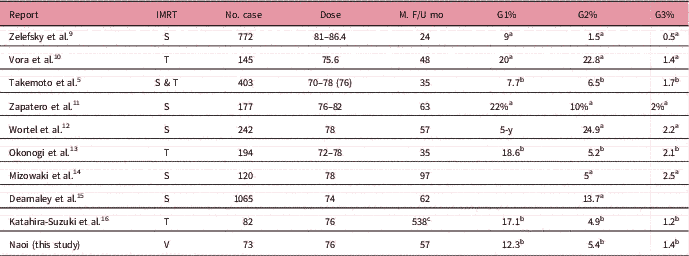
We reported the long-term outcome concerning locally advanced prostate cancer patients treated with radiation therapy using VMAT, mainly late adverse events such as rectal bleeding. Previous studies have reported that the incidence of late rectal bleeding ranges from 5% to 24%, of which approximately 2% were grade 3 patientsReference Takemoto, Shibamoto and Ayakawa 5 , Reference Budaus, Bolla and Bossi 6 , Reference Zelefsky, Fuks and Hunt 9 – Reference Someya, Hori and Tateoka 17 (Table 7). In our study, late rectal bleeding occurred in 19% of patients, of whom 5.5% and 1.4% were classified as grades 2 and 3, respectively, a finding that was similar to previous studies. One study reported that VMAT was inferior to Tomotherapy (Tomo) concerning organ-at-risk (OAR) sparing;Reference Wolff, Stieler and Welzel 18 however, in the studies using Tomo, 4.5% to 23% of patients had grade 2 rectal bleeding (Table 7). In our study, late rectal bleeding occurred equally or less frequently in patients treated using VMAT than in those in studies using Tomo. In the statistical analysis of risk factors for late rectal bleeding, significant differences were found in the CTV of the prostate and rectal dose volumes (V60, V65, V70) in univariate and multivariate analyses. The irradiated rectal volume and size of the radiation field led to rectal bleeding as a natural consequence.
Reports of late rectal bleeding by intensity-modulated radiation therapy (IMRT)

Abbreviations: S, static IMRT; V, VMAT; T, tomotherapy.
a RTOG/EORTC criteria.
b CTCAE criteria, 5-y: cumulative incidence.
c Days.
Many prostate cancers occur in elderly individuals aged ≥70 years, and many patients receive anticoagulant therapy for cardiovascular disease prior to radiation therapy. For at-risk patients such as those undergoing concomitant anticoagulant therapyReference Katahira-Suzuki, Omura and Takano 16 and with severe diabetes, careful treatment options are necessary. Currently, we have reduced the prescribed dose to 72 Gy for at-risk patients. In our study, two factors may have resulted in less rectal bleeding. The CTV margin was lower than that reported elsewhere. Using our method, the CTV margin was 5 mm in all directions, while that in other reports ranged from 6 to 10 mm.Reference Takemoto, Shibamoto and Ayakawa 5 , Reference Vora, Wong, Schild, Ezzell and Halyard 10 , Reference Wortel, Incrocci and Pos 12 , Reference Katahira-Suzuki, Omura and Takano 16 , Reference Inokuchi, Mizowaki and Norihisa 19 Another factor may have been that we performed IGRT using kilo-voltage CT (KV-CT) for all patients. When comparing the IGRT images, Elekta Synergy uses KV-CT, while Tomo uses megavoltage-CT (MV-CT). The image quality of KV-CT was superior to that of MV-CT in the IGRT system.Reference Groh, Siewerdsen, Drake, Wong and Jaffray 20 Consequently, it is considered to lead to highly accurate treatment. In addition, VMAT involves less treatment time, while Tomo has been reported to take approximately 10 min.Reference Elith, Dempsey, Findlay and Warren-Forward 21 , Reference Rao, Yang and Chen 22 Therefore, VMAT is less susceptible to body movement and intestinal peristalsis.
Previous studies have reported PSA recurrence to be approximately 10% in IMRT patients and 20% in early IMRT patients. In our study, PSA failure occurred in 5.4% of patients, the 5-year recurrence-free survival was 95%, and local control had similar or improved outcomes than those reported in other studies.Reference Elith, Dempsey, Findlay and Warren-Forward 21 , Reference Tanaka, Yamaguchi and Hachiya 23 , Reference Zelefsky, Kollmeier and Cox 24
Limitation
The number of VMAT cases is small, and since it uses two RTPS, it is difficult to evaluate equally. However, there was no statistically significant difference in the frequency of occurrence of side effects.
Conclusion
VMAT may provide better accuracy and involve fewer time constraints for patients compared with other IMRT methods. Late rectal bleeding in this treatment is considered to be almost equivalent to other IMRT methods.
Acknowledgements
None.
Conflicts of Interest
The authors declare that they have no conflicts of interest.
Ethics approval and consent to participate
This manuscript has been approved by the institutional committees (Juntendo University Nerima Hospital with the authorisation number 18-09).
Consent for publication
Not applicable.
Availability of data and material
Data sharing not applicable to this article as no datasets were generated or analysed during the current study.