INTRODUCTION
Iron is among the most ubiquitous of materials in the modern world, with a bewildering array of applications, and consequently tends to be regarded as a functional material with little inherent value. This is unlikely to have been the case in the past when iron was mostly produced using the direct or bloomery smelting method. It is readily accepted that the cost of smelting iron in this way, in terms of the time required and resources consumed, was considerably higher than for the indirect method used in the modern world. This raises the possibility that iron may have had an economic value relative to other materials significantly greater than it does today.
Assessing the degree to which this might have been the case in the past requires the survival of written records such as the mid-sixteenth-century ledgers of John Smythe, a merchant of Bristol. These include records of Smythe’s importation of iron from the Basque region, between 1539 and 1550, which suggest that iron was indeed a valuable commodity, being between 10 and 30 times more valuable relatively than iron today.Footnote 1 Obviously, the difficulties of making this type of assessment increase significantly for more remote periods when written evidence is rare, and the Roman period is a case in point. Although literary and epigraphic sources are available, few discuss the value of materials such as iron in anything but general terms.
THE VINDOLANDA TABLETS
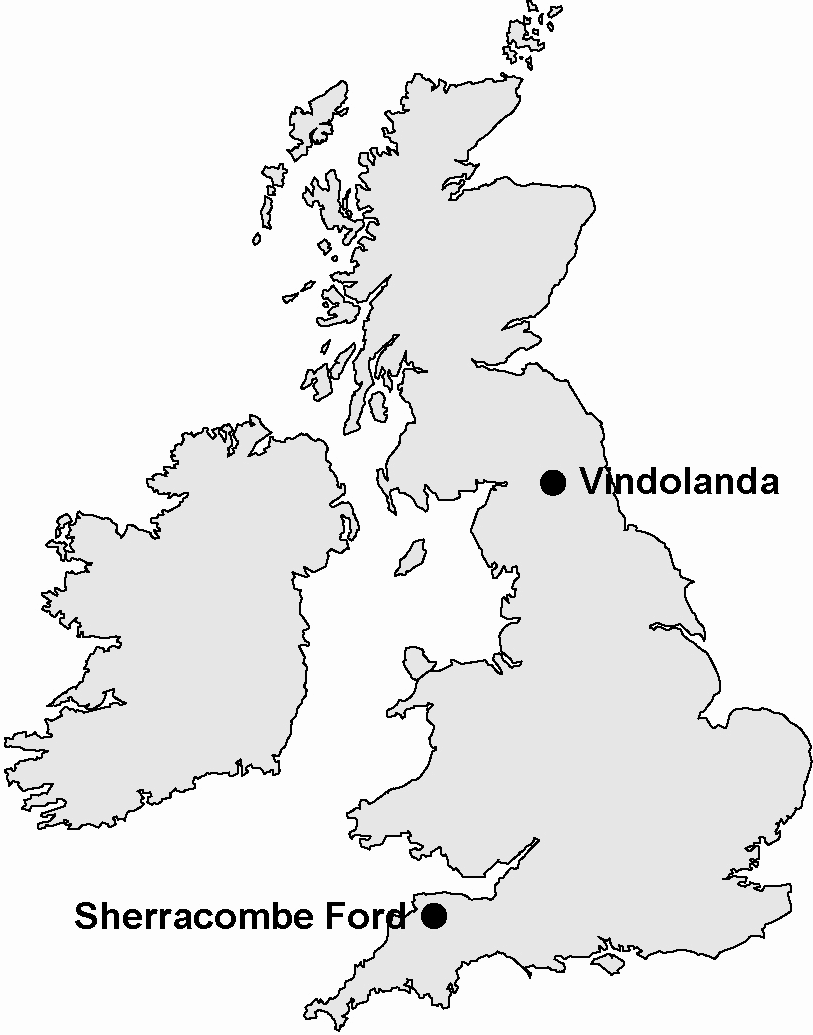
The discovery, over the last thirty years, of hundreds of writing-tablets from the fort of Vindolanda in northern England (fig. 1) provides valuable information that enables us to begin to approach an assessment of the value of iron during the first two centuries of Roman rule in Britain. The Vindolanda tablets are an assemblage of documents, mostly written in ink on thin sheets of wood, 853 of which are now translated and published.Footnote 2 They were written by military personnel and associated civilians mostly between a.d. 85 and a.d. 130, and their content ranges from military readiness reports to the personal and official correspondence of the garrison commanders. They also include a series of accounts, one of which (Tablet No. 183) is of importance here for it contains the following extract:
line 2: iron, 90 pounds …
line 3: to Ascanius, denarii 32+
Location of sites discussed in text.

Here we have the record of a transaction in which a man named Ascanius purchased 90 Roman pounds of iron for the sum of 32 denarii. This amounts to around 29 kg of metal according to the conversion figures for Roman units of measurement given by Duncan-Jones,Footnote 3 suggesting a price of around 1.1 denarii per kilogram of metal. On the face of it this is a straightforward statement, but some caution is necessary in its interpretation since closer scrutiny raises a number of questions concerning its meaning and context, the answers to which have great potential to affect or distort any assessment of the contemporary value of iron.
Perhaps the first question should concern the reliability of the translation itself, derived as it is from an imperfectly preserved original. The right side of the tablet is less legible than the remainder of the document and, as a result, in line 2 only the letter ‘p’ survives of the last word which has been transcribed as ‘pondo’ (pounds). In the third line only ‘XXXII’ survives of the numeral, raising the possibility that Ascanius may have paid up to 34 denarii for his iron.Footnote 4 However, the translation presented above is generally accepted; pondo seems a plausible extrapolation in the first line and 32 denarii serves as a minimum price for the iron in question. Thus, the extract forms a reasonable foundation for further investigation.
From an archaeometallurgical perspective, a second question concerns whether the purchased iron was in the form of a raw iron bloom, fresh from the furnace, or refined bars or billets. This is significant for a bloom consists of a spongey mass of iron mixed with a significant amount of slag that must eventually be expelled through smithing before the metal can be used. Thus, 29 kg of bloom iron would have included a proportion of slag, suggesting the value of usable, refined metal was higher than indicated by Tablet No. 183. However, it seems most likely that blooms would have been refined, at least to some degree, at the production site before transportation to the purchaser. This is supported by the recovery of six billets of refined iron from the Roman fort at Newstead in southern Scotland,Footnote 5 suggesting that this was the most likely form for iron to be delivered to the Roman military. Additionally, if iron blooms were routinely smithed on military sites following delivery, smithing floors composed of the fused and trampled waste expelled during refinement would be relatively common discoveries in forts. This does not appear to be the case and it, therefore, seems a reasonable assumption, in the absence of evidence to the contrary, that the iron referred to in Tablet No. 183 was in the form of refined iron billets from which most of the slag had been removed by the time they were purchased.
Next, the extract reveals little of the context within which the purchase of iron took place and there are assumptions regarding this that require acknowledgement. For instance, the status — whether military or civilian — of those involved in the transaction is unknown. Although the tablet was recovered from within the fort at Vindolanda, many of the documents in the assemblage were written by civilians and whether Ascanius or the unnamed vendor of the iron were soldiers or not remains obscure. It seems likely, however, that there is at least some degree of military involvement, especially since line 1 of the tablet mentions a centurion whose name is mostly illegible.
Supply arrangements for the Roman army in the first and second centuries a.d. were flexible and operated on a variety of scales.Footnote 6 Large-scale provision of many commodities such as foodstuffs, wood and hides seems to have been the responsibility of various local civilian authorities. Sometimes these goods travelled a considerable distance to the units that consumed them,Footnote 7 in volumes sufficient to have a significant effect on patterns of inter-provincial trade.Footnote 8 However, it also appears that individual units and soldiers obtained additional supplies more locally through purchase or requisition. Breeze notes that the surviving documentary evidence detailing such transactions all involves small quantities,Footnote 9 raising the possibility that Vindolanda Tablet No. 183 may be of this type. It is possible that Ascanius was one of his unit’s immunes, a specialist smith obtaining iron on its behalf.Footnote 10 At first glance, this interpretation is weakened by the monopoly on metal production which is generally accepted to have been exerted by the Roman state at the time the tablet was written.Footnote 11 In such a situation it seems strange that the Vindolanda garrison was purchasing iron relatively locally, rather than having its needs met by state-run iron-smelting operations. However, unlike other metals, exploitable deposits of iron ore are ubiquitous,Footnote 12 which would make absolute control difficult. It thus seems more probable that the Roman state restricted its control to specific areas, such as the Weald in southern Britain,Footnote 13 or north-eastern Bosnia,Footnote 14 where ores were particularly rich or plentiful, thereby ensuring a supply of the metal for its own use. In other, less richly mineralised areas, civilian production may have been possible, a situation which individual military units were able to exploit through local purchase and requisition, as with other commodities. The relatively small amount of iron involved in the transaction recorded in Tablet No. 183 supports such an interpretation.
Finally, it is necessary to examine some of the factors that may have had a significant effect on the price for iron quoted in Tablet No. 183. It is possible that the Roman military was able to purchase supplies at favourable rates and that 1.1 denarii per kilogram was a relatively low price for iron. Set against this is the possibility that middlemen may have been involved in conveying the metal from its producers to the military and that the price may have become elevated above the market rate as a consequence. Also, we do not know the origin of the iron in question. Duncan-Jones has suggested that transportation of cargo by river cost around five times as much as by sea over an equivalent distance, while carriage over land was 23 times as expensive.Footnote 15 If the iron purchased by Ascanius originated any significant distance from Vindolanda, especially considering the fort’s location away from the coast and navigable rivers, its price may have been elevated significantly.
Having acknowledged these possibilities, however, it seems best to assume that selling iron to the military in this way must have been a profitable activity and that if the price was too high, the army would have made other, more cost-effective arrangements. Thus we are able to conclude that the price obtained by Ascanius represents a reasonable minimum cost for iron in the early second century a.d. at Vindolanda.
TESTING TABLET NO. 183
Fortunately, the information contained in some other Vindolanda tablets permits us to test the validity of this conclusion. Tablet No. 186 preserves 25 lines of another account recording purchases made by soldiers over the course of several months.Footnote 16 Lines 7 and 8 are of particular interest to this study and translate, according to the latest reading, as: Footnote 17
line 7: December, to Gracilis, nails
line 8: for boots, number 100, asses 12
If, as seems reasonable, we assume that the work of the smith in manufacturing these nails added value to the raw iron metal used, we have a means of testing the price for iron quoted in Tablet No. 183. Volumetric calculations, based on the illustration of a typical hobnail in Manning,Footnote 18 suggest that the average nail contained round 5 g of iron. In making such a nail an experienced smith would lose perhaps 10 per cent of the original raw material,Footnote 19 so that 180 nails, weighing 900 g, could be manufactured from 1 kg of iron costing 1.1 denarii. Using the price paid by Gracilis, these 180 nails would be worth 1.35 denarii, an increase in value of 23 per cent. The implication is that the price for iron from Tablet No. 183 is at least locally consistent with the other information on prices contained in the Vindolanda tablets and thus forms a plausible basis for assessing the relative value of iron.
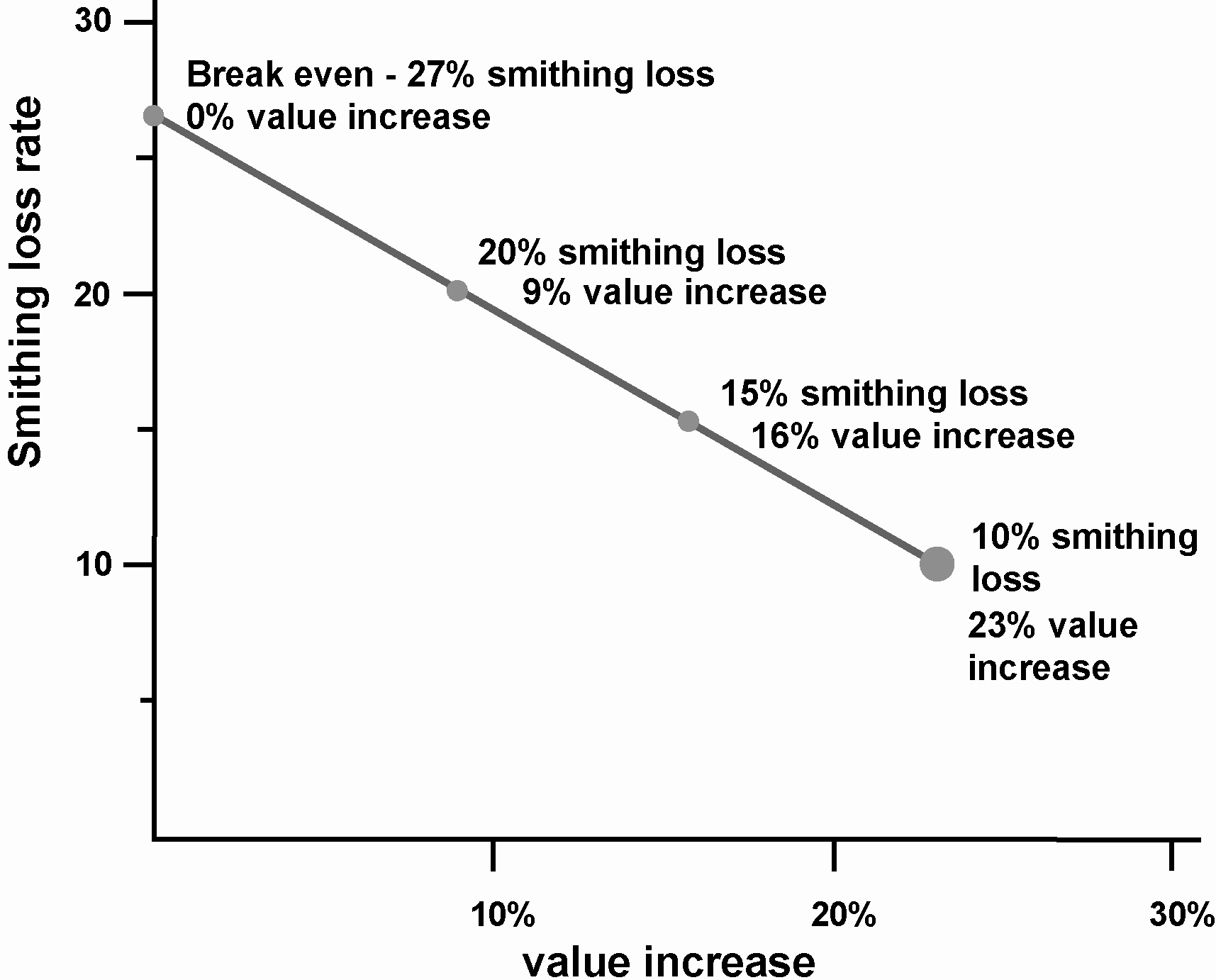
However, we should also be aware of another assumption: that Gracilis’ nails were made by an experienced smith, who was able to keep losses of iron during manufacture to an acceptable minimum. Experiment has shown that losses of iron during smithing are negatively correlated with the smith’s experience.Footnote 20 Therefore, a less experienced smith would have produced fewer nails from the initial 1 kg of iron and thus increased the value of the iron to a lesser degree. This is illustrated in fig. 2, which presents the relationship between the smithing loss rate, or smithing skill, and the degree of increase of value and suggests that when smithing losses reached 27 per cent, the increase in the value of the iron used would fall to zero.
Theoretical comparison of smithing loss rates of iron with increase in the value of the metal based on the manufacture of nails.

PRICE COMPARISONS: COMMODITIES
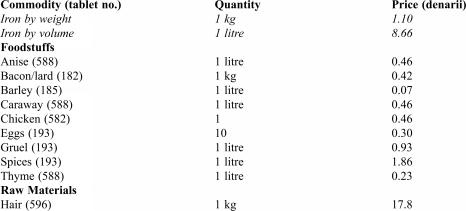
Having established that a plausible price for iron at Vindolanda in the early second century is 1.1 denarii per kilogram, we are left with the question of what this meant in real terms. An obvious way to begin to answer this is to establish comparisons with the known prices of other commodities, and, once more, the Vindolanda tablets are a rich source of information. Table 1 presents the most reliable information from the tablets concerning the prices paid for foodstuffs and raw materials.Footnote 21 The quantities given in the tablets are, for many items, in units of volume rather than weight. This makes direct comparison difficult since Tablet No. 183 records iron in units of weight. Accordingly, to facilitate comparison, the value of iron is shown in Table 1 both in terms of price per weight and volume.
COMPARISONS OF PRICES OF FOODSTUFFS AND RAW MATERIALS FROM THE VINDOLANDA TABLETS

It is readily apparent that iron at Vindolanda in the late first and early second centuries was significantly more valuable than even exotic, imported foodstuffs such as anise and caraway and more expensive, by a factor of four or five, than the enigmatic ‘spices’ recorded on Tablet No. 193. The disparity is even greater between iron and more basic, staple foodstuffs, such as eggs, barley, bacon/lard or thyme, that were presumably all available quite locally. Only hair is listed as more valuable than iron, being about twice the price by weight of the metal. It is unknown what sort of hair is referred to here and for what use it was intended, but a kilogram represents a significant quantity. Unfortunately, no other prices for raw materials can be confidently recovered from the tablets, so no further comparisons can be made in this category.
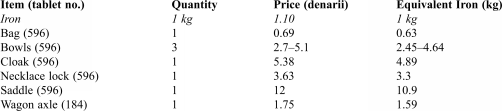
Alternatively, Table 2 presents the comparison of manufactured items from the Vindolanda tablets (Nos 184 and 596) with iron. As can be seen, the value of a kilogram or two of iron is broadly comparable with that of relatively simple manufactured goods, such as bowls, a bag or a wagon axle. Increasing complexity of manufacture, as in the case of the necklace lock or cloak, corresponds in value to increasingly large amounts of iron, while the saddle was roughly equivalent to 10 kg of iron.
PRICES OF MANUFACTURED ITEMS FROM THE VINDOLANDA TABLETS

PRICE COMPARISONS: THE ROMAN ECONOMY
So far we have established a value for iron, at a specific time and place, in monetary terms which has enabled comparisons to be made with a variety of commodities. However, the question of the fundamental value of the metal remains unanswered; but it may be possible to address this by examining the value of a denarius in contemporary society. Before attempting this, it should be acknowledged that monetary values are subject to variations, which have the potential to limit the relevance of any conclusions drawn. Firstly, chronological variations owing to inflationary factors are possible. The Vindolanda tablets were, however, written well before the third century and the increasing inflation and monetary instability of that period.Footnote 22 It is feasible, therefore, to discount inflation as a source of significant variation in monetary value, providing our assessment is restricted to the later first and second centuries a.d. More problematic are the potential geographical fluctuations caused by the relatively slow rates of communication that would have contributed to regional variations in the supply and demand of many commodities. There has been much debate on the nature of the Roman economy, part of which has concerned its level of integration on an empire-wide scale — one position advocates an empire-wide single market, the other promotes the imperial economy as a grouping of local economic systems.Footnote 23 Perhaps most likely is a median position in which the Empire’s economy consisted of a series of regional economies linked by long-distance trade.Footnote 24 Assuming this to be the case, it is probable that, although the relative value of commodities would perhaps have been similar between regional markets, they may also have varied semi-independently as a result of local factors. As a consequence, the conclusions drawn here are most applicable to Vindolanda in the late first and early second centuries and perhaps the surrounding region — the relatively remote and less developed region of northern England. Their extension to the wider province of Britannia and further afield, therefore, requires increasing degrees of caution.
PRICE COMPARISONS: LABOUR
The most fundamental measure of the value of money is in comparison with the value of labour as reflected in wages. Economists have been able to calculate an index of the prices of staple consumables compared with the wage rates of builders from the thirteenth century to the present day in order to facilitate comparisons of the value of money.Footnote 25 This was achieved through analysis of the detailed records of prices and wages surviving for these seven centuries. Unfortunately, despite sources such as the Vindolanda tablets, sufficiently detailed records are unavailable for Roman Britain. Therefore, we must rely on simpler comparisons using information which survives in the available corpus of literary and epigraphic evidence.
Most useful are military wages, for they were the same over the entire Empire at any given time. According to SuetoniusFootnote 26 and Dio,Footnote 27 in a.d. 83 — at the beginning of the period in which the Vindolanda tablets were written — the emperor Domitian raised legionary pay from 225 to 300 denarii per year.Footnote 28 This equates to 0.8 denarii per day, or the equivalent of 0.73 kg of refined iron according to the price quoted on Tablet No. 183. Soldiers were probably paid at a relatively generous rate, but evidence for a possibly more typical wage is recorded on a writing-tablet from the province of Dacia (modern Romania).Footnote 29 This document was written on behalf of an illiterate gold miner and records that, for six months of presumably at least semi-skilled work, he would receive his board and 70 denarii. Unfortunately, given the probable geographic variations in value — not only of prices but also of wages — between the provinces of Dacia and Britannia, direct comparison with the Vindolanda evidence is unreliable. However, for the sake of completeness, the Dacian gold miner would have received the equivalent of 0.36 kg of Vindolanda iron per day (plus board).
It is interesting to compare these figures with their equivalents in the modern world. According to the UK National Office of Statistics, the average annual wage at the time of writing is £22,500, or a daily rate of £60. Modern iron has a value of around £600 per tonne,Footnote 30 or £0.6 per kg, suggesting that the average daily wage is the equivalent of 100 kg. These are very different relative values to those of the first and second centuries a.d. at Vindolanda.
THE ECONOMIC CONTEXT OF IRON PRODUCTION
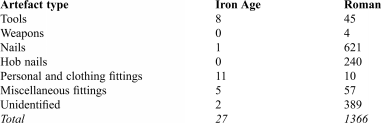
In light of this evidence, it is possible to undertake some speculative exploration of the economic context of iron production in Roman Britain. Before beginning, it is worth noting that the Roman occupation of Britain heralded a huge increase in the consumption of iron by Britain’s inhabitants. As an illustration, Table 3 presents a summary of the iron objects, recovered from non-military and non-urban sites, dating to the Iron Age and Roman periods in Cornwall, Devon and West Somerset, a relatively remote region in which military occupation was relatively brief and urbanisation limited. The extent of the increase in the use of and demand for iron is obvious and this pattern is repeated all over the province as iron became ubiquitous and the uses to which it was put extended.
NUMBER AND TYPE OF IRON ARTEFACTS RECOVERED FROM 35 SITES WITH IRON AGE OCCUPATION AND 38 WITH ROMAN OCCUPATION IN SOUTH-WEST ENGLAND

Of course, such increased demand is a prerequisite for an increase in production, but Roman rule also introduced other factors which stimulated the smelting of iron. The first was the imposition on the population of a requirement to pay taxes in cash, prompting the production of a surplus which could be sold to raise the necessary money.Footnote 31 To those with access to the necessary smelting expertise and resources, one way of achieving this was to increase their output of iron, a material that may also have been acceptable to the Roman authorities for payment of taxes in kind. This factor was also reinforced by the reduction of the risk inherent in such a strategy owing to the stable political and economic conditions that Roman rule brought in its wake. In effect, this expanded the markets accessible to smelters, enabling them to realise reliably a return on their increased production.
Although it has been acknowledged that the prices recorded in the Vindolanda tablets are highly localised in their applicability, it remains interesting to speculate on the potential economic ramifications for those who produced iron. It is difficult to know what the typical scale of civilian iron production was at the time the Vindolanda tablets were written, but the unpublished site at Sherracombe Ford, on the southern fringes of Exmoor, provides a possible example. The ceramic evidence indicates smelting on this site occurred between the late second and late third centuries a.d. over the course of perhaps a hundred years,Footnote 32 and is, therefore, later than when the Vindolanda tablets were written. However, the level of production, which can be estimated from the volume of slag remaining on the site — equating roughly to 1,000 kg of refined iron per yearFootnote 33 — represents a moderate output that might provide a reasonable proxy for earlier sites. According to the price recorded on Tablet No. 83, such an annual output would have been worth 1,100 denarii; the equivalent of 1,375 days’ or 3.8 years’ pay for a legionary. Of course, these figures make the assumption that the Vindolanda iron price had a wider applicability than is likely to have been the case. As already discussed above, it is probable that the metal’s value would have been significantly lower close to the sources of production. Even so, this quick calculation provides a general illustration of the economic opportunities available to those who had access to the appropriate skills and resources to undertake iron production at this time.
CONCLUSION
The title of this paper includes a quote from Richard Reece’s book on the coinage of Roman Britain, which he used to describe an attempt to estimate the money supply to Britain using the degree of wear on coin dies.Footnote 34 It is also an apposite description of the calculations and statistics presented here, based, as many of them are, on a mixture of estimates, assumptions and intuition. When this is accounted for, the conclusion that none of them are likely to be completely correct is inescapable and accuracy is even less likely the further one travels spatially and temporally from Vindolanda in the later first and early second century a.d.
However, an exacting and precise analysis of the economic characteristics of Roman iron has not been the intention of this study. Instead, it attempts, through extrapolation of the available evidence, to provide a semi-quantitative glimpse of aspects of the economic situation as it pertained to iron and iron production. This is important, firstly, from an archaeometallurgical perspective, since economics is a major influence on the nature of the technology employed in iron production. Perhaps less obviously, assessments of value can also inform wider archaeological interpretations of contemporary perceptions of iron as a material. For example, was the metal simply the functional commodity it is to the modern, Western mind, or did it carry connotations of wealth — as perhaps suggested by Caesar’s mid-first-century b.c. comment that the Britons ‘use either bronze or gold coins, or instead of coins, or indeed of coined money, tallies of iron of a certain standard of weight’?Footnote 35 The potentially high relative value of iron suggested by the evidence examined in this paper implies that the answer to the latter part of this question may well have been ‘yes’. If this were indeed the case, we must consider how this may have influenced the way in which the population of a newly-conquered Britain perceived the Roman state, which was profligate in its use of iron. For example, consider a Roman legion of around 5,000 men. Each carried, in his weapons and armour alone, around 15 kg of iron,Footnote 36 making a total of 300 tonnes for the legion as a whole. This equates, according to the Vindolanda tablets, to a value of 3.5 million denarii, or sufficient to pay a single legionary for 1,200 years. To the Late Iron Age population of Britain, this must have been nothing short of awe-inspiring.
ACKNOWLEDGEMENTS
My first acknowledgement must be to the Exmoor Iron Project for the opportunity to use the data from Sherracombe Ford. In addition, I would like to thank Gill Juleff, Val Maxfield, Thilo Rehren, and Peter Crew for their practical input, advice and suggestions.