Introduction
The significant presence and influence of Christianity in Sogdiana is attested to by both material culture products—coins, architecture, objects of devotion like censers and pendant crosses—and the texts.Footnote 1 This article discusses two categories of material evidence:
1. Architectural evidence which includes the recently excavated church ruin in the Urgut region, 30 km south of Samarqand. This is referred as the “Urgut church”, relating to the location of the excavation.
2. Small material culture objects comprising a wide spectrum of items with personal or communal devotional characteristics, such as pendant crosses and incense burners or other general objects like lanterns or ceramic tiles on which crosses are inscribed.
In the absence of historical texts on the advance of Christianity into Sogdiana, this material evidence is extremely valuable, since it represents a direct, local Sogdian image of Christianity as an inherently integrated religion. In other words, this material evidence is evidence of the fact that Christianity in Sogdiana was an established and visible presence for several centuries. Accordingly, a comment can be offered on whether Christianity remained an imported religion or whether it had a genuine local expression that was represented in local material culture.
Medieval attestations of “Christian architecture” in Sogdiana and the current archaeological situation
Several medieval sources inform us of “Christian architecture” in Sogdiana, that is to say, the existence and functioning of either a church or monastery building. In particular, there are two main medieval historical attestations about Christian architecture in Sogdiana.
The first is the Ṣūrat al-’Ar ḍ by Abu al-Qasim Ibn Hawqal, a 10th century Arab geographer, who reports:
Al-Sāwdār is a mountain to the south of Samarkand … On Sāwdār [there is] a monastery of the Christians where they gather and have their cells. I found many Iraqi Christians there who migrated to the place because of its suitability, solitary location and healthiness. It has inalienable properties (wuqūf), and many Christians retreat to it; this place towers over the major part of Sogd and is known as Wazkird.Footnote 2
In 1894 Barthold made the first attempt to locate the above-mentioned “monastery of Christians”.Footnote 3 He suggested that Sāwdār, as mentioned by Ibn Hawqal, was possibly a mountain range directly south of Samarqand surrounding the towns of Qara-teppa and Urgut, in the modern-day Urgut region. Some years later, Vasily Viatkin identified the Wazkird as the town called Wizd that is recorded in the waqf documents.Footnote 4 He proposed that the Wizd might be the contemporary town of Qinghir, which was also located in the Urgut region.
Although the precise location of the monastery was not identified for a long time, it was commonly accepted that it was somewhere in the Urgut region. The “Urgut church” was finally located and unearthed between 2004 and 2007 (details are given below).
The second mention of Christian architecture in Sogdiana is to be found in The history of Bukhara (943 ce) by Abu Bakr Narshakhi, a native of Bukhara, who wrote in early 10th century:
When you enter the city proper, the quarter to the left is called the “quarter of the rogues”. Before this time a Christian church was there, but now it is a mosque of the Banī Hanzala.Footnote 5
In contrast to Ibn Hawqal's testimony, Narshakhi's report has not yet been confirmed by archaeological evidence. No church building has been excavated in Bukhara to date, although other material evidence is available, such as coins.Footnote 6
Judging from the topographic position of the church described in the text, it was located in the southwestern part of the Bukhara citadel; that is to say, outside the “core” of the city proper, which was surrounded by the citadel.Footnote 7 This led Naymark to opine that “it was definitely not the main temple of the city”, which implies that it was probably a small chapel or parish.Footnote 8 On the other hand, Narshakhi's observation that this church was converted into a mosque for one of the four main Arab tribes participating in campaigns—the Banī Hanzala—might suggest otherwise. It is likely that the area in which the church was located played a significant role in the overall economy or social life of the city, and this may have prompted the decision to convert it into a mosque.Footnote 9 Furthermore, one may also posit that the presence of a church in that part of Bukhara suggests that there was a sizeable Christian community there. This implies that the conversion of the church into a mosque was strategic: that it was intended to attract a large group of people (who may have been from various social strata, for example artisans, architects and so on) to the new religion of the city.
Equally, the fact that Narshakhi has included this information in his history also suggests that in its time the church in Bukhara was an important institution. As a native of the region, he may have heard of this church first-hand or might even have seen it himself (albeit when it was no longer a church but a mosque). Accordingly, its inclusion should be regarded as signifying the importance of the church, at least for the area outside the city's citadel if not for the entire Bukharan oasis. This is suggested by the fact that Narshakhi was selective about the data he included in his work. Thus, he mentioned the church converted into a mosque in the Semirechye,Footnote 10 but remained silent about the Urgut church, which was functioning in his time but only mentioned by Ibn Hawqal some three decades later. However, for historiographical purposes, Narshakhi's record is a significant testimony as it allows us to pinpoint areas which possibly had dense Christian communities in Sogdiana and beyond.
Archaeological situationFootnote 11
In Sogdiana, the only definite Christian architecture excavated to date is the Urgut church.Footnote 12 The paucity of Christian architecture contrasts with the overwhelming bulk of religious architecture representing Buddhist and Zoroastrian structures.Footnote 13
However, this trend is not limited to Sogdiana, but is pertinent to the whole Central Asian region, where only six identifiably Christian edifices, including the Urgut church, have been excavated. These are the “Oval house” monastery,Footnote 14 the Kharoba-Koshuk church,Footnote 15 the Aq-Beshim “building IV”Footnote 16 and “building VIII”Footnote 17, and the Termez church.Footnote 18
Nevertheless, as Sergei Khmelʹnitskiĭ remarked, “the Christian architecture of pre-Islamic Central Asia falls behind the Buddhist one, in quantity of conserved and researched monumental remains, but not in historical and cultural significance”.Footnote 19 [5] Thus, the scarcity of known Christian (ecclesiastical and monastic) architectural remains does not imply that the Church of the East (which, until the arrival of the Latin-speaking missionaries in Central Asia in the 13th century, was the main expression of Christianity) had only established a few institutions. The surviving examples of Christian architecture are thus significant testimony to the existence of an architectural tradition within the Church of the East in Sogdiana, which was still extant in the 13th century.
In his travelogue, Oriente Poliano, Marco Polo made particular mention of a church in the city of Samarqand commemorating the conversion of Chagatai and dedicated to John the Baptist.Footnote 20 James Ryan has recently cast doubt on Polo's account, stating that “the report that the Eljigidei Khan (1327–1330 ce) built a church at Samarkand, dedicated to St John Baptist, raises questions; a suspiciously similar report was made concerning Chaghatay, who supposedly constructed a church of the same name at “Summachra”.”Footnote 21 However, the significance of Polo's account, over and above its historical accuracy, is that in the 13th century in Sogdiana there existed an unambiguously recognisable Christian structure.
Therefore, this may be considered to support the proposal that there was a continuous tradition of Christian architecture in the region of Sogdiana, distinct from that of other faiths. Furthermore, the fact that Samarqand was one of the provinces of the Church of the East also suggests the possible existence of various further Christian architectural structures in the region, which remain undiscovered. According to the archaeological observations report by Yuri Buryakov et al., conducted in the course of construction projects near Registan Square in Samarqand in 1968, a mosaic with an equatorial cross pattern was uncovered on the excavation floor, about 6–7 metres deep. In the same report, it is said that some metallic (bronze) pendants in the shape of equilateral crosses were recovered; however, no physical evidence of these artefacts exists today.Footnote 22 Considering the material evidence collected during the excavation in Registan Square, which largely belongs to the Timurid Era (14th-15th centuries), the church remains noted in the report could have been those of the Church of St John the Baptist recorded by Polo or his possible informant Mar Sergius.
The Urgut church
The Urgut church is located about 30 km from Samarqand in Sufiyon Mahala, in the area also known as Sulaimonteppa (Hill of Solomon). Preliminary investigation of the site was carried out between 1995 and 1999 by members of the East Sogdian Archaeological Expedition. A systematic excavation of the site was then undertaken between 2004 and 2007 by the expedition in cooperation with the Samarqand Institute of Archaeology. The excavation team was led by Alexei Savchenko.
To date, no specific comprehensive hard-copy publication about this site has been made available.Footnote 23 The only available material includes brief reports from each excavation season, published on the webpage of the Society for Exploration of Eurasia.Footnote 24 Additionally, five short articles have been published, three of which deal primarily with background literature and the issue of the localisation of the site based on Ibn Hawqal's reference.Footnote 25
Physical format and ground plan
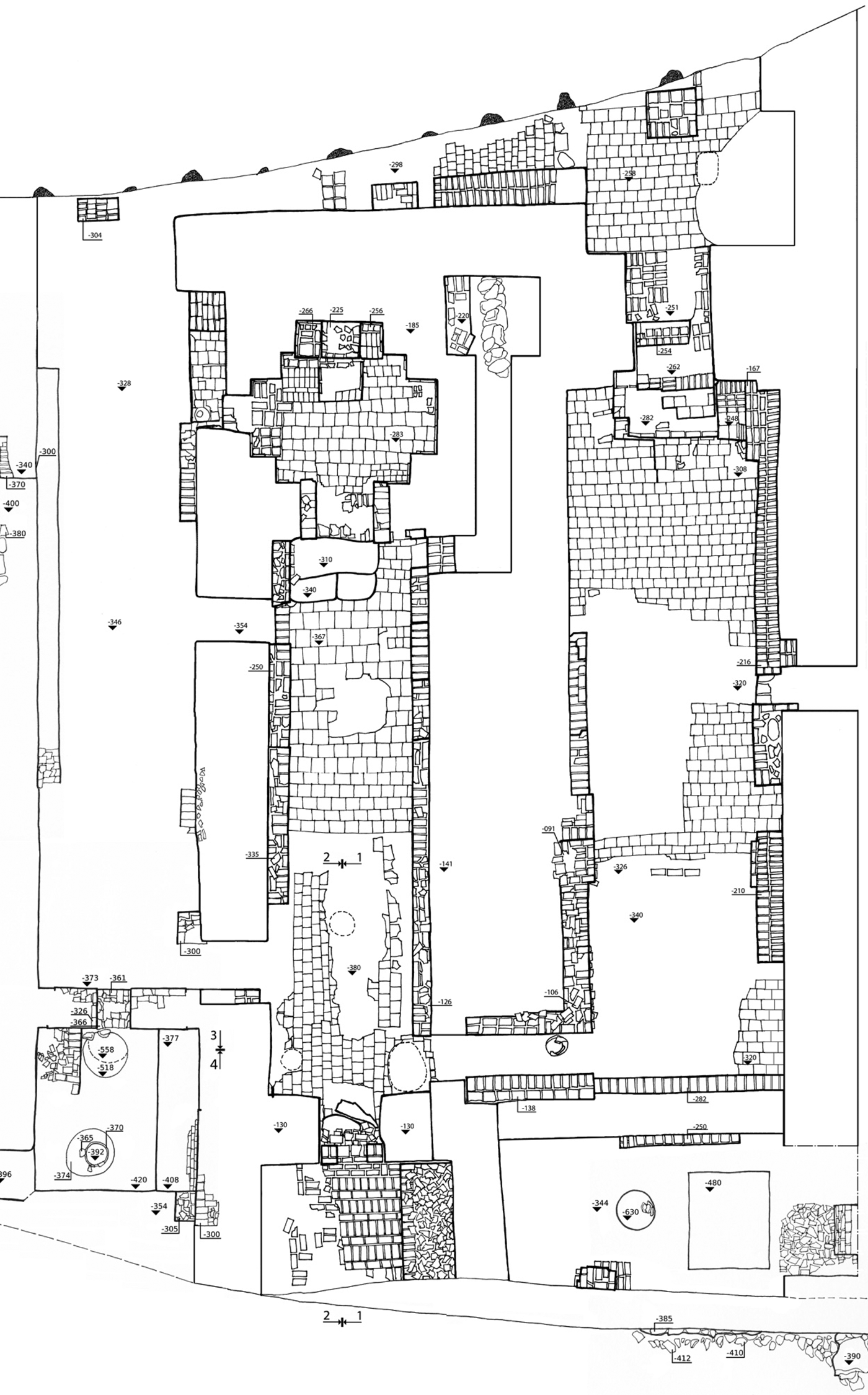
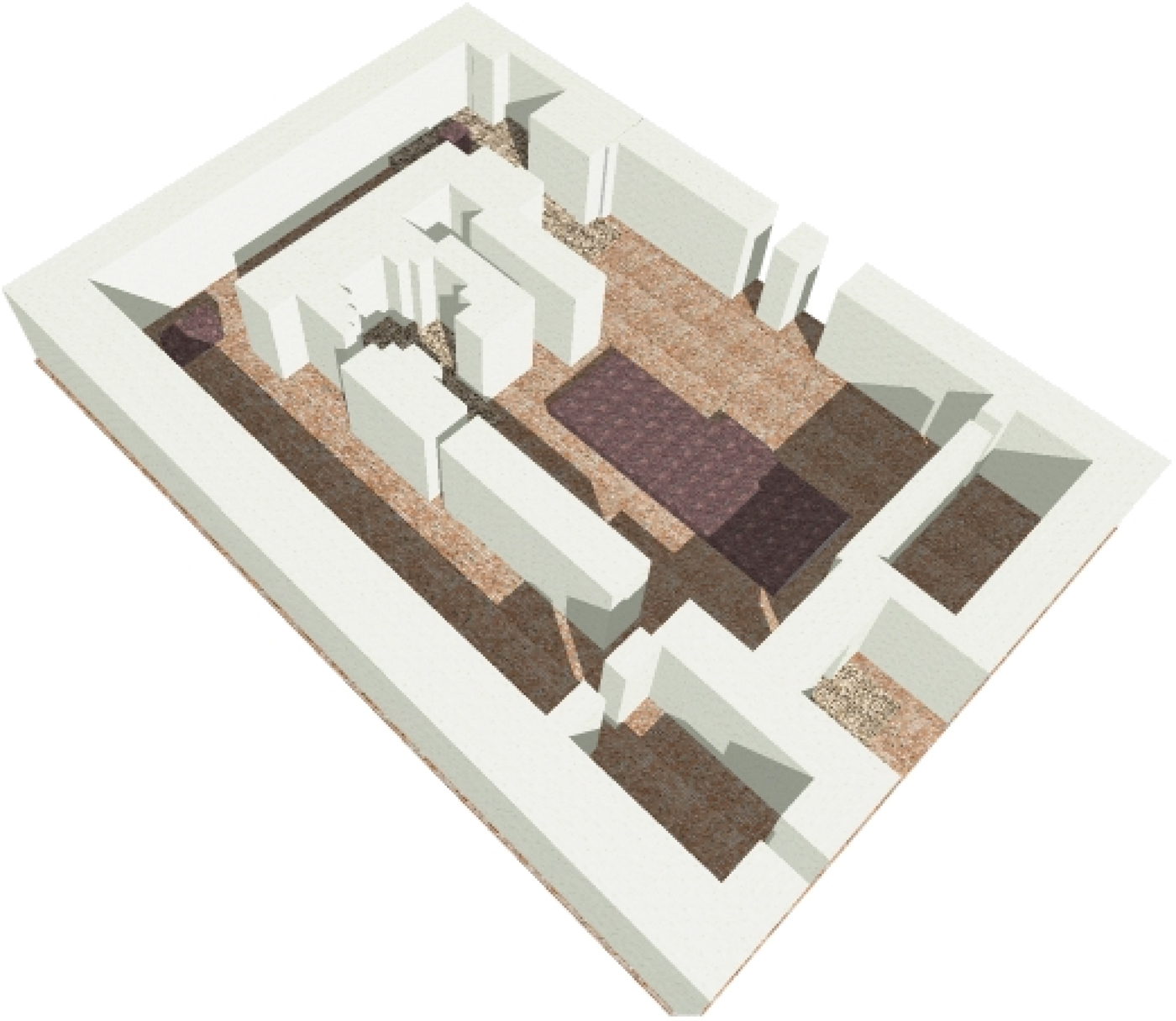
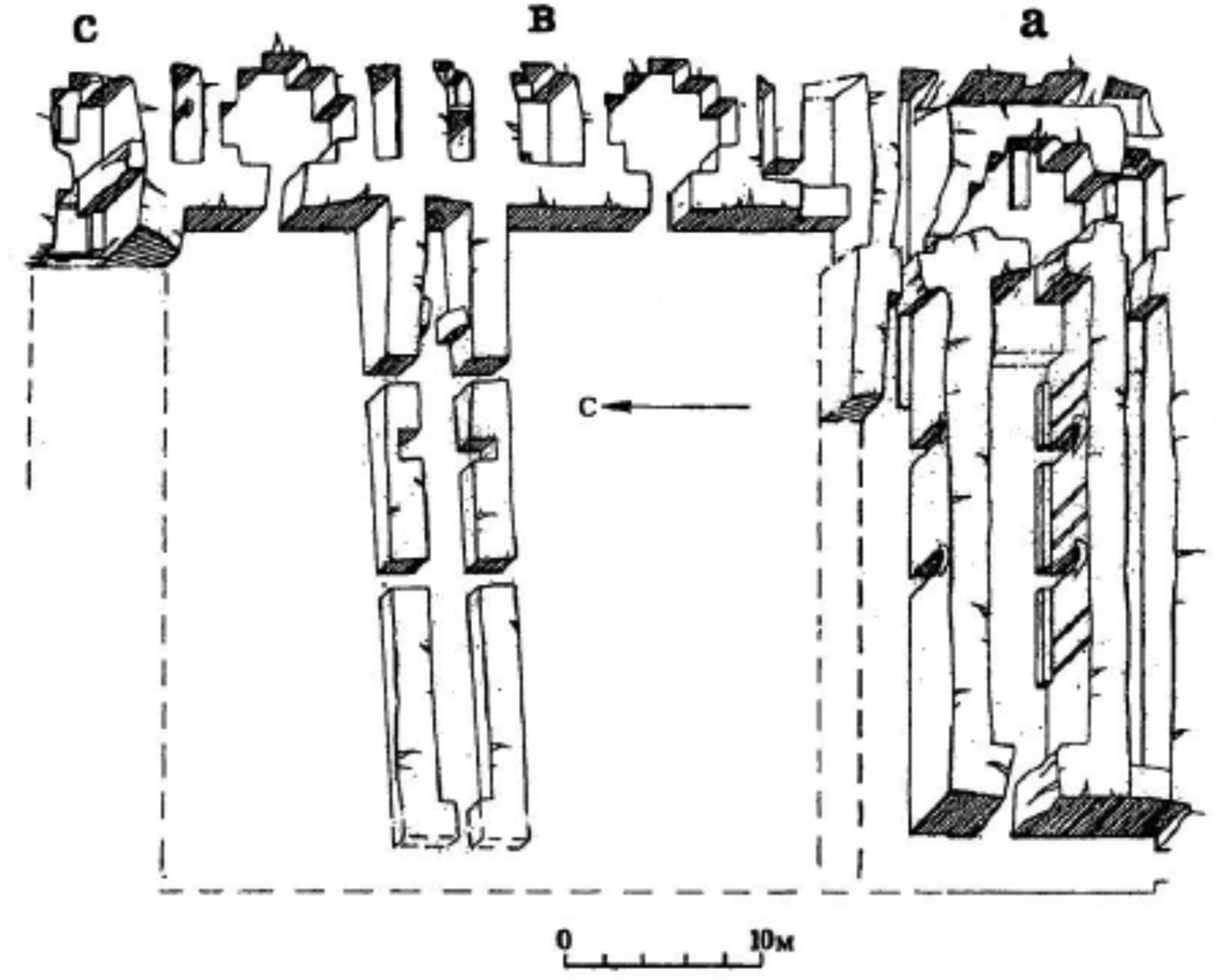
The Urgut church building was rectangular, with two naves oriented in an easterly direction with a deviation of 3° to the north.Footnote 26 The walls of the structure were made of different sorts of baked bricks typical of the Samanid and Qarakhanid period.Footnote 27
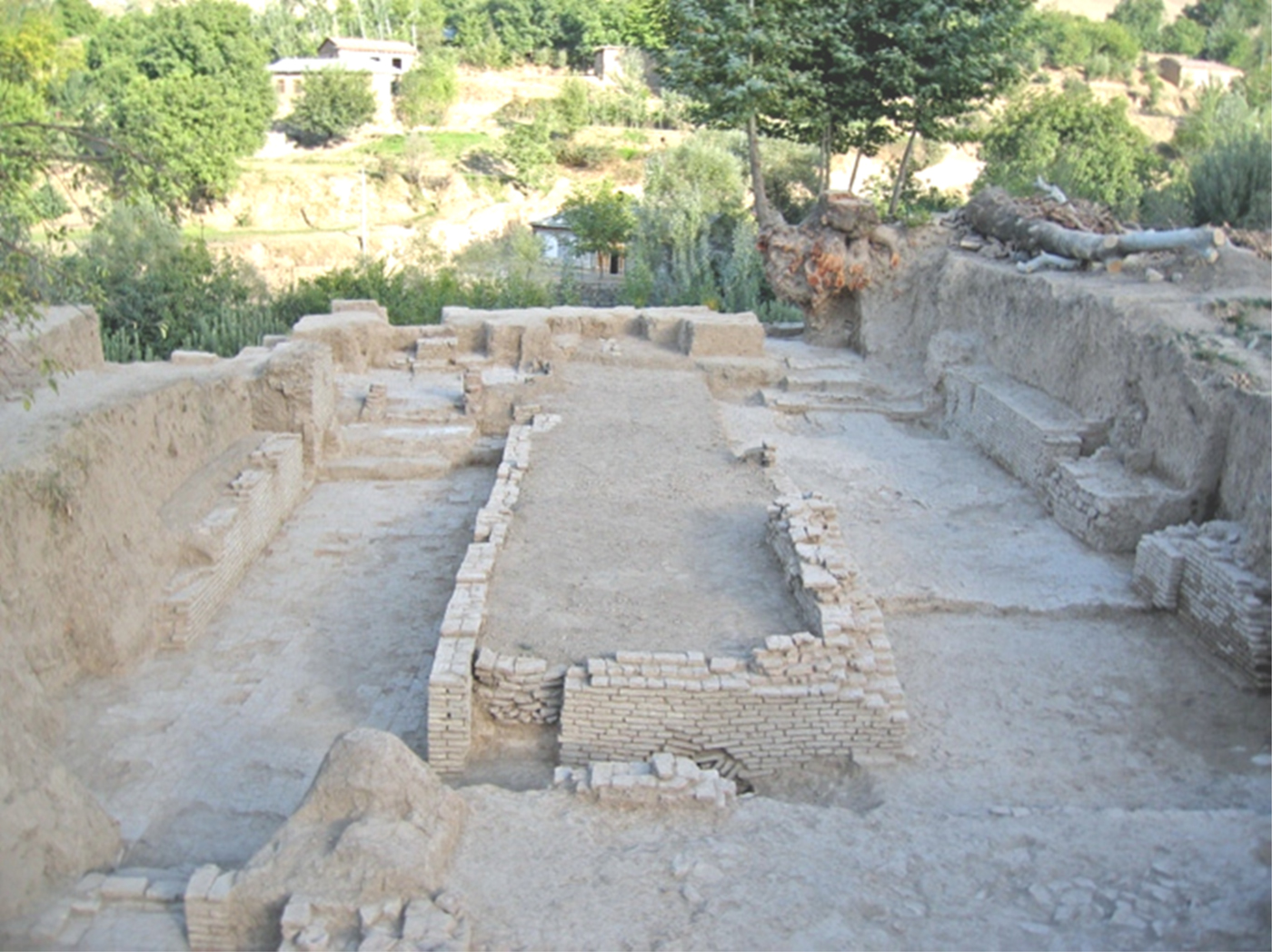
The naves were separated by a raised platform (bema) in the centre, measuring 9.30 × 3.35 metres. The skeletal (contour) wall of the bema was built from fired bricks of 30 × 15 × 5 centimetres and was filled with tightly compacted loess.Footnote 28
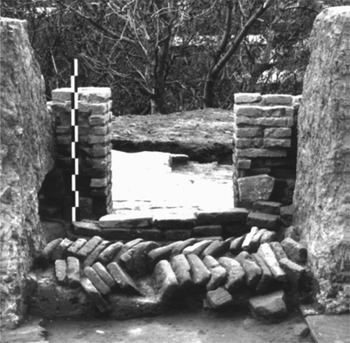
The main entrance, with an arched doorway, was situated in the western wall with a “rectangular narthex paved with altering rows of long and cross-laid fired bricks”, which led directly into the northern nave.Footnote 29 The main entrance, according to the results of the 2006 excavation, “had been filled with rubble, which probably indicates a squatter occupational period of the complex”.Footnote 30 The floor of this nave was paved in two layers of ceramic tiles (30 × 20 × 2.5 cm).
The southern nave was connected and accessed from the northern nave by a narrow corridor, accessed immediately from the entrance.Footnote 31 Like the northern aisle, it also extended along the east-west axis and was framed by a mud brick wall approximately 1.5-metres thick and faced with several rows of fired brick from the inside. It had two doorways on the southern wall, one of which was intentionally filled with rubble and brick pieces.
The floor in the southern nave was paved by fired bricks of 23 × 23 × 5 cm.Footnote 32 In both naves, cubical altars built of fired bricks were located at the chancel in the east end. Steps (stone steps in the northern nave and fired brick steps in the southern nave) marked the entrance of the chancel, accessed through a low narrow passage in the Church of the East liturgical-architectural tradition called a šqāqōnā.Footnote 33 The layout of the chancel in the northern nave was cross-shaped. To the south, it was flanked by another room, which possibly functioned as a diaconicon (a room used by deacons to prepare the Eucharist elements or where the baptism font was situated). Due to the poor state of preservation, the exact layout of this chamber cannot be reconstructed. However, its function as part of the liturgical furnishing of the church can be discerned from the difference in the formation of the paving and the bricks discovered between the northern and southern chancels in the east end of the church.
At the east end of the southern nave, the floor elevates to form several steps leading outside the main eastern wall, beyond which are the remains of another building. Judging from the gypsum plastering of the paved floor, it appears to have been integral to the church proper. Present in the centre of the building is a rectangular base (altar?) built of fired brick. At the rear end, the wall had a round-shaped niche furnished with a ceramic plaque. Its furnishings, rectangular base and niche are thought to “suggest its use as an oratorium [that was] external to the main nave”.Footnote 34
The Urgut church complex also had a separate kitchen and dining hall, both located to the north. The dining hall had the “same proportions and the altar-like structure of the eastern end” but lacked the liturgical furnishings present in the northern and southern naves.Footnote 35 A wine cellar was located in the west, adjunct to the southern nave's external wall and possibly a tower.Footnote 36
The ground plan of the Urgut church. © Savchenko, 2010.

In his description of the architectural elements of the Urgut church, Savchenko asserts that the platform in the middle served “as a base for a church tower”.Footnote 37 However, it is unlikely that the church included a tower, particularly in the view of Savchenko's previous identification of this platform in 2005 as a bema:Footnote 38
The overall layout of the complex can be conveniently described as two aisles separated by a raised platform in the centre … The top of the platform could be reached through the aperture in its western wall, which must have been followed by a mud brick or loess stairway, not preserved. I believe that the most plausible interpretation of this platform is as a bēma, which played an important role in the liturgical setting of the Eastern Syrian churches and was situated in the centre of the nave (although the exact position varies).Footnote 39
Construction material and furnishings
The Urgut church was built from fired and mud bricks of varying shapes and size (30 × 15 × 5 cm, 23 × 23 × 5 cm, 30 × 30 × 5 cm, and 27 × 8 × 5 cm). However, from the reports, it is not possible to determine if the different-size bricks indicate the different wall sections for which they were used—skeletal wall, internal wall, on the foundation level, or on the upper level—or different phases of construction—repair or sections that were added later.Footnote 40 In the archaeological reports, only the brick size used for the construction of the bema has been clearly specified (30 × 15 × 5 cm).Footnote 41
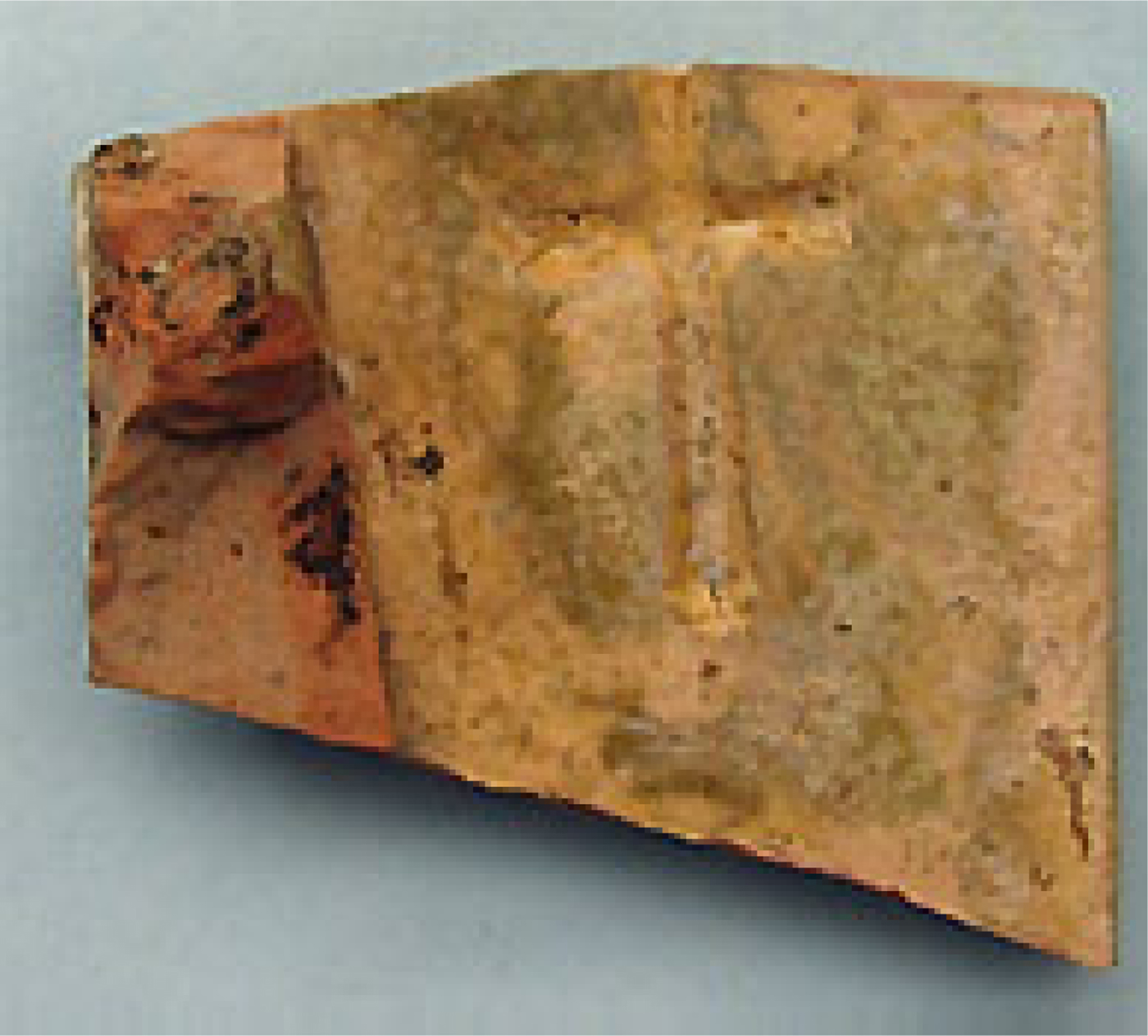
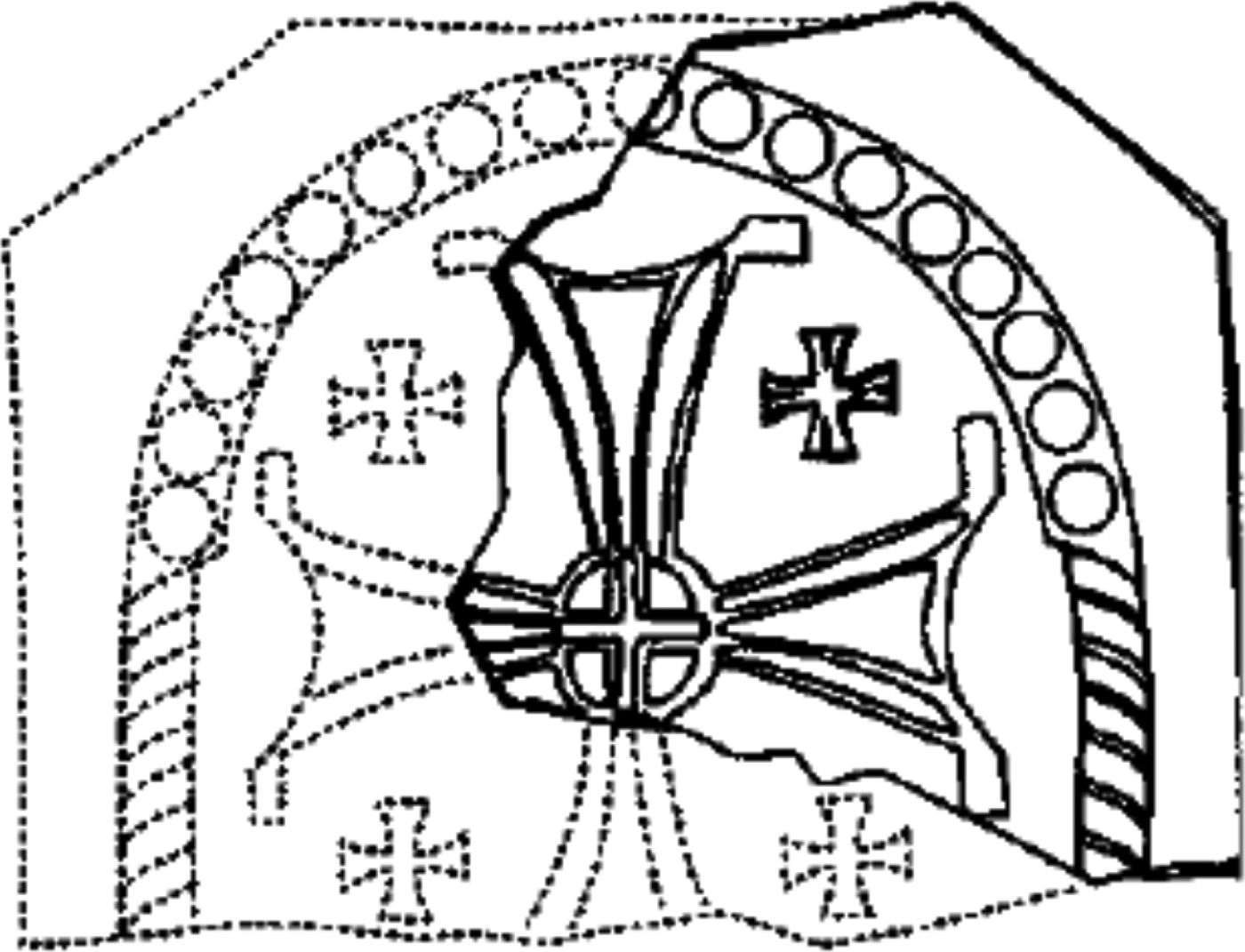
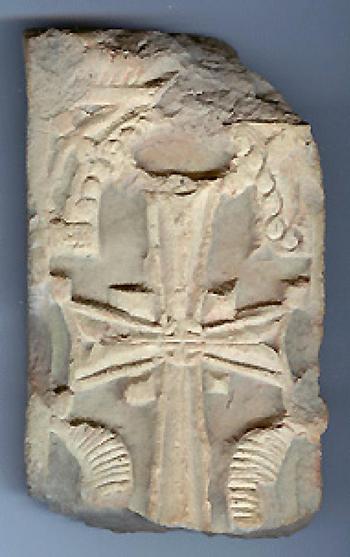
Ceramic tiles (30 × 20 × 2.5 cm) and fired bricks were used for the pavement in the interior. Most tiles still intact in the building are those that were used on the floor. A tile fragment engraved with the symbol of the cross, which was found during the excavation, was probably used to decorate the wall. The “fragments of decorative plaster and remains of emerald-green, carmine, ochre, white and cobalt stucco” found among rubble, which might have fallen from a wall, indicate that some sections of the interior walls also had coloured ornaments.Footnote 42
The internal walls were furnished with niches, probably to hold lanterns and other liturgical objects.Footnote 43 The walls were approximately 3 metres high and 1.5 metres thick.Footnote 44 Commenting on the layout of the wall, Savchenko states that, “despite being very neatly erected, [they] deviate from the magnetic axis by 15°. This [aberration might be] explained by the simple fact that, in the absence of a compass, the builders’ only reference points were those of sunrise and sunset”.Footnote 45
(Colour online) The church with the platform (bema) in the centre, seen from the east. Image reproduced after Savchenko, 2004, Excavations 2004: Brief Report' online resource.

(Colour online) Hypothetical 3d model of the Urgut church, based on the ground plan given in Savchenko, 2010, p. 78.

Access and doorways
Although the church had one main entrance (indicated by its arched layout and narthex), based on descriptions of the doorways and the functionality of some of the adjunct chambers, the church could have been accessible from four sides:
• From the south: through the southern nave, indicated by two doorways, one of which was discovered at the time of excavation to have been sealed off by rubble.
• From the west: via the narthex leading into the northern nave.
• From the kitchen: the refectory was connected by two doorways visible in the main northern wall. How the kitchen was accessed is not described. However, it was probably had entrances on both western sides, aligned with the main church entrance, as well as on the east end. It is impossible to imagine that firewood or other products used in the kitchen would have been carried in through the main nave.
Although the state of the preservation of the wall does not allow for the reconstruction of any windows in the church, it is possible that the church had some sort of fenestration. The main light source was probably from oil lanterns that were kept in the niches within the church.
Architectural parallels
Discussing the architectural layout of the Urgut church complex, Savchenko said that “the main problem presented by the ground plan is that of the prototypes”.Footnote 46 However, the major architectural feature of the Urgut church—the cross-shaped chancel terminating at the nave—has parallels in the church architecture of both Central Asia, exemplified by the church complexes discovered at Aq-Beshim,Footnote 47 and of churches of the Tur Abdin region and Hira.Footnote 48 In Savchenko's opinion, “the closest architectural parallel seems to be found in Church 7 in Hakkari”.Footnote 49 This impression was based, however, on the visual features of the ground plans of these two churches and no further comprehensive comparative examination between them was undertaken.Footnote 50
Collapsed arches of the main entrance viewed from the inside of the church. Reproduced after Savchenko, 2005.

Date
Archaeological examination has revealed that the Urgut church underwent several phases of occupation, and that its decline was gradual and took place over a long period.Footnote 51 Based on numismatic evidence, specifically a bronze coin of Turghar (type B) dated to the first quarter of the 8th century as well as the C-14 dating of organic materials and ceramics, the church functioned between the 7th and 13th centuries.Footnote 52 Collateral evidence that may point to the date of the Urgut church is the Syriac inscription incised on a rock at nearby Qizil-qiya which records “August of the year 1206 [of Alexander]”, that is August 895.Footnote 53
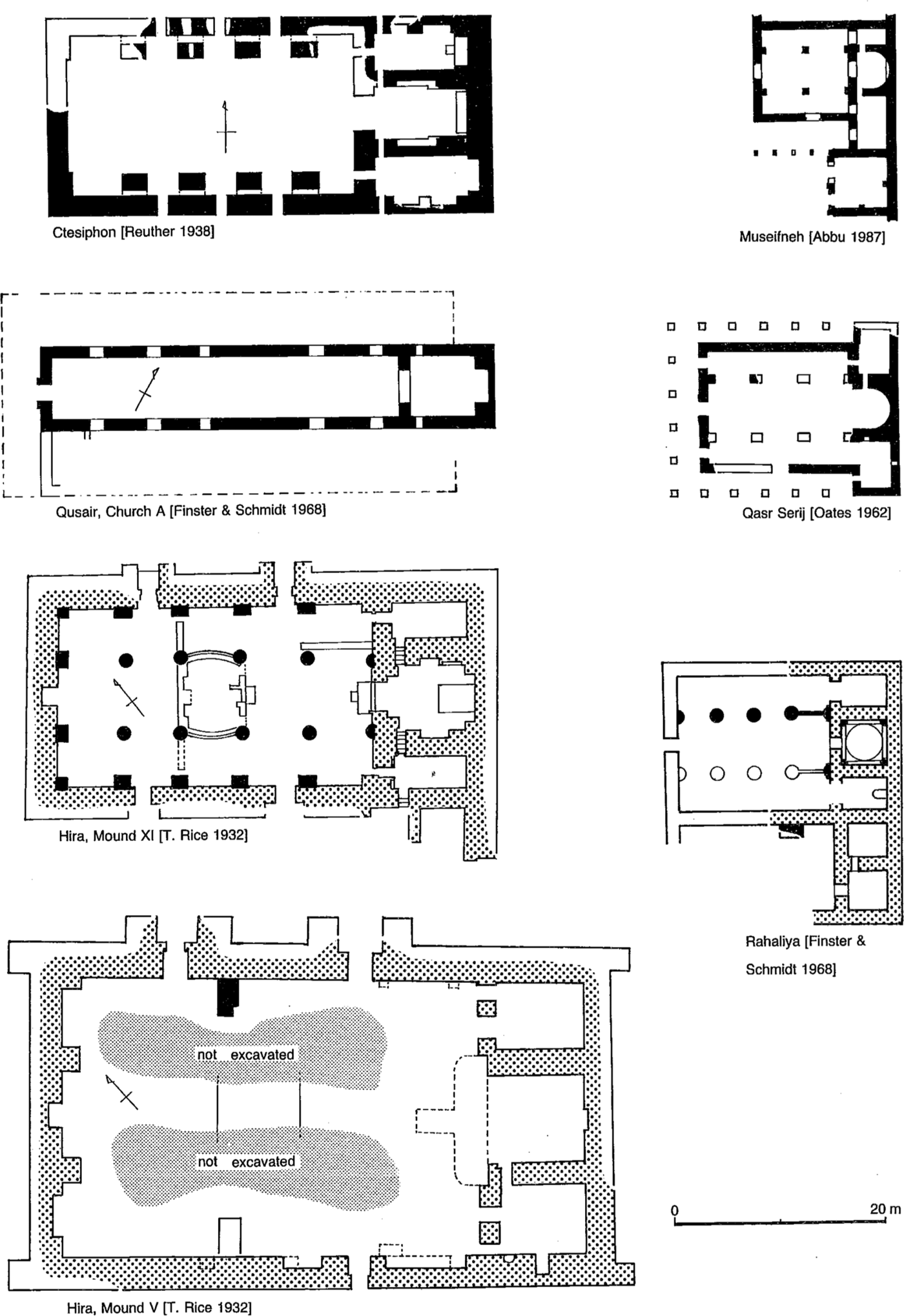
Early churches from Iraq. Reproduced after Okada, 1991, p. 75.

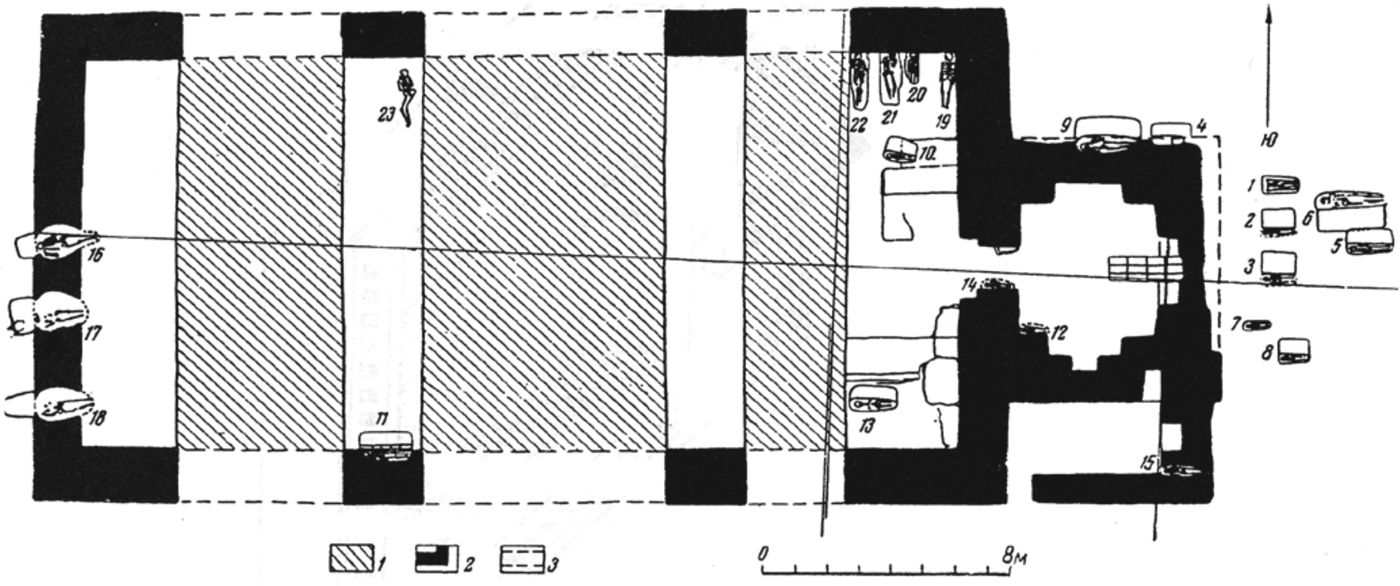
Aq-Beshim “building IV”. The image also shows the burials that were discovered. Reproduced from Kyzlasov, 1954, p. 223.

The Urgut church: architectural contexts
The architectural typology of the Urgut church, including its liturgical architectural elements, is comparable to existing examples of Christian architecture known both in Mesopotamia and Central Asia.Footnote 54 Specifically, it displays similarities with East Syrian church architecture. As such, the first aspect of its architectural reality is that it represents the architectural style of a specific ecclesiastical tradition, namely the Church of the East, which for many centuries was the dominant expression of Christianity east of the Euphrates and beyond, in Central Asia and China.
Consequently, although it is the only evidence from Sogdiana, typologically it is part of a larger group of architectural corpora. On the basis of its architectural features, the Urgut church can be placed both in its immediate regional context, that is Sogdiana/Central Asia, as well as in the wider and more geographically extensive context of the Church of the East. The majority of the architectural evidence of the Church of the East known today has been found in Mesopotamia proper, that is east of the Euphrates at Ctesiphon and in the western flank of Hira, as well as down the Gulf and further afield in the eastern extremities of the Sassanid Empire, at the Marv oasis, and in the Semirechye region en route to China.Footnote 55
Aq-Beshim “building VIII”. Reproduced from Semenov, 1999, p. 52.

Some examples of Church of the East architecture
The patriarchal church located in Seleucia that served as a “headquarters” for the Church of the East was excavated on the western side of the Ctesiphon, a twin city of Seleucia.Footnote 56 Oscar Reuther describes the church as having had a rectangular plan (27.18 x 15.06 metres), built of fired brick and a “[single] nave roofed with a barrel-vault supported on pillared walls”.Footnote 57 Its sanctuary was flanked by pastophoria (prosthesis and diaconicon).Footnote 58 These two were accessed via narrow doorways cut out of the western edge of these rooms. A special feature of the sanctuary chamber was that it had rectangular niches that were cut out of the north and south walls. The liturgical furnishing of the church did not include bema. Footnote 59
In addition, architectural examination revealed that this church was built on top of, possibly, the ruins of a smaller church, which had a narrower nave than the “upper” structure and thick, rounded pillars resting on square bases along the sidewalls.Footnote 60 The date of the monument (7th century) is confirmed by an ostracon bearing an inscription that was unearthed from a deposit under the church floor.Footnote 61
Hira, southwest of Ctesiphon, on the western flank of Mesopotamia, bordering the great desert that stretched to Arabia and Syria, has yielded a significant amount of Christian architecture. This shows that it was an important locus of Christianity, as was recognised by later Muslim authors. At Hira, two church buildings (known as “Mound V” and “Mound XI”) were excavated which, based on their architectural features and mural paintings, were dated to between the 6th and 7th centuries.Footnote 62
“Hira-Mound XI” is a three-nave church built from mud bricks. The naves were divided by four pairs of detached columns. There was a barrier extending north–south across all three naves which, at the second pair of columns, divided the western two-fifths of the naves from the eastern nave. There are three rooms at the east end of the church: the sanctuary and the pastophoria which flanked it. The pastophoria were accessed via narrow doorways cut out of the western edge of these rooms.
The bema was positioned east of this barrier in the space occupying the central nave towards the east end. The bema walls in the north and south curved outwards and contained benches.Footnote 63
“Hira-Mound V”, though not well preserved, bears many similar architectural features to “Hira-Mound XI”, such as the presence of bema and pastophoria. However, as is evident from the excavated section, it was a one-nave church, although it is possible that columns existed in the sections that were excavated, which would mean that it had possibly two or three naves. Both church buildings at Hira were built with a southeasterly orientation. Excavation reports supply many fine examples of the plaster plaque crosses, which were used for the interior decoration of both churches.Footnote 64 However, it is not clear from the reports to which church specific pieces belonged.Footnote 65
The island of Kharg, which lies approximately 25 miles offshore from Bushire in the Persian Gulf opposite Bahrain, yielded the remains of a three-nave church constructed of dressed stone and probably roofed by a three-barrel vault.Footnote 66 The interior walls were decorated in stucco with stylistic features resembling Sassanid ornamentation.Footnote 67 The monastery, which forms an outer wall of the church, comprised about 60 cells, each with three small chambers. Several small ruins were also associated with the church and monastic dwellings. Roman Ghirshman considers them to have been the accommodation of married clergy.Footnote 68 However, it is also possible that these buildings, which were not far away, were used by pilgrims and visitors to the island. The church and monastic community of Kharg is believed to have come into existence from the 3rd century and continued until the 8th century.Footnote 69
The excavations at the site of Ain Sha'ia in southwestern Iraq unearthed a church and monastic complex.Footnote 70 The monastery was located in a fortified complex and the church was three-nave (measuring approximately 14 by 22 metres) decorated with stucco and murals, and with a brick-paved courtyard.Footnote 71 The naves are divided by solid partition walls and there are three access points along their length. The east end has three rooms: a rectangular sanctuary flanked by pastophoria. The liturgical furnishing of the church did not include a bema.
Other edifices related to the Ain Sha'ia monastery are the so-called Dukakin caves. These caves are dug into marlstone stratum at the height of 40–45 metres in the cliff and are located to the west of the monastery. “They have twenty entrances on the north side and twenty-one on the south, and some caves are linked together without any intermission inside”.Footnote 72 In his descriptions of the site, in particular Cave 1, Ken Matsumoto notes that the floor at the entrance was laid with fired-brick and marlstone chips, and inside, it was coated with chaff-mixed mud. “The living space is in the dimensions of 1.8 metres wide, 6.5 metres deep and 1.9 metres high with an annex of 1.0 metres wide, 2.2 metres deep and 1.9 metres high”.Footnote 73 The relationship of these caves with Ain Sha'ia was determined as a result of both their geographical location and the material finds (though these are few in number). As demonstrated by chisel traces observed in Cave 2, the Dukakin caves were dug artificially. “The inside part of the cave is smooth in ceiling but its floor surface is up-and-down in a zigzag way, viewed from a plan, while utilising lots of cracks which run freely on the marlstone of the cliff component”.Footnote 74 The Ain Sha'ia monastery, including the Dukakin cave community, ceased to function in the 9th century.Footnote 75
Significant items of material culture discovered in the Ain Sha'ia complex include pieces of 12 plaque crosses and inscriptions.Footnote 76 All the crosses are typologically similar to those observed at Hira and in other churches in the Gulf and Mesopotamia. Some plaques include floral and geometrical motifs, while in others, the cross is positioned beneath an arch.Footnote 77 The excavation reports state that none of the crosses was found within the church nave(s) or in the sanctuary; however, it is unclear from the report whether most of the plaque crosses were discovered in situ.Footnote 78 At any rate, the presence of decorative elements is invaluable for understanding the interior decor of Church of the East churches. And, of course, these provide evidence for comparative study with other churches.
Two monastic complexes comprising a church and monastic settlement structures have been uncovered on the islands of Marwah and Sīr Banī Yās, located approximately 100 km and 170 km to the west of the city of Abu Dhabi, respectively.Footnote 79 Both the church buildings of Marwah and Sīr Banī Yās have identical dimensions and layout, notably a deep chancel, a relatively short nave, and a partition wall in the south chambers, which, as shown in Sīr Banī Yās, served as a foundation for the tower.Footnote 80 The material culture objects collected from the site, including the C-14 testing, have shown that these sites were occupied and functioning from the 6th to mid-7th centuries.Footnote 81
There is a known church and monastery complex on a site on the island of Al-Qusur of Failaka, Kuwait.Footnote 82 The church measures 36 by 19 metres and several other smaller constructions were observed in its environs. The church, in many aspects, is similar to that of Ain Sha'ia: three-nave, built from mud brick, its naves divided by solid partitions, with three access points along the wall dividing the naves. The rectangular sanctuary is located in the east-end of the church and is flanked by the pastophoria, which has an interesting feature in that each of its chambers contained niches on the north, south, and east walls. In the eastern niche of the pastophoria in the northern nave, four grooves in the plaster floor were observed. They are thought to indicate the presence of a table or altar.Footnote 83
A narthex was located on the west side and two burial niches were discovered in the southern nave within the partition wall. According to the excavation report, the church at Al-Qusur was built in the early 7th century and was diminished in the late 8th or early 9th century.Footnote 84 Two monumental plaque plaster crosses were discovered at this church; the first plaque was found in the southern nave and depicts a cross surrounded by a geometrical and floral frame.Footnote 85 The shape of the cross and its floral-geometric frame design is comparable to those found in other Christian sites in Mesopotamia and in the Gulf region, such as Kharg and Ain Sha'ia.
Other specimens of Church of the East architecture are known from the Gulf coast of Saudi Arabia, at JubailFootnote 86 and Jebel Berri.Footnote 87 In many respects these churches are similar to those of Ain Sha'ia and Al-Qusur. The churches have comparable dimensions, layout, internal décor (with stucco), and chronology of occupation.Footnote 88 In addition, the church building at Jubail also included a bema. Footnote 89 The physical structure of the Jubail church comprised a walled open courtyard (approximately 15,020 m2) and three rooms located at the far east end, of which the middle room “contains [the] distinctive feature[of] a sanctuary with a raised platform, bema [βωμος], along the east wall”.Footnote 90
The remains of two churches were discovered at the site of Qusur in southwestern Iraq, where one edifice is better preserved than the other.Footnote 91 The church was originally a three-nave church, with the naves partitioned by a solid wall. It had a square sanctuary with a domed roof located in the east end. The church was constructed with stone foundations and mud brick, and its walls were coated in plaster. It measured approximately 20 by 40 metres.Footnote 92 Judging by the remains of the doorways on the north and south walls of the sanctuary, it was flanked by pastophoria. No decorative elements were preserved. The church is dated to the late 6th or early 7th century.Footnote 93
Another church in southwestern Iraq was excavated at the site of Rahiliya. Like the Qusur church, it was constructed of stone and mud bricks. This three-nave church was divided by five sets of pillars measuring 15 by 23 metres. The pillars in both the west end and east end were attached to the far-west and far-east walls dividing the nave and sanctuary, respectively. The church building also included subsidiary rooms located to the south of the church proper.Footnote 94 The square sanctuary, flanked by pastophoria, was accessed from the central nave. The church was dated, on the basis of an examination of the ceramics assembled from the site, broadly to the late Sassanian period.Footnote 95
In the exterior eastern provinces of the Sassanid empire, Church of the East architecture is represented by the Kharoba-Koshuk church, located north of Marv on the road leading to Chorasmia.Footnote 96 According to Galina Pugachenkova, the church at Kharoba-Koshuk was probably built in the 5th-6th centuries and functioned until the 11th-12th centuries.Footnote 97 The building was built from mud bricks and had a definite rectangular shape (51 metres long and 13 metres wide). It consisted of one nave, divided into six spans of different lengths. The apse was located in the southeast, and was preceded by a room, which probably had a domed roof.Footnote 98
In Semirechye, Church of the East architecture is exemplified by two unique church complexes excavated at the site of Aq-Beshim.Footnote 99 The second church complex excavated there (“building VIII”) was built in the southeastern corner of the city within the city walls and consisted of three, possibly four, sections. Each section was in turn divided into long rooms (hallways) of 25 metres, stretching from east to west. The “long halls” in the east end were adjoined by smaller square structures (5 by 5 metres) furnished with niches (altars?). Along the eastern facade of the building there were a number of additional rooms located between the rooms with altars. Judging from its size, Aq-Beshim “building VIII” was built in three stages, but with little chronological difference. The squared cross-shaped rooms were covered by a dome and the hallways were arched. This is similar to the features of Aq-Beshim “building IV”.Footnote 100
Origins and regional characteristics of Church of the East architecture
The majority of the examples described above are believed to originate from either the model of existing large halls, such as royal halls or palaces, which were built in the ivan style—a house with three chambers opening out into a hall or courtyard—or from the model of Jewish and Babylonian temples, as exemplified by the church buildings unearthed at Hira. This architectural model is distinguished by the square chamber in the eastern end that was accessed via a narrow passage.Footnote 101 This chamber at the eastern end was a separate section within the church proper; it was linked to the western part, where laity and worshippers stood.Footnote 102
In Central Asian Christian architecture, as noted by Veronika Voronina, especially with regard to the church at Kharoba-Koshuk and building IV at Aq-Beshim, the main distinguishing feature was the walled open yard. Voronina points out particularly that: “unlike the long churches of Ctesiphon; churches in Central Asia represent a special type where the nave is replaced with an open yard”.Footnote 103 In her opinion, this feature is a local characteristic of church architecture which developed in the Central Asian region.
Contrary to Voronina's opinion, discussing the architectural peculiarities of the church buildings in Central Asia, specifically at Kharoba-Koshuk, Khmelʹnitskiĭ agrees with Pugachenkova that the church at Kharoba-Koshuk was built on the model of the “long churches” of Ctesiphon. According to Khmelʹnitskiĭ, “even closer architectural analogies [to Kharoba-Koshuk] are represented by the churches in South Syria”.Footnote 104 As for the Aq-Beshim “building IV”, he is of the opinion that only the square chamber with an altar, located in the eastern end of the structure, can be designated as the church proper; the open courtyard was “an extensive threshold—in Western terminology, an atrium or narthex”.Footnote 105 He concludes that:
the church-chapel, its squared plan with axial niches and vaulted dome, belongs to the ancient and indigenous architectural methods of Central Asia; a method which later was translated into monumental forms of Islamic sacred and civil buildings.Footnote 106
Leonid Kyzlasov, commenting on the architectural format of Aq-Beshim “building IV” (which he excavated himself), opined that it “represents cultural syncretism, which is reflected in the combined architectural methods of the Syria (cross-shaped plan covered by dome) and Central Asia (an open court yard with porticos along the perimeter)”.Footnote 107 Thus, contrary to Khmel'nitskiĭ’s view which attributes the “entire” architectural model of Aq-Beshim (squared cross-shaped plan with dome and open courtyard) to the Central Asian architectural tradition, Kyzlasov describes only the open courtyard as being in the Central Asian architectural style that was specifically adopted in construction of church buildings.Footnote 108 Kyzlasov's interpretation (similar to that of Voronina) is that the open courtyard at Aq-Beshim building IV functioned as an open-roofed nave. The same feature is observed in the Aq-Beshim “building VIII”, excavated in 1996–1997.Footnote 109
Regarding the distinctiveness and regional characteristics of Church of the East architecture, the above-mentioned views on the characteristics of its architecture can be summarised in Yasuyoshi Okada's words about the church architectures known in Iraq that:
the churches in Iraq, especially in the southern region, though not so many, represent the notable architectural phenomenon in the time around the Muslim conquest, that various factors and elements, both native alien, skilfully composed not in one way a new category of architecture, neither Sasanian nor Islamic.Footnote 110
The Urgut church in the context of Church of the East architecture
The preceding section presents 14 up-to-date, documented examples of Church of the East architecture from Mesopotamia, the Persian Gulf region, and Central Asia. Of course, this is a small number of specimens from which to draw conclusive suggestions. However, by considering their shared architectural characteristics, it is possible to make some observations about their relationship and significance.
In relation to the churches described above, the Urgut church shares four main features:
1. General architectural outline/model: the layout of the Urgut church is rectangular, with two naves, divided by a bema in the middle.Footnote 111 The doorways are located along the length of the walls.
A unique feature in the layout of the Urgut church, which is distinct from the other examples mentioned here, is its separate kitchen and dining hall, both located to the north of the building. According to Savchenko, the dining hall had the “same proportions [as the naves] and the altar-like structure in the eastern end” but lacks other liturgical furnishings that were present in the northern and southern naves.Footnote 112 This dining hall was separated by a solid wall and was accessed from the sanctuary (by one doorway) and the northern nave (by two doorways) and possibly from the oratorium, located behind the sanctuary. There was also a door from the kitchen that opened into this dining hall. If the outline of this particular section is turned by 180 degrees, then the Urgut church looks like a three-nave church where the sanctuary is flanked by pastophoria. The main nave is divided into two aisles by the bema and the other nave is separated by the solid wall. This feature (i.e. separation of the naves by a solid wall) is present in several of the churches mentioned earlier, such as Ain Sha'ia. The presence of the kitchen at the western end suggests that the Eucharist bread may have been baked there, in which case this room did not serve as a general kitchen, but as a prosthesis (a liturgical chamber). The presence of the doorways also indicates that this refectory was possibly a nave, since it was also accessed from the sanctuary.
2. Construction materials: in the churches discussed, the building materials generally vary by region. However, the majority of the churches are built from mud and fired bricks, as was the Urgut church.
3. Liturgical architectural features: namely a sanctuary located at the east end, flanked by pastophoria. To the north of the sanctuary there was one room that probably served as a diaconicon. In its immediate Central Asian context, the Urgut church is unique in that it included a bema, absent in the other churches, including those at Aq-Beshim and Kharoba-Koshuk.
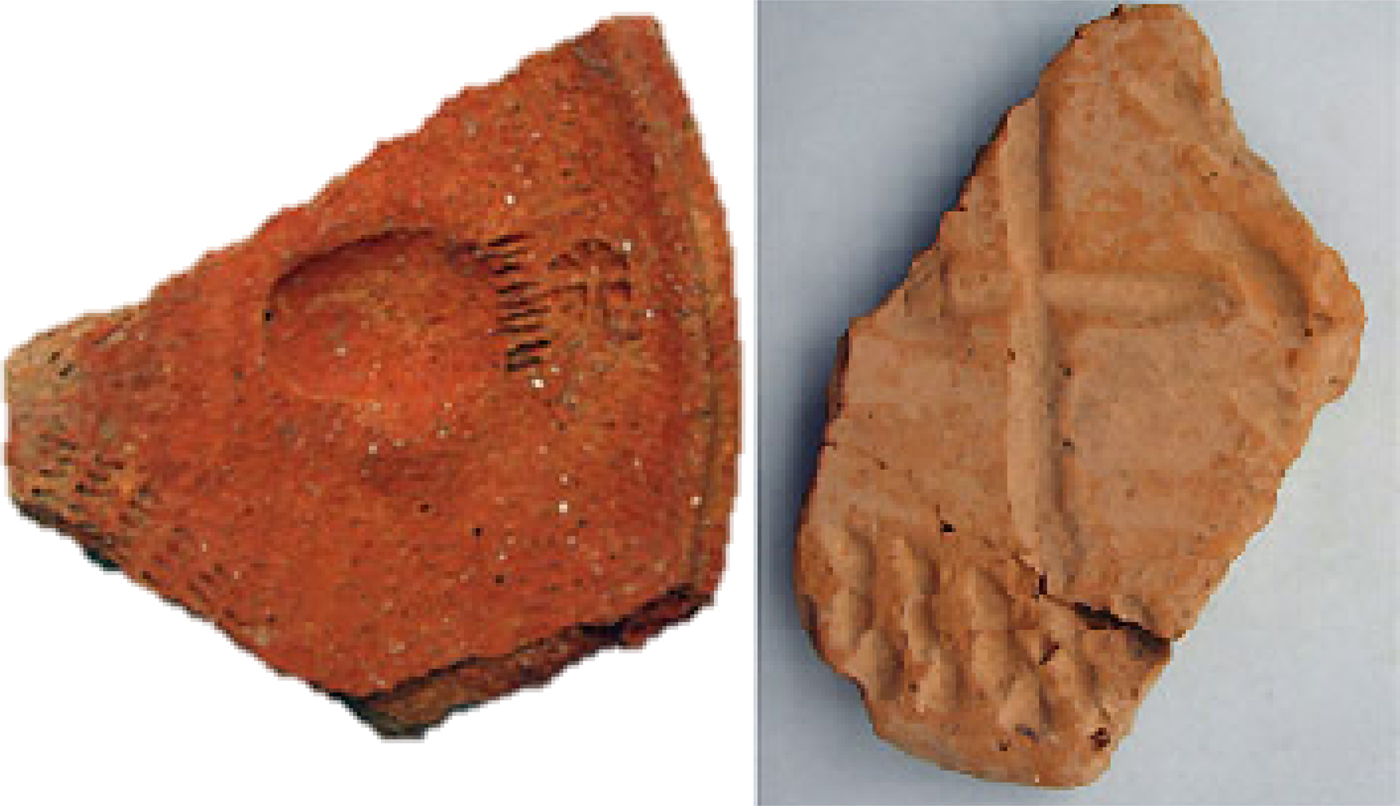
4. Interior decor: in contrast with the Mesopotamian and Gulf churches, no monumental elements of decor, such as cross plaques or other ornamented detail, have been found at the Urgut church. However, the ceramic tile found in the nave in the niche in the eastern wall suggests that at least parts of the church were decorated. Furthermore, the presence of fragments of coloured stucco also indicates that the walls were decorated with some sort of mural. In this connection, it is noteworthy that a cross plaque (a tile bearing an impression of the cross) is known from Marv. Although the exact archaeological context of this evidence is obscure, its use in the decor of churches is certain.Footnote 113
The Urgut church: monastic or parochial
The Urgut church has, to date, been believed to be a monastic church or even a monastery. The concluding remark of the archaeological reports on the Urgut church reads:
after careful considerations, it has been decided by the project leader, Dr. Alexei Savchenko, and the Society for the Exploration of EurAsia to conclude the fieldwork at Urgut since the project's objective, set in early 2004, has been fully achieved with the discovery and excavation of the Christian church and monastery belonging to the Church of the East mentioned by the 10th century geographer and historian Ibn Hawqal.Footnote 114
However, this conclusion needs to be reconsidered.
The designation of the excavated edifice as a “Christian church and monastery” is based on Ibn Hawqal's description, particularly his use of the words عُمرٌ [‘umra] and قلاّيات [qillāyāt]. Savchenko translated the first word, ‘umra, as “monastery”, and in the footnote he described it as a “calque from the Syriac  instead of the Arabic [دير]”.Footnote 115 The word qillāyāt, translated as “cell” in both Syriac (
 ) and Arabic, denotes the sense “small in size” (i.e. an alcove, a recess, a recessed portion of a room, or a monk's cell).Footnote 116 Thus, Savchenko translates the passage as follows: “On Sāwdār [there is] a monastery of the Christians where they gather and have their cells”.Footnote 117 However, judging by its ground plan, the excavated Urgut church can be firmly designated a church (i.e. a gathering place), which is signified by the word مجمع [majm‘a] in Ibn Hawqal's passage.Footnote 118
In Arabic, majm‘a could mean gathering in a place (i.e. church building or monastery) or in the sense of a gathering of people (i.e. assembly). In Ibn Hawqal's passage, the word majm‘a relates to the word ‘umra; thus, it can be understood that the author uses the word ‘umra in the sense of building, qualified by majm‘a, implying “assembly place” (i.e. church building). Accordingly, Ibn Hawqal perhaps uses the word ‘umra with its Arabic semantics (i.e. building), and therefore, it may not have the Syriac connotation of “monastery”. In addition, within the excavated area, no traces of additional structures that may have been used for habitation (i.e. cells (qillāyāt)) have been found to support the designation of the Urgut church as a monastery or a church located in a monastic setting.
(Colour online) Fragment of ceramic tile with the impression of the cross. Reproduced after Savchenko.

Cross plaque from Marv. Reproduced after Pilipko, 1968.

One could justify the absence of cells in the excavated edifice by suggesting that Ibn Hawqal was either referring to another complex that comprised a separate place of assembly (church) or habitations (cells), or perhaps to a few caves located in a mountain nearby the excavated church.
The first option—that Ibn Hawqal was describing a different monument—is very unlikely. As Savchenko himself points out “neither the available data nor common sense allow that in the Urgut area (i.e. the Shawdar mountains in the south of Samarkand) there once were two Christian monasteries, one described by the Arab geographers, and the other unnoticed”.Footnote 119
The second option, namely that by qillāyāt Ibn Hawqal meant the nearby caves, equally does not find corroborative material justification. The so-called “monastic” caves of Urgut were brought to the attention of scholars in 1920 when a collection of Syriac inscriptions was observed on the mountain wall at Urgut.Footnote 120 They are located at about a 20–30 minute walk from the Urgut church and not all of them are easily accessible.Footnote 121 According to Mark Dickens’ recent survey:
Cave 1 is accessed by a narrow opening in the rock face and provides just enough room to stand up in and cave 2 is actually a small grotto which could provide one person with a very cramped place to shelter from the elements. Cave 3, the highest, is inaccessible without climbing ropes for all but the most seasoned rock-climbers.Footnote 122
Previous surveys, including that of Dickens, have not comprehensively documented these caves, in terms of providing exact measurements of their height, depth, or internal structure. However, it appears that these caves were not monastic in that they were not a monastic habitat. At most, they could be described as overhangs or small holes, approximately 4–5 feet wide in the opening and 2–3 feet deep. They possibly resulted from two large rocks falling together or a rock falling off, and are very narrow. Dickens confirmed that, judging by their overall shape and size, they could, at most, accommodate one or two people at a time.Footnote 123 Thus, they could only be useful for temporary shelter and there is no evidence to show that they were used by monks as a dwelling. However, these caves may well have been used as a place for short stops.
In the passage under discussion, Ibn Hawqal also mentions the word وقوف [wuqūf].Footnote 124 Savchenko has translated this as “inalienable properties” (i.e. “endowment lands”).Footnote 125 The word wuqūf (as a verbal noun) means to pause, stop walking, or stand up (i.e. stop). Considering the context in which Ibn Hawqal uses this word, namely as a description of the natural conditions of Urgut (solitude, a healthy climate), it is possible to assert that wuqūf means a stopping place, a place used for retreat and stoppage, as opposed to its being the plural of waqf (endowment land). Thus, perhaps by the word wuqūf, Ibn Hawqal is referring to these caves, which monks used for holding vigils or travellers used to pause from their journey.
Furthermore, the possibility that these caves were used for short stays or stoppage is supported by the content of the inscriptions found in these caves, in particular, on several occasions, the word “vigil” in connection with a personal name:  “Baršabbā kept vigil/stayed the night”.Footnote 126 The Syriac word for vigil is
 , which stems from the verbal root
 meaning “to pass the night, remain all night”.Footnote 127 This could support the theory that these caves were used for overnight stays at most.
The inscriptions found in the Urgut caves comprise very short phrases and personal names (a total of 51), followed by the sign of the cross. In addition to the inscriptions noted in 1920, a recent survey by Dickens has identified further:
the inscriptions can be divided into five locations: Cave 1, Cave 2, Cave 3, the lower cliff face and the upper cliff face, where a small inscription-covered grotto is located. There are also two inscriptions that were sawed off the cliff by A. Y. Kaplunov of the Museum of History, Culture and Art in 1936 and taken back to the Museum, where they reside to this day”.Footnote 128
Both the caves’ proximity to the church and the content of the inscriptions found there indicate that Christians living in the region, as well as those who emigrated there from Iraq, as shown by Ibn Hawqal, were familiar with them. Although available evidence supports traces of human activity in them, no other types of material evidence have been found to support the idea that they were used as monastic habitations. No traces of food, fire, or intentional adjustment of space has been found. It may be argued that they were possibly used as temporary vigil stations or spaces of retreat, on the basis of the content and size of the inscriptions, which are often short and mention words such as vigil and prayer.
A further point to be made is that the designation of the Urgut church as a “Christian church and monastery” does not find support in comparisons with parallel examples of the monastic complexes of the Church of the East, about which Ibn Hawqal may well have been informed. Three particular sites that were either founded or flourishing contemporaneously with the Urgut church are:
1. The monastery at Kharg Island, excavated in 1960, represents a rare example of the capacious cenobitic institutions of its period. It consisted of 70 cells, built around a courtyard, and a church. Furthermore, satellite settlements were discovered in its vicinity, which also belonged to and were used by either the Christian community living on the monastic site or elsewhere on the island.Footnote 129 The communal gathering place of this monastic community was probably a church which was richly decorated with stucco reliefs analogous to those known from churches in Sīr Banī Yās and Jubail.
2. The monastery at Sīr Banī Yās is located to the south, off the coast of the modern United Arab Emirates.Footnote 130 The size of this site is more modest than the coenobium discovered at Kharg (eight cells were excavated, and there might have been just 30 to 40 cells in total). However, its design—in terms of the arrangement of cells and satellite settlements around the church building—is similar to the overall plan of the monastery at Kharg.Footnote 131
3. The monastery at Ain Sha'ia, which provides the most direct parallel, was located in a fortified complex, which included a three-aisled church.Footnote 132 The so-called Dukakin caves, discussed earlier, appear to have been intentionally dug and modified into dwellings by monks. Traces of habitation of these caves by a monastic community include epigraphic finds.Footnote 133 Based on their design (the size of the rooms, the passages connecting the caves, and their plastered interior), these caves are believed to have been in use (functioning either as dwellings or for other purposes) long before their adaptation by a Christian community at Ain Sha'ia.
The above examples show that most of the monastic complexes of the Church of the East had a similar layout: a church building for gathering, a monastic settlement for cenobitics, and caves for solitary monks. Placing the Urgut church within this extended framework of the monastic and ecclesiastical architecture of the Church of the East brings up stark structural anomalies, in that it does not have all the architectural elements of a monastic complex.
It is possible to identify the caves located near the Urgut church as the habitat of anchorite monks—given that these solitary monks did not have any possessions and lived in extremely harsh conditions—and thus to see the caves as part of a monastic complex in Urgut. However, this really needs to be supported by more compelling evidence, similar to that recovered in the Dukakin Caves at the Ain Sha'ia monastic complex.
Another piece of evidence pointing to the parochial nature of the Urgut church is the liturgical architectural feature of the bema. Emma Loosley's recent study of architecture of the bema, focusing on the churches of northwestern Syria, has established that in Syria the bema was not used in monastic churches.Footnote 134
The excavations of churches built in the Church of the East tradition which were part of monastic complexes, such as Sīr Banī Yās, the churches on Kharg island, and at Ain Sha'ia, did not reveal the presence of bema either.Footnote 135 Among the currently known Church of the East church buildings, the bema has been found only in the three-nave church (designated Church XI) excavated at Hira. The naves in the church were divided by four pairs of detached columns. There was a barrier extending north-south across all three naves, which, at the second pair of columns from the west, divided the western two-fifths of the naves from the eastern nave. The bema was positioned east of this barrier in the space occupying the central nave towards the eastern end. The bema walls in the north and south curved outwards and contained benches.Footnote 136 The only other church building of the Church of the East tradition in which the bema has been found is the church discovered at Jubail, on the Persian Gulf coast of Saudi Arabia.Footnote 137
Extant evidence may be understood to suggest that in the Church of the East tradition the bema was used only in congregational churches: in community churches, the reading of scriptures and the sermon required a bema. Accordingly, one possible conclusion is that the Urgut church was an ordinary parish church serving a sizeable community in the Urgut region of Sogdiana. There may have been coenobitic monks among the populace who used the solitary environment for retreats or vigils; however, there is no compelling evidence to support the designation of the Urgut church as a monastic church.
Furthermore, Loosely points out that among Syrian churches, only one bemata church per village is known, and that these churches were used for holding communal services.Footnote 138 Following this assertion, the Urgut church can be identified as a community church. Of course, this does not imply that there were no monks among the Christian community living at Urgut nor that the monastic tradition was not known in Sogdiana. The argument here is concerned only with the hermeneutic context of the Urgut church, and is more suggestive than conclusive. The possibility must be considered that there was a monastery similar to that of Ain Sha'ia, which has not survived or been excavated to date. Thus the position taken here will be reviewed if such evidence surfaces.
Urgut church: a symbol of patronage
The fundamental link of the architectural evidence with its sociocultural and economic environment is made through the themes of patronage and dialogue. Both are represented in church architecture by architectural form and typology (whether domestic architectural form or official public-political form) and construction quality (construction material, size, the environmental setting).
As Richard Krautheimer observes, in the Roman Empire the layout of church architecture, which had an architectural vocabulary of the highest public order, emerged after Constantine's conversion and therefore signified an imperial patronage.Footnote 139 Consequently, in the Roman Empire and in those regions that were influenced by Greco-Roman culture (e.g. northern Syria, Alexandria), churches were built following the architecture of the basilica.Footnote 140 Outside the Roman Empire, it was the ivan architecture, used for both official and domestic buildings, that provided inspiration. This is borne out by the Church of the East architecture found in Mesopotamia proper: East of the Euphrates at Ctesiphon and in the western flank of Hira, as well as down the Gulf and further afield in the eastern extremities of the Sassanid Empire, at the Marv oasis, and in the Semirechye region en route to China.
Furthermore, patronage is indicated not only by the form of the architecture but by the very fact of its existence. Christian architecture, like other forms of architecture, is a product of available economic resources being dedicated to either individuals or the state. Thus, in the construction of religious buildings such as a church or monastery, the role of either lay or political patrons, such as local rulers, was significant. As such, church buildings bear witness to those who dedicate resources to their construction.
Although in the existing historiography no direct records concerning the patronage of Christian architecture in Sogdiana have survived, possible parallels can be drawn from examples from Iran proper, Mesopotamia, and Marv. For example, the Sogdian translation of the “Life of Baršabbā” discusses his involvement in building churches and monasteries in Marv and its environs under the patronage of the Persian queen. One could also include the example of the reconstruction and rebuilding (twice) of the Great Church of Seleucia with financial endowments from the state. First “Catholicos Yahwalaba I (415–420) rebuilt it under king Yazdegerd I with money given by Theoddsius II; the second time, catholicos Mar Aba (540–551) enlarged it using the subsidies given by ’Abd al-Massih of Hira”.Footnote 141
In a similar manner, one may surmise that the Sogdian church might also have benefited from some sort of patronage. The numismatic evidence shows at least that there were some, albeit unknown, Sogdian rulers who identified with the Christian faith and who might possibly have been patrons of the Sogdian church.
Small material culture objects
This section introduces the material culture objects that were either discovered at archaeological sites such as the Urgut church or acquired in the area of Sogdiana as a whole.
Objects discovered during the excavation of the Urgut church
The reports of the excavation of the Urgut church contain a few samples of material culture objects that were discovered at the site or acquired from local residents in the course of the excavations. The description of the objects is limited, and indicate only the approximate dating of the object and its specification, for example a glazed ceramic oil lantern from the 13th century or a fragment of a plate bearing an impression of the cross.
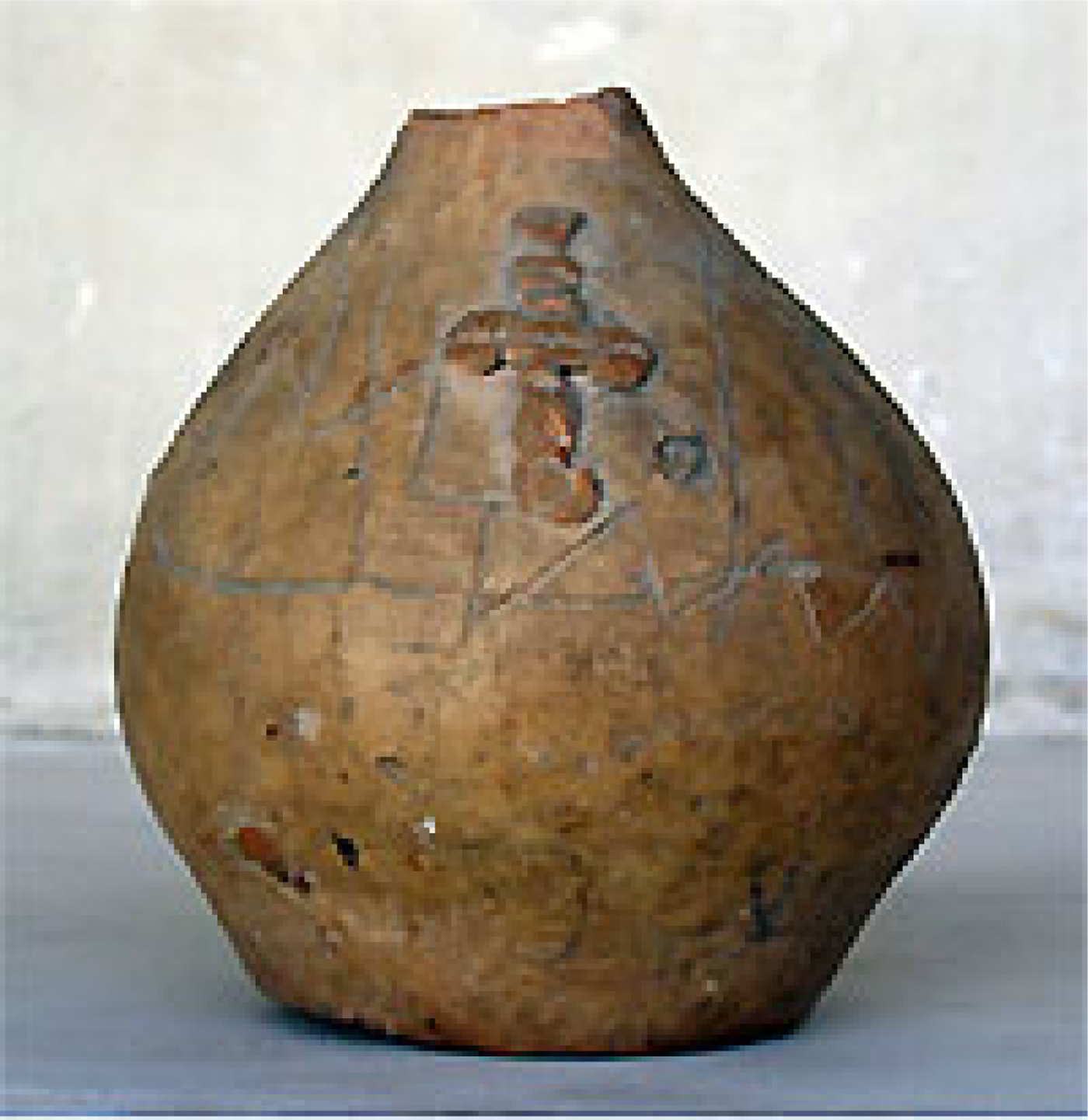
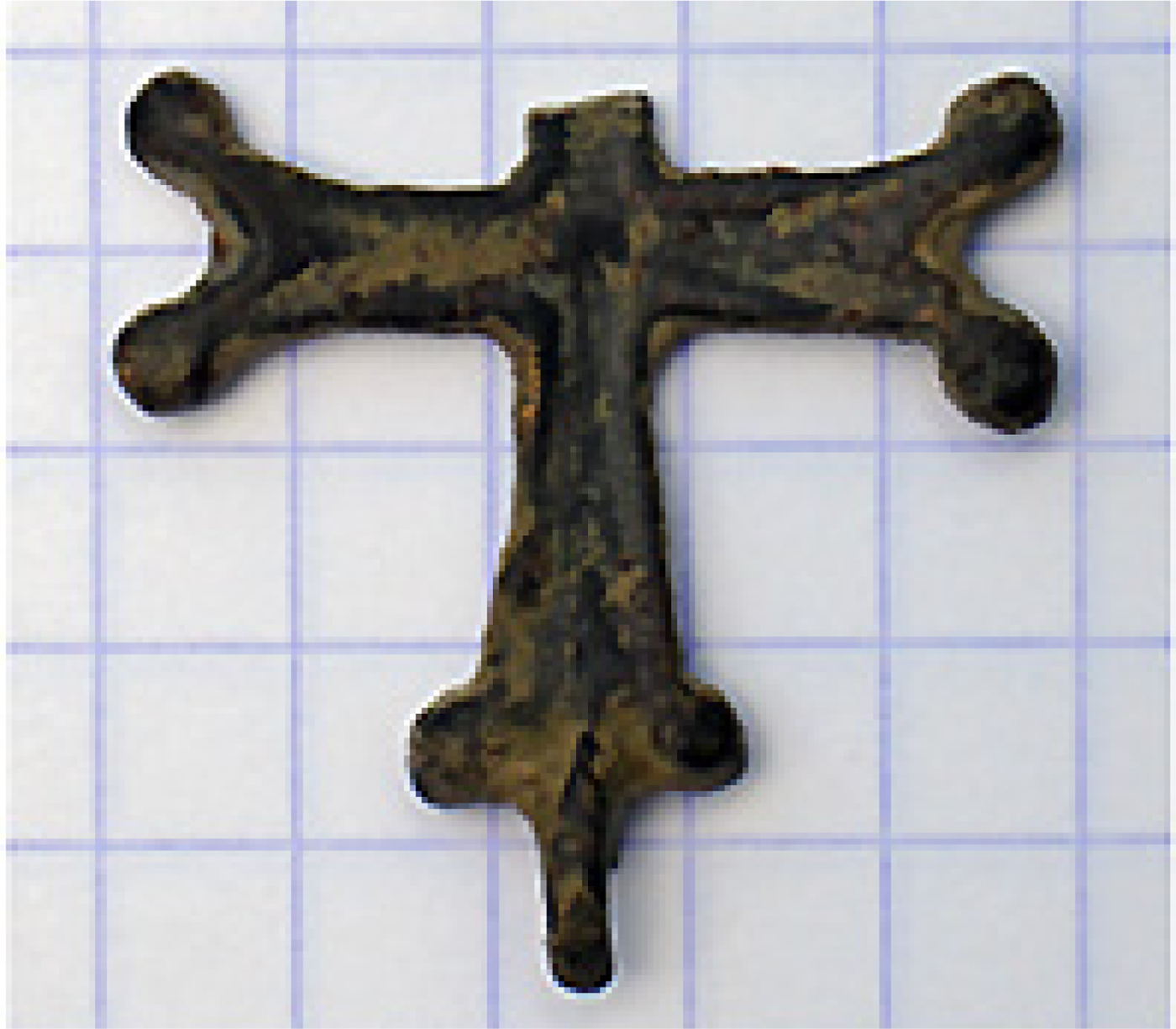
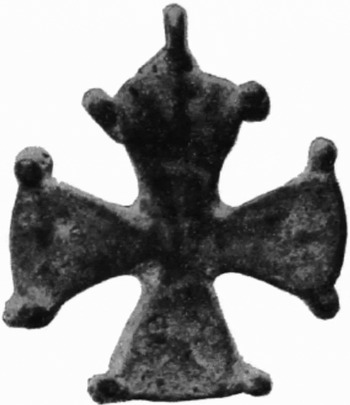
During the excavation of the Urgut church, objects were also acquired from local residents, such as a ceramic jar featuring an appliqué cross and incised ornamental writing imitating Syriac which was acquired from local residents Kutbiya Rafiyeva and Aziza Haydarova.Footnote 142 The jar was reportedly discovered some 60 years ago in a village named Gus-soy.Footnote 143 Lacking any archaeological context, it is difficult to determine the application of this object; that is, whether it was among the liturgical items of the church or had another use.Footnote 144 In addition, a pendant bronze cross was also acquired and given to the Samarqand Museum. The cross appears to be equilateral with flared arms; the upper part of the cross, where there was a loop for hanging, is broken.Footnote 145 From an iconographic perspective the pendant crosses acquired from Urgut, including the crosses mentioned below, resemble the conventional typology of crosses known in Central Asia.Footnote 146
(Colour online) Objects found in the 2004 excavation season: a circa 13th century oil lantern and a metallic pendant cross. Reproduced after Savchenko 2004 ‘Excavations 2004: Brief Report' online resource.

(Colour online) Objects found in the 2005 excavation season: a fragment of plate with a seal impression of the cross and a fragment of a ceramic plate kept in a niche. Reproduced after Savchenko 2005 ‘Excavations in Urgut: August-October 2005. Progress Report' on-line resource.

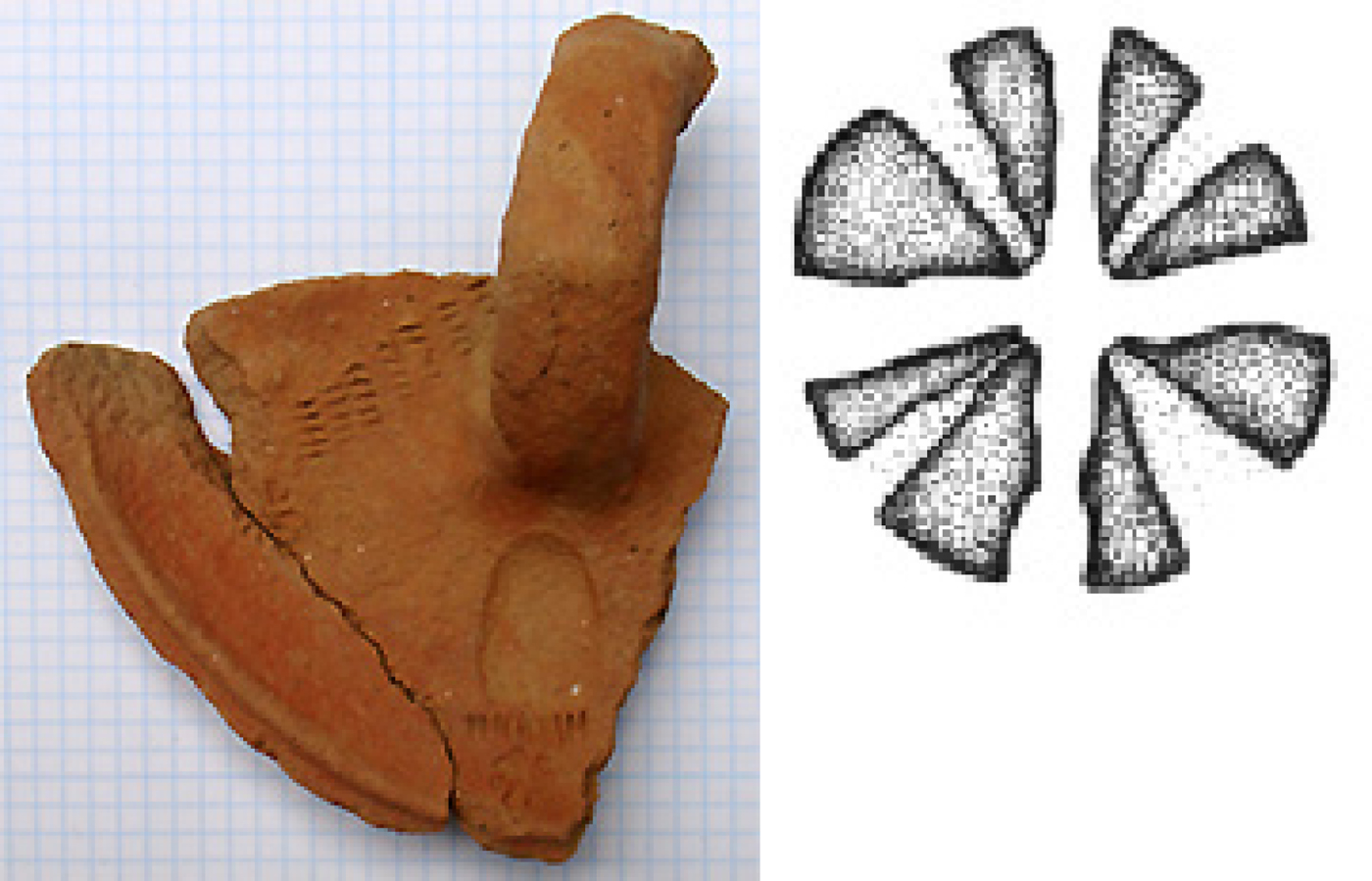
(Colour online) Object found in the 2006 excavation season: a fragment of a lid of a ceramic vessel, with an offprint of a cross-shaped stamp, thumb-print, and a decorative pattern of several rows of notches. On the right, the enlarged pattern on the ceramic fragment. Reproduced after Savchenko 2006 ‘Excavations in Urgut: June-July 2006. Progress Report’ on-line resource.

(Colour online) Ceramic jar from Urgut. Reproduced after Savchenko and Dickens, 2009, p. 295.

(Colour online) Pendant cross acquired from a private collector by the East Sogdian Archaeological Expedition, now housed in the Samarqand Museum. Image © Savchenko.

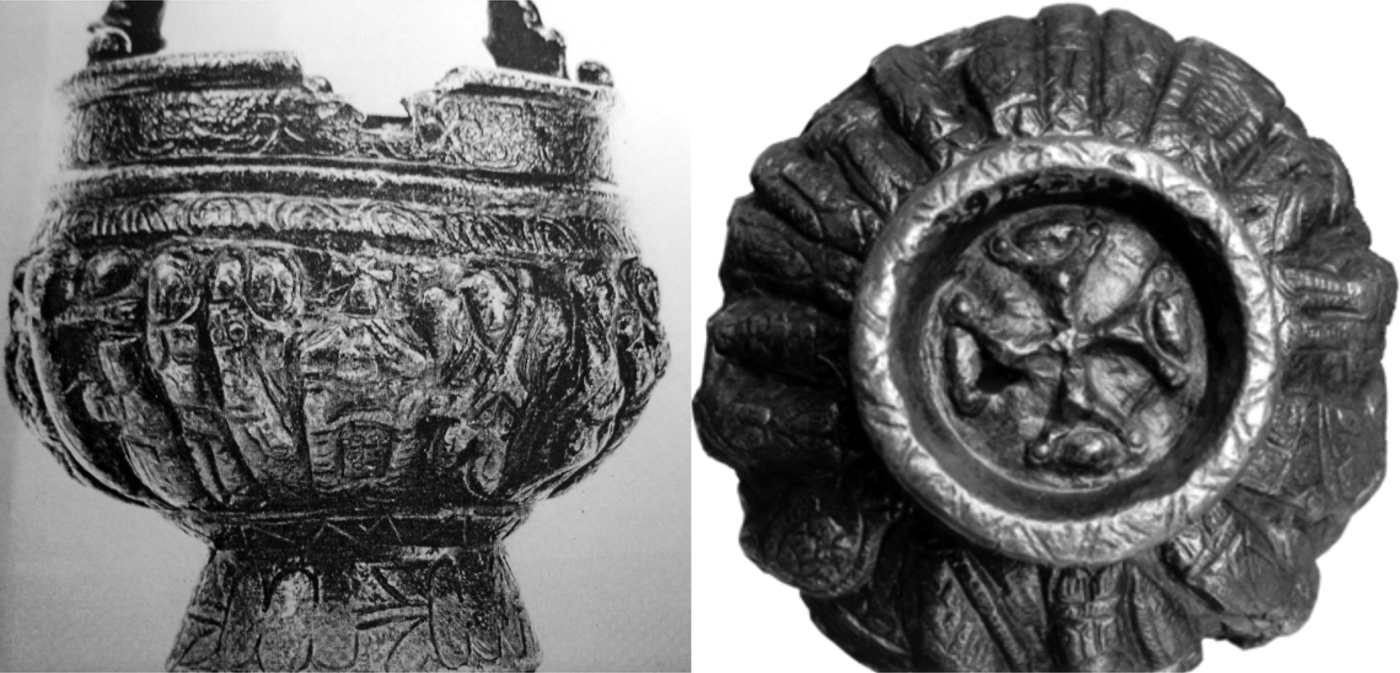
Syrian bronze censer from Urgut. Images reproduced after Zalesskaya, 1972, and Savchenko, 2005.

Objects acquired in Sogdiana
Bronze censer
According to the acquisition records of the State Hermitage Museum, St Petersburg,Footnote 147 the Syrian bronze censer was bought on 2nd August 1916 from Davud Mirzo Mahdi Yusupov, a merchant from Samarqand, who claimed that the object was found in the same year in the Urgut area. Currently housed at the State Hermitage Museum (CA 12758), it first appeared in work by V. Zalesskaya in 1972 and was reassessed by G. Dresvyanskya in 1995.Footnote 148 The censer has also been mentioned in other works related to the history of Christianity in Central Asia.Footnote 149
The hemispherical-shaped censer is made of bronze using a casting technique. Its body is decorated with six crudely executed New Testament episodes: the Annunciation, the Visitation, the Nativity, the Baptism, the Crucifixion, and the Women at the Tomb. The proportions of the human figures differ and are delineated by metal lines cut deeply into the surface, which appears to be made up of individual spherical surfaces. Their facial features, due to the poor execution, are barely identifiable.
These six episodes are framed by decorative stripes; at the top of the censer are two bands, one of which includes a three-leaf rosette. At the bottom there is also a band consisting of triangles within triangles; the insides of the triangles on the upper line are filled with dotted lines, and those on the lower line with large circles. The border underneath is filled with concentric arches closely adjacent to each other. The censer has conical legs decorated with engraved ornaments made of stylised plant shoots. The base of the censer has an equilateral cross in high relief, which appears to be decorated by large “beads” in each arm. The upper rim of the censer was pierced by three holes through which chains were pulled, and there are three tabs between them.
Referring to several studies on censers of similar design held at the State Hermitage Museum and elsewhere in Europe, Zalesskaya points out that nearly all of them are considered to be of Syrian-Palestinian origin, datable to between the 6th and 7th centuries.Footnote 150 On the basis of the close iconographic resemblance of that censer with these, Zalesskaya identifies the censer under discussion as having the same provenance.Footnote 151
The censer from Urgut, however, also displays distinctive decorative features, such as the division of the episodes by punctures, and triangles within triangles filled with dotted lines, which are unique to a later chronology (7th-9th centuries ce). On the basis of comparison with iconographic features in known typology, Zalesskaya suggested that the Urgut censer belongs typologically to the group of censers that were produced in the 8th-9th centuries and therefore she considers it to be an object imported from Mesopotamia.Footnote 152
Almost three decades after the initial discussion of the Urgut censer, and based on very general observations, particularly regarding the manufacturing technique and its artistic quality, Dresvyanskya suggests that the censer was not imported, but manufactured in situ by local artisans.Footnote 153 She considers that the dense ornamentation of the censer was intended to compensate for the poor quality of the cast.Footnote 154 Further, Dresvyanskya argues that Zalesskaya's proposed date could be amended to one century earlier. Although the 10th-11th centuries (close to the date suggested by Zalesskaya) saw the ultimate canonisation of the gospel episodes depicted in the censer, censers with such imagery were produced in large quantities from the 6th-7th centuries onwards. However, Dresvyanskya concludes that despite the possible artistic connections of the censer from Urgut with earlier known prototypes, it was manufactured around the end of 12th or first half of the 13th centuries.Footnote 155
Dresvyanskaya's suggestion that the object was manufactured locally, in contrast with Zalesskaya's claim that it was a Mesopotamian import, seems very plausible, especially if one takes into account that Sogdian masters of the early medieval period were renowned for their craftsmanship of silver and bronze articles.Footnote 156 However, Dresvyanskaya's suggested dating is not satisfactory, especially when compared with Zalesskaya's thorough assessment. He provided a comparative assessment of many more analogous censers, and a typology evolved within the chronology of the 8th and 9th centuries. Furthermore, if one were to accept the later dating (that is, of the 12th-13th centuries) one would expect that more similar objects would have been found in the region, especially since the religious atmosphere in Sogdiana during the 13th century, under Mongol rule, was relatively relaxed.
St Mina's ampulla
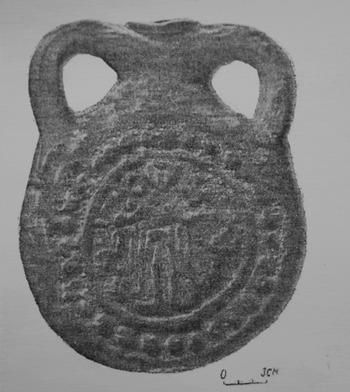
Like the above-mentioned censer, the archaeological context of St Mina's ampulla is unknown. It is currently housed at the State Hermitage Museum, St Petersburg (CA 1514). The only background information in the acquisition records show that it was acquired in 1931. According to Boris Staviskiy, who included it in a 1960 publication, it was found at Afrāsiāb in Samarqand prior to 1920.Footnote 157
The ceramic ampulla has an oval body, a short cylindrical neck, and two handles. It is 8.6 cm high and 1.8 cm thick. The diameter of the neck is 7 cm and the stamped depiction measures 4 cm in diameter. Its name derives from its main iconographic element: a stamped depiction of Abū Mīnā in a “canonical pose: standing with outstretched arms”.Footnote 158
Abū Mīnā, or St Mina, is one of a number of martyr-wonderworker saints widely celebrated in both Eastern and Western Christianity.Footnote 159 Abū Mīnā’s fame among Christian communities in different regions is attested to by the discovery of numerous small clay bottles (ampullae) on which his name and picture are engraved. Abū Mīnā ampullae were probably produced at his monastery, located 45 km southwest of Alexandria in Egypt, the remains of which were excavated in 1905–1907.Footnote 160 The ampullae were intended to hold the oil of lamps suspended above the saint's tomb, or holy water of the sanctuary of Abū Mīnā, and were kept by pious pilgrims.Footnote 161
St Mina's ampulla. Reproduced after Satviskiy, 1960.

Judging by the quantity of surviving samples discovered at various places both in the saint's homeland, Egypt, and in other places in the Middle East (e.g. Palestine, Syria, as well as in Turkey, Italy, France, and Britain), the St Mina's ampullae are probably the most prevalent surviving form of pilgrimage artefacts of the late antique and early medieval period (4th-9th centuries ce).Footnote 162
No exact date for the ampulla has been suggested, although such items were produced in large quantities at the monastery of Abū Mīnā between the 4th and 7th centuries.Footnote 163 Accordingly, this object might have come to Sogdiana at any time within this period or later.
The so-called pilgrim flask (as a type of ceramic vessel) is not completely foreign to the ceramic culture of Central Asia, including Persia and China. Similar objects, in different designs, forms, and with different functionality, are well known and discussed in art and archaeology scholarship on the region.Footnote 164 However, there are no other known finds of St Mina's ampullae in Sogdiana or Central Asia. Thus it is difficult to establish a definite context for this ampula. Given that it has no major monetary value, being simple earthenware of no significant practical use, it is difficult to identify it as a commercial commodity that was bought by merchants.
A special link between the ampulla and Sogdian Christianity is suggested by ascetic Sogdian Christian texts related to the Egyptian church fathers. In this connection, it is possible to suggest that the ampulla was perhaps a holy souvenir that someone brought from Egypt.
Christian crosses from SogdianaFootnote 165
In addition to the metallic pendant cross found at the site of the Urgut church, and the bronze cross acquired from local residents, four more Christian crosses have been found in Sogdiana.
Pendant cross from Afrasiab
A bronze pectoral cross was found in 1946, as a surface find at the site of Afrāsiāb in Samarqand. It is believed to be from the 6th-7th centuries, which Alexei Trenozhkin designated the Tali Barzu V period.Footnote 166 In regard to its physical features, the Afrāsiāb cross is similar to the bronze pendant cross acquired in Urgut.
Pendant cross from a burial site at Dashti-Urdakon, Panjikent
A bronze pectoral cross was discovered during the excavation of a burial site at Dashti-Urdakon, which contained burials of different types, including inhumation and burials in ossuaries.Footnote 167 The burials are identified as Christian. The cross was discovered in the tomb of a young child. The burial site is securely dated to the 8th century, based on an accompanying small object.
A drawing of the Afrāsiāb bronze cross. Reproduced after Trenozhkin.

The cross from the burial at Durmanteppa
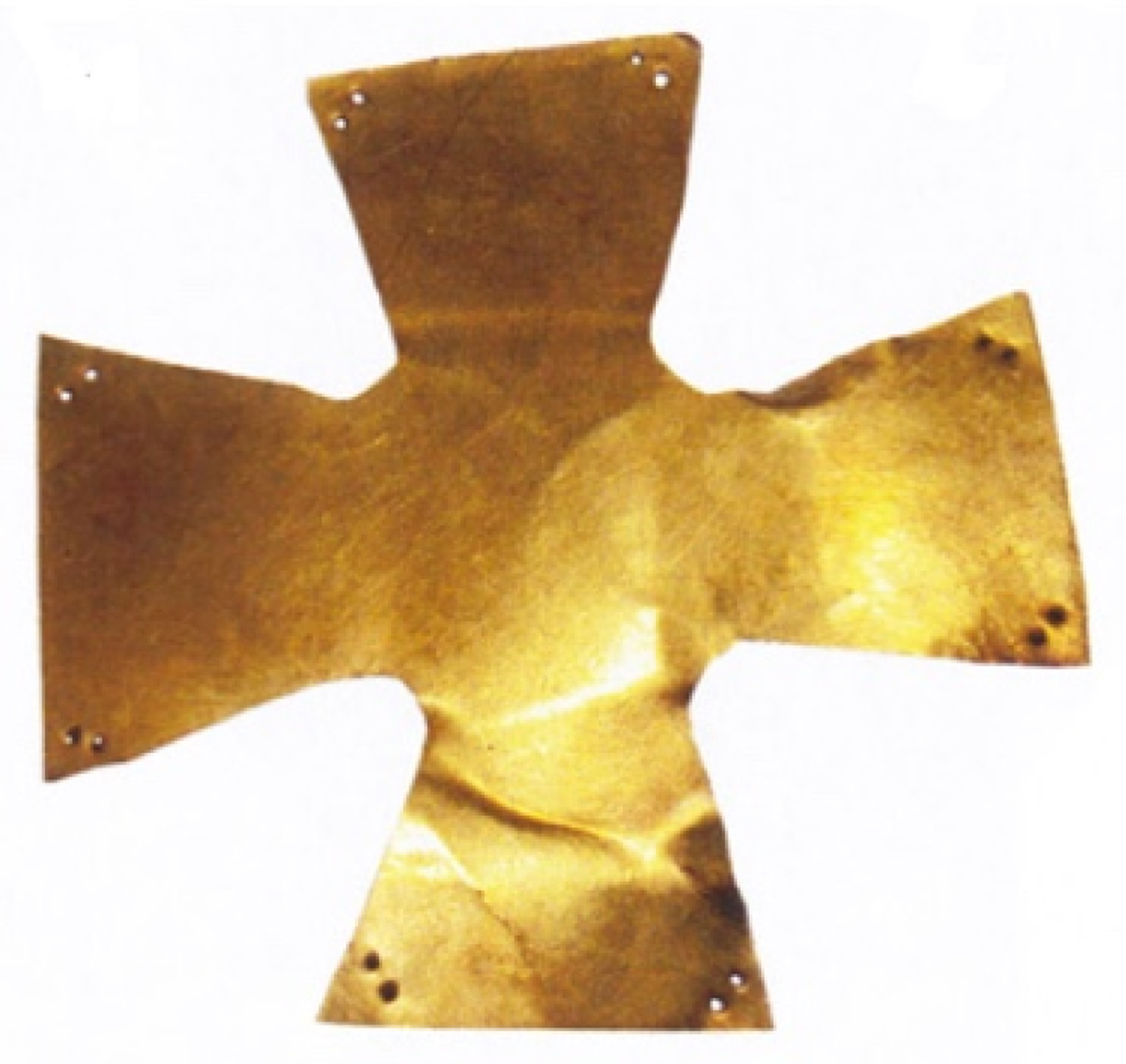
The Durman burial was excavated in 1986 in the Durmanteppa area in Samarqand, to which it owes its archaeological name.Footnote 168 Of the three graves opened by the archaeologists, only one had escaped the hands of ancient tomb robbers. The material culture objects of this grave included a thin gold foil cross that was sewn on the garment of the deceased, who was buried in a wooden coffin of which only the nails survive. Judging by the position of the skeletons, the burials were oriented in a westerly direction.Footnote 169 The burial is reported to be from the middle of the 11th century.Footnote 170 Other accompanying artefacts from this burial include a sword and sheath.Footnote 171 It is unlikely that the deceased held an ecclesiastical office, but it is probable that he was Christian who held a political, official post—an emissary perhaps. The cross on his clothing was most likely sewn in as a protective amulet. The involvement of Christians, in particular, members of the Church of the East, in the courtly and political spheres is well documented.
A clay form for moulding crosses
A clay mould used to manufacture crosses was accidentally discovered at the site of Arbinjan-teppa, located about 80 km to the west of Samarqand, on the road leading to Bukhara. This artefact is housed at the Institute of Archaeology in Samarqand.Footnote 172 A ceramic mould for making crosses was also discovered at the archaeological excavations at Marv.Footnote 173 The type of metal used for this mould cannot be determined, but the cross would have looked similar to the crosses acquired in Urgut and found in Afrāsiāb. In other words, ichnographically, the mould can be related to the crosses known in the art and archaeology of the Church of the East (i.e. in Mesopotamia, Iran, Central Asia, and China).
(Colour online) Golden cross from the Durmanteppa burial. Reproduced after Savchenko and Dickens, 2009. p. 297.

Sogdian material culture and Sogdian Christianity
Thomas Schlereth commented that “material culture objects made or modified by humans, consciously or unconsciously, directly or indirectly, reflect the belief patterns of individuals who made, commissioned, purchased, or used them, and by extension, the belief patterns of the larger society of which they are a part”.Footnote 174 Applying this premise to the material culture objects described above, it is possible to say that they reflect both the social actions of Sogdian Christians as well as various patterns for the integration of Christianity into the Sogdian milieu.
Integration into landscape
The material culture objects discussed above belonged to a specific group (i.e. to Christians). However, they also functioned within a wider cultural space—that is, they were produced in the workshop and purchased in the market, while the church building stood alongside other private houses or on the main road. Although the introduction of this material culture into Sogdian society does not imply a radical shift in the material perception of Christianity, it does show that it was integrated into the public space through architecture, and that the objects related to it were manufactured and sold. Furthermore, it shows that Christianity was part of local religiosity. Christians in Sogdiana were able to own land on which to erect their churches, and to import or manufacture their devotional objects.
(Colour online) Mould for making crosses. Reproduced after Savchenko, 2010.

Conformity with the international Church of the East
One of the main characteristics of the material culture discussed above is its typological and iconographic commonality with the Christian material culture of the Church of the East tradition in Persia, Mesopotamia, and Central Asia. Aside from being indicative of the “direction” where the artistic inspiration and knowledge came from [11] in the development of this material culture, it also bears witness to an intrinsic relationship between the Christian communities living in Sogdiana and a much wider network of Christian communities.
Conclusion
Prior to its establishment in Sogdiana and elsewhere in the East, Christianity took root in the Mesopotamian borderlands of the Persian Empire, possibly under the Parthian Dynasty (247 bc-224 ce). However, its centralisation and organisational formation as a major religion took place under the Sassanid Dynasty (224–651 ce).Footnote 175 The dissemination of Christianity in Persia is connected to, among other things (including trade and bilateral connections), deportations, or forced migrations, carried out under Šāpūr I and Šāpūr II.Footnote 176 This means that the church in Persia comprised indigenous Iranian and Syriac as well as Greek-speaking communities that were resettled in various regions of Iran.Footnote 177 However, as the officially recognised church of the Sasanian Empire, the Church of the East had to demonstrate conformity with its geopolitical and cultural setting. This was displayed through its socio-political engagement with the Persian monarchy, as well as by its integration into the local social fabric. This is manifested in the material culture via the adoption of local architectural models for building churches as well as the integration of Christian symbols in objects intended for both public and private use, such as seals and coins. Another fundamental display of the integration of Christianity into Persian contexts was the translation of Christian texts, in particular the Bible, into the local language, to which the Pahlavi Psalter bears testimony.Footnote 178 The significance of these material expressions is that they show the church to be a locally integrated social institution under the Zoroastrian monarchy.
Likewise, when the Church of the East was planted in Sogdiana, it had to show its conformity with the local socio-cultural and political setting in a tangible way. The material culture—comprising both architectural and small objects—discussed in this article vividly illustrates the integration of Christianity into Sogdian society through a material expression that was both locally produced and imported. As exemplified by Ibn Hawqal's record, these material culture products, especially the architecture, which also became part of popular local memory (i.e. local residents would have referred to the area by its major landmark, such as the church building), have provided a landmark for geographers and historians.
These material culture objects served as a means of visual identity for Christians in the multi-religious milieu of Sogdiana. In other words, Christians were differentiated by their material culture objects: by wearing pendant crosses, Christians displayed their religious belief.
 stems from the root
 meaning “living in the sense of dwelling, inhabiting” and could signify either an abstract or objective meaning (e.g. a space occupied by a monastery, inhabited by monks, or a monastic life, a lifestyle followed by monks):