Re-partnering in old age: the contextual background
The human need for love, friendship, and physical contact, and the fear of loneliness do not diminish with age (De Jong Gierveld, Reference De Jong Gierveld2002; Reference De Jong Gierveld2004). As such, widowhood and late-life divorce along with increase in life expectancy are likely to lead to re-partnering in old age (Brown et al., Reference Brown, Roebuck and Lee2012). Definitions of re-partnering in old age range from broad to narrow. Broad definitions include persons aged 50 years and above (Brown et al., Reference Brown, Roebuck and Lee2012) or 55 years and above (De Jong Grieveld, Reference De Jong Gierveld2004). Narrow definitions (Koren, Reference Koren2011) have restricted the phenomenon to when a person is considered old from a social perspective, such as the mandatory retirement age. Re-partnering includes the following three main forms (e.g., De Jong Grieveld, Reference De Jong Gierveld2004): remarriage (e.g., Cooney and Dunne, Reference Cooney and Dunne2001), cohabitation (e.g., Brown et al., Reference Brown, Roebuck and Lee2012), and living apart together (LAT; e.g., Levine, Reference Levine2004; Duncan and Phillips, Reference Duncan and Phillips2010). In the United States, adults aged over 65 years represented about 6% of all remarriages in 2010 (Cruz, Reference Cruz2012). In addition, Brown et al. (Reference Brown, Roebuck and Lee2012) found that approximately 4% of the unmarried population aged 50 years and above was cohabiting. The Netherlands’ Living Arrangements and Social Networks survey of men and women aged 55 to 89 years (N = 4,494) found that a total of 21% re-partnered. Men re-partnered more frequently (41%) than women (10%). Most men were remarried, whereas most women were living apart together (De Jong Grieveld, Reference De Jong Gierveld2004).
Re-partnering in old age is a developing phenomenon, usually more common within modern Western societies (e.g., De Jong Grieveld, Reference De Jong Gierveld2004) than in more traditional cultures (e.g., Mehta, Reference Mehta2002). It is also developing, within societies located between traditionalism and modernity, as a phenomenon in the process of becoming recognized as an acceptable choice in old age (Koren and Eisikovits, Reference Koren and Eisikovits2011). Cultural differences can also be found relating to the three forms of couplehood. Research literature in the United States distinguishes between remarriage and cohabitation in later life (Cooney and Dunne, Reference Cooney and Dunne2001; Brown et al., Reference Brown, Roebuck and Lee2012). However, it does not refer to the option of living apart together. Scandinavian (Levine, Reference Levine2004), British (Davidson, Reference Davidson2002; Haskey and Lewis, Reference Haskey and Lewis2006), Dutch (De Jong Grieveld, Reference De Jong Gierveld2004), and Israeli (Koren, Reference Koren2011; Koren and Eisikovits, Reference Koren and Eisikovits2011) research literature does refer to living apart together relationships later in life, in addition to remarriage and cohabitation. These diversities reflect tolerance toward various forms of re-partnering relationships that exist in different countries and cultures.
Remarriage and cohabitation have different legal and financial implications. From a day-to-day perspective, however, they are much more similar to each other than to living apart together. They involve living in the same household with coinciding daily routines (Levin, Reference Levine2004). Some re-partnering couples chose living apart together out of financial and emotional caution. Others considered their independence and were concerned that cohabitation or marriage might alter a satisfying relationship, and hence wished to maintain the status quo (Haskey and Lewis, Reference Haskey and Lewis2006).
Re-partnering in old age refers to older people entering such a relationship after launching adult children who have families of their own, and after retirement. As such, it does not involve commitment to raising a family together, and it occurs in the stage of life when one's social status changes due to retirement, resulting in having more time to spend with each other. Thus, it differs from lifelong marital relationships in several ways. The motives for entering and remaining in a re-partnering relationship are characterized by discontinuity. Whereas the primary purpose of a lifelong marital relationship is to raise, provide, and care for a family, the main reasons for re-partnering in old age are loneliness and the wish to enjoy life. Caregiving in these relationships is usually motivated by willingness and love rather than by commitment and a sense of duty, as is frequently the case in lifelong marital relationships (Koren, Reference Koren2011).
Previous studies on re-partnering in old age have focused on gender differences. Among the themes revealed were women looking for someone to go out with and men seeking a partner for emotional intimacy – because women find intimacy also in their relationships with friends and children (Davidson, Reference Davidson2002). Another theme was men's preference to live under the same roof to receive traditionally gender-based services, whereas women prefer separate living arrangements to avoid the provision of these services and the nursing of a chronically ill partner (Davidson, Reference Davidson2002). These themes emerged from interviews with men and women who were in re-partnering relationships, but not with each other. This paper is based on a study in which interviews were conducted with men and women in the same re-partnering relationship, therefore presenting a dyadic view of the phenomenon (Eisikovits and Koren, Reference Eisikovits and Koren2010).
An important consideration in re-partnering is likely to be the nature and quality of the lifelong marital relationship (Davidson and Fennell, Reference Davidson and Fennell2002; Carr, Reference Carr2004). Among the widowed, a very bad lifelong marital relationship might remove all motivations to try again (Davidson and Fennell, Reference Davidson and Fennell2002). Those who experienced a very good lifelong marital relationship might regard the deceased partner as irreplaceable (Davidson and Fennell, Reference Davidson and Fennell2002) and might refrain from re-partnering to sanctify the memory of the spouse (Carr, Reference Carr2004; Bennett et al., Reference Bennett, Arnott and Soulsby2013). Individuals who divorced from a bad marriage, however, might hope for a better re-partnering relationship (Davidson and Fennell, Reference Davidson and Fennell2002).
Marital quality determined by closeness–distance, which are emotional and physical components of couplehood, usually refer to lifelong marital relationships when relating to old age (e.g., Goodman, Reference Goodman1999). There is a paucity of studies on how these couplehood components relate to the nature and experience of various forms of re-partnering relationships in old age (e.g., Brown and Kawamura, Reference Brown and Kawamura2010). These concepts require further exploration, and are discussed in the following review.
Closeness–distance in marital relationships: the conceptual framework
Couplehood in romantic and marital relationships involves a shift from being two separate individuals to becoming a couple (Seider et al., Reference Seider, Hirschberger, Nelson and Levenson2009). This shift includes emotional and physical components on various continua: of closeness−distance, togetherness−separateness, “I-ness”−“we-ness,” and intimacy−autonomy.
Autonomy, according to the self-determination theory, is the need to experience that one's behavior is driven out of self-will (Gaine and La Guardia, Reference Gaine and La Guardia2009), and is therefore related to I-ness: one's inner world, which is unique, and distinguished from that of the other, emphasizing separateness from the other. Intimacy, on the other hand, is the need to be close, and the motive of intimacy is the desire to share one's innermost self, including thoughts and feelings, with another who shares parts of the self in return, leading to mutual caring (McAdams, Reference McAdams1989) and to a sense of togetherness and we-ness. This process occurs over time and involves various experiences within an intimate relationship. These include emotional intimacy referring to feelings of closeness, social intimacy referring to common friends and similar social networks, intellectual intimacy and the sharing of ideas, sexual intimacy through sharing affection and sexual activity, and recreational intimacy, including mutual interest in hobbies (Schaefer and Olson, Reference Schaefer and Olson1981, p. 50). All people desire intimacy in one form or another but differ in their degree of motivation and desire. Furthermore, intimacy motivation is not a fixed trait and can change depending on one's life course (McAdams, Reference McAdams1989). Autonomy and intimacy are considered as basic components of normal human development (e.g., Erikson, Reference Erikson1998), and balancing between the two is part of couplehood (Goodman, Reference Goodman1999).
We-ness and togetherness in close relationships is the inclusion of the other in the self (Aron et al., Reference Aron, Mashek, Aron, Mashek and Aron2004). The idea of we-ness and togetherness as overlapping selves, as presented by Aron et al. (Reference Aron, Mashek, Aron, Mashek and Aron2004), is based on various existential branches of thought such as the idea that a “we” relationship means “living in each other's subjective contexts of meaning” (Shutz, Reference Shutz1970, p. 167). As such, we-ness versus separateness is an important construct in forming close couplehood relationships because it involves a partial transformation of identity, a shift in what makes two entities one (Seider et al., Reference Seider, Hirschberger, Nelson and Levenson2009). In addition, closeness and distance involve matters of emotion, physical closeness, extent of mutual self-disclosure, and amount of time spent together and apart (Rosenblatt and Barner, Reference Rosenblatt and Barner2006, p. 278). It also includes satisfaction in sexual relationship (Timm and Keiley, Reference Timm and Keile2011), and could be influenced by the relationship with offspring throughout the life course (Orbuch et al., Reference Orbuch, Thornton and Cancio2000).
Closeness/distance and their related concepts, along with sexual relationship and offspring influences, have yet to be explored and examined within re-partnering in old age. The phenomenon was previously classified based on the following three external–physical variables of living arrangements and relationship formality: officially married according to law of state and/or religion (Cooney and Dunne, Reference Cooney and Dunne2001); cohabitation under the same roof (Brown et al., Reference Brown, Roebuck and Lee2012), and living apart together (Levine, Reference Levine2004). The relational components of emotional closeness/distance have not yet been studied in these classifications. Thus, the aim of this paper is to explore and examine how the emotional and physical components of re-partnering in old age interplay, and how they are experienced. This will result in the presentation of a typology of re-partnering in old age based on this interplay from a dyadic perspective.
Methods
This paper is based on the data from a larger qualitative study entitled “The meaning of second coupleood in old age from a dyadic view” (Eisikovits and Koren, Reference Eisikovits and Koren2010). The data are drawn from one of the themes identified in the larger study relating to forms of re-partnering in old age. The qualitative approach enabled uncovering and understanding the experience of the participants (Strauss and Corbin, Reference Strauss and Corbin1990) as both individuals and part of a couple attaining a dyadic perspective on the phenomenon. The study was approved by the Ethics Committee of the University of Haifa Research Authority on Experiments with Humans.
Participants and recruitment
Theoretical sampling (Patton, Reference Patton2002) was used to achieve the most varied sample theoretically possible according to the following criteria: age when entering the relationship, which was 65 years and above for men and 60 years and above for women (when the participants retired, these were the designated retirement ages according to the Social Security Act, which granted a new status to being old); late-life family stage, re-partnering due to widowhood or divorce after raising families with children and grandchildren, after launching adult children who had raised families of their own, and after retirement; formality of the relationship and living arrangements, including remarriage, or cohabitation under the same roof or in separate homes; independence in daily functioning; and sufficiently fluent in Hebrew to provide in-depth descriptions. Both members of the couple had to agree to participate because of the dyadic aim of the study. Participants were identified using connections with informal networks and the assistance of professionals working with older persons, who had access to the relevant population throughout the country, such as neighborhood clubs for older persons. The study unit was the couple and therefore both members had to agree to participate. After one member of the dyad was approached and agreed to participate, the partner had to agree. Approximately one out of every three couples approached agreed to participate.
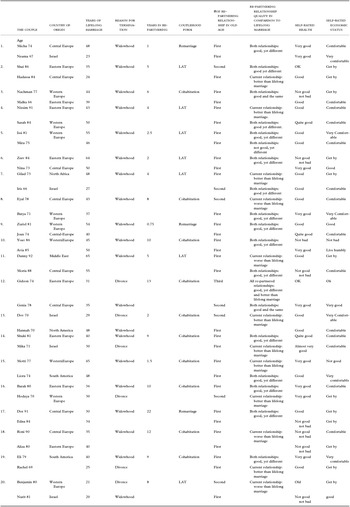
The sample included 20 couples (see Table 1). The men were aged 70–92 years, and the women were aged 66–88 years. Marital status of the participants when re-partnering included 34 who were widowed, whose lifelong marriages had lasted between 27 and 65 years, and six who were divorced, whose lifelong marriages had lasted between 20 and 31 years. Three couples had remarried, ten were cohabitating under the same roof, and seven were living in separate homes. Participants perceived themselves to be in good to very good health and reported their socioeconomic status as middle to upper-middle class. All were Jewish; most declared themselves as secular, about a quarter traditional, and the rest religious. Data analysis revealed that six participants perceived their re-partnering relationship to be worse than their lifelong marriage, nine participants perceived their re-partnering relationship to be better than their lifelong marriage, three perceived the two relationships as good and the same, while 21 stated that each relationship had a different purpose regarding the life stage at which it occurred and therefore could not be compared in terms of better or worse. Out of these 21 participants, 20 perceived both relations as good yet different, and one as not good yet different.
Demographic information

Notes: Both relationships are good and the same: three participants.
Both relationships are good, yet different: 21 participants.
Both relationships are not good, yet different: one participant.
Current relationship better than lifelong marriage: nine participants.
Current relationship worse than lifelong marriage: six participants.
Sum: 40 participants.
Data collection procedures
The author developed an interview guide, drawing on key issues relating to re-partnering in old age identified in the literature. This served as a basis for 40 semi-structured interviews to collect qualitative data from 20 couples. All interviews were conducted by the author from 2005 to 2006. The “grand-tour” opening question (Spradley, Reference Spradley1979) was: “Tell me your story of re-partnering in old age.” The relevant content domain to this paper is the dyadic unit of re-partnering, and includes questions such as: "What needs does the relationship fulfill and include (e.g., friendship, emotional and sexual intimacy, caregiving, support)? What do you have in common and in what ways do you differ? What, if anything, makes you compatible with one another?
Each of the participants signed a letter of consent after reading a brief explanation about the topic of the study and the means to ensure confidentiality. The interviews lasted for 1.5 to 2.5 hours and were conducted by the author separately to enable each member of the couple to narrate freely and discuss their own unique experiences. This enabled each member of the couple to raise material that might not have emerged in joint interviews, especially when discussing sensitive topics or criticizing the partner (Eisikovits and Koren, Reference Eisikovits and Koren2010). The couples who agreed to participate knew, prior to their agreement, that the interviews would be conducted separately and none of them expressed reservations about this.
Data analysis process
The couple was the unit of analysis; however, interviews were conducted separately and analyzed individually and dyadically for overlaps and contrasts (for details, see Eisikovits and Koren, Reference Eisikovits and Koren2010). All the data of the larger study were organized and coded using ATLAS.ti 5.0 (2005). First, the entire interview was read to capture the main issue and compare its uniqueness with other interviews. Then open coding was conducted, naming the sentence or paragraph according to the main idea. If necessary, each section could be given several names (Strauss and Corbin, Reference Strauss and Corbin1990). This process enabled the development of content categories for each interview. Subsequently, cross-case analysis was performed by identifying themes that cut across interviews. Units of meaning were identified and grouped into four major themes and subthemes within each, assisting transfer of the unit of analysis from the individual to the couple level. This was achieved by examining how each theme and subtheme that emerged from cross-case analysis on the individual level was addressed by both members of a dyad (Eisikovits and Koren, Reference Eisikovits and Koren2010).
The theme relating to forms of couplehood, on which this paper is based, was constructed by dimensionalization (Strauss and Corbin, Reference Strauss and Corbin1990) and by abductive inference (Charmaz, Reference Charmaz2006). Dimensionalization was achieved through open coding (Strauss and Corbin, Reference Strauss and Corbin1990) performed on the collected data and based on the theoretical knowledge (Charmaz, Reference Charmaz2006) of couplehood. This led to elaboration on two dimensions: physical closeness/distance and emotional closeness/distance. The physical dimension referred to whether or not the partners lived in the same home. The emotional dimension included several parameters derived through abductive inference. This included inductively identifying parameters relating to theoretical knowledge of the couplehood components, and then further examining them deductively on the remaining data (Charmaz, Reference Charmaz2006). The parameters are presented in the Findings.
Dyadic analysis examining overlaps and contrasts of the text and subtext, and content and interpretations between the members of each couple (see Eisikovits and Koren, Reference Eisikovits and Koren2010) was performed. This revealed that 15 couples (30 participants) tended toward emotional closeness and five couples (ten participants) tended toward emotional distance. These findings were then examined regarding living arrangements, revealing that the three couples who were married had changed their official status for religious reasons. Otherwise, they would have preferred to cohabit without being married, as illustrated by one of the women participants:
You know, I’ll tell you the truth, if I weren't religious, I wouldn't have married, I would live with someone without marrying him, but this is impossible; especially because of my children. They are all very religious and I couldn't do that. (Couple #1, woman, widowed, aged 67 years, one year remarried)
As these married couples resembled the unmarried couples cohabiting under the same roof (Brown et al., Reference Brown, Roebuck and Lee2012), the three married couples and ten cohabiting couples were grouped together and set apart from the couples living in separate homes.
The findings of data analysis showed four types of re-partnering in old age, which are collectively exhaustive, meaning that there must be an appropriate type for each couple, and mutually exclusive, meaning that a couple can belong to only one type at any given time (Bailey, Reference Bailey1994). The result is a fourfold typology of re-partnering in old age, in which each of the four types is essentially different from the others. After interviewing 17 couples (34 individual interviews), theoretical saturation had been reached, meaning that no new themes were emerging from data analysis (Patton, Reference Patton2002). To ensure that this was not accidental, data collection continued from another six individuals (three couples) until theoretical saturation was confirmed.
Trustworthiness
Trustworthiness was achieved in several ways. First, to ensure referential adequacy, tape-recorded interviews and their verbatim transcriptions enabled verification from the original (Lincoln and Guba, Reference Lincoln and Guba1985). Second, the researchers of a larger study simultaneously performed separate analyses. The identified themes were compared and negotiated until agreement was reached, on which variations were found. Third, peer debriefing was achieved by a group of colleagues familiar with qualitative methods, who asked provocative questions relating to the analysis. This was helpful in acquiring additional insights beyond those of the researchers (Lincoln and Guba, Reference Lincoln and Guba1985). Fourth, dyadic analysis provided a means for achieving trustworthiness similar to triangulation because the more the sources available for interpreting data, the more reliable are the findings. In addition to the researcher's interpretation of each individual partner's quotes, a third interpretation was derived by combining two individual perspectives. Although this additional interpretation was enriching, it was also limiting because the two interpretations were interdependent and therefore mutually restrictive (Eisikovits and Koren, Reference Eisikovits and Koren2010).
To present the experience from a dyadic perspective, data are presented in the form of quotes from both partners for each theme addressed. Each partner's quote is first interpreted individually, providing two perspectives: that of the man and the woman. The third perspective – the result of integrating two individual interpretations – is then presented. All quotes were translated from Hebrew, and identifying details have been altered to maintain confidentiality.
Findings
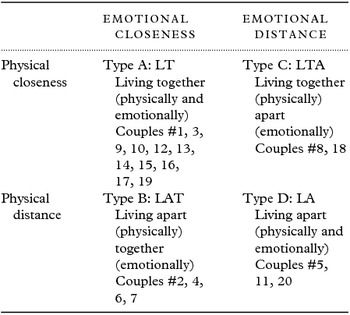
A multidimensional conceptual typology emerged from the interplay between the dimensions of physical and emotional closeness/distance, creating a fourfold typology, which is mutually exclusive on the structural level and is conceptual because each type is labeled (Bailey, Reference Bailey1994), as follows (see also Table 2):
A fourfold typology of re-partnering in old age

Type A: living together (physically and emotionally); Type B: living apart (physically) together (emotionally); Type C: living together (physically) apart (emotionally); Type D: living apart (physically and emotionally).
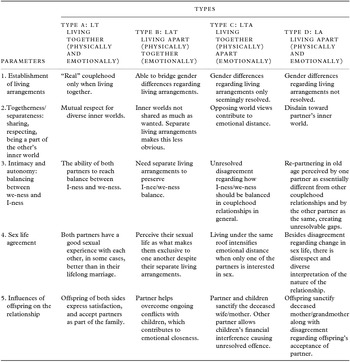
To examine whether the types were mutually exclusive and collectively exhaustive also on the content level, the following five abductive (Charmaz, Reference Charmaz2006) parameters were used: (1) Establishment of living arrangements; (2) togetherness/separateness: sharing, respecting, being a part of the other's inner world; (3) intimacy and autonomy: balancing between we-ness and I-ness; (4) sex life agreement; and (5) influences of offspring on the relationship.
Data analysis revealed a range of variations for each parameter within each of the four couplehood types. In the Findings, however, participants that are typical for each parameter within each couplehood type are presented. To comprehend the differences between each of the four types of couplehood, the comparison between them is presented through each of the parameters. Data analysis also presents comparisons between re-partnering and lifelong marital experiences.
Establishment of living arrangements
One of the unique parameters of re-partnering in old age was if and how members of a couple established their living arrangements. This included how they perceived their living arrangements, and how they dealt with disagreements regarding whether or not to live under the same roof.
Type A: living together (physically and emotionally)
The following quotes illustrate the belief that “real” couplehood can be accomplished only by living together under the same roof:
Hodaya: I don't like the idea of living in separate houses. I like living together. When you live alone, you don't get to know your partner’s, let's say, unpleasant sides. You only get to know his beautiful side and you don't experience intimacy. You can spend one night here, one night there, but it lacks a strong intimate relationship with the good and the bad. Besides, I like living with someone, it's not that I don't like being by myself sometimes, but I like the total togetherness with all the aggravation it creates. . . .But if I want to go to the theater and he doesn’t, then I go. No hard feelings . . . My first husband gave me freedom, but out of indifference . . . He [my current partner] gives me freedom because he understands my needs; there's a big difference. (Couple #16, woman, aged 70 years, divorced, ten years re-partnered)
The bad experience in her lifelong marriage that ended in divorce did not prevent Hodaya from fulfilling her personal preference of not living alone. She gives two reasons for the importance of living together. First, she prefers the hardships of couplehood over the difficulties of loneliness. Second, she believes that a partner relationship can be defined as such only through a genuine opportunity of intimate acquaintance, experiencing the partner's attractive and less attractive traits. Once these are established and the relationship becomes stable, she can enjoy being by herself when going to the theater. Although they live together, they do not restrict each other, and although they do not share all their activities, this is not due to disrespect. The contrast between her two couplehood experiences strengthens her sense of emotional closeness with her current partner.
Her partner's perception is expressed as follows:
Barak: As a widower, I went through a difficult crisis. I wanted to end my life because I had a very good wife and we got along very well. . . . We [my current partner and I] were together [for] a few months and decided to see how we get along living together. In the beginning, there were ups and downs. We danced around each other like in a wrestling match; you don't know when you’ll get hit. Going to bed together could also be scary, but slowly, with wisdom and intuition, we learned how to live together with the good and the bad. (Couple #16, man, aged 80 years, widowed, ten years re-partnered)
Although the man had a good lifelong marital experience, the woman's lifelong marital experience was not good and ended in divorce, so both partners prefer living together under the same roof based on the same belief that it is the best way to establish a partner relationship. This is not out of naivety, but out of awareness that difficulties are part of the deal. Their shared worldview regarding living arrangements and their good couplehood experience contribute to their emotional closeness.
Type B: living apart (physically) together (emotionally)
As opposed to couples who belong to group A, the following quotes illustrate agreement among the partners that not living under the same roof is essential for their desired balance between autonomy and intimacy, to achieve emotional closeness.
Nissim: We never spoke about living arrangements; neither of us wants to leave our own apartment. We both want to keep our apartments to remain independent. We eat dinner together at Sara's house, we prepare whatever there is, and it doesn't really matter. I stay till about 10:30 pm and then go back to my apartment; I have to rest and get some sleep. (Couple #4, man, widowed, aged 91 years, four years re-partnered)
Remaining in separate living arrangements is considered a natural and taken-for-granted state to maintain financial and psychological autonomy, and this needed no discussion. Nissim has a satisfying, fulfilling, and meaningful daily routine with his partner, which defines the boundaries of their relationship. This arrangement enables the simultaneous experience of intimacy and preservation of his autonomy.
The following quote illustrates his partner's complementary perspective:
Sarah: I asked him if he wanted to come over. . . “Yes I do.” We talk and discuss things, watch TV together and sit together till about 10 when I have to take my medication. He says good night and goes home because after you take your medicine, it's time to go to sleep.
Interviewer: Would you like him to stay?
Sarah: No, because he has the things he's used to and I have mine, he wakes in the night a lot and that could disturb me. Even though we don't live together, I feel calm that he's by my side, close by, and that makes me feel secure in every way. (Couple #4, woman, widowed, aged 84 years, four years re-partnered)
The quote begins with the description of a regular evening spent together and continues with old age-related reasons for not living together under the same roof. This living arrangement does not decrease the woman's sense of intimacy, however. She feels very secure in the knowledge that he lives close by and is always ready to be there for her. The following quotes compare their re-partnering relationships with their lifelong marital relationships:
Sarah: I loved my husband a lot and I love Nissim a lot, but differently . . . There is a difference, he's not my husband; he's my lover. For my husband, I did things because he demanded it. With Nissim, it's different. (Couple #4, woman, widowed, aged 84 years, four years re-partnered)
Her partner's perspective follows:
Nissim: My wife suffered from depression and I was obliged to take care of her. Sarah is more likeable, I feel more for her. (Couple #4, man, aged 91 years, widowed, four years re-partnered)
Both partners have a good re-partnering experience. Although Sarah describes both relationships as good yet different, and Nissim states that his current relationship is better than his lifelong marriage, they both describe elements of obligation that characterized their lifelong marital relationships. As representatives of type B, this couple illustrates how not living together under the same roof does not necessarily indicate emotional distance. On the contrary, their quotes illustrate that they need this distance to preserve their emotional closeness. This is reflected by the fact that they do not spend nights together, thereby avoiding unpleasantness that might be the result of disturbing each other's sleep. Their current living arrangement enables them to “be” and “do” out of willingness rather than duty.
Type C: living together (physically) apart (emotionally)
The next couple represents how a disagreement regarding living arrangements was not solved, even though a compromise was made, and how this did not enhance their closeness; the woman expresses her perspective as follows:
Batya: . . . At first, I really wanted each of us to live in our own apartment because at my age, I want to do what I like. I don't want to take care of the laundry and the cooking, I don't feel like serving. He said he wasn't interested in that kind of a relationship and that he doesn't want a woman just for services but that emotionally, he needs a woman by his side. So I did some thinking and did what he wanted . . . there are advantages . . . he simply wanted it, he said he can't be alone, he's not the type, so I understood that I should respect this, it's a matter of respecting each other's wishes. I also asked him to consider my wishes and not expect me to do his laundry. It's a matter of give and take. . . I did all that was expected from me in life, I gave birth, raised a nice family, I did my duty. Re-partnering is something you do for yourself, not because you have to, that's what's nice about old age, you don't owe anything, you do what you want and that's a big difference. When you raise a family, you know you have obligations to the children and to your husband. He worked and earned the money and I did the housework. . . . Now I do what I want and if I don't want to do it, he [my current partner] can stand on his head; I won't do it. (Couple #8, woman, widowed, aged 71 years, eight years re-partnered)
Like most women (Davidson, Reference Davidson2002), Batya prefers not to live under the same roof as a couple, which is consistent with her perception of old age; doing what you want, not what you have to. She experienced her lifelong marriage as an obligation to fulfill social and familial expectations. Now that these obligations are over, she wishes to experience a relationship that is driven by self-determination, free of her previously dictated gender role.
However, she realizes that she has to compromise, and has relinquished her ideal to maintain a couplehood relationship with her partner. She justifies this by expecting him to compromise in return. She is able to live with the compromise she made because she has not given in to her partner's true wish for her to fulfill gender-based tasks. Thus, they cohabit physically, but in practice, she behaves like a woman living physically apart. The following quote illustrates her partner's perspective:
Eyal: I wanted her to come live with me; she preferred to stay at her place, so we decided that I would move in with her. It's my “fault” that we are living together, it's the only way. I didn't want to be responsible if the couplehood didn't “stick.” I wanted to live under the same roof, that's what I’m used to from my marriage. You get to know the other person, completely exposed, the good and the bad, the inconsiderateness, the laziness. You see it all, 24 hours a day. It's not only the lovey-dovey in those few hours you spend together when living apart. It was out of the question for me to live alone. We almost broke up, but then she said: “I know that if you’ll live alone, it won't take long until some woman will get attached to you and I’ll lose you altogether.” And I think she was right. (Couple #4, man, widowed, aged 78 years, eight years re-partnered)
Eyal's worldview is that only by living in the same house, one gets to know the authentic other, rather than what the other chooses to reveal. He uses the word “stick,” which indicates closeness, but also the difficulty to part when the relationship is no longer rewarding. The following quote illustrates the contrast between his lifelong marriage and his re-partnering relationship in old age:
When she [my current partner] invites friends over for entertaining, she doesn't sleep for two nights, she gets stressed out. My wife, may she rest in peace, whenever you came over, the refrigerator was full. We always entertained, those were my life norms, mine are different from hers [my current partner], but being without her [my current partner] would be a worse alternative. As far as lifestyle goes, it's different from what I would like, but I don't demand it from her. She gets tired, she has no patience, she has a problem, she's not calm; she gets stressed about everything. . . . With my deceased wife, there were arguments, but never screaming. With her [my current partner], when she starts arguing, I go out . . . when my wife passed away, God didn't punish only her; he punished me more. (Couple #4, man, widowed, aged 78 years, eight years re-partnered)
Eyal sanctifies the memory of his deceased wife (Bennett et al., Reference Bennett, Arnott and Soulsby2013). His lifelong marriage was an ideal that he mourns and he has not found this ideal in his current relationship. The differences between the two women are illustrated through how they cope with the gender-based tasks involved in entertaining in the home. His current partner's inability to meet his standards is a major criterion for him regarding his emotions toward her and their relationship. The insignificance of living under the same roof is strengthened when he refers to his wife's death as a punishment and emphasizes his dissatisfaction with his current relationship.
Although lack of fulfillment of gender-based tasks does not necessarily indicate emotional distance, the man in this case misinterpreted living under the same roof as an indication that his partner would fulfill the same roles his deceased wife fulfilled. When he realizes that she will not fulfill his expectations, he becomes antagonistic toward his partner. Although the woman is able to maintain her autonomy within the relationship, her partner's dissatisfaction contributes to the emotional distance between them.
Each partner has a different ideal of re-partnering in old age. The woman seeks a relationship in which she can practice and preserve her autonomy whereas the man longs to recreate his lifelong marriage. The compromise in living arrangements was not able to bridge their contrasting ideals. As such, this transition took place only on the superficial level, and did not represent the essence of what the man wanted in the relationship. Thus, their physical closeness through living under the same roof leads to emotional distance rather than emotional closeness. Both partners appear to be holding on to the relationship despite it being not fully rewarding, as this is still better than the alternative of being alone (Davidson and Fennell, Reference Davidson and Fennell2002).
Type D: living apart (physically and emotionally)
The following quote illustrates a situation in which the woman's preference for separate living arrangements determines their position, although the man would definitely prefer living under the same roof. One partner decided in advance not to enter into a total physical and emotional couplehood relationship while the other wished for a more total relationship, but found this difficult to fulfill with this partner. The unbridged gap between expectations is what creates their emotional distance. The woman's perspective is as follows:
Nurit: Living together was never my wish. I knew that, sooner or later, he’d become a burden that I would not be able to experience again, not after what I went through with my husband, and I just do not have the emotional strength to go through something similar again. I said that I don't want someone who would need 100% commitment again. (Couple #20, woman, aged 81 years, eight years re-partnered)
This woman's choice of the type of re-partnering was derived from past experience and memories of nursing a chronically ill husband for many years. She sought a relationship that would enable her to preserve her selfhood. Her partner's view of re-partnering was different, yet he was aware of his partner's perception:
Benjamin: We didn't decide on separate living arrangements. Living together is a natural stage in couplehood. You should ask why it stopped here, why it didn't develop further. I would have wanted that, but Nurit didn't because I think she is afraid of the burden. Perhaps living together would be difficult also for me, and eventually, the friction would cause an explosion. This could happen. (Couple #20, man, aged 80 years, eight years re-partnered)
Benjamin represents the common norm that a couple in a romantic relationship is expected to live together under the same roof. He perceives living separately as temporary, until the relationship develops further. In his view, the living arrangements represent their emotional distance. He is aware that they both have anxieties regarding the potential difficulties of growing older and possible conflicts. He is aware that his partner is not interested in putting herself in a situation in which she might become emotionally closer and completely devoted to the relationship.
Both partners are fully aware of the gap between them concerning living arrangements and couplehood and that they did not find a way to bridge this gap. The wish to avoid the burden of caregiving does not necessarily have to influence emotional closeness between partners when there is agreement between them. However, in the context of their different expectations, the woman's wish not to live under the same roof and the man's interpretation of this as her avoiding the “natural stage in couplehood” has created emotional distance. As such, whereas the man hopes that their present state is temporary, and will develop into greater commitment including increased emotional closeness, he realizes that this will never happen because the woman is not interested in a more emotionally close relationship. Knowing herself, she realizes that by becoming closer emotionally, further commitment would be inevitable. Thus, their emotional distance is created because of their different expectations regarding living arrangements which they were unable to bridge.
Togetherness/separateness: sharing, respecting, being a part of the other's inner world
This parameter refers to togetherness/separateness relating to if and how re-partnering partners share, respect, and are part of each other's inner world.
Type A: living together (physically and emotionally)
The following quotes illustrate each partner's ability to respect and share each other's inner worlds despite their differences, thus enhancing their interest in one another and contributing to their emotional closeness.
Mika: At this age, my expectations were less romantic. I wasn't looking for Prince Charming; I was looking for a friend and partner.
Interviewer: What do a friend and partner mean to you?
Mika: A partner, a friend, is a person who is like a part of you. I always say that one of the reasons this marriage, this couplehood, works is because we are not alike; we are two different personalities, but we are similar in our weaknesses and that's why we can tolerate each other's shortcomings. (Couple #14, woman, aged 71 years, nine years re-partnered)
Mika describes a way for partners to create togetherness by sharing their different inner worlds while respecting the differences between them. Her partner also relates to the benefit of their differences and adds to it the timing of re-partnering in old age.
Shuki: First of all, we have different interests and I think this is good because we enrich one another. When I talk about something or hear something I don't know about, it interests me more. That, for example, is one of the things that make me feel good. I’m curious to hear about something that is far from my expertise. I like that. I’m not sure this would have worked out when I was younger, when mutual interests were important to me, but now, in my re-partnering relationship, it's good; it adds interest to my life. (Couple #14, man, aged 81 years, nine years re-partnered)
Shuki adds that it is the timing of their re-partnering in old age that enables them to appreciate each other's different inner worlds, providing mutual enrichment at a time of life when the outside world recedes. This contrasts earlier periods in the life course when sameness led to compatibility, as in his lifelong marriage.
Both partners emphasize that in old age, they seek different things than when they were younger and how similar ways of perceiving their different interests contributes to their togetherness and sense of emotional closeness.
Type B: living apart (physically) together (emotionally)
The following quote illustrates the man's inner world and his wish to share it with his partner:
Gilad: Up until a year ago, for the last 30 years, I still went folk dancing, which was a way to get away from my wife a bit. . . I was always active. After retirement, I took groups out on cruises abroad. When Iris also retired, I said to myself that I’ve done enough. Now I want to spend my life with Iris and be with her all the time, that's all; and we feel good together. (Couple#7, man, widowed, ad 73, 4 years re-partnered)
In his lifelong marriage, Gilad needed activities such as folk dancing to fill his inner world because his wife was not able to meet this need. This is in contrast to his re-partnering relationship with Iris, who has become the center of his world, and he therefore no longer needs external interests for fulfillment. Iris describes her own inner world and her opinion regarding Gilad's inner world:
Iris: With my husband, there was a lot of togetherness, we were both in the education field. . . . We [my current partner and I] are actually together most of the time. Either he sleeps over at my place or I sleep at his place. Besides all my activities, I also meet with my girlfriends. He has no friends, and he finds it difficult to read, so he wants to be with me all the time, or to alleviate the boredom, he's on the computer or does household chores at his place. I would love to share what I read with him, but I see that he's just not interested; he listens to me, but not beyond that. I miss not being able to share the insights of my reading . . . but, besides this, our relationship is fulfilling and does me good. I love him. Listen, to be pampered and to be shown how much you mean to your partner, and the compliments, and there's a lot of advantages to not being alone and to being able to share various experiences. (Couple#7, woman, widowed, age 66, 4 years re-partnered)
Iris describes a rich inner-world experience in contrast to her partner, whose main inner world has become their couplehood relationship. Iris would prefer her partner's inner world to be more diverse. She wishes that he would understand her inner world better, and share her insights into the books she reads, as was the case with her husband, with whom she shared similar interests and a career. However, in spite of this diversity, she comes to terms with the situation and realizes that they experience more togetherness than separateness due to her partner's deep feelings and expressions of adoration toward her. Although she is unable to share part of her inner world, she is able to share other experiences with him. Despite the sense that not all can be shared, both partners experience togetherness as characterizing their relationship. Gilad experiences his re-partnering relationship as better than his lifelong marriage whereas Iris perceives each of her relationships as good but different. Their shared experience that their current relationship is good is the foundation of their emotional closeness.
Type C: living together (physically) apart (emotionally)
The following quotes illustrate how diverse behavioral norms create an emotional gap of separateness. The mutual disrespect shown toward these differences leads to emotional distance:
Batya: We were at the wedding of one of his relatives. His whole family was there; his grandchildren were standing really close to us and didn't come to say hello even once. They paid no attention to me, which I could try and understand, but why not say hello to their own grandfather? It didn't seem to bother him. That would never happen in my family. I was so upset, I wanted to go home. . . . but Eyal [my partner] calmed me down and said that this is how the young generation behaves. (Couple #8, woman, widowed, aged 71 years, eight years re-partnered)
Batya describes their different interpretations of the incident with Eyal's grandchildren. Her partner seems to be more tolerant of his grandchildren's behavior, whereas she is unable to bear it, perceiving it as disrespectful to elderly adults, claiming that her family does not behave in such a way. The following quote illustrates that certain norms in Batya's family are unacceptable to Eyal:
Eyal: I’ll tell you what I mean by differences in devotion to each other: We come from different worlds. She didn't have a good relationship with her mother; she once even told me that she wished her mother were dead already. For me to hear such a thing is outrageous, the same with her daughter; she's divorced and left the country with her new husband, leaving her children behind. They aren't alone, they have their father, but this is difficult for me to understand, to toss your children aside for your own convenience. I understand that life doesn't stop because of one's children, but they could have tried to find a better solution. (Couple #8, man, widowed, aged 78 years, eight years re-partnered)
Eyal chooses to be judgmental of Batya's relationship with her mother, blaming Batya's personality rather than focusing on the mother−daughter relationship. He judges the intergenerational relationships in Batya's family according to the norms with which he grew up and does not consider possible cultural differences that might cause such behavior.
Both partners criticize the other's intergenerational family relationships, each judging the other according to the norms with which they grew up and which have become part of their inner world. This gap created by norm differences creates a void, leading to emotional distance.
Type D: Living apart (physically and emotionally)
The following excerpt illustrates separateness relating to diverging inner worlds.
Interviewer: What is a successful couplehood for you?
Nurit: Those are people with a lot of mutual interests. They go to lectures, to concerts. He doesn't want to go anywhere. They travel abroad together, read the same books, they’re together a lot. We’re not together at all. I see him only every other weekend. (Couple #20, woman, aged 81 years, eight years re-partnered)
For Nurit, togetherness is expressed through mutual enjoyment of recreational activities and by the amount of time spent together. She expresses these ideas through comparing with others, who represent what she considers to be normative behavior for successful couplehood. She believes that their emotional separateness leads to their physical–spatial separateness. Her partner expresses his own dissatisfaction:
Benjamin: I expect collaboration and mutual interests with my partner, which I don't have. The difference between us is that I’m interested in more abstract things. I’m not interested in gossip and what happens to others. My partner is very interested in such things. We read different kinds of books. At the moment, I’m not reading, but when I do, it's more philosophy and non-fiction. I don't read life stories or made-up stories about life. Nurit reads all kinds of American novels and watches movies on TV. That's one thing I don't do. . . . (Couple #20, man, aged 80 years, eight years re-partnered).
Besides indicating that they have no mutual interests, Benjamin speaks of his partner with disdain, diminishing the value of her interests in comparison to his. Such an attitude leads to a sense of emotional distance between them. Both partners indicate emotional distance due to the disappointment that they lack mutual interests. However, Nurit merely describes the situation, whereas Benjamin speaks judgmentally and with disrespect regarding their different interests.
Intimacy and Autonomy: balancing between we-ness and I-ness
This parameter relates to the interplay of intimacy/autonomy expressed through the partners’ attempt to balance between we-ness/I-ness and through the level of satisfaction with this balance.
Type A: living together (physically and emotionally)
The following quotes illustrate a process of learning how to balance between intimacy and autonomy, which begins as a power struggle and ends with acceptance:
Dov: We live together, enjoy each other's company but also enjoy many things outside our couplehood. . . At first, I wanted her to come to hear my lectures, but she didn't want to, and when she wouldn't let me participate in her activities, I really got offended. But now I’ve learned to appreciate it, and I accept it with love. I love her and admire her. I have actually become more flexible so that she can feel free. We’re together, but each of us goes our own way. I wanted this from the start, and I’ve succeeded. (Couple #13, man, divorced, aged 70 years, two years re-partnered)
Dov describes a process of change in his perception of the role of autonomy in an intimate relationship. At first, he imagined much more we-ness and was offended when his partner refused his requests. After realizing that he could not change her mind, he examined the pros and cons of their relationship and concluded that his love for her is more important than insisting on a specific amount of we-ness. He sees the benefits of balancing between intimacy and autonomy to such a degree that he takes credit for the idea as his own, rather than as imposed upon him by his partner. Taking credit for the idea is a way of ending the power struggle with an upper hand and eases acceptance of the outcome.
His partner's quote illustrates feeling at ease with her partner, allowing her the autonomy she needs within the couplehood relationship:
Hanna: I can do what I want, and we’re together and I’m independent. I don't feel that I have to apologize. I do what I want and take him into consideration also. Things just go along smoothly. We each have our own activities and we also enjoy being here together. We enjoy our togetherness and I’m grateful for the way things turned out. (Couple #13, woman, widowed, aged 70 years, two years re-partnered)
Hanna does not mention her partner's process and it is not clear if she is aware of it; she remains in the here and now of the situation and describes how grateful she is for the ability to combine intimacy with autonomy. She feels secure enough with her partner to not have to think twice before doing things on her own and for herself.
Both partners describe their satisfaction with the balance they have created between intimacy and autonomy, regardless of the different efforts by each side that were necessary to achieve this balance.
Understanding their satisfaction from their re-partnering relationship is intensified by the experience of their lifelong marriages, as in the following quotes:
Dov: My ex-wife fooled around a lot; I had no alternative but to leave her, I don't regret it for a moment. Our relationship was very bad. (Couple #13, man, divorced, aged 70 years, two years re-partnered)
Hanna: We [my husband and I] met when I was 16 and married when I was 18 and a half. In those days, it was the custom, we both married as virgins and we were married for 48 years, but I knew that my husband had other women. About 12 years ago, the husband of one of them even phoned me. I was in shock and considered leaving him, but the thought of being divorced was worse. I wouldn't be able to stand it; it was accepted in our generation marriage is for life. (Couple #13, woman, widowed, aged 70 years, two years re-partnered)
Both partners experienced infidelity in their lifelong marriages. Their different reactions to being betrayed might be due to gender differences, but their similar experience of infidelity by their spouse might have forged their connection. Besides the love they feel for each other, as long as balancing between autonomy and intimacy does not mean being unfaithful, they can tolerate the effort it takes to achieve such balance.
Type B: living apart (physically) together (emotionally)
The following quotes illustrate how separate living arrangements are essential for the woman to preserve “I-ness,” in light of a lifelong marriage of being completely dependent on her husband, and how they also enable the creation of a meaningful “we-ness” for both partners.
Iris: . . . [With my husband] we always did everything together. It was a real shock when he suddenly died. I didn't even know what a bank looked like. After he died, things changed; I had to learn to take care of myself. . . . In the beginning, he [my current partner] really wanted the complete togetherness. Living together, but this didn't suit me because I advanced slowly in the relationship and I liked to have the option of going back [to my place and to be by myself]. That really suited me. He probably got used to it, too, later on. And the bottom line is that it's very convenient. I think he thinks so, too. (Couple #7, woman, widowed, aged 66 years, four years re-partnered)
Since her husband's death, Iris has learned to be independent to the extent that she no longer seeks dependence. However, she indicates the importance of living in separate homes to preserve her selfhood. For her, going home goes beyond the physical space. She needs emotional space to maintain I-ness alongside the we-ness that she experiences with her partner. Emotional closeness with her partner helps her to articulate her needs. She feels that her partner is able not only to understand her needs, but to accept them, see the benefits, and adopt them as his own, as illustrated below:
Gilad: We each decided on our own, without bringing it up between us. As if it's understood that I am in my apartment and she is in hers. Even yesterday, I asked her: “You know, there's something interesting; neither of us has raised the issue of how to continue; to be known legally as a couple or not, get married or not.” Suddenly, she says: “You know what, I’m comfortable the way it is, and I said: “So am I.” So really, she came to me like this: “I miss you, you miss me and it's different. There's the freedom without the clinging.” She has other commitments, so she has her freedom. I have other things, too, and we get along fine, don't bother each other really, and respect each other. Everything runs along smoothly and it's fun. We travel, visit friends. Of course, there's a lot of coming and going, inviting people, being invited out, weddings and all kinds of events, and we’re together all the time (Couple #7, man, widowed, age 73 years, four years re-partnered).
As indicated by Iris above, Gilad would have preferred that they live together. However, by adopting Iris's opinion regarding the benefits of ongoing courtship and constant longing for each other, he convinces himself that the benefits of living physically apart overcome the drawbacks. The ongoing preservation of their mutual attraction enhances the experience of intimacy, while allowing each partner to practice autonomy. Once he accepts his partner's needs, they are both at ease. They recognize the fact that their separate living arrangement is what helps them preserve their intimacy—a closeness that might not have been possible had they been living under the same roof.
Type C: living together (physically) apart (emotionally)
The following quotes illustrate the partners’ different perceptions of the optimal balance between intimacy and autonomy, thus contributing to emotional distance:
Batya: He goes where he wants to and so do I because I have my own car and he has his. It's very important not to be too dependent on each other. Independence is very important, very important. (Couple #8, woman, widowed, aged 71 years, eight years re-partnered)
Batya is proud of her independence and of how they are able to preserve their autonomy. She is not aware that her partner does not share her viewpoint, as illustrated below:
Eyal: The personal attention, the warmth from her side; “I” comes first and “we” comes only later. While for me, the “we” comes first and the “I” only later. But this is where the difference begins and it is often felt. I am with her because it's convenient for me to appear with her in company. She's impressive. When she opens her mouth, she talks to the point, she's cultured, she's beautiful . . . . with Batya, there are some criteria like her egoism that aren't so good, that's all. (Couple #8, man, widowed, aged 78 years, eight years re-partnered)
Eyal perceives putting I-ness before we-ness as a drawback and emphasizes the gap between him and his partner in a negative way, indicating that they do not share the same emotional base. Batya's satisfaction with the autonomy she found in widowhood does not coincide with Eyal's needs. Their mutual unawareness of their contrasting worldviews of how the balance between we-ness and I-ness should be is what creates emotional distance.
Although emotionally, they are not in the same place, other benefits keep them together; she enjoys being in a relationship while preserving her autonomy, and he is pleased with his partner's impressive appearance and that she wards off social aloneness.
Type D: living apart (physically and emotionally)
The following quotes illustrate emotional distance created by the partners’ different requirements regarding the we-ness and I-ness balance. The difference is reflected in their accounts regarding their separate living arrangements.
Mira: Early in our marriage, my husband became ill with depression and never really recovered, it wasn't easy. . . . after he passed away, the only thing I wanted was peace and quiet, my independence and my comfort, that's all, and I will not give that up . . . He [my current partner] suggested that if we’re a couple, he's willing to come to live here. First of all, I don't want him here all the time. I feel very comfortable here alone. It's nice when we’re together; we hardly fight, and we get along very well, on the whole, but when he goes, I feel this kind of liberation. I have the house to myself. The other half of my bed becomes my office, a place for newspapers, cosmetics and letters. When he comes, I have to get rid of it all to make room for him. . . . he very much wants to live together and I don’t. I disappointed him with this right from the start. It's difficult for him. He brings it up, once in a while. When he realizes that I will not respond positively, he leaves it, but it is important to him. (Couple #11, woman, aged 75 years, 2.5 years re-partnered)
The background to Mira's marriage reinforces her determination to maintain her style of living alone. Yet, she does not wish to forego the benefits of couplehood. She perceives her partner as a partial component of her life, enjoys his company while he is with her, but also cherishes her time alone too much to change things. Her relief when he returns to his apartment indicates that she needs her space and the sense of I-ness within the relationship and that the separate living arrangement is what helps her to remain in the relationship. As long as her partner is willing to stay in the relationship in its current form, she feels no need to compromise regarding her preferences.
Her partner describes his lifelong marriage and current relationship and perceives the situation as follows:
Issi: The truth is, I don't try to compare; my marriage was good. We were married for 55 years, and as I said, I see both relationships as good. In any case, we don't fight. We have disagreements, and I might travel abroad alone because I doubt she’ll want to come along with me. . . . I find it natural that we’re not living together, for the time being. I have my own little living space here and I’m alone here, for when I want to spend time on my own interests, but at the same time, I could also move in with her. It might be difficult with all the things I have here, but we could find a solution. I don't insist on it and don't demand it. If she would offer, I’d move in there. I wouldn't be too happy to leave here, but so far, it hasn't come up. (Couple #11, man, aged 81 years, 2.5 years re-partnered)
Issi, in contrast to Mira, describes both his marriage and current relationship as good, which might explain his ambivalence about the possibility of moving in with his partner; shifting back and forth between the pros and cons. In their power relations, the woman's will is what dictates the living arrangements while the man has to find a way to be able to live with it. It is obvious that he would prefer to live under the same roof as his partner. However, to “save face” and as a coping strategy with the power relations, he presents himself as undemanding, indicating that if he was more assertive, the living arrangements might be more to his liking. Despite appreciating the opportunity to “do his own thing,” he would still prefer to live with his partner. However, he realizes that she is not interested at present and accepts this.
The position of each of the partners regarding the balance between their desired comfort level of I-ness and we-ness is explained by their lifelong marital experiences. Both partners are aware not only of the gap between them regarding their living arrangement preferences, but also that this gap represents their emotional distance.
Sex-life agreement
This parameter refers to agreement/disagreement among partners regarding their sex life, which combines physical and emotional closeness/distance.
Group A: living together (physically and emotionally)
The following quotes illustrate congruence between partners regarding their sex-life:
Dov: Our sex life, Hanna enjoys it a lot and so do I . . . it's very mutual. She knows how to give, which is important. My wife didn't want to sleep with me, and wasn't willing to have sex with me. (Couple #13, man, divorced, aged 70 years, two years re-partnered)
His partner's perspective follows:
Hanna: The sexual part is great. My husband wasn't interested. He didn't love my body. Dov is very interested in me, very excited; it's really a very romantic second chapter in life. (Couple #13, woman, widowed, aged 70 years, two years re-partnered)
Both partners experience re-partnering in old age as an opportunity to enjoy a better sexual relationship than experienced in their lifelong marriage.
Group B: living apart (physically) together (emotionally)
Couples who live apart physically but are together emotionally tend to agree on their sex life as follows:
Nissim: . . .I’m 91 years old. I have difficulty having an erection and older women have difficulties too.
Interviewer: So what you’re saying is that sex is not a part of your relationship?
Nissim: No, it definitely is a part; we hug and kiss so we can feel good and cozy. (Couple #4, man, widowed, aged 91 years, four years re-partnered)
Nissim differentiates between sexual intercourse and other sexual expression in old age. Although his sex life differs from the conventional definition, he describes a very satisfying sexual experience with his partner, who describes the situation in a similar manner:
Sarah: At our age, we aren't functionally capable like when we were younger; we hug and kiss, which makes it different than just being friends. (Couple #4, woman, widowed, aged 84 years, four years re-partnered)
Similar to Nissim, Sarah expresses the functional difficulty in having sexual intercourse in old age. Nevertheless, this does not stop her from enjoying the hugging and kissing, which she defines as a satisfying sex life. She adds that their physical encounter is what makes their relationship more than just a friendship, indicating exclusivity despite their separate living arrangements.
Group C: living together (physically) apart (emotionally)
Emotional distance is illustrated through lack of flexibility toward changing sexual needs of the other as follows:
Ronni: At the time, I agreed [not to have sex], but I don't have love, what can I do? That's what there is now. (Couple #18, man aged 90 years, 12 years re-partnered)
On the initiative of his spouse, they agreed to re-partner without sex. At the time, Ronni agreed, but as time passed, he wished to change their agreement, with no success, as illustrated below:
Aliza: We sleep together but we don't have sex. I don't want it, I never wanted anything more intimate with him. When he takes a bath he asks me to wash his back. I never join him. I need a certain distance; that's my nature. He always said that he loves me and he's happy with me, but I feel that he would like to have sex, and that not having sex bothers him. (Couple #18, woman, aged 80 years, 12 years re-partnered)
Aliza recognizes her spouse's change in needs, but despite being aware of his lack of fulfillment, she does not change. Aliza and Ronni's sexual needs are characterized by incongruence and a lack of flexibility resulting in a forced compromise, which contributes to emotional distance.
Group D: living apart (physically and emotionally)
The following quote illustrates disagreement regarding change in sexual activity throughout the repartnering years:
Benjamin: Physical intimacy isn't there anymore, and I miss it a lot, the physical intimacy. It changed when Nurit moved to the retirement home. What happened was that, as long as she lived alone, I was very significant to her. I was her connection to the world. When she moved there, she made friends, she was absorbed in it, and decided that she doesn't need me that much anymore. That's how I see it. I never spoke to her about it, but she told me she wasn't interested. I asked what happened and she didn't want to explain. I think her sexual activity with me played a social role for her. I miss the sex and the physical contact; I don't know what the real reason is. (Couple #20, man, aged 80 years, eight years re-partnered)
Among other dissatisfactions, Benjamin is discontented with the change that occurred in their sex life. His partner's transition to a retirement home serves as an account to explain why she lost interest. Questioning Nurit's initial attraction to him by claiming that their sexual encounters served as a social need indicates disrespect toward her use of sex as a means of gain. His partner's illustration is in congruence with his on the descriptive level, but her interpretations are different:
Nurit: The sexual intimacy stopped, somehow. He sleeps here at the weekends; you know you, get used to the physical closeness, so it doesn't bother me that he sleeps in the same bed. It's a double bed, and besides, I’m used to him. It doesn't go beyond this, it's a process. I became less and less interested, he misses it. . . . It doesn't attract me, I passed that age. There will be those who disagree with me, but this is how I feel, and I want a friendship that isn't so demanding. (Couple #20, woman, aged 81 years, eight years re-partnered)
Nurit is aware of her spouse's dissatisfaction with their sex life and their disagreement on the issue. She links their sexual activity to their mutual commitment. According to her viewpoint, as long as there is no sex, the relationship becomes less committed and non-exclusive. Alongside her subjective lack of attraction toward him, she adds the objective reason of old age to justify the change in their relationship.
Both partners link their sex life or lack of it to the nature of their relationship. Benjamin perceives the change as leading emotional distance, whereas Nurit perceives their emotional distance as contributing to ending their sexual activity together.
Influences of offspring on the relationship
This parameter refers to if and how the influence of offspring on the re-partnering relationship indicates closeness or closeness/distance between partners.
Group A: living together (physically and emotionally)
The following couple illustrates how their adult children not only accept their parent's partner, but have gained an extra parent.
Liora: I’m so happy. His daughters say that their father has won the lottery and that I am his prize. They both love me and I love them, it's really extraordinary, and my children, too, are so happy to see how I love him; it's really a great gift. (Couple #15, woman, widowed, aged 74 years, 1.5 years re-partnered)
Her partner's viewpoint is as follows:
Motti: My children love her like crazy, as if she's their mother. She cares for them, cooks for them, they love to come visit us and also invite us over to them. Her children receive my help as if they were my own. I helped her youngest daughter find an apartment to rent and took care of all the negotiation and the renting lease, and when she needs the car, I let her use it. (Couple #15, man, widowed, aged 77 years, 1.5 years re-partnered)
Both partners feel that the families of both sides have not only accepted the relationship but have welcomed them as part of their families. Thus, their togetherness reflects on the willingness of their adult children to accept the relationship.
Group B: living apart (physically) together (emotionally)
The following couple illustrates how the man's offspring appreciate the relationship very much, and the woman's offspring accept it, and how couplehood helps the woman deal with previous conflict with her children:
Zeev: I must say, we are lucky that her children and my children very much agree and accepted our relationship. We all meet together on holidays, and we invite my children and her children and celebrate together as if we have been together for years. . . . when my family comes to visit and Nina isn't here, they call her to come over; my children and grandchildren are all happy to see her. (Couple #6, man, widowed, aged 86 years, two years re-partnered)
The acceptance of the relationship by both sets of offspring contributes to the sense of togetherness not only as a couple but also as one big family. This is especially true relating to Zeev's family who is grateful to Nina for caring for their father and grandfather. Nina does not impose herself on the family but causes them to invite her to join them. She feels that her partner's family very much accepts her and emphasizes how much her relationship with Zeev helps her overcome disappointments with her own children:
Nina: His family is great; they know I keep kosher so when I come over they especially prepare kosher food or we all go together to a restaurant. . . . On one of the holidays, none of my children could come over for a meal, and I got into an argument with them. Zeev saw how upset I was and took me out to a festive meal, which made up for it in a way (Couple #6, woman, widowed, aged 73 years, LAT, two years re-partnered).
Nina seems to have found a warm spot in her partner's family, and she feels that they are much more appreciative of her than her own family. She experiences this not only with her partner, who is sensitive to her needs, but also with his family, in contrast to her experiences with her own children. Both partners feel that their offspring do not interfere with their couplehood, and that Zeev's family is not only supportive but enjoys Nina's company. In a way, the conflicts that Nina has with her children strengthen their bond by providing the opportunity for her partner to express his care for her.
Group C: living together (physically) apart (emotionally)
The following excerpt illustrates emotional distance influenced by offspring's attitudes toward the relationship:
Eyal: In general, I know my children want more from our couplehood, that she would invite them more, get closer to them; they claim they can't come without an invitation.
Interviewer: How do her children accept you and your couplehood?
Eyal: I noticed that it's a matter of how advantageous things are. God forbid their mother spends money on me, when she buys something, they make sure I won't have any claims on it. I signed a document, an agreement, but some of the things I helped purchase and they belong to me. . . . (Couple #8, man, widowed, aged 78 years, eight years re-partnered)
Eyal describes how offspring from both sides contribute to the emotional distance he feels toward his spouse. His identification with his children regarding dissatisfaction with Batya's normative codes of behavior and joining their blaming her for the situation, indicates how his children's non-acceptance influences his emotional attitude towards his partner. Regarding her children, the constant reminder that he will have no part of the purchases acquired throughout the year offends him and increases his emotional distance from his partner. His partner's perspective on the gap between the real and the ideal attitudes of offspring is expressed as follows:
Batya: You’ve probably heard this also from all the people you’ve interviewed; there are my children and his children. That's a very important issue in re-partnering. I told my children: “Look, if you want me to be nice to your partner, I also want you to be nice to my partner. He's not your father, your father isn't here anymore. He's not my husband, he's my partner, my boyfriend, and that's how I want you to behave.” And they do; the grandchildren, too. . . . Regarding his children, they accuse me: “You always make trouble for him, you always cause trouble.” (Couple #8, woman, widowed, aged 71 years, eight years re-partnered)
To deal with the problematic issue of how her children deal with her re-partnering, Batya tries to construct reality in such a way that she is not alone, and that such issues are normative. She not only deals with her children but also has to encounter the dissatisfaction of her partner's children. Her partner, on the other hand, identifies with his children's dissatisfaction rather than joining his spouse. Both partners encounter problems with their children regarding their couplehood. The difference between them is that Batya acts to try and change her children's attitudes, whereas Eyal joins his children in their dissatisfaction, thus allowing them to influence his relationship resulting in emotional distance.
Group D: living apart (physically and emotionally)
The following quote illustrates that children's attitudes toward the relationship might have a negative influence on the couplehood.
Moria: We’re together a lot, almost every evening, unless there are family problems. . . my family was very loyal, they loved their father but when they got to know Dan, they said: “Mom, are you happy with him? Dad won't come back”. . . with Dan it's different; it was very difficult for them to accept that he found another woman. . . .I felt it. . . .we always had problems, we spoke more than once, my children and grandchildren welcome him warmly, they know there was a grandfather, I don't hide anything, I don't feel as though I’m betraying anyone; with him, it's different. (Couple #11, woman, aged 88 years, five years re-partnered)
Moria raises two main issues: one is the way both families accept the couplehood and the spouse, and the other is how she and her spouse deal with this. She feels as though her family accepts the idea of re-partnering more easily than Dan's family. She feels not only that his family perceives the phenomenon as a betrayal of their mother and grandmother, but that Dan has difficulty dealing with their attitude, and allows it to have a negative influence on their relationship. The following quote illustrates his perspective:
Dan: . . . Her family accepts me very well, that's how I feel . . . she claims that my family doesn't accept her that much, but I’m not sure this is true. My children aren't thrilled but they came to terms with it. They know that to be lonely isn't pleasant, so they want what's good for me. . . . They loved their grandmother and it kind of disrespects her memory, as if grandfather's love should be for grandmother only, also after her death; but they are realistic. They know it can't go on forever and that I live in an environment where I have to find friends, some closer than others, and this relationship is closer. (Couple #11, man, aged 92 years, five years in second couplehood)
Dan begins by stating that he feels accepted by Moria's family. He continues that, rather than accepting the situation, his children are resigned to it. This is due to their worldview that re-partnering represents a betrayal of their mother and grandmother. Second, Moria's difficulty with his children's attitude does not have a good influence on their sense of togetherness, creating emotional distance. Finally, by emphasizing the aspect of friendship rather than romance, he complies with his children, he justifies his re-partnering.
Both agree that Moria's family accepts the phenomenon well. The difference in their perspectives is that Dan has difficulty admitting being torn between his personal needs and his family, which contributes to the partners’ emotional distance.
Discussion
Many studies have examined lifelong marital relationships (e.g., Seider et al., Reference Seider, Hirschberger, Nelson and Levenson2009). Far fewer studies (e.g., Brown and Kawamura, Reference Brown and Kawamura2010) have addressed the characteristics and dynamics of re-partnering that begins in old age, at the stage of development after adult children have launched and created families of their own and after retirement (Carter and McGoldrick, Reference Carter and McGoldrick1989).
The present study contributes to the knowledge on re-partnering in old age by presenting a typology of such relationships based on dyadic versions. The typology was constructed through dyadic analysis (Eisikovits and Koren, Reference Eisikovits and Koren2010), examining the interplay between the dimensions of physical and emotional closeness/distance. The interplay between the two dimensions was examined using the following five abductive (Charmaz, Reference Charmaz2006) parameters that emerged through dyadic data analysis: (1) Establishment of living arrangements; (2) togetherness/separateness: sharing, respecting, being a part of the other's inner world; (3) intimacy and autonomy: balancing between we-ness and I-ness; (4) sex life agreement; and (5) influences of offspring on the relationship.
Four mutually exclusive and collectively exhaustive types (Bailey, Reference Bailey1994) emerged, each essentially unique. Table 3 presents the uniqueness of each type according to the content that emerged from the parameters (see Table 3):
Uniqueness of each type by parameter content

Type A. Living together (physically and emotionally): For the couples belonging to this type, the physical and emotional space is inseparable; they feel the need to live together physically to experience emotional closeness. This is expressed through a worldview that genuine closeness can be established only by experiencing each other's attractive characteristics along with the less attractive, as illustrated by Hodaya and Barak. Such closeness is experienced as inclusion of the “other” in the “self” (Aron et al., Reference Aron, Mashek, Aron, Mashek and Aron2004), even when their inner worlds are different. The promotion of emotional closeness by different inner worlds is described as beneficial in old age when people's outer world narrows down (Erikson, Reference Erikson1998). They welcome the other's introduction of new interests to help broaden their own outer world. Despite the physical closeness, they are able to construct a balance between intimacy and autonomy to both partners’ satisfaction (Goodman, Reference Goodman1999). Re-partnering has enabled them to experience a fulfilling sex life in contrast to their lifelong marital sexual experience. Strengthening previous findings, they experience the new partnership as positive social capital (Spalter, Reference Spalter2010). This is illustrated by Liora and Motti, whose offspring are satisfied with the relationship and experience the new family member as a gain.
Type B. Living apart (physically) together (emotionally): Unlike type A, type B couples require physical distance to experience emotional closeness. Due to their experiences in their lifelong marriages, their intimacy motivation has changed (McAdams, Reference McAdams1989). Thus, in re-partnering in old age, they need to separate their physical and emotional space to preserve the balance they seek between intimacy and autonomy. Although their relationship is characterized mainly by emotional closeness, they also experience a degree of emotional distance. This is expressed by Sarah and Nissim, who acknowledge that their age-related disabilities might disturb each other and are dealt with more easily when remaining physically separate. Another example is Iris and Gilad's relationship, in which they share each other's inner worlds to different degrees. Iris wishes that Gilad would share her love for literature, which is a dominant part of her inner world. Gilad, who has few outside interests, has filled his inner world with their relationship, and wishes that Iris would do likewise. In this case, thanks to the separate living arrangements, possible emotional distance is encountered less, and in turn, is experienced less intensely. Although sexual activity does not necessarily include intercourse, they share a warm and fulfilling sex life (Davidson and Fennell, Reference Davidson and Fennell2002), which contributes to exclusivity and emotional closeness. Similar to type A, they perceive their re-partnering as a positive change in social capital (Spalter, Reference Spalter2010) yet differently; like Zeev, who helps Nina overcome ongoing conflicts with her children, which in turn contributes to emotional closeness (see Table 3).
For both types A and B, gender preferences regarding living arrangements in which men prefer living under the same roof while women prefer separate living arrangements (Davidson, Reference Davidson2002) were either not an issue or were bridged without harming their emotional closeness.
Group C. Living together (physically) apart (emotionally): The gender-based differences regarding living arrangements, as found in the literature on re-partnering in old age (Davidson, Reference Davidson2002), creates a gap which, through compromise, is bridged externally but not internally. To the men's disappointment, the women agree to live under the same roof but continue to function as if living apart regarding traditionally gender-based tasks such as cooking or doing laundry. Another reason for emotional distance is the cultural differences based on unbridgeable family norms. These cultural differences lead to different perceptions of the desired balance between intimacy and autonomy. Partners who have grown up according to individualist norms usually place I-ness before we-ness, whereas members who were raised according to collectivist norms usually place we-ness before I-ness (Goodman, Reference Goodman1999). The inability to bridge such differences can lead to emotional distance, as in the case of Batya and Eyal. Furthermore, one member of the couple sides with his children and as such perceives change in social capital as negative (Spalter, Reference Spalter2010), while the other tries to convince the offspring of its positive consequences. The combination of the partners’ incongruence regarding their sex life and allowing the children's negative attitudes to influence re-partnering contributes to emotional distance.
Type D. Living apart (physically and emotionally): Similar to type C, members of type D did not succeed in bridging gender-based differences regarding living arrangements. However, unique to type D is the expression of emotional distance through disrespect of the other's inner world, as in the case of Benjamin, who speaks with disdain of Nurit's taste in literature in comparison to his own “superior” preference. In addition, one member of the dyad is initially interested in limited emotional closeness due to previous lifelong marital experience (McAdams, Reference McAdams1989). The other member, however, does not wish to limit the closeness. This is strengthened by incongruence regarding sexual relationship expectations, when only one of the partners is interested. Such a gap in perception of the ideal re-partnering relationship in old age contributes to emotional distance. The separate living arrangements make it more difficult to overlook this emotional gap, resulting in the partners’ awareness of their emotional distance. This contrasts type C, in which one of the members lives with the illusion of emotional closeness while unaware of the partner's experience of emotional distance. Similar to type C, type D partners allow the attitudes of offspring to influence their re-partnering relationship, thus leading toward emotional distance. Type D offspring perceive re-partnering as negative social capital (Spalter, Reference Spalter2010) stemming from sanctifying their deceased parent or grandparent (Carr, Reference Carr2004). While type C partners and offspring use sanctification, as illustrated by the sanctification of Eyal's deceased wife (Bennett et al., Reference Bennett, Arnott and Soulsby2013), in type D only the offspring sanctify the deceased. Similar to type C the men in type D seek physical closeness more than their women partners. This coincides with Davidson's (Reference Davidson2002) findings on repartnering in old age that women seek someone to go out with while men seek someone to come home to.
Limitations and practical and theoretical implications
The qualitative tradition of research based on the naturalistic paradigm takes into account that findings are limited to the time and space in which data were gathered (Lincoln and Guba, Reference Lincoln and Guba1985). In light of this, participants’ birth cohort and country of residence in which the relationship occurs should be considered when discussing the findings and their implications.
The participants were born before and during the Second World War and the majority were born in various parts of Europe and immigrated to Israel as adults. Therefore, they had been raised according to the values of their countries of origin. Cohorts born before the Second World War were raised on values that positioned men as the sole providers and women as housewives. As such, their primary purpose in life was marriage and raising a family (Davidson, Reference Davidson2002). Cohorts growing up during and after the Second World War, when women had to take part in the workforce, created situations in which couples postponed marriage while remaining in a romantic relationship and therefore lived physically apart (Cooney and Dunne, Reference Cooney and Dunne2001). Living apart indicated that full commitment had not yet been established whereas living together physically in a marital relationship indicated emotional commitment. People belonging to the baby-boom cohort, who are accustomed to cohabitation (Brown et al., Reference Brown, Roebuck and Lee2012) without commitment, might contribute to changing the typology suggested here for re-partnering relationships. Among baby boomers, divorce, having more than one partner in a lifetime, and liberal attitudes toward sex are more acceptable than in older cohorts. Thus, re-partnering in old age might become more normative for older persons and their offspring (Carr, Reference Carr2004).
In a cultural context, Israeli society is located between tradition and modernity (Lavee and Katz, Reference Lavee and Katz2003). Thus, modernity is open to new types of relationships, such as re-partnering in old age, but tradition has difficulties with the phenomenon. Bridging the gap calls for accounts to excuse and justify living in such relationships (Koren and Eisikovits, Reference Koren and Eisikovits2011). Therefore, differences between traditional/collectivist values and modern/individualist values might contribute to emotional distance, as illustrated by members of type C.
Furthermore, because re-partnering among older cohorts in Israel is not yet a very common phenomenon (Koren and Eisikovits, Reference Koren and Eisikovits2011). Each couple needs to find ways to close gaps in this non-normative relationship, such as regarding living arrangements, fulfilling gender roles, and managing relationships with children according to their own values, personality, experiences, and expectations. Sometimes, expectations are met and in others they are not, and then, if the gap is not solved, an emotional distance might develop (Seider et al., Reference Seider, Hirschberger, Nelson and Levenson2009).
However, because gaps and unfulfilled expectations among couples are not necessarily restricted to cultural differences and might be related to other aspects such as the partners’ psychological personality differences, the suggested typology is not necessarily restricted to Israeli society. It also has relevance to other countries in general and those located culturally between traditionalism and modernity in particular.
Findings have indicated that re-partnering in old age is a diverse experience. One limitation of the suggested typology was the lack of balance between the closeness/distance tendencies, with only a quarter of the couples (10 participants) identified as tending toward emotional distance. Therefore, further examination of emotional distance is recommended. This might not be so easy to accomplish, however, because participants who tend toward emotional distance are less likely to consent to participate in a study than those who tend toward emotional closeness. In addition, information of this nature is usually obtained at the interview stage rather than during the recruitment process.
The suggested typology might contribute to a deeper understanding of the diverse experiences of the phenomenon of re-partnering in old age on the personal-familial, theoretical, and empirical levels. On the personal-familial level, older persons and their family members will be able to speculate about what to expect in such relationships. On the theoretical level, the suggested typology might contribute by adding it to family cycle perspectives such as Carter and McGoldrick (Reference Carter and McGoldrick1989), as an option for older individuals and families in later years. On the empirical level, a quantitative tool entitled The Re-partnering in Old Age Typology Scale (RPOAT Scale) could be established based on the parameters used to construct the typology. The purpose of such a tool would be to measure the quality of re-partnering relationships and to classify couples in such relationships. The tool would be intended for researchers, for family therapists and counselors, and for practitioners working with older populations. Findings revealed types of partner relationships that were different from those experienced by most of the participants in their previous lifelong marital relationships (Koren, Reference Koren2011). Therefore, the findings question the common perception that older persons are inflexible to change.
Conflict of Interest
None.
Acknowledgments
The author wishes to thank Prof. Zvi Eisikovits for his ongoing support as mentor.