Introduction
There have been a myriad of international humanitarian law violations committed during the war in Syria. The United Nations (UN) Special Envoy for Syria estimated that 400,000 people had been killed during hostilities by May 2016.Footnote 1 Many of these deaths have reportedly been the result of war crimes, such as indiscriminate attacks, disproportionate civilian harm, targeting of medical facilities and murder.Footnote 2 Other atrocities such as systematic rape, torture, persecution and inhumane acts have been widely documented and reported.Footnote 3 The crisis has led to a humanitarian disaster of massive proportions, with an estimated 13.5 million people in need of humanitarian assistance, more than 5 million refugees, 6 million internally displaced people and 4.5 million people in need trapped in besieged and hard-to-reach areas.Footnote 4
But it is the use of chemical weapons in this armed conflict that has arguably attracted the most universal and widespread condemnation – despite reportedly killing less than 2,000 peopleFootnote 5 – and has led to the only unified responses by international bodies.Footnote 6 The international response to the use of chemical weapons in 2013 – the crossing of US president Barack Obama's famous “red line” – led to the removal and destruction of Syria's declared stockpile of chemical weapons, implemented and overseen jointly by the Organisation for the Prohibition of Chemical Weapons (OPCW) and the UN. This operation was widely seen as one of the only “positive” aspects of the deadly war.Footnote 7 Continued use of chemical weapons in Syria prompted the OPCW director-general to take the unprecedented step of establishing a Fact-Finding Mission (FFM) to determine the facts surrounding allegations of chemical weapons use in Syria. The UN Security Council took further action in 2015 by creating the OPCW–UN Joint Investigative Mechanism (JIM), mandated with attributing responsibility for those chemical weapons attacks in Syria confirmed by the FFM.Footnote 8 This mandate meant that the large-scale attack in Ghouta in 2013, discussed below, was not part of the JIM's investigations. Both the European Union and the United States have issued sanctions against Syrian individuals and government entities alleged to have been directly or indirectly involved in chemical weapons crimes in Syria.Footnote 9 The use of chemical weapons in Syria is also the only violation of international humanitarian law committed during the armed conflict that has triggered direct military interventions by the United States and allied States.Footnote 10
This article examines the international community's responses to chemical weapons use in Syria from the perspective of international law.Footnote 11 This examination is followed by an analysis of the potential options for accountability that are available for chemical weapons-related crimes. The intention is ultimately to make the case that the special status the international community has ascribed to chemical weapons crimes in Syria could be harnessed to create an accountability mechanism, such as an ad hoc tribunal, that could help pave the complex road towards a negotiated peace.
Chemical weapons use in Syria and international responses
Allegations of chemical weapons use in Syria began to surface in 2012.Footnote 12 Up to this time, the Syrian government had given mixed information about its chemical weapons capability. In 2005, the Syrian government had reported to the UN Resolution 1540 Committee that it “does not possess any chemical weapons, their means of delivery, or any related material”.Footnote 13 But in a 2009 interview, President Bashar al-Assad made the following ambiguous statement in response to a question about Syria's intention to produce chemical weapons: “Chemical weapons, that's another thing. But you don't seriously expect me to present our weapons program to you here? We are in a state of war.”Footnote 14
In July 2012, the Syrian government implicitly admitted for the first time that it had stocks of chemical weapons, stating that they would never be used “inside Syria” and would only be used against an external attack.Footnote 15 On 20 August 2012, in response to a question about whether the US military would become directly involved in the crisis in Syria at a White House press briefing, President Obama famously stated:
We cannot have a situation where chemical or biological weapons are falling into the hands of the wrong people. We have been very clear to the Assad regime, but also to other players on the ground, that a red line for us is we start seeing a whole bunch of chemical weapons moving around or being utilized. That would change my calculus. That would change my equation.Footnote 16
On 19 March 2013, the Syrian government reported to the UN the alleged use of chemical weapons in the Khan Al-Asal area of the Aleppo Governorate.Footnote 17 The following day Syria asked the UN Secretary-General to launch an urgent investigation under the auspices of his Mechanism for Investigation of Alleged Use of Chemical, Biological or Toxin Weapons (Secretary-General's Mechanism).Footnote 18 On 21 March 2013, the Secretary-General established the UN Mission to Investigate Allegations of the Use of Chemical Weapons in the Syrian Arab Republic and contacted the OPCW and the World Health Organization (WHO) requesting their cooperation in mounting an investigation. The same day, the governments of France and the United Kingdom requested an investigation into the events that took place in the two locations of Khan Al-Asal and Otaybah in the vicinity of Damascus on 19 March 2013, as well as in Homs on 23 December 2012.
The Secretary-General's Mechanism
The origin of the Secretary-General's Mechanism for Investigation of the Alleged Use of Chemical, Biological or Toxin Weapons may be traced to the authority of the Secretary-General under Article 99 of the UN Charter, on which basis the then UN Secretary-General carried out ad hoc investigations of alleged use of chemical weapons in the 1980s.Footnote 19 The Mechanism was formalized in 1987.Footnote 20
A year later, the UN Security Council endorsed the Mechanism.Footnote 21 The Security Council encouraged the Secretary-General to carry out these investigations into violations of the 1925 Geneva ProtocolFootnote 22 or “other relevant rules of customary international law”, and to report the results.Footnote 23 The Security Council further decided that it would take “appropriate and effective measures in accordance with the Charter of the United Nations, should there be any future use of chemical weapons in violation of international law, wherever and by whomever committed”.Footnote 24
The reference to customary international law in the UN resolutions was important because the 1925 Geneva Protocol only applies during “war”, which, when the Protocol was drafted in 1925, meant only international armed conflict.Footnote 25 Therefore, it could be argued that the Geneva Protocol did not to apply to the use of chemical weapons by Iraq against its own people.Footnote 26 This aspect of the Secretary-General's Mechanism was also important for the ability of the Mechanism to apply with regard to Syria, which in early 2013 was party to the 1925 Geneva Protocol but not the 1993 Chemical Weapons Convention (CWC).Footnote 27 Since the armed conflict in Syria in 2013 was internal in character,Footnote 28 it could be argued that the Geneva Protocol was not applicable. Hence, the prohibitions in relation to chemical weapons derived from customary international law – which applied in both international and non-international armed conflicts – took on enhanced importance.Footnote 29
Although the Mechanism had been almostFootnote 30 unused for more than twenty years, until it was triggered in regard to Syria, the legal basis for OPCW resources to be used for such an investigation by the UN had been built into the CWCFootnote 31 and into the Relationship Agreement between the UN and the OPCW, along with its Supplementary Arrangement.Footnote 32
The UN team – composed mostly of OPCW and WHO experts – arrived in Damascus on 18 August 2013. Its original task was to investigate the reported allegations of the use of chemical weapons in Khan Al-Asal, Saraqueb and Sheik Maqsood (which were deemed credible), to discuss other allegations and to visit the related sites in parallel.Footnote 33 The mandate did not include attributing responsibility for any use of chemical weapons. Just three days after the team arrived in Damascus, on 21 August 2013, a large chemical weapons attack was reported in the Ghouta area of the city. Dozens of requests from UN member States were made to the Secretary-General to investigate, and the team was instructed by the Secretary-General to investigate this incident as a priority.
The team confirmed the large-scale use of chemical weapons (sarin) in the Ghouta area on 21 August 2013.Footnote 34 The death toll estimates range from 281 to more than 1,400.Footnote 35 The team also concluded that chemical weapons (again, sarin) had also been used on a smaller scale in Khan Al-Asal, Saraqueb, Jobar and Ashrafiah Sahnaya in March, April and August 2013 respectively.Footnote 36
The OPCW–UN Joint Mission
The issuance of the UN team's report on Ghouta was the first official UN confirmation that the “red line” of using chemical weapons in Syria had been crossed. However, even while the investigation was in progress, the Russian Federation and the United States had been involved in influencing President Assad to accede to the CWC. Since Russia had demonstrated that it would block any UN Security Council authorization of forceful measures against the Syrian government, the United States was moving towards a unilateral military intervention.Footnote 37 On 31 August 2013, President Obama announced that he would seek congressional authorization for a use of force.Footnote 38 Desirous of avoiding being drawn into the civil war, the White House draft legislative wording to the House and Senate leaders authorized actions designed only to neuter the threat of chemical weapons or to prevent their proliferation. On 9 September, Secretary of State John Kerry made a rhetorical remark in response to questioning at a press conference that to avoid a military attack, President Assad could hand over the entire stock of Syrian chemical weapons within a week, adding: “but he isn't about to do it, and it can't be done”.Footnote 39 Russia seized upon this as a means to prevent US military action, and pressured Syria into acceding to the CWC. On 12 September, Syria stated that it would accede to the CWC, and it deposited its instrument of accession two days later.Footnote 40 The same day, the United States and Russia agreed to the Framework for Elimination of Syrian Chemical Weapons. The Framework – which was provided to the OPCW Executive Council for consideration – set out an accelerated plan for the removal and destruction of the Syrian chemical weapons stockpile under joint OPCW–UN supervision.
On 27 September 2013, the OPCW Executive Council adopted the Decision on the Destruction of Syrian Chemical Weapons (Executive Council Decision), which required Syria to swiftly declare the location and quantity of its stockpile, and established an ambitious timeline for the removalFootnote 41 and destruction of the chemical agents, material and equipment by June 2014.Footnote 42 Within hours of the adoption of the Executive Council Decision, the UN Security Council unanimously adopted Resolution 2118, endorsing the decision of the OPCW Executive Council and demanding that Syria cooperate fully. In addition, the Security Council determined that any use of chemical weapons constitutes a threat to international peace and security, expressed its strong conviction that those responsible for the use of chemical weapons in Syria should be held accountable, and vowed to impose measures under Chapter VII of the UN Charter in the event of non-compliance with the resolution, including any use of chemical weapons by anyone in Syria.Footnote 43
The implementation of the plan involved a coordinated international effort.Footnote 44 By the end of September 2014, just a year later, the OPCW–UN Joint Mission on the elimination of Syrian chemical weapons announced that it had completed its mandate, with 96% of the declared stockpile destroyed.Footnote 45 The OPCW announced on 4 January 2016 that all chemical weapons declared by Syria had been destroyed.Footnote 46
The apparent success of the destruction operation – carried out in a complex and difficult security environment – was marred, however, by continuing allegations of the use of chemical weapons, mainly chlorine, in Syria in 2014.Footnote 47 Any use of a toxic chemical – such as chlorine – as a weapon is prohibited under Article 1 of the CWC.Footnote 48 However, as chlorine (which has many legitimate uses) is not one of the toxic chemicals specifically listed in the Schedules annexed to the CWC, it is not subject to the verification regime established by the Convention.Footnote 49 In addition, doubts or ambiguities about the Syrian declaration of its stockpile led the OPCW director-general to establish in 2014 a team of experts (known as the Declaration Assessment Team or DAT) mandated to verify the accuracy or completeness of Syria's declaration. In March 2018, the director-general informed the Executive Council that the DAT was still not able to resolve all identified gaps, inconsistencies and discrepancies in Syria's declaration and therefore could not fully verify that Syria had submitted a declaration which could be considered accurate and complete.Footnote 50
The OPCW Fact-Finding Mission
Once Syria became a party to the CWC, the Secretary-General's Mechanism no longer had a mandate to investigate allegations of chemical weapons use on Syrian government-controlled territory.Footnote 51 Under the CWC, there are essentially two ways in which allegations of the use of chemical weapons may be investigated, although these have never been used. Under Article IX, a challenge inspection can be requested by a State Party if it suspects another State Party of non-compliance through the use of chemical weapons.Footnote 52 Under Article X, the director-general must initiate an investigation if a State Party has requested assistance and protection against the use or threat of use of chemical weapons.Footnote 53 The OPCW Technical Secretariat may also assist a national investigation into chemical weapons use pursuant to its mandate to provide technical assistance to States Parties in the implementation of the provisions of the CWC.Footnote 54
When further allegations of chemical weapons use (chlorine) in Syria began to be reported in 2014, neither an Article IX or Article X investigation was requested. Instead, the director-general of the OPCW established the FFM, which was tasked with establishing the facts surrounding allegations of the use of toxic chemicals, particularly chlorine, for hostile purposes in Syria.Footnote 55 Access of the FFM to the affected sites, as well as hospitals and other places of interest, was guaranteed through an exchange of letters between the OPCW director-general and the Syrian government, as well as UN Security Council Resolution 2118.Footnote 56
Like the Secretary-General's Mechanism, the FFM does not have a mandate to attribute responsibility.Footnote 57 However, in its third report of December 2014, the FFM concluded with “a high degree of confidence that chlorine ha[d] been used as a weapon” in the villages of Talmenes, Al Tamanah and Kafr Zita.Footnote 58 It was the first time that there had been a confirmed use of chemical weapons on the territory of a State party to the CWC. The OPCW Executive Council responded by adopting a decision in February 2015 which condemned the use of chemical weapons as a violation of international law, expressed the conviction that those responsible should be held accountable, and supported the continuation of the work of the FFM, in particular the study of all available information relating to allegations of the use of chemical weapons (i.e. not just chlorine, but also allegations related to sarin and mustard gas) in Syria.Footnote 59 The UN Security Council subsequently adopted a resolution that endorsed the OPCW Executive Council's decision, demanded that those responsible be held accountable, and reiterated that it would use measures under Chapter VII of the UN Charter in the event of non-compliance.Footnote 60
Despite these decisions, chemical weapons attacks continued to take place in the ensuing months, most notably in the Idlib Governorate.Footnote 61 This prompted further UN Security Council action, discussed below. From 1 December 2015 to 20 November 2016, the FFM recorded sixty-five potential incidents of the use of chemical weapons reported in open sources, and actively investigated six of these incidents.Footnote 62 In addition, the FFM investigated a number of alleged incidents reported by the Syrian government to the OPCW.Footnote 63
The FFM investigated the widely reported large-scale use of chemical weapons in the Khan Shaykhun area of southern Idlib in April 2017 and concluded that “a large number of people, some of whom died, were exposed to sarin or a sarin-like substance”.Footnote 64 This incident – which reportedly resulted in over eighty deaths and 300 wounded, including many children – prompted US president Donald Trump to authorize a military strike on 7 April on Shayrat Airbase, based on US intelligence which determined that it was the base for the aircraft which carried out the chemical attack.Footnote 65 This was the first time that the United States had taken unilateral action and the first intentional strike against the Syrian government.
Responsibility for the Khan Shaykhun attack was strenuously denied both by the Syrian government and by Russia; both countries suggested that the chemical gas may have been released through an air strike by Syrian aircraft on a warehouse containing ammunition and equipment belonging to rebels near Khan Shaykhun,Footnote 66 or was staged by anti-Assad forces to look like a chemical weapons attack.Footnote 67 In an interview on 13 April, President Assad said the attack was “100 per cent fabrication” by the United States “working hand-in-glove with the terrorists”, intended to provide a pretext for the air strike on Shayrat Airbase.Footnote 68 He added: “You have a lot of fake videos now… We don't know whether those dead children were killed in Khan Sheikhun. Were they dead at all?”
Unlike with the Ghouta attack in August 2013, since the FFM investigated the Khan Shaykhun incident, the JIM had a mandate to determine responsibility for the attack, which, at the time of writing, is the second-largest known use of chemical weapons in Syria after the 2013 Ghouta incident. The JIM's conclusion – that Assad's forces were responsible for the attack – is discussed further below. Syria and Russia put pressure on the FFM to visit the town as part of its investigation, but the security conditions (the town was not under Syrian government control), together with other available credible evidence, weighed against an on-site visit.Footnote 69 The decision not to carry out an on-site inspection was used by certain pro-Russian media elements to put the FFM's findings in doubt.Footnote 70 A draft decision of the OPCW Executive Council proposed by Russia and Iran in November 2017 suggested that the OPCW should withhold “findings that are not based on the results of on-site investigations”.Footnote 71 For its part, the JIM carried out an on-site inspection of Shayrat Airbase.Footnote 72
Another large-scale use of chemical weapons was widely reported to have taken place on 7 April 2018 in the town of Douma in the Eastern Ghouta region.Footnote 73 More than forty persons were reported to have died in the attack. The FFM immediately began to investigate the attack, and this time it conducted two site visits. At the time of writing, it had not yet concluded what chemical agent, if any, was used.Footnote 74 Since the JIM's mandate had ended by the time of the Douma attack, the FFM's findings will not form the basis of a JIM conclusion on responsibility.
The OPCW–UN Joint Investigative Mechanism
In the wake of the FFM's reports of 2014 determining that chemical weapons (chlorine) had been used repeatedly in Syria, as well as graphic reports in the news media and human rights groups depicting the aftermath of such attacks (including video footage shown during a meeting of the Security CouncilFootnote 75), the Security Council on 7 August 2015 adopted Resolution 2235 establishing the JIM. The JIM had the mandate to identify “to the greatest extent feasible” individuals, entities, groups or governments perpetrating, organizing, sponsoring or otherwise involved in incidents involving the use of chemicals as weapons in Syria that have been the subject of findings by the FFM.Footnote 76 The Security Council reaffirmed that it would impose measures under Chapter VII of the UN Charter. The mandate of the JIM, initially created for just one year, was extended by the Security Council in Resolution 2319 until November 2017.Footnote 77 The new resolution required the JIM to place more emphasis on the use of chemical weapons by non-State actors by, inter alia, consulting with and briefing UN counterterrorism and non-proliferation bodies.Footnote 78
In its reports of August and October 2016, the JIM found that Syrian armed forces used chemical weapons on 21 April 2014 at Talmenes (chlorine), on 16 March 2015 at Sarmin (chlorine) and on 16 March 2015 at Qmenas (chlorine).Footnote 79 It also found that Islamic State had used sulphur mustard in one incident on 21 August 2015, in the town of Marea.Footnote 80
As noted above, the JIM concluded that the Syrian Air Force was responsible for the Khan Shaykhun sarin attack.Footnote 81 The JIM also found that Islamic State militants had carried out an attack using sulphur mustard in Um-Housh in Aleppo Province on 16 September 2016.Footnote 82 These findings came with high political stakes. The British foreign secretary, Boris Johnson, accused Russia of trying to cover up the use of sarin by the Syrian government, which he stated “can only undermine the global consensus against the use of chemical weapons”.Footnote 83 The US ambassador to the UN, Nikki Haley, stated that the report further “confirms what we have long known to be true”.Footnote 84 The day before the JIM report was released, the US secretary of State, Rex Tillerson, commented that the “reign of the Assad family” in Syria was coming to an end, and that the “only issue is how that can be brought about”.Footnote 85 Russia, for its part, stated that it had “started a thorough study of this paper, which is of very complex technical nature. Such work should be conducted with the involvement of relevant specialists from various departments.”Footnote 86
On 24 October and 16 November 2017, Russia used its veto, for the ninth and tenth times respectively in relation to Syria, to block resolutions that would have extended the mandate of the JIM.Footnote 87 In explanation, the Russian ambassador stated that “[w]e need a robust, professional mechanism that will help to prevent the proliferation of the threat of chemical terrorism in the region and [the United States] need[s] a puppet-like structure to manipulate public opinion”, while the US ambassador commented that “Russia has killed the Joint Investigative Mechanism”.Footnote 88
The end of the JIM meant that there was no international body – apart from the OPCWFootnote 89 – mandated to determine responsibility for the alleged chemical weapons attack that took place in Douma in April 2018. The United States, the United Kingdom, France and other governments quickly attributed the attack on the rebel-held town to the Syrian government, an accusation that was vehemently denied by Syria and its allies, leading to fractious exchanges at the UN Security Council and the OPCW. Each side voted against the other's proposals to establish a new body mandated to investigate chemical attacks in Syria.Footnote 90 The United States, the United Kingdom and France launched punitive air strikes on 13 April 2018 against three Syrian research, storage and military targets.Footnote 91
It remains to be seen whether the Security Council will make good on its pledge to take action under Chapter VII of the UN Charter, should chemical weapons be used in Syria in violation of Resolution 2118.Footnote 92 This is undoubtedly a question of politics, not law. As noted by the UN Secretary-General in his remarks on the subject:
As previously determined by the Security Council, the use of chemical weapons anywhere constitutes a threat to international peace and security and a serious violation of international law. I hope that the Security Council will now be able to come together and use the tools available to it to take concrete steps to ensure that those who have used chemical weapons are held accountable, in order to deter and put an end to those inhumane acts. There can be no impunity for such abhorrent attacks.Footnote 93
The measures available under Chapter VII include a referral of the situation of Syria to the International Criminal Court (ICC)Footnote 94 and the establishment of an ad hoc international or hybrid tribunal to investigate and prosecute persons allegedly responsible for chemical weapons crimes.Footnote 95 In the event that the Security Council should fail to reach agreement on these types of measures, it could signal its clear recognition that the use of chemical weapons in any circumstances, by anyone, is an international crime, opening up further possibilities for national prosecutions. At the time of writing, despite the reports of the JIM assigning responsibility to both State and non-State actors for chemical weapons attacks in six separate incidents, any such action by the Security Council remains stymied by the likely use of the veto by Russia.
OPCW Technical Secretariat additional inspections in Syria
With the Security Council gridlocked on Syria, the OPCW cautiously responded to the JIM's 2016 reports with the adoption by the Executive Council of a decision mandating further inspections by the Technical Secretariat at sites identified in the JIM's third and fourth reports as being involved in the weaponization, storage, delivery and use of toxic chemicals as weapons.Footnote 96 The decision further requires the Secretariat to “retain and promptly analyse any information or materials, including samples from the Syrian chemical weapons programme, that it considers relevant to existing or future allegations of chemical weapons possession or use”.Footnote 97 In addition, the Secretariat is required to conduct inspections, including sampling and analysis, twice a year at the Barzah and Jamrayah facilities of the Syrian Scientific Studies and Research Centre (SSRC).Footnote 98
The Executive Council decision – a result of political compromise in an (unsuccessful) effort to find consensus – stops short of any findings or measures on accountability.Footnote 99 The additional inspections of sites identified by the JIM as being involved in the use of chemical weapons only relate to those incidents mentioned in the third and fourth reports (three incidents involving chlorine and one involving sulphur mustard). Since the FFM has already investigated the facts surrounding these incidents, the additional inspections would appear to be intended to inspect the point of origin of the weapons used. At the time of writing, the security situation has prevented any inspections at sites identified in the JIM's third and fourth reports from taking place.Footnote 100 A further Executive Council decision may be required to mandate the Secretariat to inspect sites connected to the other findings of the JIM, including in relation to the Khan Shaykhun incident, which involved sarin.
Inspections of the Barzah and Jamrayah SSRC facilities were conducted in February and March 2017 and February 2018.Footnote 101 The objective of these inspections was to determine whether activities at the facilities were consistent with the obligations of the Syrian Arab Republic under the CWC.Footnote 102 The SSRC has long been suspected by Western intelligence to have played a central role in the development of the Syrian chemical weapons programme. However, contrary to expectations, Syria did not declare the SSRC in its initial declaration or subsequent submissions to the Secretariat.Footnote 103 During the inspections of the Barzah and Jamrayah SSRC facilities, the inspection team did not observe any activities inconsistent with Syria's obligations under the CWC.Footnote 104 It was reported that, on 7 September 2017, IsraelFootnote 105 launched a military strike against another facility of the SSRC located at Masyaf, suspected by Western intelligence of producing chemical munitions, and a military camp nearby used to store short-range surface-to-surface missiles.Footnote 106 This facility is not covered by the Executive Council's decision. One of the targets of the air strikes conducted by the United States in concert with the United Kingdom and France following the alleged chemical weapons attack in Douma in April 2018 was the Barzah SSRC facility. The Pentagon stated that the site is now “nothing but rubble”.Footnote 107
The reference to “future allegations” in the Executive Council's decision suggests an ongoing need for the Secretariat to retain and analyze materials that it collects in the course of its activities, including those of the FFM and DAT. Should the results of the Secretariat's work indicate a violation of the CWC, this might provide a basis for further Executive Council action, as required by the CWC.Footnote 108 However, any such results would need to be clear and incontrovertible, in view of the heavily contested political context within which the Executive Council decision was adopted.
Most recently, the OPCW Conference of States Parties created a new mechanism within the Technical Secretariat that can identify “the perpetrators” of the use of chemical weapons in those instances in which the FFM determines or has determined that use or likely use occurred, and cases for which the JIM has not issued a report.Footnote 109 The mechanism is required to “preserve and provide information” to the mechanism created by the General Assembly in Resolution 71/248, discussed below, as well as “any relevant investigatory entities established under the auspices of the United Nations”.Footnote 110
The International, Impartial and Independent Mechanism
The UN General Assembly has also been active – although not unanimously – in regard to the issue of chemical weapons use in Syria. A number of resolutions from 2014 to 2016 repeatedly condemned the use of chemical weapons in Syria and called for those responsible to be held accountable.Footnote 111
On 21 December 2016, the UN General Assembly established by a majority vote the International, Impartial and Independent Mechanism to Assist in the Investigation and Prosecution of Those Responsible for the Most Serious Crimes under International Law Committed in the Syrian Arab Republic since March 2011 (IIIM). In the resolution, the General Assembly expressed its appreciation to the JIM and recalled the JIM's reports and the conclusions contained therein.Footnote 112 This suggests that one of the crimes in the mandate of the IIIM – which is tasked with collecting and analyzing evidence of violations of international humanitarian law and human rights law – is the use of chemical weapons.Footnote 113 This is confirmed in the report of the Secretary-General on the establishment of the IIIM, which notes that the three chemical weapons attacks on which the JIM made findings “may, depending on the circumstances, amount to war crimes and crimes against humanity”.Footnote 114 The JIM is specifically mentioned as a source from which the IIIM will collect evidence and relevant information.Footnote 115
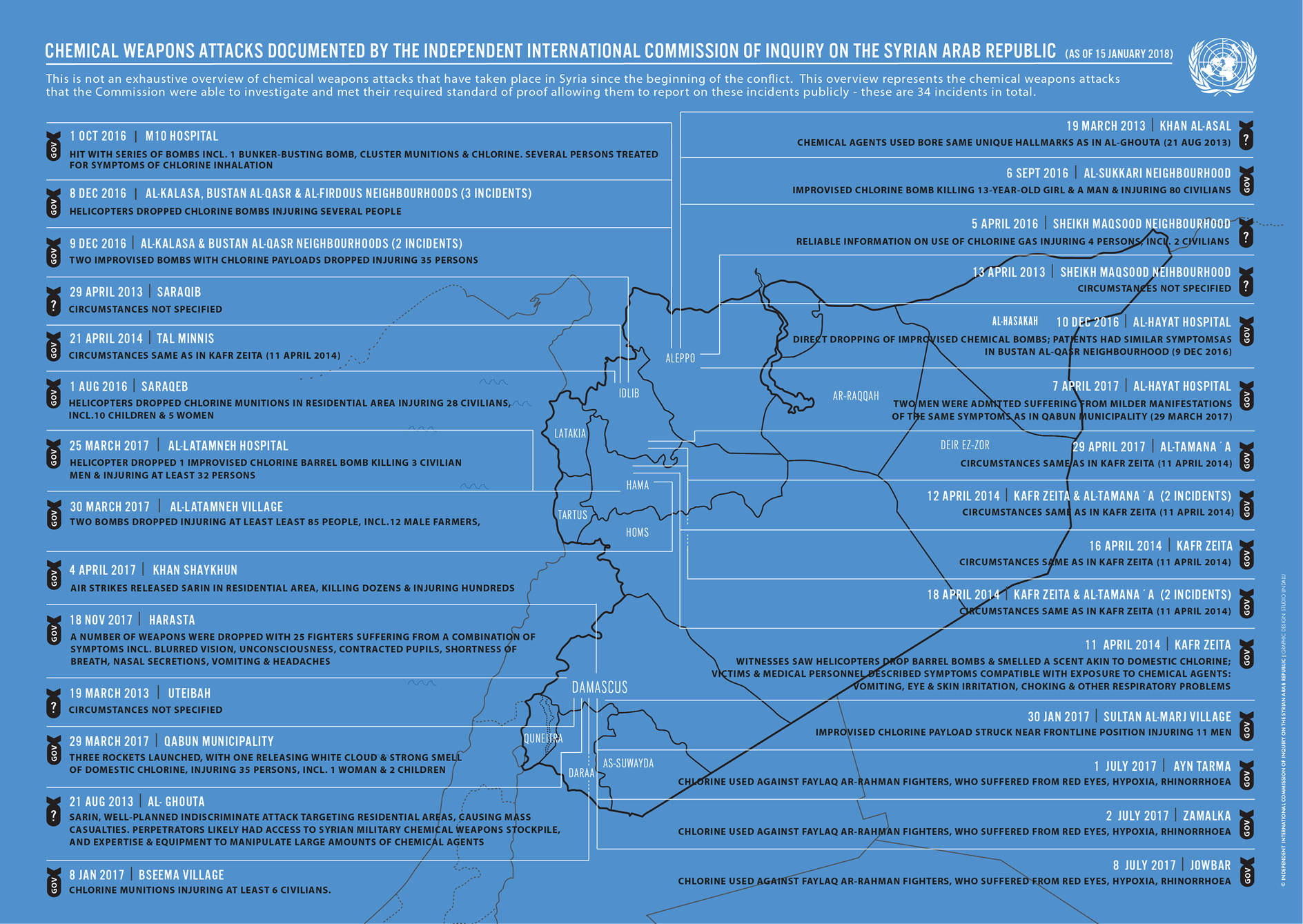
An emphasis on chemical weapons crimes committed in Syria would seem to be reflected in the recent work of the Human Rights Council-appointed Independent International Commission of Inquiry on the Syrian Arab Republic (CoI), which is a primary source of information for the IIIM. In its report of 8 August 2017, the CoI focused in large part on the chemical weapons attack on Khan Shaykhun, and – basing its position on the FFM report as well as interviews with survivors, medical personnel and others – concluded that the Syrian government was responsible for the attack.Footnote 116 The CoI also published a map of Syria with recorded chemical weapons attacks.Footnote 117 In its report, the CoI makes no mention of the JIM or the fact that the latter body is specifically tasked with determining responsibility for chemical weapons attacks confirmed by the FFM in Syria. This raises some questions about the risks of having overlapping mandates of independent UN bodies and the need for coordination. If the JIM had produced findings that were different to the CoI about responsibility for the Khan Shaykhun attack or other attacks, this may have also raised doubts about the credibility of both the CoI and the JIM. It may also have complicated the job of the IIIM and any courts seeking to rely on the evidence adduced by that body. As it turned out, both the CoI and the JIM concluded that the Syrian government was responsible for the Khan Shaykhun attack.
This was not the first time that the CoI had attributed responsibility for chemical weapons attacks in Syria. In its report of 13 August 2014, the CoI found that “[r]easonable grounds exist to believe that chemical agents, likely chlorine, were used on Kafr Zeita, Al-Tamana'a and Tal Minnis in eight incidents within a 10-day period in April [2014]”, and that “[t]here are also reasonable grounds to believe that those agents were dropped in barrel bombs from government helicopters flying overhead”.Footnote 118 The CoI had previously reported on 12 February 2014 that the chemical agents used in the Khan-al-Assal attack bore “the same unique hallmarks as those used in Al-Ghouta”. The report also indicated that the perpetrators of the Ghouta attack “likely had access to the chemical weapons stockpile of the Syrian military as well as the expertise and equipment necessary to manipulate safely large amount of chemical agents”. The CoI nonetheless found that its “evidentiary threshold” was not met in regard to identifying the perpetrators of the Ghouta chemical attacks.Footnote 119
The International Partnership against Impunity
On 23 January 2018, the International Partnership against Impunity for the Use of Chemical Weapons, a proposal of France, was endorsed by 29 States. The Partnership is an intergovernmental initiative “to supplement the international mechanisms to combat the proliferation of chemical weapons” and deals “exclusively with the issue of impunity for the perpetrators of chemical attacks worldwide”.Footnote 120 Participating States have committed to collecting, compiling and facilitating the sharing of information in order to hold perpetrators to account, and to helping States in need to build the capacity to prosecute perpetrators.Footnote 121 While the Partnership is not solely concerned with Syria, its mandate appears to overlap somewhat with that of the IIIM, discussed above, in respect of chemical weapons attacks in Syria. If the Partnership works in concert with the IIIM, it may prove to be a useful platform for information-sharing, and may provide a boost to the IIIM's capacity to fulfil its mandate with respect to chemical weapons crimes in Syria.
Options for accountability
The UN and OPCW's investigations have confirmed that chemical weapons have been used during the armed conflict in Syria, yet accountability remains elusive, and responsibility contested. Every party in this armed conflict has accused others of using chemical weapons, and no party has admitted to using them. The JIM's findings on responsibility – which should have been authoritative – have not been unanimously accepted, with Damascus and Russia expressing criticism of its methodology and conclusions.Footnote 122 As a result, the Security Council, which created the JIM, has yet to take any action on the JIM's conclusions, despite repeatedly undertaking to do so in its own resolutions. A draft Security Council resolution that would have imposed sanctions on a number of Syrian military officials and entities for the incidents involving chlorine as found by the JIM was vetoed by Russia and China on 28 February 2017.Footnote 123 In explanation of the veto, Russian president Vladimir Putin stated: “As for sanctions against the Syrian leadership, I think the move is totally inappropriate now. It does not help, would not help the negotiation process. It would only hurt or undermine confidence during the process.”Footnote 124 As noted above, on 24 October and 16 November 2017, Russia again used its veto to block resolutions that would have extended the mandate of the JIM.Footnote 125
Meanwhile, an information war about who is responsible for using chemical weapons in Syria continues to play out in the international news media, sowing further doubt and confusion in the general public's minds about each claim and counter-claim on the issue.Footnote 126 One article in Foreign Policy recently described in detail and set out an organigram of those allegedly responsible in the Syrian government for the use of chemical weapons in Syria.Footnote 127 Another recent article in RT recalled Moscow's warning that the FFM report “had many flaws and could not be deemed conclusive” and underlined that the “JIM mission never actually visited the site of the alleged attack, … relied on evidence collected by the militant groups controlling the area …[and] also failed to properly inspect the Shayrat Airbase …[by not] collect[ing] ground samples there”.Footnote 128 Countering the claim that the Syrian government is responsible for the chemical weapons attacks against anti-governmental forces and supporting civilian populations using chlorine stocks that were never declared or verified, or sarin from an undeclared stockpile, is an alternative narrative that chemical weapons were smuggled into Syria, possibly from Turkey, by forces seeking to depose Assad, in order to stage the use of a weapon that would be blamed on the Syrian government and would trigger international intervention in the war against Assad's forces.Footnote 129
With conflicting information and significant political and legal ramifications emanating from this lack of an internationally accepted truth, what should be done? From an international law perspective, it is clear what the response to these allegations should be. The use of chemical weapons in armed conflict is a war crime, and war crimes must be investigated; those suspected to be responsible must be prosecuted and, if found guilty, punished.Footnote 130 The hyper-political context of Syria and the controversial issue of chemical weapons use, together with the groundwork already laid by the existing international mechanisms, strongly suggest that an independent international criminal tribunal would be the most appropriate forum for properly investigating and prosecuting the perpetrators.
The International Criminal Court
One option would be for the Security Council to refer the situation of Syria to the ICC, in exercise of its Chapter VII powers.Footnote 131 Under Article 13(b) of the Rome Statute of the ICC, the Security Council may refer to the Prosecutor a situation in which one or more of the crimes within the jurisdiction of the ICC appears to have been committed, acting under Chapter VII of the UN Charter. While in some ways the ICC would appear to be the obvious forum for adjudication of these war crimes, there are two main problems with this option. The first problem is political. A Security Council resolution referring the situation of Syria to the ICC would almost certainly be vetoed by Russia, and possibly China. This was already tested in 2014, when a draft resolution backed by thirteen members of the Security Council that would have referred the situation in Syria to the ICC was vetoed by Russia and China.Footnote 132
The second problem is legal. The use of chemical weapons is not specifically listed as a crime under the jurisdiction of the ICC. As noted above, the ICC has jurisdiction over the war crime of using “poison or poisoned weapons” or “asphyxiating, poisonous or other gases” committed in international and non-international armed conflicts.Footnote 133 While at first glance it would appear that most uses of chemical weapons would fall within these categories, the drafting history of the Rome Statute suggests that chemical weapons were deliberately excluded from the jurisdiction of the ICC.Footnote 134 During the Rome Conference, the inclusion of chemical weapons within Article 8 was debated.Footnote 135 A prior draft of Article 8 included a specific reference to “[c]hemical weapons as defined in and prohibited by the 1993 Convention on the Prohibition of the Development, Production, Stockpiling and Use of Chemical Weapons and on Their Destruction”. Despite the deliberate exclusion of any reference to chemical weapons as defined in the CWC, it has been persuasively argued that “poison or poisoned weapons” and “asphyxiating, poisonous or other gases, and … all analogous liquids materials or devices” – language which derives directly from the 1925 Geneva Protocol – functionally includes all chemical weapons.Footnote 136
The draft Statute also contained a broad prohibition on weapons that cause unnecessary suffering and superfluous harm and that are inherently indiscriminate. The nuclear weapons possessor States objected to this clause, since it would also prohibit the use of nuclear weapons. In a compromise move to appease some non-nuclear States which viewed biological and chemical weapons as the “poor man's” weapons of mass destruction, the clauses on biological and chemical weapons were removed, alongside the removal of the broad general provision capable of covering nuclear weapons.Footnote 137 Instead, a placeholder was inserted that might allow for these weapons to be later added separately. Article 8(2)(b)(xx) provides jurisdiction over the war crime of using “weapons, projectiles and material and methods of warfare which are of a nature to cause superfluous injury or unnecessary suffering or which are inherently indiscriminate in violation of the international law of armed conflict”. This provision will only become enforceable once an annex listing such weapons is agreed upon. No agreement has yet been reached. Even were such an annex listing chemical weapons agreed to, the provision only appears in the list of war crimes for international armed conflicts, and therefore might not be applicable to instances of the use of chemical weapons in Syria.
Should the ICC decide that the use of chemical weapons does contravene the prohibition against using “poison or poisoned weapons” or “asphyxiating, poisonous or other gases” in Article 8(2)(e)(xiii–xiv) of the Rome Statute, a further jurisdictional issue arises. These provisions were added to the list of war crimes committed in non-international armed conflict in the Rome Statute at the Kampala Review Conference in 2010, pursuant to Article 121(5) of the Statute. This provision states that the amendment will come into force for each State Party that ratifies it. For States Parties that have not ratified the amendment, “the Court shall not exercise its jurisdiction regarding a crime covered by the amendment when committed by that State Party's nationals or on its territory”. Syria is not a party to the Rome Statute, and it is not clear from the text of the Statute whether the Security Council's referral of a situation would cover crimes added by an Article 121(5) amendment. An argument can be made that since Article 121(5) seeks to provide jurisdiction based on State consent, and Security Council referrals are not based on State consent, Article 121(5) cannot logically apply to Security Council referrals.Footnote 138 This interpretation would best comport with the functionality of Security Council referrals in the Rome Statute. However, it remains to be seen how the ICC would determine this matter.Footnote 139
The use of chemical weapons in Syria could theoretically be prosecuted as “violence to life and person” against persons taking no active part in hostilities or those members of the armed forces who are hors de combat, or “intentionally directing attacks against the civilian population as such, or against individual civilians not taking direct part in hostilities” in Article 8(2)(c)(i) or 8(2)(e)(i) of the Statute. But to establish guilt for these charges, it would have to be proven that the attacks were directed against civilians or those not participating directly in hostilities. Such elements do not capture the full criminality of using chemical weapons, which are banned even when directed against members of the armed forces.
An alternative to prosecuting the use of chemical weapons as a war crime under the Rome Statute would be to prosecute the use of chemical weapons as a crime against humanity under Article 7 of the Statute. This would be possible where such usage results in one of the proscribed acts, such as murder, extermination, persecutionFootnote 140 or other inhumane acts of a similar character intentionally causing great suffering or serious injury to body or to mental or physical health, and the act is perpetrated as part of a widespread or systematic attack upon a civilian population. One instance of the use of chemical weapons that is perpetrated in the context of multiple acts of violence against a civilian population in furtherance of an organizational policy to commit the attack could amount to a crime against humanity.Footnote 141 A series of usages of chemical weapons might also amount to a crime against humanity. Given the repeated use of chemical weapons in Syria as confirmed by the reports of the FFM and the JIM, as well as reports of its use in combination with other attacks on the civilian population,Footnote 142 prosecuting chemical weapons use as a crime against humanity might be a viable prosecutorial option, provided all the elements of the crime could be proven.
The use of chemical weapons could also theoretically be prosecuted as a crime of genocide under Article 8 of the Rome Statute, where such an act constituted one of the proscribed acts, such as killing members of the targeted group or causing serious bodily harm, and was accompanied with the intent to destroy, in whole or in part, a national, ethnical, racial or religious group as such. The use of chemical weapons has been prosecuted in other courts as a means of carrying out genocidal acts.Footnote 143 However, the facts surrounding the use of chemical weapons in Syria do not appear to evidence an intent on the side of any party to the conflict to destroy a national, ethnical, racial or religious group as such. Rather, the attacks would appear to be targeting political opponents, enemy combatants, or civilians living in rebel-held territory. It is doubtful, therefore, that genocide could be proven in relation to the use of chemical weapons in Syria.
Ad hoc international criminal tribunal
Another option would be for the Security Council to adopt a resolution under its Chapter VII powers creating an ad hoc international criminal tribunal for chemical weapons in Syria. Creating a tribunal dealing with chemical weapons use in Syria would be a logical next step for the Security Council following the JIM's reports, which make findings on accountability. The Security Council has repeatedly affirmed “that the use of chemical weapons constitutes a serious violation of international law”, determined “that the use of chemical weapons anywhere constitutes a threat to international peace and security”,Footnote 144 stressed “that those individuals responsible for any use of chemical weapons must be held accountable”,Footnote 145 and threatened to use its Chapter VII powers in case of the use of chemical weapons.Footnote 146 Just as the Security Council did in the case of the former Yugoslavia and Rwanda, the Security Council could establish an ad hoc international criminal tribunal for Syria in exercise of its Chapter VII powers. Such a tribunal could be focused on determining accountability for the use of chemical weapons, building upon the previous relevant resolutions, particularly Resolution 2235 establishing the JIM.
The JIM's findings arguably provide at least reasonable grounds to believe who is responsible for the chemical weapons attacks in Syria, sufficient for the issuance of an arrest warrant. If the JIM's conclusions are flawed, as the Syrian and Russian governments have claimed, a properly constituted investigation and trial is arguably the best way to collect and assess the evidence, allowing arguments to be canvassed in a transparent, fair and legal process. Without such a judicial follow-up process, the JIM's reports will be the last official word on the matter – which is presumably not the best outcome for Damascus, Russia or other Syrian allies.
However, for the Security Council to pass such a resolution, there would still need to be unanimity from the five permanent members. Should Russia or China fail to be convinced of the need or advantage of establishing an ad hoc international criminal tribunal on chemical weapons crimes, such a resolution will never be adopted.
National prosecutions
National courts can also carry out prosecutions, but national jurisdictions are dependent on having applicable and relevant legislation in place, as well as the ability and will to investigate a complex crime that may require extradition and judicial assistance agreements. An international criminal tribunal would likely be better placed in terms of resources and legitimacy required to establish the “truth” with regard to the use of chemical weapons in Syria. Nonetheless, national prosecutions may present a viable option if jurisdiction is founded.
There is near-universal adoption of the CWC,Footnote 147 Article VII of which requires criminalization of the use of chemical weapons at the national level. As of 31 July 2016, 145 States Parties (76%) had prohibitions in place, while 143 (74%) had specific penalties. 127 States Parties (66%) had provisions for extraterritorial jurisdiction (for crimes committed by nationals).Footnote 148 Moreover, the most comprehensive prohibition against using chemical weapons is found in Article I(1)(b) of the CWC. The CWC prohibits States Parties from using chemical weapons in all circumstances, as well as developing, producing, otherwise acquiring, stockpiling and retaining or transferring them (directly or indirectly) to anyone, or assisting, encouraging or inducing, in any way, anyone to engage in any of those activities.Footnote 149 This broad category of possible criminal activity covers a range of direct and indirect perpetrators. However, the CWC only requires national legislation to cover crimes that are committed on a State Party's territory or by its nationals. Therefore, in regard to the use of chemical weapons in Syria, this means that basically only Syria could investigate and prosecute these crimes (a point made by the Russian ambassador in his statement to the 83rd session of the OPCW Executive Council).Footnote 150 If foreign fighters were involved in the use of chemical weapons in Syria, the States of nationality of the offenders would have jurisdiction pursuant to Article VII of the CWC. However, it is likely that the majority of those involved in these crimes are Syrian nationals and only a small number of CWC States Parties have legislated to allow for the exercise of universal jurisdiction over chemical weapons crimes, regardless of the location of the offence or the nationality of the offender.Footnote 151
A higher proportion of national courts may be able to exercise universal jurisdiction over chemical weapons crimes in Syria by prosecuting these acts as a war crime, crime against humanity or genocide. In particular, States that are party to the Rome Statute, and which have ratified the Kampala Amendment, may have legislation in place that would allow them to prosecute those suspected of using chemical weapons in Syria, regardless of their nationality.Footnote 152 But other States may also have applicable legislation that allows them to prosecute persons suspected of serious violations of international humanitarian law, such as attacks on civilians, indiscriminate attacks and murder.
National prosecutions are supported by the practice of the OPCW policy-making organs, the Conference of States Parties and the Executive Council, which have consistently “underlined that the use of chemical weapons by anyone in any circumstances would be reprehensible and completely contrary to the legal norms and standards of the international community”.Footnote 153 In the Ieper Declaration adopted on 21 April 2015, the States party to the CWC unanimously determined that “any use of chemical weapons anywhere, at any time, by anyone, under any circumstances is unacceptable and would violate the legal norms and standards of the international community”, and expressed the “strong conviction that those individuals responsible for the use of chemical weapons should be held accountable”.Footnote 154 This pronouncement has been repeated in a number of operative decisions of the Executive Council.Footnote 155 Regional statements and national statements by States Parties at meetings of the policy-making organs have reiterated these sentiments.Footnote 156 Sixty-one States Parties made a joint statement at the 2016 Conference of States Parties that expressed the “strong conviction that every actor involved in these chemical weapons attacks must be held accountable”.Footnote 157 In 2017, one State Party unequivocally declared that the “use of chemical weapons by anyone, anywhere at any time constitutes an international crime”.Footnote 158
There have been a number of cases at the national level prosecuting non-State actors for the use or possession of chemical weapons. Many of these cases relied on the implementing legislation of the CWC, often in conjunction with terrorism charges.Footnote 159 The use of chemical weapons has also been prosecuted at the national level as a war crime, genocide or crime against humanity. In the Zyklon B case before the British Military Court at Hamburg, the owner and second-in-command of the firm which arranged the supply of the poison gas to the SS were convicted of the war crime of supplying “poison gas used for the extermination of allied nationals interned in concentration camps well knowing that the said gas was to be so used”.Footnote 160 4.5 million persons were exterminated through the use of Zyklon B in Auschwitz/Birkenau alone.Footnote 161 The case is instructive as to how the use of a chemical weapon as a tool for the “wholesale extermination of human beings”Footnote 162 can be prosecuted as an international crime.Footnote 163
The use of chemical and biological weapons by Japan during World War II, through Units 731 and 100 in China,Footnote 164 was prosecuted domestically in the Soviet Union as a crime against humanity.Footnote 165 The use of chemical weapons and of biological weapons were characterized in the submissions of different parties during the trial as “deeds that in every civilized country are regarded as heinous crimes”.Footnote 166 Individuals involved in Units 731 and 100 were also prosecuted by the Chinese authorities, but there are no reliable records of those trials. In Van Anraat, a Dutch chemical dealer who sold the component chemicals that were used to make mustard gas to Saddam Hussein's government was tried in the Netherlands for complicity in genocide and war crimes. Ultimately, he was acquitted of the genocide charge but convicted on the war crimes charge.Footnote 167 The conviction was upheld by the Court of Appeals,Footnote 168 the Supreme Court of the NetherlandsFootnote 169 and the European Court of Human Rights (ECtHR).Footnote 170
In the Anfal case, the Iraqi Special Tribunal found Ali Hassan al-Majid, the secretary-general of the Northern Bureau of the Ba'ath Party responsible for commanding all State agencies in the Kurdish-populated region of the country in 1987–88, guilty of committing genocide against the Kurds using chemical weapons. The Iraqi High Tribunal found that there was a “clear plan” to target the Kurdish population with sarin and mustard gas by al-Majid, who was responsible for the implementation of a policy to exterminate the Kurdish population, in a joint criminal enterprise with Saddam Hussein.Footnote 171 Evidence in the case included a number of audio tapes recording meetings of al-Majid with senior Ba'ath officials in 1988 and 1989, in which al-Majid stated: “I will kill them all with chemical weapons! Who is going to say anything? The international community? Fuck them! The international community and those who listen to them.”Footnote 172
Measures available under the Chemical Weapons Convention
A further possible option for establishing an international criminal tribunal for chemical weapons use in Syria emanates from the OPCW. Unlike the Security Council, the policy-making organs of the OPCW are not subject to a veto power of any particular members. While decisions are in practice usually taken by consensus, they may be taken by a majority vote.Footnote 173 Hence, in response to the JIM's reports in 2016, the OPCW Executive Council adopted a decision by majority vote, which, inter alia, instructed the Technical Secretariat to inspect the sites identified by the JIM as having been involved in the chemical weapons attacks.Footnote 174 Similarly, in a Special Session in 2018, the Conference of States Parties adopted a decision by majority vote which established the so-called “attribution mechanism” that may identify the perpetrators of the use of chemical weapons.Footnote 175
The CWC requires the Conference of States Parties to take the “necessary measures” to redress and remedy “any situation which contravenes the provisions of the Convention”, and sets out certain options of redress, including the possibility of recommending collective measures to States Parties.Footnote 176 Given that the appropriate response to the use of war crimes is prosecution and punishment of offenders, a case may be made that a “measure” which is “necessary” to redress the use of chemical weapons in Syria is the setting up of an ad hoc international or hybrid tribunal to try the alleged perpetrators.Footnote 177 This may be particularly necessary where other national or international fora of accountability are unable or unwilling to perform these judicial functions. It could also allow the OPCW States Parties to institute a judicial procedure that may determine individual responsibility without having to first determine State responsibility based on the JIM's reports, which have not been accepted by all States Parties. This would not preclude the OPCW policy-making organs from later making determinations as to State responsibility and adopting necessary measures under Article XII in that context. Insofar as accountability measures are concerned, it could also be considered necessary for the OPCW policy-making organs to recognize or establish a duty of States Parties to investigate, prosecute and punish offenders regardless of the nationality of the offender or place where the crime took place, as a means to redress the situation.
The 2018 decision of the Conference of States Parties establishing the attribution mechanism clearly demonstrates the potential of the OPCW in this regard. The decision cites as its legal basis the general mandate of the Conference of States Parties to take decisions on matters raised by States Parties or brought to its attention by the Executive Council, and to review compliance with the CWC.Footnote 178 The only reference to Article XII in the decision is in respect of the obligation to bring cases of particular gravity to the attention of the UN General Assembly and Security Council.Footnote 179 Nonetheless, the work of the mechanism could lead to criminal prosecutions. The mechanism is required to “preserve and provide information” to the IIIM, as well as “any relevant investigatory entities established under the auspices of the United Nations”.Footnote 180 The Technical Secretariat has concluded an arrangement with the IIIM for this purpose.Footnote 181
Where the Security Council is blocked from taking action, the role of the OPCW policy-making organs in establishing measures of redress for violations of the CWC takes on renewed significance. As guardians of the CWC, with its objective of eliminating the possibility of the use of chemical weapons, the OPCW policy-making organs are singularly well placed to contribute to setting up an accountability mechanism for chemical weapons use in Syria. If such a mechanism were part of a comprehensive peace plan or negotiation with international backing, this would undoubtedly solidify the support for such a decision by the OPCW policy-making organs.
Conclusion – the potential to move forward
The truth is that international humanitarian law sets all kinds of red lines, and a great number of them have been crossed in the war in Syria. But the difference with crossing the red line of using chemical weapons is the universal condemnation by the international community and the total absence of legal defences. No party to the armed conflict in Syria has admitted to using chemical weapons or has defended their use as justified. There are good reasons for that. The prohibition against using chemical weapons is absolute. There is no justification, no military necessity that can be raised in defence of their use. Chemical weapons are banned because their use violates the fundamental rule against means and methods of war that cause unnecessary suffering and superfluous injury.Footnote 182 This rule refers to the effect of a weapon on combatants. The use of chemical weapons also breaches the rule prohibiting indiscriminate attacks and using indiscriminate weapons.Footnote 183 Therefore, the use of chemical weapons is unlawful whether the targets or victims are civilians or members of the armed forces or armed groups. The prohibition applies whether there is one victim or one hundred victims. Therefore, once responsibility for the use of chemical weapons is established beyond doubt, there ends the legal dispute.
This does not mean that the war crime of using a chemical weapon is any more grave or deserving of condemnation than other war crimes. But in the context of the armed conflict in Syria, the world's unified stance on chemical weapons crimes may present an opportunity for progress on accountability within the complex context of a potential transition to peace. Despite the fact that the “red line” of chemical weapons use has been crossed multiple times during the war, the prohibition on using chemical weapons remains intact. Syria has maintained its position that “the military will never use such weapons against its own people or even terrorists”.Footnote 184 Syrian allies the Russian Federation and Iran (itself a victim of chemical weapons use during the Iran–Iraq War and usually a staunch advocate for the victims of chemical weapons) have strenuously defended Syria against such accusations. Even Islamic State – which has openly admitted to committing atrocities such as sexual slavery, murder and cruel treatment – has not claimed any use of chemical weapons, despite the JIM's findings that it used sulphur mustard on two occasions.Footnote 185 Unlike the cases of other banned weapons under international law, the use of chemical weapons in Syria has been the subject of two specific accountability measures established by the international community: the Secretary-General's Mechanism and the JIM. This practice is remarkable in view of the typically high political sensitivity that weapons-use regulations carry in the international arena. It attests to the singularly unified stance of the international community on the prohibition of chemical weapons in international law and the need for accountability.
With the issuance of the JIM's reports identifying the perpetrators of chemical weapons attacks in Syria, the international community stands at a crossroads in terms of whether States are willing to take the necessary measures to deliver on accountability. It has been aptly noted by commentators that “[a]n ad hoc tribunal dedicated to Syria offers the most promising avenue for war crimes accountability, if only the political will existed for its creation”.Footnote 186 As demonstrated by the international community's responses to the use of chemical weapons in Syria, the key difference between chemical weapons crimes and other international crimes committed during the war in Syria is that there is political will to establish responsibility for chemical weapons crimes. This political will is evident in the US–Russia Framework for Elimination of Syrian Chemical Weapons, the decisions of the OPCW Executive Council on the destruction of Syrian chemical weapons, the endorsement of the FFM, the decision of the Conference of States Parties to establish an attribution mechanism, the resolutions of the UN Security Council and General Assembly setting up accountability mechanisms and demanding accountability for chemical weapons crimes, the sanctions imposed by certain governments on those considered to be involved, the US unilateral military strike on Shayrat Airbase, and the joint air strikes of the United States, UK and France following the Douma incident.
This political will could be harnessed to create an ad hoc tribunal to try the alleged perpetrators of these crimes. The inclusion or endorsement of international tribunals in peace agreements can play an important role in the credibility of the peace process. The 1995 General Framework Agreement for Peace in Bosnia and Herzegovina contained a reference (in an annex) to the International Criminal Tribunal for the former Yugoslavia and established the parties’ duty to cooperate with it. The 1945 London AgreementFootnote 187 established the International Military Tribunal at Nuremberg. An ad hoc tribunal may serve as a tool to facilitate the transition to peace. In this area of startlingly contested versions of events, an international trial may be the most accepted and legitimate means to establish the truth about the use of chemical weapons in Syria. Given the central position that chemical weapons use has been accorded by the international community in this war, the truth at least about this aspect of the war can provide an accepted basis on which to begin to build a lasting transition to peace. Moreover, incorporating an ad hoc tribunal for chemical weapons crimes into the peace negotiation may provide a crucial means of encouraging international acceptance of the process. A peace agreement on Syria that is entirely devoid of accountability mechanisms is likely to founder and fail to gain the broad regional or international support that would allow it to succeed. Moreover, an ad hoc tribunal would provide an added incentive to end the use of chemical weapons in Syria. The fact that chemical weapons have continued to be used even after the creation of the JIM and the IIIM suggests that these mechanisms – which, unlike a court, do not make findings beyond a reasonable doubt and cannot impose punishment – fail to serve as a deterrent to perpetrators. The possibility of actual criminal proceedings is likely to be more effective. Establishing an ad hoc tribunal may be a more politically viable option than a Security Council referral to the ICC, and can be crafted in a manner that achieves the objectives of the sponsoring States while remaining independent and impartial. Unlike national trials, an ad hoc tribunal would function through State cooperation and would be based on international law rather than extradition agreements and national law, which may prove difficult to apply to crimes committed in Syria. Most importantly, an ad hoc tribunal could be built into the peace agreement, signalling a commitment to justice by the involved parties.
A mechanism to try the alleged perpetrators of chemical weapons crimes would be in every major player's interest. It would provide a needed boost to the Security Council's credibility or to that of the OPCW, if created by that body. A tribunal would allow the evidence about chemical weapons use and responsibility to be presented and debated in a fair and legal process. A tribunal is the best opportunity for Syrian officials accused of involvement in these crimes and subject to sanctions by the United States and European Union to clear their names, or for responsibility to be appropriately apportioned in a fair, legal and public process.
The case made here for an ad hoc tribunal on chemical weapons crimes does not mean to suggest that there should be impunity for all other international crimes committed during the Syrian crisis – at least not in the long run. But injecting a modicum of justice and the rule of law, on which all sides can agree, into a negotiated peace deal may allow some progress to be made in an otherwise bleak legal and political outlook.