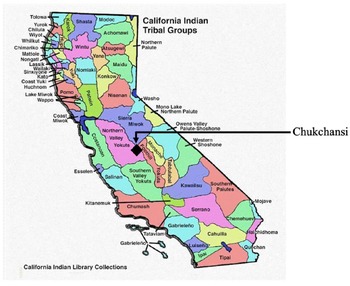
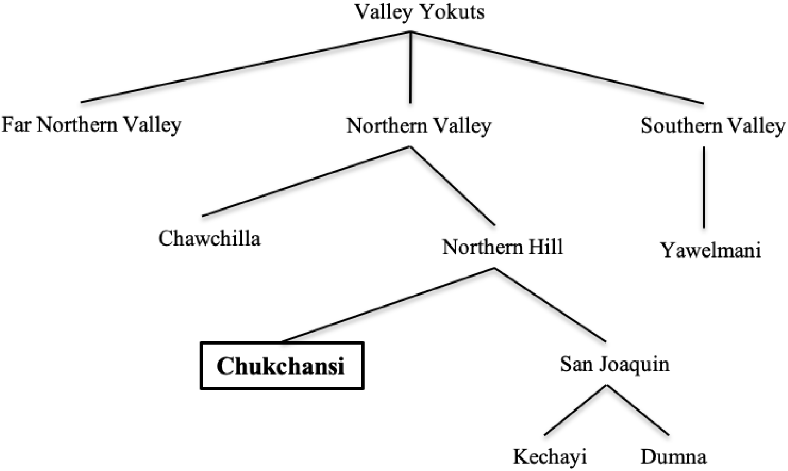
Chukchansi belongs to the Yokuts language family (ISO 639 code: yok) ancestrally spoken in the San Joaquin valley of Central California and in the adjacent foothills of the Sierra Nevada. The headquarters of the Chukchansi tribe is located in Coarsegold and many members of the tribe live in and around Madera and Fresno counties. As shown in the map in Figure 1, there are three major territories of the Yokuts: Northern Valley Yokuts, Foothill Yokuts, and Southern Valley Yokuts. While the territory of the Chukchansi is in the foothills area, the dialect is linguistically Northern Valley (Whistler & Golla Reference Whistler and Golla1986), as shown in Figure 2. Yawelmani, a Yokuts language that has been a subject of extensive linguistic research (e.g. Newman Reference Newman1944, Archangeli Reference Archangeli1983, Weigel Reference Weigel2005), is a dialect of the Southern Valley Yokuts. It is unclear to what extent Yokuts varieties are mutually intelligible. Yokuts is often considered to be a part of a larger Penutian language family (e.g. Dixon & Kroeber Reference Dixon and Kroeber1913, Sapir Reference Sapir1921, DeLancey & Golla Reference DeLancey and Golla1997). While the status of Penutian as a macro-family is disputed, Yokuts is very likely related to the Miwok and Costanoan language families of California (Callaghan Reference Callaghan1997).
As is the case with most Native American languages in North America, Yokuts in general and Chukchansi in particular are highly endangered. Reports on the number of Chukchansi speakers vary. According to Golla (Reference Golla and Christopher2007), there are a few semi-speakers. To the best of the authors’ knowledge, there may be up to a dozen native speakers, most of whom are elders and all of whom are bilingual in English. However, members of the Chukchansi community have been involved in language documentation and revitalization efforts over the last decade, including adoption of an orthography and development of pedagogical materials. Collord’s (Reference Collord1968) ‘Yokuts grammar: Chukchansi’ is the main previous documentation of Chukchansi before this century, and remains the most complete grammar of the language.
The third author is the language consultant for this study. She is a fluent native speaker in her seventies. English was introduced to her when she entered elementary school. Chukchansi continued to be her home language. As an adult, Chukchansi and English are used in communication with her siblings. She has been extensively involved in the ongoing Chukchansi documentation and revitalization efforts, which began in 2009. The recordings are of the third author’s speech, accompanied by the first author, at California State University, Fresno, in October 2013.
Map of the Native American tribes in California (Source: https://cla.berkeley.edu/images/indian-library-map.jpg).

Valley Yokuts languages (following Whistler & Golla Reference Whistler and Golla1986).

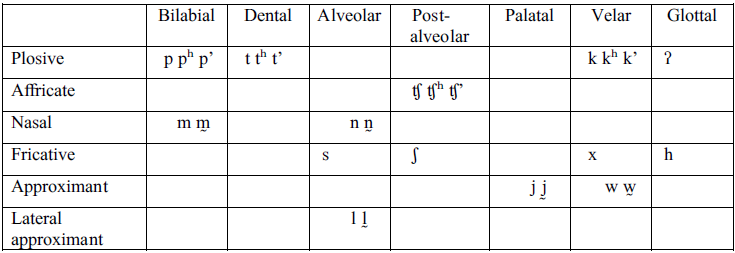
Consonants
The set of consonants in Chukchansi includes plosives, affricates, ejective plosives and affricates, fricatives, nasals, central approximants, lateral approximants, and laryngealized nasals and approximants. Consonants can have bilabial, dental, alveolar, postalveolar, palatal, velar and glottal places of articulation. There is no contrast between dental and alveolar place, nor between postalveolar and palatal place. In addition to contrastive ejectivity, plosives and affricates contrast in aspiration at all places of articulation; affricates in Chukchansi pattern with plosives with respect to laryngeal distinctions. All sonorants contrast modal voicing and laryngealization. Fricatives only contrast place, not phonation.
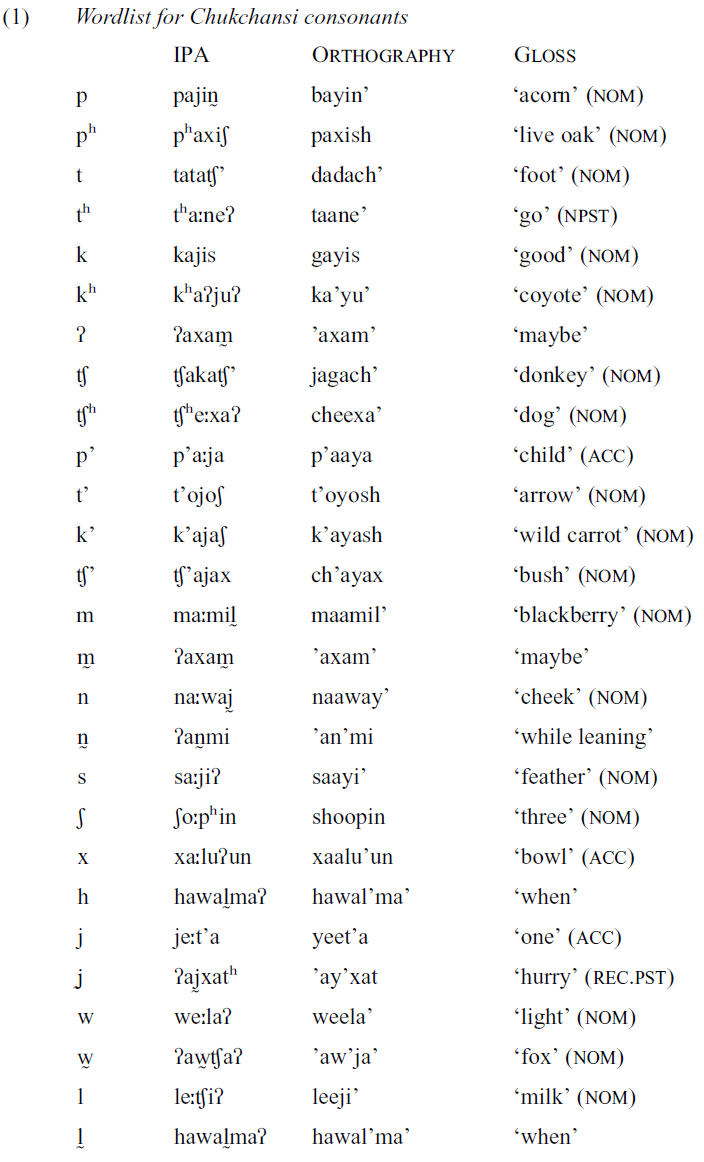
In the wordlist in (1), the consonants of Chukchansi are illustrated occurring in word-initial position, except for the glottalized sonorants, which only occur after vowels. The words are given in both a broad, phonemic IPA transcription and the Chukchansi orthography.Footnote 1
Plosives, affricates, and ejective plosives and affricates
Plosives are distinguished at four places of articulation: bilabial, dental, velar, and glottal. Affricates are postalveolar; the aspirated postalveolar affricate ʧʰ is very rare, only occurring in a few words (Collord Reference Collord1968: 2). According to Newman (Reference Newman1944: 14), the aspirated alveolar plosive in Yokuts (represented as /ṭ/ in Newman) is the source of both the alveolar fricative /s/ and the aspirated postalveolar /ʧʰ/ in Chukchansi. The dental and velar plosives are often accompanied by slight affrication, especially the aspirated plosives and ejectives: [tΘ tΘș kx kxș]. This affrication is never as long as that of the postalveolar affricates [ʧ ʧʰ ʧș]. Perceptually, the frication noise in dental plosives is always dental [Θ], while the frication noise in velar plosives is sometimes retracted, sounding uvular [qχ qχș] (see Figures 8 and 3, 5, respectively). In fact, velar plosives in general have a retracted quality, as noticed by an anonymous reviewer. The third author, a native speaker of Chukchansi, has the impression that before front and central vowels, the velar plosives in Chukchansi are slightly retracted compared to English velar plosives (e.g. comparing Chukchansi /kʰaʔjuʔ/ [k̠ʰaʔjuʔ] ‘coyote’ (nom) with English /kʰatn̩/ ‘cotton’). However, before back vowels, the author feels no difference between velar plosives in Chukchansi and in English. In the absence of articulatory data, which is not available, we cannot be certain about the precise place of articulation of the dental and velar plosives or the postalveolar affricates.
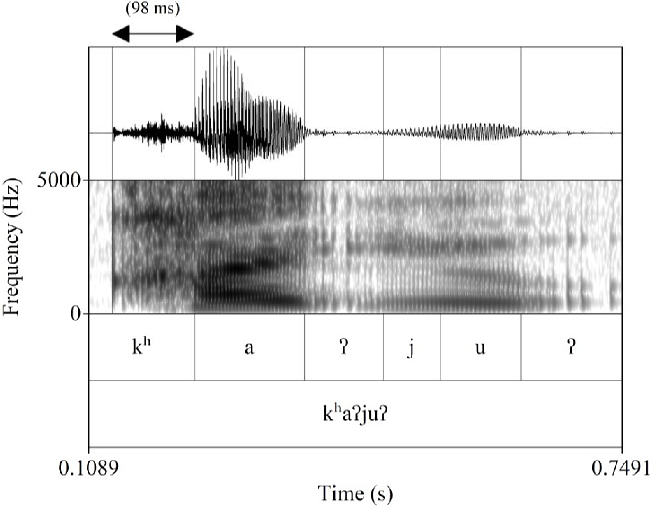
A spectrogram and waveform of /kʰaʔjuʔ/ ‘coyote’ (nom), illustrating the aspirated velar plosive with a 98 ms VOT.

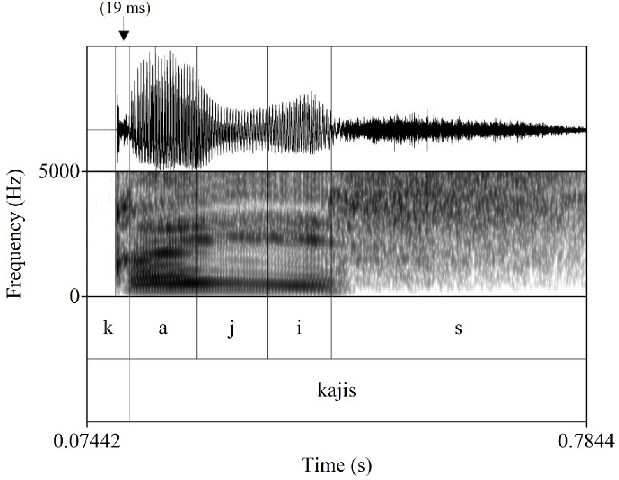
A spectrogram and waveform of /kajis/ ‘good’ (nom), illustrating the unaspirated velar plosive with a 19 ms VOT.

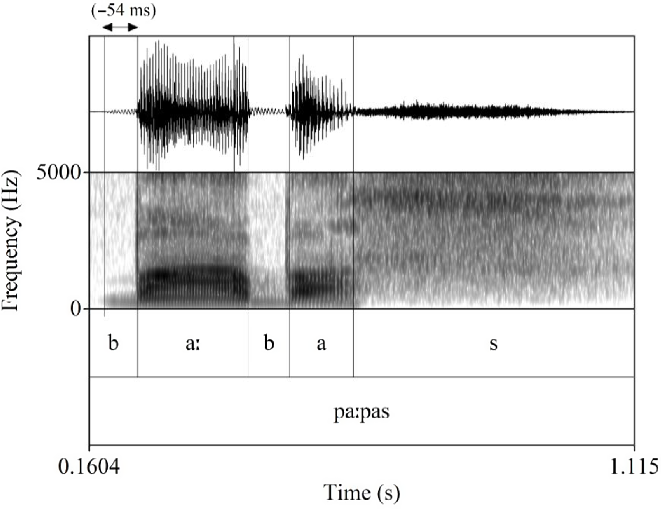
Plosives and affricates in Chukchansi (and other Yokuts languages) do not have contrastive voicing (e.g. Newman Reference Newman1944, Kroeber Reference Kroeber1963, Collord Reference Collord1968). The unaspirated bilabial plosive may, however, appear voiced word-initially and intervocalically, i.e. in onset position. For example, see /܀ajin̰/ [怂ajin̰] ‘acorn’ (nom) in the wordlist (1) above and /܀aː܀as/ [怂aː怂as] ‘potato’ (nom) in Figure 7. Plosives and affricates, except for the glottal plosive, instead show a three-way contrast between voiceless aspirated (Figure 3), voiceless unaspirated (Figure 4), and ejective (Figure 5). Figures 3–5 show this three-way contrast at the velar place of articulation: /k kʰ kș/. For the case of the aspirated velar plosive /kʰ/ in /kʰaʔjuʔ/ ‘coyote’ (nom) in Figure 3, the duration of the aspiration is 98 ms. In the case of the unaspirated velar plosive /k/ in /kajis/ ‘good’ (nom) in Figure 4, a brief release burst of 19 ms is present, followed immediately by the periodic waveform of the vowel.
In these two cases, the contrasting unaspirated and aspirated plosives are in onset position. The aspiration contrast is neutralized when these plosives occur in the coda, where only ejective plosives are typically released. We do not find any consistent differences in the release of coda plosives based on the manner of the following onset consonant.
In word-final coda position, Chukchansi exclusively has aspirated, not unaspirated plosives at the phonetic level: [pʰ tʰ kʰ]. Chukchansi words that end morphophonemically in unaspirated plosives /p t k/ include bare roots in the unmarked nominative case and particles without suffixes (though word-final [k] does appear as an allomorph of the imperative suffix /-k(a)/). In six such words illustrated in (2)–(4), the final plosives are realized with aspiration: [pʰ tʰ kʰ].

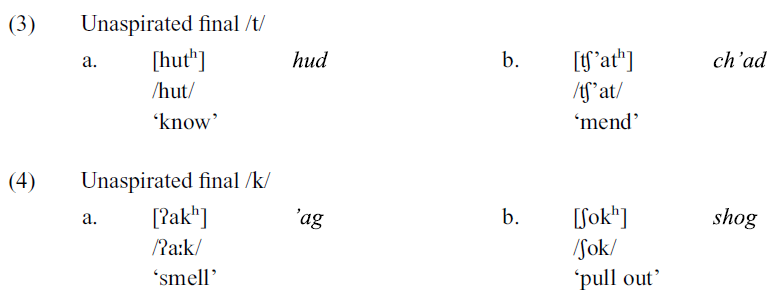
Comparing the words above ending in the unaspirated phonemes /p t k/, as in (2)–(4), with words ending in the aspirated phonemes /pʰ tʰ kʰ/ in (5) and (6), the contrast is neutralized. Both unaspirated and aspirated plosives are released word-finally with aspiration (contrasting with ejectives, which have a glottal release following the oral release).

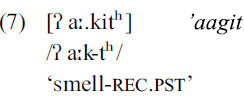
The aspirated release of the word-final consonants in (2)–(4) may be related to their position at the end of the utterance. Note that word-final vowels in many of the recordings are also accompanied by aspiration. There may be a final glottal abduction gesture resulting in aspiration of our word-final tokens, as suggested by a reviewer, though we have not determined whether its domain is the word, phrase or utterance. The word-final consonants in (2)–(4) are written as unaspirated in the orthographic column due to related morphological forms in which these consonants occur in onset position and are clearly unaspirated, like [k] in [ʔåkitʰ] (7). The contrast between the two forms of /ʔaːk/ with [kʰ] in (4a) and [k] in (7) shows the alternation between aspirated and unaspirated allophones of the phoneme /k/ (the [i] in the surface form is due to phonotactics, as discussed below in the section ‘Syllable structure and vowel alternation’).
The facts in (2)–(4) and (5)–(6) suggest that aspiration is not contrastive in coda position. No aspiration contrast for postalveolar affricates /ʧ ʧʰ/ is observed in coda position.
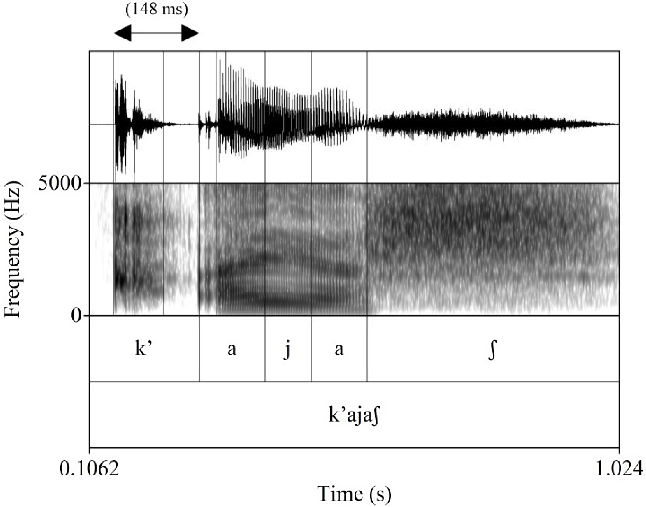
Ejectives form another series of plosives and affricates in Chukchansi. In previous literature of Yokuts languages, this type of plosive is referred to as ‘glottalized’ (Newman Reference Newman1944, Kroeber Reference Kroeber1963, Collord Reference Collord1968, Gamble Reference Gamble1978). Figure 5 illustrates a case where a velar ejective /kș/ occurs in word-initial position, in /kșajaʃ/ ‘wild carrot’ (nom).
A spectrogram and waveform of /kșajaʃ/ ‘wild carrot’ (nom), illustrating the velar ejective with a VOT of 148 ms.

The supralaryngeal closure of the ejective is followed by the release burst of the compressed air from the oral cavity. The release burst is often followed by further aperiodic noise that indicates affrication (see /tșojoʃ/ [tΘșojoʃ] ‘arrow’ (nom) in Figure 8 as well). As an anonymous reviewer points out, this noise cannot be aspiration, which requires an open glottis, though the glottis is still closed at this phase of the ejective. The affrication noise is followed by a period of silence representing the length of time it takes from the release of the obstruction in the oral cavity to the release of the glottalic obstruction. The initial portion of the vowel following the release of the glottalic obstruction is often laryngealized, as shown in Figure 5 (see also /pșonoʃ/ ‘hand’ (nom) in Figure 18, though compare /tșojoʃ/ ‘arrow’ (nom) in Figure 8 without vowel laryngealization). For the case in Figure 5, the entire VOT from release of oral closure to beginning of the (laryngealized) vowel is 148 ms.
The intense burst, long VOT and long total duration of Chukchansi ejectives such as /kș/ in Figure 5 are characteristics of ‘fortis’ ejectives (as opposed to ‘lenis’), in the sense of Kingston (Reference Kingston1985). See also the division between ‘strong’ vs. ‘weak’ in Bird (Reference Bird2002), ‘stiff’ vs. ‘slack’ in Kingston (Reference Kingston, Sharon and Keren2005), and ‘complex’ vs. ‘simplex’ in McDonough & Wood (Reference McDonough and Valerie2008), Chukchansi ejectives being ‘strong’, ‘stiff’, and ‘complex’, respectively. Ejectives in Chukchansi are thus similar to the strong ejectives found in many Athabaskan and Salishan languages, including Navajo and Montana Salish (e.g. Lindau Reference Lindau1984, McDonough & Ladefoged Reference McDonough and Peter1993, Flemming, Ladefoged & Thomason Reference Flemming, Ladefoged and Thomason1994, McDonough & Wood Reference McDonough and Valerie2008, among others), as opposed to those in Hausa, Quiché, and many languages of the Caucasus (Lindau Reference Lindau1984, Kingston Reference Kingston1985, Vicenik Reference Vicenik2010). However, unlike typical ‘fortis’ or ‘stiff’ ejectives in Kingston’s (Reference Kingston1985, Reference Kingston, Sharon and Keren2005) typology, vowels following ejectives in Chukchansi often begin with laryngealization and low amplitude, like ‘lenis’ or ‘slack’ ejectives. This finding is in line with the proposals in Wright, Hargus & Davis (Reference Wright, Hargus and Davis2002) and Vicenik (Reference Vicenik2010) that a simple, two-way classification of ejectives does not account for their different phonetic characteristics.
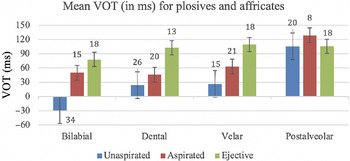
Figure 6 shows the mean values for Voice Onset Time (VOT) in ms for each of the plosive and affricate phonemes. VOT was calculated from the release of full oral closure to the onset of the voiced vowel. VOT also includes the fricative release portion of postalveolar affricates as well as any fricative release portions of dental and velar plosives. These values are taken from 226 plosive or affricate tokens in either word-initial or intervocalic position and in either stressed or unstressed position from 63 words recorded for this study in addition to the wordlist at the beginning of this section. These words were read three times each. Due to the small number of tokens recorded, the different environments of stress and position were combined; this does not seem to have influenced the aggregated values in Figure 6.
Mean VOT (in ms) for plosives and affricates. Error bars show standard deviation grouped by laryngeal state (unaspirated, aspirated, ejective). Numbers show number of tokens.

The VOT mean values in Figure 6 show the typical crosslinguistic pattern for the plosives where bilabials have the shortest VOT and velars the longest (Maddieson Reference Maddieson, John and Hardcastle1997). The longer measurement for postalveolar affricates is also typical, as it takes into account the fricative release component of the sound. The fricative portion of postalveolar affricates is always longer than the fricative portion in dental and velar plosives and ejectives that have affrication.
The mean VOT measurement (−29 ms) for the unaspirated bilabial plosive combines both voiced tokens [b] and unvoiced tokens [p]. This is responsible for the high standard deviation (41 ms) of the unaspirated bilabial plosive in Table 1. Splitting up the 34 total tokens of the unaspirated bilabial plosive /p/, 22 tokens are voiced [b] (mean VOT: −55 ms, SD: 25 ms), and 12 tokens are unvoiced [p] (mean VOT: 20 ms, SD: 7 ms). Eighteen of the 22 of voiced [b] tokens are in word-initial position, while the remaining four voiced [b] tokens are intervocalic. Eight of the 12 unvoiced [p] tokens are in word-initial position, while four of the unvoiced [p] tokens are intervocalic. These VOT values of the voiced [b] and voiceless [p] tokens combine to give the negative mean VOT of the 34 total tokens of /p/ (−29 ms; SD: 41 ms).
A spectrogram and waveform of /paːpas/ [baːbas] ‘potato’ (nom), illustrating pre-voiced word-initial and fully voiced intervocalic tokens [b] of the unaspirated bilabial plosive /p/; the word-initial plosive has a negative VOT of 54 ms.

In Figure 7, both the word-initial and intervocalic tokens of the unaspirated bilabial plosive /p/ in /paːpas/ ‘potato’ (nom) are voiced [b], as illustrated by their periodic waveforms and the voicing bars. The word-initial token of /p/, realized as [b], in Figure 7 has a negative VOT of −54 ms. Compare this case to the one in Figure 4, with the unaspirated velar plosive /k/ in /kajis/ ‘good’ (nom), which is realized as unvoiced [k] and has a positive VOT of 19 ms.
One finding particular to Chukchansi is shown in Figure 6: velar and especially dental ejectives have a much higher mean VOT than their aspirated counterparts (about 2.25:1 and 1.75:1, respectively), but bilabial ejectives only have somewhat higher mean VOT (1.5:1) and postalveolar ejectives slightly shorter (0.85:1) than their aspirated counterparts. The greater relative length of dental and velar ejectives may be due to the appearance of long, aperiodic noise with steady amplitude in many tokens. This noise indicates affrication, as confirmed by perception and noted by multiple reviewers.
This release pattern contrasts with that of ‘strong’ or ‘stiff’ ejectives in many other languages, where the rapid release of oral closure while the glottis remains closed yields a burst with high initial amplitude that quickly lessens (Lindau Reference Lindau1984, Kingston Reference Kingston1985). While affrication also occurs in non-ejective dental and velar plosives (as noted by multiple reviewers), the fricated portion in the non-ejective plosives comprises most of the VOT, following the burst of the plosive release and preceding the adjacent vowel. In ejective plosives, on the other hand, the fricated portion only makes up some of the VOT, which includes the silent period before the onset of the vowel as well. Consequently, the VOT of dental and velar ejectives is longer than the VOT of aspirated dental and velar plosives. In addition, the VOT of ejectives is similar for dental and velar ejectives, while aspirated plosives have the typically crosslinguistic pattern where velars have longer VOT than dentals (Maddieson Reference Maddieson, John and Hardcastle1997), as pointed out by an anonymous reviewer. Lastly, the Chukchansi data follow the cross-linguistic tendency for ejective and aspirated plosives to be differentiated by VOT (among other properties), as shown by Cho & Ladefoged (Reference Cho and Ladefoged1999).
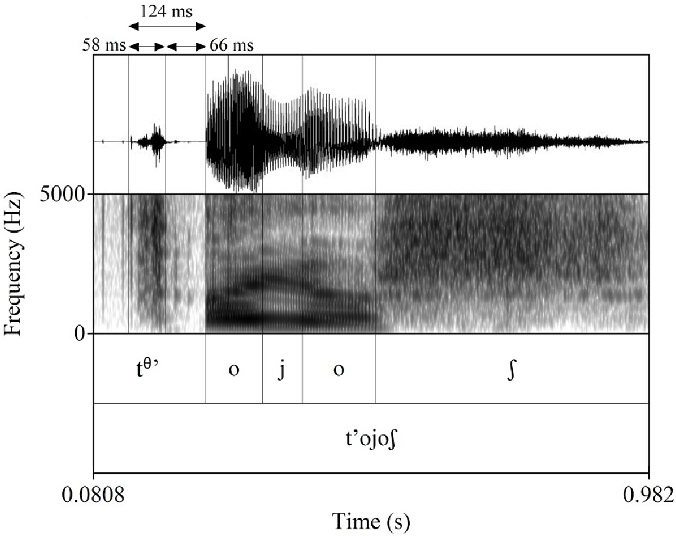
Figure 8 shows the affricated release burst of the dental ejective token /tș/ in /tșojoʃ/ [tΘșojoʃ] ‘arrowș (nom). As shown, the amplitude of the oral release of the ejective begins low and slowly increases before lessening into the silent period, which is then followed by the vowel /o/. In Figure 8, the affricated release burst phase lasts 58 ms, while the silent phase lasts 66 ms, adding up to the whole VOT of 124 ms. Compare Figure 5, with the velar ejective /kș/ in /kșajaʃ/ ‘wild carrot’ (nom), which has a different release burst pattern (high initial amplitude, rapidly reduced). We are unsure whether these different release burst patterns are systematic or not, or whether they are an epiphenomenon of the place of articulation of the fricative release, as suggested by an anonymous reviewer.
A spectrogram and waveform of /tșojoʃ/ [tΘșojoʃ] ‘arrow’ (nom), illustrating the dental ejective [tΘș] with affricated release phase of 58 ms and a silent phase of 66 ms.

While velar and dental ejectives often have the release burst pattern shown in Figures 5 and 8, respectively, bilabial ejectives never do. Similar to bilabial ejectives, bilabial plosives are never affricated. In addition, some tokens of the bilabial ejective [pș] are closer to ‘lenis’ or ‘slack’ ejectives in the sense of Kingston (Reference Kingston1985, Reference Kingston, Sharon and Keren2005), as opposed to dental and velar ejectives [tș kș], which are always clearly ‘fortis’ or ‘stiff’. While bilabial ejectives always have a release burst and a silent period, as in ‘fortis’ ejectives, these phases are shorter in duration than those in dental and velar ejectives. This difference in duration may be related to the affricated release burst in the latter but not the former ejectives, and it may also contribute to the longer VOT measurements for dental and velar ejectives vis-à-vis their aspirated counterparts vs. in bilabials.
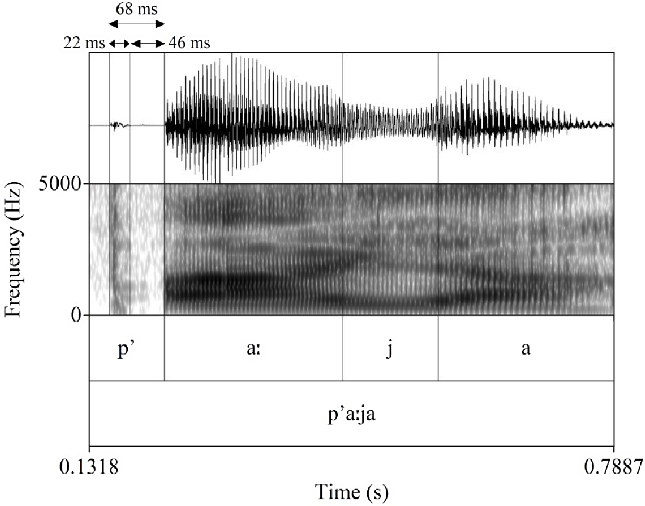
Figure 9 shows the non-affricated release burst of the bilabial ejective token /pș/ in /pșaːja/ ‘child’ (acc). In Figure 9, the non-affricated release burst phase lasts 22 ms, while the silent phase lasts 46 ms, adding up to the whole VOT of 68 ms.
A spectrogram and waveform of /pșaːja/ ‘child’ (acc), illustrating the bilabial ejective [pș] with a non-affricated release phase of 22 ms and a silent phase of 46 ms.

The three ejective tokens in Figures 5, 8, and 9 illustrate the variable pronunciation of ejectives in Chukchansi. Similar to ejectives in Witsuwit’en (Wright et al. Reference Wright, Hargus and Davis2002, Hargus Reference Hargus2007) and Hul’q’umi’num’ (Percival Reference Percival2019), different ejective tokens in Chukchansi may contrast in the intensity of the oral release burst, though this appears to correlate with place of articulation. Ejective tokens also contrast in whether the following vowel starts with laryngealization: Figure 5 shows heavy laryngealization and Figure 8 shows none, with Figure 9 intermediate. The difference in vowel laryngealization does not appear to be correlated with the difference in burst intensity or duration of VOT, again supporting Wright et al.’s (Reference Wright, Hargus and Davis2002) and Vicenik’s (Reference Vicenik2010) arguments against a simple ‘fortis/stiff’ vs. ‘lenis/slack’ contrast in ejectives.
Fricatives
Fricatives in Chukchansi are distinguished at four places of articulation: alveolar, post-alveolar, velar and glottal. All fricatives in Chukchansi are voiceless in all positions. The alveolar and post-alveolar fricatives are both sibilants. The alveolar sibilant often has an impressionistic retroflex quality. Compare (8) [χoːwiʂ], which is audibly post-alveolar or retroflex, with (9) [soχ], which is audibly alveolar. The velar fricative often sounds retracted, as noted by reviewers, especially next to the back vowels /u ů o o̊/. This retraction is audible in (8) [χoːwiʂ] and (9) [soχ] (see also Collord Reference Collord1968: 2–3).
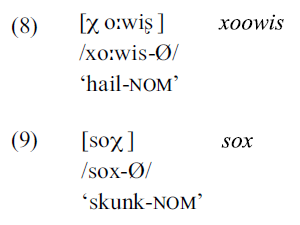
Due to a lack of articulatory data, which is unavailable, we cannot be certain about the precise place of articulation of the fricatives. Moreover, we have not found any discernable pattern for the variation in tokens of /s/; the presence of alveolar [s] vs. post-alveolar [ʃ] or retroflex [ʂ] tokens is not consistently correlated with syllable position or adjacent vowels. For some words with /s/, we hear the alveolar [s] token in some utterances and the post-alveolar [ʃ] or retroflex [ʂ] token in other utterances of the same words.
Sonorants
Nasals and approximants contrast modally voiced and laryngealized segments in Chukchansi. The laryngealized or glottalized sonorants are post-glottalized, not pre-glottalized (see Ladefoged & Maddieson Reference Ladefoged and Ian1996, Howe & Pulleyblank Reference Howe and Douglas2001, Bird et al. Reference Bird, Caldecott, Campbell, Gick and Shaw2008 for pre- vs. post-glottalization). This contrast is phonotactically limited: while modally voiced sonorants can surface in any position, laryngealized sonorants only surface after a vowel. Moreover, sonorants that are underlyingly laryngealized are typically articulated with modal voice when intervocalic. Most often, laryngealization only shows up acoustically in coda position, at the end of the sonorant segment. In onset position, then, sonorants almost always have modal voice, as explained below.
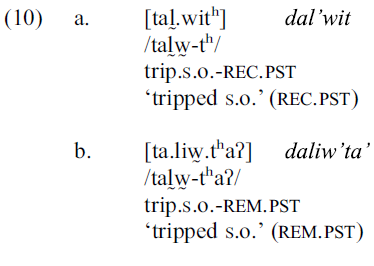
The phonotactic restriction on laryngealized sonorants drives alternations between modally voiced and laryngealized segments on the surface, as with the root /tal̰w̰/ ‘trip someone’ with the two underlyingly laryngealized sonorants /l̰/ and /w̰/ (10). In (10a), [l̰] is in the coda and retains laryngealization, while [w] is in the onset and is modally voiced. In (10b), this is reversed: laryngealized coda [w̰] and modally voiced onset [l].
Laryngealized sonorants may surface in intervocalic position in order to keep a lexical contrast. For example, the roots /saw/ ‘scream’ (11a) and /saw̰/ ‘water’ in (11b) only differ in laryngealization of the labial-velar approximant.
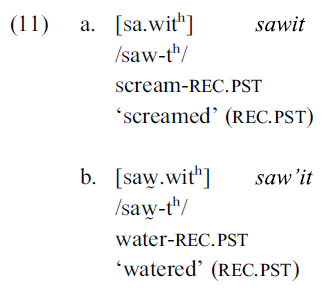
When the approximant is intervocalic, the laryngealized /w̰/ in (11b) often surfaces with laryngealization in the middle of the segment in order to preserve the contrast with plain /w/ in (11a). The third author, a native speaker, syllabifies intervocalic laryngealized sonorants as in (11b): the first syllable ends with a laryngealized sonorant, and the second syllable begins with the same sonorant but modally voiced.
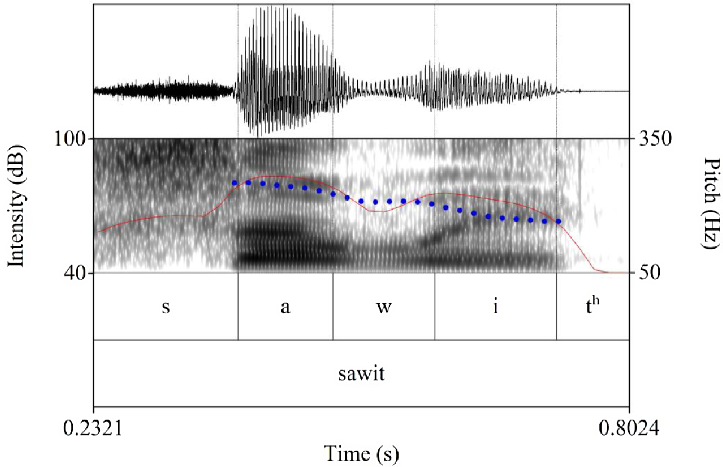
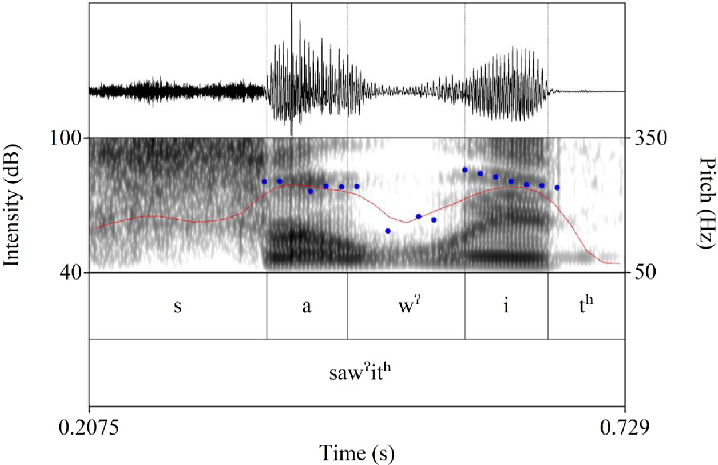
In Figure 11, /w̰/ in /saw̰itʰ/ ‘watered’ (11b) shows reduced amplitude and pitch and increased duration in comparison to /w/ in /sawitʰ/ ‘screamed’ (Figure 10, example (11a)). The laryngealization or creaky voicing of /w̰/, visible in Figure 11, is strongest in the middle of the segment but spreads rightward into the following vowel. We consider this sonorant to be mid-glottalized, but with the laryngeal gesture persisting to the end of the oral (labial and tongue body) gestures. Mid-glottalization is consistent with the third author’s native speaker intuitions about syllabification in (11b), with the strongest laryngealization flanked by the oral articulation of the sonorant on either side. Similar variation in the timing of the laryngeal gesture in laryngealized sonorants also occurs in St’át’imcets (Bird Reference Bird2011).
There is diachronic evidence that Chukchansi has reanalyzed some intervocalic laryngealized sonorants as a [ʔ]+sonorant sequence. For example, cognates of /kʰaʔju/ ‘coyote’ in other Yokuts varieties have a laryngealized sonorant: /kʰaj̃u/ (Newman Reference Newman1944, Gamble Reference Gamble2018). These Yokuts varieties retain the glottalization contrast intervocalically; it is likely that the intervocalic [ʔ.j] sequence in (12) is the Chukchansi reflex of intervocalic /j̃/.
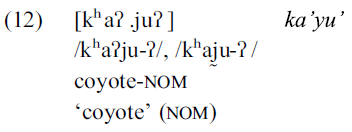
As previously shown for [kʰaʔ.juʔ] in Figure 3, laryngealization occurs before modal voicing of the sonorant, yielding the pre-glottalized sequence [ʔ.j]; though, as an anonymous reviewer notes, there is overlap between the glottal gesture and the oral (palatal) gesture. This timing contrasts with that of laryngealized sonorants in general in Chukchansi, which are mid-glottalized or post-glottalized, not pre-glottalized. In Figure 11, showing [saw̰.witʰ] ‘watered’ (rec.pst), and Figures 14 and 15 further below, showing [ʔan̰mi] ‘while leaning’ and [saw̰mi] ‘while watering’, laryngealization occurs toward the middle (Figure 11) or the end (Figures 14 and 15) of the sonorants.
A spectrogram and waveform of /sawitʰ/ ‘screamed’ (rec.pst), illustrating the intensity (red solid line) and the pitch (blue dotted line) of the modally voiced labial-velar approximant in intervocalic position.

A spectrogram and waveform of /saw̰itʰ/ ‘watered’ (rec.pst), illustrating the intensity (red solid line) and the pitch (blue dotted line) of the laryngealized labial-velar approximant in intervocalic position.

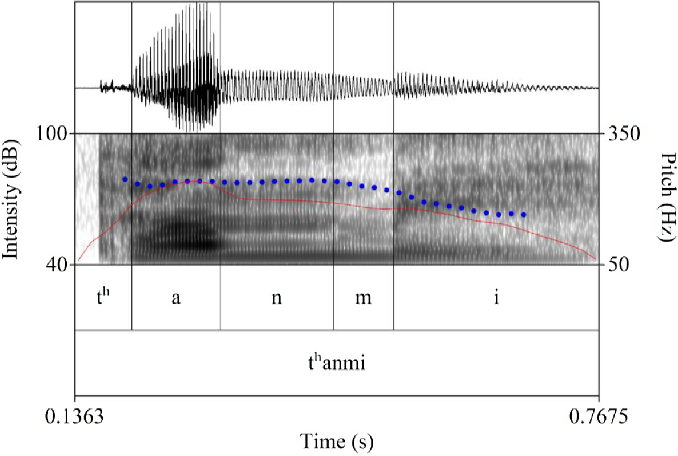
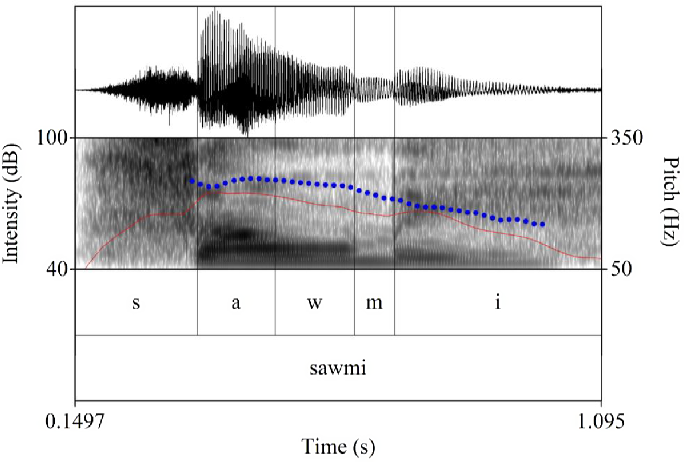
In word-medial position when the sonorant precedes another consonant, i.e. in coda position, the contrast between modally voiced and laryngealized sonorants can be observed as a contrast in pitch and intensity (in addition to the presence of a glottal gesture in the latter, which shows up in the spectrum as silence and may be perceived as a glottal stop). Glottalized sonorants tend to have a sharp decrease in pitch and intensity from the preceding vowel, while plain sonorants show either a slight decrease in pitch and intensity or none at all. Examples of the plain alveolar nasal /n/ and plain labial-velar approximant /w/ preceding another consonant are shown in Figures 12 and 13. In the spectrogram of the plain nasal in /tʰanmi/ ‘while going’ (Figure 12), the intensity of the signal (red solid line) decreases slightly during the alveolar nasal into the following bilabial nasal. There is no sharp change in the pitch level (blue dotted line) either into, during, or out of the alveolar nasal. In the spectrogram of /sawmi/ ‘while screaming’ (Figure 12), there are small decreases in both pitch and intensity during the labial-velar approximant, which continue to decrease following this segment.
A spectrogram and waveform of /tʰanmi/ ‘while going’, illustrating the intensity (red solid line) and the pitch (blue dotted line) of the modally voiced alveolar nasal in coda position.

A spectrogram and waveform of /sawmi/ ‘while screaming’, illustrating the intensity (red solid line) and the pitch (blue dotted line) of the modally voiced labial-velar approximant in coda position.

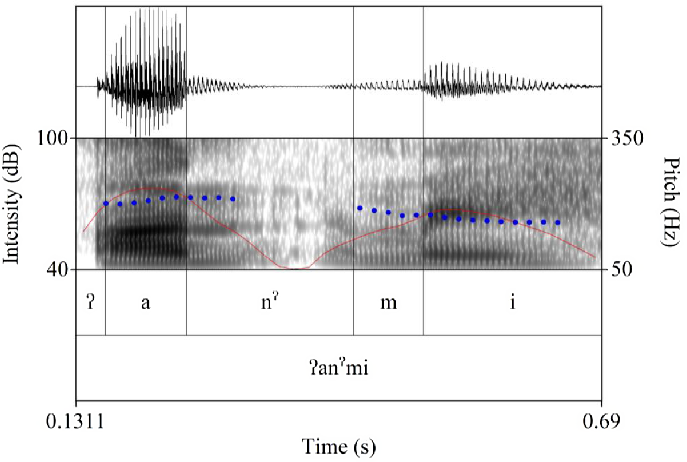
A spectrogram and waveform of /ʔan̰mi/ ‘while leaning’, illustrating the intensity (red solid line) and the pitch (blue dotted line) of the laryngealized alveolar nasal in coda position.

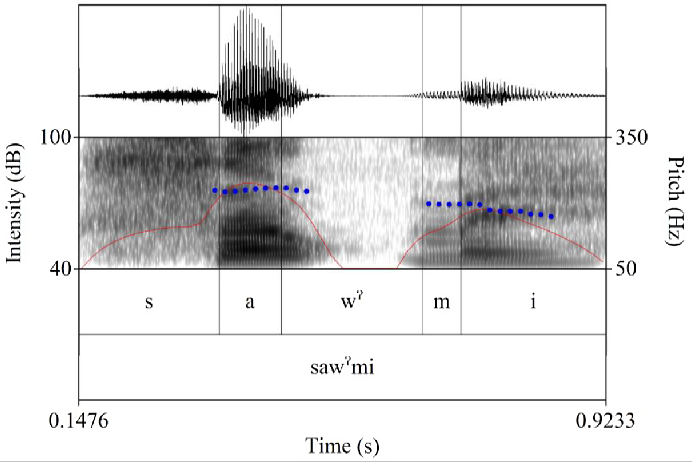
A spectrogram and waveform of /saw̰mi/ ‘while watering’, illustrating the intensity (red solid line) and the pitch (blue dotted line) of the laryngealized labial-velar approximant in coda position.

When a laryngealized nasal or approximant is in coda position, the decrease in amplitude, intensity and pitch level is dramatic compared to the cases of the modally voiced sonorant. The intensity level for the laryngealized portions of the laryngealized alveolar nasal in /ʔan̰mi/ ‘while leaning’ (Figure 14) and the laryngealized labial-velar approximant in /saw̰mi/ ‘while watering’ (Figure 15) drops below the bottom threshold of 40 dB on the y-axis. The amplitude of the laryngealized portion of the laryngealized sonorants is also much reduced relative to the modally voiced sonorants in Figures 12 and 13. Due to the cessation of voicing in the laryngealized portion of the segments in Figures 14 and 15, f0 is absent in the middle of this portion. In both figures, intensity and amplitude levels rise sharply and pitch returns after the laryngealized sonorant ends and the following modally voiced sonorant begins. In Figure 14, the pitch drops slightly at the beginning of modal voicing on [m] in [ʔan̰mi], though we are not certain whether this is due to the previous glottal constriction having raised f0 beforehand, as suggested by a reviewer, or because of a general downdrift of pitch toward the end of a word spoken in isolation.
In the laryngealized portions of the laryngealized sonorants in Figures 14 and 15, there is a period of silence, especially noticeable in Figure 15. The brief period of silence in the laryngealized sonorants in these cases is typically perceived as a glottal stop, as also noted in Collord (Reference Collord1968: 4), e.g. /ʔan̰mi/ is perceived as [ʔanʔmi]. In other tokens of laryngealized sonorants, there is no full glottal closure or silence, but creaky voicing instead. For example, in [saw̰itʰ] in Figure 11, the laryngealized sonorant /w̰/ has creaky voicing but not full glottal closure (see also Bird Reference Bird2011 for St’át’imcets). The same variation occurs with intervocalic glottal stops /ʔ/, which are sometimes realized as a full closure [ʔ] and other times as creaky voice on the neighboring vowels.
Vowels
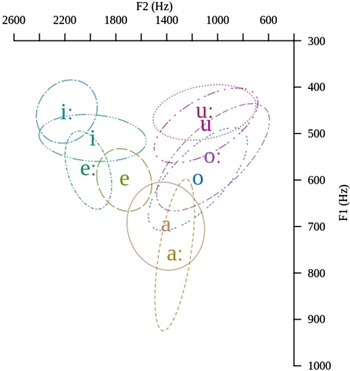
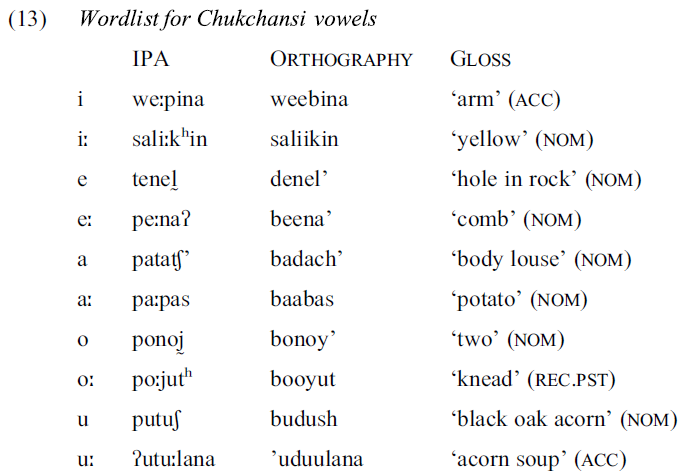
Chukchansi has a ten-vowel system, distinguishing five vowel qualities that are also contrastive in length, as shown in the impressionistic vowel diagram.

The five vowel qualities are arranged in a triangular system /i e a o u/, with a single low vowel /a/ and the non-low back vowels /o u/ rounded. As discussed below, the long vowels /iː eː aː oː uː/ are more peripheral than the short vowels /i e a o u/, e.g. short /e o/ are closer to Cardinal Vowel 3 /ɛ/ and Cardinal Vowel 6 /ɔ/, respectively. These vowels are illustrated in (13):
Vowel F1 and F2
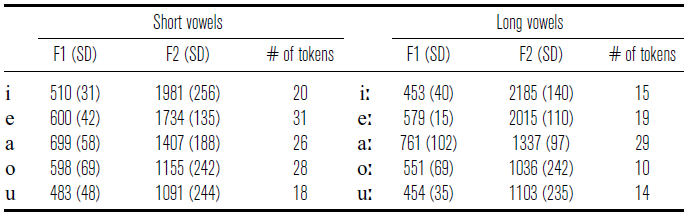
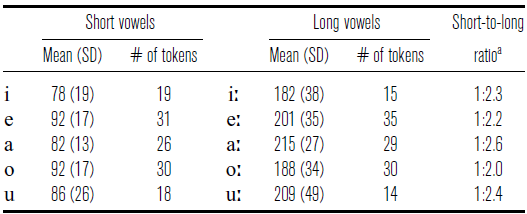
In addition to being distinguished by duration, short and long vowels in Chukchansi are also distinguished in the vowel space. Impressionistically, long vowels in Chukchansi are more peripheral than short vowels. Table 1 shows the mean values and standard deviations of the first two formants for the ten Chukchansi vowels. The measurements were based on vowels in the penultimate (stressed) position of two- or three-syllable words and in an open syllable.Footnote 2 Based on the recording of one native speaker, these words were produced in isolation, repeated two or three times, with a total of 247 tokens. Consonant environment was not controlled for, to allow for a balanced number of tokens. The wordlist includes both words recorded for this study and additional words that were necessary to obtain enough tokens of all the vowels. Formant measurements were made at the midpoint of the vowel in Praat (version 6.0.41; Boersma & Weenink Reference Boersma and Weenink2018), using a modified script from Christian DiCanio (http://www.acsu.buffalo.edu/∼cdicanio/scripts.html).
Mean F1/F2 values (in Hz), Standard Deviations (in parentheses) and number of tokens of Chukchansi vowels.

The F1 mean values in Table 1 show that high and mid short vowels tend to have higher values (and are thus lower in the vowel space) compared to their long counterparts. The F1 mean value for /a/, on the other hand, is lower than for /aː/, suggesting that the short vowel is higher in the vowel space than its long counterpart for the low vowel. The F2 mean values for /i e/ are lower than for /iː eː/, but they are higher for /o a/ than for /oː aː/. This suggests that, with the possible exception of /u uː/, long vowels are slightly more peripheral than short vowels, as cross-linguistically expected (e.g. Johnson & Martin Reference Johnson and Jack2001 for Creek, Maddieson, Smith & Bessell Reference Maddieson, Smith and Bessell2001 for Tlingit, Hirata & Tsukada 2009 for Japanese).Footnote 3 Figure 16 shows the vowel space of the ten vowels in Chukchansi, with the IPA symbol at the mean and the ellipses giving one standard deviation.
Chukchansi vowel space, with ellipses indicating one standard deviation away from the mean. The figure was created using the phonR package in R (McCloy Reference McCloy2016).

As shown in Figure 16 below, there is quite a bit of overlap in the acoustic space between a short vowel and its long counterpart. The degree of overlap is greater for /u uː/ than for the other vowel pairs. Among the long vowels, there is a slight overlap between the front vowels /iː eː/ and between the back vowels /uː oː/. The long vowel /aː/ does not overlap with the other long vowels. Among the short vowels, a small amount of overlap occurs among adjacent vowels, with the largest overlap between /a o/.
Vowel length
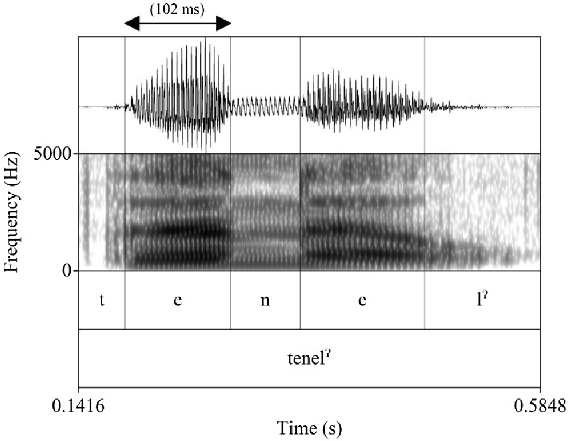
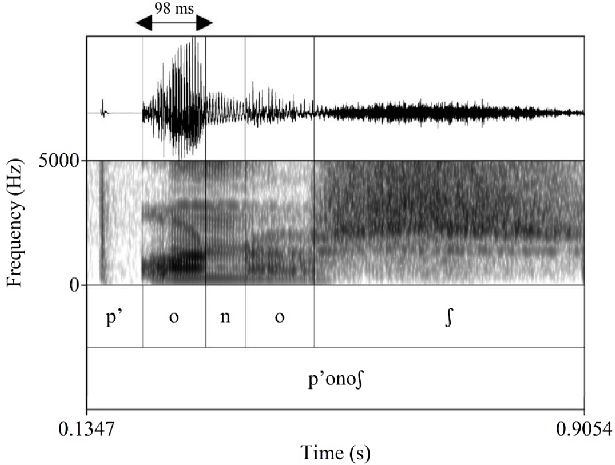
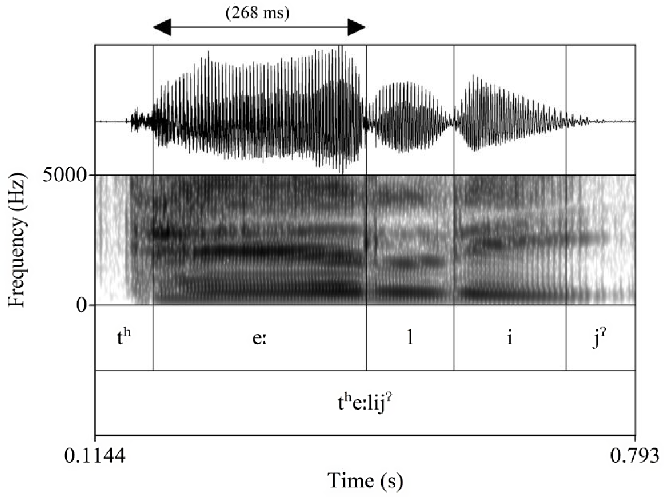
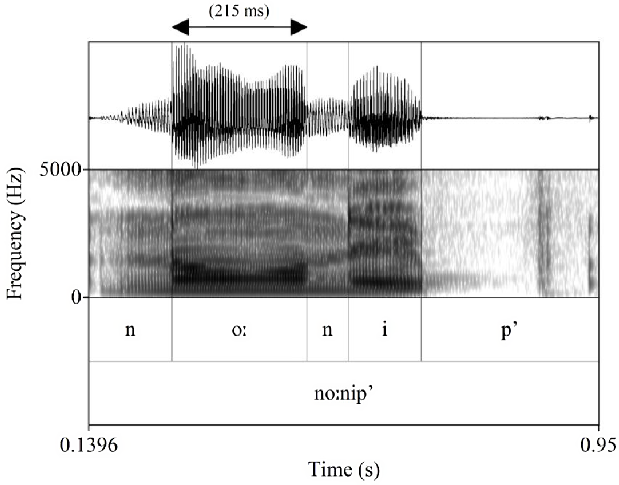
All vowels in Chukchansi have contrastive length, as illustrated in Figures 17–20. The contrasted vowels are in an open penultimate syllable, thus bearing the primary stress, as described below in the section ‘Prosodic Features’. They show the relative duration of short and long vowels. The vowels are preceded by the plosives /t pș tʰ/ or the nasal /n/ and followed by the modally voiced alveolar sonorants /n l/. Vowel duration was measured from the beginning of high-amplitude, periodic waveforms to the end of the high-amplitude in the waveform. The waveforms in Figures 17–20 show that the distinction in amplitude clearly shows the boundary between vowels and sonorants. Figures 17 and 18 illustrate the short vowels /e/ in /tenel̰/ and /o/ in /pșonoʃ/.
Figures 19 and 20 show the long vowel counterparts: /eː/ in /tʰeːlij̃/ and /oː/ in /noːnipș/. The duration difference for short vs. long vowels in the cases presented in Figures 17–20 is greater than a 1:2.0 ratio. In the case of /tenel̰/ vs. /tʰeːlij̃/, the ratio is 1:2.6. In the case of /pșonoʃ/ vs. /noːnipș/, it is 1:2.2.
Mean duration values (in ms), Standard Deviations (in parentheses), number of tokens and duration ratios of Chukchansi vowels.

aMartin’s (2011) study is the only other existing acoustic investigation of Chukchansi vowels. His study is based on two speakers, one of whom is the third author in the present study. He finds the duration ratio for short vs. long vowels to be 1:1.5 for mid front and high vowels, and about 1:2.0 for mid back and low vowels.
A spectrogram and waveform of /tenel̰/ ‘hole in rock’ (nom), illustrating the mid short vowel /e/ in open penult with a 102 ms duration.

A spectrogram and waveform of /pșonoʃ/ ‘hand’ (nom), illustrating the mid short vowel /o/ in open penult with a 98 ms duration.

Duration measurements of short and long vowels are presented in Table 2. The duration measurements were based on the same vowels from which the formant measurements were made.
In addition to the mean duration values and standard deviations, Table 2 shows the number of tokens analyzed and the duration ratios of the vowels with contrastive length. The results indicate that for all vowels, the duration ratios for short vs. long vowels are at least 1:2.0. The smallest duration ratio is observed for the mid back vowels /o oː/ and the greatest duration ratio for the low vowels /a aː/.
A spectrogram and waveform of /tʰeːlij̃/ ‘tooth’ (nom), illustrating the mid long vowel /eː/ in open penult with a 268 ms duration.

A spectrogram and waveform of /noːnipș/ ‘nine’ (nom), illustrating the mid long vowel /oː/ in open penult with a 215 ms duration.

Syllable structure and vowel alternation
Chukchansi Yokuts is an exclusively suffixing language. Open-class, lexical items in Chukchansi, including nouns, adjectives, and verbs, consist of a lexical root at the left edge of the word and an obligatory final suffix: case for nouns and adjectives (/-a/ acc in (16)) and tense, mood, or gerundials for verbs, like /-tʰaʔ/ rem.pst in (17). In addition, lexical words can also have any amount of optional non-final suffixes (/-han-/ pass, /-la-/ caus, /-maʔʃa-/ desid in (17)). The words in (14)–(17) show different levels of morphological complexity, from monomorphemic words, either adverbs (14) or unmarked nouns in the nominative case (15) to words with several morphemes (17).
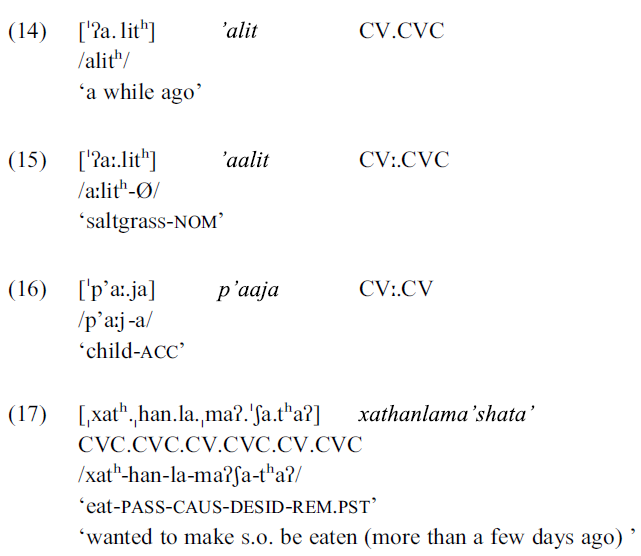
Chukchansi has three syllable types: CV, CVː, and CVC, which are illustrated in (14)–(17). All consonants in Chukchansi are possible codas morphophonemically. The only restriction on coda consonants we are aware of involves the neutralization of the plosive aspiration vs. unaspiration contrast in coda position, discussed above (see examples (2)–(4)). Vowel length and coda consonants cannot both occur in the same syllable, i.e. there are no *CVːC syllables. When a CVːC syllable would occur due to morpheme concatenation, the long vowel shortens, as seen in (18).
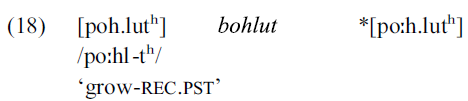
Clusters of two consonants can appear word-internally, and are heterosyllabic ([h.l] in (18)). There are no complex onsets or codas, and thus no clusters of three or more consonants. Where a cluster of more than two consonants might be expected based on morpheme concatenation, a high vowel [i] or [u] appears after the first consonant so that only two-consonant clusters surface, as seen in (19).

These generalizations, which are identical in other Yokuts languages, have been attributed to a CV(X) syllable canon for Yokuts by Kuroda (Reference Kuroda1967) and Kenstowicz & Kisseberth (1979), for example. That is, a syllable in Chukchansi has an obligatory onset and vocalic nucleus (CV), either a coda consonant or vowel length (X), and no complex onset, nuclei or codas. The CV(X) syllable canon drives the high-vowel∼zero alternation observed above (in (18) and (19)) and in (20a, b), where the vowel [i] appears and prevents a complex coda [lpș].

The high vowel∼zero alternation is categorical and is insensitive to segmental or morphological factors, occurring with both front, in (20), and back, in (18)–(19), vowels and with both verbs, in (18)–(19), and nouns, in (20). This alternation has been analyzed as deletion (Collord Reference Collord1968), epenthesis (Archangeli Reference Archangeli1991, Guekguezian Reference Guekguezian2011), or both (Newman Reference Newman1944, Kuroda Reference Kuroda1967). Throughout this Illustration, we assume epenthesis, i.e. that the high vowel is not present in the morphophonemic representation. However, the data are equally amenable to a deletion account; for phonological arguments, which are outside of the scope of this Illustration, we refer the reader to the references.
Other vowel alternations in Chukchansi, like in other Yokuts varieties, are at least partly sensitive to segmental or morphological factors other than the CV(X) syllable canon. In rounding harmony, suffix vowels or epenthetic vowels are rounded following a rounded root vowel. For example, in verbs with the rec.pst suffix /-(i)tʰ/, rounding harmony produces [u] in [poh.l u tʰ], as in (18) above, and [poː.j u tʰ], as in (21):
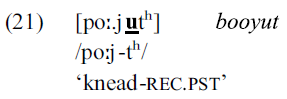
Rounding harmony is not automatically triggered by every rounded root vowel. For instance, /oː/ in /poːj/ triggers rounding of the following vowel of the the rec.pst suffix /-(i)tʰ/ to [u], seen in (21), but /o/ in /som/ does not, so that the suffix vowel remains [i], as seen in (22) (data in Newman (Reference Newman1944), Collord (Reference Collord1968) and Guekguezian (Reference Guekguezian2011) show that this is not due to the difference in length).
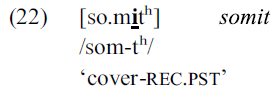
The different behavior of /o(ː)/ vowels in Yokuts rounding harmony has been attributed to an abstract difference in vowel height (Newman Reference Newman1944, Kuroda Reference Kuroda1967) or a morphological property of the root (Blevins Reference Blevins2004).
Some vowel alternations in Chukchansi are associated with specific suffixes and are not predictable from phonotactics. For example, the form [po.hoː.l] of the root ‘grow’ with /-e-/ causative in (23) below differs from the forms [poh.l] in (18) and [poː.hul] (19) above in that the first vowel is short though in an open syllable and the second vowel is long and has the same quality as the first. The change of root vowels is conditioned by the specific suffix /-e-/ causative. The vowel of the causative suffix /-e-/ undergoes rounding harmony to [o] while the vowel of the remote past suffix /-tʰaʔ/ does not. These vowel alternations are categorical processes, and the insertion of long vowels like [oː] in (23) are driven by morphological, not phonotactic reasons.
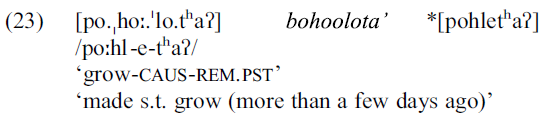
Morphologically-driven vowel alternations in Yokuts like those in (23) have been analyzed as stem variants linked to different suffixes (Newman Reference Newman1944, Gamble Reference Gamble1978), morphophonological processes (Collord Reference Collord1968, Whistler & Golla Reference Whistler and Golla1986, Gamble Reference Gamble1991, Callaghan Reference Callaghan1997), a CV- or prosodic templates (Archangeli Reference Archangeli1983, Reference Archangeli1991; Guekguezian Reference Guekguezian2011), the interaction of morphological cycles and prosodic requirements (Guekguezian Reference Guekguezian2017), and representational specifications unique to suffixes (Golston & Krämer 2018, Golston, Guekguezian & Krämer Reference Golston, Guekguezian and Krämer2019). As far as we are aware, no acoustic studies have been done of vowel alternation in Chukchansi or other Yokuts varieties. The acoustic properties of vowels that undergo phonological and morphological alternation provide a fruitful avenue of future research.
Prosodic features
In earlier observations of Yokuts languages, word-level stress is claimed to be on the penultimate syllable (Newman Reference Newman1944, Kroeber Reference Kroeber1963, Collord Reference Collord1968). This observation is primarily based on pitch differences: a word uttered in isolation has a pitch peak on the penult (Collord Reference Collord1968: 6,14). Collord (Reference Collord1968: 14) also finds secondary stress on all heavy syllables (CVː or CVC) in Chukchansi. More recent acoustic studies of Chukchansi stress, including Mello (Reference Mello2012), Guekguezian (Reference Guekguezian2016) and Peed (Reference Peed2019) mostly confirm the pattern in Collord.Footnote 4 We follow the general pattern in the literature for words uttered in isolation: penultimate light and heavy syllables have primary stress, marked by a pitch peak, while pre-penultimate heavy syllables have relative higher pitch as wellFootnote 5 The words in (24) illustrate this pitch pattern.
(24)Word-level stress in Chukchansi Footnote 6
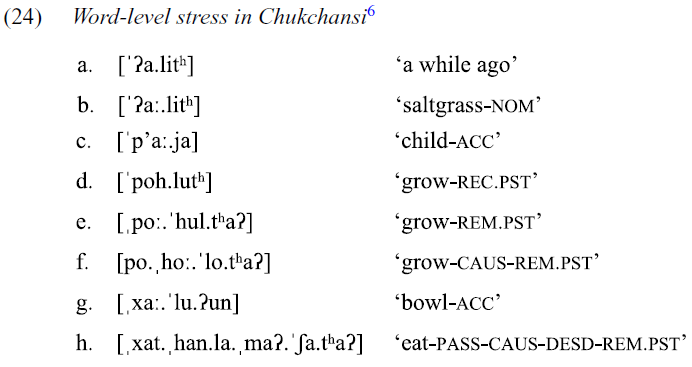
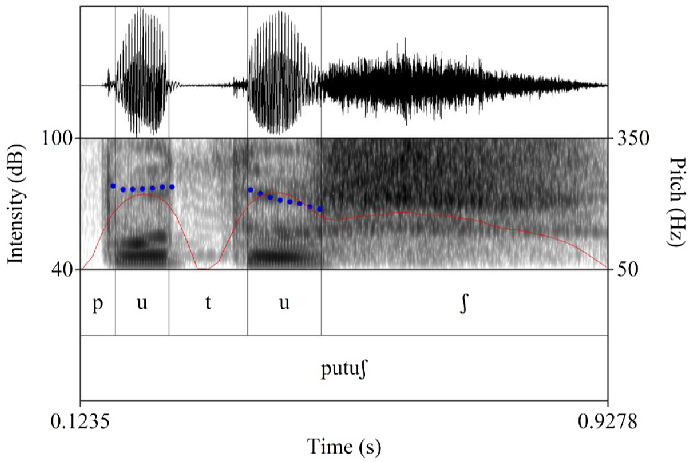
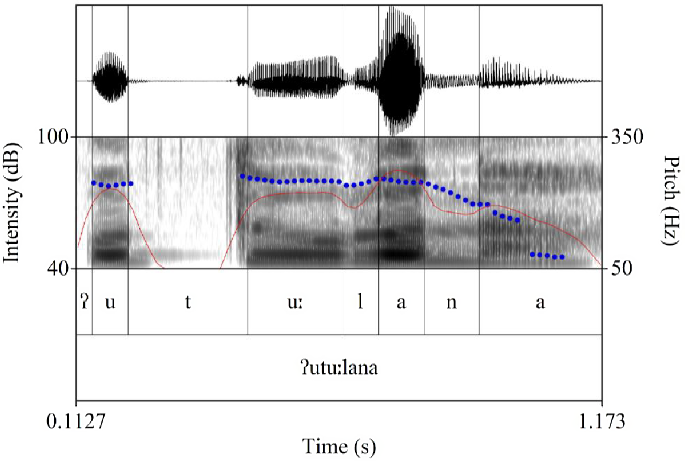
Figures 21 and 22 show a pitch peak on the penultimate syllable, whether the word is disyllabic, like [ˈpu.tuʃ] ‘black oak acorn’ (nom) in (Figure 21), or longer, like [ʔu.̩tuː.ˈla.na] ‘acorn soup’ (acc) (Figure 22).
A spectrogram and waveform of [ˈpu.tuʃ] ‘black oak acorn’ (nom), illustrating the pitch peak (blue dotted line) on the penultimate syllable.

A spectrogram and waveform of [ʔu.̩tuː.ˈla.na] ‘acorn soup’ (acc), illustrating the pitch peak (blue dotted line) on the penultimate syllable.

Because the antepenultimate syllable [tuː] of [ʔu.̩tuː.ˈla.na] in Figure 22 is heavy, it has secondary stress, visible as a higher pitch level than the unstressed syllables [ʔu.] and [.na], almost as high as the pitch peak on the stressed penult [.la.]. As an anonymous reviewer points out, the intensity is higher on the light, penultimate syllable than on the heavy, antepenultimate syllable in Figure 22 (as is true for [po.̩hoː.ˈlo.tʰaʔ] in (24f) above]. This suggests that primary stress may have higher intensity than secondary stresses, though further study is needed to investigate this possibility.
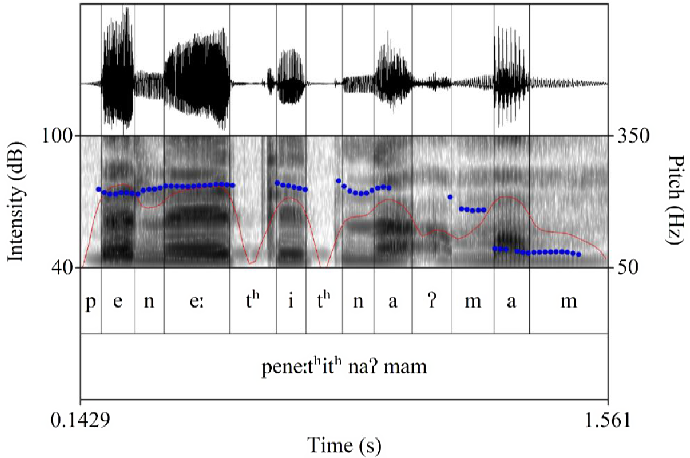
The word-level stress patterns shown above apply to words uttered in isolation. Collord (Reference Collord1968: 27) observes that ‘the stress pattern of a multi-word utterance may not coincide with isolation criteria in identifying word boundaries’. In terms of phrase-level prosody, Chukchansi has a phrase-final drop in pitch. This phrase-final pitch drop is likely responsible for the pitch fall observed on final syllables of words spoken in isolation. The data in Peed (Reference Peed2019) also suggest that phrase-final syllables have lower pitch than word-final syllables in phrase-medial position, which in general sustain the same pitch level as penultimate syllables (Peed Reference Peed2019: 32). These facts about the interaction of word-level and phrase-level stress are shown by the phrase [pe.ˈneː.tʰitʰ naʔ mam] (25), whose prosodic pattern is illustrated in Figure 23.

A spectrogram and waveform of [peneːtʰitʰ naʔ mam] ‘I asked you’, illustrating pitch (blue dotted line), with a rise to a peak on the penultimate lexical syllable [.neː.], a steady level followed by a sharp drop on the phrase-final syllable [.mam.].

Figure 23 shows a rise in pitch to a peak on the penultimate syllable [.ˈneː.] of the lexical verb [pe.ˈneː.tʰitʰ]. This pitch level is sustained roughly at the same level until it drops sharply on the phrase-final syllable [.mam.].
These facts suggest that word-level and phrase-level prosody may interact as follows: the penultimate syllable of each word has a pitch peak, while the final syllable of each phrase has a pitch trough. As a result, a word in isolation, like in Figures 21 and 22, shows a peak on the penult followed by a sharp drop on the ultima. For a word in phrase-medial position, there will be no drop on the ultima: the pitch level may stay the same or decrease slightly. More detailed acoustic study is needed to investigate the interaction between word and phrase stress, the relative prominence of stresses within the word, and the precise pitch heights and movements associated with each level and domain of stress.
Transcription of recorded passage
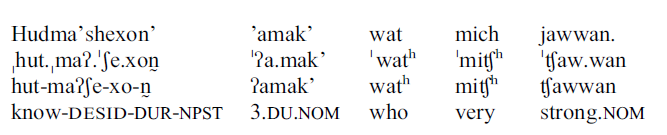
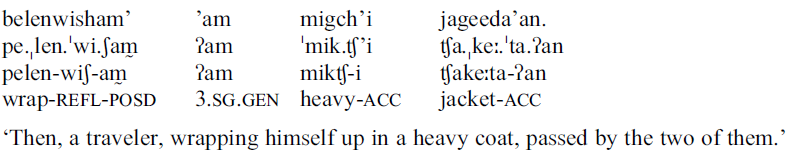
The transcribed recorded passage is an adapted version of ‘The North Wind and the Sun’ story.

‘The two of them wanted to know who was very strong.’


Acknowledgements
We are grateful to editors Marija Tabain and Matthew Gordon, and two anonymous reviewers for many helpful comments and suggestions on earlier drafts of this manuscript.
Supplementary material
To view supplementary material for this article (including audio files to accompany the language examples), please visit https://doi.org/10.1017/S0025100321000268.