Oppositional defiant disorder (ODD; American Psychiatric Association, 2013) is a common childhood disorder (Lavigne, LeBailly, Hopkins, Gouze, & Binns, Reference Lavigne, LeBailly, Hopkins, Gouze and Binns2009; Nock, Kazdin, Hiripi, & Kessler, Reference Nock, Kazdin, Hiripi and Kessler2007). The prevalence of ODD is high in the preschool years (Lavigne et al., Reference Lavigne, LeBailly, Hopkins, Gouze and Binns2009) but declines slightly around 5 years of age (Lavigne et al., Reference Lavigne, Binns, Christoffel, Rosenbaum, Arend and Smith1993), with this decline continuing into adolescence (Canino, Polanczyk, Bauermeister, Rohde, & Frick, Reference Canino, Polanczyk, Bauermeister, Rohde and Frick2010). For some children, however, the presence of ODD either as a disorder or as a high level of ODD symptoms is relatively stable over time in both clinic (Campbell, Reference Campbell1995; Speltz, McClellan, Deklyen, & Jones, Reference Speltz, McClellan, Deklyen and Jones1999) and community samples (Lavigne et al., Reference Lavigne, Cicchetti, Gibbons, Binns, Larsen and DeVito2001). ODD exhibits both prospective homotypic continuity with conduct disorder (Lahey, Reference Lahey1991; Moffitt, Reference Moffitt1993) and heterotypic continuity with disorders and symptoms of disorders such as anxiety and depression (Burke & Loeber, Reference Burke and Loeber2010; Lavigne, Gouze, Bryant, & Hopkins, Reference Lavigne, Gouze, Bryant and Hopkins2014; Stringaris & Goodman, Reference Stringaris and Goodman2009a). Given its prevalence and association with subsequent psychopathology, increasing our understanding of the risk factors contributing to symptoms of ODD in early childhood is important for developing prevention and intervention programs.
Developmental psychopathologists have noted the importance of adopting a multiple-level systems perspective in examining the pathways by which various psychosocial risk factors contribute to the development of childhood disorders (Masten & Cicchetti, Reference Masten and Cicchetti2010). Longitudinal models of cascading effects within and across domains may help identify critical mediating processes that would likely be effective targets for interventions to reduce psychopathology (Masten & Cicchetti, Reference Masten and Cicchetti2010). Other researchers have stressed the need to examine chains of mediational processes across contextual, parent, parenting, and child factors (Grant et al., Reference Grant, Compas, Thurm, McMahon, Gipson and Campbell2006; Lavigne, Gouze, Hopkins, Bryant, & LeBailly, Reference Lavigne, Gouze, Hopkins, Bryant and LeBailly2012).
The present study examined a longitudinal cascade model of risk factors from multiple domains that contribute to the development and maintenance of ODD symptoms in young children from preschool to school entry (ages 4–6 years). The inclusion of specific risk factors was guided by a review of prior studies examining risk factors associated with ODD along with a cross-sectional study of those risk factors with ODD symptoms in 4-year-olds in the present sample (Lavigne et al., Reference Lavigne, Gouze, Hopkins, Bryant and LeBailly2012). These risk factors fell within the domains of contextual, parent, parenting, and child characteristics (Smeekens, Riksen-Walraven, & van Bakel, Reference Smeekens, Riksen-Walraven and van Bakel2007). As noted below, although prior research supports the association of each specific factor with ODD symptoms, few studies have examined the interplay of factors from multiple domains simultaneously, an approach consistent with a developmental cascade framework.
Among contextual variables, externalizing problems, ODD symptoms, or ODD as a disorder are associated with (a) poverty and lower socioeconomic status (SES; Greene et al., Reference Greene, Biederman, Zerwas, Monuteaux, Goring and Faraone2002; McLeod & Shanahan, Reference McLeod and Shanahan1993), (b) parental stress (Baker & Heller, Reference Baker and Heller1996; McMahon, Grant, Compas, Thurm, & Ey, Reference McMahon, Grant, Compas, Thurm and Ey2003; Ross & Blanc, Reference Ross and Blanc1998), and (c) family conflict (Grant et al., Reference Grant, Compas, Thurm, McMahon, Gipson and Campbell2006; Zimet & Jacob, Reference Zimet and Jacob2001). The association of contextual factors with ODD symptoms may involve mediational processes (Lau, Rijsdijk, Gregory, McGuffin, & Eley, Reference Lau, Rijsdijk, Gregory, McGuffin and Eley2007) including parental depression (Grant et al., Reference Grant, Compas, Thurm, McMahon, Gipson and Campbell2006) and parenting factors such as parental support and hostility (Grant, Compas, Thurm, McMahon, & Gipson, Reference Grant, Compas, Thurm, McMahon and Gipson2004).
Among parent characteristics, maternal depression is associated with symptoms of child psychopathology (Goodman et al., Reference Goodman, Rouse, Connell, Broth, Hall and Heyward2011; Kim-Cohen, Moffitt, Taylor, Pawlby, & Caspi, Reference Kim-Cohen, Moffitt, Taylor, Pawlby and Caspi2005). Maternal depression may increase child psychopathology via several mechanisms, including decreasing parental support (Hipwell et al., Reference Hipwell, Keenan, Kasza, Loeber, Stouthamer-Loeber and Bean2008), increasing parental hostility (Bor & Sanders, Reference Bor and Sanders2004; Heller & Baker, Reference Heller and Baker2000), contributing to poorer parental scaffolding ability and diminished ability to help the child regulate emotions (Gelfand & Teti, Reference Gelfand and Teti1990; Hoffman, Crnic, & Baker, Reference Hoffman, Crnic and Baker2006), and decreasing attachment security (Carter, Garrity-Rodous, Chazan-Cohen, Little, & Briggs-Gowan, Reference Carter, Garrity-Rodous, Chazan-Cohen, Little and Briggs-Gowan2001).
Child characteristics associated with symptoms of ODD include higher levels of temperamental negative affect (NA), lower levels of effortful control (EC; Eisenberg et al., Reference Eisenberg, Valiente, Spinrad, Cumberland, Liew and Reiser2009) and inhibitory control (Zeman, Cassano, Perry-Parrish, & Stegall, Reference Zeman, Cassano, Perry-Parrish and Stegall2006), and insecure attachment (DeVito & Hopkins, Reference DeVito and Hopkins2001). Somewhat less well accepted, but increasingly supported in the literature, is the relationship between externalizing disorders or ODD and problems with sensory regulation (SR) as measured independently of other temperament variables (Ben-Sasson, Carter, & Briggs-Gowan, Reference Ben-Sasson, Carter and Briggs-Gowan2009; Gouze, Hopkins, LeBailly, & Lavigne, Reference Gouze, Hopkins, LeBailly and Lavigne2009).
While the associations cited above are relatively well established, few researchers have examined the mediational processes by which these factors are associated with the level of symptoms (or presence of disorder) of ODD, or with stability of ODD over time. Mediational processes are likely to play important roles in the association of most psychosocial factors with disruptive behavior disorders (Burke, Loeber, & Birmaher, Reference Burke, Loeber and Birmaher2002), and developmental cascade models assume single variables are unlikely to determine longitudinal outcomes (Cox, Mills-Koonce, Propper, & Gariepy, Reference Cox, Mills-Koonce, Propper and Gariepy2010).
To improve our understanding of mediational processes within and across domains, Lavigne et al. (Reference Lavigne, Gouze, Hopkins, Bryant and LeBailly2012) examined a cross-sectional, multidomain model, including the factors noted above, that had been shown to have significant relationships with ODD symptoms or externalizing disorders. Briefly, the best fitting cross-sectional model for ODD symptoms at age 4 showed that (a) variables in each domain were associated with symptoms of ODD via mediation by variables at a more proximal level, often via several long meditational chains; (b) SES had indirect effects on the level of ODD symptoms via contextual factors of stress and conflict, the parent factor of parental depression, and parenting factors, including parental hostility, support, and scaffolding; (c) conflict had direct effects on symptoms of ODD and indirect effects on ODD symptoms, via parental depression and parenting; (d) stress did not have a direct effect on symptoms of ODD but did have an indirect effect via decreased parental support; and (e) parental depression did not have a direct effect on ODD symptoms, but parental depression was associated with ODD symptoms via pathways that included parenting (increased parental hostility, decreased parental support, and decreased quality of scaffolding) and child temperament, including SR and NA, but not EC.
Parenting factors of support, hostility, and scaffolding had direct associations with symptoms of ODD. The effects of parental hostility and support were partially mediated by their associations with child EC and SR. Parenting had little relation to the expression of NA. Among child factors, EC had a strong association with ODD symptoms. Children low on EC had higher symptom levels of ODD. SR and NA had weaker, but significant associations with ODD symptoms in expected directions, and IC was unrelated to ODD symptoms. Attachment did not have a direct effect on ODD symptoms, instead exerting its effect indirectly through child EC.
Although cross-sectional studies can advance knowledge about relations between putative risk factors and outcomes, as well as contribute to the development of longitudinal models when cross-sectional data are lacking (Rutter, Reference Rutter2005), such models cannot replace a longitudinal analysis in addressing certain key issues (Shanahan, Copeland, Costello, & Angold, Reference Shanahan, Copeland, Costello and Angold2008). In particular, longitudinal analyses are necessary to determine how cascading domains of risk factors may contribute to the presence of disorder at a later date, and to identify the factors associated with stability or change in symptoms over time. Presently, few studies have examined the factors associated with stability and change in ODD. Lavigne et al. (Reference Lavigne, Arend, Rosenbaum, Binns, Christoffel and Gibbons1998) found that lower SES, poorer family cohesion, more negative life events, and higher levels of maternal NA were associated with more stable diagnoses of ODD in young children. Other variables found to be associated with stability of ODD diagnosis and high levels of ODD symptoms include more severe levels of disruptive behavior disorders (Burke et al., Reference Burke, Loeber and Birmaher2002) and ongoing stress (Campbell, Pierce, Moore, Marakovitz, & Newby, Reference Campbell, Pierce, Moore, Marakovitz and Newby1996). None of these studies of the stability of ODD (diagnosis or high symptom level), however, examined potential mediating or cascading effects of these risk factors.
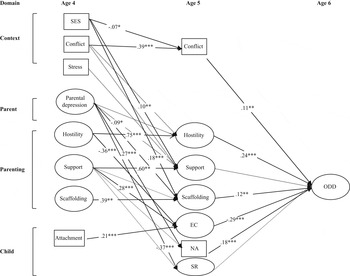
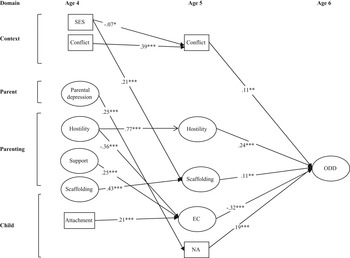
In the present study, we examined a longitudinal, multidomain, cascade model (Figure 1) that was derived from a cross-sectional model previously shown to be associated with ODD symptoms in young children (Lavigne et al., Reference Lavigne, Gouze, Hopkins, Bryant and LeBailly2012). The longitudinal cascade model included (a) age 4 contextual and parent risk factors as predictors of subsequent parenting, and child factors at age 5; and (b) age 5 parenting and child factors as predictors of ODD symptoms at age 6. We hypothesized that there would be cascading effects from more distal to more proximal factors from ages 4 to 6, with contextual (SES, family stress, and family conflict) and parent (parental depression) factors at age 4 predicting parenting and child factors at age 5. We also hypothesized that the contextual and parent factors measured at age 4 would be associated with age 6 ODD symptoms via their effects on age 5 contextual factors. We further hypothesized that the parenting and child factors at age 5 would be associated with ODD symptoms at age 6.
Multidomain (multiple level) cascade model of factors at age 4 and 5 associated with levels of symptoms of oppositional defiant disorder (ODD) at age 6 regardless of ODD symptom levels at ages 4 and 5. Solid lines illustrate significant paths; dotted lines illustrate nonsignficiant paths. SES, Socioeconomic status; EC, effortful control; NA, negative affect; SR, sensory regulation. *p < .05. **p < .01. ***p < .001.

Two primary models were examined. First, we created a model examining the cascading, multidomain associations of these variables assessed at ages 4 and 5 with the level of ODD symptoms at age 6. This model primarily examines the indirect effects and mechanisms by which different levels of ODD symptoms are found at age 6. Second, we created a model examining the associations of those variables with changes in ODD symptoms between ages 5 and 6. This model is most important for understanding the factors that are associated with changes in ODD symptoms between ages 4 and 6 years. In addition, the parsimonious model of predictors was examined; this model is particularly important in deciding which factors may be the most important predictors of ODD symptom levels at age 6 years. We were primarily interested in examining factors associated with ODD symptoms at the beginning of early grammar school, at age 6, rather than the trajectory of changes in ODD symptoms. For this reason, we did not conduct latent growth curve model analyses to determine which factors were associated with a general growth trend. Furthermore, because we were primarily concerned with the cascading, or mediating, effects associated with the presence of ODD symptoms at age 6, early in a child's grammar school career, rather than moderators associated with differing trajectories of symptoms, structural equation modeling approach (SEM) was preferable to hierarchical linear modeling.
Method
Participants
Data were collected as part of a multilevel, longitudinal study of the factors related to symptoms of ODD in young children. Children and their parents were followed from ages 4 to 6, ages that include three key developmental periods: preschool, kindergarten, and grammar school entry. There were 796 children and their parents who were recruited from 23 primary care pediatric clinics in Cook County, Illinois, and 13 Chicago Public School preschool programs.
Efforts were made to recruit a highly diverse sample, and we attempted to ascertain a sample that was similar in its racial/ethnic distribution to that of Cook County, Illinois, which, at the time of study initiation, was 45.4% White non-Hispanic, 22.2% Hispanic, 26.4% African American, and 5.9% other (United States Census Bureau, 2007). To obtain a substantial minority inclusion, we recruited through the Chicago Public Schools, which were 10% White non-Hispanic, 51% African American, 36% Hispanic, and 3% other at that time (http://www.cps.edu/school/data/Pages/Schooldata.apx). To reduce recruitment costs, we needed to recruit at schools with large enrollments located in various racial/ethnic communities throughout Chicago. We were aided in identify such schools by the early childhood education program of the Chicago Public Schools. Primary care practices were recruited from across the county, including inner-city practices. All such practices were members of the Pediatric Practice Research Group (Christoffel et al., Reference Christoffel, Binns, Stockman, McGuire, Poncher and Unti1988), a consortium of local practices interested in primary care research.
At the time of enrollment, eligible children were age 4 years, were English or Spanish speaking, lived with the parent participating in the study for 6 months or longer, obtained a standard score on the Peabody Picture Vocabulary Test of >70 (Dunn & Dunn, Reference Dunn and Dunn1997), were not enrolled in class for the intellectually disabled, and did not meet criteria for autism spectrum disorder.
When approached at the schools and offices at the initial contact, 1,738 families expressed an interest in learning about the study at the initial contact. From among that group, 827 (47.5%) families agreed to participate and completed the age 4 assessment. There were 31 families who were ineligible, resulting in a final sample of 796.
Of the 796 4-year-olds, there were 391 (49.1%) boys; the mean age of the entire sample was 4.44 years. All social classes (Hollingshead, Reference Hollingshead1975) were included, with 303 (38.1%) children in the highest class (Class I), 290 (36.4%) in Class II, 79 (9.9%) in Class III, 63 (7.9%) in Class IV, and 61 (7.7%) in Class V. We sought a racially/ethnically diverse sample that was similar to the diverse county from which the sample was recruited, Cook County, Illinois. For the sample, parent-reported racial/ethnicity membership was: 433 (54.4%) White non-Hispanic, 133 (16.7%) African American, 162 (20.4%) Hispanic, 19 (2.4%) Asian, and 35 (4.4%) multiracial or “other.” Race/ethnicity was not reported by 14 (1.8%) parents. When compared to Cook County census data (United States Census Bureau, 2007), the study sample had slightly more White non-Hispanic children than the county (Cook County, 45.4% White), was similar to that of the county for Hispanic children (Cook County, 22.2%) and Asian children (Cook County 5.5%), and had somewhat fewer African American children (Cook County, 26.4%). With other included in the minority category, the overall percentage of minority children in the sample (45.6%) was slightly lower than in the county (54.1%).
A total of 626 children and families (78.6%) participated in all three waves of data collection. Families completing all three waves differed from those who did not with respect to race, with a greater proportion of dropouts among minority participants χ2 (5, 796) = 77.7, p = .001; lower SES groups χ2 (4, 796) = 69.61, p = .001; and younger children, 25 days older at study entry, t (773) = 2.41, p = .02. As discussed in the Data Analysis section, missing data were imputed, so the final sample N for this report was 796.
Measures
A multiple-informant approach was used that included parent reports and interviews to assess outcomes and several risk factors, observer ratings for risk factors of child attachment and parent scaffolding, and objective measures of IC. Child self-reports could not be used because of the children's ages. We used multiple indicators of a construct to estimate latent factors and reduce measurement error associated with single measures whenever possible. When multiple indicators could not be used, either a single measure or a composite measure was used to assess the particular construct (see Data Analysis section for details). Information about measures of internal consistency derived from this sample are included below. Additional information about measures of internal consistency obtained by test developers, and sample items, is available online.
Contextual measures
SES and demographics
Parent-reported demographic information on the child's age, sex, and race, and parent's education and employment was obtained. Parent education and employment were coded for SES using the Hollingshead Four Factor Index of Social Status (Hollingshead, Reference Hollingshead1975).
Family conflict
A composite measure (α = 0.71) of parent-reported family conflict was developed from the McCubbin Family Distress Index (McCubbin, Thompson, & Elver, Reference McCubbin, Thompson, Elver, McCubbin, Thompson and McCubbin1996), the Family Problem Solving/Communication Scale (McCubbin, McCubbin, & Thompson, Reference McCubbin, McCubbin, Thompson, McCubbin, Thompson and McCubbin1996), and the Family Environment Scale conflict scale (Moos & Moos, Reference Moos and Moos1986).
Life stress
A composite (α = 0.79), parent-report, life stress measure was created from the McCubbin Family Changes & Strains Scale (McCubbin & Patterson, Reference McCubbin, Patterson, McCubbin, Thompson and McCubbin1996), the Perceived Stress Scale (Cohen, Kamarck, & Mermelstein, Reference Cohen, Kamarck and Mermelstein1983), and the Parenting Stress Index, Short Form total stress score (Abidin, Reference Abidin1995).
Parental depression
Two measures of self-reported parental depression were used: the Center for Epidemiological Studies Depression Scale, study α = 0.55 (Radloff, Reference Radloff1977); and the Beck Depression Inventory, study α = 0.86 (Beck, Steer, & Garbin, Reference Beck, Steer and Garbin1988). The α value for the Center for Epidemiological Studies Depression Scale was relatively low, but the composite α (α = 0.90 at age 4 and 5) was good.
Parenting measures
Parent support and hostility
The Parent Behavior Inventory (PBI; Lovejoy, Weis, O'Hare, & Rubin, Reference Lovejoy, Weis, O'Hare and Rubin1999) is a parent-report measure of parenting behavior that yields two factor-analytically derived subscales: hostility/coercion (hereafter referred to as hostility; study α = 0.72 at ages 4 and 5), and support/engagement (hereafter referred to as support; study α = 0.89). Following commonly used procedures (Brown, Reference Brown2006), items were combined into three parcels of parental support/engagement and hostility, providing three indicators of each latent factor.
Scaffolding
The NICHD Three Boxes Paradigm (NICHD Early Childhood Research Network, 1999), a videotaped parent–child interaction paradigm was used to assess scaffolding. Scaffolding refers to a parents' ability to sensitively coregulate and structure their children's learning and behavior (Baker, Fenning, Crnic, Baker, & Blacher, Reference Baker, Fenning, Crnic, Baker and Blacher2007) The NICHD parent behaviors were rated by trained research assistants on 7-point Likert scales for dimensions of supportive presence, respect for autonomy, cognitive stimulation, quality of assistance, confidence, and hostility. In a factor analysis, we identified a one-factor solution we labeled scaffolding (interrater reliability with a 20% random sample, 0.69–0.80, M = 0.73, study α = 0.79 at age 4, 0.78 at age 5). Items were divided into parcels, creating three indicators of the latent scaffolding factor.
Child factors
Child NA
Rothbart, Ahadi, Hershy, and Fisher's (Reference Rothbart, Ahadi, Hershy and Fisher2001) Children's Behavior Questionnaire (CBQ; study α = 0.78) is a widely used, parent-report measure of temperament that yields a measure of NA. We followed Lengua et al.'s (Reference Lengua, West and Sandler1998) procedures of reducing item contamination with measures of child psychopathology (see Data Analysis section). A single measure of NA was used that included CBQ scales for discomfort, sadness, fear, anger/frustration, and soothability (negatively loaded).
Child EC
Temperament researchers emphasize EC's role in emotion regulation (Eisenberg et al., Reference Eisenberg, Guthrie, Fabes, Shepard, Losoya and Murphy2000). The CBQ, described above, was used as a measure of EC (study α = 0.62). After eliminating items to reduce item contamination (see Data Analysis section), the CBQ indicators of EC were inhibitory control and attentional focusing.
Child SR
The Short Sensory Profile (SSP; study α = 0.81) is a 38-item parent-report questionnaire yielding a single total score of SR (McIntosh, Miller, Shyu, & Hagerman, Reference McIntosh, Miller, Shyu and Hagerman1999). For the SSP, we followed the same procedures to reduce item contamination that were used with the CBQ, After reducing item contamination, there were three SR indicators measuring the tactile, movement, and low-energy components of SR.
Attachment
A research assistant observed the mother and child during a home visit for 120 min and then completed the Attachment Q-Sort (Waters, Reference Waters1987). The Attachment Q-Sort is a continuous measure of attachment security showing good convergent validity with the Strange Situation Paradigm (van IJzendoorn, Vereijken, Bakermans-Kranenburg, & Riksen-Walraven, Reference van IJzendoorn, Vereijken, Bakermans-Kranenburg and Riksen-Walraven2004). A second observer rated a 20% random sample of home visits (reliability = 0.77).
Receptive language
The Peabody Picture Vocabulary Test (α = 0.94; Dunn & Dunn, Reference Dunn and Dunn1997), a measure of single-word receptive language, was used as a screening measure to ensure that child participants could participate in the parent–child interaction tasks.
Child psychopathology: ODD
ODD symptoms
Three parent-rated, continuous measures of symptoms of oppositional behavior (composite α = 0.93 at ages 4, 5, and 6) were used: the parent-report ODD symptom scale from the Child Symptom Inventory for young children (Gadow & Sprafkin, Reference Gadow and Sprafkin1997, Reference Gadow and Sprafkin2000); the parent-report Eyberg Child Behavior Inventory (Eyberg & Pincus, Reference Eyberg and Pincus1999); and the symptom count measure for ODD from the Diagnostic Interview Schedule for Children Parent Scale—Young Child version (Fisher & Lucas, Reference Fisher and Lucas2006), a developmentally appropriate adaptation of the parent form of the Diagnostic Interview Schedule for Children.
Procedure
Parents were approached by research assistants at pediatric offices and preschools and given study information; subsequently, they were contacted by telephone, and a home visit was arranged for interested families at which study measures were completed. Overall, there were 1,738 families who expressed interest at the initial contact, 827 (47.5%) families who completed the Wave 1 evaluation, and 31 found to be ineligible, resulting in a final sample of 796. Parents were recontacted 1 and 2 years after the initial visit for another visit during which the Diagnostic Interview Schedule for Children Parent Scale—Young Child version and study questionnaires were readministered. This study was approved by the authors' institutional review boards; written consent to participate was obtained each year.
Data analysis
Initially, missing data and item frequencies were examined within each age group. Less than 5% of the data were missing within each group. Because imputation is generally less biased than listwise deletion (Graham, Reference Graham2009), missing data were imputed using SPSS V15.0 Expectation Maximization methodology using maximum likelihood procedures for multiple imputation.
For the longitudinal model, we retained the direct pathways showing a significant relationship to the level of ODD symptoms in the cross-sectional sample of 4-year-olds, as well as the indirect pathways within and across domains with a significant association with ODD symptoms. Pathways between specific variables within or across domains that were statistically significant but were not associated with ODD symptoms were eliminated; for example, if the path from SES to family stress was significant, but the path from stress to ODD symptoms was not, then neither the path from SES to stress nor the path from stress to conflict was retained.
Item contamination between scales for behavior problem scales and both temperament (Eisenberg et al., Reference Eisenberg, Valiente, Spinrad, Cumberland, Liew and Reiser2009; Lengua, West, & Sandler, Reference Lengua, West and Sandler1998) and SR (Ben-Sasson et al., Reference Ben-Sasson, Cermak, Orsmond, Tager-Flusberg, Carter and Kadlec2007) can inflate the relationships among EC, NA, SR, and ODD. To address this problem, we used a procedure developed by Lengua et al. (Reference Lengua, West and Sandler1998) to identify items to measure each construct while reducing item contamination across constructs. Because of the large number of items, two panels comprising either seven or eight doctoral-level psychologists and advanced clinical child psychology graduate students rated half of the items of the SSP, CBQ EC, CBQ NA, and behavioral symptom scales. For each item, the quality of the item as a sensory, temperament, or behavior problem indicator was rated on a 5-point Likert scale. SSP sensory items were retained if rated as significantly better indicators of sensory problems than temperament or behavioral symptoms; CBQ EC and NA items were retained if rated as significantly better indicators of temperament than were sensory or behavior problems.
SEM with LISREL 8.8 (Joreskog & Sorbom, Reference Joreskog and Sorbom2006) was used to evaluate the hypothesized models. We followed a two-step analytic approach (Anderson & Gerbing, Reference Anderson and Gerbing1988) in which confirmatory factor analysis was used first to test the goodness of fit of the measurement models before examining the structural models. Because multiple indicators serve to control for measurement error in latent factors, we sought multiple measures of each construct whenever possible. When the only developmentally appropriate manifest indicator involved a questionnaire with multiple items, individual items were combined into unidimensional subsets (parcels) to create multiple indicators, a procedure allowing for estimating latent factors while avoiding problems of nonnormality sometimes associated with a single indicator (Brown, Reference Brown2006). A single manifest indicator was used when the measure of the construct involved a single item, and if a good fit for a latent construct could not be achieved using multiple indicators, a composite indicator was created by summing the standardized scores from multiple scales (Nunnally & Bernstein, Reference Nunnally and Bernstein1994).
As recommended by Brown (Reference Brown2006), we report the Satorra–Bentler scaled chi-square (SB χ2; Satorra & Bentler, Reference Satorra, Bentler, von Eye and Clogg1994) to correct for multivariate nonnormality, although we did not use it to assess overall model fit because that measure is inflated by large sample sizes (Bollen, Reference Bollen1989). To obtain scaled robust maximum-likelihood chi-square values using LISREL 8, we followed Bryant and Satorra's (Reference Bryant and Satorra2012) guidelines. When assessing model goodness of fit, Brown (Reference Brown2006) recommends using multiple indices, including an index of absolute fit (standardized root mean square residual [SRMR]), an index adjusting for model parsimony (root mean square error of approximation [RMSEA]), and comparative fit indices (nonnormed fit index [NNFI]; comparative fit index [CFI]). Experts disagree on the criteria for establishing acceptable goodness of fit for commonly used indices. With regard to RMSEA, Hu and Bentler (Reference Hu and Bentler1999) consider a reasonably good fit to be close to 0.06 or below, Browne and Cudeck describe <0.08 as adequate, and MacCullum, Browne, and Sugawara (Reference MacCallum Browne and Sugawara1996) consider RMSEA values between 0.08 and 0.10 to be “mediocre.” With regard to NNFI and CFI, Bentler and Bonett (Reference Bentler and Bonett1980) proposed that relative fit indices (e.g., NNFI and CFI) of >0.90 indicates an acceptable model fit, while Hu and Bentler (Reference Hu and Bentler1999) suggested that only relative fit indices above 0.95 indicate acceptable model fit. However, Marsh, Hau, and Wen (Reference Marsh, Hau and Wen2004) have cautioned researchers against accepting Hu and Bentler's (Reference Hu and Bentler1999) more stringent criteria and support retaining Bentler and Bonett's (Reference Bentler and Bonett1980) criterion of 0.90. With regard to SRMR, a value of <0.08 has often been recommended (Brown, Reference Brown2006). In this study, we describe models with RMSEA <~0.06, NNFI > 0.95, CFI > 0.95, and SRMR < 0.08 as good fitting models. If the RMSEA is >0.06 but <0.08, the NNFI is >0.90 but <0.95, the CFI is >0.90 but <0.95, and the SRMR is <0.08, the model fit is described as moderately good. Models whose fit indices do not reach these thresholds are described as poor fitting. The significance of specific indirect effects was determined using bootstrapping procedures described by Mallinckrodt, Abraham, Wei, and Russell (Reference Mallinckrodt, Abraham, Wei and Russell2006).
Results
Comparison of ODD scores with normative data
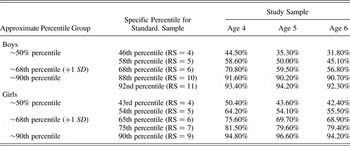
Table 1 compares the distribution of scores in the study sample at each age with those of the standardization sample for the Child Symptom Inventory on the ODD scale of that measure on key percentile levels (<50th percentile, <68th percentile, i.e., 1 SD, and <90th percentile). Because the normative sample reported a percentile for each raw score and the latter did not always correspond to those key percentiles, percentiles for the closest raw scores were reported. For boys, the percent of children below the approximate 50th, 68th, and 90th percentiles were similar to the normative sample at each age group. For girls, slightly fewer girls were above the 90th percentile at each age than in the normative sample. Overall the full range of scores were similar to that of the normative sample at each age.
Percentile levels for oppositional defiant disorder symptom scores for the study sample at each age in comparison to the standardization sample for the Child Symptom Inventory

Note: Key percentile levels (50th percentile, 1 SD, and 90th percentile) were chosen to allow for comparison of the study sample distribution of scores on the oppositional defiant disorder scale at each age with the standardization sample on the Child Symptom Inventory. The T scores and percentile for each raw score were presented in the norm manual, but did not always correspond the 50th, 68th, or 90th percentile. When that occurred, the two closest percentiles were included. RS, Raw score.
We also have reported the prevalence of ODD in children age 4 for this sample and compared that prevalence to those of other available studies of young children (Lavigne et al., Reference Lavigne, LeBailly, Hopkins, Gouze and Binns2009). Compared to the only other existing study using a structured interview (Egger & Angold, Reference Egger and Angold2006), the prevalence of ODD was slightly higher, 8.3% versus 6.6%.
Measurement models
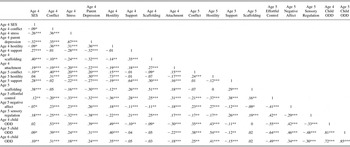
The first measurement model (Figure 1), which included predictors of the level of age 6 ODD symptoms without including age 4 or 5 ODD symptom levels, showed moderately good model fit, SB χ2 (413, 796) = 1,415.41, RMSEA = 0.05, NNFI = 0.94, CFI = 0.95, SRMR = 0.06. That model consisted of 10 latent factors with multiple indicators: (a) parental depression at age 4, with the original two parent depression scales as manifest indicators; (b) parental hostility at ages 4 and 5, with three parcels of items from the PBI hostility scale as indicators at both ages; (c) supportive-engagement at ages 4 and 5, with three parcels of items from the PBI supportive-engagement scale at both ages; (d) scaffolding at ages 4 and 5, with three parcels of items from the NICHD three boxes task as indicators at both ages; (e) EC at age 5, with two indicators from the CBQ; (f) SR at age 5, with three parcels of expert items from the SSP as indicators; and (g) the outcome measure, symptoms of oppositional behavior, with three indicators. The first model also included four factors with a single-composite indicator (age 4 stress, ages 4 and 5 conflict, and age 5 NA), as well as two factors with a single-item indicator (age 4 attachment, age 4 SES). The second measurement model (Figure 2) examined changes in ODD symptoms from ages 5 to 6 and included two additional latent factors, each with three indicators. That model showed a moderately good fit, SB χ2 (593, 796) = 2,743.72, RMSEA = 0.07, NNFI = 0.92, CFI = 0.94, SRMR = 0.06. Table 2 includes latent factor correlations. The online-only supplementary materials for this article provide a 31 × 31 table of correlations among the manifest indicators in Table S.1 and the factor loadings for the manifest indicators for each latent variable in Table S.2.
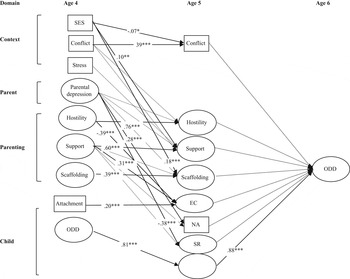
Multidomain (multiple level) cascade model of factors at ages 4 and 5 associated with changes in oppositional defiant disorder (ODD) symptom levels to age 6. Solid lines illustrate significant paths; dotted lines illustrate nonsignficiant paths. SES, Socioeconomic status; EC, effortful control; NA, negative affect; SR, sensory regulation. *p < .05. **p < .01. ***p < .001.

Correlations among latent factors

Note: SES, Socioeconomic status; ODD, oppositional defiant disorder.
*p < .05. **p < .01. ***p < .001.
Models for symptoms of ODD
The initial longitudinal cascade model (Figure 1) examined the ways in which (a) contextual and parent risk factors predicted subsequent contextual, parenting, and child factors at age 5; and (b) how those factors were associated with levels of ODD symptoms at age 6. This model, SB χ2 (477, 796) = 1,712.74, showed a moderately good fit, RMSEA = 0.06, NNFI = 0.93, CFI = 0.94, SRMR = 0.07. Of the seven hypothesized direct effects of age 5 factors that were predicted to be associated with higher levels of age 6 ODD symptom levels, four were significant and in the expected direction: family conflict (completely standardized path coefficient [PC] = 0.11, p < .01), parental hostility (PC = 0.24, p < .001), child NA (PC = 0.18, p < .001), and child EC (PC = –0.29, p < .001). Two other direct effects, for support and SR, were not significant.
The relationship between age 5 parental scaffolding skills and higher levels of age 6 ODD symptoms (PC = 0.12, p < .01) was significant and consistent with findings from the cross-sectional model. Nonetheless, the finding seems counterintuitive because one would not expect a desirable parental skill such as scaffolding to be associated with increased levels of problem behavior. When multiple factors serve as predictor variables and unexpected findings emerge, the possibility of suppression effects needs to be considered carefully (Gaylord-Harden, Cunningham, Grant, & Holmbeck, Reference Gaylord-Harden, Cunningham, Grant and Holmbeck2010). To determine if suppression effects were present, the correlations of the manifest indicators for scaffolding with ODD were examined. Those correlations showed either no relationship or a small but significant positive relationship between scaffolding skills and ODD symptoms. Because the signs of those bivariate correlations and the PCs were the same, negative suppression was not occurring. Because supportive parenting was correlated with scaffolding, however, the inclusion of both support and scaffolding may have had a cooperative suppression effect (i.e., in which the inclusion of support in the analysis may have increased the predictive value of scaffolding, by partialling out or “suppressing” error variance in ODD symptoms, leading an otherwise nonsignificant bivariate finding to be significant). As a result, two additional models were examined. In the first model, the path from age 5 support to age 6 ODD symptoms was retained and the path for age 5 scaffolding to age 6 ODD symptoms removed. As in the original model, that model also showed a nonsignificant relationship between age 5 support and age 6 ODD symptoms. The second model retained the path from age 5 scaffolding to age 6 ODD symptoms, eliminating the path from age 5 support to age 6 ODD symptoms. That model continued to show a significant relationship between age 5 scaffolding and age 6 ODD symptoms (PC = 0.12, p < .01). With no indications of suppression effects, the possibility that scaffolding is associated with higher subsequent ODD symptoms needs to be considered.
Cascading effects across domains were then examined. Three contextual factors were measured at age 4: SES, family conflict, and family stress. Because the age 4 levels of conflict, stress, hostility, support, and scaffolding were included in the model, paths from age 4 to age 5 reflect a relationship with the increase in that factor from age 4 to 5. The results show that lower SES was associated with increased family conflict from age 4 to 5 (PC = –0.07, p < .05), and higher SES with an increase in supportive parenting from ages 4 to 5 (PC = 0.10, p < .01). Higher SES also was associated with an increase in parental scaffolding skills from age 4 to 5 (PC = 0.18, p < .001). Conflict at age 4 was not associated with increased parental hostility (PC = 0.05) or supportive parenting (PC = 0.01) at age 5. Similarly, stress (PC = 0.03) was unrelated to a change in supportive parenting at age 5.
Indirect effects on age 6 ODD symptoms were noted for SES. SES had an indirect effect on age 6 ODD symptoms, with lower SES associated with more ODD symptoms via increased conflict (indirect effect PC = –0.01, 95% CI = –0.002 to –0.02). SES was also associated with higher ODD symptoms at age 6 via the relationship between SES and scaffolding (indirect effect PC = 0.02, 95% CI = 0.01–0.03), with higher SES linked to an increase in scaffolding skills from age 4 to 5, but the increase in scaffolding skills was associated with higher levels of ODD symptoms at age 6. As noted above, this latter finding did not seem to be associated with suppression effects. Age 4 family conflict was associated with age 6 ODD symptoms because of the stability of family conflict from ages 4 to 5 (indirect effect PC = 0.02, 95% CI = 0.01–0.03). Stress did not show any cascading effects on age 6 ODD symptoms. For each of the contextual variables, the indirect effect over 2 years was small but significant.
Parental depression at age 4 showed some indirect effects on the presence of age 6 ODD symptoms, as well. This occurred because parental depression had a small indirect effect on age 6 ODD symptoms via its relationship with child NA (indirect effect PC = 0.04, 95% CI = 0.02–0.07). Age 4 parental depression was associated with higher level of age 5 NA (PC = 0.26, p < .001), and higher levels of age 5 NA were associated with higher levels of ODD symptoms at age 6 (PC = 0.18, p < .001). Maternal depression also showed a small but significant indirect effect associated with ODD symptoms via scaffolding (indirect effect PC = –0.01, 95% CI = –0.002 to –0.07).
Among parenting factors, higher levels of parental hostility at age 4 were associated with age 6 ODD symptoms via child EC. That is, higher age 4 parental hostility was associated with poorer child EC at age 5 (PC = –0.36, p < .001), while poorer age 5 EC was associated with increase ODD symptoms at age 6 (PC = –0.29, p < .001). The combined indirect effect was small but significant (indirect effect PC = 0.11, 95% CI = 0.06–0.18). Because a path from age 4 hostility to age 6 ODD via age 5 hostility was also included, the path from age 4 hostility to age 6 ODD via EC is accounting for the contribution of EC to ODD separate from the direct effect of age 5 EC on age 6 ODD. There were also persistent effects of ages 4 and 5 parental hostility on age 6 ODD symptom level, with age 4 hostility contributing to age 6 ODD symptom levels via age 5 hostility (indirect effect PC = 0.18, 95% CI = 0.08–0.24).
Age 4 parental support had a significant indirect effect on age 6 ODD symptoms via age 5 EC, with greater support associated with lower levels of ODD symptoms by its association with greater age 5 EC (indirect effect PC = –0.08, 95% CI = –0.14 to –0.04). There were also persistent effects of ages 4 and 5 parental scaffolding skills on age 6 ODD symptom level, with age 4 scaffolding skills contributing to age 6 ODD symptom levels via age 5 scaffolding skills (indirect effect PC = 0.05, 95% CI = 0.01–0.07).
In this cascade model, attachment was conceptualized as a child factor, and was the only child factor included at age 4. This was done for two reasons. First, while attachment is considered the child's “internal working model” of a relationship with the parent, it is thought to result from the interaction between the parent and the child and to be closely associated with parenting. Second, the cross-sectional model from which the longitudinal model was derived showed that attachment did not have a direct effect on ODD as did the other age 5 factors in this model. Rather, attachment had indirect effects on levels of ODD symptoms via its effect on child EC. As expected, higher levels of attachment security at age 4 were associated with higher levels of ODD symptoms at age 6 via age 5 EC; that is, higher age 4 attachment security was associated with better age 5 EC (PC = 0.21, p < .001), and better age 5 EC was associated with fewer symptoms of age 6 ODD (PC = –0.29, p < .001). Overall, the indirect effect for attachment on age 6 ODD symptom levels via EC was small but significant (indirect effect PC = –0.06, 95% CI = –0.09 to –0.02).
Cascading effects on changes in ODD from ages 4 to 6
The model described above provides information about the relative contribution of various contextual, family, and child factors to the level of ODD symptoms observed at age 6. We also examined a second model to determine how those factors are associated with changes in ODD symptoms between ages 4 and 6. This second model (Figure 2) differs from that described above by including a latent ODD factor at ages 4 and 5 as well as age 6 and including paths for the autoregressions of ODD between those ages. This model thus “controls for” the baseline level of ODD and examines the changes in ODD occurring between ages 5 and 6. In such a model, the contributions of other factors to changes in ODD between ages 5 and 6 will depend upon the stability of ODD over time. That is, if the level of ODD a child exhibits over time is very stable (i.e., children with higher levels of symptoms at one age continue to rank high in symptom levels at the subsequent age, even if overall levels rise or decline), then the contribution of contextual, parent, parenting, and child factors to age 6 ODD symptoms levels to increases in ODD symptoms will be small. If ODD symptom levels are not very stable over time, however, then other factors may contribute to changes in levels of ODD symptoms. The model in Figure 2 thus examined the cascading associations of contextual, parent, parenting, and child effects on changes in ODD symptoms at age 6. That model also showed moderately good fit, SB χ2 (680, 796) = 3,297.37, RMSEA = 0.07, NNFI = 0.91, CFI = 0.93, SRMR = 0.08. In this model, the relationships between consecutive waves of ODD symptoms were very strong, as reflected in the stability correlations between autoregressive PCs for ODD (age 4 ODD → age 5 ODD, PC = 0.81, p < .001; age 5 ODD → age 6 ODD, PC = 0.88, p < .001). None of the direct effects for risk factors other than age 5 ODD made a significant contribution to changes in ODD between age 5 and 6. Because there were no significant direct effects from ages 4 to 5 involving risk factors other than ODD symptom levels, there were also no indirect, cascading effects on changes in ODD symptom levels from ages 5 to 6.
Alternative models
In SEM, it is important to consider plausible alternative models. Possibly, an adequate model of factors associated with ODD symptom at age 6 does not involve cascading effects. ODD symptoms at age 4 may already be established, and other risk factors present at age 4, along with ODD symptoms at age 4, may provide a better model of the relationship of risk factors to ODD symptoms at age 6. To test this possibility, a model in which each of the multilevel factors at age 4 along with age 4 ODD symptoms was associated with age 5 ODD symptoms, which in turn was associated with age 6 ODD symptoms (diagram of model available online only in supplemental Figure S.1), showed a moderately good fit, SB χ2 (333, 796) = 1,778.92, RMSEA = 0.07, NNFI = 0.92, CFI = 0.94, SRMR = 0.06. Comparing nonnested models using the Akaike information criterion (AIC), the cascading model (AIC = 1,948.74) showed better fit than the noncascading alternative model (AIC = 2,042.92).
Might ODD symptoms lead to more parental scaffolding?
The cascading model noted above (Figure 1) raised the possibility that scaffolding might lead to higher levels of ODD symptoms. Possibly, higher levels of ODD symptoms at age 4 are associated with increased parental scaffolding at age 5, which in turn may be associated with higher levels of ODD symptoms at age 6. We tested this possibility by including a latent factor for ODD at age 4 and an additional path from age 4 ODD symptoms to age 5 parental scaffolding, along with the path from age 5 scaffolding to age 6 ODD symptom levels. The results suggest that higher levels of ODD symptoms at age 4 are associated with a small increase in scaffolding from age 4 to age 5 (PC = 0.09, p < .05) and higher levels of scaffolding at age 5 are associated with higher levels of ODD symptoms at age 6 (diagram of model available online only in supplemental Figure S.2).
Parsimonious model
A parsimonious model (Figure 3) predicting ODD symptoms at age 6 was created by eliminating nonsignificant paths and latent factors that did not include significant paths to another factor (e.g., stress at age 4, SR at age 5). This post hoc parsimonious model showed a moderately good fit, SB χ2 (294, 796) = 1,202.68, RMSEA = 0.06, NNFI = 0.92, CFI = 0.94, SRMR = 0.07. As expected, the parsimonious model (AIC = 1,370.68) showed a better fit than the full cascading model (AIC = 1,948.74) in Figure 1.
Parsimonious model of the multidomain (multiple level) cascade model in Figure 1 of factors associated with levels of symptoms of oppositional defiant disorder (ODD) at age 6. SES, Socioeconomic status; EC, effortful control; NA, negative affect; SR, sensory regulation. *p < .05. **p < .01. ***p < .001.

Discussion
The primary goal of this study was to examine a multidomain, cascading model of contextual, parent, parenting, and child factors at ages 4 and 5 as predictors of ODD symptoms at age 6. The period from ages 4 to 6 includes important developmental transitions from preschool to kindergarten entry and formal schooling. We used a large, diverse community sample to examine this model.
Among the contextual factors, cascading effects were found for SES, with lower SES leading to more ODD symptoms at age 6 via increased conflict between ages 4 and 5. Cascading effects for SES were also found via changes in parent scaffolding skills between these two ages. Higher SES was associated with an increase in scaffolding skills from ages 4 to 5, and this increase in scaffolding skills predicted higher levels of ODD symptoms at age 6. Subsequent analysis suggested that there is a transactional process at work, in which the child's oppositional behavior at age 4 leads to an increase in scaffolding behavior by parents, which in turn predicts more ODD symptoms at age 6. The pattern that emerges over time suggests that parents may be responding to oppositional behaviors by providing more scaffolding to reduce frustration for their children that might elicit oppositionality. That approach, however, may be ineffective, because the increase in scaffolding is associated subsequently with more oppositional behavior.
The term scaffolding was first introduced by Wood, Bruner, and Ross (Reference Wood, Bruner and Ross1976). The concept is often used in the educational literature to describe a way of teaching a child who is attempting to master a cognitive task or to develop a socioemotional skills above his/her current level of functioning. Baker et al. (Reference Baker, Fenning, Crnic, Baker and Blacher2007) describe scaffolding as involving a parents' ability to sensitively coregulate and structure their children's learning and behavior through reciprocal interaction, and may involve emotional regulation, motivation (focusing and persisting), and teaching technical skills. Technical scaffolding involves the ability to show or demonstrate how to successfully complete the task with the parent's support; motivation scaffolding involves keeping the child engaged and focused on the task and maintain some enthusiasm for the task; and emotional scaffolding involves making the task a positive experience for the child, increasing his or her sense of effectiveness and accomplishment. In an ideal scenario, scaffolding involves awareness of the child's current level of mastery of the task, provision of just enough support to the child (not too much or not too little) to move to a more advanced level of competence, and the reduction of appropriate supports, often in a gradual manner, for the child to be able function at the higher level of mastery independently over time. One of the ways in which a more resistant, oppositional child might affect the parent's scaffolding skills is that during a difficult task, the parent may try to be more supportive to keep the child engaged. This increased support, however, may reinforce the oppositional behavior; the resulting increase in uncooperative child behavior in turn may decrease the parents' ability to engage effectively in the motivational and emotional components of scaffolding.
More stringent parenting practices, such as firmer limit setting or greater use of time-out when oppositional behavior occurs, may be preferable to increasing scaffolding, as a means of reducing oppositional behavior. Another type of approach that minimizes confrontations, such as conflict resolution procedures (Green & Ablon, Reference Green and Ablon2006), may be preferable, but may be difficult to implement with such young children. Therefore, research comparing the effectiveness of both types of procedures is needed to determine how to best respond to oppositional behavior to reduce its frequency.
Conflict from age 4 to age 5 was quite stable, and age 4 conflict predicted age 6 ODD symptoms by leading to an increase in the level of family conflict at age 5 years. Conflict at age 4 did not lead to either increased parental hostility or supportive parenting at age 5; as a result, cascading effects for conflict were not found, even though age 5 parental hostility predicted higher levels of ODD symptoms at age 6. No cascading effects were noted for stress.
Cascading effects were noted for parental depression at age 4. Higher levels of parental depression predicted more age 6 ODD symptoms by leading to higher levels of child NA at age 5. The specific mechanisms by which parental depression and child NA are associated are presently unclear. Certainly, genetic factors may underlie the parent depression/child NA relationship. If parental depression affects subsequent ODD symptoms via parenting, then it must be doing so via other parental attitudes or behaviors than parental hostility, support, or scaffolding skills, because the relationship between parental depression and changes in those aspects of parenting from ages 4 to 5 were not significant in the present study.
Among parenting factors, cascading effects were noted for both parental hostility and parental support via their effects on the child factor of EC. Higher levels of parental hostility at age 4 predicted higher levels of age 6 ODD symptoms by leading to poorer child EC. That is, higher age 4 parental hostility led to poorer child EC at age 5, and poorer age 4 EC predicted increased ODD symptoms at age 6.
Both supportive parenting behaviors and scaffolding skills are considered desirable aspects of parenting, and their latent factors were positively correlated (.36 at age 4, and .19 at age 5) in the present study. Nonetheless, their associations with the level of ODD symptoms at age 6 in the present study were quite different: higher levels of scaffolding predicted increased levels of age 6 ODD, while support did not have a significant direct effect on age 6 ODD symptoms. Support at age 4 did have an indirect effect on age 6 ODD symptoms by leading to higher levels of EC at age 5. In addition, an alternative model showed that age 4 scaffolding was unrelated to age 5 EC. Taken together, these findings suggest several possibilities. First, there are elements of supportive parenting distinct from scaffolding skills that may be associated with the development of EC and, subsequently, may lead to fewer ODD symptoms. Similarly, attachment security, closely linked to parenting, has a cascading effect on ODD, via the association of more secure age 4 attachment with higher levels of age 5 child EC, which in turn predicts fewer symptoms of age 6 ODD. Research clarifying those components of support independent of scaffolding and the relationship of attachment security with EC has potentially important clinical implications.
Comparing the model predicting overall levels of age 6 ODD symptoms with the model of changes in ODD symptoms from ages 5 to 6 is informative. After controlling for the effects of age 5 ODD symptoms on age 6 ODD symptom levels, none of the factors at age 5 contributed to changes in ODD levels from ages 5 to 6, while the model of predictors of age 6 ODD symptom levels yielded five significant predictors (i.e., conflict, hostility, scaffolding, EC, and NA). The cross-sectional model (Lavigne et al., Reference Lavigne, Gouze, Hopkins, Bryant and LeBailly2012) also indicated that each of these factors was associated with ODD symptom levels at age 4. The effects of these factors on ODD symptom levels may well occur prior to age 5, adding little to subsequent changes in ODD.
Implications for prevention and treatment and future research
This multidomain, multilevel model makes it clear that the effect of any single risk factor is not very large, which suggests that focusing on any single factor for prevention or treatment is unlikely to be effective for all children with ODD symptoms. Parent training programs (Eyberg, Boggs, & Algina, Reference Eyberg, Boggs and Algina1995; Webster-Stratton, Reid, & Hammond, Reference Webster-Stratton, Reid and Hammond2004) are commonly used to treat oppositional defiant disorder and “difficult” children. While these treatments are empirically supported, their effect sizes are moderate in magnitude, which suggests that other factors should be addressed in addition to parenting. The present study suggests that reducing family conflict in the home is also important. The relatively large effect size for child EC as a predictor of subsequent ODD symptoms suggests that improving child self-regulatory skills is likely to be another fruitful avenue for intervention. While some school-based interventions (Eisenberg, Spinrad, & Eggum, Reference Eisenberg, Spinrad and Eggum2010) are beginning to focus more on developing such skills, the present model suggests that examining ways in which child attachment security, parent support, and parental depression influence the development of EC could yield useful clues about ways to improve interventions focusing on the development of self-regulatory skills. Furthermore, the present findings suggest that another potentially useful strategy would be to develop child-focused interventions designed to enhance EC, for example, teaching delay strategies or self-talk. To our knowledge, although there are school-based interventions targeted at increasing child EC skills, there are no individualized clinic-based ones designed for those children who, despite supportive parenting, have specific difficulties with EC.
Prior studies have found that many of the multidomain risk factors associated with ODD symptoms are also associated with symptoms of internalizing disorders, specifically, anxiety and depression (Hopkins, Lavigne, Gouze, LeBailly, & Bryant, Reference Hopkins, Lavigne, Gouze, LeBailly and Bryant2013). Cross-sectional studies raise the possibility of common pathways across domains for multiple disorders, but also pathways that may be specific to ODD. Common pathways include caregiver depression and child NA; specific pathways include scaffolding, which had the effect of increasing ODD symptoms, but was not related to child depressions symptoms. These studies employed cross-sectional designs, and additional research will be needed to examine similarities and differences over time.
In the last several years, there has been growing attention to the possibility of dimensions of ODD that may differentially predict the development of internalizing and externalizing ODD comorbidities. Both two- and three-dimensional models have been studied. While the three-dimensional model developed by Stringaris and Goodman (Reference Stringaris and Goodman2009b) was adopted by DSM-5, a recent study (Lavigne, Bryant, Hopkins, & Gouze, Reference Lavigne, Bryant, Hopkins and Gouze2015) indicates that the DSM-5 model is not gender or temporally invariant, at least in young children, while a two-dimensional model with NA and behavioral dimensions was. While most of the attention about ODD dimensions has centered upon their association with the development of comorbidities (Lavigne et al., Reference Lavigne, Gouze, Bryant and Hopkins2014; Stringaris & Goodman, Reference Stringaris and Goodman2009a), an important issue for future research has to do with multidomain factors, such as those examined in this report, which may be associated with the development of these dimensions. Research will also be needed to understand the interplay between genetic and psychosocial factors in affecting the development of ODD symptoms and the pathways by which it develops. Along with the possibility of direct genetic effects (e.g., child inheriting a tendency toward high NA from a parent), gene–environment correlations (rGE) could play a role in the development of ODD via these pathways. In passive rGE the parental genotype may be shaping various components of the family environment; for example, parental depression/NA shapes parental hostility (Lau & Eley, Reference Lau and Eley2008) via passive rGE, which in turn affects ODD symptom levels. In evocative rGE the individual's genetically predisposed characteristics elicit certain responses from others. Here, the child's NA may elicit a parental response such as hostility or increased depression. Similarly, the mother's depression may be eliciting NA on the part of the child; these interactions may be bidirectional. Both of these processes may affect the development of cascading pathways and need further research to understand their role in the development of ODD symptoms.
The main focus of this report has been on mediating processes involved in the multidomain, cascading model associated levels of ODD symptoms at age 6, and changes in ODD that occur until age 6. The parsimonious model focuses on key variables and processes that might be the ones most likely to contribute to ODD levels at age 6; these variables are ones that might be most useful to focus on in developing intervention and prevention programs in future research. Additional studies, using procedures such as optimal data analysis (Yarnold & Soltysik, Reference Yarnold and Soltysik2005), might take such variables as the starting point in developing classification trees to be used in early identification of individuals most likely to have high levels of ODD symptoms at age 6.
Limitations
While this study used multiple methods for data collection, including direct observation of parenting and attachment, most variables were measured via parent report because of the absence of other ways to assess most of the constructs. As a result, common method variance may play a role in the results, and results could differ if ratings of symptoms of ODD were obtained from teachers rather than parents. An alternative approach would have been to examine the relationship of the multilevel factors with teacher-reported ODD. A number of studies indicate that there is poor agreement between parent and teacher ratings of ODD symptoms for preschool and school-age children (Drabick, Gadow, & Loney, Reference Drabick, Gadow and Loney2007; Korsch & Petermann, Reference Korsch and Petermann2015; Lavigne, Dahl, Gouze, LeBailly, & Hopkins, Reference Lavigne, Dahl, Gouze, LeBailly and Hopkins2015; Munkvold, Lundervold, Lie, & Manger, Reference Munkvold, Lundervold, Lie and Manger2009), source-specificity is stable across grade levels (Drabick, Bubier, Chen, Price, & Lanza, Reference Drabick, Bubier, Chen, Price and Lanza2011), and risk factors associated with ODD symptoms differ for parent and teacher parent ratings in cross-sectional studies (Lavigne, Dahl, et al., Reference Lavigne, Dahl, Gouze, LeBailly and Hopkins2015). Further research is needed to determine whether risk factors associated with parent- and teacher-rating discrepancies differ in longitudinal studies.
Despite these limitations, the present model provides strong evidence for the importance of developmental cascades, whereby a particular risk factor may lead not only to increases in that factor over time but also to increases in other risk factors, thereby increasing the likelihood that symptoms will remain stable or become more severe. Early intervention, with strategies aimed at reducing multiple risk factors, is critically important to prevent these cascading effects.
Supplementary Material
To view the supplementary material for this article, please visit http://dx.doi.org/10.1017/S0954579415001194.