1 Introduction
In this electronic era, digital libraries’ (DLs) importance in academics is growing in leaps and bounds due to numerous factors such as cuts in budget for traditional libraries, nearly unlimited storage space at a much lower cost, ease of use, no physical boundary, round the clock availability and advances in information technology (Song et al., Reference Song, Huang, Councill, Li and Giles2007; Palfrey, Reference Palfrey2016; Weiss, Reference Weiss2016). DLs, for example, DBLPFootnote 1 , MEDLINEFootnote 2 , CiteSeerFootnote 3 arXivFootnote 4 , MASFootnote 5 , Google ScholarFootnote 6 , and BDBCompFootnote 7 are being extensively used by the researchers to find scholarly literature for their research and discovery (Nicholson & Bennett, Reference Nicholson and Bennett2016).
In addition to the literature search facility, these DLs also provide some useful analysis and information functionality that is being used for better decision making by funding agencies and academic institutions for grants and individual’s promotion decisions. It is presumed that these DLs contain and provide high-quality content to its users, however, they failed to provide (Lee et al., Reference Lee, Kang, Mitra, Giles and On2007). Christen (Reference Christen2006) and Ferreira et al. (Reference Ferreira, Gonçalves and Laender2012) in their studies stated that the main sources of errors in DLs are the typographical, scanning and data conversion, find and replace, copy and paste, meta data, imperfect citation-gathering software, disparate citation formats, ambiguous author names, the decentralized generation of content (i.e., by means of automatic harvesting) and abbreviations of publication venue titles, etc. Among these sources of errors, a great attention is paid to the ambiguous author names from the research community due to its inherent difficulty. Specifically, name ambiguity arises when a set of citation records contains ambiguous author names and it may appear in two different forms, in the first form the same author name may appear under distinct names called synonyms, and in the second form distinct author names may have similar names referred to as homonyms (Shin et al., Reference Shin, Kim, Choi and Kim2014). Author name ambiguity problem is closely related to other research fields like entity disambiguation (Bhattacharya & Getoor, Reference Bhattacharya and Getoor2007; Murnane et al., Reference Murnane, Haslhofer and Lagoze2013; Chisholm & Hachey, Reference Chisholm and Hachey2015; Krzywicki et al., Reference Krzywicki, Wobcke, Bain, Martinez and Compton2016; Oramas et al., Reference Oramas, Espinosa-Anke, Sordo, Saggion and Serra2016; Zhu et al., Reference Zhu, Ghasemi-Gol, Szekely, Galstyan and Knoblock2016), instance unification (Aswani et al., Reference Aswani, Bontcheva and Cunningham2006), authority control Carrasco et al. (Reference Carrasco, Serrano and Castillo-Buergo2016), Web appearance disambiguation (Bekkerman & McCallum, Reference Bekkerman and McCallum2005), name disambiguation (On et al., Reference On, Lee, Kang and Mitra2005; Ferreira et al., Reference Ferreira, Gonçalves and Laender2012; Shin et al., Reference Shin, Kim, Choi and Kim2014) object distinction (Zhu & Li, Reference Zhu and Li2013), semantic matching (Giunchiglia & Shvaiko, Reference Giunchiglia and Shvaiko2003), record linkage (Christen, Reference Christen2006; Kum et al., Reference Kum, Krishnamurthy, Machanavajjhala, Reiter and Ahalt2014), name variant problem (Maguire, Reference Maguire2016), name aliasing problem (Scholtes et al., Reference Scholtes and Maes2016) and global names architecture (Pyle, Reference Pyle2016).
Generally, author name ambiguity is resolved by means of different publication attributes such as co-authors, title words, keywords, affiliations, references, abstract words, venues and publication years (On et al., Reference On, Lee, Kang and Mitra2005; Elliott, Reference Elliott2010; Ferreira et al., Reference Ferreira, Veloso, Gonçalves and Laender2010; Esperidião et al., Reference Esperidião, Ferreira, Laender, Gonçalves, Gomes, Tavares and de Assis2014). However, each DL is not providing all these attributes, they only provide scant information about these attributes and manual annotation is not possible at such a large scale. Furthermore, in recent years an ever increasing amount of publication data are being accepted and imported by DLs that makes names ambiguity problem more severe than in the past (Wang et al., Reference Wang, Tang, Cheng and Philip2011).
The problem of author name ambiguity is illustrated with the help of DBLP. Recently, when we search for an author name ‘C Chen’ in DBLP (a renowned DL), we get more than 20,000 different author names having same names or its variants, 137 different author names with exactly the same name ‘C Chen’. Methods that resolve name ambiguity problem in DLs are called author name disambiguation (AND).
We reviewed some of these techniques according to the defined inclusion/exclusion principal given in section 2.2 in this survey and their key characteristics are analyzed, such as the proposed methodology, which type of clustering or classification is used, applied similarity measures, metrics used for measuring the performance, uncertainty handled or not, used data set, capabilities of the techniques, evidence used and limitations of these techniques. We classified these AND techniques into five categories according to the applied AND technique. Details of these categories are given in section ‘A Classification for Author Name Disambiguation Techniques’.
1.1 Why need another AND survey?
Other reviews/surveys on AND can be found in the literature (Torvik & Smalheiser, Reference Torvik and Smalheiser2009; Elliott, Reference Elliott2010; Ferreira et al., Reference Ferreira, Gonçalves and Laender2012). Torvik and Smalheiser (Reference Torvik and Smalheiser2009) refuted the need of a universal author name identifier or manual disambiguation for AND. They reviewed some AND techniques since 2007. Another description of techniques during 2004–2010 was done by Elliott (Reference Elliott2010). She reassessed some individual efforts, some manual efforts and some projects that are working to resolve author name ambiguity problem like Authority, LCAF and The Names Project. A brief survey on AND was presented by Ferreira et al. (Reference Ferreira, Gonçalves and Laender2012). They classified the AND techniques in to author assignment methods and author grouping methods. In author assignment method a reference is directly assigned to an author using some type of machine learning (ML)-based model, while in author grouping methods a similarity either predefined or proposed is used to group the citations. However, their proposed taxonomy is not comprehensive enough and is insufficient in the current literature. We propose a comprehensive taxonomy of AND techniques according to the used methodology—ML techniques (Wang et al., Reference Wang, Tang, Cheng and Philip2011; Huynh et al., Reference Huynh, Hoang, Do and Huynh2013; Imran et al., Reference Imran, Gillani and Marchese2013; Tran et al., Reference Tran, Huynh and Do2014; Han et al., Reference Han, Liu, Hu, Wang and Sun2015; Seol et al., Reference Seol, Lee and Kim2016) that have been further subdivided into three categories, and non-ML techniques (Fan et al., Reference Fan, Wang, Pu, Zhou and Lv2011; Wang et al., Reference Wang, Tang, Cheng and Philip2011; Tang et al., Reference Tang, Fong, Wang and Zhang2012; Shin et al., Reference Shin, Kim, Choi and Kim2014) into two subcategories. Moreover, these all surveys reviewed the techniques up to the year 2012. There has been an extensive research effort in recent years on the solution of author name ambiguity problem. Figure 1 shows the increased trend of AND methodsFootnote 8 within the last 12 years. So, there is a need for a survey that incorporates recent techniques.
Number of author name disambiguation publications in last 12 years

A comparison of techniques from the past 6 years is done in the ‘Selective Author Name Disambiguation Techniques’. Some open challenges and future research directions are given in ‘Current Challenges and Future Research Directions’. Finally, we conclude the survey with a summary of presented techniques in ‘Conclusions’.
2 Methods
To conduct this AND survey, we adopted the systematic literature review methodology proposed by Kofod-Petersen (Reference Kofod-Petersen2012). They devised a three-step methodology—planning, conducting and reporting.
2.1 Research questions
To achieve the aim of this review following research questions are thus posed as follows:
-
1. What are the existing techniques to AND?
-
2. What methodologies are followed in these AND techniques?
-
3. What implications will these findings have, when creating new AND systems?
-
4. What are the limitations of these AND techniques?
2.2 Research strategy
In search of the answers to the research questions identified in section ‘Research Questions’, relevant data (papers) for AND was collected using online DLs: ACM, DBLP, Google Scholar, IEEE Xplore, SpringerLink, CiteSeer and ISI Web of knowledge. The first keyword that we used for data retrieval is ‘author name disambiguation’. Subsequently, we chose the keywords from these set of initial papers and found iteratively more papers. Keywords used in these searches were, for example, DL, name disambiguation, clustering, classification, synonyms, homonyms, citation analysis, bibliographic citation, common names, data integration, link discovery, mixed and split citations, and namesake resolution. Furthermore, we also used ‘AND’ and ‘OR’ of these keywords. We followed the literature search strategy of Moher et al. (Reference Moher, Liberati, Tetzlaff and Altman2009). After this search strategy, we found 159 different papers. Then, we found 16 more papers by manually reading and noting the references of first set of papers and then retrieving those papers. We collected a set of 175 papers, out of which we selected only 31 papers that fulfills our designed selection criteria. So, finally 31 articles form the data set to answer the posed research questions in this survey. We strictly focused on recent works (past 6 years’ only) that used author name ambiguity and we do not included works that used only MEDLINE/PubMed data sets and also not those that mainly focused on other research areas like record linkage, authority control, entity resolution and instance unification, etc., as our selection criteria. The details of every step can be shown in Figure 2.
Literature review and selection process

2.3 Comparison criteria
We compared these AND techniques according to the following quality criteria. These quality criteria may not fully characterize AND techniques but with the help of these characteristics, we may be able to somehow compare the performance of several AND techniques. We briefly discuss one by one these quality criteria as follows.
-
a. Capability: AND techniques have two main problems: homonyms and synonyms. If a method handles both of these problems than it is better than the method that only deals with the single problem.
-
b. Evidence: It is related to the requirement of the attributes used in the method, either the primary evidence is required only or secondary evidence is also needed. The primary evidence means attributes readily available in citation records and secondary means auxiliary attributes that are not present in citation record and needs further processing.
-
c. Uncertainty: In AND, missing data about some attributes is called uncertainty. A technique is considered good if it is robust to these uncertainties.
-
d. Preliminary: This characteristic gives detail about the requirements of the human intervention like some techniques require user feedback, others require setting the threshold. Many techniques require Web data, some need complete data, others require total ordering of rules, and still others require citations should be greater than two. Techniques that require no preliminary data are good techniques.
-
e. No. of Ambiguous Authors ‘K’: Number of ambiguous authors ‘K’ is known in advance or not. Some techniques estimate the number of unknown authors. Those techniques are better which do not require number of ambiguous authors in advance because in real world we have no clue about how many ambiguous authors in a DL.
-
f. Limitations: Limitations are some issues or drawbacks of the presented techniques.
2.4 Data sets and evaluation metrics
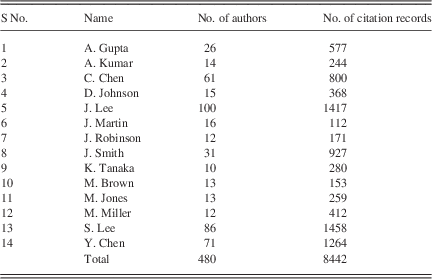
In AND three data sets—DBLPFootnote 9 , ArnetminerFootnote 10 and BDBCompFootnote 11 —are used frequently and considered as bench mark data sets. They are publicly available and can be downloaded from respective websites. However, some researchers used other data sets such as Microsoft Academic Search, KISTI, ArXive, and MEDLINE. DBLP is the most used collection that is composed of 8442 citation records associated with 480 distinct authors belonging to 14 ambiguous groups, which means an average of ~18 citation records per author, as shown in Table 1. The original version of this collection was created by Han et al. (Reference Han, Giles, Zha, Li and Tsioutsiouliklis2004), and, with slight variations, it has been used in performance evaluation for various author disambiguation methods (Peng et al., Reference Peng, Lu, Hsu and Ho2012; Ferreira et al., Reference Ferreira, Veloso, Gonçalves and Laender2014; Shin et al., Reference Shin, Kim, Choi and Kim2014; Wu et al., Reference Wu, Li, Pei and He2014; Zhu et al., Reference Zhu, Yang, Xie, Wang and Hassan2014; Han et al., Reference Han, Liu, Hu, Wang and Sun2015; Liu & Tang, Reference Liu and Tang2015). Han et al. (Reference Han, Giles, Zha, Li and Tsioutsiouliklis2004) created this collection by collecting bibliographic citation records from DBLP and authors homepages. After that, they transformed author names to abbreviated forms consisting of the first name initial and the last name, and clustered the bibliographic citation records into ambiguous groups, each of which corresponds to the authors with the same abbreviated name.
The DBLP data set

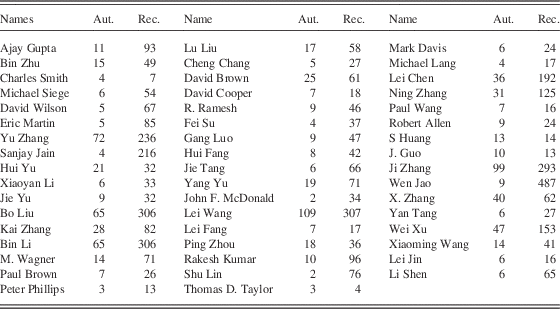
An excerpt of the Arnetminer data set and its statistics are given in Table 2 and more details are found online. The original version of this collection was created by Wang et al. (Reference Wang, Tang, Cheng and Philip2011). Then, Tang et al. (Reference Tang, Fong, Wang and Zhang2012) manually checked, labeled and included more ambiguous authors to expand this data set. It is used with slight variations in many AND studies (Tang et al., Reference Tang, Fong, Wang and Zhang2012; Shin et al., Reference Shin, Kim, Choi and Kim2014; Wu et al., Reference Wu, Li, Pei and He2014). Subsets of this data set have also been used in other works (Han et al., Reference Han, Giles, Zha, Li and Tsioutsiouliklis2004, Reference Han, Xu, Zha and Giles2005, Reference Han, Liu, Hu, Wang and Sun2015; Ferreira et al., Reference Ferreira, Veloso, Gonçalves and Laender2010).
The Arnetminer data set
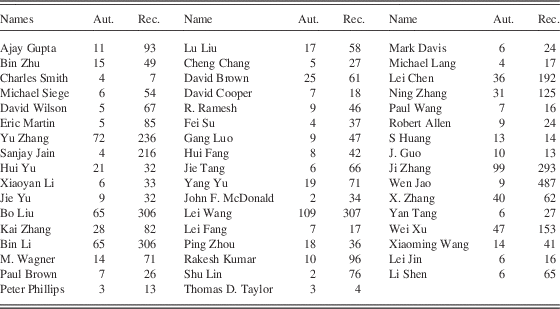
Aut. denotes the number of distinct authors and Rec. represents citation records associated with that author.
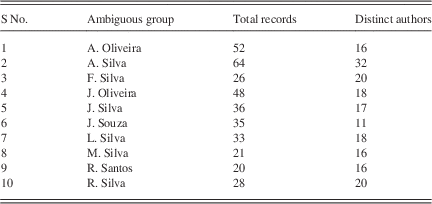
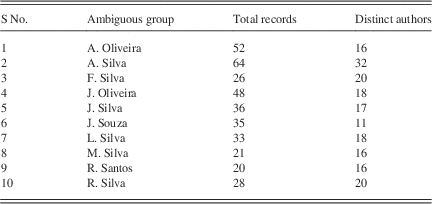
BDBComp is relatively a small data set of 363 records belonging to 184 distinct authors, but it is very difficult to disambiguate as some authors have only one citation record. BDBComp data set statistics are given in Table 3 and this collection has also been frequently used in AND studies (Levin & Heuser, Reference Levin and Heuser2010; De Carvalho et al., Reference De Carvalho, Ferreira, Laender and Gonçalves2011).
The BDBComp data set
Metrics are important to judge the quality, performance, efficiency or progress of a process, product or plan. The number of Man of the matches or batting average of a cricket player is a well used metrics to rank cricket players, and surely for event sponsors to rate players. In all disciplines, metrics play pivotal role to access the performance. All Sciences including bibliometrics, scientometrics or informetrics use different quality metrics. However, for comparison we are using the following metrics to measure the performance of our proposed system with that of baseline methods.
Mostly, three metrics—K-metric, pairwise-F1 (PF1), and cluster-F1 (CF1) are used to measure the effectiveness of AND techniques (Pereira et al., Reference Pereira, Ribeiro-Neto, Ziviani, Laender, Gonçalves and Ferreira2009; Shin et al., Reference Shin, Kim, Choi and Kim2014).
2.4.1 K-metric
K-metric is defined as the geometric mean of the average cluster purity (ACP) and the average author purity (AAP). ACP evaluates the purity of the algorithm-generated clusters with respect to the gold standard reference clusters, so it measures the amount of data misclassified into the wrong clusters by checking whether the generated clusters include only the publication records belonging to the reference clusters. AAP evaluates the level of splitting author information into several clusters, so it checks how fragmented the generated clusters are. ACP, AAP and K-metric are expressed in the following equation:
 $${\rm ACP}{\equals}{1 \over N}\mathop{\sum}\limits_{r{\equals}1}^R \mathop{\sum}\limits_{s{\equals}1}^S {{n_{{rs}}^{2} } \over {n_{r} }},\,{\rm AAP}{\equals}{1 \over N}\mathop{\sum}\limits_{s{\equals}1}^S \mathop{\sum}\limits_{r{\equals}1}^R {{n_{{rs}}^{2} } \over {n_{s} }},\,{\rm K}{\equals}\sqrt {{\rm ACP}{\times}{\rm AAP}} $$
here, N denotes the size of the citations in the collection, S the number of gold standard reference clusters manually generated, and R the number of clusters automatically generated by the Proposed Algorithm. Also, n s is the number of elements in cluster s and n rs the number of elements belonging to both cluster r and cluster s.
2.4.2 PF1
PF1 is defined as the harmonic mean of pairwise precision (PP) and pairwise recall (PR). PP is the fraction of publication records corresponding to the same author in the algorithm-generated clusters and PR is the fraction of publication records associated with the same author in the gold standard reference clusters. The PP, PR and PF1 measures are expressed in Equation (2), where C(n, r) denotes the number of combinations of r elements from n elements:
 $$C(n,r){\equals}{{n\,!\,} \over {r\,!\,(n{\minus}r)\,!\,}},n\geq r$$
. Other parameters including r, s, n
s
and n
sr
are defined as before in Equation (1).
 $${\rm PP}{\equals}{{\mathop{\sum}\nolimits_{r{\equals}1}^R \mathop{\sum}\nolimits_{s{\equals}1}^S C(n_{{rs}} ,2)} \over {\mathop{\sum}\nolimits_{r{\equals}1}^R C(n_{r} ,2)}},{\rm PR}{\equals}{{\mathop{\sum}\nolimits_{r{\equals}1}^R \mathop{\sum}\nolimits_{s{\equals}1}^S C(n_{{rs}} ,2)} \over {\mathop{\sum}\nolimits_{r{\equals}1}^S C(n_{s} ,2)}},{\rm PF}{\minus}1{\equals}{{2{\times}{\rm PP}{\times}{\rm PR}} \over {{\rm PP}{\plus}{\rm PR}}}$$
2.4.3 Cluster F1 (CF1)
CF1 is defined as the harmonic mean of cluster precision (CP) and cluster recall (CR), where CP is the fraction of the generated clusters that are equal to the reference clusters and CR is the fraction of correctly retrieved clusters from the reference clusters. The CP, CR and CF1 measures are given in the following equation:
 $${\rm CP}{\equals}{{R{\cap}S} \over R},{\rm CR}{\equals}{{R{\cap}S} \over S},{\rm CF}{\minus}1{\equals}{{2{\times}{\rm CP}{\times}{\rm CR}} \over {{\rm CP}{\plus}{\rm CR}}}$$
2.5 Contributions
We reviewed these selected AND techniques, their prominent features, such as capabilities, limitations and briefly included some open challenges that needs researchers attention. We deliberately not include AND works that are older than 6 years now and have been discussed in some other surveys. We believe that this article will be useful for future researchers who are going to carry out research in AND domain. Moreover, our contribution complements the existing surveys by presenting: (a) an overall look of more recent AND techniques, (b) classification of AND techniques based on presented solution method, (c) complete synthesis of the AND techniques, and some open challenges and future research directions related to AND are also discussed.
3 A Classification of author name disambiguation techniques
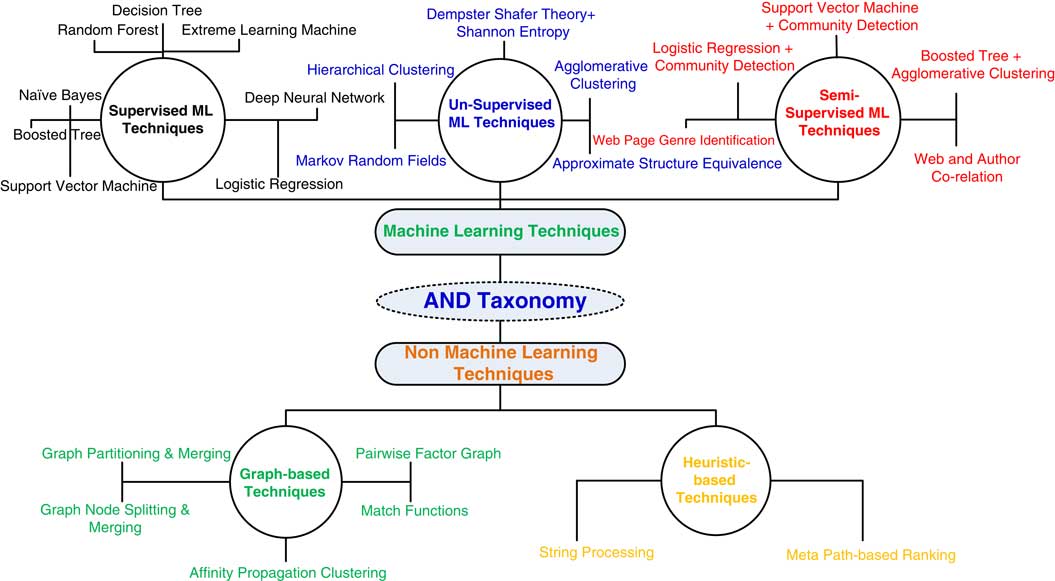
AND techniques can be classified in many ways but we classified them into: ML-based techniques (Wang et al., Reference Wang, Tang, Cheng and Philip2011; Huynh et al., Reference Huynh, Hoang, Do and Huynh2013; Imran et al., Reference Imran, Gillani and Marchese2013; Tran et al., Reference Tran, Huynh and Do2014; Han et al., Reference Han, Liu, Hu, Wang and Sun2015; Seol et al., Reference Seol, Lee and Kim2016) that has been further divided into three subcategories, and non-ML-based techniques (Fan et al., Reference Fan, Wang, Pu, Zhou and Lv2011; Wang et al., Reference Wang, Tang, Cheng and Philip2011; Tang et al., Reference Tang, Fong, Wang and Zhang2012; Shin et al., Reference Shin, Kim, Choi and Kim2014) into two subcategories. The proposed classification of selected AND techniques is shown in Figure 3.
Proposed author name disambiguation taxonomy. ML=machine learning

ML techniques construct models based on prior observations which can then be used to predict the class of unseen data (Provost & Kohavi, Reference Provost and Kohavi1998). The model is constructed using a learning process that mines valuable information about the data using the previous observations. ML methods usually receive a set of citations data for training and learns a model. The learned model is then applied to unseen data to attempt to guess the correct values. ML methods used in AND are of three types as described in the following paragraphs.
3.1 Supervised AND techniques
The first ML techniques are supervised techniques in which labeled training data are manually created and inputted to the classifier. The data consist of pairs of the form 〈A i , B i 〉, where A i is input feature vector and B i is correctly labeled output class. The objective of learning function in supervised learning is to map input attributes to correct output class value. With the help of training data, a classification model is trained and validated using some validation technique such as ‘k’ fold cross-validation. Here ‘k’ can be any number from 2 to N. Then the trained model is used to predict the output of unseen data. For example, the input can be a set of publication features like co-authors, title words, year of publications and venue information and the output can be the true author name class. True authors are target authors and false authors are homonym/synonyms authors of the target authors.
3.2 Unsupervised AND techniques
The second ML techniques are unsupervised techniques in which the learner is provided with input data, which has not been labeled. The aim of the learner is to find the intrinsic patterns in the data that can be used to determine the correct output value for new data instances. The assumption here is that there is a structure to the input space, such that certain patterns occur more often than others, and we want to see what generally happens and what does not. In statistics, this is called density estimation. A variety of unsupervised learning algorithms has been used in AND. In these techniques, some predefined similarity measures or some similarity functions are used for forming and finding the clusters of ambiguous author names. Key challenges to this type of technique are how to find the number of clusters and the value of the suitable threshold for similarity.
3.3 Semi-supervised AND techniques
The main disadvantage of the supervised technique is that they require a large amount of labeled training data. Similarly, finding number of hidden clusters and similarity threshold in unsupervised techniques is difficult. To overcome these drawbacks of supervised and unsupervised techniques, semi-supervised techniques are introduced. In these techniques, authors want to achieve good accuracy by using a small amount of labeled training data in conjunction with unlabeled data. In nearly all semi-supervised techniques one assumption made about the data consistency that data close to each other or having similar structure are likely to have the same label. Some good results have been reported in the literature for this type of techniques and in this regard, a variety of algorithms has been developed for AND in literature (Imran et al., Reference Imran, Gillani and Marchese2013; Zhao et al., Reference Zhao, Wang and Huang2013; Maguire, Reference Maguire2016).
3.4 Graph-based AND techniques
These are only some techniques Tang and Walsh (Reference Tang and Walsh2010) and Shin et al. (Reference Shin, Kim, Choi and Kim2014), which can be purely called graph-based techniques. Otherwise, the majority of techniques such as, Fan et al. (Reference Fan, Wang, Pu, Zhou and Lv2011) and Wang et al. (Reference Wang, Tang, Cheng and Philip2011) form a graph and then find some similarity in them. Subsequently, they cluster these results by using ML techniques to disambiguate the author names. However, we have classified both these techniques under the umbrella of graph-based techniques. Some authors say that graphs are a natural representation of author name ambiguity problem and it takes into consideration the semantics of the problem. They represent author names as nodes and their co-author relationships as edges between them. After constructing graph some graph-based similarity measures are applied for disambiguation.
3.5 Heuristic-based AND techniques
When exact solutions are not possible or it is too slow to get the exact solution then heuristic-based techniques come into the scene and give solution quickly. It is worth noting here that these solutions may not be an optimal but they are near to an optimal. These methods are sometimes called short cuts, the rule of thumb or observation based. A heuristic function searches the solution space on the basis of available information and decides to go to the branch that approximates the exact solution. These methods also at the end may use ML techniques to resolve the ambiguity of author names.
4 Selective author name disambiguation techniques
In this section, selected AND techniques are elaborated, compared and their findings are presented.
4.1 Supervised AND techniques
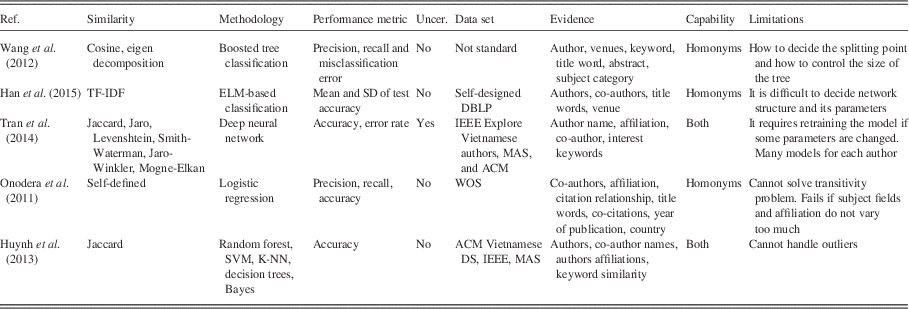
Wang et al. (Reference Wang, Berzins, Hicks, Melkers, Xiao and Pinheiro2012) presented a boosted tree classification method for name disambiguation that comprises of four steps. In the first step, name and affiliation filtering are done by matching first initial and last name and affiliation matches, whereas similarity scores for six different publication features are calculated in the second step. Then author name screening is done using false rate and in the last stage boosted tree classifier is applied to the manually crafted data set of 100 authors having 4253 citations in it. It cannot classify high false rate authors and requires manual checking. A deep neural network-based approach is proposed by Tran et al. (Reference Tran, Huynh and Do2014) to automatically learn features and disambiguate the author names from any data set. However, they tested their proposed solution with Vietnamese’s data set that they prepared and used in their earlier study. The architecture of this solution has two main components. In the first component, data is taken as input and data representations are computed. These data representations can be prepared in many ways but authors’ used string matching technique. According to their claim, these computations can be done on any data set automatically. The second component take the basic feature set as its input and learn the features in it is hidden layers to disambiguate the author name. The last layer of the feed forward deep neural network computes the probabilities to find whether two instances of the author name in a pair belongs to the same author name or not. They utilize the multi-column deep neural network technique to improve the generalization capabilities of the system that is similar to ensemble method bagging. Optimal no of hidden layers and no of units is a complex task and requires skill and experience.
Two extreme learning machine-based algorithms for AND are proposed by Han et al. (Reference Han, Liu, Hu, Wang and Sun2015). First is one classifier for each name (OCEN) and the second is one classifier for all names (OCAN). In OCEN for each name a classifier is trained with the help of some attributes and when an unseen paper that is written by these ambiguous authors’ is given to the classifier, it tells the identity of that author. They use a list of author names, title words of papers and venue title words as attributes for OCEN and extract features from these three attributes. Then, they reduce the dimensionality of features via principal component analysis. In the end, they formulate and solve the optimization problem using extreme learning machine method. In OCAN, they train a classifier that can predict whether the same author name in any given pair of entries in the bibliography referred to the same entity or two different entities. The idea behind this strategy is that an entity pair provides an abstraction from the concrete names. So, this classifier is not concerned with any specific name, which enables it to disambiguate all names. In this strategy, they use similarity of the two entities. They formulate the feature vector of similarities between author names, title words, and venue title words. They create enhanced feature extraction, which exploit additionally the information in the relationship of the entries referring to the same author name. Finally, they apply extreme learning machine method on the proposed problem and find the solution. They compare its performance with support vector machine classifier and conclude that it has similar or better generalization performance. Missing data case is not handled in this strategy. If a single author or two homonyms share the same or similar title it would fail to distinguish.
A discrimination function that predicts true authors (target authors) and false authors (homonyms) using logistic regression on Web of Science data set is used by Onodera et al. (Reference Onodera, Iwasawa, Midorikawa, Yoshikane, Amano, Ootani, Kodama, Kiyama, Tsunoda and Yamazaki2011). They extract true author papers from 629,000 retrieved papers by using two stage filtering. In the first stage, they remove the retrieved papers if either their affiliation addresses has low similarity score to those of its source papers or there is no citation relationship between the venue of the retrieved papers and that of source papers. During the second stage, retrieved papers are manually judged and on the basis of this judgment a discrimination function of logistic regression is defined. The salient discrimination predictors are common co-author(s), the similarity of address, the similarity of title words, and citation relationships in venues between the retrieved and source papers. This method is not good for papers whose subject fields and affiliation addresses vary a little or do not vary at all. Five supervised ML techniques: Random Forest, Support Vector Machine, k-Nearest Neighbors, C4.5 (decision tree) and naive Bayes are proposed by Huynh et al. (Reference Huynh, Hoang, Do and Huynh2013) for solving Vietnamese author name ambiguity problem. They use Levenshtein similarity for calculating similarity between features. They propose a set of features from publications’ data set that can be used to assist training classifiers. They test their model on three different data sets from the online DLs. It requires very specific neat and clean data set for the training of the models.
Table 4 shows the comparison of supervised AND techniques.
Supervised author name disambiguation techniques comparison
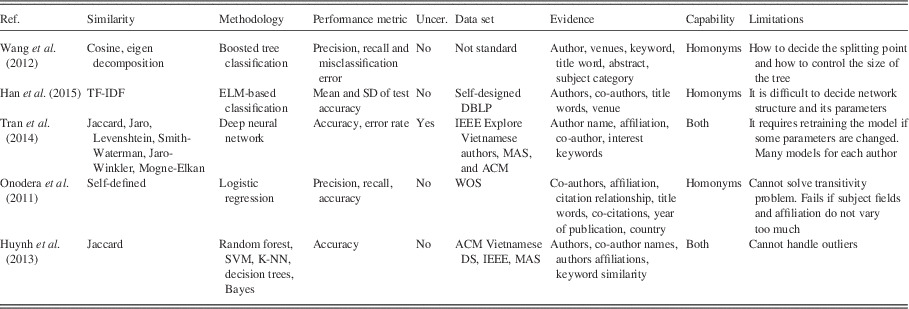
From left to right: Ref. is the references of the paper, Similarity used, what Methodology followed, Performance Metrics, Uncer. refers to either Uncertainty handled or not, Data set used, Evidence used, Capability of the method and Limitations.
4.2 Unsupervised AND techniques
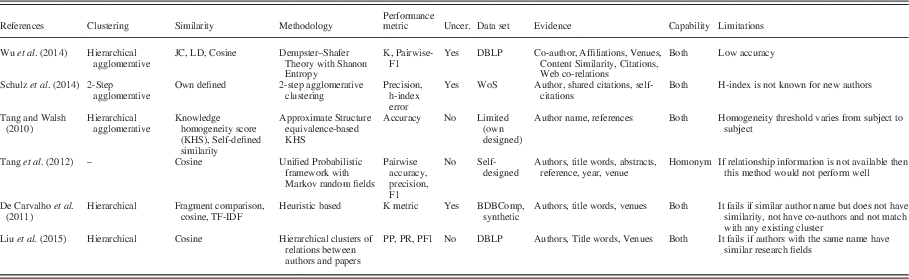
Wu et al. (Reference Wu, Li, Pei and He2014) proposed algorithms for author name disambiguation that uses Dempster–Shafer theory (DST) in combination with Shannon entropy (SE). In the first step, some high-level features like affiliation, venue, contentisim, co-authors, citations, Web correlation and their co-relation similarities are calculated. In next step, these features are fused using DST and SE. On the basis of this information, belief and plausibility of each author is calculated. They get a matrix of pairwise correlation of papers. Each entry in this matrix is linked to a belief function and a plausibility function. Finally, they apply the DST-based hierarchical agglomerative clustering algorithm for author name disambiguation. In the process of clustering they use three different convergence conditions for clustering algorithm namely: pre-set number of clusters, the number of available evidence and distance between clusters.
Cognitive maps of psychology and structural equivalence of network analysis-based knowledge homogeneity scores are used to recognize the ambiguous author name in bibliographic, particularly common surnames in China, is presented by Tang and Walsh (Reference Tang and Walsh2010). Their basic assumption is that every author has its particular set of the knowledge base at a particular time. During that time, two authors having the same knowledge base are considered the same author whereas two authors having different knowledge base are considered two distinct authors. Finding true structural equivalence in the real world is rare. Hence, approximate structural equivalent (ASE) is used instead of equivalence, such that authors within a structurally equivalent cluster are more similar to each other than to those outside of that cluster. If these structurally equivalent records contain author names with the same (or similar) family name and first initial, these similar authors are taken to be the same authors. To find the ASE, a knowledge homogeneity similarity (KHS) score is calculated that is based on the summation of shared references, the forward citations of each reported reference, and the minimum number of references reported by the two articles. Rarer references are given higher weights. Once the KHS matrix is constructed, hierarchical clustering with single linkage is done to distinguish the groups. These methods do not perform well when references of a citation are not available.
A unified probabilistic framework to address the name disambiguation problem specifically homonyms in DLs is proposed by Tang et al. (Reference Tang, Fong, Wang and Zhang2012). They formalize the disambiguation problem using Markov random fields, in which the data are cohesive on both local attributes and relationships. In this approach, they suggest an algorithms that automatically estimate the number of unknown ambiguous authors and the required unknown parameters. The basic idea behind this work is that a similar content and similar relationship belongs to the same author. They claim that their approach can achieve better performance in name disambiguation than baseline methods because the approach takes advantage of interdependencies between paper assignments. In the first step, they assign six attributes (Title word, venue name, Publications’ year, Abstract, Authors, References) to each paper that they acquire from the online DLs. They define five types of relationships namely, co-pub venue, co-author, co-citation, constraints and time of co-authorship among these papers, and gave unknown weights to these relationships which they find in the later stages. They transform the content-based information and structure-based information into the hidden Markov random fields (HMRF) as feature functions. They define an objective function as the maximum a posteriori configuration of the HMRF. They use Bayesian information criterion to estimate the true number of authors. To find the unknown parameters they devised an algorithm that first initializes and assigns random values to unknown parameters and then updates these values for each function values to optimize the objective function.
Another algorithm that not only disambiguates author name problem but it also reconstructs the h-index of the authors is proposed by Schulz et al. (Reference Schulz, Mazloumian, Petersen, Penner and Helbing2014). They apply this algorithm on a large scale data set of Web of Science. This algorithm consists of two main steps. In the first step, they calculate the pairwise similarity between all papers on the basis of number of shared co-authors, self-citations, common references and the number of papers citing both publications. Calculating these pairwise similarities between papers, they construct a link between those publications that have similarity score greater than some threshold. Their aim is to find a distinct author that they find by knowing each connected component. These connect links form a number of clusters and a new similarity between these clusters is calculated. A link between these clusters is constructed if this similarity is above a threshold as in the previous step. Then these connected clusters are merged. These clusters are the set of papers by a unique author. They optimize and validate the disambiguated authors by re-constructing their h-index. Information about h-index is necessary for this system, but new researchers have no h-index information and this system does not disambiguate them well.
A technique named ‘Fast Multiple Clustering’ is presented by Liu et al. (Reference Liu, Li, Huang and Fang2015) in which three-step clustering is used to disambiguate author names. In the first step, co-authors are used to finding clusters of the authors in which multiple relations such as paper related to authors and papers related to other papers are found. On the basis of these relations, the related papers are clustered in different clusters. Further, bigger clusters are formed on the basis of similarity between title words. Finally, venue information is used to cluster the papers of the authors who tend to publish in the same venue but may have different title words. Authors claim that this technique is better in PF1 and faster as compared to three existing techniques. Another advantage of their proposed technique is that it can be used for almost all bibliographic databases.
Comparison on different quality criteria of unsupervised AND techniques is given in Table 5.
Unsupervised author name disambiguation techniques comparison
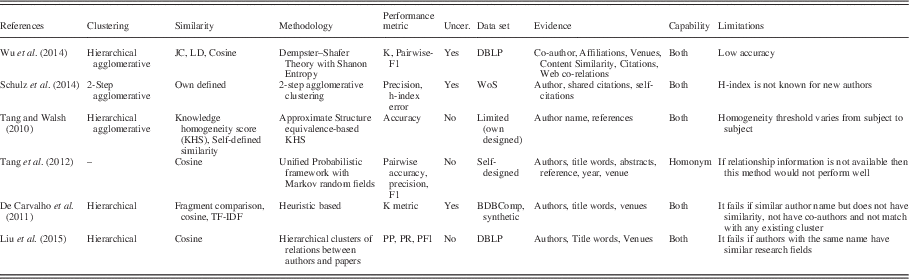
From left to right: Reference of the paper, Type of clustering, Similarity used, what Methodology followed, Performance metrics, Uncer. refers to either Uncertainty handled or not, Data Set used, Evidence used, Capability of the method and Limitations of the methods.
4.3 Semi-supervised AND techniques
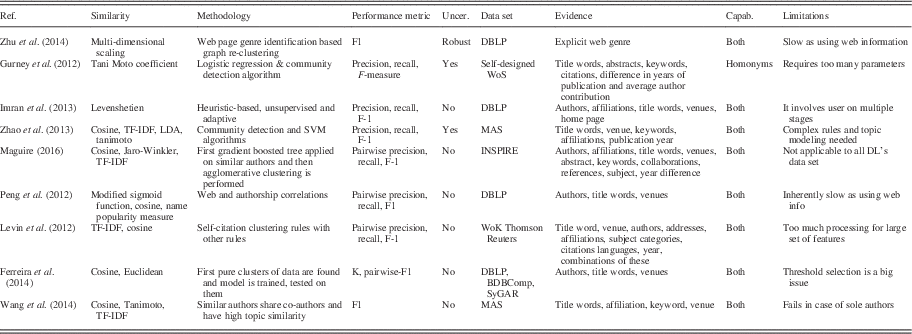
A hybrid name disambiguation framework that not only used the traditional information, co-authors, but also Web page genre information is proposed by Zhu and Li (Reference Zhu and Li2013). This framework consist of two main steps: Web page genre identification and re-clustering model. In Web page genre identification, returned pages are classified either home page of an author or not. Those records that found at the authors’ home page belonged to him and are disambiguated. The remaining ambiguous records are disambiguated using co-authors’ information. Some records that neither disambiguated from co-authors’ names nor from Web information are sent to re-clustering model. Then they build a graph ‘G’ using all citation records in which each vertex represents a citation record and each edge denotes the same co-authors relationship or they are of the same domain. If there are many links present between two vertices, then they are considered to be related to each other. They transfer this graph into a similarity matrix by using multi-dimensional scaling algorithm. This algorithm detect similarities among objects. They construct two-dimensional matrices for co-authorship and topic-relationship and calculate the distance between two vertices with the help of Euclidean distance. If the distance between citations is less than a specific threshold then they are considered by the same author. One author might have more than one citation record on one personal page and have other different citation records on another personal page that represent as two distinct authors which cannot be fully handled by this approach.
Levin et al. (Reference Levin, Krawczyk, Bethard and Jurafsky2012) presented a semi-supervised two-stage method to disambiguate authors in DLs. In the first stage, they used citation-based rules along with some other simple rules to create labeled training data automatically. Then these initial clusters are being used as a bootstrap to learn the similarity metrics for the second stage of agglomerative clustering. They used a large number of old as well as new features for measuring the similarity between pairs of publications and solve the optimization problem to find disambiguated authors. They evaluate this model on a data set collected from the Thomson Reuters Web of Knowledge. Ferreira et al. (Reference Ferreira, Veloso, Gonçalves and Laender2014) proposed an enhancement to their previously proposed technique in 2010 named SAND (self-training associative name disambiguation) that consists of three steps. Pure but fragmented clusters are generated in the first step using co-authors heuristic. Representative clusters from the first step are used for the training of the model. In the last step, finding associative name disambiguator and training of the model that detects the appearance of the new authors. Remaining clusters that are not used for training of the model are used for testing purpose. They test SAND on DBLP and BDBComp data sets and achieve better results than two supervised and two unsupervised approaches. Finding the pure clusters in the first phase is a tough task.
A semi-supervised approach for AND that utilizes Microsoft academic search data are proposed by Zhao et al. (Reference Zhao, Wang and Huang2013). They pre-processed data set and found many useful features. They construct a co-author-based bibliographic network and apply community detection algorithm. Support vector machine and some other ML models are used to handle uncertainty in the data. They boost the performance of these models with the help of a self-taught procedures. Lastly, they merge the results from different models and achieved 0.98717 mean F-score on Microsoft academic search data set provided by KDD cup 2013. Very recently, an ethnicity sensitive method that mainly comprises of three parts is presented by Maguire (Reference Maguire2016). In the first part phonetic-based blocking for similar author signatures is done. After blocking, supervised ML-based linkage function is proposed that exploited the ethnicity sensitive information. Author names are divided into seven groups of ethnicity as White, Black, American Indian or Alaska Native, Chinese, Japanese, Asian or Pacific Islanders and others using. For a pair of given names the probability of the ethnic group for both the names is estimated and on the basis of this information the origin of the author is predicted. Finally, hierarchical agglomerative clustering is done on the basis of a distance between two pairs of publications’ linkage function. Web co-relations’ and author co-relations’-based approach to measure similarities between publications for AND is presented by Peng et al. (Reference Peng, Lu, Hsu and Ho2012). They use two assumptions, citations on the same Web page are related to the same author and citations with same rarer authors belong to the same author. They measure these both type of co-relations by pairwise similarity metrics by using modified sigmoid function, cosine metric and name popularity metric.
Gurney et al. (Reference Gurney, Horlings and Van Den Besselaar2012) developed an algorithm that address the issues of discarded records due to null data fields and their resultant effects on recall, precision, and F-measure. They implement a dynamic approach to similarity calculations based on all available data fields. They use the Tani Moto coefficient for similarity calculations of (a) title words (b) abstract words (c) last names and first initials of co-authors (d) cited references in whole-string form (e) normalized author keywords (f) normalized indexed keywords (g) normalized research addresses (h) venue. They also include average author contributions and age difference between publications, both of which has meaningful effects on overall similarity measurements, resulting in significantly higher recall and precision of returned records. Logistic regression is then applied to find the unknown weights to all the parameters. In the final stage, authors are found with the help of Blondel community detection algorithm. This algorithm take into account the weighted edges of a network and assign each node to a specific community based on the surrounding nodes and its edge weights. Logistic regression predicts the probability whether two publications are from the same author or not, but the community detection algorithm works on the entire interconnected network of nodes or publications and identifies the communities of papers belonging to unique authors. The results are presented from a test data set of heterogeneous catalysis publications and demonstrate significantly high average F1 scores and substantial improvements compared with previous stand-alone techniques. Null combination code (NC) is the presence or absence of shared meta data in a citation. It is a numeric string where each number refers to a field present in the citation. For example, NC code 124 represents that title, abstract and author assigned keywords are present. A zero in this code means respective field is not present in the citation. This method requires pre-checking of records and calculation of NC code manually that is a tedious job.
A solution for AND is proposed by Imran et al. (Reference Imran, Gillani and Marchese2013) that can also be used as a wrapper service for DLs. They use selected features of an author and citation record to disambiguate author names using unsupervised techniques. First of all, they collect citation records of an ambiguous author name in which both the mixed citations and split citations exist. They make clusters of their citations on the basis of their disciplines and then divide these clusters into smaller ones using co-authors information. Afterward, these small clusters are fused together on the basis of remaining evidence. In this phase, two clusters are fused only if their distance is reduced to a certain threshold limit. Meanwhile, they interact with users to further purify the retrieved clusters, so users’ feedback directly influences the results of the disambiguation. Wang et al. (Reference Wang, Zhao, Huang and Xu2014) proposed a unified semi-supervised framework which is capable of solving both homonyms and synonyms. This framework uses semi-supervised approach to the solution of author names where there are no training data are provided. Multi-aspect similarity indicator and a support vector machine are applied to fuse the attributes. In the final step, a self-taught method is presented to resolve the ambiguities in the authors to enhance the performance of the disambiguation system. A comparative analysis of semi-supervised AND techniques is done in Table 6.
Semi-supervised author name disambiguation techniques comparison
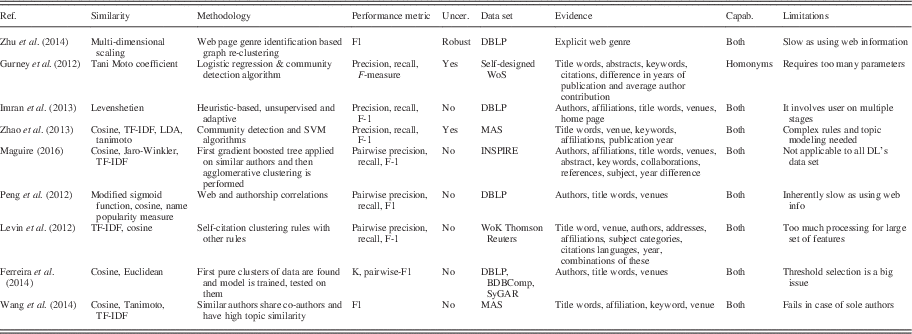
From left to right: Ref. is the references of the paper, Similarity used, what Methodology followed, Performance metrics, Uncer. represents either Uncertainty handled or not, Data set used, Evidence used, Capab. refers to the Capability of the method and Limitations.
DL=digital libraries.
4.4 Graph-based AND techniques
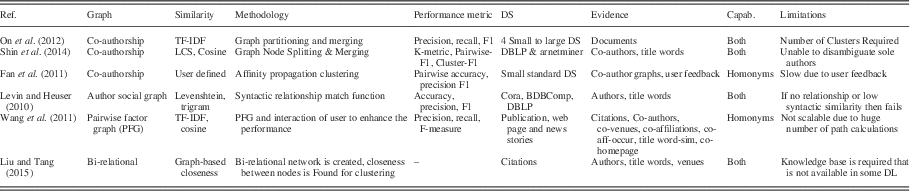
Two multi-level scalable algorithms for AND are proposed by On et al. (Reference On, Lee and Lee2012). First is a multi-level graph partitioning (MGP) algorithm, and the second is a multi-level graph partitioning and merging (MGPM) algorithm. Input data are represented in the form of affinity graph, where each entity denote the node and relationship between two nodes represented the edge. Edge weights between two entities are calculated using the term frequency inverse document frequency of all word tokens. These graphs are then level by level approximately partitioned into the smaller graphs using MGP schemes. Three steps are followed for the MGP algorithm: scaling-down, partitioning and scaling-up. During the scaling-down, the size of the graph is repeatedly decreased; in the clustering, the smallest graph is partitioned and in the scaling-up, partitioning is successively refined to the larger graph. MGP has somewhat low accuracy as compared to MGPM. To overcome this drawback they propose MGPM algorithm that is faster but more accurate graph partitioning method. The MGPM algorithm is also a MGP algorithm but it allows multi-resolutions at variant levels. After every stage, the algorithm decide to go next level only if the partitioning step produces more inter-cluster edges than intra-cluster edges. Otherwise, the MGPM algorithm stop at the current level. In the end, the MGPM algorithm generate different levels of each branch and various resolutions for each leaf node. After dividing graph into smaller sub-graphs, they combine the sub-graphs together if two sub-graphs has the biggest normalized cuts. They repeatedly merge the sub-graphs until the number of sub-graphs is equal to the given number of clusters ‘K’. The drawback of this method is that it assumed predefined no of clusters.
Collaboration network of authors along with syntactic similarity between author names to disambiguate author names in three different subsets of DL data sets is presented by Levin and Heuser (Reference Levin and Heuser2010). They assume that two syntactically similar authors are same if there are a close relationship and small distance between them. They make a graph by considering two type of nodes; author nodes and paper nodes, edges are relationships between papers and their writers. They define multiple metrics to measure the closeness and distance between authors. Finally, they define five matching functions based on these metricsone for syntactic matching and fours for relationship matching. Their research results depict that this approach significantly improve the performance of just syntax-based similarity measures. A graph-based method called graphical framework for name disambiguation is proposed by Fan et al. (Reference Fan, Wang, Pu, Zhou and Lv2011). In it they model the relationships among publications using undirected graphs. Authors are represented with a vertex and an edge shows a coauthor’s relationship in this graph. Then, they solve homonyms problem by iteratively finding valid paths, computing similarities, clustering with the help of affinity propagation algorithm and in the last step using user feedback as a complementary tool to enhance the performance. They simulate using PubMed and DBLP data sets, and results reveal that their proposed approach is better both in precision and recall than DISTINCT—a baseline approach. This approach does not handle outliers and fail in the case of sole authors.
In a study by Liu and Tang (Reference Liu and Tang2015), a problem and knowledge domains-based bi-relational network (BRN) framework for AND is proposed. The problem domain is used to construct basic BRN and knowledge domain is exploited to elaborate the covert aspects of the network. Subsequently, they use a random walk with a restart to find the closeness between BRN nodes and affinity propagation algorithm for clustering the obtained results from the previous step. A graph-based method—ADANA is proposed by Wang et al. (Reference Wang, Tang, Cheng and Philip2011), in which they modeled pairwise factor graph that can be used to integrate several types of features as well as user feedbacks into a unified model. They define three types of feature functions: document pair, correlation and constraint-based feature functions. In document pair feature functions, they found known relationships from publications. In correlation feature functions, they found some hidden features with the help of known functions and in the constraint-based feature functions, the user is involved in finding the unknown features. Finally, they exploit active selection of the users’ corrections in an interactive mode to improve the disambiguation performance after some preliminary clustering results. They exploit some additional information such as affiliation, references, etc. that is not present in every DL.
A topological–collaborative approach is presented to solve homonyms in DLs by Amancio et al. (Reference Amancio, Oliveira and Costa2015) in which they used topological features of the collaborative graph along with weighted collaboration patterns among authors. In this technique, the first step is the formation of the weighted network among authors according to the strength of their collaborations and then characterized the network using several topological features such as neighborhood degree, neighborhood strength, clustering coefficient, average shortest path length, hierarchical measurements and locality index. Fuzzy K-NN is used in the classifier to disambiguate different homonyms. Authors validated proposed technique on a data set extracted from the arXiv repository and concluded that topological features enhance the accuracy of their results. Among these topological features, the average shortest path length is the most prominent feature for disambiguation. A graph framework for author name disambiguation (GFAD) is presented by Shin et al. (Reference Shin, Kim, Choi and Kim2014) that exploit authors, co-authors and paper title words information. They claim that this framework is robust and domain independent because it requires only author names, co-author names and paper titles information that is surely available in all DLs. They model the author name and co-author names in an undirected graph, where a vertex denoted an author name and an edge indicated a co-author relationship. Homonyms are resolved by splitting the vertex that is common to multiple non-overlapping cycles so that each cycle corresponded to a unique author. The heteronymous name problem is handled by merging multiple author vertices into one by identifying those vertices that actually represent a single author with different names. Moreover, unlike other related studies, outlier issues are also handled in GFAD. It remove outliers by comparing similarity among outliers with the help of cosine similarity. Experiments are conducted on two real world data sets of DBLP and Arnetminer. This method fails when there is less or no title word similarity in two papers written by sole authors and also fails in the case of very ambiguous author names. Furthermore, as it used Johnson (Reference Johnson1975) algorithm for cycle finding, so it is computationally too expensive. All these graph-based methods in this section are compared in Table 7.
Graph-based author name disambiguation techniques comparison
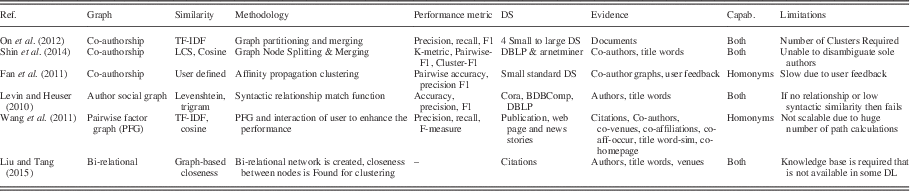
From left to right: Ref. is the references of the paper, Similarity used, what Methodology followed, Performance metrics, Data set (DS) used, Evidence used, Capab. refers to the Capability of the method and method Limitations.
DL=digital libraries.
4.5 Heuristic-based AND techniques
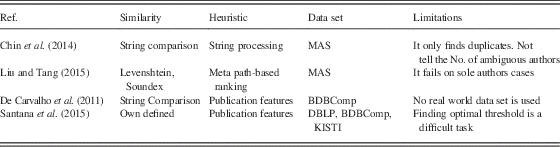
INDi a solution for the existing cleaned DLs is presented by De Carvalho et al. (Reference De Carvalho, Ferreira, Laender and Gonçalves2011). Their proposed solution utilize similarity among bibliographic records and group the new records to authors with similar citation records in the DL or to new authors when the similarity evidence is not strong enough. Some particular heuristics are used for checking whether references of new citation records belong to pre-existing authors of the DL or if they belong to new ones (i.e., authors without citation records in the DL), avoiding running the disambiguation process in the entire DL. They run simulations on BDBComp collection and synthetic DSs to assess the effectiveness of their method. They compare its performance with an unsupervised method. They use synthetic data for incremental disambiguation purpose that generated data from existing data and does not portray the real world situation where many new authors also publish.
A name matching framework for author name disambiguation for Microsoft Academic Search data set is proposed by Chin et al. (Reference Chin, Zhuang, Juan, Wu, Tung, Yu, Wang, Chang, Yang, Chang, Huang, Kuo, Lin, Lin, Lu, Su, Wei, Yin, Li, Lin, Tsai, Lin, Lin and Lin2014) and it realize two implementations. This method has six stages in total. In the first stage, they decide that either the name is a Chinese name or non-Chinese. They group Korean, Singaporean and Vietnamese names into Chinese. They built two dictionaries of Chinese names. In the second stage, they clean and preprocess the citations data. In the third stage, they make blocks of similar author names. Author name blocks are created using a dictionary of (key, value) pairs. In this blocking strategy, a name is used as a key and the number of its occurrence as a value. For instance, an author name ‘Ajay Kumar Gupta’ has following keys. ‘Ajay’, ’Kumar’, ’Gupta’, ’Ajay Kumar’, ’Ajay Gupta’, ’Kumar Gupta’ and ‘Ajay Kumar Gupta’. In this blocking scheme, the order of the names does not matter. During this stage, they take care of low recall and high false positives that both might degrade the performance of the overall AND system at later stages. In the fourth stage, they identify duplicates in the blocks. After identification, they split some names that are wrongly included in the blocking stage. In the fifth stage, they link the names of authors to their identifiers. Lastly, they merge the results of two predictions by using background information and a filtering process. This merging step boosts the F1 score.
Santana et al. (Reference Santana, Gonçalves, Laender and Ferreira2015) proposed a combination of the domain-specific heuristics to disambiguate authors in bibliographic databases. The authors assume that a researcher’s publication profile may be characterized by the terms of one’s citations. The co-authors form the collaborations networks and title and venue terms portray one’s research interests. Using these three domain-specific heuristics a similarity function is proposed and if the similarity between two compared authors is greater than a specified threshold than these authors are included in the training data set. It is also assumed that if there is a low similarity between a citation and its most similar group then this is a new author which is not already present in the training data set. In the final step optimal threshold for different parameters are estimated using the standard procedure of cross-validation. Ranking-based name matching algorithm and a system called RankMatch is proposed by Liu and Tang (Reference Liu and Tang2015). RankMatch has four steps. The first step is preprocessing in which some data cleansing activities are done like noisy first and last name and mistakenly separated or merged names are identified. The next stage is r-step in which recall of the system is enhanced. The next stage is the p-step that improves the precision of the system. In this step, they calculate different meta path-based similarity measures. Then these ranking-based measures combine with string-based measures are used to remove the conflictory names from the results of the previous stage. In the last, post-processing stage, the unconfident names are removed from the system despite the fact that names are compatible and they might have acceptable meta path similarity between names. They achieved good F1 score on MAS data set. Comparison on different quality criteria of heuristic AND techniques is given in Table 8.
Heuristic-based author name disambiguation techniques comparison
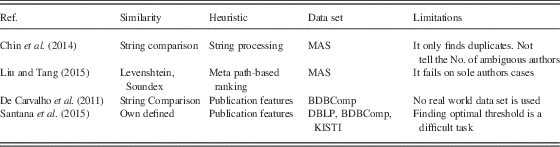
From left to right: Ref. is the Reference, Similarity used, what Heuristic followed, Data set used and Limitations.
5 Critical discussion
Supervised AND techniques require representative labeled training data. Creating labeled training data is resource and time consuming and accurate labeling is often hard to achieve. For example, obtaining sufficient training data for AND in bibliography might require weeks to months to collect and then label that data. In some cases even in manual labeling, the data may not be correct due to lack of bibliographic evidence. On the other hand, According to Ferreira et al. the performance of supervised AND techniques is relatively better than unsupervised techniques Ferreira et al. (Reference Ferreira, Veloso, Gonçalves and Laender2014). In a supervised study by Wang et al. (Reference Wang, Berzins, Hicks, Melkers, Xiao and Pinheiro2012), author affiliation history is required that is usually not available in DLs. In Han et al. (Reference Han, Liu, Hu, Wang and Sun2015), their proposed technique require a large number of training examples to train their model that is not available for a new or a rising researcher. Similarly, Tran et al. (Reference Tran, Huynh and Do2014) present a technique that requires retraining of the model if some parameters are changed or new citation have been inserted in the DL.
Unsupervised AND techniques do not require any training data set. However, unsupervised learning algorithms also have some drawbacks, some of them are as under: (a) it is difficult to decide which type of clustering best suits to the problem at hand, (b) no of clusters (K) is not known in advance, (c) when to stop the clustering process is not known and (d) these techniques are not as efficient as supervised ones.
The technique proposed by Tang and Walsh (Reference Tang and Walsh2010) used homogeneity score for clustering and its threshold vary from subject to subject which is very difficult to find. Tang et al. (Reference Tang, Fong, Wang and Zhang2012) technique performs poorly when relationship information is not available.
Semi-supervised AND techniques also require some training data as well as a number of clusters in advance. However, semi-supervised techniques like Zhu et al. (Reference Zhu, Yang, Xie, Wang and Hassan2014) and Peng et al. (Reference Peng, Lu, Hsu and Ho2012) require Web information that slows down their progress in DLs. Whereas, Imran et al. (Reference Imran, Gillani and Marchese2013) proposed method need users feedback for higher accuracy of the proposed system.
Graph-based AND techniques require fewer attributes than other techniques. These techniques has a rigorous mathematical foundation and considered the semantics of the citations for disambiguation. GFAD is unable to disambiguate very ambiguous author cases and authors having no common authors among them.
Heuristic-based AND techniques are sometimes very efficient and give a solution in a very straight forward manner. However, it is possible these techniques might sometimes not give an accurate solution. These techniques do not have a rigorous mathematical foundation and consider some previous heuristic like coauthor inclusion, string processing or meta path-based similarity in AND. Liu and Tang (Reference Liu and Tang2015) proposed method fail in the case of sole authors.
6 Current challenges and future research directions
In spite of the development of a variety of AND techniques, a little effort has been focused on some of the challenges of the author name ambiguity problem. These challenges are the main reason behind the unreliable AND solutions. We discuss some of them in following paragraphs.
Sole author cases: Majority AND techniques considered that ambiguous author name can be disambiguated by knowing his or her co-authors identity. However, these studies failed or produced inferior results when there were citations that only written by the sole author. This case even became more worst when these sole authors had published only one or a few papers (Han et al., Reference Han, Giles, Zha, Li and Tsioutsiouliklis2004; On et al., Reference On, Elmacioglu, Lee, Kang and Pei2006; Levin & Heuser, Reference Levin and Heuser2010; De Carvalho et al., Reference De Carvalho, Ferreira, Laender and Gonçalves2011; Fan et al., Reference Fan, Wang, Pu, Zhou and Lv2011; Shin et al., Reference Shin, Kim, Choi and Kim2014). Some new features or techniques need to be explored to handle these types of authors such as reference similarity, affiliation information or some hidden topics of the publications.
Imbalance distribution of publications: According to a study by Torvik and Smalheiser (Reference Torvik and Smalheiser2009), 46% of the authors have written only one publication in their entire career. The authors’ distributions of publications follow power law distribution. According to this law, many authors have only a few publications and a few authors have many publications. This imbalance citation distribution more hardens the AND problem.
Scalability: The majority of existing AND techniques are only applied to specific and limited scale data set. When they are applied on a larger scale either they loose performance or even fail to disambiguate. Due to the rapid increase in publications by academics in recent years, scalability of the AND techniques is also a challenging issue that needs attention and resolution. Schloss Dagstuhl Leibniz-Zentrum fr Informatik GmbH announced a project titled ‘Scalable Author Disambiguation for Bibliographic Databases 2015–2018’Footnote 12 in which scalability is the main focus of their project. In this regard new AND systems should be validated on huge data sets.
No standard representation of names: Presently, every publisher has his own set of rules for author name representation which makes AND more challenging and difficult to resolve. Some writes as ‘FirstName, LastName’, others write as ‘LastName, FirstName’, still others write as ‘FirstNameInitial, LastName’. To make some cases of name ambiguity somewhat simpler and easier publishers should come to an agreement on the standardization of representing names and then follow this standard. Some ongoing efforts, such as ORCID, Scopus Author Identifier or Web of Science Researcher Id might eliminate this issue (Arunachalam & Madhan, Reference Arunachalam and Madhan2016; LaFlamme, Reference LaFlamme2016).
Interdisciplinary work: Many existing data sets that are used for AND techniques belong to Computer Science. But, in this contemporary era, the boundaries between different knowledge areas are blurring and interdisciplinary research is gaining popularity. Every discipline has its own pattern of a number of co-authors like Medical Sciences have a lot of publications with sole authors, whereas Physics have publications with a lot of co-authors. As recently reported in Nature news that ‘Physics paper sets record with more than 5,000 authors’Footnote 13 . Multidisciplinary articles authored by many persons from multiple institutions (nationwide or worldwide) may cause ‘multiple entity disambiguations’ problems.
Incremental disambiguation: It is constantly needed to insert new citation records in disambiguated DL and each reference should be assigned to their respective ‘true’ authors. One possible solution to this problem could be to re-run disambiguation technique after every insertion of new citation records into the disambiguated DL. This solution is not possible due to two reasons: first, DL usually composed of thousands, sometimes even in several millions of records. Second, this could be applied only in the case of unsupervised techniques. It is not possible to apply this strategy in supervised techniques because every time, we cannot retrain the classifier.
New authors: A huge number of new researchers present their work in different venues. Nearly all AND techniques use static data or existing data. No one has considered the real world situation in which many new authors are publishing. AND techniques should be capable of doing correct predictions about these new authors publications that have not yet published any work (Ferreira et al., Reference Ferreira, Gonçalves and Laender2015). So, there is also a room for working on this kind of solution that takes into account the new authors situation in DLs. This might be a good future research direction for new AND techniques. A related work on creating a synthetic data set for this situation has been the subject of a study conducted by Ferreira et al. (Reference Ferreira, Gonçalves and Laender2012) but still this is an approximation to the situation and only creates synthetic data of existing authors in the DL data set.
7 Conclusions
A substantial review of a broad range of existing author name disambiguation techniques has been presented, compared and classified into categories on the basis of used techniques. Some representative methods of all categories are included in this survey. It was observed in the surveyed techniques that the vast majority of the techniques resolved the ambiguity of author names by using some predefined similarity measures or by proposing new similarity functions and then clustering the results of these similarities in citations data. Some methods disambiguate by using graph-based or community detection-based techniques. These AND techniques have been classified in to five categories: supervised, unsupervised, semi-supervised, graph-based and heuristic-based. Supervised techniques have usually better performance on their training data set than other technique but they require costly training data for each class. These techniques required that complete representation data of all target classes should be present in the training data set. Selection of suitable similarity measures and clustering technique in unsupervised techniques is a difficult task. Semi-supervised works well in the case of a limited number of target ambiguous authors but fails when the number of ambiguous authors increases. Graph-based methods are new and need some maturity and rigorous proof. Heuristic-based solutions not always work; sometimes they give very bad results than other techniques.
Some open challenges and future research directions that need some more attention from researchers have been discussed. The new and sole authors cases in citations were reviewed in the context of AND. Similarly, the need for a standardized name for publishers is identified. Scalability and interdisciplinary research issues have been examined in detail.
During this review, we identified that we cannot directly compare the performance of one method to other due to several reasons. One most important reason is there is no standard data set available on which all techniques can be compared, some used DBLP, others used Arnetminer, and still, others used MAS or CiteSeer or BDBCOMP data set. Finally, some used their own defined, like Chinese, Korean or German data sets. Similarly, everyone used different performance metrics for comparisons. The majority of studies used a data set of Computer Science field, whereas now research trends have been revolutionized and new mixed fields are emerging that made author name ambiguity problem even harder than it was in the previous decade. This survey will definitely provide new avenues for researchers to advance and discover some AND techniques.
Acknowledgment
The first author is partially supported by a grant of the Higher Education Commission (HEC), Pakistan.