The emergence of antimicrobial resistance is a major public health concern and has major clinical implications.Reference Schwartz, Bell and Hughes 1 – 4 One approach for controlling antimicrobial resistance is to minimize inappropriate antimicrobial use.Reference File, Srinivasan and Bartlett 5 – Reference Costelloe, Metcalfe, Lovering, Mant and Hay 8 To achieve this goal, stewardship campaigns and programs have been established in both inpatient and outpatient settings.Reference Huttner, Harbarth and Nathwani 6 , Reference Wagner, Filice and Drekonja 9 – Reference Hersh, Beekmann, Polgreen, Zaoutis and Newland 13 Stewardship programs have included a variety of strategies.Reference Wagner, Filice and Drekonja 9 , Reference Drekonja, Filice and Greer 10 , Reference Tabah, Cotta and Garnacho-Montero 14 – 16 In inpatient settings, programs have incorporated, for example, monitoring and feedback and prescriber education.Reference Wagner, Filice and Drekonja 9 , Reference Elligsen, Walker and Pinto 17 , Reference Kaki, Elligsen, Walker, Simor, Palmay and Daneman 18 In outpatient settings, programs have used feedback to prescribers, delayed prescribing, and attempts to educate patients,Reference Drekonja, Filice and Greer 10 , Reference Finkelstein, Davis and Dowell 19 – Reference Hallsworth, Chadborn and Sallis 22 because patient and family expectations are thought to be major drivers of inappropriate antimicrobial use.Reference Nyquist, Gonzales, Steiner and Sande 23 – Reference Bauchner, Pelton and Klein 25
Regardless of the intervention proposed, most stewardship approaches are designed to be implemented in traditional practice settings. However, not all antimicrobial prescribing is based upon office visits; prescribing may occur without a direct, face-to-face clinical encounter—for example, by telephone. Thus, for non-face-to-face (ie, phantom) encounters, standard approaches to improve antimicrobial prescribing may not be effective. Given the interest in reducing antimicrobial use across the spectrum of care, the purpose of this project was to determine the frequency of antimicrobial prescribing in a large cohort of patients with comorbidities, to describe the types of antimicrobials prescribed to outpatients via phantom encounters, and to compare patient characteristics in antimicrobial prescribing between phantom and face-to-face healthcare encounters.
METHODS
Study Cohort
To study outpatient antimicrobial prescribing among patients with chronic diseases, we used a cohort of Medicare recipients with a prior history of a myocardial infarction for whom we have complete claims data. Our cohort consists of 185,010 Medicare recipients who experienced an acute myocardial infarction (AMI) in 2007 or 2008 (an inpatient stay with primary diagnosis code 410.x1). In the analyses, we utilized Part D prescription drug events from the Chronic Condition Data Warehouse (www.ccwdata.org) and claims and enrollment information from Medicare. Each patient’s index date was considered to be the date of hospital discharge for the visit corresponding to the AMI. Exclusion criteria for this study were having had an AMI in the year before the index stay; not being enrolled in Medicare Parts A and B for a year before the index stay and either a year after the index stay or until their death; and not being enrolled in Medicare Part D during the 6 months before and the year after the index stay. The University of Iowa’s institutional review board approved this study.
Defining a Phantom Prescription
In the year following each patient’s index date, we recorded each instance a patient received an antimicrobial of interest (Appendix 1). We included the most commonly prescribed oral antimicrobials. If a patient filled a prescription for an antimicrobial of interest and also visited a medical professional in the 7 days preceding the date on which the prescription was filled, we labeled the prescription as an antimicrobial prescription with a visit. In contrast, if a prescription was filled but there was no visit recorded in the 7 preceding days, we labeled this prescription as a phantom prescription. We defined a visit to a medical professional as any visit that yielded an inpatient or outpatient Medicare institutional claim or a carrier Medicare non-institutional claim. Inpatient claims are hospital based. In addition to general outpatient visits, outpatient claims include hospital outpatient departments, rural health clinics, federally qualified health centers, renal dialysis facilities, outpatient rehabilitation facilities, comprehensive outpatient rehabilitation facilities, and community mental health centers. Carrier claims are provider claims for non-inpatient services. Carriers include physicians, physician assistants, clinical social workers, nurse practitioners, independent clinical laboratories, ambulance providers, and freestanding ambulatory surgical centers. 26 Finally, to estimate the impact of refill prescriptions on the phantom antimicrobial prescribing rate, we defined a refill prescription as when a subject fills another prescription for the same antimicrobial within 7 days of the former prescription’s supply ending.
Comparing Patient Attributes
To determine whether patients who received phantom antimicrobial prescriptions were different from patients who received antimicrobials following a visit, we compared the phantom prescriptions to visit-associated prescriptions. We considered the following patient characteristics: age, gender, race, measures of socioeconomic status, measures of patient comorbidities in the year prior to the index AMI, and measures of cardiac and survival outcomes in the year after index. We compared the proportions by estimating odds ratios and by testing whether the odds ratios were equal to 1.
Because many patients received multiple antimicrobials in the year following their AMI, we answered the question of whether there existed differences between the 2 groups in 2 different ways. First, we considered the patient as the unit of analysis. Here if a patient received any phantom prescription for antimicrobials, the patient was considered to be a patient with phantom prescriptions. If a patient received 1 or more antimicrobials and all the prescriptions were associated with a visit, then he or she was considered to be a patient without phantom prescriptions. If a patient did not receive any antimicrobial prescriptions in the study period, he or she was excluded from this analysis.
Second, we used the antimicrobial prescription as the unit of analysis. For this analysis, for each antimicrobial prescription, we recorded the attributes of the patient for whom the prescription was prescribed and filled. For this analysis, some individuals will be counted more than once and can even be counted in both the phantom and visit-associated cohorts. For instance, if a patient received 7 phantom and 3 visit-associated antimicrobial prescriptions, the patient’s attributes will be counted 7 and 3 times in the phantom and visit-associated cohort attributes, respectively. To account for the clustering effects related to some patients receiving multiple antimicrobial prescriptions, we employed a univariate generalized estimating equation model with a binomial distribution, logit link, and exchangeable correlation structure.
Comparing Antimicrobial Prescription Rates
We were primarily interested in the antimicrobials most frequently prescribed. Thus, we only considered antimicrobials that were one of the 20 most common antimicrobials prescribed to either patients with phantom prescriptions or patients with a visit. For each of these drugs, we computed (1) the total number of antimicrobial claims, both phantom and visit-associated; (2) the percentage of all antimicrobial claims associated with each drug, both phantom and visit-associated; and (3) the percentage of claims for each drug that were prescribed without a visit.
We computed odds ratios and their 95% confidence intervals comparing the odds that the given antimicrobial prescription is phantom with those odds for all other antimicrobials listed in Appendix 1. Bonferroni adjustments were made for multiple comparisons.
Because antimicrobials are often inappropriately prescribed for influenza, Reference Polgreen, Yang, Laxminarayan and Cavanaugh 27 we determined whether the rate at which antimicrobials are prescribed without a prescription is significantly higher at times when influenza is more prevalent. We performed these analyses for all antimicrobials listed in Appendix 1, as well as certain other antimicrobials and combinations of antimicrobials. Data from the Centers for Disease Control and Prevention giving the national influenza-like illness rate for each week in the years 2007–2009 were used to determine influenza activity. If the influenza-like illness rate was higher than 2.1% in a particular week, then we considered this a high influenza rate week, and otherwise the week was considered a low influenza rate week. We determined whether each antimicrobial prescription was filled during a high or low influenza rate week.
Finally, because urinary tract infections (UTIs) may be frequently self-diagnosed and in some cases appropriately treated without a visit, we assessed whether antimicrobials often prescribed for UTIs were prescribed without a corresponding visit at a higher rate than the other antimicrobials. We considered sulfamethoxazole-trimethoprim, trimethoprim, fosfomycin, nitrofurantoin, ciprofloxacin, and levofloxacin as drugs often prescribed for UTIs. Using generalized estimating equation models because some patients received multiple antimicrobial prescriptions, we modeled the odds of receiving one of the aforementioned UTI drugs without a visit compared with the odds for any other microbial studied. Note these models are univariate. We report Wald P values testing whether the odds ratio equals 1. All analyses were performed using SAS, version 9.4 (SAS Institute).
RESULTS
Of the 185,010 patients in the cohort, 113,904 received an antimicrobial of interest in the year following their index AMI. In our cohort, a total of 356,545 prescriptions were filled for all antimicrobials of interest. Of these prescriptions, 52,587 (14.75%) were filled without a corresponding visit in the 7 days prior to the filling of the prescription. Of these 52,587 phantom prescriptions, 12,511 (23.79%) were what we defined as a refill prescription. If one were to eliminate all refill prescriptions, then the refill-adjusted phantom antimicrobial prescribing rate would be 13.04%.
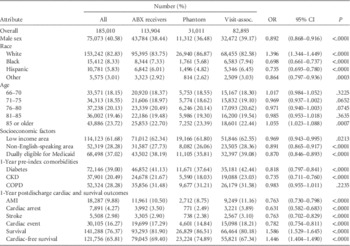
As shown in Table 1, our cohort of 185,010 patients is predominately female (59.42%), white (82.83%), and from a low-income area (61.68%). Furthermore, 16.27% of the cohort experienced another cardiac event in the year following their AMI; 76.37% survived for 1 year, and 65.81% survived 1 year without experiencing another cardiac event. The cohort of 113,904 antimicrobial receivers is also primarily female (61.56%) and white (83.75%); 81.90% survived and 69.40% survived without experiencing a cardiac event for 1-year after discharge. We defined a cardiac event as an AMI, stroke, or unstable angina.
Patient-Level Analysis Comparing Patient Characteristics Associated With Phantom Prescriptions to Visit-Associated Prescriptions

NOTE. Comparing patients’ race, age, socioeconomic status, 1-year pre-index comorbidities and 1-year post-index outcomes for 4 cohorts: all patients, patients receiving any antimicrobial of interest, patients who received at least 1 antimicrobial and none of which were phantom, and patients receiving at least 1 phantom prescription. For patients with at least 1 antimicrobial prescription, the odds ratios (ORs) compare the odds a patient with the given attribute will have a phantom prescription to those odds of a patient without the given attribute. ABX, antimicrobials; AMI, acute myocardial infarction; CKD, chronic kidney disease; COPD, chronic obstructive pulmonary disease.
Table 1 displays patient characteristics for patients who received at least 1 phantom antimicrobial and patients who received only visit-associated antimicrobial prescription(s). Of the patients who received an antimicrobial, the odds that at least 1 of the prescriptions was a phantom prescription was significantly higher for the following groups: females, white patients, patients 85 and older, patients who survived the year following their index AMIs, patients who did not have either diabetes mellitus or chronic kidney disease in the year prior to their index AMIs, patients who did not have any cardiac events in the year after their index dates, those who lived in predominantly English-speaking areas, and those who were not dually eligible for Medicare.
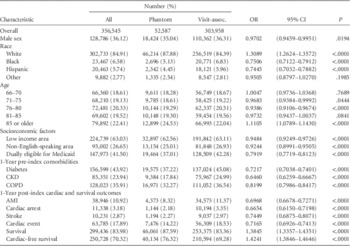
In Table 2 we show the results from our antimicrobial-level analysis. Note that the results are similar to the results of our patient-level analysis (Table 1). The following patient characteristics were associated with a higher likelihood that a prescription did not have a corresponding visit: female, white, 85 or older, from an area that predominantly speaks English, not dually eligible for Medicaid, without a diagnosis of diabetes or chronic kidney disease or chronic obstructive pulmonary disease in the year prior to their index AMI, and those who did not have any cardiac events and survived the year following their index AMI.
Antimicrobial-Level Analysis Comparing Patient Characteristics for Phantom Prescriptions to Visit-Associated Prescriptions

NOTE. Comparing patients’ race, age, socioeconomic status, 1-year pre-index comorbidities, 1-year post-index survival, and cardiac outcomes for phantom and visit-associated antimicrobial prescriptions. The odds ratios (ORs) compare the odds that a prescription filled by a patient with the given attribute will be a phantom prescription to the odds of a patient without the given attribute. AMI, acute myocardial infarction; CKD, chronic kidney disease; COPD, chronic obstructive pulmonary disease.
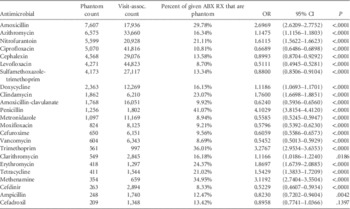
The third set of analyses involved determining whether specific antimicrobial agents had a higher chance of being prescribed without a corresponding visit, and results are displayed in Table 3. We adjusted for multiple comparisons using the Bonferroni method using a level of significance of 0.05/23=0.0022. Even when adjusting for multiple comparisons, all the odds ratios are significantly different from 1 for all antimicrobials in Table 3 except clarithromycin, ampicillin, and cefadroxil. Specifically, prescriptions including amoxicillin, penicillin, trimethoprim, and methenamine are much more likely than the typical antimicrobial studied to be prescribed without a visit. Conversely, levofloxacin, metronidazole, moxifloxacin, vancomycin, and cefdinir are much less likely to be prescribed without a visit.
Comparing Phantom and Visit-Associated Prescription Rates for Various Antimicrobials

NOTE. Phantom count or visit-associated count for a specific antimicrobial is the total number of such prescriptions (RX) filled for that antimicrobial. The odds ratio (OR) for a specific antimicrobial compares the odds of a prescription for the given antimicrobial being phantom to those odds for all other antimicrobials (ABX) listed in Appendix 1.
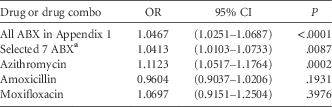
The odds of a prescription for various antimicrobials and combinations of antimicrobials being phantom in high influenza weeks compared with those odds during low influenza weeks is displayed in Table 4. For all antimicrobials in Appendix 1, we estimated that the odds a prescription was filled without a visit during a high influenza week is 1.0467 (95% CI, 1.0251–1.0687, P<.0001) times that of the odds in a week with a lower influenza rate. For a combination of clarithromycin, azithromycin, amoxicillin, amoxicillin-clavulanate, levofloxacin, moxifloxacin, and doxycycline, the odds ratio is 1.0413 (1.0103–1.0733, P=.0087), yielding a result very similar to that of all antimicrobials. Both amoxicillin and moxifloxacin, each analyzed separately, yielded odds ratios which were not significantly different from 1. Azithromycin, on the other hand, was significantly more likely to be prescribed without a visit when the influenza rate was high, with an odds ratio of 1.1123 (1.0517–1.1764, P=.0002). Finally, prescriptions for common UTI drugs were less likely to be phantom prescriptions than non-UTI-drug prescriptions: the odds of receiving one of the commonly prescribed UTI drugs without a visit was 0.6931 (0.6783–0.7082, P<.0001) times the odds of receiving a phantom prescription for any of the other antimicrobials studied.
Comparing Odds of Phantom Prescriptions During Influenza Season

NOTE. The odds ratios (ORs) compare the odds of a prescription for the given antimicrobial or combination of antimicrobials (ABX) being phantom for those filled during a high influenza week to the odds for those filled during a low influenza week.
a The selected 7 antimicrobials are clarithromycin, azithromycin, amoxicillin, amoxicillin-clavulanate, levofloxacin, moxifloxacin, and doxycycline.
DISCUSSION
Our results show that almost 15% of antimicrobials were prescribed without evidence of a corresponding encounter with a healthcare provider. Even removing refill prescriptions from consideration yielded a phantom antimicrobial prescribing rate of more than 13%. These phantom prescriptions were more likely to be prescribed for patients who were white, for patients who were female, and/or for patients who were relatively healthy. For example, having diabetes and chronic kidney disease reduced the odds of phantom prescriptions. Finally, phantom antimicrobial prescriptions occurred more commonly in our study population during weeks with higher influenza rates, especially prescriptions for azithromycin.
Although we could link a majority of antimicrobial use to healthcare encounters, we believe that this rate of phantom prescribing is important to consider when designing programs to measure and control antimicrobial use. Among our cohort of approximately 185,000 patients, during a year of follow up, more than 356,500 antimicrobial prescriptions were filled, and 52,587 of these were phantom prescriptions. In the United States, more than 250 million prescriptions for antimicrobials are filled every year.28 Thus, given our results, it is conceivable that several tens of millions of antimicrobial prescriptions may be written without a corresponding face-to-face encounter with a healthcare provider. These phantom antimicrobial prescriptions are concerning because they are potentially immune from traditional office-based-stewardship interventions.
We think that most of these phantom prescriptions are filled on the basis of telephone calls. Although some of these antimicrobial prescriptions are appropriate, it is harder to evaluate the appropriateness of antimicrobial use. From the clinician’s perspective, it is substantially harder to make an appropriate diagnosis without the ability to perform a physical examination, conduct a structured interview, or order appropriate diagnostic tests. Furthermore, over the telephone, the history may not actually be taken by the prescriber, but instead may be taken by someone else (eg, a nurse or answering service). From a stewardship perspective, without a clinical note, detailed diagnosis, or laboratory values, it is difficult to evaluate prescriptions, feed back prescribing rates in a standardized fashion, or do accurate benchmarking.
Our results are especially important given the emergence of telehealth or electronic visits (e-visits). Substantial concerns have been raised for the potential for such visits to increase inappropriate antimicrobial use.29–31 Nevertheless, e-visits have advantages over telephone encounters. First, they are structured appointments and telephone-based prescribing is not. Insofar as telephone visits often occur at busy times, they decrease the opportunity for correcting patient expectations, a major driver of antimicrobial use.Reference Nyquist, Gonzales, Steiner and Sande 23 – Reference Bauchner, Pelton and Klein 25 Second, a scheduled e-visit has the potential for the prescriber to learn more about the patient’s condition. Finally, with e-visits, there is potentially more-structured data to enable stewardship efforts than with telephone prescribing.
Although our study population was older with more comorbidities, it was actually the healthier and more affluent patients who were more likely to have these phantom antimicrobial prescriptions. Initially this result was surprising to us. Our initial intuition was that the clinicians would be more likely to prescribe antimicrobials to people who were not as healthy because these patients may be more vulnerable and more likely to have worse outcomes if they were to suffer a condition requiring an antimicrobial. Given that phantom prescribing is also more common among people living in relatively more affluent areas, our findings may be related to patient expectations. In affluent areas, expectations for treatment may be higher. Indeed, other work has shown that where provider density is higher, inappropriate antimicrobial prescribing is higher.32,33
This work is subject to many limitations. Our population is made up entirely of Medicare fee-for-service beneficiaries who have experienced an AMI. Therefore our results may not be generalizable to healthier and younger populations. However, this is an important group to consider. Infections may have more serious outcomes in this population, and adverse drug events may be more common. Future work should focus on relatively healthy populations where inappropriate prescribing may actually be higher.
Our study has several limitations. First, some antimicrobial prescriptions labeled as phantom may have been associated with a visit. If patients went to a clinic and paid cash, we have no record of this visit. Likewise, some subjects may have paid cash for their antimicrobials and not submitted a claim. Second, our phantom prescribing estimates may, in part, be driven by appropriate antimicrobial prescribing for UTIs. However, the odds of receiving a prescription for an antimicrobial agent typically prescribed for UTIs without a corresponding visit were significantly lower than the odds of receiving a phantom prescription for other antimicrobials. Third, some prescriptions could be related to dental visits, which we do not capture, but dental prescriptions are likely to affect only a subset of the antimicrobials we considered, and some antimicrobials highlighted in our analysis are much less likely to be prescribed in a dental setting (eg, azithromycin). Finally, antimicrobials could have been filled in a nursing home where there was a provider encounter but it was not charged to Medicare as such. To address this issue, we conducted a sensitivity analysis. We compared patients with at least 1 claim for a long-term care facility to those without such a claim. We found that patients with nursing home claims were less likely to have a phantom prescription than patients without such a claim (data not shown). We were not surprised by this finding because, overall, phantom prescriptions tended to occur in healthier patients.
Despite our limitations, we found that phantom antimicrobial prescribing was relatively common. As the population ages and clinics become busier, pressure and incentives for these types of encounters will likely increase. In addition, e-visits will undoubtedly continue to increase. Thus, new antimicrobial stewardship efforts are needed to target these types of prescribing. Also, our results suggest that the rate of encounter-free antimicrobial prescribing should be investigated in other populations, especially younger, healthier populations that might be more likely to have higher expectations for antimicrobial prescribing.
ACKNOWLEDGMENTS
Financial support. The National Heart, Lung and Blood Institute at the National Institutes of Health (grant K25HL122305 to L.A.P.); and the University of Iowa Health Venture’s Signal Center (to P.M.P.).
Potential conflicts of interest. All authors report no conflicts of interest relevant to this article.
SUPPLEMENTARY MATERIAL
To view supplementary material for this article, please visit https://doi.org/10.1017/ice.2016.269