I. INTRODUCTION
It is possible to produce highly transparent polycrystalline Nd:YAG by sintering to >99.99% density because Nd3xY3-3xAl5O12 (Nd:YAG) has a cubic crystal structure. Ikesue et al.Reference Ikesue, Furusato and Kamata1 first reported highly efficient laser gain in transparent Nd:YAG ceramics by sintering a powdered mixture of Al2O3, Y2O3, and Nd2O3 at 1750 °C for 8 h. They found that the addition of 0.14 wt% (1.35 mol%) SiO2 was critical to sintering Nd:YAG to transparency and proposed that SiO2 plays a critical role in incorporating Nd3+ into the YAG lattice. Yagi et al.Reference Yagi, Yanagitani and Ueda2 produced transparent Nd:YAG ceramics using coprecipitated Nd:YAG powders doped with several hundred parts per million SiO2 and sintered at 1700 °C for 20 h.
Thermodynamic modelings of the SiO2-YAG and SiO2-Nd:YAG systems predict that silica-rich liquid phases form at temperatures as low as 1390 °C.Reference Fabrichnaya, Seifert, Weiland, Ludwig, Aldinger and Navrotsky3 Boulesteix et al.Reference Boulesteix, Maître, Baumard, Sallé and Rabinovitch4 observed a liquid phase at particle necks in SiO2-doped Nd:YAG ceramics sintered at 1527 °C for 15 min. In 0.3 wt% SiO2-doped 1 at.% Nd:YAG, differential thermal analysis showed an endothermic peak at 1390 °C, which was attributed to liquid phase formation.Reference Stevenson, Li, Martinez, Anderson, Suchy, Kupp, Dickey, Mueller and Messing5 A similar peak was not observed in Nd:YAG samples without SiO2 doping. Using a combination of nuclear magnetic resonance and transmission electron microscopy, Stevenson et al.Reference Stevenson, Li, Martinez, Anderson, Suchy, Kupp, Dickey, Mueller and Messing5 showed that Si4+substitutes into the YAG crystal structure on tetrahedrally coordinated Al3+ sites and no liquid phase remains in 0.035–0.28 wt% SiO2-doped 1 at.% Nd:YAG at temperatures between 1600 and 1750 °C. It is apparent that SiO2 acts as a transient liquid-phase sintering aid during YAG sintering. That is, a liquid phase forms at 1390 °C and affects intermediate stage densification followed by Si4+ substitution into the YAG structure, leading to subsequent densification by solid state mechanisms.
To successfully process transparent ceramics, any sintering aid must not affect the optical properties of the host material. This constraint markedly limits the number of sintering aids available for optical ceramics. To decrease Si4+ content in Nd:YAG ceramics, we consider adding a sintering aid that interacts with the known liquid-phase densification mechanisms during intermediate stage sintering of SiO2-doped Nd:YAG, but which is then eliminated from the system. In other ceramic systems where SiO2 acts as a liquid-phase sintering aid, such as cordierite, codoping with B2O3 has been shown to increase densification rates and lower sintering temperatures. Further, B2O3 is known to vaporize from borosilicate glass melts,Reference Taylor, Dent, Braski and Fabes6, Reference Shelby7 and so it may act as a fugitive liquid phase sintering aid during Nd:YAG sintering.
In this article, we report on how changing the ratio of B2O3 to SiO2 and total dopant concentration affects densification in Nd:YAG ceramics. We investigate the effects of B2O3-SiO2 doping on sintering kinetics and microstructure when sintered in vacuum and O2. The resulting ceramics sinter to transparency at 1600 °C, more than 100 °C lower than any other reports for pressureless sintering Nd:YAG ceramics doped with ≤0.14 wt% SiO2.
II. EXPERIMENTAL PROCEDURE
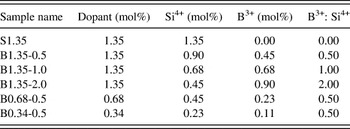
To investigate how B2O3 affects the sintering of Nd:YAG, solid state reaction (SSR) powders formed by dry pressing and tape casting were used for sintering. All samples in this study were 1 at.% Nd:YAG and will be referred to simply as “Nd:YAG.” To prepare the Nd:YAG ceramics by the SSR process, α-Al2O3 powder (AKP50, >99.99%, 100–300 nm; Sumitomo Chemical Co., Tokyo, Japan), Y2O3 (BB, >99.999%, 50 nm; Shinetsu Co., Tokyo, Japan), and Nd2O3 (>99.99%, 200 nm; Alfa Aesar, Ward Hill, MA) powders were used. Samples were doped according to the compositions in Table I using tetraethylorthosilicate (99.999+%; Alfa Aesar) and trimethyl borate (99.999+%; Alfa Aesar) as the SiO2 and B2O3 sources, respectively. The B3+:Si4+ atomic ratio was varied between 0.5 and 2 while maintaining the total dopant content at 1.35 mol%, which is equivalent to 0.14 wt% SiO2 doping. To investigate the role of dopant content on sintering kinetics, the B3+:Si4+ ratio was held constant at 0.5, whereas the total dopant content was varied from 0.34 to 1.35 mol%. We introduce a descriptive nomenclature to facilitate discussion. Samples doped with SiO2 are denoted “S” and samples doped with borosilicate are denoted “B.” Undoped samples are labeled “U.” The mol% dopant follows “S” or “B.” For borosilicate-doped samples, the B3+:Si4+ atomic ratio follows the dopant content. For example, 1.35 mol% SiO2-doped samples are denoted S1.35, whereas the samples labeled B1.35-0.5 are 1.35 mol% borosilicate doped with B3+:Si4+ = 0.5.
Sample compositions.

Samples were green formed by dry pressing and tape casting processes described by Lee et al.Reference Lee, Kupp, Stevenson, Anderson, Messing, Li, Dickey, Dumm, Simonaitis-Castillo and Quarles8 Green densities were 45% of theoretical density for dry-pressed samples and 48% of theoretical density for tape-cast samples. Initial- and intermediate-stage sintering were studied using dry-pressed samples heated in a thermo-mechanical analyzer (TMA) (TMA-50; Shimadzu Inc., Kyoto, Japan) at 10 °C/min to 1400 °C and held for 1 h in air. For final stage densification, tape-cast samples were vacuum-sintered (<1 mTorr) between 1400 and 1750 °C for 2–20 h in a tungsten mesh–heated furnace (M60; Centorr Vacuum Industries, Nashua, MA). A set of tape-cast samples was also sintered in flowing O2 (0.3-slpm flow rate) in a high purity Al2O3 tube furnace (CM Furnaces Inc., Bloomfield, NJ) between 1500 and 1600 °C for 2–20 h. Density was measured by the Archimedes method.
Microstructures were observed using both optical and scanning electron microscopy (SEM) (Model XL20; Hitachi Inc., Tokyo, Japan). Grain size and pore size were determined using the linear intercept method. B3+ content was determined by laser ablation inductively coupled plasma mass spectrometry (LA-ICPMS) (Scientific Xseries 2; ThermoFisher Inc., Waltham, MA). Before LA-ICPMS, at least 200 μm of each sample surface was removed using 15 μm diamond grit to eliminate surface effects. In-line transmission was measured using a spectrophotometer (DU-800; Beckman Coulter, Brea, CA). Fluorescence spectroscopy was performed on a confocal scanning optical microscope (alpha300 S; Witec Inc., Ulm, Germany) with 514-nm excitation from a tunable Ar laser.
III. RESULTS
A. Initial- and intermediate-stage sintering
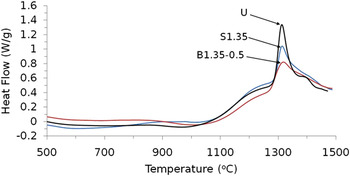
Figure 1 shows differential thermal analysis of dry-pressed Nd:YAG samples U, S1.35, and B1.35-0.5. The clear exothermic peak beginning at 1265 °C and reaching its maximum at 1325 °C is attributed to the perovskite- to garnet-phase transition.Reference Ikesue, Furusato and Kamata1, Reference Fabrichnaya, Seifert, Weiland, Ludwig, Aldinger and Navrotsky3, Reference Kochawattana9, Reference Maître, Sallé, Boulesteix, Baumard and Rabinovitch10 Compared to the peak from the undoped sample, the SiO2 and B2O3-SiO2 samples have a lower and broader peak, suggesting that SiO2 and B2O3-SiO2 doping affects the phase transition. In contrast to the work of Maitre et al.,Reference Maître, Sallé, Boulesteix, Baumard and Rabinovitch10 no endothermic peaks were observed in any sample. This is likely due to the use of 50% less SiO2 in this study (1.35 mol%) compared with the study by Maitre et al.Reference Maître, Sallé, Boulesteix, Baumard and Rabinovitch10
Differential thermal analysis of solid state reaction (SSR) Nd:YAG powders heated at 10 °C/min to 1500 °C.

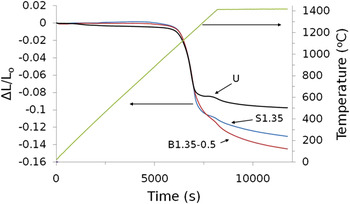
Figure 2 shows uniaxial shrinkage versus time for dry-pressed SSR Nd:YAG samples (U, S1.35, and B1.35-0.5) heated in a TMA at 10 °C/min and held at 1400 °C for 1 h. Shrinkage begins at 1100 °C for each sample. At 1320 °C, there is an inflection in the shrinkage data for all three samples, which corresponds to the perovskite- to garnet-phase transition. This phase transition results in a theoretical 11.5 vol% expansion; therefore, it is likely that densification by sintering continues to occur in this temperature range, but the volumetric expansion associated with the phase transition reduces the total shrinkage measured by the TMA. Thus, the inflection in the shrinkage data does not indicate changing densification mechanisms but reflects a competition between sintering-related shrinkage and phase transition–related expansion.Reference Ikesue, Furusato and Kamata1
Linear shrinkage of dry-pressed SSR Nd:YAG powders heated in a thermo-mechanical analyzer at 10 °C/min to 1400 °C and held for 1 h.

The linear dimensional change in the silica-doped sample is 12.9% and the total linear shrinkage in the borosilicate-doped sample is 14.4%. Assuming isotropic shrinkage, this correlates to relative densities of 83.7 and 88.2%, respectively. For the undoped sample, linear shrinkage at the end of the 1400 °C hold is 9.7%, which corresponds to 74.1% density.
B. Final-stage densification and microstructure in Nd:YAG ceramics
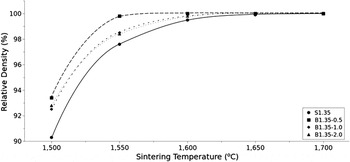
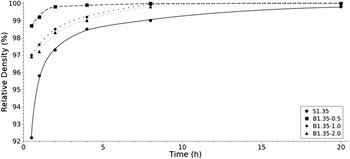
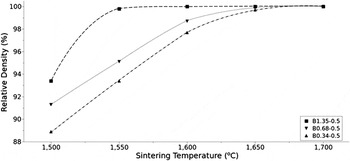
Figure 3 shows the isothermal densification of tape-cast Nd:YAG samples vacuum-sintered for 2 h between 1500 and 1700 °C. Figure 4 shows the sintering kinetics of samples with the same compositions heated to 1550 °C. For all temperatures and times, B2O3-SiO2 samples sintered to greater densities than samples doped with SiO2. Below 1650 °C, sintered density was highest in samples with B3+:Si4+ = 0.5 and decreased with increasing B3+:Si4+ atomic ratio. Figure 5 shows sintered density as a function of temperature for Nd:YAG samples with 0.34–1.35 mol% B2O3-SiO2 and a constant B3+:Si4+ of 0.5. It is seen that, as B2O3-SiO2 dopant content increases, sintered density increases at all temperatures. By 1700 °C, all samples are over 99.9% dense and visibly transparent.
Relative density versus temperature for tape-cast SiO2- and B2O3-SiO2-doped Nd:YAG ceramics with varying B3+:Si4+. Hold time was 2 h at each temperature.

Densification kinetics at 1550 °C for tape-cast SiO2- and B2O3-SiO2-doped Nd:YAG ceramics with varying B3+:Si4+.

Relative density versus sintering temperature for tape-cast SiO2- and B2O3-SiO2-doped Nd:YAG ceramics with varying dopant content and constant B3+:Si4+ = 0.5. Hold time was 2 h at each temperature.

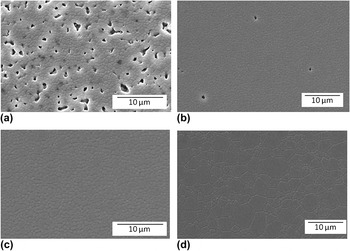
SEM micrographs of tape-cast samples with 0.34 mol% B2O3-SiO2 and B3+:Si4+ = 0.5 sintered between 1550 and 1700 °C are shown in Fig. 6. These images are representative of final-stage densification in B2O3-SiO2-doped Nd:YAG ceramics. Note that some pores are larger than the average grain size but shrink with increasing temperature and time. For example, the average grain size shown in Fig. 6(b) is 840 nm and the average pore size is 2.3 μm. The densification behavior observed in Fig. 6 is similar to that observed in SiO2-doped, coprecipitated 1 at.% Nd:YAG samples in which densification was also limited by a small population of pores similar to or larger than the average grain size.Reference Stevenson, Li, Martinez, Anderson, Suchy, Kupp, Dickey, Mueller and Messing5
Scanning electron microscopy (SEM) images of tape-cast Nd:YAG ceramics doped with 0.34 wt% B2O3-SiO2 with B3+:Si4+ = 0.5 (B0.34-0.5) sintered at (a) 1550 °C for 2 h, (b) 1600 °C for 2 h, (c) 1600 °C for 8 h, and (d) 1700 °C for 8 h.

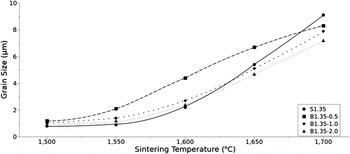
Figure 7 shows grain size as a function of temperature for samples doped with 1.35 wt% SiO2 or B2O3-SiO2 sintered between 1500 and 1700 °C for 2 h. When B3+:Si4+ = 0.5, the grain size is similar to that of the silica-doped samples, but increasing the B3+:Si4+ ratio decreases grain size at all sintering conditions. At lower sintering temperatures, SiO2-doped samples have a smaller average grain size than B2O3-SiO2-doped samples, but by 1700 °C, the SiO2-doped sample has the largest average grain size. Average grain size as a function of temperature for samples with 0.34–1.35 mol% B2O3-SiO2 is shown in Fig. 8, and increasing B2O3-SiO2 content is seen to increase grain growth at all temperatures.
Average grain size versus temperature for tape-cast SiO2- and B2O3-SiO2-doped Nd:YAG ceramics with varying B3+:Si4+ ratio. Hold time was 2 h at each temperature.

Average grain size versus temperature for tape-cast SiO2- and B2O3-SiO2-doped Nd:YAG ceramics with varying dopant content. Hold time was 2 h at each temperature.

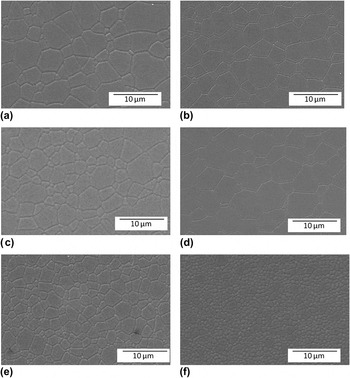
SEM micrographs of samples sintered at 1700 °C for 2 h are shown in Fig. 9. All samples are pore-free and the microstructures are qualitatively consistent, that is, grain shapes are similar in all samples regardless of additive amount or composition. Like SiO2-doped samples, no second phases are observed at triple points or grain boundaries.
SEM images of tape-cast SiO2- and B2O3-SiO2-Nd:YAG ceramics sintered at 1700 °C for 2 h. (a) B1.35-0.5, (b) B1.35-1, (c) B1.35-2, (d) S1.35, (e) B0.68-0.5, and (f) B0.34-0.5.

C. Mass spectrometry of sintered borosilicate-doped Nd:YAG ceramics
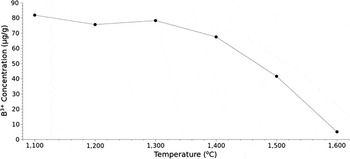
LA-ICPMS was used to determine the Si4+ and B3+ content as a function of sintering temperature and time for samples with B3+:Si4+ = 0.5. The initial amount of B3+ was 83 μg/g. Figure 10 shows B3+ content in samples heated at 5 °C/min in air to between 1100 and 1500 °C with no hold time. B3+ content at 1100 °C was approximately the same as the initial composition (∼80 μg/g). At 1400 °C, B3+ content begins to decline, and by 1600 °C, the B3+ content is <5 ppm. On the basis of previous studies on boria volatilizationReference Taylor, Dent, Braski and Fabes6, Reference Shelby7 and the LA-ICPMS data, we propose that B3+ vaporizes during sintering. Si4+ content was also measured by LA-ICPMS and remained constant for all temperatures and times. Therefore, the sintering kinetics of defect chemistry at temperatures ≥1600° C of the B2O3-SiO2-doped samples are controlled only by the Si4+ content of the samples and are similar to samples doped with only SiO2.
B3+ concentration versus temperature for tape-cast Nd:YAG ceramics (B1.35-0.5). Heating rate was 5 °C/min with no hold time at each temperature.

D. Optical properties
In-line transmittance for Nd:YAG samples doped with 1.35 mol% SiO2 and B2O3-SiO2 is shown in Fig. 11. The samples were 1-mm thick. The SiO2-doped sample was sintered at 1700 °C for 8 h, whereas the B2O3-SiO2-doped sample was sintered at 1600 °C for 10 h. Average grain sizes were 20 and 7 μm, respectively. Both samples demonstrate in-line transmission approaching the theoretical limit (84%) from 400 to 1100 nm. Figure 12 shows the fluorescence spectra for the same samples excited with a 514 nm laser. The fluorescence peaks result from crystal-field splitting of the f-orbitals in Nd3+. No fluorescence peaks shifted in the B2O3-SiO2-doped sample relative to the SiO2-doped sample, indicating that B2O3-SiO2 doping has no effect on Nd3+ substitution or coordination into the YAG lattice.
In-line transmission of tape-cast Nd:YAG ceramics B1.35-0.5 and S1.35 sintered at 1600 and 1700 °C, respectively, for 8 h. Sample thickness was 1 mm.

Stimulated fluorescence of tape-cast Nd:YAG ceramics B1.35-0.5 and S1.35 sintered at 1600 and 1700 °C, respectively, for 8 h. Excitation wave length was 514 nm.

IV. DISCUSSION
The dilatometric data in Fig. 2 show that the key kinetic differences between SiO2- and B2O3-SiO2-doped samples occur between 1330 and 1400 °C. In this temperature range, the densification rate of B2O3-SiO2-doped samples exceeds that of SiO2-doped samples. During final-stage densification between 1500 and 1700 °C, the relative density of B2O3-SiO2-doped Nd:YAG ceramics exceeds that of SiO2-doped Nd:YAG ceramics, but the densification rates are nearly identical. Further, mass spectrometry showed that B3+ is not present in samples sintered ≥1600 °C or after 4 h at 1500 °C. Clearly, the key kinetic contribution of B2O3-SiO2 doping occurs during the brief period of liquid phase sintering between 1330 and 1400 °C when the relative density is nominally 67–88%.
Densification occurs by a solution precipitation mechanism in the 1330–1400 °C temperature range as a result of liquid phase formation. Kwon and Messing derived an equation to describe densification in diffusion-limited densification by liquid phase sintering systemsReference Kwon and Messing11:

where E(ρ) is a density-dependent function, D liq is the rate of ionic diffusion in the liquid, δ liq is the thickness of the liquid phase layer, γ lv is liquid–vapor interfacial energy, Ω is molar volume, β c is the fractional contact area between the particles, k B is Boltzmann’s constant, T is the temperature, and r is the average particle radius. Note that the densification rate is proportional to D liq.
In borosilicate and alumino-borosilicate glasses and melts, B3+ is known to be both 3- and 4-fold coordinated, with the relative concentration of each coordination dependent on melt chemistry and applied pressure.Reference Stebbins12 In the threefold coordination, B3+ creates nonbridging oxygen, which decreases both melting temperature and viscosity while increasing free volume relative to non-B3+ containing glasses. According the Stokes–Einstein equation,

where η is viscosity and r* is the atomic radius of the diffusing ion; diffusion in a liquid is inversely proportional to the viscosity of the melt. Therefore, it is proposed that B3+ increases densification by decreasing the liquid viscosity during sintering, which subsequently increases D liq and the associated densification kinetics by a liquid phase sintering mechanism.
At higher sintering temperatures (≥1500 °C), B3+ evaporation results in reduced sintering and grain growth kinetics to levels associated with lower SiO2 dopant levels. In samples with 1.35 mol% B2O3-SiO2 doping, increasing B3+:Si4+ ratio leads to decreased silica content after B3+ vaporizes. Stevenson et al.Reference Stevenson, Li, Martinez, Anderson, Suchy, Kupp, Dickey, Mueller and Messing5 showed that densification and grain growth are critically dependent on SiO2 content, and increasing SiO2 content in Nd:YAG ceramics from 1600 to 1750 °C increased both densification and coarsening. Therefore, the decreased density and grain size observed in Figs. 3 and 4 for samples with lower B3+/Si4+ ratios is attributed to the relatively lower silica content after B3+ evaporation. Similarly, samples with lower total dopant content but identical B3+/Si4+ ratios (B0.68-0.5 and B0.34-0.5) have lower sintering and grain growth kinetics during final stage sintering because the silica contents are lower after B3+ vaporization.
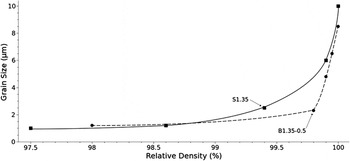
The relationships between SiO2 content and microstructure are clearly observed in the sintering trajectory shown in Fig. 13 for samples S1.35 and B1.35-0.5. The samples with the highest SiO2 content, S1.35, have a more coarsening sintering trajectory than the B1.35-0.5 samples. The sintering trajectory for the B1.35-0.5 samples is similar to the S1.35 samples up to 98.5% density, after which the B2O3-SiO2-doped samples show significantly decreased coarsening versus the S1.35 sample. This behavior can be explained by B3+ evaporation. As the samples sinter to 98% density (which occurs around 1550 °C for a 10 °C/min ramp with no hold time), B3+ is still present in the system, leading to relatively faster densification and grain growth kinetics. At temperatures ≥1600 °C and corresponding densities >98%, B3+ has vaporized from the system and densification and coarsening kinetics are controlled by the remaining SiO2 content. Because the SiO2 content at this point is lower for the B1.35-0.5 samples than the S1.35 samples, the B1.35-0.5 samples sinter along a more densifying trajectory, as described in Stevenson et al.Reference Stevenson, Li, Martinez, Anderson, Suchy, Kupp, Dickey, Mueller and Messing5 As shown in Fig. 11, B1.35-0.5 ceramics sintered to transparency at 1600 °C for 8 h, which is more than 100 °C below the sintering temperature required to achieve transparency in S1.35 ceramics.
Sintering trajectory of Nd:YAG samples sintered between 1500 and 1700 °C for 2–8 h.

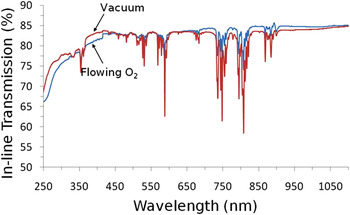
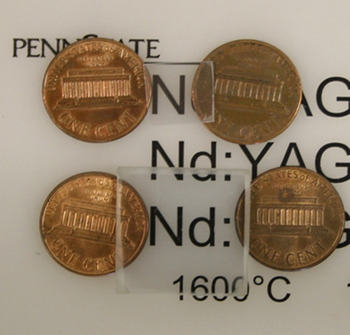
The ability to sinter highly transparent Nd:YAG ceramics at ≤1600 °C has important practical implications. For example, most reports of sintering transparent Nd:YAG ceramics use expensive refractory metal vacuum furnaces to achieve the high temperatures (≥1700 °C) required for sintering transparent ceramics and to avoid entrapped gases, which can limit pore elimination. By lowering the sintering temperature to ≤1600 °C, it becomes possible to sinter in less expensive tube and box furnaces. To examine whether transparent ceramics could be achieved by pressureless sintering at lower temperatures, B1.35-0.5 samples were sintered in an Al2O3 tube in a flowing O2. Figure 14 shows the in-line transmission for these samples after sintering in vacuum (refractory metal furnace) or flowing O2 (Al2O3 tube furnace). Each sample (flowing O2 and vacuum) was sintered at 1600 °C for 20 h. Both samples are highly transparent with in-line transmissions approaching 84% from 400 to 1100 nm. Although the in-line transmission of the oxygen-sintered sample is less than the vacuum-sintered sample from 250 to 400 nm, this proof of concept shows that borosilicate-doped Nd:YAG ceramics can be sintered to transparency without requiring expensive refractory metal furnaces. An image of samples sintered in flowing O2 (top) and vacuum (bottom) is shown in Fig. 15.
In-line transmission of Nd:YAG ceramics B1.35-0.5 sintered in flowing O2 and vacuum. Both samples were sintered at 1600 °C for 20 h. Sample thicknesses were 0.6 and 1 mm for the O2-sintered and vacuum-sintered samples, respectively.

Image of B1.35-0.5-doped Nd:YAG samples sintered in flowing O2 (top) and vacuum (bottom). Both samples were sintered at 1600 °C for 20 h. To demonstrate their transparency, the samples are raised above the text.

V. CONCLUSIONS
In Nd:YAG ceramics, TMA showed that initial- and intermediate-stage densification kinetics were enhanced for B2O3-SiO2-doped versus SiO2-doped samples, leading to a 100 °C reduction in sintering temperature. Inductively coupled plasma mass spectrometry determined that B3+ begins to vaporize at 1300 °C and is reduced to trace levels (<5 ppm) by 1600 °C. Because B3+ evaporates, it does not affect in-line transmission and fluorescence spectra. It is proposed that B3+ enhances diffusion during the brief period of liquid phase–assisted densification between 1330 and 1400 °C in Nd:YAG ceramics by forming nonbridging oxygen in the liquid phase. In this way, 0.34–1.34 wt% B2O3-SiO2 doping was shown to be a transient liquid phase sintering aid in Nd:YAG ceramics. Because of the reduced sintering temperature, borosilicate-doped samples could be sintered to transparency in a simple alumina tube furnace rather than requiring an expensive refractory metal vacuum furnace.