Poverty is pervasive in our world today and, sad to say, on the rise. As a short-term medical volunteer in South America, my mind is forever etched with the image of a young child who discovered a dead animal in the middle of the road and rejoiced as she dragged it back to her shanty to provide food for her family. I witnessed hundreds of starving young children and adults rummaging through garbage or jumping on the backs of dump trucks in hopes to get “first pick” of food and materials that might help them survive. Hundreds began lining up in the middle of the night to receive care from our medical and dental clinics. Mothers walked for miles with their children in the hope of receiving a free three-month supply of multivitamins.
Over half the world lives in poverty, and a billion (33%) of these individuals are children (Shah, Reference Shah2011). Many of these children live without sufficient shelter (640 million), access to clean water (400 million), and access to healthcare services (270 million). Thus, it is not surprising that 10.6 million children (or 29,000 children each day) died worldwide in 2003 before the age of 5 years. These numbers allow us to estimate well over 21 million parents who are bereaved by the death of a child each year, not including the additional millions of affected siblings, extended family members, and friends. Poverty and lack of resources or access to support makes this population especially vulnerable to long-term complications, including increased mortality (Li et al., Reference Li, Precht and Mortensen2003). While initiatives are rightfully targeting efforts to implement strategies to decrease the majority of these deaths that seem preventable, this long-term goal is fraught with governmental and political barriers. The inability of these populations to access services, such as pediatric palliative care to decrease the physical, psychological, social, and spiritual suffering of dying children and their families, represents a massive widespread inequity that must be addressed.
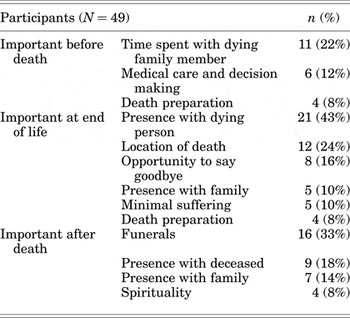
Some life-threatening conditions can result in a cure. Unfortunately, many life-threatening illnesses will result in death, especially for those living in developing countries who may not have access to advanced medical care. What, if anything, can be done to bring the benefits of pediatric palliative care to such vulnerable and underserved populations across the world of dying children and their family members? We explored elements of a good death based on the perceptions of bereaved individuals (N = 49) living in Ecuador. The participants averaged 28.76 years in age (SD = 18.02), were mostly female (n = 38, 77.6%), lived in villages surrounding the city of Quito, and had experienced the death of a loved one within the previous 9 or 10 months (SD = 6.11). Educational level averaged 6.67 years (SD = 3.20). Average family income averaged $311 a month (SD = 196.56). American researchers conducted semistructured interviews via Spanish translators, asking open-ended questions. Content analysis identified emerging themes. Bereaved individuals reported the things most important to them (1) before the death of their loved one, (2) at the end of life, and (3) after the death (Table 1). Participants perceived that time spent with their dying family member, preparation for death, and medical care and decision making were most important before the death. Other important components at the end of life included being present with the dying person, the presence of other family members, an opportunity to say goodbye, the location of the death (hospital, home), minimal suffering, and death preparation. Bereaved participants reported that presence with family, presence with the deceased (e.g., physical—seeing the body; nonphysical—reminiscing), funerals, and spirituality were most important after death. Anecdotally, many participants reported that this was the first time anyone had asked them how they were doing since their loved one's death. When asked what their advice would be to us as scientists, participants simply requested that we come back again and keep asking these questions.
Counts and frequencies of participant reports

Legacy making is one strategy that has shown promise in helping to improve coping and adjustment for children with life-threatening illnesses and their family members in the United States (Akard et al., Reference Akard, Gilmer and Friedman2013). Legacy-making activities (e.g., creating memory books, making a special craft) can be cost-effective and may help children and families facilitate doing or saying things to be remembered in case of a child's death. Such activities can be helpful not only for ill children, but can also have positive effects on bereaved family members in cases where a child has died. A national survey suggested that 97% (n = 75) of children's hospitals in the United States offer legacy-making services to children with life-threatening conditions and their families (Foster et al., Reference Foster, Dietrich and Friedman2012). More research is needed to determine what legacy-making services are offered to pediatric palliative care populations across the globe and how such services can be culturally appropriate, beneficial, and feasible worldwide.
These findings provide insights into significant areas of future research and practice. Healthcare professionals can share with parents of dying children what other bereaved family members have found to be important both before and after a child's death. Providers can also help educate community leaders (e.g., pastors, teachers) on how they can offer support to children living with life-threatening conditions and their family members and recognize signs of high-risk individuals who may need to seek professional support. Universities and healthcare organizations can establish relationships with global partners to increase collaborative research efforts. Importantly, we must identify gatekeepers who have access to the “invisible” underserved populations throughout the world. These gatekeepers are key to educating professionals (e.g., healthcare providers, researchers, policy makers) on how we can access and develop more accessible services for these often hard-to-reach groups. More research is critical to explore effective and accessible strategies for culturally appropriate interventions that will decrease suffering for dying children and their loved ones throughout the world.
Pediatric palliative care professionals should include global perspectives for the needs of dying children and bereaved individuals in developing countries. For some of us, that role is to physically visit and actively do research or provide clinical care in the Third World. Others may take advantage of opportunities to be a co-investigator or consultant to assist in developing studies or analyzing and interpreting data. While not all researchers or clinicians have global interests, all palliative care professionals can contribute by (1) developing culturally sensitive palliative care interventions and studies that may have implications for those in developing countries, (2) collaborating with palliative care professionals (e.g., clinicians, researchers) in developing countries, (3) exposing students and mentoring them to consider global perspectives within pediatric palliative care, or (4) presenting research results in international peer-reviewed journals and conferences to disseminate palliative care knowledge across the globe.
Healthcare professionals who care for children with life-threatening conditions and their families are endowed with invaluable skills that can be applied to significantly advance the field of pediatric palliative care and improve life for the invisible community of dying children and their loved ones. We challenge pediatric palliative care professionals to contribute their rare, invaluable, and significant knowledge across the globe. In the words of John F. Kennedy, “To those whom much is given, much is expected.”