


INTRODUCTION
“Nobody had nothing. Everybody had something.”
– Franz Stangl, Commandant of the Treblinka death camp
Since 1945, mass violence has claimed the lives of at least twelve million civilians (Harff Reference Harff2003, 57). According to the United Nations High Commissioner for Refugees (UNHCR), as of 2015, 65.3 million people were forcibly displaced (UNHCR 2015). An inevitable feature of any large-scale killing and displacement of civilians is a transfer of wealth. The dead lose everything, while refugees leave behind houses, land, and valuables. The possessions of even the poorest can be of use to those who kill, expel, or simply stay put and survive.
Evidence from numerous conflicts around the world shows the magnitude and the pervasiveness of this phenomenon. During the partition of India and Pakistan, millions of acres of land and thousands of businesses were abandoned (Schechtman Reference Schechtman1951) and later redistributed. In the Pakistani city of Lahore alone, almost 500 factories changed owners after the Partition (Talbot Reference Talbot2006, 93). In Israel/Palestine, the value of property left behind by Palestinian refugees and later taken over by the Israeli state amounts to at least US$ 3 billion; the value of Jewish property left behind in various Arab states is estimated to have a similar worth (Levin Reference Levin2001, 226-27; Lewis Reference Lewis1996). When the Iraqi city of Sinjar was liberated from ISIS in 2015, the Yazidi residents plundered the houses of fleeing Sunni neighbors, in “compensation” for their suffering under the Islamic State (Morris Reference Morris2015).
Property transfers, a general category that includes a range of possible actions, such as confiscation and redistribution of assets by states and individuals, looting, extortion, and even grave digging, are a crucial component of mass violence, displacement, and refugee return processes (Phuong Reference Phuong2000), yet we know little about their local-level social and political consequences. Our understanding of this phenomenon is limited by the paucity of reliable data, and even more importantly, by the difficulty of isolating the impact of property redistribution from that of other aspects of conflict. Property transfers accompany periods of social upheaval and economic turmoil, which also affect behavior and attitudes. Property transfers and their effects are also endogenous to the preexisting intergroup relations in a given community. Finally, the location of violence is rarely random, which complicates causal identification of the political and economic effects of property transfers.
Several scholars have studied the economic impact of mass violence, but either focused on the macro (national or province) level, or analyzed violence as a holistic process without distinguishing between different channels that may drive its effects (Acemoglu, Hassan, and Robinson Reference Acemoglu, Hassan and Robinson2011; Grosfeld, Rodnyansky, and Zhuravskaya Reference Grosfeld, Rodnyansky and Zhuravskaya2011; Rogall and Yanagizawa-Drott Reference Rogall and Yanagizawa-Drott2013). The micro-level research centers on post-violence human capital (Bleakley and Ferrie Reference Bleakley and Ferrie2016; Voigtländer and Voth Reference Voigtländer and Voth2012) and individual-level political activism and attitudes caused by exposure to violence (Blattman Reference Blattman2009; Grossman, Manekin, and Miodownik Reference Grossman, Manekin and Miodownik2015). Studies that do focus on violence-related property transfers, important as they are, either present a general overview of the patterns of plunder (e.g., Dean Reference Dean2008; Rickman Reference Rickman2007) or provide isolated evidence of the process and its inherent gruesomeness (e.g., Aly Reference Aly2006; Gross and Grudzinska-Gross Reference Gross and Grudzinska-Gross2012).
This article examines the lasting effects of conflict-related property transfers by focusing on a morally charged but theoretically and empirically important case study—the acquisition of Jewish valuables by the population living near the Treblinka death camp in Nazi-occupied Poland.Footnote 1 The exact location of the camp was a German decision, exogenous to the behavior and the views of the local population. This allows us to address important identification concerns that affect existing research. Located in northeastern Poland, Treblinka was the largest killing center of Operation Reinhard (Einsatz Reinhard, ER)—the Nazi effort to exterminate the Jews of Poland. Subsequently, the camp's functions expanded to include the extermination of Jews from other European countries.Footnote 2 Overall, during the camp's operation in 1942–43, Nazis and their collaborators killed 850,000 to 900,000 Jews in Treblinka. Believing German assurances that Treblinka was a labor camp or a transit point from which the Jews would be sent to perform agricultural work in Nazi-occupied Ukraine, many victims took valuables with them to this final destination. After the Jews were gassed, their property—jewelry, golden dental work, money, clothing, and tools—was collected, sorted, and sent to Germany. However, even though the German authorities strove to secure all Jewish loot, their ability to do so was limited, and some Jewish valuables ended up in the hands of the local Polish population, at first through trade with the camp guards and later through grave digging. Such behaviors were so widespread that a nearby village, Wólka Okrąglik, is still locally known as Golden Wólka (Złota Wólka).
This article focuses on the political and economic effects of the acquisition of Jewish property at the micro level by analyzing communities located within a forty-mile radius of Treblinka. We find that the effects of property transfers are highly localized: they are most pronounced in the immediate vicinity of the camp and decline precipitously with distance. Politically, proximity to the camp is associated with higher electoral support for an anti-Semitic party, the League of Polish Families, in the 2001 parliamentary election, when Polish-Jewish relations during the Holocaust were a salient national issue. We also find that proximity to the death camp is associated with newer and better housing stock during the Communist period. At the same time, we find no evidence that property transfers have affected levels of economic activity, migration patterns, or levels of human development in the area.
By focusing on the long-run political and socioeconomic impact of wartime property transfers at the local level, this article makes an important contribution to the study of politics and society in post-conflict states and improves our understanding of the legacies of war, violence, and displacement.
TREBLINKA: BACKGROUND
The Nazis established the Treblinka death camp (also known as Treblinka II) in July 1942, when the extermination of Jews was already underway in two other ER camps, Bełżec and Sobibór. The camp's general placement was influenced by its proximity to Małkinia, a railway junction equidistant from the two major urban centers, Warsaw and Białystok. At the same time, to keep the killing secret, the camp was built in a secluded area; a separate railroad was constructed to transport the victims from Małkinia to the killing center (Arad Reference Arad1987; Kogon Reference Kogon1947).
In the vicinity of Małkinia, the exact placement of the camp was exogenous to the attributes and behavior of the local population. Official Nazi documents offer no detailed information on the decision to locate the camp at its exact site, near the Polish village of Treblinka, and the decision appears to have been made locally by the official in charge of the camp’s construction, SS Hauptsturmführer (Captain) Richard Thomalla. The specific site was likely selected due to its proximity to a small stone quarry and a penal labor camp (Treblinka I), the prisoners of which could be employed in the construction of Treblinka II. Both the quarry and the penal labor camp predated the Nazi decision to exterminate the Jews (Arad Reference Arad1987, 37). The local Polish population did not know in advance about the purpose of the camp and was not involved in its operation. The camp's activities were officially secret, which suggests that Germans did not view the locals as potentially supportive of their plans.
The camp was divided into three sections. The first section contained the housing of the German staff, the barracks of the non-German guards, and the living quarters of some of the camp's Jewish prison laborers. The second section, also known as the Lower Camp, was the reception area where the trains bringing Jews to the camp were offloaded. There, the Jews were ordered to undress and to hand over all their valuables for “safekeeping” (Webb and Chocholaty Reference Webb and Chocholaty2014, 38). Specially designated Jewish prison laborers conducted body searches to ensure that no valuables remained hidden. Later on, the valuables were sorted and stored in special warehouses. A detail of prison laborers, called the Goldjuden (Gold Jews), was in charge of collecting gemstones and precious metals (Arad Reference Arad1987, 108).
From the Lower Camp, a path known as the “Road to Heaven” led to the Upper Camp with the gas chambers, designed to look like showers. After the chambers closed, carbon monoxide was pumped inside. Once those inside the gas chambers died, Jewish prison laborers, called the “Dentists,” removed gold and platinum dental work. The money, gemstones, and precious metals collected by the Dentists and the Goldjuden were later sent to the ER headquarters in Lublin. According to one of the “Dentists,” about eighty pounds of gold alone were sent each week (Arad Reference Arad1987, 158). Other items such as fountain pens, shoes, clothing, and hair were transported by special trains.
The dead were buried in mass graves. The victims' bodies were not cremated until 1943, when the camp authorities ordered the Jewish prisoners to open the graves and burn bodies in order to destroy the evidence of mass murder. However, this task was never completed. On August 2, 1943, the Jewish prisoners of Treblinka rebelled, and approximately 300 were able to escape. Most were caught and killed, but some managed to survive.
In November 1943, after killing 850,000 to 900,000 Jews in 16 months, the camp ceased operations. The region was liberated from Nazi occupation by Soviet troops in July 1944. In large part because its victims were almost exclusively Jews, “the camp did not even figure on the map of Polish martyrdom sites” in the postwar period, remaining largely unknown to the Polish public until the 1990s (Kuwalek Reference Kuwalek, Tych and Adamczyk-Garbowska2014; Woycicka Reference Woycicka2013, 188–189). Until 1963, no commemorative ceremonies were held at the site of the camp, and a memorial to the victims was only erected in 1964 (Webb and Chocholaty Reference Webb and Chocholaty2014, 122). An on-site museum opened as late as 2006.
The key purpose of Treblinka was murder, but plunder was also important. The amount of money, gold, and gemstones stolen from the victims was gargantuan—it is estimated that 1,250–1,500 train cars full of goods were sent to Germany (Levin Reference Levin2004, 179–80). The Nazi authorities sought to secure all Jewish valuables, yet in practice this was impossible. Quite a few Jews did not voluntarily deliver their valuables to the Germans, and the Dentists and the Goldjuden sometimes overlooked gold, gemstones, or money hidden by the victims on their bodies or inside their luggage. Additionally, theft was rampant. The Treblinka staff simply helped themselves to Jewish valuables. The Jewish prisoners were severely punished for any attempts to hide valuables, but some still managed to pocket goods later used to bribe guards, acquire weapons for the camp's underground resistance organization, or get food (Chrostowski Reference Chrostowski2004, 66; Glazar Reference Glazar1995, 61, 121; Rajchman Reference Rajchman2011, 134). Franz Stangl, the second commandant of Treblinka, describes his arrival to the camp as follows:
I stepped knee-deep into money . . . I waded in notes, currency, precious stones, jewelry, clothes. They were everywhere . . . I went to the mess for some coffee and talked to some of the officers. They said they had great fun; shooting [Jews] was “sport;” there was more money and stuff around than one could dream of, all there for the taking (Sereny Reference Sereny1974, 157, 160).
Jankiel Wiernik (Reference Wiernik1944, 10, 26), a Jewish survivor, offers an almost identical description. Treblinka's small German staff and the more numerous non-German guards thus quickly amassed considerable wealth. “[They] had so much money that they did not even bother to touch it. I think that they all became millionaires in Treblinka,” recalled Abraham Kszepicki, a Jewish prisoner. Going on home leave, the Germans would take along suitcases of Jewish loot (Arad Reference Arad1987, 162). The non-German guards, predominately Soviet POWs who had switched allegiances during the war, spent their money on food, alcohol, and even sex in nearby villages, as the influx of cash gave rise to prostitution in exchange for money and valuables. Otto Horn, the camp's SS nurse, recalled that the guards “were always foraging in the villages for food and drinks” (Sereny Reference Sereny1974, 196; see also Wiernik Reference Wiernik1944, 22; Glazar Reference Glazar1995, 71). According to a Polish source, the guards paid “without even counting the bills” (Arad Reference Arad1987, 163).
The trade between the guards and Poles in the surrounding rural communities took place only during the short period that the camp was operational, between 1942 and 1943. A much longer period of looting started after the camp was dismantled. The Jewish-Polish writer Rachela Auerbach, who visited Treblinka in November 1945, was appalled by “all kinds of pilferers and robbers with spades and shovels in their hands [who] were digging and searching and raking and straining the sand” (quoted in Arad Reference Arad1987, 379). For years, the locals would visit the site of the camp in search of valuables that the victims might have hidden or the Dentists and the Germans might have missed.
Auerbach's report and others like it eventually prompted the Ministry of Public Administration to urge local authorities in December 1945 to stop the plunder, but the digging continued. Some people were arrested for plundering mass graves, but no charges were brought (Woycicka Reference Woycicka2013, 235–236). In journalistic and eyewitness accounts from the area, terms like “Eldorado,” “Klondike,” and “gold rush” are often used (Gross and Grudzinska-Gross Reference Gross and Grudzinska-Gross2012, 21; Rusiniak Reference Rusiniak2006; Woycicka Reference Woycicka2013, 236). As late as 2008, a resident of Wólka Okrąglik, the village closest to Treblinka, told journalists: “My brother-in-law found a diamond as big as a half of a big toenail. But he drank it away, didn’t even build a barn. Others have instead built houses and not only that – entire farms.” Another man encouraged the journalists to visit his neighbor: “Ask him how the jewelers came all the way from Warsaw to evaluate the gems in his backyard!” (Głuchowski and Kowalski Reference Głuchowski and Kowalski2008).
CASE SELECTION
For decades, political scientists have largely overlooked the Holocaust. However, following the recent micro-level turn in violence research (e.g., Kalyvas Reference Kalyvas2006), the discipline has witnessed a growing interest in the topic (Braun Reference Braun2016; Dumitru and Johnson Reference Dumitru and Johnson2011; Finkel Reference Finkel2015; King Reference King2012; Kopstein and Wittenberg Reference Kopstein and Wittenberg2011). The key feature of these new studies is their focus on sub-national variation. Because of its geographic span, the Holocaust offers numerous opportunities for quantitative and mixed-method analysis. Other important advantages of studying the Holocaust are the availability of qualitative and quantitative data and the opportunity to analyze long-term effects of violence (Acemoglu, Hassan, and Robinson Reference Acemoglu, Hassan and Robinson2011; Charnysh Reference Charnysh2015; Grosfeld, Rodnyansky, and Zhuravskaya Reference Grosfeld, Rodnyansky and Zhuravskaya2011), something that cannot yet be done for more recent conflicts.
In the case of the Holocaust, Treblinka offers a unique opportunity to study the impact of violence-related property transfers. The precise location of the camp was a German decision, exogenous to the characteristics of the local population; the trade with the guards and campsite digging were localized phenomena; the killing and the camp's day-to-day operation did not involve the Polish population; there were few Jews in the surrounding villages before and after the Holocaust; and the Polish government for decades after the war neither prevented grave digging nor held commemorative activities at the camp. During and after WWII, villages in the region were subject to the same macro-level policies and shocks regardless of whether they benefited from Jewish property. This combination of factors allows us to evaluate the impact of property transfers by analyzing the communities located in the general vicinity of the camp: the closer to the camp, the higher the level of property transfers as a result of wartime trade and post-WWII looting.
It is important to note that our empirical strategy is not that of “ideal case” causal identification. While we have no reasons to believe that communities closer to or further away from the camp systematically differed from one another before the war, pre-WWII census data do not exist at such a granular level. Yet even with these identification and data constraints, Treblinka remains the best available empirical setting for measuring the impact of Holocaust-era property transfers.
Treblinka is not the only Holocaust-era death camp for which evidence of local enrichment from trade and grave digging exists. However, because of post-WWII border shifts, two other ER camps, Bełżec and Sobibór, wound up close to the new Soviet (now Ukrainian) border (see Figure 1). As a result, the surrounding communities were affected by population exchanges between the USSR and Poland and later experienced vastly different political, social, and economic realities.
Former Nazi Extermination Camps on the Territory of Contemporary Poland.

The Majdanek death camp is located on the outskirts of Lublin, a large and dynamic urban center that was 30% Jewish before the war, which limits our ability to isolate the effect of wartime property transfers. The region also had a sizable Ukrainian minority that was expelled after WWII, so many beneficiaries of the Holocaust left. The Chełmno (Kulmhof) death camp was in an area annexed to the German Reich and subject to massive population movements during and after the war. The area around Auschwitz also experienced post-WWII population exchanges. Furthermore, Auschwitz is a place of martyrdom, not only for Jews but also for Poles, and has been a major site of commemoration throughout the postwar period.
Unlike all other Holocaust death camps, the Treblinka area did not witness major border shifts or population movements. The only possible concern is that during the Nazi occupation, Treblinka was located 20 km (~12 miles) from the border between the General Government (GG), which encompassed central and southeastern Poland, and Bezirk (District) Bialystok (BB), an administrative unit that the Nazis planned to annex to the German Reich. However, BB was never formally annexed to Germany and the day-to-day life of local communities was not vastly different in the two zones. Furthermore, nothing prevented the former BB population from going to Treblinka to dig for Jewish valuables after the end of the Nazi occupation.
Finally, it should be remembered that communities surrounding the death camps were not the only places where the transfer of Jewish property took place. Jewish homes and property were taken over or distributed to non-Jews all over Europe. But importantly, these other property transfers were often endogenous to pre-WWII relations between Jews and non-Jews. The Treblinka area, due to the exogenous placement of the death camp, population stability during and after the war, and the relatively small number of Jews in the countryside before the Holocaust, is a unique case that allows us to identify the effects of Jewish property on the surrounding communities.
THEORY AND EXPECTATIONS
Economic Impact
Mass violence is generally associated with the destruction of physical and human capital as well as the interruption of productive economic activity. The resultant economic costs may be short-lived, however. In a study of the effects of the 1994 Rwandan Civil War, Verpooten and Berlage (Reference Verpooten and Berlage2007) find that by 2002, household income and assets had largely returned to prewar levels. Studies on wartime bombing conclude that societies can fully recover within two decades (Brakman, Garretsen, and Schramm Reference Brakman, Garretsen and Schramm2004; Koubi Reference Koubi2005; Miguel and Roland Reference Miguel and Roland2011).
By contrast, the Holocaust, with an estimated death toll of six million Jews, had more persistent economic effects. Acemoglu, Hassan, and Robinson (Reference Acemoglu, Hassan and Robinson2011) link the severity of the Holocaust to lower per capita income and lower population growth in Russian cities and regions. Aklubut-Yuksel and Yuksel (Reference Akbulut-Yuksel and Yuksel2015) find that the removal of Jewish professionals from the civil service lowered the level of human capital among Germans who were of school age during the Nazi period.
While studies of mass violence focus on the destruction of physical or human capital, they have not considered the implications of the redistribution of wealth from victims to perpetrators and bystanders. This is striking because greed is construed by some scholars as a key motivation in conflict (e.g., Collier and Hoeffler Reference Collier and Hoeffler2004) and because property transfers have played an important role in most historical episodes of mass violence. To the extent that the victims' possessions are redistributed to the perpetrators, bystanders, and/or survivors, mass violence may produce economic benefits. Indeed, Rogall and Yanagizawa-Drott (Reference Rogall and Yanagizawa-Drott2013) find that 6 years after the Rwandan genocide, households in villages that experienced more violence owned more assets and had higher output per capita and consumption levels. In antebellum Georgia, the 1832 land lottery, which redistributed the land of the expelled Cherokee, produced long-term economic benefits for some of the winners (Bleakley and Ferrie Reference Bleakley and Ferrie2013). Relatedly, studies show that the Holocaust not only enriched broad segments of the German population (Aly Reference Aly2006) but also benefitted non-Jews in Nazi-occupied territories (Bartov Reference Bartov2008). Thus, even as WWII devastated the Polish economy as a whole, some Poles may have become materially better off at the expense of the murdered Jews.
A large portion of the newly acquired wealth in the Treblinka area was in the form of jewelry, gold, and foreign currency, the preferred means of storing capital not only in the 1940s but also for the entire duration of state socialism (Kochanowski Reference Kochanowski2015). How and when the Jewish valuables were spent was shaped by the political and economic climate in postwar Poland. Importantly, Jewish property represented a finite resource, such that spending it in one way reduced the ability to spend it in other ways.
During and immediately after WWII, the rule of law in Poland was extremely weak. Currency and gold could easily be destroyed, lost, or stolen. Productive assets, such as machinery or livestock, were no safer than cash as they could be confiscated by the authorities or stolen (with varying degrees of impunity) by bandits or greedy neighbors. Following the imposition of the Communist regime, order was restored but the protection of property rights remained limited. In 1946, most industries were nationalized; the remaining private businesses were marginalized through administrative and legal encroachments during the Stalinist period (1948–56). Buying a good in order to resell it at a higher price was defined as speculation and punished with fines and prison sentences. The sale of agricultural produce by private producers was restricted and land ownership lacked constitutional protections until 1983.
Under these circumstances, consumption was a ready means to dispense wealth. A number of historic and journalistic accounts of Treblinka mention heavy drinking. Some peasant women in the area around Treblinka were seen wearing furs and expensive clothes during the war, suggesting that the Jewish valuables were used to purchase luxury goods (Arad Reference Arad1987, 163). In postwar Poland, the coveted goods were radios, TV sets, and cars. If consumed immediately or hidden during uncertain times and spent on luxury goods in the 1960s and 1970s, property transfers would have a limited long-term economic impact.
H1A : Property transfers increased consumption.
Another potentially attractive option was investment in real estate: houses and roofs could not be easily stolen, and the government had little interest in expropriating a rural dwelling. Anecdotal evidence from Treblinka suggests that the locals began to invest the looted valuables in building new homes and renovating existing ones as soon as the fighting ended. In 1947, journalist Jerzy Rawicz wrote: “[V]illages around Treblinka have been beautifully restored. Instead of ramshackle dwellings there are houses with tiled roofs. Where did those people get the money to do this? There were no special loans for the Treblinka district” (quoted in Wóycicka Reference Woycicka2013, 236). Another observer noted that “thatched roofs were gone, replaced by sheet metal” (Gross and Grudzinska-Gross Reference Gross and Grudzinska-Gross2012, 31).
H1B : Property transfers increased investment in real estate.
Alternatively, the loot could have been invested in productive assets such as agricultural equipment, farm animals, and workshop tools (Kochanowski Reference Kochanowski2015). In the long run, such investment could produce higher incomes, greater entrepreneurship, and higher human capital. After 1956, such use of acquired wealth was not impossible as Poland maintained private ownership of agricultural property and allowed private activities in the retail and craft sectors, unlike many other Communist countries (Kornai Reference Kornai1992). Nevertheless, the danger of expropriation was ever present and arbitrary taxation and frequent regulatory changes hampered private economic activity until the 1980s. Furthermore, holding on to the loot and investing it in productive assets once the political environment changed would require considerable foresight, risk propensity, skills, and entrepreneurial spirit. Studies of wealth transfers in states with property rights protections superior to Poland have found no evidence that a one-time increase in a family's assets improves economic well-being in the long run. In particular, Bleakley and Ferrie (Reference Bleakley and Ferrie2016, 1492) conclude that children of the 1832 Cherokee Land Lottery winners “did not have more wealth, literacy, or income as adults.” We investigate whether the long-run economic benefits were similarly negligible in communities that benefitted from Treblinka by testing the following hypothesis:
H1c : Property transfers led to (a) the investment in productive assets in the medium term and (b) better developmental outcomes in the long term.
Political Impact
Existing studies have not systematically explored the political impact of wartime property transfers. Studies on the political effects of the Holocaust have linked the elimination of the Jewish middle class to greater electoral support for the communists in Russian regions (Acemoglu, Hassan, and Robinson Reference Acemoglu, Hassan and Robinson2011) and to lower interest in politics among the affected cohorts in Germany (Akbulut-Yuksel and Yuksel Reference Akbulut-Yuksel and Yuksel2015).
Can mass violence affect political attitudes via property transfers, a channel distinct from changes in social structure? An implicit argument in research on Nazi economic policies is that benefitting from Jewish wealth made the German population more supportive of the Nazis (Aly Reference Aly2006). This article considers two channels connecting wartime property transfers to political attitudes. One is material interest: beneficiaries of wartime redistribution acquire a stake in perpetuating the new status quo and perceive victims as a threat to their new possessions. Material interest could partly explain why postwar property restitution initiatives are fraught with tension and, in the case of the Holocaust-era transfers, have been argued to produce anti-Semitism (Dean Reference Dean2008, 213; Fritzsche Reference Fritzsche2016, 184; Gross Reference Gross2007; Polonsky Reference Polonsky1997, 200–203; Stola Reference Stola, Goschler and Dean2007).
The second channel draws on the social psychology literature and emphasizes the need for cognitive consistency. Research on cognitive dissonance (Festinger Reference Festinger1957) shows that people who have acted immorally and inconsistently with their beliefs experience psychological discomfort and may seek to restore a positive self-image by vilifying the victims, denying wrongdoing, or blaming the circumstances (Castano and Giner-Sorolla Reference Castano and Giner-Sorolla2006; Iyer, Leach, and Crosby Reference Iyer, Leach and Crosby2003). Rationalization may be most likely when past actions are exposed and criticized (Staub Reference Staub and Michalczyk1997). This type of reaction is common not only among those who acted immorally but also among their descendants, co-nationals, and co-ethnics. Revelations about in-group transgressions were found to evoke defensive responses, such as derogating the victims and minimizing in-group complicity (Branscombe, Schmitt, and Schiffhauer Reference Branscombe, Schmitt and Schiffhauer2007; Rotella and Richeson Reference Rotella and Richeson2013). Facing criticism for behavior during the Holocaust may increase negative attitudes toward Jews and undermine reconciliation, as posited by the “secondary anti-Semitism” theory (Imhoff and Banse Reference Imhoff and Banse2009).
According to a number of scholars, in the case of Poland, the material and psychological factors are so closely intertwined that they cannot be analytically separated from each other (Gross Reference Gross2007; Polonsky Reference Polonsky1997, 203; Tymowski Reference Tymowski, Andrzej2002, 303).Footnote 3 Theoretically, both mechanisms lead us to expect that communities in the vicinity of the death camp will demonstrate greater support for parties that protect the existing status quo, both material and normative/psychological.
H2A : Property transfers led to greater electoral support for parties that deny any Polish wrongdoing during the Holocaust.
Relatedly, if residents of areas that benefitted from Jewish wealth have more at stake in the elections centered on Polish-Jewish relations, they may be more likely to vote in such elections.
H2B : Property transfers led to higher turnout in elections focused on the Holocaust.
DATA AND METHODS
Unit of Analysis
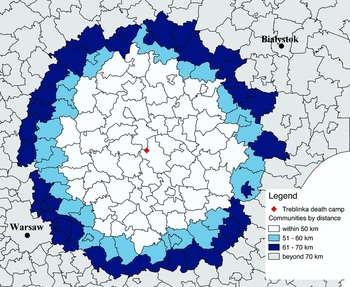
Our unit of analysis is community (gmina, pl. gminy), the smallest administrative unit for which statistical data are available. Because Polish Jews were predominantly town and city dwellers, we exclude urban gminas, where the impact of property transfers cannot be isolated from other aspects of Polish-Jewish relations before, during, and after the Holocaust. First, we sample communities located up to 50 km (~31 miles) from Treblinka, then we increase the distance from the camp to 60 km (~37 miles) and 70 km (~44 miles). The 50-km radius offers the best test: it allows for holding constant important confounders, such as regional histories, economy, geography, or modes of agricultural work, and yet accounts for the important variation in the exposure to the property of Jews murdered in Treblinka. In the 1940s, people living 50 km away from the camp could still travel to Treblinka and back in one day. However, their motivation to do so would be weaker than that of the population at shorter distances, because they would need to devote more time and effort to an activity with uncertain returns. The key disadvantage of restricting the sample to the communities within a 50-km radius is small sample size. Expanding the radius increases the sample but introduces more sources of heterogeneity into the data. We do not consider communities located outside the 70-km radius because, as clearly seen in Figure 2, they include the exurbs of Warsaw and Białystok, which are quite different from rural communities in the vicinity of the camp.
Communities at a 50-, 60-, and 70-km Distance from Treblinka.

Independent Variable
Our “treatment” is the acquisition of the Holocaust victims' property by residents of local communities during and after the operation of the death camp. We use Distance to Treblinka as a proxy for the exposure to Jewish valuables. This approach is not a perfect solution, as not everyone in the vicinity of the camp engaged in trade with guards or dug through the ashes and graves. However, the opportunities for enrichment certainly declined as a function of distance to Treblinka. The closer to the death camp a community was, the more likely would some of its residents have learned about “Treblinka gold,” traded with the camp guards, or later dug for gold.
We measure Euclidian distance (“as the crow flies”) from the geometric center of each community. A more accurate distance measure for communities located further from the camp would take into account historical roads, bridges, and natural obstacles. However, we lack the comprehensive data needed to measure such distances, as historical maps include only major paved roads, which were less likely to be used by peasants traveling by bicycle, crossing fields and forests, or avoiding paved roads in fear of encountering a checkpoint or getting robbed.
We use the natural logarithm of distance to account for the fact that enrichment opportunities dropped more precipitously at shorter distances than at longer distances. First, anecdotal evidence suggests that the local population protected “their” Jewish loot from outsiders (Bikont Reference Bikont2015; Grabowski Reference Grabowski2013). In a telling example, after a pogrom in Radziłów (July 1941), peasants from Wąsosz tried to join the looting but were turned away because Wąsosz is 17 km (10.6 miles) away from the town, while the peasants from Konopki, located only 4 km (2.5 miles) away, were allowed by the local plunderers to take part (Gross Reference Gross2007, 42). Relatedly, residents of communities at relatively short distances were able to visit the camp more frequently and thus could benefit from Jewish wealth disproportionately more than people from more distant localities. Second, peasants at more proximate distances did not need to rely on transportation, so for them, each additional kilometer would matter more than for peasants travelling from greater distances who were forced to rely on bicycles, horses, trains, and buses. Using the logarithmic transformation allows us to account for this dynamic: the differences between short distances matter more than differences between long distances.Footnote 4
Dependent Variables
To measure the effects of exposure to Jewish property, we draw on community-level data from a variety of historical and contemporary sources, summarized in Table A1 in the Appendix. We use the earliest community-level measures that are available for each indicator. Because communities' borders changed over time, our sample size varies slightly across periods. We digitized community-level maps for interwar, immediate postwar, pre-1999, and post-1999 Poland to adjust distance measurement in accordance with administrative changes.
Consumption
The data on immediate post-WWII consumption at the community level are unavailable. We are, however, able to measure the prevalence of (1) radio subscribers (Radios) and (2) TV subscribers (TVs) per 1,000 people in each community in 1976 (earliest available). TVs and radios were highly sought-after luxury goods during the socialist period. It is possible that Jewish valuables were used to purchase other items, such as cars, but such data are unavailable at the community level. It should be emphasized that we do not analyze whether luxury goods acquired immediately after the Holocaust were still owned and used in the 1970s. Rather, we examine the possibility that Jewish valuables were hidden during the immediate postwar period and spent when radios and TVs became available.
Real Estate
To examine whether the areas located closer to the death camp experienced a construction boom, we use the 1988 national census available from Poland's Central Statistical Office (Główny Urząd Statystyczny, GUS). The census groups dwellings in each community by period of construction into the following categories: (1) before 1918; (2) 1918–44; (3) 1945–70; (4) 1971–78; and (5) 1979–88. We use the share of Dwellings Built in 1945–70 as a dependent variable.Footnote 5
The 1988 census also provides data on the quality of the roof material. It groups dwellings into those with (1) metal (blacha) roofs; (2) asbestos or asphalt shingle (eternit i dachówka) roofs; (3) tar (papa) roofs; and (4) “other” roofs. In postwar Poland, tar and asbestos were cheaper than asphalt shingle, which, in turn, was cheaper than metal. Thus, we use community-level shares of Dwellings with Metal Roofs from the total number of dwellings as an indicator of higher investment in real estate.
An obvious explanation for the variation in the quality of housing could be the extent of wartime destruction. To account for this possibility, we control for Share Farmhouses Destroyed in 1945.Footnote 6 The extent of rural destruction in the vicinity of Treblinka—Węgrow (18%) and Sokołów (14%) counties—is lower than in Warsaw county (27%) and suggests that the area suffered relatively mild damage.
Productive Assets
The data on individual investment decisions in socialist Poland are extremely limited. To evaluate investment in productive assets, we collected data on private entrepreneurship outside of agriculture in 1982 (In Handicrafts Footnote 7 per 1,000 people), on the number of privately owned shops (Shops per 1,000 people), and on trade volume (Trade in Złoty per person). We also collected data on privately owned Cattle per 100 hectares (ha) in 1976 as a measure of productive assets in agriculture. Here, we are interested in the medium- and long-term effects, but do not assume a time lag between property transfers and investment. Both immediate post-WWII and delayed investment in productive assets might have had enduring downstream economic effects.
Political Effects
Communist-era elections, neither free nor fair, are unhelpful for measuring local political attitudes. In the post-communist period, most elections focused on economic reforms and communist legacies rather than on WWII issues. The main exception is the 2001 parliamentary election, in which the Holocaust was salient due to the 2000 publication of Neighbors (Sąsiedzi), by the Polish-American historian Jan Tomasz Gross. The book exposed the Jedwabne massacre of the summer of 1941, in which Jews were killed by their Polish neighbors. The controversy surrounding the book, likened in salience to the Vietnam War in the United States (Tymowski Reference Tymowski, Andrzej2002, 292), gave politicians “an opportunity to formulate and show their differences of opinion on the Polish past” (Wolentarska-Ochman Reference Wolentarska-Ochman2003, 172).
Three main positions emerged in this debate. The left and center parties expressed full acceptance of Poland's responsibility for the murder of the Jedwabne Jews.Footnote 8 Parties associated with the disintegrating Solidarity camp, on the other hand, were divided. On the extreme right side of the debate was the League of Polish Families (Liga Polskich Rodzin, LPR), formed in May 2000. LPR politicians campaigned by denying the pogrom and claimed that blaming Poles for the massacre was a provocation by Jews seeking to undermine Poland's reputation (Pankowski Reference Pankowski2010). This extreme right party was also no stranger to anti-Semitic rhetoric. We discuss the LPR position in more detail in the Appendix (p. 4 and Figures A1 and A2).
Unlike the LPR, the less radical Solidarity offshoots—the Law and Justice (Prawo i Sprawiedliwość, PiS), which quickly emerged as the main party of the Polish right, Civic Platform (Platforma Obywatelska, PO), and the Solidarity Electoral Action of the Right (Akcja Wyborcza Solidarność Prawicy, AWSP)—accepted that individual Poles murdered Jews, but criticized Gross's research as inaccurate. PiS leadership, in particular, became an important force among those who adopted the “restrained criticism” approach (Wolentarska-Ochman Reference Wolentarska-Ochman2003).Footnote 9
Another, though substantially less salient debate taking place in Poland prior to the 2001 election focused on the restitution of property expropriated by the Nazi and Communist regimes. In January 2001, the lower house of the Polish Parliament (Sejm) passed a reprivatization law that entitled former property owners and their descendants to receive restitution in kind (when possible) or monetary compensation for up to 50% of the current value of the lost assets. The law restricted the beneficiaries of restitution to Polish citizens, both at the time of loss of property and on December, 31, 1999, which excluded most Jewish claimants.Footnote 10 The President vetoed the law, and the Sejm failed to gather enough votes to override the veto before the 2001 election.
Candidates who ran on the center-right PiS list in the Treblinka area in the 2001 election voted for the law and against the Presidential veto. Candidates who ran on the extreme-right LPR list voted against the law (see Appendix Table A3). At the same time, the LPR's overall position was convoluted, as it did not reject reprivatization in principle when it applied to ethnic Poles and portrayed the President's veto as “bowing to Jewish interests” (Lipiński Reference Lipiński2001). While the draft law did not explicitly mention Jewish property, it could be construed as helping those who benefited from the Treblinka camp because it resolved the ongoing debates on property transfers during and after WWII and excluded Polish Jews who emigrated after the war. However, the topic of Holocaust-era property transfers did come up during the reprivatization debate and the LPR capitalized on the Presidential veto to channel the issue into the realm of Polish-Jewish relations. By voting against the law, future LPR candidates in the Treblinka area effectively rejected, even if implicitly, any possibility of restitution.
To summarize, on the Jedwabne issue, the main choice on the right of the political spectrum was between a minimal and limited recognition of Poles' improper behavior during the Holocaust, advocated by the PiS, and a total rejection of any wrongdoing, championed by the LPR. The reprivatization debate can also be framed as a choice between the possibility of restitution and a complete rejection of it, although we do not have sufficient data to support this claim. What is clear, though, is that as Sejm members before the 2001 election, the PiS candidates in the Treblinka area did support a law that envisioned some, even if extremely limited, compensation to Jews whose property had been expropriated, while the LPR candidates voted against it. Thus, we view a vote for the LPR as a defense of the psychological and material status quo by rejecting and denying transgressions committed by Poles against Jews or their property. A vote for PiS, on the other hand, indicates an acceptance of at least some wrongdoings by the Poles during and after the Holocaust.
While both debates defined the political fault lines of the 2001 election, it is important to emphasize that neither focused explicitly on Treblinka. The Jedwabne debate centered on physical violence inflicted upon Jews by ethnic Poles. During the restitution debate the key concern was the formerly Jewish, German, or Polish private property expropriated by the Nazi and Communist governments. Whereas the mere fact of being in the national spotlight likely affected citizens' political attitudes in Jedwabne, the same cannot be said about the Treblinka area. What the Jebwabne and restitution debates did, however, was provide an opportunity to express existing political attitudes. Thus, our main dependent variables are LPR Vote Choice and Turnout in the 2001 election. We also examine vote for PiS, PO, and AWSP to eliminate the possibility that LPR support is explained by greater overall right-wing preferences in the area.
Even though there is evidence of intergenerational transmission of anti-Semitic attitudes in Poland (Törnquist-Plewa Reference Törnquist-Plewa, Karlsson and Zander2006), the 2001 election still presents a rather hard test for the durability of political attitudes shaped by property transfers as the majority of people who participated in the plunder of Jewish property had likely died. By looking at the community-level outcomes in 2001, we are in a good position to evaluate whether property transfers indeed have a long-term political impact.
Control Variables
Even though the exact location of the camp was exogenous to local economic characteristics, proximity to the rail network between Warsaw and Białystok influenced Treblinka's general placement. Because distance to the railway may have also affected economic activity, we control for Railway Distance in 1945, as measured from the center of each municipality (in km). We also control for Distance to City (Warsaw or Białystok), as the decision to locate the camp at Treblinka was influenced by the presence of large Jewish ghettos in these urban centers and by the relative isolation of the area from heavily populated regions that helped keep the mass murder of Jews secret. Descriptive statistics for the variables used in the analysis are presented in Table A2 in the Appendix.
Poland has an open-list PR system with different party candidates running from different electoral districts, and this feature of the Polish electoral system might potentially bias our results. As Figure A3 in the Appendix demonstrates, most communities in the vicinity of Treblinka are located in Siedlce electoral district; however, some communities fall into two additional electoral districts, Białystok and Warsaw II. To control for district-level factors, such as the identity of party candidates, we use fixed effects.
RESULTS
Economic Impact
First, we analyze whether the proximity to Treblinka is associated with greater consumption (H1A). As noted above, we are unable to measure immediate postwar spending and instead examine the prevalence of luxury goods in the 1970s, which would require peasants to hide their wealth until the possession of gold and foreign currency was legalized (1956) and luxury goods became easier to purchase (1960s and 1970s). Results of an OLS regression are presented in Table 1. Models (1)–(2) show that proximity to Treblinka is not associated with greater ownership of radios and TV sets. The coefficients on the logged Distance to Treblinka are small and not statistically significant. Of course, it is still possible that much of the wealth was consumed immediately on food, alcohol, and other items.
OLS Regression, Luxury Goods (1-2), and Productive Assets (3-6).

Notes: Communities within 50 km of Treblinka. Standard errors in parentheses. *p < 0.1; **p < 0.05; ***p < 0.01
An alternative to consumption is investment in productive assets (H1C). As noted earlier, such investment was risky, but not impossible in Poland after the end of Stalinism. Models (3)–(6) in Table 1 examine the effects of property transfers on the size of the population engaged in private handicrafts, on the prevalence of private shops, and on the volume of local trade in 1982, as well as on the number of cattle owned by individual farmers in 1976. Regression results do not support H1C: the coefficients are small and not statistically significant, and Distance to Treblinka explains little variation in the models. Additional analysis (Tables A4 and A5 in the Appendix) demonstrates that proximity to Treblinka is not associated with greater education levels in 1978 and 1988, or with higher incomes and greater entrepreneurship after 1989.
Finally, we consider H1B that the exposure to Jewish wealth led to greater investment in real estate, as measured by Dwellings Built in 1945–70 and Dwellings with Metal Roofs. Because our dependent variable is a proportion, we use a generalized linear model with quasibinomial error structure to correct for boundedness, non-constant variance, and non-normal errors, as well as overdispersion.Footnote 11
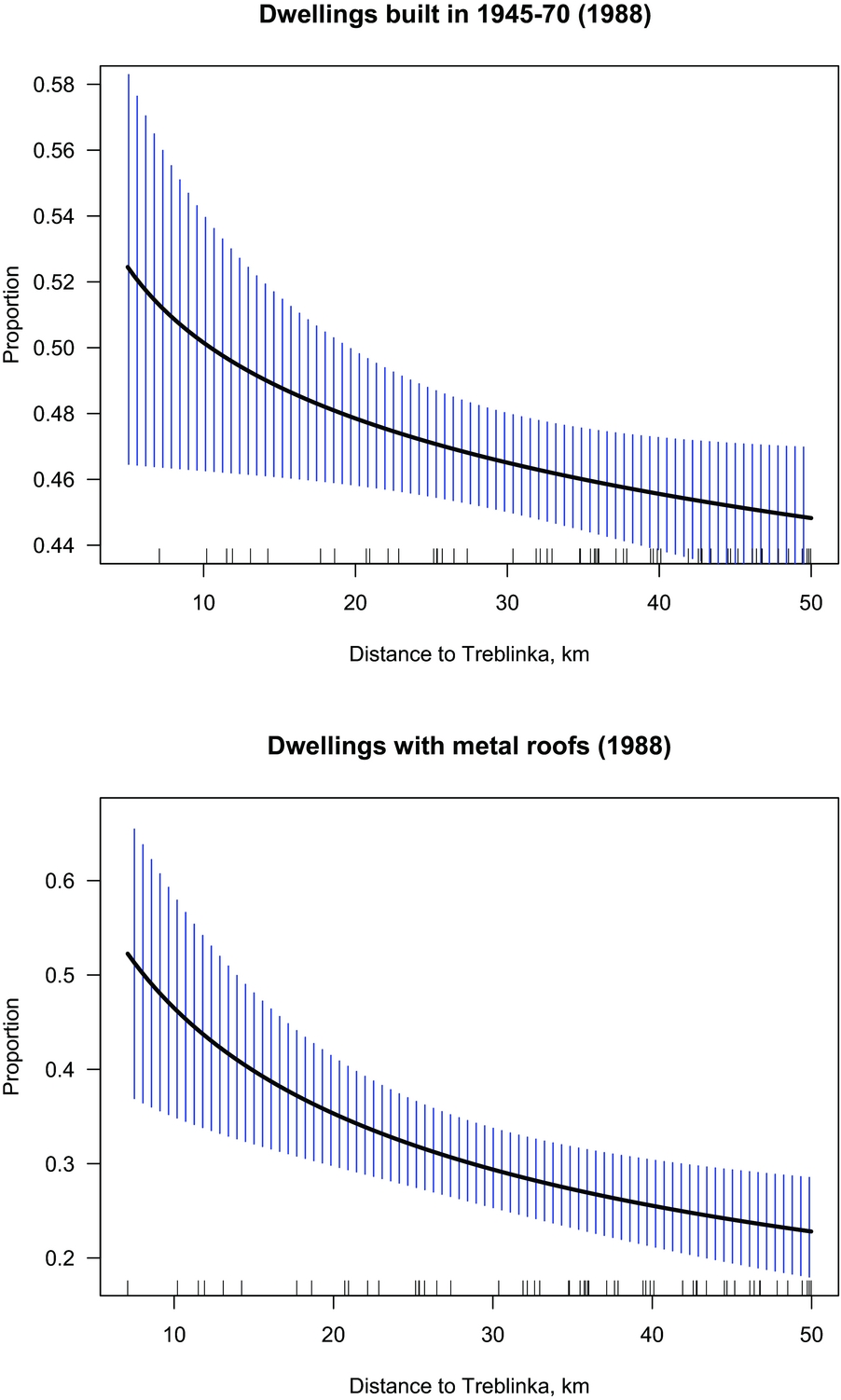
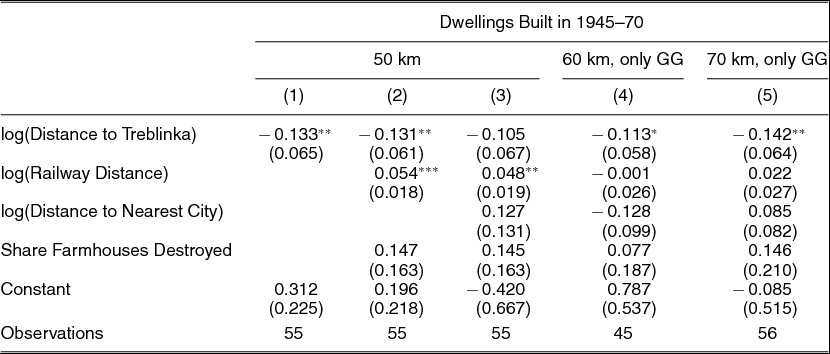
Analysis presented in Table 2 suggests that the share of houses built after the war diminishes with distance from the death camp. The coefficient on Distance to Treblinka is negative and significant in four out of five models. The results are robust to controlling for Railway Distance and the extent of wartime damage, which may have necessitated higher levels of postwar reconstruction. However, in the 50-km radius sample, the coefficient on Distance to Treblinka diminishes and is no longer statistically significant when we control for distance to the nearest city. Yet the negative coefficient on Distance to Treblinka regains statistical significance in larger, 60- and 70-km radius samples (GG-located communities only). The effects are substantively meaningful: moving from a distance of 5 km to 15 km away from the death camp is associated with a 4% decrease in the share of houses built between 1945 and 1970 (see Figure 3).
Investment in Real Estate and Distance to Treblinka Death Camp.

Logit Regression, Investment in New Houses.

Notes: Models (4) and (5) exclude communities located outside the GG. Standard errors corrected for overdispersion in parentheses. *p < 0.1; **p < 0.05; ***p < 0.01
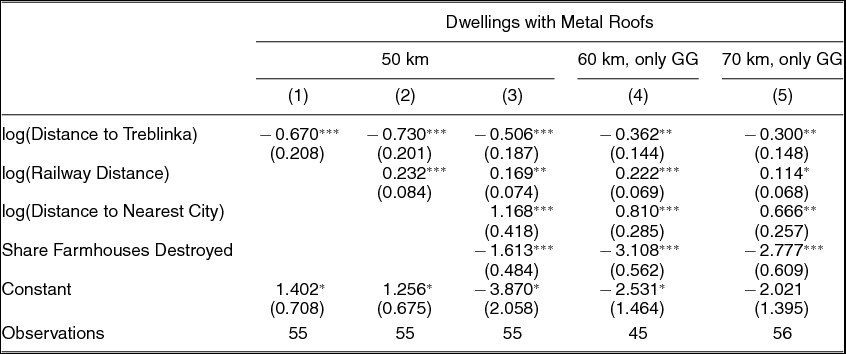
Investment in real estate might mean not only the construction of new homes but also the renovation of existing ones. In Table 3, we analyze whether dwellings in communities located closer to the death camp are more likely to have roofs made of sheet metal, the most expensive roof material at the time. The coefficient on Distance to Treblinka is negative and statistically significant in all models, even after controlling for distance to the railroad or the nearest city. The closer to the camp, the better the roofs: as we move from 5 km to 15 km away from Treblinka, the share of dwellings with metal roofs decreases by 18% (see Figure 3).
Logit Regression, Investment in Better Roofs.

Notes: Models (4) and (5) exclude communities located outside the GG. Standard errors corrected for overdispersion in parentheses. *p < 0.1; **p < 0.05; ***p < 0.01.
Our analysis indicates that the wartime property transfers had tangible and lasting consequences: wealth acquired in Treblinka affected the local patterns of investment in real estate. At the same time, the acquisition of Jewish valuables did not increase consumption of luxury goods in the 1970s or investment in productive assets and human capital in the 1970s and 1980s. As discussed earlier, in the wake of WWII, the rule of law was weak, protection of private property was extremely limited, and many economic assets were expropriated by the communist regime. Even though the expropriations largely stopped after 1956, peasants who still had Jewish valuables might have been wary of risky investments. Against this background, spending on real estate was arguably the best option. Our findings should also be viewed against the background of communist policies, which promoted economic equality. Under such conditions, the presence of any lasting economic effects of wartime property transfers is remarkable.
Political Effects
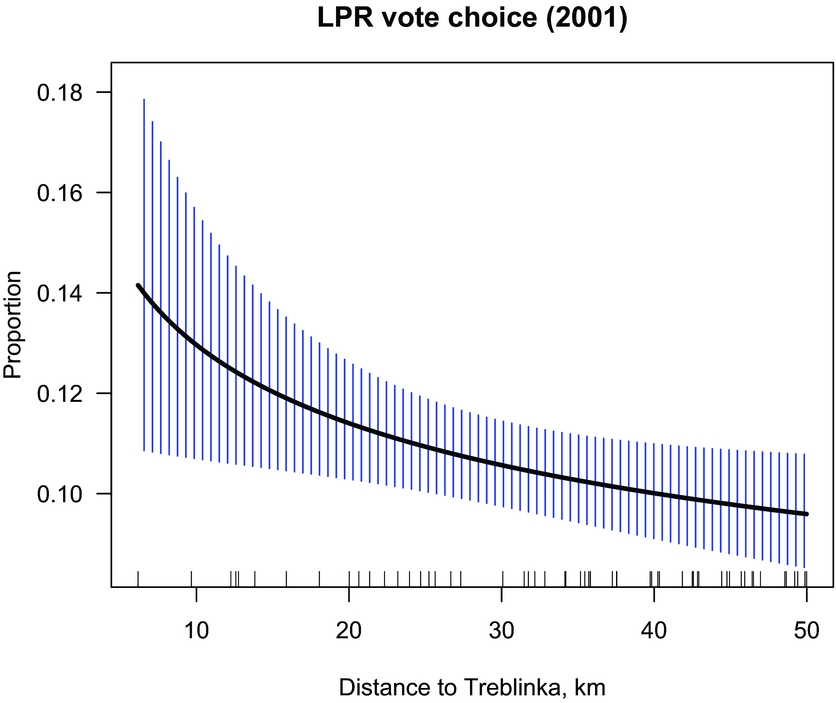
What are the political effects of property transfers? First, we analyze whether the Treblinka-area population was more likely to vote for the LPR (H2A) by regressing the share of the LPR vote on the logarithm of Distance to Treblinka. As can be seen in Table 4, the coefficient on Distance to Treblinka is negative and statistically significant, suggesting that wartime property transfers likely affected voting behavior more than 55 years after the Holocaust. Moving from 5 km to 15 km away from the death camp is associated with a 2.7% decrease in electoral support for the anti-Semitic LPR, a substantively meaningful effect given that the party's overall vote share in 2001 was 8% (see Figure 4). In the community of Kosów Lacki, where Treblinka is located, LPR won 14% of the vote, whereas in communities 50 km away from the camp LPR support is estimated at 9.5%, i.e. closer to its national-level result.
Support for the LPR and Distance to Treblinka Death Camp.

Logit Regression, Support for the LPR in the 2001 Election.

Notes: Models (4) and (5) exclude communities located outside the GG. Standard errors corrected for overdispersion in parentheses. *p < 0.1; **p < 0.05; ***p < 0.01
At the same time, we find no effect of property transfers on the vote for other right-wing parties from the Solidarity camp, such as PiS, PO, and AWSP (see Table 5, Models (1)–(4)). This finding suggests that exposure to the Jewish wealth did not result in overall higher support for the right in the Treblinka area. Model (5) in Table 5 shows that even in a political environment infused with debates over Polish participation in the persecution of Jews and potential restitution, communities closer to Treblinka did not exhibit higher turnout (H2B).
Logit Regression, Support for the Right and Turnout in the 2001 Election.

Notes: Communities within 50 km of Treblinka. Standard errors corrected for overdispersion in parentheses. *p < 0.1; **p < 0.05; ***p < 0.01
The results demonstrate that living near the death camp and benefiting from Jewish property indeed made local Poles more likely to support the xenophobic LPR, but not other right-wing parties. It is important to note that the results hold even after excluding communities located in Bezirk Bialystok, parts of which (though not the area close to Treblinka) have historically been a hotbed of anti-Semitism (Bikont Reference Bikont2015; Kopstein and Wittenberg Reference Kopstein and Wittenberg2011). We believe that acquiring Jewish property was the reason for higher support for the LPR in the area around Treblinka.
ALTERNATIVE EXPLANATIONS AND ROBUSTNESS CHECKS
Could higher support for the LPR near Treblinka be explained by the persistence of pre-WWII voting patterns? Because the LPR is often viewed as a reincarnation of the interwar National Democrats (Endecja) (De Lange and Guerra Reference De Lange and Guerra2009), we regress the support for Endecja in the 1928 Parliamentary election (the last free and fair election in interwar Poland) on Distance to Treblinka. We also examine whether the area in the vicinity of Treblinka was the site of greater political polarization, following Kopstein and Wittenberg (Reference Kopstein and Wittenberg2011) by using 1928 vote shares for the Bloc of National Minorities. Table A11 in the Appendix demonstrates that political attitudes did not systematically vary with distance to Treblinka before WWII.
To further eliminate the possibility that the Treblinka area is more prone to vote for right-wing parties regardless of their position on the Holocaust, we demonstrate that the distance to Treblinka is not associated with support for the LPR or the Solidarity Block in the parliamentary elections just before and after 2001 (Appendix Table A12), in which Polish-Jewish relations were not salient in political discourse. The table also examines the 2015 election, in which some PiS candidates drew on WWII and the Holocaust to gain votes.
Could exposure to mass violence—simply living close to a site of mass murder, witnessing it, and interacting with perpetrators—make people more likely to vote for the LPR? While the existing data do not allow us to completely reject this possibility, we believe it is unlikely to explain our findings. Here, it is important to remember how localized and geographically concentrated the political and economic effects of Treblinka are. The persecution and murder of Jews took place all over Poland and was generally known. Furthermore, recent work on the Holocaust demonstrates that during Treblinka's operation, the residents of Białystok, located 93 km (~58 miles) from the camp, were well aware of the camp's purpose (Finkel Reference Finkel2017, Chap. 3). Thus, it is extremely unlikely that peasants living just 15 km from the camp knew less about or were substantially less exposed to mass violence than those in a village literally next door. We also argue against this possibility by examining support for the LPR at the sites of Polish and Jewish martyrdom in WWII. Perhaps the best-known German massacre of ethnic Poles occurred at Palmiry (community Czosnów), where some 1,700 victims (including members of the Polish political and cultural elite) were murdered in 1939. And yet, the LPR won a mere 6% of the vote in this community in 2001. Even more importantly, the LPR won just 6% of the vote, below the national average of 8%, in Lipniak-Majorat where Germans murdered 448 ethnic Poles in 1941. This community is located just 30 km (~19 miles) away from Treblinka. Support for the LPR was also below the national average, at 7.7%, in the community of Szulborze Wielkie, 20 km (~12 miles) away from Treblinka, where in 1941, some 5,000 Jews from nearby towns were shot in the forest near Mianówek. In this case, the Polish community witnessed the violence but was largely unaffected by property transfers, as the Jewish victims were dispossessed by Germans in their native towns, before being transported to the killing site.
Sites of mass violence in Poland are different from other areas due to contemporary commemoration activities. Localities close to Treblinka are affected by Holocaust commemoration and frequent visits by Jewish groups. It is possible that foreign Jewish visitors, seen as intruders, would fuel resentment and lead to higher support for the LPR in the area. Yet we believe that Holocaust commemoration does not explain the observed results, as the LPR did not advocate forcefully against commemoration as such. Second, unlike other major commemoration sites, Treblinka is located in the forest outside residential settlements, which limits the potential for contact and friction between the Jewish commemorators and the local population (Feldman Reference Feldman2008, Chap. 4). Indeed, while Auschwitz has witnessed high-profile political and even physical confrontations between Jews and Poles, the Treblinka site has not. Finally, while disentangling the two explanations is challenging—almost all places that witnessed large-scale killing of Jews experienced both wartime property transfers and post-Holocaust commemoration—we do make such an attempt by looking at the former Warsaw ghetto in the Appendix (p. 19).
Examining the effects of mass violence on political and economic outcomes half a century later raises the possibility that migration in and out of the area drives our results. First, anti-Semitic Poles looking for gold may have been more likely to move closer to Treblinka in the 1940s. In-migration in search of wealth would also create the need for new homes, which could explain our findings on investment in real estate. Appendix Table A13 eliminates this possibility by demonstrating that in-migration rates are not associated with Distance to Treblinka. Another possibility is that people who benefited from Jewish property became wealthy enough to leave the countryside altogether. While we cannot fully eliminate this possibility, out-migration of those who benefited the most would likely weaken the effects of property transfers still visible in the Treblinka area, and thus presents less of a concern for our findings. We also show that communities close to Treblinka are not different from communities located further away in (1) gender and (2) age structure both immediately after the war and in the 1990s (Appendix Tables A14 and A15).
Additional support for our argument comes from the analysis of how the coefficient on Distance to Treblinka changes when the camp coordinates are shifted away from the original location to counterfactual sites in the area (see Appendix Figure A5 and Table A16) and from the examination of spatial structure of the data by plotting the 20-km averages for the main dependent variables for all communities in the 50-km radius (Appendix Figure A6).
DISCUSSION AND CONCLUSION
This article analyzes the political and economic effects of an important, widespread, but understudied feature of violent conflict—the transfer of victims' property. Because mass violence is a complex and multifaceted social process, identifying and measuring the downstream effects of wartime property transfers is extremely challenging. We utilize a setting that allows us to tease out these effects by focusing on the communities in the vicinity of the Treblinka death camp. The camp placement was exogenous to the attitudes and characteristics of the local population, and the property transfers were geographically limited. Both before and after WWII, the communities that benefited from property transfers were subject to the same macro-level policies and conditions as the communities that did not benefit from the Holocaust.
Our approach is analytical rather than normative: we do not comment on the moral aspects of the channels through which the Jewish victims' property enriched the local communities, such as grave digging. However, we do recognize the ethical challenges of using the Holocaust in value-neutral social science research, selecting Treblinka as a “case study,” and applying the neutral term of “property transfers” when “talk[ing] of terrible things so matter-of-factly in this language of science,” as Carpenter aptly puts it. At the same time, we agree with Carpenter (Reference Carpenter2012, 366) on the necessity of such detached abstraction, as “it protects the scientific community and the idea of research for its own sake from the kind of politicization that can undermine the scientific enterprise.”
We find that property transfers left a tangible, enduring, but also highly localized impact. Politically, communities near Treblinka exhibited higher levels of electoral support for the LPR, an anti-Semitic party that in the 2001 election campaigned against recognizing Polish complicity in the killing of Jedwabne Jews. At the same time, the proximity of the death camp did not make the local population more politically active or generically right-wing. The economic implications of property transfers—investment in new and better homes—also endured despite the communist regime's efforts to remake the country's economic landscape. We found no evidence that the acquisition of Jewish valuables led to the purchase of luxury goods, invigorated local economies, or translated into higher levels of human capital. We also demonstrate that our findings cannot be explained by prewar political attitudes, migration patterns, or commemoration activities.
Our findings are significant for theoretical, empirical, and policy reasons. With regards to political attitudes, our research speaks to an important but often ignored challenge to post-conflict reconstruction and reconciliation. Wartime property transfers generate postwar restitution concerns, which in turn may increase support for extremist political views. Qualitative historical research on the aftermath of the Holocaust has identified similar processes in the immediate postwar period (Cichopek-Gajraj Reference Cichopek-Gajraj2014; Gross Reference Gross2007), but only now are we able to demonstrate how persistent these effects can be. Our finding that the influx of valuables into a community did not produce long-term positive economic and social outcomes supports the emerging but still extremely limited research on the topic (Bleakley and Ferrie Reference Bleakley and Ferrie2016). At the same time, one should also remember that the investment choices made by the beneficiaries of property transfers “no doubt depended on the range of choices they perceived as available to them” (Bleakley and Ferrie Reference Bleakley and Ferrie2016, 1487)—in this case, in predominantly rural areas, against the background of communist economic policies, weak rule of law, and state-provided healthcare and education.
This combination of the political and economic effects of property transfers has important implications for post-conflict development. Scholars and the international community currently view restitution of or compensation for lost property as important components of post-conflict reconstruction (e.g., Das Reference Das2004; Houtte et al. Reference Houtte, Delmartino, Yi and Das2008; Phuong Reference Phuong2000) and transitional justice (Appel Reference Appel2005; Elster Reference Elster2004, 170–75; Nalepa Reference Nalepa2010, 5; Teitel Reference Teitel2000, Chap. 4). Although scholars of transitional justice do recognize the distinction between perpetrators and beneficiaries of wrongdoings (Elster Reference Elster2004, 99), they focus primarily on how states “settle scores with members and collaborators” (Nalepa Reference Nalepa2010, 5) of regimes that engaged in wrongdoings, while overlooking the accidental beneficiaries of such crimes. Our findings suggest that property transfers can, in some cases, pose an obstacle to post-conflict stability and reconciliation. Counterintuitively, places that benefited most from mass violence may be in greatest need of investment—both social and economic—to combat their support for extremist views. The international community should take this into account when devising post-conflict reconstruction and reconciliation programs. The reconstruction and transitional justice policies should also pay closer attention to local conditions and legacies, rather than devise and implement one-size-fits-all national level solutions, as the effects of property transfers are highly localized.
Empirically, our findings illuminate political and social debates about mass violence in general and the Holocaust specifically. We show that mass violence and the resulting redistribution of wealth during WWII in Poland affected voting behavior more than 50 years after the Holocaust and remains visible in the houses in which many locals still reside. Unfortunately, we lack the fine-grained data necessary to distinguish between the two possible mechanisms linking property transfers to the LPR vote. Both material interest in preventing restitution and psychological factors, such as shame for benefitting from the Holocaust, are likely to have increased support for the radical right in the Treblinka area.
While this article identifies a significant long-run impact of wartime property transfers, it only constitutes a first attempt to quantitatively examine the phenomenon. An important limitation is our inability to directly test the psychological mechanisms that may explain the higher levels of LPR support in the vicinity of Treblinka. In line with research in social psychology, revelations about in-group transgressions may provoke defensive responses ranging from minimizing in-group complicity to derogating the victims. Reactions of the local population to stories about “Treblinka gold” support both possibilities. In particular, the locals who acknowledge enrichment from Treblinka often seek to justify it by contrasting Jewish “wealth” to Polish destitution. “No one was harmed. Jews are still rich, and people are forced to work for them,” explains a 90-year-old resident of Nowa Wieś (Kącki Reference Kącki2011). Perhaps to minimize their shame, some local respondents claimed that the merchant buying gold and diamonds from the local peasants after the war was himself Jewish. Others minimize the Poles' transgressions by pointing to much more disturbing behavior by the Nazis or by shifting the blame entirely (Kącki Reference Kącki2011).
Yet another strategy of dealing with the past is by emphasizing that Poles helped Jews during the Holocaust, often followed by assertions that Jews are ungrateful and blame the Poles in order to receive compensation. Jan and Halina Rytel-Skorek, who live in the village of Treblinka, gathered recollections of local residents into a book about Poles rescuing Jews (Kopówka and Rytel-Andrianik Reference Kopówka and Rytel-Andrianik2011). According to memories published in this book, the local Poles not only brought Jews food at night, risking German retribution, but also refused money they were offered in return (Kopówka and Rytel-Andrianik Reference Kopówka and Rytel-Andrianik2011, 405). An employee of the Treblinka museum told one of the authors that no one wants to talk about the past as “local men are seen as gold diggers and local women as prostitutes.”
There are also important scope conditions of our argument. In this study, we examined predominantly rural communities around Treblinka and excluded urban gminas. It is possible that the impact of property transfers would be different—for instance, with regards to investment decisions—in cities, where the population is involved in non-agricultural occupations and is more geographically mobile. At the same time, the focus on the countryside is important because this is precisely where many armed conflicts take place (Kalyvas Reference Kalyvas2006).
It should also be remembered that in our setting, Jewish property was appropriated independently and voluntarily by the population, not distributed or sold by the government or the occupying authorities, resulting in “dual ownership,” a situation in which both the original and the new owners have a legal claim on the property (Elster Reference Elster2004, 170–75). As Bleakley and Ferrie (Reference Bleakley and Ferrie2016) show, the government-sanctioned distribution of Cherokee land in Georgia has not led to higher levels of human capital and economic development, but the political impact of state-led distribution remains unexplored.
Finally, we should bear in mind that the Polish population in the vicinity of the death camp did not participate in the killing of the Jews from whose property they benefited. The Treblinka-area beneficiaries of the Holocaust can also be certain that the previous owners are long dead. The beneficiaries thus have fewer reasons to worry about restitution. One can only speculate how people might have behaved had they, rather than Germans, carried out the killings. Examining the impact of property transfers on different types of beneficiaries and wrongdoers is a promising direction for future research.
SUPPLEMENTARY MATERIAL
To view supplementary material for this article, please visit https://doi.org/10.1017/S0003055417000296.
Replication files can be found on Dataverse at https://doi.org/10.7910/DVN/8SR1GY.






Comments
No Comments have been published for this article.