Introduction
Toxocara cati is a common gastrointestinal nematode in cats worldwide, which not only infects young kittens but can also cause human toxocariasis (Dubinsky, Reference Dubinsky1999; Janitschke, Reference Janitschke1999). Adult T. cati usually live in the upper small intestine of definitive felid hosts, where female worms may produce up to 200,000 eggs per day. Eggs passed in the faeces are not infective and require an incubation period in soil to embryonate (Glickman & Schantz, Reference Glickman and Schantz1981). Embryonated eggs hatch in the small intestine where released larvae perforate the wall, enter a blood vessel and migrate through the liver and lungs to the left heart where they are disseminated by the systemic circulation (somatic migration). Eventually, these larvae penetrate through capillary vessels and migrate to surrounding tissues where they may survive for years without undergoing further development (‘hypobiosis’). The primary route of infection of kittens is by transmammary transmission of larvae that are found in milk (Burke & Roberson, Reference Burke and Roberson1985).
Infective eggs are ingested by non-felid species, such as small rodents, as paratenic hosts and follow a similar somatic cycle, where the presence of larvae in tissues are potentially infective to predators. This type of transmission is called ‘paratenesis’. When a cat preys upon an infected paratenic host, larvae are liberated from the tissues during digestion and then complete their development in the intestinal tract (Glickman & Schantz, Reference Glickman and Schantz1981). Paratenic hosts, such as man and small rodents, can infect themselves unintentionally by swallowing infective eggs (Beaver, Reference Beaver1969; Beaver et al., Reference Beaver, Clifton and Cupp1984). Dogs are the chief culprits in spreading human toxocariasis because of their indiscriminate defaecatory habits (Markell et al., Reference Markell, Voge and John1992). So T. cati is regarded as less important in terms of potential exposure to humans, and despite case histories of human infection, historical factors have led to T. cati being under-recognized as a zoonosis, particularly when compared with the prominence given to Toxocara canis in dogs. Differentiation of the two infections remains challenging even today. It is recommended that further work be conducted to facilitate differentiation between the two species so that the importance of T. cati as a zoonosis can be clearly defined (Fisher, Reference Fisher2003). Toxocara cati is a common parasite of cats and Felidae, and has a cosmopolitan distribution (Yamaguti, Reference Yamaguti1961; Sadighian, Reference Sadighian1970; Mirzayans, Reference Mirzayans1971; Vanparijs & Thienpont, Reference Vanparijs and Thienpont1973; McColm & Hutchison, Reference McColm and Hutchison1980). The rate of infection in the human population depends on the history of pica, the abundance of pets, personal hygiene and public health, the prevalence of Toxocara in definitive hosts, and the abundance of eggs contaminating the environment (Charleston, Reference Charleston1977; Kazura, Reference Kazura and Nelson1996). About 10% of the world population are seropositive (Lappin, Reference Lappin1993). Toxocara cati is mostly prevalent throughout tropical, subtropical and temperate regions (Mizgajska-Wiktor & Uga, Reference Mizgajska-Wiktor, Uga, Holland and Smith2006), where visceral larva migrans is one of the most important parasitic diseases of man transmitted by carnivores in Iran (Dalimi & Mobedi, Reference Dalimi and Mobedi1992).
The risk of humans coming into contact with contaminated soil is plausible as 15% (adult) and 90% (puppies) of dogs and 24–67% of cats harbour adult worms (Vanparijs & Thienpont, Reference Vanparijs and Thienpont1973). Recent studies have demonstrated that soil samples taken from house gardens where a clinical case of toxocariasis was found, are likely to be contaminated (Magnaval & Baixench, Reference Magnaval, Baixench, Lewis and Maizels1993). Toxocara eggs have been recovered from salads and other raw vegetables taken from such gardens (Vazquez Tsuji et al., Reference Vazquez Tsuji, Martinez-Barbabosa, Tay Zavala, Ruiz Hernandez, Perez Torres and Defalla1997). It is unlikely that infection will result from fresh droppings due to the length of time required for egg maturation. Eggs washed from the soil surface into deeper layers may remain viable for several years (Mizgajska-Wiktor & Uga, Reference Mizgajska-Wiktor, Uga, Holland and Smith2006). Due to the close association with domestic cats, there are possibilities of human infection with zoonotic helminthes such as T. cati. Although the larvae of non-human ascarids, such as T. cati, are capable of limited development in human hosts, this may, in some circumstances, lead to serious public health problems, e.g. encephalitis and granulomatous lesions (Woodruff et al., Reference Woodruff, Salih, Savigny, Baya, Shah and Defalla1981). Less commonly, zoonotic toxocariasis is associated with consumption of raw meat from potential paratenic hosts, such as chickens (Nagakura et al., Reference Nagakura, Kanno, Tachibana, Kaneda, Ohkido, Kondo and Inoue1990), lambs (Salem & Schantz, Reference Salem and Schantz1992) or rabbits (Sprent, Reference Sprent1956).
The importance of controlling feline parasites is not only to relieve clinical symptoms in infected cats, but also to minimize the zoonotic potential of larval nematode infections in humans (Sprent, Reference Sprent1956). Since cats constitute a potential source of T. cati infection in humans (McColm & Hutchison, Reference McColm and Hutchison1980; Markel et al., Reference Markell, Voge and John1992), the aim of the present study is to determine the prevalence and intensity of infection of T. cati in stray cats in urban areas of Sari, Mazandaran province, northern Iran. Feline toxocariasis has not been studied in Sari city despite the growth in the cat population in recent years.
Materials and methods
From April to October 2004, with permission from appropriate authorities from the Iranian Environmental Health Organization, post-mortem examinations were carried out on 100 stray cats (28 male and 72 female), collected from five urban areas of Sari. Sari lies the centre of the Mazandaran province in northern Iran with a human population around 196,000 and lies between the parallels 35°58′ and 36°50′ of the northern latitude and between 52°56′ and 53°59′ of the eastern longitude. The mean yearly relative humidity is 85.83% with rainfall occurrence in all seasons of the year and an average temperature of 17°C.
Trapping using baited cage-traps with tinned fish was undertaken in five urban areas of approximately equal distance from each other in the north, south, east, west and in the centre of Sari. Twenty cats from each area were anaesthetized and killed by chloroform and, prior to autopsy, the gender and weight of each cat were recorded. Based on dental development, maturation of genital structure and body size, the specimens were divided into adult (1.5–3.0 kg) and juvenile ( ≤ 1.4 kg) age groups. Following post-mortem examination, the gastrointestinal tract was removed, opened up and the mucosa examined microscopically for mature and immature worms. The contents of the gastrointestinal tract were washed with tap water on a 60-mesh sieve (aperture size 250 μm) prior to examining the worms.
All helminths recovered, including T. cati worms, were fixed in 10% formalin cleared in lactophenol and stained in formalin alcohol azocarmin lactophenol. Male and female worms were identified according to Yamaguti (Reference Yamaguti1961). Eggs removed from the uterus near the vulva of female worms were examined microscopically at × 400 magnification and those regular in shape with a characteristic pitted shell were regarded as T. cati eggs (Soulsby, Reference Soulsby1982). The uniformity of the cellular contents of the eggs was also considered. Worm burdens were recorded directly at autopsy, together with the lengths of males and females and the maturity status of eggs as a proportion of overall female worm maturity.
Statistical tests were performed using the SPSS 13.0 (Statistical Package for Social Science). Chi-square tests were performed to study the prevalence of T. cati relative to host age, weight, gender and season and the urban sites. The relationship between host gender and age with overall worm burdens in cats was examined using the Student's t-test whereas host weight, season and urban sites relative to overall worm burdens were examined using ANOVA tests.
Results
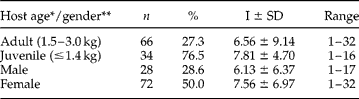
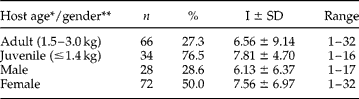
A total of 66 adult and 34 juvenile cats were examined with 18 adults (27.3%) and 26 juveniles (76.5%) being infected with T. cati with an overall prevalence of 44%. Toxocara cati was always confined to the upper half of the small intestine, i.e. in the anterior 60 cm. There were significant differences in the prevalence of infection between adult and juvenile cats (χ2 = 22.04; df = 1; P = 0.000). There were no significant differences in the prevalence of infection between male and female cats (table 1; P>0.05). Relative to body weight, the highest prevalence value of 76.5% occurred in cats ≤ 1.4 kg. There were significant differences in prevalences in cats of different weights. (χ2 = 22.41; df = 2; P = 0.000).
Prevalence (%) and intensity (I) of infection of cats with Toxocara cati, relative to host age and gender.
*t = 0.59; df = 98; P>0.05; **t = 0.53; df = 98; P>0.001; n, number of cats examined.
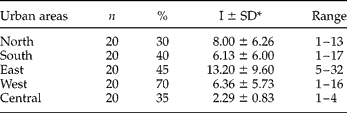
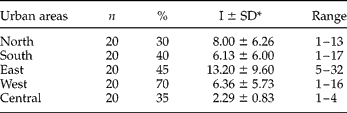
In each the northern, southern, eastern, western and central areas of Sari, infection rates were 6 (30%), 8 (40%), 9 (45%), 14 (70%) and 7 (35%) respectively with no significant differences (P>0.05).
The mean intensity of infection with T. cati was 7.30, with a range of 1 to 32 worms (table 1). Female cats showed a higher intensity of infection than males, although the difference was not significant. Relative to age/weight, adult cats (1.5–3.0 kg) showed a significantly higher intensity of infection than juveniles ( ≤ 1.4 kg) (P < 0.01).
In the various urban areas of Sari city, cats sampled in the eastern area showed the highest intensity of infection (table 2) and this difference was significant (P < 0.05). Relative to season, cats sampled in the summer showed a high intensity of infection compared with other seasons of the year, but the differences were not significant.
Prevalence (%) and intensity (I) of infection of cats with Toxocara cati, relative to urban areas.
*F = 3.40 [4, 39]; P < 0.05; n, number of cats examined.
Discussion
The present study confirms that compared with most localities worldwide the prevalence of T. cati infection (44%) in cats in Sari is high, which suggests that climatic conditions are suitable for the spread and survival of the eggs. Similar prevalences of T. cati of 42.5% have been recorded in Mexico city by Martinez-Barbabosa et al. (Reference Martinez-Barbabosa, Vazquez Tsuji, Cabello, Gutierrez Cardenas and Chasin2003), 41.99% in Dublin, Ireland by O'Lorcain (Reference O'Lorcain1994) and 39% in Poland by Luty (Reference Luty2001). Infection of cats with T. cati can occur either through ingestion of infective eggs or from feeding on rodents containing larvae in their tissues. Cats usually defaecate at night in sandy soils and bury the faeces. Such a habit is favourable for Toxocara eggs as it protects them from desiccation (Uga & Kataoka, Reference Uga and Kataoka1995). Additionally, Toxocara eggs are resistant to low temperatures and high humidities (Uga et al., Reference Uga, Minami and Negata1996) but desiccation and direct sunlight will decrease infectivity (Woodruff et al., Reference Woodruff, Salih, Savigny, Baya, Shah and Defalla1981). It is likely that infection can occur at any age, either by ingestion of eggs or tissues containing larvae, although the highest prevalence of infection occurs in kittens and young cats (Charleston, Reference Charleston1977). Nichol et al. (Reference Nichols, Ball and Snow1981) in London and Shaw et al. (Reference Shaw, Dunsmore and Jakob1983) in Perth, Western Australia, reported higher prevalences of T. cati in kittens than in adult cats, which is similar to the results of the present study. Swercezk et al. (Reference Swercezk, Nielsen and Helmboldt1971) suggested that the high prevalence of Toxocara in kittens as due to the transmammary route of infection. O'Lorcain (Reference O'Lorcain1994) showed that intra-uterine infection seldom occurs and that infection of T. cati mostly results from the ingestion of infective eggs, earthworms, cockroaches and/or rodents containing larvae in their tissues. The present study confirms the findings of Sadjjadi et al. (Reference Sadjjadi, Oryan, Jalali and Mehrabani2001) who reported no difference in the intensity of infection in male and female cats. However there are many stray cats in the various residential areas of Sari city as well as other cities in Iran, the cat population rapidly increasing in these urban sites. This can significantly contribute to the dissemination of viable Toxocara eggs into the environment, and a mild, temperate climate such as that found in Sari appears to enhance the embryonation of Toxocara eggs in the soil and their potential transmission to humans.
The prevalence of T. cati has previously been studied in different cities in Iran, for example in the southern city of Shiraz, 108 stray cats showed a prevalence of 52.8% and a mean worm burden of 6.25 ± 9.26 with a range of 1–50 worms (Sadjjadi et al., Reference Sadjjadi, Oryan, Jalali and Mehrabani2001). In studies by Mirzayans (Reference Mirzayans1971) on 105 domestic cats in Tehran, Dalimi & Mobedi (Reference Dalimi and Mobedi1992) on 13 domestic cats in the Mazandaran province, and Sadighian (Reference Sadighian1970) on eight wild cats in the Shahsavar area, the prevalences of infection with T. cati were 31.4%, 27.3% and 62.5%, respectively. Maximum worm burdens in cats in Iran have been reported as 50 (Sadjjadi et al., Reference Sadjjadi, Oryan, Jalali and Mehrabani2001) and 45 (Mirzayans, Reference Mirzayans1971). In the present study the mean worm burden in infected cats was 7.30 ± 6.82 with a range of 1–32 and a prevalence of 44%. These values are comparable with those in Spain where a mean of 8.1 ± 10.4, a range of 1–49 worms and a prevalence of 55.2% were recorded (Calvete et al., Reference Calvete, Lucientes, Castillo, Estrada, Grasia, Peribanez and Ferrer1998).
In conclusion, stray cats in all urban areas of Sari city are infected to varying degrees with feline toxocariasis. Considering the high prevalence of this zoonotic parasite and its hygienic significance in causing human toxocariasis, particularly in children, plus the lack of control of stray cat populations, there is a need to improve personal and food hygiene as well controlling stray cats in these urban sites. It is clear that the worldwide distribution of stray cats would have an impact on sanitation and it is necessary that public health authorities, pet owners and veterinarians in crowded urban centres pay more attention to this phenomenon, and that the general public is informed of the hazards and zoonotic aspects of T. cati, especially as female worms can lay up to 200,000 eggs per day.
Acknowledgements
The authors are grateful to Dr Ahmad Ali Enayati, Dr Hossein Nahrevanian, Dr Alireza Rafiei and Mr Mohammad Vahedi for reading the early draft of the manuscript and making useful suggestions for its improvement and to Mr Bahram Laktarashi and Mr Akbar Ebadattalab for their help in sampling. This work was supported by the grant no. 83-6 from deputy of Research, Mazandaran University of Medical Sciences, Sari, Iran.