In 1934, the Ghanaian photographer Joseph Ankonam Kwesi Aaba published a compendium of recipes for plant-based therapies in the coastal city of Sekondi. While Aaba made his living taking portraits in the African community in Sekondi, his first love was medicine and health. Beginning in 1924, Aaba decided to devote a portion of his photography earnings to what he described as a series of ‘preparations, researches and experiments with regard to … herbal medicine and its ramifications’. By 1930, Aaba compiled his findings into two small booklets which he self-published and sold in neighbouring coastal towns. These preliminary publications established Aaba as the resident expert on healing. Through his leadership, the Society of African Herbalists (SAH) was founded the following year.Footnote 1
Aaba portrayed literate Africans with access to formal education as the most likely parties to ‘advance the local herbal practice’ and place the Gold Coast on the ‘track’ to industrialisation and even independence from colonial rule. As the first herbalist known to have authored and published a medical text in Ghana, African Herbalism: A Mine of Health (1934), Aaba inaugurated a new era of healer literacy. Aaba described the need to document herbal recipes with a certain urgency:
The knowledge and practice of medical herbalism have come down to us from our forefathers, and it is our duty to preserve them and hand the same over to the rising generation in a new and improved form. But is there any possibility of expecting such improvement from the present illiterate medical herbalists? The answer is doubtless in the negative.Footnote 2
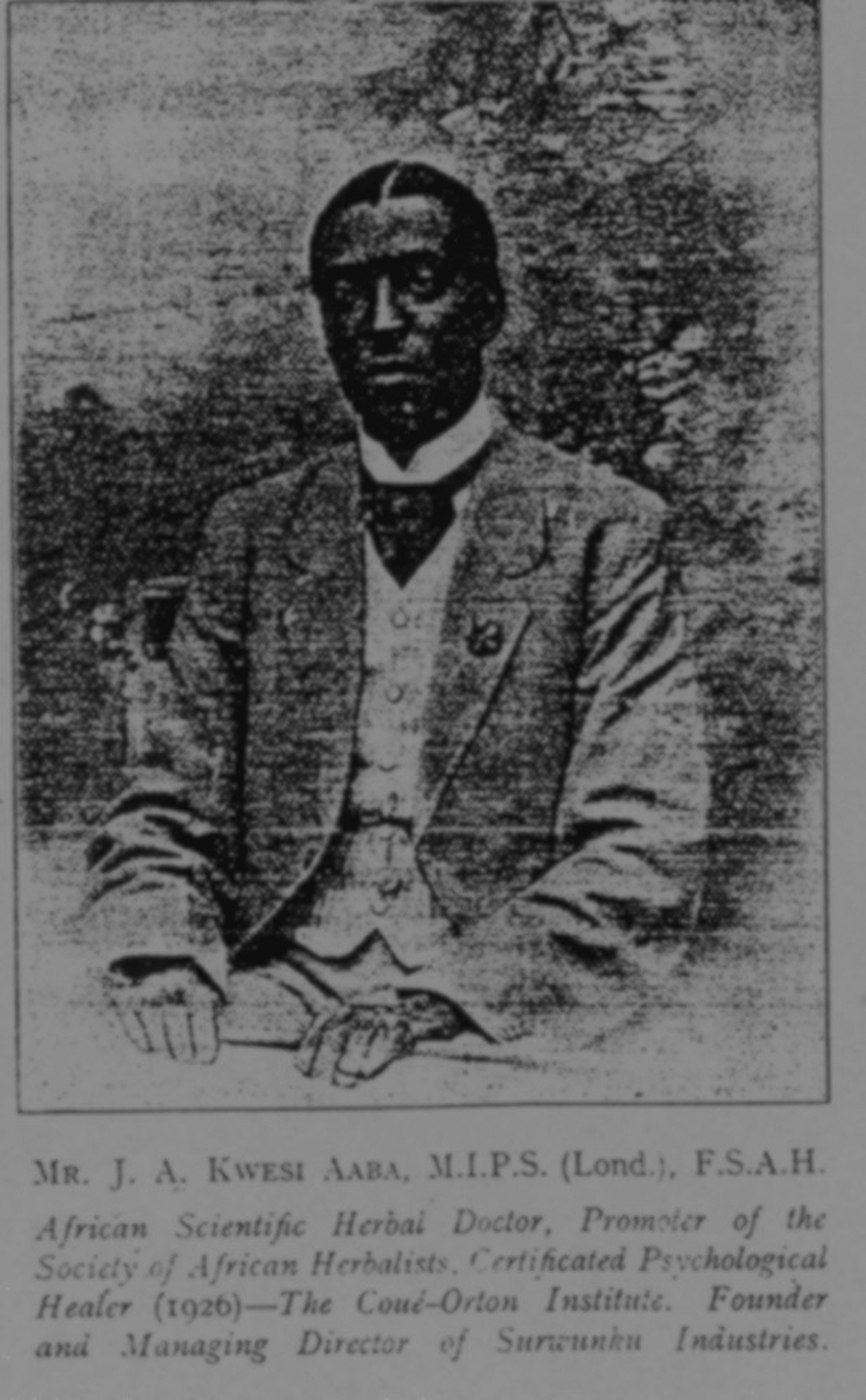
He positioned his project in opposition to the oral system of documentation common among healers, and moreover used a studied iconography to rebrand indigenous healing in a context of colonial disrespect. Aaba's photographic portraits of Members and Fellows of the Society, which appeared throughout the book, represented herbalism as a formal, respectable enterprise. Aaba himself, arrayed in a vest, waistcoat, and cravat before a leafy backdrop, featured among the besuited herbalists portrayed in the text (See Figs. 1 and 2).
Josiah Ankonam Kwesi Aaba author of African Herbalism: A Mine of Health. Original caption reads: Mr. J. A. Kwesi Aaba, M.I.P. S. (Lond.), F.S.A. H. African Scientific Herbal Doctor, Promoter of the Society of African Herbalists, Certificated Psychological Healer (1926) – The Coué-Orton Institute, Founder and Managing Director of Surwunku Industries. Source: Aaba, African Herbalism: A Mine of Health, courtesy Ghana Public Records and Archives Administration Department.

Books and suits appeared as symbols of legitimacy in both Aaba's work as well as that of his teachers. (Left) Herbalist F. Couloo-Ainooson photographed reading from a book. Source: African Herbalism: A Mine of Health courtesy of Ghana Public Records and Archives Administration Department; (Right) Emile Coué and J. Louis Orton photographed reading from a book. Source: The Coué-Orton Intensive Course.
This division between those who could read and write, and those who could not, heralded coming schisms between medical practitioners in Ghana. Here, I use Aaba's concern with literacy and the related issue of numeracy to examine the pursuit of medical authority among members of two successive healing organisations in the Sekondi-Takoradi area of Southern Ghana: SAH and the Ghana Psychic and Traditional Healing Association (GPTHA). Healers in these organisations documented their quest for wider government recognition through letters, recipe books, meeting minutes, and petitions.Footnote 3 From 1930 to 1970, a rising class of literate healers used writing as a tool to regain public trust in their work. From the healers' perspective, such actions had become necessary because colonial and missionary policies, including a successful vaccination campaign to end yaws, had eroded public and government faith in African medical practices.Footnote 4 Healers lost patients to a new hospital set up for Africans at Korle Bu and competed with newly trained nurses at maternity clinics for pregnant women.Footnote 5 Additionally, healers lost status when government outlawed a series of animist shrines. Gradually, new medications for diseases like malaria devalued their role as indigenous ‘pharmacists’.Footnote 6 They needed to reclaim authority in their communities and among their peers.
Healers in a Ghanaian context sought the trust of patients, peers, religious authorities, and government in their own way of healing to regain what sociologists term ‘medical authority’. In the 1930s and 1940s, African scientific herbalists deployed written texts to assert the legitimacy and efficacy of indigenous therapeutics and herbal remedies. Then, by independence in 1957, traditional and psychic healers in Ghana used writing as a device to assert national culture and their own legitimacy as healers. Healers saw themselves as a ‘traditional’ and ‘cultural’ equivalent to the Ghanaian doctors then training at the Korle Bu Medical School. In the late 1950s and 1960s, they sought equal, if not superior, footing with these medical peers.
ESTABLISHING AUTHORITY IN AFRICAN TRADITIONAL MEDICINE
Medical authority in biomedicine is a complex metric dependent on levels of trust from patients, physicians, civil society, and government regulatory bodies. Studies of public trust in individual physicians and the medical profession as a whole indicate that lack of confidence in practitioners undermines care as well as ‘physician authority’.Footnote 7 The public's trust of physicians is conjoined with overall belief in biomedicine as a viable system.Footnote 8 For the medical profession to function, physicians must also have confidence in one another, and specifically in their abilities to efficiently diagnose and treat patients. Governments moreover afford official recognition to particular kinds of medical institutions depending on levels of trust.Footnote 9
In African contexts, traditional medical practitioners have long competed with biomedical practitioners for medical authority.Footnote 10 Ultimately, African healers have sought the trust of their patients, as well as religious authorities, Ministries of Health, and Food and Drugs Boards. As I argue here, Ghanaian healers used writing as a platform for national legitimacy during the twentieth century. Healers saw literacy as a way to prove that they were erudite and knowledgeable, as opposed to non-literate and incompetent. They adjusted their practices in a climate where colonial physicians, and later African doctors, used books and reading to indicate superior expertise. These healers sought to secure trust in their diagnostics through various kinds of written documents – healer licences, recipe books, association constitutions, training certificates, and safety stamps on herbal products.
The authorship of medical authority provides a new lens through which we can understand the history of African traditional medicine. Expert knowledge takes many forms, with non-experts observing skills, tasting medications, and hearing testimonies as they recognise situated knowledge. Most investigations of African healing stress its verbalised components. My analysis departs from this existing scholarship by building on work in the sociology of science on the authoring of expertise.Footnote 11 For example, Albert Olawale explains that in Yorùbá herbal medical practice, spoken knowledge, or ‘oral literature’, encompassed both material objects as well as chants and incantations used ‘in diagnosing afflictions, prescribing and “enforcing” healing processes and manufacturing drugs’.Footnote 12 Tola Pierce notes Ifa priests developed a system of oral ‘storage’ using symmetry in verses and regular public and private performances to encourage memory retention.Footnote 13 Similarly, John Janzen documents ‘verbal therapy’ or words spoken and sung in the actual act of healing in ngoma sessions in Central and Southern Africa.Footnote 14
If oral history is key to understanding Africa's past, it has been especially critical in discussions of healing where practitioners have been thought to keep minimal records. Especially for the precolonial period, historians have relied on deep analysis of the evolution of African word lists to identify patterns in the oral transmission of therapeutics.Footnote 15 For the colonial period, researchers have turned to colonial archives, which provide transcripts of testimonies of healers in court cases. For recent periods, interviews provide a window onto the life histories of healers.Footnote 16 In large part because of this dependence on oral records, histories of African healers are scant compared to ethnographic accounts.Footnote 17
The same pattern holds true for studies of traditional healing in Ghana, where the few histories that exist stress low levels of literacy among healers spanning generations.Footnote 18 National surveys of healers in Ghana conducted in the early 2000s found that the majority had only attended primary and occasionally middle school, in contrast to medical doctors with tertiary training at the Ghana Medical School.Footnote 19 These studies indicate that children in poor families might be apprenticed to a shrine priest or spend time with an elderly relative knowledgeable about herbs in lieu of attending formal schooling. Writing in 1996, Ghanaian physician and historian Steven Addae noted ‘that African healing methods were not completely useless; people were cured by traditional methods’, but highlights that a ‘culture of illiteracy’ meant ‘the secrecy used by the healers … ensured that there was virtually no opportunity for such healers to learn from each other or improve on their methods.’Footnote 20 A national study of traditional medicine practice in Ghana conducted in 2001 described 61 per cent of healers interviewed as non-literate, with more women healers and healers from the Northern Region unable to read and write fluently than their peers in the more literate other nine regions. (For context, a majority of all Ghanaians were literate by 2001).Footnote 21
My findings suggest a different framing for this history. In Ghana we see a rising class of literate healers from the 1930s on, with perhaps close to 40 per cent of all traditional medical practitioners able to read newspapers, write down some of their observations, and calculate profits on paper by the beginning of the twenty-first century. Indeed, a close examination of the actual writings of these literate healers provides a window into the transformation of Ghanaian medicine and the healers' quest for authority at the national level. Their stories echo a growing body of evidence that calls into question the assumption of healer non-literacy across Africa in the twentieth century. For instance, in Nigeria around 1911, the Ìjèbú healer Joseph Odùmósù wrote a three-volume Ìwòsàn in Yorùbá providing instructions for more than 5,621 therapeutic interventions for such concerns as gonorrhoea, goitre, the obtaining of a suitable wife, poisoning, impotence, and adultery.Footnote 22 Similarly, in South Africa, the midwife Louisa Mvemve published a self-help herbal manual in 1915. Souleymane Kanté of Guinea documented medicinal plants in the N'ko alphabet he invented around 1940. While each of these cases has been held up as a surprising anomaly, when viewed in totality and against national rates for schooling, they suggest the contours of a wider phenomenon of healer literacy.Footnote 23 This study furthers such investigations by recasting healers as authors. The writings of the Ghanaian healers I study suggest that, if anything, healers' literacy outpaced that of Ghanaian society as a whole, where literary rates above those fifteen and older did not pass 20 per cent until 1960.
Healers in Ghana used written texts to assert medical authority, particularly in the coastal areas, like Sekondi-Takoradi, where Christian missionaries first promoted primary education. As a new wave of healer-authors, they artfully managed secrecy in their texts, divulging some useful information to professional colleagues and trainees to establish their expertise, and withholding key details to maintain their market advantage. The fact that so much of our understanding of African healers during the twentieth century comes third hand from interested observers, whether early anthropologists, missionaries, and colonial administrators, or postcolonial academics, makes it even more critical to closely examine the documents healers authored themselves.Footnote 24 Doing so allows us to better comprehend how they sought to reclaim medical authority.
LITERATE HEALERS IN SEKONDI, 1930–40
During the early 1930s in the coastal city of Sekondi, Joseph Ankonam Kwesi Aaba led a group of men and women healers as they launched one of the first organisations of healers in what was then the British Gold Coast colony. Calling themselves African Scientific Herbalists, they hoped to harness information on healing plants to promote an herbal industry in the burgeoning city of around 22,000. Wearing the latest suits shipped in from Europe, they spent their afternoons reading proto-nationalist African newspapers that advocated independence. They also discussed herbs. Through a close analysis of how Aaba understood literacy, it is possible to surmise some of the Society's goals for African Scientific Herbalism in Sekondi and beyond. Aaba crossed a Fanti word with an English one to depict his unique project:
To find a suitable and applicable title for the dual undertaking [in herbal experiments and photography] the writer taxed his ingenuity for some time and at last hit upon the Fanti word ‘surwunku’ (meaning ‘unique’) to precede the English word ‘industries’, thus giving the title of the enterprise as ‘Surwunku Industries’.Footnote 25
As part of transferring local understandings of African Scientific Herbalism into a written form, his writing often employed this simultaneous use of Fanti and English. A chemist, a convert, a photographer, a plant experimenter, and a healer, Aaba hybridised his enterprises at ‘Unique’ Industries.
Fragmentary evidence provides a portrait of Aaba, the primary promoter of SAH. His company, Surwunku Industries, combined ‘curative african [sic] herb specialists, african herbal pharmacy and dispensary, professional photographers, etc.’. He was born in the first days of 1885 in the coastal town of Elmina, a Fanti fishing village that hosted a fort constructed in 1482 under the orders of Portuguese sailors engaged in trafficking people, gold, and spices.Footnote 26 Aaba learned about healing plants from a relative named Kobina Adzie, a renowned healer. While informal family interactions exposed him to African healing, Aaba also secured access to book knowledge by attending St Joseph Roman Catholic School. Aaba continued his education in Nigeria, where he attended the Catholic St Gregory's Grammar School in Lagos. There, he would have sung hymns composed in Europe while rubbing shoulders with the children of Catholic elites from across British West Africa.Footnote 27 Aaba took up a position as a store manager on his return to the Gold Coast in 1903. In 1919, he was also a clerk of the Gold Coast Government Railway and reportedly worked at the British West Africa Bank in Lagos.Footnote 28
To further his education, Aaba gleaned ideas and theories from European medical textbooks as well as correspondence courses on hypnosis and diet that he requested from the French Coué-Orton Institute. (James Louis Orton and Emile Coué gained a global following for their performances of hypnosis.)Footnote 29 Aaba received a certificate in Psychological Healing from the Coué-Orton Institute in 1926; for his textbook, he adapted their theories on diet for the peculiarities of Fanti cuisine. He also took his photography very seriously, and in 1928 was elected a member of the Royal Photographic Society in London, adding his name to a roster populated with members from Bedford and Manchester, Chicago, and Los Angeles (See Fig. 2).Footnote 30
As residents of Sekondi, Aaba and his colleagues had good access to government and missionary schools. As early as 1911, 34 per cent of both men and women in Sekondi were literate.Footnote 31 In contrast, two decades later, only around 35,000 people, or 1 per cent of all Gold Coast colonial subjects, could ‘at least read and write’.Footnote 32 Keen to expand education, Aaba helped raise funds for the establishment of a Catholic Secondary School in the Gold Coast.Footnote 33 Surrounding himself with a rising literate class, he sought out individuals who shared his interest in herbal medicine in the Sekondi area.Footnote 34 One strategy was to include an enthusiastic forward to his book by Kobina (William Esuman-Gwira) Sekyi, the playwright, lawyer, and proponent of the Gold Coast Aborigines Rights Protection Society. Sekyi's endorsement noted the superiority of some African therapies to those of European physicians.Footnote 35
As promoter of the SAH, Aaba was aware that he needed other healers to help him document and improve on herbal remedies. The SAH included Akan speakers from as far away as Kumasi, suggesting the organisation served those conversant with Fanti, as well as those literate in the closely related Akan languages of Asante Twi and Akuapem Twi. From 1931 to 1942, Aaba worked with the SAH to institute a programme of herbalist training and proposals for herbal hospitals. In keeping with his plans for an herbal industry for the colony, he and his colleagues launched a line of herbal products in Sekondi and neighbouring towns.Footnote 36 Aaba was among a group of particularly proficient practitioners calling themselves ‘The Faculty’ who trained ‘the African medical herbalists of the future, on proper or scientific lines’.Footnote 37 These individuals designed tests to gauge herbal knowledge for prospective members. They sought to translate Fanti and other Akan concepts of medicine into English. They administered a basic written examination for new healers with roughly 28 questions on subjects such as ‘Making of decoctions, infusions, bitters, syrups, powders’, ‘Diseases of Women and how to treat them’, ‘Town and country-side herbs’, and ‘Herbs in Plains and deserts’.Footnote 38 They instituted a process of credentialing that emphasised the value of literacy for African Scientific Herbalists.
Abba's initiatives operated outside of the colonial administration, and in fact colonial officials ridiculed their project. Even so, members of the SAH continued their campaign of legitimation. For example, they petitioned government officials in the Native Administration office to recognise their organisation, listing members' medical credentials and systems of training. For instance, Professor Lord Annan, MBHSL (Member of the Bronze Health and Strength League, London), FSAMH (GC) (Fellow of the Society of African Medical Herbalists [Gold Coast]) held the society's ‘Certificate of Efficiency in African Medical Herbalism’, was a ‘Specialist in the treatment of Children's Diseases, Sterility in Women and Male Sexual Weakness’, and had also trained in the C. C. Zain System of psychological healing.Footnote 39 They hoped that the government would recognise their credentials, and training programme, perhaps providing further funding and official licences. While the British leadership discounted the SAH and would not grant official approval, indigenous kings like Nana Ofori Atta (who served in a somewhat restricted form within the colonial administration) sponsored their campaign and brought their case before the legislative council.Footnote 40 Atta's case was dismissed – an unsurprising outcome given colonial expectations that Aaba and his colleagues were generally incompetent compared to biomedical practitioners. Historian of medicine K. David Patterson noted that ‘a subsequent plea by Aaba that the depression was bringing forth a host of charlatans who could only be eliminated by licensing of the reputable practitioners’ was similarly rejected, ‘on the ground that recognition was impossible “at the present stage of development of your society”’.Footnote 41
WRITING MEDICAL AUTHORITY UNDER COLONIAL OCCUPATION
African herbalists dressed in three-piece suits promoting their credentials in typed documents created both anxiety and comedy for the British Gold Coast government. But members of the SAH did not just mimic; they proposed a new paradigm for medical authority.Footnote 42 Further, in creating a medical text, Aaba presented himself as a ‘responsible’ party who could be held accountable for the legitimacy of herbal medicine. He channelled centuries of plant and healing knowledge, including information passed on by his late relation Kobina Adzie, took credit for it, and suggested his own innovations were a sign of his claim to the work.Footnote 43
A close reading of the surviving pages of Aaba's textbook allows us to recover his vision for African Scientific Herbalism. In this case, African Scientific Herbalism emerged as a local reconstruction of healing knowledge in the face of British discrimination. Near Aaba's photography shop in Sekondi, colonial authorities arrested healers for ridding communities of evil influences. During the interwar period, official monitoring of traditional healing and divination extended throughout the colony. While previous decrees in 1906 and 1921 had attempted to abolish specific healing shrines, a general ordinance in 1930 made the overall practice of witch-finding in the Gold Coast illegal. The anti witch-finding law was implemented after Asifu, the priest of a shrine in Suhum in the Eastern Region, was vilified in the Gold Coast press for amassing huge sums during events where he identified individuals (‘witches’) causing harm through invisible means. The head of Catholic Missions in the Gold Coast pushed the Government to arrest Asifu and to outlaw witch identification, and threatened to excommunicate all Catholics within the Mission's ‘spiritual jurisdiction’ who agreed to travel to the fetish to learn of their status as witches.Footnote 44 British colonies throughout Africa regularly implemented similar wide-sweeping policies to suppress trials by ordeals, animist rituals, and secret societies involving murder. As US anthropologist Stacey Langwick notes, ‘the magic of British efforts to construct a category called ‘witchcraft’ was that it simultaneously remade healing’.Footnote 45
A prominent Catholic still passionate about healing, Aaba focused strategically on the physical interplay of the body, plants, and the environment in his effort to write a new definition of African ‘Herbalism and Science’ apart from divination.
There are old native remedies to be examined, new medical plants to be discovered, and herbals to be written for the coming generation. These make it the more necessary for the country to cry for educated medical herbalists.
If your father or mother is ‘Ninsini’ (African herbal doctor or doctress), you are the right man, with your education, to help advance the local herbal practice.Footnote 46
Aaba reached out to young people who had attended missionary and colonial schools in a bid to nurture and reframe healing knowledge. Aaba stressed the equivalence between ‘Ninsini’, ‘herbalist’, and ‘doctor’, Ninsini (or odunsini) is a term found in Akan languages, including Fanti, and refers to one who heals primarily using plants. In using this term, he implicitly suggested a contrast with כkomfo (or okomfo), who were associated with specific religious shrines and divine healing and knowledge through spiritual possession. Historically, כkomfo were a professionalised class with a formalised three-year period of apprenticeship.Footnote 47
Excising the spiritual dimension of plants from much of his text, Aaba considered plant pharmacology on bodily systems as a means to establish ‘rational therapeutics’:
With the rational plan of treatment it is necessary for the medical herbalist to be quite conversant with the medicinal properties of the herbs employed and their action on the body. Rational therapeutics (art of curing diseases) is the more scientific, and it is the outcome of pharmacology (the science which treats of the action of drugs on the body in health and disease).Footnote 48
Aaba gleaned ideas and theories from European medical texts, including the writings of Paracelsus, whom he described as ‘the great German herbalist’, and Giambattista della Porta, ‘one of the early Neapolitan scientific herbalists’.Footnote 49 He valued book knowledge over oral communication: ‘there could be neither improvement nor progress in the now advanced countries if crude and primitive methods were not ameliorated in a rational and scientific way by means of education.’Footnote 50
Aaba identified the value of African healing for those who could read both Fanti and English. Aaba's text sought to reconcile English and Fanti conceptions of disease and therapeutics. A local Ghanaian minister transposed a list of two hundred English words for diseases into Fanti for Aaba. Aaba and the minister selected such terms as childlessness, loss of voice, prolapse of the bowel and vomiting of blood, all of which mirrored symptom-driven understandings of bodily illness in Ghana. Familiar with the colonial physician's wide use of injections with syringes, Aaba described how ‘African herbal physicians employ the knife in what we have termed “African Herbal Inoculation”.’ In his view, incisions provided an entry point for various healing substances used to combat not only snakebites and syphilis, but also evil influences and secret poisonings. For example, he suggested that an ‘African anti-syphilis herbal inoculation, known as “Babasu Adan” or “Babasu Kunkuma”’, was such that ‘its potency reduces after a time, as in the case of vaccination against small-pox’.Footnote 51
Equipping his readers with a sort of guidebook, Aaba described his ‘herbal project’ as a set of ‘researches and experiments in connection with medical herbalism’ and provided detailed instructions on how interested readers should select, preserve, and use fifty forest plants to effect good health:
African Herbal and Vegetable Materia Medica embraces the study of African leaves, roots, barks, flowers, seeds, fruits and vegetables employed in the treatment of ailments; their medical uses; their classification and properties; the methods of preparing the medicines; the medicinal doses; the modes of administering the medicines.Footnote 52
While presumably many of these plants were known to other healers and even lay persons, Aaba situated his project as one where his personal labours researching these plants added value and additional knowledge to the common domain.
His text however, was not a full disclosure of generations of inherited recipes. In his list of 100 ‘African Herbs and their Medicinal Virtues Arranged in Alphabetical Order’, Aaba used both English and Fanti in strategic ways designed to protect healers' trade secrets. Each plant was listed with only its Fanti name, making it somewhat more difficult for those who did not know Fanti to identify them, but plant usage was indicated through English terms: eye tonic, womb herb, nervine, aphrodisiac. He only provided recipes for about a quarter of the preparations; many of these were particularly well known, including those for limes, kola, and maize. Elsewhere, I have discussed how healing plant experts not only in Ghana, but also South Africa, Madagascar, Republic of Congo, and Cameroon, have strategically revealed knowledge about plants in order to maintain intellectual property rights.Footnote 53
Nor were the plants in Aaba's repertoire limited to those that grew in Sekondi. Rather, the plants and remedies reflected the confluence of cultures in the port city at the terminus of the colony's railway.Footnote 54 Plants included wusa (Aframomum melegueta, also known as grains of paradise, guinea grains, alligator pepper) and bisi (kola), each of which had long been traded from the tropical forest regions to markets in Europe, the Americas, and the Middle East. A plant from the Northern Territories could be used to treat Kwaha (waist pains) and Kadwi (impotency) as well as sterility, acquiring Fanti meanings along its journey through colonial transportation routes: ‘The leaves and seeds were eaten in the desert by the cows frequently transported to the coast for slaughter … the herb grew on the Gold Coast out of the dung dropped by the cows, hence the name ‘Nantwibin’ … is the Fanti name for cow … dung.’Footnote 55
Aaba's writings document efforts to create not only public trust in healing, but also a vision for African nationalism at a time of acute repression of African cultural values and manufacturing knowledge. Throughout his textbook, Aaba used the metaphors of a steam engine and a ship: ‘We have deviated from the track that leads to nationhood’, or ‘a country that does not develop its own crafts, arts and industries should be likened to a vessel without a compass’.Footnote 56 These allusions were fitting in Sekondi, where railway transport and ship cargo fuelled the local economy:
This feeble effort of ours to encourage literate Africans to enter the field of African medical herbalism has been the outcome of serious reflection on … the doubtful condition of the future stability in Gold Coast of such important and honourable profession as medical herbalism; and the passing slowly, into oblivion of other local industries, such as African Soapmaking, Salt Industry, Weaving of Kente Cloth, Rearing of Pigs, Goats and Sheep on a large scale, where to all intents and purposes, industry is the steam that keeps a national engine moving. Footnote 57
For Aaba and his colleagues, their trajectory and aims were clear: African-led improvements of local industries would power the Gold Coast to the ultimate destination of independence.
Thus, as cofounder of the Society of African Herbalists, Aaba used written texts to promote the creation of a Gold Coast herbal industry according to ‘scientific’ principles. As he emphasised, African herbalism had long depended on experimental science, even if there was not an exhaustive set of treatises to prove it:
The medicinal virtues of some of our native herbs that are shown in this book have been made possible through our long investigation work and careful study, observation, common sense and practical herbal experience, coupled with our own way of testing herbs. There will be a time when the chemical constituents of the indigenous plants will be determined by African analytical chemists.Footnote 58
His scientific approach was at times aspirational; the underlying chemistry of plants was absent from Aaba's book. Yet, Aaba did predict the future achievements of chemists in Ghana. I have located letters sent on behalf of ‘J. A. Kwesi Aaba, the Herbalist’, in administrative files of the Pharmacy Faculty of the Kwame Nkrumah University of Science and Technology. The correspondence provides a recipe for a treatment for ‘Heart Palpitations’ to a team of Ghanaian scientists and physicians studying plant medicines. This suggests that although his association may not have survived through the 1960s, Aaba participated in efforts to test healer treatments in laboratories for several more decades.Footnote 59
LITERATE HEALERS IN SEKONDI AND TAKORADI AFTER INDEPENDENCE, 1960–70
Thus, by the 1960s, Aaba's prophecy that ‘there will be a time when the chemical constituents of the indigenous plants will be determined by African analytical chemists’, began to be realised.Footnote 60 As the curtain closed on the colonial era, the independence leadership in Ghana experimented with indigenous spirituality and healing. First president Nkrumah embodied this trend, conferring with high-priestess Nana Oparebea at the Akonnedi shrine of Larteh, whose ‘deity was a spiritual extension’ of his administration.Footnote 61 Unlike Aaba, nationalist leaders saw little need to distinguish between medical healing and spiritual healing; their investments in traditional medicine embraced both. In 1960, Nkrumah worked with healers and academics to sponsor the Ghana Psychic and Traditional Healing Association (GPTHA) as part of a larger movement to foster ‘traditional medicine’ around the world.Footnote 62
Official accounts of GPTHA's founding emphasise the role of Nkrumah, a proponent of African cultural values. Nkrumah attended university at Lincoln College in the northeastern state of Pennsylvania in the United States and went on to study for a doctorate in philosophy at the prestigious University of Pennsylvania. In contrast to his colonial predecessors, Nkrumah was confident in the depths of knowledge in African healing and religion, even in the absence of ancient texts. In his uncompleted PhD thesis, ‘Mind and thought in primitive society: a study in ethno-philosophy with special reference to the Akan People of the Gold Coast, West Africa’, Nkrumah sought to elevate Africans and their beliefs from the depths of colonial and missionary condemnation. Nkrumah advocated an acknowledgement of Akan spiritual practice as the philosophical manifestation of an intelligent society. ‘When the psychology of Fetishism comes to be written’, Nkrumah suggested, ‘it will be found that it does not fall behind other religions of the world in philosophy and practice, and therefore the mind that created it cannot be inferior to any other mind’.Footnote 63
A key figure in obtaining Nkruman's support was the biologist Mensah-Dapaa, who rediscovered the spiritual power of local therapies, particularly in the face of psychosis. Around 1960, Mensah-Dapaa contracted a mysterious illness for which he could not find a cure, either in Ghana or abroad. Mensah-Dapaa finally ended up at the Akonnedi Shrine. In an account of his experience presented to the first conference of the Ghana Science Association, Mensah-Dapaa explained that ‘[f]or the first time in my life I realised what a perfect stranger I had been all the time in my own Africa.’Footnote 64 Mensah-Dapaa vowed to understand high priestess Oparebea's spiritual practice, becoming a daily observer at the Akonnedi shrine. According to Ghanaian journalist Kojo Vieta, Mensah-Dapaa's research was brought to the attention of Nkrumah, who summoned Mensah-Dapaa and Oparebea to the capital, where together they dreamed up the vision for a GPTHA.Footnote 65 Oparebea became the spiritual guide, a sort of queen mother of the association. Mensah-Dapaa emerged as ‘Scientific and Educational Attaché to the Akonnedi Shrine’ and in his capacity as National Secretary travelled across the regions to publicise GPTHA.
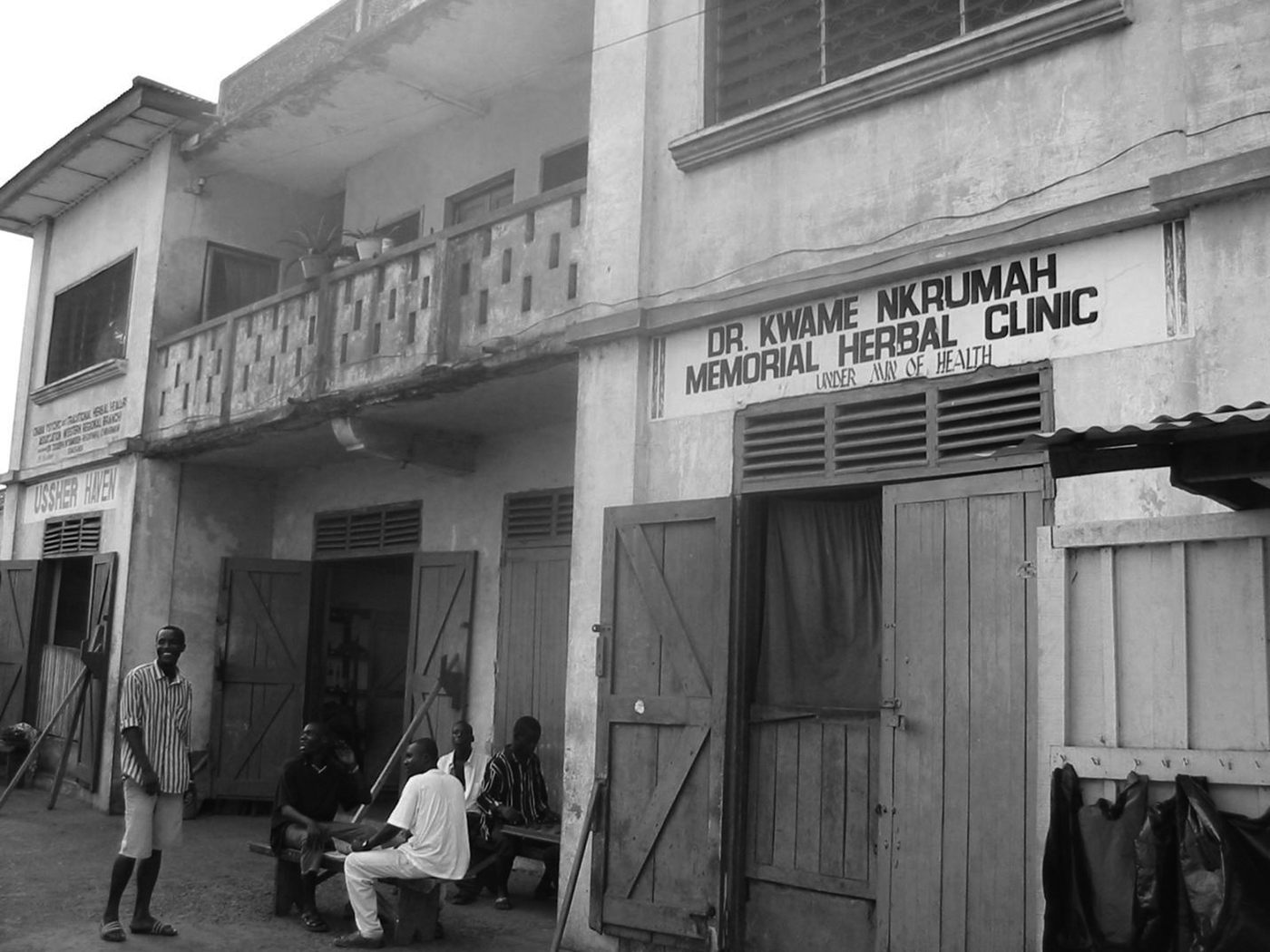
For healers, Nkrumah's support was a huge shift in government policy after years of colonial denigration (See Fig. 3). Nkrumah used the significance of respect in honour cultures to his advantage.Footnote 66 As one healer expressed, ‘It is a great honour for the herbalists, Priests and Priestesses that now Government has allow[ed] us to perform [our] practice, our work in public and to help the Nation.’Footnote 67 The notable use of the term Psychic moreover granted a place at the table to those who practiced spiritual divination in the כkomfo tradition. GPTHA correspondence confirmed that ‘Government have formed for all Herbalists and Traditional Healers in Ghana an Association. It does not seek to destroy what they were doing but rather to give it a more appropriate name and uniform Organisation throughout Ghana.’Footnote 68
Healers continue to commemorate the role of Ghana's first president in increasing their medical authority. Kwame Nkrumah Memorial Herbal Clinic and GPTHA office, Takoradi, Ghana (photo by author).
A more cynical interpretation is that Nkrumah mobilised healers the same way he had disenfranchised youth in his ‘Verandah Boys’ auxiliary wing of the Congress People's Party (CPP). In this sense, GPTHA was a means for the state to gain party support and infiltrate further segments of society, while simultaneously promoting respect for Ghanaian culture. During one Shama Junction meeting of the GPTHA in late 1963 that drew delegates from up to 15 districts, the regional organiser, a middle-aged healer, Atta Kwesi promised a visit from Nkrumah to garner support for 1G£ membership dues.Footnote 69 When the association's national secretary, Mensah-Daapa visited a meeting of healers at the same location in 1964, he explained ‘that everybody must try to find CPP Cards and the Association [should] also co-operate with the CPP Officials, the Regional Commissioner, District Commissioners, and the Local Councils’.Footnote 70 The anthropologist David Brokensha similarly witnessed CPP manoeuvrings at the formal inauguration of GPTHA at Larteh in April 1962.Footnote 71
Healers in the Sekondi-Takoradi area, however, did not see themselves as part of a Nkrumah puppet organisation. Nor did twenty-first century healers in the Sekondi area recall Aaba's SAH. Aaba appears to have been active until at least 1958, when he depicted himself as a ‘Phyto-Biotherapist’ and Co-founder and President of the Society of African Medical Herbalists (Ghana) in an article on medicine and diet that he wrote for the nationalist journal The Ghanaian. Footnote 72 But rather than cite Aaba's coordinating role, healers with whom I spoke pointed to a more recent regional explanation for the creation of GPTHA.Footnote 73 According to Tigare specialist Michael Acquah in Kojokrum village near Sekondi, priests from witch-finding shrines in the Takoradi area had begun organising themselves into a society during the 1950s. In 1969, Acquah explained that he helped to cofound a splinter organisation called the Ghana Psychic and Traditional Healers Association (as opposed to the Healing Association sponsored by Nkrumah's government). A retrospective account authored by Acquah's association in 1973 explained that the obosomfo (Tigare priest) Kwaku Boateng in Koforidua first ‘conceived the idea that Herbalists should form themselves into a group in order to facilitate the exchange of ideas’ as early as 1960.Footnote 74 This ‘Herbalists Association’ structured itself as a labour organisation under the domain of the Trade Union Congress of Ghana. The contested nature of GPTHA can be seen in two different letterheads in use in Acquah's personal archive, only one of which listed W. S. Mensah-Dapaa as National Secretary.Footnote 75
Regardless of the politics behind GPTHA's founding, and its initial inspiration, a variety of practitioners embraced the organisation. Surviving minutes from the Shama Junction Branch of GPTHA, preserved by healer Acquah, provide important insights into the diversity of members. District meetings attracted כkomfo (shrine priest/esses) like Kobina Brentu as well as odunsini (herbalists) such as Nana Yawson, who conducted a practice near the residence of the Queen Mother in Takoradi.Footnote 76 Members notably embraced a distinction between psychic and traditional healers, respectable English terms that approximated the Akan conceptualisation for healers attached to shrines who relied on spiritual divination and herbalists who used primarily plants. Madam Cecilia Quartey took on the role of ‘women's leader’ in an effort to increase their involvement with the organisation.Footnote 77 Prophets and prophetesses from syncretic Christian movements like the Apostolic church also joined in meetings, as did adherents to witch-finding sects such as Tigare. Healers joining the Shama Branch of GPTHA anticipated a larger role for themselves in national affairs and increased status in their communities. Through the GPTHA they were able to form stronger links with healers across the new nation (See Fig. 4).
Branch meeting of the Ghana Psychic and Traditional Healers Association c. 1960s, with members in both suits and traditional attire, Mensah-Dapaa is standing centre left, with renowned healer and ‘Fearless Psychic Lord’ Torgbe G. K. K. Gbedemah presiding, seated at center back. Source: Michael Acquah/Ghana Traditional Medicine Foundation.
These newly organised healers continued to use literacy as a tool in building up their authority within the Ghanaian nation. The majority of early GPTHA members may not have been fluent in English; they preferred to conduct events in Fanti, Twi, and other Ghanaian languages. However, literate members and hired letter-writers produced minutes and correspondence in English. Surviving letters from the early days of the association are peppered with warm addresses like ‘Dear Comrade’, ‘Brother-in-herbs’, and ‘One in medicine’.Footnote 78 Their letters and records were a byproduct of mass literacy campaigns under Nkrumah. According to census records, literacy increased from 4 per cent in 1948 to 20 per cent in 1960, making it more likely that healers could readily find letter writers and readers.Footnote 79 And yet, the uneven levels of writing proficiency among the healers created divisions within GPTHA and drew the attention of state officials. In a letter to two ‘okomfou’ in Sefwi Bekwai, a district secretary writing in 1963 to correct a misunderstanding explained ‘I am deeply sorry that none of you, the two, can read and write.’Footnote 80 Even when members learned of meetings through the ‘beating of gong-gong’ – the patterned drumming of the town messenger – written communication was still at work. The district commissioner in Shama first wrote to regional Chiefs to request for drum messaging, ‘Nana – You are requested to beat gong-gong to inform all Native Doctors or anyone having an idea of Native Medicine and Komfo, to meet me at Shama Junction on Sunday 11 October 1964, at 1 pm prompt.’Footnote 81
Familiarity with mathematical figures was also a critical way for GPTHA's leaders to vanquish allegations of fraud and maintain control over the growing association's agenda and finances. In August 1964, regional officials conducted a probe into the accounts of the Bibiani Branch of GPTHA. They confirmed allegations of embezzlement of membership dues. Officials suggested that ‘[i]n future, it may be necessary to get a Treasurer who could read and write.’ Desiring a paper trail, they explained, ‘There were no documents with the Treasurer to enable checking of amount received and amount paid out. I consider such procedure as dangerious [sic].’Footnote 82 Given these concerns, members seeking office in the splinter Healers Association in November 1970 received sheets of paper with set essay questions such as ‘Why I like to become an Organising Secretary’ and ‘The loyalty I owe to my Country’. Candidates had 25 minutes to write a ‘brief essay’ for which they could gain up to ‘20 marks’. They were also asked to do math sums in their heads.
Misuse of membership fees was a constant theme both in GPTHA correspondence and in healer reminiscences of the period. Healers particularly recounted Mensah-Dapaa's apparent theft of GPTHA funds as the Nkrumah regime toppled after the coup d’état in 1966 and Mensah-Dapaa's mysteriously disappeared to London with his English wife. Multiple explanations survive for Mensah-Dapaa's subsequent death, including that it was hastened by the spiritual intervention of swindled GPTHA members. In this context, basic math and English skills were critical to avoid members' subjection to petty officials and university academics. It was in the GPTHA's own interest to avoid the further disappearance of funds during the post-Nkrumah period. Members' personal records, such as the mental math examinations Acquah kept in his notes, suggest a preoccupation with written and mathematical literacy.
The healers faced a final challenge to their medical authority in the form of the new elite class of African physicians trained abroad and at the Ghana Medical School at Korle Bu. At a meeting at Shama Junction, Kwesi had a last word of warning as the meeting drew to a close. He explained that the healer ‘should not show himself or herself when he or she goes to hospital’:
The European doctors have plan to poison anybody who will prove or show that he or she is a herbalist, because we are going to supply them medicines to do their work so they are coming under us.Footnote 83
Healers felt that their superior knowledge of local medicine posed a threat to both European and Ghanaian physicians, though it is difficult to ascertain whether anyone had actually been poisoned. Physicians' disrespect of healers has been a common trend not only in Ghana but elsewhere in independent Africa.Footnote 84 The association's name contrasted neatly with that of the Ghana Medical Association, inaugurated merely four years before.Footnote 85 GPTHA members remained in the domain of ‘Healing’, while physicians trained in the European tradition maintained control over ‘Medicine’. Kwesi's cautionary remarks to the healers gathered at Shama Junction spoke to the high stakes of the contest for medical and scientific authority in the new nation. As Mensah-Dapaa highlighted in 1961 at a Ghana Science Association discussion on incorporating traditional medicine into orthodox medicine, ‘In trying to map out the lines along which Medical Science and Traditional Healing should work hand in hand in Ghana it is highly desirable to eliminate rivalry or subjugation of one to the other.’Footnote 86
CONCLUSION
A rising class of healers in Ghana used writing to rebuild public trust in indigenous medicine between 1930 and 1970. First, African Scientific Herbalists adapted literacy to reposition themselves in the face of colonial suppression. A literate leader in the organisation, Aaba, mobilised other healers to document therapeutics and standardise their practice. After independence, healers in southern Ghana continued to use literacy to broker professional power. Healers took writing and arithmetic tests in a bid to maintain control over their funds and reputations. Unlike Aaba, however, members of the GPTHA did not write herbals to train the next generation, nor did they downplay the value of animist beliefs in their practice. In both periods, literate healers used their ability to read and write in English to enhance their position in the eyes of other healers, their communities, and the government. Ultimately, they sought respect after the public increasingly turned to biomedicine for therapy.
With the rise of ‘clerk’ jobs in colonial Gold Coast, literacy emerged as a way for individuals who could read and write to pursue non-farming careers, often in a European-owned enterprise or colonial administrative office. As historian Nancy Rose Hunt notes for colonial Congo, ‘access to books and letters and the talent of writing represented new capacities to mobilise wealth and power’.Footnote 87 Within Ghanaian history, literacy came to be associated with urbanisation and opportunities in industrialising centres, with non-literate persons hiring letter-writers to pen notes to families back home in rural areas. Families in Ghana valued education as a way for their children, particularly boys, to enter less physically demanding professions in the civil service. Literacy extended the period of productive work; in her study of debility in Botswana, Julie Livingston notes that schooling allowed those who were less physically mobile to pursue new sedentary professions in the postcolonial period.Footnote 88
The rise of literacy becomes an important lens through which we can re-examine healer legitimacy in African settings. Seeing healers-as-authors repositions traditional medical practitioners among the scientific and medical class and destabilises researchers' expectations. Earlier scholarship on indigenous African healing stresses its orality, in contrast to Ayurvedic medicine in South Asia or Chinese traditional medicine where written treatises supplement spoken knowledge. Lamenting the loss of herbal data, Ghanaian biologist Ebenezer Laing comments how frequently ‘very knowledgeable old people in traditional communities die with their valuable knowledge, making the world the poorer.’Footnote 89 But healers in Ghana did write. Beyond authoring key herbals, healers cultivated everyday writing activities, penning other aspects of their healing activities and professional interactions. For example, Acquah, a former GPTHA secretary, kept detailed notebooks documenting the testimonies of women he cured of ‘witchcraft’ with accompanying photographs during the 1970s and 1980s.
Literate healers blur the lines between science and non-science in their written claims to medical authority. Past research on traditional healing in Africa frequently contemplates the hybridity of modern and traditional practices. In her study of healers in South Africa, historian Karen Flint asks, ‘What is traditional about traditional medicine?’ noting that healers, cultural brokers, colonists, and the public have all shaped expectations for what constitutes therapeutic authenticity.Footnote 90 The divide between tradition and modernity is a recurring theme both in African studies and national discourses.Footnote 91 Public health officials have often deemed ‘modern’ techniques and ingredients unsuitable for traditional medicine, even as healers readily incorporate them and patients gladly accept them.Footnote 92 Literacy, a trait both historians and policymakers do not usually associate with African healers, is another realm in which closer study reveals a more complicated picture of traditional medicine.
Further, using healer-authored documents, rather than records of colonial administrators, anthropologists, and post-independence workers, or even oral history interviews conducted with these official accounts in mind, shifts our periodisation of the history of traditional medicine in Africa. For instance, histories of indigenous medicine in Africa often stress the importance of witchcraft in the 1920s and 1930s.Footnote 93 Instead, Aaba's writings from this period offer an important view into a group of practitioners who self-identified as scientists. For Aaba, herbalism in the Gold Coast was a scientific and rational pursuit based on centuries of indigenous experimentation. At the same moment when anthropologists like Edward Evans-Pritchard famously documented supernatural beliefs in what is today South Sudan, or Robert Rattray headed ethnological surveys for the Gold Coast, focusing on magic and unscientific practices, African healers themselves wrote a different story under colonial occupations. Or, in the 1960s and 1970s, when fads shifted, and WHO policies highlighted the public health utility of traditional healing globally, healers like Acquah reclaimed beliefs in spiritual causality and the roles of female witches. A healer-centred history, based in their written accounts interjects new preoccupations and discourses.
Ghanaian healers have continued to seek greater medical authority, with literacy remaining a major internal concern. Since the 1960s, different healing organisations have continued to arise, including those centred on key healers, such as ‘Doctor’ Assiamah. Most of these groups came together when Ghanaian healers lobbied for recognition through the Ghana Federation of Traditional Medical Practitioners (GHAFTRAM), an umbrella organisation founded in 1997. GHAFTRAM has been a way for the Ministry of Health, through its Traditional and Alternative Medicines Department to better regulate and enumerate healers, implement courses on standardisation of drugs, and check for compliance with the 2000 Traditional Medicine Practice Act. GHAFTRAM electoral materials have noted the importance of literacy to leadership positions, even as national health policy has at times taken a more paternalist approach to healer management.Footnote 94 In 1999, when Kojo Odum Eduful ran for GHAFTRAM General Secretary, he listed his attributes as ‘A Brilliant Scholar, Versatile and a Bold Scribe.’Footnote 95 Interviews with healers confirm the value of writing and reading. ‘Doctor’ Padan explained to me that he learned traditional medicine from his father, the renowned healer Kwado Manu, after he dropped out of middle school. He regretted that he and other healers often traded in formal schooling for traditional knowledge at home. For him, literacy was a sign of his membership in learned society and his aspiration to increase his knowledge base. Further, he affixed the term Doctor to his name, given extensive training with his father and his own investigations.Footnote 96 Other healers showed me their collections of textbooks, often herbals and alternative medicine handbooks published in North America and Europe. Despite healer efforts to assert their credentials and expertise, a new bachelor's degree in herbalism at the pharmacy faculty of the Kwame Nkrumah University of Science and Technology has recently opened a new chapter in relations between herbal specialists, with B. Herbalism graduates providing advice to herbal medicine manufacturers, working at biomedical clinics, and marketing their own products. This article takes healer-authored documents as a guide to posit that literacy has long been an accepted route for healers to gain trust and, and such, warrants further attention in Ghana and other parts of Africa.