Ostracism is the act of being excluded or ignored by another individual or group of individuals (Williams & Zadro, Reference Williams, Zadro and Leary2001). Therefore, there are ostracizers and ostracized individuals in the process of ostracism. The study found that when an individual is ostracized by members of a certain group, the group membership of the ostracizers could affect the prejudicial attributions and aggressive intention of the ostracized individual. For example, participants who were ostracized by ethnic out-group members showed higher prejudicial attributions and hostility to ostracizers than those ostracized by ethnic in-group members (Schaafsma & Williams, Reference Schaafsma and Williams2012). However, in many cases, people also could observe other people being ostracized, witnessing other people being ostracized by others has been known to have negative consequences and even make the observers generate the feeling of ostracism. Researchers call this form of ostracism vicarious ostracism (Wesselmann et al., Reference Wesselmann, Bagg and Williams2009). Observers who suffered from vicarious ostracism are essentially individuals who were ostracized, and they could also experience the feeling of pain similar to the first-person experienced ostracism (Wesselman et al., Reference Wesselmann, Wirth, Pryor, Reeder and Williams2013). However, there is no research to explore the effects of the group membership of the ostracizers on the prejudicial attributions and aggressive intentions of individuals who suffering from vicarious ostracism. Thus the purpose of this study is to explore the effects of intergroup vicarious ostracism on observers’ prejudicial attributions and aggressive intentions.
Prejudicial Attributions and Aggressive Intentions in Intergroup Ostracism
Ostracism detection system theories argue that humans are equipped with an ostracism detection system that promptly detects ostracism clues and encoded ostracism messages from other individuals and groups (Kerr & Levine, Reference Kerr and Levine2008; Spoor & Williams, Reference Spoor, Williams, Forgas, Haselton and von Hippel2007). Thus, regardless of the type of ostracism (ostracism via computer, ostracism by strangers, or ostracism by despised out-group members), it could make ostracized individuals feel the pain of ostracism (Meyer et al., Reference Meyer, Masten, Ma, Wang, Shi, Eisenberger and Han2013; Yang, Wei, Zhao, & Liu, Reference Yang, Wei, Zhao and Liu2017; Zadro et al., Reference Zadro, Williams and Richardson2004;).
Each individual is subordinated to different groups in the course of social interactions and holds multiple group identities accordingly. In-group refers to people who share common group identities (e.g., nations, religions, and political parties), and is also known as the group to which the individual belongs (Balliet et al., Reference Balliet, Wu and De Dreu2014). Conversely, out-group refers to all groups except the individual’s own group, and is also called the “other groups” (Sumner, Reference Sumner1906). Several studies have shown that basic needs (Gonsalkorale &Williams, Reference Gonsalkorale and Williams2007) and emotion (Wirth & Williams, Reference Wirth and Williams2009) of participants who were ostracized were not affected by the membership of ostracizers. However, it is worth noting that these studies mainly focused on loosely structured groups.
Contrary to the research of Gonsalkorale and Williams (Reference Gonsalkorale and Williams2007) and Wirth and Williams (Reference Wirth and Williams2009), recently researchers used the participants with highly entitative (Lickel et al., Reference Lickel, Hamilton, Wieczorkowska, Lewis, Sherman and Uhles2000) and highly essentialized (Haslam et al., Reference Haslam, Rothschild and Ernst2000) groups (e.g., race and ethnic group, such groups have low intergroup permeability and strong in-group identity) have found that those individuals who were ostracized by ethnic in-group members displayed lower basic needs satisfaction than those ostracized by ethnic out-group members (Sacco et al., Reference Sacco, Bernstein, Young and Hugenberg2014). Similarly, the group membership of the ostracizers could also affect the prejudicial attributions of the individual. Here, prejudicial attributions refer to the belief among people who are ostracized that they are primarily being treated as such due to their group membership, and they may also tend to think that they are the victims of prejudice or that those who ostracize them are racist (Goodwin et al., Reference Goodwin, Williams and Carter-Sowell2010).
Intergroup ostracism is a form of negative intergroup contact. Compared with in-group ostracism, individuals who suffer from out-group ostracism are more likely to believe that this ostracism is an exclusionary behavior caused by different group membership. For example, in a study by Schaafsma and Williams (Reference Schaafsma and Williams2012) that selected students of Moroccan, Turkish and Dutch descent in high schools in Netherlands as participants, the results showed that participants who were ostracized by ethnic out-group members revealed higher prejudicial attributions and hostility than those ostracized by ethnic in-group members, and that the effect of group membership on hostility was mediated by the extent to which the ostracized individuals attributed their ostracism to the racist attitudes of the ostracizers.
On the contrary, individuals who were ostracized by in-group members considered their position in the group as marginalized. In order to regain the acceptance of the group, individuals are likely to actively strengthen their connection with in-group members, showing lower aggressive intentions, and even exhibiting prosocial behavioral responses (Yang et al., Reference Yang, Wei, Zhao and Liu2017). Therefore, we believe that Tibetan and Hui individuals who suffered from out-group ostracism will show higher prejudicial attributions and aggressive intentions than those who suffered in-group ostracism. However, it remains unclear whether the same differences in prejudicial attributions and aggressive intentions also exist in the observers who suffer from intergroup vicarious ostracism.
Effects of Intergroup Vicarious Ostracism on Prejudicial Attributions and Aggressive Intentions
Intergroup vicarious ostracism is vicarious ostracism that occurs at group level. Research has shown that individuals who observe others being ostracized could also experience the feelings of belonging being threatened (Wesselmann et al., Reference Wesselmann, Bagg and Williams2009). This indicates that individuals suffering from vicarious ostracism can also experience the painful feelings of ostracism. Further research has also found that observer's response is influenced by the group relationship between ostracizers and ostracized—i.e., it depends upon whether the ostracizers and ostracized come from the same or different groups. This has been demonstrated by Paolini et al. (Reference Paolini, Alparone, Cardone, van Beest and Merla2016). Their findings suggest that the observers’ autonomic response is stronger, marked by a more intensive facial thermal variation in the nose and perioral areas when they observed an in-group member being ostracized by in-group members than when they observed an out-group member being ostracized by in-group members. This may because in-group relationships and its members are more important than the out-group for the individuals.
Participants who observe an in-group member being ostracized by in-group members, could also experience the ostracism feeling. However, since the ostracizers and ostracized individuals have the same group identity, it is unlikely that the observers believe that such ostracism within in-group members is due to group identity, and they were less likely attribute ostracism to ostracizers’ prejudice, thus showing less aggressive intentions, even ostracizing the person who has been ostracized, to strengthen contact with in-group members (Williams, Reference Williams2007); on the contrary, when ostracism is from out-group members, in order to reduce their negative experience and achieve effective self-defense, individuals are likely to generate external or group-level attributions (Mendes et al., Reference Mendes, Major, McCoy and Blascovich2008), for example, observers may think that they are the victim of prejudice. This perceived unfair treatment usually leads individual to show high aggressive intentions (Schaafsma & Williams, Reference Schaafsma and Williams2012). Furthermore, many researchers have found that prejudicial attributions can positively predict individuals’ aggressive intentions (Parrott & Peterson, Reference Parrott and Peterson2008; Parrott et al., Reference Parrott, Peterson and Bakeman2011).
Therefore, we draw three hypotheses: Those participants who observed an in-group member (Tibetan and Hui college students) being ostracized by out-group members will make stronger attributions of ostracism to the prejudice of the ostracizers (Hypothesis1) and show greater aggressive intentions towards them (Hypothesis 2) than those who observed an in-group member being ostracized by in-group members. In addition, we also infer that under the condition of out-group, prejudicial attributions mediate the effects of inclusionary status on the aggressive intentions (Hypothesis 3).
Present Study
We selected participants from the Tibetan and Hui ethnic group in northwestern China. The Study1 and Study2 focuses on how ostracism occurring both within the Tibetan ethnic in-group (i.e., ostracism of Tibetans by other Tibetans) and by the ethnic out-group (i.e., ostracism of minority Tibetans by the majority Han ethnic group) affected Tibetan observers' prejudicial attributions (Study 1) and aggressive intentions (Study 2), respectively. In Study 3, Hui college students were chosen as participants to further examine the results of Study 1 and Study 2 and explore the relationship between prejudicial attributions, inclusionary status, and aggressive intentions.
The Tibetans, as a native ethnicity, evolved from tribes. Different tribes on the Tibetan Plateau merged to become a nation that broke the boundaries of blood and original tribes. There are around 6.4 million Tibetans living in Chinese territory, most of which are mainly distributed in China as in the Tibet, Qinghai, and Gansu provinces. In addition, the entire Tibetan population believes in Buddhism and uses their own characters and language.
The history of the Hui ethnic group date back to the 13th century. The Mongol army conquered their territory westward, which resulted in large masses of people flooding into China seeking refuge. As time passed by, this group of people absorbed people from Han, Mongolian, and Uyghur ascent and gradually evolved into a completely new ethnic group—the Hui Chinese. Until now, the total population of the Hui Chinese has reached approximately 9.8 million, and they use Mandarin mostly in their daily life. Due to the unique religious beliefs and cultural characteristics, the Tibetans and Hui have high national identity. In China, the Han people belong to the majority group, and the Tibetans and Hui people belong to the minority groups. China implements ethnic regional autonomy in areas where minority peoples live in compact communities.
Unlike adolescents (Will et al., Reference Will, Crone, van den Bos and Güroğlu2013) and undergraduate students (Wesselmann et al., Reference Wesselmann, Williams and Hales2013) investigated in past studies, ethnic groups have clear boundaries and low group permeability. As noted in previous research, members of such groups often have different attribute tendencies and aggressive intentions based on whether ostracism is performed by in-group members or out-group members (Schaafsma & Williams, Reference Schaafsma and Williams2012). Therefore, we employed three experimental studies with a sample of Tibetan and Hui college students to verify the above mentioned hypotheses.
STUDY 1
Methods
Participants
We used the G-Power Software to calculate the sample size, setting the effect size as 0.40 in the prior test, and power (1 – β) = 0.90. The total sample size required was 93, with no less than 24 participants in each condition. A total of 118 undergraduates of Tibetan nationality, were randomly recruited through a Bulletin Board System (BBS) and they volunteered to take part in the study, with 95% of the participants from the ethnic region (It is mainly the areas where the Tibetan and Hui people centralized habitation, and there are also a very small number of Han people). None of the participants had participated in a similar experiment before. Their vision or corrected vision was normal; therefore, their ability to watch the Cyberball game being used in the experiment was unimpaired. Eight questionnaires were unfinished; data from these eight were excluded from analyses, yielding a total of 110(27 male) valid responses, aged 19–24 years (M = 21.44, SD = 1.12).
Design
A 2 (inclusionary status: ostracism, inclusion) × 2 (group membership: In-group, out-group) between-subjects design was employed. The Cyberball paradigm was used to induce vicarious ostracism (Wesselmann et al., Reference Wesselmann, Bagg and Williams2009).
Procedure
First, participants entered individual cubicles and were informed that they would be observing the online ball-tossing game called Cyberball (Williams, Cheung, & Choi, Reference Williams, Cheung and Choi2000). Participants were told that the game involved three other people playing over the Internet, but actually these players were virtual confederates (coded respectively Player1, Player 2 and Player3). Participants were asked to take the perspective of Player 2 during the game and to imagine “where the game is being played” and “being in Player’s 2 shoes” to exercise their visualization skills. Participants were also told that the exercise of their mental visualization ability was more important than the players’ performance (Wesselmann et al., Reference Wesselmann, Bagg and Williams2009).
In order to induce better distinguish between in- and out-group members by participants, photos and national information of three players were presented respectively in the screen (Yang et al., Reference Yang, Wei, Zhao and Liu2017). Therefore, each player’s information including three sections, an avatar passes the ball, the code of the player and a photo equipped with the ethnic identity information. Furthermore, in order to control for the influence of gender factor on the research results, the participants’ gender and the sex of the three players were matched by the experiment assistant before beginning.
Participants were randomly assigned to one of the four experimental treatment conditions. Under the condition of the in-group status, participants saw three Tibetan faces as fellow players. While under the out-group status condition, participants saw Player 2 who was portrayed as a Tibetan, playing with two individuals portrayed as Han (see Figure 1). The game involved 30 throws and lasted approximately 5 minutes. Inclusion and ostracism were operationalized by the number of times that the Tibetan player was tossed the ball. In the inclusion condition, participants watched a game in which all three Cyberball players included each other equally (approximately 33% of the time). In the ostracism conditions, participants observed a game in which Player 2 was tossed to once by the Player 1 and Player 3 respectively at the beginning of the game but then was never thrown to again during the game.
Examples of Cyberball Screens.
Note. The left screenshot shows an example of a screen that might be seen in the in-group condition; all of the players are Tibetan. The right screenshot shows an example of a screen that might be seen in the out-group condition; Player 1 and Player 3 are Han, while Player 2 is Tibetan.

After it was finished, we measure feelings of ostracism by asking participants to indicate the extend in which they have felt ignored and included (reverse scoring) on a Likert 7-point scale (1: not at all, 7: totally). Finally, we measured the prejudicial attributions made by the participants. After all the experiments were completed, participants were led to another room, where they were informed about the experiment’s real purpose and thanked for participating in the experiment.
Materials
Prejudicial attribution measure. The prejudicial attribution measure developed by Goodwin et al. (Reference Goodwin, Williams and Carter-Sowell2010) was used to gauge the degree of attribution of ostracism to the prejudice. Participants were asked to rate on a five-point scale (1 indicating total disagreement and 5 indicating total agreement) three questions, such as "How much do you believe others responded to the Player 2 during the game because his/her national identity?" Higher scores of participants indicated they were more likely to perceive that they were being ostracized on account of their ethnicity and were more likely to attribute their ostracism to prejudice (α = .77).
Results
Manipulation Check
A 2 (inclusionary status: Ostracism or inclusion) × 2 (group membership: In-group or out-group) between-subjects analysis of variance (ANOVA) was used to test the effectiveness of the manipulation check. The results showed that a main effect of inclusionary status is significant, F(1, 106) = 393.33, p < .001, ηp2 = .788, such that those participants who witnessed an in-group member being ostracized (M = 5.75, SD = 0.91) revealed more ostracism sense than those who witnessed an in-group member being included (M = 2.53, SD = 0.78). The interaction between inclusionary status and group membership was not significant F(1, 106) = 2.24, p = .137, ηp2 = .021. This indicates that the experimental manipulation was effective, and there was no evidence that observers experienced ostracism was moderated by group membership of the ostracizers.
The Difference of Prejudicial Attributions between In-group and Out-group in Different Situations
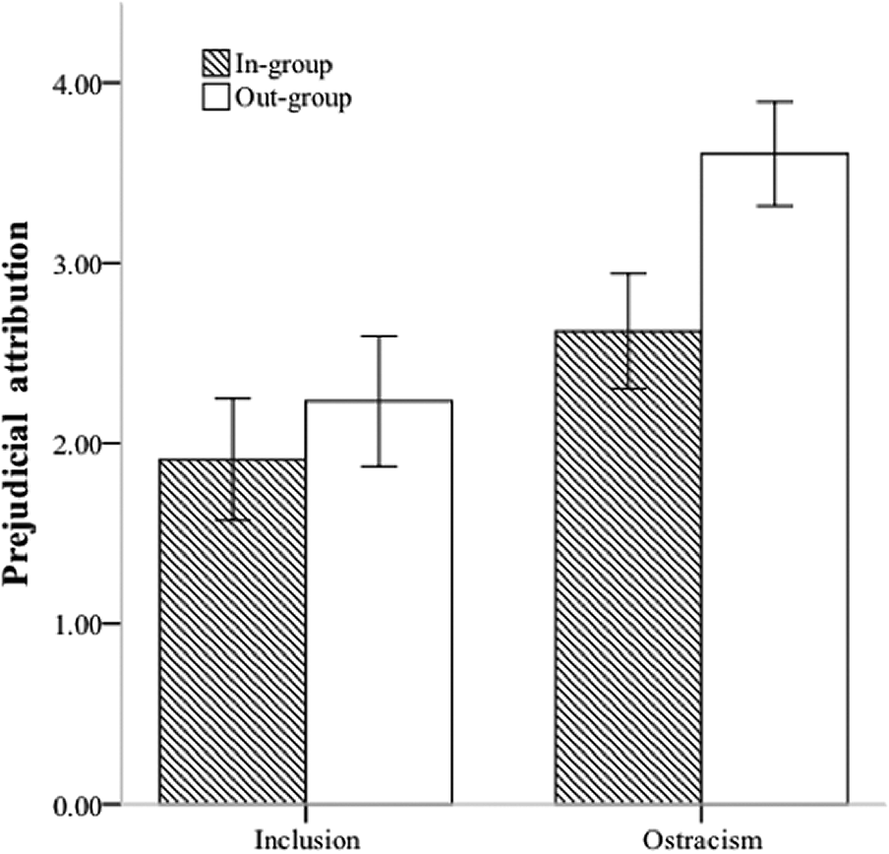
We conducted a 2 x 2 ANOVA with inclusionary status condition (ostracism or inclusion) and group membership (in-group or out-group) as between-subjects variables and prejudicial attributions as the dependent variable. The results showed that the interaction between inclusionary status and group membership was found to be significant F(1, 106) = 4.26, p = .042, ηp2 = .039. Simple effects analyses revealed that, in the ostracism condition, prejudicial attributions were greater in the out-group condition (M = 3.60, SD = 0.73) than in the in-group condition (M = 2.62, SD = 0.85), F(1, 106) = 19.65, p < .001, ηp2 = .156. In the inclusion condition, there was no significant difference of prejudicial attributions between in-group (M = 1.91, SD = 0.84) and out-group (M = 2.23, SD = 0.91), F(1, 106) = 2.00, p = .161, ηp2 = .018 (see Table 1 and Figure 2). This result offers support for Hypothesis1. Specifically, those participants who observed an in-group member being ostracized by out-group members were more likely to attribute ostracism to prejudice than those who observed an in-group member being ostracized by in-group members. This indicates that prejudicial attributions were affected by the ostracizer’s group membership”.
Study 1. Means (and standard Standard deviationsDeviations) of vVariables as a function Function of inclusionary Inclusionary status Atatus and group Group membership Membership

Effects of Intergroup Vicarious Ostracism on Prejudicial Attributions (Tibetan)

STUDY 2
Method
Participants
Through the school BBS, 121 Tibetan college students were randomly recruited and volunteered to participate the study, with 95% of them came from the ethnic region. None of the participants had participated in similar experiments. Their vision or corrected vision was normal. Finally, after we removed the nine unfinished questionnaires, there were 112(50 male) valid data, aged 18–24 years (M = 20.87, SD = 1.05).
Design
A 2 (inclusionary status: Ostracism, inclusion) × 2 (group membership: In-group, out- group) between-subjects design was employed. The Cyberball paradigm was used to induce vicarious ostracism (Wesselmann et al., Reference Wesselmann, Bagg and Williams2009).
Procedure
This experiment procedure is the same as Experiment 1, with the only difference being the dependent variables were replaced by aggressive intentions.
Materials
Aggressive tendencies measure. The “laboratory assistant application paradigm” (Twenge et al., Reference Twenge, Baumeister, Tice and Stucke2001) was used. Participants were told that Player1 on the left side of the screen who just participated game was applying to become a psychology laboratory assistant, and since the position was fiercely competitive, we wanted to get some evaluative information of the individual from them. Participants were further told that their evaluation would be one of the most important ground upon which we would ultimately hire him or not. The participants were subsequently asked to answer on a seven-point scale (1 for totally disagree, 7 for totally agree) with six questions such as “the applicant is very friendly." Items 1, 2, 5, and 6 utilized reverse scoring. Higher scores of participants indicated they have more aggressive intentions to the ostracizers (α = .76).
Results
Manipulation Check
We conducted a 2 × 2 ANOVA with inclusionary status condition (ostracism or inclusion) and group membership (in-group or out-group) as between-subjects variables and average score of manipulation check as the dependent variable. The results showed that a main effect of inclusionary status is significant, F(1, 108) = 416.87, p < .001, ηp2 = .794, such that participants who witnessed an in-group member being ostracized (M = 5.48, SD = 0.80) showed more ostracism sense than those who witnessed an in-group member being included (M = 2.62, SD = 0.66). The interaction between inclusionary status and group membership was not significant F(1, 108) = 1.55, p = .216, ηp2 = .014. This indicates that the experimental manipulation was effective, and observers experienced ostracism was not moderated by group membership of the ostracizers.
The Difference in Aggressive Intentions between In-group and Out-group in Different Situations
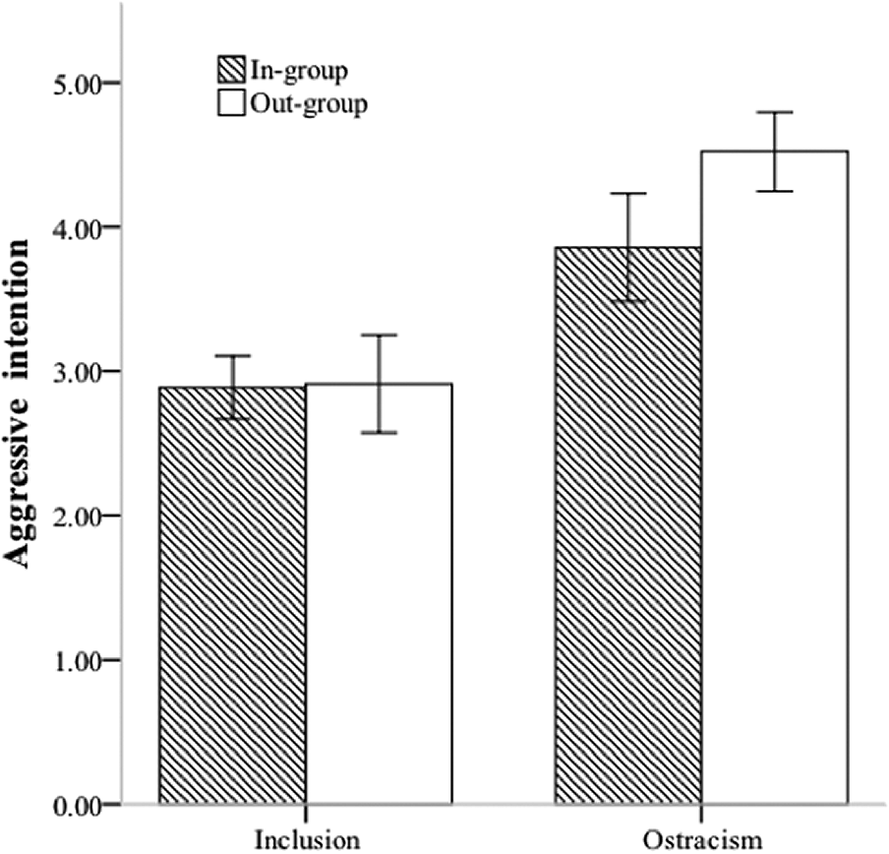
Taking inclusionary status and group identity as fixed factors, aggressive intentions were set as the dependent variable, we carried out a 2 (inclusionary status: Ostracism, inclusion) × 2 (group membership: In-group, out-group) between-subjects analysis of variance (ANOVA). The results showed that the interaction between inclusionary status and group membership was found to be significant F(1, 108) = 4.59, p = .034, ηp2 = .041. Simple effects analyses revealed that, in the ostracism condition, aggressive intentions were greater in the out-group condition (M = 4.52, SD = 0.75) than in the in-group condition (M = 3.86, SD = 0.97), F(1, 108) = 10.51, p = .002, ηp2 = .089. In the inclusion condition, there was no significant difference of aggressive intentions between in-group (M = 2.89, SD = 0.56) and out-group (M = 2.91, SD = 0.82), F(1, 108) = 0.02, p = .903, ηp2 = .00 (see Table 2 and Figure 3). This result offers the support for Hypothesis 2. Specifically, those participants who observed an in-group member being ostracized by out-group members were more likely to show higher aggressive intentions than those who observed an in-group member being ostracized by in-group members. This indicates that the aggressive intentions were affected by the ostracizer’s group membership.
Study 2. Means (and standard Standard deviationsDeviations) of variables Variables as a function Function of inclusionary Inclusionary status Status and group Group membership Membership

Effects of intergroup vicarious ostracism on aggressive intentions (Tibetan)

STUDY 3
Method
Participants
A total of 148 undergraduate students of Hui nationality were randomly recruited and volunteered participate the study by the school BBS. 95% of the subjects were from ethnic region. All the participants had no prior experience with similar experimental paradigms. Their vision or corrected vision was normal. We removed four unfinished questionnaires, as well as five questionnaires from participants who did not believe their evaluations would affect the employment decisions for the player 1. After making these exclusions, there were 139 (male 49) valid participants, aged 18–25 years (M = 20.11, SD = 1.20).
Design
A 2 (inclusionary status: Ostracism, inclusion) × 2 (group membership: In-group, out-group) between-subjects design was employed. The Cyberball paradigm was used to induce vicarious ostracism (Wesselmann et al., Reference Wesselmann, Bagg and Williams2009).
Procedure
First, the manipulation of intergroup vicarious ostracism and inclusion was performed in a similar way to the Study 1. The differences were that under the condition of the in-group status, participants saw three Hui faces as fellow players. While under the out-group status condition, participants saw Player 2 who was portrayed as a Hui, playing with two individuals portrayed as Han. Second, the participants were asked to complete both the manipulation check and the questionnaire of prejudicial attributions. Finally, the participants completed the measurement of the aggressive intentions.
Materials
The measurement of prejudicial attributions is the same as Study 1.
Aggressive intentions measurement is the same as in Study 2, except that an additional question was placed at end of the questionnaire, which asked, “Do you believe that your evaluation will ultimately affect our employment decision for Player 1?” (1: Yes, 2: No).
Results
Manipulation Check
Taking inclusionary status and group identity as fixed factors, average score of manipulation check as the dependent variable, we carried out a 2 (inclusionary status: Ostracism, inclusion) × 2 (group membership: In-group, out-group) between-subjects analysis of variance (ANOVA). The results showed that a main effect of inclusionary status is significant, F(1, 135) = 672.55, p < .001, ηp2= .833, such that participants who witnessed an in-group member being ostracized (M = 5.75, SD = 0.65) showed more ostracism sense than those who witnessed an in-group member being included (M = 2.51, SD = 0.81). The interaction between inclusionary status and group membership was not significant F(1, 135) = 1.70, p = .195, ηp2 = .012. This indicates that the experimental manipulation was effective, and observers experienced ostracism was not moderated by group membership of the ostracizers.
The Difference in Prejudicial Attributions and Aggressive Intentions between In-group and Out-group in Different Situations
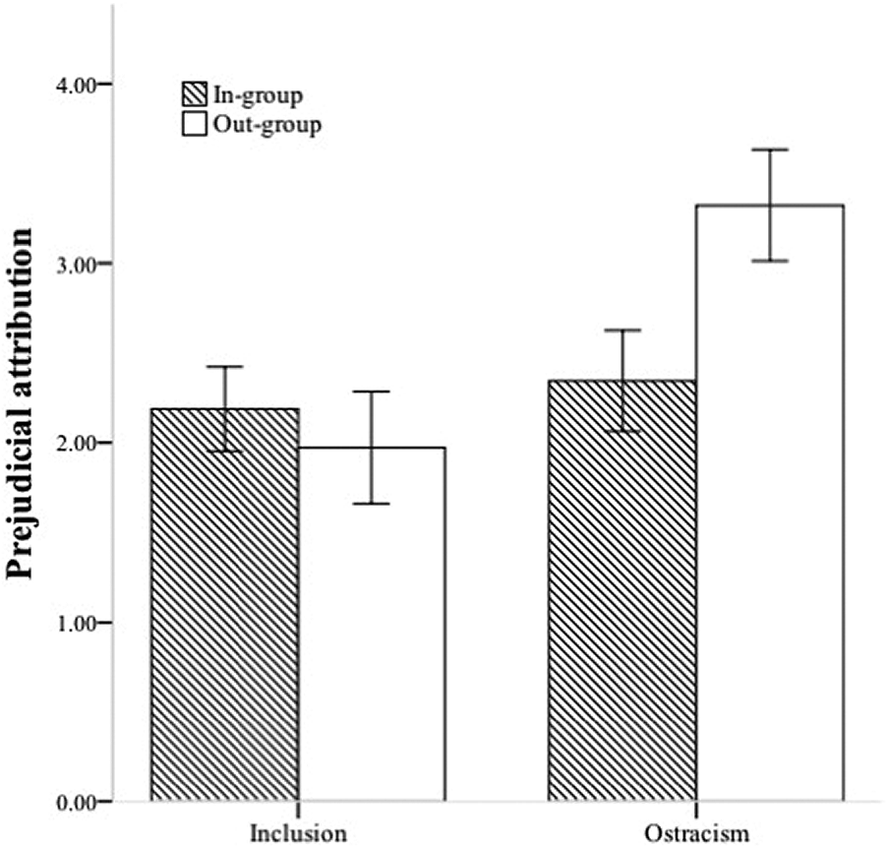
We conducted a 2 x 2 multivariate analysis of variance (MANOVA) with inclusionary status condition (ostracism or inclusion) and group membership (in-group or out-group) as between-subjects variables, and set prejudicial attributions and aggressive intentions as the dependent variables. The results showed that the interaction between inclusionary status and group membership in prejudicial attributions was found to be significant F(1, 135) = 17.82, p < .001,ηp2 = .117. Of course, this significant interaction also exists at the level of aggressive intentions F(1, 135) = 6.35,p = .013, ηp2 = .045. For the prejudicial attributions, simple effects analyses revealed that, in the ostracism condition, prejudicial attributions were greater in the out-group condition (M = 3.32, SD = 0.91) than in the in-group condition (M = 2.34, SD = 0.81),F(1, 135) = 23.85, p < .001,ηp2 = .150. In the inclusion condition, there was no significant difference of prejudicial attributions between in-group (M = 2.19, SD = 0.67) and out-group (M = 1.97, SD = 0.92), F(1, 135)= 1.15, p = .285, ηp2 = .008 (see Table 3 and Figure 4).
Study 3. Means (and standard Standard deviationsDeviations) of variables Variables as a function Function of inclusionary Inclusionary status Status and group Group membership Membership

Effects of Intergroup Vicarious Ostracism on Prejudicial Attributions (Hui)

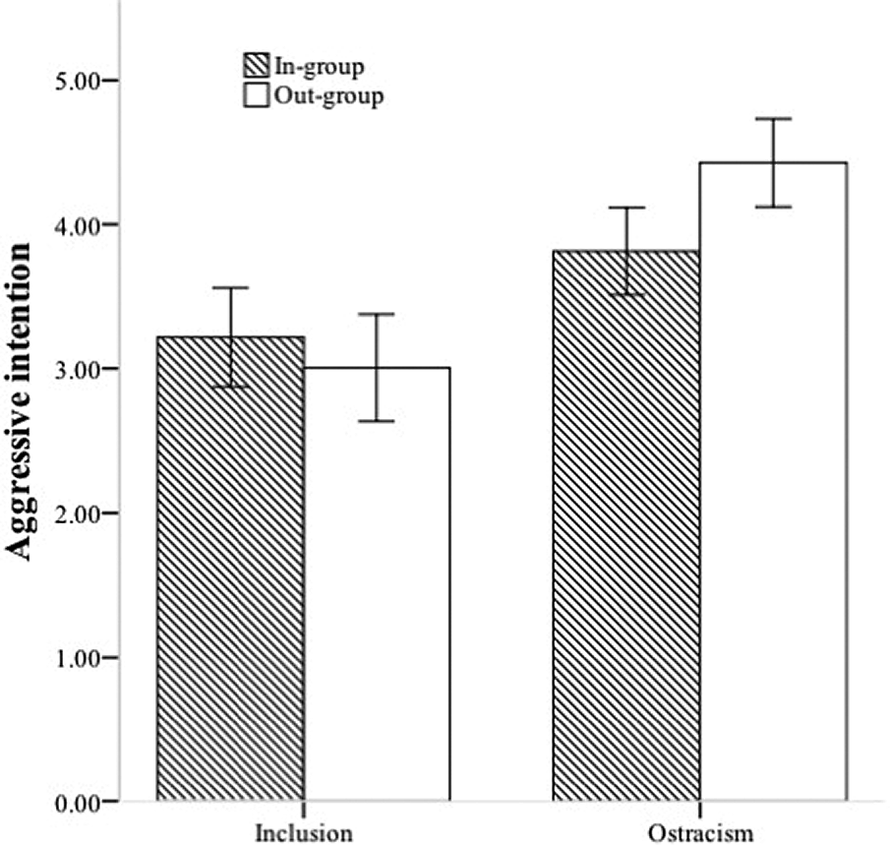
For the aggressive intentions, simple effects analyses revealed that, in the ostracism condition, aggressive intentions were greater in the out-group condition (M = 4.43,SD = 0.89) than in the in-group condition (M = 3.81, SD = 0.87), F(1, 135) = 6.99, p = .009, ηp2 = .049. In the inclusion condition, there was no significant difference of aggressive intentions between in-group (M = 3.22, SD = 0.98) and out-group (M = 3.00, SD = 1.10), F(1, 135) =0 .84, p = .362,ηp2 = .006 (see Figure 5).
Effects of Intergroup Vicarious Ostracism on Aggressive Intentions (Hui)

This result offers support for Hypothesis 1 and Hypothesis 2. Specifically, those participants, Hui college students, who observed an in-group member ostracized by out-group members were more likely than those who observed an in-group member ostracized by in-group members to show higher prejudicial attributions and aggressive intentions to the ostracizers. This indicates that in-group and out-group ostracism has different impact on the observers’ prejudicial attributions and aggressive intentions.
Moderated Mediation Analysis
We conducted a moderated mediation analysis to examine the effects of group membership on the relationship among inclusionary status, prejudicial attributions and aggressive intentions. The results indicated that the interaction of inclusionary status and group membership could positively predict prejudicial attributions (B = 1.19, p < .001) (95% bias-corrected confidence interval did not include zero; 95% CI [0.64, 1.75]). Therefore, these results support a moderated mediation. Simple slope analysis showed that under the in-group condition, prejudicial attributions did not mediate the effect of inclusionary status on aggressive intentions (95% bias-corrected confidence interval include zero; 95% CI [–0.05, 0.18]). However, under the out-group condition, prejudicial attributions did indeed mediate the effect of inclusion and ostracism on aggressive intentions (95% bias-corrected confidence interval did not include zero; 95% CI [0.15, 0.69]) (see Figure 6).
The Group Membership Moderated the Mediate Effects of Prejudicial Attributions between Inclusionary Status and Aggressive Intentions.
Note. ***p < .001. **p < .01.

Discussion
In this research, we took our participant from Chinese Tibetan and Hui college students for three experiments that were carried out and that respectively explored the impact of intergroup vicarious ostracism on observers’ prejudicial attributions and aggressive intentions. Results show that individuals who suffered from intergroup vicarious ostracism not only experienced ostracism feelings, but also that those who observed an in-group member being ostracized by out-group members showed attributing the ostracism they experienced to prejudice and aggressive intentions toward ostracizers at a higher rate than those who observed an in-group member being ostracized by in-group members. The results supported our hypotheses. This demonstrates that observers attributed ostracism to prejudice and their aggressive intentions to the ostracizers were affected by the group membership of the ostracizers. This was consistent with the finding of past research that the observers showed punitive behavior against the ostracizers in the in-group ostracism condition (Will et al., Reference Will, Crone, van den Bos and Güroğlu2013). However, current research further found that the observers showed aggressive intentions to the ostracizers and that the aggressive intentions were affected by the group membership of the ostracizers.
Observers who suffered from intergroup vicarious ostracism can also experience ostracism. According to the theory of ostracism perception systems, the innate ostracism detection system of human beings can help observers experience feeling of ostracism (Kerr & Levine, Reference Kerr and Levine2008; Spoor & Williams, Reference Spoor, Williams, Forgas, Haselton and von Hippel2007). For example, research has demonstrated that there was no significant difference in emotional experience and basic needs between the ostracized individuals and the observers, regardless of using Cyberball or the imaginary experience paradigm (Giesen & Echterhoff, Reference Giesen and Echterhoff2018).
When observers witness an in-group member being ostracized by members of the in-group, though observers could feel the sense of ostracism, since ostracizers and the ostracized share a common language and culture, observers are less likely attribute this ostracism to prejudice based on group member identity (Williams, Reference Williams2007). Individuals may display self-blaming attributions, and it often leads to imitation or low levels of aggression, even prosocial behavior to increase the consistency with members of the in-group. For example, children who suffered from in-group ostracism tend to exhibit high imitation behavior to obtain re-inclusion of in-group members (Watson-Jones, Whitehouse, & Legare, Reference Watson-Jones, Whitehouse and Legare2016). Therefore, in the condition of in-group ostracism, prejudicial attributions could not mediate the relationship between ostracism and aggressive intentions.
Conversely, when an observer who observed an in-group member being ostracized by a member of the out-group, because of the immutability of the ethnic group (Zhang et al., Reference Zhang, Zheng, Liu, Zhao and Sun2014) and the unwillingness to belong to an out-group (Williams & Eberhardt, Reference Williams and Eberhardt2008), observers who experience ostracism would seek support by using various strategies toward their fellow in-group members (Yang et al., Reference Yang, Wei, Zhao and Liu2017). Attributing out-group ostracism to prejudice is an effective way to promote the relationships among and cohesion of in-group members (Tajfel & Turner, Reference Tajfel and Turner1986) and alleviate the negative experiences of individuals. For example, research has indicated that Black participants who attribute out-group ostracism to racial discrimination showed less activity in distress-related regions of the brain (Masten et al., Reference Masten, Telzer and Eisenberger2011). Therefore, compared to those who observed an in-group member being ostracized by in-group members, observers who observed an in-group member being ostracized by out-group members are more likely to attribute ostracism to prejudice.
However, although attributing out-group ostracism to prejudice could help observers to acquire and maintain a positive image of the in-group (Goodwin et al., Reference Goodwin, Williams and Carter-Sowell2010; Stephan et al., Reference Stephan, Ybarra, Morrison and Nelson2009), these attributions also increase the in-group members’ negative attitudes toward out-group members—in turn making individuals feel a sense of injustice when experiencing or observing ostracism based on group membership, and increasing the probability of observers showing higher aggressive intentions toward ethnic Han’s ostracizers (Parrott & Peterson, Reference Parrott and Peterson2008; Parrott et al., Reference Parrott, Peterson and Bakeman2011). Thus, those participants who observed an in-group member being ostracized by out-group members showed much higher prejudicial attributions and aggressive intentions to ostracizers than those who observed an in-group member being ostracized by in-group members. In addition, the relationship between ostracism and aggressive intentions was mediated by prejudicial attributions in the out-group condition.
The present study explored the effects of intergroup vicarious ostracism on individuals’ prejudicial attributions and aggressive intentions and found that those responses were affected by the group membership of the ostracizers. These findings deepen past research, which explored the observers’ attribution to the ostracism events and behavior response toward the ostracizers (Will et al., Reference Will, Crone, van den Bos and Güroğlu2013). Moreover, our research also expands and supplements prior research of intergroup vicarious ostracism as previous research only drew participants from the United States (Masten et al., Reference Masten, Telzer and Eisenberger2011) and Europe (Paolini et al., Reference Paolini, Alparone, Cardone, van Beest and Merla2016), while this study uses the Chinese ethnic group to investigated the influence of intergroup vicarious ostracism.
Current study also provides an inspiration to prevent the occurrence of group events. We found, in the intergroup vicarious level, those participants who observed an in-group member being ostracized by out-group members, showed much higher prejudicial attributions and aggressive intentions towards ostracizers than those who observed an in-group member being ostracized by in-group members. Therefore, in order to effectively reduce the occurrence of intergroup ostracism, it is necessary to increase intergroup contact, promote understanding between different groups, and form the positive out-group attitude, so as to achieve the purpose of decreasing intergroup conflicts.
Nevertheless, a number of questions still remain unanswered. First, this study explored only aggressive intentions. Future research should investigate actual behavioral responses as well. Second, we only explored the condition of intergroup vicarious ostracism, in which an observer's prejudicial attributions and aggressive intentions are affected by the group membership of the ostracizers. We did not further explore the mechanisms of occurrence and mitigation of this negative intergroup attitude. All these issues need to be explored in future research.
We found that there were higher prejudicial attributions and aggressive intentions toward ostracizers when participants observed an in-group member being ostracized by out-group members than when they observed an in-group member being ostracized by in-group members. We also found that under the out-group conditions, prejudicial attribution mediate the effects of inclusionary status on aggressive intentions, while this mediation effects do not exist under the in-group condition. The above results indicate that the ostracizers’ group identity affects the observers’ attribution of ostracism to prejudice and subsequently leads to aggressive intentions toward ostracizers.