


Introduction
In the general population, the lifetime prevalence rates for obsessive-compulsive disorder (OCD) range between 1.9% and 3.3%. In patients with schizophrenia, the prevalence rates of OCD have consistently been reported to be higher at between 3.8% and 59.2%, depending upon the diagnostic criteria used, patient population and phase of the schizophrenic illness (Poyurovsky, Weizman and Weizman, Reference Poyurovsky, Weizman and Weizman2004). In the literature, this group of patients has been described as more disturbed, socially isolated, and treatment resistant compared to their non-OCD counterparts. However, the empirical basis regarding the optimal treatment for co-morbid OCD in patients with schizophrenia is almost non-existent (Rodriguez, Corcoran and Simpson, Reference Rodriguez, Corcoran and Simpson2010).
Cognitive behavioural therapy (CBT) is widely recognized as the treatment of choice for OCD. However, no controlled studies have evaluated the effectiveness of such treatment for patients with schizophrenia and co-morbid OCD. In a case study (Ekers, Carman and Schlich, Reference Ekers, Carman and Schlich2004) the scores on the Yale-Brown obsessive-compulsive scale (Y-BOCS) decreased from 31 to 17 following 20 sessions of CBT. A further reduction in symptoms was reported at a 6-month follow-up but this was not described in detail. The study had no baseline assessment or complementary measures of obsessive-compulsive symptoms. In another study, positive effects of CBT were reported in a patient with schizophrenia who gradually developed OCD after remission of positive symptoms (Kobori, Sato, Katsukura and Harada, Reference Kobori, Sato, Katsukura and Harada2008). The patient was successfully treated for OCD, with Y-BOCS scores decreasing from 31 to 11. However, the study lacked follow-up assessment, had no baseline measurement, and therapist-rated Y-BOCS was the only measure of OCD symptoms.
Despite the large number of controlled studies demonstrating that CBT is an effective treatment for OCD, its effectiveness for patients with co-morbid schizophrenia remains unknown. Thus, Ekers and colleagues (Reference Ekers, Carman and Schlich2004) stated, “Further case studies are recommended and would benefit from a comparison baseline period” (p. 377).
Case presentation
David is a single Caucasian male in his late 20s living in a city in Norway. When David was 18 years old, he experienced grandiose and paranoid delusions as well as auditory hallucinations. In this period, he had several episodes during which he was admitted to in-patient facilities at the local university hospital and diagnosed with paranoid schizophrenia by a psychiatrist. He was then medicated with Clozapine. He reported that when the medication was at the highest level, he was taking a dose of 600 mg. When he was referred for OCD treatment he was on a stable dose of 75 mg, which he reported to be helpful. He was smoking cannabis on a regular basis prior to the onset of his schizophrenia, but had not smoked for the previous 3 years.
His delusions were related to a fear that others could read his thoughts, which made him attempt to control his thoughts. He also reported that he was hearing commanding auditory hallucinations. He had a delusion related to a person able to control everything that happened to him. At the time of the OCD treatment, he was applying for welfare from social services and living in an apartment owned by the local government. David reported that his OCD had been stable for the last few years. His checking behaviour was primarily aimed at preventing fire, but he was also afraid of burglary, which made him compulsively check doors and windows. He also had routines of mentally checking after he had left home.
David also reported obsessions related to contamination and disgust. This led to compulsive hand washing (after touching objects like his pet, furniture, kitchen items, public places) which was both distressing and time-consuming, and avoidance behaviour of the same objects. He washed his hands frequently (about 30 times and up to an hour per day) and used a lot of soap and very hot water, which resulted in very dry and chapped skin.
Based on a structured clinical interview (ADIS-IV) with an experienced psychologist, it was concluded that David met the criteria for an OCD diagnosis. A few years prior to the treatment a structured interview was conducted (SCID-II), which gave no indication of any axis II disorder. Further, his performance on the WAIS-R intelligence test indicated that he was within the average range of intellectual abilities.
Case conceptualization and course of treatment
Two OCD-specific questionnaires (Y-BOCS and OCI-R) were used together with one questionnaire (BDI) measuring symptoms of depression to evaluate treatment effect. Medication was kept stable during the baseline, treatment, and follow-up period.
Three 1-hour sessions of CBT, including exposure and response prevention, were delivered each week over a period of 3 weeks. The treatment was based on a manual developed by Kozak and Foa Reference Kozak and Foa(1997) and was delivered by a psychologist with extensive experience in delivering CBT for OCD. In the initial phase, David collaborated in developing a plan for gradual exposure to anxiety-evoking situations and rules for response prevention were outlined. The hierarchy was developed to target both his fear of starting a fire and fear of contamination. Between the sessions, he had homework assignments, usually involving the repetition of exposure exercises introduced in the treatment sessions. To challenge David's lack of confidence in his memory and beliefs regarding tolerance of uncertainty the exposure tasks were formulated as behavioural experiments to test such assumptions. At the end of the 3-week intensive treatment, David reported a significant reduction in obsessions and compulsions and that he was now able to leave his home without performing time-consuming and distressing checking routines. He also reported that thoughts he used to experience as distressing were less frequent and associated with little or no distress or disturbance.
Results
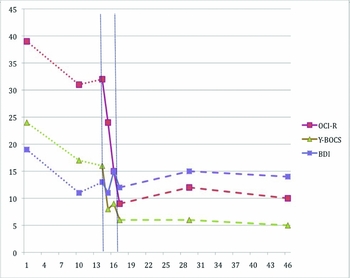
During the baseline condition, a slight reduction in symptoms was observed. David described this improvement as being a consequence of challenging himself to spend less time on his compulsions in order to be prepared for treatment.
David responded well to the treatment. His score on the Y-BOCS dropped from 24 to 5 (79%) and his score on the OCI-R dropped from 38 to 10 (73%) from before treatment to 6-months follow-up. His level of OCD-symptoms was before treatment in the clinical range and after treatment he could be classified as recovered (less than 8 on the Y-BOCS), and if compared to the results from larger controlled studies he met the criteria for clinical significant change (Pallanti et al., Reference Pallanti, Hollander, Bienstock, Koran, Leckman and Marazziti2002).
Interestingly, he also reported that he tried to apply CBT techniques on his symptoms of schizophrenia, trying to pay less attention to auditory hallucinations and reduce his safety behaviour. He also reported being more able to ignore auditory hallucinations and negative automatic thoughts. David reported that the decrease in OCD symptoms was associated with a significantly higher quality of life and that his family and some of his friends had noted and made comments about the improvements. Figure 1 summarizes his changes in symptoms during the baseline, treatment, and follow-up periods.
Obsessive-compulsive and depressive symptoms at baseline, during the 3-week treatment, and follow-up period. Notes: The first three measure points are before the treatment (week 1, 10 and 14). The three next points are after the first (week 15), the second (week 16) and the third week (week 17) of treatment. The first point of follow-up is at about 3 months after ended therapy (week 29) and the last point represents 6-months follow-up (week 46). OCI-R = Obsessive Compulsive Inventory-Revised; Y-BOCS-SR = Yale-Brown Obsessive Compulsive Scale self-report version; BDI = Beck Depression Inventory.

Treatment implications
The main finding from the study is in line with previously published studies demonstrating that CBT is a promising treatment for OCD in patients with schizophrenia and co-morbid OCD. To establish this further, controlled studies are warranted. Although the case illustrates that CBT for OCD in patients with schizophrenia may be promising, there is need for more studies that address and overcome the challenges of delivering CBT to this patient group, and describe when CBT is unlikely to be helpful.
Interestingly, the patient reported that the treatment was well tolerated and no adverse side effects were observed or reported. On the contrary, the patient reported that he was able to apply the strategies learned during treatment to other symptoms, such as auditory hallucinations, with some success. There is, however, a need for studies that structurally monitor psychotic symptoms to determine whether CBT for OCD may be effective for comorbid symptoms of psychosis.
Acknowledgments
The project was financially supported by the Norwegian ExtraFoundation for Health and Rehabilitation through EXTRA funds. The authors have no conflicting interests.



Comments
No Comments have been published for this article.