Introduction
Pregnancy and lactation are two important periods in the reproductive cycle during the life of any mammalian species and they are also the most expensive processes in terms of nutrient requirements (Wade and Schneider, Reference Wade and Schneider1992). For example, in farmed ruminants, nutritional deficit during gestation may produce a delay in maturation of the foetus, low milk production and loss in live weight in the mother (Robinson et al., Reference Robinson, Sinclair and Mcevoy1999). In addition to these negative physiological effects, undernutrition during pregnancy can also affect early mother–young relationships. In sheep, desertions of twin lambs were increased in Merino ewes experiencing low nutrition in the last 6 weeks of gestation compared to well-fed ewes (Putu et al., Reference Putu, Poindron and Lindsay1988). Undernourished ewes took longer to initiate nursing and attach to their lamb than well-fed ewes (Dwyer et al., Reference Dwyer, Lawrence, Bishop and Lewis2003). In deer, underfed mothers were more likely to ignore, avoid and be aggressive to their young than well-fed mothers (Langenau and Lerg, Reference Langenau and Lerg1976). Furthermore, besides its effects on maternal care of the young, undernutrition seems also to impair the behaviour of the neonate. Thus, undernourished ewes have been reported to give birth to lambs of poor vigour (Thomson and Thomson, Reference Thomson and Thomson1949; Moore et al., Reference Moore, Millar and Lynch1986 cited by Dwyer et al., Reference Dwyer, Lawrence, Bishop and Lewis2003). Low birth weight impairs the behaviour of the newborn lamb and undernutrition during pregnancy can exacerbate this problem (Dwyer et al., Reference Dwyer, Lawrence, Bishop and Lewis2003). As a whole, it seems therefore possible that undernutrition during pregnancy will have negative consequences on the behavioural performances of the young as well as of the mother, including the establishment of the mother–young bond in the immediate post-partum period.
One aspect of mother–young bonding that may be important for successful rearing of the young in ruminants is the establishment of recognition between the mother and her neonate. This is well recognized in sheep (Nowak et al., Reference Nowak, Porter, Levy, Orgeur and Schaal2000). However, the possible impact of undernutrition during pregnancy on this specific aspect of bonding remains largely unknown. Therefore, the main aim of the present study was to investigate whether undernutrition alters the early ability of the mother and her neonate to recognize each other in the goat, in which the characteristics and mechanisms of bonding and mother–young recognition are similar to those encountered in sheep (reviewed in Poindron et al., Reference Poindron, Levy and Keller2007a and Reference Poindron, Terrazas, Navarro-Montes de Oca, Serafín and Hernández2007c).
Relying on the literature in sheep, we hypothesized that undernutrition during pregnancy would impair the behaviour of the mother and of the kid at parturition and the ability of does and their kids to show a preference for each other. To verify this, we studied the post-partum behaviour of does and their kids that had either received adequate nutrition during pregnancy or had been fed 70% of their nutritional requirements during the second half of pregnancy. We compared their behaviour in the 90 min following parturition, as well as their ability post partum to discriminate between their kin (own kid or doe) and an alien equivalent goat.
Sheep and goat possess two systems of recognition of their neonate. At very short range (<0.25 m in ewes, Alexander, Reference Alexander1978; <1 m in goats, Poindron et al., Reference Poindron, Gilling, Hernandez, Serafin and Terrazas2003), recognition depends primarily on olfactory cues (Lévy et al., Reference Lévy, Kendrick, Keverne, Porter and Romeyer1996; Kendrick et al., Reference Kendrick, Da Costa, Broad, Ohkura, Guevara, Lévy and Keverne1997) and it controls the selective access of their own young to the udder (Lévy et al., Reference Lévy, Keller and Poindron2004). At greater distances recognition depends on visual and acoustic cues (Alexander and Shillito, Reference Alexander and Shillito1977; Alexander, Reference Alexander1978; Poindron et al., Reference Poindron, Gilling, Hernandez, Serafin and Terrazas2003; Sèbe et al., Reference Sèbe, Nowak, Aubin and Poindron2007). As these two systems are independent (Poindron et al., Reference Poindron, Levy and Keller2007a and Reference Poindron, Terrazas, Navarro-Montes de Oca, Serafín and Hernández2007c), they were both taken into account to assess maternal recognition in the present study. Therefore a test of maternal selectivity at nursing was carried out at 4 h post partum and a two-choice test of non-olfactory discrimination was performed at 8 h post partum. In kids, however, only a two-choice preference test was carried out at either 12 or 24 h after birth. The time of these various tests was determined according to the previously reported abilities of mothers and kids to discriminate between their own and an alien kid or mother in these experimental situations (Romeyer and Poindron, Reference Romeyer and Poindron1992; Poindron et al., Reference Poindron, Gilling, Hernandez, Serafin and Terrazas2003 and Reference Poindron, Terrazas, Navarro-Montes de Oca, Serafín and Hernández2007c; Terrazas et al., Reference Terrazas, Serafin, Hernandez, Nowak and Poindron2003).
To assess the ability of does to recognize their kids, mothers underwent a test of selective nursing for olfactory discrimination (Hernandez et al., Reference Hernandez, Delgadillo, Serafín, Rodríguez and Poindron2004) at 4 h post partum and a two-choice test of discrimination excluding olfactory cues (Poindron et al., Reference Poindron, Gilling, Hernandez, Serafin and Terrazas2003) at 8 h post partum. These two separate tests were carried out to take into account the fact that like sheep, goats use two separate systems of discrimination, depending on the distance at which recognition operates. Kids, on the other hand, underwent only a two-choice discrimination test involving all sensory cues (Poindron et al., Reference Poindron, Gilling, Hernandez, Serafín and Terrazas2007b), as there is no evidence to suggest that there are two separate systems of recognition as in the dams. This test was performed at either 12 or 24 h of age, as preference for the mother is already established at these times (Poindron et al., Reference Poindron, Gilling, Hernandez, Serafín and Terrazas2007b).
Material and methods
General conditions of study
Subjects
The study was spread over two consecutive years, with different animals each year. Forty-four multiparous crossbred goats from the Neurobiology Institute (UNAM) and their kids were studied. Animals were kept permanently under intensive management conditions in two 15 × 7 m2 pens at a density of about 5 m2 per animal, half of each pen being covered with a roof for sun and rain protection. Animals were fed lucerne hay, grains and minerals according to the physiological requirements of their reproductive state, until the beginning of the experimental treatment and had ad libitum access to water throughout. Oestrus was synchronized with vaginal sponges impregnated with fluorogestone acetate (Intervet, Mexico City, Mexico), followed by an intramuscular (i.m.) injection of 300 IU of eCG (Folligon) at sponge withdrawal and introduction of bucks at the same time.
Experimental groups
Pregnancy and litter size were determined by ultrasound 8 weeks after mating, after which goats were immediately allocated to either the control (n = 22) or the underfed group (n = 22), balancing groups for litter size according to the results of ultrasound diagnosis. In the control group, the females were fed 100% of their nutritional requirements according to their bodyweight, stage of pregnancy and litter size (National Research Council (NRC), 1981). In this group, the composition of the diet was as follows: 43.16% of chaffed maize straw, 33% of worn-out flour maize, 19.8% alfalfa hay, 2.2% of soybean meal and 1.9% of minerals. This represented 2.083 Mcal/kg with 11.2% crude protein.
In the underfed group, the females received the same type and amount of food as the control group until week 11 of gestation, after which energy and protein were limited to 70% of requirements until parturition. To achieve this, the diet was modified as follows: 25% alfalfa hay, 73% chaffed maize straw, 2% minerals and free access to water, resulting in a diet of 1.72 Mcal/kg with 7.2% crude protein. Therefore, underfed goats received the same quantity of dry matter as control goats, but the nutritive value of the food was 30% lower. From parturition onwards, all animals in both nutritional groups were fed according to the full requirements of their reproductive state.
Bodyweight of goats and kids
Since animals were managed in groups, including feeding, it was not possible to monitor their individual intake. Nonetheless, the overall consumption was monitored daily in each group. Leftover feed was weighed each day and the quantity of food distributed the next day was adjusted accordingly, ensuring that underfed goats always received on a given day 5% more than what they had consumed the previous day. This meant that they always had sufficient amounts to ingest. Therefore, from the first to the last week of feed restriction, underfed goats consumed 99%, 77.5%, 75%, 70%, 69%, 67.5%, 67.5%, 67.5%, 65% and 56% of the energy they would normally have required if not restricted (i.e. 71% in average over the 10 weeks of undernutrition), taking into consideration their weight in each given week. Finally, we monitored the bodyweight of the goats by weighing the animals every 2 weeks from week 11 of gestation until parturition, and again at 15 and 30 days post partum, to verify whether the feeding regimens actually resulted in differences of nutrition level between nutritional groups. Also, kids were weighed at birth, 15 and 30 days after birth.
Observations and testing procedures
Due to the high number of parturitions over short periods of time and limitation of manpower, it was not possible to carry out the observations at parturition and the tests of recognition in all mothers and kids. Thirty-one mothers (14 control and 17 underfed) and their 44 kids were observed at parturition; 26 of these mothers were also tested for recognition of the kid at 8 h while their kids were tested for recognition of the mother at 12 or 24 h. For two additional mothers observed at parturition, kids were also tested for recognition, while the three remaining mothers were only observed at parturition. Finally, 13 mothers could not be observed at parturition and were only tested for recognition of the kid at 8 h and their kids tested at either 12 or 24 h for recognition of the mother. Thus, 20 control and 19 underfed mothers were tested for recognition of their kid at 8 h post partum, while 30 control kids and 28 underfed kids were tested for recognition either at 12 h (control = 14 and underfed = 11) or at 24 h (control = 16 and underfed = 17).
Observations at parturition
When parturition was imminent (frequent abdominal contractions, rupture of water bag or hooves of kid visible), the doe was placed in a 2 × 2 m2 pen made of openwork steel panels, so that animals were not isolated from the rest of the flock. Starting at parturition, the behaviour of the doe and her kid(s) was recorded with a Sony V-8 camcorder placed on a tripod outside the pen, with an observer making sure that the framing of the subjects would allow later analysis in the laboratory. In the case of a single birth, the recording lasted 90 min; in the case of twin births, the recording ended 90 min after the birth of the second kid (control: single births = 7, twin births = 12; underfed: single births = 9, twin birth = 16). The video-recordings were analysed later in the laboratory, using the program Observer Video-Pro, version 4.0 (Noldus, The Netherlands). Not only the behaviour of the mother towards the two first-born kids but also the behaviour of these two kids were analysed. The individual behaviours taken into account were as follows:
(a) Mothers
(1) Latency to start licking the kid and total duration of licking (s).
(2) Frequency of emission of low- and of high-pitched bleats.
(3) Latency of acceptance of the kid at the udder for more than 5 s without interruption by the mother or the kid and total time (s) spent nursing the kid (sum of all nursing bouts >5 s).
(b) Kids
(1) Frequency of emission of low- and high-pitched bleats.
(2) Latency to try to stand up (behaviourally try to stand up means when the newborn begins to synchronize movements specially in hinder regions in order to stand up).
(3) Latency to stand up for more than 5 s.
(4) Latency to start nosing the body of the mother, which signifies udder-seeking behaviour (Alexander and Williams, Reference Alexander and Williams1966).
(5) Latency in seconds to reach the udder from birth and total time spent with the head engaged in the inguinal region (s).
In addition, indices of maternal behaviour and of kid activity were computed to obtain an overall assessment of the behaviour of the does and their kid(s) during the first 90 min following birth of the kids. The index of maternal behaviour (IMB) towards a kid consisted of the sum of the standardized values obtained for the following individual variables during the 90 min of observation of that kid: IMB = total duration of licking + total number of bleats emitted by the mother + total duration of nursing. For the kids, the index of kid behaviour (IKB) consisted in the sum of the standardized values of the following variables: IKB = total time spent at the udder + total number of bleats emitted by the kid − latency to start nosing the body of the mother − latency to stand up − latency between standing up and reaching the udder. For latencies, standardization resulted in the most negative values for the shortest latencies, which were indicative of higher kid activity. Therefore, values of latencies were subtracted so that negative values would contribute positively to the index.
Tests of discrimination in does and in kids
(a) Maternal selectivity at the udder at 4 h. Four hours after parturition, a test of selective acceptance of the kid at the udder was performed in this pen in 18 control and 21 underfed does. All kids were removed from the pen and the dam was submitted to two successive 5-min tests with either the first-born or the second-born kid and an alien kid of similar age and physical aspect. The order of presentation of their own and the alien kid was randomized across goats within each experimental group. The following behavioural parameters were measured: (a) number of low-pitched bleats emitted by the goat, (b) number of acceptances at the udder, (c) duration of suckling, (d) number of refusals at the udder, (e) number of head butts at or biting of the kid and (f) number of high-pitched (protest) bleats. The first three parameters are indicative of acceptance of the kid and the last three of rejection. The overall effect of nutrition was studied by comparing these behavioural variables between control and underfed does. For individual classification of the does, a mother was classified as non-selective if she nursed the alien kid for more than 5 s without interruption and without displaying any aggressive behaviour towards it during the whole test. A doe was classified as ambivalent if she nursed the alien kid for more than five consecutive seconds but also showed aggressive behaviour towards the kid during the test. In all other instances does were classified as selective.
At the end of the test, goats and their kids were transferred in a larger pen (8 × 11 m2) together with other mothers and kids, to allow some degree of mother–young separation and interactions with other animals.
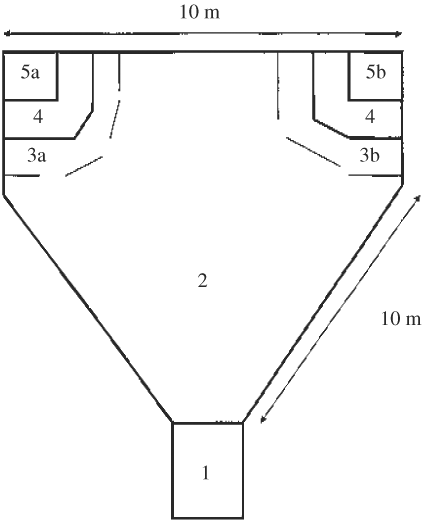
(b) Two-choice test of maternal preference for their own kid in the absence of olfactory cues at 8 h post partum. Goats were submitted to a test of choice between their own and an alien kid of the same age at 8 h post partum (20 control and 19 underfed), in which choice relied only on visual and acoustic cues (Poindron et al., Reference Poindron, Gilling, Hernandez, Serafin and Terrazas2003). Goats were tested only once to avoid possible habituation to the test (Lindsay and Fletcher, Reference Lindsay and Fletcher1968). Testing conditions were the same as those described in the study of Poindron et al. (Reference Poindron, Gilling, Hernandez, Serafin and Terrazas2003). Briefly, the testing area was a 10 m × 10 m × 10 m triangular enclosure, delimited by 1-m high, solid-metal barriers (Figure 1). The testing area was divided into three main zones: two 1-m wide zones of contact in front of the two pens for the kids and a neutral zone. Alien kids were matched for size and age to the goat’s own kids. The goat was put into the starting pen and released after 30 s, giving her the opportunity to see and hear both kids before being released. In all cases, both kids had bleated before the goat was released. Two experimenters recorded the following parameters over 5 min:
(1) latency to reach a contact zone;
Figure 1Testing pen used in goats to test the non-olfactory recognition of kids by their mother: 1 – waiting area for the doe; 2 – neutral zone; 3a and 3b – zones of contact near each kid; 4 – zone inaccessible to the animals, thus preventing perception of individual olfactory cues and 5a and 5b – holding pens for the kids.

(2) identity of the first kid reached;
(3) total time spent in the contact zone near each kid;
(4) number of maternal visits to the contact zone;
(5) total time spent looking towards each kid regardless of the position of the goat in the testing area. Looking towards was defined as the rear-front axis of the goat’s head being directly oriented towards a kid.
(c) Two-choice test of preference of kids for their mother at 12 or 24 h post partum. Two separate groups of kids born from control and underfed goats were tested either at 12 h (control n = 14: five single, nine twins; underfed n = 10: three single, seven twins) or at 24 h after birth (control n = 16: four single, six twins and six triplets; underfed n = 17: seven singles, eight twins and two triplets). This time of test was selected because it had been shown in a previous study that in our experimental conditions, kids were able to show a preference for their mother at 12 h of age (Poindron et al., Reference Poindron, Gilling, Hernandez, Serafín and Terrazas2007b).

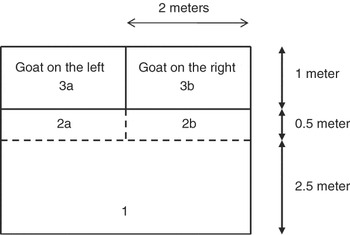
The tests were carried out in a roofed building adjacent to the pens holding the groups of pregnant and post-parturient animals. The testing area consisted of a 4 m × 4 m enclosure delimited by 1-m high, solid-metal barriers (Figure 2). This area itself was divided in one section of 4 m × 3 m for the kids and two 2 m × 1 m sections to hold the mothers. These three sections were delimited by openwork panels separating the does from each other and from the kid, so that the kid could see, hear and smell the does and get in nasal contact with them, but the kid could not suckle and the does could not pass their head through the panels. A 0.5-m-wide zone of contact was defined in front of each pen holding a mother. The two stimulus goats used in one test had given birth at about the same time and were coming from the same group (control or underfed). The kid to be tested was placed in the middle of the testing area, 1.5 m away from the contact zone. The test started as soon as the kid was placed in the testing area. The tested subjects could not see other animals, apart from the two mothers they were tested with, but acoustic isolation from the rest of the flock was not possible.
Testing pen used in kids to test the recognition of mother goats by their kid: 1 – neutral zone; 2a and 2b – zones of contact with each mother and 3a and 3b – holding pens for the mothers.

For the test, all kids belonging to the two mothers involved were removed except the one to be tested. These unused kids were kept in a pen in another building and out of the mothers’ sight and earshot. The two mothers were placed in their holding pen and the kid to be tested could not see in which pen its dam was placed. The side of the pen (right or left) where the own mother stood was alternated between tests, so that half of the animals were tested with their mother on the right and half with their mother on the left. During the test, which lasted 5 min, the following variables were recorded on a preformatted sheet:
(1) Latency to reach a mother: time (s) taken by the kid to reach a contact zone.
(2) Identity of mother (own or alien) that the kid reached first.
(3) Time spent in each contact zone (s).
(4) Number of kid’s visits to each contact zone.
Indices of maternal preference for each kid and of kid preference for each mother were computed on the same principle as for behavioural indices at parturition. The index of maternal preference for a kid was computed in the following manner. First, each variable to be included in the index was standardized, with the values for the doe’s own kids and for the alien kids included in a single standardization process. Then the index was computed for each kid by summing the standardized values of Time spent close to the doe + number of visits in the contact zone for the does + first choice (initially coded as 0 for no choice, 1 for wrong choice and 2 for correct choice). The procedure was the same for the index of kid preference for each mother, using the same behaviours towards each mother, except for Time looking towards each mother, which was not measured in kids.
Statistical analyses
Statistical analyses of individual behavioural parameters were carried out by nonparametric tests (two tailed) because of the lack of normality of the data. Intragroup comparisons (behaviour towards the two stimulus subjects) were performed with the Wilcoxon signed-ranks test. Comparisons between the control and the underfed groups were performed with the Mann–Whitney U-test. The proportions of kids or goats that reached their own mother or their own kid first were compared between the two groups by a Fisher exact probability test. Live weights of mothers and kids at parturition were analysed by Student’s t-test, and the general effect of treatment over time was tested using an ANOVA for repeated measures followed by the Tukey procedure for post hoc comparisons. All tests were performed with the statistical package Systat, version 10.0 (Evanston, IL, USA). Exact values of P are indicated in the test and the level of statistical significance was set at P ⩽ 0.05. Results for individual behavioural data are presented in terms of medians and quartiles. Results of non-behavioural data are presented in terms of their means and s.e. Finally, as behavioural indices followed a normal distribution, they were analysed using parametric statistical tests, including Pearson correlations with Bonferroni corrections to investigate the relations between indices, and the results are presented as means and s.e.
Ethics
This work was carried out according to the local ethic protocol and according to the guidelines for the ethical use of animals in applied ethological studies (Sherwin et al., Reference Sherwin, Christiansen, Duncan, Erhard, Lay, Mench, O’Connor and Petherick2003).
Results
Bodyweight of goats and kids
Goats
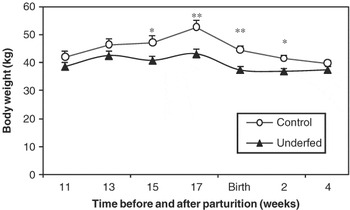
In the goats, there was an effect of time and of nutritional group on bodyweight, as well as an interaction between time and nutritional group (ANOVA; P < 0.05). Mean bodyweight did not differ significantly between control and underfed goats until week 13 of pregnancy (t-test, P > 0.05). In contrast, at weeks 15 and 17 of pregnancy, at parturition and until the second week after birth, control females were significantly heavier than underfed females (t-test, P < 0.05; Figure 3).
Bodyweight (mean ± s.e.) of goats during pregnancy and after parturition in control (n = 19) and underfed groups (n = 21). *P ⩽ 0.05, **P ⩽ 0.01.

Kids
Control kids were significantly heavier than underfed kids at birth (3.19 ± 0.22 v. 2.43 ± 0.14 kg, t-test, P < 0.001). In addition, bodyweight of kids was affected by time and nutritional group, with a significant interaction between these two factors. Control kids were still heavier at 15 days of age than underfed kids (6.93 ± 0.45 v. 5.34 ± 0.41 kg, t-test, P = 0.001) and also at 30 days (9.12 ± 0.61 v. 7.33 ± 0.61 kg, t-test, P = 0.05).
Behaviour at parturition
Behaviour of the mother
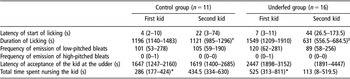
When considering the behaviour of the mothers towards their first-born kid (singles and first-born twins), the latency of onset and duration of licking over the 90 min of observation did not differ significantly between control and underfed goats (P ⩾ 0.11; Table 1), while mothers of singles licked their kid longer than mothers of twins (Mann–Whitney U-test, P = 0.018). In contrast, when considering the behaviour of mothers towards their second-born kid, control does licked their kid significantly longer than underfed mothers (Mann–Whitney U-test, P = 0.022). Bleating activity (low-pitched, high-pitched or total bleats) did not differ significantly between control and underfed goats, regardless of whether maternal bleating activity concerned the period of observation for the first-born kid, or the period for the second-born kid in twins. The latency to nurse a kid did not differ significantly between control and underfed goats for the first- or the second-born kid, whereas underfed goats tended to nurse their first-born kid longer than controls (Mann–Whitney U-test, P = 0.054). However, there was no global significant effect of litter size on the duration of nursing for first-born kids or of birth order for twins.
Maternal behaviour of goats during the first 90 min following the birth of each their kid (s)

Goats had received either 100% (control group) or 70% (underfed group) of their nutritional requirements during the second half of pregnancy.
x v. y between control and underfed goats for a given variable: P < 0.05, Mann–Whitney U-test; *P = 0.054.
The maternal behaviour index of does did not differ between the control and underfed groups, either for the first-born (−0.138 ± 0.548 and 0.895 ± 0.542) or for the second-born kid (−0.494 ± 0.298 and −1.473; t-test, P ⩾ 0.17). On the other hand, independent of the nutrition group, this index was significantly higher for single kids than for first-born or second-born kids (1.100 ± 0.530, −0.502 ± 0.491 and −1.021 ± 0.344; t-test, P = 0.042 and 0.005), while there was no significant difference between the first- and the second-born kids in twins.
Behaviour of the kids
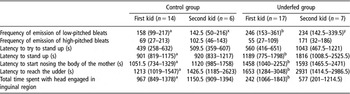
The latency of udder-seeking behaviour was shorter in control kids than in underfed kids (Mann–Whitney U-test, P = 0.027; Table 2) as was the latency to stand up (Mann–Whitney U-test, P = 0.050). The latency to reach the udder was also significantly shorter in control than in underfed kids (Mann–Whitney U-test, P = 0.048) and was significantly shorter in first-born than in second-born twins (P = 0.042). As a whole, the time spent by kids engaged in the inguinal region did not differ significantly between control and underfed kids or according to birth order in twins. However, single control kids spent less time engaged in the inguinal region than underfed single kids (P = 0.026), whereas this was not the case in twins. The frequency of low-pitched bleats of kids was significantly higher in underfed kids than in control kids (P = 0.020) and this tended to be also the case for the total number of bleats emitted by kids (P = 0.10), whereas the difference was not significant for high-pitched bleats (P = 0.63).
Behavior of first (singles and first-born twins) and second-born (twins) kids during the first 90 min of their life

Control group: mothers had received 100% of their nutritional requirements during the second half of pregnancy; underfed group: mothers had received 70% of their nutritional requirements during the second half of pregnancy.
a v. b(first kid) and x v. y(second kid) between control and underfed goats for a given variable: P < 0.05, Mann–Whitney U-test.
In kids, the behavioural index did not differ significantly between the control and the underfed groups (0.556 ± 0.551 and −0.463 ± 0.699) or between singles and twins (0.996 ± 0.572 and −0.690 ± 0.640 ANOVA, P = 0.19 and 0.14). Similarly there was no significant difference between first- and second-born kids in litters (−0.747 ± 0.947 and −0.632 ± 0.900).
Correlations between index of maternal behaviour, index of kid behaviour and birth weight of kids
In the control group, the Pearson correlation between the indices for maternal and kid behaviour was 0.30 and those between these indices and the birth weight of the kid were 0.16 and 0.06 (P ⩾ 0.61). In the underfed group, these correlations were 0.52, 0.45 and 0.20 (P = 0.026, 0.077 and 1.00). Considering both groups together did not result in reinforcing these correlations (r = 0.43, 0.28 and 0.19; P = 0.012, 0.21 and 0.67).
Selective nursing behaviour at 4 h post partum
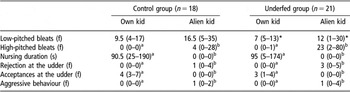
At 4 h post partum, the proportions of selective mothers did not differ between the two nutritional groups (16/18 and 20/21, Fisher exact P = 0.59). Only one control and one underfed doe nursed the alien kid for 6 and 12 s (v. 215 and 238 s for their own kid) without showing any aggressive behaviour. One additional control mother nursed the alien kid for 11 s (v. 25 s for her own kid), but displayed aggressive behaviour towards it, while all other control and underfed goats were selective, nursing their own kid while the alien was rejected with aggressive behaviour or the emission of numerous high-pitched bleats. No significant differences were found for any of the behaviours recorded in this test between the underfed and the control groups (Mann–Whitney U-test, P ⩾ 0.15; Table 3). All behaviours indicative of rejection were significantly higher for the alien kid than for the own kid in both nutritional groups (Wilcoxon test, P ⩽ 0.004), with the exception of the low-pitched bleats. These did not differ between own and alien lambs in the control group (P = 0.36) but tended to be higher with the alien kid than with the own kid in the underfed group (P = 0.059). When both nutritional groups were considered together, mothers emitted significantly more low-pitched bleats with the alien kid than with their own kid (14 [4.5–33] v. 7 [4–14.5]; Wilcoxon test, P = 0.039), as in the case of high-pitched bleats (Table 1).
Selectivity of nursing behaviour at 4 h post partum in goats having received either 100% (control group) or 70% (underfed group) of their nutritional requirements during the second half of pregnancy

Different letters between the own and the alien kid for a given variable indicate a significant difference of behaviour for that variable between the two kids (Wilcoxon test, P < 0.05). *P = 0.059. There were no significant differences between the two nutritional groups (Mann–Whitney U-test, P > 0.05). Duration of test: 5 min for each kid, which were presented successively.
Two-choice test of maternal preference for the own kid at 8 h post partum
Initial behaviour of does
Underfed mothers took longer to reach a contact zone compared to control mothers (11 s [10–17.5] v. 28 s [14–62]; P = 0.027). The proportions of goats reaching their own kid first did not differ from a random choice (binomial test, P > 0.05) or between control and underfed groups (14/20 v. 10/19; Fisher exact P = 0.33).
Total time spent by mothers in each contact zone
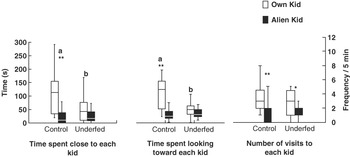
Control goats spent more time near both kids than underfed goats (P = 0.032). Control mothers also spent more time in the contact zone near their own kid than underfed mothers (P = 0.021), but the time near the alien kid did not differ between nutritional groups (P = 0.37). Also, control goats spent more time near their own kid than near the alien kid (P = 0.001). In contrast, in the underfed group, there was no significant difference between the time mothers spent near the own kid and near the alien kid (P = 0.19; Figure 4).
Preference by mothers for 8-h-old kids in a two-choice test excluding olfactory cues. Goats were fed either 100% (control) or 70% (underfed) of their requirement for the second half of pregnancy. Results are shown as box plots (median and interquartile range) of the mother’s behaviours towards their own (open box) or the alien (black box) kid for left: time spent by goats in the contact zone near each kid; centre: time spent looking at their own or the alien kid; right: frequency of maternal visits to their own or the alien kid. **P ⩽ 0.01, *P ⩽ 0.05 for own v. alien kid (Wilcoxon signed-ranks test). a, b for control v. underfed goats (Mann–Whitney U-test). Duration of the test: 5 min.

Total time spent looking towards each kid, regardless of the position of the mother in the testing area
Control goats spent more time looking towards both kids than underfed goats (P = 0.002). Control goats also spent more time looking towards their own kid than underfed goats (P = 0.003; Figure 4), while this was not the case for the time spent looking towards the alien kid (P = 0.28). Also, control goats spent more time looking towards their own kid than towards the alien kid (P = 0.001), whereas this was not so in the underfed group (P = 0.15).
Number of maternal visits to the contact zones
In both nutritional groups, mothers visited the contact zone near their own kid more frequently than near the alien kid, although the difference did not reach significance in underfed goats (control: P = 0.005; underfed: P = 0.053; Figure 4). Level of nutrition of the doe did not affect the number of maternal visits near the own kid, near the alien kid or the total number of visits near both kids (P ⩾ 0.41).
Indices of preference for each kid
The preference index of control mothers for their own kid was significantly higher than in underfed mothers (control: 2.770 ± 0.688, underfed: 0.170 ± 0.652, P = 0.004) while the preference index for the alien kid did not differ significantly between the two groups (control: −1.668 ± 0.503, underfed: −0.990 ± 0.424, P = 0.31). The control does showed a higher preference for their own kid compared to the alien kid (P < 0.001), whereas the underfed does showed no difference in preference index between their own and the alien kid (P = 0.42). Both nutrition of the doe (P = 0.006) and identity of the kid (P = 0.001) had an impact on the preference index and there was also an interaction between these factors (P = 0.016).
Two-choice test of preference for the mother in 12-h-old kids
Initial behaviour of kids
The latency to reach a mother did not differ between control and underfed kids (67.5 s [32–218] v. 147.5 s [60–238], P = 0.29). All the kids of the control group reach a mother, while two kids of the underfed group did not reach a mother. For the kids that reached a mother, the proportions of kids reaching their own mother first did not differ significantly between groups (control kids: 11/14; underfed kids: 6/8; Fisher exact probability P = 1) or from a random choice in each nutritional group taken separately (binomial test, control: P = 0.057; underfed: P = 0.29) but did so when considering both groups together (17/22; P = 0.017).
Time spent in each contact zone (Figure 5)
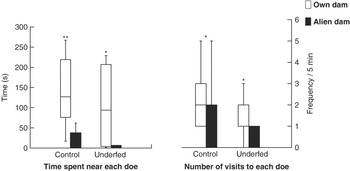
For those kids that reached a mother, the total time spent by kids near the two mothers did not differ significantly between nutritional groups (P = 1) (Figure 5). Kids spent more time near their own mother than near the alien dam in the control group (P = 0.002). This was also the case for kids in the underfed group, but the difference failed to reach significance (P = 0.069). The times spent near the own mother or near the alien mother did not differ between control and underfed kids (P ⩾ 0.84).
Preference of 12-h-old kids for their mother in a two-choice test involving visual, acoustic and olfactory cues. Kids were born from does that had been fed either 100% (control, Co) or 70% (underfed, UF) of their requirement for the second half of pregnancy. Results are shown as box plots (medians and interquartile ranges) of the kids’ behaviours towards their own (open box) or the alien (black box) dam for on the left: lengths of time spent in the contact zone either near each dam, on the right: frequency of visits to their own or the alien dam. **P ⩽ 0.01, *P ⩽ 0.05, for own v. alien dam (Wilcoxon signed-ranks test). a, b for control v. underfed kids (Mann–Whitney U-test). Duration of the test: 5 min.

Number of visits by the kids to each contact zone (Figure 5)
The total number of visits to both mothers did not differ significantly between the two groups of kids (P = 0.15). Control kids tended to visit their own mother more frequently than underfed kids (P = 0.063) while the number of visits to the alien mother did not differ significantly between groups (P = 0.48). Both control and underfed kids visited their own dam more frequently than the alien mother (P ⩽ 0.041).
Preference index
For those kids that reached a mother at 12 h, the preference index for their own mother was higher than for the alien mother (P = 0.001) but there was no affect of nutrition (P = 0.37) and no interactions (P = 0.74; control own: 1.75 ± 0.48; control alien: −1.11 ± 0.56; underfed own: 1.10 ± 0.67; underfed alien: −1.31 ± 0.60).
Two-choice test of preference for the mother in 24-h-old kids
Initial behaviour of kids
The latency to reach a mother did not differ significantly between control and underfed kids at 24 h (67 s [34.5–91] v. 47 s [36–144], P = 0.82). All the kids of the control group reached a mother, while two kids of the underfed group did not reach a mother. When considering only the kids that reached a mother, the proportion of kids reaching their own mother first did not differ between groups (control: 11/16; underfed: 13/15; Fisher exact P = 0.39) or from a random choice in each group separately (control: P = 0.21; underfed: P = 0.073), but did so when the two groups were considered together (24/31; P = 0.003).
Time spent in each contact zone
In kids that reached a mother, the total time spent near the two mothers did not differ significantly between groups (P = 0.94). Similarly, the time spent by kids near their own or near the alien mother did not differ between control and underfed kids (P ⩾ 0.89). On the other hand, in both groups, kids spent more time near their own dam than near the alien dam, although the difference just failed to reach significance in the control group (control: 111 s [67.5–216] v. 8.5 s [1–105.5], P = 0.056; underfed: 131 s [48–189] v. 27 s [1–43], P = 0.005).
Number of visits by the kids to the contact zones
The total number of visits made by the kids to the two mothers did not differ significantly between control and underfed kids (P = 0.60). Also, the frequency of visits by the kids to their own mother or to the alien dam did not differ between the two groups (P ⩾ 0.51). Finally, in both nutritional groups kids visited their own mother more frequently than the alien one (control: 2.5 [1–3.5] v. 1 [0–2], P = 0.02; underfed: 3 [1–3] v. 1 [0–2], P = 0.002).
Preference indices at 24 h
For kids that reached a mother at 24 h, the index of preference was significantly higher for their own mother than for the alien doe in both nutritional groups (control, own: 0.994 ± 0.54, control, alien: −0.798 ± 0.51; underfed, own: 0.744 ± 0.673; underfed, alien: −0.928 ± 0.322; ANOVA, P < 0.001), while there was no significant difference between nutritional groups and no significant interaction between nutritional group and identity of the goat (P ⩾ 0.46).
Comparison of preference for the own mother in kids at 12 and 24 h
Regarding individual behaviours, there were no significant differences between 12 and 24 h-old kids in any of the studied variables in the control group (Mann–Whitney U-test, P ⩾ 0.16). In the underfed group, there was only some influence of testing time on the number of visits paid by the kids to the mothers: 12 h-old kids tended to pay less visits to both mothers and paid significantly less visits to the alien mother than 24 h-old kids (P = 0.052 and 0.031). Twelve-hour-old underfed kids also tended to pay less visits to their own mother than 24 h-old kids (P = 0.072).
When considering the indices of preference for the own and the alien dam in kids that reached a mother, there was a significant effect of time and of the identity of the doe (ANOVA for repeated measures, P = 0.049 and 0.001), but not of nutrition (P = 0.15): indices at 24 h were overall higher than at 12 h. There were no significant interactions between any of these factors (P ⩾ 0.29).
Correlations between behaviour at parturition and behaviour in the recognition tests
Mothers
There were no significant correlations between the index for maternal or kid behaviour at parturition and the index of preference for the own kid in the recognition test at 8 h, whether the two nutritional groups were considered separately (controls, n = 12: r = 0.26 and −0.013; underfed n = 14: r = 0.011 and −0.19) or together (n = 26, r = −0.045 and −0.024).
Kids
Considering the limited number of kids that had been observed at parturition and tested for discrimination in each nutritional group at a given time, we pooled the data of the tests carried out at 12 h and at 24 h. When considering separately the control and the underfed groups (n = 18 and 20), the correlations between the indices for the behaviour of the mother or the behaviour of the kid at parturition and the preference index of the kids during the two-choice test were 0.10 and 0.14 in the control group and 0.41 and 0.10 in the underfed group. When both nutritional groups were pooled, these correlations were 0.28 and 0.06. However, none of these values were significant (P ⩾ 0.22).
Discussion
Our hypothesis that undernutrition during the second half of pregnancy would impair the display of early doe and kid behaviour, including the establishment of recognition between goats and their kid, was partly supported by our results. In parturition behavioural undernutrition impaired the behaviour of the does and also had an important impact on the behaviour of the kids. Also, undernutrition impaired the doe’s non-olfactory discrimination of the kid at 8 h post partum. At this time control goats displayed discrimination between their own and the alien kid for all considered behaviours and their different preference indices for the two types of kids reflect this. Underfed does were not as good as control does at discriminating between their own kid and the alien kid. Underfed does showed a preference for their kid only by the higher number of visits they paid to it than to the alien kid. All other behaviours did not differ significantly for their own and for the alien kid. In contrast to this effect of undernutrition at 8 h, there was no evidence of any impairment of selective acceptance of the young at the udder at 4 h post partum and very marginal effects on the display of maternal behaviour at parturition: only licking of second-born kids was reduced in underfed does. In particular, there was no evidence to suggest that maternal motivation at parturition had been affected by undernutrition, since neither the latencies to initiate licking and to nurse nor the IMB differed significantly between control and underfed does.
It is unlikely that the little effect maternal undernutrition had on the behaviour of the mothers at parturition and on maternal selective behaviour could be attributed to a failure of the treatment to attain its goals. Indeed, underfed goats ingested an average 30% less energy than controls over the period of undernutrition and the level of restriction imposed induced significant differences in live weights of does as early as week 15 of pregnancy and for at least 2 weeks after restriction had ceased. Similar effects were also found for the weight of kids at birth and at 2 weeks of age. In this respect, our results are congruent with those of other studies in sheep (Russel et al., Reference Russel, Doney and Reid1967 and Reference Russel, Maxwell, Sibbald and McDonald1977; Robinson and Aitken, Reference Robinson and Aitken1985; Dwyer et al., Reference Dwyer, Lawrence, Bishop and Lewis2003) and goats (Schdeva et al., Reference Schdeva, Sengar, Singh and Lindhal1973; Sahlu et al., Reference Sahlu, Fernandez and Totchoiba1992 and Reference Sahlu, Hart, Le-Trong, Jia, Dawson, Gipson and Teh1995) with similar schemes of food restriction. Therefore, it follows that the level of undernutrition applied in the present study impaired more specifically the ability of the doe to develop non-olfactory recognition of her young, while having little influence on other aspects of maternal behaviour.
Undernutrition during pregnancy may have impaired the display of maternal preference of the doe for their own kid at 8 h in various ways, given the multi-factorial nature of maternal care. For example, maternal motivation may have been reduced in underfed does through some effect of undernutrition on maternal physiological factors involved in the facilitation of maternal behaviour, as suggested by results in sheep (Dwyer et al., Reference Dwyer, Lawrence, Bishop and Lewis2003). This could have in turn impaired their performances in the two-choice test since underfed mothers spent less time near and looked at the two kids less during the test and also took more time to reach a kid than control mothers. This suggests that the underfed does were less motivated to reach their young. However, there are several elements indicating that a difference of maternal motivation between the two nutritional groups is unlikely to account for the lower discrimination performances in underfed does. Instead, the extended latency of underfed does to reach a kid may be directly related to the greater difficulty they had to discriminate between the two kids. When mothers were deprived of their own kid during the selectivity test while being tested with the alien, their vocal response to the separation of their own kid did not differ between the two nutritional groups, as was also the case for the overall selectivity outcome of the test. This indicates that maternal motivation or strength of bonding was not impaired by undernutrition. Similarly, the low correlations found between the maternal behaviour index at parturition in the two groups – which depends on maternal motivation – and the indices of preference for each kid during the recognition test, do not support the hypothesis that undernutrition impaired the non-olfactory discrimination of kids through some effect on maternal motivation or through the quality of maternal or kid behaviour at parturition.
Another possibility would be that the display of a preference for their own kid was impaired in underfed mothers because both kids, also from the underfed group, were less active during the test than control kids, thus rendering discrimination more difficult. Nonetheless, there is no clear evidence to support this hypothesis. While underfed kids took significantly longer to stand or to reach the udder than controls in the first 90 min of their life, they also spent more time at the udder and bleated more. Furthermore, in the test at 12 h they performed as well as control kids. On the whole it would appear that undernutrition directly affected some parameter specific to non-olfactory maternal discrimination. Further studies are warranted to identify the exact mechanisms involved in this impairment.
Contrary to what was found in the mothers, undernutrition during the second half of pregnancy had only a very limited impact on the ability of kids to display a preference for their mother since both at 12 h and at 24 h, both control and underfed kids did display a preference for their own dam. In particular, 12-h-old underfed kids displayed a preference for their mother despite the fact that they paid less visits to their own dam than 12-h-old controls and also paid less visits to the dams than 24-h-old underfed kids. In contrast to this lack of influence of undernutrition on the ability of kids to develop a preference for their mother, there was some indication that the locomotor behaviour of kids at birth was impaired by undernutrition of the does during pregnancy. Latencies for all motor activities (udder-seeking, standing, reaching the udder) were shorter in control kids than in underfed kids. On the other hand, time spent at the udder and bleating activity were higher in underfed kids, particularly in singles, possibly indicating lower fat reserves and/or higher feeding motivation. These opposite effects may have compensated each other, resulting in underfed kids being able to recognize their mother as efficiently as controls.
The ability of kids to discriminate and display a preference for their mother at 12 h of age, especially in underfed kids, is consistent with previous results obtained with the same type of goats and in the same conditions (Poindron et al., Reference Poindron, Gilling, Hernandez, Serafín and Terrazas2007b). However, our results contrast with the lack of discrimination reported before the age of 48 h in West African dwarf goats (Addae et al., Reference Addae, Awotwi, Oppong-Anane and Oddoye2000; Awotwi et al., Reference Awotwi, Oppong-Anane, Addae and Oddoye2000). Therefore it seems unlikely that undernutrition was the cause for the later display of mother recognition in the studies of Addae et al. (Reference Addae, Awotwi, Oppong-Anane and Oddoye2000) and Awotwi et al. (Reference Awotwi, Oppong-Anane, Addae and Oddoye2000), unless it had been very severe. Other factors, such as differences between breeds’ testing conditions and criteria used, could still account for these discrepancies.
As a whole, our results are consistent with those reported in sheep, in which undernutrition impaired maternal behaviour and attachment to the lamb and significantly reduced birth weight, and have impact on early behavioural development of the young (Dwyer et al., Reference Dwyer, Lawrence, Bishop and Lewis2003). The fact that non-olfactory preference for the kid by the doe and therefore its recognition was affected by undernutrition during pregnancy is congruent with the finding of these authors that undernutrition impaired the strength of maternal bonding. Indeed, mothers need to establish a preference for their young so that bonding can be formed. However, both in sheep and in goats, maternal bonding depends mainly on the olfactory recognition of the neonate, which establishes within less than 2 h post partum in the majority of mothers in both species (Lévy et al., Reference Lévy, Keller and Poindron2004; Poindron et al., Reference Poindron, Levy and Keller2007a). In that respect, the lack of difference in selective behaviour at 4 h between underfed and control goats may appear to contradict the effect found by Dwyer et al. (Reference Dwyer, Lawrence, Bishop and Lewis2003) on maternal bonding score. Nonetheless, as tests for selective nursing were not conducted in their study, it is difficult to conclude whether maternal selectivity at nursing was affected in their ewes or whether the bonding score they used is a measure of bonding involving elements other than maternal selectivity at nursing. Indeed, maternal behaviour scores used in sheep result from the response of the mother to a conflict including components specific of maternal behaviour and bonding (those linked to reunion with the young), but involving also components linked to aspects not directly related to maternal behaviour (presence of a human: O’Connor et al., Reference O’Connor, Jay, Nicol and Beatson1985; Lambe et al., Reference Lambe, Conington, Bishop, Waterhouse and Simm2001; Everett-Hincks et al., Reference Everett-Hincks, Lopez-Villalobos, Blair and Stafford2005). Therefore, we cannot rule out that the effect of undernutrition on maternal bonding score may have been partly due to some indirect influence on the response to the presence of humans as well as to influences on maternal bonding. The comparison of our results on maternal selectivity with those of Dwyer et al. (Reference Dwyer, Lawrence, Bishop and Lewis2003) on bonding score is also difficult because we did not carry out a test of maternal behaviour score. In the form it is used in sheep, such a score may not be well adapted in goats as they are ‘hiders’ and do not necessarily respond strongly to mother–young separation (Addae et al., Reference Addae, Awotwi, Oppong-Anane and Oddoye2000; Awotwi et al., Reference Awotwi, Oppong-Anane, Addae and Oddoye2000). The behaviour of the mother in the presence of an alien kid during the test of selectivity at nursing is certainly a good alternative for assessing maternal bonding, although the absence of conflict with a human makes it difficult to compare with the maternal behaviour score used in sheep. In any case, the fact that undernutrition affected non-olfactory discrimination at 8 h and maternal selectivity at nursing differently matches the fact that these two systems of recognition function independently from each other (Poindron et al., Reference Poindron, Levy and Keller2007a and Reference Poindron, Terrazas, Navarro-Montes de Oca, Serafín and Hernández2007c). It demonstrates further the multi-factorial basis of maternal care and indicates that undernutrition can affect differentially the various factors involved in the display of maternal care, possibly in relation to the passive or active nature of the sensory cues provided by the neonate (olfactory and visual v. postural, tactile and acoustic: Pryce, Reference Pryce1992).
Our results and those obtained in sheep by Dwyer et al. (Reference Dwyer, Lawrence, Bishop and Lewis2003) both indicate that undernutrition during pregnancy had significant effects on the birth weight of the young, but a more limited impact on their behaviour than on that of the mothers. Together, these findings may suggest that (1) the foetus is somewhat more protected from the adverse effects of nutrient limitation than the mother and (2) that the nervous system and functions of the foetus are also less affected than its overall body growth. Whether such a level of restriction may influence kid survival and production in commercial systems still needs more investigation, but undernutrition is considered as one of the potentially important factors leading to preweaning mortality of kids (Ramírez-Bribiesca et al., Reference Ramírez-Bribiesca, Tórtora, Hernández and Huerta2001; Torres-Acosta et al., Reference Torres-Acosta, Aguilar-Caballero, Williams and Ortega-Pacheco2001). Furthermore, it must be underlined that the various components of early mother–young relationships that were not impaired in the present study may have been affected with a more severe restriction of nutrition or if the does had had to forage for their food, thus expending more energy. Finally, some of our results suggested the possibility of an interaction between order of birth in litters and undernutrition (e.g. maternal licking, suckling behaviour of the kid). The limited number of animals in each class of animals, especially to study the possible relations between behaviour at parturition and performance in the two-choice test of discrimination, did not permit a full investigation of these possible interactions. Nonetheless, given the importance of colostrum ingestion for filial bonding in sheep (Nowak and Poindron, Reference Nowak and Poindron2006) and the impact of nutrition on initial colostrum production (Banchero et al., Reference Banchero, Perez, Bencini, Lindsay, Milton and Martin2006), undernutrition during pregnancy is likely to have more marked consequences in multiple-bearing than in single-bearing mothers. Therefore, future studies should focus more on the effects of undernutrition and strategic feeding in multiple-bearing does, as they are the most likely to be affected in terms of both production and welfare.
Acknowledgements
The authors are grateful to F. Hernandez, H. Sánchez, S. Viveros, S. Cervantes and A. Olazabal for their assistance during the experiments and to R. Paulin and F. Paulin for the care of the animals. They are also grateful to Dr P. Vercoe and Ms. M. Chadwick for revision of the English in the final version and to the referees for their constructive comments. This work was supported by PAPIIT grant IN217205 - FIS B/3872-1 and CATEDRA IN2-07 and VR was supported by a CONACyT grant.