Introduction
Evidence from developed countries suggests that at least one in 1,000 elderly people is living in severe squalor (Snowdon and Halliday, Reference Snowdon and Halliday2011), but that the prevalence among younger persons is lower (McDermott and Gleeson, Reference McDermott and Gleeson2009). A cross-age study in London (Halliday et al., Reference Halliday, Banerjee, Philpot and Macdonald2000) showed that half of the 81 participants in a study of squalor had accumulated or hoarded items such as newspapers, bottles, and plastic bags to a major degree. Snowdon and Halliday (Reference Snowdon and Halliday2011) reported that one-third of those living in moderate or severe squalor, and who had been referred to their old age psychiatry service, were rated on a living conditions rating scale as having accumulated/hoarded items or rubbish to a major degree, and another third exhibited a moderate degree of hoarding/accumulation.
Maier (Reference Maier2004) pointed out that the term “hoarding” has been used inappropriately in some publications. When people purposely collect and persistently retain items for future use or because they perceive that they could have intrinsic value (even if others think otherwise) that can be called hoarding. The same applies when individuals obtain items on impulse and then insist on retaining them even if valueless. However, accumulating items, rubbish or dirt as a result of having no motivation to discard them (though not objecting to others getting rid of them) should not be called hoarding. Nor should collectionism (Volle et al., Reference Volle, Beato, Levy and Dubois2002), which is attributable to an “organic” tendency to reach out for objects or material, without desire to keep them once they are removed from sight and reach. Nor should accumulation be called hoarding if it occurs because of physical or intellectual disability and consequent difficulties in discarding.
If Maier's (Reference Maier2004) argument is accepted, the findings of various epidemiological studies of hoarding have to be questioned, because of their varied understanding of what is encompassed by the term “hoarding.” Some studies of “clinically significant hoarding” have probably included cases where organic brain disease had resulted in behavioral changes, including neglecting to throw out rubbish (Mataix-Cols et al., Reference Mataix-Cols, Pertusa and Snowdon2011), whereas criteria for the proposed DSM-5 category of “hoarding disorder” are more restrictive. By definition, if a person's accumulation/hoarding is attributable to a mental or organic disorder, that person does not have hoarding disorder.
The prevalence of clinically significant hoarding has been estimated to be in the region of 2%–5% in the general population (Mataix-Cols, Reference Mataix-Cols, Snowdon, Halliday and Banerjee2012). A substantial proportion of people who hoard live in squalor. Kim et al. (Reference Kim, Steketee and Frost2001) found that 56% of a sample of “elderly hoarders” lived in homes that were markedly or extremely filthy. Frost et al. (Reference Frost, Steketee and Williams2000) drew attention to public health problems in cases of hoarding, including violation of sanitation laws. These two groups of researchers (like various others) did not reveal whether the studies related only to people who purposely collected material and then had difficulty discarding, or whether some resulted from accumulation attributable to organic brain disease, resulting in lack of interest, will or ability to discard.
Ratings of the degree of uncleanliness using appropriately designed scales have not yet been reported from large epidemiological studies in defined populations. There is good reason to rate samples of people with hoarding disorder, as well as people who hoard or accumulate but do not fulfill “hoarding disorder” criteria, on a scale that records cleanliness and related aspects of their dwellings. The Environmental Cleanliness and Clutter Scale (ECCS) (Halliday and Snowdon, Reference Halliday and Snowdon2009) has proved useful in assessing the severity and pattern of uncleanliness in cases of severe domestic squalor (SDS). It has also been used in examining outcomes of interventions in such cases (McDermott and Gleeson, Reference McDermott and Gleeson2009). A previous study showed the ECCS to be valid and reliable in rating degrees of squalor, and an exploratory analysis had suggested the potential utility of classifying squalor cases into two categories – those where hoarding and/or accumulation had resulted in restricted access (and thus difficulty in cleaning) within a home, and those where the major feature throughout the home was the presence or accumulation of filth and rubbish (Halliday and Snowdon, Reference Halliday and Snowdon2009). Halliday has been quoted as referring to these as cases of “dry squalor” and “wet squalor,” respectively (Snowdon et al., Reference Snowdon, Halliday and Banerjee2012).
Although some researchers have used the term “self-neglect” when referring to cases of domestic squalor, most studies of self-neglect appear to focus on neglect of self without separately rating neglect of the domestic environment. For example, a self-neglect severity scale devised by Kelly et al. (Reference Kelly, Dyer, Pavlik, Doody and Jogerst2008) includes items related to personal hygiene and tests of ability to function as well as rating living conditions. The ECCS has the advantage of providing comprehensive observational ratings of domestic living conditions isolated from measures of the occupant's self-care, behavior, and expressed views.
The present study aimed to examine the utility of the ECCS in rating a cross-age series of cases of hoarding and/or squalor referred to a service developed specifically to organize and coordinate interventions to deal with these problems. The study allowed examination of the relationship between the items of the ECCS, using principal component analysis to identify different types of squalor among referred cases, and exploration of its clinical utility in the “real world.”
Methods
The Severe Domestic Squalor (SDS) Project is run by a non-government agency in Sydney, funding being from the NSW Department of Ageing, Disability and Home Care. It “aims to provide support and assistance to people who are living in environments that are so unclean that their health, ability to receive services or their ability to live independently in the community is jeopardised.” It is available for referrals from half of the municipalities in Sydney. Most referrals (85%) are from government and community services (29% community health and mental health services, 20% Housing, 17% Home and Community Care, 10% hospital inpatient services, and 9% other community services), while 7% are from family and identified clients themselves, and 8% from a variety of other sources. Less than 50% of referrers have had training in a health discipline (nursing, allied health, etc.).
All referrers are asked to provide relevant details on standard forms, and to rate aspects of cleanliness of the identified dwelling on the ten-item ECCS and supplementary items. During the first year of the Project, 32 training sessions were held (attended by 748 individuals) in order to educate referrers and the community about how best to respond to situations of squalor (McDermott and Gleeson, Reference McDermott and Gleeson2009). These included presentations of the ECCS and how to rate degrees of messiness. Those referring the cases included in this study were given no special training in how to use the scale, but it is known that a large proportion attended the education sessions. Telephone or face-to-face discussions with Project staff were initiated by some referrers who had difficulty in deciding how to rate particular aspects. Written instructions are provided to those using the ECCS, and referrers reported finding the scale easy to use.
The ECCS provides descriptions of four anchor-points for each item, including what should be accepted as “normal.” In addition, raters are asked to state whether the identified dwelling is in a state of severe, moderate, or mild squalor, or shows no squalor at all. ECCS rating sheets were available for consecutive referrals between August 2008 and November 2011, apart from some that Project staff accepted for services without ECCS forms being completed (e.g. where the referrer was the occupant). Some others were deemed inappropriate to accept, and were excluded from the study, because there was negligible evidence of squalor or hoarding. Where occupants of rooms in boarding houses shared toilets/bathrooms, the cases were included but ratings on that item were recorded as missing. Basic demographic details were provided in relation to the occupant deemed to be principally responsible for the living conditions in an identified dwelling. Sociodemographic data from one quarter of the cases were included in McDermott and Gleeson's (Reference McDermott and Gleeson2009) evaluation of the first year of the SDS Project's work.
Data analysis
The data were analyzed using SPSS (version 17). Descriptive data are presented as frequencies, percentages, and means. Categorical variables were analyzed using Pearson's X 2 test for independence and group differences for continuous variables were analyzed using one-way ANOVA. When ratings were missing for one or more of the ECCS items, the case was excluded from some of the analyses. Cronbach's α was used to test for reliability (internal consistency) of the ECCS items. Principal component analysis with varimax rotation was used to examine latent variables underlying the ECCS. A probability level of 0.05 was used to determine statistically significant differences.
Results
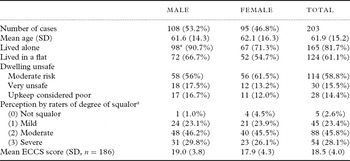
Characteristics of the 203 persons included in the study are shown in Table 1. The mean age of the participants was 61.9 years with approximately equal numbers of males (n = 108, 53%) and females (n = 95, 47%). Males were more likely to live alone (90.7%) compared to females (71.3%, X 2 = 12.73, p < 0.001). A majority (124, 61.1%) lived in a rented flat or in a bedsitting room and the rest (n = 79, 38.9%) lived in a house. Those living in a flat were more likely to live alone (112, 90.3%). Raters regarded 30 (15.5%) out of 194 dwellings as very unsafe to live in for structural, health, or other reasons. Upkeep was considered very poor in 28 (14%) of the 194 dwellings, most (21 out of 28) being houses.
Characteristics of occupants, living conditions and ratings of squalor, and cleanliness

ECCS = Environment Cleanliness and Clutter Scale.
aCases with missing items were not included.
*p < 0.05 between genders.
Most raters in this study referred only one or a few cases each, though several housing officers in deprived areas of the city referred larger numbers. The 203 ECCS ratings were provided by about 80 referrers. Only 10% of people under the age of 65 years who were referred during the first year of the study were in employment-related activities (McDermott and Gleeson, Reference McDermott and Gleeson2009), and 67% had contact with friends and others in the community. Clinical assessment was not a requirement when referring cases to the service. Although project staff had not received formal psychiatric training, they developed some expertise through regular case discussions and seminars, and were able to provide details that suggested that half of those referred to their service had psychiatric problems.
ECCS ratings
The mean ECCS score was 18.5 (Table 1) and was not significantly different between dwellings occupied by men and women or between types of dwellings. For those living in flats or bedsits, their mean age was 60.6 (range 28–87) years and their mean ECCS score was 18.63 (SD = 3.81). For those living in houses, their mean age was 63.79 years and their mean ECCS score was 18.26 (SD = 4.37).
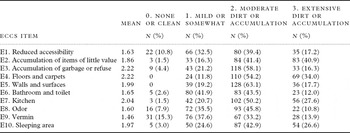
The distribution and percentage of participants, given ratings corresponding to “normal,” mild, moderate, or severe on the ten ECCS items is shown in Table 2. While access within the home (ECCS, E1) was rated as severely impaired (less than 10% of floor space accessible) in 17.2% of cases, accumulation of items (ECCS, E2) was deemed to be “markedly excessive, with items piled at least waist-high in all or most areas, most furniture and appliances inaccessible, and cleaning virtually impossible” in 40.9%. Garbage and food waste (ECCS, E3) were piled at least knee-high in the kitchen and elsewhere, with no recent attempt to remove refuse or garbage, in 16.3% of cases. Cronbach's α for the ECCS was 0.72 (n = 186), thereby demonstrating good internal consistency.
Distribution of ratings of severity on the ECCS items

Items E6, E9, and/or E10 were not rated for 17 dwellings due to lack of access to the toilet or bedroom or the facility was shared with others.
Factor analysis
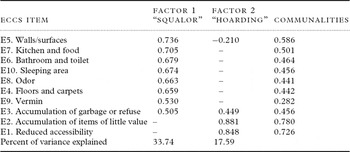
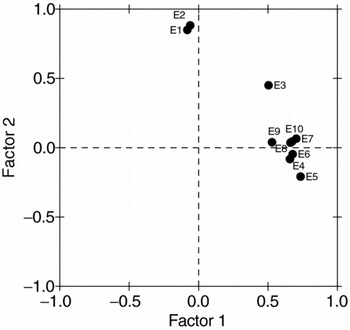
Principal component analysis applied to 186 cases with data available for all ten ECCS items showed a two-factor solution to be the most plausible. Rotation of sums of squared loadings showed that the two components accounted for 51.3% of the variance. Table 3 shows the factor loadings of the ten items for the two factors together with communalities, i.e. the percent of variance explained by the two factors for each item. Factor 1 comprised seven items and explained 33.7% of the variance. The items included ratings of wall surfaces, kitchens, bathrooms, sleeping area, odor, floors, and the presence of vermin; we call this factor squalor. Factor 2 comprised two ECCS items, accumulation of items of little value and reduced accessibility, and we call this the hoarding factor. The item assessing the accumulation of garbage or refuse (E3) loaded almost equally on the two factors. The territorial map of the factor loadings is shown in Figure 1. This map shows two distinct clusters as described above for Factors 1 and 2. Another factor analysis using imputed values for missing items resulted in almost the same factor structure, except that vermin was associated with a third factor, which in the two-factor solution explained only 0.282% of the variance for this item.
Principal component analysis: rotated component matrix, sorted by factor loading (n = 186)

Territorial map of the variable loadings on Factors 1 and 2 after varimax rotation (see Table 3). Variable names represent the ten items from the ECCS (Halliday and Snowdon, Reference Halliday and Snowdon2009). Note variables with a high loading on Factor 2 (E1, reduced accessibility and E2, accumulation of items of little obvious value) are independent of the cluster represented by Factor 1 (E4–E10, the uncleanliness items plus odor and vermin). One item (E3, accumulation of refuse or garbage) loaded evenly on both Factors.

Hoarding versus squalor
Because this analysis suggested that people living in homes with very poor access and very marked accumulation of items may be living in conditions that can be differentiated from those observed in cases without such high access and accumulation ratings, we combined scores on two items, access and accumulation (E1 and E2) to form a single score (potentially ranging from 0 to 6). We then examined combined scores of the eight items loading on the squalor factor (potentially ranging from 0 to 24). We surmised that those whose dwellings were rated 5 or 6 on access and accumulation (Factor 2), but with mean total scores of 15 or less on the remaining eight ECCS items, would be perceived as hoarding but not living in severe squalor. Those scoring low on access/accumulation but high on the other items would be likely to be living in very unclean homes but without evidence of major hoarding problems. Those scoring high on both access/accumulation and the sum of the other eight items would be likely to be viewed as hoarding and living in squalor.
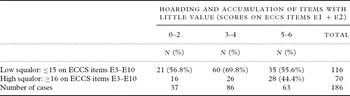
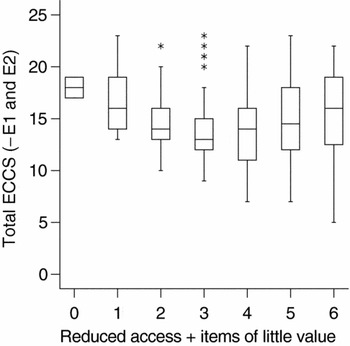
After reviewing the data, we examined mean total ECCS scores according to their score on access/accumulation, and we have summarized the findings, in cases where scores on all ten items were provided (n = 186), in Table 4. The numbers of dwellings where scores of 0–2, 3–4, and 5–6 on items E1 and E2 were recorded, and where there were totaled scores of 16 or more on the other eight items (corresponding to an average item score of 2 or more) were compared with corresponding ratings of dwellings where the total on the eight items was 15 or less. The mean ECCS total score of those given a rating of 6 for access and accumulation was not very different from that for people given an access/accumulation rating of 2, and rather less than those scoring 1 or 0 on these two items (Figure 2). The finding is much the same even if ratings of garbage are no longer included.
ECCS scores of participants according to their scores on access + accumulation

A box plot showing the relationship between ECCS scores summed over Factor 1 (E3–E10, y-axis) and Factor 2 (E1 and E2, x-axis). Boxes indicate the interquartile range, with horizontal lines showing medians. Asterisks indicate outliers, 1.5–3 box lengths from the upper edge (n = 186).

Of 63 dwellings that were rated 5 or 6 on access/accumulation (E1 + E2), 28 (44.4%) were given scores of 16 or more on the ECCS squalor items (E3–E10). In eight dwellings where there was a score of 6 on items E1 + E2, the total score on the eight squalor items was 20 or more (out of 24). Among them were cases of undoubted hoarding and undoubted squalor where the histories pointed to a DSM-5 diagnosis of hoarding disorder rather than any other mental disorder.
Of the 63 dwellings rated 5 or 6 on items E1 + E2 (Table 4), 35 (55.6%) had scores of 15 or less on the ECCS squalor items (E3–E10), suggesting these were examples of “hoarding” without severe squalor. There were 16 cases with high scores on the ECCS squalor items, with low scores on access/accumulation, indicative of squalor without hoarding. It should be noted that 81 (43.5%) out of 186 dwellings rated fairly low on both access/accumulation and on a total of the other ECCS items, indicating relatively mild squalor/hoarding.
Discussion
The availability of data from over 200 cases referred to a Squalor Project team, where the ECCS had been used to rate severity of uncleanliness and associated features, allowed an opportunity to explore whether there are measurably different types of squalor and accumulation. Our factor analysis appeared to show good differentiation of cases of hoarding without much squalor from those living in squalor but without hoarding. It also showed what we know from clinical practice: there are some people who accumulate excessive amounts of possessions, often of little obvious value, and live in severe squalor.
This was an opportunistic study. The data were made available to us, but we were not involved in collecting them. Although some of the participants had been assessed by mental health professionals and given diagnoses, the majority had not. Clinical data were usually not accessible. Thus, we cannot comment on what proportion of the cases of hoarding or of squalor might have been attributable to mental illness, psychological problems (hoarding disorder, personality disorder, etc.), or physical or intellectual disability. Clinical assessment during 2000–2009 of 120 people living in moderate or severe squalor who were referred to an old age psychiatry team, in a catchment area that covers 25% of the population covered by the Squalor Project, showed that 35% had dementia, 24% alcohol-related brain damage or substance abuse, 15% schizophrenia or a paranoid state, 9% personality disorder, and 3% depression (Snowdon and Halliday, Reference Snowdon and Halliday2011).
The reliability and validity of the ECCS have been established (Halliday and Snowdon, Reference Halliday and Snowdon2009). In the present study, the internal consistency (Cronbach's α of 0.71) was somewhat lower than in our previous study using expert raters (0.87; Halliday and Snowdon, Reference Halliday and Snowdon2009). In that study, we found that total ECCS ratings of greater than 12 usually indicated that a person was living in unacceptable squalor, and that intervention was warranted. In the present study, the mean total ECCS score of those living in what the raters deemed to be severe squalor was about 21, while the mean score of those in moderate squalor was 13. The fact that the mean total ECCS score was 18.45 is an indication of the perceived severity of the squalor in these referred cases.
Review of the cases led those conducting the earlier study to a view that there were two groups of occupants identified as living in squalor, one related to hoarding, and another where squalor was mainly attributable to failure to dispose of filth. The present study allowed further testing of this supposition. Factor analysis did indeed point to two types of squalor, one with high ratings on the access and accumulation items, the other with “filth” items rated highly (Figure 1). Some referred cases were rated high on hoarding/accumulation but low on squalor, as shown in Table 4. Others also were rated as showing poor access and marked accumulation of items, and also were rated high on filth items. If failure to discard was purposeful, the latter were cases of hoarding with squalor. Whether such hoarding should be attributed to hoarding disorder rather than a mental disorder (e.g. schizophrenia or dementia) or medical condition (such as cerebrovascular disease) cannot be answered by ECCS ratings; it depends on whether clinicians have diagnosed a condition that has caused the hoarding (Mataix-Cols et al., Reference Mataix-Cols2010). Contrastingly, in some cases of severe squalor (as rated on items 3–10 of the ECCS), there was good access and relatively little accumulation of items. Levels of clutter and accumulation varied across a continuum, as did levels of uncleanliness.
The raters in the present study were untrained but found the ECCS easy to use. Judgments were needed when rating situations that did not conform to the brief anchor-point descriptions given in the scale. For example, how does one rate the surfaces item when walls appear clean but windows and sills are filthy? Raters are asked to choose an “average” rating. A limitation of the study is that we do not know whether some raters give unduly high ratings or how reliable their ratings would be in comparison to others. However, the advantage of the study is that it shows that descriptive ratings can be made, and that these give a clear idea concerning perceived severity. The fact that an intervention study showed that ECCS ratings of 57 dwellings fell from a mean of 18.8 to a mean of 6.5 by the end of service involvement (McDermott and Gleeson, Reference McDermott and Gleeson2009) suggests that untrained raters are able to perceive differences between degrees of uncleanliness and accumulation over time.
It was of interest that although squalor was rated as severe in 28% of cases, only 15.5% of the dwellings were rated as very unsafe to live in. The definition of “very unsafe” provided by the ECCS is “The dwelling is so cluttered and unhealthy that people should not enter it (except if specialists with appropriate clothing and equipment) and/or there is a high fire risk (rating 3).” “Considerable risk of fire, injury, or health problem” is rated 2. Evidently, some raters considered that severe messiness does not necessarily require a place to be labeled as uninhabitable, in spite of considerable risks.
We welcome the fact that the new category/diagnosis of “hoarding disorder” is likely to be introduced in DSM-5 (Mataix-Cols et al., Reference Mataix-Cols2010). It has been suggested that, in view of the perceived implications for management in such cases, a qualifier relating to squalor (in addition to qualifiers concerning degrees of insight and of acquisition) should be made available to those making a diagnosis of hoarding disorder. At present, there is insufficient reason for this embellishment (Snowdon et al., Reference Snowdon, Mataix-Cols and Pertusa2012). Nevertheless, we contend that measurement of the degree of squalor in cases of hoarding disorder is desirable, in order to improve our understanding of its prevalence and relevance. The ECCS is well suited to this purpose, and allows (by examining access/accumulation scores vs. squalor item scores) quantitative descriptions of whether squalor is associated with hoarding or not – and whether the squalor is wet or dry.
Conflict of interest
None.
Description of authors’ roles
John Snowdon transcribed the deidentified data from community files. Glenn Hunt analyzed the data. The three authors cowrote the paper.
Acknowledgments
Many thanks are due to Michael Zautsen for data entry. We are very grateful to Catholic Community Services for allowing access to data they gathered in order to rate outcomes of their interventions in cases of squalor/hoarding. We thank all those involved in trying to help and support people who, in the absence of intervention, would be at risk of homelessness.