Introduction
From the late 1930s onwards, urban growth rates accelerated throughout Africa. In Mombasa, the African population increased from 40,000 in 1939 to 63,000 in 1945, while in Dar es Salaam, the African population increased from 34,750 in 1940 to 93,363 in 1957.Footnote 1 This rapid urban growth coincided with and, in part, contributed to the labour unrest that swept through the continent during the late 1930s and continued in the period after 1945. Strikes and urban riots revealed the depth of discontent among the urban labour force, as protests engulfed the towns of the Rhodesian Copperbelt (1935 and 1937), Kenya (1939) and Tanganyika (1939).Footnote 2 In each case, the colonial authorities found that the urban environment and its associated problems of overcrowding, poor housing, rotational employment and low wages were key contributing factors in the outbreak of the protests. Consequently, in the wake of the unrest, and with the labour shortages of the Depression giving way to growing and increasingly settled urban populations, colonial governments were forced to concede that the poor living conditions in many African towns was a matter that required urgent attention.Footnote 3 Such a view found a receptive audience among officials in the Colonial Office, which, as a result of the 1940 Colonial Development and Welfare Act (CDWA), was eager to promote policies that would lead to improved social welfare provision in the colonies.Footnote 4
Having identified the urban problem as an issue that needed resolving, a consensus gradually emerged in London and the colonies that the system of migrant casual labour on which the colonial economies depended should be eradicated. It was argued that casual labour contributed to a range of social problems, such as vagrancy, unemployment and crime. It therefore followed for colonial officials that the increasing number of migrants settling in the towns and cities was not only placing additional strain on already overstretched infrastructure but was also contributing to the state of social disorder.Footnote 5 The solution, as advocated by a number of investigative commissions, including the Howman and Phillips Committees, was to ‘stabilize’ the African workforce.Footnote 6 Stabilization typically involved: setting a higher minimum wage, addressing malnutrition and poor health among workers, hiring only registered casual labourers and providing adequate housing and social services for urban workers and their families.Footnote 7
Housing was critical to the policy of stabilization, for if workers were to settle permanently in the towns and cities then they would require ‘family housing’, along with the necessary infrastructure and social amenities.Footnote 8 Moreover, although it was assumed that employers would continue to provide accommodation, it was also acknowledged that at a time when colonial governments were intervening more directly in the social and economic spheres of colonial rule, the state would have to play a greater role in the provision of housing. In Kenya, for example, in 1944, the government submitted a request for CDWA assistance to build 756 houses for its African employees, of which three-quarters would be for families.Footnote 9 The rationale in Kenya, as in other colonies in British Africa, was simple: the provision of suitable and affordable family housing would encourage workers to settle in the urban environment and form stable nuclear families. Model families, with access to improved social amenities, such as education, health and employment opportunities, would, in turn, help to raise the standard of living of low-income neighbourhoods, which had long been regarded as a source of social instability.Footnote 10
The Sudan, which was jointly administered by Britain and Egypt from 1898 until independence in 1956, has largely been neglected in studies of late imperial urban policy. This is primarily because of the Sudan's ‘Condominium’ status, which meant that the Sudan government reported to the Foreign Office and not the Colonial Office and was therefore excluded from policy debates regarding the development and welfare agenda.Footnote 11 However, as Justin Willis has argued in relation to Indirect Rule or Native Administration, the Sudan was far from an exceptional case. In fact, as Willis notes, the officers of the Sudan Political Service (SPS) ‘perceived the same problems [and] pursued similar policies’ to colonial officials elsewhere in British Africa.Footnote 12 Using the example of the Sudan government's post-war slum clearance programme, this article makes a similar argument. It demonstrates how the colonial authorities regarded the inhabitants of the Deims, or ‘Native Lodging Areas’, that surrounded the southern edge of the city as a source of disease, crime and social disorder. The article explores the authorities’ response to the rapid expansion of the Deims during the late 1940s, demonstrating how the Sudan government, like other colonial administrations in British Africa, sought to control casual labour through urban planning and housing and thereby create a more productive and ‘modern’ urban class.
In this respect, the article echoes the work of those historians who have focused on late colonial development policy in Africa. As Joseph Hodge has demonstrated, development, whether conceived of in terms of agricultural production, ecological conservation or the provision of social welfare and medical services, had been undertaken by the colonial state since the establishment of colonial rule.Footnote 13 The ‘colonial science’ that informed these development policies, as Christophe Bonneuil has argued, was a specific colonial form of knowledge: a discourse that was shaped by a belief in the superiority of European science and presented indigenous or local practices as irrational, thereby serving to justify the civilizing mission.Footnote 14 During the inter-war period, this faith in the possibilities of science and development sat uneasily alongside the principles of trusteeship and Indirect Rule but, following the influential work of Frederick Cooper, historians are increasingly recognizing that the 1930s was also a period of change with regard to colonial development policy.Footnote 15 The Depression and the subsequent labour protests highlighted the terrible living conditions in the African colonies. As Cooper, Hodge and Joanna Lewis have argued, these protests, in combination with the outbreak of World War II and the growth of anti-colonial nationalism after 1945, were used by colonial governments across British Africa to justify greater state intervention with regard to economic development and the provision of social services.Footnote 16
The towns and cities, as Adam Branch and Zachariah Mampilly have suggested, became a key focus for late colonial development initiatives, owing to the frequency of urban protests, the rise of organized trade unionism and the influx of the rural poor from the countryside.Footnote 17 Through initiatives such as the promotion of apolitical trade unionism, the provision of maternal and child welfare services or the development of public housing schemes and community centres, the colonial state sought to intervene more directly in the daily lives of the subject population, aiming to transform colonial subjects into productive and orderly citizens.Footnote 18 These policies, as Branch and Mampilly point out, were often accompanied by a high degree of coercion and state violence: street hawkers and the urban unemployed faced greater harassment from the police, while the inhabitants of ‘illegal’ squatter settlements were liable to be evicted and their homes destroyed with little or no warning.Footnote 19 Unsurprisingly, given the highly authoritarian nature of many of these policies and the racial and cultural prejudices that shaped them, the late colonial development initiatives did not yield the desired results. However, in spite of this, the belief in the transformative power of the state did not disappear with the formal end of imperial rule, with many independent African governments pursuing similar policies to their colonial predecessors.Footnote 20 Though not the focus of this article, such continuities have been evident in Sudan. During the 1980s and 1990s, following the influx of war-displaced southern Sudanese migrants to Khartoum, the authorities, regarding these internally displaced persons as a potential source of insecurity and crime, used similar policies to the British administration, including the violent destruction of informal settlements and the forcible relocation of residents.Footnote 21 This supports a recent argument made by David Anderson and Øystein Rolandsen, who have pointed to the relationship between the coercive and authoritarian nature of the colonial state and the violent political culture that has dominated East African politics since independence.Footnote 22
In terms of methodology, the article draws on archival sources, which include official reports, correspondence and social surveys.Footnote 23 As Willis has noted, a reliance on the official record can reduce the urban population to a ‘disorganized rabble, just as the administrators of the time were wont to perceive them’.Footnote 24 Indeed, official sources often have little to say about everyday urban life, the informal economic sector or the rich associational life in many African towns and cities.Footnote 25 Yet, as this article demonstrates, such sources are invaluable because they reveal how colonial officials perceived colonial subjects, how colonial administrations responded to the challenges posed by rapid urban growth and, above all, how the colonial state sought – often without success – to monitor, control and regulate the urban African population.Footnote 26
Segregation in Khartoum
Land use in Khartoum during the Condominium period was regulated through a series of ordinances. The Town Lands Ordinance of 1899 authorized the Sudan government to obtain any land it required, either by purchase or by exchange, and ordered landowners to construct buildings conforming to specific regulations within two years. In 1909, this legislation was strengthened with the promulgation of Town Building Regulations which established three classes of residential land. The tenure of these holdings was regulated under the 1912 Government Town Lands Ordinance, which also created a fourth class of land, the ‘Native Lodging Area’. In each class of land, residents were required to construct houses according to a certain specification, with houses in Class 1 requiring a superior specification to those houses in Class 3. If an owner failed to comply with the regulations, the government could retake possession of the land.Footnote 27
The building regulations amounted to a de facto policy of racial and social segregation. The large plot sizes and long leases in Class 1 encouraged wealthy residents, such as expatriate officials, to invest in land for private housing but the majority of the city's poorest residents could not afford to construct a house according to the specification for Class 3.Footnote 28 Therefore, while British officials lived in palatial villas, the urban poor were forced to find accommodation in the Native Lodging Areas, where the land could be reclaimed by the authorities with just one month's notice.Footnote 29 The insecurity of tenure, coupled with the high cost of building materials, contributed to the proliferation of low-quality, temporary poor housing. The 1912 Annual Report for Khartoum Province recorded the impact of the Government Town Lands Ordinance:
Now that houses of a better type are taking the place of mud buildings in the third-class part of the town, the natives are forced either to leave the town or associate themselves with others and share a hosh with perhaps thirty or forty other families. The consequence is that all yards and unoccupied ground have been taken up for native huts. It is quite a thing to see a yard containing from twenty to fifty mud huts and straw tukls. . .To-day we may have a place occupied by one family and in less than a week's time we may find over hundred occupants in the same place.Footnote 30
Even when wealthy Sudanese applied to purchase a plot in a Class 1 area, the authorities objected to the introduction of ‘Sudanese standards of living’ into residential areas inhabited by British officials.Footnote 31 It was in this way that city planning and urban architecture served as important symbols of racial distinction and separation.Footnote 32 Downtown Khartoum, the administrative centre of the colonial state in the Sudan, was divided into a zoned grid system, while the sprawling layout of the Native Lodging Areas reflected the ‘irregular’ nature of the neighbourhoods, where the infrastructure was limited and the building regulations rarely enforced.Footnote 33
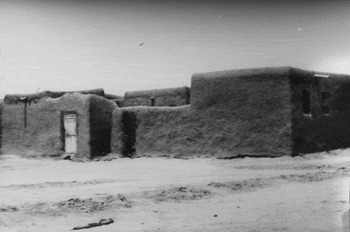
The majority of the urban poor – the casual labourers, emancipated slaves and rural migrants – lived in the Deims (meaning residential quarter), which surrounded the southern edge of Khartoum. The Deims were first established in 1902 and the area was formally classified as a ‘Native Lodging Area’ in 1912 following the introduction of the Government Town Lands Ordinance.Footnote 34 Since the land on which the Deims were built was classified as a ‘Native Lodging Area’, the municipal authorities were under no obligation to provide the necessary infrastructure – pit latrines, for example, were not installed in the Deims until the 1930s.Footnote 35 Houses in the Deims, referred to locally as a jaloo, were built from cob, which was then protected with zibla, a plaster made from a fermented mixture of animal waste, soil and water. Houses had no foundations and erosion at ground level was common, particularly during periods of heavy rain (see Figure 1).Footnote 36
A jaloo; this type of housing was common in the Deims
Source: Sudan Archive Durham (SAD) 649/1/28, F. Addison. An example of a jaloo from between 1907 and 1931.

S.R. Simpson, the commissioner of lands and registrar general (1945–53), justified these housing conditions on the basis that the residents of the Deims were temporary migrants who only worked in the capital for a short period of time:
The ‘native lodging area’. . .was originally intended for those casual labourers whom towns attract; they came and they went; they had no families and merely wanted somewhere to ‘lodge’ whilst working in the town. There was, therefore, nothing very strange or reprehensible in allotting only enough space for a single room; it fully served the purpose. It was in no sense a ‘home’; it was merely a temporary ‘lodging’.Footnote 37
In other words, by imagining the casual labourer as a single male migrant who circulated between the city and the countryside, SPS officials argued that if the migrant's true home was in the countryside then improving conditions in the urban areas was not only unnecessary but also risked encouraging more migrants to abandon their rural homes in favour of the towns and cities.
This unwillingness to invest in the necessary infrastructure meant that as the urban population increased overcrowding became a serious problem. With people living in such close proximity to each other, and without adequate sanitation facilities, outbreaks of disease were common. Typical outbreaks included cholera, dysentery, relapsing fever and malaria.Footnote 38 The regular outbreak of disease was symptomatic of the colonial authorities’ inability, or unwillingness, to address the issues that contributed to the overcrowding and insanitary conditions in the Deims. The problem was, in part, one of perception. In 1902, all the inhabitants of Khartoum who were without permanent accommodation were resettled south of the city – in the area which later became the Deims. This policy was justified on the basis that this ‘floating population’ defied all ‘sanitary regulations’.Footnote 39 This was common practice throughout cities in colonial Africa where ‘metaphors of disease and contamination . . .served as rationales for racial segregation’, and the expulsion of the urban poor.Footnote 40 Of course, the insanitary conditions which subsequently developed in neighbourhoods such as the Deims only served to fuel fears of contagion that the authorities used in a circular fashion to legitimize continued segregation and neglect.
From bachelor housing to family housing
Khartoum experienced similar urban growth rates to other African towns and cities during this period. By 1945, the population of the Deims was estimated to be 30,000, while overall it was estimated that the population of Khartoum had increased from 186,093 in 1944 to 245,736 in 1956.Footnote 41 The city's rising population contributed to the overcrowding problem and the shortages of suitable housing, particularly in the lower-income neighbourhoods. J.W. Kenrick, the district commissioner in Omdurman, conducted a survey in the early 1950s into living conditions in Murada – one of the town's low-income neighbourhoods that was comparable with the Deims. The survey, underlining the extent of the overcrowding, found that 2,273 people were living as 356 households on 259 plots.Footnote 42 Of the 356 households, 135 contained more than six persons and only 80 consisted of fewer than five persons. The problem was not so much the number of people in a household but the population density, with Kenrick estimating that 45 per cent of Murada's population were living at a density of 12.5 persons per plot.Footnote 43
The demand for housing was not just limited to the Deims and the lower-income neighbourhoods but also in the first- and second-class areas of Khartoum, where the European expatriates and the senior Sudanese civil servants lived. The Annual Report 1948 stated that: ‘Land auctions in the first, second and third class residential areas showed that money was available and people anxious to buy.’Footnote 44 Traders and merchants, who had amassed a great deal of wealth during the war, sought to invest their income in land and property, as ongoing import shortages meant there were few other avenues for investment.Footnote 45 This city-wide competition drove up the price of land. Simpson complained that site values had ‘reached an excessive price’.Footnote 46 In June 1947, five first-class plots which had been sold for £E208 in 1946 were auctioned for a total of £E533 and 38 second-class plots which had been sold for £E578 in 1946 were auctioned for a total of £E1,399 (£E = Egyptian pound).Footnote 47 There were comparable levels of competition in the third-class areas: in 1946, 220 plots in third-class areas were made available, and in response the municipal authorities received 1,500 applicants.Footnote 48
The housing shortage contributed to the post-war industrial unrest in the Sudan, with the provision of suitable housing one of the key objectives for many trade unions and professional associations. The Sudan government Railways, for example, provided some housing for employees, particularly in the towns of Atbara and Port Sudan, but the majority of workers were forced to find accommodation in the private sector. A 1948 Commission of Inquiry, which was appointed to investigate the causes of the 1947 railway strike, reported that with as many as ‘two or three families crowding into one house’ high rents and overcrowding were universal complaints among railway workers.Footnote 49 Similarly, the Watson Commission, which was appointed to investigate the 1951 police strike, cited rising private rental prices and substandard police accommodation as key causes of the unrest.Footnote 50 The Commission even went as far as to accuse the government of neglect, reporting that police officers were still living in accommodation that had been condemned in 1937.Footnote 51
Although the Sudan government acknowledged that the state needed to play a greater role in the provision of housing, it was unwilling to bear the financial burden of a large-scale housing development project.Footnote 52 Not only was the cost of public housing schemes considered prohibitive, but the government initially regarded the housing shortage as a temporary crisis. In response to the railway workers’ complaints about high rents, the 1948 Commission of Inquiry pointed to the situation in the 1930s when workers vacated houses provided by the Sudan Railways because they could obtain private houses at lower rents. The Commission thus argued that if demand for houses declined the railway authorities would be ‘left with blocks of empty houses’.Footnote 53 Unwilling to invest in public housing, SPS officials, such as Simpson, argued that the best solution was to make more land available for construction in Khartoum, where land shortages had ‘prevented natural economic factors from taking their normal course’. According to Simpson, if more land was made available for construction, then the price of plots in the first- and second-class areas would be reduced. In turn, this would lead to lower rents and reduced prices for plots in the third-class areas.Footnote 54
Since Khartoum was surrounded by the river to the north and east, the only direction for further expansion was to the south, where the Deims were located. The Deims had been allowed to develop around the outskirts of the city so as to keep the inhabitants segregated from the residents of the first- and second-class quarters. The authorities were therefore unwilling to leave the Deims where they were and develop the land around them.Footnote 55 One report, for example, complained that the ‘natural development of Khartoum’ had been ‘halted by the persistent and embarrassing presence of the old deims’.Footnote 56 A plan to resettle the residents of the Deims had been in place since the 1930s but the scheme had not been implemented owing to a lack of funds.Footnote 57 However, with the housing shortage becoming acute, officials drew up plans to demolish the Deims and resettle all of the inhabitants to a new residential area further south.
The plan to resettle the residents of the Deims was not just about making more land available for the development of the first- and second-class zones. In the post-war decade, the provision of suitable housing became a central tenet of the Sudan government's attempts to ‘stabilize’ the labour force. Simpson, writing in 1946, emphasized the importance of housing:
Better housing conditions are of vital importance to the ordinary man; next to the food he eats, perhaps the most important thing to the average citizen is the house he and his family live in. Better education and better medical service will avail him but little if has to go home to the slum conditions which to this day exist in the fair city of Khartoum.Footnote 58
The conditions in the Deims had been justified on the basis that the accommodation was suitable for the single male migrant worker. However, as increasing numbers of migrants settled in the Deims, officials were forced to concede that the image of the casual labourer as a lone bachelor was no longer appropriate – if it ever had been.Footnote 59 The 1948 Commission of Inquiry, for example, acknowledged this in its report, stating that: ‘we are unable to accept the contention that men on the lowest wage level are, or ought to be, unmarried’.Footnote 60
The realization that not all of the Deims’ residents were temporary male migrants did not fundamentally alter officials’ perception of the urban environment as a source of vice. Officials echoed sentiments that had been expressed by earlier reports which had described overcrowding in the Deims as a ‘menace to health’ and a ‘social evil’.Footnote 61 A range of problems, such as unemployment, crime and prostitution, were attributed to living conditions in the Deims where, it was argued, traditional communal obligations were in decay. Writing in 1954, P.J. Sandison, referring to the ‘dangerous anonymity’ of the urban environment and ‘the collapse of the traditional social system’, warned that in the absence of ‘normal social groupings’, the loss of ‘moral control’ and ‘demoralization’ was inevitable.Footnote 62 Of course, such views obscured the variety of associational life in Khartoum, where residents were often active in a number of organizations ranging from informal rotational credit and mutual help societies to sport clubs, cultural associations, trade unions and political organizations.Footnote 63
SPS officials’ concerns about the social consequences of the urban environment mirrored contemporary anxieties in post-war Britain. The war had highlighted the terrible conditions in Britain's inner-city slums where Aneurin Bevan, the minister of health, argued that poverty and poor housing had resulted in ‘castrated communities’.Footnote 64 To remedy this situation, Bevan drew up plans for public housing and the development of ‘New Towns’. It was hoped that these initiatives, when combined with the expansion of state education, health and social welfare, would help to achieve the Labour government's vision of creating a more inclusive and responsible society.Footnote 65 Planning was central to the post-war housing policy, and town planners, such as Patrick Abercrombie, the architect of the 1944 Greater London Plan, argued that with proper planning towns and cities could be reorganized to avoid social disintegration and promote community cohesion.Footnote 66
In recent years, historians have drawn increasing attention to how ideas about housing and town planning circulated between the metropole and the colonies.Footnote 67 In Kenya, for example, Richard Harris and Alison Hay have documented how officials were not only influenced by ideas from Britain but also drew inspiration from other territories in Africa, including Northern and Southern Rhodesia and South Africa.Footnote 68 In the case of the Sudan, owing to a lack of access to the necessary archival records, it is less clear how SPS officials came to be exposed to the latest ideas in housing and town planning. From the available sources, it appears that the influence was diffuse but it is nonetheless evident that SPS officials and their Sudanese subordinates shared the metropolitan planners’ view that proper planning and the provision of suitable housing could serve as a remedy for social problems. In 1954, Sa’ad ed din Fawzi, a lecturer in economics at the University of Khartoum, was commissioned by the Sudan government to conduct a survey of low-income neighbourhoods in Khartoum. In the introduction to his report, Fawzi, emphasizing that ‘we must study man before we can plan’, cited Le Congrès International d’Architecture Moderne, stating that: ‘The modern aim. . .of town planning is nothing less than the “creation of a physical environment that will satisfy man's emotional and material needs and stimulate his spiritual growth”.’Footnote 69 Similarly, and demonstrating that SPS officials were aware of developments in other colonial territories, Sandison, in his 1954 essay on low-cost housing in Sudan, cited reports on housing in the Belgian Congo and West Africa.Footnote 70
It is also clear from the plan to resettle the residents of the Deims that the Sudan government shared the metropolitan planners’ view of housing as both an ‘illness and a cure’.Footnote 71 As part of the plans to resettle the residents of the Deims, a newly appointed town planner devised plans for blocks of approximately 50 plots with open spaces at regular intervals, as well as space for a school, market, health centre, cinema, police station and shops.Footnote 72 Here, the aim was to replace the unregulated houses of the Deims with new accommodation on a planned site that was designed to resemble a suburb of an imagined English town in the hope that the creation a self-contained neighbourhood would help to create a sense of social cohesion or community spirit.
In addition to the planned layout for the new neighbourhood, a municipal engineer prepared six standard house plans, all of which included a family room, guest room, veranda, kitchen, bathroom and pit latrine.Footnote 73 The house plans also reflected colonial ideas about appropriate gender roles within the home: if a man was expected to earn a steady income in order to provide suitable accommodation for his family, the inclusion of a kitchen and other domestic amenities reflected the expectation that workers’ wives would socially reproduce the male labour force and raise the next generation of workers.Footnote 74 The assumption among officials was that ‘function and behaviour’ would follow form.Footnote 75 By encouraging Sudanese workers to construct family-sized homes, the residents would form stable, nuclear families which, in turn, would produce efficient and disciplined workers because if a worker was responsible for a monthly rent or providing for his family he would be less likely to work irregularly or become involved in industrial unrest.
The demolition of the Deims
In 1946–47, as the first step in the resettlement programme, a plan was developed to move 550 residents to plots located to the south of the Deims in an area that would become known as the ‘New Deims’.Footnote 76 In theory, these residents were supposed to demolish their properties in the Deims once the construction of their new houses had been completed. However, many residents chose to maintain their old property and rent it out.Footnote 77 To overcome this problem, the authorities decided to demolish the remaining houses in the Deims. In March 1949, as part of this process, a survey of 5,777 houses was completed by Ali Nadim, the Deims resettlement officer.Footnote 78 Based on the findings of Ali Nadim's survey, the residents of the Deims were classified into three categories:
Group A: ‘absentee landlords’ who had been allocated plots but rented their old properties to tenants.
Group B: ‘owner occupiers’. This group included people who were living in the Deims as a result of original allotment, purchase, or inheritance.
Group C: ‘tenants’, who were leasing a property from absentee landlords in Group A.Footnote 79
It was decided to allot a plot of 200 square metres in the New Deims, subject to the payment of ground rent (15 piastres P.T. per month), free to all owner-occupiers in Group B and to tenants in Group C. Plots were only allocated to tenants in Group C who had been residents of the old Deims for at least 10 years, lived with their families and had permanent employment.Footnote 80 The basis on which plots were allocated was clearly designed to distinguish the ‘responsible’ worker, who was permanently settled in Khartoum with his family, from the single or short-term migrant, who was regarded as a potential source of social and labour unrest. In only allocating plots to long-term residents, it was hoped that the city would be purged of those elements – the short-term or temporary migrants – who did not fit with the planners’ vision of an orderly colonial city.
This provoked opposition from the landlords who opposed the plans on the basis that they would lose their rental income.Footnote 81 Officials, however, had little sympathy. The authorities portrayed the landlords as irresponsible and corrupt profiteers. One government circular stated that while it was inevitable that the landlords would resist ‘the death of the goose that has laid them so many golden eggs’ they deserved ‘scant sympathy’.Footnote 82 Simpson, who described tenement letting as a ‘disgrace’, complained that landlords had ‘with a minimum of capital expenditure’ acquired ‘a swollen rent-roll which would be the envy of slum landlords. . .elsewhere’.Footnote 83 Such criticism obscured the fact that the development of tenement letting in the Deims was a consequence of colonial policies. In Khartoum, the state depended upon a large casual labour force, but exclusionary building regulations and low wages meant that workers were denied access to permanent housing. Landlords, who had benefited from the authorities’ reluctance to enforce municipal regulations in the Deims, had emerged to fill the void, providing affordable accommodation which, although in poor condition, was well-suited to the cyclical and insecure nature of urban employment.
Here was a key dilemma for the colonial authorities. Entrepreneurs, such as the landlords in the Deims, provided affordable housing and other essential services to the urban workforce at little or no cost to the state and private capital. However, although tenement letting eased the housing shortage in the Sudan's rapidly growing cities, the Deims had become synonymous with other activities that were associated with non-wage employment or the ‘informal sector’, such as street hawking, prostitution, alcohol production and theft.Footnote 84 Such activities had always been criminalized by the colonial state but during the post-war period, when the authorities were increasingly anxious about the relationship between casual labour and social disorder, the belief among officials was that the living conditions and subsistence activities in the Deims undermined efforts to create a ‘disciplined work culture’.Footnote 85 The assumption was that poor housing, ‘irregular’ social relations, alcohol consumption and crime all contributed to labour unrest and low productivity. By minimizing tenement letting and by determining who had access to housing, the state aimed to limit the influence of the petty entrepreneurs – the landlords and street hawkers – who facilitated the cyclical pattern of casual labour.Footnote 86
In mid-1949, the government warned those persons in Groups B and C, who had been allotted plots in 1946–47, that they must construct their houses in the New Deims by the end of the year. Those residents who had not yet been allocated plots in the New Deims were also informed that they would be allocated a site in due course and that they must construct their new houses within one year. When the absentee landlords continued to protest, the authorities responded by repossessing 103 plots from those residents who had been allocated sites in the New Deims in 1946–47. After negotiations, the authorities agreed to return the plots to their original lessees on the condition that the demolition of the Deims began immediately. Demolitions started in June 1949 and increased in intensity as the year progressed.Footnote 87 By the end of the year, 1,036 houses had been demolished, with the result that only 53 houses remained in Deim Gashasha and 50 in Deim Telegraph. These remaining houses were demolished by mid-January 1950.Footnote 88 The demolition continued apace: 1,009 houses were demolished in 1950, 1,884 in 1951 and 1,848 in 1952, so that within three years, 5,855 houses had been destroyed.Footnote 89 The allocation of plots in the New Deims was carried out simultaneously with the demolition of houses in the old Deims. By April 1951, 3,804 plots in the New Deims had been allocated to residents of the old Deims, of which 3,721 had been constructed by November 1953.Footnote 90 Overall, it was estimated that approximately 30,000 people had been relocated from the old Deims in what Fawzi described as ‘a gigantic operation of slum clearance and social resettlement’.Footnote 91
Competing visions of urban order
The resettlement programme highlighted important differences between how the planners and the Sudanese thought domestic life should be organized. The house plans for accommodation in the New Deims had been designed for nuclear families but historically northern Sudanese families, particularly those from the central riverain region, had lived in large kinship-based compounds in order to accommodate local social practices, such as the custom for newly married couples to live with their in-laws for a period of time.Footnote 92 It was also customary within many northern Sudanese households for women not to socialize with male guests. Whenever a male guest was present, it was expected that a household would divide into two. In order to facilitate this social custom, houses were built with separate male and female quarters, which were respectively known as hawsh rijali and hawsh nisa’i.Footnote 93 Consequently, although officials acknowledged that ‘everything possible should be done to prevent the collapse of the traditional social system’, many of the residents surveyed by Fawzi in the New Deims complained that either the plot sizes were too small or that the house plans devised by the municipal engineer were ill-suited to the needs of Sudanese families.Footnote 94
These conflicting understandings of how domestic life should be structured were evident throughout British Africa. Carolyn Brown, for example, has documented how the colonial authorities attempted to recreate an imagined English mining village for workers at the Engu colliery in Nigeria. As in Khartoum, British officials believed that by providing two-roomed houses with the necessary social amenities, the Nigerian mineworker could be reshaped into the image of his idealized British counterpart. However, workers and the trade unions objected to the housing scheme: home visits by health workers were regarded as an invasion of family privacy, and workers, many of whom were polygynous, argued that the houses were too small for their families and servants. As a result, the trade unions organized a boycott of the housing estate and fined any worker who chose to live in one of the houses.Footnote 95 In other words, as the cases of Khartoum and the Engu colliery demonstrate, Africans had their own ‘ideas about respectability, order, and rank in the home’.Footnote 96
Since the land on which old Deims were built was classified as a ‘Native Lodging Area’, the residents were not entitled to any compensation if they had been in possession of a plot for more than 10 years. Moreover, as there was no organized system of housing loans or grants for the inhabitants of the New Deims, residents were responsible for the cost of constructing a new house.Footnote 97 Prior to the demolition of the Deims, British officials had assumed that residents would be able to build their own property. However, not only was constructing a house from cob a skilled process but it was also expensive – Sandison reported that in 1954 it cost approximately £E180 to construct a three-room house from cob. In addition to the cost of constructing a house, a plot owner had to purchase a lease and pay an annual ground rent charge. Apart from low-interest government housing loans, which were only available to government employees, there were very few credit options available to low-income households.Footnote 98
The scale of the resettlement programme, coupled with the demand for houses in the first- and second-class areas, created a shortage of building materials and drove up wages for skilled workers, such as carpenters and masons.Footnote 99 Unable to afford the cost of labour or building materials, many of the relocated residents transferred their plots to landlords who then developed the land and rented out the property. Others borrowed money from traders and then developed the plot themselves.Footnote 100 Of the households in the New Deims surveyed by Fawzi, 40.7 per cent were tenants and just under 10 per cent were sub-tenants – highlighting the fact that the construction of a new house was beyond the means of many residents.Footnote 101 It was a similar situation in Nigeria, where the Lagos Executive Development Board, which oversaw slum clearance and housing projects, built 6,714 houses between 1957 and 1966 as part of a new housing estate called Surulere. However, according to Lisa Lindsay, these new houses did not replace all of the accommodation that had been demolished in central Lagos during the same period. Moreover, although the rents in the new houses were subsidized, the prices were still higher than many former residents of central Lagos could afford. As a result, residents were forced to find alternative accommodation in cheaper areas of the city.Footnote 102
In Khartoum, to reduce the financial burden of constructing a new house, the authorities permitted residents to collect all the building material from their old homes which could then be used to develop their plots in the New Deims. However, this meant that many inhabitants simply replicated the houses of the old Deims, which bore little resemblance to the plans devised by the municipal engineer. For example, it was reported that many of the lowest-paid residents – those earning between £E1 and £E9 per month – could not afford to complete the construction of their houses, with many only succeeding in building the outside wall.Footnote 103 Those persons who could not afford to build a house or were not allocated an alternative site in the New Deims were provided with an ex gratia payment of £E10 and offered accommodation in the alms house.Footnote 104
To high building costs was added the pressure of rising rents. During the war, rents had been restricted under the 1943 Rent Restriction and Recovery of Premises Ordinance but in April 1950 this legislation was abolished. The 1950–51 Annual Report for Khartoum District noted that following the abolition of rent control, prices increased by 100 to 300 per cent.Footnote 105 The Report of Committee on Rent Control recorded that a house which was let for £E10 per year in 1948 had increased to £E45 per year in 1953.Footnote 106 Casual labourers and low-paid government employees were the worst affected by the rising cost of rent. ‘Abd al-Qadir Yousif, the commissioner of labour, reported that rents were ‘accounting for an unduly high proportion of household's incomes’ and this was causing ‘genuine hardship. . .amongst the working class’.Footnote 107 Of the 7,776 low-income households surveyed in 1951–52, 53.8 per cent earned less than £E15 per month, with the majority of these households earning less than £E10 per month. Unsurprisingly, Fawzi reported that as a household's income decreased the percentage of income accounted for by rent increased. For those households with an income of £E7 to £E9, rent accounted for 20.11 per cent of their income but for households with an income of less than £E3 rent accounted for as much as 49.02 per cent.Footnote 108
In 1953, the Workers’ Housing Committee initiated a pilot housing scheme in Khartoum. Fawzi's survey reported that of the 561 households in the New Deims that had an income of between £E10 and £E15 per month, 280 paid more than £E2 per month in rent for low-quality housing.Footnote 109 Therefore, in view of the difficulties that low-income households encountered when trying to find affordable accommodation, the pilot scheme aimed ‘to tailor houses to the depth of the householder's pocket’.Footnote 110 As part of the scheme, 200 two-roomed houses were constructed that government employees could then purchase at a cost of £E2 per month. To be eligible for the scheme, applicants had to be married, to have lived in Khartoum for at least five years and to have a monthly income of less than £E12 – conditions which again conformed with officials’ idealized vision of the ‘modern’ Sudanese family.Footnote 111
The Labour Department's report for 1953–55 recorded that the pilot scheme had proved successful with the houses in ‘great demand’ and monthly instalments ‘up-to-date’.Footnote 112 Based on the initial success of the scheme, a British firm submitted a proposal to construct housing estates in Khartoum, Atbara and Port Sudan, but in 1953, the Housing Committee postponed the plans indefinitely on the basis that a large-scale building programme would be too expensive.Footnote 113 As Richard Harris and Susan Parnell have noted, this was typical of many of the post-war housing schemes in British Africa. In West Africa and Uganda, houses were built on the basis that they would be let at subsidized rents but the financial challenges of providing affordable housing were enormous. In Kenya, for example, CDWA funds were used to finance the construction of housing estates in Nairobi in the mid-1940s but even with a 50 per cent subsidy and a 40-year loan the colonial government was unable to recover its costs by charging affordable rents. As a result, the government abandoned the idea of subsidized housing in favour of providing housing for a relatively affluent minority of Kenyans, which, of course, did little or nothing to resolve the issues that had contributed to the housing crisis.Footnote 114
Conclusion
The labour unrest of the late 1930s marked a ‘turning point’ in urban policy in British Africa.Footnote 115 The protests highlighted the terrible conditions in many African cities, where overcrowding, poor housing and inadequate infrastructure contributed to workers’ grievances. Concerned that the unrest would spiral into broader social disorder, colonial governments and the Colonial Office argued that the labour force needed to be stabilized. The provision of better housing and urban infrastructure was central to the policy of stabilization. Influenced by contemporary thinking in British town planning, colonial officials believed that family housing on planned estates would serve as a remedy for the industrial unrest, cure the social problems associated with the urban environment and promote a sense of community cohesion.
In Khartoum, as the population increased and as poor housing contributed to the post-war industrial unrest, the Sudan government increasingly perceived the Deims as an obstacle to the development of an ordered colonial city. Acknowledging that ‘bachelor housing’ was no longer appropriate and that low-paid workers actually required family housing, the Sudan government sought to relocate the residents of Deims to a new planned site. Here, officials hoped, model housing would help to create model families. However, the resettlement of the Deims proved ill-suited to the needs of the residents. Without financial support from the state, many residents were unable to afford the construction of a new house, with the result that conditions in the New Deims quickly replicated conditions in the old Deims, where overcrowding, sub-letting and high rents were common. Moreover, although officials regarded housing as a tool that could reshape the Sudanese worker in the image of his British counterpart, the houses in the New Deims proved ill-suited to the needs of Sudanese workers, who regarded the accommodation as too small to uphold local notions of domestic respectability and familial obligations.
The resettlement of the Khartoum Deims was typical of many of the post-war urban planning initiatives in British Africa. On the one hand, colonial officials and technical experts, confident that metropolitan knowledge and ideas could be successfully applied to the colonies, believed that urban development projects could provide renewed legitimacy for imperial rule and help transform colonial subjects into modern citizens. However, limited financial resources, the coercive nature of the development policies and resistance from African residents, who had their own ideas about how to live a modern urban life, meant that many of these projects could not simply be imposed as colonial planners originally envisioned. In other words, as Tim Livesy writes, ‘colonial development’, like so many other areas of imperial rule, ‘was contingent’, shaped not only by the plans of colonial officials but also the expectations of Africans.Footnote 116