INTRODUCTION
In young adult life, individuals who were born very preterm (≤32 weeks gestation) continue to be susceptible to experience a range of subtle deficits, ranging from cognitive impairments to behavioral difficulties (Eryigit Madzwamuse, Baumann, Jaekel, Bartmann, & Wolke, Reference Eryigit Madzwamuse, Baumann, Jaekel, Bartmann and Wolke2015; Lindstrom, Lindblad, & Hjern, Reference Lindstrom, Lindblad and Hjern2009; Nosarti et al., Reference Nosarti, Giouroukou, Micali, Rifkin, Morris and Murray2007, Reference Nosarti, Murray, Reichenberg, Cnattingius, Lambe, Yin and Hultman2012; Van Lieshout, Boyle, Saigal, Morrison, & Schmidt, Reference Van Lieshout, Boyle, Saigal, Morrison and Schmidt2015), which can result in a substantial burden to both families and society (Heinonen et al., 2013; Joseph et al., 2016; Lindstrom, Windbladh, Haglund, & Hjern, Reference Lindstrom, Winbladh, Haglund and Hjern2007).
Furthermore, very preterm adults have worse life satisfaction, decreased academic qualifications, a lower net income, and are less likely to establish a family compared to their full-term born counterparts (Basten, Jaekel, Johnson, Gilmore, & Wolke, Reference Basten, Jaekel, Johnson, Gilmore and Wolke2015; Lindstrom, Winbladh, Haglund, & Hjern, Reference Lindstrom, Winbladh, Haglund and Hjern2007; Moster, Lie, & Markestad, Reference Moster, Lie and Markestad2008; Saigal et al., Reference Saigal, Day, Van Lieshout, Schmidt, Morrison and Boyle2016). Whereas most published studies have explored the association between perinatal variables (e.g., gestational age and birthweight) and a variety of outcomes, such as academic and educational performance in school-aged children and adolescents (Anderson & Doyle, Reference Anderson and Doyle2003; Cheong et al., Reference Cheong, Anderson, Roberts, Burnett, Lee, Thompson and Doyle2013), to the best of our knowledge, no study to date has investigated how cognitive difficulties experienced by very preterm individuals may be associated with the way they function in adult life.
In addition to displaying lower intelligence quotient (IQ) compared to controls (Kerr-Wilson, Mackay, Smith, & Pell, Reference Kerr-Wilson, Mackay, Smith and Pell2012), very preterm individuals have been shown to obtain lower scores on tests assessing executive function (Burnett, Scratch, & Anderson, Reference Burnett, Scratch and Anderson2013). Executive functions are widely accepted as fundamental components of human cognition, enabling individuals to engage in complex reasoning and goal-oriented and adaptive behaviors. These abilities include the maintenance and manipulation of information, temporal organization, set shifting, self-monitoring, concept formation, verbal fluency, inhibition, motivation, organization, and planning (Wechsler, Reference Wechsler1981).
In very preterm children and adolescents, executive function deficits have been suggested to underlie academic underachievement, as well as social and behavioral problems (Aarnoudse-Moens, Smidts, Oosterlaan, Duivenvoorden, & Weisglas-Kuperus, Reference Aarnoudse-Moens, Smidts, Oosterlaan, Duivenvoorden and Weisglas-Kuperus2009; Anderson & Doyle, Reference Anderson and Doyle2004; Delobel-Ayoub et al., Reference Delobel-Ayoub, Arnaud, White-Koning, Casper, Pierrat, Garel and Group2009). However, there is a paucity of studies investigating if and how specific aspects of cognition affect real-life achievements. One such study, demonstrated a direct association between mathematical abilities in childhood and wealth in adulthood (Basten et al., Reference Basten, Jaekel, Johnson, Gilmore and Wolke2015). Here, we attempted to extend current knowledge by studying whether executive function deficits in adults who were born very preterm are associated with a range of real-life achievements, including educational attainment, income, personal relationships, and social adjustment.
METHODS
Study Population
A total of 406 infants born before 33 weeks’ gestation (range, 24–32 weeks) between 1979 and 1984 were admitted to the neonatal unit of University College Hospital London within 5 days of birth. A total of 302 survived, were discharged, and recruited into a follow-up study at ages 8, 14, 18, and 22 (Nam et al., Reference Nam, Castellanos, Simmons, Froudist-Walsh, Allin, Walshe and Nosarti2015; Roth et al., Reference Roth, Baudin, Pezzani-Goldsmith, Townsend, Reynolds and Stewart1994). At current assessment, 122 very preterm individuals were assessed (mean age 31.20 years; range 28–34 years).
Neonatal risk variables were collected at birth and included: birth weight, gestational age, and severity of perinatal brain injury, based on neonatal cranial ultrasound classification summarized as (a) normal, no-periventricular hemorrhage (no-PVH), (b) uncomplicated periventricular hemorrhage without ventricular dilatation (PVH), and (c) periventricular hemorrhage with ventricular dilatation (PVH+DIL) (Nosarti et al., Reference Nosarti, Walshe, Rushe, Rifkin, Wyatt, Murray and Allin2011). Very preterm individuals who were assessed did not differ from those who were not assessed in terms of birth weight (assessed at 31: 1306.70 g; not assessed at 31:1371.75 g; t=−1.73; df=447; p=.084); however, those who were assessed were born at a slightly younger gestational age than those who were not (assessed at 31: 29.21 weeks; not assessed at 31: 29.67; t=−2.05; df=447; p=.040). In the returning cohort, males were overrepresented compared to females (assessed at 31: 62%; not assessed at 31: 48%, χ2=7.06; df=1; p≤0.01).
Seventy-nine term-born controls were selected from the local area using community advertisements. Inclusion criteria were full-term birth (38–42 weeks) and birth weight>2500 grams. Exclusion criteria were a history of neurological conditions including meningitis, head injury, and cerebral infections. The current assessment period started in 2012 and lasted approximately 3.5 years.
Assessment was undertaken with the understanding and written consent of each participant, with the approval of the appropriate local ethics committee, and in compliance with national legislation and the Code of Ethical Principles for Medical Research Involving Human Subjects of the World Medical Association (Declaration of Helsinki).
Materials
Sociodemographic data were collected for each participant including: years in full-time education, employment status (employed vs. unemployed), income, relationship status, biological parenthood, and socio-economic status (SES). SES was quantified using a standardized tool (HMSO, 1991, which provides a six-tier ordinal scale ranking professions as: 1–Professional; 2–Intermediate; 3–Skilled non-manual; 4–Skilled Manual; 5–Semi-skilled; and 6–Unskilled Manual.
Testing lasted between 3.5 and 4 hr with the tests administered in a quasi-random order, with refreshment breaks when required. In addition, each participant completed a comprehensive neurocognitive assessment covering a variety of domains, but with a focus on executive function.
Intelligence
IQ was assessed using the Wechsler Abbreviated Scale of Intelligence (WASI) (Wechsler, Reference Wechsler1999) a measure of general intelligence that consists of four subtests which produce a Verbal IQ (VIQ) and Performance IQ (PIQ) measure, together these comprise the Full-scale IQ (FIQ) score.
Executive Function
The Hayling Sentence Completion Test (HSCT) (Burgess & Shallice, Reference Burgess and Shallice1997) assessed initiation and suppression responses. Participants were asked to provide a semantically related or unrelated word to complete a sentence. The overall scaled score was based on time to initiate response and errors made.
The Controlled Oral Word Association Test (COWAT) (Benton & Hamsher, Reference Benton and Hamsher1976) measured verbal fluency; the mean of the total words produced for each of the three letters F, A, and S provided a measure of phonetic fluency.
Two subtests from the Cambridge Neuropsychological Test Automated Battery (CANTAB) (Fray, Robbins, & Sahakian, Reference Fray, Robbins and Sahakian1996) were included. The Stockings of Cambridge (SOC) is a task that assesses spatial planning. Participants are required to plan and execute a set of moves by shifting colored circles between different locations. A “Problems Solved in Minimum Moves” score is then calculated. The Intra-Extra Dimensional Set Shift (IED) is a task involving maintaining attention to a reinforced stimulus and then shifting attention to a previously irrelevant stimulus. A “Total Errors Adjusted” scores is then calculated, which provides a measure of rule acquisition and reversal.
The Trail Making Test (TMT-B) (Tombaugh, Reference Tombaugh2004) measured visual attention, set shifting, and cognitive flexibility. Participants were asked to connect numbers and letters, alternating between the two sequences. The time in seconds for completion of Part B was used as summary score.
The Continuous Performance Test - Errors of Commission (CCPT-EC) (Conners, Reference Conners2000) is a computerized task that was used to measure attention and response inhibition. The “Errors of Commission” are incorrect responses to non-targets or stop-stimuli (such as the letter x).
Real-life achievement
The Role Functioning Scale (RFS) (Goodman, Sewell, Cooley, & Leavitt, Reference Goodman, Sewell, Cooley and Leavitt1993) is an interviewer-rated assessment that was used to measure functioning in work and in social domains. The “Global Role Functioning Index” (GRFI) is the sum of four subscales: “Working Productivity,” “Independent Living and Self Care,” “Immediate Social Network Relationships,” and “Extended Social Network Relationships.”
The Social Adjustment Scale Self-Report (SAS-SR) (Weissman & Bothwell, Reference Weissman and Bothwell1976) is a self-rated measure that yields an “Overall Score” that provides a measure of an individual’s satisfaction with his/her social situation.
Statistical Analysis
SPSS 22.0 (IBM, Armonk, NY) and Matlab 13b (Mathworks Inc) were used for the analyses. A total of 5.7% of the very preterm sample had cerebral palsy and 2.5% had another neurosensory disability. Analyses were repeated excluding individuals with disabilities. This, and other reasons such as fatigue, resulted in 8.9% of data missing, including individuals with disabilities, and 6.4% of data missing after excluding individuals with disabilities. This was dealt with by multiple imputations using the “MNAR” procedure implemented in SPSS.
All measures were transformed for normality except the IQ measures. Group differences in neurocognitive and socio-demographic measures were initially examined using independent t test, chi-square, or Fisher’s exact test, with significance set at p<.05. Analysis of covariance was then performed to explore group differences when controlling for age and sex. Mean performance differences are presented as standardized scores (mean=0; SD=1), and discussed in terms of effect size, using Cohen’s d (.20=small; .50=moderate; .80=large) (Cohen, Reference Cohen1992). Principal Component Analysis (PCA) with Direct Oblimin rotation was performed on the executive function tests. Components were extracted based on examination of scree plots and the criterion of having eigenvalues>1. Factor scores from extracted components were then used in further analyses.
Multiple regressions were run to examine whether real-life achievements were associated with executive function. To assess the contribution of executive function to real-life achievements, independently from IQ, and of IQ, independently from executive function, a ZCA-whitening transformation of IQ and executive function scores was performed (e.g., Brown et al., 2012). Transformed scores have several useful properties: (a) they are orthogonal (i.e., de-correlated), allowing to make inferences about the contribution of one factor to the outcome independently of the other; (b) they show maximal covariance with the un-transformed scores (i.e., remain as similar as possible to the original data); (c) their standard deviation is equal to 1, suggesting that estimated regression coefficients can be treated as estimates of the effect size.
We ran a regression analysis examining the independent contribution of IQ and executive function and their interaction with group membership to lifetime achievement. Group and sex were included as nuisance covariates. Logistic regression was used to fit “Work Status” scores (unemployed vs. employed) and linear regression was used to fit “Global Role Functioning Index,” “Years in Education,” and “Social Adjustment Scores.”
RESULTS
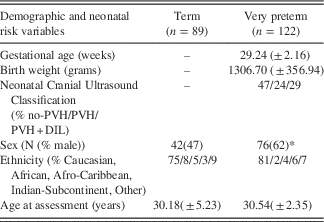
Demographic and neonatal risk variables (for the very preterm group only) are presented in Table 1. The very preterm group contained significantly more men than the term-born group (χ2=4.76; df=1; p=.029).
Neonatal and demographic variables for study participants

Note. Means and standard deviations (±) are presented, unless otherwise specified. *p<0.05 using Student’s t-test, Pearson chi-square, or Fisher’s exact test as appropriate. Ultrasound Classification: no-PVH=normal neonatal cranial ultrasound; PVH=uncomplicated periventricular hemorrhage without ventricular dilatation; PVH+DIL=periventricular hemorrhage with ventricular dilatation.
Neurocognitive Test Performance
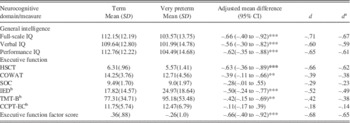
The very preterm group performed worse than controls on the majority of neurocognitive tests (Table 2). After adjusting for age and sex, differences at conventional thresholds of significance were observed for the following individual executive function tests: the HSCT, COWAT, IED, and TMT-B. PCA results conducted on all six executive function tests indicated that the best model involved just one component, including the HSCT, COWAT, SOC, IED, and TMT-B tests. The Kaiser-Meyer-Olkin measure of sampling adequacy was .73, Bartlett’s test of sphericity was significant (χ2 (10, N=211)=139.90, p<.01), and all communalities were above .3. This single component accounted for 43% of the variance in test performance. Factor scores for this component are also detailed in Table 2, with the very preterm group displaying significantly lower scores than controls.
Neurocognitive test scores for study participants

Note. Raw scores are presented as means and standard deviations. Mean differences are all standardized scores (mean=0; SD=1). Effect sizes are calculated with Cohen’s d. Results are adjusted for age and sex.
a Higher scores indicate better performance except where indicated: *p≤0.05, **p≤0.01, ***p≤0.001.
b Effect sizes, excluding participants with cerebral palsy or a neurosensory disability, are calculated with Cohen’s d. Results are adjusted for age and sex.
HSCT=Hayling Sentence Completion Test; COWAT=Controlled Oral Word Association Test; SOC=Stockings of Cambridge; IED=Intra-Extra Dimensional Shift; TMT-B=Trail Making Test Part B; CCPT-EC=Conner’s Continuous Performance Test–Errors of Commission, Executive Function.
Achievement Measures
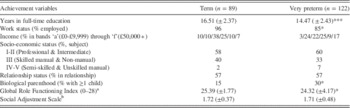
Real-life achievement measures are detailed in Table 3. The very preterm group was significantly less educated (t=6.13; df=192.63; p<.01), had a lower employment rate (χ2=5.80; df=1; p=.016) and had worse GRFI scores (t=2.54; df=173.68; p=.012) compared to controls. A higher proportion of very preterm adults had become biological parents (χ2=6.05; df=1; p=.014).
Achievement variables for study participants

Note. Means and standard deviations (±) are presented, unless otherwise specified. Results are adjusted for sex. *p≤0.05 and ***p≤0.001 using Student’s t-test, Pearson chi-square, or Fisher’s exact test as appropriate.
a Cohen’s d=-0.33.
b Cohen’s d=0.03.
Association Between Neurocognitive Test Scores and Life Achievement Measures
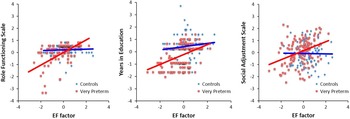
Results show that executive function score in the very preterm group had a stronger positive association with real-life achievement measures than in the control group (Figure 1). Specifically, executive function was significantly associated with scores on the Role Functioning Scale (β=.49; t=3.52; df=169; p<.01), years of education (β=.24; t=2.06; df=205; p=.04), scores on the Social Adjustment Scale (β=–.46; t=−3.27; df=205; p<.01), and participants’ work status (β=−1.97; t=−3.09; df=177; p<.01).
There was a significant association between IQ and years in education, independently of executive function, in the whole sample (β=.47; t=5.24; df=205; p<.01).
Associations between executive function and real-life achievement in very preterm participants (and term-born controls as comparison).

Neurocognitive Performance in the Very Preterm Group After Removal of Cases With Cerebral Palsy and Other Neurosensory Impairments
Results remained unchanged after excluding very preterm individuals who had cerebral palsy or another neurosensory disability.
DISCUSSION
Very preterm adults performed worse than full-term controls on measures of executive function and IQ with moderate to large effect sizes. Similarly, they also showed poorer real-life achievements than controls: they were significantly less educated, had poorer overall social and occupational functioning, and had a lower employment rate. Executive function performance in the preterm group independently of IQ had a stronger positive association with real-life achievement measures than in the control group, indicating how crucial these skills are for everyday functioning.
The current results are similar to previously reported findings, which indicated that individuals who were born very preterm performed worse than full-term controls on neurocognitive measures in childhood, adolescence, and young adulthood (26 years old) (Aarnoudse-Moens, Weisglas-Kuperus, Duivenvoorden, van Goudoever, & Oosterlaan, Reference Aarnoudse-Moens, Weisglas-Kuperus, Duivenvoorden, van Goudoever and Oosterlaan2013; Burnett et al., Reference Burnett, Scratch and Anderson2013; Eryigit Madzwamuse et al., Reference Eryigit Madzwamuse, Baumann, Jaekel, Bartmann and Wolke2015). However, executive function abilities, which are subserved by the frontal lobe, are believed to continue to develop until the third decade of life (De Luca et al., Reference De Luca, Wood, Anderson, Buchanan, Proffitt, Mahony and Pantelis2003; Petanjek et al., Reference Petanjek, Judas, Simic, Rasin, Uylings, Rakic and Kostovic2011); hence, it has been difficult to ascertain whether the impairments described in younger very preterm populations persist into adulthood or ameliorate with time (Luu, Ment, Allan, Schneider, & Vohr, Reference Luu, Ment, Allan, Schneider and Vohr2011).
Here we found that adults over the age of 30 who were born very preterm continue to demonstrate lower neurocognitive scores compared to full-term controls. These include lower scores on both IQ subtests (Verbal IQ and Performance IQ) and on several executive function tasks, which may suggest a global, rather than a specific, cognitive problem (Lohaugen et al., Reference Lohaugen, Gramstad, Evensen, Martinussen, Lindqvist, Indredavik and Skranes2010; Wolke & Meyer, Reference Wolke and Meyer1999). Despite evidence of a global impairment, very preterm adults appeared to experience difficulties in specific executive function domains, such as response initiation and suppression, verbal fluency, visual attention, and set shifting. These findings extend previous work demonstrating similar difficulties (Aarnoudse-Moens, Smidts, et al., Reference Aarnoudse-Moens, Smidts, Oosterlaan, Duivenvoorden and Weisglas-Kuperus2009; Anderson & Doyle, Reference Anderson and Doyle2003; Mulder, Pitchford, Hagger, & Marlow, Reference Mulder, Pitchford, Hagger and Marlow2009) including in the current sample when participants were in their early twenties (Nosarti et al., Reference Nosarti, Giouroukou, Micali, Rifkin, Morris and Murray2007, Reference Nosarti, Nam, Walshe, Murray, Cuddy, Rifkin and Allin2014), suggesting a developmental stability into adulthood (Breeman, Jaekel, Baumann, Bartmann, & Wolke, Reference Breeman, Jaekel, Baumann, Bartmann and Wolke2015).
There were no statistically significant group differences in measures of rule acquisition and reversal and in a task involving spatial planning. Further work is required to understand whether these findings may suggest a very preterm profile in which only some aspects of executive function are affected (Aarnoudse-Moens, Duivenvoorden, Weisglas-Kuperus, Van Goudoever, & Oosterlaan, Reference Aarnoudse-Moens, Duivenvoorden, Weisglas-Kuperus, Van Goudoever and Oosterlaan2012) or whether this variance may be attributed to methodology (i.e., tasks chosen) (Mulder et al., Reference Mulder, Pitchford, Hagger and Marlow2009). Although further studies are required, there is evidence to suggest that a global executive function impairment is related to neonatal brain injury such as white matter alterations, which can affect up to a fifth of preterm individuals (Cheong et al., Reference Cheong, Thompson, Wang, Hunt, Anderson, Inder and Doyle2009; Woodward, Clark, Bora, & Inder, Reference Woodward, Clark, Bora and Inder2012).
Similarly, recent studies undertaken with subsamples of this cohort, demonstrated significant associations in the very preterm group between EF ability and alterations in cortical maturation between mid- to late-adolescence in temporal, occipital and parietal cortices (Nam et al., Reference Nam, Castellanos, Simmons, Froudist-Walsh, Allin, Walshe and Nosarti2015) and in basal ganglia connectivity at age 30 (Karolis et al., Reference Karolis, Froudist-Walsh, Brittain, Kroll, Ball, Edwards and Nosarti2016). A further study showed altered neural activity and working memory (Froudist-Walsh et al., 2015). Therefore, it seems plausible that the neurocognitive deficits seen here may be at least partly explained by underlying neurodevelopmental alterations.
Considering the importance of executive function abilities for real-world functioning (Salthouse, Reference Salthouse2012), our finding of a significant relationship between executive function and adult achievement are perhaps unsurprising. Executive function deficits are associated with worse school functioning, including poorer attention and math skills (Aarnoudse-Moens et al., Reference Aarnoudse-Moens, Weisglas-Kuperus, Duivenvoorden, van Goudoever and Oosterlaan2013), which have direct consequences on adult achievements (Basten et al., Reference Basten, Jaekel, Johnson, Gilmore and Wolke2015). Hence, the findings presented here may be a result of a cascade of effects that include executive function deficits and worse academic performance that may each contribute to social opportunities and achievement in adulthood. Moreover, the stronger association between executive function and achievement detected in the very preterm group may emphasize the importance of executive function for everday life (Burnett et al., Reference Burnett, Scratch and Anderson2013); thus, even subtle impairments may have a disporpotionate impact on real-life functioning.
Indeed, our results showed that very preterm individuals had spent less time in education (Aarnoudse-Moens, Weisglas-Kuperus, van Goudoever, & Oosterlaan, Reference Aarnoudse-Moens, Weisglas-Kuperus, van Goudoever and Oosterlaan2009; Burnett et al., Reference Burnett, Scratch and Anderson2013; Hack, Reference Hack2009) and had lower rates of employment, a finding that has, however, not been consistently reported (Hack, Reference Hack2009; Saigal et al., Reference Saigal, Stoskopf, Streiner, Boyle, Pinelli, Paneth and Goddeeris2006). We also found lower interviewer-rated scores on a measure of adult functioning in areas such as work productivity and quality of social relationships, but not in self-rated social adjustment (SAS-SR). One possible explanation for this discrepancy may be a self-reported bias, whereby very preterm individuals perceive themselves as functioning better than others do (Saigal et al., Reference Saigal, Feeny, Rosenbaum, Furlong, Burrows and Stoskopf1996).
Despite this, those very preterm individuals who were employed did not earn less than their full-term counterparts, and a similar proportion of very preterm adults and term-born controls were in relationships; findings contrary to the literature (Lindstrom et al., Reference Lindstrom, Winbladh, Haglund and Hjern2007; Moster et al., Reference Moster, Lie and Markestad2008; Swamy, Ostbye, & Skjaerven, Reference Swamy, Ostbye and Skjaerven2008; Winstanley, Lamb, Ellis-Davies, & Rentfrow, Reference Winstanley, Lamb, Ellis-Davies and Rentfrow2015). The very preterm group also had higher rates of biological parenthood, which may reflect the fact that very preterm individuals are likely to have children at a slightly earlier age than their term-born controls (Mathiasen, Hansen, Nybo Anderson, & Greisen, Reference Mathiasen, Hansen, Nybo Anderson and Greisen2009). Early biological parenthood may be related to poorer achievement, such as fewer years of education and lower work status (Cooke, Reference Cooke2004), but also to findings that very preterm adults display reduced risk-taking behaviors including having multiple partners (Cooke, Reference Cooke2004; Saigal et al., Reference Saigal, Day, Van Lieshout, Schmidt, Morrison and Boyle2016), and that they rate the quality of their existing relationships as being highly satisfying (Hallin, Hellström-Westas, & Stjernqvist, Reference Hallin, Hellström-Westas and Stjernqvist2010; Winstanley et al., Reference Winstanley, Lamb, Ellis-Davies and Rentfrow2015).
Our result of a stronger association between executive function deficits and poorer real-life achievements in very preterm adults compared to controls enhances the current understanding of the mediating factors underlying the social and economic risk following very preterm birth. While acknowledging that no single factor is likely to be a sole predictor of overall life achievement, the fact that executive function scores proved so crucial in the current analysis may have important implications. Executive function abilities could represent ideal targets for intervention as they are potentially malleable (Dahlin, Nyberg, Backman, & Neely, Reference Dahlin, Nyberg, Backman and Neely2008; Hsu, Novick, & Jaeggi, Reference Hsu, Novick and Jaeggi2014), relying on brain regions such as the prefrontal cortex, which show protracted developmental change compared to other brain regions (Petanjek et al., Reference Petanjek, Judas, Simic, Rasin, Uylings, Rakic and Kostovic2011), thus leaving a longer window of opportunity for improvement (Nosarti & Froudist-Walsh, Reference Nosarti and Froudist-Walsh2016).
Therefore, the most immediate implication of our study is the requirement for research to investigate the efficacy of targeting executive function in very preterm individuals with appropriate strategies (i.e., cognitive training) and the concomitant effects of this on broader indices of achievement and function. Recent findings indicate that training has led to an improvement in working memory in very preterm samples (Grunewaldt, Lohaugen, Austeng, Brubakk, & Skranes, Reference Grunewaldt, Lohaugen, Austeng, Brubakk and Skranes2013; Lohaugen et al., Reference Lohaugen, Antonsen, Haberg, Gramstad, Vik, Brubakk and Skranes2011), although the potential benefits of cognitive training for real-life functioning are yet to be investigated.
Limitations of this study include the fact that the very preterm individuals we studied were born in the late 1970s and may have displayed deficits in adulthood that are not representative of very preterm cohorts born in more recent years (Basten et al., Reference Basten, Jaekel, Johnson, Gilmore and Wolke2015), due to advances in neonatal care. Similar to other longitudinal studies, attrition is a critical limitation; participants studied here are a subset of the original cohort. However, participants in the current study did not differ from those who did not attend in terms of birth weight and were born at only a slightly younger gestational age.
A further limitation is that the current very preterm participants are relatively “high-functioning” as they had mean IQ scores within the average range, while being lower than those obtained by controls, in line with results of other studies (Allen, Cristofalo, & Kim, Reference Allen, Cristofalo and Kim2010). Hence, we examined the associations between executive function score, independently of IQ, and measures of real-life achievement. The current preterm participants were recruited from a major teaching hospital in central London, which encompassed several “wealthy” geographical catchment areas. Previous studies examining the current preterm cohort have found no differences in parental SES compared to controls (Nosarti et al., Reference Nosarti, Giouroukou, Micali, Rifkin, Morris and Murray2007), which supports the notion that executive functions may have a unique role in determining life achievement. Lastly, the examiners were not blind to the participants’ group membership, which may have biased some results. However, the majority of tasks are completed independently of the assessor or administered using a script (such as the IQ assessment).
Conclusions
The main hypothesis of this study was supported; cognitive deficits are evident in adulthood and may be partly accountable for the lower levels of real-life achievement seen in very preterm survivors. These results highlight the need to investigate the multifactorial underpinnings of achievement in very preterm populations and further studies are required to ascertain how specific factors may influence outcomes. Our findings emphasize the need for cognitive remediation programs to be delivered to vulnerable groups, which thus far have targeted specific executive function components (e.g., working memory, cognitive control), and may one day show generalizable benefits for a successful overall life adjustment.
Acknowledgments
We thank our study participants for their continuing help. We also thank the National Institute for Health Research (NIHR) Biomedical Research Centre at South London and Maudsley NHS Foundation Trust. The study was funded by the Medical Research Council, UK (ref. MR/K004867/1). The authors have no financial relationships relevant to this article to disclose. The authors have no conflicts of interest relevant to this article to disclose.