Many third-party attempts for settling disputes do not consist of just one mediator, but a coalition of mediators who intervene simultaneously.Footnote 1 The mediation effort of the Contact Group, i.e., the United States, Russia, France, Britain and Germany, to settle the conflict in Bosnia in 1994 provides one example out of many. When studying the effectiveness of these mediation efforts, however, the previous literature largely ignored how ‘multiple mediators’ interact with each other and co-ordinate their intervention. So far, scholars have preferred to focus on the relations both between the warring parties and actors who either have mediated in the past or potentially will in the future.Footnote 2 Very little research tries to answer the question how ‘multiparty mediation’, i.e., those mediation attempts that involve multiple interveners, influence conflict settlement outcomes in a systematic way.Footnote 3
Nonetheless, disaggregating intervening coalitions and ‘opening the black box’ of those mediation attempts seem an effort worth making, since combined mediation attempts are likely to be different from intervention with a single mediator.Footnote 4 Mediators are driven by their own incentives, constrained by their own domestic factors and are tied to each other through various kinds of relationships. They share information and resources, and pursue other means of synchronizing and/or integrating activities. The Contact Group, for example, used the combined leverage of resources, intelligence and logistics to enhance the effectiveness of its intervention. However, a coalition of interveners may increase the complexity of the mediation process, leading to unanticipated co-ordination and collective action problems, which ultimately can induce a serious deterioration in the overall conflict situation. The crisis in Burundi in the 1990s provides an example of this:Footnote 5 the sheer number of intervening third parties, i.e., the United Nations (UN), the European Union or the Arusha Group of states, eventually undermined official claims that the international community itself wanted peace, since the interests, motivation and agendas of each of the mediators did not necessarily overlap. The UN Secretary-General Ban Ki-Moon emphasized accordingly: ‘Multiple actors competing for a mediation role create an opportunity for forum shopping as intermediaries are played off against one another. Such a fragmented international response reinforces fragmentation in the conflict and complicates resolution’.Footnote 6
In other words, there are numerous examples of conflict resolution, where a coalition of mediators either was effective or was unsuccessful in settling a dispute. Although intervention with more than one mediator can make these attempts ultimately more synergetic, it may also create conflicts among the third parties that actually hamper effective dispute management. While such problems have frequently been noted, we still lack good answers for why this may occur. Comprehensive studies seeking to address this question both theoretically and in a rigorous empirical way are surprisingly rare. At the same time, the existing literature on multiparty mediation produced many contradictory claims about its effectiveness and overly derives its conclusions from single case studies. Beardsley and Greig consequently emphasize that there is not yet ‘a clear understanding of the degree to which the presence of multiple mediators improves or detracts from the conflict management process’.Footnote 7
As one of the first steps towards filling this gap, this article develops a new theoretical framework that approaches the existing claims analytically by drawing on the concepts of collective action and recent work on collaboration as well as democracy. More specifically, I first examine the size of an intervening group and argue that size and mediation effectiveness are characterized by an inverted U-shaped relationship. More mediators are generally able to create synergy due to combined efforts, making them more effective than a single third party.Footnote 8 Yet a very large number of interveners implies higher organizational costs and greater heterogeneity of interests.Footnote 9 This increases the chances that co-ordination and collective action problems exist, which ultimately lower the prospects for effective mediation. Secondly, I analyse multiparty mediation through conflicting relationships and co-operative interaction between the interveners. Mediators sharing a history of conflict and distrust will transfer these past relationships to a mediation attempt, making these interveners less likely to be effective. Consequently, states having friendly and co-operative interaction with each other are likely to be more effective in managing conflicts peacefully due to higher communication flows, more trust and lower transaction costs.Footnote 10 Finally, I examine the impact of interveners’ regime types on mediation success. A coalition of mediators that is largely democratic should be more effective, since these mediators are characterized by a shared culture of peaceful conflict resolution, inclusivity and increased communication flows.Footnote 11
This research has important theoretical and empirical implications beyond the usual scope of work on international mediation. Little systematic work has examined multiparty mediation, and a better understanding of how combined mediation efforts can influence conflict resolution may help policy makers use third-party mediation more successfully. Knowing in advance when co-operation with some states might create synergies and, conversely, when joint mediation is unlikely to be successful can make a crucial contribution to how decision makers perceive multiparty mediation. Furthermore, this article's theoretical framework introduces new concepts to the study of mediation, adding to the empirical findings that might influence the rich literature on collective action and its related problems for conflict and co-operation between actors. I will return to these topics in greater detail in the analysis section and the conclusion.
In the remainder of the article, I first review the relevant literature on multiparty mediation in conflict resolution attempts and highlight the many contradictory claims about its effectiveness. I then develop a theoretical framework in order to approach these claims analytically, drawing on the concepts of collective action and group size, collaboration via conflict and co-operative interaction as well as regime type. Afterwards, I detail the research design and, employing data from the Issues Correlates of War Project (ICOW)Footnote 12 for 1965–2000, test the theory empirically. The empirical analysis and the robustness checks largely provide support for the theory, but also show that both conflicting relations between the interveners and more democratic mediation coalitions do not seem to be crucially important for settling conflicts peacefully. The article concludes with a comprehensive discussion about its findings, the implications for policy makers and the avenues for future research.
Literature review
The following research disaggregates mediating coalitions by examining how third parties interact with one other and how this may influence the outcome of mediation attempts. As stated above, when studying this process, I use the term ‘multiparty mediation’,Footnote 13 which can be defined as ‘information sharing, collaborative analysis and strategizing, resource sharing, formal partnerships and other means of synchronizing and/or integrating activities to make own individual efforts more effective together as interconnected pieces of a larger peace process’.Footnote 14 Building upon this definition, the previous research, although being sparse and mostly qualitative in its nature, has produced an interesting body of insights.
The most extensive studies on multiparty mediation have been conducted by Crocker, Hampson and Aall.Footnote 15 These scholars approach multiparty mediation in a threefold manner. First, there is simultaneous intervention by multiple mediators who do not necessarily co-ordinate their efforts. Secondly, conflicts may see sequential mediated intervention that involves more than one third party. Finally, there are composite actors such as coalitions of states.Footnote 16 In this study, I primarily focus on the third ‘composite’ category where third parties actually form a coalition and seek to represent a single interest.Footnote 17
Crocker, Hampson and Aall are aware of the potential of intervention conducted by more than one mediator. First, their structural theoretical argument suggests that multiparty mediation implies smaller shares of the fiscal burden and the political risk for each member of this coalition. These actors can further pool resources and skills and, thus, in principle have more leverage than a single intervener. Ultimately, this should make a multiparty mediation more effective than single-party interventions. For example, Argentina, Brazil, Chile and the United States formed a mediating coalition in 1995 to resolve the boundary dispute between Peru and Ecuador. Crocker, Hampson and Aall highlight that peace was eventually established due, in particular, to the combined leverage of these four powerful countries.Footnote 18
Secondly, multiparty mediation can create effective outcomes as ‘the lead mediator gains the benefit of the partners’ insights, relationships, credibility, resources, diplomatic “reach”, and political “balance”. Broadening, when successful, isolates the spoilers and “rejectionists” common to most conflict situations’.Footnote 19 The process that led to the Oslo Peace Accords, for example, was a successful multiparty mediation effort in which the Norwegian mediators could draw upon the insights of their American partners.Footnote 20 More specifically, the formal and public mediation led by the United States was on the verge of failing as both Palestinians and Israelis were unwilling to take any risks and – in the light of media attention – feared exposure. Accordingly, Norway – with the full backing of the United States – opened up confidential channels that directly circumvented these constraints.
These two conditions, however, require that the members of a mediating coalition largely share similar goals and are willing to work together.Footnote 21 They further have to maintain coherence, co-ordinate and sequence their initiatives, as well as have staying power over the process.Footnote 22 Garb and Nan emphasize that these factors positively influenced the establishment of conflict resolution networks in the Georgian–Abkhaz peace intervention.Footnote 23 However, since Garb and Nan derive their conclusions from a single case, it is difficult to know whether the findings also apply to other instances of multiparty mediation. Similarly, Strimling argues that some level of co-ordination between mediators is a necessary requirement to achieve effective outcomes.Footnote 24 She categorizes mediators’ interaction along the clusters of communication, co-ordination, collaboration and integration. For example, higher forms of communication and co-ordination increase the understanding and efficacy of resource allocation. Strimling's analysis lacks empirical evidence, though, and she consequently highlights that ‘there is need for … much more rigorous empirical research on the impacts of cooperation’.Footnote 25
By contrast, and as the title of their book Herding Cats implies, Crocker, Hampson and AallFootnote 26 are rather sceptical of multiparty mediation attempts. The authors emphasize that caveats of multiparty mediation may be higher complexity and costs, more difficulties in maximizing leverage and potentially conflicting agendas.Footnote 27 Put differently, multiparty mediation may lead to serious co-ordination problems and a lack of transparency over the allocation of responsibilities: ‘Problems of handoff between one peacemaker and the next are all too frequently encountered when different mediators try to engage parties in negotiations over a prolonged period of time … During this period, misunderstandings and conflicting interpretations about implementation are common’.Footnote 28 The implementation of the Bicesse Accords in Angola between 1991 and 1993, for example, saw multiple mediators from the United States, Portugal, Russia or the Organization of African Unity who were able neither to effectively co-ordinate their intervention nor to agree on a consistent and coherent agenda for peace.
Summing up, existent research on multiparty mediation has identified crucial aspects of this complex phenomenon, but often merely describes multiparty mediation processes and so systematic work remains rare. There are many contradictory claims about the effectiveness of multiparty mediation, and researchers have often tended to derive overly strong conclusions from single case studies. I will address this shortcoming in the next sections by developing a theoretical framework of multiparty mediation and its impact on effectiveness. More specifically, I offer a new way to interpret the many opposing arguments on mediating coalitions by focusing on public choice approaches as well as recent work on collaboration and democracy.
Theoretical framework: the impact of multiparty mediation – size, conflict, co-operation and regime type
Size
As stated above, one stream in the mediation literature generally argues that a coalition of mediators is more likely than a single intervener to establish a stable peace agreement.Footnote 29 First, Touval and Zartman emphasize that ‘third parties are only accepted as mediators if they are likely to produce an agreement or help the parties out of a predicament and for this they usually need leverage’.Footnote 30 Owing to the combined leverage of a mediating coalition, multiparty mediation can then create obligations and expectations that help enforce compliance. A single mediator often lacks the required leverage to solve conflicts effectively and peacefully. Secondly, states that form part of a mediating coalition have connected issues and interests. This establishes trust, which is a crucial element for overcoming collective action problems and being ultimately more effective in settling disputes. Finally, interacting third parties usually interact more often and more intensively, which facilitates co-ordination and decreases uncertainty.Footnote 31 However, I contend that it is likely that there are decreasing returns with respect to higher levels of mediation effectiveness arising from higher leverage. In other words, multiple mediators are only to a certain extent more effective than a single third party. Mediating parties vary in terms of their leverage and the larger a coalition of mediating states, the higher the likelihood of unanticipated problems hindering co-ordination, which ultimately may cause a sufficiently large coalition of mediators not to contribute significantly more to effective outcomes than a smaller set of interveners would have done.Footnote 32
Public choice theorists argue here that the complexity or organizational costs for providing a public good – in this case global or regional peace – increase with a larger number of actors.Footnote 33 Organizational costs increase with group size in two different ways. First, the larger a group of states try to settle a conflict peacefully, the more likely it is that the intervening coalition is characterized by a greater heterogeneity of interests.Footnote 34 This, in turn, makes it more difficult, both for the mediators and the belligerents, to reach any agreement at all or anything beyond a minimal consensus. Secondly, states can participate in mediation efforts without contributing much or anything at all, yet still obtain the reputation of a peaceful broker afterwards. Beardsley argues in a similar way when suggesting a collective action problem in which the presence of multiple third parties with the potential to offer mediation reduces the likelihood that any mediation will take place at all.Footnote 35 Under these circumstances, enforcement through monitoring and/or sanctioning is essential in order to prevent states from free-riding on other states’ mediation efforts.Footnote 36 Monitoring procedures ensure that contributions become perceptible for the intervening coalition. In addition, only the prospect of detecting non-contributions to an effort of international mediation allows states to sanction defectors accordingly.Footnote 37 However, with an increasing number of mediators, it is more costly to organize monitoring devices that provide perceptibility of individual contributions, and therefore enforcing actors’ compliance becomes less likely to succeed.Footnote 38
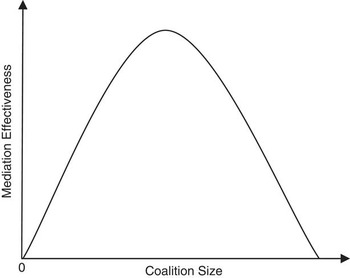
To recapitulate, my argument on the impact of coalition size on mediation effectiveness centres on a mediating coalition's leverage and organizational costs. I contend that greater size will increase leverage, but also increase organizational costs. In other words, I expect to find an inverted U-shaped relationship between coalition size and mediation effectiveness, as depicted graphically in Figure 1.Footnote 39 More formally, I postulate the following hypothesis:
Expected impact of coalition size on mediation effectiveness

HYPOTHESIS 1. The size of an intervening group and mediation effectiveness are characterized by an inverted U-shaped relationship: both small and very large groups are less likely than medium-sized intervening coalitions to mediate disputes effectively.
Conflicting and Co-operative Interactions
The overview of the literature showed that previous work on multiparty mediation effectiveness emphasized the maintenance of coherence and co-ordination between the coalition members. However, previous research did not unpack this mechanism. In order to address this in my theoretical framework, I focus on the interactive ties between mediators in a coalition. In more detail, states in the international system are tied to each other in multiple forms. Countries may have good and friendly relations with each other for decades, but they could also share a relationship of common distrust, hostility and war instead. In turn, this implies that states’ interaction in the past may increase understanding of countries’ future behaviour and its impact on mediation effectiveness.Footnote 40
Before examining the likely impact of mediators’ conflicting or co-operative interaction on mediation effectiveness, however, we first need to define the actual concept in question. Crescenzi and Enterline elaborate the underlying causal mechanisms of interstate interaction along four dimensions.Footnote 41 First, according to ‘accumulation’, if states interact frequently, then the relationship is well defined, but further interaction also has a decreasing marginal effect. Secondly, the duration between specific interaction events matters. The longer the time lapse before a new interaction between states occurs, the less related they are and the more likely it is that these events will be independent of each other. Thirdly, the intensity or degree of interstate interaction determines the impact of these relations. For example, a simple trade dispute is likely to have a significantly smaller impact on future interaction than a previous full-scale war. Finally, the intensity of states’ interaction may change over time. The last interactive event between states does not disappear immediately, but gradually diminishes over time. As a result, interaction between states lasts for a certain period, albeit with a different degree of intensity.
Defining mediators’ interaction along those four dimensions demonstrates that interaction does not occur in a historical vacuum, varies over time and may well have different effects on states’ behaviour depending on its intensity. Against this background, I can formulate the argument on states’ conflicting or co-operative interaction and their impact on mediation effectiveness quite simply now. If states negotiate with each other or, as in the focus of this study, a coalition of countries tries to mediate conflicts, their decisions and the likelihood of certain outcomes are ‘conditioned to some extent by the prior relationship’.Footnote 42
On the one hand, mediators sharing a history of conflict and distrust will convey this relation into the mediation process. If states in multiparty mediations are connected via ‘negative’ ties, it is rather unlikely that they will be able to establish a culture of co-ordination, but will face communication and co-ordination difficulties instead.Footnote 43 This makes these mediators less likely to be effective. Coming back to the Contact Group, for example, its initial mediation efforts have seen severe setbacks due to the aloofness of the Americans towards the Russians and vice versa. This argument enables me to formulate the next hypothesis:
HYPOTHESIS 2a. The more conflicting the interactions between states in a mediating coalition, the less effective the mediation attempt.
On the other hand, a coalition of countries sharing friendly and co-operative ties with each other is likely to be more effective in managing conflicts peacefully. Those ‘positive’ ties between interveners should enhance communication flows and resource sharing as well as facilitate a common understanding of how to mediate effectively.Footnote 44 Furthermore, states that previously shared co-operative relationships with each other are likely to have encountered similar negotiation situations as mediation bargaining processes earlier. They are, therefore, familiar with the counterpart's intentions, preferences and incentives. This ultimately helps save transaction costs between the mediators, increases the co-operative efforts and may well induce synergy – despite possible collective action problems as outlined above.Footnote 45 My hypothesis on co-operative interactions in multiparty mediation efforts argues accordingly:
HYPOTHESIS 2b. The more co-operative interactions there are between states in a mediating coalition, the more effective the mediation attempt.
Regime Type
The final core variable of the theoretical framework pertains to interveners’ regime type in a mediating coalition. Drawing upon the democratic peace literature,Footnote 46 democracies have a common structural background and a common political culture, which gives these kinds of regimes more inclusivity, a higher level of transparency and it promotes a common understanding that induces shared norms. One of the most important norms of democracies is the peaceful resolution of conflicts.Footnote 47 This should make democratic belligerents not only more likely to settle their disputes peacefully, but also have an impact on the efforts of democratic mediators. For example, Dixon contends that democracies will be more successful in dispute settlement, since they operate under a norm of bounded competition that favours the use of compromise and non-violence.Footnote 48 When intervening, democracies seek to follow these principles. Similarly, democratic interveners all share, practise and understand concepts such as limited governments, respect for judicial practices as well as constitutional constraints.Footnote 49 Owing to their previous, long-lasting practice and experience with these issues, democracies will be more likely to settle disputes effectively than (largely) autocratic coalitions, which are not familiar with them.
In addition, the inclusivity and transparency of democratic systems allows enhanced communication flows between these sorts of regimes, which facilitates the resolution of collective action problems in a mediating coalition and, ultimately, makes the mediators more effective in co-operating with each other. As indicated above, mediators having more information about each other will ultimately face less uncertainty and thus perceive their fellow mediators as more trustworthy.Footnote 50 This is crucial against the background that effective conflict resolution depends on the ‘credible and truthful transmission of information’Footnote 51 – especially towards the belligerents as they primarily demand mediation from states they can trust.Footnote 52 By contrast, the promises of autocracies are less likely to be credible, since there is an ‘insecure hold of power and the absence of an heir’.Footnote 53 Finally, increased flows of information allow democracies to co-ordinate their efforts and resources more effectively.Footnote 54 Unlike autocracies, democracies tend to have transparent, open systems, which increase the likelihood that those regimes know about each other’s ‘internal evaluations, their intentions, the intensity of their preferences, and their willingness to adhere to an agreement even in adverse future circumstances’.Footnote 55
In short, mediating coalitions that mainly comprise democratic states are characterized by high levels of communication, co-ordination, collaboration and integration. These are precisely the four factors that Strimling highlights for multiparty interventions to be successful.Footnote 56 Above all, however, (largely) democratic coalitions should all share, practise and understand the norms of peaceful conflict management. Therefore, my last hypothesis claims:
HYPOTHESIS 3. The more democratic a coalition of mediating states, the more effective is the mediation attempt.
Research design
Data
I define mediation as a ‘mode of negotiation in which a third party helps the parties to a dispute find a solution which they cannot find by themselves’.Footnote 57 Consequently, I consider all kinds of voluntary, non-coercive third-party interventions of states such as facilitation, good offices or conciliation as mediation attempts. Cases that involve more than one third party via a coalition formation are treated as multiparty mediation attempts and I drop pure military interventions or bilateral conflict managements.Footnote 58
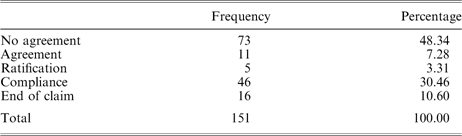
I employ data from the Issues Correlates of War (ICOW) project.Footnote 59 The ICOW data cover territorial claims and maritime claims in the Western Hemisphere and Western Europe, as well as river claims in those two regions plus the Middle East. Claims are identified according to explicit evidence of contention involving official representatives of two or more nation states over the issue type in question. My unit of analysis is a contentious issue claim with a third-party mediation attempt, while the temporal domain of my study is from 1965 to 2000 due to data constraints. To illustrate this with an example, the ICOW data list sixteen mediation attempts – either single-party mediation or multiparty mediation attempts – for the Falklands War between Argentina and the United Kingdom. Thus, I consider all sixteen settlement attempts for my analysis, while each mediation is a separate observation. In total, I obtain 151 contentious issues with settlement efforts over fifty-five territorial issues, twenty-two river claims and seventy-four dyadic maritime claims in the period under study.
The data are essentially cross-sectional. However, some temporal dependence may persist in claims for a specific dyad, as subsequent interventions or settlement attempts are unlikely to be independent from previous conflict management efforts. To address this problem, I cluster the standard errors on claims per dyad and consider a duration variable that is specified below.
Dependent Variable
The dependent variable measures the effectiveness of third-party settlement attempts along five categories. First, the third-party mediation may be completely ineffective and there is no agreement among the belligerents. Secondly, the antagonists may be able to reach an agreement with the help of third parties, but at least one of the disputants does not ratify the treaty. Thirdly, although there is an agreement that addresses the issues that led to the dispute in the first place, at least one of the belligerents does not comply with it. Fourthly, although all of the warring parties comply with the agreement that was reached, this still may not end the claim. Finally, if all conflict states comply with an agreement and the claim is ended, then the effectiveness of a third-party intervention is considered to be at its maximum. Since the dependent variable follows an ordinal scale, I use ordered probit regression models to test my hypotheses. Table 1 gives an overview about Effectiveness.
The Effectiveness of Third-Party Settlement Attempts, 1965–2000

Explanatory Variable
The core variables of interest follow the lines of my theoretical framework. First, I consider a binary variable that indicates whether a conflict attracted multiparty mediation or not. This not only gives me leverage for comparing single and multiparty conflict management interventions, but also tests the literature's naïve, non-disaggregated claim on multiparty mediation effectiveness. In my sample, fifty-two settlement attempts (34.44 per cent) saw multiparty mediation, while ninety-nine cases (65.56 per cent) were mediated by a single third party. Following my reasoning, I then disaggregate this variable to create an item counting the number of third parties that were simultaneously involved in an intervention. This variable ranges in the interval [1; 6]. I include its squared term in some models for testing my hypothesis on the inverted U-shaped relationship between coalition size and mediation effectiveness.
Secondly, in order to measure conflicting and co-operative interactions between states in third-party interventions, I rely on Crescenzi and Enterline's dynamic model of interstate interaction.Footnote 60 This model captures the four dimensions of interstate interaction, i.e., accumulation, temporal distance, degree and the rate of change, with two equations. First, we obtain a growth function:

where itg is the interaction level on the growth dimension – either co-operative or conflicting – for a particular dyad in a specific time unit t, it −1 signifies the dyad's interaction level in the previous period and β represents some pre-defined weight. Degree measures a dyad's current extent of interaction, while Temporal Distt is the time elapsed since the previous interaction occurred.Footnote 61
Secondly, interstate interaction is captured by a decay function:

where itd is the interaction on the decay dimension, Event History is the accumulation of occurrences of either conflict or co-operation between two states up to time t, Event Temporal Distt signifies the time that has passed since the last event and α weighs the relative impact of the two factors.Footnote 62 Combining the growth with the decay function results in the overall level of interaction between a dyad:

With these equations, I construct variables for both conflicting and co-operative interactions between states in mediating coalitions. The variable that measures conflict relations uses militarized disputes as the negative shocks to a dyadic relationship.Footnote 63 It is theoretically bounded in [−1; 0] and lagged one year to account for temporal dependency. In my sample, this variable varies from −0.24 to 0.00. The item for co-operative interactions among dyads relies on the mutual membership in intergovernmental organizations (IGOs).Footnote 64
The joint decision of a dyad to join the same IGO(s) in a given year operationalizes co-operative shocks. This variable is weighed by the number of other nations currently in the IGO, lagged by one year as well, and I employ a centred version of this item due to its high pairwise correlation with Size. The final item, Co-operation, ranges from −0.76 to 0.35 in my sample. Since both the variable on conflicting relations and the item on co-operative interaction measure in essence interstate interaction at the dyadic level, I operationalize the mean value for all possible dyads in a mediating coalition as the final variable. Mediation efforts that only saw one third party obtained the highest possible value for both conflicting interaction and co-operative relationships.
Thirdly, the overall level of democracy of a mediating coalition is measured by the average value of all intervening countries’ polity2 value from the Polity IV data,Footnote 65 ranging from −10 (full autocracy) to +10 (full democracy).
Although I am primarily interested in the impact of multiparty mediation, I have to control for variables along the other two conceptual clusters that influence the effectiveness of intervention attempts, i.e., variables pertaining to the warring parties as well as the dispute context and its characteristics,Footnote 66 in order to avoid omitting variables and thereby biased results. Further, including other determinants of mediation effectiveness controls for possible selection effects as well, since it may be that only certain types of conflicts actually see multiparty mediation. Hence, I consider the following variables: first, I include the belligerents’ regime types in order to address one of the most crucial aspects of the antagonists. As elaborated above, democracies have common structural backgrounds and share the norm of peaceful conflict resolution, which will also increase the chances that fighting parties settle their disputes more effectively.Footnote 67 The data are taken again from Polity IV,Footnote 68 using a weakest link specification where the least democratic country in a dyad determines the effectiveness of an outcome.
A second control captures another important characteristic of the fighting parties. Belligerents that approximate military parity, i.e., neither side has a clear military advantage, are less likely to settle disputed issues effectively.Footnote 69 Power discrepancies decrease the incentives for the most powerful country to agree to a peaceful settlement as it stands a better chance of winning the conflict militarily. Using data from the Correlates of War Project,Footnote 70 I include the natural log of the ratio of the stronger country's capability to that of the weaker country.Footnote 71
Thirdly, the intensity or the importance of an issue claim is operationalized by Salience, which measures the characteristics of the issue claim. As Hensel demonstrates, highly salient disputes are more difficult to resolve and are more likely to lead to a militarized dispute.Footnote 72 Following Hensel and Mitchell, the sample's variable ranges [2; 12], with higher values indicating greater salience.Footnote 73
Finally, I control both for the context of disputes and existing temporal dependence by including the duration of an issue claim. Settlement attempts are less likely to be effective in long-standing conflicts that have ‘witnessed a long history of mutual attack and atrocity’.Footnote 74 Hence, the longer the duration of a conflict, the less likely it is that it will end in an effective settlement.Footnote 75
Empirical findings
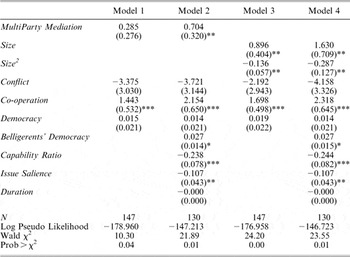
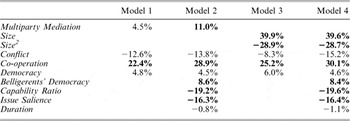
Table 2 displays the results of my analysis. I employ four models. First, the focus in Model 1 is on the effect of multiparty mediation per se and the remaining core explanatory variables. Secondly, in Model 2, I include the controls on the right-hand side of the model. Finally, Models 3 and 4 follow the same procedure as Models 1 and 2, but here I replace the naïve approach using a binary item with variables that are the size of an intervening coalition. Although the signs and standard errors of non-linear models’ coefficients can be interpreted directly, they cannot be considered as slopes or elasticities. Hence, to unveil the implied magnitude of my substantial findings, Table 3 reports the average change in the predicted probability across categories of Effectiveness as an explanatory variable changes from its minimum to its maximum (while holding all other variables at their means).
The Effectiveness of Multiparty Mediation, 1965–2000

Note: Cut points are not reported; clustered robust standard errors in parentheses; *Significant at 10 per cent; **significant at 5 per cent; ***significant at 1 per cent (two-tailed).
Predicted Probabilities of Mediation Effectiveness, 1965–2000

Note: Change of predicted probabilities of Effectiveness is shown for each independent variable when moving from the minimum to the maximum; all other variables held at their mean values; significant variables in bold.
Before turning to my core explanatory variables, I briefly discuss the results of the control covariates. Consistent with the previous literature that emphasized the importance of these variables,Footnote 76 most of these items appear to matter for mediation effectiveness. The signs of the belligerents’ level of democracy and the capability item have the expected direction, and are statistically significant at the 10 per cent level at least. Furthermore, Issue Salience has the expected negative sign and is significant at the 5 per cent level. When moving from the minimum towards the maximum of Issue Salience, for example, the predicted probability of reaching the most effective settlement decreases by about 16.35 per cent on average across each category of Effectiveness. However, the coefficient of Duration is approximately zero. The impact of this variable on the effectiveness of interventions is, therefore, only minor at best.Footnote 77
Turning to my variables of main interest, I largely find support for the hypotheses. In particular, Multiparty Mediation and Co-operation exert a positive influence on mediation effectiveness. Both variables are statistically significant with the exception of Model 1, where Multiparty Mediation does not even approach the 10 per cent level. Those two variables also have a substantively important influence on the dependent variable. Moving from the minimum to the maximum value of Multiparty Mediation increases the predicted probability to obtain a higher category of Effectiveness by about 7.75 per cent on average. Even more substantively strong, if interveners share good and friendly relations with each other, they tend to convey this culture of co-operation into the mediation process. The probability of effective conflict resolution is raised across each category of Effectiveness by about 26.65 per cent on average, if Co-operation changes from its lowest to its highest value. Hence, positive interactions among mediators, as measured by the joint decision of a dyad to join the same IGO(s) in a given year, are conveyed into multiparty mediations, making these efforts more effective.
If countries have had hostile and conflicting relations with each other before intervening in a dispute, then the conflict management outcome should be lower. Conflict actually has a highly negative impact. On average, the chances to see the most effective settlement of a dispute decrease by about 12.48 per cent across each category of Effectiveness, if Conflict changes from its lowest to its highest value. This substantive effect should be interpreted cautiously, however, due to the insignificance of this variable in all of my models. Comparing my findings for Conflict and Co-operation basically leads to the rather surprising conclusion that countries value co-operative relationships more than conflicting interactions. In other words, if states have had negative encounters in the past, it is apparently less likely that these experiences are seen as an obstacle for effective multiparty mediation. On the contrary, my results show that these conflicting relations are unlikely to matter at all. Note, however, that the insignificance of Conflict may be the result of selection effects. First, countries having (extremely) hostile relations with each other may not agree on mediating a dispute simultaneously in the first place. Secondly, when belligerents ask for mediation, they seek to address states that could favour their interests.Footnote 78 In other words, the antagonists seek to avoid a mediating coalition (or a single mediator) that is biased towards the dyadic counterpart as this would increase the chances that the mediation outcome might not favour them, but their opponent. Hence, fighting parties intend to establish a balance between mediators: the larger the bias of one mediator to a belligerent, the higher the likelihood that the opponent will ask for an additional state that represents its interest.Footnote 79 For example, over the course of the conflict between Israel and the Palestinian Liberation Organization (PLO), the former frequently asked the United States to mediate, while the PLO feared that the United States would merely mirror Israeli interests and therefore, also demanded that the Soviet Union should mediate. As a result, the United States and the Soviet Union formed mediating coalitions on various occasions such as during the 1991 peace conference in Madrid – despite their fairly uncooperative interactions. However, the influence of these multiparty mediations was low as there was basically no interference from the American and Soviet sponsors, while the belligerents limited themselves to planning future bilateral negotiations.Footnote 80 Furthermore, recall that I argued that mediators with a mutual history of conflict and distrust will convey this relation into the mediation process. Gent shows in this context that states with conflicting ties or diverging preferences are more likely to form a coalition in the case of military interventions.Footnote 81 Under those circumstances, conflicting ties may well cancel each other out, thereby leading to the overall insignificance of this item.
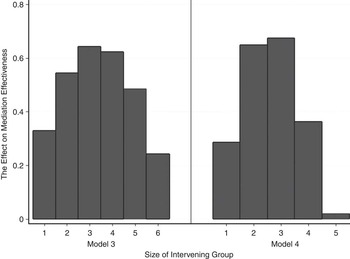
Most interestingly for my study, the results confirm the first hypothesis of a non-linear relationship between the size of an intervening group and mediation effectiveness, thereby rejecting the naïve claim that more mediators are always more effective. Figure 2 illustrates this relationship graphically. While the x-axis signifies the values of Size in Models 3 and 4, respectively, the predicted probabilities of seeing either value 3 or 4 on Effectiveness are shown at the y-axis. Table 2 shows furthermore, for example, that the turning point associated with the size of an intervening group lies at around 3.29 here (Model 4: 2.84). In other words, both very small and very large groups of interveners perform worst in settling disputes peacefully. On the one hand, one intervener on its own or two third parties that mediate may not have the necessary amount of leverage to create incentives for the disputants. On the other hand, although very large groups of mediators may have the necessary leverage, they are more difficult to organize and have a greater heterogeneity of interests, making them ultimately also less effective. This finding is robust over a wide variety of model specifications. Adding or suppressing controls from the model does not alter this result.
Inverted U-shaped relationship between coalition size and mediation effectiveness Note: Graph displays predicted probabilities for effective mediation attempts based on Models 3 and 4. All variables apart from Size and Size 2 are held at their means.

Finally, I hypothesized that a higher level of democracy on the intervening side would increase the chances that disputes are mediated effectively. Although the variable is positively signed, my findings are inconsistent with that logic. Increasing the interveners’ overall democracy score from its minimum to its highest value slightly raises the likelihood of more effectively mediated outcomes by 4.98 per cent on average, but the variable is insignificant in each model. This finding clearly shows that we have to examine the supply side of multi-mediation more carefully, because there seems to be much more that has to be uncovered.Footnote 82 Two potential explanations appear plausible for this inconclusive finding, however. First, as argued above, democracies share norms of peaceful conflict resolution and have a common structural background. They are also tied to each other through higher flows of information. However, effective conflict resolution might rather depend on the mediators’ interests, their leverage capabilities or mediation techniques.Footnote 83 And these factors are largely independent from the (aggregate) regime type of the intervener(s). Garriga argues in a similar way when stating that democracies are actually more constrained in their foreign policy due to domestic checks and balances.Footnote 84 Eventually, this may cancel out the postulated positive impact of democracies’ common institutional backgrounds, preference similarities and enhanced information flows, ultimately leading to the observed insignificance of Democracy. Secondly, the provision of effective conflict settlement may entail collective action problems – especially for intervening democratic coalitions.Footnote 85 Although democracies may have an interest in peace and peaceful conflict resolution, the ‘bonds of friendship’ between democracies can cause these kinds of states to contribute less than their ‘fair share’, i.e., there might be a democratic tendency to free-ride in multiparty mediation efforts.Footnote 86 In other words, the more democracies there are as third-party interveners in disputes, the more likely it is that these states will rely on their ‘fraternal obligation’ and expect that other democracies will provide more leverage or resources for settling a conflict. This forces other interveners, including those that may be less democratic, to compensate for the lost resources and we conclude that the level of democracy in multiparty mediations does not play a major role for effective outcomes.
Robustness
In order to ensure the robustness of my findings, I changed a variety of model specifications and reran the estimates. First, the dependent variable's ‘ratification’ category has only five observations, meaning that this value could be an outlier category that overestimates my results. In order to address this, I recoded Effectiveness by grouping the ‘agreement’ and ‘ratification’ categories together. Similarly, given my rather small sample of events, I also considered all models using a less stratified dependent variable by employing a dichotomous item for Effectiveness with the value of ‘0' matching categories 0–2 and the value of ‘1’ matching categories 3 and 4 of the original variable. Both changes did not alter the substance of my findings.
Secondly, I stated above that mediation efforts and their composition are unlikely to be independent from previous attempts in a dispute. To further address this issue, I ran models with a simple count item on the number of previous mediation efforts in a conflict. In addition, I also created a variable indicating whether it is a particular mediating group's first, second, third, etc. attempt in a specific dispute.Footnote 87 This approach accounts for ‘learning’ and reciprocity over the course of mediations.Footnote 88 Although the ‘simple count item’ is not significant in any model, the more informative ‘learning’ variable is significant at the 1 per cent level and negative. Thus, subsequent mediation attempts of the same mediator or intervening coalition are less effective, which may reflect more difficult conflicts or dispute issues in question. However, my core findings do not change when taking into account possible learning over mediation attempts.
Thirdly, I then considered a couple of other variables that may influence both mediation effectiveness and my explanatory variables, although I did not incorporate these items in my original design. On the one hand, I included a covariate for belligerents’ alliances in order to better capture the relationship between antagonists and a dummy item indicating whether a dispute broke out due to a territorial claim because these ones are likely to be the most intense conflicts.Footnote 89 However, both variables are highly insignificant in any model specification and the other findings stay the same. On the other hand, it could well be that the style of a mediation attempt and not the size of a coalition matter for the prospects for peaceful settlement. Dixon, for example, finds that more enforcing strategies seem to induce more effective outcomes.Footnote 90 Against this background, the ICOW data include dichotomous variables on functional techniques (which attempt to address the use of the claimed territory but do not address sovereignty questions), procedural attempts (which address future efforts to settle a claim but do not address sovereignty directly) and substantive attempts (which address sovereignty over part or all of a claimed territory). Therefore, I included these variables in my estimations, but the results stay the same and there is no substantive difference between the different mediation strategies as such, i.e., all mediation strategy items are statistically insignificant while using functional attempts as a baseline category.
Fourthly, one could also argue that it is not only the size of a mediating coalition but the type of the mediators, i.e., major powers versus small powers that influence the effectiveness of a third-party settlement attempt. For example, Favretto claims that major powers can rely on superior intelligence-gathering resources, a higher military effectiveness and are better equipped for intervening in the most difficult types of disputes.Footnote 91 In sum, this enables more powerful states to solve issues of incomplete information, commitment problems and conflicts of indivisibility more effectively than less powerful actors, which, ultimately, should translate into higher mediation outcomes. Therefore, following the operationalization of Democracy, I created a variable for measuring the capabilities of a single mediator or a coalition by the average value of all the intervening countries’ CINC score from the Correlates of War data.Footnote 92 Including this variable in any model reveals that mediators’ capabilities have a negative but insignificant impact on mediation effectiveness. In other words, size plays a more important role than pure power in the context of multiparty mediation, which again points to a disconnect between single-party mediations and cases of intervening coalitions.
Fifthly, my theory indicates that there may be problems of selection bias. The decision to mediate – either unilaterally or as part of a coalition – is itself a strategic consideration. There are many underlying factors that are likely to influence both the decision to mediate and mediation effectiveness.Footnote 93 Although I tried to mitigate the consequences of selection bias with multiple strategies in the research design, the empirical results indicate that these problems may persist for some covariates. In order to deal with this issue in more depth, I ran alternative estimations using a Heckman selection model.Footnote 94 For these calculations, the specifications are as follows. First, I employed the entire ICOW dataset, i.e., I did not drop cases without third-party mediation and hence used as my unit of analysis here any contentious issue whether or not it attracted settlement efforts. Secondly, the onset of mediation signified the dependent variable in the selection equation and I used Effectiveness as the dependent item for the outcome stage. Finally, the explanatory variables for the first stage comprised the control variables from above, which also represent usual factors that explain mediation onset, i.e., the intensity of a claim dispute, belligerents’ regime type and their capability scores as well as variables for modelling time dependencies.Footnote 95 I did not change the model specifications from my core estimations above in order to model the second stage. The results from these calculations nevertheless showed that it is unlikely that unmeasured influences in the first stage associated with unmeasured influences in the outcome equation bias my parameter estimates. The parameter ρ, which indicates whether the error terms in the selection and the outcome equation are correlated, is statistically insignificant for the specification in the previous Model 4 (with a p-value of 0.142). Furthermore, my core results do not change substantially in the selection model, and I still find an inverted U-shaped relationship between Size and Effectiveness, while Co-operation is positively signed and significant. Conflict and Democracy remain insignificant.
Conclusion
This article has sought to increase our understanding of the impact of multiparty mediation in third-party conflict resolution. In one of the first quantitative studies to examine this phenomenon, I have disaggregated the coalition of intervening states and developed a theoretical framework that examines the outcome of peaceful settlement attempts analytically according to some of the mediators’ unique characteristics and interactions with each other.
Using data on states’ claims on various issues in 1965–2000, my findings are largely in line with the theory. In general, multiparty mediation may not necessarily be more effective than single third-party mediations in bringing conflicts to an end.Footnote 96 Instead, I found an inverted U-shaped relationship between the size of the intervening group and effective outcomes. As elaborated above, the optimal size of a group trying to settle a dispute peacefully seems to be around three.Footnote 97 My findings on conflicting and co-operative interaction among mediators are as expected and consistent with conventional wisdom. Put simply, countries enjoying good relations with each other are more likely to intervene effectively, while hostile states are less likely to create synergetic effects. More precisely, the latter may actually decrease the chances that a conflict will be brought to an end by peaceful means, but my results lack statistical significance. Finally, although previous research has claimed that a coalition of democratic intervening states may be more effective in settling issue claims, my findings suggest that the overall regime type of an intervening coalition is of minor importance.
The policy implications of this article are both crucial and straightforward. First, if belligerents seek to settle a dispute by peaceful means, then they should demand mediation from a coalition of states up to a certain size only. If antagonists ignore the size of a mediating coalition, then less effective outcomes automatically become more likely, hence questioning the demand for mediation in the first place. Secondly, when allowing a set of states to intervene, countries should be aware of these mediators’ previous relationships with each other – in particular with regard to their co-operative interactions. Otherwise, conflicting instead of synergetic negotiations may occur. Similarly, decision makers willing to mediate conflicts must be aware of those with whom they are planning to intervene. My results found evidence that countries with less co-operative attitudes towards another intervener may not suit as partners in a mediating coalition. Finally, the regime type of intervening states appears to be a factor that is of little importance. Although I do not intend to reject the idea that some democratic states may be helpful in a group of mediators, my research indicates that the chances of effective conflict resolution are not necessarily driven by regime type.
My empirical analysis demonstrates a great deal of support for the theory and certainly increases our understanding of multiparty mediation. Still, many important questions remain. For example, the variables I employed in order to examine mediators’ interactions are largely of an ex-ante nature. The question that logically follows is whether other aspects of interaction during a dispute may influence the relationships between interveners and ultimately the effectiveness of their effort. This is worthy of further research and data collection efforts. Also, although my analysis indicates that coalitions’ regime types tend to be of minor importance in dispute settlement, this finding runs against my theoretical expectation and many other studies. Future research might want to address this and find evidence for or against the alternative explanations I provided above. Finally, and related to the last avenue for further analyses, there is the issue of selection bias. Some readers may find my efforts to consider selection here inadequate, and I agree that it may be a promising avenue for addressing this question more effectively to consider the issue of why multiparty mediation rather than single third-party intervention occurs in the first place. On the one hand, a supply-side explanation could suggest that mediators benefit from shaping conflict outcomes, and hence more than one third party will try to be involved in a dispute settlement. On the other hand, a demand-side explanation would argue that multiple third parties are necessary to bring in various sources of information and leverage, or, as I argued above, to counteract any perceived biases, such that each belligerent has a third party at the table that more closely represents their interests. Future research may unveil the factors determining selection of multiparty mediatiors more effectively than I could do in this study.