… we stand largely where they stand—outside of the American Constitution, but under the American flag. The hazards of war make strange bedfellows, but none stranger than this of the Afro-American and Filipino peoples.
– T. Thomas Fortune, 1903Footnote 1What is liberty for a race, and how is it to be obtained?
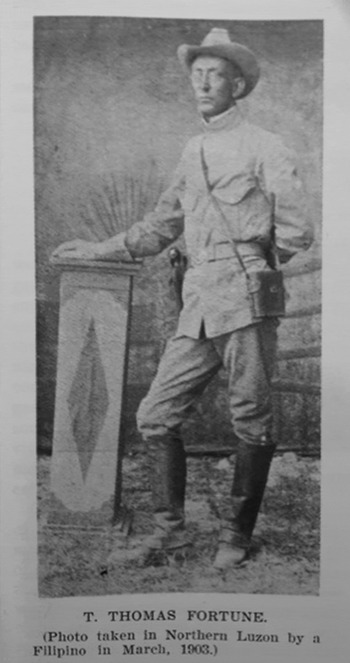
— Booker T. Washington, 1903Footnote 2In the spring of 1903, one of the nation's foremost black journalists paused in the humid air of Northern Luzon for a photographic self-portrait. Dressed in explorer's garb, T. Thomas Fortune struck a manly pose (Fig. 1). Bandits and cholera stalked the countryside as the Philippines struggled to recover from two years of brutal warfare between Filipino guerrillas and the U.S. Army. Yet Fortune had bravely marched northward from Manila accompanied by two black U.S. soldiers, a “Capt. Wormsley” and Robert Gordon Woods, the latter considered an expert on the Islands. As a temporary agent of the U.S. Treasury Department, Fortune was determined to gather information on trade and labor conditions in two of America's recent possessions; just weeks previously he had completed a calmer and much more cordial visit to Hawaii. In the back of his mind lay the strained finances of his New York Age, his tense friendship and collaboration with Booker T. Washington, and his struggle with alcohol. At the front was the question of whether these new territories might make a good home for African Americans seeking a fresh start, away from the violence and poverty of the U.S. South.
T. Thomas Fortune in Luzon, Voice of the Negro, Mar. 1904. Image courtesy of the Schomburg Center for Research in Black Culture, New York, NY.

Forty-four years ago, Fortune's biographer, Emma Lou Thornbrough, looked briefly at his journey, reconstructing it primarily through the papers of Booker T. Washington and Fortune's own writings.Footnote 3 Despite rich new scholarship on race and empire, and newly accessible digital newspaper archives in Hawaii, only a few contemporary scholars have briefly revisited the trip. One historian describes Fortune as consistently militant in the Philippines, making common cause with Filipinos and calling out white racism wherever he saw it.Footnote 4 Most others see Fortune's close relationship with Booker T. Washington at this time as constraining his radicalism, though few go so far as W. E. B. Du Bois, who would in 1907 describe Fortune as a “fallen” genius, “groveling in the dust” due to his association with the Wizard of Tuskegee.Footnote 5 To one historian, Fortune abroad is a carrier of masculinist imperialism, “swept up in romantic ideas about empire.”Footnote 6
Washington's already-mixed reputation, too, seems to have suffered further as a larger body of recent scholarship has probed Tuskegee's overseas projects. Going further than Louis Harlan, who found that Washington's internationalism remained “provincial,” at least one historian charges the Tuskegee leader, in conjunction with sociologist Robert E. Park, with helping to create a “global South” by adapting Jim Crow politics to West Africa and beyond “in a manner that appealed to powerful imperial interests across the global North.”Footnote 7
This article seeks to trouble such scholarship. Examination of Washington's speeches and letters in the years leading up to and simultaneous with Fortune's journey, as well as Fortune's own words and writings reveals that, at least around the turn of the twentieth century, both men hoped U.S. “expansion,” and African American participation in it, might expose not only the power of race, but also its instability and vulnerability. Fortune did indeed preach the Tuskegee line of respectability and self-help as he traveled in Hawaii and the Philippines and contemplated a refuge for African Americans. Washington is no doubt part of the story of the global economic restructuring of slave labor into something that remained, and remains, racialized and exploitative. But both men also imagined transnational alliances along lines of color that might destabilize a strengthening Jim Crow system at home. Fortune in particular seemed to hope that new, emancipatory cultural and racial mixings, channeled and empowered through “newspaper organs,” might emerge from America's encounter with the world. Yet vibrant and ethnically diverse newspaper presses in both territories dogged the renowned black journalist during his visit, even as he tried to use the medium to advocate for African American citizenship and opportunity.
* * * * * * * * * * * *
Fortune was born into slavery in Marianna, Florida, in 1856, the third child of two slaves, Emanuel and Sarah Jane. His parents each claimed African, European, and American Indian ancestry.Footnote 8 After Emancipation, his family was terrorized by white supremacists (Emanuel was active in Reconstruction politics) and fled to Jacksonville in 1869. Fortune's education included time in a Freedmen's Bureau school and two school terms at Howard University in the 1870s, but he would always cite his work as a printer's assistant for several newspapers as key to his intellectual growth. Printer's offices, he said, were “wonderful schools.”Footnote 9 He founded the New York Globe in 1881; the paper would become the Freeman, and, later, the Age. His editorials were often militant; he called upon African Americans to resist white violence with deadly force, and demanded that the government uphold African American social and political rights.
Fortune's reputation as a race agitator was perhaps greatest during the 1880s and 1890s. In 1884, he published Black and White: Land, Labor, and Politics in the South, in which he strongly affirmed the rights of African Americans as American citizens; advocated, as Washington would, a practical, industrial education for blacks; and, citing radical economist Henry George, called land ownership key to African American advance. After Ida B. Wells's newspaper office was destroyed by a white mob in Memphis, Tennessee, Fortune gave her a job on the Age and printed numerous anti-lynching articles. Fortune was perhaps the first to propose a national black civil rights organization, in 1884; in 1890 he spearheaded the National Afro-American League, which collapsed by 1893 for lack of funds.Footnote 10
By late 1902, however, Fortune's best days as a race advocate seemed behind him. He was broke, in debt, and in near-daily communication with Booker T. Washington, for which he was fiercely criticized by some black leaders. That summer, Washington had helped place Fortune at the head of the Afro-American Council, and many black newspaper editors were dismayed, predicting, with some accuracy, Tuskegee's takeover and blunting of the early civil rights group's activist edge.Footnote 11 Fortune felt his work as a race man entitled him to a political appointment, perhaps as minister to Haiti, but Roosevelt had repeatedly rebuffed him.Footnote 12 Finally, he got a placement of sorts: General James S. Clarkson, a white, old-time abolitionist and Republican leader, arranged Fortune's appointment as a temporary Special Immigrant Agent of the Treasury Department to study racial and economic conditions in Hawaii and the Philippines.Footnote 13
Fortune described his purpose to Booker T. Washington a month before his departure, writing that he “had in mind the shunting of our surplus labor to the Orient if I found the conditions such as to warrant such recommendations.” He also wanted to get out of the country and “make enough money to pay my debts and start fresh in purely literary work,” an astonishing statement for the famed journalist (and considerably less-famous poet) to make. He assured the Tuskegee leader that he had stopped drinking for good, and that Washington “need no further fears on that score.”Footnote 14 Washington wrote President Theodore Roosevelt that Fortune's appointment had given him “the greatest general satisfaction,” which suggests he along with Clarkson bent Roosevelt's ear.Footnote 15
The Washington Post, however, linked Fortune's journey to the colonization schemes of Alabama Sen. John Tyler Morgan, notorious for his racial extremism even in a time of virulent white supremacy.Footnote 16 Morgan, the paper claimed, had told Secretary of War Elihu Root and Philippines Commissioner William Howard Taft that although Southern farmers still believed they needed the Negro, soon enough “millions” of African Americans might emigrate, be given “homesteads of about twenty acres each,” and be found “working out their own salvation” in the Philippines. Morgan told the Post that his plan would not deprive African Americans of their citizenship—they would “still be under the flag” in a climate “better suited to them”—and that Taft and Root were impressed with his idea.Footnote 17 Scholars have not uncovered any correspondence between Washington, Fortune, and Morgan, and such an alliance seems unlikely, for Fortune had locked horns with the senator and ex-Confederate general in the past.Footnote 18
In the years before his overseas journey, Fortune appeared skeptical but not wholly opposed to voluntary black migration outside the United States. In Black and White he rejected white-run colonization schemes, and as late as 1901 he was still sharply critical of Bishop Henry McNeal Turner's calls for mass black migration to Africa, on the grounds that Afro-Americans were, by now, culturally American and foreign to Africa.Footnote 19 However, in the fall of 1891 in the New York Age, Fortune pushed back at a white journalist critical of schemes by Turner and Edward P. McCabe to settle African Americans in Liberia and Oklahoma, respectively. Fortune agreed that such efforts would likely be fruitless, but objected to the journalist's scorn at “improvident Negroes” eager to get to “some promised land where there is no work to do.” “Why improvident?,” Fortune asked. Had it not always been the case, for both black and white, that “discontent, caused by hard social conditions,” motivated emigration?Footnote 20 Fortune may also have considered black emigration a way to reduce white mob violence in the South. In an 1899 letter to the New York Sun, Fortune included a lengthy passage from his longtime friend William A. Pledger, who wrote that, “as a solution to the difficulty” of mob rule, a group of African Americans, “thoroughly imbued with American ideas” would prove “a positive acquisition” to the Philippines.Footnote 21 Pledger's statement and Fortune's possible endorsement of it hint at two other ideas that Fortune would return to on his journey: that African Americans could help Filipino society develop; and that Tuskegee, or Fortune himself, might help furnish the right black population.Footnote 22
Fortune arrived in Honolulu from San Francisco on the steamer Doric on December 16, 1902, landing on a tropical island with an astonishingly vibrant newspaper scene. The alliance of missionary descendants and white business interests, mainly planters, who overthrew Queen Liliuokalani in 1893 constituted much of the newspaper press; newspapers quoted herein and not denoted as in-language or “independent” are such establishment, oligarchy-supporting journals. But many outspoken oppositional and nationalist newspapers, published in English, Hawaiian, or both, and staffed by native, mixed-race, or white journalists, still existed in 1902. These were accompanied by in-language ethnic newspapers, as well as independent, pro-labor papers. In 1909, Hawaii had around 100 publications in print; about 30 percent published in languages other than English, including Chinese, Japanese, Portuguese, Korean, and several Filipino languages.Footnote 23 Fortune was intrigued; one Honolulu paper reported shortly after his arrival that he was “greatly interested in the newspapers of the city, asking many questions about them.”Footnote 24
If Hawaii's newspaper scene was healthy, its sugar economy was not. As he toured the Islands with representatives of the planters' association and the chamber of commerce, “[e]ven the hack drivers talk sugar to me,” Fortune told the press, “and the paramount idea is how to get sugar planting back to the old time basis when everybody, according to all accounts, carried round a hundred or so in his pocket just for change to rattle.”Footnote 25 Planters suffered from a shortage of labor and were desperate to find the “right” kind of worker. A report from U.S. Commissioner of Labor Carroll D. Wright put it bluntly: “Hardly a locality exists in the world where there is a surplus of unskilled labor that has not been visited and investigated by Hawaiian labor agents.”Footnote 26 As they brought in workers from abroad, planters hoped they could find a way to gain an exemption from Chinese exclusion for Hawaii and thus import Chinese laborers, thought by many to work the hardest and with the least protest.
In exploring possible black emigration to Hawaii, which one paper reported was part of Fortune's personal advocacy work for African Americans and “in no way connected to his mission,”Footnote 27 Fortune was forced to engage a planter discourse in the oligarchy's press that racialized labor. Finding the right laborer was tantamount to finding the correct racial group, whose members were thought to naturally—via biology, culture, or some combination of the two—possess the proper attributes to handle the difficulties of reliably harvesting cane. It was a long-standing discussion in the Islands' best-funded presses. Two years before Fortune's arrival, for example, the Maui News described labor strife on a plantation: Japanese at Kahului were striking for better wages and shorter working hours; by a combination of “threats and coaxing” and “the foolish terror of the Hawaiians,” they convinced some native Hawaiians to join them; then workers at the Spreckelsville mill joined in. Fortunately for the plantation owner, the News reported, “a large consignment of negroes and Italians had recently arrived”; they were put to work “with gratifying results.”Footnote 28 Yet by the summer of 1901, after a Japanese man was reportedly stabbed by a black laborer, planters' opinion of African American labor had soured.Footnote 29
Commissioner Wright's 1903 report was filled with more explicit race/labor typologies. The Japanese were vain “like children,” and had to be flattered into working; the Chinaman was, by contrast, “a sort of agricultural automaton.”Footnote 30 Puerto Ricans were apt to carry weapons, drink, and fight, but were slowly settling down and having families due to their possession of “the heredity of the Caucasian.”Footnote 31 Planters, Wright wrote, still desired Chinese workers the most, and sought to “play off” the Chinese against the Japanese to make labor more “tractable.”Footnote 32
When members of the same racial group were perceived as acting in disparate ways, Hawaii's planter press simply divided the group into subtypes, often based on region. One editorial less than three years before Fortune's visit, noting that Kohala planters were to “experiment” with African American labor, advised, “it matters very much where you get your negro from.” Those from the agricultural sections of the United States were “sober, quiet and industrious”; if they came with their families, “we could educate their children in our schools.” But there was an itinerant “class” of African American from “the vicinity of the towns” who could be found “stealing, poker playing, crap shooting and drinking.” The paper suggested direct recruitment of the best class of black man by those who sought him, rather than relying, remotely, on a labor agent.Footnote 33 In laying out his plan for African American labor on the islands, Fortune apparently echoed this discourse. The “true negro,” he said, differed from the “half breed tinctured with the ambition of the white united to the natural shirking responsibility of the negro.” A class “culled from barbers, waiters, touts, dock hands and the riff raff of Southern cities” had been “spoiled for work by their closer association with white man's ways which they imitate but do not emulate.”Footnote 34
Fortune knew that Hawaiian agriculturalists sought “coolie” labor, but told an audience of businessmen that due to organized labor's success in “the coal strike” on the mainland—a reference to the 1902 anthracite strike in Eastern Pennsylvania, which Roosevelt had mediated—Chinese exclusion from the United States and its territories would likely continue. But, Fortune said, because “discontent among the negro laborers of the South was never greater,” perhaps the time was ripe for black labor. “I believe that from 20,000 to 300,000 negro laborers, not the vicious from the slums, but men who are workers all the time, could be secured to work in the fields of Hawaii and the Philippines,” Fortune said.Footnote 35 The “true negro agriculturist,” Fortune said, would “not be easily persuaded to leave” the United States, “but it is a possibility, if you go at it the right way and get men like Booker Washington, myself if you like, and others who have the interests of the race truly at heart, to get the supply for you.”Footnote 36
Newspapering gave Fortune some clout with Hawaii's mainstream press; the Gazette wrote upon his arrival that, “perhaps no negro publicist and orator is better known in the United States.”Footnote 37 But the press remained cool to any talk of black emigration to Hawaii. Most papers claimed that African American labor had been tried before, on Maui, with disastrous results.Footnote 38 The Hawaiian Gazette printed eleven one-paragraph responses from eleven major sugar planters to Fortune's proposal for black settlement; almost all rejected it. J. A. Gilman, of Castle & Cooke, said that African Americans “who would come from so far away are always the undesirable ones.” F. A. Schaefer and several others noted that the “experiment” failed in the past; W. M. Giffard, for example, said that African Americans had shown “a tendency to fight” with each other and not associate with Hawaiians. Only W. O. Smith, secretary of the planters' association, said the plan might work if whole black communities, along with their preachers, were brought in, so that “they might build new homes.”Footnote 39 Even Fortune's African American friend T. McCants Stewart, a former emigrant to Liberia who was practicing law in Honolulu in 1902, told the Evening Bulletin that Hawaii could only attract the worst elements of black labor, as only “40 Acres and a Mule,” an impossibility on Hawaii, could attract the best black plantation laborers.Footnote 40 The most sought-after racial group for labor in the fields remained the Chinese.
Fortune's own views toward the Chinese are hard to decipher from press reports of his visit. Fortune would write upon his return to the United States that the Chinese were among the “best and most sympathetic and reliable people” he had met on his journey.Footnote 41 Yet one article in the planter press suggests Fortune supported keeping Chinese workers out of U.S. territories, in opposition to a Cornell political economist who claimed Chinese entrepreneurialism was vital to development across Southeast Asia. In the mid-1800s, Republicans and reformers had equated the coerced labor of the “coolie trade” with slavery, and their efforts to stop the importation of indentured labor helped pave the way ideologically for Chinese exclusion later in the century. This may help explain how, in 1902, Fortune could position himself as both a fighter for racial equality and one who might support restrictions on Chinese migration.Footnote 42
Hawaii's independent, nationalist, but non-native press similarly mixed pro-labor and anti-Asian sentiments in a “race-inflected antimonopoly populism”Footnote 43 common to the time. Fortune's visit was watched by at least one such newspaper known for lambasting the annexationists and calling the planter oligarchy “an American mafia.” The Independent—at the time edited by ardent Hawaiian nationalist F. J. Testa, one of seven signers of an anti-annexation letter to President McKinley in October, 1897—urged Fortune to explore the “general inhumanity” of the way in which field labor was employed on the island. If he looked closely, Fortune could surely produce a plan that would “forever remove the Asiatic blot on the industrial progress of this Territory.” “Search the methods of the ‘sugar barons,’ Mr. Fortune … and obtain a story … of the transmutation of Chinese labor passage money into Hawaiian Territory Treasury warrants.” A concern with corruption and the inhumane treatment of workers moved inexorably toward excluding “Asiatics.”Footnote 44
Native Hawaiians, too, watched Fortune's visit. At least one Hawaiian-language newspaper commented on his arrival, and several had addressed U.S. race relations prior to his journey. The Home Rula Repubalika, run by Robert William Kalanihiapo Wilcox, who was nearly hanged for his armed revolt against the white oligarchy, expressed sympathy toward African Americans in 1901, when Booker T. Washington's visit to the White House sparked Southern outrage. Roosevelt had said he would make himself president of the entire nation, the paper wrote, so why all the fuss? The Republican Party in the United States, after all, was known to be friendly to dark-skinned people. But on Hawaii, “our Republicans are not like that. They are highly racist against the dark-skinned. Yet they still claim the rights of the Republican name,” something the paper called a “fraud.”Footnote 45 But the Ke Aloha Aina (“The Patriot”), founded by Joseph Kahooluhi Nawahi, a native Hawaiian legislator and publisher, commented during Fortune's visit that “it would be outrageous if this dirty labor race is introduced to us in Hawaii in place of the Chinese,” and, the paper warned ominously, “it would not only be us who would witness the bad things of these people …”Footnote 46
Thrown into Hawaii's complicated racial politics and watched closely by local media, Fortune attempted to flip some racist assumptions while simultaneously performing his official duties. After a few weeks on the islands, Fortune told the Hawaiian Star that he understood why planters desired Chinese labor so strongly: the Chinaman “smokes no expensive cigars, buys no twenty-five cent drinks, entertains no friend and has got the white man, who spends half his income [on] clothes, entirely out of the race as regards labor competition.” (The Japanese man, Fortune said, also had a “disposition to dress up and be a bit of an American dude, which costs money.”)Footnote 47
Short of Chinese labor and besides black labor, what else might help Hawaii? Fortune recommended the islands diversify their agriculture and grow coffee and vanilla at higher altitudes, and consider rubber and cacao, too. Fortune may not have forgotten his past belief in the importance of land; the Star reported that he was “looking largely into the lands which are open for homesteading” for African American workers.Footnote 48
* * * * * * * * * * * *
As Fortune was completing his Hawaiian investigation and preparing to set sail for Manila, race relations were deteriorating rapidly in the U.S. South. Attention to the domestic front reveals connections between American empire and a rapidly advancing Jim Crow system and philosophy, and provides clues into Booker T. Washington's and perhaps T. Thomas Fortune's global thinking in the early 1900s.
Washington wrote Fortune in February 1903 from Tuskegee, hoping his friend had not suffered seasickness en route from Hawaii to Manila and confiding, “I must confess that we are passing through a rather severe trial in the South just now.”Footnote 49 Three things had inflamed Southern politicians and newspaper editors: President Roosevelt, at Washington's recommendation, had appointed William D. Crum, an African American, to the position of collector of customs in Charleston, South Carolina; black public officials in Washington, D.C., had attended a judicial reception at the White House; and, in early January, Roosevelt had shut down the Indianola, Mississippi, post office after local politicians forced out due to her race its postmaster, Minnie M. Cox, an African American woman and a McKinley appointee.Footnote 50 Perhaps as troublesome for Washington was that Secretary Root, just back from the Philippines, had delivered an ominous speech on African American rights. “The whole situation is very much mixed and there is a good deal of unrest among our people,” Washington wrote Fortune in mid-February. “Secy. Root's speech in New York a few weeks ago, which nobody seems to understand, further complicates the matter.”Footnote 51
Root had spoken at the Fortieth Anniversary Meeting of the Union League Club in New York City on February 6.Footnote 52 (Blacks, whites, and sometimes both races together had formed Union Leagues that became “the political voice for impoverished freedmen” after the Civil War.Footnote 53 By 1903, however, few such clubs retained their activist edge.) Root began by honoring the “Gentlemen of 1863” present, who had helped end the “curse of slavery.” But now, Root told the gathering, three “problems almost immeasurable” challenged the younger generation: a widening gap between rich and poor, which corrupted politics and threatened through envy to provoke a “war of classes”; ever-more powerful unions, which hurt American meritocracy by protecting “sloth,” “incompetency,” and “stupidity”; and the so-called Negro Problem, though he never named it as such. Here, Root questioned the entire Reconstruction project to grant African Americans full citizenship. “I fear we are compelled to face the conclusion that the experiment has failed,” he told the gathering. He described the loss of black suffrage rights in the South, and hinted at his exasperation at Southerners' “loud outcries” against Roosevelt for appointing African Americans, when the president had in fact made fewer such appointments than his predecessor. Soon, Root said, “white men will succeed in excluding blacks from all offices in the southern States.” Root repeated that the country must “face the failure of the plan … to lift the blacks” after emancipation through the strategy of voting rights. A vexed Washington wrote Fortune, “[T]he President seems to be standing squarely and so far as I can get information directly or indirectly, he is with us.”Footnote 54
Two weeks following Root's speech, his words appeared to be on Washington's mind as Washington spoke to a Bronx audience and pointedly addressed freedom, race, and empire. After reciting famous groups in U.S. history that revealed the “desire for liberty that is natural in every human breast,” such as the “Cavaliers of Jamestown” and the “Puritans of Plymouth Rock,” Washington complicated freedom, bringing the concept into increasingly incongruous situations. Through the Monroe Doctrine, the United States would not only “contend against the world for its freedom, but for the freedom of all governments upon the two American continents.” Next, the former slave described the Civil War as a Confederate leader might: “Half a century later we find the Southern section of our country entering into a political and physical war in a contention for freedom in the control of domestic and state policies …” As for the recent Spanish-American war, “we [found] ourselves demanding, at the point of the sword, the freedom of our neighbors, the Cubans.”
Washington then put this problematic “freedom” into conversation with race. “During all the period that the majority and dominant races were contending for the most complete and perfect freedom and independence,” he continued, “there were living by their side two other races, different in color and different in history—the Indian and the Negro.” Whenever and wherever whites and Indians met, “there either was war between the two or injustice and oppression shown [upon] the original American.” When encountering other races on a quest for freedom, Washington told his audience, “you have so far practiced absorption, colonization, or extermination.” Yet, “you have got the Indian out of the range of your vision. And in this country it seems to be the fashion to consider a problem solved when we get it out of our sight to such an extent that its existence is unobtrusive and our consciences are eased.”
But now, Washington said, a new “experiment in the way of race accessions” loomed:
Just now the Filipino seems to be going through the interesting process of being carefully examined. If he can produce hair that is long enough and nose and feet that are small enough, I think the Filipino will be designated and treated as a white man; otherwise he will be assigned to my race. If I were to consider the question purely from a selfish standpoint, I should urge that our new subjects be classed as Negroes; but if I were to consider unselfishly the peace of mind of the Filipino himself, I should hope that he … will not struggle through all future generations considered and looked upon as a problem, instead of a man.Footnote 55
The speech is fascinating not only for its scarcely veiled anger at white America. What was the “selfish” reason Washington cited for imagining the Filipino as black? Did he hope Tuskegee might be called upon to work not only in Africa, where its employees were mediating between indigenous Ewe farmers and German colonialists in the growing of cotton, but in the Philippines, too? Or was it a numbers game—that is, could more allies in a struggle against discrimination tip the scales toward racial justice?Footnote 56
The two possibilities are not mutually exclusive. Fortune and Washington, in the early years of the twentieth century, were attempting to positions themselves as brokers for African American labor and coordinators of Tuskegee-style “uplift” in the territories, and seemed to hope that American empire might destabilize a white racial order and present new opportunities for black advancement at home and abroad. The Hawaiian Star reported that Fortune was attempting to supply black labor to “a big rubber plantation on the Congo in West Africa.”Footnote 57 Earlier in 1902, Fortune and Washington had discussed black emigration to the Congo with each other and, for Washington, with investors.Footnote 58 By mid-February of 1903, Washington was being recruited by the powerful Lord Grey of the British South Africa Company in Rhodesia to tour the nation for six to nine months and recommend how best to “raise, educate, and civilize the black man.”Footnote 59 Newspapers reported the offer and Washington consulted with Roosevelt before deciding that, according to Harlan, “his primary responsibility was to his institution and the American Negro.”Footnote 60
But perhaps, Washington must have thought, Tuskegee could both participate in American empire and advocate for people of color. In 1900, he informed readers of The Century Magazine, the widely read successor to Scribner's Monthly, that what Tuskegee had accomplished in the U.S. South “under most difficult circumstances” could be attempted in Cuba and Puerto Rico. Tuskegee was training “a few of the most promising men and women from these islands” to replicate the institute's “industrial” methods in their lands. But historically, Washington wrote, white Cubans and white Spaniards had treated black Cubans with near-equality. “In only a few instances [was] the color-line drawn … Certainly it will place [the United States] in an awkward position to have gone to war to free a people from Spanish cruelty” only to “treat a large proportion of the population worse than did even Spain herself, simply on account of color.” To Washington, a U.S. encounter with Cuba's fainter color line might highlight and unsettle sharply drawn racial segregation at home.Footnote 61
In Honolulu as he would in Manila, in public appearances Fortune stressed Washington's educational philosophy and a kind of politics of respectability. At the Honolulu YMCA, he spoke on “Self-Respect and Its Basis.”Footnote 62 In that speech, according to a lengthy write-up in the Pacific Commercial Advertiser, Fortune addressed an “unusually large audience” and “drew graphic word pictures” about the lives and character of Abraham Lincoln, Samuel C. Armstrong, and Booker T. Washington. Fortune linked “the Great Emancipator” to Armstrong, who “stood on the prow of a vessel headed from Mexico” and “pondered … what was to become of these millions of freed blacks.” Arriving in Virginia and “remembering what his father taught in Hawaii before the war,” Armstrong created the Hampton Institute, educating “head, heart, and hands.” Then Washington, Fortune said, “walked 300 miles to Hampton Institute from the wilds of West Virginia,” and later toiled day and night to build Tuskegee and “carry out the work of Lincoln and Armstrong.” Fortune ended with words on character, whose basis was “in the home, in the school, in the church,” and without which “no one could have respect.”Footnote 63 At least in public, Fortune and Washington were in synch ideologically in 1902–1903.
Armstrong, who died in 1893, had written that, “from 1820 to 1860, the distinctively missionary period, there was worked out in the Hawaiian Islands the problem of the emancipation, enfranchisement, and Christian civilization of a dark-skinned Polynesian people in many respects like the negro race.”Footnote 64 Historian Gary Okihiro notes incisively that an 1882 letter from Hawaii's Bureau of Immigration to Armstrong, which asked the famed educator about the feasibility of black labor on Hawaii, reveals that “the ideas of native education and servile labor for the ostensible uplift of subject races migrated between island and continent, and a seed first cultivated in Hawai'i and transplanted in the American South had found its way back, full circle, to the Islands.”Footnote 65 Fortune's trip to Hawaii surely represents the continued circulation of educational philosophies intimately tied to racialized notions of civilization and labor, and embraced by expansionists as a method for integration and control of subject races at home and abroad.
Yet for Fortune and Washington, coexisting with and possibly cloaked by these conservative philosophies and pedagogies lay more subversive hopes, critiques, and perhaps agendas. “If the American flag remains in the Philippines,” Fortune would soon write, “Afro-Americans will have to be drafted to hold it up.”Footnote 66 As he prepared to leave Hawaii, he switched temporarily from journalist to poet, publishing a verse in the Evening Bulletin titled, “The Kanaka Maiden.” The maiden was Hawaii herself, “made for love, and not for labor.” But her “towering hills” and “slumberous vales” were no longer her own; instead, a “stranger lords it now on the hillsides,” and “even on the restless ocean tides / Are nothing seen but alien sails.”Footnote 67 Fortune's rebellious poem may echo Hawaiian mele (chants, songs, or poems) that Hawaiians, according to Amy Ku'uleialoha Stillman, increasingly printed in late-nineteenth-century Hawaiian-language newspapers as a way to voice political and nationalist desires.Footnote 68 The same romantic style that helped disguise the poem's subversiveness, however, also constrained its critique. “The Kanaka Maiden” evoked a nostalgic view of a lost land that dovetailed with late-nineteenth-century sympathies for indigenous peoples as “dying races.”
As Fortune was preparing to leave Hawaii for Manila, Washington wrote him again. “I advise you to be very careful about what you say to newspaper men, especially in the Philippines, as they are rather treacherous.”Footnote 69 His remarks, as Fortune would soon discover, were prescient.
* * * * * * * * * * * *
By late February 1903, when Fortune arrived in Manila, the black press in the United States had already engaged for several years in a lively debate about the Spanish-American and Philippine-American wars. Many black newspapers stood staunchly against the conflicts. Some drew affinities along lines of color; the Salt Lake City Broad Ax declared that “no Negro possessing any race pride can enter heartily into the prosecution of the war.”Footnote 70 Others stressed the hypocrisy of bringing democracy to Asia while African Americans were being disenfranchised at home, as the Richmond Planet did when it editorialized, “A man who is not good enough to vote for a government is not good enough to fight for it.”Footnote 71 Some black editors, such as Sol Johnson of the Savannah Tribune, supported U.S. intervention in Cuba or the Philippines from the start, pushing for African American enlistment and fighting for soldiers' fair treatment. But by 1899, Johnson saw race and nation merging treacherously, in what he called a “pernicious” outburst:
The Spanish American war has drawn the Anglo Saxons together … The stars and stripes and the Union Jack are blended together on festive occasions and men's faces grow red and their throats hoarse in exulting and exhilarating utterances of love, friendship and union for the united race …Footnote 72
Fortune would have surely followed these editorials, as well as black soldiers' letters, which were reprinted extensively in the black press and which showed a range of responses, from pride at serving one's country to outrage at white soldiers' racism toward black troops and Filipinos.Footnote 73
The contours of black editors' critiques of Anglo-Saxonism and the extent of the affinities they felt with Filipinos were shaped and constrained in part by their domestic fight against Bishop Turner and other advocates of black migration to Africa. In describing both Africans and Filipinos, the black press could critique a racialized binary of civilization and savagery, but might also employ that framework with little modification, to stress, for example, how unsuited African Americans were for “savage” Africa. The Indianapolis Freeman wrote in February 1899 that Filipinos had “some notions of government,” but, “the bushmen of today cannot be the legislator of tomorrow” and hence must be under U.S. control until “the staying hand of America might be withdrawn.”Footnote 74
Fortune's own views on Western imperialism were complex. In Atlanta, Georgia, in 1895, concurrent with but overshadowed by Booker T. Washington's famous “Atlanta Compromise” speech at the same venue, Fortune spoke to Methodist missionaries and African American leaders on “The Nationalization of Africa.” Fortune described European imperialism as bloody and cruel, but also claimed it would produce a stronger, more unified and better-governed continent, helping Africa escape the “demoralizing heterogeneousness” of so many “savage” tribes. Racial diversity and hybridization, by contrast, would strengthen Africa, and in fact Fortune predicted Europeans would be assimilated and absorbed into the continent, producing a new and glorious civilization.Footnote 75 A similar cosmopolitan mix, he would soon write, could happen in the Philippines.
When Fortune reached the elegant Hotel de Oriente in Manila late one night in February 1903, he found that an American porter had left on his table “a large batch of Manila newspapers, saying that … he was sure I would find many things in them to interest me.” Their vitriol shocked the journalist.Footnote 76 Examination of the Manila American and other American-run newspapers available at the National Library of the Philippines reveals a different expression of white supremacy from that which Fortune encountered on Hawaii, one contained and disseminated by a unique newspaper press that Fortune would characterize as “Southern” in character.Footnote 77
Shortly before Fortune's February arrival, the Manila American published an editorial titled, “Chinese are wanted, but no negroes,” which linked Sen. Morgan with Roosevelt and “special envoy” T. Thomas Fortune. On Hawaii, the paper reported, Fortune had “told the planters that 100,000 southern negroes could be landed … within six months.”Footnote 78 “[W]e do not want any more negroas [sic] in the Philippines,” the Manila American declared. “He is here now, and we are having all sorts of trouble with him.” Though “quite a number” of African Americans on the Islands were “shining examples” of success, too many had become “vagrants,” exploiters of Filipina women, and members of “bands of highwaymen … commonly called ‘ladrones.’”Footnote 79 The Manila American called upon its readers to “meet Mr. Fortune upon his arrival in the islands, and vehemently protest against the importation of negroes.”Footnote 80
The Manila Freedom, though it did not comment directly on Fortune's visit, also favored Chinese labor, due to what it characterized as the racial inferiority of Filipinos. “We are here, supposedly” the paper wrote around the time of Fortune's arrival, “to help the Filipino climb up the ladder of success … We have seen their shortcomings so often that we have rather grown to despise the little brown man, with his timid ways … The Filipino is a Malay, and will never get over that crowning misfortune.”Footnote 81 To the Freedom and most other white American newspapers in Manila, any attempt to “uplift” Filipinos was futile.
Fortune explained the American media's aggressiveness toward him as a function of what he claimed were its practitioners' roots in the American South. The newspapers were “as violently Democratic and race-hating as those of Memphis or Atlanta,” due to President McKinley's “fatal weakness for appointing Southern Democrats to controlling positions in the civil and military establishments in the insular territories.”Footnote 82 He fired off a letter to Booker T. Washington: “No southern white man should be allowed to hold office in the Philippines … The Filipinos hate the whole tribe of southerners here, and so do I.”Footnote 83 He said the “open-armed hospitality” with which he was greeted on Hawaii, by contrast, was due to the Christian virtues of “the descendants of New England missionaries.”Footnote 84
Was Manila a kind of outpost of Dixie? A Southern Democrat, Luke E. Wright of Tennessee, would succeed Taft as governor-general in 1904. A few years later, then-Gov. General William Cameron Forbes would attribute discrimination against Filipinos to the large “proportion of Southerners found in the Government service of the Philippine Islands.”Footnote 85 On the other hand, troop regiments in the Philippines came from all parts of the United States, as did, of course, racist attitudes toward African Americans. Top posts in the Philippines Commission—also known as the Taft Commission, the legislative body appointed by the president to govern in the Philippines—were not dominated by Southerners.Footnote 86 Many black soldiers did indeed chaff at white Americans' racism; one wrote to the Richmond Planet that “the whites have begun to establish their diabolical race hatred in all its home rancor in Manila …” The soldier did not distinguish whites by region, however.Footnote 87
Yet the long shadow of the Civil War likely stretched outward toward the territories. The American press in Manila may have feared that greater black presence in the Philippines could, as Amy Kaplan suggests, reopen, instead of heal, the wounds of the Civil War, recasting it as a “global race war,” and destroying the sense of white unity that the Savannah Tribune editor had described.Footnote 88 In the recently ended war with Filipino rebels, a small number of African American troops did defect, including David Fagen of the Twenty-fourth Infantry, who became a captain in the rebel army and led several guerilla attacks on U.S. troops.Footnote 89 Philippine rebels appealed to African American soldiers to join the insurgency, and, their eyes on the U.S. South, implored black U.S. troops to “consider your history,” “take charge that the blood of [Georgia lynching victim] Sam Hose proclaims vengeance,” and defect.Footnote 90
Fortune was not the only target of the American press in Manila; its editors were aggressively opposed to the Philippines Commission. The diary of Daniel R. Williams, personal secretary of Philippines Commissioner Bernard Moses, demonstrates the government's frustration. Williams wrote on August 11, 1901, that the “American papers of Manila” had from the start “antagonized and obstructed the work of the civil authorities.” Objecting to the appointment of Filipinos to government posts (called “Filipinization”), these papers characterized the natives as “treacherous, untrustworthy, etc.” Williams called Filipinos “morbidly sensitive to criticism,” and hoped they could learn that “the attacks of a few disgruntled American papers do not express American sentiment.”Footnote 91
Two years later, Commissioner Taft echoed Williams's assessment, lashing out several times at the “young lions of the American press” in a speech before the Union Reading College in Manila on December 17, 1903. It was the close relationship between the military and “those venturesome business spirits that thrive best in times of trouble and excitement,” Taft said, which accounted for the ire. Because they fought a guerilla war marked by “treachery and cruelty,” current and former soldiers, some of them now newspapermen, held strong grudges against all Filipinos. “The Anglo-Saxon is not noted for his courtesy” toward “races which he considers inferior to his,” Taft said. With 70,000 troops in the Philippines in 1900, merchants found profits “very great indeed,” and advertised food and drink in the American press only. Now, Taft said, with the American army reduced to 15,000 men, “the pinch is being felt,” and both merchant and editor blamed the civil government and its policy of “encouraging the native as far as it could.”Footnote 92 Manila's press “lions” resemble Donna Gabbacia's “mobile Americans”: investors, businessmen, and missionaries who developed American empire as they pursued private agendas and interests abroad and clung to their own customs, languages, and religions.Footnote 93 Whether or not Fortune could pin Manila's aggressive racism on Southerners, he sensed the importance of regional differences and newspaper publics in the projection of U.S. power abroad.Footnote 94
Despite his unfriendly reception among whites in Manila, Fortune still polled Filipinos on their opinion of black emigration. Fortune's questionnaire was reprinted in the Spanish-language La Democracia, a Filipino newspaper that advocated for gradual independence for the Islands, as opposed to others, which were more forceful.Footnote 95 Fortune's first four questions were for identification purposes; the next five got to the heart of the matter:
-
5. What, in your opinion, are the needs for workers in the Philippines?
-
6. Are you pro Chinese immigration?
-
7. Please name your reasons.
-
8. Are you pro immigration of negroes to the Philippines?
-
9. Please give all your views.Footnote 96
La Democracia, in an editorial on Fortune's questionnaire and plan, strained to remain polite toward the struggle of African Americans in the United States, but admitted a “rare stupification” (nuestra estupefaccion raya en lo insolito) at the thought of how “we Filipinos shall be entitled to the blessings of humanity by the work of redeeming a people.” Fortune's poll came at the worst time possible; famine still loomed and Filipinos were struggling to address basic necessities, not to mention “vital political questions.” Fortune had “ponderously stoked the fire of racial discord” (atizar muy ponderosamente el fuego de las discordias de raza).Footnote 97
Before leaving the Philippines, Fortune embarked on a dangerous, six-week trek through Northern Luzon as a cholera epidemic raged, a trip “few Americans had ever attempted.”Footnote 98 Two African American soldiers, Capt. Robert Gordon Woods and Capt. Wormsley, accompanied him. Throughout the journey, recounted a year later in a series of articles for Voice of the Negro and in one article in the mainstream journal The Independent a few months after his return, Fortune alternately employed and sometimes critiqued the prevailing civilizationist discourse of the times.
Toward Asia, Fortune frequently adopted an Orientalist frame, starting with his first installment on his trip for Voice of the Negro in March 1904.Footnote 99 “‘Ah for some retreat / Deep in yonder shining Orient,’” Fortune wrote, quoting Tennyson's “Locksley Hall,” though he stopped before the line, “I shall take some savage woman / She shall rear my dusky race.”Footnote 100 The Orient, Fortune wrote, was “wrapped in mystery … its people … have no thing in common with the strong thinking and death killing efforts after material things of the whiter races: for they think languidly and labor only when is necessary.”Footnote 101 But he then defended Filipino work habits, which he said were the most-discussed topic among whites in the islands, who constantly denounced “the laziness of the Filipino.” Fortune recounted breaking into one such conversation and silencing it: “‘I have been in the Philippines two months and have not seen a white man working with his hands; they were all working with their mouths,’” he told a group of white Americans on a “coastwise steamer.” “‘Why do you expect the Filipino to do what you will not and cannot do?’”Footnote 102
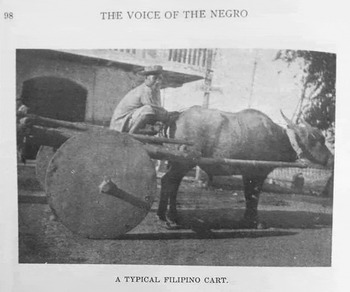
Still, in Fortune's third installment in Voice of the Negro, he complained that “The average Filipino appears to have been born tired.”Footnote 103 He described the incredible dusk-til-dawn din of Manila—roosters crowing, brass bands playing in the early morning, Catholic church bells pealing—and concluded that Filipinos must have no nerves. “People without nerves do not think much, rapidly or profoundly, and the basic elements of their character are superficiality.” That he then attributed the same characteristics to “eighty percent of American negroid people” and much of mankind in general softened the blow only a little.Footnote 104 When printed alongside such statements, Fortune's photographs from his journey suggest a distanced, anthropological gaze (Fig. 2). He stood uncomfortably within dominant, racialized discourses of civilization, attempting to adopt aspects that might bolster his standing as an American while also scrambling the logics of white supremacy. Of one white general in Luzon with whom he and Capt. Woods stayed, who was uncomfortable around Fortune's “brothers in black and yellow” and who was later convicted of embezzling public monies, Fortune wrote, “His race prejudice will wear itself out in Bilabid prison, where he must consort on terms of equality with all the race colors of the globe.”Footnote 105
“A Typical Filipino Cart,” pulled by a carabao, or water buffalo. Probably taken by T. Thomas Fortune, in Voice of the Negro, Mar. 1904. Image courtesy of the Schomburg Center for Research in Black Culture, New York, NY.

Fortune's Philippines journey almost ended in ignominy when, upon returning from his Luzon trek, he, Capt. Woods, and possibly as many as three other African Americans were arrested after a dispute with police, described with equal parts glee and contempt in the Manila American. The newspaper claimed Fortune stopped his carriage in the middle of the street to speak with another African American, blocked traffic, and talked back to a police officer. The American claimed that Fortune, taken to the police station, kept yelling, “I am T. Thomas Fortune. I am the special agent of the U.S. Treasury. That's who I am.” The newspaper dubbed Fortune “T. Thomas Titmouse,” though two days later it reluctantly acknowledged that Vice Governor Wright had intervened to get the case dismissed.Footnote 106
Fortune would sum up his recommendations for the Philippines in his final installment for Voice of the Negro. Luzon's rich farmland was not being exploited by Filipinos, who “do not seem to care to work”; the land could support up to seven million more people, five million of whom “could be Negroes.” “The Negro and the Filipino get along splendidly together,” and emigration from the Southern United States, “where [African Americans] are wronged and robbed … would be good for them, good for the Filipinos, who badly need rejuvenation of blood, and good for the United States,” which could “take a long step in solving the Filipino and the Negro problem,” and avoid coming bloodshed on both accounts. The United States had not given the black man “life, liberty, and the pursuit of happiness,” and in fact “seems now to be on a policy of crushing out entirely his manhood and citizen rights.” He was owed. “Give the American Negro a chance in the Philippine Islands, if he wants to go there,” Fortune concluded.Footnote 107
Upon his return to the United States on June 24, the Treasury Department informed Fortune his appointment had been for only six months and had been terminated on May 16. He would not be paid for his final weeks of travel. He protested, withholding his final report on the trip; there is no evidence it was ever completed or published.Footnote 108 Aside from his three Voice of the Negro articles, Fortune did publish an essay for the national journal The Independent, wherein he described three major political groups in the Philippines: the main group of nationalist Filipinos, whom he said regarded Taft as their “saint”; white Americans on the islands, dominated by a Southern mentality; and a tiny, heterogeneous third group composed of “the best Filipinos,” a few white Americans and Europeans, and all three hundred African Americans. This third group, which in its cosmopolitanism recalled Fortune's 1895 speech on a “nationalized” Africa, was the Philippines's only hope for a harmonious and prosperous future, for it believed that the islands should be governed “in the interests of all the people, native and foreign born, with justice for all and special favors for none.” Fortune hoped it would succeed, though he admitted—reflecting his continued interest in the interplay of media and publics, civil rights and readership—the tiny group had “no acknowledged leader and no newspaper organ.”Footnote 109
* * * * * * * * * * * *
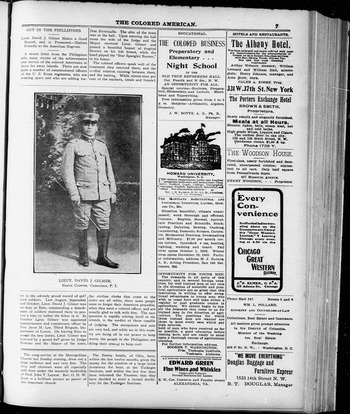
Fortune's and some black newspaper editors' attempts to promote and imagine a better life for African Americans in Hawaii or the Philippines were not necessarily naïve or deceptive. Lt. Gilmer, the dignified black soldier pictured in Fig. 3, may have found in Manila some relief from American racial mores and perhaps obtained real opportunities for professional advancement. The Colored American certainly thought so, writing that “the race question is rapidly solving itself in the [Philippine] islands, is the verdict of those capable of judging.”Footnote 110 Gilmer's dignified portrait—he stands, as in Fortune's snapshot from Luzon, in front of a painted backdrop—demonstrates how African Americans used photographic and newspaper media to emphasize or imagine new racial mores in the nation's new possessions. Booker T. Washington advertised adjacent to Gilmer's photograph Tuskegee programs in “several foreign countries.” Optimists like Washington could take heart in the letters of some black soldiers in the Philippines, who wrote home without mentioning race at all. Another, Chaplain T. G. Steward of the Twenty-fifth infantry, when cursed by three white privates on a street in Manila, seemed to revel in his apparent authority to stop, intimidate, and reprimand his antagonists: “I … read them a lecture.”Footnote 111 In this particular case, military rank seemed to travel across segregated military units and trump social rankings based on skin tone.
Lt. David J. Gilmer, Colored American newspaper, Jan. 16, 1904.

Fortune's guide for his Luzon trip, Capt. Robert Gordon Woods, seems to have had a long and relatively successful career in administrative positions with the Philippines Constable and Army. Woods appears decades later at the close of World War II in a profile in the Chicago Afro-American. Age seventy-two in 1945, he was still living in the Philippines. At the start of Japanese occupation, according to the Afro-American, when first approached by a “hissing, bowing Jap,” Woods survived the encounter and his eventual imprisonment by “playing dumb.” Woods might remain in the islands after the war, the Afro-American suggested, “because he has come to love the little brown people.”Footnote 112
The Afro-American's profile, along with the derogatory comments about black labor by one native Hawaiian newspaper, reflect the various racial discourses available to African Americans and Asians encountering U.S. imperial agendas—each group might draw upon different strains of a contradictory ideological mix to make claims for their worth or sophistication. The accessibility of an Orientalist discourse to African Americans in the late nineteenth century is shown in Fortune's writings in Voice of the Negro, where he often posited himself as a Westerner visiting the strange, indolent East. In the ideology of the Hampton Institute, in fact, African Americans were expected to help “civilize” Native Americans—even as the tenets of industrial education “situated the black labor force at the bottom of the Southern economy.”Footnote 113 Hawaiians and Filipinos, of course, could employ the tenets of race science or popular biases to assert their own civilized nature in opposition to blacks. Perhaps someone translated the Ke Aloha Aina article for Fortune, for he wrote upon his return to the United States that the “Hawaiian Kanaka” was like the American Indian, “think[ing] himself better than the black man.”Footnote 114 Though Fortune would write that Filipinos didn't seem to share other non-whites' disdain for African Americans, a Filipino student publication at the University of California at Berkeley two years after Fortune's return to the United States printed as filler at the end of an article on education a short poem about a “little nigger” and a crocodile.Footnote 115 Perhaps its editors consciously sought respectability in America through racial put-downs, or maybe the periodical medium, wherein “white space” between articles was often quite literally an Anglo-Saxon territory filled by convention with ethnic jokes or minstrel sketches, dictated editors' decisions more automatically.Footnote 116 Either way, in 1903 and beyond, any moves toward Afro-Asian solidarity faced racial bigotries flowing in multiple directions. (Fortune's hopes for black labor abroad also seem stymied in part by a growing belief in a racial association between African Americans and crime.)Footnote 117
In light of Fortune's journey and his interest in newspapers as agents of reform, historians might rethink or extend Benedict Anderson's widely cited work on nationalism and print capitalism. If newspapers and their circulation helped people imagine the concept of the nation-state—a “deep, horizontal comradeship,” according to Anderson—such media surely also played a role in expanding or, conversely, policing notions of citizenship within the nation itself. In an era where print was king, movies only nascent, and television and radio nonexistent, activist-editors such as Fortune fought fiercely over citizenship's “borders of belonging.”Footnote 118
Two years after his journey and back at the helm of the Age, Fortune was still optimistic about empire's possible unintended effects on domestic race politics. Riffing on the U.S. policy of tutelage for Filipinos, Fortune described a group of Filipino emigrants to America who, “believing that ‘benevolent assimilation’ means what the term implies,” enrolled in a state college in Illinois. The chilly reception the “innocent, dark-skinned” students received at the school must be, the students decided, “one of the peculiarities of benevolence.” Believing that “all things would work out benevolently,” the young Filipinos got haircuts at a barbershop in town; outraged white students threatened to boycott the business. “It mattered not that the students from the Orient were Malay, not Negroes; it was sufficient grounds for objection that they had the color of the American Negro.” Fortune concluded: “There are hopeful signs that the battle of the ‘color line’ is not to be fought out by the Negro race alone.”Footnote 119