INTRODUCTION
Receiving a diagnosis of cancer is frequently described as one of the most serious life events an individual faces (Meyerowitz et al., 1989). Being told that one has a potentially fatal disease often results in feelings of depression, increased vulnerability, and loss of control over one's life (Tsongas, 1984; Kaufman & Micha, 1987; Dreifus-Kattan, 1990). For some individuals, putting one's faith and reliance in a higher power while facing an uncontrollable situation can be a significant source of hope (Post-White et al., 1996; Ballard et al., 1997; Saleh & Brockopp, 2001). However, for others, a cancer diagnosis might prompt feelings of betrayal or punishment by God (Doyle, 1992) and a separation from religion. The present study investigated the role of religion and spirituality among men who have been diagnosed with early-stage prostate cancer. Specifically, we addressed three questions: (1) whether a diagnosis of prostate cancer impacts a man's daily religious and spiritual experiences, (2) which cognitive and affective factors are predictive of a diagnosis-related increase in religiosity and spirituality, and (3) the roles of daily religious and spiritual experiences in longitudinally predicting worry about a cancer recurrence, emotional well-being, and negative affect 18 months after diagnosis.
Does Cancer Lead One to Become More or Less Religious or Spiritual?
In this article, religion is defined as an act consisting of service, worship, commitment to, and reliance on a higher power such as the Judeo-Christian God. Spirituality is defined as consisting of personal feelings of connectedness to a higher power and the ultimate source of life's meaning and value (Jenkins & Pargament, 1995). Pargament (1997) theorizes that the degree that religion and spirituality are utilized to cope with adverse events is a reflection of (1) the extent the individual already incorporates religion and/or spirituality into life and (2) the extent that religion and spirituality are compelling as coping resources. Although many individuals do turn to their religion and spirituality to cope (Gall, 2004), some individuals may rely less on religion and spirituality as coping resources because other nonreligious/nonspiritual resources have always been sufficient to resolve stressful situations (Fitchett et al., 2000). Additionally some individuals might engage in negative religious coping or religious struggle, seeing their condition as an act of punishment and expressing religious disillusionment and discontent (e.g., Koenig et al., 1998; Exline et al., 1999; Fitchett et al., 2004; Pargament et al., 2004).
Research suggests that some people increase their level of religiosity and spirituality after being diagnosed with cancer (Sodestrom & Martinson, 1987). In a study of end-of-life issues among 108 gynecological cancer patients, 76% indicated that religion had a prominent place in their lives, 49% said that they had become more religious since having cancer, and none reported a decline in religiosity since diagnosis (Roberts et al., 1997). Another study examining concerns and coping in a small sample of 14 localized and regional breast cancer survivors reported that all participants increased their use of religious and/or spiritual coping as a result of their illness (Fredette, 1995). O'Connor et al. (1990) found that 17% of their sample of 30 cancer patients reported a renewal of their religious faith. Feher and Maly (1999) reported that, for their sample of women with breast cancer (N = 26), half indicated that their religious and/or spiritual belief increased, half indicated that it stayed the same, and none reported that their faith weakened after their diagnosis. In sum, there is evidence in the literature that underscores the importance of religion and spirituality among cancer patients. Yet, few studies compare levels of religion and spirituality among those who do and do not have cancer. This is the aim for the first part of the current study.
Are there Particular Cognitive- Affective Constructs that are Strongly Related to Religious and/or Spiritual Coping?
To our knowledge, few studies have examined correlates of religion and spirituality among cancer patients. Our approach to this question is guided by self-regulation theory (Leventhal et al., 1992; Diefenbach et al., 1996; Miller et al., 1996; Miller & Diefenbach, 1998), which postulates that a serious health threat, such as a cancer diagnosis, impacts a person's belief system, emotional reactions, and one's coping responses. The literature suggests that it takes a serious threat for which one's available coping resources are insufficient for an individual to utilize religion and/or spirituality. For example, Sodestrom and Martinson (1987) report increased religious practices among patients who were aware versus not aware that their life expectancy was less than 6 months long. Feelings of helplessness also have been associated with increased religiosity and spirituality (Cotton et al., 1999). However, little information is available on such self-reporting cognitive and emotional constructs as perceptions of seriousness, symptom experience, worry about cancer, and negative affect at diagnosis in relationship to religiosity and/or spirituality. The second part of this article will examine the influence of these theoretically derived cognitive and affective factors that may be predictive of a diagnosis-related increase in religiosity and spirituality.
Do Religion and Spirituality Help to Facilitate Adjustment?
Religion and spirituality have been important sources of strength and comfort for some cancer patients (Roberts et al., 1997). A review by Jenkins and Pargament (1995) reported that cancer patients with strong religious beliefs reported lower anxiety and hostility and, at the same time, higher life satisfaction, sense of comfort, solace, and support. Similarly, among breast cancer survivors, Gall (2000) found that those patients who reported stronger beliefs in God's control over life and professed to stronger feelings of connectedness to God as well as a stronger sense of spirituality also had more positive appraisals of their current cancer situation. Of 103 women with breast cancer, 85% indicated that religion had helped them cope with their illness (Johnson & Spilka, 1991). Similar results were found in a sample of 1610 individuals suffering from various cancers. Brady et al. (1999) found higher levels of spiritual well-being (defined as spiritually based peace, meaning, comfort, and strength) were associated with higher levels of contentment with one's quality of life. This effect remained significant even after covarying for physical, emotional, and social/family well-being, social desirability, and negative affect. However, religion and/or spirituality might not always have beneficial effects, as demonstrated in a recent study (Gall, 2004). In this cross-sectional report of 34 prostate cancer patients, a patient's relationship with God (particularly attributions of prostate cancer as a result of God's anger) was associated with poorer role, emotional, and social functioning. Thus, the role of religion and/or spirituality is more multifaceted and in need of longitudinal examination.
What Aspects of Religion and Spirituality are Important for Adjustment?
Years of clinical experience (Baugh, 1988) and a review of the current state of the religious coping literature (Cole and Pargament, 1999a, 1999b) suggest that a relationship with God based on partnership and reliance can be the source of peace and security. Thus we hypothesize that high levels of religious coping/practices involving a partnership approach will be associated with better adjustment to prostate cancer. Further, in the realm of spiritual experience and coping, feeling connected to a higher power and feeling inner peace and harmony might be associated with improved adjustment. Therefore, we also hypothesize that higher levels of spiritual coping will be associated with better adjustment to prostate cancer.
Guided by the commonly used cognitive-affective, self-regulation theoretical framework (Leventhal et al., 1992; Diefenbach et al., 1996; Miller & Diefenbach, 1998), we further predict that increased disease severity perceptions around the time of diagnosis will be associated with a corresponding increased level of religiosity and spirituality. In a similar vein, we also expect that men displaying higher versus lower levels of negative affect and worry about their prostate cancer at the time of diagnosis will be more likely to report becoming more religious and spiritual since being diagnosed. These hypotheses will be evaluated in the third part of this article.
METHODS
The Internal Review Board of Fox Chase Cancer Center approved this study.
Study Population
For Part I, participants consisted of men from two samples. The first sample was comprised of 254 men diagnosed with localized prostate cancer (T1-2N0M0) who presented to Fox Chase Cancer Center or an affiliated network hospital for an opinion regarding treatment options. Data from this sample were collected during the time they were diagnosed (baseline) and during the 12-month and the 18-month follow-up periods of a longitudinal parent study exploring prostate cancer patient treatment decisions and well-being after therapy. Patients were eligible for the parent study if they had a diagnosis of early-stage prostate cancer, had not yet decided on a form of treatment, were free of medical comorbidity (diabetes, heart disease, etc.) that could limit their treatment options, and were able to communicate effectively in English. We only included data from participants if they were not missing any variables used in the analyses (resulting in N = 254). Part I's second sample consisted of data collected via the 1998 General Social Survey of the University of Chicago's National Opinion Research Center. This is a national representative household survey that samples English-speaking persons in the United Stats over 18 years of age (Davis & Smith, 1998). We randomly selected men from this data set with complete religiosity and spirituality data to create a subset of 238 men that approximately matched the age and racial distribution of the prostate cancer sample. Although we do not know the prevalence of cancer among the men from the national sample, the American Cancer Society (2002) suggests that in 1998, 5% of American men aged 40–59 years and 27% of men aged 60–79 developed some form of cancer. By multiplying the percentages of the national sample that fall into each of these categories, we determined that the overwhelming majority (81%) of participants from the national sample would not have developed any type of cancer. We were therefore confident that this sample acted as an adequate comparison group for the data of our men diagnosed with prostate cancer. The analyses for Parts II and III were based on data from the 254 men with localized prostate cancer.
Study Parameters
Demographics and Treatment Options
Prostate cancer patients provided demographic information concerning their age, ethnicity, and education at diagnosis (i.e., baseline). This information was also available from the national sample. Prostate cancer patients indicated their treatment options: prostatectomy, external beam radiation therapy, permanent prostate seed implants, or observation (“watchful waiting”).
Affective Variables
All affective variables were collected from prostate cancer patients at baseline and approximately 18 months after diagnosis. The emotional well-being subscale of the Functional Assessment of Cancer Therapy–Prostate instrument (Fact-P; Esper et al., 1997) consists of six items (e.g., “I am losing hope in the fight against my illness,” “I am sad”; α = .73) and is answered on a 5-point scale (0 = not at all to 4 = very much). Prostate cancer patients specified their levels of anxiety and depressive affect over the past week (0 = not at all; 4 = extremely) by completing the Profile of Mood States anxiety and depressive affect subscales (Usala & Hertzog, 1989). We averaged these items to create a negative affect index (α = .91). Prostate cancer patients also indicated their worry (1 = not at all; 5 = very much) about prostate cancer around the time of their diagnosis via a single item (Diefenbach et al., 1999, 2002). Eighteen months after diagnosis, participants used the same scale to report on their levels of worry that their prostate cancer would recur.
Perceived Disease Severity and Prostate Cancer Symptoms
Perceptions of disease severity were collected from participants at the time they were diagnosed. Patients indicated “How long do you think you will live with prostate cancer” in 5-year increments (1 = 5 years or less; 4 = more than 15 years). Prostate cancer patients indicated the extent (1 = not at all; 5 = very much) that they were experiencing prostate cancer-related symptoms with three items from the Sexual Adjustment Questionnaire (Waterhouse & Metcalfe, 1986; e.g., “had the desire for sexual activity”) and four items from the Changes in Urinary Function scale (Scott et al., 1994; Watkins-Bruner et al., 1995; e.g., “sensation of not emptying your bladder completely after you finished urinating). We combined all seven items (α = .63). Finally, men with prostate cancer also indicated “Overall, how serious is prostate cancer” on a 5-point scale (1 = not at all; 5 = very much).
Religious and Spiritual Coping
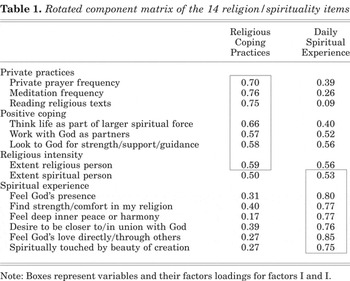
Participants from both the national and the patient sample completed the National Institute on Aging/Fetzer Measure of Religiousness and Spirituality (F.I.N.I.o.A.W. Group, 1999). The prostate cancer patients completed this measure approximately 12 months after diagnosis, whereas participants from the national sample completed it during their one-time questionnaire session. We selected those items from the measure that reflected religious and spiritual coping (see Table 1). All items were answered using a 4-point scale; however the answer stems varied, as appropriate, based upon the NIA/Fetzer measure's answer stems. We subjected all 14 items to a factor analysis. The rotated component matrix (see Table 1) resulted in two 7-item orthogonal factors: religious coping/practices (α = .87) and spiritual coping (α = .92). Participants also provided their religious affiliation information.
Rotated component matrix of the 14 religion/spirituality items

Also at the 12 month postdiagnosis assessment point, we asked prostate cancer patients “Since being diagnosed with prostate cancer, have you become more religious?” and “have you become more spiritual?” (1 = not at all, 4 = a great deal). Due to the nonnormal distribution of each of these variables, we recoded the scores for extent of increases in these variables as 1 = none, 2 = some, 3 and 4 = a lot.
Data Analyses
We used SPSS for Windows v. 12 for all analyses. For Part I, we first assessed via t test for differences in age between the national and prostate cancer sample. We used chi-square analyses to assess group differences in race, education, and religious affiliation. We used two separate multiple regression analyses to test Part I's hypotheses involving group differences in religious practices/coping and daily spiritual experience. In each of these regressions we simultaneously entered age (continuous variable), race dummy coded as “Caucasian” versus not, education dummy coded as “a College Education” or not, religious affiliation coded as “no religion” versus “any religion”, and the group variable dummy coded as “prostate cancer sample” or not. We reported the standardized betas and their corresponding standard errors.
For Part II, utilizing the prostate cancer sample (same dummy codes as for Part I), we used ordinal logistic regression to predict becoming more religious (Y/N) or spiritual (Y/N) and simultaneously entered age, race, education, religious affiliation, treatment option dummy “watch and wait” versus “active treatment,” and the following variables assessed at diagnosis: prostate cancer symptoms, perceived life expectancy, prostate cancer seriousness, negative affect, worry about prostate cancer, and emotional well-being. For Part III, we simultaneously entered age, race, education, treatment option, worry about prostate cancer at diagnosis (continuous variable), the degree a patient became more religious since diagnosis, and level of their religious coping/practices, followed by the interaction of these last two variables to predict 18-month worry about recurrence. We performed this same regression predicting 18-month worry about recurrence from the spiritual coping since diagnosis, level of daily spiritual experience, and their interaction. We had insufficient variability to perform analyses with the 18-month emotional well-being score (only 2.5% of scores were <3 on a 4-point scale) or the negative affect score (only 7% of scores were >2 on a 4-point scale).
RESULTS
Part I: Prostate Cancer Patients versus National Sample
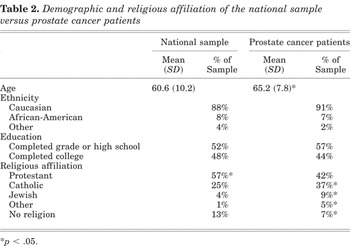
The first part of the results section addressed the question of whether men with prostate cancer reported higher levels of daily spiritual experience, religious coping/practices, and religious affiliation than men from the national sample. As can be seen from Table 2, the two samples were of comparable race and education level (χ2 statistics n.s.). The group of men with prostate cancer were on average 4.5 years older than the national sample (t = −5.69, df = 490, p = .00). The majority of men with prostate cancer opted for active treatment (i.e., 53% external beam radiation, 27% brachytherapy, 16% surgery), and only 4% of patients chose watchful waiting. A higher percentage of individuals with prostate cancer reported having a Catholic (χ2 = 8.05, df = 1, p ≤ .05), Jewish (χ2 = 4.02, df = 1, p ≤ .05), or “Other” (χ2 = 3.85, df = 1, p ≤ .05) religious affiliation than individuals from the national sample. Compared to the national sample, the prostate cancer group had a lower percentage of members reporting a Protestant affiliation (χ2 = 10.47, df = 1, p ≤ .05), and a lower percentage of members reporting having no religious affiliation (χ2 = 3.70, df = 1, p ≤ .05).
Demographic and religious affiliation of the national sample versus prostate cancer patients

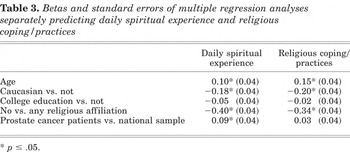
Table 3 contains the comparison of the prostate cancer versus national samples on daily spiritual experience and religious coping/practices. After controlling for age, race, education, and religious affiliation, prostate cancer patients reported having higher daily spiritual experiences (daily spiritual experience: β = .09, SE = .04), but do not engage in more frequent religious coping or practices (β = .03, SE = .04).
Betas and standard errors of multiple regression analyses separately predicting daily spiritual experience and religious coping/practices

Part II: Cognitive-Affective Predictors of Increased Religiosity/Spirituality.
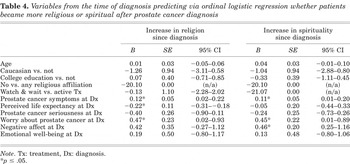
Before reporting the relations between cognitive-affective variables and increases in religiosity or spirituality, we first report on the prevalence of increased religiosity and spirituality after diagnosis. With regard to spirituality, 33% indicated that they became “somewhat,” 15% “quite a bit”/“a great deal,” and 53% “not at all” more spiritual since diagnosis. As for religiosity, 33% indicated that they became “somewhat,” 8% “quite a bit”/“a great deal,” and 59% “not at all” more religious since diagnosis. We also asked the extent that participants in the prostate cancer group had become less religious or less spiritual as the result of their diagnosis, using the same response set. The majority of the group did not decrease in their levels of either since diagnosis (98% “not at all” less spiritual; 95% “not at all” less religious).
As can be seen in Table 4, increase in religion and spirituality were both predicted by more symptoms at diagnosis and higher levels of worry about prostate cancer. In addition, increases in religiosity were predicted by lower perceived life expectancy, and increases in spirituality were predicted by higher negative affect.
Variables from the time of diagnosis predicting via ordinal logistic regression whether patients became more religious or spiritual after prostate cancer diagnosis

Part III: Religion and Spirituality's Longitudinal Impact on Worry about Recurrence
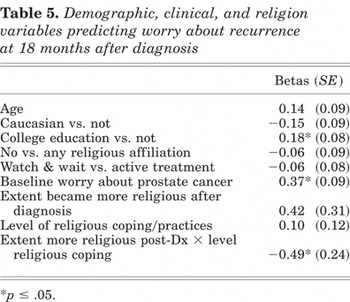
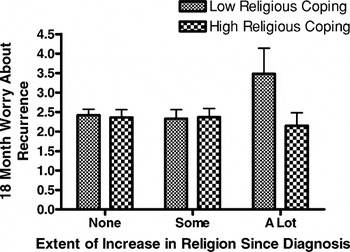
Results in Table 5 demonstrate that neither becoming more religious since diagnosis nor level of religious coping/practices were predictive of worry about recurrence. However, the interaction term between becoming more religious and religious coping/practices predicted worry about recurrence reported 18 months after diagnosis. To interpret the interaction, we performed a median split of the religious coping/practices variable. Men in the “low” religious coping/practices group had an average score of 1.85 (SD = 0.56), whereas those in the “high” religious coping/practices group had an average score of 3.53 (SD = 0.52). Combining high versus low religious coping/practices grouping variable with the existing level of being more religious since diagnosis variable (none, some, a lot), we formed six groups.
Demographic, clinical, and religion variables predicting worry about recurrence at 18 months after diagnosis

We plot the mean values (and error bars) of worry about recurrence 18-month after diagnosis in Figure 1. The level of worry among the men who reported the highest increase in religion and had high levels of religious coping/practices is similar to that of all other men, but is lower in contrast to the men with low religious coping/practices who reported high increases in religion after diagnosis.

Mean worry about recurrence scores at the 18-month postdiagnosis follow-up as a function of extent patients perceived themselves as becoming more religious since diagnosis and the level of their religious coping/practices. Bars represent standard errors of the mean.
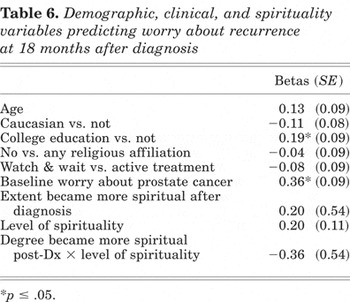
We did not find a similar pattern of results for the longitudinal impact of increased spirituality and level of spiritual experience (Table 6) on worry about recurrence. Higher levels of spirituality had the tendency to longitudinally predict more worry about recurrence (p = .09).
Demographic, clinical, and spirituality variables predicting worry about recurrence at 18 months after diagnosis

DISCUSSION
We report on one of the first prospective studies on the prevalence and influence of daily spiritual and religious experiences among prostate cancer patients. Results from our analyses in Part I suggest that, after a prostate cancer diagnosis, men report small but significantly higher levels of spirituality compared to the reference group. We did not observe differences in level of religious coping/practices between the national and prostate cancer samples. Both the national and the patient sample had religious coping/practices scores reflecting “somewhat” to “moderately” high levels.
From Part II, we learn that increases in religiosity and spirituality are more pronounced among men who reported elevated levels of prostate cancer-related symptoms at diagnosis and elevated levels of cancer-related worry. We should note that ratings of seriousness of prostate cancer and emotional well-being were not associated with changes in level of either religiosity or spirituality.
Finally, analyses from Part III suggest that positive short-term effects of adjustment (decreased recurrence worry) due to diagnosis-related increased religion were restricted to patients who reported higher versus lower religious coping/practices. Men with lower religious coping/practices at baseline who reported increasing their religiosity after diagnosis were more worried about a recurrence. These men fared worse even compared to men with low religious coping/practices and who did not report any diagnosis-related increase of religiosity.
The results of Part I of our analyses are consistent with earlier retrospective findings in the literature that some cancer patients report an increase in spirituality and religiousness (Brandt, 1987; Sodestrom & Martinson, 1987; O'Connor et al., 1990; Fredette, 1995; Roberts et al., 1997; Feher & Maly, 1999). Compared to reports in the literature, the increase in spirituality and religiosity in our sample is fairly modest. A reason for this small increase could be attributed to the nature of the cancer. Early-stage prostate cancer has an average 5-year survival rate of 95%, and this might confer a lower existential threat than advanced prostate cancer. Further it is also conceivable that a small percentage of our national sample would suffer from prostate cancer; however, based on our estimates, this percentage is quite small and thus would have to show an enormous increase in spirituality and religiosity to influence the overall results. This seems quite unlikely. The small group differences may also be explained by regional differences in religiosity. Thirty-eight percent of the national sample was from regions classified as part of the “Bible Belt” (South Atlantic, West South Central, and East South Central sections of the United States). Yet, all men from the prostate cancer group were from the traditionally more secular Middle Atlantic section of the United States. Future work is needed with a comparison group of individuals who are known to be disease free and matched in regional religious tendencies. General conclusions need to be tempered in light of the small differences found.
In Part II we demonstrated that both health-related (more physical symptoms) as well as cognitive-affective variables (shorter perceived life expectancy, worry about prostate cancer, and negative affect at diagnosis) were predictive of increased levels of religion and spirituality. This is consistent with previous studies that related cognitive-affective constructs such as helplessness (Cotton et al., 1999) and beliefs about a poor prognosis (Sodestrom & Martinson, 1987) to increases in religiosity. Our study is the first to extend the influence of cognitive-affective constructs to increased religiosity and spirituality in response to having cancer. Of particular interest is the finding that elevated symptom reports at diagnosis are associated with increased levels of both religion and spirituality. According to self-regulation theory, external or internal stimuli, such as disease-related symptoms, trigger cognitive and affective reactions that are processed, acted upon, and reappraised (Leventhal et al., 1992; Diefenbach et al., 1996; Miller et al., 1996; Miller & Diefenbach, 1998). In this case, elevated symptom experiences, as well as increased worry about prostate cancer at diagnosis, were significantly associated with both increased religiosity and spirituality. It is possible that the symptom experience produced elevated levels of worry (but not perceptions of seriousness), which in turn were elevated with religious/spiritual experiences. That beliefs about seriousness, which is a cognitive construct, are not significantly related to increases of religiosity/spirituality is in line with existing research that examined the role of affect and cognition on health behavior. For example, several studies have found that worry about breast cancer was related to screening behavior, but not perceptions about severity or perceptions about disease occurrence (e.g., McCaul et al., 1998, Diefenbach et al., 1999). Prostate cancer patients in our study might also engage in religion or spirituality to cope with the emotional impact of the cancer diagnosis and its treatment, thus seeking religious consolation for the affective component of the disease, but not as a measure to ameliorate the practical aspects of the disease (Ferraro & Kelley-Moore, 2000).
These findings, however, raise further questions: Is a patient's use of religion and spirituality a regular part of daily living or only performed in the face of uncontrollable adversity? What are the roles of religiosity and spirituality in relation to beliefs about health and disease? What function does religion play when patients hope to gain control by engaging in religious/spiritual coping? Do they seek religion for solace, or hope to cure their disease? Qualitative in-depth interviews of patients with chronic illnesses as well as quantitative efforts would shed light on these issues.
In Part III of our analyses our data suggest that using religion after diagnosis without high levels of usual religious practices does not bring the hoped effects of solace and comfort. Perhaps those with lower religious practices/coping who adopt religious coping/practices after diagnosis are pleading with God regarding their prostate cancer (Pargament, 1997); alternatively, they might have experienced religious turmoil or dissonance, dealing with anger toward God concerning their diagnosis (e.g., Exline et al., 1999; Gall, 2004).
Our findings from Part III also suggested that worry of recurrence was very low for a subset of individuals for whom religion has not been part of their coping repertoire. Our results confirm Pargament's assertion that the extent an individual already incorporates religion and spirituality into his life is indicative of the positive role religion/spirituality has in that person's life. Individuals with low levels of religiosity/spirituality might draw strength from other personal and social resources, and therefore do not see a need for religion (Fitchett et al., 2000). Future work should examine the role of religious or spiritual coping over time, as coping efforts might be employed by the individual in a dynamic way depending on their perceived progress of disease and treatment.
Our results suggest that the development and application of religious coping interventions for all patients may not be advisable, as individuals who did not increase their religiosity as a result of a diagnosis and who had low religious practices/coping adjusted equally well. However, men who seek religion in the wake of a cancer diagnosis might be approached to attenuate the negative aspects of religious coping, such as religious struggle, and increase positive aspects, such as finding solace and peace with oneself (Cole & Pargament, 1999b). Before such an intervention can be developed it is necessary to more closely examine which aspects of religiosity and spirituality are helpful and which might have a negative impact on future well-being.
Our study has some limitations. First, we do not know whether individuals from the national sample were suffering from any type of life-threatening illness such as cancer or other significant levels of comorbidity. Future work is needed with a comparison group of individuals who are known to be disease free. Second, we utilized a retrospective assessment of degree of change in religion since being diagnosed. There is the possibility that individuals' responses were biased by disease and treatment-related experiences. Given these limitations, our analyses for parts II and III are still preliminary. Finally, although our findings regarding race are consistent with previous research (Bearon & Koenig, 1990; Ferraro & Koch, 1994), the minority proportion of our sample is not representative of that of the United States; thus results are only applicable for the represented sample of individuals.
In conclusion, our results suggest that a prostate cancer diagnosis triggers a small increase in spiritual experiences. Further, religious coping strategies to reduce cancer-related worry were most effective among those patients whose religiousness/spirituality increased the most since diagnosis and who were experienced in religious coping/practices. The implementation of religious/spirituality interventions seems premature.
ACKNOWLEDGMENTS
Preparation of this article was supported in part by grants from the National Cancer Institute, CA6136-04; CA06927, which supports the Behavioral Core Research Facility at Fox Chase Cancer Center; the Commonwealth of Pennsylvania, PADOH ME-98155; and the Department of Defense, DAMD 17-01-1-0006. We are grateful to Elissa Kolva, Jenevie Dorsey, Christy Vass, Anny Ayala, Jessica Meyers, Mary Ann Ryan, and Doris Gillespie for their assistance with this project.