Implications
Alternative protein feedstuffs to imported soybean meal (SBM) are needed to improve the self-sufficiency for protein sources of the European pig production. Rapeseed expeller meal (RSM) is abundant and has a high protein content and a balanced amino acid (AA) profile and could serve as an alternative to SBM. However, RSM contains higher levels of fiber and other anti-nutritional factors (ANF) that could affect pig performance. The present experiment showed that up to 30% RSM can be included in diets for young pigs at the expense of SBM without affecting nitrogen (N) and energy retention in the body or efficiency of utilization of digested nitrogen (DN) or metabolizable energy (ME) for retention in young pigs.
Introduction
Rapeseed meal, the co-product from rapeseed processing for oil extraction, is increasingly available in Europe due to the rapid growth of the biofuels industry (Carré and Pouzet, Reference Busato, Bestetti, Rossi, Gerber, Peter and Blum2014). Increased and efficient use of RSM as an alternative protein source to SBM could decrease the dependency on imports and improve the self-sufficiency for protein sources of European pig production. Because feed represents up to 70% of the total cost for pig producers, small improvements or even similar feed efficiency when using RSM compared with SBM could enhance profitability. In this regard, nutrient and energy digestibility and utilization/partitioning following absorption are key factors affecting the net efficiency of any pig system. Le Goff and Noblet (Reference Kim2001) reported that the fecal loss of nutrients and energy in most pig rearing systems ranges from 15% to 25% of the total intake. Variation in energy and nutrient metabolism and partitioning following digestion will further determine the net efficiency of pigs (Gilbert et al., Reference Fandrejewski, Katarzyna, Kotarbinska and Stanislawa2017). Rapeseed meal has a higher fiber content than SBM and contains other ANF such as tannins, phytic acid, and glucosinolates, which could interfere with the digestive and metabolic processes of the pigs (Mejicanos et al., Reference Len, Lindberg and Ogle2016). High dietary fiber (DF) is associated with impaired nutrient utilization and reduced net energy (NE) values in the diet (Noblet and Le Goff, Reference Noblet, Karege and Dubois2001) and increased viscera weight in pigs (Jørgensen et al., Reference Jensen, Olesen and Sørensen1996). Because visceral organ mass is a major contributor to fasting heat production (van Milgen et al., Reference van Milgen, Bernier, Lecozler, Dubois and Noblet1998), increased viscera weight by RSM-feeding may increase the total heat production of the pigs. Goitrogenic effects associated with glucosinolates in RSM could also lead to changes in basal metabolic rate and overall energy expenditure (Kim, Reference Jørgensen, Zhao and Eggum2008), and in protein turnover (Hocquette et al., Reference Hocquette, Ortigues-Marty, Pethick, Herpin and Fernández1998).
Given this scenario, understanding the effects of RSM-based diets on the digestive and metabolic efficiency of pigs is of major interest. The objective was to determine the effects of increasing inclusion of expeller RSM, replacing SBM in isonitrogenous and isoenergetic diets, on nutrient and energy digestibility, N retention, energy metabolism and substrate oxidation by means of balance and respiration experiments with young pigs. We hypothesized that replacing SBM with RSM at iso-NE and iso-standardized ileal digestible (SID) levels for the most limiting AA would reduce nutrient and energy digestibility, N retention and increase energy expenditure in young pigs.
Material and methods
Animals and experimental design
The experiment was conducted as a randomized complete block design with four experimental diets, four periods and two replicates per diet per period (a total of eight replicate pigs per diet). Each experimental period lasted 3 weeks and consisted of a 2-week adaptation period followed by a 4-day balance period, which included a 22-h respiration experiment by means of indirect calorimetry in an open-air circulation system (Chwalibog et al., Reference Chwalibog, Tauson and Thorbek2004). In each period, eight castrated crossbred pigs (Danish Landrace/Yorkshire×Duroc) from two litters were obtained from a commercial herd. One pig from each litter was allocated to one of the four dietary treatments. The pigs from periods 1 to 4 had an average initial BW of 19.2±3.2, 21.9±4.2, 24.5±4.0 and 25.1±2.4 kg, respectively.
Diets
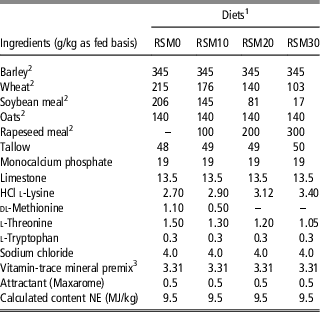
The RSM was a commercial expeller RSM (Mestilla UAB, Klaipėda, Lithuania) produced by pre-conditioning and pressing of the RS cake at a temperature ranging from 106°C to 115°C. The RSM contained 34.0% CP and 11.1% fat. The four experimental diets were: a control diet (RSM0) based on wheat, barley, oats and SBM, with no RSM and three treatment diets (RSM10, RSM20 and RSM30), in which SBM and wheat were partially replaced with 10%, 20% and 30% of RSM, respectively (Table 1). The chemical contents of the ingredients are presented in the Supplementary Material S1. The diets were optimized based on the chemical analyses and on SID table values for CP and AA for the feed ingredients (Sauvant et al., 2004). The NE values for all the ingredients were calculated based on the Dutch energy evaluation system (CVB; Blok, Reference Blok2006). All four diets were optimized to meet or exceed the requirements for essential AAs and all other nutrients and energy for pigs of this age (National Research Council (NRC), Reference Morgan and Whittemore2012). The diets were subsequently mixed and pelleted at the Centre for Feed Technology (Fôrtek) of the Norwegian University of Life Sciences (Ås, Norway). The pelleting conditions were: pelleting capacity 600 kg/h, conditioning temperature 75°C, and pelleting temperature 82°C.
Ingredient composition of the experimental diets for pigs

NE=net energy.
1 RSM0: control diet based on grains and soybean meal and with no rapeseed meal; RSM10,20,30: experimental diets where wheat and soybean meal were partially replaced with 10%, 20%, and 30% of rapeseed expeller meal, respectively.
2 Chemical composition in Supplementary Material S1.
3 Provided per kg of diet: 96 mg Zn (ZnO); 96 mg Fe (FeSO4); 48 mg Mn (MnO); 20.8 mg Cu (CuSO4); 0.48 mg I (Ca(IO3)2); 5700 IU vitamin A; 1200 IU cholecalciferol; 100.7 mg dl-α-tocopheryl acetate; 3.57 mg menadione; 2.4 mg thiamin; 9.0 mg riboflavin; 36.0 mg d-pantothenic acid; 12.0 μg cyanocobalamine; 12.0 mg niacin; 0.24 mg biotin; and 1.8 mg folic acid.
Housing and feeding
During the adaptation period, pigs were housed in pairs in pens with concrete floors covered with straw. During the balance periods, pigs were housed individually in stainless steel metabolic cages (1.65×0.75 m) with a slatted floor of round bars and devices for quantitative collection of feces, urine, and feed residues. All pigs were provided with a rubber mat in the front of the metabolism cages.
Upon arrival at the experimental farm, pigs were offered a commercial weaner diet, which was gradually replaced by one of the four experimental diets. Pigs within the same pen were assigned randomly to one of the four experimental diets and they were separated at every meal to allow individual feeding. Pigs were fed equal meals twice daily at 0900 and 1500 h throughout the experimental period, except during the respiration experiment, when they were fed one full meal shortly after transfer into the respiration chambers. The pigs had access to the feed throughout the 22 h measurements. Daily feed allowance was similar across treatments and adjusted to a level where pigs had a minimum of feed residues, that is were fed as close to ad libitum as possible. Water was added to the diet immediately before feeding at a ratio of 2 : 1 (w/w). Pigs were provided ad libitum access to water from drinking nipples. The temperature was kept at 20±2°C and a 12-h light/12-h dark cycle was provided for the duration of the experiment.
Experimental procedures
Pigs were weighed at the start and end of the balance period. The collection was conducted between 0800 and 1200 h every day. Feed residues, feces and urine were quantitatively collected from each individual pig, weighed, and frozen at −20°C. Urine was collected in bottles containing 10 ml of 5% sulphuric acid, weighed, and 10% of urine from the daily samples were frozen at −20°C. The bars inside the metabolic cages, the rubber mat, and the collection plate were rinsed with 1% citric acid solution daily after completion of the collection procedures, and the resulting manure was collected in separate containers, weighed and frozen at −20°C. Diets were sampled daily during the balance periods and pooled before preparation for chemical analyses. Following each balance period, feed residues, feces, urine and manure were thawed, homogenized, and representative samples were taken and frozen at −20°C for later chemical analyses.
The respiration experiments were performed in two open-air-circuit respiration chambers with a volume of 3500 l and constructed for animals with a live weight range of 5 to 200 kg. Before initiation of the experiment gas recovery tests were performed, and the following recovery factors were found for CO2: chamber A 0.992 and chamber B 0.965. The corresponding factors for O2 were: chamber A 0.915 and chamber B 0.959. For CH4 the recovery was 1.000 for both chambers. Pigs were brought into the respiration chambers between 0930 and 1030 h at the assigned day for the respiration experiment. Each pig was measured for 22 h, starting at 1100 h and finishing at 0900 h the following morning. For a detailed description of the construction and function of the respiration chambers, as well as for the calibration and measurement procedures see Chwalibog et al. (Reference Chwalibog, Tauson and Thorbek2004). At the end of each experimental period, pigs were euthanized and the liver was removed and weighed.
Sample processing and chemical analyses
Samples of feces were freeze-dried, and feces and diets were ground through a 1-mm screen before chemical analyses. Feed residues were analyzed for dry matter (DM) and it was assumed that the chemical composition of the DM was equal to that in the DM of the feed. Wet feces were analyzed for DM and N, and freeze-dried feces for ash, fat, gross energy (GE) and fiber contents. Urine and manure were analyzed for N.
Dry matter was measured by drying to constant weight at 105°C, and ash was determined by incineration at 525°C. Nitrogen was determined by the Kjeldahl method using the Tecator-Kjeltec system 1030 (Tecator AB, Höganäs, Sweeden) and CP calculated as N×6.25. Fat content was determined by petroleum ether extraction in a Soxtec system 2043 (Foss, Hillerød, Denmark) after HCl hydrolysis. Total carbohydrate and lignin (CHO+L) content in the diet and feces was calculated from the previous analyses as:
 $${\rm CHO}{\plus}{\rm L}\,{\equals}\,{\rm DM}-{\rm ash}-{\rm CP}-{\rm fat}$$
Gross energy was determined using an IKA Calorimeter system (IKA Gmbh and Co. KG, Staufen, Germany) and starch was analyzed according to Bach Knudsen (Reference Bach Knudsen1997). Neutral detergent fiber in the diets was determined using the Ankom200 Fiber Analyzer system with F58 Ankom filter bags (ANKOM Technologies, Fairport, NY, USA). Amino acid and tryptophan in the diets were analyzed according to Commission dir. No 152/2009/EC. Amino acids were determined on a Biochrom 30 Amino Acid Analyzer (Biochrom Ltd, Cambridge, UK), whereas tryptophan was analyzed on a Dionex UltiMate 3000 HPLC system (Dionex Softron GmbH, Germering, Germany) with a Shimadzu RF-535 fluorescence detector (Shimadzu Corporation, Kyoto, Japan). Total, soluble and insoluble non-starch polysaccharides (T-NSP, S-NSP and I-NSP, respectively), and their constituent sugars were determined as alditol acetates by GLC for neutral sugars, and by a colorimetric method for uronic acids in three parallel runs as described by Bach Knudsen (Reference Bach Knudsen1997). Klason lignin was measured gravimetrically as the residue resistant to sulphuric acid hydrolysis as described by Theander et al. (Reference Sauvant, Pérez and Tran1994). The following parameters were calculated from the previous analyses:
Total non-cellulosic polysaccharides (T-NCP)=rhamnose +fucose+arabinose+xylose+mannose+galactose +glucose+uronic acids
 $$\eqalignno{ & {\rm Cellulose}_{{{\rm DF}}} \,{\equals}\,{\rm T}{\hbox -}{\rm NSP}-{\rm T}{\hbox -}{\rm NCP} \cr & {\rm Insoluble}{\hbox -}{\rm NCP}\left( {{\rm I}{\hbox -}{\rm NCP}} \right)\,{\equals}\,{\rm I}{\hbox -}{\rm NSP}-{\rm Cellulose}_{{{\rm DF}}} \cr & {\rm Soluble}{\hbox -}{\rm NCP}\left( {{\rm S}{\hbox -}{\rm NCP}} \right)\,{\equals}\,{\rm T}{\hbox -}{\rm NCP}-{\rm I}{\hbox -}{\rm NCP} \cr & {\rm DF}\,{\equals}\,{\rm T}{\hbox -}{\rm NSP}{\plus}{\rm Klason}\,{\rm lignin} $$
Total glucosinolate analysis of the RSM was performed according to Commission dir. no 1864/90/EEC.
Calculations
The apparent total tract digestibility (ATTD) of individual nutrients and energy was calculated according to the equation:
 $$\eqalignno { {\rm ATTD}_{{{\rm nutrient}}} ( \,\%\, )\,{\equals}\, & {[ {( {{\rm Nutrient}\,{\rm intake}\,( {\rm g} )}} - {\rm Nutrient}\,{\rm in}\,{\rm feces}\,( {\rm g} )} )\cr&/{\rm Nutrient}\,{\rm intake}\,( {\rm g} )]{\times}100} ]$$
Based on 4 days quantitative collection of urine and feces, DN (g) was calculated as ingested nitrogen (IN) minus fecal nitrogen (FN). Retained nitrogen (RN, g) was calculated as DN minus urinary nitrogen (UN) and N in manure. Energy in urine (UE, kJ) and manure was calculated as 53.5 kJ/g×UN (g) (Chwalibog et al., Reference Chwalibog, Tauson and Thorbek2004). Energy in methane was calculated as 39.6 kJ/l×CH4 (l) (Brouwer, Reference Brouwer1965). Metabolizable energy (kJ) intake was calculated by subtracting fecal energy (FE), UE and energy in methane from the GE intake. Heat production (HE) was calculated based on the 22-h measurements of gas exchange and the mean UN according to Brouwer (Reference Brouwer1965) as follows:
HE (kJ)=16.18 (kJ/l)×O2 (l)+5.02 (kJ/l)×CO2 (l)–2.17 (kJ/l),×CH4 (l)–5.99 kJ/g×UN (g) where 22 h volumes of O2, CO2 and CH4 were extended to 24 h by multiplication with 24/22.
Retained energy (RE, kJ) was calculated as the difference between ME and HE. Energy retained as protein (RPE, kJ) was calculated from the N balance as RN, g×6.25×23.86, kJ/g and energy retained as fat (RFE, kJ) as the difference between total RE and RPE. The respiratory quotient (RQ) was determined as the ratio between CO2 production and O2 consumption.
The oxidation of protein (OXP), carbohydrate (OXCHO) and fat (OXF) was calculated according to Chwalibog et al. (Reference Chwalibog, Jakobsen, Henckel and Thorbek1992) and validated for RQ values below and above one (Chwalibog and Thorbek, Reference Choi, Jeong, Kim, Lee, Kwon and Kim1995):
 $$\eqalignno{ & {\rm OXP}\,( {{\rm kJ}} )\,{\equals}\,{\rm UN}\,( {\rm g} ){\times}6.25{\times}18.42\,( {{\rm kJ}\,/\,{\rm g}} ) \cr & {\rm OXCHO}\,( {{\rm kJ}} )\,{\equals}\,( {-2.968{\times}{\rm O}_{2} \,( {\rm l} ){\plus}4.174{\times} \cr &{\rm CO}_{2} \,( {\rm l ) }} \cr & -1.761 {\times}{\rm CH}_{4} \,( {\rm l} )-2.446{\times}{\rm UN}\,( {\rm g} ) ){\times}17.58\,\:{\rm kJ}/{\rm g }\cr & {\rm OXF}\,( {{\rm kJ}} )\,{\equals}\,( {1.719{\times}{\rm O}_{2} \,( {\rm l} )-1.719{\times}{\rm CO}_{2} \,( {\rm l} )}\cr & -1.719{\times}{\rm CH}_{4} \,( {\rm l} )-1.963{\times}{\rm UN}\,( {\rm g} ) ){\times}39.76\,\:{\rm kJ}/{\rm g }$$
The ME requirement for maintenance (MEm) and the efficiency of utilization of ME for retention in body tissues (k g) were estimated by a linear regression approach, where ME/kg0.60 was regressed on RE/kg0.60, where the intercept (I) denoted the MEm value and k g was the reciprocal of the slope (b) (Thorbek et al., Reference Theander, Åman, Westerlund and Graham1984).
Liver index was calculated as the ratio of liver weight to metabolic BW (g/kg0.60).
Statistical analysis
Statistical analysis of general animal performance, ATTD, N balance, energy metabolism and substrate oxidation data was performed using the GLM procedure of SAS (Reference Pérez de Nanclares, Trudeau, Hansen, Mydland, Urriola, Shurson, Piercey Åkesson, Kjos, Arntzen and Øverland1990) for randomized complete block design, with individual pigs as the experimental unit. The fixed effects of diet (n=4) and period (n=4), and the effect of pig live weight as a covariate for the general animal performance and ATTD analyses were included in the statistical model. As the interaction between diet and period was non-significant, it was removed from the model. The effect of the covariate pig live weight on ATTD was non-significant and therefore not included in the analysis. Treatment means were separated using the least-squares means test. Polynomial contrasts were used to determine the linear, quadratic, and cubic effects of increasing level of RSM in the diets. Results are presented as least-squares means for each dietary treatment, and variance is expressed as the pooled standard error of the mean. Effects were considered significant if P<0.05 and a tendency if 0.05⩽P⩽0.10.
Linear regression analysis for determination of MEm and k g was performed using the procedure REG in SAS (Reference Pérez de Nanclares, Trudeau, Hansen, Mydland, Urriola, Shurson, Piercey Åkesson, Kjos, Arntzen and Øverland1990).
Results
A significant effect of the period was found for most of the parameters, which may be explained not only by the differences in BW between the pigs from the different periods but also by a litter effect. However, pigs were allotted to the dietary treatments according to litter and BW to account for these effects, therefore, the effect of the period will not be included in the discussion.
Diets
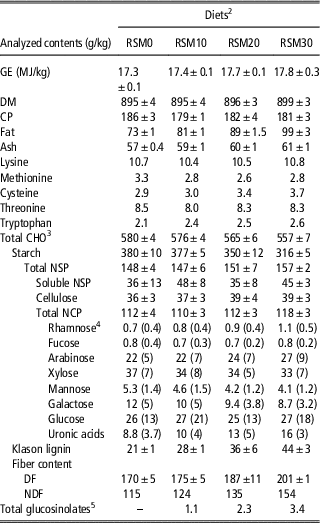
Partial replacement of SBM with increasing levels of expeller RSM was reflected in the CHO+L composition of the diets (Table 2). The contents of T-NSP, cellulose, lignin, DF and NDF increased with increasing RSM inclusion, whereas the starch content decreased. Regarding monomeric residues of NSP, RSM inclusion resulted in increased contents of rhamnose, arabinose, and uronic acids. Inversely, the contents of xylose, mannose and galactose decreased with increasing RSM inclusion. The CP and GE concentrations were similar among diets, with a slightly higher CP content in the RSM0. There were no major differences in the concentrations of essential AA between the diets and the concentrations of lysine, methionine, threonine, and tryptophan exceeded the requirements of the pigs (NRC, Reference Morgan and Whittemore2012). The RSM used in this experiment contained 11.3 μmol/g total glucosinolates, resulting in 1.13, 2.26 and 3.39 mmol/kg total glucosinolate calculated content in the RSM10, RSM20 and RSM30 diets, respectively.
Analyzed chemical composition of the experimental diets to pigs (as fed basis)Footnote 1

GE=gross energy.
1 Values are means ± standard deviation from the chemical analysis of representative samples from all diets from each period (n=4), except for amino acids and NDF, which were analyzed in pooled samples of each diet from the four periods (n=1).
2 RSM0: control diet based on grains and soybean meal and with no rapeseed meal; RSM10,20,30: experimental diets where wheat and soybean meal were partially replaced with 10%, 20% and 30% of rapeseed expeller meal, respectively.
3 The total carbohydrate content was calculated as CHO=DM–ash–CP–fat.
4 Values in parenthesis are soluble NSP.
5 The total glucosinolate content is given in mmol/kg diet and was calculated based on the analyzed glucosinolate content of the rapeseed expeller meal and the inclusion level in the diet.
Health status, intake of nutrients and performance
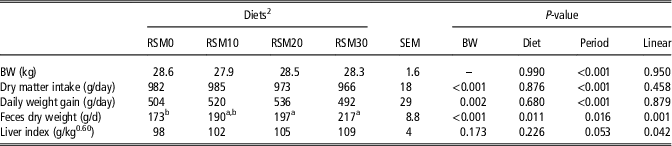
In general, the pigs had a good health status throughout the experiment, but some pigs experienced transitional loose stools. One pig was excluded from the study due to low feed intake and another pig was excluded due to technical problems during the balance period. Both pigs belonged to the RSM10 group. One pig on the RSM20 diet received antibiotic treatment (Tribrissen® Vet. 48%; Legemiddelindustrien (LMI), Copenhagen, Denmark) following veterinary recommendations due to unthriftiness. The BW, daily weight gain, and daily feed intake during the balance periods were similar among dietary groups, whereas the feces dry weight (P=0.011, linear P=0.001) and the liver index (linear P=0.042) increased with increasing inclusion of RSM in the diets (Table 3).
Effects of replacing soybean meal with increasing levels of rapeseed expeller meal (RSM) on BW, feed intake, weight gain, feces excretion and liver index of young pigsFootnote 1

a,bValues within a row with different superscripts differ significantly at P<0.05.
1 Values are least-squares means and pooled standard error of the mean (SEM), n=8 except for the RSM10 group where n=6.
2 RSM0: control diet based on grains and soybean meal and with no rapeseed meal; RSM10,20,30: experimental diets where wheat and soybean meal were partially replaced with 10%, 20% and 30% of rapeseed expeller meal, respectively.
Digestibility of dietary components
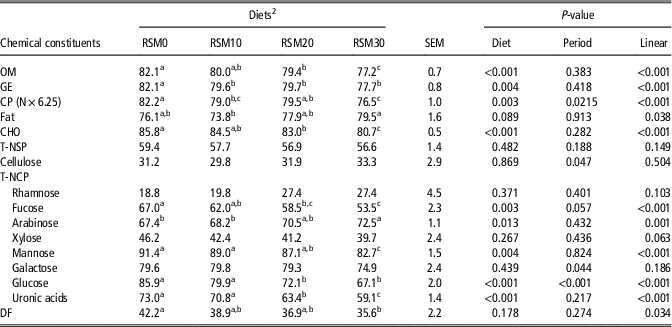
Partially replacing SBM with increasing levels of expeller RSM reduced (P<0.01, linear P<0.001) the ATTD of organic matter (OM), CP, CHO and energy (Table 4). The ATTD of fat (P=0.089, linear P=0.038) increased and ATTD of DF (linear P=0.034) decreased with increasing RSM inclusion, whereas ATTD of T-NSP and cellulose was not affected by diet (P>0.10). Regarding individual monomeric residues of NSP, the ATTD of fucose, mannose, glucose and uronic acids was reduced (P<0.01, linear P<0.001), whereas ATTD of arabinose increased (P=0.013, linear P=0.001) with increasing RSM in the diet.
Effects of replacing soybean meal with increasing levels of rapeseed expeller meal (RSM) on apparent total tract digestibility (ATTD, %) of main nutrients, energy and individual fiber fractions in young pigsFootnote 1

OM=organic matter.
a,b,cValues within a row with different superscripts differ significantly at P<0.05.
1 Values are least-squares means and pooled standard error of the mean (SEM), n=8 except for the RSM10 group where n=6.
2 RSM0: control diet based on grains and soybean meal and with no rapeseed meal; RSM10,20,30: experimental diets where wheat and soybean meal were partially replaced with 10%, 20% and 30% of rapeseed expeller meal, respectively.
Nitrogen metabolism
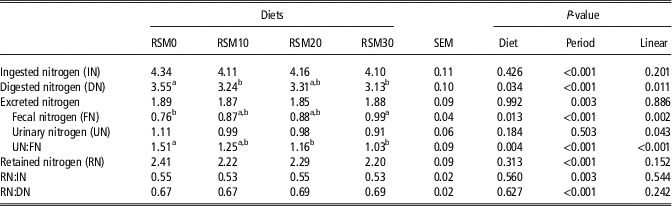
Due to the reduced ATTD of CP, the amount of DN decreased (P=0.034, linear P=0.011) in pigs fed increasing levels of expeller RSM (Table 5). There was no dietary effect on the total N excretion (P>0.10). Excretion of N in the feces increased linearly (P=0.013, linear P=0.002), whereas excretion of N in urine decreased (linear P=0.043) with increasing RSM inclusion. Consequently, increasing dietary levels of RSM resulted in a decreased UN:FN (P=0.004, linear P<0.001). Retained nitrogen was not affected by diet (P>0.10), nor was the efficiency of utilization of IN or DN for retention (RN:IN and RN:DN, both P>0.10).
Nitrogen metabolism (g/kg0.60 per day) in young pigs fed increasing levels of rapeseed expeller meal (RSM) replacing soybean mealFootnote 1

a,bValues within a row with different superscripts differ significantly at P<0.05.
1 Values are least-squares means and pooled standard error of the mean (SEM), n=8 except for the RSM10 group where n=6.
2 RSM0: control diet based on grains and soybean meal and with no rapeseed meal; RSM10,20,30: experimental diets where wheat and soybean meal were partially replaced with 10%, 20% and 30% of rapeseed expeller meal, respectively.
Energy metabolism
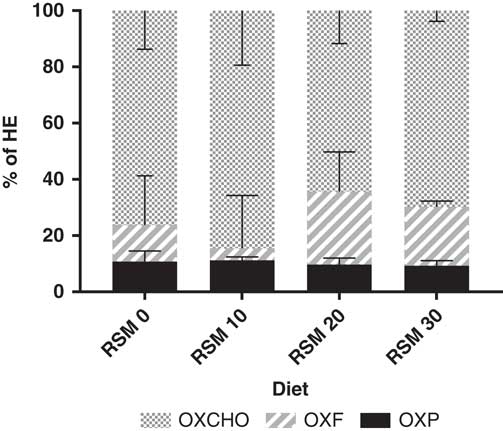
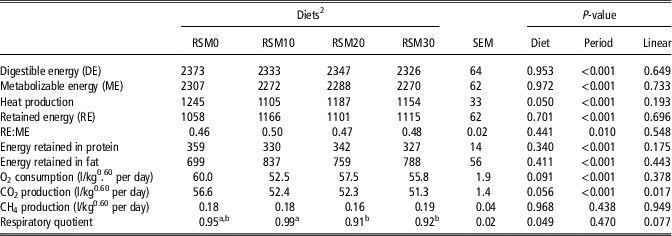
Intake of ME (P>0.10) was similar across dietary treatments (Table 6). There was a tendency (P=0.050) for lower HE in the RSM fed pigs compared with the control pigs. The calculations of nutrient oxidation in proportion to HE (Figure 1) showed that increasing RSM inclusion tended to reduce OXP (linear P=0.062) and OXCHO (cubic P=0.061), whereas it tended to increase OXF (cubic P=0.067). The cubic effects were likely due to OXF being higher on RSM20 than on RSM30, whereas the reverse occurred for OXCHO. Retained energy (P>0.10) was not affected by diet, nor when it was expressed in proportion to ME (P>0.10). Partitioning of RE between protein and fat was not affected by diet (P>0.10). Oxygen consumption and CH4 production were not affected by diet (P>0.05), whereas CO2 production decreased in pigs fed increasing levels of RSM (P=0.056, linear P=0.017). The RQ was affected by diet (P=0.049, linear P=0.077, cubic P=0.023), with higher values in pigs fed lower levels of RSM, namely RSM0 and RSM10, than pigs fed RSM20 and RSM30.
Substrate oxidation in young pigs fed increasing levels of rapeseed expeller meal. OXCHO=oxidized carbohydrate; OXF=oxidized fat; OXP=oxidized protein; HE=heat production. Diet codes RSM0, soybean meal based control diet, RSM10, RSM20 and RSM30 diets in which soybean meal and wheat were gradually replaced with 10%, 20% and 30% rapeseed expeller meal, respectively.

Energy metabolism (kJ/kg0.60 per day) in young pigs fed increasing levels of rapeseed expeller meal (RSM) replacing soybean mealFootnote 1

a,bValues within a row with different superscripts differ significantly at P<0.05.
1 Values are least-squares means and pooled standard error of the mean, n=8 except for the RSM10 group where n=6.
2 RSM0: control diet based on grains and soybean meal and with no rapeseed meal; RSM10,20,30: experimental diets where wheat and soybean meal were partially replaced with 10%, 20% and 30% of rapeseed expeller meal, respectively.
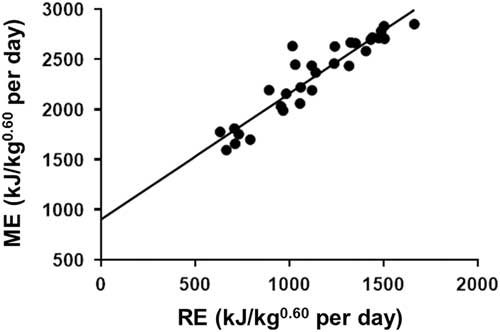
Because there was no difference in RE:ME among groups, linear regression analysis of ME/kg0.60 on RE/kg0.60 was performed on all pigs. The analysis gave the following significant (P<0.001) equation (Figure 2):
 $$\eqalignno { {\rm ME}^{{0.60}} \,{\equals}\, & 902\,\left( {{\!}\pm\,105.3} \right){\plus}1.257\,\left( {{\!}\pm\,0.090} \right)\cr &{\times}{\rm RE}^{{0.60}} ;\,R^{2} \,{\equals}\,0.87,\,{\rm CV}\,{\equals}\,6.1$$
Linear regression analysis of metabolizable energy (ME/kg0.60) on retained energy (RE/kg0.60) in young pigs: ME/kg0.60=902±105.3+1.253±0.090×RE/kg0.60; R 2=0.87, CV=6.11.

The resulting MEm estimate was 900 kJ/kg0.60. The k g value was 0.80.
Discussion
The European pig industry needs alternatives to imported SBM and pigs that perform efficiently when fed such ingredients. Therefore, our objective was to determine the effects of replacing SBM with increasing levels of expeller RSM on nutrient and energy digestibility, N balance, energy metabolism and substrate oxidation of young pigs.
Increasing inclusion of expeller RSM in the diets, partially replacing SBM and wheat, led to increased dietary fat because of the higher fat content in RSM than in SBM (11.1% v. 1.0% of DM), and decreased starch levels because wheat was replaced along with SBM to achieve nutrient balanced diets. The fiber content in RSM is considerably higher than that in SBM (Bach Knudsen, Reference Bach Knudsen2014), therefore, replacing SBM with increasing levels of RSM resulted in gradually higher content of DF, T-NSP, cellulose, NDF and lignin in the diet. Despite the higher fiber and glucosinolate levels, all diets were readily consumed and the pigs performed well even on the RSM30 diet. The increasing DF level most likely caused the linear decrease in ATTD of OM, GE, CP and CHO+L observed in the pigs fed increasing levels of RSM. This negative relation between fiber level and nutrient and energy digestibility has been extensively reported in pigs (e.g. Jørgensen et al., Reference Jensen, Olesen and Sørensen1996 and Reference Jørgensen, Serena, Hedemann and Bach Knudsen2007). The type of fiber may also affect the digestive processes. Because fiber in RSM is more lignified and insoluble than in SBM (Bach Knudsen, Reference Bach Knudsen2014), the fiber fraction in our RSM diets was more resistant to microbial fermentation than in the control diet. Although RSM inclusion did not affect ATTD of T-NSP, the ATTD of DF was linearly decreased, because DF includes the indigestible lignin which increased with increasing RSM inclusion. Pérez de Nanclares et al. (Reference Parr, Liu, Parsons and Stein2017) recently reported reduced apparent ileal digestibility and ATTD of energy, DM, OM, CP, NDF, ADF, P and most AA and monosaccharides in weanling pigs fed high-fiber RS co-products compared with SBM. The reduced digestibility of energy and nutrients may be caused by reduced enzyme activity, lack of enzyme-substrate interaction resulting from entrapment of nutrients in the complex fiber matrix of the RS diets, and/or by interference with other ANF in RSM, such as tannins and phytic acid. Similarly, the reduction in ATTD of DF may result from lack of microbiota-substrate interaction due to the complexity of the fiber matrix in the RS diets. In the present study, the lower digestibility and fermentability of the RSM diets resulted in increased bulking of feces (g DM/day) with increasing inclusion of RSM. This may have increased passage rate and reduced mean retention time of the digesta in the gastrointestinal tract, thus decreasing the time available for enzymatic digestion and microbial fermentation. This may further explain the reduced ATTD of nutrients and energy.
The diets were formulated on the basis of NE and SID CP and AA values, and adjusted to be similar across treatments. Chemical analyses of diets showed no major differences in the concentrations of GE, CP and AA. In addition, intake of N and DE or ME was similar among pigs fed the different diets. Therefore, it can be assumed that any effect observed on protein and energy metabolism could be attributed to the replacement of SBM with RSM and not to diets being unbalanced or differences in N and/or energy intake. Despite less N being available for absorption because of the reduced ATTD of CP and lower DN with increasing inclusion of RSM, retained N was similar across dietary groups, also when expressed in proportion of IN and DN. This is in agreement with previous research where inclusion of fiber in pig diets did not affect RN:IN (Zervas and Zijlstra, Reference van Milgen, Noblet and Dubois2002; Hansen et al., Reference Gilbert, Billon, Brossard, Faure, Gatellier, Gondret, Labussière, Lebret, Lefaucheur, Le Floch, Louveau, Merlot, Meunier-Salaün, Montage, Mormede, Renaudeau, Riquet, Rogel-Gaillard, van Milgen, Vincent and Noblet2006) or RN:DN (Len et al., Reference Le Goff and Noblet2007). Morgan and Whittemore (Reference Mejicanos, Sanjayan, Kim and Nyachoti1988) suggested that unaffected or even higher RN with high-fiber diets is due to a higher N utilization, which is supported by the improved efficiency of utilization of DN for retention (RN:DN) found by Hansen et al. (Reference Gilbert, Billon, Brossard, Faure, Gatellier, Gondret, Labussière, Lebret, Lefaucheur, Le Floch, Louveau, Merlot, Meunier-Salaün, Montage, Mormede, Renaudeau, Riquet, Rogel-Gaillard, van Milgen, Vincent and Noblet2006) when including fiber in pig diets. However, our results and those of Len et al. (Reference Le Goff and Noblet2007) could not support this suggestion, as RN:DN was not affected by increasing DF. Total N excretion was similar across dietary treatments. However, there was a repartition of N from urine to feces, as shown by the linear decrease in UN excretion coupled with a linear increase in FN as dietary RSM inclusion increased, and the consequent linear decrease of UN:FN. This repartition probably reflects the increasing DF concentrations in the RSM diets. It is well established that high DF induces a shift in N excretion from urine to feces in pigs, partly due to a higher N excretion in the form of bacterial protein (reviewed by Bindelle et al., Reference Bindelle, Buldgen, Delacollette, Wavreille, Agneessens, Destain and Leterme2009) and partly due to N associated to the fiber matrix. For RSM, in particular, the latter can account for a large part as RS hulls constitute 28% to 30% of the DM in oil-free RSM and they have a low digestibility of DM and N (Jensen et al., Reference Hocquette, Ortigues-Marty, Pethick, Herpin and Fernández1990).
The kinetics of the RQ values showed a similar pattern for all treatment groups, with peak values being reached 5 to 6 h after the start of the measurements, and then declining. This suggested that the pigs consumed the major part of their diet during the first part of the measurements. The relatively low RQ values found here probably reflected that young pigs have very little de novo lipogenesis (Chwalibog and Thorbek, Reference Choi, Jeong, Kim, Lee, Kwon and Kim1995).
The linear increase of liver index with increasing RSM inclusion is in agreement with earlier findings (Fandrejewski et al., Reference Chwalibog and Thorbek1994; Choi et al., Reference Carré and Pouzet2015; Parr et al., Reference Noblet and Le Goff2015). Increased liver weight was associated with the presence of glucosinolates in the RS diets. In contrast, other studies have reported no effect of RSM-feeding on liver weight (Busato et al., Reference Buchmann and Wenk1991; Pérez de Nanclares et al., Reference Parr, Liu, Parsons and Stein2017). Despite the enlargement of this metabolic active organ, there was a tendency for reduced HE in the RSM fed pigs compared with the control pigs. These results have to be taken with caution because the RSM10 group, with two pigs excluded from the analyses, seemed to contribute greatly to this effect. Retained energy was similar for pigs fed the different diets, also when expressed in proportion to ME, which agrees with the observations of Hansen et al. (Reference Gilbert, Billon, Brossard, Faure, Gatellier, Gondret, Labussière, Lebret, Lefaucheur, Le Floch, Louveau, Merlot, Meunier-Salaün, Montage, Mormede, Renaudeau, Riquet, Rogel-Gaillard, van Milgen, Vincent and Noblet2006). It may be that, as argued in the latter study, the difference in DF content in their diets (48 to 111 g/kg DM) and ours (170 to 201 g/kg) was not large enough to induce an effect on HE:ME and RE:ME. Greater difference in DF content (59 v. 268 g/kg DM) has been reported to increase HE:ME and consequently reduce RE:ME (Jørgensen et al., Reference Jensen, Olesen and Sørensen1996). The effect of glucosinolates in RSM on HE in pigs was investigated by Buchmann and Wenk (Reference Buchmann and Wenk1989) and Fandrejewski et al. (Reference Chwalibog and Thorbek1994). In agreement with our results, these authors did not observe major changes in HE:ME even when including 25% or 30% of a high-glucosinolate RSM (24.3 μmol/g DM in Fandrejewski et al. (Reference Chwalibog and Thorbek1994) v. 11.3 μmol/g DM in the present experiment). Despite no effect on HE:ME, Fandrejewski et al. (Reference Chwalibog and Thorbek1994) also observed increased liver and kidney weights, which could be expected to result in an increased HE, whereas Buchmann and Wenk (Reference Buchmann and Wenk1989) reported a decrease in triiodothyronine and thyroxine, which could be expected to reduce HE through a decrease in the basal metabolic rate. Results from the previous and present studies indicate that the causes for a change in HE when feeding RSM could have opposite effects.
It could be expected that a higher DF level would lead to higher fermentation and consequently higher CH4 production. However, increasing levels of RSM did not affect CH4 production, and the values found made up 0.3% to 0.4% of DE, which are similar to those of Hansen et al. (Reference Gilbert, Billon, Brossard, Faure, Gatellier, Gondret, Labussière, Lebret, Lefaucheur, Le Floch, Louveau, Merlot, Meunier-Salaün, Montage, Mormede, Renaudeau, Riquet, Rogel-Gaillard, van Milgen, Vincent and Noblet2006). This is in line with the unaffected ATTD of T-NSP after replacing SBM with RSM, and probably a consequence of the DF fraction in the RSM diets being hard to degrade by the young pigs, whose gastrointestinal tract and fermentation capacity were not fully developed. The slightly lower OXCHO:HE and OXP:HE in pigs fed RSM20 and RSM30 may reflect the lower starch content and lower ATTD of CP of these diets, whereas the slightly higher OXF:HE in these pigs may be explained by the higher fat content and ATTD of fat in these diets.
In the present investigation, we could not document differences in any traits related to feed efficiency between dietary treatments. The estimated MEm requirement of 900 kJ/kg0.60 is slightly higher than that stated by NRC (Reference Morgan and Whittemore2012), which is 825 kJ/kg0.60. However, values found in the literature vary to a large extent (e.g. 850 kJ/kg0.60, van Milgen et al., Reference van Milgen, Noblet and Dubois2001; 1050 kJ/kg0.60, Noblet et al., 1989). The estimate of the efficiency of utilization of ME for retention, k g, was 0.80, which is within the range (0.69 to 0.82) reported by Thorbek et al. (Reference Theander, Åman, Westerlund and Graham1984).
Taken together, the results from the present experiment indicate that replacing SBM with up to 30% RSM as an alternative protein source in diets for young pigs reduced the digestive efficiency of the animals but did not compromise N and energy retention in the body or the efficiency of utilization of DN or ME for retention.
Supplementary material
To view supplementary material for this article, please visit https://doi.org/10.1017/S1751731118000988
Acknowledgments
The authors thank T.J. Olsen, P.B. Lund, B. Thim and B. Ditlevsen for their practical help at the farm, M. Stubgaard and L. Ørbæk for their assistance with the chemical analyses, and A. Ali for the operation of the respiration units. This research was financially supported by FeedMileage-Efficient use of feed resources for sustainable Norwegian food production (the Research Council of Norway; grant no. 233685/E50), and by Foods of Norway, a Centre for Research-based Innovation (the Research Council of Norway; grant no. 237841/030).
Declaration of interest
The authors declare that there is no conflict of interest.
Ethics statement
The research protocol complied with the guidelines of The Animal Experiments Inspectorate, Ministry of Environment and Food, Copenhagen, Denmark, regarding animal experimentation and care (license no. 2015-15-0201-00685). The experiment was conducted at the Rørrendegård experimental farm of the University of Copenhagen in Tåstrup, Denmark.
Software and data repository resources
All data are stored at the Norwegian University of Life Science’s server.