INTRODUCTION
Philippine human population density and growth drive unsustainable patterns of marine resource extraction that in turn undermine the biological diversity and productivity of coastal ecosystems and habitats (Pauly & Chua Reference Pauly and Chua1988; Cicin-Sain & Knecht Reference Cinin-Sain and Knecht1998; Cruz-Trinidad et al. Reference Cruz-Trinidad, White, Gleason and Pura2002; Alcala & Russ Reference Alcala and Russ2002; Green et al. Reference Green, White, Flores, Carreon and Sia2003), yet population factors are often overlooked in conservation strategy formulation. The Philippine National Biodiversity Strategy and Action Plan (Ong et al. Reference Ong, Afuang and Rosell-Ambal2002), for example, recognizes population pressure as a root cause of biodiversity loss, but does not propose actions to address that threat. This study used a population-environment approach to address both rapid population growth and marine resource decline in an integrated fashion in selected rural coastal areas in southern Philippines.
The Philippines is recognized as the epicentre of marine diversity and its coastal and marine resources are an important economic resource and food, especially protein, source (White & Cruz-Trinidad Reference White and Cruz-Trinidad1998; Carpenter & Springer Reference Carpenter and Springer2005). Yet, <4% of Philippine coral reefs are in excellent condition and fisheries resources are overexploited (Courtney et al. Reference Courtney, Atchue, Carreon, White, Smith, Deguit, Sievert and Navarro1999; Licuanan & Gomez Reference Licuanan and Gomez2000; Israel & Banzon Reference Israel and Banzon2002; Alcala & Russ Reference Alcala and Russ2002; Green et al. Reference Green, White, Flores, Carreon and Sia2003; DA/BFAR [Department of Agriculture/Bureau of Fisheries and Aquatic Resources] 2004; World Bank 2005; White et al. Reference White, Gomez, Alcala, Russ, McClanadan and Castilla2006). One reason for fisheries decline and coastal habitat degradation is increased anthropogenic pressure on the resources owing to large coastal populations’ dependency on marine resources for income, food and habitat (Pauly & Chua Reference Pauly and Chua1988; Cicin-Sain & Knecht Reference Cinin-Sain and Knecht1998; Courtney et al. Reference Courtney, Atchue, Carreon, White, Smith, Deguit, Sievert and Navarro1999; Cruz-Trinidad et al. Reference Cruz-Trinidad, White, Gleason and Pura2002). Sixty-two per cent of Filipinos reside in the Philippine coastal zone (DENR-DILG [Department of Environment and Natural Resources-Department of the Interior and Local Environment] 2007) and the density of human settlements averages 286 persons per km2 (World Bank 2005; ADB [Asian Development Bank] 2006) as compared to 255 nationwide (NSO [National Statistics Office] Philippines 2000). In the biodiversity-rich marine corridors of the Danajon Bank and Verde Island Passage, population densities exceed 600 persons per km2 (CIESIN [Centre for International Earth Science Information Network] 2000; PFPI [PATH Foundation Philippines Inc.] 2009), densities three times the level associated with high biodiversity loss (Harrison Reference Harrison1997). The human populations in marine hotspot regions are growing at a faster pace than the Philippine national average figure of 2.04% a year (NSO Philippines 2007) which already surpasses the average growth rate for the world as a whole (1.4%), for developing countries (1.6%) and for global biodiversity hotspots (1.8%) (Cincotta et al. Reference Cincotta, Wisnewski and Engelman2000). For example, in Tawi-Tawi province, whose surrounding seas contain 25% of the coral reef cover in all of the Philippines (NOAA [National Oceanic and Atmospheric Administration] Ocean Explorer 2007), the population is expanding annually by 5.53% (NSO Philippines 2009) owing to the province's above-average rates of total fertility, migration and population momentum (DeLaPaz & Colson Reference DeLaPaz and Colson2008). To keep pace with the current rate of population growth, in 2002 Armada (Reference Armada, Villareal, Kelleher and Tietze2002) estimated that fish stock must increase by 30% by 2010, a tall order given the overstressed state of Philippine marine-coastal ecosystems and the prevailing open access regime, which in effect encourages overfishing (Silvestre et al. Reference Silvestre, Miclat and Chua1989).
Pauly and Chua (Reference Pauly and Chua1988) first analysed the interrelationships among population-environment dynamics and overfishing in coastal Philippines. Subsequently Pauly (Reference Pauly1994) outlined a three-pronged approach to roll-back overfishing and restore coastal habitats: (1) create land based alternative employment opportunities for young fishers; (2) rebuild traditional management mechanisms to limit entry complemented by modern measures such as the establishment of marine protected areas (MPAs); and (3) ensure that women in rural coastal communities have the means to limit the number of children they want to bear. Pauly (Reference Pauly1994) noted that women's right to family planning was largely negated by husbands and other powerful men (conservative politicians and religious leaders) in Philippine society. This observation holds fast to this day, with Filipino women still having more pregnancies than they want owing to sociocultural constraints and lack of access to contraceptive services (Alonzo Reference Alonzo2004; Engelman Reference Engelman2008). This situation is particularly acute in rural coastal Philippines where health infrastructure is poor and communities are geographically isolated and difficult to reach.
The Philippine non-profit organization PATH Foundation Philippines Inc (PFPI) Integrated Population and Coastal Resource Management (IPOPCORM) initiative takes an interdisciplinary approach to address overfishing and high population growth in coastal Philippines. IPOPCORM's central organizing theme is food security from the sea, assuring people's access to an affordable and sustainable supply of marine resources. This is particularly important considering the high levels of poverty and malnutrition in coastal Philippines, where 80% of fisher households earn below the poverty threshold (DENR-DILG 2007) and where children in fisher households are three times more likely to suffer from malnutrition compared to children in other households (M.A. Amarillo, L. D'Agnes & J. Castro, unpublished data Reference D'Agnes, Castro, D'Agnes and Montebon2005). Fish and other aquatic products supply 35–45% of the total animal protein intake of Filipinos (White Reference White, Briones and Garcia2008) and as much as 70% in small islands (DENR-DILG 2007). Managing these resources is an important factor for coastal food security. The IPOPCORM model uses a holistic approach to achieve food security by simultaneously (1) improving management of coastal resources; (2) supporting alternative livelihoods among fishers to reduce fishing pressure; and (3) easing population pressure by expanding access to family planning services.
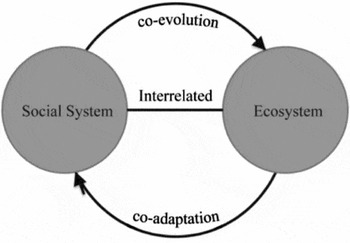
Marten's (Reference Marten2001) linked ‘eco-social systems’ concept provides the theoretical basis for integrating human health and natural resource management by assuming that small improvements in ecological and social systems can reinforce one another and catalyse feedback loops and synergies that tip a whole system from ruin to restoration (Fig. 1).
Linked eco-social systems concept.

Researchers and practitioners in the population-environment field hypothesize that projects that deliver integrated conservation and health services, including family planning and reproductive health (hereinafter labelled RH), resonate with rural communities and result in more community buy-in, greater acceptance of the interventions, and better conservation and health results (D'Agnes & Margoluis Reference D'Agnes and Margoluis2007; Pielemeier et al. Reference Pielemeier, Hunter and Layng2007). These integrated projects may also add value to conservation and health efforts by enhancing natural resource sustainability and quality of human life (White et al. Reference White, Christie, D'Agnes, Lowry and Milnec2005; Pielemeier et al. Reference Pielemeier, Hunter and Layng2007) and by alleviating poverty (Merrick Reference Merrick2002; DeSouza Reference DeSouza2004). One possible reason is that biodiversity conservation measures can require communities to forego income and the provision of health services may balance the community's opportunity costs by improving welfare (Melnyk Reference Melnyk2001). Incorporating gender perspectives can also help to remediate disparities in natural resource management (D'Agnes et al. Reference D'Agnes, Castro, D'Agnes and Montebon2005) and other inequitable social arrangements in rural communities, which may cause both rapid population growth and environmental degradation in many developing countries (Mazur Reference Mazur2009).
While RH interventions are likely to play only a limited role in the resuscitation of Philippine marine resources, nevertheless it will be difficult to sustain conservation gains without parallel effort to address demographic factors and related gender inequity issues in coastal Philippines, particularly the high rate of unintended pregnancy among women and teens and their lack of access to contraceptive services (Engelman Reference Engelman2008; Guttmacher Institute 2009). This is particularly true in biodiversity rich coastal areas, such as those bordering marine protected areas, where communities acutely lack access to RH services and unmet need for family planning is high due to either geographic remoteness or political and social opposition or some combination of both factors. By demonstrating the improved outcomes that result from delivering RH services in an integrated fashion with marine conservation interventions, this study argues that integrating population perspectives into natural resource management agendas enhances and ultimately improves conservation objectives, while also addressing a root cause of resource degradation and human poverty.
METHODS
The study used a quasi-experimental evaluation design to test IPOPCORM's central hypothesis that there will be a significant improvement in coastal resource management (CRM) outcomes and RH outcomes by delivering these services in an integrated manner as opposed to delivering either intervention in isolation. Quasi-experimental design studies, also described as nonrandomized pre-post intervention studies, aim to evaluate benefits of specific interventions that occur in situations not conducive to experimental control (Cook & Campbell Reference Cook and Campbell1979). Quasi-experimental research designs use comparison groups matched on certain characteristics to measure an intervention's impact. Threats to validity are minimized by accounting, during the analysis, for pre-existing factors that could affect the outcome difference between treatment and comparison groups. This study collected data in three comparison groups, further described below, in 2001, before the standardized intervention and, in 2007, after the standardized intervention had been implemented for at least four years in all research sites. Two stages of regression analyses on these data, bivariate and multivariate, demonstrate whether the difference in the pre-post groups is attributable to the intervention.
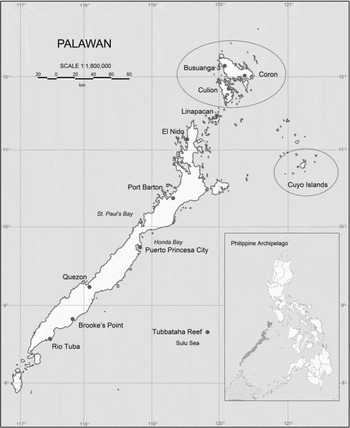
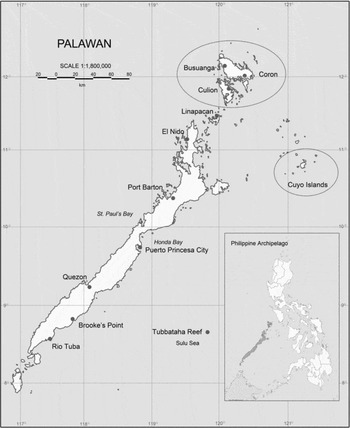
Three island municipalities in northern Palawan province Philippines (Fig. 2) served as the experimental sites for evaluation of the independent CRM intervention (Cuyo), the independent RH intervention (Busuanga) and the integrated CRM+RH intervention (Culion). Site selection was informed by recommendations from the provincial government, available biodiversity data (Werner & Allen Reference Werner and Allen2000) and their ranking as top priority areas for conservation of marine biodiversity (DENR [Department of Environment and Natural Resources] and UNEP [United Nations Environment Programme] 1997). The experimental sites were also matched in terms of population size (ranging from 14 600 to 18 600 inhabitants) and socioeconomic condition. All encompassed poor rural subsistence communities with sizeable numbers of households living in poverty and dependent on coastal-marine resources for subsistence and livelihood. Each was an underserved area in terms of health, CRM and other public services owing to their isolated location, poor transportation and telecommunications infrastructure, and relatively small internal revenue allotment. The ecosystems in the study sites were not as degraded and their population densities were not as high as in other coastal areas of the country (NSO 2000; MERF [Marine Environment and Resource Foundation] Inc. 2001). Thus, the important drivers for coastal resource use, such as food and livelihoods, could be detected in the changes in their ecosystem states and associated resources.
Location of the operation research sites in Palawan province (Philippines).
The original evaluation design included a control site, for which no intervention was to be made, for comparison purposes. Unlike the experimental sites, the comparison site experienced substantial development inputs from local government and other sources during the course of the study. These inputs effectively disqualified that municipality as a suitable control for purposes of this evaluation. We choose instead to compare the impact of the integrated (CRM+RH) intervention to the impact of the independent CRM and the independent RH interventions.
Intervention models
Three distinct interventions were delivered by different non-governmental organization (NGO) teams working in partnership with PFPI, local government units (LGUs) and peoples’ organizations (POs; for example associations of fisherfolk, women and youth). Each intervention model consisted of a standardized set of activities comprising service delivery, information education and communication (IEC) and policy advocacy interventions. The same community-based approach to service delivery was applied in each model in order to build the capacity of local institutions to manage, implement and sustain the interventions. In each site, the characteristics of the LGUs and POs were similar. The POs were all newly established as part of the project CRM interventions. The LGUs’ capacity to implement CRM and RH was very low, evidenced by a lack of dedicated staff with technical knowledge and skills in these areas.
The CRM intervention supported participatory coastal resource assessment (PCRA), establishment and management of marine and mangrove protected areas (MPAs), mangrove reforestation, increased enforcement, and peer education and behaviour change communication (BCC) interventions to encourage community compliance with MPA management practices, the Philippine Fisheries Code and municipal ordinances prohibiting dynamite and cyanide use in fishing. Policy advocacy inputs targeted to LGUs used a rights-based approach to strengthen enforcement of the Philippine Fisheries Code, particularly the provision affording small-scale fishers with preferential access to municipal waters.
The RH intervention supported family planning information and counselling for informed choice, community-based distribution and social marketing of non-clinical methods of contraception (such as condom and pill), referral for other services and care, and peer education and BCC to reduce risk of unplanned pregnancy and sexually transmitted infections including HIV/AIDS. Policy advocacy inputs targeted at LGUs used a rights-based approach to expand women's access to the full range of pregnancy prevention methods and youth's access to sexual and RH information and services.
The integrated approach included both types of interventions (CRM+RH) delivered as one service package. Supplementary policy advocacy inputs targeted to LGUs encouraged coordination and collaboration across the health and environment sectors and integration of RH into CRM agendas to enhance food security and operational efficiencies.
All three intervention models incorporated an economic development component that supported small and environment-friendly enterprise development (EED) opportunities and micro-credit facilities targeted mainly at women and youth in the communities due to their higher poverty incidence (NSCB [National Statistical Coordination Board] Philippines 2007). In the CRM and integrated CRM+RH study areas, fisher households received top priority as their families were more likely to be displaced by the MPAs and, thus, in need of a safety net during the period of regeneration of fish sanctuaries.
Methods for the biophysical surveys
Pre-intervention (2001) and post-intervention (2007) resource and ecological habitat assessments were conducted in the three experimental sites by an independent marine research institute. The condition of coral reefs and mangroves and their associated fish and benthic communities were appraised using similar methods for both survey rounds. Benthic coral data were gathered via line intercept transect (LIT) technique and underwater video belt transect (UVBT) surveys (adapted from English et al. Reference English, Wilkinson and Baker1997). These methods recorded each life form, at the taxon level, intercepted at regular points along a 50 m transect. All transect lines were placed in locally recognized areas of high fisheries value or good coral reef health, and a global positioning system (GPS) device recorded the location of each transect line. At the time of the 2001 round of data collection, all transects were in non-managed areas that were, in essence, open access fishing grounds. In 2007, the same transects in the CRM and CRM+RH sites were located in areas that had been under improved management, due to the application of the CRM interventions, with significant restrictions on fishing effort for at least three years. Transects in the RH site were located in non-managed open access fishing areas.
Fish visual census (English et al. Reference English, Wilkinson and Baker1997) was used to collect reef fish data using the same transects used for the benthic survey. All fish falling within 2.5 m both sides and 5 m above the transect line were identified at the species level; each individual species was counted and its total length (in cm) was approximated in order to estimate fish biomass. Target species (for example surgeonfish and parrotfish) were recorded first, followed by the slow-moving reef fish (such as damselfish or cardinal fish).
For mangrove resources, the transect line plot (TLP) method adapted from Cabahug (Reference Cabahug1986) was used to assess the structural formation, stand growth and density, species association, zonation and species diversity of mangrove areas. Transects considered the different land uses, forest conditions and extent of mangrove areas perpendicular to the shorelines and riverbank. As with the coral and fish transects, all TLPs were in non-managed areas at the time of the baseline (2001) survey while, in 2007, the same transects were in areas of improved management in the CRM and CRM+RH sites and in non-managed areas in the RH site.
Methods for the community household surveys
Pre-project (2001) and post-project (2007) household surveys were conducted in the same three study municipalities by independent demographic and health research teams affiliated with the University of the Philippines. In each municipality, a sample of nine coastal barangays (villages) was randomly selected with probability proportional to the size (PPS) of the barangay. A complete list of households was obtained from each study barangay. From the list, sampling frames for four different study populations were derived, and then a sample of households was drawn using the systematic random sampling technique.
The four different study populations taken from the sample households included: male youth (age 15–24 years), female youth (age 15–24 years), adult women in the reproductive age group (15–49 years) and adult men (15–60 years). Once a sample of households was selected for one age-sex group, those households were no longer eligible for sampling in the succeeding age-sex groups. This prevented the possibility of an individual being included in both the youth and the adult sample. Different household samples were used for the baseline and post-project measurements. In 2007, the researchers did not attempt to follow-up the same households and individuals that were surveyed in 2001 because they wanted to obtain a cross section of the population at the two different time points. The goal was to sample 400 households and 400 respondents per municipality for each survey round, which, for all practical purposes, was achieved.
Indicators and means of measurement
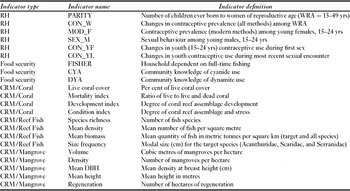
The study examined twenty-two dependent variable indicators to determine change in CRM, RH and food security status in the study sites (Table 1). All CRM indicators were considered impact indicators as they measured change in the status and diversity of coral reef, reef fish and mangrove biophysical conditions, theoretically due to the application of the CRM intervention. All CRM indicators were measured at the barangay level, since the CRM interventions primarily impacted shallow coastal habitats within 15 km of the barangay shoreline and were implemented through barangay level management structures, such as POs and barangay development councils.
Dependent variable indicators used in analysis (RH = reproductive health, CRM = coastal resources management).

The effects of health interventions introduced through programme activities must have an impact on the population, and hence the outcomes of a programme must be measured at the population level. All of the RH impact indicators were measured at the municipal level since the project's reproductive health and family planning inputs covered all barangays in the study municipality. The PARITY indicator reflects changes in population growth, theoretically due to the application of the RH interventions, by measuring changes in the average number of children born to women of reproductive age (WRA; 15–49 years old). The CON-W indicator reflects access to and use of RH information and services and pregnancy prevention methods among WRA. Four other RH impact indicators (CON_YF, CON_YL, MOD-F and SEX_M) manifest youth's access to and subsequent use of sexual and RH education and services and contraceptive methods.
Three proxy indicators for food security at the household and individual level (micro-level) included household dependency on full-time fishing (FISHER) and community respondents’ knowledge of cyanide (CYA) and dynamite (DYA) fishers in their area. We acknowledge that these are not standard food security indicators, but elected to use them because of the links between subsistence fishing, food insecurity, and illegal and unsustainable fishing practices in coastal Philippine (Bayer & Atchue Reference Bayer and Atchue2001). We also concede that knowledge in the community of individuals that engage in dynamite and cyanide fishing is not a perfect measure of the actual level of dynamite and cyanide fishing practices, but knowledge of these fishers within the community is likely to be positively correlated to these damaging fishing practices. The original study design also included an indicator to measure change in the nutritional status of under-five children at the household level. However, because the method used to weigh children in the 2007 survey round differed appreciably from the method used at baseline (2001), the nutrition indicator and data were eliminated in the final analysis.
Statistical methods
The biophysical (CRM) and the socio-demographic (RH and food security) data were analysed separately. We determined spatio-temporal trends for the CRM indicators using a PC-ORD software package for multivariable analysis of ecological community data. Statistical significance was determined at the 0.05 level. LIT and Video benthic data were analysed using the REEFSUM program applied in Microsoft Visual Foxpro version 6. We used the TWINSPAN (two-way indicator species analysis; Hill Reference Hill1979) classification method to arrange multivariable data in an ordered two-way table by classification of individuals and attributes. We also used detrended correspondence analysis (DCA) to determine relationships among sites and life forms, given their arrangement in an ordination space, which is based on correlation values and resemblances.
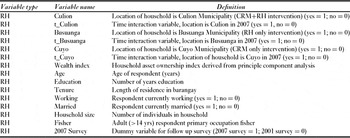
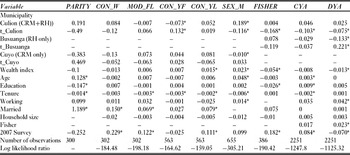
For the RH and food security data, bivariate changes were initially examined for each of the three interventions by subtracting the baseline (2001) value of each dependent variable in each intervention group from the post-project (2007) value of the dependent variable in the same intervention group, and testing the statistical significance of each of these (first difference) changes. Consistent with public health literature, statistical significance was determined at the 0.10 level. We tested the hypotheses for the integrated approach by performing multivariable regression analysis for each indicator from pooled 2001 and 2007 household survey data, including independent variables (Table 2) to account for the location (intervention municipality) of the household and a time-interaction variable for each intervention municipality to examine relative changes in the indicators between interventions over time, while holding other independent factors constant.
Independent socioeconomic variables used in multivariate regressions to control for differences in the characteristics of the respondents and households that are shown in other studies to influence the RH dependent variables.

The standard errors of the coefficient estimates obtained from the regressions are corrected for multiple observations in each barangay using the cluster command in STATA. The Probit model used for the regressions is represented by the equation: Pr(yi = 1) = F(xi′b) where the dependent variable yi can be only one or zero, and the continuous independent variables xi are estimated, and where b is a parameter to be estimated, and F is the normal cumulative distribution function.
Each regression combines all of the observations from the three municipalities in the two household surveys taken in 2001 and 2007. This allows a comparison to be made of the statistical significance of the differences in the changes of each of the indicators between the three interventions over time (difference-in-difference test). Specifically, the results found for the time interaction variable for the CRM+RH intervention (t_Culion) indicates the direction of the change in the indicator in the CRM+RH municipality between 2001 and 2007, and whether the change in the indicator is statistically significant compared with the change in the indicator for the comparison (omitted) municipality. The comparison municipality for parity (PARITY = mean number of children born), contraception (CON_W, MOD_FL, CON_YF, CON_YL) and sexual activity among young males (SEX_M) is the RH municipality (Busuanga). The comparison municipality for the food security indicators (FISHER, CYA and DYA) is the CRM intervention (Cuyo).
A set of independent socioeconomic variables (Table 2) was included in the regression analysis to control for differences in the characteristics of the respondents and households shown in other studies to influence RH dependent variables (Bulatao & Lee Reference Bulatao, Lee, Bulatao and Lee1983, Akin et al Reference Akin, Griffin, Guilkey and Popkin1986; Akin & Schwartz Reference Akin and Schwartz1988; Ainsworth et al Reference Ainsworth, Beegle and Nyamete1996). Ordinary least squares (OLS) regression analysis was used for the one continuous dependent variable (number of children born), and Probit regression analysis was performed for the other categorical (1 = yes, 0 = no) dependent variables.
The independent socioeconomic variables used in the multivariable regression analysis include wealth, age, and education, tenure in the barangay, work status, marital status and household size. We also included the presence of a full-time fisher in the household in the multivariable analysis as an indicator of knowledge of cyanide and dynamite fishing, under the assumption that fishers may be more aware of local community practices. In the absence of data on household income or wealth, household ownership of assets, which serve as a proxy for household wealth, was used as the basis for constructing a wealth index using principal components analysis (PCA). Previous studies indicate that such index is a robust measure of socioeconomic status (Filmer & Pritchett Reference Filmer and Pritchett1999; Wagstaff & Watanabe Reference Wagstaff and Watanabe2003). The tenure variable captured the effect of migration through the assumption that the more time the individual and household has lived in the municipality the more likely the individual and household will be responsive to the interventions designed to change behaviour.
RESULTS
CRM indicators
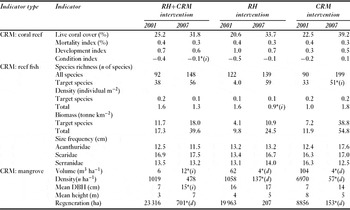
Of the eighteen CRM indicators, the CRM+RH municipality experienced no significant change in 14, three significant increases in two categories (benthos and mangrove), and one statistically significant decrease (mangrove regeneration) (Table 3). By comparison, the two experimental sites where the independent interventions were applied each experienced two or more significant decreases in mangrove indicators (including regeneration), and only one significant increase (for example reef fish density for the RH site and reef fish target species richness for the CRM site). Because no detectable change suggests stability and is a better result than a statistically significant decrease for these indicators, and since the CRM+RH intervention achieved two more statistically significant increases than the independent interventions, the integrated intervention outperformed the RH and CRM interventions for these indicators.
Indicator values, trends and statistical significance of first differences for CRM indicators by intervention, for the years 2001 and 2007. *p < 0.05, (i) = increasing trend, (d) = decreasing trend.

It is worth mentioning that a severe coral bleaching incident in 1998 impacted coral reef ecosystems across the Philippines. During the time period of this study, it was expected that corals would show improvement overall as they recovered from the bleaching event. This may explain why most of the study indicators of coral reef health, such as live coral cover and the mortality and development indices, do not show any statistically significant difference between the study sites. The condition index did show a statistically significant increase in the CRM+RH site, which indicates the efficacy of protective management.
RH and food security indicators
There were statistically significant differences in two of the six reproductive health indicators (CON_YF and SEX_M) between the CRM+RH intervention and the RH intervention (Table 4). The positive and statistically significant result found for CON_YF suggests that the increase in the likelihood of young females and males using a contraceptive method during first intercourse between 2001 and 2007 in the CRM+RH municipality was greater than the change in this indicator in the RH municipality, holding all other factors constant. Similarly, the negative and statistically significant result for SEX_M suggests that the decrease in the likelihood that a young male is sexually active in the CRM+RH municipality was greater than the change in this indicator in the RH municipality, holding all other factors constant. The difference-in-difference test results for the other reproductive health indicators (PARITY, CON_W, MOD_FL, and CON_YL) were not statistically significant and suggest that the CRM+RH intervention performed equally well as the independent RH intervention for these indicators. The PARITY (mean number of children born) result implies a significant decline in population growth in both the CRM+RH and RH sites, which indicates the efficacy of reproductive health and family planning interventions.
Multivariable regression results for the effects of location and other independent variables on indicators in pooled 2001 and 2007 surveys. Ordinary least squares (OLS) regression results for PARITY, and Probit regression results for all other indicators where the results indicate the marginal effects (DF/dx) on the probability of each indicator. *p < 0.10.

There were significant changes in all three food security indicators (FISHER, CYA, DYA) between the CRM+RH intervention and the CRM intervention (Table 4). The negative difference-in-difference result found for full-time fishers (FISHER) indicates that the small (and insignificant) increase in the likelihood of being a full-time fisher in the CRM+RH municipality was less than the larger (and significant) increase in the likelihood of being a full-time fisher in the CRM municipality. The statistically significant negative results for CYA and DYA suggest that the decrease in the likelihood of respondents’ knowledge of cyanide and dynamite fishing in the CRM+RH municipality was larger than in the CRM municipality, all else being constant.
Other data trends from the 2001 and 2007 household survey rounds in the CRM+RH site reflect a significant decline in the incidence of income-poverty among young (15–24 years) adults as measured by the proportion earning monthly income from all sources totalling <1500 Philippine pesos (Php 50 = US$ 1.00, January 2001). Independent programme monitoring data from 2003 and 2004 support this finding (Montebon et al. Reference Montebon, D'Agnes, Castro and Aquino2004).
DISCUSSION
Impact on ecosystem health
Of the eighteen biophysical variables measuring change in status and health of shallow habitats in the CRM+RH site, seventeen either improved or remained stable. The significant increase in coral condition is attributed to the recovery in some hard coral species consequent to the establishment in 2004 of a MPA (1.11 km2 in size), with project support and community involvement. Likewise, improvements in mangrove conditions are ascribed to the vigilance and enforcement efforts of local POs, which the project mobilized and empowered. By providing stewardship opportunities, the POs helped in changing the attitude of the community towards management and conservation of coastal resources. One PO, for example, reforested about 10 ha of logged-over areas and was able to reduce mangrove cutting and charcoal making by 50% (compared to baseline). Although the reef fish indicators demonstrated no significant change, the disaggregated data from the sanctuary area in the CRM+RH site indicate total biomass increased by 31 tonne km−2 in the 2007 survey. Other factors that could have impacted the reef fish parameters include increased artisanal fishing effort at the perimeter of the MPA (where the MPA acts as a magnet for fishers) or laxity in enforcement effort (where fishers are still fishing in the MPA).
The statistically significant increase in reef fish species richness in the CRM municipality can in part be attributed to the project's establishment of a MPA (1.08 km2) in 2003 with community involvement. Another probable factor is the isolated nature of the island ecosystems in the CRM site, which showed higher variability and potential receptiveness to CRM intervention responses at baseline compared to the other study areas (MERF 2001).
The significant increase in reef fish density in the RH site (Busuanga) was unexpected since the project supported no CRM interventions in that study area. However, information from provincial government sources indicates the LGU created and enforced a MPA in one of the study barangays during the course of the present study. The LGU also granted concessions to private groups that established pearl farms in the study area, which can produce the same ‘refuge effect’ as a well-managed MPA. These factors may have contributed to the fish density outcome.
Impact on human health and well-being
The CRM+RH intervention generated the desired impact on all nine of the RH and food security indicators. Moreover, it exceeded the impact of the independent RH and the independent CRM intervention for five of the nine indicators and performed equally as well for the remaining four indicators. This strongly suggests that the CRM+RH approach yields a larger impact on human health and food security compared to the sectoral management approaches.
Qualitative information from IPOPCORM's monitoring system offers insights into the community's receptivity to the CRM+RH intervention, which reportedly emulated their lifestyles more closely than the single-sector approaches (Hermann Reference Hermann2004). Whereas the gains from the integrated approach were perceived to benefit everyone in the community in terms of improved food security, women were perceived as the main beneficiaries of the RH intervention while fishers were thought to gain the most from CRM. The perception of equitable distribution of benefit may have engendered a deeper level of solidarity and community of practice in the CRM+RH site, resulting in larger impact.
Both the integrated and independent RH interventions delivered the same sexual and RH education and services to youth in the study municipalities. However, the two models employed different BCC strategies to encourage responsible sexual practices among youth. In the RH site, conventional methods (such as ‘just say no’) were promoted whereas in the integrated site the concept of ‘stewardship’ was advanced in a dual context. Youth were encouraged to become stewards of the environment and their sexuality in order to enjoy a brighter future. They were also encouraged to spearhead coastal conservation actions in their villages to improve food security for current and future generations. The stewardship BCC strategy may have contributed to the significantly higher impact on youth RH outcomes reflected in the indicator results (CON_YF and SEX_M) for the integrated site. As such, we hypothesize a connection between youths’ stewardship acts and their positive feelings about themselves. Additional research is needed to determine if self-efficacy was a significant moderator between youths’ pro-environmental behaviours and more responsible sexual practice.
IPOPCORM engaged a wide range of stakeholders in the pursuit of a shared vision of improved food security. This focus, and the broad support it garnered, helped to deflect criticism from conservative and religious groups opposed to family planning in the Philippines thus enabling a more conducive environment for behaviour change among adults and youth in the CRM+RH study area compared to the non-integrated programme sites (Hermann Reference Hermann2004). In the RH intervention site, several peer educators reportedly faced opposition from conservative/religious factions in their villages, which may have compromised their ability to deliver services to some target groups, particularly youth.
The income-poverty result in the integrated CRM+RH site suggests added-value and the model's potential for reducing vulnerability to poverty at the micro-level. Programme monitoring data point to an increase in non-fishing sources of income (for example seaweed cultivation) as possibly influencing this outcome (Montebon et al. Reference Montebon, D'Agnes, Castro and Aquino2004). Other contributing factors could be the EED inputs and youth's improved practice for family planning and subsequent pregnancy prevention in the integrated site, which allowed them to take advantage of economic development opportunities. The significant increase in full-time fishing effort in the CRM site may explain why income-poverty persisted in that study area despite similar EED inputs. Other data from the 2007 round of household surveys point to an increase in the mean number of household members in the CRM site, which could have diluted the effects of EED.
Given that poor individuals and households are more vulnerable to the impacts of climate change (UNFPA [United Nations Population Fund] 2009), the income-poverty outcome in the integrated CRM+RH site confers further added value in terms of the community's ability to cope with future environment and climate change. Similarly, the reduction in destructive fishing in the same study area may enhance coral reef resilience against future bleaching events by reducing anthropogenic stress on the ecosystem (Grimsditch and Salm Reference Grimsditch and Salm2006).
Over the six-year period of the study, the budgetary support for field implementation totalled US$ 101 500 for the RH intervention compared to US$ 139 200 for the CRM intervention and US$ 218 300 for the integrated CRM+RH intervention. Even though the integrated approach cost more to field, the cost was less than the combined cost of the two independent interventions signifying value-added in terms of cost efficiency.
Implications for policy and programme development
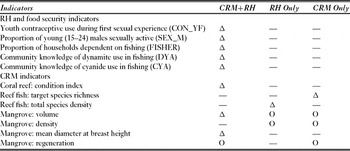
Overall, the integrated CRM+RH intervention generated a greater impact on the majority of the indicators used in the study to measure improvements in human and ecosystem health (Table 5). Improvements in biophysical parameters reflect both the efficacy of protective area management and the vigilance and enforcement efforts of local POs. The same institutions managed RH activities that enabled contraceptive access in the communities, improved reproductive health outcomes among youth and a significant reduction in the average number of children born to women of reproductive age. These findings support the project's central hypothesis and imply that it will be difficult to ensure long-term sustainability of CRM gains and prevent over-use of coastal resources unless integrated forms of management that combine conservation with family planning are delivered simultaneously and with community involvement. They also have implications for similar ecologically significant biodiversity rich areas in the Philippines and neighbouring countries where demographic dynamics pose challenges to return on investment in biodiversity conservation.
Statistically significant trends on selected indicators (2001–2007). Δ = trend in desired direction, O = trend in undesired direction, — = no trend.

Study limitations
Owing to its inherent complexity, limitations may have influenced study outcomes. We acknowledge that the indicators used in this analysis to measure CRM all focus on biophysical parameters, while CRM, in a broader sense, entails fishing pressure and effort, as well as larger governance issues such as the level of organization of community and peoples’ organizations and the capacity of the local governments to create structures to manage and protect their natural resources. The study design was not able to incorporate quantitative measurements for processes that might have affected the changes in the status of resources, such as governance mechanisms that could have lead to effectiveness of management, law enforcement and compliance. We collected fishing effort data, specifically catch per unit of effort (CPUE), for this study, however the qualitative methods used were not consistent across sites and thus the data were not viable for the purposes of this comparison study. This is unfortunate, as an analysis of fisheries catch data could support the study's biophysical results and further demonstrate increase in total fish biomass. In addition, catch data could also further demonstrate how increases in total fish biomass in MPAs translate to increases in fish catch and, subsequently, fishers incomes. Future research should be sure to incorporate fisheries catch data as well as capture the strength of management and governance institutions that play a role in effective CRM.
There are inherent limitations in the quasi-experimental research design, especially the difficulty in controlling for confounding factors that are threats to the internal and external validity of the study. For example, effects of site-specific factors and inherent geographical differences between the three municipalities (such as island isolation and accessibility) on the status of the coastal habitats and resources could provide an alternative explanation for the biophysical results beyond the impact of the CRM intervention. Similarly, unanticipated factors such as remittances from overseas workers may have influenced the income-poverty outcome which was not accounted for in the research design.
ACKNOWLEDGEMENTS
We thank the David and Lucile Packard Foundation for generously supporting this study. We also thank USAID's Office of Population and RH for its support via the Population Reference Bureau (PRB), CDM International and the Building Actors and Leaders for Excellence in Community Development (BALANCED) Project. The views and opinions of authors expressed here do not necessarily state or reflect those of the Packard Foundation, the US Government or USAID. Lastly we thank Anil Bamezai of RAND Corporation for his guidance on the quasi-experimental design.