Paranoia is a common symptom in individuals diagnosed with schizophrenia and it is estimated that 50–90% of these individuals experience paranoia (Sartorius et al. Reference Sartorius, Jablensky, Korten, Ernberg, Anker, Cooper and Day1986; Moutoussis et al. Reference Moutoussis, Williams, Dayan and Bentall2007). Psychological mechanisms underlying paranoid beliefs have been a focus of research and theoretical debate (Bentall et al. Reference Bentall, Corcoran, Howard, Blackwood and Kinderman2001; Freeman et al. Reference Freeman, Pugh, Vorontsova, Antley and Slater2010; Freeman & Garety, Reference Freeman and Garety2014). One influential theory proposes that individuals prone to paranoia make excessively external personal attributions (i.e. blame other people) for negative events in order to avoid activation of latent negative self-schemas (Bentall et al. Reference Bentall, Kinderman and Kaney1994). Such attributions are hypothesised to protect individuals from negative self-appraisals and consequent distress but lead to paranoid beliefs, such as that other people wish to harm the individual (Bentall et al. Reference Bentall, Kinderman and Kaney1994). Empirical tests of the attributional model have yielded mixed results, suggesting both normal and low self-esteem in paranoid individuals (Lyon et al. Reference Lyon, Kaney and Bentall1994; Kinderman & Bentall, Reference Kinderman and Bentall1997; Freeman et al. Reference Freeman, Garety, Fowler, Kuipers, Dunn, Bebbington and Hadley1998).
Other investigators have proposed that paranoid attributional style as a defence against negative self-appraisals is only present in one subtype of paranoid individuals, namely, those who believe that their persecution is undeserved (Trower & Chadwick, Reference Trower and Chadwick1995; Chadwick et al. Reference Chadwick, Trower, Juusti-Butler and Maguire2005). These researchers have argued that there are two types of paranoia: ‘bad-me’ and ‘poor-me’. While individuals from both subgroups feel persecuted, bad-me individuals blame themselves and believe that their persecution is deserved. Poor-me individuals, on the other hand, believe that their persecution is unjustified and perceive others as bad. Consistent with this account, research has shown that bad-me paranoia is associated with anxiety, depression and low self-esteem (Freeman et al. Reference Freeman, Garety and Kuipers2001; Chadwick et al. Reference Chadwick, Trower, Juusti-Butler and Maguire2005; Melo et al. Reference Melo, Taylor and Bentall2006), while poor-me paranoia is associated with an externalising bias for negative events (Melo et al. Reference Melo, Taylor and Bentall2006). A recent study examined the temporal relationships between self-esteem and both bad-me and poor-me paranoia in daily life using the experience sampling method (ESM; Udachina et al. Reference Udachina, Varese, Oorschot, Myin-Germeys and Bentall2012). The results showed that bad-me paranoia was associated with lower subsequent self-esteem, whereas poor-me paranoia was associated with higher subsequent self-esteem; bad-me beliefs in particular were associated with low self-esteem and low mood. Although initially poor-me and bad-me beliefs were thought to be two different kinds of paranoia (Trower & Chadwick, Reference Trower and Chadwick1995), evidence suggests that poor-me and bad-me positions are not immutable but are nevertheless moderately stable. One study showed that beliefs about deservedness can fluctuate within the paranoid individuals, with some switching between bad-me and poor-me positions over a period of 1 month (Melo et al. Reference Melo, Taylor and Bentall2006). Another investigation using ESM showed that while 80% of paranoid individuals preserved their poor-me or bad-me stances over a period of 1 week, fluctuations in deservedness beliefs occurred (Udachina et al. Reference Udachina, Varese, Oorschot, Myin-Germeys and Bentall2012).
Taken together, these more recent findings can be interpreted as evidence for the dynamic nature of the paranoid process, indicating that the bad-me phase of the paranoid process could be viewed as an augmentation of distress, while the poor-me phase could be seen as a defence against distress (Udachina et al. Reference Udachina, Varese, Oorschot, Myin-Germeys and Bentall2012). This is consistent with the revised attributional model of paranoia, which proposes dynamic and non-linear relationships between attributions and self-concepts (Bentall et al. Reference Bentall, Corcoran, Howard, Blackwood and Kinderman2001). The model predicts highly unstable self-esteem in paranoid individuals, allowing for both normal and low self-esteem depending on recent life events. In support of this account, research has shown that instability of self-esteem and attributional judgements is a central feature of paranoia (Thewissen et al. Reference Thewissen, Bentall, Lecomte, Van Os and Myin-Germeys2008; Udachina et al. Reference Udachina, Varese, Oorschot, Myin-Germeys and Bentall2012).
Most research to date has shown that psychotic symptoms are associated with heightened sensitivity to stress (Myin-Germeys & van Os, Reference Myin-Germeys and Van Os2007; Lataster et al. Reference Lataster, Wichers, Jacobs, Mengelers, Derom, Thiery, Van Os and Myin-Germeys2009; Palmier-Claus et al. Reference Palmier-Claus, Dunn and Lewis2012; Reininghaus et al. Reference Reininghaus, Kempton, Valmaggia, Craig, Garety, Onyejiaka, Gayer-Anderson, So, Hubbard, Beards, Dazzan, Pariante, Mondelli, Fisher, Mills, Viechtbauer, Mcguire, Van Os, Murray, Wykes, Myin-Germeys and Morgan2016). The results of this body of research are consistent with the predictions of several models of psychosis, which include stress as a vulnerability factor for psychosis (e.g., Zubin & Spring, Reference Zubin and Spring1977; Nuechterlein & Dawson, Reference Nuechterlein and Dawson1984). However, if poor-me paranoia were to be viewed as a defence against distress and low self-esteem, it is reasonable to expect that poor-me paranoia should be associated with low or at least normal sensitivity to negatively appraised (stressful) situations. To date no studies have examined whether perceived deservedness of persecution moderates reactions to stress.
Current study
We investigated reactivity to stress in poor-me and bad-me individuals and compared it with stress reactivity reported by previously paranoid individuals and healthy controls. Since perceived threat from other people in particular is central to paranoia and because growing evidence points to the importance of social factors in psychosis (Cantor-Graae, Reference Cantor-Graae2007; Varese et al. Reference Varese, Smeets, Drukker, Lieverse, Lataster, Viechtbauer, Read, Van Os and Bentall2012; Stilo et al. Reference Stilo, Di Forti, Mondelli, Falcone, Russo, O’Connor, Palmer, Paparelli, Kolliakou, Sirianni, Taylor, Handley, Dazzan, Pariante, Marques, Zoccali, David, Murray and Morgan2013; Bentall et al. Reference Bentall, De Sousa, Varese, Wickham, Sitko, Haarmans and Read2014; Morgan & Gayer-Anderson, Reference Morgan and Gayer-Anderson2016), we expected that the hypothesised differences in stress sensitivity would be observed in situations involving other people in particular, rather than other types of stressful situations. We therefore assessed stress sensitivity in two types of situations (i) stressful situations involving other people (social stress) and (ii) stressful situations involving unpleasant activities (activity stress). We predicted that in stressful social but not activity related situations poor-me individuals would display changes in self-esteem and mood similar to or smaller than those reported by healthy controls, and smaller than those reported by bad-me individuals. We used the ESM to address our hypotheses – a method that has previously been employed to study psychosis (e.g., Myin-Germeys et al. Reference Myin-Germeys, Delespaul and Van Os2003; Thewissen et al. Reference Thewissen, Bentall, Lecomte, Van Os and Myin-Germeys2008), and which has been shown to be feasible, reliable and valid methodology (Palmier-Claus et al. Reference Palmier-Claus, Myin-Germeys, Barkus, Bentley, Udachina, Delespaul, Lewis and Dunn2011). There are several advantages to using ESM in psychological research, including high ecological validity and reduced memory bias (Myin-Germeys et al. Reference Myin-Germeys, Delespaul and Van Os2003).
Methods
Participants
In total, 203 individuals entered the study. Out of these, 138 individuals with an ICD-10 diagnosis of schizophrenia spectrum disorders (SSD; schizophrenia, delusional disorder, schizoaffective disorder, psychotic disorder not otherwise specified) were recruited from in- and outpatient healthcare facilities as well as voluntary organisations that support individuals with psychotic symptoms. Diagnoses were confirmed by clinical staff where possible. In addition, 63 healthy controls were recruited. Written informed consent was obtained from all the participants.
Of the 203 individuals who entered the study, 27 individuals with SSD and six healthy controls did not return the booklets and/or failed to comply with the protocol. A further 20 individuals with SSD and five controls completed fewer than 20 valid reports. The final sample therefore comprised 91 individuals with SSD and 52 control participants. Patient participants who dropped out/were excluded from the analyses, due to insufficient number of valid reports did not differ from patient participants who were included on the Positive and Negative Syndrome Scale (Kay et al. Reference Kay, Opler and Lindenmayer1988) total score, t (29, 137) = 0.89, p = 0.372.
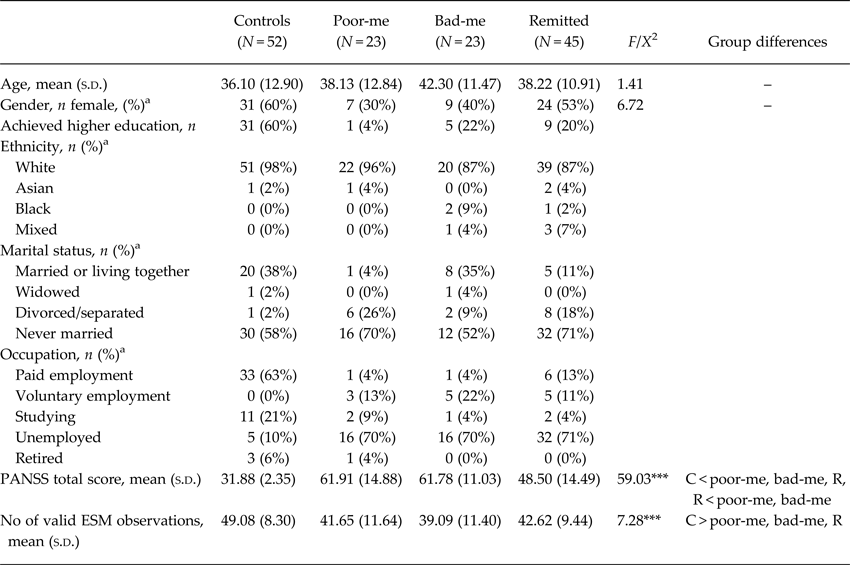
Individuals with SSD were further divided into three groups according to their average ESM paranoia and perceived deservedness scores (see Measures). For this purpose, for each participant, (i) an average score over all the available ESM paranoia reports and (ii) an average score over all the available ESM deservedness reports was calculated. First, individuals with SSD were divided into currently paranoid and remitted groups according to a median split of their average ESM paranoia reports. Those with scores below 1.67 were considered remitted and the remaining participants were considered currently paranoid. Next, currently paranoid participants were divided into poor-me and bad-me according to a median split of their average ESM deservedness scores. Participants with scores below 1.99 were considered poor-me and the remaining individuals were considered bad-me. Sociodemographic and clinical characteristics of the final sample are summarized in Table 1.
Sociodemographic and clinical characteristics of the study sample (N = 143)

PANSS, positive and negative syndrome scale.
a Because of rounding percentages may not add up exactly to 100%.
Measures
The Positive and Negative Syndrome Scale (PANSS; Kay et al. Reference Kay, Fiszbein and Opler1987), administered in the form of a semi-structured interview, is a widely used measure of symptoms of schizophrenia. It has three sub-scales: a Positive Syndrome, a Negative Syndrome, and a General Psychopathology Scale; a total score can also be calculated. The PANSS has good reliability and validity (Kay et al. Reference Kay, Opler and Lindenmayer1988).
ESM procedure and measures
The ESM is a structured diary technique, which allows the assessment of symptoms, feelings, and behaviour in the context of daily life. During an initial meeting, each participant underwent a training session during which the ESM procedure was explained. Each participant also received an electronic wristwatch and a set of ESM self-assessment forms. Participants completed a practice form under the supervision of the researcher; potential obstacles to compliance were explored. The wristwatch was programmed to emit a signal (beep) at an unpredictable moment in each of ten 90-min time blocks between 7.30 a.m. and 10:30 p.m., on 6 consecutive days, resulting in 60 beeps per person. Participants were instructed to complete the forms immediately after each beep and to record the time of completion. The recorded times were later compared wiith the programmed beep schedule. Following previous methodological recommendations (Palmier-Claus et al. Reference Palmier-Claus, Myin-Germeys, Barkus, Bentley, Udachina, Delespaul, Lewis and Dunn2011), (i) reports completed later than 15 min after the beep and (ii) data from participants who completed fewer than 20 valid reports were excluded from the analysis. To enhance compliance with the procedure, all participants were contacted by telephone during the assessment period. At the end of the assessment each participant handed in the forms and the watch.
Each ESM self-assessment form completed by the participants included a number of items rated on a 7-point Likert scales [1(not at all) to 7(very)] measuring the following variables.
Paranoia was calculated as the mean score on three statements derived from the Persecution and Deservedness Scale Persecution subscale (PaDS; Melo et al. Reference Melo, Corcoran, Shryane and Bentall2009) (‘I worry that others are plotting against me’, ‘I feel that I can trust no-one’, ‘I believe that some people want to hurt me deliberately’) (Cronbach's alpha = 0.94). Principal components analysis (PCA) of the items identified one factor (eigenvalue >1), explaining 90% of the total variance.
Deservedness was calculated as the mean score on three statements derived from the PaDS Deservedness subscale (Melo et al. Reference Melo, Corcoran, Shryane and Bentall2009), each associated with one of the paranoia items (‘Do you feel you deserve others to plot against you?’, ‘Do you feel you deserve to have no-one you can trust?’, ‘Do you feel you deserve to be hurt?’) (Cronbach's alpha = 0.90). For each item, scores were recorded only if a score on a related ESM persecution item was >1. PCA of the items identified one factor (eigenvalue >1), explaining 82% of the total variance.
Positive and negative affect was assessed using nine adjectives. PCA with Harris–Kaiser rotation on the raw within-subject scores identified 2 factors with eigenvalues >1 and explaining 66% of the total variance. Two factor-based scales were created. The negative affect scale included ‘lonely’, ‘anxious’, ‘irritated’, ‘sad’, and ‘guilty’ (Cronbach's alpha = 0.87) and the positive affect factor included ‘cheerful’, ‘excited’, ‘relaxed’ and ‘satisfied’ (Cronbach's alpha = 0.77).
Self-esteem was assessed as the mean score on four statements [‘I like myself’, ‘I am a good person’, ‘I am ashamed of myself’ (reverse-scored), ‘I am a failure’ (reverse-scored)] (Cronbach's alpha = 0.81). PCA of the items identified one factor (eigenvalue >1), explaining 64% of the total variance.
Social stress was calculated as the mean score on three statements [‘I like this company’ (reverse scored), ‘Right now, I'd prefer to be alone’, ‘I'm enjoying myself’ (reverse scored)] (Cronbach's alpha = 0.80). PCA of the items identified one factor (eigenvalue >1), explaining 72% of the total variance.
Activity stress was calculated as the mean score on three statements [‘I'd rather be doing something else’, ‘I like this activity’ (reverse scored), ‘This activity is difficult’] (Cronbach's alpha = 0.66). PCA of the items identified one factor (eigenvalue >1), explaining 61% of the total variance.
All the above measures have been used in previous ESM research and have been shown to be reliable and valid (Myin-Germeys et al. Reference Myin-Germeys, Van Os, Schwartz, Stone and Delespaul2001; Udachina et al. Reference Udachina, Thewissen, Myin-Germeys, Fitzpatrick, O’Kane and Bentall2009; Udachina et al. Reference Udachina, Varese, Oorschot, Myin-Germeys and Bentall2012).
Statistical analyses
Multilevel linear regression models were used to test the study hypotheses. These are a variant of the more commonly used unilevel linear regression analyses and are ideally suited for the analysis of ESM data, in which repeated observations (beep level) are nested within individuals (participant level) (Oorschot et al. Reference Oorschot, Kwapil, Delespaul and Myin-Germeys2009).
Differences in self-esteem, affect and stress levels
To investigate whether levels of self-esteem, affect, and stress differed across the four groups, we estimated a series of multi-level regression models testing whether the categorical variable ‘group’ [control; poor-me; bad-me; remitted] predicted current self-esteem, affect, and stress.
Stress sensitivity
To investigate whether the effects of social and activity stress on self-esteem varied across groups, a multilevel regression was carried out. In this regression, social stress, activity stress, the categorical variable ‘group’ [controls; poor-me; bad-me; remitted], ‘social stress’ × ‘group’ interaction, and ‘activity stress’ × ‘group’ interaction were entered as predictors of self-esteem. The predictor variables ‘social stress’ and ‘activity stress’ were entered simultaneously into the model in order to establish their mutual independence. The analyses were repeated for negative and positive affect as the dependent variables. In all these analyses, the interaction term ‘group’ × ‘stress’ was of major interest as the main hypothesis concerned the differences in stress sensitivity across different groups.
Analyses were carried out with the XTMIXED module of Stata v.9.2. (StataCorp, 2007), providing non-standardized regression coefficients of the predictors in the multilevel model (b-values). All multilevel models were corrected for the a priori selected possible confounders ‘gender’ and ‘age’, which were entered as additional predictors. Main effects and interactions were assessed using the Wald test. When significant interactions were encountered, stratified analyses were conducted to clarify group differences using the LINCOM command of Stata.
Results
The intraindividual ranges of deservedness ratings in poor-me, bad-me, and remitted participants are presented in Supplementary Fig. 1. In poor-me group, median deservedness scores equalled 1 for 91% of individuals (N = 21), with two remaining individuals scoring between 1 and 2. In bad-me group, deservedness scores were ⩾2 for 91% of participants (N = 21); 60% of participants scored ⩾3 (N = 14). In the remitted group, deservedness scores were 1 for 76% of participants (N = 22) and the remaining 24% scored between 2 and 5.5 (N = 7). Consistent with previous research (Udachina et al. Reference Udachina, Varese, Oorschot, Myin-Germeys and Bentall2012), most dramatic fluctuations in deservedness ratings over the assessment period were observed in the bad-me group, although some fluctuations also occurred in participants from poor-me and remitted groups.
Differences in self-esteem, affect, and stress levels
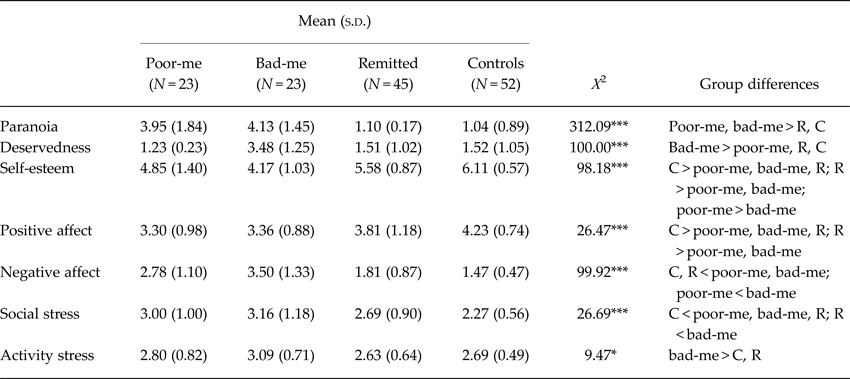
The mean scores on study variables together with the results of statistical tests are shown in Table 2. It shows that self-esteem was lower in all patient groups compared with the controls; however, self-esteem was not as low in the poor-me as in the bad-me group. Negative affect was higher in bad-me and poor-me groups, than in remitted or control groups. However, negative affect was higher in bad-me than in poor-me group. Similarly, positive affect was lower in all patient groups than in the control group; bad-me and poor-me groups also scored lower than the remitted group.
Mean scores (s.d.) for study variables (stratified by group) and group differences

Separate means were calculated for each participant and subsequently aggregated to obtain group means. ESM, experience sampling method; R, remitted; C, controls. *p < 0.05; **p < 0.01; ***p < 0.001
Stress sensitivity
Self-esteem
Across all participants, both social [β( s.e.) = −0.13(0.01), p < 0.001] and activity [β(s.e.) = −0.06(0.01), p < 0.001] stress were associated with decreased self-esteem. Analyses with ‘group’, ‘group’ × ‘social stress’, and ‘group’ × ‘activity stress’ as additional predictors revealed a significant ‘group’ × ‘social stress’ interaction [χ2(3) = 44.89, p < 0.001], indicating that the effect of social stress on self-esteem varied across the different groups (Table 3). The group × activity stress interaction, however, was non-significant [χ2(3) = 4.23, p = 0.237], suggesting that the effect of activity stress on self-esteem was similar across groups (also Table 3). Follow-up analyses showed that the decrease in self-esteem due to social stress was smaller in the poor-me group than in all other groups. In addition, the decrease in self-esteem was larger in the bad-me and the remitted groups than in the control group. Finally, self-esteem decrease was larger in the bad-me group than in the remitted group (also Table 3).
Multilevel model estimates B (s.e.) – effect of social and activity stress on self-esteem, stratified by group

Statistically significant associations (p < 0.05) are in bold. C, controls; R, remitted.
Negative affect
Across all participants, both social [β(s.e.) = 0.21(0.01), p < 0.001] and activity [β(s.e.) = 0.12(0.01), p < 0.001] stress were associated with increased negative affect. A ‘group’ × ‘social stress’ interaction was significant [χ2(3) = 23.44, p < 0.001] as was the ‘group’ × ‘activity stress’ interaction [χ2(3) = 13.43, p = 0.004] (Table 4). Follow-up analyses revealed that the increase in negative affect due to social stress was larger in the bad-me group than in any other group (also Table 4). The increase in negative affect due to activity stress was larger in the poor-me group than in the controls.
Multilevel model estimates B (s.e.) – effect of social and activity stress on negative affect, stratified by group

Statistically significant associations (p < 0.05) are in bold. C, controls; R, remitted.
Positive affect
Across all participants, both social [β(s.e.) = −0.38(0.02), p < 0.001] and activity [β(s.e.) = −0.17(0.01), p < 0.001] stress were associated with decreased positive affect. Analyses with ‘group’, ‘group’ × ‘social stress’, and ‘group’ × ‘activity stress’ as additional predictors revealed a significant ‘group’ × ‘social stress’ interaction [χ2(3) = 19.81, p < 0.001], and also a significant ‘group’ × ‘activity stress’ interaction [χ2(3) = 23.66, p < 0.001] (Table 5). Follow-up analyses revealed that the decrease in positive affect due to social stress was smaller in poor-me group as compared with all other groups. In addition, the decrease in positive affect due to activity stress was smaller in bad-me group than that in all other groups. Finally, the decrease in positive affect due to activity stress was larger in the controls than in the remitted group.
Multilevel model estimates B (s.e.) – effect of social and activity stress on positive affect, stratified by group

Statistically significant associations (p < 0.05) are in bold. C, controls; R, remitted.
Discussion
Our data generally support our predictions. In particular, when faced with stressful social situations, poor-me individuals’ self-esteem and positive affect suffered the least compared with all other groups; poor-me participants’ self-esteem seemed especially immune. In contrast, bad-me individuals were most sensitive to social stress, showing the largest decrease in self-esteem and the largest increase in negative affect than any other group. As predicted, no consistent between-group differences in sensitivity to activity stress emerged. The impact of activity stress on self-esteem was similar across groups. As for mood sensitivity to activity stress, poor-me participants reported a greater increase in negative affect than the controls, while bad-me participants reported the smallest decrease in positive affect. Consistent with earlier studies (Freeman et al. Reference Freeman, Garety and Kuipers2001; Chadwick et al. Reference Chadwick, Trower, Juusti-Butler and Maguire2005; Melo et al. Reference Melo, Taylor and Bentall2006; Melo & Bentall, Reference Melo and Bentall2013), we found that although poor-me beliefs were associated with lower than normal self-esteem and mood, this abnormality was less evident in poor-me than in bad-me group. Overall, our findings suggest that poor-me paranoia may protect vulnerable individuals against low self-esteem and distress associated with stressful social situations, but not other sources of stress.
Our results indicate that bad-me paranoia was associated with an exaggerated response to social stress, which is consistent with evidence showing that bad-me stance is characterised by marked instability of self-esteem and mood, presumably reflecting hypersensitivity to changes in social environment (Udachina et al. Reference Udachina, Varese, Oorschot, Myin-Germeys and Bentall2012). Hypersensitivity of bad-me individuals to social threat is also in line with the idea that self-esteem and self-esteem-relevant emotions have a functional value as they protect the individual against potential social exclusion (Leary et al. Reference Leary, Terdal, Tambor and Downs1995). According to this theory, low self-esteem signals a dangerously close proximity to social exclusion, leading to hypervigilance towards potential social rejection. Higher self-esteem, on the other hand, indicates relative safety from potential exclusion, thus allowing individuals to relax their guard. As this and previous research (Freeman et al. Reference Freeman, Garety and Kuipers2001; Chadwick et al. Reference Chadwick, Trower, Juusti-Butler and Maguire2005; Melo et al. Reference Melo, Taylor and Bentall2006; Udachina et al. Reference Udachina, Varese, Oorschot, Myin-Germeys and Bentall2012) show that bad-me beliefs are associated with highly negative self-concept, individuals holding bad-me beliefs would be expected to be hypersensitive to social context according to this theory.
While the mechanisms underlying the observed difference in reactions to social stress in poor-me and bad-me paranoia are unclear, one theory would suggest that the attributions individuals make for social events might be important (Bentall et al. Reference Bentall, Kinderman and Kaney1994; Bentall et al. Reference Bentall, Corcoran, Howard, Blackwood and Kinderman2001). Briefly, this account argues that paranoid beliefs result from the repeated interpretation of negative events in terms of external personal causes (i.e. attributing negative events to other people). As previous research suggests that poor-me beliefs are associated with a tendency to attribute negative events to external causes (Melo et al. Reference Melo, Taylor and Bentall2006), it is possible that such attributions were more prevalent among poor-me individuals, thus buffering their self-esteem and mood from social stress; bad-me individuals, on the other hand, were more likely to make internal attributions for unpleasant social interactions, leading to increased distress. We could further speculate, that the selective insensitivity to social (but not activity) stress associated with poor-me beliefs could be explained by better availability of external personal explanations in situations involving other people.
The reduced sensitivity of poor-me individuals to social stress contradicts most research, which has shown heightened emotional sensitivity to stress, including social, in individuals with psychosis (see Myin-Germeys & van Os, Reference Myin-Germeys and Van Os2007, for review). However, the vast majority of these studies did not differentiate between subgroups of individuals with psychosis. The results of investigations that have examined subgroups, however, are compatible with ours, especially given the evidence that poor-me beliefs are more prevalent in clinical populations than in subclinically paranoid individuals (Fornells-Ambrojo & Garety, Reference Fornells-Ambrojo and Garety2005; Melo et al. Reference Melo, Corcoran, Shryane and Bentall2009). For example, one study showed that individuals with mild-to-moderate paranoia were more sensitive to social context, reacting with greater paranoia to social encounters with unfamiliar individuals (Collip et al. Reference Collip, Nicolson, Lardinois, Lataster, Van Os and Myin-Germeys2011). In contrast, highly paranoid individuals (predominantly diagnosed with schizophrenia), were indifferent to familiarity. Another study compared emotional sensitivity of individuals diagnosed with schizophrenia, individuals at ultra-high risk of psychosis (UHRP), and controls, finding that UHRP individuals were most reactive to social stress, while the emotional sensitivity of individuals diagnosed with schizophrenia was comparable with that of controls (Palmier-Claus et al. Reference Palmier-Claus, Dunn and Lewis2012). Importantly, in this study, individuals with significant levels of depression were excluded from the schizophrenia group. As depression is associated with bad-me paranoia (Udachina et al. Reference Udachina, Varese, Oorschot, Myin-Germeys and Bentall2012), it implies that poor-me beliefs prevailed in schizophrenia group.
The observation that the differences in stress sensitivity between bad-me and poor-me individuals were related specifically to social aspects of the environment is consistent with accumulating evidence highlighting the role of social factors in psychosis, including social adversity, migration and childhood abuse (Cantor-Graae, Reference Cantor-Graae2007; Varese et al. Reference Varese, Smeets, Drukker, Lieverse, Lataster, Viechtbauer, Read, Van Os and Bentall2012; Stilo et al. Reference Stilo, Di Forti, Mondelli, Falcone, Russo, O’Connor, Palmer, Paparelli, Kolliakou, Sirianni, Taylor, Handley, Dazzan, Pariante, Marques, Zoccali, David, Murray and Morgan2013). These experiences can be thought of as ‘social defeat’ or social exclusion experiences (Cantor-Graae, Reference Cantor-Graae2007; Selten et al. Reference Selten, Van Der Ven, Rutten and Cantor-Graae2013). Further, several authors have argued that repeated exposure to defeat/social exclusion experiences may lead to stress sensitisation and this, in turn, may bring about psychotic symptoms (Collip et al. Reference Collip, Myin-Germeys and Van Os2008; Selten et al. Reference Selten, Van Der Ven, Rutten and Cantor-Graae2013). Other researchers have emphasised the role of impoverished social environment in the emergence of psychosis. Specifically, it has been proposed that florid persecutory delusions arise as a result of social isolation, populating an otherwise ‘barren interpersonal world’ with complex networks of menacing characters (Hoffman, Reference Hoffman2007; p. 1067). Of course, depression and associated social withdrawal often precede psychotic illness (Hafner et al. Reference Hafner, Maurer, Loffler and Riecherrossler1993; Rietdijk et al. Reference Rietdijk, Ising, Dragt, Klaassen, Nieman, Wunderink, Cuijpers, Linszen and Van Der Gaag2013). It is possible that subclinical paranoia characterised by high perceived deservedness of persecution (i.e. bad-me paranoia), low self-esteem, depression, and an increasing emotional cost of social encounters lead to a dramatic reduction in social interactions. This withdrawal culminates in the development of full-blown delusions and a decrease in perceived deservedness of persecution, i.e. poor-me paranoia. While the switch to poor-me paranoia alleviates distress by blunting sensitivity to social stress, it also increases the likelihood of hospitalisation. Interestingly, one study (Morrison et al. Reference Morrison, French, Lewis, Roberts, Raja, Neil, Parker, Green, Kilcommons, Walford and Bentall2006) found that in individuals with subclinical psychotic symptoms the intensity of psychotic symptoms was associated with a closing gap between self-perceptions and self-ideals – a gap previously found to be associated with depression (Higgins et al. Reference Higgins, Bond, Klein and Strauman1986).
Strengths and limitations
Our study was the first to examine the differences in reactions to stress in subgroups of paranoid individuals. Because the individuals’ experiences were assessed in the context of their daily life, our findings have high ecological validity. Despite these strengths, our results should also be interpreted with a number of caveats in mind. First, the causal relationship between stress on the one hand, and self-esteem and affect on the other, cannot be conclusively established, as the analyses were cross-sectional. Second, the stressfulness of events was self-reported and therefore subjective. However, this should not present a problem as the study was concerned with the impact of these events on self-esteem and mood, rather than the stressfulness of the events per se.
Conclusions
In sum, we found that poor-me paranoid beliefs were associated with attenuated sensitivity and bad-me beliefs were associated with exaggerated sensitivity to social, but not activity stress. We also observed that, compared with bad-me paranoia, poor-me paranoia was associated with higher self-esteem and lower negative affect. Our results are compatible with the attributional model of paranoia (Bentall et al. Reference Bentall, Corcoran, Howard, Blackwood and Kinderman2001), which suggests that in some circumstances paranoia may serve a protective function against low self-esteem and depression. Our findings also contribute to the debate about the continuity of paranoid experience (Melo et al. Reference Melo, Taylor and Bentall2006; Freeman et al. Reference Freeman, Pugh, Vorontsova, Antley and Slater2010; Collip et al. Reference Collip, Nicolson, Lardinois, Lataster, Van Os and Myin-Germeys2011), suggesting that qualitative differences may exist between paranoid beliefs with different content.
Supplementary material
The supplementary material for this article can be found at https://doi.org/10.1017/S0033291717001362.