



1. Introduction
Consider the Cauchy problem of pseudo-parabolic equations with logarithmic nonlinearity
 \begin{equation}
\left\{\begin{array}{llc}
u_{t}-\Delta u-\alpha\Delta u_{t}=u \log u^2 & \text{in}\ & \mathbb{R}^{N}\times (0,+\infty) , \\
u(x,0)=u_{0}(x), & \text{in} &\mathbb{R}^{N} ,
\end{array}\right.
\end{equation}
where 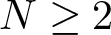 $N\geq 2$,
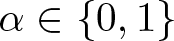 $\alpha\in \{0,1\}$ and u 0 is the initial condition, which satisfies certain assumptions specified below. To study the existence of local or global solutions of (1.1), the geometry of the energy functional associated with (1.1), given by
 \begin{equation}
E(u):=\frac{1}{2}\int_{\mathbb R^N} (|\nabla u|^2+|u|^2)\,dx-\frac{1}{2}\int_{\mathbb R^N} |u|^2\log|u|^2\,dx,
\end{equation}
applies an important rule. Unfortunately, the singularity of the logarithm at the origin causes the functional to fail to be finite and belong to the class  $C^{1}(H^{1}(\mathbb{R}^{N}); \mathbb{R})$. For example, consider the following smooth function
 \begin{equation*} v(x):=\left\{
\begin{array}{lcc}
\frac{1}{|x|^{N/2}\log |x|}&\text{if} & |x|\geq 3,\\
0 &\text{if} & |x|\leq 2.
\end{array}\right.\end{equation*}
It belongs to  $H^{1}(\mathbb{R}^{N})$, but
 $\int_{\mathbb{R}^{N}} v^{2}\log v^{2}\,dx=-\infty$. In addition to this, there are various reasons why (1.1) is interesting from a mathematical perspective. Firstly, the nonlinearity is not Lipschitz, leading to challenges even in addressing the local existence of solutions. Additionally, the second term in the energy functional (1.2) lacks a definite sign, making it challenging to obtain a priori estimates. Lastly, the Cauchy problem (1.1) can exhibit either superexponential growth or decay.
In [Reference Alfaro and Carles1], the authors note that when α = 0, Eq. (1.1) exhibits certain similarities with bistable equations used to model the Allee effect in population dynamics.
As discussed in [Reference Karch23, Reference Showalter and Ting31, Reference Ting32] and related references, pseudo-parabolic equations are crucial in modelling various nonlinear physical systems, including the unsteady flow of second-order fluids in one dimension, the seepage of homogeneous fluids through fissured rocks, and heat conduction involving dual-temperature processes. These equations belong to a broader class known as Sobolev-type equations, sometimes referred to as Sobolev–Galpern type.
The existence, uniqueness, and regularity of solutions for the initial boundary value problem and the Cauchy problem in the context of linear pseudo-parabolic equations were first studied by Showalter and Ting [Reference Showalter and Ting31], Gopala Rao and Ting [Reference Rao and Ting29, Reference Rao and Ting30], and Ting [Reference Ting33]. Following these contributions, many authors have investigated the global existence and asymptotic behaviour of solutions using various techniques; see, for example, [Reference Karch23–Reference Li and Du25, Reference Xu and Su34] and the references therein.
Cao et al. [Reference Cao, Yin and Wang7] considered the semilinear pseudo-parabolic equation
 \begin{equation}
u_{t}-\Delta u_{t}-\Delta u =u^p, \;\;\;x\in \mathbb{R}^{N}, \;\;t \gt 0,
\end{equation}
supplemented with nonnegative and nontrivial initial data  $u_{0}\in C^{2+\alpha}(\mathbb{R}^{N})$. It was shown that there are two critical exponents,
 $p_{0}=1$ and
 $p_{c}=1+\frac{2}{N}$ such that
• For
 $0 \lt p\leq p_{0}$, Eq. (1.3) has a global classical solution.
• For
$1 \lt p\leq p_{c}$, Eq. (1.3) admits a classical solution that blows up in finite time.• For
$p \gt p_{c}$ and u 0 is sufficiently large, (1.3) admits a classical solution that blows up in finite time.• For
$p \gt p_{c}$ and u 0 is sufficiently small, (1.3) admits a global classical solution.


Considering the logarithmic nonlinearity, the Taylor expansion at infinity indicates that  $2u\log |u|$ lies between
 $|u|$ and
 $|u|^{1+p}$ for p > 0. This raises the question of how
 $2u\log|u|$ affects solutions, especially which one
 $2u\log|u|$ influences—whether it behaves more like
 $|u|$ or
 $|u|^{1+p}$. When the viscosity term
 $\Delta u_{t}$ is omitted, Eq. (1.1) reduces to the logarithmic heat equation. This equation was studied in [Reference Boudjeriou and Alves5] for any
 $N\geq 1$, where the global existence and uniqueness of weak solutions were established, as well as some qualitative properties such as blow-up at infinite time and regularity. In this work, we improve upon many of the results obtained in [Reference Boudjeriou and Alves5] and further investigate properties of weak solutions that were not discussed there. For the one-dimensional case
 $(N=1)$, the Cauchy problem, involving heat equations with logarithmic nonlinearity
 \begin{equation}
u_{t} -u_{xx}=\lambda u\log(u^2), \;\;t \gt 0, \;x\in \mathbb{R},
\end{equation}
supplemented with non-negative initial data, where λ > 0, was studied by Alfaro and Carles [Reference Alfaro and Carles1]. Specifically, by adapting the approach from the Ph.D. thesis of Meyer [Reference Meyer27], they proved the existence and uniqueness of solutions under the assumptions that the initial data u 0 are continuous and bounded, with continuous and bounded first derivatives, and bounded, piecewise continuous second derivatives. The large-time behaviour of solutions was analysed by comparing cases with constant initial data, Gaussian initial data, and compactly supported initial data. It was found that the solution either exhibits superexponential growth or decay over time. However, for λ < 0, it was proved that Eq. (1.4) behaves differently. Specifically, solutions are a priori bounded between 0 and  $\max(1, \|u_{0}\|_{\infty})$. These results, as pointed out in [Reference Alfaro and Carles1, Section 6], could be extended to the case of a general dimension
 $N\geq2$.
For simplicity, we assume that  $\alpha \in \{0,1\}$. However, the results established here hold for any α > 0. Observe that when
 $\alpha = \lambda \gt 0$, and by considering the unknown function
 $v(x,t) = u(\lambda t, \sqrt{\lambda}x)$, Eq. (1.1) reduces to
 \begin{equation*} v_{t}-\Delta v-\Delta v_{t}=\lambda v \log v^2. \end{equation*}
Thus, our analysis will focus on the case where λ > 0. Although some of our results exhibit a similar pattern of superexponential growth or decay as observed in [Reference Alfaro and Carles1], there are two key distinctions. Firstly, the assumptions on the initial data in our work are more relaxed compared to those in [Reference Alfaro and Carles1]; we only require the initial data to belong to  $W(\mathbb{R}^{N})\cap L^{\infty}(\mathbb{R}^{N})$, see the definition of
 $W(\mathbb{R}^N)$ in §2. Secondly, the solutions of (1.1) fail to preserve the Gaussian structure. In contrast, for α = 0, this property does hold; if the initial data are
 $u_{0}(x)=\exp\left(1+\frac{N}{2}-\frac{|x|^2}{2}\right)$, by uniqueness, the solution is
 $u(x,t)=\exp\left(e^{t}+\frac{N}{2}-\frac{|x|^2}{2}\right)$. It is worth noting that the preservation of Gaussian structures is a significant tool in studying the dynamics of the Cauchy problem for Schrödinger equations with logarithmic nonlinearity. This feature reduces the complexity of solving the partial differential equation to solving an ordinary differential equation; see, for example, [Reference Carles8–Reference Carles and Gallagher10]. Another property that is lost for the Cauchy problem (1.1) is the tensorization property. Precisely, when α = 0, if
 $u_{1}(x_{1}, t)$,
 $u_{2}(x_{2}, t)$, ...,
 $u_{N}(x_{N}, t)$ are solutions to the one-dimensional logarithmic heat equation (1.1), then the function
 $u(x, t) = \prod\limits_{i=1}^{N} u_{i}(x_{i}, t)$ satisfies the N-dimensional equation.
Partial differential equations with logarithmic nonlinearity arise in various fields, such as quantum mechanics, quantum optics, nuclear physics, open quantum systems, and c condensation. Physical applications of these equations are discussed in [Reference Bialynicki-Birula and Mycielski4, Reference Zloshchastiev36] and the references therein. From a mathematical perspective, the Cauchy problem for logarithmic Schrödinger equations and logarithmic wave equations were first studied by Cazenave and Haraux [Reference Cazenave and Haraux13]. The global existence is established using compactness methods within a subset of  $H^1(\mathbb{R}^N)$. In the case of Schrödinger equations, uniqueness of solutions in any dimension is proved, thanks to the inequality
 \begin{equation*}
\left|\text{Im}\left(v\log |v|^{2}-u\log |u|^{2}\right)(\overline{v}-\overline{u})\right|\leq 4|u-v|^{2}, \;\;\forall u,v\in \mathbb{C}.
\end{equation*}
In contrast, for three-dimensional wave equations, uniqueness was proved through fine properties of the wave equation combined with a general result concerning the trace.
On the other hand, to the best of our knowledge, Chen et al. [Reference Chen, Luo and Liu14, Reference Chen and Tian15] were the first to investigate the global existence and blow-up behaviour of solutions at infinite time for initial boundary value problems involving heat equations and pseudo-parabolic equations with logarithmic nonlinearity. Specifically, they addressed the following problem
 \begin{equation}
\left\{\begin{array}{lc}
u_{t} -k \Delta u_{t}-\Delta u=u\log|u|, & x\in \Omega, \;t \gt 0, \\
u(x,t)=0, & x\in \partial \Omega, \;t \gt 0,\\
u(x, 0)=u_{0}(x), & x\in \Omega,
\end{array}\right.
\end{equation}
for k = 0 and k = 1, with  $u_{0}\in H_{0}^{1}(\Omega)$. By potential well techniques in combination with Galerkin approximation, they established the following results:
(i) If
$J(u_{0})\leq d$ and
$I(u_{0})\geq 0$, the weak solutions are bounded in
$L^{\infty}(0, +\infty; H^1_{0}(\Omega))$;(ii) If
$J(u_{0}) \lt M\leq d$ and
$I(u_{0})\geq 0$, or
$J(u_{0})=M$ and
$I(u_{0}) \gt 0$, the weak solution decays to zero;(iii) If
$J(u_{0})\leq d$ and
$I(u_{0}) \lt 0$, the weak solution blows up at infinite time,


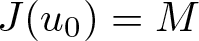


where
 \begin{align*} J(u)&=\frac{1}{2}\|\nabla u\|^2_{2}-\frac{1}{2}\int_{\Omega}|u|^2\log|u|\,dx +\frac{1}{4}\int_{\Omega} |u|^2\,dx, \quad\\ I(u)&=\|\nabla u\|^2_{2}-\int_{\Omega} |u|^2\log|u|\,dx,\end{align*}
and
 \begin{equation*} d=\inf_{u\in H^1_{0}(\Omega)\backslash \{0\}}\sup_{\lambda \geq 0}J(\lambda u), \quad M=\frac{1}{4}(2\pi )^{N/2}e^N.\end{equation*}
Chen et al. [Reference Chen, Luo and Liu14, Reference Chen and Tian15] also compared logarithmic nonlinearity with polynomial nonlinearity, concluding that the latter plays a significant role in causing the solution of (1.5) to blow-up in finite time. It is important to note that uniqueness was not established in these cases. Subsequently, for k = 0, Han [Reference Han19] improved the result on the blow-up of solutions in infinite time by relaxing assumption (iii) to  $I(u_{0}) \lt 0$. The authors in [Reference Ji, Yin and Cao22] considered the following problem
 \begin{equation}
\left\{\begin{array}{lc}
u_{t}-k \Delta u_{t}-\Delta u=m(t)u\log|u|, & x\in \Omega, \;t\in \mathbb{R}, \\
u(x,t)=0, & x\in \partial \Omega, \;t\in \mathbb{R},\\
u(x, t)=u(x, t+T), & x\in \Omega, \; t\in \mathbb{R},
\end{array}\right.
\end{equation}
where T > 0,  $k\in \{0,1\}$,
 $\Omega \subset \mathbb{R}^{N}$ is a bounded domain with smooth boundary, and m(t) is a smooth, positive, and
 $T-$periodic function. For k = 0, they established the existence of at least one positive periodic solution to problem (1.6) by employing topological degree arguments combined with uniform a priori
 $L^{\infty}$-estimates, see [Reference Ji, Yin and Cao22, Lemma 2.6]. On the other hand, for k = 1, the same approach was used to prove the existence of a positive periodic solution, though the proof of the
 $L^{\infty}$-estimates is not provided and is simply assumed. It was further shown in [Reference Ji, Yin and Cao22, Theorem 1.1] that for k = 0, the positive periodic solution is unstable, in the sense that if the solution starts from a small neighbourhood of the periodic solution, it may either grow at the rate of
 $e^{e^t}$ or decay at the rate of
 $e^{-e^t}$. Additionally, when k = 1 and
 $m(t)=m_{0}$, [Reference Ji, Yin and Cao22, Theorem 1.2] showed that a small perturbation in the initial data can lead to double exponential growth.
2. The functional framework and preliminary results
2.1. The energy space
$W(\mathbb{R}^{N})$

In this subsection, following [Reference Cazenave11], we introduce and review some properties of the function space  $W(\mathbb{R}^{N})$. We define
 $W(\mathbb{R}^{N})$ as
 \begin{equation*} W(\mathbb{R}^{N}):=\left\{u\in H^{1}(\mathbb{R}^{N}):\; u^{2}\log u^{2}\in L^{1}(\mathbb{R}^{N})\right\},\end{equation*}
which can be characterized as a Banach space through its connection with Orlicz spaces. To illustrate this, we consider
 \begin{equation*} F(s)=s^{2}\log s^{2}, \;\;\;\;s\in \mathbb{R},\end{equation*}
and define  $A,B:[0, +\infty) \to \mathbb{R}$, given by
 \begin{equation}
A(s)=
\left\{\begin{array}{lc}
-s^2\log s^2 & \; 0\leq s\leq e^{-3}, \\
3s^{2}+4e^{-3}s-e^{-6}, & \; s\geq e^{-3},
\end{array} \right.
\quad \quad B(s)= A(s)+F(s).
\end{equation}
It can be verified through direct calculations that A(s) is a nonnegative increasing function, and  $A\in C^{1}([0, +\infty))\cap C^{2}((0, +\infty))$. Furthermore, according to [Reference Cazenave11, Lemma 1.1], there exists
 $C_{\epsilon} \gt 0$ such that
 \begin{equation}
\left|B(|r|)-B(|s|)\right|\leq C_{\epsilon}|r-s|(|r|+|s|)^{1+\epsilon}, \;\;\;\forall s,r\in \mathbb{R}, \;\forall \epsilon \gt 0.
\end{equation}
The Orlicz space  $L^{A}(\mathbb{R}^{N})$ corresponding to the function A is defined by
 \begin{equation*} L^{A} (\mathbb{R}^{N})=\left\{u\in L_{loc}^{1}(\mathbb{R}^{N}):\, A(|u|)\in L^{1}(\mathbb{R}^{N})\right\},\end{equation*}
and equipped with the Luxembourg norm
 \begin{equation*} \|u\|_{A}= \inf\left\{\lambda \gt 0:\, \int_{\mathbb{R}^{N}} A\left(\frac{|u|}{\lambda}\right)\,dx \leq 1\right\}.\end{equation*}
It has been established in [Reference Cazenave11, Lemma 1.2] that A(s) is a Young function and satisfies the so-called Δ2-condition. Therefore,  $(L^{A}(\mathbb{R}^{N}); \|.\|_{A})$ is a separable, reflexive Banach space. Furthermore, there holds
 \begin{align}
\text{for any}\; u\in L^{A}(\mathbb{R}^{N}), \;\;\inf\left\{\|u\|_{A}, \|u\|^{2}_{A} \right\}\leq \int_{\mathbb{R}^{N}}A(|u|)\,dx\leq \sup\left\{\|u\|_{A}, \|u\|^{2}_{A} \right\}.\nonumber\\
\end{align}
In [Reference Cazenave11, Proposition 2.2], the energy space  $W(\mathbb{R}^{N})$ is characterized as the reflexive Banach space
 $W(\mathbb{R}^{N})= H^{1}(\mathbb{R}^{N})\cap L^{A}(\mathbb{R}^{N})$, equipped with the norm
 \begin{equation*}\|u\|= \|u\|_{H^{1}(\mathbb{R}^{N})}+\|u\|_{A}.\end{equation*}
Furthermore, the following chain of continuous embeddings holds
 \begin{equation*} W(\mathbb{R}^{N}) \hookrightarrow L^{2}(\mathbb{R}^{N})\hookrightarrow W'(\mathbb{R}^{N}),\end{equation*}
where 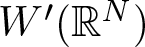 $W'(\mathbb{R}^{N})$ is the dual space of
 $W(\mathbb{R}^{N})$ given by
 \begin{equation*} W'(\mathbb{R}^{N})=H^{-1}(\mathbb{R}^{N})+L^{A'}(\mathbb{R}^{N}),\end{equation*}
with  $L^{A'}(\mathbb{R}^{N})$ being the dual space of
 $L^{A}(\mathbb{R}^{N})$ (see, e.g., [Reference Cazenave11]).
As proved in [Reference Boudjeriou and Alves5, Proposition 6.3], the energy functional E, associated with (1.1), belongs to  $C^{1}(W(\mathbb{R}^{N}); \mathbb{R})$ and satisfies
 \begin{equation}
E'(u)v=\int_{\mathbb{R}^{N}} \nabla u\cdot\nabla v\,dx-\int_{\mathbb{R}^{N}} u\log u^{2}v\,dx, \quad \forall u,v \in W(\mathbb R^N).
\end{equation}
The Nehari manifold is defined as
 \begin{equation*}
\mathcal{N}=\left\{u \in W(\mathbb{R}^{N}) \backslash \{0\} : \; I(u)=0 \right\},
\end{equation*}
where  $I(u)= E'(u)u$. Hereafter, we denote by d the following real number
 \begin{equation}
d:=\inf_{\mathcal{N}}E(u).
\end{equation}
It can be readily seen that d can be characterized as
 \begin{equation}
d=\inf_{\mathcal{N}}E(u)= \frac{1}{2}\inf_{u\in \mathcal{N}} \|u\|^{2}_{2}.
\end{equation}
Furthermore, by applying the logarithmic Sobolev inequality (2.9), as shown in [Reference Ardila3, Proposition 1.4], one can deduce that
 \begin{equation}
d=\frac{\pi^{N/2}}{2} e^{N}.
\end{equation}
Recently, in [Reference Guerrero, López and Nieto18], the global existence and uniqueness for the Cauchy problem of the logarithmic Schrödinger equation
 \begin{equation}
iu_{t}+\Delta u+\lambda u\log|u|^2=0 \;\;\;(x,t)\in \mathbb{R}^{N}\times \mathbb{R}, \;\;\;u(x,0)=\varphi(x) \;\;x\in \mathbb{R}^{N}.
\end{equation}
have been studied for N = 3 and in the functional space  $H^{1}(\mathbb{R}^{N})\cap \mathcal{F}(H^{a})$, where
 \begin{equation*}\mathcal{F}(H^{a}):=\left\{\varphi \in L^{2}(\mathbb{R}^{N}): \; x\mapsto \langle x\rangle^{a}\varphi(x) \in L^{2}(\mathbb{R}^{N})\right\},\end{equation*}
for a > 0 and  $\langle x\rangle=(1+|x|^2)^{1/2}$. It was shown that if the initial datum
 $\varphi\in H^{1}(\mathbb{R}^{3})\cap \mathcal{F}(H^{a})$, then a unique solution
 $u\in L_{loc}^{\infty}(\mathbb{R}; H^{1}(\mathbb{R}^{3}))$ exists for all
 $\lambda\in \mathbb{R}\backslash\{0\}$. This result was later improved in [Reference Carles and Gallagher10], proving the global existence and uniqueness of a solution in
 $L_{loc}^{\infty}(\mathbb{R}; H^{m}(\mathbb{R}^{N})\cap \mathcal{F}(H^{a}))$ for
 $\varphi\in H^{m}(\mathbb{R}^{N})\cap \mathcal{F}(H^{a})$ with
 $m=1,2$ and
 $a\in (0, 1]$.
It is important to note that the logarithmic term in the energy functional (1.2) is well defined on  $H^{1}(\mathbb{R}^{N})\cap \mathcal{F}(H^{a})$. Indeed, in view of lemma 2.4, we have
 \begin{equation*} 2\int_{\mathbb{R}^{N}} |u|^2\log|u|\,dx\precsim \int_{\mathbb{R}^{N}} |u|^{2-\delta}\,dx+\int_{\mathbb{R}^{N}} |u|^{2+\delta}\,dx,\end{equation*}
for any sufficiently small  $\delta\in (0,2)$. The first term can be estimated as
 \begin{align*} \int_{\mathbb{R}^{N}} |u|^{2-\delta}\,dx&=\int_{\mathbb{R}^{N}} \left(|u|\langle x\rangle^{a}\right)^{2-\delta}\langle x\rangle^{-a(2-\delta)}\,dx\leq \|\langle x\rangle^{a}u\|^{2-\delta}_{2}\\ &\quad\times\left(\int_{\mathbb R^N} (1+|x|^2)^{-\frac{a (2-\delta)}{\delta}}\,dx\right)^{\delta/2}.\end{align*}
Choosing δ so that  $0 \lt \delta \lt \frac{2a}{N+a}$ for
 $a\in (0,1]$ yields
 \begin{equation*} \int_{\mathbb R^N} (1+|x|^2)^{-\frac{a (2-\delta)}{\delta}}\,dx \lt \infty \quad \text{and}\quad \int_{\mathbb{R}^{N}} |u|^{2+\delta}\,dx \lt \infty.\end{equation*}
Hayashi and Ozawa [Reference Hayashi and Ozawa20] noted that  $H^{1}(\mathbb{R}^{N})\cap \mathcal{F}(H^{a})$ is a strictly narrower than
 $W(\mathbb{R}^{N})$, with
 \begin{equation*} H^{1}(\mathbb{R}^{N})\cap \mathcal{F}(H^{a})\subsetneq W(\mathbb{R}^{N})\subsetneq H^{1}(\mathbb{R}^{N}).\end{equation*}
The authors of [Reference Hayashi and Ozawa20] studied the existence of strong solutions of (2.8) with a changing sign of the nonlinearity, namely when λ > 0 and λ < 0. It was shown that for  $\lambda\in \mathbb{R}\backslash\{0\}$ and
 $\varphi\in H^{1}(\mathbb{R}^{N})$ there exists a unique solution
 $u\in C(\mathbb{R}; H^{1}(\mathbb{R}^{N}) )$ of (2.8). Moreover,
(1) For λ > 0 and
$\varphi\in W(\mathbb{R}^{N})$, the unique solution of (2.8) belongs to
$ C(\mathbb{R}; W(\mathbb{R}^{N}) )\cap L^{\infty}(\mathbb{R}; W(\mathbb{R}^{N}) )$.(2) For λ < 0 and
$\varphi\in W(\mathbb{R}^{N})$, the unique solution of (2.8) belongs to
$ C(\mathbb{R}; W(\mathbb{R}^{N})) $.


Furthermore, in [Reference Hayashi and Ozawa20], the existence and uniqueness of a strong solution to (2.8) is constructed in W 2, where
 \begin{equation*} W_{2}:=\{\varphi\in H^{2}(\mathbb{R}^{N}): \;\varphi \log|\varphi|^2\in L^{2}(\mathbb{R}^N)\}.\end{equation*}
This solution exhibits further regularity, belonging to  $ C(\mathbb{R}; W_{2}) $ for λ > 0.
Note that in (2), when λ < 0,  $u\in L^{\infty}(\mathbb{R}; W(\mathbb{R}^{N}) )$ cannot hold. In fact, in [Reference Carles and Gallagher10], it was shown that for
 $\varphi\in H^{1}(\mathbb{R}^{N})\cap \mathcal{F}(H^{a})$ and λ < 0 the solution of (2.8) satisfies
 \begin{equation*} \|\nabla u(t)\|_{2}\sim \log t \;\;\;\text{as}\; t\rightarrow \infty.\end{equation*}
Under the condition (3.9) in theorem 3.2, we show that this phenomenon does not occur for solutions of (1.1) by establishing that  $u\in C_{b}(0,+\infty; W(\mathbb{R}^{N})).$
We end this subsection with the notations that we will use throughout this paper.
• We use
$A\lesssim B$ to indicate that
$A\leq C B$ for some constant C > 0. When C depends on additional parameters, we write
$A\lesssim_{*} B$.•
$C([0,T]; X)$ represents the space of strongly continuous functions from
$[0,T]$ to X.•
$C_{b}([0,T]; X)$ denotes the space of uniformly bounded, strongly continuous functions from
$[0,T]$ to X.• The norm of
$L^{p}(\mathbb{R}^{N})$ for every
$p\in [1, \infty]$ is denoted by
$\|\,\cdot\,\|_{p}.$•
$u(t)=u(\cdot,t)$ for any
$t\in [0,+\infty)$.• The positive part of w is denoted by
$w^{+}=\max\{w,0\}$, and the negative part by
$w^{-}=\max\{-w,0\}$.• BR denotes the open ball with centre at 0 and radius R > 0.
• The inner product in
$L^{2}(\mathbb{R}^{N})$ is denoted by
$(.\,,\,.)$.• The inner product in
$H^{1}(\mathbb{R}^{N})$ is denoted by
$\langle.\,,\,.\rangle$.• We use “
$\rightarrow$”, “
$\rightharpoonup$” and “
$\rightharpoonup^{*}$” to denote strong convergence, weak convergence, and weak-star convergence, respectively.•
$2^*=\frac{2N}{N-2}$ if
$N \geq 3$ and
$2^*=+\infty$ if
$N=1,2$.


2.2. Preliminary results
In this subsection, we present some preliminary results that will be used throughout this paper. We begin by recalling the logarithmic Sobolev inequality, and for a proof, we refer the reader to [Reference Lieb and Loss26, Theorem 8.14].
Lemma 2.1. Let  $f\in H^{1}(\mathbb{R}^{N})\backslash\{0\}$. Then, for all α > 0
 \begin{equation}
\int_{\mathbb{R}^N} f^2 \log f^2dx \leq\frac{a^2}{\pi}\|\nabla f\|^2_{2}+ \big( \log \|f\|^2_{2}-N(1+\log a)\big)\|f\|^2_{2}.
\end{equation}
Moreover, equality holds if and only if f is, up to translation, a multiple of  $ \exp\left({\frac{-\pi |x|^{2}}{2\alpha^2}}\right)$.
In what follows, we present a version of the logarithmic Gronwall inequality, as stated in [Reference Cazenave and Haraux13, Corollary 2.1.3].
Lemma 2.2. Let  $w_{0}\geq 0$,
 $ a\geq1$,
 $K\geq 0$, and
 $w\in L^{\infty}(0,T)$ be a positive function such that
 \begin{equation*} w(t)\leq w_{0}+K\int_{0}^{t}w(s)\log (a+w(s))\,ds\;\;\;\text{a.e.}\; [0,T].\end{equation*}
Then it follows that
 \begin{equation*} w(t)\leq (a+w_{0})^{e^{Kt}}, \;\;\;\text{a.e.}\; t\in [0,T].\end{equation*}
The next proposition can be verified through straightforward computations, so we will omit its proof.
Proposition 2.3. For each λ > 0, define the function
 \begin{equation*} g(\lambda)= E(\lambda u)= \frac{\lambda^{2}}{2}\|u\|^{2}_{H^{1}(\mathbb{R}^{N})}-\frac{\lambda^{2}}{2}\log \lambda^{2}\|u\|^{2}_{2}-\frac{\lambda^2}{2}\int_{\mathbb{R}^{N}} u^{2}\log u^{2}\,dx.\end{equation*}
Then there exists  $\lambda^{*}=\lambda^{*}(u) \gt 0$ such that
 \begin{equation*} I(\lambda u)\left\{
\begin{array}{lcc} \gt 0 & \text{if}& 0 \lt \lambda \lt \lambda^*, \\
=0 & \text{if}& \lambda=\lambda^*, \\ \lt 0 & \text{if}& \lambda \gt \lambda^*.
\end{array}\right.\end{equation*}
Furthermore,
 \begin{equation*} \lim_{\lambda \rightarrow 0^{+}}g(\lambda)=0 \quad \text{and}\quad \lim_{\lambda \rightarrow +\infty}g(\lambda)=-\infty.\end{equation*}
The value  $\lambda^{*}$ is the unique point where
 $\lambda\mapsto g(\lambda)$ reaches its maximum.
As a result of Proposition 2.3, we obtain
 \begin{equation*} d=\inf_{u\in W(\mathbb{R}^{N})\backslash\{0\}}\sup_{\lambda \gt 0} E(\lambda u).\end{equation*}
Lemma 2.4. [Reference Boudjeriou6] Lemma 2.1
We have
(1) For all β > 1, we have
$|s^{\beta-1}\log s|\leq \frac{1}{(\beta-1)e}, \quad \forall s\in (0,1].$(2) For any
$\alpha,\delta \gt 0$, there exists a positive constant
$C_{\alpha,\delta}$ such that
\begin{equation*}
|\log s|\leq C_{\alpha,\delta}(s^\alpha+s^{-\delta}),\quad \quad \forall s \gt 0.
\end{equation*}(3) For any σ > 0, we have
$\log s\leq \frac{s^\sigma}{\sigma e},\; \forall s \gt 0.$


Lemma 2.5. [Reference Boudjeriou and Alves5] Lemma 6.1
For any δ > 0 and  $u\in H^{1}(\mathbb{R}^{N})$ there exist
 $C_{\delta} \gt 1$, C > 0 such that
 \begin{equation*} \int_{\mathbb{R}^{N}} |u|^{2}\log^{+} (|u|^{2})\,dx \leq \delta C \int_{\mathbb{R}^{N}} |\nabla u|^{2}\,dx +3\|u\|^{2}_{2}\log(C_{\delta}+\|u\|^{2}_{2}),\end{equation*}
for any  $N\geq 1$.
A crucial lemma for proving the global boundedness of weak solutions to (1.1) is the following:
Lemma 2.6. [Reference Giusti17] Lemma 7.1
Consider a sequence of positive numbers  $\{Y_{n}\}_{n}$ that satisfies the recursive inequality
 \begin{equation*} Y_{n+1}\leq Cb^{n}Y^{1+\alpha}_{n}, \;\;\;n=0,1,2,\ldots,\end{equation*}
where C > 0, b > 1, and α > 0 are given constants. Suppose
 \begin{equation*} Y_{0}\leq C^{-1/\alpha}b^{-1/\alpha^{2}}, \end{equation*}
Then it follows that
 \begin{equation*} Y_{n}\leq C^{-1/\alpha}b^{-1/\alpha^{2}}b^{-n/\alpha}, \;\;n\in \mathbb{N}.\end{equation*}
As a result,  $Y_{n}\to 0$ as
 $n\to \infty.$
We conclude this subsection with Martinez’s inequality, which will be used to establish the decay estimates. For a proof, see [Reference Qin28, Theorem 1.5.13].
Lemma 2.7. Let  $\Phi :[0, +\infty)\rightarrow [0, +\infty)$ be a non-increasing function, and let
 $\phi:[0, +\infty)\rightarrow [0, +\infty)$ be a strictly increasing C 1 function such that
 \begin{equation*} \phi(0)=0, \quad \phi(t)\rightarrow +\infty \; \; \text{as}\;\; t\rightarrow +\infty.\end{equation*}
Assume that there exist  $\sigma\geq 0$ and ω > 0 such that for all
 $S\geq 0$
 \begin{equation*} \int_{S}^{+\infty}\Phi^{1+\sigma}(t)\phi'(t)\,dt\leq \frac{1}{\omega}\Phi^{\sigma}(0)\Phi(S).\end{equation*}
Then  $\Phi(t)$ exhibits the following decay properties: for all
 $t\geq 0$
 \begin{equation*} \left\{
\begin{array}{l}
\text{if}\; \sigma=0,\;\;\text{then}\;\;\Phi(t)\leq \Phi(0)e^{1-\omega\phi(t)}.\\
\text{if}\;\sigma \gt 0, \;\;\text{then}\;\;\Phi(t)\leq \Phi(0)\left(\frac{1+\sigma}{1+\omega\sigma\phi(t)}\right)^{1/\sigma}.
\end{array}\right.\end{equation*}
3. The main results
Definition 3.1. Let  $u_{0}\in W$. A global weak solution to (1.1) starting from u 0 is a function
 $u :\mathbb{R}^{N}\times (0, +\infty)\to \mathbb{R}$ that belongs to
 $L^{\infty}(0,T; W(\mathbb{R}^{N}))$ for any T > 0, such that
 $u_{t}\in L^{2}(0,T; H^{1}(\mathbb{R}^{N}))$, and satisfies
 \begin{align}
\int_{\mathbb{R}^{N}}u_{t}(t)v\,dx+\int_{\mathbb{R}^{N}}\nabla u(t)\cdot\nabla v\,dx+\alpha \int_{\mathbb{R}^N} \nabla u_{t}(t)\cdot\nabla v\,dx=\int_{\mathbb{R}^N} u(t)\log u^2(t)v\,dx,\nonumber\\
\end{align}
for each  $v\in W(\mathbb{R}^{N})$ and a.e.
 $t\in [0,T] $ and
 \begin{equation}
u(\cdot, 0)=u_{0}(\cdot).
\end{equation}
Remark 1. Notice that from the definitions of A and B introduced above, we have
 \begin{equation}
s\log s^2=\frac{1}{2}B'(|s|)-\frac{1}{2}A'(|s|)-s, \;\;\;\forall s\in \mathbb{R}.
\end{equation}
Since  $|B'(|s|)|\leq |s|^{p}$ for any
 $p\in (2,2^{*})$ and
 $W(\mathbb{R}^{N})\hookrightarrow L^{2}(\mathbb{R}^{N})$, we derive
 \begin{equation*} \int_{\mathbb{R}^{N}} |B'(|s|)||v|\,dx \lt \infty\quad \text{and}\quad \int_{\mathbb{R}^{N}} |u||v|\,dx \lt \infty.\end{equation*}
On the other hand, since Aʹ is a positive and increasing function on  $\mathbb{R}$, it follows from [Reference Cazenave11, Lemma 1.3] that
 \begin{equation*} \int_{\mathbb{R}^{N}}|v|A'(|u|)\,dx\leq 2\int_{\mathbb R^N} A(|u|)+A(|v|)\,dx \lt \infty.\end{equation*}
Consequently, the right-hand side of (3.1) is well-defined.
Theorem 3.1. Let  $u_{0}\in W$ and
 $\alpha\in\{0,1\}$. Then, there exists a global weak solution to (1.1) in the sense of definition (3.1). Moreover,
•
$u\in C([0,T]; W(\mathbb{R}^{N}))$ for all T > 0.• The energy identity holds
(3.4)\begin{equation}
\int_{0}^{t}\|u_{s}(s)\|^2_{H^{1}(\mathbb{R}^{N})}\,ds+E(u(t))=E(u_{0}), \;\;\;\text{for all }\; t\in [0,T].
\end{equation}• If
$u_{0}\in W(\mathbb{R}^{N})\cap L^{\infty}(\mathbb{R}^{N})$, then for any T > 0, we have
(3.5)\begin{align}
&\|u\|_{L^{\infty}(\mathbb{R}^{N}\times (0,T))}\nonumber\\ &\quad\leq \max\left\{\left(\mu^{\frac{2N+4}{2q}} 2^{\frac{(2N+4)^{2}}{2}}\int_{0}^{T}\int_{\mathbb R^N} |u|^{q}\,dxdt\right)^{\frac{2}{2N+4-Nq}}, 2\|u_{0}\|_{\infty}\right\}.
\end{align}where
$\mu=2^{q+\frac{4q^{2}(N+2)}{2N+4}}S^{\frac{2qN}{2N+4}}$,
$ 2 \lt q \lt 2+\frac{4}{N}$, and S > 0 is a constant depending only on N.• If
$u_{0}\in W(\mathbb{R}^{N})\cap L^{\infty}(\mathbb{R}^{N})$, the global weak solution of (1.1) is unique.


Remark 2. Theorem 3.1 and the results below still hold in the case where N = 1, due to the embeddings  $W(\mathbb{R})\hookrightarrow H^{1}(\mathbb{R})\hookrightarrow L^{\infty}(\mathbb{R})$ (see, for instance, [Reference Lieb and Loss26, Theorem 8.5]).
Remark 3. From the regularity mentioned in definition 3.1, we note that the integral on the right-hand side of (3.5) is finite for any  $N\geq 2.$ Indeed, let
 $N\geq 3$. Then, by the interpolation inequality, for some
 $\theta\in (0,1)$, we have
 \begin{equation}
\|u\|^{q}_{q}\leq \|u\|^{(1-\theta)q}_{2}\|u\|^{\theta q}_{2+\frac{4}{N}}\leq \|u\|^{(1-\theta)q}_{L^{\infty}(0,T; L^{2}(\mathbb{R}^{N}))}\|u\|^{\theta q}_{2+\frac{4}{N}}.
\end{equation}
On the other hand, by Hölder’s inequality, we infer that
 \begin{equation*} \int_{\mathbb R^N} |u|^{2+\frac{4}{N}}\,dx\leq \|u\|^{2}_{2^{*}}\|u\|^{\frac{4}{N}}_{2}\leq\|u\|^{2}_{L^{\infty}(0,T; L^{2^{*}}(\mathbb{R}^{N}))}\|u\|^{\frac{4}{N}}_{L^{\infty}(0,T; L^{2}(\mathbb{R}^{N}))}.\end{equation*}
Combining this with (3.6) yields
 \begin{equation*}\|u\|^{q}_{q}\leq \|u\|^{(1-\theta)q}_{2}\|u\|^{\theta q}_{2+\frac{4}{N}}\leq \|u\|^{(1-\theta)q}_{L^{\infty}(0,T; L^{2}(\mathbb{R}^{N}))}\|u\|^{2\left(\frac{\theta q}{2+\frac{4}{N}}\right)}_{L^{\infty}(0,T; L^{2^{*}}(\mathbb{R}^{N}))}\|u\|^{\frac{4}{N}\left(\frac{\theta q}{2+\frac{4}{N}}\right)}_{L^{\infty}(0,T; L^{2}(\mathbb{R}^{N}))}.\end{equation*}
Integrating this over  $(0,T)$, we obtain
 \begin{equation*}\int_{0}^{T}\int_{\mathbb R^N} |u|^{q}\,dxdt \lt \infty.\end{equation*}
Similarly, one can show that this integral is finite when N = 2. Here we have used the fact that the embedding  $W(\mathbb{R}^{N})\hookrightarrow H^{1}(\mathbb{R}^N)$ is continuous.
Under the same initial condition u 0, when α = 0, the existence, uniqueness, and boundedness of global weak solutions to (1.1) were established in [Reference Boudjeriou and Alves5]. Specifically, the uniqueness [Reference Boudjeriou and Alves5, Corollary 2.6] was proved under the condition
 \begin{equation}
E(u_{0}) \lt d\quad \text{and}\quad I(u_{0}) \gt 0.
\end{equation}
The weak solution of (1.1) was shown to belong only to  $L^{\infty}(0, T; W(\mathbb{R}^{N}))$. Furthermore, the boundedness of the global solution of (1.1) was obtained via the Moser iteration technique, combined with a result on the higher integrability of the weak solution proved in [Reference Boudjeriou and Alves5, Theorem 2.5]. In theorem 3.1, we extend the uniqueness result for α = 0 by dropping out the condition (3.7). We prove the boundedness of the global weak solution using a simplified approach based on the De Giorgi iteration technique and improve the regularity of these solutions.
Regarding the existence of global weak solutions for (1.1), we concentrate only on the case where α = 1, as the case α = 0 has been previously addressed in [Reference Boudjeriou and Alves5]. To construct the global weak solution of (1.1), we adopted an approximation to regularize the logarithmic term, similar to the one used recently for Schrödinger equations with logarithmic nonlinearity [Reference Hayashi and Ozawa20]. Namely, for all ϵ > 0, we consider the regularized Cauchy problem
 \begin{equation}
\left\{\begin{array}{llc}
u_{\epsilon t}-\Delta u_{\epsilon}-\Delta u_{\epsilon t}=2u_{\epsilon} \log (|u_{\epsilon}|+\epsilon) & \text{in}\ & \mathbb{R}^{N}\times (0,+\infty) , \\
u_{\epsilon}(x,0)=u_{0}(x), & \text{in} &\mathbb{R}^{N}.
\end{array}\right.
\end{equation}
The argument used by the authors in [Reference Hayashi and Ozawa20] to construct a global weak solution in  $W(\mathbb{R}^{N})$ for Schrödinger equations was based on showing that the sequence of approximate solutions
 \begin{equation*} i\partial_{t}u_{\epsilon}+\Delta u_{\epsilon}+2\lambda u_{\epsilon}\log (|u_{\epsilon}|+\epsilon)=0, \;\;\; u_{\epsilon}(x,0)=\varphi(x), \quad (x,t)\in\mathbb{R}^{N}\times \mathbb{R},\end{equation*}
forms a Cauchy sequence in  $C([-T,T]; L^{2}(\mathbb{R}^{N}))$ for T > 0. The property of conservation laws of the L 2- norm of
 $\{u_{\epsilon}\}_{0 \lt \epsilon \lt 1}$ played a crucial role in this proof. In contrast, this property does not hold for the solutions of (3.8), making the arguments used in [Reference Hayashi and Ozawa20] unsuitable. Instead of proving that
 $\{u_{\epsilon}\}_{0 \lt \epsilon \lt 1}$ forms a Cauchy sequence, we use compactness arguments as done in [Reference Boudjeriou and Alves5]. It is important to note that the method used here requires fewer calculations than the one used in [Reference Boudjeriou and Alves5].
Definition 3.2. We classify the initial energy  $E(u_{0})$ as follows:
• Subcritical if
$E(u_{0}) \lt d, $• Critical if
$E(u_{0})=d, $• Supercritical if
$E(u_{0}) \gt d.$


Theorem 3.2. Let  $u_{0}\in W(\mathbb{R}^{N})$, and let u be a weak solution of (1.1). Assume that the following conditions hold:
 \begin{equation}
E(u_{0})\leq d\quad \text{and}\quad I(u_{0}) \gt 0.
\end{equation}
Then, the following results hold
•
$u\in C_{b}(0, +\infty; W(\mathbb{R}^{N}))$ and
$u_{t}\in L^{2}(0, +\infty; H^{1}(\mathbb{R}^{N})).$• If
$u_{0}\in L^{\infty}(\mathbb{R}^{N})$, there exists a constant ρ > 0 independent of t such that
(3.10)\begin{equation}
\|u\|_{L^{\infty}(\mathbb{R}^{N}\times (0, +\infty))}\leq \rho.
\end{equation}• If
$E(u_{0})$ is subcritical, then for all
$t\geq 0$
(3.11)\begin{equation}
\|u(t)\|^{2}_{H^{1}(\mathbb{R}^{N})}\leq \|u_{0}\|^{2}_{H^{1}(\mathbb{R}^{N})}e^{1-2\beta t},
\end{equation}(3.12)\begin{align}
\int_{\mathbb{R}^{N}} A(|u(t)|)\,dx &\precsim \|u_{0}\|^{2+\frac{4}{N}}_{H^{1}(\mathbb{R}^{N})}e^{\frac{2N+4}{N}(1-2\beta t)}+ \|u_{0}\|^{2}_{H^{1}(\mathbb{R}^{N})}\nonumber\\ &\quad\times \left(1+\log(1+\|u_0\|^2e^{1-2\beta t})\right)e^{1-2\beta t}.
\end{align}where
$\beta =\min\left\{\left(1-\frac{a^2}{\pi}\right), \left(N(1+\log a)-\log\left( 2E(u_{0})\right)\right) \right\}$ and
$\frac{(2E(u_{0}))^{1/N}}{e} \lt a \lt \sqrt{\pi}.$• If
$E(u_{0})$ is critical, there exists
$t_{\delta} \gt 0$ such that for any
$t\geq t_{\delta}$,
(3.13)\begin{equation}
\|u(t)\|^{2}_{H^{1}(\mathbb{R}^{N})}\leq \|u_{0}\|^{2}_{H^{1}(\mathbb{R}^{N})}e^{1-2\beta_{*} t},
\end{equation}(3.14)\begin{align}
\int_{\mathbb{R}^{N}} A(|u(t)|)\,dx &\precsim \|u_{0}\|^{2+\frac{4}{N}}_{H^{1}(\mathbb{R}^{N})}e^{\frac{2N+4}{N}(1-2\beta_* t)}+ \|u_{0}\|^{2}_{H^{1}(\mathbb{R}^{N})}\nonumber\\&\quad\times \left(1+\log(1+\|u_0\|^2e^{1-2\beta_* t})\right)e^{1-2\beta_* t}.
\end{align}where
$\beta_{*} =\min\left\{\left(1-\frac{a^2}{\pi}\right), \left(N(1+\log a)-\log\left( 2\gamma \right)\right) \right\}$,
$\frac{(2 \gamma)^{1/N}}{e} \lt a \lt \sqrt{\pi}$, and
$\gamma=d-\int_{0}^{t_{\delta}}\|u_{s}(s)\|^2_{H^{1}(\mathbb{R}^{N})}\,ds$.


Remark 4. We point out that when the initial datum is  $u_{0}=0$, the uniqueness result from theorem 3.1 implies that
 $u\equiv 0$, ensuring that the statements in theorem 3.2 hold true. Conversely, if
 $E(u_{0})=d$ and
 $I(u_{0})=0$, then according to [Reference Ardila3, Proposition 1.4], u 0 is a ground state solution, which is the Gaussian (up to translation) given by
 \begin{equation}
u_{0}(x)=\exp\left(\frac{N}{2}-\frac{|x|^2}{2}\right).
\end{equation}
Due to uniqueness, u must be the stationary solution  $u(x,t)=u_{0}(x)$, satisfying both the first and second statements of theorem 3.1. Furthermore, it is important to note that the condition
 $d \lt E(u_{0})$ and
 $I(u_{0}) \gt 0$ fails to hold when the initial data are either too small or too large.
Theorem 3.3. Let  $u_{0}\in W(\mathbb{R}^{N})$, and let u be a weak solution of Eq. (1.1) for α = 1. Suppose one of the following conditions holds
(1)
$E(u_{0}) \lt 0,$(2)
$E(u_{0}) \lt d$ and
$I(u_{0}) \lt 0,$(3)
$E(u_{0})= d$ and
$I(u_{0}) \lt 0,$(4)
$E(u_{0}) \lt \frac{\min\left\{\|u_{0}\|_{2}, \|u_{0}\|^2_{2}\right\}}{4\sqrt{e}}-\frac{1}{2}$.


Then
 \begin{equation}
\lim_{t\to +\infty}\|u(t)\|_{H^1(\mathbb{R}^{N})}=+\infty.
\end{equation}
Moreover,
• If (1) holds, then
(3.17)\begin{align}
&\|u_{0}\|^2_{H^{1}(\mathbb{R}^{N})} -2t\left(I(u_{0})+\|u_{0}\|^2_{2}\right)\leq\|u(t)\|^2_{H^{1}(\mathbb{R}^{N})}\leq e^{N(1+\log \sqrt{\pi})}\nonumber\\ &\qquad\qquad\qquad\qquad\times\left(1+e^{-N(1+\log \sqrt{\pi})} \|u_{0}\|^{2}_{H^{1}(\mathbb{R}^{N})}\right)^{e^{2t}}, \;\forall t\geq 0.
\end{align}• If (2) holds, then there exists β > 0 such that
(3.18)\begin{align}
\|u_{0}\|^2_{H^1(\mathbb{R}^N)}+2\beta t&\leq \|u(t)\|^2_{H^1(\mathbb{R}^N)}\leq e^{N(1+\log \sqrt{\pi})}\nonumber\\&\quad\times\left(1+e^{-N(1+\log \sqrt{\pi})} \|u_{0}\|^{2}_{H^{1}(\mathbb{R}^{N})}\right)^{e^{2t}}, \;\forall t\geq 0.
\end{align}• If (3) holds, then there exist
$t_{0} \gt 0$ and τ > 0 such that
(3.19)\begin{align}
\|u_{0}\|^2_{H^1(\mathbb{R}^N)}+2\tau (t-t_{0})&\leq \|u(t)\|^2_{H^1(\mathbb{R}^N)}\leq e^{N(1+\log \sqrt{\pi})}\nonumber\\&\quad\times\left(1+e^{-N(1+\log \sqrt{\pi})} \|u_{0}\|^{2}_{H^{1}(\mathbb{R}^{N})}\right)^{e^{2t}}, \;\forall t\geq t_{0}.
\end{align}• If (4) holds, then there exists κ > 0 such that
(3.20)\begin{align}
\|u_{0}\|^2_{H^1(\mathbb{R}^N)}+2\kappa t&\leq \|u(t)\|^2_{H^1(\mathbb{R}^N)}\leq e^{N(1+\log \sqrt{\pi})}\nonumber\\&\quad\times\left(1+e^{-N(1+\log \sqrt{\pi})} \|u_{0}\|^{2}_{H^{1}(\mathbb{R}^{N})}\right)^{e^{2t}}, \;\forall t\geq 0.
\end{align}


Remark 5. From remark 9, we obtain the double exponential growth estimate stated in theorem 3.3
 \begin{equation*} \|u(t)\|^2_{H^1(\mathbb{R}^N)}\leq e^{N(1+\log \sqrt{\pi})}\left(1+e^{-N(1+\log \sqrt{\pi})} \|u_{0}\|^{2}_{H^{1}(\mathbb{R}^{N})}\right)^{e^{2t}}, \;\;\forall t\geq 0,\end{equation*}
for any  $u_{0}\in W(\mathbb{R}^{N})$. In the case where α = 0 and
 $I(u_{0}) \lt 0$, [Reference Boudjeriou and Alves5, Theorem 2.8] proved that the
 $H^1(\mathbb{R}^N)$-norm blows up at
 $+\infty$ with an exponential lower bound of e t. However, in theorem 3.3, we are able to show that the solution blows up at
 $+\infty$ with a polynomial lower bound. This difference is clearly due to the presence of the term
 $\Delta u_{t}.$
Remark 6. Note that when  $u_{0}=\nu w$ for some
 $w\in W(\mathbb{R}^{N})$ and ν > 0 is sufficiently large, then conditions
 $(1)-(4)$ in theorem 3.3 are satisfied. It appears that there are no initial data satisfying
 $d \lt E(u_{0})$ as this condition is not met with either small or large initial data.
Theorem 3.4. Let  $\varphi(x)=\exp\left(\frac{N}{2}-\frac{|x|^2}{2}\right)$. Then for any ϵ > 0, there exist two functions
 $u_{0}^{i}\in W(\mathbb{R}^{N})\cap L^{\infty}(\mathbb{R}^{N})$,
 $i=1,2$ with
 \begin{equation*}\|u_{0}^{i}-\varphi\|_{\infty}+\|u_{0}^{i}-\varphi\|_{2} \lt \epsilon,\end{equation*}
such that for all t > 0
 \begin{equation}
\|u_{1}(t)\|_{\infty}\geq \exp\left(\frac{N}{2}\right)e^{e^{2t}\log (1+\delta)},
\end{equation}
and
 \begin{equation}
\|u_{2}(t)\|_{\infty}\leq \exp\left(\frac{N}{2}\right)e^{e^{2t}\log (1-\delta)},
\end{equation}
where  $0 \lt \delta \lt 1$ is small enough, and
 $\{u_{i}\}_{i=1,2}$ are weak solutions of (1.1) for α = 0 with the corresponding initial data
 $\{u^i_{0}\}_{i=1,2}$. Moreover, for all t > 0
 \begin{equation}
\|u_{1}(t)\|_{2}\geq \frac{e^{\frac{N}{2}}\pi^{\frac{N}{2}}}{2} \exp\left(e^{2t}\log(1+\delta)\right),
\end{equation}
and
 \begin{equation}
\|u_{2}(t)\|_{2}\leq \frac{e^{\frac{N}{2}}\pi^{\frac{N}{2}}}{2} \exp\left(e^{2t}\log(1-\delta)\right).
\end{equation}
Theorem 3.4 shows the instability of Gaussian functions φ, up to translation. Specifically, if the solution of the heat logarithmic equation starts in a small neighbourhood of a Gaussian function, it may either grow at a rate of  $e^{e^{2t}}$ or decay at a rate of
 $e^{-e^{2t}}$. However, results concerning such growth or decay estimates for the Cauchy problem of heat equations or pseudo-parabolic equations with power nonlinearity remain unavailable.
Theorem 3.5. Let  $\varphi(x)=\exp\left(\frac{N}{2}-\frac{|x|^2}{2}\right)$, and let u is the weak solution of (1.1) for α = 1. Then for any ϵ > 0, there exists a function
 $u_{0}\in W(\mathbb{R}^{N})\cap L^{\infty}(\mathbb{R}^{N})$, with
 \begin{equation*}\|u_{0}-\varphi\|_{\infty}+\|u_{0}-\varphi\|_{2} \lt \epsilon,\end{equation*}
such that for all t > 0
 \begin{equation*} \|u(t)\|_{\infty}\geq \exp\left(\frac{N}{2}\right) \exp\left(e^{\frac{2t}{N+1}\log(1+\delta)}\right), \end{equation*}
and
 \begin{equation*} \|u(t)\|_{2}\geq \frac{e^{\frac{N}{2}\pi^{\frac{N}{2}}}}{2} \exp\left(e^{\frac{2t}{N+1}\log(1+\delta)}\right),\end{equation*}
where  $0 \lt \delta \lt 1$ is sufficiently small. Moreover, for some
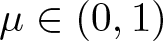 $\mu \in (0,1)$
•
$u_{0}\geq 1+\mu $, then
\begin{equation*} u(x,t)\geq e^{e^{2t}\log (1+\mu)}, \;\;\;\text{a.e. }\; (x,t)\in \mathbb{R}^{N}\times (0,+\infty),\end{equation*}• If
$u_{0}\leq 1-\mu$, then
\begin{equation*} u(x,t)\leq e^{e^{2t}\log (1-\mu)} \;\;\;\text{a.e. }\; (x,t)\in \mathbb{R}^{N}\times (0,+\infty).\end{equation*}


To establish theorems 3.4 and 3.5, we consider initial data of the forms  $v^1_{0}(x)=(1+\delta)\varphi(x)$ and
 $v^2_{0}(x)=(1-\delta)\varphi(x)$, where δ > 0 is chosen to be sufficiently small. Direct calculations show that
 $I(v^1_{0}) \lt 0$ and
 $E(v^1_{0}) \lt d$. This confirms that
 $v^1_{0}$ meets the second condition of theorem 3.3. On the other hand,
 $I(v^2_{0}) \gt 0$ and
 $E(v^2_{0}) \lt d$, which satisfies condition (3.9) in theorem 3.2 for subcritical initial energy.
4. Construction of a solution in
$W(\mathbb{R}^{N})$

4.1. Existence of a local weak solution to (3.8)
Although the theory of local existence for (3.8) is well established in the literature, we include a sketch of the proof for the reader’s convenience. Hereafter, we set
 \begin{equation*} g(u)=2u\log|u|, \quad g_{\epsilon}(u_{\epsilon})=2u_{\epsilon} \log (|u_{\epsilon}|+\epsilon)\;\;\text{for}\; \epsilon \gt 0.\end{equation*}
The function  $s\mapsto g_{\epsilon}(s)$ is clearly smooth on
 $\mathbb{R}$ for any ϵ > 0. The energy functional associate with (3.8) defined on
 $H^{1}(\mathbb{R}^{N})$ is given by
 \begin{align}
E_{\epsilon}(\varphi)=\frac{1}{2}\|\nabla \varphi \|^{2}_{2}-\frac{1}{2}\int_{\mathbb R^N} |\varphi|^{2}\log\big(|\varphi|+\epsilon)^2\big)\,dx& +\frac{1}{2}\int_{0}^{|\varphi|}\frac{2 s^2}{s+\epsilon}\,ds,\nonumber\\ & \;\;\;\text{for}\; \varphi \in H^{1}(\mathbb{R}^{N}).
\end{align}
For α = 1, we say that  $u_{\epsilon}\in C^{1}([0,T];H^{1}(\mathbb{R}^{N}))$ is a weak solution of (3.8) if
 \begin{equation}
\int_{\mathbb{R}^{N}} u_{\epsilon t}(t)v\,dx +\int_{\mathbb{R}^{N}} \nabla u_{\epsilon}(t)\cdot \nabla v \,dx +\int_{\mathbb{R}^{N}}\nabla u_{\epsilon t}(t) \cdot\nabla v\,dx =\int_{\mathbb{R}^{N}} g_{\epsilon}(u_{\epsilon}(t))v\,dx,
\end{equation}
for each  $v\in H^{1}(\mathbb{R}^{N})$ a.e.
 $t\in [0,T]$ and
 $u(.,0)=u_{0}(.)$.
In what follows, we denote uϵ as u. Let K(x) be the fundamental solution of the operator of  $I-\Delta$ on the entire
 $\mathbb{R}^{N}$. K is the well-known Basel potential of order 2, with
 $K, \nabla K\in L^{1}(\mathbb{R}^{N})$,
 $K(x)\geq 0$, and
 $\int_{\mathbb R^N} K(x)\,dx=1$, see [Reference Henry21, Section 1.6]. Consider Eq. (3.8) for u at the point (y, t), multiply the equation by
 $K(x-y)$, and then integrate with respect y over
 $\mathbb{R}^{N}$ to find
 \begin{equation}
u_{t}-K\star\Delta u= K\star g_{\epsilon}(u),
\end{equation}
where  $\star$ denotes the convolution with respect to the spatial variable. We supplement this equation with the initial condition
 \begin{equation}
u(x,0)=u_{0}(x).
\end{equation}
According to [Reference Cazenave12, Proposition 1.5.2], solving (3.8) is equivalent to finding a  $u\in C^{1}([0, T];H^{1}(\mathbb{R}^{N}))$ that satisfies (4.4) and the identity (4.2). It has been proven in [Reference Karch23, Proposition 2.1] that the operator
 $Av=-K\star\Delta u$ has a unique extension to a bounded operator from
 $L^{2}(\mathbb{R}^{N})$ to
 $L^{2}(\mathbb{R}^{N})$. Consequently, from [Reference Henry21], the operator A is sectorial in
 $L^{2}(\mathbb{R}^{N})$. Therefore, by [Reference Henry21, Theorem 1.3.4], the operator −A generates an analytic semigroup, denoted by e −tA.
Definition 4.1. A continuous function  $u\in C([0,T];H^{1}(\mathbb{R}^{N})$ is said to be a mild solution of the initial value problem (4.3) and (4.4) if it satisfies the integral equation
 \begin{equation}
u(t)=e^{-tA}u_{0}+\int_{0}^{t}e^{-(t-s)A}K\star g_{\epsilon}(u(s))\,ds.
\end{equation}
To establish the existence of a local weak solution for (4.3)–(4.4), we need the following remark and the subsequent lemma.
Remark 7. As proved in [Reference Furioli, Kawakami, Ruf and Terraneo16, Proposition 2.1], u is a mild solution of (4.3) and (4.4) if and only if u satisfies (4.3) in the sense of distribution.
Lemma 4.1. For any ϵ > 0, the Nemytski operator  $u\mapsto K\star g_{\epsilon}(u)$ is locally Lipschitz continuous from
 $H^{1}(\mathbb{R}^{N})$ to
 $L^{2}(\mathbb{R}^{N})$.
Proof. Firstly, we show that  $u\mapsto g_{\epsilon}(u)$ is a locally Lipschitz operator from
 $H^1(\mathbb{R}^{N})$ to
 $L^{2}(\mathbb{R}^{N})$. Indeed, for any R > 0 and
 $u,v\in H^{1}(\mathbb{R}^{N})$ such that
 $\max\left\{\|u\|_{H^{1}(\mathbb{R}^{N})},\|v\|_{H^{1}(\mathbb{R}^{N})}\right\}\leq R$. Without loss of generality, we assume
 $|v|\leq |u|$ and v ≠ 0. Then, using the second inequality in lemma 2.4, we have
 \begin{align*}
&|g_{\epsilon}(u)-g_{\epsilon}(v)|\\ &=2| u\log(|u|+\epsilon)- v\log(|v|+\epsilon)|=2|u-v||\log(\epsilon+|u|)|+|\log(|u|+\epsilon)\\ &\quad-\log(|v|+\epsilon)||v|\\
&\lesssim |u-v|(\epsilon^{-\delta}+(|u|+\epsilon)^{\nu})+2\frac{|v|}{|v|+\epsilon}|u-v|\\
&\lesssim|u-v|(\epsilon^{-\delta}+2^{\nu}|u|^{\nu}+2^{\nu}\epsilon^{\nu})+|u-v|\\
&\lesssim_{\epsilon} |u-v|+|u-v||u|^{\nu}, \;\;\;\forall \nu \gt 0.
\end{align*}
Squaring the latter inequality and integrating over  $\mathbb{R}^{N}$ yields
 \begin{equation*} \|g_{\epsilon}(u)-g_{\epsilon}(v)\|^{2}_{2}\lesssim_{\epsilon} \|u-v\|^{2}_{2}+\int_{\mathbb{R}^{N}}|u|^{2\nu}|u-v|^{2}\,dx.\end{equation*}
Selecting  $\nu=\frac{2}{N}$ and using Hölder’s and Sobolev’s inequalities, we find
 \begin{equation*} \|g_{\epsilon}(u)-g_{\epsilon}(v)\|^{2}_{2}\lesssim_{\epsilon} \|u-v\|^{2}_{2}+\|u\|_{2}^{\frac{4}{N}}\|u-v\|^{2}_{H^{1}(\mathbb{R}^{N})}\lesssim_{\epsilon} (1+R^{\frac{4}{N}})\|u-v\|^{2}_{H^{1}(\mathbb{R}^{N})},\end{equation*}
thus the conclusion. On the other hand, by applying Young’s inequality, we infer that
 \begin{align*} \|K\star g_{\epsilon}(u)-K\star g_{\epsilon}(v)\|^{2}_{2}&= \|K\star\left( g_{\epsilon}(u)- g_{\epsilon}(v)\right)\|^{2}_{2}\lesssim_{\epsilon} \|K\|^{2}_{1}\|g_{\epsilon}(u)-g_{\epsilon}(v)\|^{2}_{2}\\ &\lesssim_{\epsilon} (1+R^{\frac{4}{N}})\|K\|^{2}_{1}\|u-v\|^{2}_{H^{1}(\mathbb{R}^{N})}.\end{align*}
Thus, we have completed the proof.
Finally, following the approach in [Reference Alves and Boudjeriou2] and [Reference Henry21, Chapter 1], where  $D(A^{1/2})=H^{1}(\mathbb{R}^{N})$ and
 $D(A)=\{u\in H^{1}(\mathbb{R}^{N}):\; Au\in H^{2}(\mathbb{R}^{N}) \}$, there exists T > 0 and a unique
 $u\in C ([0,T];H^{1}(\mathbb{R}^{N}))$ that is a mild solution to the initial value problem (4.3) and (4.4). Moreover, according to [Reference Karch23, Theorem 3.1], for
 $u_{0}\in H^{1}(\mathbb{R}^{N})$, we have
 $u\in C^{1}([0,T]; H^{1}(\mathbb{R}^{N})).$
Remark 8. Let  $u_{0}\in H^{1}(\mathbb{R}^{N})$. The solution uϵ can be extended to a maximal mild solution in
 $[0, T_{\max})$ such that :
(1)
$T_{\max}=+\infty$, meaning that the Cauchy problem (3.8) admits a global mild solution, or(2)
$T_{\max} \lt +\infty$, and
\begin{equation*} \lim_{t\to T^{-}_{\max}}\|u(t)\|_{H^{1}(\mathbb{R}^{N})}=+\infty,\end{equation*}indicating that the solution blows up in finite time.


4.2. Uniform estimates
In this subsection, we derive some uniform a priori estimates for uϵ that enable us to take the limit in (4.2) as  $\epsilon \to 0^{+}$. Note that since
 $u_{0} \in W(\mathbb{R}^{N})$, the dominated convergence theorem gives us
 \begin{equation}
E_{\epsilon}(u_{0}) \rightarrow E(u_{0})\;\;\;\text{as}\; \epsilon \to 0^{+}.
\end{equation}
Lemma 4.2. There exists K > 1 independent of ϵ such that
 \begin{equation}
\|u_{\epsilon }(t)\|^2_{H^{1}(\mathbb{R}^{N})}\leq (K+\|u_{0}\|^2_{H^{1}(\mathbb{R}^{N})})^{e^{14t}}, \;\;\;\forall t\in [0,T_{max}).
\end{equation}
Moreover,  $T_{\max}=+\infty$ and there exists
 $C_{T} \gt 0$ independent of ϵ such that
 \begin{equation}
\|u_{\epsilon}\|_{L^{\infty}(0, T; H^{1}(\mathbb{R}^{N}))}^{2}+\int_{0}^{T}\|u_{\epsilon s}(s)\|^{2}_{H^{1}(\mathbb{R}^{N})}\,dt\leq C_{T}, \;\;\;\forall T \gt 0.
\end{equation}
Proof. Taking  $v=u_{\epsilon}$ in (4.2) and integrating over
 $(0,t)$, we obtain
 \begin{align}
\frac{1}{2}\|u_{\epsilon}(t)\|^{2}_{H^{1}(\mathbb{R}^{N})}+\int_{0}^{t}\|\nabla u_{\epsilon}(s)\|^{2}_{2}\,ds&=\frac{1}{2}\|u_{0}\|^{2}_{H^{1}(\mathbb{R}^{N})}+\int_{0}^{t}\int_{\mathbb R^N} 2|u_{\epsilon}(s)|^{2}\log\nonumber\\ &\quad\times(|u_{\epsilon}(s)|+\epsilon)\,dxds,
\end{align}
for all  $t\in [0,T_{\max})$. Note that for sufficiently small ϵ > 0, we have
 $\log (|s|+\epsilon)\leq \log(|s|+1)$ for all
 $s\in \mathbb{R}$. Using this, we can estimate the right-hand side of (4.9) as follows
 \begin{eqnarray*}
&&\int_{0}^{t}\int_{\mathbb R^N} |u_{\epsilon}(s)|^{2}\log(|u_{\epsilon}(s)|+\epsilon)\,dxds\\ &&\leq \int_{0}^{t}\int_{\mathbb R^N} |u_{\epsilon}(s)|^{2}\log(|u_{\epsilon}(s)|+1)\,dxds
\\ &&=\int_{0}^{t}\int_{\{|u_{\epsilon}(s)|\leq 1\}} |u_{\epsilon}(s)|^{2}\log(|u_{\epsilon}(s)|+1)\,dxds\\ &&\quad+\int_{0}^{t}\int_{\{|u_{\epsilon}(s)| \gt 1\}} |u_{\epsilon}(s)|^{2}\log(|u_{\epsilon}(s)|+1)\,dxds\\
&&\leq 2\log(2)\int_{0}^{t}\int_{\mathbb{R}^{N}} |u_{\epsilon}(s)|^{2}\,dxds+ \int_{0}^{t}\int_{\{|u_{\epsilon}(s)| \gt 1\}} |u_{\epsilon}(s)|^{2}\log(|u_{\epsilon}(s)|)\,dxds,
\end{eqnarray*}
where  $\{|u_{\epsilon}(s)|\leq 1\}=\{(x,s):\; |u_{\epsilon}(x,s)|\leq 1\}$ and
 $\{|u_{\epsilon}(s)| \gt 1\}=\{(x,s):\; |u_{\epsilon}(x,s)| \gt 1\}$. From lemma 2.5, we estimate the second term as
 \begin{align*}
\int_{0}^{t}\int_{\mathbb{R}^{N}} |u_{\epsilon}(s)|^{2}\log^{+}(|u_{\epsilon}(s)|)\,dxds&=\int_{0}^{t}\int_{\{|u_{\epsilon}(s)| \gt 1\}} |u_{\epsilon}(s)|^{2}\log(|u_{\epsilon}(s)|)\,dxds\\
&\leq \delta C\int_{0}^{t}\|\nabla u_{\epsilon}(s)\|_{2}^{2}\,ds+\frac{3}{2}\int_{0}^{t}\|u_{\epsilon}(s)\|^2_{2}\\ &\quad\times\log(C_{\delta}+\|u_{\epsilon}(s)\|^2_{2})\,ds,
\end{align*}
for all δ > 0 and  $t\in [0, T_{\max})$. Combining this with the previous inequality yields
 \begin{align}
&2\int_{0}^{t}\int_{\mathbb R^N} |u_{\epsilon}(s)|^{2}\log(|u_{\epsilon}(s)|+\epsilon)\,dxds\nonumber\\
&\leq 4\log(2)\int_{0}^{t}\int_{\mathbb{R}^{N}} |u_{\epsilon}(s)|^{2}\,dxds+2\delta C\int_{0}^{t}\|\nabla u_{\epsilon}(s)\|_{2}^{2}\,ds+3\int_{0}^{t}\|u_{\epsilon}(s)\|^2_{2}\nonumber\\ &\quad\times\log(C_{\delta}+\|u_{\epsilon}(s)\|^2_{2})\,ds
\end{align}
Choosing  $\delta =\frac{1}{4C}$ and gathering (4.10) with (4.9), we obtain
 \begin{align*}
&\frac{1}{2}\|u_{\epsilon}(t)\|^{2}_{H^{1}(\mathbb{R}^{N})}+\frac{1}{2}\int_{0}^{t}\|u_{\epsilon}(s)\|^{2}_{H^{1}(\mathbb{R}^{N})}\,ds\\ &\leq \frac{1}{2}\|u_{0}\|^{2}_{H^{1}(\mathbb{R}^{N})}+ \left(4\log(2)+1\right)\int_{0}^{t}\|u_{\epsilon}(s)\|^2_{2}\,ds+3\int_{0}^{t}\|u_{\epsilon}(s)\|^2_{2}\\ &\quad\times\log(C+\|u_{\epsilon}(s)\|^2_{2})\,ds.
\end{align*}
Letting  $K=\max\{2e, C\} \gt 1$, we deduce
 \begin{equation*}
\|u_{\epsilon}(t)\|^{2}_{H^{1}(\mathbb{R}^{N})}\leq \|u_{0}\|^{2}_{H^{1}(\mathbb{R}^{N})}+ 14 \int_{0}^{t}\|u_{\epsilon}(s)\|^2_{H^{1}(\mathbb{R}^{N})}\log(K+\|u_{\epsilon}(s)\|^2_{H^{1}(\mathbb{R}^{N})})\,ds.\end{equation*}
Applying the logarithmic Gronwall inequality found in lemma 2.2, we conclude
 \begin{equation*}\|u_{\epsilon}(t)\|^{2}_{H^{1}(\mathbb{R}^{N})}\leq (K+\|u_{0}\|^2_{H^{1}(\mathbb{R}^{N})})^{e^{14t}}, \;\;\forall t\in [0, T_{\max}). \end{equation*}
Since
 \begin{equation*} \lim_{t\to T^{-}_{\max}} (K+\|u_{0}\|^2_{H^{1}(\mathbb{R}^{N})})^{e^{14t}}=(K+\|u_{0}\|^2_{H^{1}(\mathbb{R}^{N})})^{e^{14T_{\max}}} \lt \infty,\end{equation*}
we conclude that  $T_{\max}=+\infty.$ Furthermore, by taking
 $v=u_{\epsilon t}$ in (4.2) and integrating over
 $(0,t)$, we obtain
 \begin{align}
\int_{0}^{t}\|u_{\epsilon s}(s)\|^2_{H^1(\mathbb{R}^{N})}\,ds+\frac{1}{2}\|\nabla u_{\epsilon}(t)\|^2_{2}=\frac{1}{2}\|\nabla u_{0}\|^2_{2}+\int_{0}^{t} \int_{\mathbb{R}^{N}} g(u_{\epsilon}(u(s))u_{\epsilon s}(s)\,dxds\nonumber\\
\end{align}
for any  $t\in [0,T]$ and T > 0. The term on the right-hand side of (4.11) can be estimated as follows
 \begin{align*}
\int_{0}^{t} \int_{\mathbb{R}^{N}} g(u_{\epsilon}(u(s))u_{\epsilon s}(s)\,dxds&=2\int_{0}^{t} \int_{\mathbb{R}^{N}} u_{\epsilon}(s)\log (|u_{\epsilon}(s)|+\epsilon)u_{\epsilon s}(s)\,dxds\\
&=\int_{0}^{t}\int_{\mathbb R^N} \partial_{s}\left(u^2_{\epsilon}(s)\log (|u_{\epsilon}(s)|+\epsilon)\right)\,dxds\\ &\quad -\int_{0}^{t}\int_{\mathbb R^N} \frac{u^2_{\epsilon }(s)\partial_{s}|u_{\epsilon s}(s)|}{|u_{\epsilon}(s)|+\epsilon}\,dxds\\
&=\int_{0}^{t}\partial_{s}\left(\int_{\mathbb R^N} \frac{1}{2}u^2_{\epsilon}(s)\log ((|u_{\epsilon}(s)|+\epsilon)^2)\,dx\right)ds\\ &\quad -\frac{1}{2}\int_{0}^{t}\partial_{s}\left(\int_{\mathbb R^N} \int_{0}^{|u_{\epsilon}(s)|}\frac{2\sigma^2}{\sigma+\epsilon}\,d\sigma dx\right)ds\\
&=\frac{1}{2}\int_{\mathbb R^N} u^2_{\epsilon}(t)\log ((|u_{\epsilon}(t)|+\epsilon)^2)\,dx\\ &\quad -\frac{1}{2}\int_{\mathbb R^N} u^2_{0}\log ((|u_{0}|+\epsilon)^2)\,dx\\ &\quad -\frac{1}{2}\int_{\mathbb R^N} \int_{0}^{|u_{\epsilon}(t)|}\frac{2\sigma^2}{\sigma+\epsilon}\,d\sigma dx\\ &\quad +\frac{1}{2}\int_{\mathbb R^N} \int_{0}^{|u_{0}|}\frac{2\sigma^2}{\sigma+\epsilon}\,d\sigma dx.
\end{align*}
Combining this with (4.11) and the definition of  $E_{\epsilon}(\cdot)$ in (4.1), we derive
 \begin{equation}
\int_{0}^{t}\|u_{\epsilon s}(s)\|^2_{H^{1}(\mathbb{R}^{N})}\,ds+E_{\epsilon}(u_{\epsilon}(t))=E_{\epsilon}(u_{0}), \;\;\forall t\in [0,T].
\end{equation}
Using lemma 2.5 and (4.12), we conclude that for sufficiently small ϵ > 0
 \begin{align*}
& \int_{0}^{t}\|u_{\epsilon s}(s)\|^2_{H^{1}(\mathbb{R}^{N})}\,ds+\|\nabla u_{\epsilon}(t)\|^{2}_{2} \\ &\leq 2E_{\epsilon}(u_{0})+\int_{\mathbb R^N} |u_{\epsilon}(t)|^{2}\log\big((|u_{\epsilon}(t)|+\epsilon)^2\big)\,dx\\
&\leq 2E_{\epsilon}(u_{0}) +2\log 2\|u_{\epsilon}(t)\|^2_{2}+\int_{\mathbb R^N}|u_{\epsilon}(t)|^2\log^{+}|u_{\epsilon}(t)|^2\,dx\\
&\leq 2E_{\epsilon}(u_{0}) +2\log 2\|u_{\epsilon}(t)\|^2_{2}+C\delta \|\nabla u_{\epsilon}(t)\|^{2}_{2}+3\|u_{\epsilon}(t)\|^2_{2} \log(C_{\delta}+\|u_{\epsilon}(t)\|^2_{2}),
\end{align*}
for all δ > 0. Hence, in view of (4.7) and (4.6), for sufficiently small δ > 0 and ϵ > 0, there exists a constant  $C_{T} \gt 0$, independent of ϵ, such that
 \begin{equation}
\int_{0}^{t}\|u_{\epsilon s}(s)\|^2_{H^{1}(\mathbb{R}^{N})}\,ds+\| u_{\epsilon}(t)\|^{2}_{H^{1}(\mathbb{R}^{N})}\leq C_{T}, \;\;\;\forall t\in [0,T].
\end{equation}
Therefore, we have completed the proof.
4.3. Convergence
Lemma 4.3. Let  $u_{n}=u_{\epsilon_{n}}$ be the solution to (3.8) with
 $\epsilon_{n}\in (0,1)$ and as
 $n\to \infty$,
 $\epsilon_{n}\to 0$. There exists a subsequence
 $\{u_{n}\}_{n}$ (still denoted by un) and for any T > 0,
 \begin{equation}
u\in L^{\infty}(0,T; W(\mathbb{R}^{N}))\cap C^{0,1}([0,T]; H^{1}(\mathbb{R}^{N})), \;\;u_{t}\in L^{2}(0, T; H^{1}(\mathbb{R}^N)),
\end{equation}
such un converges to u as  $n\to \infty$ in the following sense :
 \begin{equation}
\left\{\begin{array}{lcl}
u_{n} \stackrel{*}{\rightharpoonup} u & \text{in}& L^{\infty}(0,T; H^{1}(\mathbb{R}^{N})),\\
u_{nt}\rightharpoonup u_{t} &\text{in} & L^{2}(0,T;H^{1}(\mathbb{R}^{N})),\\
\end{array}\right.
\end{equation}
 \begin{equation}
u_{n}(t)\rightharpoonup u(t) \;\;\text{in}\; H^{1}(\mathbb{R}^{N})\;\;\;\;\forall t\in [0,T].
\end{equation}
Proof. In (4.8), we change uϵ to  $u_{\epsilon_{n}}$ such that
 $\epsilon_{n} \rightarrow 0$ as
 $n\to \infty$. Then (4.15) follows directly from (4.8). Next, we show (4.16). Indeed, in view of (4.8) for
 $t,s\in [0,t]$, we have
 \begin{align}
\|u_{n}(t)-u_{n}(s)\|^{2}_{H^{1}(\mathbb{R}^{N})}&=2\int_{s}^{t}\langle u_{n}(\sigma)-u_{n}(s),u_{n\sigma}(\sigma)\rangle\,d\sigma\\
&\lesssim |t-s|^{1/2}.\nonumber
\end{align}
Similarly, we deduce from the facts that  $u\in L^{\infty}(0, T; H^{1}(\mathbb{R}^{N}))$ and
 $u_{t}\in L^{2}(0, T; H^{1}(\mathbb{R}^{N}))$
 \begin{align}
\|u(t)-u(s)\|^{2}_{H^{1}(\mathbb{R}^{N})}\lesssim |t-s|^{1/2},
\end{align}
for all  $t,s\in [0,T].$ From (4.7) and (4.17) there exists
 $\chi \in H^{1}(\mathbb{R}^{N})$ such that
 \begin{equation}
u_{n}(t)\rightharpoonup \chi \;\;\text{in}\; H^{1}(\mathbb{R}^{N}).
\end{equation}
Claim 4.4.
 $\chi=u(t)$.
Let  $\eta\in (0,1)$ be small enough. Then
 \begin{align*}
\|u(t)-\chi\|^{2}_{H^{1}(\mathbb{R}^{N})}&=\langle u(t)-\chi,u_{n}(t)-\chi\rangle+\frac{1}{\eta}\int_{t}^{t+\eta}\langle u(t)-\chi, u(t)-u_{n}(t)\rangle \,d\tau\\
&=\langle u(t)-\chi,u_{n}(t)-\chi\rangle\\
&\quad +\frac{1}{\eta}\int_{t}^{t+\eta}\langle u(t)-\chi, u(t)-u(\tau)+u(\tau)-u_{n}(\tau)+u_{n}(\tau)\\ &\quad -u_{n}(t)\rangle \,d\tau.
\end{align*}
Since  $u_{n}, u\in C^{0,1}([0,T]; H^{1}(\mathbb{R}^{N}))$, we have for any
 $\tau\in [t,t+\eta]$ that
 \begin{equation*} |\langle u(t)-\chi, u(t)-u(\tau)\rangle|\lesssim \|u(t)-\chi \|_{H^{1}(\mathbb{R}^{N})}|\tau-t|, \end{equation*}
 \begin{equation*} |\langle u(t)-\chi, u_{n}(t)-u_{n}(\tau)\rangle|\lesssim \|u(t)-\chi \|_{H^{1}(\mathbb{R}^{N})}|\tau-t|. \end{equation*}
Given  $\gamma \in (0,1)$, we fix τ of a such way that
 $|\tau-t| \lt \gamma$. Have this in mind, one obtains
 \begin{align*}
\|u(t)-\chi\|^{2}_{H^{1}(\mathbb{R}^{N})}&\lesssim
\langle u(t)-\chi,u_{n}(t)-\chi\rangle+\frac{2}{\eta} \|u(t)-\chi \|_{H^{1}(\mathbb{R}^{N})}\int_{t}^{t+\eta}|\tau-t|\,d\tau\\
&\quad +\frac{1}{\eta}\int_{t}^{t+\eta}\langle u(t)-\chi, u(\tau)-u_{n}(\tau)\rangle \,d\tau\\
&
\lesssim \langle u(t)-\chi,u_{n}(t)-\chi\rangle+2 \gamma\|u(t)-\chi \|_{H^{1}(\mathbb{R}^{N})}\\
&\quad +\frac{1}{\eta} \int_{t}^{t+\eta}\langle u(t)-\chi, u(\tau)-u_{n}(\tau)\rangle \,d\tau.
\end{align*}
Observe that from (4.15), we have
 \begin{equation*} \lim_{n\to \infty}\langle u(t)-\chi,u_{n}(t)-\chi\rangle =\lim_{n\to \infty}\int_{t}^{t+\eta}\langle u(t)-\chi, u(\tau)-u_{n}(\tau)\rangle \,d\tau=0.\end{equation*}
Therefore, taking the limit as  $n \to \infty$ in the latter inequality, we find
 \begin{equation*} \|u(t)-\chi\|^{2}_{H^{1}(\mathbb{R}^{N})}\lesssim 2\gamma \|u(t)-\chi \|_{H^{1}(\mathbb{R}^{N})}.\end{equation*}
Since this holds for any sufficiently small  $\gamma \in (0,1)$, we obtain
 $\|u(t)-\chi\|^{2}_{H^{1}(\mathbb{R}^{N})}=0$, which completes the proof. On the other hand, by the logarithmic Sobolev inequality (2.9) and the fact that
 $u\in L^{\infty}(0,T; H^{1}(\mathbb{R}^N))$, we deduce that
 \begin{equation*} t\mapsto \int_{\mathbb R^N} |u(t) |^{2}\log|u(t)|\,dx\in L^{\infty}([0,T]),\end{equation*}
which implies  $u\in L^{\infty}(0, T; W)$.
4.4. Limit equation and corresponding initial data
In this subsection, we complete the proof of theorem 3.1. First, since  $u_{n}(0)\rightharpoonup u(0)$ and
 $u_{n}(0)=u_{0}$, it follows that
 $u(\cdot, 0)=u(\cdot).$ According to [Reference Cazenave12, Lemma 9.3.6], we have
 \begin{equation*} u_{n}(x,t)\rightarrow u(x,t) \;\;\text{a.e. in} \;(x,t)\in \mathbb{R}^{N}\times (0,T),\end{equation*}
which implies
 \begin{equation}
2u_{n}(x,t)\log(|u_{n}(x,t)|+\epsilon_{n})\rightarrow 2u(x,t)\log(|u(x,t)|) \;\;\text{a.e. in}\; \;\mathbb{R}^{N}\times (0,T).
\end{equation}
On the other hand, since  $\epsilon_{n} \in (0,1)$ and by lemma 2.4, for
 $\alpha, \delta \in (0,1)$ we have
 \begin{align*}
|u_{n}(x,t)\log (|u_{n}(x,t)| + \epsilon_{n})| &\lesssim |u_{n}(x,t)\left(|(|u_{n}(x,t)| + \epsilon_{n})^{\alpha} +(|u_{n}(x,t)| + \epsilon_{n})^{-\delta} \right)\\ &\lesssim |u_{n}(x,t)|(|u_{n}(x,t)| + 1)^{\alpha} +|u_n(x,t)|^{1-\delta}\\ &\lesssim |u_{n}(x,t)|^{1+\alpha} + |u_{n}(x,t)|+1.
\end{align*}
Squaring the previous inequality and integrating over  $B_{R} \times (0,T)$ for all R > 0, we obtain
 \begin{equation*}\|u_{n}\log (|u_{n}|+\epsilon_{n})\|^2_{L^{2}(B_{R}\times (0,T))}\lesssim \|u_{n}\|^{2(1+\alpha)}_{L^{2(1+\alpha)}(B_{R}\times (0,T))}+ \|u_{n}\|^{2}_{L^{2}(B_{R}\times (0,T))}+1.\end{equation*}
By choosing  $0 \lt \alpha \lt \frac{2}{N-2}$ and applying the interpolation inequality along with the Sobolev embedding inequality, we find
 \begin{align*}\|u_{n}\log (|u_{n}|+\epsilon_{n})\|^2_{L^{2}(B_{R}\times (0,T))}&\lesssim T\|u_{n}\|^{2(1+\alpha)\gamma}_{L^{\infty}(0,T;L^{2}(B_{R})) }\|u_{n}\|^{2(1+\alpha)(1-\gamma)}_{L^{\infty}(0,T;H^{1}(B_{R}))}\\ &\quad+ T\|u_{n}\|^{2}_{L^{\infty}(0,T;L^{2}(B_{R}))}+1,\end{align*}
for some  $\gamma\in (0,1)$. Next, combining this with (4.13), there exists
 $C=C(R) \gt 0$, independent of n, such that
 \begin{equation*}\left\|u_{n}\log (|u_{n}|+\epsilon_{n})\right\|_{L^{2}(B_{R}\times (0,T))}\leq C,\end{equation*}
for each R > 0. Since R > 0 is arbitrary, for some subsequence of  $(u_n)$, still denoted by itself, (4.20) combined with [Reference Zheng35, Lemma 3.1.5] gives
 \begin{equation}
2u_{n}\log (|u_{n}|+\epsilon_{n})\rightharpoonup u\log u^{2}\;\;\;\text{in}\;\;L^{2}(B_{R}\times (0,T)).
\end{equation}
By selecting  $v\in C^{\infty}_{0}(\mathbb{R}^{N})$ in (4.2) and applying (4.15) and (4.21), we obtain as
 $n\to \infty$
 \begin{align}
&\int_{0}^{T}\int_{\mathbb{R}^{N}} u_{t}v\,dxdt+\int_{0}^{T}\int_{\mathbb{R}^{N}} \nabla u.\nabla v\,dxdt+\int_{0}^{T}\int_{\mathbb{R}^{N}} \nabla u_{t}.\nabla v\,dxdt\nonumber\\ &\quad=\int_{0}^{T}\int_{\mathbb{R}^{N}} u \log u^{2}v \,dxdt.
\end{align}
Thus, the proof is completed by the density of  $ C^{\infty}_{0}(\mathbb{R}^{N})$ in
 $W(\mathbb{R}^{N})$.
Remark 9. We have
 \begin{equation}
\|u(t)\|^2_{H^{1}(\mathbb{R}^{N})}\leq e^{N(1+\log \sqrt{\pi})}\left(1+e^{-N(1+\log \sqrt{\pi})} \|u_{0}\|^{2}_{H^{1}(\mathbb{R}^{N})}\right)^{e^{2t}},
\end{equation}
for any  $t\in [0, +\infty)$ and
 $u_{0}\in W(\mathbb{R}^{N}).$
Indeed, by taking v = u in (4.22) and integrating over  $(0,t)$, we obtain
 \begin{equation*} \frac{1}{2}\|u(t)\|^{2}_{H^{1}(\mathbb{R}^{N})}+\int_{0}^{t}\!\|\nabla u(s)\|^{2}_{2}\,ds=\frac{1}{2}\|u_{0}\|^{2}_{H^{1}(\mathbb{R}^{N})}+\int_{0}^{t}\!\int_{\mathbb R^N} 2|u(s)|^{2}\log(|u(s)|)\,dxds,\end{equation*}
for all  $t\geq 0$. Next, using the logarithmic Sobolev inequality (2.9) gives
 \begin{align*}
&\frac{1}{2}\|u(t)\|^{2}_{H^{1}(\mathbb{R}^{N})}+\int_{0}^{t}\|\nabla u(s)\|^{2}_{2}\,ds \\ &\leq \frac{a^2}{\pi }\!\int_{0}^{t}\!\|\nabla u(s)\|^{2}_{2}\,ds+\frac{1}{2}\|u_{0}\|^{2}_{H^{1}(\mathbb{R}^{N})}\,{+}\, \int_{0}^{t}\!\left(\log \|u(s)\|^{2}_{2}-N(1+\log a)\right)\|u(s)\|^2_{2}\,ds,
\end{align*}
for all a > 0. Furthermore, selecting  $a=\sqrt{\pi}$, we deduce
 \begin{align*}
\|u(t)\|^{2}_{H^{1}(\mathbb{R}^{N})}&\leq \|u_{0}\|^{2}_{H^{1}(\mathbb{R}^{N})}+ 2\int_{0}^{t}\left(\log \|u(s)\|^{2}_{H^{1}(\mathbb{R}^{N})}-N(1+\log \sqrt{\pi})\right)\|u(s)\|^2_{2}\,ds\\
&= \|u_{0}\|^{2}_{H^{1}(\mathbb{R}^{N})}+ 2\int_{0}^{t}\log \left(\|u(s)\|^{2}_{H^{1}(\mathbb{R}^{N})}e^{-N(1+\log \sqrt{\pi})}\right)\|u(s)\|^2_{2}\,ds\\
&\leq \|u_{0}\|^{2}_{H^{1}(\mathbb{R}^{N})}+ 2\int_{0}^{t}\log \left(1+\|u(s)\|^{2}_{H^{1}(\mathbb{R}^{N})}e^{-N(1+\log \sqrt{\pi})}\right)\|u(s)\|^2_{2}\,ds\\
&\leq \|u_{0}\|^{2}_{H^{1}(\mathbb{R}^{N})}+ 2\int_{0}^{t}\log \left(1+\|u(s)\|^{2}_{H^{1}(\mathbb{R}^{N})}e^{-N(1+\log \sqrt{\pi})}\right)\\ &\quad\times\|u(s)\|^2_{H^{1}(\mathbb{R}^{N})}\,ds.
\end{align*}
Finally, invoking again the logarithmic Gronwall inequality found in lemma 2.2, we conclude (4.23).
5. Regularity and uniqueness
We prove the following points in theorem 3.1.
Lemma 5.1. Let u be a weak solution of (1.1). Assume that (3.4) holds. Then  $u\in C([0,T]; W(\mathbb{R}^{N})).$
Proof. Assuming α = 1, we observe from (4.14) and (2.2) that
 \begin{equation}
u\in C([0,T]; W(\mathbb{R}^{N}))\Longleftrightarrow t\longmapsto \int_{\mathbb R^N}|u(t)|^{2}\log |u(t)|^{2}\,dx\in C([0,T]; \,\mathbb{R}).
\end{equation}
In light of (3.4), we have
 \begin{equation*}t\mapsto E(u(t))\in C([0,T]; \,\mathbb{R}),\end{equation*}
which implies  $t\mapsto \int_{\mathbb R^N}|u(t)|^{2}\log |u(t)|^{2}\,dx\in C([0,T]; \,\mathbb{R}).$ This argument is also valid for the case α = 0 if one uses [Reference Boudjeriou and Alves5, Lemmas 3.4 and 5.1].
Proof. The case where α = 0, the energy identity (3.4) is proved in [Reference Boudjeriou and Alves5, Lemma 3.4]. Here, we focus on proving it for α = 1. Firstly, we observe that the identity (3.1) holds for test functions  $v\in H_{loc}^{1}(\mathbb{R}^{N})$, i.e.,
 \begin{align}
\int_{\mathbb{R}^{N}}u_{t}(t)v\,dx+\int_{\mathbb{R}^{N}}\nabla u(t)\cdot\nabla v\,dx+ \int_{\mathbb{R}^N} \nabla u_{t}(t)\cdot\nabla v\,dx=\int_{\mathbb{R}^N} u(t)\log u^2(t)v\,dx,\nonumber\\
\end{align}
for each  $v\in H^{1}_{loc}(\mathbb{R}^{N})$ and a.e.
 $t\in [0,T]$. Let
 $\phi\in C^{\infty}_{0}(\mathbb{R})$ be a positive function such that
 $\phi(x)=1$ if
 $|x|\leq 1$ and
 $\phi(x)=0$ if
 $|x|\geq 2$. For
 $x\in \mathbb{R}^{N}$ and
 $n\in \mathbb{N}$, define
 $\phi_{n}(x)=\phi\left(\frac{|x|}{n}\right)$. By definition,
 $\|\nabla \phi_{n}\|_{\infty} \leq \frac{C}{n}$ for some constant C > 0 independent of n. Taking
 $v=u_{t}(t)\phi_{n}\in H_{loc}^{1}(\mathbb{R}^{N})$ in (5.2) and integrating over
 $(0,t)$ for any
 $t\in [0,T]$, we find
 \begin{align*}
&\frac{1}{2}\int_{0}^{t}\int_{\mathbb R^N} (u^{2}_{s}(s)\phi_{n}+|\nabla u_{s}(s)|^{2}\phi_{n})\,dxds+\frac{1}{2}\int_{\mathbb R^N} \left(|\nabla u(t)|^{2}+|u(t)|^{2}\right)\phi_{n}\,dx\\ &-\frac{1}{2}\int_{\mathbb R^N} |u(t)|^{2}\log |u(t)|^{2}\phi_{n}\,dx\\
=&-\int_{0}^{t} \int_{\mathbb R^N} \nabla u_{s}(s).\nabla \phi_{n}u_{s}(s)\,dxds-\int_{0}^{t} \int_{\mathbb R^N} \nabla u(s).\nabla \phi_{n}u_{s}(s)\,dxds\\ &+\frac{1}{2}\int_{\mathbb R^N} \left(|\nabla u_{0}|^{2}+|u_{0}|^{2}\right)\phi_{n}\,dx -\frac{1}{2}\int_{\mathbb R^N} |u_{0}|^{2}\log |u_{0}|^{2}\phi_{n}\,dx.
\end{align*}
Using the regularity of u as stated in definition 3.1 and the properties of ϕn, the dominated convergence theorem allows us to obtain
 \begin{equation*} \int_{0}^{t}\|u_{s}(s)\|^{2}_{H^{1}(\mathbb{R}^{N})}\,ds+E(u(t))=E(u_{0}), \;\;\forall t\in [0,T],\end{equation*}
which completes the proof.
Lemma 5.3. Let  $u_{0}\in W(\mathbb{R}^{N})\cap L^{\infty}(\mathbb{R}^{N})$ and u be a weak solution of (1.1). Then
 \begin{align}
\|u\|_{L^{\infty}(\mathbb{R}^{N}\times (0,T))}\leq \max\left\{\left(\mu^{\frac{2N+4}{2q}} 2^{\frac{(2N+4)^{2}}{2}}\int_{0}^{T}\int_{\mathbb R^N} |u|^{q}\,dxds\right)^{\frac{2}{2N+4-Nq}}, 2\|u_{0}\|_{\infty}\right\},\nonumber\\
\end{align}
where  $\mu=2^{q+\frac{4q^{2}(N+2)}{2N+4}}S^{\frac{2qN}{2N+4}}$, S > 0 is a constant depends only on N, and
 $ 2 \lt q \lt 2+\frac{4}{N}.$
Proof. Let us assume first  $N\geq 3$, and for k a positive real number, we set
 \begin{equation}
k_{n}=k-\frac{k}{2^{n}},\; n\in \mathbb{N}, \quad \text{and}\quad k\geq 2\|u_{0}\|_{\infty}.
\end{equation}
Taking  $v=(u-k_{n})_{+}\in W(\mathbb{R}^{N})$ in the identity (3.1) to find
 \begin{align*} &\int_{\mathbb{R}^{N}} u_{t}(u-k_{n})_{+}\,dx +\int_{\mathbb R^N} \nabla u.\nabla (u-k_{n})_{+}\,dx+\alpha \int_{\mathbb R^N} \nabla u_{t}.\nabla (u-k_{n})_{+}\,dx\\ &\quad=\int_{\mathbb R^N} u (u-k_{n})_{+}\log|u|^{2}\,dx.\end{align*}
The left-hand side can be written as
 \begin{equation*} \frac{1}{2}\partial_{t}\int_{\mathbb{R}^{N}} (u-k_{n})^{2}_{+}\,dx +\int_{\mathbb R^N}|\nabla (u-k_{n})_{+}|^{2}\,dx+\alpha \frac{1}{2}\partial_{t}\int_{\mathbb R^N} |\nabla (u-k_{n})_{+}|^{2}\,dx \end{equation*}
Thus, for any T > 0, integrating this over  $(0,t)$ for
 $t\in (0,T)$, we obtain
 \begin{align}
& \int_{\mathbb{R}^{N}} (u-k_{n})^{2}_{+}\,dx +2\int_{0}^{t}\int_{\mathbb R^N}|\nabla (u-k_{n})_{+}|^{2}\,dxds+\alpha \int_{\mathbb R^N} |\nabla (u-k_{n})_{+}|^{2}\,dx \nonumber\\
&=2\int_{0}^{t}\int_{\mathbb R^N} u (u-k_{n})_{+}\log|u|^{2}\,dxds,
\end{align}
where we note that
 \begin{equation*} \int_{\mathbb{R}^{N}} (u_{0}-k_{n})^{2}_{+}\,dx= \int_{\mathbb{R}^{N}} |\nabla(u_{0}-k_{n})_{+}|^{2}\,dx=0\end{equation*}
due to  $2\|u_{0}\|_{\infty}\leq k.$ Next, we estimate the term that contains the logarithmic nonlinearity. Using the inequality
 $\log x\leq \frac{1}{e\beta}x^{\beta}$ for any β > 0 and x > 0, we get
 \begin{align*}
2\int_{0}^{t}\int_{\mathbb R^N} u (u-k_{n})_{+}\log|u|^{2}\,dxds&=2\int_{0}^{t}\int_{\{u \gt k_{n}\}} u (u-k_{n})_{+}\log|u|^{2}\,dxds\\ &\leq \frac{4}{e\beta}\int_{0}^{t}\int_{\{u \gt k_{n}\}} |u|^{\beta+1} (u-k_{n})_{+}\,dxds,
\end{align*}
where
 \begin{equation*}\{u \gt k_{n}\}=\{x\in \mathbb{R}^{N}:\; u(x,t) \gt k_{n}\}.\end{equation*}
Choosing  $\beta=q-2$ for
 $2 \lt q \lt 2+\frac{4}{N}$ in the latter inequality and applying Young’s inequality, we find
 \begin{align*}
2\int_{0}^{t}\int_{\mathbb R^N} u (u-k_{n})_{+}\log|u|^{2}\,dxds&=2\int_{0}^{t}\int_{\{u \gt k_{n}\}} u (u-k_{n})_{+}\log|u|^{2}\,dxds\\ &\leq \frac{4}{e(q-2)}\int_{0}^{t}\int_{\{u \gt k_{n}\}} |u|^{q-1} (u-k_{n})_{+}\,dxds\\
&\leq \frac{4}{e(q-2)} \iint_{A_{n}} |u|^{q} \,dxds+\frac{4}{e(q-2)}\\&\quad\times \int_{0}^{t}\int_{\mathbb{R}^{N}} (u-k_{n})^{q}_{+} \,dxds,
\end{align*}
where
 \begin{equation*} A_{n}=\{(x,t)\in \mathbb{R}^{N}\times (0, +\infty):\; u(x,t) \gt k_{n}\}.\end{equation*}
Using the fact that  $A_{n+1}\subseteq A_{n}$ for any
 $n\in \mathbb{N}$, we derive
 \begin{align*}
\int_{0}^{t}\int_{\mathbb{R}^{N}} (u-k_{n})_{+}^{q}\,dxds&\geq \iint_{A_{n+1}} (u-k_{n})_{+}^{q}\,dxds= \iint_{A_{n+1}}|u|^{q} \left(1-\frac{k_{n}}{k_{n+1}}\right)_{+}^{q}\,dxds\\
&\geq 2^{-q(n+1)}\iint_{A_{n+1}}|u|^{q} \,dxds,
\end{align*}
which implies
 \begin{equation}
\iint_{A_{n+1}}|u|^{q} \,dxds\leq 2^{q(n+1)}\int_{0}^{t}\int_{\mathbb{R}^{N}} (u-k_{n})_{+}^{q}\,dxds.
\end{equation}
On the other hand, by Hölder’s and Sobolev inequalities, one has
 \begin{align}
&\int_{0}^{t}\int_{\mathbb R^N} (u-k_{n})^{2+\frac{4}{N}}_{+}\,dxds\nonumber\\
&\quad \leq \int_{0}^{t}\left(\int_{\mathbb R^N} (u-k_{n})^{2^{*}}_{+}\,dx\right)^{2/2^{*}}\left(\int_{\mathbb R^N} (u-k_{n})^{2}_{+}\,dx\right)^{2/N}\,ds\nonumber\\
&\quad \leq \|(u-k_{n})_{+} \|^{\frac{4}{N}}_{L^{\infty}(0,T; L^{2}(\mathbb{R}^{N}))}\left(\int_{0}^{t}\int_{\mathbb R^N} (u-k_{n})^{2^{*}}_{+}\,dxds\right)^{2/2^{*}}\nonumber\\
&\quad \leq S^{2}\|\nabla (u-k_{n})_{+}\|^{2}_{L^{2}(0,T; L^{2}(\mathbb{R}^{N}))} \|(u-k_{n})_{+} \|^{\frac{4}{N}}_{L^{\infty}(0,T; L^{2}(\mathbb{R}^{N}))}\nonumber\\
&\quad \leq S^{2}\left(\|\nabla (u-k_{n})_{+}\|^{2}_{L^{2}(0,T; L^{2}(\mathbb{R}^{N}))}+ \|(u-k_{n})_{+} \|^{2}_{L^{\infty}(0,T; L^{2}(\mathbb{R}^{N}))}\right)^{\frac{N+2}{N}}.
\end{align}
Substituting kn by  $k_{n+1}$ and combining the latter inequality with (5.5) and (5.6), we get
 \begin{align*}
&\int_{0}^{t}\int_{\mathbb R^N} (u-k_{n+1})^{2+\frac{4}{N}}_{+}\,dxds \leq S^{2}\left(\|\nabla (u-k_{n+1})_{+}\|^{2}_{L^{2}(0,T; L^{2}(\mathbb{R}^{N}))}\right.\\ &\quad+ \left.\|(u-k_{n+1})_{+} \|^{2}_{L^{\infty}(0,T; L^{2}(\mathbb{R}^{N}))}\right)^{\frac{N+2}{N}}\\
&\leq S^{2}\left(\frac{4}{e(q-2)} \iint_{A_{n+1}} |u|^{q} \,dxds+ \frac{4}{e(q-2)} \int_{0}^{t}\int_{\mathbb{R}^{N}} (u-k_{n+1})^{q}_{+} \,dxds\right)^{\frac{N+2}{N}}\\
&\leq S^{2}\left(\frac{2^{q(n+1)+2}}{e(q-2)}\int_{0}^{t}\!\int_{\mathbb{R}^{N}}\! (u-k_{n})_{+}^{q}\,dxds+\frac{4}{e(q-2)} \int_{0}^{t}\!\int_{\mathbb R^N}\! (u-k_{n+1})^{q}_{+}\,dxds\right)^{\frac{N+2}{N}}.
\end{align*}
Since  $2 \lt q \lt 2+\frac{4}{N}$, by using Hölder’s inequality, we derive
 \begin{align}
\int_{0}^{t}\int_{\mathbb R^N} (u-k_{n+1})^{q}_{+}\,dxds\leq|A_{n+1}|^{\frac{2N+4-Nq}{2N+4}}\left( \int_{0}^{t}\int_{\mathbb R^N} (u-k_{n+1})^{2+\frac{4}{N}}_{+}\,dxds\right)^{\frac{qN}{2N+4}}\nonumber\\
\end{align}
Letting  $Y_{n}=\int_{0}^{t}\int_{\mathbb R^N} (u-k_{n})^{q}_{+}\,dxds$ and noting that
 $(u-k_{n+1})_{+}\leq (u-k_{n})_{+}$, we infer from the previous inequalities
 \begin{equation}
Y_{n+1}\leq S^{\frac{2qN}{2N+4}}|A_{n+1}|^{\frac{2N+4-Nq}{2N+4}}\left(\frac{2^{2q(n+1)+1}}{e(q-2)}Y_{n}\right)^{\frac{q(N+2)}{2N+4}}.
\end{equation}
Through a chain of inequalities, we derive
 \begin{equation*} Y_{n}=\int_{0}^{t}\int_{\mathbb R^N} (u-k_{n})^{q}_{+}\,dxds\geq \iint_{A_{n+1}} (u-k_{n})_{+}^{q}\,dxds\geq\left(\frac{k}{2^{n+1}}\right)^{q}|A_{n+1}|.\end{equation*}
From this and (5.9), it follows that
 \begin{align}
Y_{n+1}&\leq k^{-q\left(\frac{2N+4-Nq}{2N+4}\right)}S^{\frac{2qN}{2N+4}}2^{\frac{2q(N+2)(2q(n+1)+1)}{2N+4}}Y^{1+\frac{2q}{2N+4}}_{n}\nonumber\\&=2^{q+\frac{4q^{2}(N+2)}{2N+4}}k^{-q\left(\frac{2N+4-Nq}{2N+4}\right)}S^{\frac{2qN}{2N+4}}2^{2nq^{2}}Y^{1+\frac{2q}{2N+4}}_{n}.
\end{align}
By setting  $\vartheta=2^{q+\frac{4q^{2}(N+2)}{2N+4}}k^{-q\left(\frac{2N+4-Nq}{2N+4}\right)}S^{\frac{2qN}{2N+4}}$, (5.10) reduces to
 \begin{equation}
Y_{n+1}\leq \vartheta \left(2^{2q^{2}}\right)^{n}Y^{1+\frac{2q}{2N+4}}_{n}.
\end{equation}
Invoking lemma 2.6, we derive  $Y_{n}\to 0$ as
 $n\to \infty$ provided that
 \begin{equation}
Y_{0}\leq \vartheta^{-\frac{2N+4}{2q}}2^{\frac{-(2N+4)^{2}}{2}}\Longleftrightarrow \int_{0}^{t}\int_{\mathbb R^N} u^{q}_{+}\,dx\leq k^{\frac{2N+4-Nq}{2}}\mu^{-\frac{2N+4}{2q}} 2^{\frac{-(2N+4)^{2}}{2}},
\end{equation}
where  $\mu=2^{q+\frac{4q^{2}(N+2)}{2N+4}}S^{\frac{2qN}{2N+4}}$. It is clear for any
 $t\in (0,T)$ and whenever k satisfies
 \begin{equation*}
\left(\mu^{\frac{2N+4}{2q}} 2^{\frac{(2N+4)^{2}}{2}}\int_{0}^{t}\int_{\mathbb R^N} |u|^{q}\,dxds\right)^{\frac{2}{2N+4-Nq}}\leq k,
\end{equation*}
the condition (5.12) holds. Thus, by selecting
 \begin{equation*} k=\max\left\{\left(\mu^{\frac{2N+4}{2q}} 2^{\frac{(2N+4)^{2}}{2}}\int_{0}^{t}\int_{\mathbb R^N} |u|^{q}\,dxds\right)^{\frac{2}{2N+4-Nq}}, 2\|u_{0}\|_{\infty}\right\},\end{equation*}
we conclude that  $(u-k)_{+}=0$ a.e.
 $(x,t)\in \mathbb{R}^{N}\times (0, T).$ In other words,
 \begin{align}
\mathop{\text{ess\,sup}}\limits_{(x,t)\mathbb{R}^{N}\times (0,T)}u(x,t)\leq \max\left\{\!\left(\!\mu^{\frac{2N+4}{2q}} 2^{\frac{(2N+4)^{2}}{2}}\int_{0}^{T}\int_{\mathbb R^N} |u|^{q}\,dxdt\!\right)^{\frac{2}{2N+4-Nq}}, 2\|u_{0}\|_{\infty}\!\right\}.\nonumber\\
\end{align}
Arguing similarly as above, we obtain
 \begin{align*} &\mathop{\text{ess\,inf}}\limits_{(x,t)\mathbb{R}^{N}\times (0,T)}u(x,t)\\ &\quad\geq - \max\left\{\left(\mu^{\frac{2N+4}{2q}} 2^{\frac{(2N+4)^{2}}{2}}\int_{0}^{T}\int_{\mathbb R^N} |u|^{q}\,dxdt\right)^{\frac{2}{2N+4-Nq}}, 2\|u_{0}\|_{\infty}\right\}. \end{align*}
Consequently, this combined with (5.13) yields (5.3). For N = 2, we adopt a similar approach as for  $N\geq 3$, with the difference that in (5.7) we apply the Gagliardo–Nirenberg inequality (see [Reference Zheng35, Theorem 1.3.4]), which we state as follows
 \begin{equation}
\int_{\mathbb R^N}|v|^{4}\,dx \leq S\left(\int_{\mathbb R^N}|\nabla v|^{2}\,dx\right) \left(\int_{\mathbb R^N}|v|^{2}\,dx\right),\;\;\;\forall v\in C^{\infty}_{0}(\mathbb{R}^{N}).
\end{equation}
Lemma 5.4. Let  $u_{0} \in W(\mathbb{R}^{N}) \cap L^{\infty}(\mathbb{R}^{N})$. Then, the global weak solution of (1.1) is unique.
Proof. Assume there are two weak solutions of (1.1), denoted by u and v. Subtracting the identities (3.1) for v and u respectively, and setting  $w=v-u$, we obtain
 \begin{align*}&\int_{\mathbb{R}^{N}}w_{t}(t)\psi\,dx+\int_{\mathbb{R}^{N}}\nabla w(t)\cdot\nabla \psi\,dx+\alpha \int_{\mathbb{R}^N} \nabla w_{t}(t)\cdot\nabla \psi\,dx\\ &\quad=\int_{\mathbb{R}^N} \big(v(t)\log v^2(t)-u(t)\log u^2(t)\big)\psi\,dx,\end{align*}
for each  $\psi\in W(\mathbb{R}^{N})$ and a.e.
 $t\in [0,T]$. Taking
 $\psi=w$ in the latter identity yields
 \begin{equation}
\frac{1}{2}\partial_{t}\|w(t)\|^{2}_{H^{1}(\mathbb{R}^{N})}=\int_{\mathbb{R}^N} \big(v(t)\log v^2(t)-u(t)\log u^2(t)\big)w(t)\,dx,
\end{equation}
for a.e.  $t\in [0,T].$ The right-hand side of this equality can be estimated as follows
 \begin{align*}
&\int_{\mathbb{R}^N} \big(v(t)\log v^2(t)-u(t)\log u^2(t)\big)w(t)\,dx\\ &\quad=\int_{\mathbb{R}^N} \int_{0}^{1}\frac{d}{ds}\left(s\log |s|^{2}\right)|_{s=\theta v+(1-\theta)u}w^2(t)\,d\theta dx\\
&\quad=2\int_{\mathbb{R}^N} \int_{0}^{1}(\log |\theta v+(1-\theta)u|+1)w^2(t)\,d\theta dx\\
&\quad\leq 2\int_{\mathbb{R}^N} (\log \left(\|u\|_{L^{\infty}(\mathbb{R}^{N}\times (0,T))}+\|v\|_{L^{\infty}(\mathbb{R}^{N}\times (0,T))}\right)+1)w^2(t)\, dx.
\end{align*}
By remark 3, we know that
 \begin{equation*} \|u\|_{L^{\infty}(\mathbb{R}^{N}\times (0,T))}+\|v\|_{L^{\infty}(\mathbb{R}^{N}\times (0,T))} \lt \infty. \end{equation*}
Substituting this into (5.15), we obtain
 \begin{align*}
\frac{1}{2}\partial_{t}\|w(t)\|^{2}_{H^{1}(\mathbb{R}^{N})} \leq 2(\log \left(\|u\|_{L^{\infty}(\mathbb{R}^{N}\times (0,T))}+\|v\|_{L^{\infty}(\mathbb{R}^{N}\times (0,T))}\right)+1)\|w(t)\|^{2}_{H^{1}(\mathbb{R}^{N})}.
\end{align*}
Since  $w(0)=0$, by Grönwall’s lemma, we conclude that
 $\|w(t)\|_{H^{1}(\mathbb{R}^{N})}=0$. Therefore,
 $v(t)=u(t)$ for all
 $t\in [0,T]$ and T > 0.
6. Asymptotic behaviour
This section is devoted to proving theorem 3.2.
Proof. The proof of first part in theorem 3.2
For the case α = 0, where the initial energy is subcritical, this was already proved in [Reference Boudjeriou and Alves5, Theorem 2.7]. When α = 1, and the initial energy is subcritical, a similar argument as in [Reference Boudjeriou and Alves5, Theorem 2.7] can be applied to establish that
 \begin{align}
\int_{0}^{t}\|u_{s}(s)\|^2_{H^{1}(\mathbb{R}^N)}\,ds \lt d, \quad \|u(t)\|^2_{2}\leq 2E(u_{0}) \lt 2d, \quad \text{and}\quad & 0 \lt I(u(t)) \lt 2d, \nonumber\\ &\quad\;\;\forall t\geq 0.
\end{align}
This implies that  $u\in L^{2}(0, +\infty; H^{1}(\mathbb{R}^{N}))$. Next, by using (2.9), we have
 \begin{align*}
\|\nabla u(t)\|^2_{2}&=I(u(t))+\int_{\mathbb{R}^{N}} |u(t)|^2\log|u(t)|\,dx\\
&\leq I(u(t))+\frac{a^2}{\pi}\|\nabla u(t)\|^2_{2} +\|u(t)\|^2_{2}\log \big(e^{-N(1+\log a)}\|u(t)\|^2_{2}\big), \;\;\forall a \gt 0 \\
&\leq I(u(t))+\frac{a^2}{\pi}\|\nabla u(t)\|^2_{2} +\|u(t)\|^2_{2}\log \big(1+e^{-N(1+\log a)}\|u(t)\|^2_{2}\big), \;\;\forall a \gt 0.
\end{align*}
Choosing  $a=\sqrt{\frac{\pi}{2}}$, and combining this with (6.1), we obtain
 \begin{equation}
\|\nabla u(t)\|^2_{2}\leq 4d+4d\log \big(1+e^{-N(1+\log\sqrt{\frac{\pi}{2}} )}2d\big), \;\;\;\forall t\geq 0.
\end{equation}
From this, along with (2.9) and (2.2), we deduce
 \begin{equation*} \sup_{t\in (0, +\infty)}\int_{\mathbb R^N} |u(t)|^2\log|u(t)|^2\,dx \lt \infty \quad \text{and} \quad \sup_{t\in (0, +\infty)} \int_{\mathbb{R}^N} B(|u(t)|)\,dx \lt \infty.\end{equation*}
Since  $B(|u|)=|u|^2\log|u|^2+A(|u|)$, it follows that
 \begin{equation*}\sup_{t\in (0, +\infty)} \int_{\mathbb{R}^N} A(|u(t)|)\,dx \lt \infty.\end{equation*}
Consequently, combining these results with lemma 5.1 yields  $u\in C_{b}(0, +\infty; W(\mathbb{R}^N)).$
For the case where the initial energy is critical, the proof proceeds similarly once the following lemma is established.
Lemma 6.1. Let  $u_{0}\in W(\mathbb{R}^{N})$ with
 $E(u_{0})=d$, and u be a global weak solution of (1.1). If
 $I(u_{0}) \gt 0$, then
 $I(u(t)) \gt 0$ for all
 $t\geq 0.$
Proof. Assume by contradiction that there exists  $t_{*}\in (0, +\infty)$ such that
 \begin{equation}
I(u(t_{*}))=0 \quad \text{and}\quad I(u(t)) \gt 0, \;\;\forall t\in [0, t_{*}).
\end{equation}
Substituting v = u in (3.1), we obtain
 \begin{equation}
-\langle u_{t}(t), u(t)\rangle=I(u(t)) \gt 0, \;\;\;\forall t\in [0, t_{*}).
\end{equation}
This implies that
 \begin{equation*} \|u(t)\|_{H^{1}(\mathbb{R}^{N})} \gt 0 \quad \text{and} \quad \|u_{t}(t)\|_{H^{1}(\mathbb{R}^{N})} \gt 0, \;\;\;\forall t\in [0, t_{*}).\end{equation*}
Hence,  $\int_{0}^{t}\|u_{s}(s)\|^2_{H^{1}(\mathbb{R}^{N})}\,ds$ is strictly positive for any
 $t\in [0, t_{*}]$. From (3.4), we derive
 \begin{equation}
E(u(t))=E(u_{0})-\int_{0}^{t}\|u_{s}(s)\|^2_{H^{1}(\mathbb{R}^{N})}\,ds \lt E(u_{0})=d, \;\;\;\forall t\in [0, t_{*}].
\end{equation}
On the other hand, by proposition 2.3, there exists  $\lambda_{*}=\lambda_{*}(u) \gt 1$ such that
 \begin{equation*} \lambda_{*}(u)=\exp\left(\frac{\|u\|^2_{H^{1}(\mathbb{R}^{N})}-\|u\|^{2}_{2}-\int_{\mathbb R^N} |u|^2\log |u|^2\,dx}{2\|u\|^2_{2}}\right) \quad \text{and}\quad I(\lambda_{*}(u)u)=0.\end{equation*}
Using this and the definition of d, we obtain
 \begin{align*} 0 \lt d\leq E(\lambda_{*}(u(t))u(t))=E(\lambda_{*}(u(t))u(t))-\frac{1}{2}I(\lambda_{*}(u(t))u(t))&=\frac{\lambda^2_{*}(u(t))}{2}\|u(t)\|^2_{2},\\ &\quad \;\;\forall t\in [0, t_{*}).\end{align*}
From this, we infer that 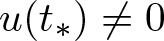 $u(t_{*})\neq 0$. This, combined with (6.3), implies that
 $d\leq E(u(t_{*}))$, which contradicts (6.5). This concludes the proof.
Proof of the third part of theorem 3.2
Taking v = u in (3.1) and integrating over (t, T), we obtain
 \begin{equation}
\frac{1}{2} \|u(T)\|^2_{H^{1}(\mathbb{R}^{N})}-\frac{1}{2} \|u(t)\|^2_{H^{1}(\mathbb{R}^{N})}=-\int_{t}^{T}I(u(s))\,ds.
\end{equation}
From above, we have  $I(u(t)) \gt 0$ for any
 $t\geq 0$, which implies that
 $t\mapsto \|u(t)\|^2_{H^{1}(\mathbb{R}^{N})}$ is a decreasing function on
 $\mathbb{R}_{+}$. Next, using the logarithmic Sobolev inequality (2.9), we find
 \begin{align*}
I(u)&\geq \left(1-\frac{a^2}{\pi}\right) \|\nabla u\|^{2}_{2}+\left(N(1+\log a)-\log \|u\|^2_{2}\right)\|u\|^2_{2}\\
&\geq \left(1-\frac{a^2}{\pi}\right) \|\nabla u\|^{2}_{2}+\left(N(1+\log a)-\log\left( 2E(u_{0})\right)\right)\|u\|^2_{2}\\
&\geq \beta\|u\|^2_{H^{1}(\mathbb{R}^{N})},
\end{align*}
where  $\beta =\min\left\{\left(1-\frac{a^2}{\pi}\right), \left(N(1+\log a)-\log\left( 2E(u_{0})\right)\right) \right\}$ and
 $\frac{(2E(u_{0}))^{1/N}}{e} \lt a \lt \sqrt{\pi}.$ Substituting this into (6.6) yields
 \begin{equation*} \int_{t}^{T}\|u(s)\|^2_{H^{1}(\mathbb{R}^{N})}\,ds\leq \frac{1}{2\beta}\|u(t)\|^2_{H^{1}(\mathbb{R}^{N})}, \;\;\forall t\geq 0.\end{equation*}
Letting  $T\to +\infty$, we get
 \begin{equation}
\int_{t}^{+\infty}\|u(s)\|^2_{H^{1}(\mathbb{R}^{N})}\,ds\leq \frac{1}{2\beta}\|u(t)\|^2_{H^{1}(\mathbb{R}^{N})}, \;\;\forall t\geq 0.
\end{equation}
Applying lemma 2.7, we derive
 \begin{equation*}
\|u(t)\|^{2}_{H^{1}(\mathbb{R}^{N})}\leq \|u_{0}\|^{2}_{H^{1}(\mathbb{R}^{N})}e^{1-2\beta t}, \;\;\;\forall t\geq 0.
\end{equation*}
Using this result alongside the logarithmic Sobolev inequality (2.9), we obtain
 \begin{equation*} \int_{\mathbb R^N} |u(t)|^{2}\log|u(t)|^{2}\,dx \leq \|u_{0}\|^{2}_{H^{1}(\mathbb{R}^{N})} \left(1+\log(1+\|u_0\|^2e^{1-2\beta t})\right)e^{1-2\beta t}. \end{equation*}
Moreover, setting 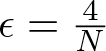 $\epsilon=\frac{4}{N} $ and applying Hölder’s and Sobolev’s inequalities in connection with (2.2), we find
 \begin{equation*} \int_{\mathbb{R}^{N}} B(|u(t)|)\,dx \precsim \|u_{0}\|^{2+\frac{4}{N}}_{H^{1}(\mathbb{R}^{N})}e^{\frac{N+2}{N}(1-2\beta t)}, \;\;\;\forall t\geq 0.\end{equation*}
By combining these results with the fact that  $B(|u|)=A(|u|)+F(|u|)$, for all
 $t\geq 0$, we conclude
 \begin{align*}
\int_{\mathbb{R}^{N}} A(|u(t)|)\,dx &\precsim \|u_{0}\|^{2+\frac{4}{N}}_{H^{1}(\mathbb{R}^{N})}e^{\frac{2N+4}{N}(1-2\beta t)}+ \|u_{0}\|^{2}_{H^{1}(\mathbb{R}^{N})} \\ &\quad\times\left(1+\log(1+\|u_0\|^2e^{1-2\beta t})\right)e^{1-2\beta t}.
\end{align*}
Proof of the fourth part of theorem 3.1
In light of lemma 6.1 and inequality (6.4), there exists  $t_{\delta}\in (0, +\infty)$ such that
 $\int_{0}^{t_{\delta}}\|u_{s}(s)\|^2_{H^{1}(\mathbb{R}^{N})}\,ds \gt 0$. Therefore, using (3.1), we obtain
 \begin{align*} E(u(t))&\leq E(u(t_{\delta}))=E(u_{0})-\int_{0}^{t_{\delta}}\|u_{s}(s)\|^2_{H^{1}(\mathbb{R}^{N})}\,ds\\ &= d-\int_{0}^{t_{\delta}}\|u_{s}(s)\|^2_{H^{1}(\mathbb{R}^{N})}\,ds \lt d, \;\;\;\forall t\geq t_{\delta}.\end{align*}
Letting  $\gamma=d-\int_{0}^{t_{\delta}}\|u_{s}(s)\|^2_{H^{1}(\mathbb{R}^{N})}\,ds$ and by applying a similar reasoning as in the subcritical initial energy case, we obtain
 \begin{equation*} \|u(t)\|^{2}_{H^{1}(\mathbb{R}^{N})}\leq \|u_{0}\|^{2}_{H^{1}(\mathbb{R}^{N})}e^{1-2\beta_{*} t}, \;\;\;\forall t\geq t_{\delta},\end{equation*}
where  $\beta_{*} =\min\left\{\left(1-\frac{a^2}{\pi}\right), \left(N(1+\log a)-\log\left( 2\gamma \right)\right) \right\}$ and
 $\frac{(2 \gamma)^{1/N}}{e} \lt a \lt \sqrt{\pi}.$ Arguing similary as done for (3.14), for all
 $ t\geq t_{\delta}$, we have
 \begin{align*}
\int_{\mathbb{R}^{N}} A(|u(t)|)\,dx &\precsim \|u_{0}\|^{2+\frac{4}{N}}_{H^{1}(\mathbb{R}^{N})}e^{\frac{2N+4}{N}(1-2\beta_* t)}+ \|u_{0}\|^{2}_{H^{1}(\mathbb{R}^{N})} \\ &\quad\times\left(1+\log(1+\|u_0\|^2e^{1-2\beta_* t})\right)e^{1-2\beta_* t}.
\end{align*}
Observe that from (6.7), one can establish in both the subcritical and critical initial energy cases that
Lemma 6.2. We have
 \begin{equation}
\int_{0}^{+\infty}\|u(s)\|^2_{H^{1}(\mathbb{R}^{N})}\,ds\leq \frac{1}{2\beta}\|u_{0}\|^{2}_{H^{1}(\mathbb{R}^{N})},
\end{equation}
and
 \begin{equation}
\int_{t_{\delta}}^{+\infty}\|u(s)\|^2_{H^{1}(\mathbb{R}^{N})}\,ds\leq \frac{1}{2\beta_{*}}\|u_{0}\|^{2}_{H^{1}(\mathbb{R}^{N})}.
\end{equation}
Proof of the third part of theorem 3.1
According to lemma 5.3, it suffices to show that
 \begin{equation*} \int_{0}^{+\infty}\int_{\mathbb R^N} |u(x,t)|^q\,dxdt \lt +\infty,\end{equation*}
where  $2 \lt q \lt 2+\frac{4}{N}$ for
 $N\geq 3$ and
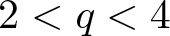 $2 \lt q \lt 4$ for N = 2. We will focus on the case
 $N\geq 3$, as the case N = 2 can be handled in a similar manner. Following the approach outlined in remark 3, we obtain
 \begin{equation}
\|u(t)\|^{q}_{q}\leq \|u(t)\|^{(1-\theta)q}_{2}\|u(t)\|^{\theta q}_{2+\frac{4}{N}}\precsim \|u(t)\|^q_{H^{1}(\mathbb{R}^N)}.
\end{equation}
Integrating this over  $(0, +\infty)$, and using (6.8) along with the fact that
 $u\in C_{b}(0, +\infty; W(\mathbb{R}^{N}))$, we obtain
 \begin{align*}
\int_{0}^{+\infty} \|u(t)\|^{q}_{q}\,dt&\precsim \int_{0}^{+\infty} \|u(t)\|^{q}_{H^1(\mathbb{R}^N)}\,dt=\int_{0}^{+\infty}\|u(t)\|^{2}_{H^1(\mathbb{R}^N)} \|u(t)\|^{q-2}_{H^1(\mathbb{R}^N)}\,dt\\ &\precsim \frac{\|u_{0}\|^2_{H^{1}(\mathbb{R}^{N})}}{2\beta}\sup_{t\in (0, +\infty)}\|u(t)\|^{q-2}_{H^1(\mathbb{R}^N)} \lt +\infty.
\end{align*}
From (6.10), we see that  $u\in C([0,t_{\delta}]; L^{q}(\mathbb{R}^{N}))$. Proceeding as before, we obtain
 \begin{align*}
\int_{0}^{+\infty} \|u(t)\|^{q}_{q}\,dt&= \int_{0}^{t_{\delta}} \|u(t)\|^{q}_{q}\,dt+\int_{t_{\delta}}^{+\infty} \|u(t)\|^{q}_{q}\,dt\\
&\precsim \sup_{t\in [0,t_{\delta}]}\|u(t)\|_{q}^{q}+\frac{\|u_{0}\|^2_{H^{1}(\mathbb{R}^{N})}}{2\beta_{*}}\sup_{t\in (0, +\infty)}\|u(t)\|^{q-2}_{H^1(\mathbb{R}^N)} \lt +\infty.
\end{align*}
Combining these results, we conclude the proof of (3.10).
7. Blow-up of solution at
$+\infty$

This section is dedicated to proving theorem 3.3.
Proof of the case
$E(u_{0}) \lt 0$

Substituting v = u into (3.1) and integrating over  $(0,t)$, we obtain
 \begin{align}
\|u(t)\|^2_{H^{1}(\mathbb{R}^{N})}-\|u_{0}\|^2_{H^{1}(\mathbb{R}^{N})}&=-2\int_{0}^{t}I(u(s))\,ds=-2\int_{0}^{t}I(u(s))\,ds\\
&=-2\int_{0}^{t}\left(I(u(s))+\|u(s)\|^2_{2}\right)\,ds+2\int_{0}^{t}\|u(s)\|^2_{2}\,ds.\nonumber
\end{align}
Since  $t\mapsto E(u(t))=\frac{1}{2}\|u(t)\|^2_{2}+\frac{1}{2}I(u(t))$ is nonincreasing, we have
 \begin{equation*} \|u(t)\|^2_{H^{1}(\mathbb{R}^{N})}\geq \|u_{0}\|^2_{H^{1}(\mathbb{R}^{N})} -2t\left(I(u_{0})+\|u_{0}\|^2_{2}\right),\end{equation*}
which implies
 \begin{equation*} \|u(t)\|^2_{H^{1}(\mathbb{R}^{N})}\geq \|u_{0}\|^2_{H^{1}(\mathbb{R}^{N})} -2t\left(I(u_{0})+\|u_{0}\|^2_{2}\right), \;\;\;\;\forall t\geq 0.\end{equation*}
The upper bound can be obtained using (4.16) and taking the limit as  $n\to \infty$ in (4.7) resulting in
 \begin{align*}\|u_{0}\|^2_{H^{1}(\mathbb{R}^{N})} -2t\left(I(u_{0})+\|u_{0}\|^2_{2}\right)&\leq\|u(t)\|^2_{H^{1}(\mathbb{R}^{N})}\leq e^{N(1+\log \sqrt{\pi})}\\ &\quad\times\left(1+e^{-N(1+\log \sqrt{\pi})} \|u_{0}\|^{2}_{H^{1}(\mathbb{R}^{N})}\right)^{e^{2t}}, \;\forall t\geq 0.\end{align*}
From this, we infer that  $\lim\limits_{t\to +\infty}\|u(t)\|_{H^{1}(\mathbb{R}^{N})}=+\infty$, and this concludes the proof.
Proof of the case
$E(u_{0}) \lt d$ and
$I(u_{0}) \lt 0$


The proof is based on the following lemmas that we establish.
Lemma 7.1. We have
 \begin{equation*}d=\inf\left\{\frac{1}{2}\|u\|^2_{2}:\; u\in W(\mathbb{R}^N)\backslash \{0\}, \; I(u)\leq 0\right\}=d_{*}\end{equation*}
Proof. It is clear that  $d_{*}\leq d$. To show
 $d\leq d_{*}$, it is sufficient to prove that
 \begin{equation*} d\leq \frac{1}{2}\|u\|^2_{2}, \;\;\;\forall u\in W(\mathbb{R}^N)\backslash \{0\}, \; I(u) \lt 0.\end{equation*}
Indeed, let  $u\in W(\mathbb{R}^N)\backslash \{0\}$ and
 $I(u) \lt 0$. Then, by proposition 2.3, there exists
 $\lambda_{*}\in (0,1)$ such that
 $I(\lambda_{*}u)=0$. In view of the definition of d, we have
 \begin{equation*} d\leq E(\lambda_{*}u)=E(\lambda_{*}u)-\frac{1}{2}I(\lambda_{*}u)=\frac{\lambda^2_{*}}{2}\|u\|^2_{2} \lt \frac{1}{2}\|u\|^2_{2}.\end{equation*}
Hence, the proof is complete.
Lemma 7.2. Assume that  $E(u_{0}) \lt d$ and
 $I(u_{0}) \lt 0$. Then there exists β > 0 such that
 $I(u(t)) \lt -\beta$ for all
 $t\geq0.$
Proof. According to lemma 7.1, for any η > 0 we have
 \begin{align*}
d_{\eta}&=\inf\left\{E(u):\; u\in W(\mathbb{R}^N)\backslash \{0\}, \; I(u)=-\eta\right\}\\
&= \inf\left\{\frac{1}{2}\|u\|^2_{2}+\frac{-\eta}{2}:\; u\in W(\mathbb{R}^N)\backslash \{0\}, \; I(u)=-\eta\right\}\\
&= \frac{-\eta}{2}+\inf\left\{\frac{1}{2}\|u\|^2_{2}:\; u\in W(\mathbb{R}^N)\backslash \{0\}, \; I(u)=-\eta\right\}\\
&\geq \frac{-\eta}{2}+d.
\end{align*}
Since  $\min\left\{d-E(u_{0}), -I(u_{0})\right\} \gt 0$, there exists η > 0 such that
 $I(u_{0}) \lt -\eta$ and
 $d-E(u_{0}) \gt \eta$. This implies
 \begin{equation}
E(u(t))\leq E(u_{0}) \lt \frac{-\eta}{2}+d \lt d_{\eta}, \;\;\forall t \gt 0.
\end{equation}
To finish the proof, it’s enough to show that  $I(u(t))\neq 0$ for all t > 0. Indeed, arguing by contradiction, suppose there exists
 $t_{0}\in (0, +\infty)$ such that
 $I(u(t_{0}))=-\beta$. This would imply
 $d_{\beta}\leq E(u(t_{0})) $. However, this contradicts (7.2), and thus completes the proof.
From (7.1) and (3.17), and using lemma 7.2, we derive for some β > 0,
 \begin{align*} \|u_{0}\|^2_{H^1(\mathbb{R}^N)}+2\beta t&\leq \|u(t)\|^2_{H^1(\mathbb{R}^N)}\leq e^{N(1+\log \sqrt{\pi})}\\ &\quad\times\left(1+e^{-N(1+\log \sqrt{\pi})} \|u_{0}\|^{2}_{H^{1}(\mathbb{R}^{N})}\right)^{e^{2t}}, \;\forall t\geq 0.\end{align*}
Proof of the case
$E(u_{0})=d$ and
$I(u_{0}) \lt 0$


We first need to prepare the following lemma.
Lemma 7.3. Suppose that  $E(u_{0})=d$ and
 $I(u_{0}) \lt 0$. Then
(1)
$I(u(t)) \lt 0$ for all
$t\geq 0$.(2) There exists
$t_{0} \gt 0$ and τ > 0 such that
$I(u(t)) \lt -\tau$ for all
$t\geq t_{0}.$


Proof. To show the first part, we argue by contradiction. Assume there exists  $t_{*}$ such that
 $I(u(t_{*}))=0$ and
 $I(u(t)) \lt 0$ for all
 $t\in [0, t_{*})$. This implies
 \begin{equation*} \|u_{t}(t)\|_{H^{1}(\mathbb{R}^{N})}\|u(t)\|_{H^{1}(\mathbb{R}^{N})}\geq \langle u_{t}(t), u(t)\rangle \gt 0\;\;\;\;\forall t\in [0, t_{*}).\end{equation*}
From this, we obtain  $\int_{0}^{t}\|u_{s}(s)\|^2_{H^{1}(\mathbb{R}^{N})}\,ds \gt 0$ for all
 $t\in [0,t_{*}]$. Therefore, by (3.4), we derive
 \begin{equation}
E(u(t)) \lt d, \;\;\;\forall t\in [0, t_{*}].
\end{equation}
By proposition 2.3, there exists  $\lambda_{*}=\lambda_{*}(u) \lt 1$ such that
 \begin{equation*} \lambda_{*}(u)=\exp\left(\frac{\|u\|^2_{H^{1}(\mathbb{R}^{N})}-\|u\|^{2}_{2}-\int_{\mathbb R^N} |u|^2\log |u|^2\,dx}{2\|u\|^2_{2}}\right) \quad \text{and}\quad I(\lambda_{*}(u)u)=0.\end{equation*}
Using the definition of d, we find
 \begin{align*} 0 \lt d\leq E(\lambda_{*}(u(t))u(t))=E(\lambda_{*}(u(t))u(t))-\frac{1}{2}I(\lambda_{*}(u(t))u(t))&=\frac{1}{2}\|u(t)\|^2_{2},\\ & \;\;\forall t\in [0, t_{*}).\end{align*}
From this, it follows that  $u(t_{*})\neq 0$. By the definition of d, we have
 $d\leq E(u(t_{*}))$, which contradicts (7.3). Hence,
 $I(u(t)) \lt 0$ for all
 $t\geq 0$. Further, arguing as we did previously, there exists
 $t_{0} \gt 0$ such that
 $E(u(t_{0})) \lt d$ and
 $I(u(t_{0})) \lt 0$. Invoking lemma 7.2, we deduce the existence of τ > 0 such that
 $I(u(t)) \lt -\tau$ for all
 $t\geq t_{0}.$
In view of (7.1) and lemma 7.3, we have
 \begin{align*}
\|u(t)\|^2_{H^{1}(\mathbb{R}^{N})}-\|u_{0}\|^2_{H^{1}(\mathbb{R}^{N})}&=-2\int_{0}^{t}I(u(s))\,ds=-2\int_{0}^{t_{0}}I(u(s))\,ds\\ &\quad-2\int_{t_{0}}^{t}I(u(s))\,ds\\
&\geq \tau(t-t_{0}), \;\;\;\forall t\geq t_{0}.
\end{align*}
Consequently, this completes the proof of (3.19).
Proof of the case
$E(u_{0}) \lt \frac{\min\left\{\|u_{0}\|_{2}, \|u_{0}\|^2_{2}\right\}}{4\sqrt{e}}-\frac{1}{2}$

The proof will be complete upon establishing the following lemma.
Lemma 7.4. Assume that  $E(u_{0}) \lt \frac{\min\left\{\|u_{0}\|_{2}, \|u_{0}\|^2_{2}\right\}}{4\sqrt{e}}-\frac{1}{2}$. Then, there exists κ > 0 such that
 $I(u(t)) \lt -\kappa$ for all
 $t\geq 0.$
Proof. We begin by proving that  $I(u_{0}) \lt 0$. Suppose
 $\|u_{0}\|_{2}\leq 1$. Then
 $\frac{1}{2}\|u_{2}\|^2_{2}+\frac{1}{2}I(u_{0})=E(u_{0}) \lt \frac{\|u_{0}\|^2_{2}}{4\sqrt{e}}.$ Given
 $\frac{1}{4\sqrt{e}} \lt \frac{1}{2}$ it follows that
 $I(u_{0}) \lt 0$. Now, if
 $\|u_{0}\|_{2} \gt 1$, we have
 \begin{equation*}\frac{1}{2}\|u_{2}\|^2_{2}+\frac{1}{2}I(u_{0})=E(u_{0}) \lt \frac{\|u_{0}\|_{2}}{4\sqrt{e}} \lt \frac{\|u_{0}\|^2_{2}}{4\sqrt{e}}.\end{equation*}
This implies
 \begin{equation*}\left(\frac{1}{2}-\frac{1}{4\sqrt{e}}\right)\|u_{2}\|^2_{2}+\frac{1}{2}I(u_{0}) \lt 0.\end{equation*}
which leads to the conclusion that  $I(u_{0}) \lt 0$. Since
 \begin{equation*}\min\left\{-I(u_{0}), \frac{\min\left\{\|u_{0}\|_{2}, \|u_{0}\|^2_{2}\right\}}{4\sqrt{e}}-E(u_{0})-\frac{1}{2} \right\} \gt 0,\end{equation*}
there exists κ > 0 such that  $I(u_{0}) \lt -\kappa$ and
 \begin{equation}
\frac{1}{4}\|u_{0}\|^2_{2} \gt e\left(2E(u_{0})+1+\kappa\right)^2.
\end{equation}
Next, we show that  $I(u(t)) \lt -\kappa$ for all
 $t\geq 0$. We argue by contradiction. Assume there exists
 $t_{*} \gt 0$ such that
 $I(u(t_{*}))=-\kappa$ and
 $I(u(t)) \lt -\kappa$ for all
 $t\in [0, t_{*})$. From this, it follows that
 $t\mapsto \|u(t)\|^2_{H^{1}(\mathbb{R}^{N})}$ is increasing on
 $[0,t_{*}]$. Thus, (7.4) implies that
 \begin{equation}
\|u(t_{*})\|^2_{H^{1}(\mathbb{R}^{N})}\geq \|u_{0}\|^2_{H^{1}(\mathbb{R}^{N})}\geq 4e\left(2E(u_{0})+1+\kappa\right)^2.
\end{equation}
On the other hand, by the fact that  $t\mapsto E(u(t))$ is non-increasing, we obtain
 \begin{equation*} E(u_{0})\geq E(u(t_{*}))=\frac{\|u(t_{*})\|^2_{2}}{2}+\frac{I(u(t_{*}))}{2} =\frac{\|u(t_{*})\|^2_{2}}{2}-\frac{\kappa}{2}.\end{equation*}
This is equivalent to
 \begin{equation*} \|u(t_{*})\|^2_{2}\leq 2E(u_{0})+ \kappa.\end{equation*}
Hence,
 \begin{equation}
\|u(t_{*})\|^2_{2} \log \|u(t_{*}\|^2_{2})\leq \left(2E(u_{0})+1+ \kappa\right)\log \left(2E(u_{0})+1+ \kappa\right).
\end{equation}
Using the logarithmic Sobolev inequality (2.9) and again using the fact that  $t\mapsto E(u(t))$ is non-increasing, we find
 \begin{align*}
2E(u_{0})+ 1+\kappa&\geq 2E(u(t_{*}))+ 1+\kappa\\
&\geq \frac{\|u(t_{*})\|^2_{H^{1}(\mathbb{R}^{N})}}{2} -\frac{a^2\|u(t_{*})\|^2_{H^{1}(\mathbb{R}^{N})}}{\pi }-\|u(t_{*})\|^2_{2}\log\|u(t_{*})\|^2_{2}\\ &\quad +N(1+\log(a))\|u(t_{*})\|^2_{2}\\
&\geq \frac{1}{4}\|u(t_{*})\|^2_{H^1(\mathbb{R}^N)}-\left(2E(u_{0})+ 1+\kappa\right)\log\left(2E(u_{0})+ 1+\kappa\right),
\end{align*}
where we have chosen  $a=\frac{\sqrt{\pi}}{2} $, and used (7.6). Combining this with (7.5), we find
 \begin{equation*} 2E(u_{0})+1+ \kappa\geq e\left(2E(u_{0})+1+ \kappa\right)^2-\left(2E(u_{0})+1+ \kappa\right)\log\left(2E(u_{0})+1+ \kappa\right),\end{equation*}
This leads to
 \begin{equation*} \log \left(2E(u_{0})+1+ \kappa\right)+1\geq e\left(2E(u_{0})+1+ \kappa\right),\end{equation*}
which equivalent to
 \begin{equation*}\log \left(e\left(2E(u_{0})+1+ \kappa\right)\right)\geq e\left(2E(u_{0})+1+\kappa\right). \end{equation*}
However, this is a contradiction since 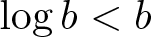 $\log b \lt b$ for all b > 0. This completes the proof.
From (7.1), and using lemma 7.4, for some κ > 0, we derive
 \begin{align*} \|u_{0}\|^2_{H^1(\mathbb{R}^N)}+2\kappa t&\leq \|u(t)\|^2_{H^1(\mathbb{R}^N)}\geq e^{N(1+\log \sqrt{\pi})}\\ &\quad\times\left(1+e^{-N(1+\log \sqrt{\pi})} \|u_{0}\|^{2}_{H^{1}(\mathbb{R}^{N})}\right)^{e^{2t}}, \;\;\forall t\geq 0.\end{align*}
8. Asymptotic behaviour via comparison principle
In this section, we prove theorems 3.4 and 3.5. Firstly, we establish the following lemma on the comparison principle.
Lemma 8.1. Let  $u, v\in L^{\infty}(\mathbb{R}^{N}\times (0,T))$ have the same regularity as defined in definition 3.1. Suppose that and for every non-negative function
 $ w\in W(\mathbb{R}^{N})$, the following inequality holds
 \begin{align}
&\int_{\mathbb R^N} u_{t}(t)w\,dx+\int_{\mathbb R^N} \nabla u(t)\cdot \nabla w\,dx+\alpha\int_{\mathbb R^N} \nabla u_{t}(t)\cdot \nabla w\,dx\nonumber\\ &\quad -\int_{\mathbb R^N} u(t)w\log |u(t)|^2\,dx\nonumber\\
& \leq\int_{\mathbb R^N} v_{t}(t)w\,dx+\int_{\mathbb R^N} \nabla v(t)\cdot \nabla w\,dx+\alpha\int_{\mathbb R^N} \nabla v_{t}(t)\cdot \nabla w\,dx\nonumber\\&\quad-\int_{\mathbb R^N} v(t)w\log |v(t)|^2\,dx,
\end{align}
for a.e. t > 0, and
 \begin{equation}
u(x,0)\leq v(x,0), \;\;\;x\in \mathbb{R}^{N}.
\end{equation}
Then, it follows that  $v(x,t)\geq u(x,t)$ a.e.
 $(x,t)\in \mathbb{R}^{N}\times (0,+\infty)$.
Proof. Subtracting the identities in (8.1) and taking  $w=(u-v)_{+}$, we obtain
 \begin{align}
&\frac{1}{2}\partial_{t}\left(\int_{\mathbb R^N} (u(t)-v(t))^2_{+}\,dx+\alpha \int_{\mathbb R^N} |\nabla (u(t)-v(t))_{+}|^2\,dx\right)\nonumber\\&\quad+\int_{\mathbb R^N} |\nabla (u(t)-v(t))_{+}|^2\,dx\nonumber\\
&\leq \int_{\mathbb R^N} \left(u(t)\log |u(t)|^2-v(t)\log |v(t)|^2\right)(u(t)-v(t))_{+}\,dx.
\end{align}
Note that the term on the right-hand side can be estimated as follows
 \begin{align*}
&\int_{\mathbb R^N} \left(u(t)\log |u(t)|^2-v(t)\log |v(t)|^2\right)(u(t)-v(t))_{+}\,dx\\
& =\int_{\mathbb R^N} 2(u(t)-v(t))\log |u(t)|+2v(t)\log\left(\left|1+\frac{u(t)-v(t)}{v(t)}\right|\right) (u(t)-v(t))_{+}\,dx\\
& \leq \int_{\mathbb R^N} 2(u(t)-v(t))\log |u(t)|+2|v(t)|\log\left(1+\left|\frac{u(t)-v(t)}{v(t)}\right|\right) (u(t)-v(t))_{+}\,dx\\
& \leq 2\int_{\mathbb R^N} (u(t)-v(t))_{+}\left(\log |u(t)|+1\right)\,dx\\
& \leq 2 \left(\log \|u\|_{L^{\infty}(\mathbb{R}^{N}\times (0,T))}+1\right)\int_{\mathbb R^N} (u(t)-v(t))^2_{+}\,dx.
\end{align*}
Combining this with (8.3) gives
 \begin{align*}
&\partial_{t}\left(\int_{\mathbb R^N} (u(t)-v(t))^2_{+}\,dx+\alpha \int_{\mathbb R^N} |\nabla (u(t)-v(t))_{+}|^2\,dx\right)\\ &\leq 4 \left(\log \|u\|_{L^{\infty}(\mathbb{R}^{N}\times (0,T))}+1\right)\int_{\mathbb R^N} ((u(t)-v(t))^2_{+}+|\nabla (u(t)-v(t))_{+}|^2)\,dx.
\end{align*}
By applying Gronwall’s lemma and noting that  $(u(0)-v(0))_{+}=0$, we infer the desired conclusion.
Proof of theorem 3.4
Set  $v(x,t)=\varphi(x)g(t)$, where
 $\varphi(x)=\exp\left(\frac{N}{2}-\frac{|x|^2}{2}\right)$ and
 $g\in C^{1}(\mathbb{R}_{+})$. It is straightforward to check that v satisfies (1.1) for α = 0 if and only if
 \begin{equation*}g'(t)= 2g(t)\log|g(t)|. \end{equation*}
Solving this (ODE) with the initial condition  $g(0)=1+\delta$, we obtain
 $g(t)=e^{e^{2t}\log (1+\delta)}$. Thus,
 \begin{equation*} v(x,t)=\exp\left(\frac{N}{2}+\frac{-|x|^2}{2}\right)e^{e^{2t}\log (1+\delta)}\end{equation*}
is a weak solution of (1.1) with the initial condition  $v(x,0)=(1+\delta)\varphi(x)$. Assume,
 \begin{equation*} v(x,0)\leq u(x,0), \;\;\;x\in \mathbb{R}^{N}.\end{equation*}
By applying lemma 8.1, we find
 \begin{equation*} u(x,t)\geq \exp\left(\frac{N}{2}+\frac{-|x|^2}{2}\right)e^{e^{2t}\log (1+\delta)}, \;\;\text{a.e. }\;\;(x,t)\in \mathbb{R}^{N}\times (0,+\infty)\end{equation*}
This implies, for all t > 0
 \begin{equation*}\|u(t)\|_{\infty}\geq e^{\frac{N}{2}} e^{e^{2t}\log (1+\delta)}, \end{equation*}
and
 \begin{equation*}\|u(t)\|_{2}\geq e^{\frac{N}{2}}\pi^{\frac{N}{2}} e^{e^{2t}\log (1+\delta)}. \end{equation*}
Next, we suppose that
 \begin{equation*} u(x,0)\leq (1-\delta)\varphi(x),\end{equation*}
for some δ > 0. Then, following a similar argument, we get
 \begin{equation*} u(x,t)\leq \exp\left(\frac{N}{2}+\frac{-|x|^2}{2}\right)e^{e^{2t}\log (1-\delta)}, \;\;\text{a.e. }\;\;(x,t)\in \mathbb{R}^{N}\times (0,+\infty).\end{equation*}
This implies, for all t > 0
 \begin{equation*}\|u(t)\|_{\infty}\leq e^{\frac{N}{2}} e^{e^{2t}\log (1-\delta)}, \end{equation*}
and
 \begin{equation*}\|u(t)\|_{2}\leq e^{\frac{N}{2}}\pi^{\frac{N}{2}} e^{e^{2t}\log (1-\delta)}. \end{equation*}
To conclude the proof of theorem 3.4, we choose  $u^{0}_{1}(x)=(1+\delta)\varphi(x)$, which satisfies for small
 $0 \lt \delta \lt 1$ that
 $ \|u^{0}_{1}-\varphi\|_{\infty}+\|u^{0}_{1}-\varphi\|_{2} \lt \epsilon$ for all ϵ > 0. Similarly, we choose
 $u^{0}_{2}=(1-\delta)\varphi(x)$. Thus, the proof is complete.
Proof of theorem 3.5
Let α = 1. We seek a subsolution of (1.1) in the form  $v(x,t)=\varphi(x)h(t)$, where
 $h\in C^1(\mathbb{R}_{+})$ and
 $h, h' \gt 0$. Substituting this into Eq. (1.1) yields that
 $v(x,t)$ is a subsolution if and only if
 \begin{equation}
\left(\varphi-\Delta\varphi \right)h'(t)\leq 2\varphi h(t) \log h(t).
\end{equation}
Since  $-\Delta \varphi(x)=(N-|x|^2)\varphi(x)$, it follows that
 \begin{equation*}
\left(\varphi+(N-|x|^2)\varphi\right)h'(t)\leq 2\varphi h(t) \log h(t),
\end{equation*}
which simplifies to
 \begin{equation*}
\left(1+N-|x|^2)\right)\varphi h'(t)\leq 2\varphi h(t) \log h(t).
\end{equation*}
To find h, it is enough to solve
 \begin{equation*} (N+1)h'(t)=2 h(t) \log h(t).\end{equation*}
with  $h(0)=1+\delta$. Solving this ODE, we obtain
 $h(t)=\exp\left(e^{\frac{2t}{N+1}\log(1+\delta)}\right)$. Suppose that
 \begin{equation*} v(x,0)=(1+\delta)\varphi(x)\leq u(x,0).\end{equation*}
Then, it follows from lemma 8.1 that
 \begin{equation*} u(x,t)\geq \exp\left(\frac{N}{2}+\frac{-|x|^2}{2}\right) \exp\left(e^{\frac{2t}{N+1}\log(1+\delta)}\right),\end{equation*}
which implies for all t > 0
 \begin{equation*} \|u(t)\|_{\infty}\geq e^{\frac{N}{2}} \exp\left(e^{\frac{2t}{N+1}\log(1+\delta)}\right),\end{equation*}
and
 \begin{equation*} \|u(t)\|_{2}\geq e^{\frac{N}{2}}\pi^{\frac{N}{2}} \exp\left(e^{\frac{2t}{N+1}\log(1+\delta)}\right).\end{equation*}
To finish the proof, we take  $u_{0}(x)=(1+\delta)\varphi(x)$ for
 $0 \lt \delta \lt 1$ sufficiently small. This choice satisfies
 $ \|u_{0}-\varphi\|_{\infty}+\|u_{0}-\varphi\|_{2} \lt \epsilon$ for all ϵ > 0.
On the other hand, if  $u_{0}\geq 1+\delta $, for some δ > 0, then
 $v(t)=e^{e^{2t}\log (1+\delta)}$ is a subsolution of (1.1). Therefore,
 \begin{equation*} u(x,t)\geq e^{e^{2t}\log (1+\delta)}.\end{equation*}
Conversely, if  $u_{0}\leq 1-\delta$, for some δ > 0 then
 $v(t)=e^{e^{2t}\log (1-\delta)}$ is a supersolution of (1.1). Thus,
 \begin{equation*} u(x,t)\leq e^{e^{2t}\log (1-\delta)}.\end{equation*}
Acknowledgements
C. O. Alves was partially supported by 307045/2021-8 and Projeto Universal FAPESQ-PB 3031/2021.
Author contribution
The authors contributed equally to the preparation of this paper.
Data availability
No new data or materials have been used in the preparation of this paper.
Conflict of interest
The authors declare no conflict of interest.
Ethical approval
Not applicable.



