Introduction
There is a growing demand for quality assessment in medicine. Indicators of outcome include: patient satisfaction, quality of life, mortality and complications. The uniform registration and classification of complications is essential in order to compare results between medical centres. Responsibility for the registration of complications lies with the medical centres and the medical personnel. The key to successful complication registration is to create an infrastructure that warrants an easy, fast and safe means of recording the information.
Strict registration of negative outcomes is necessary for the evaluation of new surgical procedures and new devices, and for determining the best policy regarding other management options, such as the necessity of post-operative antibiotic therapy.
Fortunately, severe complications in cochlear implant patients are rare. Therefore, a large number of patients are needed to detect statistically significant differences in complication rates between groups. This can be accomplished by pooling data from different clinics. However, all of the involved centres would need to be able to use the same system for the registration of negative outcomes.
A distinction must be made between complications, sequelae and failures. Complications are unexpected events not intrinsic to the procedure, whereas sequelae are inherent to the procedure; complications and sequelae both add new problems to the underlying disease. Failures are events in which the purpose of the procedure is not fulfilled.Reference Clavien, Sanabria and Strasberg1 In the case of cochlear implantation, the procedure itself may be a failure (i.e. a correctly functioning device is implanted without benefit for the patient) or the device may be malfunctioning. Device failures are further divided in ‘hard failures’ (i.e. a device with characteristics outside the manufacturer's specification, resulting in a loss of clinical benefit) and ‘soft failures’ (i.e. a device malfunction is suspected but cannot be proven using currently available in vivo methods). Furthermore, a device may have measured characteristics outside the manufacturer's specification, but still be of benefit to the patient.Reference Balkany, Hodges, Buchman, Luxford, Pillsbury and Roland2, 3
It is important that a similar definition of ‘complication’ is used. In the literature, several definitions are employed. Clavien et al.Reference Clavien, Sanabria and Strasberg1 and Dindo et al.Reference Dindo, Demartines and Clavien4 define a surgical complication as ‘any deviation from the normal postoperative course’ (including asymptomatic complications). Rombout et al. define complications in otological surgery as ‘incidents that are not intrinsic to the surgical procedure and that have a potential or actual negative effect on surgical outcome or postoperative morbidity’.Reference Rombout, Van Zanten, Fokkens and Pauw5 These are very broad definitions that leave room for discussion on what is and what is not a complication.
We adopted the stricter definition of ‘complication’ as provided by the Dutch Order of Medical Specialists: ‘an unintended and unwanted event or condition during or following medical specialist treatment that is so detrimental for the health of the patient that adjustment of the medical treatment is necessary or that causes irreversible damage’.Reference Marang-van de Mheen and Kievit6 This event has to take place within a six-week period from the start of treatment, as set by the Dutch ENT association. In order to include all possible cases of meningitis and device breakdown that may occur at a later time-point, we use the criterion that the event ‘is (probably) the result of, or has adverse consequences for the implantation’ for events that occur after this six-week period.
There are also several classification systems that have been used to report complications. For cochlear implantation, Cohen and Hoffman made the distinction between major and minor complications: major complications require additional surgery and/or hospitalisation for treatment, while minor complications are treated expectantly and/or with medication alone.Reference Cohen and Hoffman7 A more widely used system in general surgery is the Clavien classification (adapted by Rombout et al. for otological surgeryReference Rombout, Van Zanten, Fokkens and Pauw5), which was subsequently modified to become the Clavien–Dindo classification.Reference Clavien, Sanabria and Strasberg1, Reference Dindo, Demartines and Clavien4 This latter system comprises five grades based on patient morbidity, as follows: grade I = requiring no measures or simple measures (including anti-emetics, antipyretics, analgesics, diuretics, electrolytes and (bedside) seroma drainage); grade II = requiring pharmacological therapy (including blood transfusions and total parenteral nutrition); grade III = requiring surgical or radiological intervention; grade IV = requiring intensive care or intensive care unit management (life-threatening); and grade V = death. The suffix ‘d’ (for ‘disability’) is added when the patient suffers from a complication that affects them at the time of discharge.
In this paper, we present the complications and failures of more than 1000 cochlear implantations. These data were registered in a custom database, which enables fast and accurate data entry, and the grading of medical complications by different classification systems.
Materials and methods
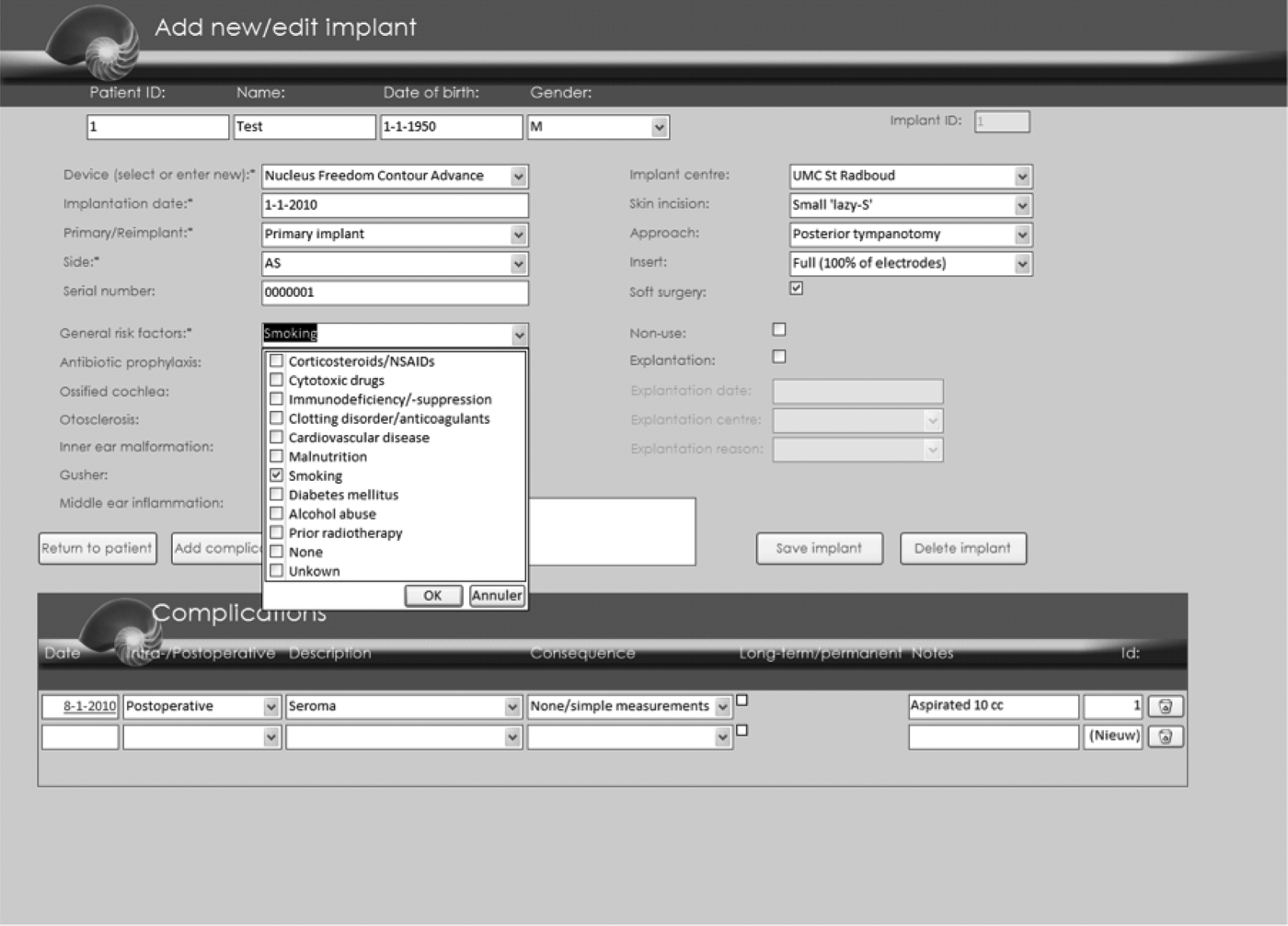
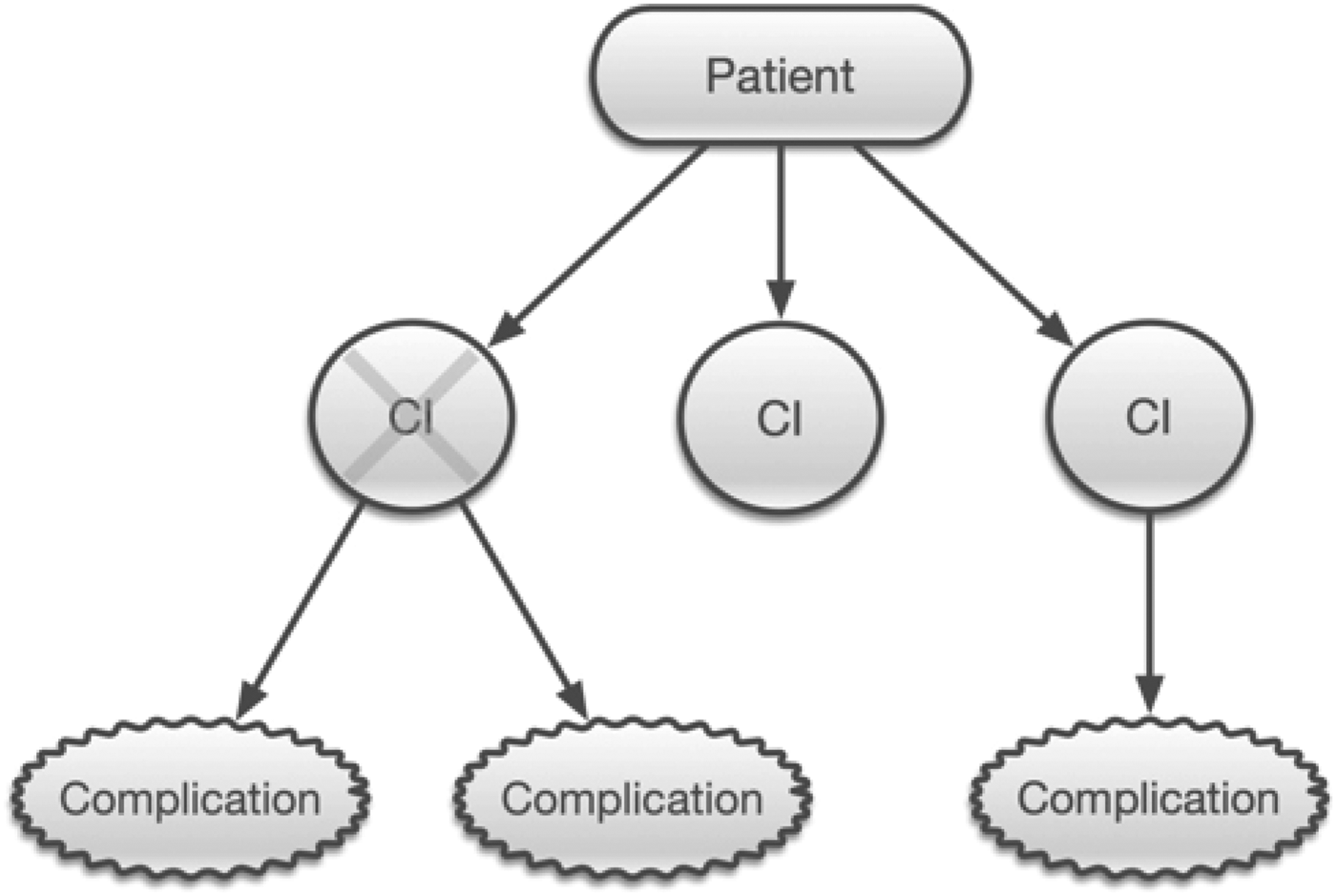
For data entry, we created a Microsoft Office Access 2007 database (Redmond, Washington, USA) (Figure 1). This is a relational database, which means that any number of implantations can be linked to a patient and any number of complications can be linked to an implantation (Figure 2).
Screenshot of data entry process in the database.20

Flow chart illustrating the relational nature of the database system. CI = cochlear implantation
In order to make the system user-friendly and to allow fast and uniform data entry, we created forms with input masks (e.g. for dates) and ‘lookups’ (a list of pre-set choices).
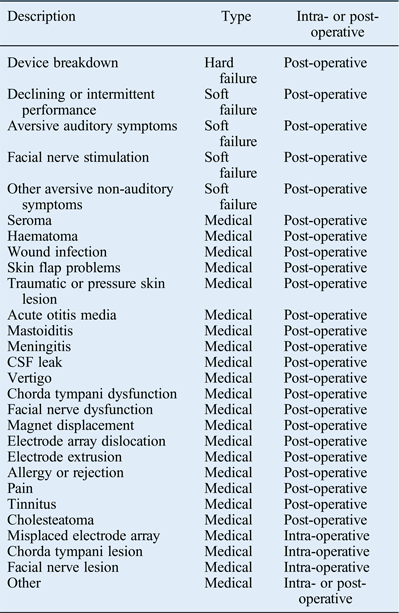
A list was composed of the most common complications in cochlear implantations reported in the literature, along with hard failure and symptoms of soft failureReference Balkany, Hodges, Buchman, Luxford, Pillsbury and Roland2 (Table I). To prevent incomplete or incorrect data entry, we included required fields and several validation rules (e.g. date of a complication could not be before the date of implantation).
List of complications included in the database
CSF = cerebrospinal fluid
To enable easy classification of the medical complications, we described the consequences of a complication in such a way that both the difference between ‘major’ and ‘minor’ complications could be made and the Clavien–Dindo grading system could be applied. In addition, general patient data could be registered, including the aetiology of deafness, pneumococcal vaccination history and information regarding several general risk factors for surgical complications (e.g. diabetes).
We built in an export function that creates an anonymised copy of the database which can be used for analysis by personnel other than the cochlear implant team. By using one-way encryption with a secure hash algorithm (‘SHA-1’), each patient is given a code based on name, birthdate and gender that makes identification of the patient impossible, but allows for the identification of double entries. This function, in combination with the uniform data entry, enables the pooling and comparison of data from multiple implant centres.
Data from all cochlear implantations conducted between 1987 and 2012 were entered into the database. The majority of the data were entered retrospectively (for those patients' charts dating from before the start of the project); data for subsequent implantations were entered prospectively by members of our cochlear implant team.
Results
Patient characteristics
The first cochlear implantation in Nijmegen, The Netherlands, took place in 1987. Between 1987 and 2012, 912 patients (470 women and 442 men) underwent a total of 1003 implantations. Mean age at implantation was 32.5 years (range, 0.6–87.6 years). Mean follow-up time was 8.6 years (range, 1.9–26.8 years).
The onset of deafness (in the best hearing ear) was congenital in 275 cases (30.2 per cent), pre-lingual (occurring before 3 years of age) in 165 cases (18.1 per cent) and post-lingual in 392 cases (43.0 per cent). In 53 cases (5.8 per cent), the onset of deafness was at an early age, but it could not be determined whether it occurred pre- or post-lingually, and in 27 cases (3.0 per cent) the individuals were not deaf at the time of implantation (Fletcher Index <90 dB HL). The latter group were patients with severe hearing loss who were implanted based on their speech perception scores (2 patients received an electro-acoustic system); the majority (22 patients) were also deaf in the other ear.
Medical complications
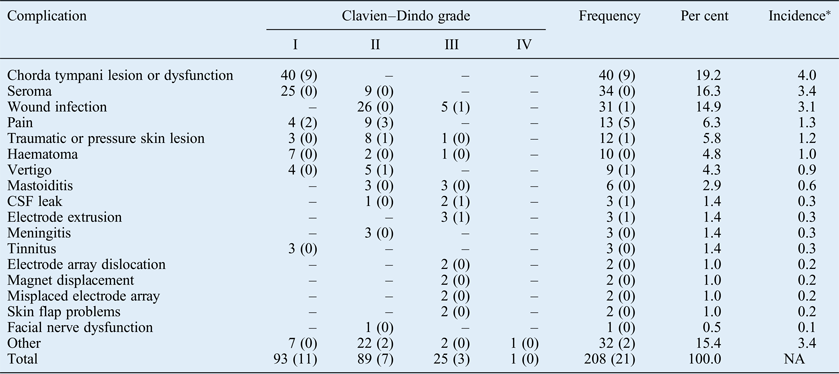
In 191 implantations (19.0 per cent), 1 or more complications were registered, with a total of 208 complications. In 175 cases (17.4 per cent) 1 complication occurred during or after implantation, in 15 cases (1.5 per cent) 2 complications occurred, and in 1 case (0.1 per cent) there were 3 complications. Thirty-five of these complications occurred intra-operatively and 173 occurred post-operatively. Forty-eight (23 per cent) were classified as ‘major’ and 160 (77 per cent) as ‘minor’ complications. The list of complications, graded using the Clavien–Dindo classification, is displayed in Table II.
Medical complications registered in 1003 implantation procedures*
Data represent n unless indicated otherwise; values in brackets represent numbers of cases with suffix ‘d’ (for disability).
* Percentage of total number of complications. CSF = cerebrospinal fluid; NA = not applicable
There were three cases of post-operative meningitis (0.3 per cent). The first such patient was admitted with pneumococcal meningitis, herpes simplex infection, pseudomonas septicaemia and deep vein thrombosis of the leg; there were no peculiarities during surgery. The second patient had pseudomonas meningitis; during surgery, inner-ear malformation (Mondini dysplasia) resulted in a perilymphatic ‘gusher’. The third patient had pneumococcal meningitis; during surgery, extensive cerebrospinal fluid (CSF) leakage was found at several locations in the middle ear, necessitating obliteration of the ear (her hearing loss had been the result of two previous episodes of meningitis). The latter two patients had received a pneumococcal vaccination before the occurrence of meningitis, the first had not.
There was one case of facial nerve dysfunction (House–Brackmann grade 3). This occurred two weeks after implantation, on the implanted side, and therefore might be unrelated (e.g. Bell's palsy). The patient was treated with famciclovir and oral steroids, and made a full recovery.
There were eight cases of cochlear implant explantation due to a medical complication: three cases of a severe wound infection, two cases of a misplaced electrode array (one case of misplacement in the hypotympanum and one case of electrode tip fold-over), one case of electrode extrusion, one case of electrode dislocation and one case of CSF leak with subsequent wound infection after closure of the leak had been attempted.
Device failures
There were 23 cases of hard failure (2.3 per cent); in 2 cases this occurred after a trauma. All affected devices were explanted. Of the patients in whom soft failure occurred, seven experienced severe facial nerve stimulation. Of these, one patient underwent re-implantation, one patient underwent cochlear implantation in the other ear and one patient became a non-user; in other cases, a substantial number of electrodes could not be used. Other cases of soft failure included two patients with pain when the cochlear implant was activated and three cases of declining performance (for which the cochlear implant was explanted in two cases and in the other case a cochlear implant was implanted in the other ear).
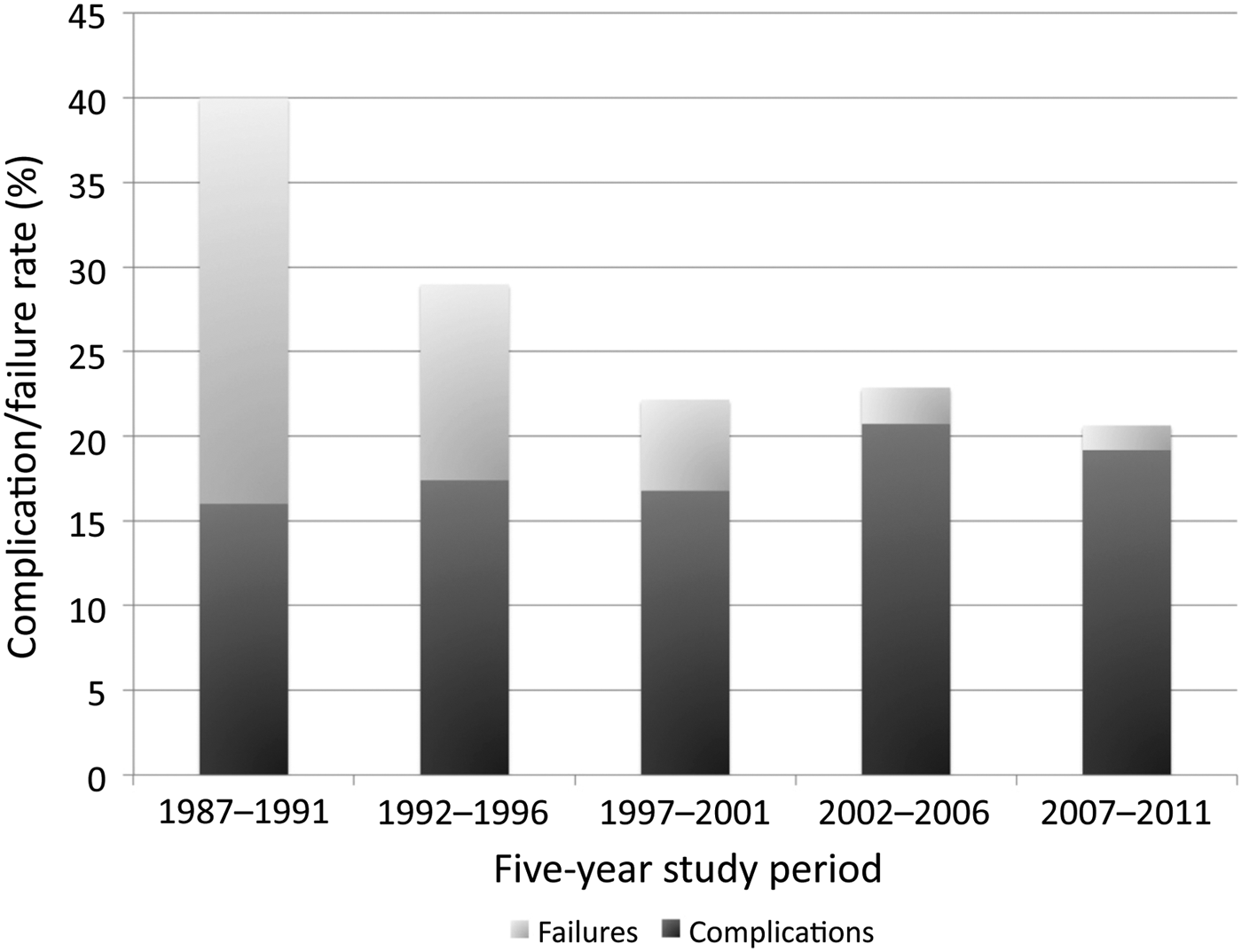
When complication and device failure rate were calculated per five years, we found a significant decrease in device failures over the years (chi-square (4 degrees of freedom) = 53.64, p < 0.001), while the incidence of medical complications remained fairly constant (no significant difference between five-year periods) (Figure 3).
Complication and failure rates per five years for cochlear implantations performed between 1987 and 2012 in Nijmegen, The Netherlands.
Discussion
Complication registration is important for both quality assessment and research purposes, and a uniform definition and classification is essential for the comparison of complication data. The custom database we created for this purpose enables fast and accurate data entry, and use of the most frequently employed classification systems for surgical complications.
In our series, medical complications occurred in 19.0 per cent of implantations. The incidence of complications reported in the literature ranges from 9.0 to 18.3 per cent.Reference Bhatia, Gibbin, Nikolopoulos and O'Donoghue8–Reference Ikeya, Kawano, Nishiyama, Kawaguchi, Hagiwara and Suzuki15
There are a number of possible explanations for the relatively high number of complications in our series, as described below. The first reason is that the bulk of our data were obtained via the extensive review of medical charts. More than three-quarters of the complications were considered ‘minor’ (such as seromas or haematomas), and it is plausible that a number of these would not have been registered as complications in clinical practice.
The second reason is the definition of ‘complication’ used, which states that every event which leads to adjustment of the medical treatment is considered a complication. Thus, if any non-routine medication were prescribed (for instance, antibiotics for minor redness of the wound), this would be registered as a complication (in this case a wound infection). In our experience, there is a low threshold for prescribing antibiotics in cochlear implantation patients for most physicians because of the fear of infection around the implant or even meningitis (in many other countries, post-operative antibiotics are given routinely). This may (partially) explain the high number of wound infection cases in our series, particularly given that the majority were resolved with pharmacological treatment alone (grade II). In many previous studies, no definition of a complication was given.
Third, the most frequent complication we encountered was a lesion or dysfunction of the chorda tympani nerve. It can be debated whether all these cases should be considered as complications, especially given that in at least a quarter of the cases the chorda was intentionally sacrificed to gain access to the cochlea; furthermore, there was a reported loss of taste for a prolonged period in only 22.5 per cent of these cases. In previous studies, loss or alteration of taste, a decrease in tongue sensation, or xerostomia (which was less common) were not present two years after surgery in 94–96 per cent of patients where the chorda tympani nerve was cut. Electrogustometry thresholds, on the other hand, often remain elevated;Reference Saito, Manabe, Shibamori, Yamagishi, Igawa and Tokuriki16, Reference Nin, Sakagami, Sone-Okunaka, Muto, Mishiro and Fukazawa17 these are therefore unintended and unwanted changes, reflecting permanent damage. Patients may also underreport persistent loss or alteration of taste, and physicians may not always inquire about taste loss after surgery.
It is also worth noting the fact that several authors of previous studies included device failures in the total number of complications, which leads to overestimation of the rate of actual medical complications.
• Although major complications are rare in cochlear implantation, there is a need for uniform registration and classification of complications
• We created a (freely available) database that enables fast and accurate data entry, and the use of common surgical complication classification systems
• In 19.0 per cent of implantations, one or more medical complications were registered (three-quarters were classified as ‘minor’); failure rate was 3.5 per cent
• There was a decrease in device failures over the years, while the incidence of medical complications remained fairly constant
The failure rate (hard and soft failure) in our series was 3.5 per cent. This is comparable to the failure rate of 3.79 per cent that was reported in a large multicentre study of 12 856 devices.Reference Battmer, O'Donoghue and Lenarz18 We found a decrease in device failures over the years, which is probably the result of technological development. However, there may be some overestimation because the older devices have been followed up for a longer time.
Conclusion
The benefits of using a database system were acknowledged previously by Ray and Gray; these authors were the first to describe the use of a computerised database system for registering cochlear implantation data.Reference Ray and Gray19 The advantage of using the present database system is that it not only enables fast and accurate data entry, but it also makes it easier to combine and compare results from different medical centres. This is particularly useful for comparing different surgical techniques, and studying complications with a low incidence and high morbidity (such as meningitis). This database (and corresponding manual) has therefore been made freely available.20 Nevertheless, every complication registration system depends on consequent data entry by the surgeon or other members of the cochlear implantation team.
In our series, we found a relatively high number of complications in cochlear implant surgery, which has remained stable over the years, while the number of device failures has declined. This stresses the use of a uniform definition of ‘complication’ as it relates to cochlear implant surgery, and an appropriate classification system for such complications, not only to compare results fairly but also for investigating the means to reduce these complications.
Acknowledgement
This work was financially supported by Cochlear Europe, Surrey, UK.